The West’s over-involvement in Ukraine

at the same summit those present joined to support sending long-range missiles to the Ukrainians, weapons fully capable of reaching cities, power grids, industrial plants and other targets deep inside Russia. So: No troops, plenty of offensive hardware.
Scholz confirmed what everyone already knows, that NATO officers and trained personnel are in Ukraine operating weapons such as the Patriot and NASAM air defense system, the HIMARS multiple launch rocket system, the British–French Storm Shadow cruise missile (SCALP–EG in France), and many other complex weapons provided to Ukraine.”
Consortium News, PATRICK LAWRENCE: The Russians in Ukraine, March 6, 2024
Recent disclosures provide an incomplete inventory of the West’s covert activities in Ukraine. There is more than we have been told, surely.
You may have read or heard about the freakout that ensued after Emmanuel Macron convened a summit of European leaders in Paris last week. At a press briefing afterward, the French president allowed that NATO may at some point send troops to Ukraine to join the fight against Russian military forces.
The Paris gathering precipitated a significant moment of truth, if we can call it such. Scholz, who is on a knife’s edge politically in part for his government’s support for Ukraine, immediately asserted that Germany would not send its Taurus long-range missiles to Ukraine because German troops would have to go with them, as the Ukrainians could not operate them on their own.
Look at the British, Scholz added indelicately. When they send their Storm Shadow missiles (and I must say I love the names the West’s arsenal minders come up with for these things) British personnel have to go with them.
Yikes! Such indiscretion.
As Stephen Bryen reported in his Weapons and Strategy newsletter, “The British cried foul and accused Scholz of ‘flagrant abuse of intelligence.’” Abuse of intelligence is a new one on me, but never mind. Bryen, who follows these matters closely as a former Defense Department official, continued:
“Scholz confirmed what everyone already knows, that NATO officers and trained personnel are in Ukraine operating weapons such as the Patriot and NASAM air defense system, the HIMARS multiple launch rocket system, the British–French Storm Shadow cruise missile (SCALP–EG in France), and many other complex weapons provided to Ukraine.”
There we have it — or there we have had it, if covertly, for a long time.
Before I go further, let me suggest a couple of thoughts readers can tuck somewhere in the corners of their minds for later consideration.
One, Russia’s intervention in Ukraine two years ago last month was unprovoked. Two, all the Kremlin’s talk about the threat of NATO hard by its southwestern border is nothing more than the distortion and paranoia of “Putin’s Russia,” as we must now refer to the Russian Federation.
It went this way in Paris last week. At the presser following the summit Macron was asked whether Ukraine’s Western backers were considering deploying troops in Ukraine. The French president replied that while European leaders had not reached any kind of agreement, the idea was certainly on the table when they gathered at Elysée Palace.
And then this:
“Nothing should be ruled out. We will do anything we can to prevent Russia from winning this war.”
Instantly came the vigorous objections. The Brits, the Spanish, the Italians, the Poles, the Slovakians, the Hungarians: They all said in so many words, “No way.” Even Jens Stoltenberg, NATO’s war-mongering sec-gen, objected to Macron’s assertion.
No one was more vehement on this point than Olaf Scholz. “What was agreed among ourselves and with each other from the very beginning also applies to the future,” saith the German chancellor, “namely that there will be no ground troops, no soldiers on Ukrainian soil sent there by European countries or NATO states.”
Plenty of Offensive Hardware
O.K., but at the same summit those present joined to support sending long-range missiles to the Ukrainians, weapons fully capable of reaching cities, power grids, industrial plants and other targets deep inside Russia. So: No troops, plenty of offensive hardware.
Last week The New York Times published a long takeout on the Central Intelligence Agency’s presence and programs in Ukraine, which extend back at least a decade and almost certainly much further……………………………………………………………………………………………………………………………..
“If NATO is so much against sending troops to Ukraine,” he asks, “why doesn’t NATO demand that the soldiers already there be sent home?”
Over-Invested in the Conflict
Excellent question. My answer: The Western powers, radically over-invested in Ukraine’s confrontation with Russia, are panicking as the Armed Forces of Ukraine retreat in the face of Russian advances and as support for this folly wanes on both sides of the Atlantic.
If anything, the covert presence of Western personnel in Ukraine may increase.
It is obvious that Ukraine is losing its war against Russia, and at a faster pace than most analysts seem to have anticipated even last autumn. I am reading reports now that the final collapse of the AFU may prove three or so months away. …………………………………………………………………….
The Ukraine crisis is merely the latest phase of the West’s long campaign to surround the Russian Federation up to its borders, destabilize it and finally subvert it. Regime change in Moscow was and remains the final objective.
This is not a war in defense of “Ukrainian democracy” — a phrase that causes one either to laugh or do the other thing. It is the West’s proxy war, start to finish, Ukrainians cynically cast as cannon fodder, expendable stooges.
Russia had no choice when it intervened two years ago, this after eight years’ patience as the Europeans — Germany and France, this is to say — broke every promise they made by way of supporting a settlement. The Americans didn’t break any promises because they never made any — and no one would take them seriously if they had.
I come to the judgment I offered when the war that began in 2014 erupted into open conflict two years ago. The Russian intervention was regrettable but necessary. I took some stick for this view back in 2022. I learn lately it is recorded in some European intelligence files as if it were a major transgression.
It is as true now as then. All we learn in drips and drops about the Western powers’ various covert doings in the sad, failed state they have done much to ruin, confirms this.
https://consortiumnews.com/2024/03/06/patrick-lawrence-the-russians-in-ukraine/?eType=EmailBlastContent&eId=c61faf77-5689-491d-afa5-bc607e7454cf
AUKUS: Are nuclear-powered submarines a good idea for Australia?

“[So] the question for us is, is it sensible for Australia to commit itself to go to war with the US against China — a war we have no reason to believe the US can win, in order to acquire submarines that we don’t need?”
ABC RN / By Nick Baker and Taryn Priadko for Global Roaming 5 Mar 24
There were always going to be questions about a nuclear-powered submarine deal with a (stated) price tag of up to $368 billion.
But, as the dust settles on the AUKUS security pact and Australians patiently wait for the subs that come with it, some defence experts are warning that the deal could fall apart.
“I think the chance of the plan unfolding effectively is extremely low,” Hugh White, an emeritus professor of strategic studies at the Australian National University, tells ABC RN’s Global Roaming.
Professor White was a defence adviser to the Hawke government and worked as a deputy secretary for strategy and intelligence in the Department of Defence. He’s also been a big critic of AUKUS.
So could AUKUS sink? And what would that mean for Australia’s defence plans?
What is AUKUS?
On September 15, 2021, a new trilateral security partnership between Australia, the UK and the US was announced, called AUKUS (A-UK-US).
Australia was scrapping its earlier $90 billion deal with France for 12 conventional-powered submarines and instead securing nuclear-powered submarines through AUKUS.
More details were announced on March 13 last year, including around the two so-called “pillars” of AUKUS.
Pillar One, which has received the most attention, is the submarines.
The plan is for Australia to buy at least three nuclear-powered Virginia class submarines from the US in the early 2030s.
We will then build at least five of a new, nuclear-powered submarine class dubbed the SSN-AUKUS, likely in Adelaide, in the 2030s, 2040s and beyond.
Pillar Two involves the sharing of technology, in areas like quantum computing, artificial intelligence and hypersonic missiles.
Former prime minister Scott Morrison called AUKUS “the best” decision of his government, while current Prime Minister Anthony Albanese has said it would “strengthen Australia’s national security and stability in our region”.
AUKUS worries
Professor White has two main worries around AUKUS.
“We do need submarines. I think submarines are a very important part of a defensive posture for Australia … [But] I don’t think we need nuclear-powered submarines,” he says.
“They’re so much more expensive. They’re so much more difficult to make. They’re so much more difficult to operate. We’ll end up with far fewer of them in our fleet.”
He says his second concern is far bigger: “I don’t think we’re going to get [the submarines].”
He claims the plan is overly reliant on future decisions and assistance from the US and UK governments, and also full of near-insurmountable technical tasks for Australia.
“I think what’s going to happen … is within the next few years, the whole thing will just come apart in our hands. And we’ll be back to square one trying to work out how to get some more conventional [submarines].”
Allan Behm, the director of the international and security affairs program at the Australia Institute, also doubts the likelihood of the AUKUS deal going ahead as planned.
One reason, he says, is that the technologies, skills and workforce that are required from a country like Australia to build and maintain nuclear-powered subs is pushing our limits, even with the involvement of the US and UK.
“We’re going into a technological domain with which we are totally unfamiliar,” says Mr Behm, who has a 30-year career in the Australian public service and was senior advisor to then-shadow minister for foreign affairs Penny Wong.
“We’re talking about a number of submarines with nuclear propulsion systems in them. And we’ve only got one nuclear reactor in Australia, which is nothing like the very, very highly enriched uranium reactors, the pressure water reactors that exist in nuclear-powered submarines,” he says.
“I think the best parallel would be, how would Australia imagine that it would undertake, conduct and retrieve a moon launch?”
US versus China
If AUKUS goes ahead as planned, is it the best way to keep Australia safe?
It’s been framed as a massive deterrent to China, which keeps building up its military.
Mr Morrison told the ABC last year, AUKUS helps to “change the calculus for any potential aggressors in our region”.
But Professor White says there are pitfalls with this strategy too.
He claims AUKUS could pull Australia into a future US-China conflict over Taiwan, which he contends the US may not win.
“China has focused so strongly and so effectively on building precisely the kinds of forces it needs to prevent the US projecting power by sea and air into the Western Pacific,” he says.
“[So] the question for us is, is it sensible for Australia to commit itself to go to war with the US against China — a war we have no reason to believe the US can win, in order to acquire submarines that we don’t need?”
While Australia has made clear it will have full control over the nuclear-powered submarines under the deal, Professor White says the US may still expect us to support them in a future war.
Cost concerns
The estimated cost of the submarine program will be up to $368 billion over the next 30 years. It’s a figure that has attracted no shortage of criticism.
“It puts so many of our defence eggs in one super expensive basket,” Mr Behm says.
“Short of expanding our defence budget by a considerable amount … we would find ourselves with very constrained capabilities in other fields in order to meet the expenditure targets of this project.”
And, based on other defence projects, he contends there will be cost blowouts.
“Whenever [the Department of] Defence says it’s going to cost you $1, always multiply it by three. And so your $368 billion is, in effect, a lifetime cost of $1 trillion,” he says.
“And you can do a hell of a lot with $1 trillion.”
A safer Australia?
The AUKUS critics have their critics too.
Peter Dean, the director of foreign policy and defence at the University of Sydney’s US Studies Centre, says he has a “diametrically opposed” outlook to Professor White and Mr Behm………………………………………………
Scrap AUKUS, totally rethink defence?
Meanwhile, Professor White, from the anti-AUKUS camp, is advocating a totally different approach to AUKUS.
He says Australia should pivot away from the US and think about “how we can develop our national capability to defend ourselves independently against a major Asian power?”
“Traditionally, Australians have believed that as a very big continent with a relatively small population … we couldn’t possibly defend ourselves. But I don’t think that’s right.”
But he says this would need a change in priorities…………………………………………………
A missing part of the discussion
Mr Behm, also from the anti-AUKUS camp, says there’s an element sometimes missing in discussions about defence.
Diplomacy has got to be central to the way in which you think about your long-term national security,” he says.
“You get much more return on your investment in diplomacy than you ever get out of defence systems, which in the life of almost all of them you never use.”………………………………….
Mr Behm advocates for more emphasis on “how you use the intellectual and cultural resources of the nation to both protect and to promote its deep and long-term security”.
“[So] I would be prepared to argue that the pivot on which our national security rests is the foreign minister.” https://www.abc.net.au/news/2024-03-05/aukus-set-to-sink/103534664
Peter Dutton’s climate denial is morphing into a madcap nuclear fantasy. The ban should stay

And don’t think for a moment that the Coalition, if in power and with no nuclear ban standing in its way, would not propose some mad-cap scheme to lock in some unproven projects from the first nuclear salesman that turns up at their door.
And don’t think for a moment that the Coalition, if in power and with no nuclear ban standing in its way, would not propose some mad-cap scheme to lock in some unproven projects from the first nuclear salesman that turns up at their door.
Giles Parkinson, Mar 5, 2024, https://reneweconomy.com.au/peter-duttons-climate-denial-is-morphing-into-a-madcap-nuclear-fantasy-the-ban-should-stay/
The energy tropes on social media are getting so bizarre it is sometimes hard to imagine how anyone would take them seriously.
Welcome to the Trumpian world we now live in: Say something often enough and people may end up believing it. And just when you think it could not get any more weird, up pops the federal Coalition with a plan for nuclear power.
There is a lot to be said about nuclear energy, and despite its exorbitant costs some countries are still trying to build nuclear plants because it either supports their military complex, or because they feel they have no choice.
In most countries, the arguments in favour of nuclear power are usually based around the promise and determination that it can accelerate the transition towards net zero and low carbon economies.
Not in Australia: The Coalition makes their position very, very clear. They don’t buy into the renewables thing, they think it is reckless and will ruin the environment, and the economy. And they are not particularly interested in accelerating, or even meeting, net zero emission targets.
Far better, they say, to stop the renewables transition in its tracks, keep coal fired power stations open and wait for small modular reactors. Which, if they ever arrive, cannot realistically be deployed in Australia before 2040, if then.
Even the large nuclear reactors suggested on Tuesday by Coalition leader Peter Dutton – maybe he realises that SMRs are indeed a fantasy – could not be built before 2040, more likely 2045.
The push for nuclear over renewables, and keeping coal fired power stations open, is an argument you can only prosecute if you happen to believe that climate science is a load of crap, and the result of some UN-based conspiracy to deprive us all of our liberties.
Which just happens to be a core belief of key members of the Coalition, its loudest media mouthpieces, and what appears to be its main advisory body, the Gina Rinehart-funded Institute of Public Affairs.
As Michael Mazengarb reported last week, a whole cast of right-wing so-called “think tanks” are prosecuting the argument for nuclear, attacking renewables, and helping feed the social media frenzy against this and other technology solutions – battery storage, EVs, and the very concept of demand management and smart energy.
The nuclear debate is moving into the mainstream. Surveys, most with loaded questions, suggest there is majority support for nuclear and the removal of Australia’s ban of the technology. That’s questionably, but even Australia’s pre-eminent business commentator, Alan Kohler, bought into the argument this week.
Kohler argued the ban against nuclear should be removed, but won’t matter much because the market will decide, and investors will not put money into nuclear because they don’t want to bury themselves under a wall of debt and absurdly expensive production costs.
“The market will decide” is a key Coalition and nuclear booster talking point.
Kohler is wrong. And so is the Coalition. The market will not decide. The market has not decided the fate of nuclear power stations for decades – they are funded, owned and often enough bailed out by governments and state-owned entities.
And there are not that many actually being built. The Coalition’s “nuclear renaissance” is a mirage and a fiction. According to a report from the International Energy Agency this week, new solar installations across the world rose to 420 gigawatts in 2023, new wind to 117 GW, and new nuclear slumped to just 5.5 GW.
And they are not doing much for emissions either. In the five year period from 2019 to 2023, the IEA says, solar accounted for 1.1 billion tonnes of avoided annual emissions. Wind accounted for 830 million tonnes of avoided annual emissions, and already installed nuclear just 160 million tonnes.
That won’t phase a Coalition government in Australia. The nuclear ban should stay because the country’s ruling parties, and the Coalition in particular, have shown a penchant for hare-brained and vanity projects that make little or no financial or strategic sense.
Think of the Aukus deal – $368 billion for six nuclear submarines, which, as was feared, as acted as a kind of Trojan horse for the nuclear boosters. Think of Snowy 2.0, already costing $12 billion and counting for a project that won’t deliver anything like the benefits claimed, and that does not include the cost of transmission.
Snowy 2.0 is an interesting case.
Read more: Peter Dutton’s climate denial is morphing into a madcap nuclear fantasy. The ban should stayIt could be argued that Snowy 2.0 has done more damage to the Australian renewable energy transition than any other project, or policy position. And you could also argue its parent company, the government-owned Snowy Hydro, could provide the perfect vehicle for Dutton’s nuclear dreams.
The sheer scale of Snowy 2.0 has caused countless of smaller, more sensible and more distributed storage projects to be delayed or cancelled.
The Snowy Hydro rhetoric in support of the project – that battery storage is not feasible, and household batteries are a waste of money – has helped deflect the media and policy debate away from where it needed to be: consumer energy resources.
Snowy Hydro didn’t like want to change their primacy in the market with new fangled ideas. Demand management, its former CEO Paul Broad liked to say, is akin to “forced blackouts.”
Their push against CER and smart energy solutions is much reported and quoted position that has caused pain across the grid and for consumers, and helped derail plans for a sensible and fair transition. Regulators and policy makers only now realise they have been led up the garden path and are scrambling for ways to repair the situation.
And the transmission lines that have been fast-tracked to support Snowy 2.0 – the HumeLink and VNI-West, most notably – have been rushed and poorly handled, and have provided a trigger point for the anti-transmission and anti-renewable agenda that now floods the airwaves.
Snowy Hydro is still at it. During a recent media tour of the stalled and costly Snowy 2.0 tunnelling project, CEO Dennis Barnes was quoted by one of the invited journalists as saying that “no other technology” exists that can deliver more than four hours storage.
“There may be technologies in 15, 20 years, but there is no commercial technology other than pumped hydro that goes beyond four hours,” Barnes was quoted as saying by The Australian.
That would be news to global energy giants such as RWE, BP and Ark Energy (owned by Korea Zinc) who have contracted to build eight-hour batteries for the NSW government as part of their plan to fill the gap that could be created if the Eraring coal generator does close as planned in August next year.
Those eight-hour batteries will all be up and running well before Snowy 2.0.
But it’s merely a symptom of the nonsense and misinformation that must be stated by developers to justify projects that are not such as great idea.
The nuclear cartel and its supporters are no different, and have been emboldened by Trump’s triumph with fake news: Facts don’t seem to matter so much any more.
The energy world, particularly in Australia, is moving away from “baseload” to renewables and “flexible” dispatchable capacity. Rooftop solar is expected to increase four fold over the next two decades, and be accompanied by a mass switch to electrification (business and households), and electric vehicles.
The switch to EVs is significant, because it causes consumers to think on a near daily basis how and where they will charge the electric vehicles, and at what cost.
It makes them focus on their options for solar, and storage, and smart software, and whether they are getting a fair deal from the current market that is now so focused on big centralised power.
The Coalition wants to throw that transition into reverse.
Exactly how the Coalition expects to jam baseload nuclear into a grid where rooftop solar accounts for all grid demand and more during the day is not explained. Don’t expect an answer, because they haven’t thought about it yet, and when they do it will probably feature curtailment and more storage.
See Alan Pear’s comment: How can nuclear fit into a renewable grid where base load cannot compete
And don’t think for a moment that the Coalition, if in power and with no nuclear ban standing in its way, would not propose some mad-cap scheme to lock in some unproven projects from the first nuclear salesman that turns up at their door.
Private investors won’t put up the money for nuclear power plants, but the Coalition – be it the LNP in Queensland with their state-owned utilities, or the Dutton-led Coalition in Canberra with Snowy Hydro – won’t need them.
Perversely, Snowy Hydro, might provide an attractive synergy for the Coalition’s nuclear plans, and not just for their shared disregard and disdain for consumer and distributed energy resources and smart energy solutions.
EdF, the French government-owned utility that runs its nuclear power plants, is also the biggest operator of pumped hydro in the world, because much of the world’s pumped hydro was built half a century ago with the specific task of backing up nuclear energy. As the name suggests, Snowy Hydro, has lots of hydro.
(Yes, nuclear needs back up power, and a lot of it. Because of that, and because its business model is based around “baseload”, it doesn’t really help in the renewables transition. In a country like Australia with world-leading wind and solar resources, it competes against it).
And, like the French government which shields French consumers from the soaring cost of nuclear (it cost $40 billion in 2022/23 alone after half their fleet went offline), the Coalition can dip into the Commonwealth budget for funds – as they did for Aukus – for which the current crop of MPs and Senators will never be accountable.
Their denial of economic reality is total. The only small modular reactor that has got close to regulatory approval and to actually being built, was the NuScale technology in the US, which got pulled because the costs spiralled beyond what even the technology’s naysayers were predicting.
But we are told repeatedly that nuclear isn’t expensive at all. “Billionaires are demanding Australians refuse cheaper, reliable, emission-free nuclear power,” Vikki Campion, the wife of National MP and anti-renewable ring-leader Barnaby Joyce, writes in the Murdoch media. Cheaper than what, exactly? Nothing much.
The Coalition has been trying to stop the renewable energy revolution for the last two decades, and is now launching attacks against institutions such as the CSIRO and AEMO.
Maybe it’s time people paused to reflect about why that is. Exactly whose purpose are they serving, whose interests are they defending? Why was it so important for Dutton to fly to Perth last week for an hour to celebrate Rinerhart’s birthday?
The fossil fuel mafia ganged up on John Howard over the then mandatory renewable target and the proposed carbon price, and right through Tony Abbott and Scott Morrison to Dutton, it’s been the same story. Malcolm Turnbull might have been different, but his legacy is Snowy 2.0.
Labor is now in power, its climate policies still fall short of what the science demands by 2030, but it is having a real crack at meeting the 82 per cent target modelled in the market operator’s Integrated System Plan, and which is now an official target.
Even the biggest energy users – those that run the smelters and the refineries – are demanding the transition to renewables, and are acting on it.
Curiously, the renewables industry stays largely mum on the nuclear issue – relying, perhaps, on the notion that rational thought, science and economics will prevail. We don’t live in that world any more.
Nuclear is nothing more than a distraction, and a dangerous one at that. The ban should stay.
Continue readingMP says coalition ‘must’ explain plan for nuclear power near Anglesea on the Victorian Surf Coast
March 3, 2024 by Tim Lamacraft, https://www.bay939.com.au/local-news/mp-says-coalition-must-explain-nuclear-coast-plan/—
The federal member for Corangamite says the coalition needs to explain where it would build a nuclear reactor on the Surf Coast.
It follows suggestions from Liberal leader Peter Dutton the former Anglesea power station would be a suitable location for nuclear power generator.
Anglesea was in Labor MP Libby Coker’s seat of Corangamite before it moved into the electorate of Wannon for the 2022 election, held by senior Liberal MP Dan Tehan who’s now seeking to downplay nuclear talk there.
Asked last week if Anglesea could host a small modular reactor (SMR) as suggested by his leader, Mr Tehan said Alcoa’s former coal mine and power generator there was already earmarked for an eco-tourism site by the UK based Eden Project.
“Planning is already taking place, and we’re looking at the first small modular nuclear reactor occurring in 2035, obviously the community and everyone hopes that the Eden Project will be up and running by that stage,” he said.
The Eden Project is facing increasing pushback from the Surf Coast community, including from the local shire where the deputy mayor is opposed to it.
“There are a lot like me who are wary of the proposal and definitely question the need, probably very, very sceptical about their being a need for it,” Cr Mike Bodsworth said, who also represents the Anglesea ward.
When asked by Geelong Broadcasters what he thought the chances of nuclear reactor going into Anglesea were, Dan Tehan said he was “on the record as supporting the Eden Project.”
“The community strongly supports the Eden Project, like I do,” Mr Tehan said.
“As we continue to investigate sites around the country, there’ll be other sites which will tick the box more so than Anglesea, where there is already – I think – a very worthwhile proposal.”
Libby Coker remains unconvinced, and says the opposition is yet to outline much of the detail behind its push for nuclear power, including the disposal of spent fuel.
“Peter Dutton and the Coalition must tell us where on the Surf Coast they’re planning to build this nuclear reactor and put its waste,” she said.
Peter Dutton won’t back down on the Coalition’s desire to take its nuclear energy policy to the next election.
news.com.au, Eleanor Campbell, 5 Mar 24
Peter Dutton has doubled down on the Coalition’s decision to push ahead with a nuclear power policy, saying it’s the only ‘credible pathway’ to net zero.
The Opposition Leader has unveiled a draft of his energy policy to take to the next election that proposes to replace existing coal-fired power generators with a mix of small and large scale nuclear reactors to use for net-zero power sources.
He also indicated where the nuclear reactors could be located.
Mr Dutton said nuclear reactors would provide a more reliable and cheaper source of clean energy.
“The Prime Minister’s had an opportunity to put forward a plan,” the Opposition Leader said.
“He doesn’t have the guts to stand up and make the decision that our country needs made and we do need to look at the best technology, zero emissions.
“I think it’s the only credible pathway we have to our international commitment to net zero by 2050.
But his plans have been ridiculed by the Albanese government, which argues it would take “decades” to build and delay Australia’s transition to clean energy.
’Cruel hoax’: Picture has state up in arms
‘Bulldust’: Twiggy lampoons nuclear push
Why this photo sent suburb into meltdown
Peter Dutton has doubled down on the Coalition’s decision to push ahead with a nuclear power policy, saying it’s the only ‘credible pathway’ to net zero.
The Opposition Leader has unveiled a draft of his energy policy to take to the next election that proposes to replace existing coal-fired power generators with a mix of small and large scale nuclear reactors to use for net-zero power sources.
He also indicated where the nuclear reactors could be located.
“If there’s a retiring coal fired generator that’s already got an existing distribution network, the wires and poles are already there to distribute the energy across the network into homes and businesses, that’s really what we’re interested in,” Mr Dutton said
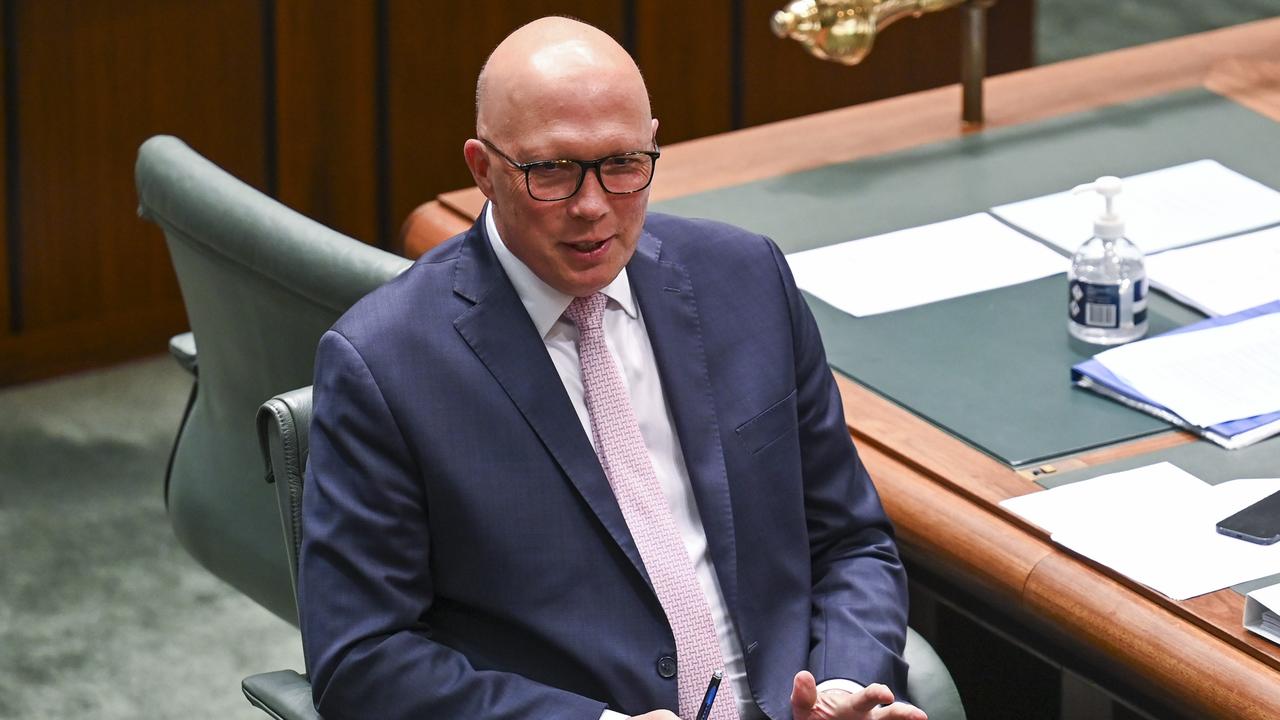
Opposition Leader Peter Dutton says nuclear power is the ‘only credible’ way to net zero. Picture: NCA NewsWire / Martin Ollman
Mr Dutton said nuclear reactors would provide a more reliable and cheaper source of clean energy.
“The Prime Minister’s had an opportunity to put forward a plan,” the Opposition Leader said.
“He doesn’t have the guts to stand up and make the decision that our country needs made and we do need to look at the best technology, zero emissions.
“I think it’s the only credible pathway we have to our international commitment to net zero by 2050.
But his plans have been ridiculed by the Albanese government, which argues it would take “decades” to build and delay Australia’s transition to clean energy.
“I look forward as well to [Mr Dutton] arguing where the financing will come for such reactors, whether taxpayers will be expected to pay for this, because we know the cheapest form of energy in Australia is renewables,” Mr Albanese said.
“Every ten years there are these proposals … what never comes is any investment, because it simply doesn’t stack up commercially.”
Treasurer Jim Chalmers blasted Mr Dutton’s “nuclear fantasy”, saying his plans to overturn laws to build nuclear module reactors would cost taxpayers hundreds of billions of dollars and set the country back in its efforts to reach net zero.
“It’s no surprise to anyone that Peter Dutton has gone for the most expensive option, the most divisive option and longest to build,” the Treasurer said on Tuesday.
“That’s because he’s more interested in cheap and divisive politics than cheap and reliable power. We see that in this more or less culture war over nuclear energy. This a nuclear fantasy.”
Mr Dutton said the technology was “unbelievable” compared with the 1950s and said rerouting the nation’s net-zero path towards nuclear would lead to greater financial relief for households.
Nuclear energy has been banned in Australia since laws were introduced in 1983.
A senate committee was told last year that if a ban on nuclear energy were to be overturned, it would take at least 10 to 15 years to have an operational nuclear power plant in Australia.
Nationals MP Bridget McKenzie said the opposition had anticipated pushback ahead of the announcement.
Independent MP Monique Ryan said the Coalition’s nuclear plan was unrealistic.
“Basically, what the Liberal National Party is doing is kicking the can down the road on the transition because they want to keep in with their friends. The big, you know, coal and gas suppliers because there is not a small functional small modular reactor in the world,” she said.
“I think it’s time that we acknowledge the fact that this is not a realistic plan.”…………………………………. more https://www.news.com.au/technology/environment/sustainability/treasurer-jim-chalmers-rips-into-opposition-leader-peter-duttons-nuclear-energy-plans/news-story/4eb130a74b64224f103e6841ed2a4283
At the Brink, THE RISK OFNUCLEAR CONFLICTIS RISING.

New York Times , 4 Mar 24 [Awesome graphics] By W.J. HenniganW. J. Hennigan writes about national security for Opinion.
Today, the mechanisms of peace aren’t moving as swiftly as the machinery of war.
THE RISK OF
NUCLEAR CONFLICT
IS RISING.
NUCLEAR NATIONS ARE
BUILDING UP THEIR ARSENALS,
SPEEDING TOWARD
THE NEXT ARMS RACE.
IS ANYONE
PAYING ATTENTION?
Today’s generation of weapons — many of which are fractions of the size of the bombs America dropped in 1945 but magnitudes more deadly than conventional ones — poses an unpredictable threat.
It hangs over battlefields in Ukraine as well as places where the next war might occur: the Persian Gulf, the Taiwan Strait, the Korean Peninsula.
This is one story of what’s at stake — if even one small nuclear weapon were used — based on modeling, research and hundreds of hours of interviews with people who have lived through an atomic detonation, dedicated their lives to studying nuclear war or are planning for its aftermath.
Nuclear war is often described as unimaginable. In fact, it’s not imagined enough.
By W.J. HenniganW.J. Hennigan writes about national security for Opinion.
IF IT SEEMS ALARMIST to anticipate the horrifying aftermath of a nuclear attack, consider this: The United States and Ukraine governments have been planning for this scenario for at least two years.
In the fall of 2022, a U.S. intelligence assessment put the odds at 50-50 that Russia would launch a nuclear strike to halt Ukrainian forces if they breached its defense of Crimea. Preparing for the worst, American officials rushed supplies to Europe. Ukraine has set up hundreds of radiation detectors around cities and power plants, along with more than 1,000 smaller hand-held monitors sent by the United States.
Nearly 200 hospitals in Ukraine have been identified as go-to facilities in the event of a nuclear attack. Thousands of doctors, nurses and other workers have been trained on how to respond and treat radiation exposure. And millions of potassium iodide tablets, which protect the thyroid from picking up radioactive material linked with cancer, are stockpiled around the country.
But well before that — just four days after Russia launched its invasion of Ukraine, in fact — the Biden administration had directed a small group of experts and strategists, a “Tiger Team,” to devise a new nuclear “playbook” of contingency plans and responses. Pulling in experts from the intelligence, military and policy fields, they pored over years-old emergency preparedness plans, weapon-effects modeling and escalation scenarios, dusting off materials that in the age of counterterrorism and cyberwarfare were long believed to have faded into irrelevance.
The playbook, which was coordinated by the National Security Council, now sits in the Eisenhower Executive Office Building, next to the West Wing of the White House. It has a newly updated, detailed menu of diplomatic and military options for President Biden — and any future president — to act upon if a nuclear attack occurs in Ukraine.
At the heart of all of this work is a chilling conclusion: The possibility of a nuclear strike, once inconceivable in modern conflict, is more likely now than at any other time since the Cold War. “We’ve had 30 pretty successful years keeping the genie in the bottle,” a senior administration official on the Tiger Team said. While both America and Russia have hugely reduced their nuclear arsenals since the height of the Cold War, the official said, “Right now is when nuclear risk is most at the forefront.”
Russian President Vladimir Putin reminded the world of this existential danger last week when he publicly warned of nuclear war if NATO deepened its involvement in Ukraine.
The risk of nuclear escalation in Ukraine, while now low, has been a primary concern for the Biden administration throughout the conflict, details of which are being reported here for the first time. In a series of interviews over the past year, U.S. and Ukrainian officials spoke on condition of anonymity to discuss internal planning, diplomacy and ongoing security preparations.
And while it may cause sleepless nights in Washington and Kyiv, most of the world has barely registered the threat. Perhaps it’s because an entire generation came of age in a post-Cold War world, when the possibility of nuclear war was thought to be firmly behind us. It is time to remind ourselves of the consequences in order to avoid them.
Imagine a nuclear weapon is launched.
The missile is launched. Once its solid-fuel rocket motor burns out, the warhead plunges back toward Earth.
A third of a mile above the ground, it explodes.
Its plutonium core and surrounding contents — so delicately pieced together inside — convert into ionized gas and electromagnetic waves within a millisecond.
Temperatures inside the explosion reach millions of degrees, hotter than the surface of the sun.
A roar equal to 10,000 tons of TNT quakes the ground below. A massive fireball blooms so quickly that it seems instantaneous.
Nearly everything flammable below ignites: wood, plastics, oil. Small animals burst into flame, then turn to ash.
Ruptured gas and downed electricity lines fuel an inferno that can rage for miles.
The firestorm consumes so much oxygen that it can suffocate people sheltering inside their cars or homes.
Then there is the shock wave, a rumbling force that expands in every direction, racing at supersonic speeds.
Buildings, trees and other living things are torn apart and thrown at one another.
Near the explosion’s epicenter, buildings heave, sag and crumble. Scalding hot glass and debris shoot like shrapnel into everything in their path. Dry leaves crackle like popcorn and disappear in the blazing heat.
The wreckage — what once was asphalt, steel, soil, glass, flesh and bone — is suctioned into the roiling stem of a mushroom cloud rising for miles.
The cloud appears like a living thing. Its colors change from white to yellow to red to black, billowing into the sky until it eclipses the sun.
Screams for help — and for death — can be heard everywhere, but help is not on the way. Finding a doctor or a nurse is nearly impossible. Most medical workers in the immediate area are dead or injured. Those who survive are quickly overwhelmed.
Then, darkness. There’s a discordant ringing. The air is thick with smoke and debris. Breathing in is difficult — spit out a mouthful of dust and glass fragments, only to take in another.
EVEN AFTER LAST week’s nuclear threat, few believe that Mr. Putin will wake up one day and decide to lob megaton warheads at Washington or European capitals in retaliation for supporting Ukraine. What Western allies see as more likely is that Russia will use a so-called tactical nuclear weapon, which is less destructive and designed to strike targets over short distances to devastate military units on the battlefield.
The strategic thinking behind those weapons is that they are far less damaging than city-destroying hydrogen bombs and therefore more “usable” in warfare. The United States estimates Russia has a stockpile of up to 2,000 tactical nuclear warheads, some small enough they fit in an artillery shell.
But the detonation of any tactical nuclear weapon would be an unprecedented test of the dogma of deterrence, a theory that has underwritten America’s military policy for the past 70 years. The idea stipulates that adversaries are deterred from launching a nuclear attack against the United States — or more than 30 of its treaty-covered allies — because by doing so they risk an overwhelming counterattack.
Possessing nuclear weapons isn’t about winning a nuclear war, the theory goes; it’s about preventing one. It hinges upon a carefully calibrated balance of terror among nuclear states.
After the nuclear age began in 1945, the United States and the Soviet Union were locked in an arms race. Each side amassed tens of thousands of nuclear arms.
Over time, nuclear weapons became symbols of national power and prestige. Other nations in Europe and Asia developed their own arsenals.
The dangerous, costly arms buildup pushed Washington and Moscow to the brink of confrontation, before a gradual warming in relations led to mutual reductions.
In the decades since, overall nuclear stockpiles have shrunk, but the number of nuclear powers has increased to nine
…………………………………………… Moscow has made implicit and explicit nuclear threats throughout the war to scare off Western intervention. Around this time, however, a series of frightening episodes took place.
On Oct. 23, Defense Minister Sergei Shoigu of Russia made a flurry of phone calls to the defense chiefs of four NATO nations, including Defense Secretary Lloyd Austin, to say Russia had indications that Ukrainian fighters could detonate a dirty bomb — a conventional explosive wrapped in radioactive material — on their own territory to frame Moscow.
……………………………………………………… If the Russian leader was indeed inching toward the brink, he stepped back.
…………………………………….. IMAGINE THE DAMAGE THE WEAPON WOULD WREAK ON PEOPLE AND
THE ENVIRONMENT………………………………………………………………………………………………………………………………..
India, which has continuing tensions over its borders with China and Pakistan, is fielding longer-range weapons.
Pakistan is developing new ballistic missiles and expanding nuclear production facilities.
North Korea, which has an arsenal of several hundred missiles and dozens of nuclear warheads, regularly threatens to attack South Korea, where the U.S. keeps about 28,500 troops.
China, which has publicly expressed its desire to control the U.S.-allied island of Taiwan by force if necessary, is increasing its nuclear arsenal at a “scale and pace unseen since the U.S.-Soviet nuclear arms race that ended in the late 1980s,” the Congressional Commission on the Strategic Posture of the United States concluded in October.
So while Washington has been helping Ukraine prepare for a nuclear attack, Taiwan or South Korea could be next. The National Security Council has already coordinated contingency playbooks for possible conflicts that could turn nuclear in Taiwan, the Korean Peninsula and the Middle East. Iran, which has continued its nuclear program amid Israel’s war on Hamas in Gaza, has amassed enough enriched uranium to build several weapons if and when it chooses.
During this time of widening conflict, the rising nuclear threat is especially destabilizing: A nuclear explosion in Ukraine or Gaza, where tens of thousands of civilians have already been killed or injured, would sizeably escalate either conflict and its humanitarian toll………………………………………………………………………………………………………………………………………………………………………………..
THIS ISN’T AN easy time for adversaries to be making big leaps of faith, but history shows it’s not impossible to forge deals amid international crises.
The Limited Test Ban Treaty, which prohibits nuclear tests in the atmosphere, in space and underwater, was signed by the United States, Britain and the former Soviet Union in 1963, less than a year after the Cuban missile crisis. Negotiations over the first Strategic Arms Limitation Talks, which froze the number of American and Soviet long-range, nuclear-capable missiles, were concluded less than two months after the United States bombed Haiphong Harbor in Vietnam in 1972, damaging some Soviet ships. Several close calls in Europe during the Cold War contributed to a sweeping collection of agreements between Washington and Moscow that capped the number of each nation’s strategic weapons, opened communication channels and amplified monitoring and verification measures.
…………………………………………………………………………………… The United States is now preparing to build new nuclear warheads for the first time since 1991, part of a decades-long program to overhaul its nuclear forces that’s estimated to cost up to $2 trillion. The outline of that plan was drawn up in 2010 — in a much different security environment than what the country faces today. This administration, or the next one, could make the political case that even more weapons need to be built in response to the expansion and modernization of other nations’ arsenals, particularly Russia’s and China’s.
BEHIND A NONDESCRIPT door on the fifth floor of the State Department building in Washington, down the hall from the former offices of the director of the Manhattan Project, a windowless control room provides a direct channel between the world’s two biggest nuclear powers.
The National and Nuclear Risk Reduction Center was established in 1988 as a 24-hour watch station to facilitate the information exchange required by various arms control treaties and security-building agreements, mostly between the United States and Russia…………………………………
Today, the mechanisms of peace aren’t moving as swiftly as the machinery of war.
………………….. The National and Nuclear Risk Reduction Center is adding translating services for Persian, Mandarin, Korean and other languages in case more nuclear nations express an interest in sharing information to reduce the risk of an inadvertent conflict.
But for now, those ambitions are unrealized, and the communication lines remain quiet. https://www.nytimes.com/interactive/2024/03/04/opinion/nuclear-war-prevention.html
More fusion hot air, literally!

Megajoules and megaheadlines are all meganonsense
By Linda Pentz Gunter, https://beyondnuclearinternational.org/2024/03/04/more-fusion-hot-air-literally/ 4 Mar 24
Another week, more fusion news, cue another overblown headline, as the mainstream media once again paid homage to industry hype, digesting nuclear propaganda soundbites without even a hiccup.
On February 8, we learned that the Joint European Torus fusion project, also known as JET, had broken its own record in energy output during a last gasp attempt to make fusion work. The 40-year old project is now closed down for good.
The moment — and just a fleeting moment it truly was, lasting a mere 5.2 seconds — was duIy celebrated as another breakthrough for fusion.
“Nuclear fusion: new record brings dream of clean energy closer,” trumpeted the BBC who were especially smug since Torus is based in the UK.
“Nuclear Fusion World Record Smashed in Major Achievement”, said Science Alert.
“Scientists have made a record-setting fusion energy breakthrough,” blared the headline on Vice.
Below – A jolly video about JET in which the narrator’s voice perhaps generates more energy than the reactor itself.
What actually happened? JET generated 69 megajoules of energy in those 5.2 seconds, breaking its previous record of 59 megajoules over 5 seconds in 2021.
For those of us who don’t go about measuring things in megajoules, I deferred to our colleague, physicist, M.V. Ramana, for an explanation.
What are they really talking about here and is it actually a breakthrough?
“One can start with the annual average consumption of one US household,” Ramana said. “That’s about 10,500 kilowatt hours which is equivalent to 37,800 megajoules. Essentially using one hour = 3,600 seconds, and one joule = one watt-second.”
Head already spinning, I hoped he would do the rest of the math. He did.
“The 69 megajoules generated by JET”, Ramana explained, “is equivalent to roughly 0.06 percent of the electricity consumed by an average US household.”
So a minuscule contribution. But here’s the catch. “The JET machine produced 69 megajoules, but this is all heat,” explained Ramana. “Only about a third of that can be converted into electricity under ideal circumstances.”
Mostly heat, and hardly any electricity. So what the JET fusion so-called breakthrough actually delivered was all hot air. Literally!
Then came some more hot air. “First ‘private’ nuclear reactor to power 2 million British homes” ran another headline. The private sector nuclear company in question is Westinghouse. Yes, that Westinghouse! The one whose executives are in jail over a failed new nuclear power plant project in South Carolina. The Westinghouse that went bankrupt, forcing its mega-giant parent company, Toshiba, to shed not only Westinghouse but all Toshiba’s nuclear assets to avoid going down with the Westinghouse ship.
The same Westinghouse that is now $20 billion over budget at its other new nuclear project at Vogtle in Georgia.
But the British press were all “oh joy, oh rapture unforeseen” over this announcement, a project that has about as much credibility as the whimsical plot of HMS Pinafore.
And finally, we learned that Michigan governor, Gretchen Whitmer, is seeking another $150 million to restart the old and decrepit Palisades nuclear plant.
Palisades has been closed for almost two years and the company that would re-open and run it, Holtec, which specializes in decommissioning and radioactive waste management, has zero experience running a nuclear power plant.
This latest ask comes on top of $150 million already approved last year for a Palisades restart and could be augmented by a $1.5 billion loan from the federal government as well.
All of this nuclear nonsense comes on the heels of other hyperbole surrounding previous so-called advances in fusion (see our earlier coverage here and here), misrepresented almost universally as an imminent answer to our worsening climate crisis.
But, as the song goes in Pinafore, “Things are seldom what they seem.”
Linda Pentz Gunter is the international specialist at Beyond Nuclear and writes for and edits Beyond Nuclear International
GLOBAL WARFARE “Summit” “16th Annual Nuclear Deterrence Summit”

The only real and proven tool we have, the hard work of diplomacy, is nowhere to be found.
Instead of creating alliances with China and Russia to solve our dire mutual challenges, this rapid warring footing is being touted here as the only real option for our security.
There’s been a shift at these conferences away from facts and towards ideology. “We’ve moved from Civil Service to profit”
02.03.24 – New York City – Anthony Donovan, https://www.pressenza.com/2024/03/global-warfare-summit-summons-national-priority/
Outraged about all the innocents being slaughtered in Russia/Ukraine, Israel/Palestine, and the build-up for war in China/Taiwan? Thank you. Most of these below represent the armaments, bombs, guidance systems, and “intelligence” skill sets being sent to these regions. It is one industry, clamoring for global dominance.
Ten feet tall, high above our heads, as the escalator descends deep below ground to the conference rooms for the 3-day “16th Annual Nuclear Deterrence Summit” in Washington DC is a brightly lit welcoming. It reads:
Securing Our World,
Ensuring Our Future
In reality, nothing could be further from the truth.
Deterrence need only fail once. Once.
It will. What gives anyone the right to threaten all our grandchildren’s existence? Nothing and no one. Our leaders have exceeded the banal mindset of the Cold War, without the public knowing it. The ominous and wrong presumption of leading a nuclear arms race to win a nuclear war has crept back in.
Hundreds of contractors, corporations, the Pentagon, Government agencies, and universities fill the rooms to solidify contracts, and encourage each other to continue building more facilities for more nuclear devices, and much faster. Why? The constant shout here: “Evil.” The enemies Russia and China are fast upon us. The “Summit” echoes their call for a national mobilization to move immediately and fully to deter these two “expansionist” fronts.
The only real and proven tool we have, the hard work of diplomacy, is nowhere to be found. Only a handful have heard of the Treaty on The Prohibition of Nuclear Weapons, and those misperceive it as naive. The trillions $ funneled quietly for this “enterprise” are flowing, unaudited, and without any media discussion, oversight or democratic process.
Jim Carrier, a discerning journalist reporting on the Summit, “I’m coming at this from the viewpoint of a journalist, not as an activist. Although… it’s very eye-opening. When I was covering this industry in 1995 everything seemed to be shutting down…. I’m shocked really. Remarkably, it has all come back to life. The vibe last year was that we couldn’t find enough people… this year it is the opposite tone. [The industry] is underway and we’ve hired many thousands of new workers. The big news announced is they will have the first new plutonium pit and it will be “war ready”.
It is frightening to see the inside of the sausage, the enthusiasm these folks are bringing to it, and the power they wield. What we have is a huge lobbying machine of contractors, … We are in a new arms race, a new war going on. The American public is wholly ignorant of it.”
“Enemies” remain the reason for maintaining a secret world of nuclear weapons and warfare. The three days of drumming to build faster was eased by finding a knowledgeable, brave soul.
Greg Mello, Executive Director of Los Alamos Study Group, “This is a real mental health challenge….. There’s been a shift at these conferences away from facts and towards ideology. …I’m going to be very blunt here. This conference is very Sino and Russophobic, … completely ignorant of aspects of foreign policy and history. I spoke to someone on our U.S. Strategic Nuclear Posture Committee, and he did not know anything about US-Russia relations. I was very shocked. It is the acquired stupidity and incompetence in the highest parts of our government, which we did not have in the past, even under Reagan. We don’t understand our “adversaries”. There were hawks back then, but there were a lot of realists who had respect for their counterparties in the Soviet Union. Now that is gone. Now we have arrogance. It has all been politicized. … We’ve moved from Civil Service to profit.”
Mello wisely addressed the NNSA (National Nuclear Security Administration) and State Department during their presentation, “How can we bring in more of the dissident voices to make the discourse in your offices richer and more critical? Can we get back to a more rational approach to the world? And a little less righteous? We need to do more to create channels, find a way to move forward.”
Mello confides later, “Back in the Obama years, on the policy side, it was clear, they could not hate Russia enough! I felt this was going to go to a very dark place.” Indeed, it has.
Hidden deeply on this Ground Hog Day of 2024, General Anthony Cotton, Commander of U.S. Strategic Command (STRATCOM, all nuclear weapons of land, sea, air, space, and related facilities), addresses the Summit talking of the new “business model” of partnership with civilian industry and academia to give our nuclear weapon industry greater agility and speed. “The tables have turned, the advancements of the civilian sector are being introduced to the DOD (Dept. of Defense), … incorporating these new technologies …. to make sure the Labs and the NNSA (National Nuclear Security Administration) have all they need” He talks of modernizing facilities and tech systems “to move fast”, “sustain that flow, the tempo of a constant production line.”
The military-industrial complex we were warned of in 1959 is extolled at the “Summit” to be a national priority, hiring the young, luring in, and incorporating the ingenuity and wisdom long developed by our civilian sector, from Apple, Microsoft, Google, Amazon, Tesla, AI developers, Boeing, Harvard, MIT, and hundreds of other entities.
Instead of creating alliances with China and Russia to solve our dire mutual challenges, this rapid warring footing is being touted here as the only real option for our security.
General Cotton shares the blinders of this “integrated battle space”. “…Platforms, weapons, they all have to be in alignment, in synch. … Analytically driven data, that informs the senior decision maker [the President] of what the picture truly is. The confidence in the decision that you make will be incredible. …A digitalized enterprise is what we are looking at, the tools and state of the art capabilities… the incredible efficiencies we are seeing in the cloud-based environments….”
Harvey Bennett, a Vietnam Veteran, and member of Veterans for Peace reporting for Pacifica Radio, stood up for the final comment facing squarely General Cotton’s presentation. “General, I think the military has been doing the job they’ve been tasked with. But those missing in action, are the diplomats. When I think about what an acceptable risk in strategic deterrence is, if it is not zero, then it is not acceptable because we are talking about annihilation, not just of our country, but worldwide.
Our successes in modernization and technology are laudable, but in the big picture, do they make us safer? Or do they increase our adversary’s sense of vulnerability, and reduce their decision time when there is a question about whether they are under attack with nuclear weapons?
I want to mention the UN Treaty on the Prohibition of Nuclear Weapons (TPNW) which entered into force January 2021. None of the nuclear weapon states are signatories, but we are a signatory to the Non-Proliferation Treaty, and Article 6 of that treaty mandates that nuclear states to pursue in good faith to negotiate with other states to reduce the nuclear arsenals with a view to disarmament.
We have a treaty now to globally eliminate nuclear weapons. I don’t want anyone to be out of a job, but I think the world wants peace, the world wants security. I don’t think that is a zero-sum game. We can’t be secure if the rest of the world isn’t secure. Relying on nuclear weapons is not going to make us safe.
I was alarmed reading a report by General John Hyten in 2018, who had your job (Cmdr. of STRATCOM), speaking to the Arms Control Association. He was describing the Global Thunder War Games of Strategic Deterrence. He was blunt and said
“I hate to tell you but (nuclear war games) ENDS THE SAME WAY EVERY TIME. IT ENDS BAD.”
Bennett said, “Even if it is not “every time”, that’s too many.”
The moderator quickly jumped in thanking the General, not allowing a response, and calling for a lunch break. Silence is not an option, and neither is “Russia, China, Iran”. Thank you, Mr. Bennett, perfectly put.
We know the solution: Shame our Representatives, and companies. Stop our unlimited funding to warfare, and re-direct it to the jobs we need for life and civilization to move forward.
The Dangers of the Nuclear Industrial Complex
The Summit on Nuclear Deterrence was just last week and “WE” were there to witness the insanity and the "evil." Harvey Bennett joined Greg Mello, Executive Director of the Los Alamos Study Group, and journalist Jim Carrier, who attended the three-day "summit" to hear members of the nuclear industrial complex and the Federal Government talk about nuclear war and deterrence. Can you imagine that they actually believe that we need to be ready to fight a nuclear war and win it? Hear that and a few voices of reason on what our country is doing in your name and with your tax dollars.
Nuclear industry cries poor , as top nuclear propagandist Rafael Grossi begs banks for more money!


UN nuclear watchdog head urges development banks to fund new projects.
Rafael Grossi says World Bank and Asian Development Bank ‘out of touch’
with modern attitudes to atomic energy.
The head of the UN’s nuclear
watchdog has called on global development banks and their government
shareholders to fund new projects, warning that a failure to do so could
delay the energy transition.
Rafael Grossi, director-general of the
International Atomic Energy Agency, told the Financial Times that a lack of
funding for [?] emissions-free nuclear energy by multilateral lenders such as
the World Bank and Asian Development Bank was “out of step” with the
wishes of most of their shareholders. He said there had been a
“sea-change” in attitudes to nuclear power due to the climate crisis
and the Russia-Ukraine war, which propelled energy security to the top of
policymakers’ priority lists.
FT 4th March 2024
https://www.ft.com/content/7cb8dda3-1739-47f0-b0a7-3d726f068808 u
Coalition MPs open to nuclear in their electorates
ABC News, 5 Mar 24
“…………………………………………………………………………………………. The electorates containing coal plants scheduled to close are held almost entirely by Liberal and National MPs, with the exception of Hunter MP Dan Repacholi.
Nationals MP Colin Boyce said the Callide Power Station could be a good option for a nuclear plant, if the community supported it.
“Absolutely on face value I would be supportive of looking at those options. The Callide Power Station at Biloela in central Queensland is number one on the list for closure according to the current Queensland government, so that site there, all the infrastructure that’s already there, the transmission lines, the water supplies, that would be somewhere to me that would be a reasonable outcome,” Mr Boyce said.
“I would suggest that site is a possible site for a possible nuclear small modular reactor, or something similar.
“Having said that we would have to take that to the community and gauge their thoughts on it before any decisions were made.”
He added that safety concerns held by some communities were valid, and that was why an honest conversation to address those concerns was necessary.
Nationals MP Darren Chester, who represents the seat of Gippsland where the Yallourn coal fired plant is scheduled to close, told the ABC last year he would consider a nuclear reactor in the Latrobe Valley if it made sense.
“If a potentially suitable site was identified for a nuclear power station in my electorate, it should be considered in a transparent manner with widespread consultation and an explanation of the potential costs and benefits,” Mr Chester said.
“If it was in the national interest and there were social, economic and environmental benefits, I’m sure that Gippslanders would be willing to have a constructive conversation about nuclear energy.”
Mr Chester told The Australian yesterday any government wanting to introduce nuclear would first have to reassure host communities safety concerns had been managed.
Nationals leader David Littleproud told Perth radio station 6PR yesterday he was ready to lead the way on the prospect of nuclear power in his electorate.
“I’ve got four coal fired power stations [in my electorate], I’ve made it very clear. I’m prepared to lead my community in that discussion,” he said.
“And we’ve got time, we don’t have to do all this by 2030.”
Liberal MP Rick Wilson said it would be premature to speculate on sites, but was open to the idea of a nuclear site in O’Connor.
Communities such as Collie in my electorate, which have experience hosting power stations, have high energy-IQ and their existing infrastructure and workforces could make them potential candidates to host a next-generation nuclear plant in the future,” Mr Wilson said.
He said like any major project, it would need the backing of the community.
Dan Repacholi, whose electorate contains plants scheduled for closure, has been contacted for comment. https://www.abc.net.au/news/2024-03-05/coalition-nuclear-plan-identifies-retiring-coal-likely-sites/103545440
Western Australia’s Premier Cook goes nuclear on Dutton’s ‘simplistic, ridiculous’ power plan
SMH, Hamish Hastie, March 5, 2024 —
A Coalition proposal to build nuclear power stations at the sites of retired or retiring coal stations is ridiculous and a distraction from efforts to reach net zero using renewables, West Australian Premier Roger Cook has said.
Opposition leader Peter Dutton floated the idea of building nuclear power stations on sites of retired coal stations – which could include the South West town of Collie – as a zero-emissions solution to the nation’s energy woes.
Cook blasted the Coalition proposal that federal Nationals leader David Littleproud was spruiking in WA this week as a fantasy.
“The rollout of small nuclear reactors or modular reactors in other countries has been halted because it’s not commercial, it’s not viable,” he said.
“In addition to that, Australia has no experience in nuclear power generation so we don’t have the workforce, we don’t have the know-how to be able to bring them in.
“You simply cannot plonk these things into a landscape and plug it into the grid. These simplistic sort of ideas are ridiculous.
“What we need to do is accept that climate change is a reality and move to exploit the abundance of wind and solar that we have at our disposal.
“There’s no quick fix here, you’ve got actually do the hard work and this is simply a sound grab by the Nationals to distract people from the real hard work which is being done.”……………………………………………………… https://www.smh.com.au/politics/western-australia/cook-goes-nuclear-on-dutton-s-simplistic-ridiculous-power-plan-20240305-p5fa0r.html
Talk of nuclear power plant sites ‘conjecture’, says Liberal MP amid internal division on Dutton’s policy
Rowan Ramsey says overturning ban on nuclear first is the ‘most logical thing’ to do as opposition leader prepares to nominate up to six locations
Paul Karp Chief political correspondent, Guardian, 5 Mar 24
The Liberal MP Rowan Ramsey has said any talk of where nuclear power plants would be built or waste would go is “conjecture” that cannot sensibly be tackled until after the nuclear ban is lifted.
As the opposition leader, Peter Dutton, prepares to announce an energy policy nominating up to six possible sites for nuclear plants, he faces internal divisions about the level of government support required, proposed locations and questions about storage of nuclear waste.
On Tuesday Dutton all but confirmed the Coalition will propose locating nuclear power plants on the site of retiring coal power plants, claiming that this would save having to build new transmission infrastructure for renewables.
The plan would suggest that the Labor-held seat of Hunter, independent Andrew Gee’s seat of Calare and Coalition-held Flynn, Maranoa, O’Connor and Gippsland are on the shortlist for nuclear power stations.
The Gippsland MP, Darren Chester, has argued that his community would need to receive “direct economic benefits” if it were to host power plants.
The Liberal MP for Sturt, James Stevens, has argued that community concerns must be allayed by explaining where and how waste will be stored. This opens another can of worms for the Coalition, as Australia has failed for decades to build a dump for its slowly accumulating intermediate nuclear waste.
Ramsey told Guardian Australia that Kimba, a proposed site for a waste dump in his South Australian electorate of Grey, was “never envisaged, planned or promised to hold high-level waste”……..
It is unclear how the Coalition’s nuclear policy hopes to overcome the enormous cost, long lead-in time and lack of private investment to make new power plants a reality.
Stevens said on Monday that “embracing nuclear generation for civilian electricity purposes is not something to be done on a whim” and that Australians would rightly want to know “how we will deal with some challenges, such as the custody of waste, the location of these generation plants”.
But the Liberal candidate for Cook, Simon Kennedy, who is likely to take Scott Morrison’s seat in parliament, argued on Tuesday that voters in his electorate are “used to” the idea of nuclear waste, because the Lucas Heights reactor – for production of medical and industrial isotopes – is “right outside the electorate”.
Kennedy told Sky News that Australians want “clean, cheap and reliable” power, accusing the Albanese government of being “ideological” for not considering nuclear.
Chester told Guardian Australia he has an “open mind when it comes to the public debate regarding nuclear energy in Australia”.
“It is premature to rule regions in or out as potential locations for a nuclear power station because there’s no proposal on the table,” he said.
“But as a matter of principle, you would need to be able to demonstrate to a potential host community, including Gippsland, that any safety concerns could be ameliorated and there were direct social and economic benefits to our community.”……………………………………
Jason Falinski, the former member for Mackellar and the New South Wales Liberal party president, told Sky News on Monday that “nuclear energy is not something that we are necessarily advocating for”.
“What we’re saying is that it should be part of the mix, part of the option available for Australian policymakers.”
On Tuesday the prime minister, Anthony Albanese, questioned where financing will come from and whether “taxpayers will be expected to pay” for nuclear, because “we know that nuclear is not only the most expensive form of new energy, it is also more than a decade off”.
“I noticed in today’s reports, [Dutton] seems to have backed away a little bit from talking about a technology that does not exist in small, modular reactors that he’s been speaking about,” Albanese told reporters on the sidelines of the Asean conference in Melbourne.
“He’s now speaking about large nuclear reactors. They need to be near populations and need to be near water.”
Albanese said “investment never comes” into nuclear because “it simply doesn’t stack up commercially”.
Dutton told reporters in Brisbane that nuclear is “the only credible pathway we have to our international commitments to net zero by 2050”.
Dutton would not rule out support for large-scale reactors, saying only that the Coalition wanted the “latest technology”.
“We’ve said we’re only interested in sites where you have an end-of-life coal-fired generation asset, so that means you can use the existing distribution network.”
Asked if taxpayers will have to support nuclear, Dutton did not respond but cited the Canadian province of Ontario and the United States as examples where businesses and households pay less for power with nuclear in the mix https://www.theguardian.com/australia-news/2024/mar/05/peter-dutton-liberal-coalition-nuclear-power-plant-policy-locations-waste-rowan-ramsey
Coalition’s plan to go nuclear puts five regions on the table as favoured locations for nuclear reactors
ABC News, By political reporter Jake Evans, 5 Feb 24
There are just a handful of regions in Australia shaping up as the most likely candidates for the Coalition’s proposal to install nuclear reactors in Australia, as the party eyes retiring coal stations as a way to go nuclear.
Opposition Leader Peter Dutton says he will be up front with voters about where the Coalition is looking to place potential nuclear reactors when the party announces its policy in coming weeks.
Speaking on Channel Seven this morning, Mr Dutton confirmed the party was “interested” in replacing retiring coal plants with nuclear, because the sites come ready with poles and wires to distribute power.
“If there’s a retiring coal asset, so there’s a coal fired generator that’s already got an existing distribution network, the wires and poles are already there to distribute the energy across the network into homes and businesses, that’s really what we’re interested in,” Mr Dutton said.
Doing so would leave just a narrow range of possible regions for a nuclear reactor.
The federal divisions of Gippsland in Victoria, Hunter in New South Wales, Maranoa and Flynn in Queensland and O’Connor in West Australia are the only electorates with coal plants scheduled to completely close in the next two decades.
There are also partial closures scheduled at Callide, Loy Yang and Vales Point in the NSW Central Coast, which would add Labor minister Pat Conroy’s electorate of Shortland to the list.
With its policy yet to be announced, it’s not clear what the Coalition considers as viable options.
Australia also still has a total ban on nuclear energy in place, which the Coalition would have to win the support of parliament to lift even if it won government at the next federal election.
And there are a number of safety and technical requirements for installing any nuclear reactor, such as geological stability and a readily available source of water.
The national science agency CSIRO has estimated nuclear energy from small modular reactors (SMRs), modern reactors built in a factory and then shipped to a site for installation, would also be more expensive than powering the grid through wind and solar.
The agency projected in its draft GenCost report that wind and solar would cost an average of $82 per megawatt hour by 2030, while SMR nuclear power would cost an average $282 by 2030.
Even if the nuclear ban was lifted tomorrow and a decision immediately taken to commission a nuclear reactor, CSIRO estimates the first SMR would not be in full operation before 2038, ruling it out of “any major role” in reaching net zero emissions by 2050.
Mr Dutton said nuclear reactors would provide a more reliable source of clean energy, and would avoid the need for thousands of kilometres of new transmission lines to be built.
“We need to make sure that we can firm up the renewables that are in the system. We know that of the G20 nations, Australia is the only nation that doesn’t have or hasn’t agreed to adopt nuclear power domestically,” he said.
Prime Minister Anthony Albanese said he looked forward to the Coalition announcing its nuclear policy.
“I look forward as well to [Mr Dutton] arguing where the financing will come for such reactors, whether taxpayers will be expected to pay for this, because we know the cheapest form of energy in Australia is renewables,” he said.
“Every ten years there are these proposals … what never comes is any investment, because it simply doesn’t stack up commercially…………………………………. https://www.abc.net.au/news/2024-03-05/coalition-nuclear-plan-identifies-retiring-coal-likely-sites/103545440
Microsoft’s Kate Crawford: ‘AI is neither artificial nor intelligent’

who benefits and who is harmed by this AI system? And does it put power in the hands of the already powerful? What we see time and again, from facial recognition to tracking and surveillance in workplaces, is these systems are empowering already powerful institutions – corporations, militaries and police
The AI researcher on how natural resources and human labour drive machine learning and the regressive stereotypes that are baked into its algorithmsSun 6 Jun 2021 18.00 AESTShare
Kate Crawford studies the social and political implications of artificial intelligence. She is a research professor of communication and science and technology studies at the University of Southern California and a senior principal researcher at Microsoft Research. Her new book, Atlas of AI, looks at what it takes to make AI and what’s at stake as it reshapes our world.
……………………………………… What’s the aim of the book?
We are commonly presented with this vision of AI that is abstract and immaterial. I wanted to show how AI is made in a wider sense – its natural resource costs, its labour processes, and its classificatory logics. To observe that in action I went to locations including mines to see the extraction necessary from the Earth’s crust and an Amazon fulfilment centre to see the physical and psychological toll on workers of being under an algorithmic management system. My hope is that, by showing how AI systems work – by laying bare the structures of production and the material realities – we will have a more accurate account of the impacts, and it will invite more people into the conversation. These systems are being rolled out across a multitude of sectors without strong regulation, consent or democratic debate.
………………………..systems might seem automated but when we pull away the curtain we see large amounts of low paid labour, everything from crowd work categorising data to the never-ending toil of shuffling Amazon boxes. AI is neither artificial nor intelligent. It is made from natural resources and it is people who are performing the tasks to make the systems appear autonomous.
Problems of bias have been well documented in AI technology. Can more data solve that?
Bias is too narrow a term for the sorts of problems we’re talking about. Time and again, we see these systems producing errors – women offered less credit by credit-worthiness algorithms, black faces mislabelled – and the response has been: “We just need more data.” But I’ve tried to look at these deeper logics of classification and you start to see forms of discrimination, not just when systems are applied, but in how they are built and trained to see the world. Training datasets used for machine learning software that casually categorise people into just one of two genders; that label people according to their skin colour into one of five racial categories, and which attempt, based on how people look, to assign moral or ethical character. The idea that you can make these determinations based on appearance has a dark past and unfortunately the politics of classification has become baked into the substrates of AI.
……………………………Beginning in 2017, I did a project with artist Trevor Paglen to look at how people were being labelled. We found horrifying classificatory terms that were misogynist, racist, ableist, and judgmental in the extreme. Pictures of people were being matched to words like kleptomaniac, alcoholic, bad person, closet queen, call girl, slut, drug addict and far more I cannot say here. ImageNet has now removed many of the obviously problematic people categories – certainly an improvement – however, the problem persists because these training sets still circulate on torrent sites [where files are shared between peers].
And we could only study ImageNet because it is public. There are huge training datasets held by tech companies that are completely secret. They have pillaged images we have uploaded to photo-sharing services and social media platforms and turned them into private systems.
……………………………………………. What do you mean when you say we need to focus less on the ethics of AI and more on power?
Ethics are necessary, but not sufficient. More helpful are questions such as, who benefits and who is harmed by this AI system? And does it put power in the hands of the already powerful? What we see time and again, from facial recognition to tracking and surveillance in workplaces, is these systems are empowering already powerful institutions – corporations, militaries and police……………………………………………………………………………………………………………
Atlas of AI by Kate Crawford is published by Yale University Press (£20). To support the Guardian order your copy at guardianbookshop.com. Delivery charges may apply https://www.theguardian.com/technology/2021/jun/06/microsofts-kate-crawford-ai-is-neither-artificial-nor-intelligent
The nuclear narrative

What is a narrative? ……… In other words, it is about occupying public space to disseminate enchanting stories that give pride of place to industry, multinationals, investors, billionaires, each greener than the last.
Jean-François Nadeau, March 4, 2024, https://www.ledevoir.com/opinion/chroniques/808350/chronique-narratif
The future of the world, at least according to the head of the AtkinsRéalis firm, lies in nuclear power. This company, formerly known as SNC-Lavalin, has changed its name. The scandals that have affected her, she asserts, belong to the past.
For its campaign to promote atomic energy, AtkinsRéalis secured the services of two former prime ministers: Jean Chrétien and Mike Harris. In 2019, as revealed by Radio-Canada, Jean Chrétien had already gone so far as to propose, with astonishing lightness, storing foreign nuclear waste in Labrador. In a letter, the former prime minister wrote to a Japanese firm: “Canada has been the largest supplier of nuclear fuel for years, and I have always thought it would be appropriate for Canada to become, at the end of account, the steward and guarantor of the safe storage of nuclear waste after their first service cycle. »
No carbon neutrality without nuclear power , repeats the boss of AtkinsRéalis like an advertising slogan. We must replace fossil fuels, while doubling or tripling, thanks to nuclear power, the production of electricity, he pleads. There is no question, in this presentation, of rethinking a model of society based on an infinite expansion of consumption. Always more cars, as long as they are electric. Always more heating, regardless of the fact that our buildings are thermal sieves. In other words, what continues to matter is growth. And the increase in AtkinsRéalis’ turnover is largely due to nuclear power, as noted by Le Devoir .
Last week, Minister Pierre Fitzgibbon reiterated again that he was not closing the door to the return of nuclear power. Since the arrival of Michael Sabia at the head of Hydro-Québec , the signals pointing in the direction of this revival have multiplied. “I think that as a government, in the ministry, at home, we must stay on the lookout for what is happening in nuclear power,” the minister further affirmed in front of an audience of business people. To have such projects accepted, the minister specified that “you simply have to have a good narrative”. In Quebec, he laments, “we have not had any narrative on nuclear power” since the closure of Gentilly-2 .
What is a narrative? In 1928, Edward Bernays, the founding father of the public relations and advertising industry, called these language elements capable of manipulating public opinion propaganda . This word ended up, as we know, having unfavorable connotations. Others were therefore substituted. Here is the latest addition, used in all sauces: the narrative . In other words, it is about occupying public space to disseminate enchanting stories that give pride of place to industry, multinationals, investors, billionaires, each greener than the last.

Pierre Fitzgibbon shows interest in mini nuclear reactors. The boss AtkinsRéalis also praises this technology, which is far from wonderful. Nobody says too loudly that these types of plants produce more nuclear waste per megawatt. These mini power plants would produce up to thirty times more radioactive waste than conventional nuclear power plants.
In his “narrative”, the boss of AtkinsRéalis barely concedes that the management of radioactive materials constitutes a serious danger for humanity.
In Ontario, a large dump for radioactive waste was approved on January 9. Tons of heavy metals, dangerous radioactive elements, plutonium, uranium, etc. will pile up there for a century, not far from the Ottawa River. The whole thing promises to occupy, for eternity, an area equivalent to 70 National Hockey League ice rinks.
In France, 280 km of underground galleries are being built to store nuclear waste. To give an idea, the galleries of the Montreal metro total 71 km. This giant sarcophagus will be the largest construction site in Europe. In these galleries, the most dangerous waste will be able to spew radioactivity for 100,000 years.
So that the hydrogen and the fumes released from this collection of waste do not explode, it is necessary to continually ventilate. Which requires electricity. A power outage, if it lasts more than a week, could be catastrophic. Obviously, electrical problems, cataclysms, wars, terrorists, this will never happen in a hundred years. Not again in a thousand years, probably. Moreover, at the entrance to these sites, in what language should we warn future generations not to dig?
The speech of the boss of AtkinsRéalis is very similar to that which is also being given these days by the cereal manufacturer Kellogg’s. Gary Pilnick, its CEO, is sad to see the cost of food soaring. However, he does not recommend reviewing the profit margins on which the food giants are fattening, nor the exploitation system which governs this surge in prices. He simply suggests eating cereal at dinner, so that consumers can lower their bills and cereal manufacturers can make more money. At the bottom of the scale, this makes no difference to the misfortunes of the majority. Agricultural producers in Quebec, for example, find themselves this year with the lowest net incomes since 1938, they say.
Nuclear industries operate according to the same elastic logic which consists of making money at all costs. Our dependence on automobiles and energy-intensive lifestyles suits them. And it is enough, to hear them, to continue to rush forward, head down, to escape from a reality that is ruining the future. Their technologies promise to fix everything. As long as you are willing to swallow their narrative first, like soft cereal .
1 This month.

Australians deserve the truth
about
AUKUS – https://aukuspublicinquiry.com/
30 July – WEBINAR (Free) – Is Nuclear Power the Solution to Climate Change? https://my.acaw.org.au/event/acaw-is-nuclear-power-the-solution-to-climate-change
18:30 – 19:45 ACST
19:00 – 20:15 AEST


PETITION – To: Prime Minister Anthony Albanese and the Australian Labor Government

of the week – Australians for War Powers Reform (AWPR)
To see nuclear-related stories in greater depth and intensity
 Antinuclear