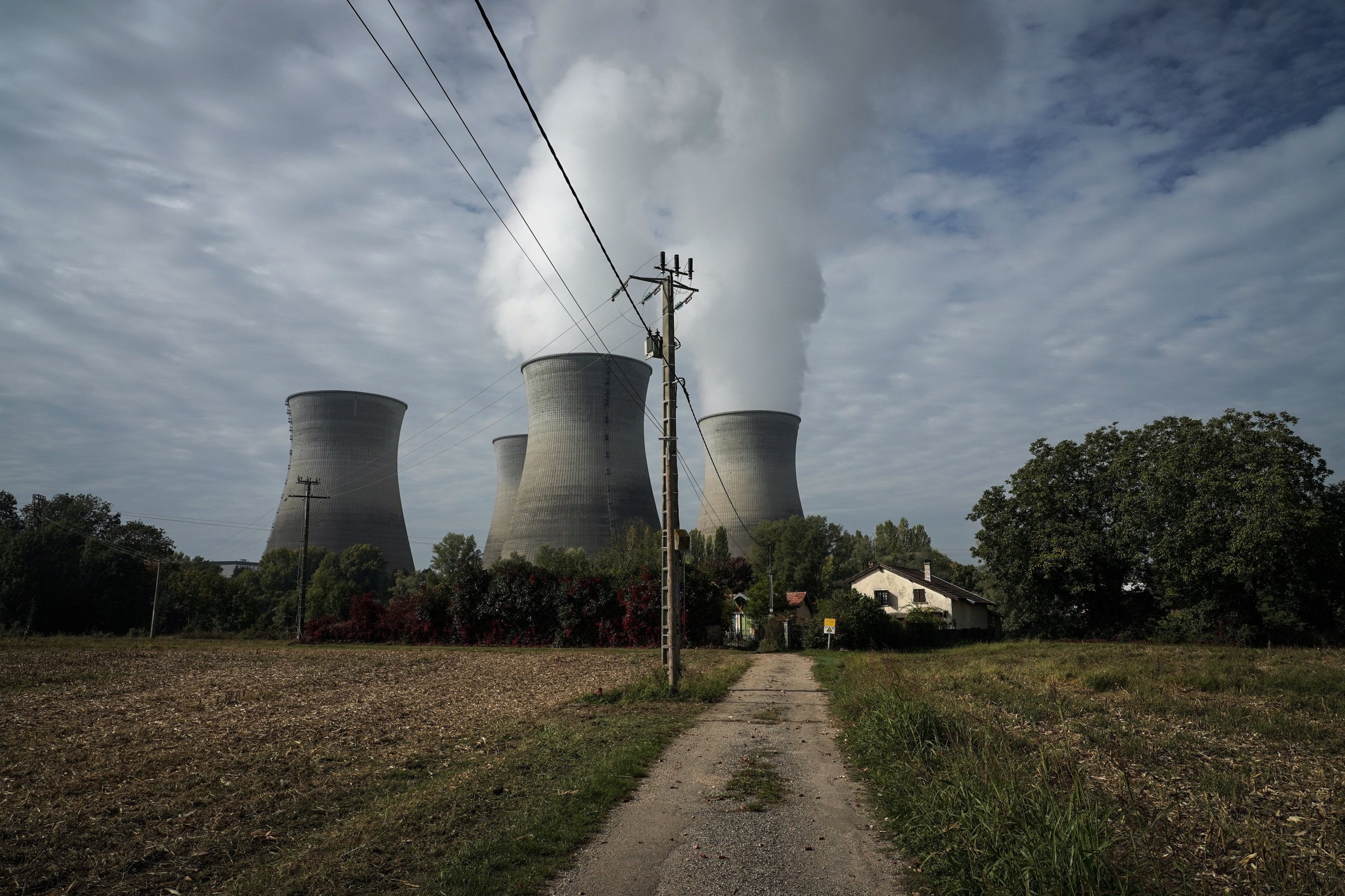
France has more grandiose plans for building nuclear reactors, but has no renewable energy targets.

France outstrips plans, to build additional nuclear plants beyond six
DAILY SABAH, BY AGENCE FRANCE-PRESSE – PARIS JAN 07, 2024
France is set to build eight new nuclear plants on top of six already announced, the energy minister has said, arguing more reactors are needed to hit carbon reduction targets.
A draft law set to be presented soon recognizes that “we will need nuclear power beyond the six first European Pressurized Reactors” (EPRs) announced by President Emmanuel Macron in early 2022, Agnes Pannier-Runacher told Sunday’s edition of the weekly newspaper Tribune Dimanche.
The bill will include a further eight plants that had until now been discussed as an “option” by the government, Pannier-Runacher said.
By contrast, the text would not include any targets for renewable energy generation by 2030, remaining “technologically neutral,” she added………………………………………………..
Pannier-Runacher suggested that the construction of even more than 14 nuclear reactors could be raised in talks with lawmakers once the energy bill reaches Parliament.
State energy firm EDF’s next-generation EPR has had a rocky start.
Three are online, one in Finland and two in China, after suffering massive construction delays and cost overruns that have also beset projects in Britain and France.
The first EPR in France, at Flamanville in Normandy, is set to come online for testing in mid-2024, EDF said last month – 17 years after construction started and at a cost of 12.7 billion euros ($13.9 billion), around four times the initial budget of 3.3 billion. more https://www.dailysabah.com/business/energy/france-outstrips-plans-to-build-additional-nuclear-plants-beyond-six
How Long Can Israel Defy the World?

More probably, however, Israel will resist such pressure and threat to resort to the Samson Option, i.e., a nuclear attack on the countries endangering “Israel’s right to exist”. In this worst-case scenario, Israel would be annihilated, but those who put pressure on it would also suffer enormous casualties. Obviously, no country in the world will run the risk of a nuclear attack to free the Palestinians.
By Prof. Yakov M. Rabkin, https://www.juancole.com/2024/01/long-israel-world.htm
Palestinians in Gaza are being decimated. Over 20,000 have been killed, mostly women and children. Three times more have been wounded. Some experts qualify it as genocide, others as massacre. Two million people have been displaced, many more than during the entire history of displacement of the Palestinians since the start of the Zionist settlement at the turn of the 20th century.
As Israel takes out hospitals and civilian infrastructure, infectious diseases and famine threaten to kill many more people. Several Israeli soldiers have been reported infected during the ground operations, one has died. General Giora Eiland suggests relying on the weapon of imminent epidemics in lieu of endangering the lives of Israeli soldiers in real warfare. Gaza is violently demodernized, bombed into stone age: hospitals, schools, power stations are bombed to rubble. What is happening appears unprecedented.
The number of victims is, indeed, unprecedented. Yet the unfolding tragedy follows the old script of the Zionist project, which is European in more than one sense. It is rooted in ethnic nationalisms of Eastern and Central Europe. Nations must live in their “natural” environment where those not of the titular nationality would be at best tolerated. According to an Iraqi journalist writing in 1945, the Zionists’ goal was “to expel the British and the Arabs from Palestine so that it will be a pure Zionist state. … Terrorism [was] the only means that can bring the Zionist aspirations to fruition.” Significantly, the journalist did not consider the future state Jewish but Zionist. He must have known that Jews from countries other than those of Europe and European colonization constituted a miniscule part of the Zionist movement.
Zionism is also European because it is a settler colonial project, the most recent of all. The Palestine Jewish Colonization Association was among several agencies devoted to turning the multi-ethnic and multi-confessional Palestine into “the Jewish homeland”. The Jewish Colonial Trust, the predecessor of Bank Leumi, today Israel’s largest bank, financed the segregated economic development of the Zionist settlement in Palestine. In the usual colonial manner, the early Zionist settlers were eager to establish a separate colony rather than integrate in the existing Palestinian society.
Zionism is not only the most recent case of settler colonialism. Israel is unique in that, unlike Algeria or Kenya, it is not populated by migrants from the colonial metropolis. But this distinction matters little to the indigenous Palestinians who, just like in many other such situations, are being displaced, dispossessed, and massacred by the settlers. Displacement is enacted not only in Gaza, where it is massive and indiscriminate, but also in the West Bank where it is more focused.
To attain its objectives Zionism has had to rely on major powers, the British Empire, the Soviet Union, France and, nowadays, the United States. The Zionists, committed to the success of their project, have been pragmatic and ideologically promiscuous. They would enjoy the support of the Socialist International during most of of the 20th century and then switch to become the darlings of White supremacists and the extreme-right.
Zionism is a nationalist response to anti-Jewish discrimination and violence in Europe. It deems antisemitism endemic and ineradicable, explicitly rejecting long-term viability of Jewish life anywhere except in “the Jewish state” in Palestine. The Nazi genocide in Europe reinforced this conviction and offered legitimacy to the fledgling colonial project while such projects were crumbling elsewhere in the world. The Zionist project, ignoring the opposition of the Palestinians and other Arabs, simply exported Europe’s “Jewish question” to Palestine.
Palestinians gradually understood that the Zionist project would deprive them of their land and resisted it. This is why the early Zionist settlers, most of them from the Russian Empire, formed militias to fight local population. They perfected their terrorist experience gained during the Russian revolution of 1905 with colonial counterinsurgency measures learned from the vast experience of the British. Established against the will of the entire Arab world, including the local Palestinians, the state of Israel has had to live by the sword. The army and the police have worked hard to keep the Palestinians down (the British used to call it “pacification of the natives”). Their task has been to conquer as much land as possible with as few Palestinians remaining on it as possible.
Many Palestinians now in Gaza had been expelled from the very area in what is now Israel that experienced the Hamas attack in October. They are mostly refugees or descendants of refugees. The high density of the population in an enclosed area (some called it “the largest open-air prison) makes them particularly vulnerable. When Israel did not like the election of Hamas in 2006, it laid siege to Gaza, limiting access to food, medicines, work etc. Israeli officials were openly admitting they were putting the Gazans “on a diet” while having to “mow the lawn” from time to time, subjecting the Gazans to violent “pacification”.
The 16 years of siege intensified anger, frustration and despair leading to the Hamas attack. In response, Israeli used drones, missiles, and aircraft to continue what used to be done with rifles and machine-guns. The death rate has increased, but the goal of terrorizing Palestinians into submission has remained the same. The name of the current onslaught on Gaza is “Iron Swords”, aptly reflects the Zionists’ century-old choice to live by the sword rather than coexist with the Palestinians on equal terms. Ein berera, “we have no choice”, the common Israeli excuse for unleashing violence, is therefore misleading.
Impunity and Impotence
Israel has enjoyed a large degree of impunity, with dozens of UN resolutions simply ignored. Only once, in the wake of the 1956 Suez War, was Israel forced to give up territorial conquest. This happened under a threat coming from both the United States and the Soviet Union. Since then, Israel has relied on firm U.S. diplomatic and military support, which has become more brazen with the advent of America’s unipolar moment after the dissolution of the Soviet Union. This support is now embodied in the supply of American munitions for the war on Gaza, in the presence of U.S. Navy vessels protecting Israel from third parties and in the U.S. vetoes at the Security Council. Israel and the United States are joined at the hip. Europe, while being more critical of Israel rhetorically, closely follows the U.S. line just as it does in the Ukraine conflict. In both conflicts, European chanceries appear to have abdicated independence and, possibly, ability of action.
Israel’s impunity also reflects impotence of the rest of the world. While Muslim and Arab governments decry and protest Israel’s assault on Gaza, none has imposed or even proposed economic, let alone military, sanctions. Fewer than a dozen of countries has suspended diplomatic relations or withdrawn diplomatic personnel from Israel. None has broken relations. Russia and China, along with most of the Global South, express their dismay at civilian casualties in Gaza but they too stop short of going beyond words.
The double standard of the Western reactions is obvious. Drastic economic sanctions imposed on Russia contrast with the generous supply of arms and at best verbal pleas for moderation in response to the Israeli actions in Gaza. In just a few months, the IDF surpassed Russia’s almost two-year record in the Ukraine with respect to the volume of explosives dropped, the number of people killed and wounded, and the civilian/military ratio among the casualties. Western sermons about inclusion and democracy are unlikely to carry much weight in the rest of the world. Palestinian lives do not really matter to Western governments.
This lackadaisical reaction to the massacres in Gaza contrasts with the indignation they provoke in the population in much of the world. Massive demonstrations call on governments to stop the violence. In response, most Western governments have strengthened measures to restrict freedom of speech. Opposition to Zionism has been declared antisemitic, the most recent such measure is the equivalence between anti-Zionism and antisemitism decided by the U.S. Congress in December 2023. Accusations of antisemitism are leveled at students, often Jewish, who organize pro-Palestinian demonstrations. Televised debates as to what constitutes “genocidal antisemitism” on elite university campuses divert attention from what looks like a real genocide in Gaza. Antisemitism serves as Israel’s Wunderwaffe, its ultimate weapon of mass distraction.
Pro-Palestinian demonstrations have been banned in several European capitals where commercial or cultural boycott of Israel has been made illegal. This pressure from the ruling class, including courts, police, corporate media, employers, and university administrations, creates a powerful sense of frustration among the rank-and-file. Shortly after attacking Gaza in 2009, and over sharp criticism of its treatment of the Palestinians, Israel was unanimously accepted into the Organization for Economic Cooperation and Development (OECD), made up of some 30 countries that boast democratic structures of governance. Former Canadian prime minister Stephen Harper, while still in office, placed solidarity with Israel above Canada’s interests to the point of claiming that his government would support Israel “whatever the cost.”
Support for Israel, tending to increase with income, has become a class issue. It serves as another reminder of the growing estrangement between the rulers and the ruled, the proverbial One Per Cent and the rest. It remains to be seen if popular frustration with the hypocrisy of governments in their support for the war on Gaza may one day result in political change that would begin to dent Israel’s impunity.
Israel is a state without borders. Geographically, it has expanded with military conquest or colonization. The Zionist movement and successive Israeli governments have taken great pains never to define the borders they envisage for their state. Israeli secret services and the army pay no heed to borders, striking targets in its neighboring countries at will. This borderless character is also embodied in Israel’s claim that it belongs to the world’s Jews rather than to its citizens. This leads to the overt transformation of Jewish organizations around the world into Israeli agents. This is particularly the case in the United States. Israeli agents, such AIPAC, ensure Israel’s interests in elections on all levels, from school boards to the White House. Israel has even played the legislative against the executive branch in Washington. Yet this unabashed political interference attracts a lot less criticism in mainstream media that the alleged meddling of China or Russia. Israel also intervenes in the political process of other countries.
Conflict Between Jewish and Zionist Values
Zionism has provoked controversy among Jews from its very inception. The first Zionist congress in 1897 had to be moved from Germany to Switzerland because German Jewish organizations objected to holding a Zionist event in their country. The Zionist argument that the homeland of the Jews is not the country, where they have lived for centuries and for which many have spilled their blood in wars, but in a land in Western Asia. For many Jews, this message bears disconcerting resemblance to that of the antisemites who resent their social integration.
Initially irreligious, Zionism transforms spiritual terms into political ones. Thus, ‘am Israel, “the people of Israel”, defined by their relationship to the Torah, becomes ethnicity or nationality in the Zionist vocabulary. This prompted the prominent European rabbi Jechiel Weinberg (1884-1966) to emphasize that “Jewish nationality is different from that of all nations in the sense that it is uniquely spiritual, and that its spirituality is nothing but the Torah. […] In this respect we are different from all other nations, and whoever does not recognize it, denies the fundamental principle of Judaism.”
Another reason for Jewish opposition to Zionism has been moral and religious. While prayers for the return to the Holy Land is part of the daily Judaic ritual, it is not a political, let alone a military objective. Moreover, the Talmud spells out specific prohibitions of a mass move to Palestine before Messianic times, even “with the accord of the nations”. This is why the Zionist project with its addiction to armed violence continues to repel many Jews causing them embarrassment and even revulsion.
True, the Pentateuch and several of the books of the Prophets, such as Joshua and Judges, teem with violent images. But far from glorifying war, Jewish tradition identifies allegiance to God, and not military prowess, as the principal reason for the victories mentioned in the Bible. Jewish tradition abhors violence and reinterprets war episodes, plentiful in the Hebrew Bible, in a pacifist mode. Tradition clearly privileges compromise and accommodation. Albert Einstein was among the Jewish humanists who denounced Beitar, the paramilitary Zionist youth movement, today affiliated with the ruling Likud. He deemed it to be“ as much of a danger to our youth as Hitlerism is to German youth”.
Zionism vigorously rejects this “exilic” tradition, which it deems “consolation of the weak”. Generations of Israelis have been brought up on the values of martial courage, proud of serving in the military. Zionists regularly refer to their state as a continuation of biblical history. The idea of the Greater Israel is rooted in the literal reading of the Pentateuch. Zionism demands total commitment and brooks little opposition or criticism. The passion of the Zionist commitment has led to assassination of opponents, pitched fathers against sons, splitting Jewish families and communities. The historian Eli Barnavi, former Israeli ambassador in Paris, warns that “the dream of a ‘Third Kingdom of Israel’ could only lead to totalitarianism”. Indeed, many Jewish community leaders, undisturbed by the specter of “dual loyalty”, insist that allegiance to the state of Israel must prevail over all others, including allegiance toward their own country.
The Zionists, whether in Israel or elsewhere, have long claimed to be “the vanguard of the Jewish people” with Zionism replacing Judaism for quite a few Jews. Their identity, initially religious, has become political: they are supporters and patriots of Israel, “my country right or wrong” rather than adherents of Judaism.
Generationally, Israel appears an exception among the wealthy countries. With every generation Israelis become more combative and anti-Arab. While in other countries young Jews are usually less conservative than their parents and embrace ideas of social and political justice, young Israeli Jews defy this trend. Israeli education inculcates martial values and the belief that, had the state of Israel existed before World War II, the Nazi genocide would never have taken place. What sustains the fragile unity of the non-Arab majority is fear: a siege mentality that most frequently takes the self-image of a virtuous victim determined to prevent a repetition of the Nazi genocide. The memory of that European tragedy has become a tool of mobilizing Jews to the Zionist cause. Its political utility is still far from exhausted.
Use of the genocide to foster Israeli patriotism has been unflagging since the early 1960s. After an air show in Poland in 2008, three Israeli F-15 fighter jets bearing the Star of David and piloted by descendants of genocide survivors overflew the former Nazi extermination camp while two hundred Israeli soldiers observed the flyover from the Birkenau death camp adjacent to Auschwitz. The remarks of one of the Israeli pilots stressed confidence in the armed forces: “This is triumph for us. Sixty years ago, we had nothing. No country, no army, nothing.”
State schools promote the model of a fighter against “the Arabs” (the word “Palestinian” is usually avoided), glorifies military service turning it into an aspiration and a rite of passage to adulthood. No wonder that Hamas and, by extension, all the Gazans, are often referred to as Nazis. Dozens of Israeli officials and public figures have openly incited genocide of Palestinians: dropping a nuclear bomb on Gaza, flattening it into a parking lot, etc. Israeli political scientists have pointed out that civic religion provides no answers to questions of ultimate meaning, while at the same time it obliges its practitioners to accept the ultimate sacrifice. Civic space in Israel has become associated above all with “death for the fatherland.”
Elsewhere in the world, the Hamas attack has galvanized the Zionist commitment under the slogan “We stand with Israel!”. Massive and organized efforts are made to fight the information war. Israeli officials rely on a network of powerful supporters, including executives of high-tech companies, who make sure that the internet amplifies pro-Israel voices and muffles or cancels pro-Palestinian discourse. Censorship leads to self-censorship because pro-Palestinian involvement impedes job prospects and threatens careers.
However, unlike Israelis, diaspora Jews become less and less committed to Jewish nationalism with every generation. Growing numbers of young Jews refuse to be associated with Israel and choose to support the Palestinians. The systematic AI assisted massacre of Palestinians in Gaza has swollen their ranks, particularly in North America. Most spectacular protests against Israel’s ferocity have been organized by Jewish organizations, such as Not in My Name and Jewish Voice for Peace in the United States, Independent Jewish Voices in Canada, and Union juive française pour la paix in France. Prominent Jewish intellectuals denounce Israel and are found among the most consistent opponents of Zionism.
Albeit incongruently, these Jews are accused of antisemitism. Even more incongruently, the same accusation is hurled at ultra-Orthodox anti-Zionists. While Israel’s claim to be the state of all Jews exposes them to disgrace and danger, many Jews who support the Palestinians rehabilitate Judaism in the eyes of the world.
The Samson Option
Since its beginning, critics of Zionism have insisted that the Zionist state would become a death trap for both the colonizers and the colonized. In the wake of the ongoing tragedy triggered by the Hamas attack, these words of an ultra-Orthodox activist spoken decades ago sound prescient:
“Only blind dogmatism could present Israel as something positive for the Jewish people. Established as a so-called refuge, it has, unfailingly been the most dangerous place on the face of the earth for a Jew. It has been the cause of tens of thousands of Jewish deaths … it has left in its wake a trail of mourning widows, orphans and friends…. And let us not forget that to this account of the physical suffering of the Jews, must be added those of the Palestinian people, a nation condemned to indigence, persecution, to life without shelter, to overwhelming despair, and all too often to premature death.”
The fate of the colonized is, of course, incomparably more tragic than that of the colonizer. Palestinian citizens of Israel face systemic discrimination while their kin in the West Bank are subject to repression from both the Israeli military and their subcontractors in the Palestinian Authority. Arbitrary detention without trial, dispossession, checkpoints, segregated roads, house searches without warrant and more and more frequent death at the hands of soldiers and settler vigilantes have become routine on the West Bank. Palestinians in Gaza, even prior to the operation Iron Swords, lived isolated on a small territory, with their access to food and medicine strictly rationed by Israel. Even peaceful protest would be met by lethal fire from Israeli soldiers sitting on the other side of the barrier. There was little work and no prospects for the future. The pressure cooker was ready to explode as it did on October 7.
Since then, thousands of Gazans have been killed and wounded by one of the most sophisticated war machines in the world. This provokes more anger and hatred among the Palestinians both in Gaza and the West Bank. Israelis find themselves in a vicious circle: chronic insecurity inevitable in a settler colony reinforces the Zionist postulate that a Jew must rely on force to survive, which in turn provokes hostility and creates insecurity.
Over two decades ago David Grossman, one of the best-known Israeli authors, addressed the then prime minister Ariel Sharon known for his bellicosity:
“We start to wonder whether, for the sake of your goals, you have made a strategic decision to move the battlefield not into enemy territory, as is normally done, but into a completely different dimension of reality — into the realm of utter absurdity, into the realm of utter self-obliteration, in which we will get nothing, and neither will they. A big fat zero….”
Critical voices within and particularly outside Israel call on the Israelis to recognize that “the Zionist experiment was a tragic error. The sooner it is put to rest, the better it will be for all mankind.” In practice this would mean ensuring equality for all the inhabitants between the Jordan and the Mediterranean and a transformation of the existing ethnocracy into a state of all its citizens. However, Israeli society is conditioned to see in such calls an existential threat and a rejection of “Israel’s right to exist”.
The settler colonial logic radicalizes society in the direction of ethnic cleansing and even genocide. No Israeli government would be capable of evacuating hundreds of thousands of settlers to free space for a separate Palestinian state; the chances of giving up Zionist supremacy in the entire land are even lower. Only strong-armed international pressure may make Israel consider such a reform.
More probably, however, Israel will resist such pressure and threat to resort to the Samson Option, i.e., a nuclear attack on the countries endangering “Israel’s right to exist”. In this worst-case scenario, Israel would be annihilated, but those who put pressure on it would also suffer enormous casualties. Obviously, no country in the world will run the risk of a nuclear attack to free the Palestinians.
Pressure is more likely to come from the public but largely misdirected at local Jewish communities, almost all of them associated in the public mind with Israel. While these Jews, even the most Zionist, have never influenced Israel’s policies towards the Arabs, they have become easy scapegoats for Israel’s misdeeds.
American politicians seem to agree. President Trump referred to Israel as “your state” when addressing a Jewish audience in the United States. President Biden said that “without Israel, no Jew anywhere is safe.” Israeli leaders appreciate such conflations between Judaism and Zionism, between Jews and Israelis. These conflations boost Zionism, feed antisemitism and push Jews to migrate to Israel. This is a welcome prospect for the country, which these new Israelis will strengthen with their intellectual, entrepreneurial, and financial resources as well as supply more soldiers for the IDF.
Despite the opprobrium and public denunciations, Israel appears immune to pressure from the rest of the world. Israeli disdain for international law, the United Nations and, a fortiori, to moral arguments is proverbial. “What matters is what the Jews do, not what the gentiles say”, was Ben-Gurion’s favorite quip. His successors, a lot more radical than Israel’s founding father, will make sure that the tragedy of Gaza does not lead to any compromise with the Palestinians. The Israeli mainstream mocks or simply ignores well-intentioned pleas of liberal Zionists, an endangered species, to “save Israel from itself”. However counterintuitive today, only changes within Israeli society may shake the usual hubris. In the meantime, Israel will continue to defy the world.
About the Author:
Yakov M. Rabkin is Professor Emeritus of History at the Université of Montréal. His publications include over 300 articles and a few books: Science between Superpowers, A Threat from Within: a Century of Jewish Opposition to Zionism, What is Modern Israel?, Demodernization: A Future in the Past and Judaïsme, islam et modernité. He did consulting work for, inter alia, OECD, NATO, UNESCO and the World Bank. E-mail: yakov.rabkin@umontreal.ca. Website: www.yakovrabkin.ca
Nuclear news for the first week of 20246
Some bits of good news . Wild and Wonderful Saiga is No Longer Endangered with a Million Roaming Now in Central Asia. 10 Things that Give us HOPE for 2024.
TOP STORIES. How Long Can Israel Defy the World?
Rokkasho redux: Japan’s never-ending nuclear reprocessing saga.
Bill Introduced in US Congress Calls for US to Drop Charges Against Julian Assange.
From the archives: Japan’s nuclear companies bribed local governments: consumers eventually pay.
Climate. What a farce! Another veteran of the oil and gas industry to lead the next round of COP 29 climate talks.
Nuclear. I try to stay off the topics of Israel and Ukrainian wars – but that’s tricky, as we teeter on the nuclear brink. Japan’s earthquake disaster lingers, – their nuclear reactors are OK, but it’s early days.
Noel’s notes: Japan’s earthquake: The world must not be conned by the irrational optimism of the nuclear lobby. The subtle ways that the nuclear lobby manipulates corporate media: example KISHA CLUBS OF JAPAN.
AUSTRALIA. Nuke policy quietly nuked: Australia to fund US nuclear weapon delivery program. Funding the imperium: Australia subsidises U.S. nuclear submarines.
US officials monitored pro-Assange protests in Australia for ‘anti-US sentiment’, documents reveal. Legendary Australian journalist John Pilger dies, aged 84. Uranium ship sneaks into ‘nuclear free’ Fremantle port, sparking concern by wharfies over safety.
*****************************************************
ECONOMICS. EDF using Pontins Brean Sands has ‘big determinantal impact’ on local economy, tourism firm fears. COP28’s Nuclear Energy Promise Is Still a Long Way Off. Nuclear Fuel: Russian Cutoff Would Upend Global Market.
EMPLOYMENT. Mass layoffs at small nuclear reactor companies. Nuclear Free Local Authorities (NFLAs) call upon nuke cops chief to issue statement on ‘toxic’ Sellafield allegations.
ENERGY. ‘Renewable surge powers all UK homes in 2023’. More than half of eligible schools enlist in new solar scheme in Ireland. Nuclear weapons test treaty fears sink plans for major wind farm. UK Nuclear Output Slumps to 42-Year Low . Swedish nuclear outage extended by 3 weeks . Germany’s coal power production drops to lowest level in 60 years in2023 after nuclear exit.
ENVIRONMENT. NRC still concerned with Air Force’s monitoring of thorium contamination at Kirtland. A ‘natural alternative’ plan for protecting fish from Hinkley nuclear station’s cooling system. Hinkley Point C proposes new wetland reserve to protect fish from cooling system.
HEALTH. Prolonged impact of the Fukushima Nuclear Power Plant Accident on health and society.
MEDIA. Burial review – deep dive into underworld of nuclear power and its toxic legacy. https://youtu.be/fw4Fp7e-9PM?si=SaQXhz1FobT2K3yb
BBC Panorama to feature RAF Lakenheath nuclear weapons saga- BBC Two on Thursday, January 18. https://www.youtube.com/watch?v=cZcg409HYIc
All CNN Gaza Coverage Seen by Bureau Monitored by Israeli Defense Force Before Publication.
PERSONAL STORIES. A Visit to Belmarsh Prison, Where Julian Assange Awaits His Final Appeal Against Extradition to the US.
POLITICS. Kim Jong Un announces launch of new spy satellites, nuclear resolutions for 2024.
POLITICS INTERNATIONAL and DIPLOMACY.
- The real reason why the USA pushed for the world to “triple nuclear power” at COP 28.
- Iran Says Prospect for Talks Over Nuclear Deal ‘Still Exists’.
- India, Pakistan exchange list of nuclear installations under 1988 bilateral pact.
- “The coming US-Saudi nuclear deal: Keep it honest,” The Bulletin of Atomic Scientists. “Improving Saudi-Israeli Ties Shouldn’t Breed Nuclear Bombs,” The Hill,
- European Parliament resolution of 12 December 2023 on small modular reactor.
SAFETY. Japan earthquake casts cloud over push to restart nuclear plants. Japan earthquake raises concerns over restarting country’s nuclear plants. We care about Japan’s disaster situation and are concerned about nuclear safety. Operational Ban Lifted on Major Japan Nuclear Plant.
Nuclear concerns as a magnitude-7.6 earthquake hits north central Japan, prompting tsunami warnings. How Japanese earthquake has chilling echoes of 2011 tsunami disaster that killed at least 20,000 and caused nuclear meltdown. In Quake-Scarred Japan, 2011 Fukushima Disaster Still Looms Large. Following earthquake, Japan’s nuclear reactors escaped serious problems – THIS TIME. “Forbidden news”- Water Containing Radioactive Materials Spills Over atKashiwazaki-Kariwa nuclear power plant . Japan Earthquake: Water Levels Rose At Shika Nuclear Plant After Monday’s Tsunami, Says Report. Systems to supply power to nuclear plant in Ishikawa partially unusable. Radioactive water spills over after quakes hit Japan.
- Fears after warning of ‘rotting’ nuclear infrastructure on Clyde.
- Nuclear disasters–in–waiting,
- IAEA says its inspectors are denied access to parts of Ukraine nuclear plant ..
- Incident: Hackers use LinkedIn to target UK nuclear waste firm.
- Volcanic hazard to planned Natrium fast nuclear reactor – even the NRC admits.
- Diablo Canyon nuclear plant must be shut down.
SECRETS and LIES. More nuclear corruption?
SPINBUSTER. Another Voice: Nuclear (yet again).
TECHNOLOGY. DOE docs: Carbon removal proposal bets on rare nuclear reactors.
WASTES. Nuclear waste site a potential danger to all who live here. Nuclear waste could threaten rare spot where endangered mussel thrives, experts say. UK’s Nuclear Waste Service (NWS) to grant £millions to the 3 Community Partnerships, to seek a site for nuclear waste dump. Challenging questions concerning UK’s Geological Disposal Facility (GDF)Test of Public Support.
WEAPONS and WEAPONS SALES. US Foreign Policy Is a Scam Built on Corruption. Once Again, Biden Bypasses Congress to Approve Arms Sale to Israel. Ukraine war – NATO provides a new bonanza for Raytheon and MBDA Germany weapons companies. American weapons company Lockheed Martin scores again with sale of more F-35s to South Korea. “Civil nuclear power” has always been a cover story for wasting public money on nuclear weapons. https://www.youtube.com/watch?v=tgQ1PtkZvGU
 | |||
| |||
Bill Introduced in US Congress Calls for US to Drop Charges Against Julian Assange.

Call your representative and tell them to support H.Res. 934
By Dave DeCamp / Antiwar.com January 7, 2024 https://scheerpost.com/2024/01/07/bill-introduced-in-house-calls-for-us-to-drop-charges-against-julian-assange/
Aresolution introduced in the House last month calls for the US to drop the charges against WikiLeaks founder Julian Assange, who faces up to 175 years in prison if extradited to the US and convicted for journalism that exposed US war crimes.
The bill, introduced by Rep. Paul Gosar (R-AZ), expresses “the sense of the House of Representatives that regular journalistic activities, including the obtainment and publication of information, are protected under the First Amendment and that the federal government should drop all charges against and attempts to extradite Julian Assange.”
Assange, who’s been held in London’s Belmarsh Prison since 2019, has a hearing scheduled at the UK High Court on February 20 and 21 to appeal his extradition to the US, which is likely his final chance. Ahead of the hearing, WikiLeaks and Assange’s supporters are asking Americans to contact their House representatives and urge them to support Gosar’s resolution.
Click here to find your representative, or call the House switchboard operator at (202) 224-3121. Tell them to support H.Res. 934 to protect the First Amendment and press freedom.
So far, the resolution has eight co-sponsors: Reps. James McGovern D-MA), Thomas Massie (R-KY), Marjorie Taylor Greene (R-GA), Anna Paulina Luna (R-FL), Eric Burlison (R-MO), Jeff Duncan (R-SC), Ilhan Omar (D-MN), and Clay Higgins (R-LA).
Vale Uncle Kevin Buzzacott, fierce advocate for his people and a nuclear free Australia
Green Left , Jim Green, January 8, 2024 Issue 1397
Arabunna Elder Uncle Kevin Buzzacott passed away in Alice Springs on November 29, 2023. A fierce advocate for his people and for a nuclear-free Australia, Kevin will be sorely missed.
Kevin was born in 1946 at Finniss Springs, on Arabunna country in South Australia. As a youngster, he learnt culture, language, how to live off the land and he learnt to work with cattle and horses.
Over the years, Kevin and his family lived in many places including Alice Springs, Tarcoola and Gawler. He worked on the railways for many years.
In 1984, Kevin moved to Port Augusta, where he worked as alcohol and drug worker. In 1985 he moved to Alice Springs where he worked on the successful campaign to stop the Todd River from being dammed. He helped establish the Arrernte Council in Alice Springs and served as an Aboriginal and Torres Strait Islander Commission regional councillor.
Kevin returned to South Australia in the mid-1990s to protect Arabunna country.
One of his major campaigns was to try to stop the rapacious water take from the Great Artesian Basin by mining company WMC (and later BHP) to supply the Olympic Dam copper/uranium mine at Roxby Downs.
The extraction of around 40 million litres of water has adversely affected the precious Mound Springs on Arabunna country — desert oases supported by the underlying Great Artesian Basin.
Kevin’s campaign might eventually succeed: there are plans to build a desalination plant on Spencer Gulf which could lead to a reduction and possible cessation of the water take from the Great Artesian Basin.
Kevin explained: “I’ve been at this game of calling for justice and peace for 30, maybe 40 years, but what really got me going was when Western Mining Corporation (WMC) set up the Olympic Dam mine. They started doing deals with the government on pastoral leases. So they did deals with S. Kidman & Co. and took up one of their cattle stations, Stuart’s Creek Station, which is on Arabunna land. Because of our native title and ongoing land rights campaigning, we’ve been fighting for these places for a long time. Stuart’s Creek is a very special, sacred place for us, and we’ve been trying to get it back for a long time.
“I thought that just before they bought that place I’d go and protest and camp on it. Also, it is on that station, on the shores of the Lake Eyre, where WMC started taking the sacred water out of the Lake Eyre Basin. That was where they started sucking the life blood out of us. That is where they put their big bore down, right on the shores of the lake. That was a real kick in the guts for me and really got me going.”
……………………………………………………………………….. Protest camp
Kevin set up a protest camp on Arabunna country in March 1999. WMC was among the most viciously racist mining companies in Australia and, true to form, the company tried to have Arabunna Elder Kevin Buzzacott evicted. The protest camp lasted until it was busted up by WMC goons and local police in December 1999.
Kevin initiated court actions against WMC and the federal government. These actions weren’t successful in the courts, but helped draw attention to the issues Kevin was fighting for.
“I did a court action against Hugh Morgan, who was the head of WMC. I charged Hugh Morgan with genocide, trying to flush him out and some of the shareholders. Hugh Morgan is based in Victoria. People in Melbourne deserve to live in a good place, they don’t need to live with these criminals and warmongers. Another court action I did was one I brought against Alexander Downer and Senator Robert Hill for stopping Lake Eyre from becoming a World Heritage site.”
After the protest camp on Arabunna country was busted up, Kevin set up a protest camp at Genocide Corner, outside the SA Governor’s residence in the centre of Kaurna Yerta/Adelaide.
“I had to go to Adelaide for the court case against Hugh Morgan, and when I was there the charges against Hugh Morgan were dismissed. The judge was a pastor in the Lutheran Church, and I asked him to stand down because I believed he had a conflict of interest as his church was a shareholder in the WMC. When he refused to do so I told him to get stuffed, walked out and went straight down to Government House to start a protest. I took banners, and whatever things I had,” Kevin said
“While I was talking to the media I was confronted by the cops. I looked over the road and saw a patch of grass and thought, ‘Bugger it, I’ll make camp and a fire here’. I ended up calling it ‘genocide Corner’, and renamed Adelaide the ‘City of Genocide’. It was on the intersection of King William Street and North Terrace [one of the main intersections in the city] so loads of people were passing by.
“Four ceremonial fires for peace were lit and, after 21 days, the Adelaide City Council and 50 police came down and arrested me for failing to cease to loiter. It was one of those laws they hadn’t used in a long time, but they used it to clear away all my stuff and my supporters.
“One of the court conditions was that I was not able to walk within the vicinity of Genocide Corner. I was of a mind just to walk straight back there, but I had the Peace Walk from Lake Eyre to Sydney coming up so I had to let that one go.”
The Peace Walk was timed to reach Sydney for the Olympics in September 2000.
“We walked for months, for 3000 kilometres, and all sorts of people from all walks of life joined us. We were carrying the fire for peace and justice. I made sure that we went through lots of different Aboriginal communities. I got a lot of support, but the government also pressured a lot of people not to support me by threatening their jobs and funding. Each place we went to, people took us through their land and we respected each mob.
There were all types of pressure put on people along the way. The cops were nasty and threatened some of the walkers with guns and everything. I visited all the jails along the way from Broken Hill to Dubbo and Bathurst. It was sad to see so many young brothers confined and locked up.
“We went to Canberra and met up with the Tent Embassy mob. A couple of politicians came to meet us and then we all went to Government House to present the Governor-General with a document of peace and justice.
“When we arrived in Sydney for the Olympic Games the Tent Embassy mob had already set up a camp [in Victoria Park], so we joined up with them. We did all sorts of things. We did a re-enactment at the beach where Captain Cook came in. We re-enacted the bad way in which he came with guns and all that and then the next day we did how they should have come.”
Reclaiming totems
In 2002, Kevin reclaimed the Emu and Kangaroo totems from the Australian Coat of Arms hanging outside Parliament House, Canberra………………………………………………………..
In 2004, Kevin participated in the Peace Pilgrimage from the Olympic Dam uranium mine to Hiroshima, Japan.
“During the first walk and then in Sydney we met people from all over and that got everything going. Aboriginal nations from Queensland were saying there should be a walk up the coast to show the world the things they were suffering. Then some people made contact with people in Hiroshima to have a walk from the uranium mine in Roxby to where the bomb was dropped in order to show how all these things are linked. Aboriginal people, Japanese monks, all sorts of people were involved. It started at Roxby and then went to Canberra and then an aeroplane took us to Japan where we walked all over the country. We visited Nagasaki and Hiroshima and met a lot of people who were kids when the bombs were falling. We did talks and took part in a huge ceremony on the anniversary of the bomb being dropped. There were people everywhere and lanterns lit and people crying, it was full on.”
In 2006, Kevin went to Melbourne for the Stolenwealth Games…………………………………………..
And Kevin was back in Melbourne in 2008 for BHP’s Annual General Meeting.
‘Born to be peacemakers’
“BHP have taken over WMC. They now own Olympic Dam and want to make it bigger. Myself and others who want to stop the mine got to be proxies for shareholders, they gave us tickets and we got to go inside on their behalf. I got to speak and I told the people there about the damage they are doing and that they need to stop it immediately.
“Aboriginal people have lived here for more than 40,000 years and cared for this country, but now it’s being turned into a sick and evil place. Myself, and others around this country, were born to be peacemakers.
“We mustn’t be frightened to educate others and fight, but not in a warlike way, to protect the earth and let everything run free. I don’t want to shoot or bomb the people from BHP and the others who are destroying this country because two wrongs don’t make a right. I think if I can help them to wake up to what they are doing then that will be punishment enough.”
Kevin was at the first meeting of the Alliance Against Uranium (later renamed the Australian Nuclear Free Alliance) in 1997 and, for many years, he served as the Alliance’s President.
He actively supported countless campaigns against uranium mining and plans to dump nuclear waste on Aboriginal land. He was at the Beverley uranium mine supporting Adnyamathanha Traditional Owners in May 2000 when SA Police viciously and illegally attacked protesters, children and journalists.
Kevin was at the Lizard’s Revenge protest at Olympic Dam in 2012.
Kevin was awarded Nuclear-Free Future Resistance Award in 2001 by the Nuclear-Free Future Foundation and travelled to Ireland to accept the award. Kevin was awarded the SA Conservation Council’s Jill Hudson Award in 2006.
Kevin was awarded the Australian Conservation Foundation’s Peter Rawlinson Award in 2007 for two decades of work highlighting the impacts of uranium mining and promoting a nuclear free Australia.
ACF Executive Director Don Henry said: “Kevin is a cultural practitioner, an activist, an advocate and an educator. He has travelled tirelessly, talking to groups large and small about the impacts of uranium mining and the threats posed by the nuclear industry. Kevin has had a profound impact on the lives of many people – especially young people – with his many tours and ‘on-country’ events. For many young activists ‘Uncle Kev’ is truly an unsung hero and, against the current pro-nuclear tide, his is a very important struggle and story.”
Kevin participated in many of the Radioactive Exposure Tours run by Friends of the Earth. We camped at the ‘Old Lake’ (Lake Eyre) and generations of young activists learnt first-hand about the impacts of the Olympic Dam mine on country and culture.
Kevin’s partner Margret Gilchrist passed on Kevin’s final message when he returned to Alice Springs with his health failing: “Keep that old fire burning; don’t stop til we’ve won; Lake Eyre for World Heritage.”
[Kevin’s funeral service can be viewed online and many videos featuring Kevin can be found at Cinemata and YouTube. Jim Green is the national nuclear campaigner with Friends of the Earth.]
Uranium ship sneaks into ‘nuclear free’ Fremantle port, sparking concern by wharfies over safety
The West Australian, Sat, 6 January 2024
A container ship carrying uranium ore was allowed to dock at Fremantle on Thursday, but was forced to wait for several hours whilst officials checked it was safe for it to berth.
The Maritime Union of Australia said wharfies expressed safety concerns when they became aware of the radioactive cargo.
”They’ve never had that cargo on board that anyone can remember so there was some push back from the workforce, to make sure all the safety requirements were in place,” union organiser Daniel Piccoli told The Sunday Times.
The vessel APL Mexico City was eventually allowed in on Thursday morning and the ship was due to sail on Sunday night.
The uranium stayed in 18 containers on the ship, which had left Adelaide on December 30.
Fremantle Port Authority said that while the cargo was prohibited from being handled, it was permitted for transit through the Port…………………………
Fremantle was a nuclear free zone under a long-time City of Fremantle policy.
According to the policy, “Council would object to uranium, nuclear waste or other material connected with the nuclear power industry being stored or transported in or through the municipality.“
Fremantle Greens MLC and former mayor Brad Pettitt said the transit was unusual, but it raised questions about whether the port workers were adequately informed about the dangerous cargo and were all the safety protocols adhered to.
He said protocols should be transparent as well as strong………. https://thewest.com.au/news/wa/uranium-ship-sneaks-into-nuclear-free-fremantle-port-sparking-concern-by-wharfies-over-safety-c-13132756
The real reason why the USA pushed for the world to “triple nuclear power” at COP 28.

While China dominates the wind- and solar-power sectors, nuclear energy is one area where officials believe the U.S. could compete with its long menu of newer reactor types and fuels.
U.S. puts diplomatic clout behind sales of cutting-edge reactors that have yet to show commercial success
Washington Heats Up Nuclear Energy Competition With Russia, China
By William Mauldin and Jennifer Hiller, Jan. 6, 2024 https://www.wsj.com/politics/national-security/washington-heats-up-nuclear-energy-competition-with-russia-china-f2f18e75
WASHINGTON—To compete with its biggest geopolitical rivals, the U.S. government is looking toward small nuclear reactors.
Not a single so-called small modular reactor has been sold or even built in the U.S., but American officials are trying to persuade partner countries to acquire the cutting-edge nuclear reactors still under development by U.S. firms. The goal: to wrest nuclear market share from Russia—the global industry giant—and defend against China’s fast-growing nuclear-technology industry.

The U.S. hopes that putting its clout behind a new technology can cement future commercial and diplomatic relationships and chip away at China’s and Russia’s ability to dominate their neighbors’ energy supply.
The Biden administration also sees nuclear energy as a way to export reliable green (?) energy, since nuclear-power plants split atoms and don’t burn carbon-based fuels that contribute most to climate change. With Russia’s broad 2022 invasion of Ukraine sending Poland and other European countries looking for new energy partners, U.S. officials and industry leaders see a potential opening in the market for U.S. exports to compete with China’s growing nuclear ambitions.
While China dominates the wind- and solar-power sectors, nuclear energy is one area where officials believe the U.S. could compete with its long menu of newer reactor types and fuels. The U.S. aims to sign agreements for partnerships lasting 50 years or longer to provide U.S. technology to Moscow’s former energy partners and to fast-growing countries in Southeast Asia worried about overreliance on Chinese and Russian energy.
“If we’re the supplier, we support the energy security of our allies and partners,” said Ted Jones, head of national security and international programs at the Nuclear Energy Institute, a U.S. industry group. “We help prevent them from finding themselves in the situation of Europe with respect to Russian gas and nuclear.”
At the core of the U.S. campaign is a technology, yet-unproven in the U.S., called a small modular reactor, or SMR. SMRs generate about one-third the energy of a conventional nuclear reactor and can be prefabricated and shipped to the site. Among other potential advantages, they are intended to be cheaper than larger reactors, which often have to be custom designed, and they can be installed to meet growing demand for energy, according to the International Atomic Energy Agency.
‘Very, very long-term strategic partnership’
U.S. officials say they are working with developers of SMRs, and the government-run Export-Import Bank and the U.S. International Development Finance Corp., to win overseas orders that will bring down costs and build an order book for the new technology, all while linking the countries’ energy systems to the U.S. and its allies. By 2035, the U.S. Nuclear Energy Agency estimates that the global SMR market could reach 21 gigawatts of power, enough to power two billion LED lightbulbs.
“It’s important that the United States maintains that leadership in the transition from the laboratory to the grid and deployment and commerciality,” said Geoffrey Pyatt, the State Department’s assistant secretary of energy resources. “It’s about building a very, very long term strategic partnership.”
To make nuclear-energy exports a viable tool of foreign policy, U.S. companies will have to prove they can deliver smaller reactors for export on time and budget, a goal that has eluded larger nuclear-power plants in the West.
The U.S. has yet to build an SMR, and none is yet under construction in the U.S. The concept’s economics remain unproven, as does the timeline for building such a reactor. One company, Kairos Power, recently received construction approval for a demonstration project in Tennessee. It plans to focus on the domestic market. NuScale Power, one of the major U.S. players, recently canceled an SMR project in Idaho when a group of utilities in the Mountain West couldn’t get enough members to commit.
To make the concept work, most SMRs’ developers would need a pipeline of orders so they could move into factory-style production, lowering unit costs.
Among the potential customers U.S. industry and government officials are looking at are Polish energy company Orlen, which wants to build SMRs designed by GE Hitachi Nuclear Energy.
The U.S. Export-Import Bank and U.S. International Development Finance Corp. have offered to arrange up to $4 billion in financing for a plant planned by NuScale in Romania, with an aim of going online in 2029 or 2030. U.S. officials also say they are in discussions with Bulgaria, Ghana, Indonesia, Kazakhstan and the Philippines on new nuclear projects.
China is leading the world in reactor construction and recently started commercial operations of a plant with two SMRs. The country is now building 22 of the 58 reactors under construction around the world, according to the International Atomic Energy Agency. China has built reactors in Pakistan and aims to join Russia as a major exporter of nuclear technology.
Last year, China and the U.S. were jockeying to provide civilian nuclear technology to Saudi Arabia. Washington appeared close to a deal, part of a regional pact with Israel, but it was derailed by Hamas’s attack on Israelis in October and the subsequent war in Gaza.
U.S. sales pitch: We’re less risky than Russia and China
Russia’s state-owned Rosatom, meanwhile, is a major exporter of both reactors and nuclear fuel.
According to the latest World Nuclear Industry Status Report, it was building 24 reactors: 19 large reactors in countries from Turkey to Bangladesh, a barge to be equipped with two small reactors under construction in China but intended for use in Russia, and three reactors at home. Of the reactors under construction in Russia, two are large; the third is an SMR that would use liquid metal for cooling. Rosatom started commercial operations of two SMRs on a floating barge in 2020, though that project took longer and cost more than expected.
Washington is counting on partner countries’ interest in working with U.S. firms and what officials are selling as a less risky tie-up than working with Moscow and Beijing on projects that have a lifespan of 50 years or more.
“It’s never good if our allies are dependent on a potential adversarial country for energy,” said Bret Kugelmass, chief executive of nuclear-power startup Last Energy, which plans to build microreactors that would generate 20 megawatts of electricity and be sited near factories.
The process for hammering out a network of government and commercial deals can take years, with U.S. officials working alongside foreign counterparts, export credit agencies, nuclear-energy firms and utilities, not to mention the U.S. Congress. Russia and China have the advantage of state-led financial sectors to fund projects that can span a decade until power flows.
U.S. industry executives and government officials say they are now working on shortcuts to marketing reactors, including setting up a single government-to-government deal that includes corporate contracts and public and private financing assistance.
The new deals are designed to appeal to partner countries that want a simpler path to getting a reactor, without the heavy dose of Chinese financing that U.S. officials say might have strings attached.
TODAY. The subtle ways that the nuclear lobby manipulates corporate media. Example KISHA CLUBS OF JAPAN
Media in other countries are controlled in a similar way, but Japan has the longest and most successful story of corporate media’s obedience to the pro nuclear dogma that prevails across the world.
Paul Richards 5 Jan 24
Starting with, the source: KISHA CLUBS OF JAPAN
Japan’s Press Club System, known as “kisha clubs,” is a unique arrangement that fosters close relationships between journalists and the institutions they cover. This system is prevalent in government offices, ministries, major corporations, and other influential entities.
1] STRUCTURE OF PRESS CLUBS
Exclusive Access:
Journalists from major media outlets join these clubs, gaining exclusive access to news briefings, announcements, and events hosted by specific institutions. Each institution typically has its own press club.
Regular Briefings:
Officials provide information to journalists within these clubs, fostering a symbiotic relationship. In return for access, journalists are expected to adhere to certain unwritten rules, which can include not reporting certain sensitive topics or leaks without permission.
2] HIERCAHICAL EFFECT
Access to Information:
Press club members receive information directly from sources, creating an information hierarchy where those outside the clubs might lack timely or direct access to crucial news.
Influence and Reporting Bias:
The system can create a situation where reporters develop close ties with the sources they cover. This might lead to a reluctance to publish critical or controversial information that could jeopardise their access or relationships. As a result, it can challenge the ability of the press to hold political power accountable.
3] CHALLENGING POLITICAL POWER
Limited Critical Reporting:
While the press club system provides access, it can also limit critical reporting. Journalists might self-censor to maintain access or avoid upsetting their sources, which can indirectly challenge the media’s ability to scrutinise political power thoroughly.
Alternative Media and Challenges:
Independent or smaller media outlets not part of these press clubs might face difficulties accessing information. However, these outlets sometimes challenge the established narrative and provide alternative perspectives, albeit with limited resources and access to official sources.
While the Press Club System provides journalists with unique access to information and sources, it also poses challenges to independent and critical reporting.
The hierarchical nature of information distribution in Japan within these clubs can lead to a cosy relationship between the press and political power, impacting the media’s ability to fully challenge or scrutinise those in authority.
There have been many concerns raised about the Japanese government’s ruling parties, and pressure on media outlets indirectly, such as withholding access to information or using informal means to influence coverage.
This might affect the independence and objectivity of reporting, though direct censorship is not a prevalent practice.
Overall, Japan maintains, it has a reputation for press freedom compared to many other countries.
However, concerns persist about self-censorship, indirect influences, and the limitations of the press club system that can impact the diversity and depth of news coverage.
The nature of political control over the press in Japan tends to be more subtle and indirect rather than overt and explicit.
Japan earthquake casts cloud over push to restart nuclear plants

January 5, 2024
TOKYO, Jan 4 (Reuters) – The powerful earthquake that hit Japan’s western coast on New Year’s Day has underscored the country’s exposure to natural disasters, casting fresh doubt over a push to bring its nuclear capacity back online.
Nuclear power plants dot the coast of mountainous Japan, which is prone to earthquakes and tsunamis due to its location on the seismically active “Ring of Fire” around the Pacific Ocean.
Monday’s magnitude 7.6 earthquake, which has killed more than 80 people in the Hokuriku region, destroyed infrastructure and left homes without power, struck days after regulators lifted an operational ban on Tokyo Electric’s (9501.T) Kashiwazaki-Kariwa nuclear power plant.
Tepco hopes to gain local permission to restart the plant, which is around 120 kilometres from the quake’s epicentre and has been offline since 2012. The utility was banned in 2021 from operating the plant due to safety breaches including a failure to protect nuclear materials.
“The Japanese public is still generally less positive toward nuclear power now than they were before the Fukushima disaster,” analysts at Rystad Energy wrote in a client note.
“As a result, public sentiment – and potentially government policy – is likely to be sensitive to any new power-plant disruptions caused by the most recent quake or any future ones.”
Japan had planned to phase out nuclear power after the March 2011 tsunami and Fukushima meltdown, but rising energy prices and repeated power crunches have prompted a shift towards restarting idled capacity and developing next-generation reactors.
After the Jan. 1 quake Tepco reported water had spilled from nuclear fuel pools at the Kashiwazaki-Kariwa plant – the world’s largest – but said radiation levels were normal.
“Citizens had felt that Tepco could probably be able to restart reactors by the end of 2024, but this earthquake seems to have reignited a sense of fear,” said Yukihiko Hoshino, a Kashiwazaki city assembly member opposing the plant restart.
Monday’s tsunami warning reminded him of the Fukushima disaster, he said.
Tepco shares fell as much as 8% on Thursday, the first trading day since the earthquake, before closing up 2.2%.
Hokuriku Electric (9505.T), whose idled Shika plant is located around 65 kilometres from the earthquake’s epicentre, slid as much as 8% before paring losses to end down 2.2%.
The company, which reported water spill-over from spent nuclear fuel pools and oil leaks at the plant after the quake, hopes to restart the No.2 reactor there sometime after April 2026, it said in October………………………………… Reporting by Kantaro Komiya, Sudarshan Varadhan, Mariko Katsumura and Sam Nussey; Editing by Hugh Lawson
Mass layoffs at small nuclear reactor companies

Pioneering Nuclear Startup Lays Off Nearly Half Its Workforce. NuScale is the second major U.S. reactor company to cut jobs in recent months.

Huff Post, By Alexander C. Kaufman, Jan 5, 2024,
Almost exactly one year ago, NuScale Power made history as the first of a new generation of nuclear energy startups to win regulatory approval of its reactor design ― just in time for the Biden administration to begin pumping billions of federal dollars into turning around the nation’s atomic energy industry.
But as mounting costs and the cancellation of its landmark first power plant have burned through shrinking cash reserves, the Oregon-based company is laying off as much 40% of its workforce, HuffPost has learned.
At a virtual all-hands meeting Friday afternoon, the company announced the job cuts to remaining employees. HuffPost reviewed the audio of the meeting. Two sources with direct knowledge of NuScale’s plans confirmed the details of the layoffs.
NuScale did not respond to a call, an email or a text message seeking comment.
Surging construction costs are imperiling clean energy across the country. In just the past two months, developers have pulled the plug on major offshore wind farms in New Jersey and New York after state officials refused to let companies rebid for contracts at a higher rate.
But the financial headwinds are taking an especially acute toll on nuclear power. It takes more than a decade to build a reactor, and the only new ones under construction in the U.S. and Europe went billions of dollars over budget in the past two decades. Many in the atomic energy industry are betting that small modular reactors ― shrunken down, lower-power units with a uniform design ― can make it cheaper and easier to build new nuclear plants through assembly-line repetition.
The U.S. government is banking on that strategy to meet its climate goals. The Biden administration spearheaded a pledge to triple atomic energy production worldwide in the next three decades at the United Nations’ climate summit in Dubai last month, enlisting dozens of partner nations in Europe, Asia and Africa.
The two infrastructure-spending laws that President Joe Biden signed in recent years earmark billions in spending to develop new reactors and keep existing plants open. And new bills in Congress to speed up U.S. nuclear deployments and sell more American reactors abroad are virtually all bipartisan, with progressives and right-wing Republicans alike expressing support for atomic energy…………
Until November, NuScale appeared on track to debut the nation’s first atomic energy station powered with small modular reactors. But the project to build a dozen reactors in the Idaho desert, and sell the electricity to ratepayers across the Western U.S. through a Utah state-owned utility, was abandoned as rising interest rates made it harder for NuScale to woo investors willing to bet on something as risky a first-of-its-kind nuclear plant.
In 2022, NuScale went public via a SPAC deal, a type of merger that became a popular way for debt-laden startups to pay back venture capitalists with a swifter-than-usual initial public offering on the stock market.
In its latest quarterly earnings, NuScale reported just under $200 million in cash reserves, nearly 40% of which was tied up in restricted accounts……………………………………..
NuScale, which has four other projects proposed in the U.S. and tentative deals in at least eight other countries, isn’t the only nuclear startup navigating choppy waters.
In October, Maryland-based X-energy, which is working with the federal government to develop a next-generation reactor using gas instead of water for cooling, cut part of its workforce and scrapped plans to go public.
In September, California-based Oklo appeared to lose a $100 million contract to build its its salt-cooled “micro-reactors” at an Air Force base in Alaska, as the independent Northern Journal newsletter first reported. ………. https://www.huffpost.com/entry/nuscale-layoffs-nuclear-power_n_65985ac5e4b075f4cfd24dba
Nuclear disasters–in–waiting

RICHARD STONE, Science 4 Jan 24
Having taken a heavy toll on Ukraine’s ecosystems and water resources, the war with Russia threatens to create a another environmental disaster: damage to the region’s extensive nuclear infrastructure—including 15 power reactors and three research reactors.
“There continues to be a highly precarious nuclear safety and security situation across Ukraine,” International Atomic Energy Agency (IAEA) Director General Rafael Mariano Grossi said in a statement after explosions were heard near the Khmelnitsky Nuclear Power Plant and its two Soviet-era reactors on 28 November 2023—the second near-miss in a single month at the site. “All of Ukraine’s nuclear facilities remain vulnerable, either directly if hit by a missile or indirectly if their off-site power supplies are disrupted.”
Russia’s assault on Ukrainian nuclear sites began on the very first day of the full-scale invasion. On 24 February 2022, troops overran the Chornobyl Nuclear Power Plant, infamous for the explosion and fire there in 1986 that sent a plume of radioactive smoke into Western Europe. During 5 weeks of occupation, Russian soldiers ransacked labs and kicked up radioactive soil and dust as they dug trenches and slogged through contaminated forests in the exclusion zone around the defunct plant. To the east that spring, Russian troops frequently shelled the Kharkiv Institute of Physics and Technology, damaging a hall containing a subcritical nuclear reactor.
Shelling has also flared up repeatedly around the Zaporizhzhia Nuclear Power Station, a complex of six reactors that constitutes Europe’s largest nuclear power plant. Russia captured the plant in March 2022 and the reactors were shut down 6 months later, eliminating the risk of a core meltdown. Still, a prodigious amount of nuclear material remains there: The reactor halls hold 1380 tons of fresh and spent uranium oxide fuel, and two repositories store an additional 2100 tons of spent fuel laced with nasty long-lived radionuclides—the ingredients, many Ukrainians fear, of a “dirty bomb” that would use conventional explosives to spread radioactive isotopes……………………………………….
The presence of IAEA observers at the Zaporizhzhia station since September 2022 has deterred the theft of dirty-bomb ingredients. But a major missile strike on one of its spent fuel repositories could turn the plant itself into a dirty bomb, spreading radioactive contamination in a radius of up to 30 kilometers, says Volodymyr Borysenko, a nuclear engineer with the National Academy of Sciences of Ukraine’s Institute for Safety Problems of Nuclear Power Plants (ISPNPP).
Even a smaller strike could contaminate the reactor complex. And the spent fuel is also at risk from repeated electricity blackouts that have struck the plant, the latest in early December 2023. Diesel-fueled generators can supply power for up to 10 days, but a prolonged outage could be dangerous, as power is needed to pump cooling water into the plant’s uranium reactor cores and pools holding spent fuel.
A lesser known radioactive risk is situated about 150 kilometers upstream from the Zaporizhzhia plant on the Dnipro River. During the Cold War, the Prydniprovsky Chemical Plant was one of Europe’s largest uranium ore processing facilities. The complex accumulated some 40 million tons of tailings—leftovers of milling uranium—and other foul residues before it closed in 1992. By early 2022, Ukraine, with help from the European Union, had fenced off highly contaminated areas. But a missile or artillery strike on a tainted building or dump could disperse radioactive dust over the nearby city of Kamianske.
One relative bright spot is Chornobyl, where Ukrainian scientists are restoring labs damaged early in the war. But large parts of the exclusion zone remain off limits because of the threat of mines and unexploded ordinance, says ISPNPP Director Anatolii Nosovskiy. Complicating matters for radiation monitoring, he says, the Ukrainian army has built defensive fortifications in the zone, near the border with Belarus…………………. https://www.science.org/doi/10.1126/science.adn7987
We care about Japan’s disaster situation and are concerned about nuclear safety:
By Global Times, Jan 03, 2024
As of Tuesday evening, the 7.6-magnitude strong earthquake that occurred in Japan has caused at least 57 deaths, multiple casualties, building collapses, widespread power outages, and fires. The latest development is a collision between a Japan Airlines plane and a Japan Coast Guard aircraft at Tokyo’s Haneda Airport during landing, resulting in at least five deaths among the six crew members of the latter. The Japan Coast Guard aircraft was originally scheduled to transport relief supplies to the earthquake-stricken area in Ishikawa Prefecture. It was preparing for takeoff on the runway when the incident occurred. It’s not difficult to imagine the various chaos that this major earthquake has brought to Japan.
This is the strongest earthquake in Japan since the “3.11” earthquake in 2011. The Japan Meteorological Agency stated on Tuesday that since January 1 local time, there have been 155 earthquakes in Japan, including two strong earthquakes of over magnitude 6. It is uncertain whether there will be continuous aftershocks or even larger earthquakes. Despite Japan’s rich experience in dealing with disasters such as earthquakes and tsunamis, human society remains vulnerable in the face of unexpected natural disasters.
Meanwhile, we also notice that in this earthquake, there is some important information that may not have received enough attention. For example, Tokyo Electric Power Company (TEPCO) announced on the evening of January 1 that the water from the fuel pools at the top floors of the No. 7 and No. 2 reactors at the Kashiwazaki-Kariwa nuclear power plant in Niigata Prefecture spilled over due to strong earthquakes. These waters contain radioactive materials, and the radiation levels are currently being measured. In addition, there was a situation at the Shika Nuclear Power Station in Ishikawa Prefecture where some water had sloshed from a cooling pool for spent fuel rods. Regarding the issues at these two nuclear power stations, the Japanese authorities have promptly concluded that they are “currently safe,” stating that “no damage or leaks were confirmed” and that the fuel cooling at the Shika Nuclear Power Station was “unaffected.”
We certainly hope that this accurately reflects the current situation regarding the nuclear power plants. The information has garnered significant attention from netizens, leading to doubts about whether Japan will experience another catastrophic nuclear accident similar to the Fukushima incident following an earthquake. One reason for this concern is that Japan is one of the countries with the highest concentration of nuclear power plants in the world, coupled with its limited land area. Once a serious nuclear disaster occurs, Japan can hardly cope with it independently. The Fukushima nuclear accident serves as a painful reminder.
More importantly, the Japanese government and TEPCO have a bad track record of mishandling nuclear accidents. To some extent, they have lost credibility. Furthermore, Japan’s stubborn and irresponsible actions regarding the dumping of nuclear-contaminated water from Fukushima have caused great concerns among the Japanese people
Japan needs to take these legitimate concerns seriously. Although the epicenter of this earthquake was in the Noto Peninsula in Ishikawa Prefecture, its impact was widespread, ranging from Hokkaido to Kyushu. The coastal areas of northern Japan, where numerous nuclear facilities and power plants are located, have been affected to varying degrees. The Kashiwazaki-Kariwa nuclear power station, which has witnessed problems, is one of the largest in the world.
It is crucial to assess the condition of these nuclear facilities and the radiation levels in the surrounding sea. Does Japan have a comprehensive monitoring plan in place? Are other nuclear power plants along the coast in a safe state? How does Japan ensure transparency in information disclosure? These issues are directly related to the well-being of the Japanese people and the surrounding countries, and they require a serious response from Japan in the process of dealing with this earthquake………………. https://www.globaltimes.cn/page/202401/1304687.shtml
Japan earthquake raises concerns over restarting country’s nuclear plants

The earthquake struck days after Japan’s regulators lifted a two-year operational ban on a power plant run by Tokyo Electric Power Company (Tepco), which operated the wrecked Fukushima nuclear plant.
Ashima Sharma, January 5, 2024, https://www.power-technology.com/news/japan-earthquake-raises-concerns-over-restarting-countrys-nuclear-plants/?cf-view
The 7.6 magnitude earthquake that hit Japan’s western coast on 1 January has raised concerns over the push to bring the country’s nuclear capacity online.
The earthquake struck just days after the country’s regulators lifted a two-year operational ban on Tepco’s Kashiwazaki-Kariwa nuclear power plant.
Tepco’s plant is located around 120km from the earthquake’s epicentre but has been offline since 2012. Tepco was also the operator of the wrecked Fukushima nuclear plant and in 2021 was banned from transporting new uranium fuel to its Kashiwazaki-Kariwa nuclear plant.
The move was to prevent Tepco from restarting the facility’s seven nuclear reactors, ten years after two of its reactors incurred a triple meltdown at Fukushima.
Following the quake, Tepco reported water spillage from two nuclear fuel pools of the No. 7 and No. 2 reactors at the Kashiwazaki-Kariwa nuclear power plant.
The company ascertained that about 14 litres of water containing radioactive materials spilled from the pools, although it said the radiation levels were normal.
The Shika nuclear power plant, operated by another company, Hokuriku Electric, and located 65km from the epicentre, also reported spillage from spent nuclear fuel pools and oil leaks.
After the Fukushima nuclear disaster in March 2011, there was a strong public and political sentiment to phase out nuclear plants in the country. However, over the years, severe power crunches coupled with rising energy prices have pushed Japan towards restarting idle reactors.
In 2023, Japan’s Kansai Electric Power restarted its 12th nuclear reactor at the Takahama plant. The 826MW Takahama No. 2 was the country’s second-oldest operating reactor, having entered service in 1975.
TODAY. Japan’s earthquake: The world must not be conned by the irrational optimism of the nuclear lobby

Dr Pangloss would be in his element. In today’s world, Pangloss would surely be paid a fortune, one that would minimise the fat salaries of Nuclear Publicist Raphael Grossi, and his cronies.
The earthquake in Japan is a timely case in point.
It demonstrates the safety of nuclear technology.
Or does it?
We get the comforting headlines in the corporate media. - “nuclear power plants largely undamaged following quake” “No Irregularities Identified At West Coast Nuclear Power Plants, Says Regulator”

Grossi’s been remarkably quiet about all this. Being the devious slimy propagandist that he is, Grossi knows that the full story may not be so comforting. He really needs a Dr Pangloss to tutor him on this one.
At first, the news of a radioactive spill at at the Kashiwazaki-Kariwa nuclear power station was unavailable – labelled “Forbidden”. And no wonder, as this, the world’s biggest NPP, has a chequered safety history, and is about to be restarted! It has 7 reactors, and is situated all too close to the earthquake fault line.
But then, the nuclear lobby rallied – and added ” No Damage or Leak” to the headline, and made it public.
So – the timing of the earthquake was unfortunate for its owner – Tokyo Electric Power Company (TEPCO), (especially as TEPCO is still afflicted with the legal and other effects of its Fukushima nuclear catastrophe).
But hey – the nuclear lobby to the rescue! Never mind that the earthquake made radioactive water from Kashiwazaki-Kariwa’s fuel pools spill over.
They will push ahead with restarting this globally iconic nuclear plant – regardless of its recent problem, and regardless of its problematic history:
- Kashiwazaki-Kariwa nuclear powerplant out of action for many months due to 74 instances of defective welding.
- Security lapses at Kashiwazaki-Kariwa nuclear power plant in Niigata.
- Safety and security issues at Kashiwazaki-Kariwa nuclear power station.
- A number of cases of unauthorized access have occurred at the Kashiwazaki-Kariwa plant.
- Japan’s nuclear regulator bans Tepco from restarting Kashiwazaki-Kariwa plant due to safety flaws.
- 60 holes at Kashiwazaki-Kariwa nuke plant found unfilled in violation of building code. TEPCO again!!
- Danger of radioactive groundwater leak at Kashiwazaki-Kariwa nuclear power plant
- Trouble with nuclear fuel rods in Japan’s Kashiwazaki-Kariwa plant.
So we wait to see what Grossi, Pangloss, and the rest of of the nuclear cabal come up with, to justify the restart of Kashiwazaki-Kariwa.
A Visit to Belmarsh Prison, Where Julian Assange Awaits His Final Appeal Against Extradition to the US

The Wikileaks founder says he fears his own imprisonment, US government surveillance, and restrictions on the group’s funding have effectively scared off potential whistleblowers.
The Nation, CHARLES GLASS, 2 Jan 24
MP BELMARSH—It is 2:30 PM on Wednesday, December 13, when Julian Assange strides into the visitors’ area. He stands out in the column of 23 prisoners for his height—6′ 2″—and flowing white locks with trimmed beard. He squints, looking for a familiar face among the wives, sisters, sons, and fathers of the other inmates. I am waiting, as assigned, at D-3, one of about 40 sets of small coffee tables surrounded by three upholstered chairs—two blue, one red—screwed into the floor of what looks like a basketball court. We spot each other, walk forward, and embrace. It is the first time I have seen him in six years. I blurt, “You’re pale.” Through a mischievous smile I remember from past meetings, he jokes, “They call it prison pale.”
He has not been outdoors—apart from a minute when police dragged him into a paddy wagon—since he took refuge in London’s cramped Ecuadorian Embassy in June 2012. The embassy’s French windows had afforded glimpses of sky. Here at Belmarsh maximum security prison in southeast London, his abode since April 11, 2019, he has not seen the sun. Warders confine him to a cell for 23 out of every 24 hours. His single hour of recreation takes place within four walls, under supervision. His paleness is best described as deathly……………………………………………………………………………………………………………………………..
Julian and I sit down, face to face, me on the red chair, he on one of the blues. Above us, glass globes hide cameras that record the interactions between inmates and their guests.
…………………………. Julian had thought prison meant communal meals at long tables, as in the movies. Belmarsh’s warders shove the food into the cells for prisoners to eat alone. It is hard to make friends that way. He has been there longer than any other prisoner apart from an old man who had served seven years to his four and a half. There are occasional suicides, he tells me, including one the night before.
……………………………… I ask whether he still has the radio he had struggled to obtain in his first year. He did, but it was not working due to a defective plug. Regulations permit each prisoner to have a radio purchased from prison stores. The authorities, however, said no radios were available for him. When I heard about it, I sent him a radio. It was returned. I then sent him a book on how to make a radio. That too was returned………………………………………………………………
How did he, a news addict, keep in touch? The prison allows him to read printouts of news stories, and friends write to him. With the invasions of Ukraine and Gaza, I say, now is an important time for whistleblowers to send documents to WikiLeaks. He regrets that WikiLeaks is no longer able to expose war crimes and corruption as in the past. His imprisonment and US government surveillance and restrictions on WikiLeaks’ funding wards off potential whistleblowers. He fears that other media outlets are not filling the vacuum.
Belmarsh does not offer him education programs or communal activity, like orchestra practice, sports, or publishing a prison journal, that are standard at many other prisons. The regime is punitive; although Belmarsh’s 700-odd inhabitants are on remand, awaiting trial or appeal. They are Category A prisoners, those who “pose the most threat to the public, the police or national security” and stand accused of terrorism, murder, or sexual violence.
We talk about Christmas, which is just another day in Belmarsh: no turkey, no carols, no presents. The prison is closed to visitors on Christmas Day and the day after, and the prison has informed his wife, Stella Moris, that she and their two young sons, Gabriel and Max, may not see him on Christmas Eve. He can attend Catholic Mass celebrated by the Polish chaplain, who has become a friend.
………….Apart from occasional visiting days, his days are all the same: the confined space, the loneliness, the books, the memories, the hope that his lawyers’ appeal against extradition and life imprisonment in the United States will succeed……….. https://www.thenation.com/article/activism/julian-assange-wikileaks-belmarsh-prison/
1 This month
Chernobyl: The Lost Tapes – A good documentary on Chernobyl on SBS available On Demand for the next 3 weeks– https://www.sbs.com.au/ondemand/tv-program/chernobyl-the-lost-tapes/2352741955560
15 April – Zoom –Nuclear Power is Not the Solution
Apr 15, 2026 01:00 AM in Canberra, Melbourne, Sydney

Join the International Physicians for the Prevention of Nuclear War (IPPNW) on Tuesday, April 14th for a timely webinar exploring the risks associated with nuclear power and challenging the myth that it offers a simple, safe, carbon-free solution to the climate crisis

21 April Webinar: No Nuclear Weapons in Australia
Start: 2026-04-21 18:00:00 UTC Canberra, Melbourne, Sydney (GMT+10:00)
End: 2026-04-21 19:30:00 UTC Canberra, Melbourne, Sydney (GMT+10:00)
Event Type: Virtual
A virtual link will be communicated before the event.
Host Contact Info: australia@icanw.org

of the week – Australians for War Powers Reform (AWPR)
To see nuclear-related stories in greater depth and intensity
 Antinuclear