Australia moves to prop up Aukus with $4.6bn pledge to help clear Rolls-Royce nuclear reactor bottlenecks in UK
Funding revealed on eve of government talks is in addition to billions of dollars to be sent to US
Guardian, Daniel Hurst in Canberra, 21 Mar 24
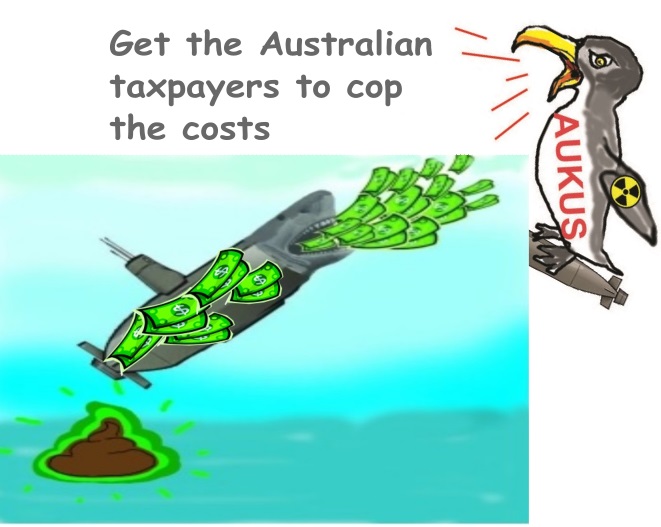
The Australian government will seek to prop up the Aukus pact by sending A$4.6bn (£2.4bn) to the UK to clear bottlenecks at the Rolls-Royce nuclear reactor production line.
The funding – revealed on the eve of high-level talks between the Australian and UK governments on Friday – is in addition to billions of dollars that will be sent to the US to smooth over production delays there.
The Australian government will also announce on Friday that the government-owned shipbuilder ASC and the British defence firm BAE Systems will jointly build the nuclear-powered submarines for the Royal Australian Navy.
The nuclear reactors for the boats are to be manufactured at Rolls-Royce in the English city of Derby, but doubts have already been raised about whether reactor cores will be made in time for the UK’s first Dreadnought nuclear submarine.
Australia has now allocated £2.4bn over 10 years to expand the production capacity at Derby to deliver reactors for Australia’s submarines, to be known as SSN-Aukus……………………………………..
Cameron and the UK defence secretary, Grant Shapps, arrived in Canberra on Thursday for talks with their Australian counterparts, Penny Wong and Richard Marles.
They will hold an annual 2+2 meeting in Adelaide on Friday, with Aukus expected to be a major focus along with the war in Ukraine, the conflict in the Middle East and China’s position in the Indo-Pacific…………………..
Marles, the deputy prime minister and defence minister, said at the same media conference that the Australian government was “really aware of the stretched industrial base in the UK and in the US”.

Australia’s commitment to help clear backlogs in the US and the UK “was not without controversy” but was necessary for Aukus to succeed, Marles said.
Under the staged plans announced last March, Australia will buy at least three Virginia-class submarines from the US in the 2030s, prior to the domestically built SSN-Aukus entering into service from the 2040s.
But revelations that the US Navy plans to build only one Virginia-class nuclear-powered submarine next year have prompted renewed concerns about lagging performance on US production lines.
Marles, Shapps and the US defence secretary, Lloyd Austin, issued a joint statement on Thursday declaring the three countries remained “fully committed to this shared endeavour” and were “investing significantly” to ensure its success.
Australia plans to set up a joint venture between ASC and BAE Systems to build the SSN-Aukus submarines. This structure will allow the Australian government to be heavily involved in delivering the strategically important project.
But the finer details have yet to be locked in, and ASC and BAE will work cooperatively in the meantime to develop the new submarine construction yard at South Australia’s Osborne shipbuilding precinct.
ASC built Australia’s conventionally powered Collins-class submarines, but has not previously worked with nuclear-powered boats.
In 2014 the then defence minister, David Johnston, was censured by the Senate for saying he “wouldn’t trust them [ASC] to build a canoe”…………………………
Australia and the UK on Thursday also signed a new defence and security cooperation agreement that formalises a commitment to consult each other on threats to sovereignty and regional security.
It includes a status of forces agreement, clearing regulatory hurdles for their forces to operate in each other’s countries.https://www.theguardian.com/world/2024/mar/21/australia-moves-to-prop-up-aukus-with-46bn-pledge-to-help-clear-rolls-royce-nuclear-reactor-bottlenecks-in-uk
Filling Nuclear Power’s $5 Trillion Hole Is Beyond the Banks

“We need to find a way to make it predictable, stable, bankable and affordable.”
“The project risks, as we have seen in reality, seem to be very high,” said European Investment Bank Vice President Thomas Ostros. – the world’s biggest multilateral lender recommends that countries needing power quickly focus on renewables and energy efficiency,
Nuclear-energy officials arrived in Brussels this week amid a growing wave of public support for atomic power. They left humbled by the tepid reaction of bankers assessing the price tag of their ambitions.
Bloomberg News, Jonathan Tirone, https://financialpost.com/pmn/business-pmn/filling-nuclear-powers-5-trillion-hole-is-beyond-the-banks/wcm/0d2062d5-7120-4480-b53a-a52e70ef2b45/amp/ 22 Mar 24,
The International Atomic Energy Agency convened a summit to build momentum for a low-emissions technology that many expect will be critical for hitting climate targets. A group of mostly Western countries pledged to triple nuclear generation by 2050. But lenders balked at the eyewatering cost of doing so.
“If the bankers are uniformly pessimistic, it’s a self-fulfilling prophecy,” former US Energy Secretary Ernest Moniz said Thursday after listening to a panel of international lenders explain why they’re unwilling to provide the $5 trillion the industry needs by mid-century.
“The bankers are calling for a proven business case,” said Jozef Sikela, the Czech Republic’s industry and trade minister. “We need to find a way to make it predictable, stable, bankable and affordable.”
Projects in Western economies have been plagued by construction delays and ballooning costs in recent decades. The newest reactor in the European Union — Olkiluoto 3 in Finland — started generating power last year, more than a decade late and three times over budget. Similarly in the US, Southern Co.’s Vogtle facility came in seven years behind schedule and $16 billion over estimates.
“The project risks, as we have seen in reality, seem to be very high,” said European Investment Bank Vice President Thomas Ostros. While the world’s biggest multilateral lender won’t close the door on nuclear, it recommends that countries needing power quickly focus on renewables and energy efficiency, he said.
China and Russia are building the most reactors. But their state-owned model of development is at odds with the European and US emphasis on private capital. That will likely need to change if Western economies want to maintain nuclear’s market share.
“We need state involvement, I don’t see any other model,” Ostros said. “Probably we need quite heavy state involvement to make projects bankable.”
Ines Rocha, a director at the European Bank of Reconstruction and Development, and Fernando Cubillos, a banker at the Development Bank of Latin America, also said their lending priorities lean toward renewables and transmission grids. “Nuclear comes last,” Cubillos said.

Potential new investors could include sovereign wealth funds or philanthropists, according to Charles Oppenheimer, who advocates for nuclear energy at The Oppenheimer Project.
“If it’s a safe and secure investment with a predictable return, there’s a huge amount of capital,” said the grandson of J. Robert Oppenheimer, the US physicist who ran the Manhattan Project. “What is lacking generally is capital for that risky build.”
Europe and the US have been trying to engineer nuclear out of its malaise, proposing a new generation of smaller reactors that can be factory-made and assembled on-site. Theoretically, that approach could cut costs, but has yet to be proven.
In the meantime, with global temperatures soaring and international climate targets in peril, some nuclear advocates say the focus on such innovations may be misguided.
“We’ve heard a lot about a leapfrogging to the next generation of nuclear technologies,” Moniz said. “I would submit it might just be better to focus on getting some technologies deployed right now.”
—With assistance from John Ainger.
Zion Lights and her lying, climate-denying mentor Michael Shellenberger

The only nuclear industry that is booming is nuclear decommissioning ‒ the World Nuclear Association anticipates US$111 billion (A$145 billion) worth of decommissioning projects to 2035. [written in 2017 – but nothing’s changed]
Zion Lights was sucked into nuclear advocacy by self-confessed liar, climate denier and MAGA lunatic Michael Shellenberger.
JIM GREEN, https://jimkgreen1.substack.com/p/zion-lights-and-her-lying-climate 21 Mar 24
The latest substack missive from British nuclear power advocate Zion Lights reflects the cognitive dissonance that all nuclear advocates must be experiencing. Mixed in with anger and nuttiness. In the UK, if the two Hinkley Point C reactors are ever completed (the only two reactors under construction in the UK), the cost will be at least A$44 billion per reactor and it will be at least 25 years between the announcement that new reactors will be built and grid-connection of the reactors. If we allow for the usual pattern of overruns and delays, the figures are likely to be A$50+ billion per reactor, and 30 years between announcement and grid-connection.
Since the last reactor startup in the UK (Sizewell B in 1995), 24 reactors have been permanently shut-down. If the Hinkley Point C reactors begin operating in the early- to mid-30s, it will be 35‒40 years between reactors startups in the UK, during which time there will have been 32 permanent reactor-shutdowns. Only Sizewell B is likely to be operating.
If not for the military connections (which Lights studiously ignores), Hinkley Point C would likely be abandoned and plans for more reactors would also be abandoned.
Lights was sucked into nuclear advocacy by self-confessed liar, climate denier and MAGA lunatic Michael Shellenberger. You can read more about Lights here, Shellenberger here, and you can read Extinction Rebellion’s important statement about both of them here. The Extinction Rebellion statement concludes: “Zion Lights, Michael Shellenberger, the Breakthrough Institute and their associated deniers and delayers are intentionally spreading doubt about the severity of the [climate] crisis and the action needed to respond to it.”
Presumably Lights did at least some research beforehand but still thought it a good idea to work for self-confessed liar and climate denier Shellenberger.
I mention Shellenberger because Lights’ latest substack post is nothing more than a cut-and-paste of lies and distortions that Shellenberger has been peddling for decades. Lights might at least have the decency to come up with her own lies and distortions.
That being the case, I won’t trawl through Lights’ post here. Instead, here is an article about Shellenberger which covers the same ground. “Nuclear power will solve global warming and feed all the world’s children.”
Is there a future for ‘pro-nuclear environmentalism’?
Jim Green, 30 Oct 2017, RenewEconomy. For a longer version of this article please click here.
Michael Shellenberger is visiting Australia this week. He has been a prominent environmentalist (of sorts) since he co-authored the 2004 essay, The Death of Environmentalism. These days, as the President of the California-based ‘Environmental Progress’ lobby group, he is stridently pro-nuclear, hostile towards renewable energy and hostile towards the environment movement.
Shellenberger is visiting to speak at the International Mining and Resources Conference in Melbourne. His visit was promoted by Graham Lloyd in The Australian in September. Shellenberger is “one of the world’s leading new-generation environmental thinkers” according to The Australian, and if the newspaper is any guide he is here to promote his message that wind and solar have failed, that they are doubling the cost of electricity, and that “all existing renewable technologies do is make the electricity system chaotic and provide greenwash for fossil fuels.”
Trawling through Environmental Progress literature, one of their recurring themes is the falsehood that “every time nuclear plants close they are replaced almost entirely by fossil fuels”. South Korea, for example, plans to reduce reliance on coal and nuclear under recently-elected President Moon Jae-in, and to boost reliance on gas and renewables. But Shellenberger and Environmental Progress ignore those plans and concoct their own scare-story in which coal and gas replace nuclear power, electricity prices soar, thousands die from increased air pollution, and greenhouse emissions increase.
Fake scientists and radiation quackery
Environmental Progress’ UK director John Lindberg is described as an “expert on radiation” on the lobby group’s website. In fact, he has no scientific qualifications. Likewise, a South Korean article falsely claims that Shellenberger is a scientist and that article is reposted, without correction, on the Environmental Progress website.
Shellenberger says that at a recent talk in Berlin: “Many Germans simply could not believe how few people died and will die from the Chernobyl accident (under 200) and that nobody died or will die from the meltdowns at Fukushima. How could it be that everything we were told is not only wrong, but often the opposite of the truth?”
There’s a simple reason that Germans didn’t believe Shellenberger’s claims about Chernobyl and Fukushima ‒ they are false.
Continue reading‘We are the masters of the house’: Israeli channels air snuff videos featuring systematic torture of Palestinians

It’s hard to imagine the depths to which Israeli society has sunk. The official tells the Channel 13 reporter that “the feeling is one of pride.”
Israeli TV channels aired a number of reports showing the torture and humiliation of Palestinians in Israeli prisons. The videos are consumed by the Israeli public as entertainment, revealing the sadism of Israeli society.
BY JONATHAN OFIR , https://mondoweiss.net/2024/03/we-are-the-masters-of-the-house-israeli-channels-air-snuff-videos-featuring-systematic-torture-of-palestinians/
Over the past month, mainstream Israeli television channels have aired what can only be described as snuff films. They depict the systematic torture of Palestinians from Gaza in Israeli jails. Such videos have aired on at least three occasions — twice on Channel 14, and once on the public broadcaster, Channel 13. While Channel 14 is considered right-wing, so is about two-thirds of the Israeli public, and the more “mainstream” Channel 13 has shown no qualms about airing similar footage.
The broadcasts follow prison officials into detention centers to document the mistreatment of prisoners, which seems to be something that the officials — and apparently the viewers — find satisfying rather than revolting. The airing of these snuff films is a demonstration of societal sadism.
As Yumna Patel has recently reported, several rights groups have sounded the alarm over the widespread and systemic abuse that Palestinian prisoners face at the hands of the Israeli authorities. These groups’ calls have been unintentionally buttressed by Israeli soldiers’ unapologetic videos of themselves torturing or demeaning Palestinian detainees, which they boastfully post on social media. Now, it seems that the phenomenon has expanded to mainstream Israeli television.
The two aforementioned reports on Channel 14 (threads with subtitles can be found here and here) contained footage of actual interrogation sessions during which torture was used. The Channel 13 report did not, but it exposed some of the worst prison conditions to be broadcast to the public. These conditions include forcing prisoners to live in inhumane conditions and subjecting them to torture and harassment. Here’s the 11-minute video with translated subtitles.
‘The feeling is one of pride’
“Here, we see the cells in which the Nukhba terrorists are held,” the narrator says.
The “Nukhba” refers to elite Hamas-led fighters who carried out the October 7 attack. In the cell, viewers notice metal bunkbeds without mattresses, and instead of a toilet, there is just a hole in the floor. The room is almost completely dark throughout the day, and prisoners have their hands and legs chained together.
We hear attack dogs barking constantly as prisoners are made to kneel while bound and blindfolded, their heads touching the floor.
“This is how it should be,” a guard says. “This is how a Nukhba prisoner should be…what happened on October 7 will never return.”
In another scene, a guard shouts at prisoners as dogs continue to bark incessantly. “Heads down! Heads on the floor!” he yells.
“There are many prisoners here that I personally saw at the [October 7] events,” a prison official says, taking pride in humiliating them. “The difference is that this time, he is afraid, shaking, with his head on the floor…no Allahu Akbar, nothing. You won’t hear a squeak from him.”
“They have no mattresses,” says a warden shift commander. “They have nothing…we control them 100% — their food, their shackling, their sleep…[we] show them we are the masters of the house.” Even without knowing the background to that phrase, to hear him say it is chilling.
“Masters of the house” was the election slogan of Itamar Ben-Gvir, the Jewish Power leader and current Minister of National Security. Ben-Gvir declared war on Palestinian prisoners long before October 7, and this has included shutting down bakeries that supply bread to prisoners — described by Ben-Gvir as an “indulgence” — and drastically limiting prisoners’ water use. So now it’s become much worse.
While one is tempted to believe that all prisoners here are “Nukhba” members, it turns out that many of them aren’t even suspected of that. Rather, they were rounded up in Gaza after October 7, during mass arrests in which hundreds of Gazan men were stripped and paraded in a most sadistic demonstration of power. The mass arrests also included hundreds of women, including pregnant women detained with their babies. Israeli security officials told Haaretz that by their own estimate, “only 10 to 15 percent of the hundreds of the semi-naked and bound Gazan men arrested in the Strip during the recent days are Hamas members or those who identified with the organization.”
Back to the Channel 13 coverage, viewers can hear the nonstop blasting of the Zionist anthem, Am Israel Hai (“the people of Israel live”).
“The prison authorities claim that it is meant to boost the morale of the staff,” the narrator declares. “But it is clear that this is another part of the psychological warfare against the prisoners.”
Torture, in other words.
It’s hard to imagine the depths to which Israeli society has sunk. The official tells the Channel 13 reporter that “the feeling is one of pride.”
The reason such sadism has become formalized as a matter of policy is because this is what the Israeli public demands. The Israeli Democracy Institute released a survey last week showing that two-thirds of Jewish Israelis oppose “the transfer of humanitarian aid to Gaza residents at this time,” even if “via international bodies that are not linked to Hamas or to UNRWA.” For right-wing voters, the opposition to aid jumps from 68% to 80%.
This is not Israel’s Abu Ghraib moment, because when Abu Ghraib was revealed, most Americans were revolted. Israeli society, on the other hand, is thirsting for genocide. No wonder they consume such videos as entertainment on mainstream TV.
Thanks to Tali Shapiro, B.M.@ireallyhatyou, Hilel Biton-Rosen, and Dave Reed.
TODAY. Desperation of the nuclear lobby! Its new financial fantasy scheme, couched in impenetrable jargon!

“International Bank for Nuclear Infrastructure (IBNI) will become the ‘Gold Standard’ of nuclear finance.“
Yes, I diligently tried to grasp it all- “Why nuclear energy needs exclusive global multilateral infrastructure bank”. I really did. Then I realised that I probably wasn’t really supposed to understand it.
It was not for me, an ordinary mortal, to understand why an International Bank for Nuclear Infrastructure (IBNI) is such a good idea . The point is – this IBNI will save the world from global heating – that’s the message!
I’m not sure that even the worthy financial and nuclear and government experts are going to be able to fully understand it either. But I guess that the nuclear lobby is banking on this bank as a last desperate measure to get heaps of taxpayer money into the failing nuclear industry.
It’s grim times for nuclear. They seem to have managed to convince everyone that nuclear wastes, and health, environmental, safety, and weapons proliferation risks don’t matter.
They used in the past, along with their coal, oil, gas industry mates, deny that climate change was real. Now they love it – and have adopted climate change as their only raison d’etre.
The nuclear lobby used to boast that their industry provided super-cheap electricity. But now they’re obviously admitting that nuclear electricity is in fact very expensive. But hey – pull a magic trick, – con governments again – and perhaps we’ll all agree to pour money into this incomprehensible new gimmick – the ” International Bank for Nuclear Infrastructure (IBNI)”
Sure sounds pretty desperate to me!
Shadow energy minister Ted O’Brien’s nuclear energy misstep

https://www.canberratimes.com.au/story/8560035/shadow-minister-ted-obriens-nuclear-energy-misstep/ By John Hanscombe, March 20 2024
A couple of weeks ago, during a run of sunny, breezy weather, the price of electricity actually went into negative territory in NSW as wind and solar kicked in.
I discovered this on a fascinating website, OpenNEM, which tracks national energy market data, including where the power comes from – solar, wind, hydro, coal and gas – the emissions it produces, and its value at any given point. It’s become a bit addictive, regularly checking to see where most of the power has come from.
It was heartening seeing renewables – especially rooftop solar – generating so much power during the day when conditions were favourable.
Solar’s peak was especially high last Tuesday, the same day shadow energy minister Ted O’Brien appeared on the ABC’s 7.30 to spruik the Coalition’s push for nuclear energy. O’Brien made the mistake of trying to mansplain to Sarah Ferguson (is there a more patronising expression than “Let me unpack this”?) why his party thought nuclear was the way to go. It was painful to watch.
He fumbled through awkward questions about cost. Questions about the fact it takes the US, with its established nuclear energy industry, 19 years to build a reactor. Questions about the Coalition’s intentions to keep coal in the energy mix. Every attempt by Ted to “unpack it” ended up in a ditch.
This question from Ferguson on Bill Gates’s enthusiasm for nuclear, cited repeatedly by the Coalition, was when things really went bad for poor old Ted: “I asked Bill Gates, on this program, whether Australia should be involved in nuclear energy, and this was his answer: ‘Australia doesn’t need to get engaged on this. Australia should aggressively take advantage of Australia’s natural endowment to do solar and wind. That’s clear-cut and beneficial to Australia.'”
By the end of the interview, the shadow minister was a shadow of his former self.
“He ended up looking like he’d been through a woodchipper,” said a mate watching from Hobart.
News from the Australian Energy Market that electricity prices were not going to be hiked next year, and would even start to come down, will make the Coalition’s nuclear pitch even harder to sell.
Most energy experts agree the cost of setting up nuclear power in Australia will be borne by consumers, that it would likely be the mid-2040s when a reactor would finally come on line.
Peter Dutton keeps calling for a mature discussion on nuclear energy.
There’s nothing mature about dismissing the work of the CSIRO, our peak scientific body, just because its research shows renewables are cheaper than coal and nuclear.
There’s nothing mature about Ted O’Brien ignoring the advice of one of the world’s most successful business operators and nuclear energy champions, Bill Gates, who says Australia doesn’t need to go down that expensive path.
And skipping from hailing theoretical small modular reactors one week to large-scale reactors the next is all over the shop.
The whole push seems to be a Quixotic attempt at relevance, a guileless opposition tilting at windmills.
The International Atomic Energy Agency (IAEA) Cannot Both Police Proliferation and Promote Nuclear Power

“We are playing with fire, and something very, very catastrophic could take place,” lamented Grossi during a September 2022 UN Security Council briefing, referring to the six Zaporizhzhia reactors in Ukraine, the closest ones to the fighting.
And yet, Grossi has also stated: “It’s very simple, the problem in Ukraine and in Russia is they are at war. The problem is not nuclear energy”. But nuclear energy is very much the problem. Wind farms and solar arrays would present no such dangers under similar circumstances.
Counter Punch, BY LINDA PENTZ GUNTER, 2o Mar 24, https://www.counterpunch.org/2024/03/21/the-iaea-cannot-both-police-proliferation-and-promote-nuclear-power/
The UN agency is sounding the alarm about Ukraine’s reactors and Iran’s nuclear intentions, while at the same time promoting the very technology that delivers these risks
On March 21 in Brussels, Belgium, the International Atomic Energy Agency (IAEA) will host what it is billing as the “First ever Nuclear Energy Summit.” The event follows a pledge made by 22 countries last December during the COP28 climate summit in Dubai to triple global nuclear capacity by 2050.
The Brussels summit, co-hosted by the IAEA and the Belgian government, and featuring prominent officials from the US Department of Energy, will bring together world leaders and other officials to “highlight the role of nuclear energy in addressing the global challenges to reduce the use of fossil fuels, enhance energy security and boost economic development,” according to the event’s website.
Ignoring for a moment that tripling anything by 2050 will be far too late to address the climate crisis now upon us, the Brussels summit is troubling as it marks a notable ramping up of aggressive nuclear power marketing by the IAEA, an agency of the United Nations that is mandated “to deter the spread of nuclear weapons”.
This goal is inherently thwarted by the promotion of civil nuclear energy, which effectively hands over the keys to the nuclear weapons castle by affording non-nuclear weapons countries the technology, materials, know-how and personnel to develop nuclear weapons. History has already demonstrated this with the nuclear weapons programs of India, Pakistan, Israel and North Korea, all of which were acquired via the civil nuclear route.
This is precisely the conundrum with Iran, a signatory to the nuclear Non-Proliferation Treaty that affords non-nuclear weapons countries the “inalienable right” to develop a civil nuclear power program. Iran has long claimed to be doing precisely that and yet the IAEA’s director general, Rafael Grossi, sounded the alarm in late February when he noted that Iran appears to have enriched uranium “well beyond the needs for commercial nuclear use.” This should not be a surprise.
Another contradiction lies in the IAEA’s stated mission to work for “the safe, secure and peaceful application of nuclear science and technology”. To achieve this, the agency eagerly advocates for the global expansion of nuclear power while at the same time worrying about the extreme peril of Ukraine’s 15 civil reactors embroiled in the current Russian war in that country.
“We are playing with fire, and something very, very catastrophic could take place,” lamented Grossi during a September 2022 UN Security Council briefing, referring to the six Zaporizhzhia reactors in Ukraine, the closest ones to the fighting.
In late February this year Grossi warned again that an “extremely vulnerable off-site power situation continues to pose significant safety and security challenges for this major nuclear facility”, calling the safety and security situation at the Zaporizhzhia plant “precarious”.
And yet, Grossi has also stated: “It’s very simple, the problem in Ukraine and in Russia is they are at war. The problem is not nuclear energy”. But nuclear energy is very much the problem. Wind farms and solar arrays would present no such dangers under similar circumstances.
At COP28, Grossi trumpeted that “global net zero carbon emissions can only be reached by 2050 with swift, sustained and significant investment in nuclear energy”, entirely ignoring the faster, cheaper and safer contribution renewable energy is already making to that end.
In the same statement Grossi described nuclear power as “resilient and robust” when it is manifestly neither. Nuclear energy’s share of global commercial gross electricity generation hit a four-decade record low in 2022 according to the 2023 World Nuclear Industry Status Report, a downward trend that is unlikely to change.
The IAEA’s triple nuclear energy plan is both a massive over-reach and a reckless and unattainable diversion, given that no new nuclear construction has ever come anywhere close to this pace, even with known and familiar reactor designs. In fact, nuclear power plants have been taking even longer to build in recent years, at even higher cost.
The proposed “new” smaller reactors — not new at all and rejected for decades as too uneconomical — are designs on paper only that have zero chance of delivery in time and in enough numbers to make any impact on the climate crisis.
The IAEA cannot be both nuclear policeman and promoter. In pushing nuclear power across the globe, the IAEA is complicit in a climate crime that wastes time and money on the needless expansion of expensive, slow and dangerous nuclear power. This takes away vital resources from renewable energy and energy efficiency that would rapidly, safely and affordably address the climate crisis, none of which nuclear power can achieve.
Linda Pentz Gunter is the editor and curator of BeyondNuclearInternational.org and the international specialist at Beyond Nuclear.
Blinken visits Middle East to discuss Gaza post-war plan

The major Arab sponsor Saudi Arabia would normalise relations with Israel in return for access to advanced US weapons and an American-backed civilian nuclear power programme.
https://www.bbc.com/news/world-middle-east-68614549 By Tom Bateman, State Department correspondent & Rushdi Abu Alouf, Gaza correspondent,, BBC News, in Jeddah and Istanbul
The US secretary of state has flown to the Middle East to discuss a post-war plan to govern and secure Gaza.
Antony Blinken’s talks with Arab leaders in Saudi Arabia and then Egypt will focus on what the US calls “an architecture for lasting peace”.
It comes as witnesses said Israeli forces had escalated their operation around al-Shifa hospital in Gaza City, carrying out a number of air strikes.
Earlier, Israel’s military said it had killed 90 gunmen there since Monday.
Separately, indirect negotiations between Israel and Hamas are continuing in Qatar to bring about a ceasefire and the release of hostages. But there are few signs that a breakthrough is imminent.
Mr Blinken’s sixth trip to the region since the start of the war in Gaza saw him land in Jeddah on Wednesday afternoon to meet the Saudi leadership.
Descending from the plane shortly before sundown he was greeted by waiting officials, including Mazin al-Himali from the Saudi foreign ministry, who embraced Mr Blinken.
He is expected to meet the Saudi Crown Prince, Mohammed bin Salman, at the royal palace on Wednesday night.
State department spokesman Matthew Miller said they would discuss efforts to reach a ceasefire agreement and increase aid deliveries to Gaza, amid further dire warnings about the scale of the humanitarian crisis there.
A UN-backed food security assessment this week said 1.1 million people in Gaza were struggling with catastrophic hunger and starvation, adding that a man-made famine in the north was imminent between now and May.
Also on the agenda would be “co-ordination on post-conflict planning for Gaza, including ensuring Hamas can no longer govern or repeat the attacks of 7 October, a political path for the Palestinian people with security assurances with Israel, and an architecture for lasting peace and security in the region”, Mr Miller added.
Mr Blinken will travel to Cairo on Thursday to meet Egyptian leaders.
The Americans are trying to bring together a major deal that would put the internationally-recognised Palestinian Authority (PA) back into Gaza for the first time since it was driven out by Hamas 17 years ago.
Nothing has yet been drawn up, but the ideas are thought to include possible support on the ground from Arab nations, while all the parties including Israel would commit to pursuing a two-state solution – the long-held international formula for peace.
The major Arab sponsor Saudi Arabia would normalise relations with Israel in return for access to advanced US weapons and an American-backed civilian nuclear power programme.
However, even if such a multi-part plan could be agreed, US officials concede it is likely only attainable in the longer term.
Meanwhile, Israeli Prime Minister Benjamin Netanyahu has repeatedly rejected the idea of PA control of Gaza. The issue is likely to be another sticking point amid an already fractious relationship with President Biden.
Some of those familiar with the plan concede it feels ambitious given the lack of breakthrough on a ceasefire agreement, the ongoing humanitarian crisis, and because any remaining trust between Israelis and Palestinians is shattered. But the US administration hopes it can still use the moment to grasp the initiative.
Mr Blinken will also travel to Israel on Friday as part of his current trip. According to Mr Miller, he will discuss with Israeli leaders the hostage negotiations and the “need to ensure the defeat of Hamas, including in Rafah, in a way that protects the civilian population”.
President Joe Biden has warned Israel that it would be a “mistake” to launch an offensive in the southern city of Rafah, where more than a million displaced civilians are sheltering.
But on Tuesday, Mr Netanyahu said Israel was “determined to complete the elimination of [the Hamas] battalions in Rafah, and there is no way to do this without a ground incursion”.
More than 31,900 people have been killed in Gaza since the start of the war, according to the territory’s Hamas-run health ministry, which does not distinguish between civilians and combatants.
The conflict began when about 1,200 people were killed and 253 others were taken hostage in Hamas’s attacks on southern Israel on 7 October, according to Israeli tallies.
On the ground in Gaza on Wednesday, heavy fighting raged around al-Shifa hospital as the Israeli military’s operation there continued for a third day.
Witnesses told the BBC that tanks previously positioned around the hospital complex had now moved eastwards, along al-Wahda Street.
They also reported a significant increase in the number of air strikes in Gaza City and other northern areas.
“The relentless sounds of explosions can be heard from around al-Shifa hospital,” said Osama Tawfiq, who lives 700m (2,300ft) from the complex. “Since Monday morning, we feel like as if the war has just begun.”
According to the witnesses, the strikes targeted homes belonging to members of Hamas who had been assigned to serve on so-called “emergency committees” in place of the armed group’s police force.
Among them was Amjad Hathat, who was reportedly killed along with 11 other emergency committee members at the Kuwait roundabout in Gaza City on Tuesday evening while securing the distribution of humanitarian aid.
Mr Tawfiq said that the situation had deteriorated in his area, after a period of relative calm that followed the withdrawal of Israeli forces in mid-January.
“We are not only enduring bombings but also facing a looming food crisis.”
“During last Ramadan, we could break our fast with some food. But now we struggle to find anything beyond water that smells like sewage and tastes like seawater, as well as meagre bread. My children are suffering from hunger.”
A UN-backed food security assessment has said 1.1 million people in Gaza are struggling with catastrophic hunger and starvation, and that a man-made famine in the north of the territory is imminent between now and May.
On Wednesday morning, the Israeli military said its troops had killed approximately 90 gunmen and questioned 300 suspects during what it called the “precise operation” in and around al-Shifa.
They first raided the hospital in November, when the military accused it of being a Hamas “command and control centre” – an allegation that Hamas and hospital officials denied.
The military said the latest operation was launched on Monday because “senior Hamas terrorists have regrouped inside… and are using it to command attacks against Israel”.
Hamas acknowledged a senior commander of its internal security force was killed there on Monday, but said he was co-ordinating aid deliveries. It said the other people killed were patients and displaced civilians sheltering there.
The military said it was taking measures to avoid harm to civilians and keep the hospital functioning, but witnesses told BBC Arabic’s Gaza Today programme that that the situation there was catastrophic and that civilians, including medics, were crowded in corridors.
“Children do not stop crying because they are dying of hunger and thirst… and the wounded suffer all night long due to the lack of medicines and painkillers,” one displaced woman, who asked not to be named, said on Tuesday.
“The bulldozers are sweeping away the places where we are staying, and shrapnel is flying above our heads everywhere,” she added.
Additional reporting by David Gritten in London
TODAY. Anthony Blinken would get into bed with the devil, if it meant lucrative sales of USA weapons and nukes to Hell

One cannot help but admire the frantic peregrinations of Antony Blinken all around the world, in pursuit of American weapons companies’ interest, as well as doing the smarmy cover-up for USA’s support of Israel’s genocide in Gaza. The guy has amazing energy and zeal. Not sure about integrity.
However, this is all symptomatic of American prevailing culture. The Biden administration does seem hell-bent on backing Israel – even though the horror of the atrocity in Gaza is visible to the world. Even though the world’s Jews now fear an awful backlash, and the rise of nasty anti-semitism.
But the USA blunders on. The war in Ukraine drags on, and the weapons flow no doubt will continue there. (The U.S. Republicans will surely eventually find a way to back the provision of more weapons to UKraine). The weapons flow continues to Israel, despite Biden’s pious proclamations about peace.
I’m forever reading in the U.S. press about other countries clamouring to buy USA nuclear technology – plans to sell small and large nuclear reactors to Poland, Romania, Slovakia, Estonia, the Czech Republic and Ukraine, Kenya, Ghana, and of course, the big nuclear submarine coup sale to Australia ………………
I also read – what I find rather nauseous – stuff about how the USA is “helping” the people of Gaza – compassionate aid, plans for when Israel is finally completely victorious, and so on.
But it was the BBC’s story today that really impressed me: Blinken visits Middle East to discuss Gaza post-war plan.
“The major Arab sponsor Saudi Arabia would normalise relations with Israel in return for access to advanced US weapons and an American-backed civilian nuclear power programme.“
I momentarily lack the energy to write about the USA’s new best friend – Saudi Arabia, (itself a buyer of USA arms), about the 2018 murder of Jamal Khashoggi, about the discrimination against women, and Saudi Arabia’s whole theocratic suppression of human rights.
But all is forgiven, if we can make money selling weapons, and if that means some delicate diplomatic acrobatics what better acrobat than Antony Blinken?
UK and Australia set to elevate defence relationship to NATO level with new ‘status of forces’ agreement
ABC News, by Defence correspondent Andrew Greene, 21 Mar 24
- In short: UK Foreign Secretary David Cameron and Defence Secretary Grant Shapps are in Australia to discuss efforts to help Ukraine against Russia’s invasion and the AUKUS partnership to deliver nuclear-powered submarines to Australia.
- It’s expected the two parties will sign a new “status of forces” agreement, which establishes the framework under which military personnel can operate in a foreign country.
- What’s next? The first Australian-built submarine is scheduled to arrive in the early 2040s.
……………………………………… During formal meetings in Canberra on Thursday, and then at AUKMIN in Adelaide on Friday, discussions are expected to focus on efforts to help Ukraine against Russia’s invasion and the AUKUS partnership to deliver nuclear-powered submarines to Australia.
“If the United Kingdom signs a ‘Status of Forces’ agreement with Australia it will be the first such arrangement it has done so with any country outside NATO,” an official familiar with AUKMIN planning told the ABC, speaking on the condition of anonymity.
A Status of Forces Agreement, or SOFA, is either a multilateral or bilateral agreement and establishes the framework under which military personnel can operate in a foreign country.
It can also shape how domestic laws of that jurisdiction apply towards them while posted there.
…………………….The Australian and British ministers will head to Adelaide late Thursday ahead of a “significant” announcement on sovereign submarine shipbuilding in Adelaide.
British defence giant BAE Systems, which is currently constructing Australia’s Hunter-class frigates, is widely anticipated to be announced as the main builder for the new SSN-AUKUS submarines to be assembled in Adelaide.
BAE Systems currently builds the Royal Navy’s submarines in northern England and already has a considerable presence in Adelaide.
The first Australian-built submarine is scheduled to arrive in the early 2040s.
Following the submarine announcement, all four ministers will go behind closed doors for their AUKMIN talks, before a joint press conference in the afternoon. …. https://www.abc.net.au/news/2024-03-21/uk-and-australian-to-strengthen-military-ties/103613164
—
Glorious new financial jargon from the nuclear lobby – the “International Bank for Nuclear Infrastructure (IBNI)”
International Bank for Nuclear Infrastructure (IBNI) will become the ‘Gold Standard’ of nuclear finance.
the IBNI will have an estimated 30+ sovereign governmental member shareholders, each with aligned views on nuclear energy and other global policy objectives. …….. IBNI – as a specialised ‘global nuclear infrastructure bank’ – will have a global mandate to finance and support nuclear sector projects, programmes and industries in all its member countries .
where the bank aims to achieve the most significant global impacts will be in catalysing a highly significant ‘capital multiplier impact’, which represents the total quantum of global financial markets capital mobilised relative to each dollar of public investment (by sovereign shareholder member states) in the bank.
IBNI will become the ‘Gold Standard’ of nuclear finance.
Why nuclear energy needs exclusive global multilateral infrastructure bank By Daniel Dean, 18 Mar 2024 https://www.nsenergybusiness.com/features/why-nuclear-energy-needs-exclusive-global-multilateral-infrastructure-bank/—
The mobilisation of trillions of dollars of global capital necessary for the nuclear sector to scale in the near-term can be supported by a new kind of financial institution – an international multilateral infrastructure bank focused exclusively on nuclear energy, writes Daniel Dean, IBNI-IO SAG chairman.
Attaining current policy objectives, including 2050 Net Zero, will require global nuclear technologies to scale to an unprecedented magnitude and at breakneck speed.

COMMENT on Lie number 1. Attaining 2050 Net Zero may well be impossible anyway, but there is zero likelihood of nuclear power to have anything meaningful to do with it, other than to slow down real solutions – energy conservation and renewable energy .
This historically unmatched scaling will also require the very rapid mobilisation of multiple trillions of dollars of capital into the sector.quick online loans. Existing nuclear project delivery and financing mechanisms rely mainly on governmental support and attract very limited risk appetite from the global financial markets. Such existing models will be insufficient for catalyzing the very significant quanta of capital necessary required to enable nuclear to scale as quickly as possible to achieve multiple 100s of GW’s of additional global nuclear generation capacity. If the world is going to achieve its ambitious climate, clean energy, energy transition and energy security goals in this short period of time, there simply needs to be a fundamental change in the approach toward financing nuclear infrastructure.
Scaling of the nuclear sector faces numerous and multidimensional impediments. These interrelated impediments span a broad spectrum and include among others: public policy; regulatory, markets and ESG frameworks; social license; geopolitical; commercial and risk allocation models; and perhaps most importantly, affordability and accessibility. Each of the nuclear sector’s impediments is manifested in the form of financial risk. Clearly, the nuclear industry will need to do its part through increased on-time and on-budget performance and other progressive improvements, alongside the key roles of governments, owner-operators, end-users/ratepayers and all other stakeholder groups that will each need to do their part. However, the ‘sum of these parts’ (e.g. what each stakeholder can individually do) does not add up to a solution that will enable nuclear to scale.
The mobilisation of the necessary capital required for nuclear to scale, requires formulation of systemic and multidimensional risk mitigation solutions. The nuclear sector is currently caught in a ‘vicious circle’, whereby nuclear cannot and will not scale without access to a ‘runway’ of cost-efficient capital and such capital is not accessible unless nuclear becomes sufficiently de-risked due to scaling. Nuclear’s ‘vicious circle’ needs to be very rapidly transformed into a ‘virtuous circle’, which will require immediate risk mitigation solutions and unlocking capital flows well before scaling can begin.
From a financial risk management perspective, the nuclear sector poses excessive financial risk as it is measured in the form of the Value at Risk (“VaR”) metric. From a financier’s perspective, VaR can be described simply as: the amount of at-risk capital deployed and the probability of loss.
Because nuclear sector financings are both highly capital intensive and the real and perceived risks of the sector are viewed to be high, it is intuitive that the nuclear sector’s VaR profiles currently compare unfavourably against many other alternative asset classes.

Well that one sure is true!
A new nuclear investor
The proposed International Bank for Nuclear Infrastructure (IBNI) will be a new multilateral nuclear infrastructure bank that will be focused on enabling nuclear technology to rapidly scale and become both highly affordable and accessible within all its member countries, globally. Importantly, IBNI will finance and support both the production and supply chain (supply side) as well as the customer side (demand side) of the nuclear sector in member countries ranging from developing countries to highly developed ‘nuclear mature’ countries. The bank will act as the global early and long-term patient capital provider and it will finance and support all areas of the nuclear value spectrum on a technology-, vendor-, and country-neutral basis including new-build (Gen. III/ III+, Gen IV and future fusion, other); life-extensions and re-starts; refinancing and restructurings; fuel cycle (mining through repository); production and supply chains; nuclear infrastructure; and decommissioning and nuclear waste management projects, programs and industries.
IBNI will be capitalised, governed and operated using models similar to those that have been proven mission-successful by the world’s major global multilateral banks, which have been in existence for many decades. Those models include the World Bank Group (WBG); the European Bank for Reconstruction and Development (EBRD); and the Asian Development Bank (ADB). In other words, the IBNI will have an estimated 30+ sovereign governmental member shareholders, each with aligned views on nuclear energy and other global policy objectives. Whereas those existing ‘multilateral development banks’ like the WBG, EBRD and ADB are generally focused on missions such as economic development and poverty eradication (and generally, within defined geographies, developmental and/or income strata), IBNI – as a specialised ‘global nuclear infrastructure bank’ – will have a global mandate to finance and support nuclear sector projects, programmes and industries in all its member countries (not limited to geography, developmental status or income level). The existing multilateral banks are currently not providing any material support for the nuclear sector. While the change in longstanding policies of these institutions toward nuclear is highly encouraged and would be complimentary (not competitive), these institutions are ill-equipped to be seen as a substitute for IBNI’s proposed role as the global nuclear financing institution.
On the one hand, the bank will use its own capital to directly co-finance and support qualified nuclear projects based on the principle of ‘additionality’ (i.e. ‘bridging gaps’ throughout the nuclear value spectrum where existing public and private funding and financing are not adequately accessible on a cost-efficient basis). It is anticipated that the bank’s main commercial operating arm, the IBNI Ordinary Operations Fund will be a self-sustaining entity that will issue long-term debt in the global ‘sovereign and supranational bond markets’. Based on the strong shareholder liquidity and support offered by the bank’s shareholders, it is envisaged that the fund will achieve ‘triple-A’ credit ratings or the highest credit quality that will allow IBNI to borrow funds at the lowest cost and in turn, pass along lowest cost financing for the benefit of the bank’s programme participants. Certainly, accessing least-cost capital is one critical element that will drive down nuclear generation costs and enable nuclear technologies to achieve affordability targets, which are critical for enabling nuclear to scale.
On the other hand, and most importantly, where the bank aims to achieve the most significant global impacts will be in catalysing a highly significant ‘capital multiplier impact’, which represents the total quantum of global financial markets capital mobilised relative to each dollar of public investment (by sovereign shareholder member states) in the bank. IBNI’s advisory team projects that the bank should reasonably target a ‘capital multiplier impact’ of more than 100x, from the bank’s targeted establishment date in 2024/25 through 2050. Accordingly, the potential for the highly significant ‘capital multiplier impact’ effect targeted by IBNI will provide the highest value for money for each public dollar invested. Thus, a comparative investment in the bank would represent the most efficient means of achieving both national and global policy objectives, relative to strictly inward investments in a countries own nuclear sector’s domestic and bilateral initiatives (which the bank would not compete with).
COMMENT: utterly convincing? Not really.
Managing nuclear risk
In order to accomplish the bank’s core mission of scaling nuclear to attain a sustainable 2050 Net Zero World, IBNI will need to enable multidimensional risk mitigation solutions that will rapidly and sufficiently reduce nuclear sector VaR profiles to levels that become acceptable and in line with other similar infrastructure asset classes.
IBNI will implement programmes and offer customised financial product lines that will be engineered to systemically and progressively ‘flatten’ the VaR curves all across the nuclear sector. This ambition goes well beyond the necessary goal of developing market confidence through the necessary demonstration of global fleet deployments of serialised, repeatable, successful nuclear projects delivered within schedule and budget. IBNI will also serve as a global aggregator of an adopted set of universal nuclear-specific standards and criteria and the bank will aim to become a global institutional repository of nuclear financing expertise, which will become relied upon by investors, lenders and financing institutions for their own evaluation of nuclear sector financing transactions. Borrowing from the World Bank’s phraseology, IBNI will become the ‘Gold Standard’ of nuclear finance. While currently there are discrete elements of nuclear-specific financing standards and expertise available (from the International Atomic Energy Agency, Organisation of Economic Cooperation and Development, and Equator Principles IV, International Finance Corporation Standards, for example), there is, by no means, the necessary comprehensive set of nuclear-specific financing standards and criteria, such as those that pertain to every other asset class which are available from the existing major multilateral financing institutions like the World Bank. Nuclear is a very unique asset class that deserves its own global financial institution that would have deep expertise within the sector and an understanding of the unique multidimensional risk elements of nuclear finance. Such an institution would be able to adopt a set of standards and criteria specific to these unique elements.
Without an IBNI, and despite the valiant combined efforts of individual governments, sporadic international cooperation and the nuclear industry itself, the nuclear sector’s ability to scale will most likely continue to be constrained and the ‘vicious circle’ will persist unbroken.
COMMENT. Yes – agreed – the nuclear sector’s ability to scale will most likely continue to be constrained and the ‘vicious circle’ will persist
IBNI offers a unique ‘whole of the world’ proposition that will enable the global nuclear sector to rapidly and efficiently break the ‘vicious circle’ that persistently plagues the sector. Only through a global and systemic approach toward mitigating nuclear’s multidimensional risk elements and sufficiently ‘flattening’ the nuclear sector’s VaR curves can the sector’s ‘vicious circle’ be transformed into a ‘virtuous circle’. IBNI offers this unique global risk mitigation solution which will enable the mobilisation of trillions of dollars of global capital necessary for the nuclear sector to scale in the near term.

This article first appeared in Nuclear Engineering International magazine.
Armed by Washington, Israel Trashes the Genocide Convention
Stop treating Gaza like a natural disaster.
SCHEERPOST, By Stan Cox and Priti Gulati Cox / TomDispatch 20 Mar 24
It’s been almost two months since the International Court of Justice ordered Israel to stop killing Gazans and destroying their means of subsistence. So let’s look back and ask (1) how Israel has responded to its “orders,” and (2) how hard the Biden administration has pushed Israel to abide by those orders. Spoiler alert: the short answers are (1) not well and (2) not very.
The American government has provided most of the armaments and targeting technologies being used to kill Gazans by the thousands while turning many of the rest of them into refugees by destroying their homes, offices, schools, and hospitals. Nor did the Biden administration threaten to withdraw that support when Israel blocked shipments of crucial food and fuel to the 25-mile-long Gaza Strip. It also keeps vetoing U.N. Security Council resolutions that would hold Israel accountable. And President Biden, despite an increasing amount of rhetorical shuffling, continues to back Prime Minister Benjamin Netanyahu and the Israeli Defense Forces (IDF), even though they have ignored the International Court’s orders and continue committing atrocities.
Flouting the Order to Stop the Killing
On January 26th, the International Court of Justice handed down a ruling in a case brought by the Republic of South Africa accusing Israel of genocide. It ordered that Israel must “ensure with immediate effect that its military does not commit any acts described” in the United Nations Convention on the Prevention and Punishment of the Crime of Genocide.
The court’s first order prohibited “killing members” of the Palestinian population or “causing serious bodily or mental harm” to them. How did Israel respond? Consider that, between late December 2023 and January 21st of this year, the IDF had killed about 5,000 Palestinians, already pushing the death toll in the Gaza Strip past 25,000. The court’s order, issued days later, would have essentially zero effect. Another 5,000-plus Palestinians would be killed by late February, raising the death toll to more than 30,000.
During the month after the ruling, Israeli troops repeatedly killed or injured civilians fleeing to, or taking shelter in, areas the IDF had advertised as “safe zones.” Typically, when, on February 12th, Israeli aircraft attacked 14 homes and three mosques in the southern Gaza city of Rafah, killing 67 Palestinians, some of the survivors told reporters that they’d been inside tents in a refugee camp. Similarly, on February 22nd, Israeli warplanes struck a residential area in central Gaza, killing 40 civilians, mostly women and children, and wounding more than 100.
Worse yet, the Biden administration has enabled that ongoing killing spree by approving 100 separate military sales to Israel since the conflict began in October. As a former administration official told the Washington Post, “That’s an extraordinary number of sales over the course of a pretty short amount of time, which really strongly suggests that the Israeli campaign would not be sustainable without this level of U.S. support.”
In other words, the backbone of the war on Gaza comes with a label: “Made in USA.” In the decade leading up to October 7th, as the Stockholm International Peace Research Institute has reported, two-thirds of Israel’s arms imports came from the United States. (From 1950 to 2020, the U.S. share was a whopping 83%!)
In just the first couple of months of the war, the Biden administration sent 230 cargo planes and 20 ships full of military goods to Israel, a trove that included 100 BLU-109 bombs (2,000-pounders designed to penetrate hardened structures before exploding), 5,400 MK84 and 5,000 MK82 bunker-busters, 1,000 GBU-39 bombs, 3,000 JDAM bomb-guidance kits, and 200 “kamikaze drones.”
Such powerful bombs, reported Al Jazeera, “have been used in some of the deadliest Israeli attacks on the Gaza Strip, including a strike that leveled an apartment block in the Jabalia refugee camp, killing more than 100 people.” And yes, such bunker-busters were widely used in the U.S. wars in Iraq and Afghanistan, but not in places as densely populated as Gaza’s cities. Israeli sources tried to justify that particular death toll by insisting it was necessary to kill one of Hamas’s leaders. If so, we’re talking about a 100-to-1 ratio, or a kind of collective punishment being supported by our tax dollars………………………………………………………………………………………………………more https://scheerpost.com/2024/03/20/armed-by-washington-israel-trashes-the-genocide-convention/
TODAY. In talking about nuclear matters, why is money the only game in town?

I’m constantly reading nuclear news items. And yes, I am getting bored with all the money stuff. I know it’s important. I know that money is very very important, especially these days with the cost of living on everyone’s mind.(Well, perhaps not the 1% – the very wealthy)
It must be so important. There’s America’s small nuclear reactor dream gone bung, because NuScale’s smrs cost too much. There are the bankruptcies Westinghouse- and those near to bankruptcy – Toshiba, EDF, and the companies with a chequered past e,g.- SNC-Lavalin, Areva (reborn as Orano),
There are the financial contortions going on in Britain, with its very dodgy “Great British Nuclear”. The USA agonising over the ginormous costs of the still uncompleted Vogtle NPP. And France with Macron’s delusional scheme for many big and small reactors to be built very fast, -while they can’t afford to fix up, or to close down, their existing fleet of aging reactors.
There are the “minor” countries also agonising over how to pay for their nuclear schemes – Indonesia, Bulgaria, Sweden, Kenya, Ghana………
But of course, Russia China, North Korea, are fine with nuclear economics – or so I’m told by some Australian nuclear zealots who are NRB (- not real bright). Yeah well, if you need a dictatorship to make nuclear power economic, I guess that’s the way to go. (But are we sure it’s all that good in those countries, anyway?)
But anyway, yes, I’m wondering why the media doesn’t seems to be fussing about the radioactive pollution of our planet, and the risks to health, especially of pregnant women, children, and everybody. Big accidents are rare – but they do happen , smaller accidents happen, too. And the connection with weapons, war, the nightmare possibility of omnicide – that’s a bit of a worry too. Of course indigenous people and those silly anti-nuclear activists make a fuss, but they don’t count, do they?
I guess it is all symptomatic of our era, our prevailing culture, the worship of not just profit, but ever-increasing profit.
Still, perhaps I should not complain. Worrying about money might be the only thing saving us from nuclear follies. And I note that when they do their earnest costing of nuclear power – they talk only about building costs and electricity prices – and it’s already too expensive! What if they also counted the cost of nuclear waste disposal, and a thousand years of securing it?
Chief scientist backs renewables, calls nuclear power ‘expensive’
Q+A / By Jason Whittaker 18 Mar 24
- In short: Chief Scientist Cathy Foley says nuclear energy is “expensive” and the energy debate must be guided by research.
- Opposition Leader Peter Dutton has criticised the CSIRO, which says renewables like solar and wind are cheaper.
- What’s next? Retired Major General Gus McLachlan says the purchase of nuclear-powered submarines is a test of leadership.
Australia’s chief scientist has backed a renewables-led path to net zero emissions over the “expensive technology” of nuclear energy.
After the federal opposition puts nuclear-fired power generation back on the national agenda, Cathy Foley told Q+A that any assessment of energy sources should be guided by evidence.
“If you look at the reports that have been done, it’s [nuclear power] an expensive technology and it’s one where it would take some time to build up the capability to do that in Australia,” Dr Foley said.
“As chief scientist, it’s not for me to actually say what the government should do.
“What we should be doing is looking at the evidence and the information that is available and making sure that we make good decisions based on all the different things we have to take into account.”
Last week, Opposition Leader Peter Dutton attacked research from the CSIRO on the higher cost of nuclear power over renewables such as solar and wind, prompting a public defence from the nation’s leading science institution.
“It’s not relied on. It’s not a genuine piece of work,” Mr Dutton said on Friday, calling the research “discredited”.
In response, CSIRO chief executive Douglas Hilton said in a statement: “I will staunchly defend our scientists and our organisation against unfounded criticism.”
Dr Foley spent 15 years at the CSIRO before becoming the nation’s chief scientist.
Asked by Q+A host Patricia Karvelas if nuclear power should be on the table, she said: “I don’t think we should be making that decision without getting the information that’s needed.”
“So at the moment the plan is to be able to get to zero emissions using renewables and batteries …
“Australia has got a fantastic situation where we have so much energy from wind and solar that we should be making the most of that.
“We have the potential to have renewables based on solar panels and wind and batteries and that is the pathway that the government has been putting forward and is on a plan to get there by getting to zero emissions.”
The power of ‘little suns’
Leading American physicist Bryan Greene said nuclear is a “wonderful energy source” — but it’s the next generation of the technology (nuclear fusion) that offers the most promise.
“Once that is on the table, everything changes,” the Columbia University professor told Q+A.
“That will be the approach that will take over, say, from 2050 or 2060 onwards.”
Current nuclear fission technology — splitting large atoms to generate energy — leaves radioactive waste and the danger of reactor meltdowns……………………more https://www.abc.net.au/news/2024-03-19/chief-scientist-cathy-foley-nuclear-expensive-backs-renewables/103602312
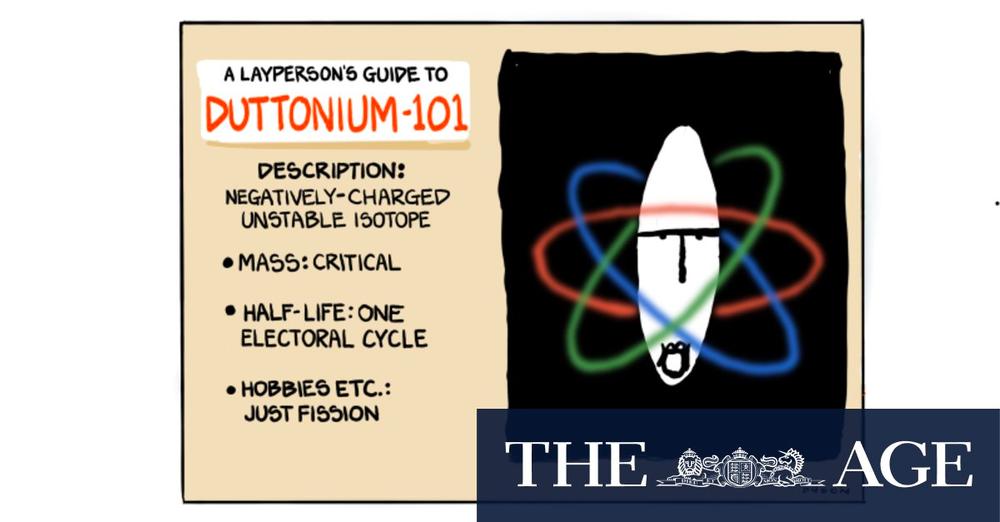
Dutton’s bid for nuclear power: hoax or reckless endangerment?
“In the last few months, we’ve seen a bill introduced into the Parliament by the Labor Government that legalises the acceptance of nuclear waste from the UK and US and provides the Government with the power to nominate any place in Australia as a nuclear waste site, with no requirement to consult with local communities or other interested groups.”
In the bigger picture, AUKUS depends upon a gamble that nuclear power will be the naval fuel of the future. And the even bigger gamble that submarines are not yet obsolete.
But beyond the tactics of Labor-baiting and the politics of diversion ……. lurks the original – and only – economic rationale of nuclear power – as an adjunct to a nuclear arms industry.
March 18, 2024, by: David Tyler https://theaimn.com/duttons-nuclear-dream-is-a-dead-cat-on-the-table-to-distract-us-from-his-dunkley-debacle/
It’s incredible. Such is our love-in with Peter “Junkyard” Dutton, our former Border Overlord, who used to play the bad cop dispensing rough justice–doing whatever it took to keep us safe-that today, he’s being cheered by most of the press gallery for reckless endangerment in his punt on nuclear energy.
Is it just to please his sponsor, Gina Rinehart and other richly attractive mining oligarchs who will make a few extra billion out of delaying the end of coal-fired power generation? Even if they do hasten the end of the world, they do get to star in their own perverted, planet-destroying mother of all snuff movies?
Or… brace yourself- does “Dutts” blunt truth and other fiction’s pin up boy-harbour
And what a boon for democracy. Voters choose between the pro-mining, colliery-opening, Labor Party and the pro-mining right-wing rump of a moribund Liberal Party, only in the race because of its secret agreement with the National Party, a mob of pro-mining, faux populists who pose as saviours of The Bush and its battlers, such as Riverview Old Boy, Barnaby Thomas Gerald Joyce’s Weatherboard Nine.
Or Bob Katter’s family which includes the incredibly successful arms manufacturer, son-in-law Rob Nioa.
ulterior motives?
Of course. A whiff of Emu Field, Montebello and Maralinga on the campaign trail helps with Coalition branding and product differentiation. “I’m with nuclear, stupid” would be a killer of an election slogan. Albo and Dutts could get together to whip up a referendum for the next federal democracy sausage BBQ. Besides, no-one in the nuclear power side hustle isn’t also itching to develop his or her own nuclear weapon cycle. Nuclear energy only makes sense if you are a nuclear arms manufacturer.
Nuclear is also a feint in the climate wars. Let’s talk tactics. Team Dutton can say that Labor is on the right track but has “no credible pathway” unless you have nuclear energy in the brew, firming up your mix. The Liberal Party plays the front end of the Coalition panto horse; the Nationals bring up the rear.
And just as he did after defeat in Aston, Dutton dashes into nuclear after his Dunkley debacle. Note he’s now a big reactor man, having got the email that small modular reactors are scarce as rocking-horse manure. It’s a revolutionary turn. A year or so ago, Dutts opposed, “the establishment of big nuclear facilities”. But being a conservative in Australian politics means, you don’t have to explain or apologise.
-ADVERTISEMENT-
Nor do you have to heed our scientists. “… the CSIRO has made clear, large reactors are too large for our small grids, and small reactors are still unproven commercially.”
Smear them. Say it’s a discredited study.
Sean Kelly sees Dutton’s pro-nuclear vision as a way of buying unity. Nobody on Dutton’s team thinks it’s a real policy, he claims, and it’s a long-term fantasy, so they won’t buck Dutton’s wilful stupidity. He’s sniping at CSIRO, too, which always wins friends amongst a growing anti-science brigade, a resource tapped into shamelessly by such figures as, “planter saint”, Barnaby Joyce; off his nut about the “green peril”. The former deputy PM also calls windmills, “filth” whilst renewable energy is a “swindle”.
The Coalition attack on CSIRO parallels its harassment of a now cowed ABC, on which it inflicted a barrage of criticism, funding cuts and Morrison’s captain’s pick of Ita Buttrose as chair. Cutbacks in the CSIRO have also taken their toll but their CEO, Professor Doug Hilton publicly rebukes Dutton.
“For science to be useful and for challenges to be overcome it requires the trust of the community. Maintaining trust requires scientists to act with integrity. Maintaining trust also requires our political leaders to resist the temptation to disparage science.”
Kelly might add that the Coalition is riven by at least ten factions, post-Morrison, and has rivals hatching plots of helping their leader by taking his job away from him. One of these, with some experience of edged weapons, is former SAS Patrol Commander, Captain Andrew Hastie who must have been cheered when in 2017 the AFP cleared of war crimes, an SAS soldier who cut the hands off two suspected Taliban fighters. Handy Andy was in command of some other soldiers at the scene. Hastie’s mentor is none other than party kingmaker, Big Mining Shill and fellow happy clapper, the Nationals’ John Anderson.
A spill now could avoid some bloodletting in the next federal election, a surgical strike, perhaps.
Rex Patrick sees Peter Dutton’s move as a “nasty” political wedge given that the federal Labor government has already signed us on to Morrison’s AUKUS which guarantees a small modular nuclear reactor inside a submarine moored near you if you happen to live close to HMAS Stirling Naval Base in Perth, the Osborne Naval Shipyards in Adelaide, SA or the yet to be opened mystery envelope containing only three options, Sydney Harbour, Wollongong/ Port Kembla or Newcastle.
Hint. The Royal Australian Navy berths in Sydney Harbour.
Moreover, the disposing of nuclear waste is also well in hand, notes Patrick.
“In the last few months, we’ve seen a bill introduced into the Parliament by the Labor Government that legalises the acceptance of nuclear waste from the UK and US and provides the Government with the power to nominate any place in Australia as a nuclear waste site, with no requirement to consult with local communities or other interested groups.”
In the bigger picture, AUKUS depends upon a gamble that nuclear power will be the naval fuel of the future. And the even bigger gamble that submarines are not yet obsolete.
Yet even today it’s uneconomic and fraught with a perplex of disposal and safety issues. Dutts the Kiwi Bikie Gangster Deporter, Dual Citizenship-Stripper, Dole-bludger-buster, or the African Gang vigilante; dog-whistling racism, fear and division, demonising the other, is as complex as the next bloke. But he is not a big ideas man. Fizza Turnbull has never heard Peter propose a single constructive idea.
Dutton’s mentor, John Howard was rarely troubled by big ideas either. But now, Dutton is calling for “a mature debate™” on a nuclear energy, we don’t need, can’t afford, could never rely on and can’t fuel. We’d be importing expensive fuel rods we can’t make at home for reactors which would never be built in time (without a slave labour workforce like the UAE) to replace our rapidly clapped-out coal-fired plant
Continue reading1 This month


Help Aunty Sue Protect Her Land and Sacred Sites From Destructive Rocket Testing.
.

Australians deserve the truth
about
AUKUS – https://aukuspublicinquiry.com/

PETITION – To: Prime Minister Anthony Albanese and the Australian Labor Government

of the week – Australians for War Powers Reform (AWPR)
To see nuclear-related stories in greater depth and intensity

