Absence of Evidence: Israel’s Case Against UNRWA

We got hold of Israel’s dossier against UNRWA – why did the donors including the UK withdraw funding on such flimsy unproven allegations before an investigation?”
the summary did “not provide evidence to support its claims.”
February 11, 2024 by: Dr Binoy Kampmark,
https://theaimn.com/absence-of-evidence-israels-case-against-unrwa/
Statistics are often given lanky legs that take their user far. But how they are used, and how they are received, is striking. The current figure of 27,500 dead is a blighting, grotesque fact. But as they are Palestinians, the issue is less significant to certain parties than, say, 140 Israeli hostages being held in Gaza.
As with much in the noisy clatter of Middle Eastern violence, the value attributed to numbers alters in the shade of ideology and self-interest. Massacres become acts of self-defence; acts of self-defence become unconscionable inflictions of murder. It also follows that an organisation of 30,000 employees, working in the field of humanitarianism, aid and salvation, can be plastered as terrorist sponsors for having 12 individuals in their service allegedly involved in a murderous assault on Israel on October 7, 2023. Despite the relative smallness of this figure, the entire organisation itself becomes a target.
Israel was initially adamant that 12 such individuals in UNRWA (United Nations Relief and Works Agency for Palestine Refugees in the Near East) had participated in the October 7 attacks by Hamas, sharing the details on January 29 with several media outlets. The accusations were made via a thin dossier amounting to no more than six pages. Little by way of evidence was supplied, though Israel was content to make further claims that almost 10% of the agency’s staff had ties to Hamas. As UN Crisis Group expert Daniel Forti writes, “Thus far, Israel has not provided evidence in writing to the UN to substantiate its allegations.”
For a gaggle of Western states and donors, that hardly mattered. The mere mention of the Satanic Twelve had made their way into public and political consciousness, and something had to be done about it. Funding to the aid body was swiftly suspended by the United States, Germany, the European Union, Sweden, Canada, Australia and the United Kingdom. The organisation was smeared and threatened with functional incapacity and prospective oblivion, an outcome that would also, inevitably, doom Palestinians. Unchallenged accusations that the agency had long been a Hamas front – an article of faith among Israeli nationalists – were bandied about with abandon.
The United Nations, for its part, was unusually fleet footed in responding to the dossier. Contracts were terminated. Inquiries were announced, along with promises of stern self-examination, purging and cleansing. On February 5, the UN Secretary General António Guterres announced that an independent panel had been created with the specific purpose of assessing “whether the agency is doing everything within its power to ensure neutrality and to respond to allegations of serious breaches when they are made.” The panel will be chaired by former French Foreign Minister Catherine Colonna, who will work alongside a Scandinavian complement of the Raoul Wallenberg Institute in Sweden, the Chr. Michelsen Institute in Norway and the Danish Institute for Human Rights.
With the setting up of such heavy machinery, the picture started getting foggier. Then a smiting report from the British news outlet Channel 4 took issue with the scanty material supplied in the document. As the network’s Lindsey Hilsum stated, “We got hold of Israel’s dossier against UNRWA – why did the donors including the UK withdraw funding on such flimsy unproven allegations before an investigation?”
Channel 4 goes on to reveal that the dossier “contains no evidence to support Israel’s explosive new claim other than stating, ‘From intelligence information, documents, and identity cards seized during the course of the fighting, it is now possible to flag around 190 Hamas and Palestinian Islamic Jihadi terrorist operatives who serve as UNRWA employees. More than 10 UNRWA staffers took part in the events of October 7.”
Even the usually less than critical CNN network reported that it had “not seen the intelligence that underlies the summary of allegations”, going on to mention that the summary did “not provide evidence to support its claims.”
-ADVERTISEMENT-
When Ophir Falk, an advisor to Israeli Prime Minister Benjamin Netanyahu, was asked by CNN anchor Anna Coren to provide evidence of the claims, he refused to do so. When asked why the alleged culprits had not been arrested, he merely replied that “the first step is for them to be fired.”
Outlets such as The New York Times and Wall Street Journal were less than concerned by the gaping lacunae and skimpiness of Israel’s case. Instead, the latter could even go so far as to claim that the dossier provided “the most detailed look yet at the widespread links between the UNRWA employees and militants.” The ABC World News Tonight was clumsy enough to suggest that the UN had “not denied the claims”, implying a veneer of veracity.
Now, other countries are finding absence of evidence from the Israeli side more than awkward. Australia’s Foreign Minister, Penny Wong, had to also admit that she had not been furnished with much in the way of evidence. “We have spoken to the Israelis and we have asked for further evidence,” she told the Australian Broadcasting Corporation’s 7.30. When asked why she did not ask UNRWA chief Philippe Lazzarini about the subject, she simply reiterated the point that she had asked the Israelis directly and was not aware if Lazzarini had evidence. “He may, I don’t know what he has.”
With trademark oiliness, Wong countered that the allegations were what mattered. “I think it is clear from UNRWA’s own actions that they regard these allegations as serious.” They had done so by “terminating the employment of a number of employees and putting in place an inquiry – in fact, there are two inquiries.” Effectively, the agency was to be punished for its own enterprising efforts to investigate the claims, leaving the accusers free to level whatever charges they saw fit.
In the meantime, Lazzarini has been scrambling to fill the funding void, making visits to the United Arab Emirates, Qatar, and Kuwait. The dying and starvation in Gaza continue with the prospect of even more horror as Israel’s armed forces prepare their offensive on Rafah. A fine thing, then, to see donor countries for UNRWA, some of whom continue funding Israel’s military efforts, to moralise about terrorists and the agency.
This week in nuclear news

A bit of good news. Illegal to marry below 18 – Zambia passes the landmark Marriage (Amendment) Act, 2023
TOP STORIES.
Mary Kostakidis: Assange’s Very Life Is at Stake.
‘Operation Al-Aqsa Flood’ Day 127: Growing international alarm over Israeli plans to invade Rafah.
Full Speed Ahead on the Global Titanic -Going Along with the Utter Madness of Nuclear Weapons.
Small Modular Reactors do not solve the many problems of nuclear, NGOs say.
Rich men with the wrong answers – nuclear power has no future and yet they persist.
From the archives. Nuclear expert Mycle Schneider on the COP28 pledge to triple nuclear energy production: ‘Trumpism enters energy policy”
Climate. Atlantic Ocean circulation nearing ‘devastating’ tipping point, study finds. Hottest January on record sees the world reach 1.7°C warming mark.
Nuclear. Very hard to exclude all the Israel-Gaza news – which could bring on nuclear war anyway!
Noel’s notes. Why we get distorted, unreliable, news about Ukraine and Israel. Against all the evidence – nuclear industry propaganda blunders on – and the media regurgitates its nonsense!
From the archives. Nuclear expert Mycle Schneider on the COP28 pledge to triple nuclear energy production: ‘Trumpism enters energy policy”
NUCLEAR ISSUES
| CLIMATE. European Union now promoting the lie that nuclear power is “green”. REVIEW CONFERENCE: CLIMATE CRISIS – WHY NUCLEAR IS NOT HELPING - also at | CIVIL LIBERTIES. UK steps up war on whistleblower journalism with new National Security Act. | ECONOMICS. The clock is ticking on the nuclear renaissance. – also at Rolls-Royce snubbed for UK’s first private small nuclear reactor plant. EDF’s nuclear struggles dampen EU nuclear prospects – the industry “on a slow descent to hell”. |
| EMPLOYMENT France: EDF Faces Unprecedented Nuclear Workload in France, | ETHICS and RELIGION. All is fair in A.I. warfare. But what do Christian ethics have to say? The West: guilty of genocide. | EVENTS. 19 February - Webinar with Dr Helen Caldicott and Martin Sheen |
| INDIGENOUS ISSUES. Tribes condemn start of uranium mining at Pinyon Plain Mine south of Grand Canyon | LEGAL. 100 Jewish Cease-Fire Supporters Arrested Blocking Biden’s NYC Motorcade Route. Canada citizens challenge environmental safety of Canadian Nuclear Safety Commission waste facility near Ottawa River. | MEDIA. CNN’s CEO Is Making Staff Churn Out Israel Propaganda. CNN staff say network’s pro-Israel slant amounts to ‘journalistic malpractice’. “In The War Of Propaganda, It Is Very Difficult To Defeat The United States”. Study Finds Media Giants NY Times, CNN and Fox News Pushing for US War in Yemen. Chicago Tribune needs reality check on Russo Ukraine war. |
| OPPOSITION to NUCLEAR . History repeats — and radiation radiates. Campaigners deeply concerned at Dr Thérèse Coffey’s support for Bradwell new nuclear power . | POLITICS. Nuclearization is underway. Or not.. (also at The future of nuclear: France’s nuclear dreams or nightmares? The folly of Ontario’s nuclear power play. Iran Plans More Nuclear Reactors Despite Serious Hurdles. Do the Right Thing: Put the South African Government’s Nuclear Plans to a Popular Referendum. Call to withdrawal from Holderness nuclear waste site talks amid tourism and farming ‘fears’. | POLITICS INTERNATIONAL and DIPLOMACY. Report: Egypt warns Israel Rafah offensive may lead to suspension of peace treaty. Western officials in protest over Israel Gaza policy Israel Aid Bill Fails in House as Progressives Slam ‘Blank Check for Netanyahu’. Walt Zlotow: Biden seeks $14 more billion to complete destruction of Palestinians in Gaza. EU Policy. Commission invites industry to join support platform for mini nuclear. Menaced by five Omnicides – Ralph Nader. Putin ‘tried everything possible’ to make peace – Ukrainian diplomat. |
SAFETY. Zaporizhzhia Nuclear Power Plant is falling apart, and the world is ignoring the danger . The dangerous craze for SMRs – also at IAEA watchdog to visit nuclear plant in occupied Ukraine to assess safety of ageing fuel and low staffing.
France’s Flamanville EPR has numerous technical problems which mean that its safety issues are not “now closed”.
| SECRETS and LIES. Absence of Evidence: Israel’s Case Against UNRWA. | SPACE. EXPLORATION, WEAPONS. Nuclear secret: India’s space program uses plutonium pellets to power missions |
| WAR and CONFLICT. Escalating to de-escalate with nuclear weapons: Research shows it’s a particularly bad idea. The pragmatist’s guide to nuclear disarmament. NATO-Russia confrontation ‘could last decades’ – Stoltenberg. Israeli PM orders evacuation of last Gaza ‘safe zone’ https://www.youtube.com/watch?v=9l59LjI4XoA | WEAPONS and WEAPONS SALES. Noetic Continental | Part I: How CIA Foists Military Equipment Through Private War Companies. Over $1 Billion in Weapons Missing In Ukraine. Why Biden’s $61 billion in weapons for Ukraine won’t prevent inevitable defeat. Citing World Court, Japan Firm Cuts Ties With Israel Arms Maker. |
TODAY. Against all the evidence – nuclear industry propaganda blunders on – and the media regurgitates its nonsense!
It would be funny, if it were not so serious.

Promoting the nuclear industry is not just serious, but dangerous. The industry’s only real purpose is nuclear weapons.
Everybody knows that big nuclear reactors are a no-no. They’re astronomically expensive to build, and even more obscenely expensive to demolish and dispose of. (that latter cost to be paid by our great-grandchildren).

So what is needed now by this insane industry – is a fairy-tale window-dressing. And hey presto! There are the non existent magical small modular nuclear reactors (SMRs) .
Today – I see heaps of enthusiastic articles, especially from the UK. Wow! Westinghouse Electric Company doing a deal with Community Nuclear Power, privately funded, - “The companies will work together to develop plans for the plants, with the aim of getting backing from the Government.” - to set up SMRs - Business Wire, Teesside Gazette, Northern Echo, Proactive Investor, ………..

They don’t mention the spectacular failure of the USA’s one and only SMR business, as NuScale heads towards bankruptcy.
What else the mainstream media does not say about SMRs:
- Problems of massive cost blowouts and multi-year delays.
- Unproven technology: Even the simplest designs used today in submarines will not be available at scale until late next decade, if at all. Taking into account the learning curve of the nuclear industry, an average of 3,000 SMRs would have to be constructed in order to be financially viable.
- Ineffective climate solution: According to the latest IPCC report published in March 2023, nuclear power is one of the two least effective mitigation options (alongside Carbon Capture and Storage).
- Waste problem: Current SMR designs would create 2-30 times more radioactive waste in need of management and disposal than conventional nuclear plants.
And there’s that other intriguing little problem. The proudly British company Rolls Royce has been counting on government backing to start off its SMR project. Now shock horror – an American company looks like winning this foolish SMR sack race. Bill Gates’ Terra Power, GE-Hitachi, Mitsubishi – all these companies will be peeved, too. An international political fracas?
When Times Were Better: Victoria’s Ties with Israel’s Defence Industry
But now, of course, there’s a live domestic debate about the war, and … most people are concerned about civilian casualties.”………… Israel’s predatory policies towards Palestinians since 1948 can be dismissed as peripheral and inconsequential to the current bloodbath (?)
Given the federal government’s brusque termination of previous agreements entered into by Victoria with purportedly undesirable entities, the Albanese government has a useful precedent.
Complicity with genocide – actual, potential or as yet unassessed by a court – can hardly be in Canberra’s interest. Over to you, Prime Minister Anthony Albanese.
February 9, 2024 Dr Binoy Kampmark, https://theaimn.com/when-times-were-better-victorias-ties-with-israels-defence-industry/
Times were supposedly better in 2022. That is, if you were a lawmaker in the Australian state of Victoria, a busy Israeli arms manufacturer, or cash counting corporate middleman keen to make a stash along the way between the two. That view is premised on the notion that what happened on October 7, 2023 in Israel was stunningly remarkable, a historical blot dripped and dribbled from nothingness, leaving the Jewish state vengeful and yearning to avenge 1200 deaths and the taking of 240 hostages. All things prior were dandy and uncontroversial.
Last month, word got out that the Victorian government had inked a memorandum of understanding (MoU) with the Israeli Defence Ministry in December 2022. “As Australia’s advanced manufacturing capital, we are always exploring economic and trade opportunities for our state – especially those that create local jobs,” a government spokesperson stated in January. It’s just business.
No one half observant to this should have been surprised, though no evidence of the MoU, in form or substance, exists on Victorian government websites. (It is, however, listed on the Australian government’s Foreign Arrangements Scheme register.) For one thing, Israel’s Ministry of Defense had happily trumpeted it, stating that its International Defense Cooperation Directorate (SIBAT) and the Victorian statement government had “signed an industrial defense cooperation statement” that December. Those present at the signing ceremony were retired General Yair Kulas, who heads SIBAT and Penelope McKay, acting secretary for Victoria’s Department of Jobs, Precincts, and Regions.
That an MoU should grow from this was a logical outcome, a feature of the State’s distinctly free approach to entering into agreements with foreign entities. In April 2021, the previous Morrison government terminated four agreements made by the Victorian government with Iran, Syria and China. The agreements with Iran and Syria, signed in November 2004 and March 1999 respectively, were intended as educational, scientific and training ventures. The two agreements with China came in the form of an MoU and framework agreement with the National Development and Reform Commission of the PRC, both part of Beijing’s Belt and Road Initiative (BRI).
The Israeli arms industry has taken something of a shine to Victoria. One of its most aggressive, enterprising representatives has been Elbit Systems, Israel’s prolific drone manufacturing company. Through Elbit Systems of Australia (ELSA), it established a Centre of Excellence in Human-Machine Teaming and Artificial Intelligence in Port Melbourne after announcing its plans to do so in February 2021.
Continue readingAustralia sends sailors to Guam for US Navy nuclear submarine training
By JUAN KING. STARS AND STRIPES • February 9, 2024
A second, larger contingent of Australian sailors is training alongside U.S. counterparts on Guam as part of an agreement to create a nuclear-powered submarine force for the Australian navy.
Australia sent 37 officers and enlisted personnel to Naval Base Guam to train aboard the submarine tender USS Emory S. Land, according to a Feb. 4 news release from the country’s Department of Defence.
The training program falls under the AUKUS pact, an agreement by Australia, the United Kingdom and United States to build eight nuclear-powered submarines for Australia by the 2030s at a cost of about $240 billion over 30 years.
A rotating force of U.S. and U.K. submarines is expected to establish itself in Australia by 2027 as part of the plan. “The opportunity for our Navy personnel to learn from our AUKUS partners demonstrates meaningful progress along Australia’s pathway to acquiring nuclear-powered submarines,” Defence Minister Richard Marles said in the release………………………….. https://www.stripes.com/branches/navy/2024-02-09/nuclear-sub-training-australia-guam-12948455.html—
100 Jewish Cease-Fire Supporters Arrested Blocking Biden’s NYC Motorcade Route

“As Jewish New Yorkers we want to make crystal clear that President Biden is not welcome in our city while he continues to fund and arm the Israeli government’s genocide of Palestinians in Gaza,” said one protester.
Brett Wilkins, 8 Feb 24 , https://www.commondreams.org/news/jewish-protest-cease-fire—
Around 100 Jewish American and allied activists were arrested in New York City Wednesday after they blocked President Joe Biden’s motorcade route to protest U.S. complicity in Israel’s genocidal war against the Palestinian people and to demand an immediate Gaza cease-fire.
The group Jewish Voice for Peace (JVP) led the Upper East Side demonstration, during which activists sat down in the intersection of Fifth Avenue and 82nd Street, where the president was attending a nearby fundraiser.
As Jewish New Yorkers we want to make crystal clear that President Biden is not welcome in our city while he continues to fund and arm the Israeli government’s genocide of Palestinians in Gaza,” saidJVP’s Jay Saper.
JVP activist Maya Edery noted that this is Biden’s first visit to New York since the October 7 Hamas-led attacks on Israel.
“Instead of answering to the majority of his base that is calling for a cease-fire, he is meeting with corporate donors behind closed doors,” Edery said.
Biden’s staunch support for Israel—which includes asking for an additional $14.3 billion in U.S. military aid atop the nearly $4 billion the country already receives from Washington and repeatedly bypassing Congress to expedite armed assistance to the key ally—has prompted many activists to call him “Genocide Joe.”
JVP activist Maya Edery noted that this is Biden’s first visit to New York since the October 7 Hamas-led attacks on Israel.
“Instead of answering to the majority of his base that is calling for a cease-fire, he is meeting with corporate donors behind closed doors,” Edery said.
Biden’s staunch support for Israel—which includes asking for an additional $14.3 billion in U.S. military aid atop the nearly $4 billion the country already receives from Washington and repeatedly bypassing Congress to expedite armed assistance to the key ally—has prompted many activists to call him “Genocide Joe.”
The president has also come under fire for casting doubt on the number of Palestinians killed and wounded by Israeli forces.
As JVP noted:
The Israeli military has killed over 27,000 Palestinians in Gaza, over 11,000 of whom were children, in four months of bombing and military assault. Gaza has been made uninhabitable by design, with Israeli airstrikes destroying 70% of infrastructure, including hospitals, universities, and the electricity and water grids.
Nearly 2 million people have been forced to flee their homes; 1.9 million are sheltering in the southern city of Rafah, where the Israeli military has lately launched airstrikes.
“Biden says that he is funding and arming Israel for Jewish safety. We’re here to call his bluff,” said JVP’s Eve Feldberg. “The president is advancing the U.S.’ own military interests.”
Wednesday’s demonstration was the latest in a wave of Jewish-led protests by groups including JVP and IfNotNow that have shut down transportation hubs, taken over the Statue of Liberty, and disrupted speeches by Biden and other administration officials.
Also on Wednesday, dozens of members of the peace group CodePink were arrested for blocking entrances to the Woodward weapons manufacturing plant in suburban Chicago.
“Woodward is a weapons manufacturer. They supply arms to Israel,” said one protester. “So we are here today to prevent workers from going in and from building bombs that have been dropped on Palestinians in Gaza.”
Five CodePink activists were also arrested after blocking an entrance to Travis Air Force Base in northern California on Wednesday, a day after members of the group including Jewish co-founder Medea Benjamin confronted Democratic California Congresswoman Nancy Pelosi over an Israel aid bill in the House.
Gaza: Chris Hedges: Let Them Eat Dirt
The final stage of Israel’s genocide in Gaza, an orchestrated mass starvation, has begun. The international community does not intend to stop it.
By Chris Hedges ScheerPost, 8 Feb 24, https://scheerpost.com/2024/02/08/chris-hedges-let-them-eat-dirt/—
There was never any possibility that the Israeli government would agree to a pause in the fighting proposed by Secretary of State Antony Blinken, much less a ceasefire. Israel is on the verge of delivering the coup de grâce in its war on Palestinians in Gaza – mass starvation. When Israeli leaders use the term “absolute victory,” they mean total decimation, total elimination. The Nazis in 1942 systematically starved the 500,000 men, women and children in the Warsaw Ghetto. This is a number Israel intends to exceed.
Israel, and its chief patron the United States, by attempting to shut down the United Nations Relief and Works Agency for Palestine Refugees in the Near East (UNRWA), which provides food and aid to Gaza, is not only committing a war crime, but is in flagrant defiance of the International Court of Justice (ICJ). The court found the charges of genocide brought by South Africa, which included statements and facts gathered by UNWRA, plausible. It ordered Israel to abide by six provisional measures to prevent genocide and alleviate the humanitarian catastrophe. The fourth provisional measure calls on Israel to secure immediate and effective steps to provide humanitarian assistance and essential services in Gaza.
UNRWA’s reports on conditions in Gaza, which I covered as a reporter for seven years, and its documentation of indiscriminate Israeli attacks illustrate that, as UNRWA said, “unilaterally declared ‘safe zones’ are not safe at all. Nowhere in Gaza is safe.”
UNRWA’s role in documenting the genocide, as well as providing food and aid to the Palestinians, infuriates the Israeli government. Prime Minister Benjamin Netanyahu accused UNRWA after the ruling of providing false information to the ICJ. Already an Israeli target for decades, Israel decided that UNRWA, which supports 5.9 million Palestinian refugees across the Middle East with clinics, schools and food, had to be eliminated. Israel’s destruction of UNRWA serves a political as well as material objective.
The evidence-free Israeli accusations against UNRWA that a dozen of the 13,000 employees had links to those who carried out the attacks in Israel on Oct. 7, which saw some 1,200 Israelis killed, did the trick. It led 16 major donors, including the United States, the U.K., Germany, Italy, the Netherlands, Austria, Switzerland, Finland, Australia, Canada, Sweden, Estonia and Japan, to suspend financial support for the relief agency on which nearly every Palestinian in Gaza depends for food. Israel has killed 152 UNRWA workers and damaged 147 UNRWA installations since Oct. 7. Israel has also bombed UNRWA relief trucks.
More than 27,708 Palestinians have been killed in Gaza, some 67,000 have been wounded and at least 7,000 are missing, most likely dead and buried under the rubble.
More than half a million Palestinians – one in four – are starving in Gaza, according to the U.N. Starvation will soon be ubiquitous. Palestinians in Gaza, at least 1.9 million of whom have been internally displaced, lack not only sufficient food, but clean water, shelter and medicine. There are few fruits or vegetables. There is little flour to make bread. Pasta, along with meat, cheese and eggs, have disappeared. Black market prices for dry goods such as lentils and beans have increased 25 times from pre-war prices. A bag of flour on the black market has risen from $8.00 to $200 dollars. The healthcare system in Gaza, with only three of Gaza’s 36 hospitals left partially functioning, has largely collapsed. Some 1.3 million displaced Palestinians live on the streets of the southern city of Rafah, which Israel designated a “safe zone,” but has begun to bomb. Families shiver in the winter rains under flimsy tarps amid pools of raw sewage. An estimated 90 percent of Gaza’s 2.3 million people have been driven from their homes.
“There is no instance since the Second World War in which an entire population has been reduced to extreme hunger and destitution with such speed,” writes Alex de Waal, executive director of the World Peace Foundation at Tufts University and the author of “Mass Starvation: The History and Future of Famine,” in the Guardian. “And there’s no case in which the international obligation to stop it has been so clear.”
The United States, formerly UNRWA’s largest contributor, provided $422 million to the agency in 2023. The severance of funds ensures that UNRWA food deliveries, already in very short supply because of blockages by Israel, will largely come to a halt by the end of February or the beginning of March.
Israel has given the Palestinians in Gaza two choices. Leave or die.
I covered the famine in Sudan in 1988 that took 250,000 lives. There are streaks in my lungs, scars from standing amid hundreds of Sudanese who were dying of tuberculosis. I was strong and healthy and fought off the contagion. They were weak and emaciated and did not. The international community, as in Gaza, did little to intervene.
The precursor to starvation – undernourishment – already affects most Palestinians in Gaza. Those who starve lack enough calories to sustain themselves. In desperation people begin to eat animal fodder, grass, leaves, insects, rodents, even dirt. They suffer from diarrhea and respiratory infections. They rip up tiny bits of food, often spoiled, and ration it.
Soon, lacking enough iron to produce hemoglobin, a protein in red blood cells that carries oxygen from the lungs to the body, and myoglobin, a protein that provides oxygen to muscles, coupled with a lack of vitamin B1, they become anemic. The body feeds on itself. Tissue and muscle waste away. It is impossible to regulate body temperature. Kidneys shut down. Immune systems crash. Vital organs – brain, heart, lungs, ovaries and testes — atrophy. Blood circulation slows. The volume of blood decreases. Infectious diseases such as typhoid, tuberculosis and cholera become an epidemic, killing people by the thousands.
It is impossible to concentrate. Emaciated victims succumb to mental and emotional withdrawal and apathy. They do not want to be touched or moved. The heart muscle is weakened. Victims, even at rest, are in a state of virtual heart failure. Wounds do not heal. Vision is impaired with cataracts, even among the young. Finally, wracked by convulsions and hallucinations, the heart stops. This process can last up to 40 days for an adult. Children, the elderly and the sick expire at faster rates.
I saw hundreds of skeletal figures, specters of human beings, moving forlornly at a glacial pace across the barren Sudanese landscape. Hyenas, accustomed to eating human flesh, routinely picked off small children. I stood over clusters of bleached human bones on the outskirts of villages where dozens of people, too weak to walk, had laid down in a group and never gotten up. Many were the remains of entire families.
In the abandoned town of Mayen Abun bats dangled from the rafters of the gutted Italian mission church. The streets were overgrown with tussocks of grass. The dirt airstrip was flanked by hundreds of human bones, skulls and the remnants of iron bracelets, colored beads, baskets and tattered strips of clothing. The palm trees had been cut in half. People had eaten the leaves and the pulp inside. There had been a rumor that food would be delivered by plane. People had walked for days to the airstrip. They waited and waited and waited. No plane arrived. No one buried the dead.
Now, from a distance, I watch this happen in another land in another time. I know the indifference that doomed the Sudanese, mostly Dinkas, and today dooms the Palestinians. The poor, especially when they are of color, do not count. They can be killed like flies. The starvation in Gaza is not a natural disaster. It is Israel’s masterplan.
There will be scholars and historians who will write of this genocide, falsely believing that we can learn from the past, that we are different, that history can prevent us from being, once again, barbarians. They will hold academic conferences. They will say “Never again!” They will praise themselves for being more humane and civilized. But when it comes time to speak out with each new genocide, fearful of losing their status or academic positions, they will scurry like rats into their holes. Human history is one long atrocity for the world’s poor and vulnerable. Gaza is another chapter.
Hottest January on record sees the world reach 1.7°C warming mark

The global average temperature in January 2024 was 1.7°C above pre-industrial levels for the month, meaning the planet has breached the 1.5°C benchmark for the past 12 months
New Scientist 8th Feb 2024
Another $61 billion to kill more Ukrainians in an unnecessary and losing war

The $61 billion will make no difference on the battlefield except to prolong the war, the tens of thousands of deaths, and the physical destruction of Ukraine.
The Biden-Schumer Plan to Kill More Ukrainians JEFFREY D. SACHS, Feb 08, 2024, Common Dreams, https://www.commondreams.org/opinion/the-biden-schumer-plan-to-kill-more-ukrainians
President Joe Biden is refusing to fold a losing hand as he bets with Ukrainian lives and U.S. taxpayer money. Biden and Democratic Senate Majority Leader Chuck Schumer propose to squander the lives of tens of thousands more Ukrainians and $61 billions of federal funds to keep Biden’s disastrous foreign policy failure hidden from view until after the November election.
The $61 billion will make no difference on the battlefield except to prolong the war, the tens of thousands of deaths, and the physical destruction of Ukraine. It will not “save” Ukraine. Ukraine’s security can only be achieved at the negotiating table, not by some fantasized military triumph over Russia.
$61 billion is not nothing. This worse-than-useless outlay would exceed the combined budgets of the U.S. Department of Labor, Environmental Protection Agency, National Science Foundation, and the Women, Infant, and Children nutrition program.
Almost exactly 10 years ago this month, Biden did much to put Ukraine on the path to disaster. This is well known to those who have looked carefully at the facts but is kept hidden from view by the White House, the Senate Democrats, and the mainstream media that back Biden. I have previously provided a detailed chronology, with hyperlinks, here.
Ukraine’s security can only be achieved at the negotiating table, not by some fantasized military triumph over Russia.
In 1990, President George H. W. Bush, Sr. and his German counterpart Chancellor Helmut Kohl promised Soviet President Mikhail Gorbachev that NATO would not expand eastward if the Soviet Union accepted German reunification. When the Soviet Union disbanded in December 1991, with Russia as the successor state, American leaders decided to renege.
President Bill Clinton began NATO expansion over the vociferous opposition of top diplomats like George Kennan and the opposition of his own Secretary of Defense, William Perry. In 1997 Zbigniew Brzezinski upped the ante, with a plan for NATO to expand all the way to Ukraine. He famously wrote that without Ukraine, Russia would cease to be a great power.
Russian leaders have repeatedly made clear that NATO expansion to Ukraine is understandably the reddest of Russian redlines.
In 2007, President Vladmir Putin stated that NATO enlargement to that date was a cheat on the 1990 promise, and that it must go no further. Despite these clear warnings, including by his own diplomats, George W. Bush Jr. committed in 2008 to expand NATO to Ukraine and Georgia in order to surround Russia in the Black Sea.
William Burns, now CIA director, and then the U.S. Ambassador to Russia, wrote a famous memo entitled “Nyet means Nyet,” explaining that Russia’s opposition to NATO enlargement was across Russia’s political spectrum. Most Ukrainians themselves were also firmly against the plan, favoring neutrality over NATO membership. The Ukrainian Rada declared Ukraine’s state sovereignty in 1990 on the basis of becoming “a permanently neutral state.” In 2009, the people of Ukraine elected Viktor Yanukovych, who ran on a platform of neutrality.
In early 2014, the U.S. decided to help bring down Yanukovych in a coup. This was standard U.S. deep-state operating procedure, one used on dozens of occasions around the world. he CIA, National Endowment for Democracy, USAID, and NGOs like the Open Society Foundation went to work in Ukraine. The point person was Victoria Nuland, who was first Richard Cheney’s principal deputy foreign policy advisor, then George Bush Jr.’s ambassador to NATO, then Hillary Clinton’s spokesperson, and by 2014 Assistant Secretary of State.
This time, the Russians caught the conspiracy on tape, in an intercepted call between Nuland and U.S. Ambassador to Ukraine Geoffrey Pyatt (now Assistant Secretary of State). Nuland explains to Pyatt that Vice President Joe Biden will help choose and cement the post-coup government. The 2014 Ukraine team, including Biden, Nuland, Jake Sullivan (then and now Biden’s national security advisor), Geoffrey Pyatt, and Antony Blinken (then the deputy national security advisor), remains the Ukraine team today.
It is a team of bunglers. They thought that Yanukovych’s overthrow would quickly usher in NATO expansion. Instead, ethnic Russians in Ukraine virulently rejected the Russophobic post-coup government that was installed by Nuland, and called for autonomy of the ethnically Russian regions. In a referendum, Crimea voted overwhelmingly to join Russia.
Obama, Biden, and their team armed the post-coup government to attack the ethnically Russian regions, thinking this would be the end of it. Yet the regions resisted. Ukraine and the breakaway regions signed the Minsk Agreements to bring an end to the fighting and give constitutional autonomy to the ethnically Russian Donbas. The Minsk II agreement was backed by the UN Security Council, but the U.S. privately agreed with the Ukrainian government that it was okay to ignore it.
In 2021, after 7 years of fighting and more than 14,000 deaths in the Donbas, Putin called on newly elected President Biden to stop NATO enlargement and engage in negotiations with Russia over mutual security arrangements. Biden rejected Putin’s call to end the gambit of NATO enlargement to Ukraine.
In February 2022, Putin launched the Special Military Operation (SMO) invasion to push Ukraine to the negotiating table. Ukraine’s President Volodymyr Zelensky immediately called for negotiations based on Ukraine’s neutrality. Within a month, a framework agreement to end the fighting was reached between Ukraine and Russia, based on Ukraine’s neutrality and an end to NATO’s enlargement to Ukraine. Biden stepped in to stop the deal, with the U.S. informing Zelensky that the U.S. would not support neutrality.
Biden and team had still more failed tricks up their sleeve. They firmly believed that U.S. financial sanctions—freezing Russia’s assets and cutting it out of the SWIFT banking system—would cripple the Russian economy and cause Putin to relent. In fact, they expected that the ensuing economic crisis would topple him. Of course, nothing of the sort happened.
Then they expected that NATO weaponry would trounce Russia on the battlefield. That too did not happen. Then they expected that Ukraine’s “counter-offensive” in the summer of 2023, backed by Pentagon and CIA planners, would defeat Russia. Instead, Ukraine lost hundreds of thousands of soldiers dead and wounded—its military hardware destroyed.
The entire war, including the loss of Ukrainian territory, the hundreds of thousands of Ukrainian casualties, and the utter waste of more than $100 billion of U.S. taxpayer money to date, could easily have been avoided.
Now, Biden and Schumer want to throw more Ukrainian lives and more tens of billions of dollars at this glaring failure. They want to do this in a rushed vote, without any Congressional let alone public oversight, without hearings, and without any strategy. The fact is they want to save Biden from the embarrassment of a decade of puerile and failed plotting, at least until the November election.
There remains one answer for Ukraine’s security: diplomacy and neutrality. That solution doesn’t cost lives or money. It was Ukraine’s choice before the 2014 coup and again in 2022 until stopped by Biden. It is the path that Biden and the Senate Democrats still refuse to take.
TODAY . Why we get distorted, unreliable, news about Ukraine and Israel

Israel

Every now and then, some journalist steps out of the accepted line, and spills the beans on what is going on in critical news.
This week, the Guardian’s Guardian’s Chris McGreal did just that. He exposed the journalistic turmoil in CNN, over its very biased coverage of Israel’s war on Gaza
It’s got particularly important right now. Most of us are probably still believing in the Hamas massacre story of, “bodies of babies with their heads cut off” – despite not one shred of evidence of this. With the whole Middle East now a tinderbox, the media is still pushing the Israel storyline that goes like this:
The Israelis suffered the brutal massacre of 1200 citizens on October 7, 2023. That justifies the massacre of 27,365 Palestinians in Gaza. In the continuing massacre of Palestinians, the Israelis are the victims. To allow humanitarian aid to the desperate , hungry, Gazan survivors is to support terrorism.
Chris McGeal explains the long, complicated, and disgraceful background of media succumbing to pressure – “the CNN network repeatedly aired inflammatory rhetoric and propaganda from Israeli officials and American supporters, often without challenge in interviews.”
He also notes the restrictions on journalists, with the Israeli block on foreign journalists, and with all CNN’s copy on the Israel-Palestine situation having be first approved by the Jerusalem bureau.
And it’s not new – this subservience - it was the same thing with the coverage of the post 9/11 time, and the unbalanced and ultra-negative coverage of the Taliban-controlled Afghanistan, and the killing of Afghan civilians by US forces.
Caitlin Johnstone, the not-so-mainstream, and intrepid, excavator of the truth, has also dug up the troubling realities on the biased news that we are fed.
She aims her blowtorch on the careers of media executives moving through corporate media – New York Times – BBC – CNN – “ The corporate media are owned and controlled by plutocrats who have a vested interest in preserving the status quo power structure upon which their kingdoms are built, and state broadcasters like the BBC have the same interest for the same reason. They decide who the executives of those outlets will be, and those executives make policy and hiring decisions which cause the outlet to function in a way that is indistinguishable from state propaganda.”
UKRAINE

Caitlin Johnstone is also one of the few writers (apart from Russian journalists) who also shine a light on the media coverage of the Ukraine war. She has examined ”the brazen propaganda push to normalize war profiteering in Ukraine “, quoting CNN anchor Erin Burnett ………. pausing to explain to her audience that this funding is actually good for Americans, because it goes straight into the US arms industry.“
She points out not only the advantages to American weapons companies of continuing the Ukraine war indefinitely, but the way in which the media report this – with approval! “western officials are now going out of their way to communicate to the public that this war will stretch on for many more years to come.”
She quotes the Wall Street Journal, Reuters, and CNN - all positively gushing over how good this war is for America - jobs, share prices, company profits - all good!
When it comes to coverage of the actual war and its battles - well, we hear a lot about the dedicated President Zelensky. We hear about the Ukrainian counter-offensive (though it did not seem to work). We get genuinely sad stories about victims of Russian strikes, and rather more dubious stories about Russian atrocities. On the whole, we really don’t hear much about the actual progress of the war, and get a stunning silence about the Ukrainian troop casualties. And there’s little attempt to explain the background to this war. As with the Gaza story, it’s as though the hostilities were new and unprovoked, and the grievances are solely on the side that the USA supports
Mostly the Ukraine coverage is about how world democracy requires more weapons to be bought (by Western tax-payers) and given to Ukraine.
The media – journalists hanging on to their jobs, companies hanging on to their advertisers, and their profits – dance to the corporate line. Are we all dancing along with them, to World War 3 ?
Assange’s Very Life Is at Stake
Julian Assange will soon find out whether he will be granted a final appeal in the U.K. in his fight against extradition, or will soon face the cruel vengeance of the U.S.
By Mary Kostakidis, 4 Feb 24, https://consortiumnews.com/2024/02/04/mary-kostakidis-assanges-very-life-at-stake/
In Julian Assange’s extradition case, Magistrate Judge Venessa Baraitser determined he would not survive imprisonment in a U.S. Supermax facility – that he is very likely to commit suicide.
One of the final witnesses in the 4 week extradition trial in 2020 was an American lawyer whose client Abu Hamza was held in ADX Colorado where Julian is likely to be sent. Abu Hamza has no hands. He was extradited from the U.K. following assurances by the U.S. that the prison system was able to deal with the special requirements of such a prisoner.
His lawyer testified that despite assurances he would not be placed in total isolation, that is indeed where he was kept, under Special Administrative Measures, and the U.S. had also failed to delivered on other undertakings to protect his human rights – he did not have a toilet in his cell he could operate – he was stripped of all dignity, contrary to guarantees.
In the case of David Mendoza Herrera, the Spanish government successfully pursued the return of their citizen who was extradited to the U.S. following assurances the U.S. reneged on – a process that took many years while the prisoner attempted first to seek redress in the U.S. but ultimately only succeeded after suing the Spanish government for failing to protect his rights. It was forced to act after the Spanish Supreme Court virtually threatened to suspend the Spain-U.S. Extradition Treaty.
The assurances provided by the U.S. in their 2021 High Court Appeal of the District Court’s decision in Assange’s case were not tested in Court. They were automatically accepted, a judge expressing complete confidence in the reliability of a guarantee from the United States Government, and differentiating between the guarantee of a State and that provided by a Diplomat.
(Whilst a Diplomat’s assurance may involve a different signature at the bottom of the page, surely it appears there only after the boss’s approval, but evidently this makes a difference).
Significantly however, the assurances were also conditional — they could be revoked at any time, so not worth the paper they were written on, no matter who signed them.
Since that decision was handed down though, the U.K. Supreme Court has delivered a landmark ruling in a case where the U.K. government had accepted assurances provided by a foreign government (Rwanda). It determined that such assurances cannot be automatically accepted – that there is a requirement for ‘meaningful, independent, evidence- based judicial review focusing on the protection of human rights on the ground in that country’.
In Julian’s case, it is the human rights of national security prisoners in the U.S., their treatment and the conditions in which they are kept.
The U.N. considers solitary confinement beyond 2 weeks as torture – special rapporteurs have been arguing this for decades. In condemning the treatment of Chelsea Manning in a U.S. prison, then Special Rapporteur on Torture Juan Mendez said:
“Prolonged solitary confinement raises special concerns, because the risk of grave and irreparable harm to the detained person increases with the length of isolation and the uncertainty regarding its duration… I have defined prolonged solitary confinement as any period in excess of 15 days. This definition reflects the fact that most of the scientific literature shows that, after 15 days, certain changes in brain functions occur and the harmful psychological effects of isolation can become irreversible.” [Emphasis added.]
Abu Hamza has been in solitary confinement for nine years. His lawyer testified walking was too painful for him because his toe nails were so long, and his pleas for them to be cut were ignored.
Significant Recent Changes in Assange’s Health
The automatic acceptance and reliability of the assurances were not the only problem at that time.
A serious problem that arose during that hearing was its failure to note or take into account the change in Julian’s medical condition. It is a critical failure because the decision delivered was based on assurances the U.S. prison system could mitigate against his known risk factors – the risk he would commit suicide. But he had developed another serious physical risk factor.
After the four-week Extradition hearing in the lower court where Assange appeared boxed in a glass booth at the back of the court where he was prevented from communicating with his lawyers, he was permitted to appear via videolink from Belmarsh at subsequent substantive hearings.
At the start of the U.S. Appeal there was a brief pre-hearing chat between Assange’s lawyer and the judge to the effect that the defendant has elected not to appear due to an increase in medication.
It was extraordinary and inconceivable he would choose not to observe the hearing via videolink. Indeed I was later informed by his wife Stella he had wanted to appear but had not been permitted to by the prison.
Both his absence and the explanation flagged a problem.
Assange had not missed a single hearing. He had shown great determination in his struggle to engage with the drama unfolding in court despite enormous challenges such as not being able to attract his lawyers’ attention (after being denied the tools and time to prepare for his own defence), and in spite of medication and a dramatic deterioration in his health as was so throughly documented by former U.N. Rapporteur on Torture Nils Melzer in his book The Trial of Julian Assange: A Story of Persecution.
Why was he so heavily medicated so as not to be able to sit in the video-link room at Belmarsh? What had necessitated this increase in medication? This question was directly pertinent to the decision the court had to make, but I heard no question from the judge about it and the hearing proceeded.
Then, remarkably, some time into the hearing, Julian appeared.
We journalists observing via a link could see him in a window on our screens. He would have been able to see and hear the judge, and those in the courtroom would be able to see him on a monitor as we could.
He looked mighty unwell, not only drugged. He had to use his arm to prop up his head but one side of his face was noticeably drooping and one eye was shut.
During these hearings we were given very occasional, brief glimpses of the defendant – time enough to note he is still observing his own legal proceeding, be it in a depersoned way. I asked the video link host on the chat facility to show us more of the defendant – we needed a better and more frequent look at him as he looked unwell.
Journalists are warned when we join the video-link that using the chat facility for anything other than communicating about technical issues and only with the host (hearings were frequently hamstrung by audio problems) could result in access being withdrawn. But many of the other 30 or so journalists on the link were sending Me Too messages on the Chat. Remarkably and to my relief the host obliged & we were shown Julian more often and for longer than in any previous hearings.
So after the bizarre news Julian was not going to attend his own hearing, the second thing I could not understand is that given his condition when he did appear, there were no questions or adjournment. Those deciding his fate were not perturbed by his state, or had failed to notice what was immediately evident to us.
Julian persisted in his attempt to focus, but he was clearly severely hampered. He eventually gave up, stood up & moved away from the monitor camera. It was as if he could no longer abide the humiliation of being scrutinised by people unknown, witnesses to a feeble, failed attempt to command his body and mind, a mind that has been razor sharp and never before let him down.
The public learnt some nine weeks later, and days after the judgement came down clearing the way for Julian’s extradition, that he in fact had had a TIA – a Transient Ischemic Attack or minor stroke – often a precursor to a major, catastrophic one when prompt access to an MRI machine would be vital if his life was to be saved.
I don’t know whether it is known, exactly when Julian had the stroke. The monitoring of prisoners is not exactly tailored to pick up and quickly respond to such silent stealthy symptoms. Did the stroke occur before the hearing? Was that why he was so heavily medicated? Or did it occur at the time of the hearing?
One thing is clear – he has had a stroke, so his condition has changed, and the assurances accepted took no account of this, though the Court’s decision was handed down long after he had the stroke and a fewsdays before it was finally made public.
One of the two Justices presiding over the U.S. Appeal, Ian Duncan Burnett, was the Chief Justice of the High Court at the time. His decision in the case of U.K. citizen Lauri Love set a precedent where extradition to the U.S. was denied on the basis of a medical condition.
This engendered a little hope that he may not reverse the District Court’s decision in Julian’s case. But as Law Professor Nils Melzer remarked, you don’t need the Chief Justice on a case where he has already set a precedent that can be followed. However you do need him if his precedent is to be overturned.
Throughout the hearing, the Love decision loomed large in our minds and Love was present in Court, but we realised this potential pathway was a dead end when it was finally raised by Julian’s lawyers.
The Chief Justice responded swiftly, dismissively and categorically: ‘Oh but that was an entirely different case. He had eczema.’ (Verbatim to my memory)
So the difference between being extradited or not, was eczema, and there would be no joy for Julian in this court despite the marked deterioration in his physical and psychological health.
Julian sought leave to appeal the decision of the High Court, in the Supreme Court, but that Supreme Court’s determination was that there were no arguable points of law to form a basis for an Appeal.
The Upcoming Hearing
Over two days on Feb. 20-21, a panel of two High Court judges will rule on whether Julian can appeal both the Secretary of State’s decision to extradite him and Judge Baraitser’s decision on the basis of all the grounds he argued which she knocked back, such as the political nature of the prosecution and the impossibility of a fair trial for him in the U.S..
The reliability and adequacy of the U.S. assurances that he will not be held in a super max prison, nor under S.A.M.s, that his suicide can be prevented, that he would be returned to Australia to serve out a sentence at some point, have not been tested in court, and now the medical condition for which they were furnished has changed. And in the meantime there has been a landmark ruling by the [U.K.] Supreme Court in another case, regarding the necessity for judicial review of foreign govt assurances.
A letter very early this year to the U.K. home secretary from a cross party group of our Parliamentarians is an important and timely one, requesting he “undertake an urgent, thorough and independent assessment of the risks to Mr. Assange’s health and welfare in the event he is extradited to the United States.”
Assange has made an application to attend this month’s hearing in person so he can communicate with his legal team.
The judges may make an immediate decision at the conclusion of the two-day hearing or reserve their judgement.
If Assange wins this case, a date will be set for a full Appeal hearing.
If he is denied the right to appeal there are no further appeal avenues at the domestic level.
He can then apply to the European Court of Human Rights, which has the power to order a stay on his extradition – a Rule 39 Instruction, which is only given in “exceptional circumstances”. It may however be a race to lodge the Appeal before he is bundled off on a plane to the U.S.
If Julian Assange is extradited and the U.S. is successful in prosecuting him he will not receive a fair trial there and unlikely to receive the constitutional protection afforded to its own citizens, the U.S. will have redefined in law, investigative journalism as ‘espionage’.
It will demonstrate that U.S. domestic laws, but not protections, apply internationally to non-U.S. citizens.
It will have cost Assange his freedom & likely his life – an example to anyone who attempts to discredit the state sanctioned narrative. A narrative that has been shattered by independent and citizen journalists in Gaza – explosively, daily, globally, and irrevocably.
This is the text of a speech delivered by Mary Kostakidis to a conference on Julian Assange held in Sydney, Australia on Jan. 29.
Journalist Mary Kostakidis presented SBS World News for two decades as Australia’s first national primetime news anchorwoman. Previous articles include “Watching the Eyes” for Declassified Australia. She covers Julian Assanges’s extradition court proceedings live on Twitter.
Australian Sailors Embed Aboard Submarine Tender for Nuclear Experience
The Sailors and Officers will embed aboard USS Emory S. Land, one of two U.S submarine tenders based in the Pacific territory, for up to five months.
Naval News Staff 04 Feb 2024
A group of 37 Royal Australian Navy officers and sailors have departed for Guam to embed on board USS Emory S. Land, the United States submarine tender.
In December last year, Australia, the United States and United Kingdom announced that Australian sailors would commence duty in Guam from early 2024 as part of preparations for the commencement of Submarine Rotational-Force West where, from as early as 2027, one UK Astute-class submarine and up to four US Virginia-class submarines will have a rotational presence at HMAS Stirling in Western Australia.
The Navy personnel will spend up to five months on board USS Emory S. Land integrating with US sailors and building the unique knowledge, skills and experience in how the US conducts nuclear-powered submarine (SSN) maintenance…………………………………… https://www.navalnews.com/naval-news/2024/02/australian-sailors-embed-aboard-submarine-tender-for-nuclear-experience/
Funding the imperium: Australia subsidises U.S. nuclear submarines
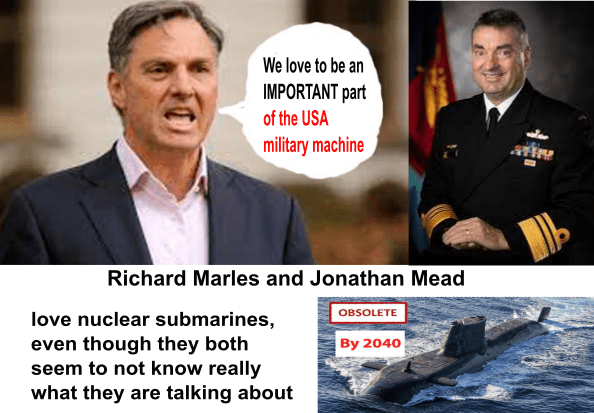
The gem in this whole venture, at least from the perspective of the U.S. military-industrial complex, is the roping in of the Australian taxpayer as the funder of its own nuclear weapons program.
By Binoy Kampmark | 6 January 2024. https://independentaustralia.net/politics/politics-display/funding-the-imperium-australia-subsidises-us-nuclear-submarines,18217
AUKUS, the trilateral pact between the United States, the United Kingdom and Australia, was a steal for all except one of the partners.
Australia, given the illusion of protection even as its aggressive stance (acquiring nuclear-powered submarines, becoming a forward base for the U.S. military) aggravated other countries; the feeling of superiority, even as it was surrendering itself to a foreign power as never before, was the loser in the bargain.
Last month, Australians woke up to the sad reminder that their government’s capitulation to Washington has been so total as to render any further talk about independence an embarrassment. Defence Minister Richard Marles, along with his deputy, Minister for Defence Industry Pat Conroy, preferred a different story.
Canberra had gotten what it wanted: approval by the U.S. Congress through its 2024 National Defense Authorisation Act (NDAA) authorising the transfer of three Virginia class nuclear-powered submarines to the Royal Australian Navy, with one off the production line, and two in-service boats. Australia may also seek congressional approval for two further Virginia class boats.
The measures also authorised Australian contractors to train in U.S. shipyards to aid the development of Australia’s own non-existent nuclear-submarine base, and exemptions from U.S. export control licensing requirements permitting the ‘transfer of controlled goods and technology between Australia, the United Kingdom, and the United States without the need for an export license’.
For the simpleminded Marles, Congress had “provided unprecedented support to Australia in passing the National Defense Authorisation Act which will see the transfer of submarines and streamlined export control provisions, symbolising the strength of our Alliance, and our shared commitment to the AUKUS partnership”.
Either through ignorance or wilful blindness, the Australian Defence Minister chose to avoid elaborating on the less impressive aspects of the authorising statute. The exemption under the U.S. export licensing requirements, for instance, vests Washington with control and authority over Australian goods and technology while controlling the sharing of any U.S. equivalent with Australia. The exemption is nothing less than appropriation, even as it preserves the role of Washington as the drip feeder of nuclear technology.
An individual with more than a passing acquaintance with this is Bill Greenwalt, one of the drafters of the U.S. export control regime.
As he told the ABC last November:
“After years of U.S. State Department prodding, it appears that Australia signed up to the principles and specifics of the failed U.S. export control system.”
In cooperating with the U.S. on this point, Australia would “surrender any sovereign capability it develops to the United States control and bureaucracy”.
The gem in this whole venture, at least from the perspective of the U.S. military-industrial complex, is the roping in of the Australian taxpayer as the funder of its own nuclear weapons program. Whatever its non-proliferation credentials, Canberra finds itself a funder of the U.S. naval arm in an exercise of modernised nuclear proliferation.
Even the Marles-Conroy media release admits that the NDAA helped ‘establish a mechanism for the U.S. to accept funds from Australia to lift the capacity of the submarine industrial base’. Airily, the release goes on to mention that this “investment” (would “gift” not be a better word?) to the U.S. Navy would also ‘complement Australia’s significant investment in our domestic submarine industrial base’.
A few days after the farcical spectacle of surrender by Australian officials, the Congressional Research Service provided another one of its invaluable reports that shed further light on Australia’s contribution to the U.S. nuclear submarine program. Australian media outlets, as is their form on covering AUKUS, remained silent about it. One forum, Michael West Media, showed that its contributors – Rex Patrick and Philip Dorling – were wide awake.
The report is specific to the Navy Columbia (SSBN-826) Class Ballistic Missile Submarine Program, one that involves designing and building 12 new SSBNs to replace the current, aging fleet of 14 Ohio class SSBNs. The cost of the program, in terms of 2024 budget submission estimates for the 2024 financial year, is US$112.7 billion (AU$168.2 billion).
As is customary in these reports, the risks are neatly summarised. They include the usual delays in designing and building the lead boat, thereby threatening readiness for timely deployment; burgeoning costs; the risks posed by funding the Columbia class program to other Navy programs; and ‘potential industrial-base challenges of building both Columbia-class boats and Virginia-class attack submarines (SSNs) at the same time’.
Australian funding becomes important in the last concern. Because of AUKUS, the U.S. Navy “has testified” that it would require, not only an increase in the production rate of the Virginia class to 2.33 boats per year, but ‘a combined Columbia-plus-Virginia procurement rate’ of 1+2.33. Australian mandarins and lawmakers, accomplished in their ignorance, have mentioned little about this addition.
But U.S. lawmakers and military planners are more than aware that this increased procurement rate:
‘…will require investing several billion dollars for capital plant expansion and improvements and workforce development at both the two submarine-construction shipyards (GD/EB [General Dynamics’ Electric Boat in Groton, Connecticut] and HII/NSS [Huntington Ingalls Industries’ Newport News Shipbuilding]) and submarine supplier firms.’
The report acknowledges that funding towards the 1+2.33 goal is being drawn from several allocations over a few financial years, but expressly mentions Australian funding ‘under the AUKUS proposed Pillar 1 pathway’, which entails the transfer component of nuclear-powered submarines to Canberra.
The report helpfully reproduces the 25 October 2023 testimony from the Navy before the Seapower and Projection Forces Subcommittee of the House of Armed Services Committee. Officials are positively salivating at the prospect of nourishing the domestic industrial base through, for instance, ‘joining with an Australian company to mature and scale metallic additive manufacturing across the SIB [Submarine Industrial Base]’.
The testimony goes on to note that:
‘Australia’s investment into the U.S. SIB builds upon ongoing efforts to improve industrial base capability and capacity, create jobs, and utilise new technologies. This contribution is necessary to augment VACL [Virginia class] production from 2.0 to 2.33 submarines per year to support both U.S. Navy and AUKUS requirements.’
The implications from the perspective of the Australian taxpayer are significant.
‘Australian AUKUS funding will support construction of a key delivery component of the U.S. nuclear strike force, keeping that program on track while overall submarine production accelerates.’
The funding also aids the advancement of another country’s nuclear weapons capabilities, a breach, one would have thought, of Australia’s obligations under the Treaty of Non-Proliferation of Nuclear Weapons.
Defence spokesman for the Australian Greens, Senator David Shoebridge, makes that very point to Patrick and Dorling:
“Australia has clear international legal obligations to not support the nuclear weapons industry, yet this is precisely what these billions of dollars of AUKUS funding will do.”
The Senator also asks:
“When will the Albanese Government start telling the whole truth about AUKUS and how Australians will be paying to help build the next class of U.S. ballistic missile submarines?”
For an appropriate answer, Shoebridge would do well to consult the masterful, deathless British series Yes Minister, authored by Antony Jay and Jonathan Lynn.
In one episode, the relevant minister, Jim Hacker, offers this response to a query by the ever-suspicious civil service overlord Sir Humphrey Appleby on when he might receive a draft proposal:
“At the appropriate juncture. In the fullness of time. When the moment is ripe. When the necessary procedures have been completed. Nothing precipitate, of course.”
In one word: never.
CNN staff say network’s pro-Israel slant amounts to ‘journalistic malpractice’

The push for more balanced coverage has been complicated by Israel’s block on foreign journalists entering Gaza except under IDF control and subject to censorship. That has helped keep the full impact of the war on Palestinians off of CNN and other channels while ensuring that there is a continued focus on the Israeli perspective.
Insiders say pressure from the top results in credulous reporting of Israeli claims and silencing of Palestinian perspectives
Insiders say pressure from the top results in credulous reporting of Israeli claims and silencing of Palestinian perspectives
Guardian, Chris McGreal, 4 Feb 24
CNN is facing a backlash from its own staff over editorial policies they say have led to a regurgitation of Israeli propaganda and the censoring of Palestinian perspectives in the network’s coverage of the war in Gaza.
Journalists in CNN newsrooms in the US and overseas say broadcasts have been skewed by management edicts and a story-approval process that has resulted in highly partial coverage of the Hamas massacre on 7 October and Israel’s retaliatory attack on Gaza.
“The majority of news since the war began, regardless of how accurate the initial reporting, has been skewed by a systemic and institutional bias within the network toward Israel,” said one CNN staffer. “Ultimately, CNN’s coverage of the Israel-Gaza war amounts to journalistic malpractice.”
According to accounts from six CNN staffers in multiple newsrooms, and more than a dozen internal memos and emails obtained by the Guardian, daily news decisions are shaped by a flow of directives from the CNN headquarters in Atlanta that have set strict guidelines on coverage.
They include tight restrictions on quoting Hamas and reporting other Palestinian perspectives while Israel government statements are taken at face value. In addition, every story on the conflict must be cleared by the Jerusalem bureau before broadcast or publication.
CNN journalists say the tone of coverage is set at the top by its new editor-in-chief and CEO, Mark Thompson, who took up his post two days after the 7 October Hamas attack. Some staff are concerned about Thompson’s willingness to withstand external attempts to influence coverage given that in a former role as the BBC’s director general he was accused of bowing to Israeli government pressure on a number of occasions, including a demand to remove one of the corporation’s most prominent correspondents from her post in Jerusalem in 2005.
CNN insiders say that has resulted, particularly in the early weeks of the war, in a greater focus on Israeli suffering and the Israeli narrative of the war as a hunt for Hamas and its tunnels, and an insufficient focus on the scale of Palestinian civilian deaths and destruction in Gaza.
One journalist described a “schism” within the network over coverage they said was at times reminiscent of the cheerleading that followed 9/11.
“There’s a lot of internal strife and dissent. Some people are looking to get out,” they said.
Another journalist in a different bureau said that they too saw pushback.
“Senior staffers who disagree with the status quo are butting heads with the executives giving orders, questioning how we can effectively tell the story with such restrictive directives in place,” they said.
“Many have been pushing for more content from Gaza to be alerted and aired. By the time these reports go through Jerusalem and make it to TV or the homepage, critical changes – from the introduction of imprecise language to an ignorance of crucial stories – ensure that nearly every report, no matter how damning, relieves Israel of wrongdoing.”
CNN staff say that some journalists with experience of reporting the conflict and region have avoided assignments in Israel because they do not believe they will be free to tell the whole story. Others speculate that they are being kept away by senior editors.
“It is clear that some who don’t belong are covering the war and some who do belong aren’t,” said one insider.
Edicts from on high
………………. In late October, as the Palestinian death toll rose sharply from Israeli bombing with more than 2,700 children killed according to the Gaza health ministry, and as Israel prepared for its ground invasion, a set of guidelines landed in CNN staff inboxes.
……………….CNN staff members said the memo solidified a framework for stories in which the Hamas massacre was used to implicitly justify Israeli actions, and that other context or history was often unwelcome or marginalised.
“How else are editors going to read that other than as an instruction that no matter what the Israelis do, Hamas is ultimately to blame? Every action by Israel – dropping massive bombs that wipe out entire streets, its obliteration of whole families – the coverage ends up massaged to create a ‘they had it coming’ narrative,” said one staffer.
The same memo said that any reference to casualty figures from the Gaza health ministry must say it is “Hamas-controlled”, implying that reports of the deaths of thousands of children were unreliable even though the World Health Organization and other international bodies have said they are largely accurate. CNN staff said that edict was laid down by Thompson at an earlier editorial meeting.
Broader oversight of coverage from the CNN headquarters in Atlanta is directed by “the Triad” of three CNN departments: news standards and practices, legal and fact-checking.
David Lindsay, the senior director of news standards and practices, issued a directive in early November effectively barring the reporting of most Hamas statements, characterising them as “inflammatory rhetoric and propaganda”.
………. one CNN staffer noted that the network repeatedly aired inflammatory rhetoric and propaganda from Israeli officials and American supporters, often without challenge in interviews.
They noted that other channels have carried interviews with Hamas leaders while CNN has not, including one in which the group’s spokesman, Ghazi Hamad, cut short questions from the BBC when he was challenged about the murder of Israeli civilians. One staffer said there is a view among correspondents that it is “agony to get a Hamas interview past the Triad
…………………………………………………….. In addition to the edicts from Atlanta, CNN has a longstanding policy that all copy on the Israel-Palestine situation must be approved for broadcast or publication by the Jerusalem bureau. In July, the network created a process it called “SecondEyes” to speed up those approvals.
…………… One result of SecondEyes is that Israeli official statements are often quickly cleared and make it on air on the principle that that they are to be trusted at face value, seemingly rubber-stamped for broadcast, while statements and claims from Palestinians, and not just Hamas, are delayed or never reported.
One CNN staffer said edits by SecondEyes often seemed aimed at avoiding criticism from pro-Israel groups……………………………..
Some CNN staff fear that the result is a network acting as a surrogate censor on behalf of the Israeli government.
“The system results in chosen individuals editing any and all reporting with an institutionalised pro-Israel bias, often using passive language to absolve the [Israel Defense Forces] of responsibility, and playing down Palestinian deaths and Israeli attacks,” said one of the network’s journalists.
……………………………………………………………. Another presenter, Sara Sidner, drew criticism for her excitable report on unverified Israeli claims that Hamas beheaded dozens of babies on 7 October.
“We have some really disturbing new information out of Israel,” she announced four days after the attack.
“The Israeli prime minister’s spokesman just confirmed, babies and toddlers were found with their heads decapitated in Kfar Aza in southern Israel after Hamas attacks in the kibbutz over the weekend. That has been confirmed by the prime minister’s office.”
………………… Gold, who was part of the SecondEyes team approving stories, again said the report had been confirmed by Netanyahu’s office and she drew parallels with the Holocaust. She responded to a Hamas denial that it had decapitated babies as unbelievable “when we literally have video of these guys, of these militants, of these terrorists doing exactly what they say they’re not doing to civilians and to children”.
Except, as a CNN journalist pointed out, the network did not have such video and, apparently, neither did anyone else………………………………….
By the time of Sidner’s broadcast there were already good reasons for CNN to treat the claims with caution.
Israeli journalists who toured Kfar Aza the day before said they had seen no evidence of such a crime and military officials there had made no mention of it. Instead, Tim Langmaid, the Atlanta-based CNN vice-president and senior editorial director, sent an instruction that President Biden’s claims to have seen pictures of the alleged atrocity “back up what the Israeli government said”.
…….. CNN insiders said senior editors should have treated the story with caution from the beginning because the Israeli military has a track record of false or exaggerated claims that subsequently fall apart.
Other networks, such as Sky News, were considerably more sceptical in their reporting and laid out the tenuous origins of the story, which began with a reporter for an Israeli news channel saying soldiers had told her that 40 children had been killed in the Hamas massacre and that one soldier had said he had seen “bodies of babies with their heads cut off”. The Israel Defense Forces (IDF) then used the claim to liken Hamas to the Islamic State.
Even after the White House admitted that neither the president nor his officials had themselves seen pictures of beheaded babies, and that they had been relying on Israeli claims, Langmaid told the newsroom it could still report the Israeli government assertions alongside a denial from Hamas.
CNN did report on the rolling back of the claims as Israeli officials backtracked, but one staffer said that by then the damage had been done, describing the coverage as a failure of journalism.
“The infamous ‘beheaded babies’ claim, attributed to the Israeli government, made it to air for roughly 18 hours – even after the White House walked back on Biden’s statement that he had seen the nonexistent photos. CNN had no access to photographic evidence, nor any ability to independently verify these claims,” they said.
……….. Some CNN staff raised similar issues with reporting on Hamas tunnels in Gaza and claims they led to a sprawling command centre under al-Shifa hospital.
The push for more balanced coverage has been complicated by Israel’s block on foreign journalists entering Gaza except under IDF control and subject to censorship. That has helped keep the full impact of the war on Palestinians off of CNN and other channels while ensuring that there is a continued focus on the Israeli perspective………………………………
The only foreign journalist to report from Gaza without an Israeli escort has been CNN’s Clarissa Ward, who entered for two hours with a humanitarian team from the United Arab Emirates.
……………. she was being prevented from conveying a fuller picture of the tragedy unfolding in Gaza because of the Israeli block on foreign journalists, putting the burden solely on a limited number of courageous Palestinian reporters who are being killed in disproportionate numbers.
“We must now be able to report on the horrific death and destruction being meted out in Gaza in the same way – on the ground, independently – amid one of the most intense bombardments in the history of modern warfare,” she wrote.
“The response to our report on Gaza in Israeli media suggests an unspoken reason for denying access. When asked on air about our piece, one reporter from the Israeli Channel 13 replied, ‘If indeed Western reporters begin to enter Gaza, this will for sure be a big headache for Israel and Israeli hasbara.’ Hasbara is a Hebrew word for pro-Israel advocacy.
Some at CNN fear that its coverage of the latest Gaza war is damaging a reputation built up by its reporting of Russia’s invasion of Ukraine, which led to a surge in viewers. But others say that the Ukraine war may be part of the problem because editorial standards grew lax as the network and many of its journalists identified clearly with one side – Ukraine – particularly at the beginning of the conflict.
One CNN staffer said that Ukraine coverage set a dangerous precedent that has come back to haunt the network because the Israeli-Palestinian conflict is far more divisive and views are much more deeply entrenched.
“The complacency in our editorial standards and journalistic integrity while reporting on Ukraine has come back to haunt us. Only this time, the stakes are higher and the consequences much more severe. Journalistic complacency is an easier pill for the world to swallow when it’s Arab lives lost instead of European,” they said.
Another CNN employee said the double standards are glaring…………………………………………………
Years of pressure
Journalists working at CNN have varied explanations……………………………………………………….. more https://www.theguardian.com/media/2024/feb/04/cnn-staff-pro-israel-bias
Distorted news: for decades CNN, BBC, and surely others, obeyed Israeli government pressure

Guardian, Chris McGreal, 4 Feb 24
“…………………………………………………..Years of pressure
Journalists working at CNN have varied explanations.
Some say the problem is rooted in years of pressure from the Israeli government and allied groups in the US combined with a fear of losing advertising.
During the battle for narrative through the second Palestinian intifada in the early 2000s, Israel’s then communications minister, Reuven Rivlin, called CNN ‘‘evil, biased and unbalanced”. The Jerusalem Post likened the network’s correspondent in the city, Sheila MacVicar, to “the woman who refilled the toilet paper in the Goebbels’ commode”.
CNN’s founder, Ted Turner, caused a storm when he told the Guardian in 2002 that Israel was engaging in terrorism against the Palestinians.
“The Palestinians are fighting with human suicide bombers, that’s all they have. The Israelis … they’ve got one of the most powerful military machines in the world. The Palestinians have nothing. So who are the terrorists? I would make a case that both sides are involved in terrorism,” said Turner, who was then the vice-chairman of AOL Time Warner, which owned CNN.
The resulting storm of protest resulted in threats to the network’s revenue, including moves by Israeli cable television companies to supplant the network with Fox News.
CNN’s chair, Walter Isaacson, appeared on Israeli television to denounce Turner but that did not stem the criticism. The network’s then chief news executive, Eason Jordan, imposed a new rule that CNN would no longer show statements by suicide bombers or interview their relatives, and flew to Israel to quell the political storm.
CNN also began broadcasting a series about the victims of Palestinian suicide bombers. The network insisted that the move was not a response to pressure but some of its journalists were sceptical. CNN did not produce a similar series with the relatives of innocent Palestinians killed by Israel in bombings.
By 2021, the Columbia Journalism Review public editor for CNN, Ariana Pekary, accused the network of excluding Palestinian voices and historical context from coverage.
Thompson has his own battle scars from dealing with Israeli officials when he was director general of the BBC two decades ago.
In the spring of 2005, the BBC was embroiled in a very public row over an interview with the Israeli nuclear whistleblower Mordechai Vanunu, who was released from prison the year before.
The Israeli authorities barred Vanunu from giving interviews. When a BBC documentary team spoke to him and then smuggled the footage out of Israel, the authorities reacted by effectively expelling the acting head of the BBC’s Jerusalem bureau, Simon Wilson, who was not involved in the interview.
The dispute rolled on for months before the BBC eventually bowed to an Israeli demand that Wilson write a letter of apology before he could return to Jerusalem. The letter, which included a commitment to “obey the regulations in the future”, was to have remained confidential but the BBC unintentionally posted details online before removing them a few hours later. The climbdown angered some BBC journalists who were enduring persistent pressure and abuse for their coverage.
Later that year, Thompson visited Jerusalem and met the Israeli prime minister, Ariel Sharon, in an effort to improve relations after other incidents.
The Israeli government was particularly unhappy with the BBC’s highly experienced Jerusalem correspondent, Orla Guerin. The Israeli minister for diaspora affairs at the time, Natan Sharansky, accused her of antisemitism and “total identification with the goals and methods of the Palestinian terror groups” after a report by Guerin about the arrest of a 16-year-old Palestinian boy carrying explosives. She accused Israeli officials of turning the arrest into a propaganda opportunity because they “paraded the child in front of the international media” after forcing him to wait at a checkpoint for the arrival of photographers.
Within days of Thompson’s meeting with Sharon, the BBC announced that Guerin would be leaving Jerusalem. At the time, Thompson’s office denied he acted under pressure from Israel and said that Guerin had completed a longer than usual posting. https://www.theguardian.com/media/2024/feb/04/cnn-staff-pro-israel-bias
1 This month.

Australians deserve the truth
about
AUKUS – https://aukuspublicinquiry.com/

30 July – WEBINAR (Free) – Is Nuclear Power the Solution to Climate Change? https://my.acaw.org.au/event/acaw-is-nuclear-power-the-solution-to-climate-change
18:30 – 19:45 ACST
19:00 – 20:15 AEST


PETITION – To: Prime Minister Anthony Albanese and the Australian Labor Government

of the week – Australians for War Powers Reform (AWPR)
To see nuclear-related stories in greater depth and intensity
 Antinuclear