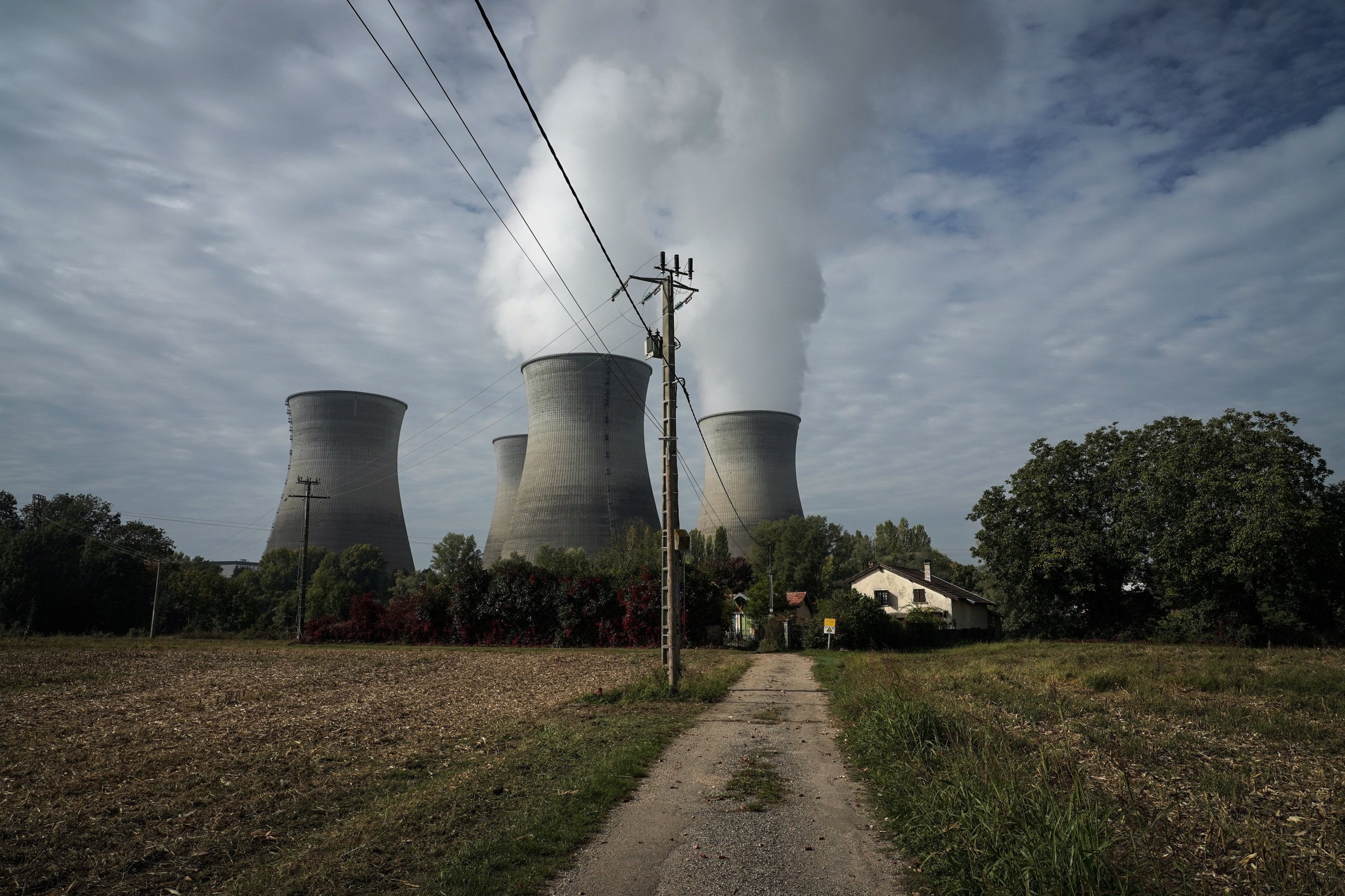
Nuclear technology: the shady beginnings and the uncertain future
ABC RN, Broadcast Mon 8 Jan 2024, https://www.abc.net.au/listen/programs/bigideas/nuclear-technology-history-and-future/102960302?fbclid=IwAR2QQafugR_2Vy3Est_CdP4MVvA6gu7g-nypcNFKhe5ixGEX8VCdTgrJpEM
The history and development of the nuclear industry is shrouded in secrecy and contradictions. And its future is throwing up more questions than answers.
A scientist, a historian and a poet consider the economic, scientific and social realities of nuclear technology.
They discuss how the lessons from the past might shape an uncertain future, and the possible consequences of playing God.
Nuclear Fallout was presented at the Brisbane Writers Festival. May 10, 2023
Original broadcast on July 6, 2023.
Speakers
Associate Professor Elizabeth Tynan
Coordinator of the professional development program at the James Cook University Graduate Research School
Author of The Secret of Emu Field: Britain’s Forgotten Atomic Tests in Australia, NewSouth Publishing, May 2022
Poet and writer; Author of The Exclusion Zone, UQP 2023
Ian Lowe
Environmental scientist, Emeritus professor at Griffith University,
Ashley Hay (host)
Novelist and essayist, former editor of Griffith Review, editorial consultant for the Climate Justice Observatory
The Case for Genocide
A ruling by the court could be years away. But South Africa is asking for provisional measures that would demand Israel cease its military assault – in essence a permanent ceasefire. This decision could come within two or three weeks.
The International Court of Justice may be all that stands between the Palestinians in Gaza and genocide.
By Chris Hedges /ScheerPost, https://scheerpost.com/2024/01/12/chris-hedges-the-case-for-genocide/
The exhaustive 84-page brief submitted by South Africa to the International Court of Justice (ICJ) charging Israel with genocide is hard to refute. Israel’s campaign of indiscriminate killing, wholesale destruction of infrastructure, including housing, hospitals and water treatment plants, along with its use of starvation as a weapon, accompanied by genocidal rhetoric from its political and military leaders who speak of destroying Gaza and ethnically cleansing the 2.3 million Palestinians, makes a strong case against Israel for genocide.
Israel’s smearing of South Africa as “the legal arm” of Hamas exemplifies the bankruptcy of its defense, a smear replicated by those who claim that demonstrations held to call for a ceasefire and protect Palestinian human rights are “anti-Semitic.” Israel, its genocide live streamed to the world, has no substantial counter argument.
But that does not mean the judges on the court will rule in South Africa’s favor. The pressure the U.S. will bring – Secretary of State Antony Blinken has called the South African charges “meritless” – on the judges, drawn from the member states of the U.N., will be intense.

A ruling of genocide is a stain that Israel – which weaponizes the Holocaust to justify its brutalization of the Palestinians – would find hard to remove. It would undercut Israel’s insistence that Jews are eternal victims. It would shatter the justification for Israel’s indiscriminate killing of unarmed Palestinians and construction of the world’s largest open air prison in Gaza, along with the occupation of the West Bank and East Jerusalem. It would sweep away the immunity to criticism enjoyed by the Israel lobby and its Zionist supporters in the U.S., who have successfully equated criticisms of the “Jewish State” and support for Palestinian rights with anti-Semitism.
Over 23,700 Palestinians, including over 10,000 children, have been killed in Gaza since Oct. 7, when Hamas and other resistance fighters breached the security barriers around Gaza. Some 1,200 people were killed – there is strong evidence that some of the victims were killed by Israeli tank crews and helicopter pilots that intentionally targeted the some 200 hostages along with their captors. Thousands more Palestinians are missing, presumed buried under the rubble. Israeli attacks have left over 60,000 Palestinians wounded and maimed, the majority of them women and children. Thousands more Palestinian civilians, including children, have been arrested, blindfolded, numbered, beaten, forced to strip to their underwear, loaded onto trucks and transported to unknown locations.
A ruling by the court could be years away. But South Africa is asking for provisional measures that would demand Israel cease its military assault – in essence a permanent ceasefire. This decision could come within two or three weeks. It is a decision that is not based on the final ruling by the court, but on the merits of the case brought by South Africa. The court would not, by demanding Israel end its hostilities in Gaza, define the Israeli campaign in Gaza as genocide. It would confirm that there is the possibility of genocide, what the South African lawyers call acts that are “genocidal in character.”
The case will not be determined by the documentation of specific crimes, even those defined as war crimes. It will be determined by genocidal intent – the intent to eradicate in whole or in part, a national, ethnic, racial or religious group – as defined in the Genocide Convention.
These acts collectively include the targeting of refugee camps and other densely packed civilian areas with 2,000-pound bombs, the blocking of humanitarian aid, the destruction of the health care system and its effects on children and pregnant women – the U.N. estimates there are around 50,000 pregnant women in Gaza, and that more than 160 babies are delivered every day – as well as repeated genocidal statements by leading Israeli politicians and generals.
Prime Minister Benjamin Netanyahu equated Gaza with Amalek, a nation hostile to the Israelites in the Bible, and cited the Biblical injunction to kill every Amalek man, woman, child or animal. Defence Minister Yoav Gallant called Palestinians “human animals.” Israeli President Isaac Herzog stated, as the South African lawyers told the court, that everybody in Gaza is responsible for what happened on Oct. 7 because they voted for Hamas, although half the population in Gaza are children who are too young to vote. But even if the entire population of Gaza did vote for Hamas this does not make them a legitimate military target. They are still, under the rules of war, civilians, and entitled to protection. They are also entitled under international law to resist their occupation via armed struggle.
The South African lawyers, who compared Israel’s crimes with those carried out by the apartheid regime in South Africa, showed the court a video of Israeli soldiers celebrating and calling for the death of Palestinians – they sang as they danced “There are no uninvolved civilians” – as evidence that genocidal intent descends from the top to the bottom of the Israeli war machine and political system. They provided the court with photos of mass graves where bodies were buried “often unidentified.” No one – including newborns – was spared, the South African lawyer Adila Hassim, Senior Counsel, explained to the court.
The South African lawyers told the court the “first genocidal act is mass killing of Palestinians in Gaza.” The second genocidal act, they stated, is the serious bodily or mental harm inflicted on Palestinians in Gaza in violation of Article 2B of the Genocide Convention. Tembeka Ngcukaitobi, another lawyer and legal scholar representing South Africa, argued that “Israel’s political leaders, military commanders and persons holding official positions have systematically and in explicit terms declared their genocidal intent.”
Lior Haiat, spokesperson for the Israeli Ministry of Foreign Affairs, called Thursday’s three hour hearing one of the “greatest shows of hypocrisy in history, compounded by a series of false and baseless claims.” He accused South Africa of seeking to allow Hamas to return to Israel to “commit war crimes.”
Israeli jurists, in their response on Friday, called the South African charges “unfounded, “absurd” and amounting to “libel.” Israel’s legal team said it had – despite U.N. reports of widespread starvation and infectious diseases from a breakdown in sanitation and shortage of clean water – not impeded humanitarian assistance. Israel defended attacks on hospitals, calling them “Hamas command centers.” It told the court it was acting in self-defense. “The inevitable fatalities and human suffering of any conflict is not of itself a pattern of conduct that plausibly shows genocidal intent,” said Christopher Staker, a barrister for Israel.
Israeli leaders accuse Hamas with carrying out genocide, although legally if you are the victims of genocide you are not permitted to commit genocide. Hamas is also not a state. It is not, therefore, a party to the Genocide Convention. The Hague, for this reason, has no jurisdiction over the organization. Israel also claims the Palestinians are warned to evacuate areas that will come under attack and provided with “safe areas,” although as the South African lawyers documented, “safe areas” are routinely bombed by Israel with numerous civilian casualties.
Israel and the Biden administration intend to prevent any temporary injunction by the court, not because the court can force Israel to halt its military assaults, but because of the optics, which are already disastrous. The ICJ’s ruling depends on the Security Council for enforcement – which given the veto power by the U.S., renders any ruling against Israel moot. The second objective of the Biden administration is to make sure Israel is not found guilty of committing genocide. It will be unrelenting in this campaign, heavily pressuring the governments that have jurists on the court not to find Israel guilty. Russia and China, who have jurists in The Hague, are battling their own charges of genocide and may decide it is not in their interests to find Israel guilty.
The Biden administration is playing a very cynical game. It insists it is trying to halt what, by its own admission, is Israel’s indiscriminate bombing of Palestinians, while bypassing Congress to speed up the supply of weapons to Israel, including “dumb” bombs. It insists it wants the fighting in Gaza to end while it vetoes ceasefire resolutions at the U.N. It insists it upholds the rule of law while it subverts the legal mechanism that can halt the genocide.
Cynicism pervades every word Biden and Blinken utter. This cynicism extends to us. Our revulsion for Donald Trump, the Biden White House believes, will impel us to keep Biden in office. On any other issue this might be the case. But it cannot be the case with genocide.
Genocide is not a political problem. It is a moral one. We cannot, no matter what the cost, support those who commit or are accomplices to genocide. Genocide is the crime of all crimes. It is the purest expression of evil. We must stand unequivocally with Palestinians and the jurists from South Africa. We must demand justice. We must hold Biden accountable for the genocide in Gaza.
Could Israel’s War in Gaza Spiral Into a Regional War?
Since the early days of this war, the conflict has not been contained to Gaza. Is a regional conflict with Iran, Hezbollah, and other actors on the horizon?
SCHEERPOST, By Maximillian Alvarez and Chris Hedges / The Real News Network 12 Jan 24
Over three months into Israel’s genocidal assault on Gaza, there is little hope the carnage will stop anytime soon—and with each passing day, the danger of Israel’s war on Gaza spiraling into a larger regional conflict increases. The devastation in Gaza is unlike anything seen in the 21st century, but Israel’s military strikes—like last week’s assassination of Saleh al-Arouri, a top leader of Hamas, in Lebanon—have not been limited to Palestine alone.
At the same time, armed resistance groups in Iraq and Syria have launched hundreds of attacks on US bases, confrontation between Israel and Hezbollah has created a simmering northern front along the Lebanese border, and Yemen’s blockade of the Red Sea has created an international crisis for shipping and trade.
Should any of these fronts open into a new facet of this war, it could lead to the unraveling of the entire region, with a very real possibility of a showdown between Israel and the US against Iran. TRNN Editor-in-Chief Maximillian Alvarez speaks with former war correspondent Chris Hedges on the slippery slope to a regional war.
TRANSCRIPT……………………………………………………………………………………………………………..
Chris Hedges: At this particular moment, I don’t think we’re that close. And that’s because Iran, in particular, but also Hezbollah, do not want a conflict with Israel…………………………… the longer the conflict goes on in Gaza, the more things can spiral out of control.
………………………………. But it could happen, and if it does, it will be absolutely catastrophic. Because a war with Iran, throughout the region, will not be interpreted as simply a war with Iran, it’ll be interpreted as a war against Shiism and 60% of Iraq is Shia, Bahrain, 3 million Shias in Saudi Arabia. So it will be interpreted by Shia, the Shiites, as a religious war and will immediately extend beyond the borders of Iran itself.
The big question in Gaza, we know what the Israeli goal is, whether they can achieve it or not, is an unknown. They want to push the 2.2, 2.3 million Palestinians out. They want them ethnically cleansed……………………………………………… really, the goal of Israel is to offer the Palestinians a choice between death by bombs, bullets, infectious diseases or exposure, or leaving Gaza.
Now, the problem that Israel has run into, although Anthony Blinken tried to run interference, is that none of the countries, especially Egypt which borders Gaza to the south, is willing to accept the Palestinians. …………………………………………………… And now we know, and this has been public, by the Netanyahu government, they are reaching out to countries in Africa and South America to take the Palestinians and offering them, reportedly, financial inducements to do so.
…………………. Netanyahu and his government is counting on that restraint to prevent a wider conflict. I read The New York Times this morning, it was kind of a remarkable front page story about all of the provocations that were being carried out by Iran. In fact, it’s the complete opposite, the provocations are carried out by Israel. And the nation that has exercised, up until this point, considerable restraint is Iran.
………………………………………………. Well, in the case of Iran and Hezbollah, it’s the fact that they don’t want to go into an open conflict with Israel because that will also probably, in the case of Iran, include a direct conflict with the United States. Netanyahu has long wanted to attack Iran, in particular the nuclear sites in Iran, and he has periodically made pushes to get the United States involved.
…………………. the push by Netanyahu is to get the United States to take out the aerial defense systems and then allow Israeli jets to bomb in particular nuclear sites. But if they bomb those sites, we’re talking about thousands and thousands of deaths, Iranian deaths.
…………………………………………………….. the longer Israel carries out these kinds of strikes, the more those provocations take place, the closer we come… despite a reluctance on the part of Iran and Hezbollah, the closer we come to a regional conflict.
……………………………………………………………… I think in the end, it’s really totally dependent on how far Israel goes. And if they do not show restraint, then I could see it beginning with Hezbollah. And once Hezbollah is actively engaged, especially if Israel does make a ground incursion into Lebanon, then you bring Iran a few steps closer to being involved in a conflict. And at that point, it becomes a regional conflict and very, very dangerous.
…………………………………………………… , the Congress is bought and paid for by the Israel lobby. Biden is one of the largest recipients of Israel lobby aid. Both parties are completely wedded to Israel. Our intelligence services are integrated with the Israeli. Israel is the 10th largest arms exporter in the world. So it’s totally, it’s training our police forces. So I think, especially because it’s Israel, it doesn’t really matter what the public and all these demonstrations, which have been very heartening to people like myself, it doesn’t matter. Especially, it’s worse because it’s Israel. So if somehow there began to be a conflict between Iran and Israel, I have little doubt that we would intervene. And at that point, we’re at war with Iran………. https://scheerpost.com/2024/01/12/could-israels-war-in-gaza-spiral-into-a-regional-war/
Aw gee! Did ya know that Australia is partnering USA in making multiple strikes on Yemen?

Yeah. It’s happened already. And many thanks to the American media (CNN) for letting me know. Not that it was discussed in the Australian Parliament or anything like that. But don’t worry. Our Defence Minister Richard Marles has it all in hand. I believe that he’s going to make an announcement to the Australian public soon. So no need to worry. The Labor government has everything in had, just as the Liberal government under John Howard did, in 2003, when we joined USA to bomb Iraq, without consulting Parliament.
Not a peep out of our Prime Minister yet. I wonder if the Australian media will bother to cover it?
Israel Is Terrified the World Court Will Decide It’s Committing Genocide

Public hearings on South Africa’s request for provisional measures will take place on January 11 and 12 at the ICJ which is located in the Peace Palace in The Hague, Netherlands. The hearings will be livestreamed from 4:00-6:00 a.m. Eastern/1:00-3:00 a.m. Pacific on the Court’s website and on UN Web TV. The court could order provisional measures within a week after the hearings.
Other States Parties to the Genocide Convention Can Join South Africa’s Case
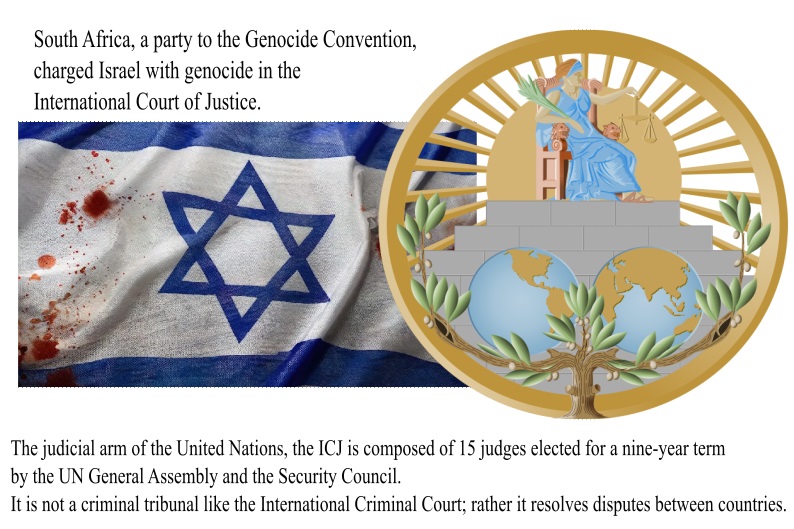
South Africa, a party to the Genocide Convention, charged Israel with genocide in the International Court of Justice.
By Marjorie Cohn / Truthout, January 8, 2024, https://scheerpost.com/2024/01/08/israel-is-terrified-the-world-court-will-decide-its-committing-genocide/
For nearly three months, Israel has enjoyed virtual impunity for its atrocious crimes against the Palestinian people. That changed on December 29 when South Africa, a state party to the Genocide Convention, filed an 84-page application in the International Court of Justice (ICJ, or World Court) alleging that Israel is committing genocide in Gaza.
South Africa’s well-documented application alleges that “acts and omissions by Israel … are genocidal in character, as they are committed with the requisite specific intent … to destroy Palestinians in Gaza as a part of the broader Palestinian national, racial and ethnical group” and that “the conduct of Israel — through its State organs, State agents, and other persons and entities acting on its instructions or under its direction, control or influence — in relation to Palestinians in Gaza, is in violation of its obligations under the Genocide Convention.”
Israel is mounting a full-court press to prevent an ICJ finding that it’s committing genocide in Gaza. On January 4, the Israeli Foreign Ministry instructed its embassies to pressure politicians and diplomats in their host countries to make statements opposing South Africa’s case at the ICJ.
In its application, South Africa cited eight allegations to support its contention that Israel is perpetrating genocide in Gaza. They include:
(1) Killing Palestinians in Gaza, including a large proportion of women and children (approximately 70 percent) of the more than 21,110 fatalities and some appear to have been subjected to summary execution;
(2) Causing serious mental and bodily harm to Palestinians in Gaza, including maiming, psychological trauma, and inhuman and degrading treatment;
(3) Causing the forced evacuation and displacement of about 85 percent of Palestinians in Gaza — including children, the elderly and infirm, and the sick and wounded. Israel is also causing the massive destruction of Palestinian homes, villages, towns, refugee camps and entire areas, which precludes the return of a significant proportion of the Palestinian people to their homes;
(4) Causing widespread hunger, starvation and dehydration to the besieged Palestinians in Gaza by impeding sufficient humanitarian assistance, cutting off sufficient food, water, fuel and electricity, and destroying bakeries, mills, agricultural lands and other means of production and sustenance;
(5) Failing to provide and restricting the provision of adequate clothing, shelter, hygiene and sanitation to Palestinians in Gaza, including 1.9 million internally displaced persons. This has compelled them to live in dangerous situations of squalor, in conjunction with routine targeting and destruction of places of shelter and killing and wounding of persons who are sheltering, including women, children, the elderly and the disabled;
(6) Failing to provide for or ensure the provision of medical care to Palestinians in Gaza, including those medical needs created by other genocidal acts that are causing serious bodily harm. This is occurring by direct attacks on Palestinian hospitals, ambulances and other healthcare facilities, the killing of Palestinian doctors, medics and nurses (including the most qualified medics in Gaza) and the destruction and disabling of Gaza’s medical system;
(7) Destroying Palestinian life in Gaza, by destroying its infrastructure, schools, universities, courts, public buildings, public records, libraries, stores, churches, mosques, roads, utilities and other facilities necessary to sustain the lives of Palestinians as a group. Israel is killing whole families, erasing entire oral histories and killing prominent and distinguished members of society;
(8) Imposing measures intended to prevent Palestinian births in Gaza, including through reproductive violence inflicted on Palestinian women, newborns, infants and children.
South Africa cited myriad statements by Israeli officials that constitute direct evidence of an intent to commit genocide:
“Gaza won’t return to what it was before. We will eliminate everything,” Israel’s Defense Minister Yoav Gallant said. “If it doesn’t take one day, it will take a week. It will take weeks or even months, we will reach all places.”
Avi Dichter, Israel’s Minister of Agriculture, declared, “We are now actually rolling out the Gaza Nakba,” a reference to the 1948 ethnic cleansing of Palestinians to create the state of Israel.
“Now we all have one common goal — erasing the Gaza Strip from the face of the earth,” Nissim Vaturi, the Deputy Speaker of the Knesset and Member of the Foreign Affairs and Security Committee proclaimed.
Israel’s Strategy to Defeat South Africa’s Case at the ICJ
Continue readingWhere your $trillions go, to risk all life

Peace and Planet News, by Anthony Donovan | Winter 2023 Edition
We’ve seen an amazing level of bipartisan support!” For what initiative do we hear this rare statement echoed about Congress today?
The 15th Annual Nuclear Deterrence Summit, held once again at the Hyatt Regency in Arlington, Va., Feb. 13–15. For three days the rooms are filled with a multitude of companies and government agencies from around the country connected to the Department of Energy, Department of Defense, and National Nuclear Security Administration that make up our nuclear weapons industry, and its terribly secretive renewed Mutually Assured Destruction (MAD) race.
What is termed the “Enterprise” is in full-out sales and confidence-building mode. It is here the relationships for securing contracts through the next 5 to 35 years are solidified.
One aged reporter who once covered the industry in the 1980s confides his shock after a dizzying day of presentations: “How did you know these gatherings were going on? I just found out last week! Can’t believe this, I mean, this is a new unbridled arms race! These people in there are totally convinced this is the only way to go.” Looking at only two of us with our sign, he asks, “Why aren’t more people in the streets? Where is the movement pushing back?”………………………………………………………………….
Attendees were a bit puzzled that I wasn’t with a company connected to the summit, but I continued to share my purpose, seeing that we desperately need their dedication and skillset to begin turning toward the critical needs before us today: sustainability, good jobs supporting our environment, food, water, air, housing, healthcare, education, infrastructure … you know the issue. Some were relieved that I was all for science and space exploration, but first, for the precious earth!
…………………………………………………… Most exhibitors were too young to remember that the vast majority of citizens had voted with their feet to end this madness, and that there was no transparency or democratic process in the decision to use our treasure to fund it all.
Inevitably the confounding old Cold War rhetoric arose, painting China and Russia as vile enemies that we can not trust to honor any agreements. ……………………..
Naturally, I’d let them know we had a most worthy instrument, The Treaty on the Prohibition of Nuclear Weapons, now international law, to help guide this needed transformation, despite its being dismissed by our mainstream media. Only a few had heard of it, and of those, few knew particulars.
Laser beamed on their one aspect of the industry, several with competitors present vying for the same contract, many met in the dozens of closed-door side rooms for private company presentations/briefings. There were open “networking breakfasts” lunches and evening cocktail parties and several daily general gatherings in the large Hyatt Ballroom focused on the latest in pit production, delivery platforms, command-and-control infrastructure and communications, warhead modernization, STRATCOM reports, reports from the heads of all our labs, Los Alamos, Oak Ridge, Sandia, etc. Presentations on increasing efficiency in product and organization, best practices, and cited pathways to “success.” After all, we are leading and “winning.” Exactly what we think we are winning made no sense to anyone on the nuclear abolition team.
There were exhibitors displaying highly specialized metal nose cones and delivery vehicle parts. Designers of fabrics that claim to protect from radioactivity, cybersecurity “experts,” nuclear waste management specialists, triad infrastructure architects, specialists in improving uranium refining, nuclear physicists and engineers specializing in all materials and their “enhanced delivery” of precision warhead targeting and interception by “safety” umbrellas, inter-agency communication specialists, and those through it all maintaining secure communications. My presence seemed harmless enough to this security. I think of all our very brave colleagues who’ve risked life to enter the kill zones of these most highly sealed-off omnicidal compounds to render witness of the crime against humanity.
Amazon, a “Gold Sponsor” of the summit, had an exhibit: “We have established good relations with the CIA, but we need to get better integrated with the NNSA. This is new to us. That’s why we’re here.”
In this very clearly white male-oriented world, there was also a presentation on the essential hiring of more “diversity” for the future. One enticing statement read they “offer specialized worth to employees by valuing their entire career life cycle–creating stable careers…” Ah, such security………..
The revolving door is astoundingly evident here, and the boundaries of government, military, with private companies is quite indistinguishable. Those with Navy, Air Force, and other triad experience are now running these private companies or working as their specialized “experts in technical and professional innovation. support and security.” One “private” company proudly advertising that 70% of “our expertise” hold all the necessary security clearances within the government!
…………………………….. Former General Lloyd Austin, who retired to become Raytheon’s CEO, was easily confirmed by our Congress to become our current Secretary of Defense under President Biden. In his hearings, General/CEO Austin guaranteed to our representatives that the Triad would get his full support to obtain all that it needed. What seems illegal goes unchallenged.
Along with the DOE, National Security Administration, and Budget Office, the regular old nuclear weapon corps were very present: General Dynamics, Huntington Ingalls, Bechtel, Flour, Honeywell, Aerospace, SAIC, etc., and a number of universities……………………………………………………………………………………………………..
Within 25 minutes we were surrounded by hotel security and managers asking us to leave the premises immediately. They then claimed even the sidewalks outside the hotel were private and we could not remain there………………………………………………………..
Ask your representative to sign H. Res. 77, sponsored by Rep. James McGovern, supporting the goals of the Treaty on the Prohibition of Nuclear Weapons! Ask your senator to call for the same in the Senate. Thank all the nations ratifying the TPNW. Ask your representative to observe the Ban Treaty’s Meeting of States this November in New York City at the United Nations. They are welcome to learn, and think deeper.
Knowing the horror of war was pushing ahead and with it an increasing, completely unnecessary risk of nuclear annihilation, there was ever-present sense of unity with the citizens of the world who are pleading and advocating another way. There were many thumbs up and waves from passing vehicles. Thinking of those who have young children/grandchildren, including a good number I got to speak with on this Summit floor, we felt there was nowhere else to be on this day celebrating the love in our hearts and in our lives, round the world, Valentine’s Day. https://peaceandplanetnews.org/where-your-trillions-go/
Energy Transition Minister Agnes Pannier-Runacher enthuses over “the rebirth of France’s nuclear industry”

EDF will construct the new plants with tens of billions in public financing

“EDF will construct the new plants with tens of billions in public financing ” – what could possibly go wrong?
France sees potential for 14 new nuclear reactors. 8 Jan 24, https://www.power-technology.com/news/france-may-build-14-new-nuclear-reactors/
France may need to build more than 14 new nuclear power plants, more than the six currently planned, if the nation is to meet its energy transition goal of reducing fossil fuel dependence from 60% to 40% by 2035.
Energy Transition Minister Agnes Pannier-Runacher stressed that nuclear will play an increasingly vital role in France’s energy mix. Speaking to La Tribune Dimanche just a few weeks before parliament reveals a bill relating to energy sovereignty, Pannier-Runacher said: “We need nuclear power beyond the first six EPRs [European Pressurised Reactors] since the existing (nuclear) park will not be eternal.”
This new energy strategy will be debated in parliament from late January and must be codified into law.
In 2022, French nuclear power output fell to a 30-year low after operational issues forced many reactors offline. This placed additional upward pressure on European energy prices, which were already being driven up reduced gas flows from Russia. However, French President Emmanuel Macron emphasised the importance of nuclear, stating: “What our country needs, and the conditions are there, is the rebirth of France’s nuclear industry.”
Over the course of 2023, availability improved, falling in line with state-controlled energy provider EDF’s target of 300–330 terawatt-hours. EDF will construct the new plants with tens of billions in public financing and chief executive Luc Rémont said his company aims to build roughly one 1.6GW reactor a year.
President Macron also reinforced his country’s commitment to nuclear at the recent COP28 climate summit in Dubai, where he led a group of 20 world leaders signing a pledge to “triple nuclear energy capacity from 2020 by 2050”. Shortly after signing, Macron pronounced that “nuclear energy is back”.
France currently has 56 operable reactors that produce around 70% of the nation’s electricity. Comparatively, Germany, another European superpower, does not produce any of its electricity from nuclear power, while in the UK the figure is 15%.
The ‘Ghost Budget’: How America Pays for Endless War

The post-9/11 war funding pattern was completely different. For the first time since the American Revolutionary War, war costs were covered almost entirely by debt. There were no wartime tax increases or cuts in spending. Quite the reverse
a “culture of endless money” inside the Pentagon.
the ability to keep borrowing and spending with minimal oversight allowed the United States to keep fighting indefinitely.
Prior to 2001, U.S. wars were financed through a mixture of higher taxes and budget cuts, and funded mostly through the regular defense budget. The post-9/11 war funding pattern was completely different.
By Linda Bilmes / Just Security https://scheerpost.com/2024/01/08/the-ghost-budget-how-america-pays-for-endless-war/
The post-9/11 wars in Iraq and Afghanistan were enabled by a historically unprecedented combination of budgetary procedures and financing methods. Unlike all previous U.S. wars, the post-9/11 wars were funded without higher taxes or non-war budget cuts, and through a separate budget. This set of circumstances – one that I have termed the “Ghost Budget” – enabled successive administrations to prosecute the wars with limited congressional oversight and minimal transparency and public debate. I adopted the name “Ghost Budget” because the term “ghost” appeared frequently in post-9/11 government reports in reference to funds allocated to people, places, or projects that turned out to be phantoms.
The Ghost Budget was the result of an interplay between changes in the U.S. budgetary process, a more assertive military establishment, and the conditions in global capital markets. It has had far-reaching implications for the conduct and course of the post-9/11 wars and for defense policy today.
Funding the Post-9/11 Wars
The “Ghost Budget” was the biggest budgetary anomaly in U.S. history. Prior to 9/11, U.S. wars were financed through a mixture of higher taxes and budget cuts, and funded mostly through the regular defense budget. One third of the costs of World War I and half the costs of World War II were met through higher taxes. During World War II, President Franklin D. Roosevelt described paying taxes as a “patriotic duty” as he raised taxes on business, imposed a “wealth tax,” raised inheritance taxes, and expanded the number of income taxpayers to roughly 80 percent of the workforce by 1945. Wars in Korea and Vietnam largely followed a similar pattern, with President Harry Truman pledging to make the country “pay as you go” for the Korean War. War funding was also a central issue in the Vietnam War, which ended when Congress refused to appropriate money for the South Vietnamese military.
The post-9/11 war funding pattern was completely different. For the first time since the American Revolutionary War, war costs were covered almost entirely by debt. There were no wartime tax increases or cuts in spending. Quite the reverse: far from demanding sacrifices, President George W. Bush slashed federal taxes in 2001 and again in 2003, just as the United States invaded Iraq. President Donald Trump reduced taxes further in 2017. Overall, federal taxes declined from 18.8 percent of GDP in 2001 to 16.2 percent by the start of 2020. In the same period, outstanding federal debt held by the public rose from $3.5 trillion to $20 trillion. War spending contributed at least $2.2 trillion to this increase.
Not only was the financing strategy unprecedented, but the budgetary mechanism used to approve the vast post-9/11 wartime spending also diverged radically from the past. In all previous conflicts, the United States paid for wars as part of its regular defense appropriations (the defense “base budget”), after the initial period (1-2 years) of supplemental “emergency” funding bills. By contrast, for the entire decade from FY 2001 to FY 2011, Congress paid for the conflicts in Iraq and Afghanistan as “emergencies,” devoid of serious legislative or executive oversight.
By statute, emergency spending is defined as “unanticipated…sudden…urgent…unforeseen…and temporary” and is typically reserved for one-off crises such as floods and hurricanes. Such emergency spending measures are exempt from regular procedural rules in Congress because the intent is to disburse money quickly in situations where delay would be harmful.
Congress continued to enact “emergency supplemental” funding even as the war effort expanded. The United States sent 130,000 military personnel into Iraq in 2003 (alongside troops from more than 30 countries). By 2009, there were 187,200 U.S. “boots on the ground” in Iraq and Afghanistan, supported by a similar number of military contractors, with nearly 500 U.S. military bases set up across Iraq, but the conflict was still being paid for as an “emergency.” In FY 2012, President Obama renamed the “Global War on Terror” as “Overseas Contingency Operations” (OCO) but the war continued to be funded using money that – although not designated as “emergency” – was explicitly exempted from regular spending limits on other government spending programs.
How We Got Here
There were three primary drivers of the Ghost Budget: unusual economic conditions, congressional budget dysfunction, and military assertiveness.
Economic Conditions: Unlike earlier wars, the post 9/11 conflicts took place in an era of free-flowing international capital markets. That provided the U.S. Treasury with access to a deep and global pool of capital, making it easy to borrow large amounts without negatively affecting the cost. It was also a period of historically low interest rates. Real interest rates (nominal rate minus inflation) on 10-year Treasury bonds fell from 3.4% at the start of 2001 to negative (-0.4%) by early 2021 — a 40-year low. Consequently, the Treasury was able to borrow trillions of dollars to pay for the wars, and simultaneously finance the tax cuts of 2001 and 2003 without having any material effect on the amount of debt service being repaid through the annual budget. By FY 2017, total public debt had more than tripled, but debt service payments as a percentage of annual budget outlays had decreased to 6.6 percent, compared to 8.5 percent of federal budget outlays in FY 2002. In terms of cash outlays, this meant that the United States paid only slightly more in interest payments in FY 2017 than it had in FY 2002 ($268 billion versus $232 billion in 2018 dollars). Borrowing seemed virtually painless.
Budget Dysfunction: For several decades, the federal budget process has become increasingly dysfunctional. This breakdown may be traced to the post-Watergate budget reforms enacted in 1974, which shifted power away from the President and to the Congress. Most budget experts from both parties agree that the reforms made the budget process weaker, less predictable, less capable of reconciling competing demands, and more prone to fiscal crises. Prior to 1974, the federal government had never ceased operations for lack of funding. Since then, it has “shut down” 22 times, completely or partially. There have been only four years in which Congress passed its annual appropriations bills on time, and a series of near-defaults and other fiscal crises. In the absence of reliable budgets, Congress has enacted hundreds of short-term stopgap “continuing resolutions” to pay the bills. In this context, it was convenient for all the stakeholders to fund the wars as an “emergency” outside the regular process. The President was able to exclude war funding from his annual defense budget request to Congress, thus presenting an artificially low number for the federal budget deficit. This helped the Bush administration sustain the pretense that the wars would be short, while pursuing its political agenda of cutting taxes. Meanwhile, Congress was freed from the need to find politically painful spending cuts elsewhere to pay for the war, and the Pentagon was able to prosecute the wars without worrying about whether Congress would pass the defense appropriations bills on time.
Military Assertiveness: In 2001, the Pentagon was actively seeking to increase its budget after a decade of post-cold war budget cuts. The Afghanistan and Iraq conflict not only reversed the downward trend in military spending, but opened the floodgates to a spending bonanza due to the nature of emergency and OCO appropriations. Unlike the regular defense base budget, the wartime supplemental money was easier to secure, had few restrictions on how it could be spent, and avoided the lengthy internal Planning, Programming, Budgeting & Execution Process (PPBE) budget justification process. Consequently, the Defense Department was able to shift war funding into other categories to obtain items on its long-time “wish list” that were only tangentially (or not at all) related to the wars in Iraq or Afghanistan. Former Defense Secretary Robert Gates termed this a “culture of endless money” inside the Pentagon.
By 2009, war spending accounted for almost one quarter of the total military budget; the Pentagon budget had grown to its highest level since the Second World War, and military spending had rebounded from 2.9% of GDP in FY 2001 to above 4% of GDP, where it remained through FY 2019. The OCO budget had evolved into a second defense budget that was largely untethered from the wars, and protected the military from congressional budget volatility.
Implications for Perpetual War
The Ghost Budget provided the ability to keep borrowing and spending in an almost unconstrained manner for more than two decades. The absence of new taxes insulated the public from the mounting cost of the wars and broke the expectation that wars would inevitably involve higher taxes. The OCO budget extended far beyond the immediate operational needs of the wars in Afghanistan and Iraq, perpetuating military actions throughout the region. As Immanuel Kant predicted in Perpetual Peace (1795), the ability to keep borrowing and spending with minimal oversight allowed the United States to keep fighting indefinitely.
Implications for Perpetual War
The Ghost Budget provided the ability to keep borrowing and spending in an almost unconstrained manner for more than two decades. The absence of new taxes insulated the public from the mounting cost of the wars and broke the expectation that wars would inevitably involve higher taxes. The OCO budget extended far beyond the immediate operational needs of the wars in Afghanistan and Iraq, perpetuating military actions throughout the region. As Immanuel Kant predicted in Perpetual Peace (1795), the ability to keep borrowing and spending with minimal oversight allowed the United States to keep fighting indefinitely.
The legacy of the Ghost Budget is that money is no longer a serious deterrent to war. To date, 99% of US assistance to Ukraine has been funded by supplemental emergency funds – which means that this spending is in addition to the $840 billion regular defense budget. The Biden administration has asked Congress to approve another $106 billion in emergency funding for the Middle East, Ukraine, and other regions. Regardless of the merits of any particular endeavor, the use of Ghost Budgets makes it far easier to prolong the fighting at any cost.
France has more grandiose plans for building nuclear reactors, but has no renewable energy targets.

France outstrips plans, to build additional nuclear plants beyond six
DAILY SABAH, BY AGENCE FRANCE-PRESSE – PARIS JAN 07, 2024
France is set to build eight new nuclear plants on top of six already announced, the energy minister has said, arguing more reactors are needed to hit carbon reduction targets.
A draft law set to be presented soon recognizes that “we will need nuclear power beyond the six first European Pressurized Reactors” (EPRs) announced by President Emmanuel Macron in early 2022, Agnes Pannier-Runacher told Sunday’s edition of the weekly newspaper Tribune Dimanche.
The bill will include a further eight plants that had until now been discussed as an “option” by the government, Pannier-Runacher said.
By contrast, the text would not include any targets for renewable energy generation by 2030, remaining “technologically neutral,” she added………………………………………………..
Pannier-Runacher suggested that the construction of even more than 14 nuclear reactors could be raised in talks with lawmakers once the energy bill reaches Parliament.
State energy firm EDF’s next-generation EPR has had a rocky start.
Three are online, one in Finland and two in China, after suffering massive construction delays and cost overruns that have also beset projects in Britain and France.
The first EPR in France, at Flamanville in Normandy, is set to come online for testing in mid-2024, EDF said last month – 17 years after construction started and at a cost of 12.7 billion euros ($13.9 billion), around four times the initial budget of 3.3 billion. more https://www.dailysabah.com/business/energy/france-outstrips-plans-to-build-additional-nuclear-plants-beyond-six
How Long Can Israel Defy the World?

More probably, however, Israel will resist such pressure and threat to resort to the Samson Option, i.e., a nuclear attack on the countries endangering “Israel’s right to exist”. In this worst-case scenario, Israel would be annihilated, but those who put pressure on it would also suffer enormous casualties. Obviously, no country in the world will run the risk of a nuclear attack to free the Palestinians.
By Prof. Yakov M. Rabkin, https://www.juancole.com/2024/01/long-israel-world.htm
Palestinians in Gaza are being decimated. Over 20,000 have been killed, mostly women and children. Three times more have been wounded. Some experts qualify it as genocide, others as massacre. Two million people have been displaced, many more than during the entire history of displacement of the Palestinians since the start of the Zionist settlement at the turn of the 20th century.
As Israel takes out hospitals and civilian infrastructure, infectious diseases and famine threaten to kill many more people. Several Israeli soldiers have been reported infected during the ground operations, one has died. General Giora Eiland suggests relying on the weapon of imminent epidemics in lieu of endangering the lives of Israeli soldiers in real warfare. Gaza is violently demodernized, bombed into stone age: hospitals, schools, power stations are bombed to rubble. What is happening appears unprecedented.
The number of victims is, indeed, unprecedented. Yet the unfolding tragedy follows the old script of the Zionist project, which is European in more than one sense. It is rooted in ethnic nationalisms of Eastern and Central Europe. Nations must live in their “natural” environment where those not of the titular nationality would be at best tolerated. According to an Iraqi journalist writing in 1945, the Zionists’ goal was “to expel the British and the Arabs from Palestine so that it will be a pure Zionist state. … Terrorism [was] the only means that can bring the Zionist aspirations to fruition.” Significantly, the journalist did not consider the future state Jewish but Zionist. He must have known that Jews from countries other than those of Europe and European colonization constituted a miniscule part of the Zionist movement.
Zionism is also European because it is a settler colonial project, the most recent of all. The Palestine Jewish Colonization Association was among several agencies devoted to turning the multi-ethnic and multi-confessional Palestine into “the Jewish homeland”. The Jewish Colonial Trust, the predecessor of Bank Leumi, today Israel’s largest bank, financed the segregated economic development of the Zionist settlement in Palestine. In the usual colonial manner, the early Zionist settlers were eager to establish a separate colony rather than integrate in the existing Palestinian society.
Zionism is not only the most recent case of settler colonialism. Israel is unique in that, unlike Algeria or Kenya, it is not populated by migrants from the colonial metropolis. But this distinction matters little to the indigenous Palestinians who, just like in many other such situations, are being displaced, dispossessed, and massacred by the settlers. Displacement is enacted not only in Gaza, where it is massive and indiscriminate, but also in the West Bank where it is more focused.
To attain its objectives Zionism has had to rely on major powers, the British Empire, the Soviet Union, France and, nowadays, the United States. The Zionists, committed to the success of their project, have been pragmatic and ideologically promiscuous. They would enjoy the support of the Socialist International during most of of the 20th century and then switch to become the darlings of White supremacists and the extreme-right.
Zionism is a nationalist response to anti-Jewish discrimination and violence in Europe. It deems antisemitism endemic and ineradicable, explicitly rejecting long-term viability of Jewish life anywhere except in “the Jewish state” in Palestine. The Nazi genocide in Europe reinforced this conviction and offered legitimacy to the fledgling colonial project while such projects were crumbling elsewhere in the world. The Zionist project, ignoring the opposition of the Palestinians and other Arabs, simply exported Europe’s “Jewish question” to Palestine.
Palestinians gradually understood that the Zionist project would deprive them of their land and resisted it. This is why the early Zionist settlers, most of them from the Russian Empire, formed militias to fight local population. They perfected their terrorist experience gained during the Russian revolution of 1905 with colonial counterinsurgency measures learned from the vast experience of the British. Established against the will of the entire Arab world, including the local Palestinians, the state of Israel has had to live by the sword. The army and the police have worked hard to keep the Palestinians down (the British used to call it “pacification of the natives”). Their task has been to conquer as much land as possible with as few Palestinians remaining on it as possible.
Many Palestinians now in Gaza had been expelled from the very area in what is now Israel that experienced the Hamas attack in October. They are mostly refugees or descendants of refugees. The high density of the population in an enclosed area (some called it “the largest open-air prison) makes them particularly vulnerable. When Israel did not like the election of Hamas in 2006, it laid siege to Gaza, limiting access to food, medicines, work etc. Israeli officials were openly admitting they were putting the Gazans “on a diet” while having to “mow the lawn” from time to time, subjecting the Gazans to violent “pacification”.
The 16 years of siege intensified anger, frustration and despair leading to the Hamas attack. In response, Israeli used drones, missiles, and aircraft to continue what used to be done with rifles and machine-guns. The death rate has increased, but the goal of terrorizing Palestinians into submission has remained the same. The name of the current onslaught on Gaza is “Iron Swords”, aptly reflects the Zionists’ century-old choice to live by the sword rather than coexist with the Palestinians on equal terms. Ein berera, “we have no choice”, the common Israeli excuse for unleashing violence, is therefore misleading.
Impunity and Impotence
Israel has enjoyed a large degree of impunity, with dozens of UN resolutions simply ignored. Only once, in the wake of the 1956 Suez War, was Israel forced to give up territorial conquest. This happened under a threat coming from both the United States and the Soviet Union. Since then, Israel has relied on firm U.S. diplomatic and military support, which has become more brazen with the advent of America’s unipolar moment after the dissolution of the Soviet Union. This support is now embodied in the supply of American munitions for the war on Gaza, in the presence of U.S. Navy vessels protecting Israel from third parties and in the U.S. vetoes at the Security Council. Israel and the United States are joined at the hip. Europe, while being more critical of Israel rhetorically, closely follows the U.S. line just as it does in the Ukraine conflict. In both conflicts, European chanceries appear to have abdicated independence and, possibly, ability of action.
Israel’s impunity also reflects impotence of the rest of the world. While Muslim and Arab governments decry and protest Israel’s assault on Gaza, none has imposed or even proposed economic, let alone military, sanctions. Fewer than a dozen of countries has suspended diplomatic relations or withdrawn diplomatic personnel from Israel. None has broken relations. Russia and China, along with most of the Global South, express their dismay at civilian casualties in Gaza but they too stop short of going beyond words.
The double standard of the Western reactions is obvious. Drastic economic sanctions imposed on Russia contrast with the generous supply of arms and at best verbal pleas for moderation in response to the Israeli actions in Gaza. In just a few months, the IDF surpassed Russia’s almost two-year record in the Ukraine with respect to the volume of explosives dropped, the number of people killed and wounded, and the civilian/military ratio among the casualties. Western sermons about inclusion and democracy are unlikely to carry much weight in the rest of the world. Palestinian lives do not really matter to Western governments.
This lackadaisical reaction to the massacres in Gaza contrasts with the indignation they provoke in the population in much of the world. Massive demonstrations call on governments to stop the violence. In response, most Western governments have strengthened measures to restrict freedom of speech. Opposition to Zionism has been declared antisemitic, the most recent such measure is the equivalence between anti-Zionism and antisemitism decided by the U.S. Congress in December 2023. Accusations of antisemitism are leveled at students, often Jewish, who organize pro-Palestinian demonstrations. Televised debates as to what constitutes “genocidal antisemitism” on elite university campuses divert attention from what looks like a real genocide in Gaza. Antisemitism serves as Israel’s Wunderwaffe, its ultimate weapon of mass distraction.
Pro-Palestinian demonstrations have been banned in several European capitals where commercial or cultural boycott of Israel has been made illegal. This pressure from the ruling class, including courts, police, corporate media, employers, and university administrations, creates a powerful sense of frustration among the rank-and-file. Shortly after attacking Gaza in 2009, and over sharp criticism of its treatment of the Palestinians, Israel was unanimously accepted into the Organization for Economic Cooperation and Development (OECD), made up of some 30 countries that boast democratic structures of governance. Former Canadian prime minister Stephen Harper, while still in office, placed solidarity with Israel above Canada’s interests to the point of claiming that his government would support Israel “whatever the cost.”
Support for Israel, tending to increase with income, has become a class issue. It serves as another reminder of the growing estrangement between the rulers and the ruled, the proverbial One Per Cent and the rest. It remains to be seen if popular frustration with the hypocrisy of governments in their support for the war on Gaza may one day result in political change that would begin to dent Israel’s impunity.
Israel is a state without borders. Geographically, it has expanded with military conquest or colonization. The Zionist movement and successive Israeli governments have taken great pains never to define the borders they envisage for their state. Israeli secret services and the army pay no heed to borders, striking targets in its neighboring countries at will. This borderless character is also embodied in Israel’s claim that it belongs to the world’s Jews rather than to its citizens. This leads to the overt transformation of Jewish organizations around the world into Israeli agents. This is particularly the case in the United States. Israeli agents, such AIPAC, ensure Israel’s interests in elections on all levels, from school boards to the White House. Israel has even played the legislative against the executive branch in Washington. Yet this unabashed political interference attracts a lot less criticism in mainstream media that the alleged meddling of China or Russia. Israel also intervenes in the political process of other countries.
Conflict Between Jewish and Zionist Values
Zionism has provoked controversy among Jews from its very inception. The first Zionist congress in 1897 had to be moved from Germany to Switzerland because German Jewish organizations objected to holding a Zionist event in their country. The Zionist argument that the homeland of the Jews is not the country, where they have lived for centuries and for which many have spilled their blood in wars, but in a land in Western Asia. For many Jews, this message bears disconcerting resemblance to that of the antisemites who resent their social integration.
Initially irreligious, Zionism transforms spiritual terms into political ones. Thus, ‘am Israel, “the people of Israel”, defined by their relationship to the Torah, becomes ethnicity or nationality in the Zionist vocabulary. This prompted the prominent European rabbi Jechiel Weinberg (1884-1966) to emphasize that “Jewish nationality is different from that of all nations in the sense that it is uniquely spiritual, and that its spirituality is nothing but the Torah. […] In this respect we are different from all other nations, and whoever does not recognize it, denies the fundamental principle of Judaism.”
Another reason for Jewish opposition to Zionism has been moral and religious. While prayers for the return to the Holy Land is part of the daily Judaic ritual, it is not a political, let alone a military objective. Moreover, the Talmud spells out specific prohibitions of a mass move to Palestine before Messianic times, even “with the accord of the nations”. This is why the Zionist project with its addiction to armed violence continues to repel many Jews causing them embarrassment and even revulsion.
True, the Pentateuch and several of the books of the Prophets, such as Joshua and Judges, teem with violent images. But far from glorifying war, Jewish tradition identifies allegiance to God, and not military prowess, as the principal reason for the victories mentioned in the Bible. Jewish tradition abhors violence and reinterprets war episodes, plentiful in the Hebrew Bible, in a pacifist mode. Tradition clearly privileges compromise and accommodation. Albert Einstein was among the Jewish humanists who denounced Beitar, the paramilitary Zionist youth movement, today affiliated with the ruling Likud. He deemed it to be“ as much of a danger to our youth as Hitlerism is to German youth”.
Zionism vigorously rejects this “exilic” tradition, which it deems “consolation of the weak”. Generations of Israelis have been brought up on the values of martial courage, proud of serving in the military. Zionists regularly refer to their state as a continuation of biblical history. The idea of the Greater Israel is rooted in the literal reading of the Pentateuch. Zionism demands total commitment and brooks little opposition or criticism. The passion of the Zionist commitment has led to assassination of opponents, pitched fathers against sons, splitting Jewish families and communities. The historian Eli Barnavi, former Israeli ambassador in Paris, warns that “the dream of a ‘Third Kingdom of Israel’ could only lead to totalitarianism”. Indeed, many Jewish community leaders, undisturbed by the specter of “dual loyalty”, insist that allegiance to the state of Israel must prevail over all others, including allegiance toward their own country.
The Zionists, whether in Israel or elsewhere, have long claimed to be “the vanguard of the Jewish people” with Zionism replacing Judaism for quite a few Jews. Their identity, initially religious, has become political: they are supporters and patriots of Israel, “my country right or wrong” rather than adherents of Judaism.
Generationally, Israel appears an exception among the wealthy countries. With every generation Israelis become more combative and anti-Arab. While in other countries young Jews are usually less conservative than their parents and embrace ideas of social and political justice, young Israeli Jews defy this trend. Israeli education inculcates martial values and the belief that, had the state of Israel existed before World War II, the Nazi genocide would never have taken place. What sustains the fragile unity of the non-Arab majority is fear: a siege mentality that most frequently takes the self-image of a virtuous victim determined to prevent a repetition of the Nazi genocide. The memory of that European tragedy has become a tool of mobilizing Jews to the Zionist cause. Its political utility is still far from exhausted.
Use of the genocide to foster Israeli patriotism has been unflagging since the early 1960s. After an air show in Poland in 2008, three Israeli F-15 fighter jets bearing the Star of David and piloted by descendants of genocide survivors overflew the former Nazi extermination camp while two hundred Israeli soldiers observed the flyover from the Birkenau death camp adjacent to Auschwitz. The remarks of one of the Israeli pilots stressed confidence in the armed forces: “This is triumph for us. Sixty years ago, we had nothing. No country, no army, nothing.”
State schools promote the model of a fighter against “the Arabs” (the word “Palestinian” is usually avoided), glorifies military service turning it into an aspiration and a rite of passage to adulthood. No wonder that Hamas and, by extension, all the Gazans, are often referred to as Nazis. Dozens of Israeli officials and public figures have openly incited genocide of Palestinians: dropping a nuclear bomb on Gaza, flattening it into a parking lot, etc. Israeli political scientists have pointed out that civic religion provides no answers to questions of ultimate meaning, while at the same time it obliges its practitioners to accept the ultimate sacrifice. Civic space in Israel has become associated above all with “death for the fatherland.”
Elsewhere in the world, the Hamas attack has galvanized the Zionist commitment under the slogan “We stand with Israel!”. Massive and organized efforts are made to fight the information war. Israeli officials rely on a network of powerful supporters, including executives of high-tech companies, who make sure that the internet amplifies pro-Israel voices and muffles or cancels pro-Palestinian discourse. Censorship leads to self-censorship because pro-Palestinian involvement impedes job prospects and threatens careers.
However, unlike Israelis, diaspora Jews become less and less committed to Jewish nationalism with every generation. Growing numbers of young Jews refuse to be associated with Israel and choose to support the Palestinians. The systematic AI assisted massacre of Palestinians in Gaza has swollen their ranks, particularly in North America. Most spectacular protests against Israel’s ferocity have been organized by Jewish organizations, such as Not in My Name and Jewish Voice for Peace in the United States, Independent Jewish Voices in Canada, and Union juive française pour la paix in France. Prominent Jewish intellectuals denounce Israel and are found among the most consistent opponents of Zionism.
Albeit incongruently, these Jews are accused of antisemitism. Even more incongruently, the same accusation is hurled at ultra-Orthodox anti-Zionists. While Israel’s claim to be the state of all Jews exposes them to disgrace and danger, many Jews who support the Palestinians rehabilitate Judaism in the eyes of the world.
The Samson Option
Since its beginning, critics of Zionism have insisted that the Zionist state would become a death trap for both the colonizers and the colonized. In the wake of the ongoing tragedy triggered by the Hamas attack, these words of an ultra-Orthodox activist spoken decades ago sound prescient:
“Only blind dogmatism could present Israel as something positive for the Jewish people. Established as a so-called refuge, it has, unfailingly been the most dangerous place on the face of the earth for a Jew. It has been the cause of tens of thousands of Jewish deaths … it has left in its wake a trail of mourning widows, orphans and friends…. And let us not forget that to this account of the physical suffering of the Jews, must be added those of the Palestinian people, a nation condemned to indigence, persecution, to life without shelter, to overwhelming despair, and all too often to premature death.”
The fate of the colonized is, of course, incomparably more tragic than that of the colonizer. Palestinian citizens of Israel face systemic discrimination while their kin in the West Bank are subject to repression from both the Israeli military and their subcontractors in the Palestinian Authority. Arbitrary detention without trial, dispossession, checkpoints, segregated roads, house searches without warrant and more and more frequent death at the hands of soldiers and settler vigilantes have become routine on the West Bank. Palestinians in Gaza, even prior to the operation Iron Swords, lived isolated on a small territory, with their access to food and medicine strictly rationed by Israel. Even peaceful protest would be met by lethal fire from Israeli soldiers sitting on the other side of the barrier. There was little work and no prospects for the future. The pressure cooker was ready to explode as it did on October 7.
Since then, thousands of Gazans have been killed and wounded by one of the most sophisticated war machines in the world. This provokes more anger and hatred among the Palestinians both in Gaza and the West Bank. Israelis find themselves in a vicious circle: chronic insecurity inevitable in a settler colony reinforces the Zionist postulate that a Jew must rely on force to survive, which in turn provokes hostility and creates insecurity.
Over two decades ago David Grossman, one of the best-known Israeli authors, addressed the then prime minister Ariel Sharon known for his bellicosity:
“We start to wonder whether, for the sake of your goals, you have made a strategic decision to move the battlefield not into enemy territory, as is normally done, but into a completely different dimension of reality — into the realm of utter absurdity, into the realm of utter self-obliteration, in which we will get nothing, and neither will they. A big fat zero….”
Critical voices within and particularly outside Israel call on the Israelis to recognize that “the Zionist experiment was a tragic error. The sooner it is put to rest, the better it will be for all mankind.” In practice this would mean ensuring equality for all the inhabitants between the Jordan and the Mediterranean and a transformation of the existing ethnocracy into a state of all its citizens. However, Israeli society is conditioned to see in such calls an existential threat and a rejection of “Israel’s right to exist”.
The settler colonial logic radicalizes society in the direction of ethnic cleansing and even genocide. No Israeli government would be capable of evacuating hundreds of thousands of settlers to free space for a separate Palestinian state; the chances of giving up Zionist supremacy in the entire land are even lower. Only strong-armed international pressure may make Israel consider such a reform.
More probably, however, Israel will resist such pressure and threat to resort to the Samson Option, i.e., a nuclear attack on the countries endangering “Israel’s right to exist”. In this worst-case scenario, Israel would be annihilated, but those who put pressure on it would also suffer enormous casualties. Obviously, no country in the world will run the risk of a nuclear attack to free the Palestinians.
Pressure is more likely to come from the public but largely misdirected at local Jewish communities, almost all of them associated in the public mind with Israel. While these Jews, even the most Zionist, have never influenced Israel’s policies towards the Arabs, they have become easy scapegoats for Israel’s misdeeds.
American politicians seem to agree. President Trump referred to Israel as “your state” when addressing a Jewish audience in the United States. President Biden said that “without Israel, no Jew anywhere is safe.” Israeli leaders appreciate such conflations between Judaism and Zionism, between Jews and Israelis. These conflations boost Zionism, feed antisemitism and push Jews to migrate to Israel. This is a welcome prospect for the country, which these new Israelis will strengthen with their intellectual, entrepreneurial, and financial resources as well as supply more soldiers for the IDF.
Despite the opprobrium and public denunciations, Israel appears immune to pressure from the rest of the world. Israeli disdain for international law, the United Nations and, a fortiori, to moral arguments is proverbial. “What matters is what the Jews do, not what the gentiles say”, was Ben-Gurion’s favorite quip. His successors, a lot more radical than Israel’s founding father, will make sure that the tragedy of Gaza does not lead to any compromise with the Palestinians. The Israeli mainstream mocks or simply ignores well-intentioned pleas of liberal Zionists, an endangered species, to “save Israel from itself”. However counterintuitive today, only changes within Israeli society may shake the usual hubris. In the meantime, Israel will continue to defy the world.
About the Author:
Yakov M. Rabkin is Professor Emeritus of History at the Université of Montréal. His publications include over 300 articles and a few books: Science between Superpowers, A Threat from Within: a Century of Jewish Opposition to Zionism, What is Modern Israel?, Demodernization: A Future in the Past and Judaïsme, islam et modernité. He did consulting work for, inter alia, OECD, NATO, UNESCO and the World Bank. E-mail: yakov.rabkin@umontreal.ca. Website: www.yakovrabkin.ca
Nuclear news for the first week of 20246
Some bits of good news . Wild and Wonderful Saiga is No Longer Endangered with a Million Roaming Now in Central Asia. 10 Things that Give us HOPE for 2024.
TOP STORIES. How Long Can Israel Defy the World?
Rokkasho redux: Japan’s never-ending nuclear reprocessing saga.
Bill Introduced in US Congress Calls for US to Drop Charges Against Julian Assange.
From the archives: Japan’s nuclear companies bribed local governments: consumers eventually pay.
Climate. What a farce! Another veteran of the oil and gas industry to lead the next round of COP 29 climate talks.
Nuclear. I try to stay off the topics of Israel and Ukrainian wars – but that’s tricky, as we teeter on the nuclear brink. Japan’s earthquake disaster lingers, – their nuclear reactors are OK, but it’s early days.
Noel’s notes: Japan’s earthquake: The world must not be conned by the irrational optimism of the nuclear lobby. The subtle ways that the nuclear lobby manipulates corporate media: example KISHA CLUBS OF JAPAN.
AUSTRALIA. Nuke policy quietly nuked: Australia to fund US nuclear weapon delivery program. Funding the imperium: Australia subsidises U.S. nuclear submarines.
US officials monitored pro-Assange protests in Australia for ‘anti-US sentiment’, documents reveal. Legendary Australian journalist John Pilger dies, aged 84. Uranium ship sneaks into ‘nuclear free’ Fremantle port, sparking concern by wharfies over safety.
*****************************************************
ECONOMICS. EDF using Pontins Brean Sands has ‘big determinantal impact’ on local economy, tourism firm fears. COP28’s Nuclear Energy Promise Is Still a Long Way Off. Nuclear Fuel: Russian Cutoff Would Upend Global Market.
EMPLOYMENT. Mass layoffs at small nuclear reactor companies. Nuclear Free Local Authorities (NFLAs) call upon nuke cops chief to issue statement on ‘toxic’ Sellafield allegations.
ENERGY. ‘Renewable surge powers all UK homes in 2023’. More than half of eligible schools enlist in new solar scheme in Ireland. Nuclear weapons test treaty fears sink plans for major wind farm. UK Nuclear Output Slumps to 42-Year Low . Swedish nuclear outage extended by 3 weeks . Germany’s coal power production drops to lowest level in 60 years in2023 after nuclear exit.
ENVIRONMENT. NRC still concerned with Air Force’s monitoring of thorium contamination at Kirtland. A ‘natural alternative’ plan for protecting fish from Hinkley nuclear station’s cooling system. Hinkley Point C proposes new wetland reserve to protect fish from cooling system.
HEALTH. Prolonged impact of the Fukushima Nuclear Power Plant Accident on health and society.
MEDIA. Burial review – deep dive into underworld of nuclear power and its toxic legacy. https://youtu.be/fw4Fp7e-9PM?si=SaQXhz1FobT2K3yb
BBC Panorama to feature RAF Lakenheath nuclear weapons saga- BBC Two on Thursday, January 18. https://www.youtube.com/watch?v=cZcg409HYIc
All CNN Gaza Coverage Seen by Bureau Monitored by Israeli Defense Force Before Publication.
PERSONAL STORIES. A Visit to Belmarsh Prison, Where Julian Assange Awaits His Final Appeal Against Extradition to the US.
POLITICS. Kim Jong Un announces launch of new spy satellites, nuclear resolutions for 2024.
POLITICS INTERNATIONAL and DIPLOMACY.
- The real reason why the USA pushed for the world to “triple nuclear power” at COP 28.
- Iran Says Prospect for Talks Over Nuclear Deal ‘Still Exists’.
- India, Pakistan exchange list of nuclear installations under 1988 bilateral pact.
- “The coming US-Saudi nuclear deal: Keep it honest,” The Bulletin of Atomic Scientists. “Improving Saudi-Israeli Ties Shouldn’t Breed Nuclear Bombs,” The Hill,
- European Parliament resolution of 12 December 2023 on small modular reactor.
SAFETY. Japan earthquake casts cloud over push to restart nuclear plants. Japan earthquake raises concerns over restarting country’s nuclear plants. We care about Japan’s disaster situation and are concerned about nuclear safety. Operational Ban Lifted on Major Japan Nuclear Plant.
Nuclear concerns as a magnitude-7.6 earthquake hits north central Japan, prompting tsunami warnings. How Japanese earthquake has chilling echoes of 2011 tsunami disaster that killed at least 20,000 and caused nuclear meltdown. In Quake-Scarred Japan, 2011 Fukushima Disaster Still Looms Large. Following earthquake, Japan’s nuclear reactors escaped serious problems – THIS TIME. “Forbidden news”- Water Containing Radioactive Materials Spills Over atKashiwazaki-Kariwa nuclear power plant . Japan Earthquake: Water Levels Rose At Shika Nuclear Plant After Monday’s Tsunami, Says Report. Systems to supply power to nuclear plant in Ishikawa partially unusable. Radioactive water spills over after quakes hit Japan.
- Fears after warning of ‘rotting’ nuclear infrastructure on Clyde.
- Nuclear disasters–in–waiting,
- IAEA says its inspectors are denied access to parts of Ukraine nuclear plant ..
- Incident: Hackers use LinkedIn to target UK nuclear waste firm.
- Volcanic hazard to planned Natrium fast nuclear reactor – even the NRC admits.
- Diablo Canyon nuclear plant must be shut down.
SECRETS and LIES. More nuclear corruption?
SPINBUSTER. Another Voice: Nuclear (yet again).
TECHNOLOGY. DOE docs: Carbon removal proposal bets on rare nuclear reactors.
WASTES. Nuclear waste site a potential danger to all who live here. Nuclear waste could threaten rare spot where endangered mussel thrives, experts say. UK’s Nuclear Waste Service (NWS) to grant £millions to the 3 Community Partnerships, to seek a site for nuclear waste dump. Challenging questions concerning UK’s Geological Disposal Facility (GDF)Test of Public Support.
WEAPONS and WEAPONS SALES. US Foreign Policy Is a Scam Built on Corruption. Once Again, Biden Bypasses Congress to Approve Arms Sale to Israel. Ukraine war – NATO provides a new bonanza for Raytheon and MBDA Germany weapons companies. American weapons company Lockheed Martin scores again with sale of more F-35s to South Korea. “Civil nuclear power” has always been a cover story for wasting public money on nuclear weapons. https://www.youtube.com/watch?v=tgQ1PtkZvGU
 | |||
| |||
Bill Introduced in US Congress Calls for US to Drop Charges Against Julian Assange.

Call your representative and tell them to support H.Res. 934
By Dave DeCamp / Antiwar.com January 7, 2024 https://scheerpost.com/2024/01/07/bill-introduced-in-house-calls-for-us-to-drop-charges-against-julian-assange/
Aresolution introduced in the House last month calls for the US to drop the charges against WikiLeaks founder Julian Assange, who faces up to 175 years in prison if extradited to the US and convicted for journalism that exposed US war crimes.
The bill, introduced by Rep. Paul Gosar (R-AZ), expresses “the sense of the House of Representatives that regular journalistic activities, including the obtainment and publication of information, are protected under the First Amendment and that the federal government should drop all charges against and attempts to extradite Julian Assange.”
Assange, who’s been held in London’s Belmarsh Prison since 2019, has a hearing scheduled at the UK High Court on February 20 and 21 to appeal his extradition to the US, which is likely his final chance. Ahead of the hearing, WikiLeaks and Assange’s supporters are asking Americans to contact their House representatives and urge them to support Gosar’s resolution.
Click here to find your representative, or call the House switchboard operator at (202) 224-3121. Tell them to support H.Res. 934 to protect the First Amendment and press freedom.
So far, the resolution has eight co-sponsors: Reps. James McGovern D-MA), Thomas Massie (R-KY), Marjorie Taylor Greene (R-GA), Anna Paulina Luna (R-FL), Eric Burlison (R-MO), Jeff Duncan (R-SC), Ilhan Omar (D-MN), and Clay Higgins (R-LA).
Vale Uncle Kevin Buzzacott, fierce advocate for his people and a nuclear free Australia

Green Left , Jim Green, January 8, 2024 Issue 1397
Arabunna Elder Uncle Kevin Buzzacott passed away in Alice Springs on November 29, 2023. A fierce advocate for his people and for a nuclear-free Australia, Kevin will be sorely missed.
Kevin was born in 1946 at Finniss Springs, on Arabunna country in South Australia. As a youngster, he learnt culture, language, how to live off the land and he learnt to work with cattle and horses.
Over the years, Kevin and his family lived in many places including Alice Springs, Tarcoola and Gawler. He worked on the railways for many years.
In 1984, Kevin moved to Port Augusta, where he worked as alcohol and drug worker. In 1985 he moved to Alice Springs where he worked on the successful campaign to stop the Todd River from being dammed. He helped establish the Arrernte Council in Alice Springs and served as an Aboriginal and Torres Strait Islander Commission regional councillor.
Kevin returned to South Australia in the mid-1990s to protect Arabunna country.
One of his major campaigns was to try to stop the rapacious water take from the Great Artesian Basin by mining company WMC (and later BHP) to supply the Olympic Dam copper/uranium mine at Roxby Downs.
The extraction of around 40 million litres of water has adversely affected the precious Mound Springs on Arabunna country — desert oases supported by the underlying Great Artesian Basin.
Kevin’s campaign might eventually succeed: there are plans to build a desalination plant on Spencer Gulf which could lead to a reduction and possible cessation of the water take from the Great Artesian Basin.
Kevin explained: “I’ve been at this game of calling for justice and peace for 30, maybe 40 years, but what really got me going was when Western Mining Corporation (WMC) set up the Olympic Dam mine. They started doing deals with the government on pastoral leases. So they did deals with S. Kidman & Co. and took up one of their cattle stations, Stuart’s Creek Station, which is on Arabunna land. Because of our native title and ongoing land rights campaigning, we’ve been fighting for these places for a long time. Stuart’s Creek is a very special, sacred place for us, and we’ve been trying to get it back for a long time.
“I thought that just before they bought that place I’d go and protest and camp on it. Also, it is on that station, on the shores of the Lake Eyre, where WMC started taking the sacred water out of the Lake Eyre Basin. That was where they started sucking the life blood out of us. That is where they put their big bore down, right on the shores of the lake. That was a real kick in the guts for me and really got me going.”
……………………………………………………………………….. Protest camp
Kevin set up a protest camp on Arabunna country in March 1999. WMC was among the most viciously racist mining companies in Australia and, true to form, the company tried to have Arabunna Elder Kevin Buzzacott evicted. The protest camp lasted until it was busted up by WMC goons and local police in December 1999.
Kevin initiated court actions against WMC and the federal government. These actions weren’t successful in the courts, but helped draw attention to the issues Kevin was fighting for.
“I did a court action against Hugh Morgan, who was the head of WMC. I charged Hugh Morgan with genocide, trying to flush him out and some of the shareholders. Hugh Morgan is based in Victoria. People in Melbourne deserve to live in a good place, they don’t need to live with these criminals and warmongers. Another court action I did was one I brought against Alexander Downer and Senator Robert Hill for stopping Lake Eyre from becoming a World Heritage site.”
After the protest camp on Arabunna country was busted up, Kevin set up a protest camp at Genocide Corner, outside the SA Governor’s residence in the centre of Kaurna Yerta/Adelaide.
“I had to go to Adelaide for the court case against Hugh Morgan, and when I was there the charges against Hugh Morgan were dismissed. The judge was a pastor in the Lutheran Church, and I asked him to stand down because I believed he had a conflict of interest as his church was a shareholder in the WMC. When he refused to do so I told him to get stuffed, walked out and went straight down to Government House to start a protest. I took banners, and whatever things I had,” Kevin said
“While I was talking to the media I was confronted by the cops. I looked over the road and saw a patch of grass and thought, ‘Bugger it, I’ll make camp and a fire here’. I ended up calling it ‘genocide Corner’, and renamed Adelaide the ‘City of Genocide’. It was on the intersection of King William Street and North Terrace [one of the main intersections in the city] so loads of people were passing by.
“Four ceremonial fires for peace were lit and, after 21 days, the Adelaide City Council and 50 police came down and arrested me for failing to cease to loiter. It was one of those laws they hadn’t used in a long time, but they used it to clear away all my stuff and my supporters.
“One of the court conditions was that I was not able to walk within the vicinity of Genocide Corner. I was of a mind just to walk straight back there, but I had the Peace Walk from Lake Eyre to Sydney coming up so I had to let that one go.”
The Peace Walk was timed to reach Sydney for the Olympics in September 2000.
“We walked for months, for 3000 kilometres, and all sorts of people from all walks of life joined us. We were carrying the fire for peace and justice. I made sure that we went through lots of different Aboriginal communities. I got a lot of support, but the government also pressured a lot of people not to support me by threatening their jobs and funding. Each place we went to, people took us through their land and we respected each mob.
There were all types of pressure put on people along the way. The cops were nasty and threatened some of the walkers with guns and everything. I visited all the jails along the way from Broken Hill to Dubbo and Bathurst. It was sad to see so many young brothers confined and locked up.
“We went to Canberra and met up with the Tent Embassy mob. A couple of politicians came to meet us and then we all went to Government House to present the Governor-General with a document of peace and justice.
“When we arrived in Sydney for the Olympic Games the Tent Embassy mob had already set up a camp [in Victoria Park], so we joined up with them. We did all sorts of things. We did a re-enactment at the beach where Captain Cook came in. We re-enacted the bad way in which he came with guns and all that and then the next day we did how they should have come.”
Reclaiming totems
In 2002, Kevin reclaimed the Emu and Kangaroo totems from the Australian Coat of Arms hanging outside Parliament House, Canberra………………………………………………………..
In 2004, Kevin participated in the Peace Pilgrimage from the Olympic Dam uranium mine to Hiroshima, Japan.
“During the first walk and then in Sydney we met people from all over and that got everything going. Aboriginal nations from Queensland were saying there should be a walk up the coast to show the world the things they were suffering. Then some people made contact with people in Hiroshima to have a walk from the uranium mine in Roxby to where the bomb was dropped in order to show how all these things are linked. Aboriginal people, Japanese monks, all sorts of people were involved. It started at Roxby and then went to Canberra and then an aeroplane took us to Japan where we walked all over the country. We visited Nagasaki and Hiroshima and met a lot of people who were kids when the bombs were falling. We did talks and took part in a huge ceremony on the anniversary of the bomb being dropped. There were people everywhere and lanterns lit and people crying, it was full on.”
In 2006, Kevin went to Melbourne for the Stolenwealth Games…………………………………………..
And Kevin was back in Melbourne in 2008 for BHP’s Annual General Meeting.
‘Born to be peacemakers’
“BHP have taken over WMC. They now own Olympic Dam and want to make it bigger. Myself and others who want to stop the mine got to be proxies for shareholders, they gave us tickets and we got to go inside on their behalf. I got to speak and I told the people there about the damage they are doing and that they need to stop it immediately.
“Aboriginal people have lived here for more than 40,000 years and cared for this country, but now it’s being turned into a sick and evil place. Myself, and others around this country, were born to be peacemakers.
“We mustn’t be frightened to educate others and fight, but not in a warlike way, to protect the earth and let everything run free. I don’t want to shoot or bomb the people from BHP and the others who are destroying this country because two wrongs don’t make a right. I think if I can help them to wake up to what they are doing then that will be punishment enough.”
Kevin was at the first meeting of the Alliance Against Uranium (later renamed the Australian Nuclear Free Alliance) in 1997 and, for many years, he served as the Alliance’s President.
He actively supported countless campaigns against uranium mining and plans to dump nuclear waste on Aboriginal land. He was at the Beverley uranium mine supporting Adnyamathanha Traditional Owners in May 2000 when SA Police viciously and illegally attacked protesters, children and journalists.
Kevin was at the Lizard’s Revenge protest at Olympic Dam in 2012.
Kevin was awarded Nuclear-Free Future Resistance Award in 2001 by the Nuclear-Free Future Foundation and travelled to Ireland to accept the award. Kevin was awarded the SA Conservation Council’s Jill Hudson Award in 2006.
Kevin was awarded the Australian Conservation Foundation’s Peter Rawlinson Award in 2007 for two decades of work highlighting the impacts of uranium mining and promoting a nuclear free Australia.
ACF Executive Director Don Henry said: “Kevin is a cultural practitioner, an activist, an advocate and an educator. He has travelled tirelessly, talking to groups large and small about the impacts of uranium mining and the threats posed by the nuclear industry. Kevin has had a profound impact on the lives of many people – especially young people – with his many tours and ‘on-country’ events. For many young activists ‘Uncle Kev’ is truly an unsung hero and, against the current pro-nuclear tide, his is a very important struggle and story.”
Kevin participated in many of the Radioactive Exposure Tours run by Friends of the Earth. We camped at the ‘Old Lake’ (Lake Eyre) and generations of young activists learnt first-hand about the impacts of the Olympic Dam mine on country and culture.
Kevin’s partner Margret Gilchrist passed on Kevin’s final message when he returned to Alice Springs with his health failing: “Keep that old fire burning; don’t stop til we’ve won; Lake Eyre for World Heritage.”
[Kevin’s funeral service can be viewed online and many videos featuring Kevin can be found at Cinemata and YouTube. Jim Green is the national nuclear campaigner with Friends of the Earth.]
Uranium ship sneaks into ‘nuclear free’ Fremantle port, sparking concern by wharfies over safety
The West Australian, Sat, 6 January 2024
A container ship carrying uranium ore was allowed to dock at Fremantle on Thursday, but was forced to wait for several hours whilst officials checked it was safe for it to berth.
The Maritime Union of Australia said wharfies expressed safety concerns when they became aware of the radioactive cargo.
”They’ve never had that cargo on board that anyone can remember so there was some push back from the workforce, to make sure all the safety requirements were in place,” union organiser Daniel Piccoli told The Sunday Times.
The vessel APL Mexico City was eventually allowed in on Thursday morning and the ship was due to sail on Sunday night.
The uranium stayed in 18 containers on the ship, which had left Adelaide on December 30.
Fremantle Port Authority said that while the cargo was prohibited from being handled, it was permitted for transit through the Port…………………………
Fremantle was a nuclear free zone under a long-time City of Fremantle policy.
According to the policy, “Council would object to uranium, nuclear waste or other material connected with the nuclear power industry being stored or transported in or through the municipality.“
Fremantle Greens MLC and former mayor Brad Pettitt said the transit was unusual, but it raised questions about whether the port workers were adequately informed about the dangerous cargo and were all the safety protocols adhered to.
He said protocols should be transparent as well as strong………. https://thewest.com.au/news/wa/uranium-ship-sneaks-into-nuclear-free-fremantle-port-sparking-concern-by-wharfies-over-safety-c-13132756
The real reason why the USA pushed for the world to “triple nuclear power” at COP 28.

While China dominates the wind- and solar-power sectors, nuclear energy is one area where officials believe the U.S. could compete with its long menu of newer reactor types and fuels.
U.S. puts diplomatic clout behind sales of cutting-edge reactors that have yet to show commercial success
Washington Heats Up Nuclear Energy Competition With Russia, China
By William Mauldin and Jennifer Hiller, Jan. 6, 2024 https://www.wsj.com/politics/national-security/washington-heats-up-nuclear-energy-competition-with-russia-china-f2f18e75
WASHINGTON—To compete with its biggest geopolitical rivals, the U.S. government is looking toward small nuclear reactors.
Not a single so-called small modular reactor has been sold or even built in the U.S., but American officials are trying to persuade partner countries to acquire the cutting-edge nuclear reactors still under development by U.S. firms. The goal: to wrest nuclear market share from Russia—the global industry giant—and defend against China’s fast-growing nuclear-technology industry.

The U.S. hopes that putting its clout behind a new technology can cement future commercial and diplomatic relationships and chip away at China’s and Russia’s ability to dominate their neighbors’ energy supply.
The Biden administration also sees nuclear energy as a way to export reliable green (?) energy, since nuclear-power plants split atoms and don’t burn carbon-based fuels that contribute most to climate change. With Russia’s broad 2022 invasion of Ukraine sending Poland and other European countries looking for new energy partners, U.S. officials and industry leaders see a potential opening in the market for U.S. exports to compete with China’s growing nuclear ambitions.
While China dominates the wind- and solar-power sectors, nuclear energy is one area where officials believe the U.S. could compete with its long menu of newer reactor types and fuels. The U.S. aims to sign agreements for partnerships lasting 50 years or longer to provide U.S. technology to Moscow’s former energy partners and to fast-growing countries in Southeast Asia worried about overreliance on Chinese and Russian energy.
“If we’re the supplier, we support the energy security of our allies and partners,” said Ted Jones, head of national security and international programs at the Nuclear Energy Institute, a U.S. industry group. “We help prevent them from finding themselves in the situation of Europe with respect to Russian gas and nuclear.”
At the core of the U.S. campaign is a technology, yet-unproven in the U.S., called a small modular reactor, or SMR. SMRs generate about one-third the energy of a conventional nuclear reactor and can be prefabricated and shipped to the site. Among other potential advantages, they are intended to be cheaper than larger reactors, which often have to be custom designed, and they can be installed to meet growing demand for energy, according to the International Atomic Energy Agency.
‘Very, very long-term strategic partnership’
U.S. officials say they are working with developers of SMRs, and the government-run Export-Import Bank and the U.S. International Development Finance Corp., to win overseas orders that will bring down costs and build an order book for the new technology, all while linking the countries’ energy systems to the U.S. and its allies. By 2035, the U.S. Nuclear Energy Agency estimates that the global SMR market could reach 21 gigawatts of power, enough to power two billion LED lightbulbs.
“It’s important that the United States maintains that leadership in the transition from the laboratory to the grid and deployment and commerciality,” said Geoffrey Pyatt, the State Department’s assistant secretary of energy resources. “It’s about building a very, very long term strategic partnership.”
To make nuclear-energy exports a viable tool of foreign policy, U.S. companies will have to prove they can deliver smaller reactors for export on time and budget, a goal that has eluded larger nuclear-power plants in the West.
The U.S. has yet to build an SMR, and none is yet under construction in the U.S. The concept’s economics remain unproven, as does the timeline for building such a reactor. One company, Kairos Power, recently received construction approval for a demonstration project in Tennessee. It plans to focus on the domestic market. NuScale Power, one of the major U.S. players, recently canceled an SMR project in Idaho when a group of utilities in the Mountain West couldn’t get enough members to commit.
To make the concept work, most SMRs’ developers would need a pipeline of orders so they could move into factory-style production, lowering unit costs.
Among the potential customers U.S. industry and government officials are looking at are Polish energy company Orlen, which wants to build SMRs designed by GE Hitachi Nuclear Energy.
The U.S. Export-Import Bank and U.S. International Development Finance Corp. have offered to arrange up to $4 billion in financing for a plant planned by NuScale in Romania, with an aim of going online in 2029 or 2030. U.S. officials also say they are in discussions with Bulgaria, Ghana, Indonesia, Kazakhstan and the Philippines on new nuclear projects.
China is leading the world in reactor construction and recently started commercial operations of a plant with two SMRs. The country is now building 22 of the 58 reactors under construction around the world, according to the International Atomic Energy Agency. China has built reactors in Pakistan and aims to join Russia as a major exporter of nuclear technology.
Last year, China and the U.S. were jockeying to provide civilian nuclear technology to Saudi Arabia. Washington appeared close to a deal, part of a regional pact with Israel, but it was derailed by Hamas’s attack on Israelis in October and the subsequent war in Gaza.
U.S. sales pitch: We’re less risky than Russia and China
Russia’s state-owned Rosatom, meanwhile, is a major exporter of both reactors and nuclear fuel.
According to the latest World Nuclear Industry Status Report, it was building 24 reactors: 19 large reactors in countries from Turkey to Bangladesh, a barge to be equipped with two small reactors under construction in China but intended for use in Russia, and three reactors at home. Of the reactors under construction in Russia, two are large; the third is an SMR that would use liquid metal for cooling. Rosatom started commercial operations of two SMRs on a floating barge in 2020, though that project took longer and cost more than expected.
Washington is counting on partner countries’ interest in working with U.S. firms and what officials are selling as a less risky tie-up than working with Moscow and Beijing on projects that have a lifespan of 50 years or more.
“It’s never good if our allies are dependent on a potential adversarial country for energy,” said Bret Kugelmass, chief executive of nuclear-power startup Last Energy, which plans to build microreactors that would generate 20 megawatts of electricity and be sited near factories.
The process for hammering out a network of government and commercial deals can take years, with U.S. officials working alongside foreign counterparts, export credit agencies, nuclear-energy firms and utilities, not to mention the U.S. Congress. Russia and China have the advantage of state-led financial sectors to fund projects that can span a decade until power flows.
U.S. industry executives and government officials say they are now working on shortcuts to marketing reactors, including setting up a single government-to-government deal that includes corporate contracts and public and private financing assistance.
The new deals are designed to appeal to partner countries that want a simpler path to getting a reactor, without the heavy dose of Chinese financing that U.S. officials say might have strings attached.
1 This month


Help Aunty Sue Protect Her Land and Sacred Sites From Destructive Rocket Testing.
.

Australians deserve the truth
about
AUKUS – https://aukuspublicinquiry.com/

PETITION – To: Prime Minister Anthony Albanese and the Australian Labor Government

of the week – Australians for War Powers Reform (AWPR)
To see nuclear-related stories in greater depth and intensity