Netanyahu’s Palestinian Genocide Is Also a Betrayal of the Jews
SCHEERPOST, December 21, 2023
Larry Gross offers his experience and thoughts on the growing calls of anti-Semitism against critique of Israel’s ongoing bombing of Gaza.
Apart from the death, destruction and suffering bestowed upon the Palestinian people in Gaza by the hands of the Israeli government, an ideological battle is taking place around the world, especially in the United States, where Jewish people face discrimination, prejudice and attacks on their identity by the hands of other Jews.
Former University of Pennsylvania—where former president Elizabeth Magill has just resigned because of this very issue—deputy dean Larry Gross and host Robert Scheer, “two old Jews,” as Scheer puts it, discuss the troubling, McCarthyite times that are transpiring now in the wake of the October 7th attacks and the subsequent daily bombardment of Gaza.
“It’s an attempt to silence opposition through a kind of rhetorical intimidation, and nobody should accept it. It is shameful and wrong and I would say it’s embarrassingly ignorant when the U.S. Congress votes for a resolution that defines criticism of Zionism as anti-Semitic,” Gross said.
The simple and objective realities that Jews like Gross and Scheer discuss could now be construed as anti-Semitic, despite them being Jewish. This “card,” Gross and Scheer argue, along with the “Holocaust card,” is illogical and stifles crucial dialogue.
Gross says “it is intellectually bankrupt, morally reprehensible and politically opportunistic,” while Scheer pleads “this idea that the U.S. Congress could tell even Jewish people that if you dare criticize this political movement of Zionism that you’re anti-Semitic, this is one of the greatest distortions of thought.”
“They pull out their victim card and accuse anybody who criticizes them of anti-Semitism. And as you know, if you’re Jewish, then you’re a, what do they call it, self-hating Jew? That’s the kind of trick psychoanalysts play, which is you can’t win no matter what you say,” Gross said.
Despite their vast experience with both Judaism as a religion and Israel as a state, with Gross spending eight years growing up in Israel and Scheer reporting on the Six-Day War when it happened, their contributions to the discussion of the war on Gaza can now be labeled and disregarded, thanks to the efforts of people like Elise Stefanik against university presidents in Congress and the rest of the establishment figures who uncritically take Israeli government officials’ words as fact.
Robert Scheer …………………………………………… If you are not Jewish, they’ll tell you you’re anti-Semitic. But even if you’re Jewish, they’ll tell you you are self-hating or anti-Semitic……………………………
Larry Gross ……………………………. (Jews are) famous for debate, dispute and argument. In fact, it’s sort of built into the centuries long tradition of Judaism………………………………… there is no uniform Jewish orthodoxy that everybody is expected to adhere to…………………………………….
…………………………….. there has been a consistent use of what might be called and has been called playing the Holocaust card that whenever the subject of Israel’s behavior externally or internally, particularly internally, comes up, the sort of importance of Israel: because Holocaust, because we need this because of the Holocaust, etc. is is played.
…………………………………And there are a number of problems with that. One of which is that at least half of the citizens of Israel come from communities and/or countries of origin that had nothing to do with the Holocaust, that were never in Europe, that were basically Middle Eastern Muslim countries…………………………………………………………………. . So Israel is not a collection of Holocaust survivors, as sometimes is implied.
……………………………..the key point today is that, to put it bluntly and crudely, the Holocaust card doesn’t work anymore, particularly for young people.
………………………………………….. So, I think the the Israeli effort to portray itself as needing to be militant and aggressive in the way that it has been, has run out of, you know, sort of moral authority and in fact, ceded the the role of victim, no longer held by the Jews, but held by the Palestinians whose lives they are constraining and controlling in ways that very much resemble the apartheid system in South Africa.
……………………………………… if you operate on a rhetoric of victimhood, the victims that we can see today are not Jews.
…………………………………….. But yes, so 1,200, let’s say Israelis were slaughtered in an obscene war crime by Hamas fighters on October 7th. But by now, the Israelis have killed, I don’t know, upward of 15, maybe by now, 20,000. ………………………………………………
Gross You know, using the kind of carpet bombing that just a year or so ago, we were decrying, condemning Russia for using in the Ukraine, except worse.
…………………………………………………………..just incidentally, one of the best examples, one of the biggest successes of the Israeli efforts to undermine political opposition through bogus claims of anti-Semitism is their collusion with politicians in Britain to get rid of Jeremy Corbyn. To undermine an actual leftist who was the head of the Labor Party and who was undermined by the centrist members of the Labor Party with the active support and participation and help of the Israelis in mounting bogus claims that Corbyn was anti-Semitic despite his entire record of support for causes.
………………………………………………. And incidentally, as long as we’re on the subject of, you know, sort of Israeli backstage political maneuvering, it is by now documented that Israel was supporting Hamas for years. Israel was allowing Qatar to funnel billions of dollars to Hamas. And Netanyahu is recorded on tape talking about how we support Hamas to to counter the Palestinian Authority……………………………………………………………………………
Scheer……………………………………………. the irony here, the deep irony is that we never really came to grips with the actual Holocaust, meaning the elimination, the death, the destruction of 6 million Jews. And that was at the hands of primarily a Christian Europe. As you point out, this was not a Muslim crime and it did not happen in the Mideast.
……………………………………………… But the terrible thing here is for those of us who come out of a secular or liberal or reformed Jewish tradition, this is a denial of the universalist human rights values. And that’s why young people are rebelling against this, because they accept that human rights are universal, whether it applies to Ukrainians or applies to anybody in the world,
Gross ………………………………. the religious parties have always succeeded in controlling important aspects of Israeli life, public and private, in terms dictated by religion, not by secular law.
……………………………………………….I mean, the extreme religious orthodoxies in Israel have become much more militant in a non-democratic fashion. And this is one of the reasons that the Israeli public has been protesting long before October 7th and since then but for more than a year or so since there have been demonstrations against this anti-democratic, religious parties.
……………………………………………………………. And what we suddenly had from ’67 on and with accelerating force was ultra orthodox Zionism, ethno-nationalist Orthodox Zionism. And they’re the ones who were pushing the eradication of the Palestinian communities on the West Bank. They care much more at the West Bank than they do about Gaza…………………… they’re engaged there in apartheid chopping up of the land and various forms of what I think could appropriately be called ethnic cleansing, trying to kick people out, to appropriate their land, to push them out on religious grounds. And incidentally, this is again, important because Israel and its allies in their P.R. are very dishonest about this…………………………………………………………………….
Scheer. ………………………………………………………….You get to blame the Palestinians. And I want to ask you, as a professor, as somebody who comes out of the university, you look at what’s going on now, people are afraid to speak up. That’s my experience……………………………………………………………………………………………………………………………………………………………………………………………………………….
Gross. ………………………………………………. the incredible failures of Netanyahu’s government has been this unleashed calamity in Gaza. They are making Gaza unlivable on purpose. In the delusion, illusory notion that somehow all of those Palestinians will leave and go somewhere else…………………………………….
Scheer. …………………………… I think that’s an important point on which to end and it goes back to the universalism of Jewish values of an oppressed people. The Palestinians are the Jews of the modern world, that probably can get you fired. ………………………………………………….. more https://scheerpost.com/2023/12/21/netanyahus-palestinian-genocide-is-also-a-betrayal-of-the-jews/
Ukraine losing 800 troops a day – ex-NATO officer

https://www.rt.com/news/589421-ukraine-losses-attrition-morale/ 22 Dec 23
Kiev’s manpower is “significantly worn out” as Russia’s “strategy of attrition” is taking effect, a former German Air Force Colonel has said.
Around 800 Ukrainian troops are being killed and wounded daily amid the conflict with Russia, retired German Air Force Colonel and prominent military analyst Ralph D. Thiele has claimed.
In an opinion piece for Focus magazine on Wednesday, Thiele, who used to serve in the personal staff of NATO Supreme Allied Commander Europe, claimed that Kiev needs to recruit more than 20,000 soldiers every month in order to replace its dead and injured. He did not reveal his sources or basis for his calculations, however.
Ukraine also requires additional personnel to be able to rotate its troops on the frontline, so that “exhausted soldiers” may recover and units may replenish their material supplies, he wrote.
According to Thiele, who now heads the Political-Military Society, EuroDefense (Germany) and StratByrd Consulting think tanks, “the highly motivated defense” and subsequent counteroffensive, which he described as “a thing of the past,” came at a “high price” for Ukraine.
Kiev’s manpower and hardware are “significantly worn out,” he said. “Western weapons systems are not miracle weapons and are wearing out,” the analyst added.
The worsening battlefield situation and decreasing Western support for Kiev are “eating away at the morale” of the Ukrainian troops, who “will have to save ammunition in a war of attrition and endure slaughter at the front without rest and without a greater sense of achievement,” Thiele stressed.
Russia has also lost “a large number of soldiers and huge amounts of material” during the conflict, but “it has much more of both than Ukraine,” he argued.
“Step by step, Russia’s superiority in the conflict with Ukraine is becoming more visible,” the analyst acknowledged. Moscow’s “strategy of attrition” is “taking effect” in terms of personnel, material, ammunition and morale, he said.
Thiele’s number of 800 Ukrainian soldiers being lost per day appears to be higher than the one announced by Russian Defense Minister Sergey Shoigu at the expanded meeting of the Defense Ministry’s Board on Tuesday. According to Shoigu, some 400,000 Ukrainian troops have been killed or wounded since the start of the fighting in late February 2022. This means that, according to Russian figures, Kiev’s daily losses stand at around 600 servicemen.
Russian President Vladimir Putin, who chaired the meeting, stressed that “we can say with confidence that our troops have the initiative” on the frontline with Ukraine. “In essence, we are doing what we consider necessary, what we want. Wherever… commanders decide active defense is best, it takes place. And where it is needed, we improve our positions,” Putin explained.
Day X Marks the Calendar: Julian Assange’s ‘Final’ Appeal

December 22, 2023, by: Dr Binoy Kampmark https://theaimn.com/day-x-marks-the-calendar-julian-assanges-final-appeal/—
Julian Assange’s wife, Stella, is rarely one to be cryptic. “Day X is here,” she posted on the platform formerly known as Twitter. For those who have followed her remarks, her speeches, and her activism, it was sharply clear what this meant. “It may be the final chance for the UK to stop Julian’s extradition. Gather outside the court at 8.30am on both days. It’s now or never.”
Between February 20 and 21 next year, the High Court will hear what WikiLeaks claims may be “the final chance for Julian Assange to prevent his extradition to the United States.” (This is qualified by the prospect of an appeal to the European Court of Human Rights.) Were that to take place, the organisation’s founder faces 18 charges, 17 of which are stealthily cobbled from the aged and oppressive US Espionage Act of 1917. Estimates of any subsequent sentence vary, the worst being 175 years
The WikiLeaks founder remains jailed at His Majesty’s pleasure at Belmarsh prison, only reserved for the most hardened of criminals. It’s a true statement of both British and US justice that Assange has yet to face trial, incarcerated, without bail, for four-and-a-half years. That trial, were it to ever be allowed to take place, would employ a scandalous legal theory that will spell doom to all those who dive and dabble in the world of publishing national security information.
Fundamentally, and irrefutably, the case against Assange remains political in its muscularity, with a gangster’s legality papered over it. As Stella herself makes clear, “With the myriad of evidence that has come to light since the original hearing in 2018, such as the violation of legal privilege and reports that senior US officials are involved in formulating assassination plots against my husband, there is no denying that a fair trial, let alone Julian’s safety on US soil, is an impossibility were he to be extradited.”
In mid-2022, Assange’s legal team attempted a two-pronged attempt to overturn the decision of Home Office Secretary Priti Patel to approve Assange’s extradition while also broadening the appeal against grounds made in the original January 4, 2021 reasons of District Judge Vanessa Baraitser.
The former, among other matters, took issue with the acceptance by the Home Office that the extradition was not for a political offence and therefore prohibited by Article 4 of the UK-US Extradition Treaty. The defence team stressed the importance of due process, enshrined in British law since the Magna Carta of 2015, and also took issue with Patel’s acceptance of “special arrangements” with the US government regarding the introduction of charges for the facts alleged which might carry the death penalty, criminal contempt proceedings, and such specialty arrangements that might protect Assange “against being dealt with for conduct outside the extradition request.” History shows that such “special arrangements” can be easily, and arbitrarily abrogated.
On June 30, 2022 came the appeal against Baraitser’s original reasons. While Baraitser blocked the extradition to the US, she only did so on grounds of oppression occasioned by mental health grounds and the risk posed to Assange were he to find himself in the US prison system. The US government got around this impediment by making breezy promises to the effect that Assange would not be subject to oppressive, suicide-inducing conditions, or face the death penalty. A feeble, meaningless undertaking was also made suggesting that he might serve the balance of his term in Australia – subject to approval, naturally.
What this left Assange’s legal team was a decision otherwise hostile to publishing, free speech and the activities that had been undertaken by WikiLeaks. The appeal accordingly sought to address this, claiming, among other things, that Baraitser had erred in assuming that the extradition was not “unjust and oppressive by reason of the lapse of time”; that it would not be in breach of Article 3 of the European Convention on Human Rights (inhuman and degrading treatment)”; that it did not breach Article 10 of ECHR, namely the right to freedom of expression; and that it did not breach Article 7 of the ECHR (novel and unforeseeable extension of the law).
-ADVERTISEMENT-
Other glaring defects in Baraitser’s judgment are also worth noting, namely her failure to acknowledge the misrepresentation of facts advanced by the US government and the “ulterior political motives” streaking the prosecution. The onerous and much thicker second superseding indictment was also thrown at Assange at short notice before the extradition hearing of September 2020, suggesting that those grounds be excised “for reasons of procedural fairness.”
An agonising wait of some twelve months followed, only to yield an outrageously brief decision on June 6 from High Court justice Jonathan Swift (satirists, reach for your pens and laptops). Swift, much favoured by the Defence and Home Secretaries when a practising barrister, told Counsel Magazine in a 2018 interview that his “favourite clients were the security and intelligence agencies.” Why? “They take preparation and evidence-gathering seriously: a real commitment to getting things right.” Good grief.
In such a cosmically unattached world, Swift only took three pages to reject the appeal’s arguments in a fit of premature adjudication. “An appeal under the Extradition Act 2003,” he wrote with icy finality, “is not an opportunity for general rehearsal of all matters canvassed at an extradition hearing.” The appeal’s length – some 100 pages – was “extraordinary” and came “to no more than an attempt to re-run the extensive arguments made and rejected by the District Judge.”
Thankfully, Swift’s finality proved stillborn. Some doubts existed whether the High Court appellate bench would even grant the hearing. They did, though requesting that Assange’s defence team trim the appeal to 20 pages.
How much of this is procedural theatre and circus judge antics remains to be seen. Anglo-American justice has done wonders in soiling itself in its treatment of Britain’s most notable political prisoner. Keeping Assange in the UK in hideous conditions of confinement without bail serves the goals of Washington, albeit vicariously. For Assange, time is the enemy, and each legal brief, appeal and hearing simply weighs the ledger further against his ailing existence.
Nuclear Power Fanatic Peter Dutton Shows Off His Nuclear-Powered Christmas Lights
Saying it was the most credible way to power a suburban Christmas light display, Peter Dutton has posted a picture of the Christmas lights at his Brisbane home, with a barely noticeable nuclear power plant in the background.
“I’m seeing a lot more of those ugly solar panels on roofs these days. So I wanted to show Australians what a nuclear-powered option looked like. You can hardly notice it at all,” Dutton said.
He said Australians were making a mistake in rushing towards renewable energy options, instead of the more practical option of nuclear. “People are are mucking around with sun and wind, when the more sensible solution of splitting an atom in a nuclear fission reactor in Australian suburbs is right there in front of us. Or behind me, in my case”.
More serious governance failures in Defence contracting
The pattern of poor governance by Defence has been further exposed following disturbing revelations in yet another contract.
MICHELLE FAHY, DEC 23, 2023 https://undueinfluence.substack.com/p/more-serious-governance-failures?utm_source=post-email-title&publication_id=297295&post_id=140001297&utm_campaign=email-post-title&isFreemail=true&r=1ise1&utm_medium=email
It was revealed this week that Defence Department officials congratulated themselves for not recording minutes of a critical meeting in which the work of consultants it had hired was being checked against the contract.
Incredibly, the failure to record minutes was noted as a positive in a post-implementation review of the project, with the only negative point listed being that the donuts arrived too early in the meeting.
This serious accountability failure is a breach of Defence’s contracting rules and the Commonwealth Procurement Rules, adherence to which is fundamental to good governance.
The failure to keep minutes of the key meeting means there’s no official record of who attended the meeting, in what capacity, and what contribution they made.
It was just one of a raft of irregularities found in a $100 million contract between the Defence Department and KPMG, which is part of the One Defence Data program, following a damning review by external consultants, Anchoram Consulting.
Some of the irregularities described in the review bear striking similarities to those found in Defence’s controversial Hunter Class frigate procurement from BAE Systems, Australia’s largest ever surface warship acquisition, which has been referred to the National Anti-Corruption Commission following a scathing report by the auditor general.
One of the grounds for the corruption referral was the absence of a number of important accountability documents, including minutes of key decision making meetings, related to the Hunter Class frigate procurement process. (Read full story on the $46 billion frigate procurement here and here.)
The Australian National Audit Office report on the frigates noted that the Defence Department was a serial offender when it came to deficient record-keeping. The auditors footnoted a comment from the Commissioner for Law Enforcement Integrity that a “lack of record keeping can create corruption vulnerabilities within an Agency”.
A lack of record keeping can create corruption vulnerabilities
Another revelation in the Anchoram review was that Defence had made “a six-figure payment” to KPMG “for work the government knew had not been delivered”.
Similarly, as the audit office revealed in May, during the frigate procurement process the Defence Department made milestone payments to BAE Systems even though BAE had missed the milestones.
Anchoram revealed that the KPMG project was plagued by a “lack of accountability” and “real and perceived conflicts of interest”. Core governance documents were not signed off and key requirements of KPMG’s contract were diluted from “mandatory” to “desirable”, sometimes in consultation with KPMG itself, despite Defence requirements stating explicitly that mandatory items cannot be changed.
Furthermore, Anchoram concluded that “the Commonwealth has a significant risk that it absolved [KPMG] from its commercial obligations and consequently transferred delivery risk from [KPMG] to the Commonwealth.”
The review said the Commonwealth’s ability to govern the One Defence Data program’s financials and ensure value for money had been “significantly compromised”.
Similarly, with the frigate procurement process, Defence sidelined the central procurement rule of achieving value for money. Numerous conflicts of interest and revolving door appointments, including the secretive involvement in the frigate tender evaluation process of people formerly employed by BAE Systems (as I reported exclusively in July) prefigure the serious governance issues exposed by Anchoram in Defence’s cosy arrangement with KPMG.
The Anchoram Consulting report, dated April 2022, has been released publicly this week following an order from independent senator David Pocock to the Defence Department.
Meanwhile, the Parliamentary Joint Committee of Public Accounts and Audit is conducting an inquiry into Defence’s frigate procurement process.
Labor MP Julian Hill, the chair of the committee, has stated: ‘It does feel like someone has back-engineered a decision and gone, “we want to go with BAE”…’.
The Anchoram Consulting report on the One Defence Data program can be downloaded here.
The ‘Greater Israel’ Scheme And Its Global Power Play: A Delusional Recipe For Armageddon

AuthorMatthew Ehret, The Last American Vagabond,
In 1996, a nest of American-born imperialists revolving around Paul Wolfowitz, Dick Cheney, Donald Rumsfeld, and Richard Perle created a new think tank called “The Project for a New American Century.”
While the principled aim of the think tank ultimately hinged on a new “Pearl Harbor moment” that would justify a new era of regime-change wars in the Middle East, a secondary but equally important part of the formula involved the dominance of “Greater Israel” Likud fanatics then taking power over the murdered body of Yitzhak Rabin.
It was toward the start of the new regime of Prime Minister Benjamin Netanyahu that Richard Perle wrote the report “Clean Break: A Strategy for Securing the Realm,” which outlined a series of goals that would govern the strategic vision of Washington and Tel Aviv for the next two decades. It called for:
Canceling the foundations for the Oslo Accords that threatened to bring about a climate of peace through economic cooperation in the Middle East under a two-state solution- Launching a new doctrine of “right of hot pursuit” justifying armed incursions into Palestinian territories
- Inducing the United States to overthrow Saddam Hussein’s regime in Iraq
- Armed incursions into Lebanon and possible strikes against Syria and Iran
In 2007, General Wesley Clark added even more detail to this neocon program when he revealed the content of a discussion he had with Wolfowitz and Rumsfeld 10 days after 9/11. General Clark stated that he was told of planned invasions of seven countries scheduled to take place within five years… namely: “Iraq, Syria, Lebanon, Libya, Somalia, Sudan, and Iran.”
This program was, in short, a recipe for establishing the long-awaited “Greater Israel” promoted by the likes of Theodor Herzl, Vladimir Jabotinsky, and Rabbi Abraham Isaac Kook over a century ago.
While the Anglo-Zionist timeline was disrupted over the ensuing years (sometimes involving brave intervention by individuals within America’s intelligence community), the intention embedded in “Clean Break” never disappeared.
With the coming breakdown of the over-inflated Western financial system on one side and the emergence of a viable new multipolar security and economic architecture on the other side, it appears the ghouls that orchestrated 9/11, assassinated Rabin (1995) and Arafat (2004), and revived the Crusades have decided to kick over the chess board.
Conducting a rational analysis of the motives for this type of dynamic poses a major difficulty for any geopolitical commentator used to thinking in academically acceptable terms, which presume that rational self-interest animates the players within a game. In this case, rational self-interest is infected by heavy doses of self-delusional Hegemonism, fanatical imperial zealotry, and end-times eschatology with a Messianic twist (taking both Christian and Jewish forms).
Sifting out Order from Chaos
Netanyahu and his neocon (see: uniparty) supporters in America and Britain appear to be supportive of Israel’s ambition to provoke a vast regional war on one hand, while also believing that perhaps they will be able to use Israel as a wedge to disrupt Russian and Chinese-led development corridors (BRI, short for Belt and Road Initiative, and International North-South Transport Corridor) on the other hand.………………………………………………………………………………………………………………………………………………………………………………………………………………………………………..
If Israel wishes to have full control over Gaza’s maritime oil/gas reserves, it can only achieve its goal if the legal owners and beneficiaries living in Gaza disappear.
On October 13, 2023, a policy paper authored by Israel’s Ministry of Intelligence was leaked. It recommended “the forcible and permanent transfer of the Gaza Strip’s 2.2 million Palestinian residents to Egypt’s Sinai Peninsula,” as +972 reported.
The paper laid out three possible scenarios for the people of Gaza. The first involves the replacement of Hamas with the Palestinian Authority in Gaza. The second involves the emergence of a new local Gaza authority (not Hamas or PA), and the third includes the expulsion of all civilians into Egypt. The report clearly identifies the third scenario as the most preferable option. The report’s authors write that this third option “will yield positive, long-term strategic outcomes for Israel, and is an executable option. It requires determination from the political echelon in the face of international pressure, with an emphasis on harnessing the support of the United States and additional pro-Israeli countries for the endeavor.”
Of course, US support for moving Gazans into the Sinai Peninsula began literally minutes after October 7. This would create a serious problem for future retaliation by extremely radicalized and traumatized people whose families have been killed by Israel’s crimes for decades. Hamas’ Qatar-based Muslim Brotherhood leadership of multi-billionaires would then easily be able to coordinate with Egypt’s Muslim Brotherhood to act as agent provocateurs attacking Israel.
The Muslim Brotherhood has served as a major organizing force led by Anglo-Zionist intelligence for decades, was instrumental in orchestrating the Arab Spring, and supported the overthrow of Bashar al-Assad.
Perhaps if this was still 1996, and no powerful coalition of Russia, China, and Iran existed to defend Egypt against the threatened Anglo-Zionist war, then perhaps the PNAC Clean Break Strategy for Securing the Realm might be possible. The decision to ignore reality by rehashing this obsolete program implies the height of incompetence, which threatens to grow far beyond a regional war and into a global thermonuclear conflagration more quickly than many imagine.
This foreshadowing of a prophetic global war to usher in the Messiah (as many Christian rapturists dream of), was outlined in depth by Greater Israel advocate and Jabotinsky collaborator Rabbi Abraham Isaac Kook 100 years ago.
Kook was Britain’s selection for the Chief Ashkenaz Rabbi for Jerusalem and Palestine from 1919 to 1935, and his influence in shaping several generations of radical Zionist zealots that took over control of much of Israel’s government after the inside job that was the Six Day War is immense. His prophetic remarks should not be easily dismissed. In his book Orot, Kook said:
“In wars, national characters crystalize. Israel, as the universal reflection of mankind, benefits thereby. The heels of Messiah follow upon World Conflagration… At the hour of the downfall of Western civilization, Israel is called upon to fulfill its divine mission by providing the spiritual basis for a New World Order.” [emphasis added]
The only hope to avoid this calamity and disrupt this flight toward an Armageddon scenario steered by End Times Messianic cultists is to force a ceasefire, as Russia, China, and the vast majority of world citizens (even Americans) demand.
Without this restoration of sanity, the world as a whole will be in for an experience that will make the 14th-century Dark Age appear to be an uncomfortable hiccup in world history. https://www.thelastamericanvagabond.com/greater-israel-power-armageddon/
What? Ukraine Is Not Winning the War? The Narrative Turns. Now What?

Patrick Lawrence ScheerPost, December 20, 2023.
“Putin’s Russia is closing in on a devastating victory. Europe’s foundations are trembling.”
This was the headline atop a Dec.9 commentary in The Telegraph, the farthest right of the major London dailies. The subhead elaborated the theme in yet graver terms: “Kyiv’s counteroffensive has ended in failure. This could be NATO’s Suez moment.” The piece that followed included all sorts of goodies in this line.
It is not official, not yet, that Ukraine’s grand counteroffensive, the great Russophobic hope of the Zelensky and Biden regimes earlier this year, has proven a bust and that defeat is in the offing. The closest we have to such an admission came from Volodymyr Zelensky earlier this month, when the Ukrainian president declared that the counteroffensive “did not achieve the desired results.” I loved that moment, to be honest. It reminded me of Emperor Hirohito’s famous declaration on August 15, 1945, when he announced the surrender on Japanese radio. “The war,” he told his desperate subjects, “has not necessarily progressed to our advantage.”
O.K., let’s leave Zelensky to Zelensky, Joe Biden to Joe Biden, and Antony Blinken to Antony Blinken. We can count news of failure unofficially official when mainstream media start dropping such news on their readers and viewers. The Telegraph, so far as I know, was the first big daily on either side of the Atlantic to make such blunt admissions. Others have already followed, if in gentler, more oblique language—in Zelensky-speak, this is to say.
A significant moment may be upon us. What will follow once it is acknowledged that the Nazi-infested crooks in Kyiv have failed? President Biden, as is his consistently unwise wont, radically overinvested in the proxy war he chose to start with the Russian Federation as soon as he took office three years ago next month. Having defined the Ukraine conflict as a war in the name of democracy and freedom —“values” rather than interests, this is to say—he has left the U.S. and its European clients no room for compromise and nearly none even for negotiation. What is the next move when defeat is too obvious any longer to deny?
If we are about to enter uncharted territory, will it prove dangerous ground? It may, but this is not yet clear. It will be uncertain and probably unstable: This we know. Of the many things I do not like about this circumstance, I will mention a few straightaway. Biden may be the stupidest president of the postwar era on the foreign policy side: He exhibits no capacity whatsoever for nimble or imaginative thought. He is a warmonger of long standing, an election year is upon us, and he is by now in obvious danger of being impeached. His mental incompetence, atop all this, is plain for all to see. ………………………………………………………………………………………………………
‘“People Snatchers:’ Ukraine’s Recruiters Use Harsh Tactics to Fill Ranks,” appeared Dec. 15. In it, Thomas Gibbons–Neff describes how plainclothes goons have taken to kidnapping draft-age Ukrainian men, some with mental or physical disabilities, and forcing them into the military induction process. This is sometimes done at gunpoint. People are taken off the streets, at factory gates, from inside shop:
Recruiters have confiscated passports, taken people from their jobs and, in at least one case, tried to send a mentally disabled person to military training, according to lawyers, activists and Ukrainian men who have been subject to coercive tactics. Videos of soldiers shoving people into cars and holding men against their will in recruiting centers are surfacing with increasing frequency on social media and in local news reports.
The harsh tactics are being aimed not just at draft dodgers but at men who would ordinarily be exempt from service — a sign of the steep challenges Ukraine’s military faces maintaining troop levels in a war with high casualties, and against a much larger enemy.
Lawyers and activists say the aggressive methods go well beyond the scope of recruiters’ authority and in some cases are illegal. They point out that recruiters, unlike law enforcement officers, are not empowered to detain civilians, let alone force them into conscription. Men who receive draft notices are supposed to report to recruitment offices.
We are reading here about a desperate regime that has sent too many of its able-bodied to their deaths and is now running out of bodies.
A day later, Carlotta Gall, with several colleagues sharing the byline, published “Ukrainian Marines on ‘Suicide Mission’ in Crossing Dnipro River.” Here we read about incensed grunts at the front condemning the Kyiv regime’s incessant propaganda as to the military’s progress against Russian forces. Again this is very effective reporting:
Soldiers and marines who have taken part in the river crossings described the offensive as brutalizing and futile, as waves of Ukrainian troops have been struck down on the river banks or in the water, even before they reach the other side …
In the case of the Dnipro, President Volodymyr Zelensky of Ukraine and other officials have suggested recently that the marines have gained a foothold on the eastern bank. The Ministry of Foreign Affairs posted a statement last month claiming they had established several strongholds.
But marines and soldiers who have been there say these accounts overstate the case.
“There are no positions. There is no such thing as an observation post or position,” said Oleksiy, who withheld his last name. “It is impossible to gain a foothold there. It’s impossible to move equipment there.”
“It’s not even a fight for survival,” he added. “It’s a suicide mission.”
…… The Times is not yet prepared to state plainly that Kyiv is not far from defeat. But, in that way, The Times thinks American readers must be gently prepared for bad news, as if we are a nation of kindergartners—well, let’s not “go there”—we are being so prepared.
…………………………………………………………..In plain English, the kind you and I speak: The Biden regime has no idea what to do in the face of failure, but, as failure cannot be admitted, it must be dressed up as a new strategy.
………………………………………………………………The significance of the moment is in large part in the collapse of the propaganda. ………………………………..more https://scheerpost.com/2023/12/20/patrick-lawrence-what-ukraine-is-not-winning-the-war/
Assange Appeal Hearing Set for February

Julian Assange’s wife Stella Assange confirmed that the hearing will take place at the Royal Courts of Justice in the middle of February.
By Joe Lauria / Consortium News, https://scheerpost.com/2023/12/19/assange-appeal-hearing-set-for-february/
Imprisoned publisher Julian Assange will face two High Court judges over two days on Feb. 20-21, 2024 in London in what will likely be his last appeal against being extradited to the United States to face charges of violating the Espionage Act.
Assange’s wife Stella Assange confirmed that the hearing will take place at the Royal Courts of Justice. Assange had had an earlier request to appeal rejected by High Court Judge Jonathan Swift on June 6.
Assange then filed an application to appeal that decision and the dates have now been set. Assange is seeking to challenge both the home secretary’s decision to extradite him as well as to cross appeal the decision by the lower court judge, Vanessa Baraitser.
Baraitser had ruled in January 2021 to release Assange from Belmarsh Prison and deny the U.S. request for extradition based on Assange’s mental health, his propensity to commit suicide and conditions of U.S. prisons. On every point of law, however, Baraitser sided with the United States.
The U.S. appealed her decision, issuing “diplomatic assurances” that Assange would not be mistreated in prison. The High Court, after a two-day hearing in March 2022, accepted those “assurances” and rejected Assange’s appeal.
His application to the U.K. Supreme Court to hear the case was then denied. Assange then applied for a new appeal of Baraitser’s legal decisions and the home secretary’s extradition order.
Swift rejected Assange’s 150-page argument in a three-page rejection. The appeal of that decision will now take place two months from now.
If convicted under the World War I-era Espionage Act, the WikiLeaks publisher and journalist is facing up to 175 years in a U.S. dungeon for publishing classified material revealing crimes by the U.S. state, including war crimes.
Assange was also charged with conspiracy to commit computer intrusion, though the indictment agains him does not accuse him of stealing U.S. documents or even of helping his source, Army intelligence analyst Chelsea Manning, to do so.
A Merry AUKUS Surprise, Western Australia!
December 20, 2023, by: Dr Binoy Kampmark, https://theaimn.com/a-merry-aukus-surprise-western-australia/
The secretive Australian government just cannot help itself. Clamouring and hectoring of other countries and their secret arrangements (who can forget the criticism of the Solomon Islands over its security pact with China for that reason?) the Albanese government is a bit too keen on keeping a lid on things regarding the withering away of Australian independence before a powerful and spoiling friend.
A degree of this may be put down to basic lack of sensibility or competence. But there may also be an inadvertent confession in the works here: Australians may not be too keen on such arrangements once the proof gets out of the dense, floury pudding.
It took, as usual, those terrier-like efforts from Rex Patrick, Australia’s foremost transparency knight, forever tilting at the windmill of government secrecy, to discover that Western Australians are in for a real treat. The US imperium, it transpires from material produced by the Australian Department of Defence, will be deploying some 700 personnel, with their families, to the state. And to make matters more interesting, Western Australia will also host a site for low-level radioactive waste produced by US and UK submarines doing their rotational rounds under the AUKUS arrangements.
The briefing notes from the recently created Australian Submarine Agency reveal that the Submarine Rotational Force-West (SRF-West) will host as many as four US nuclear submarines of the US Navy Virginia-class at HMAS Stirling and one UK nuclear-powered boat from 2027. As part of what is designated the first phase of AUKUS, an Australian workforce of some 500-700 maintenance and support personnel is projected to grow in response to the program before Australia owns and operates its own US-made nuclear-powered boats. Once established and blooded by experience, “This workforce will then move to support our enduring nuclear-powered submarine program and will be a key enabler for SRF-West.”
The ASA documents go on to project that “over 700 United States Personnel could be living and working in Western Australia to support SRF-West, with some also bringing families.” The UK will not be getting the same treatment, largely because the contingent from the Royal Navy will be moving through on shorter rotations.
The stationing of the personnel in question finally puts to rest those contemptible apologetics that Australia is not a garrison for the US armed forces. At long last Australians can be reassured, if rather grimly, that these are not fleeting visits from great defenders, but the constant, and lingering presence of an imperial power jealously guarding its interests.
The issue of storing waste will have piqued some interest, given Australia’s current and reliably consistent failure to establish any long-term storage facility for any sort of nuclear waste, be it low, medium or high grade. But never fear, the doltish poseurs of the Defence Department are always willing to please and, as the department documents show, learn in their servile role.
As Patrick reveals, the documents released under FOI tell us that “operational waste” arising from the Submarine Rotational Force operation at HMAS Stirling will include the storage of low to intermediate level radioactive waste on Australian defence sites. One document notes that, “The rotational presence of United Kingdom and United States SSNs in Western Australia as part of the Submarine Rotational Force – West (SRF-West) will provide an opportunity to learn how these vessels operate, including the management of low-level radioactive waste from routine sustainment.”
The ASA also confirms with bold foolhardiness that, “All low and intermediate radioactive waste will be safely stored at Defence sites in Australia.” The storage facility in question is “being planned as part of the infrastructure works proposed for HMAS Stirling to support SRF-West.”
The Australian Defence Minister Richard Marles has retained a consultant, Steve Grzeskowiak, to the remunerative value of AU$396,000 from February to December this year to identify a suitable site on land owned by the Commonwealth. Absurdly, the same consultant, when Deputy Secretary of Defence Estates, conducted an analysis of over 200 Defence sites in terms of suitability for low-level waste management, finding none to pass muster.
In a troubling development, Patrick also notes that the Australian Naval Nuclear Power Safety Bill 2023, in its current form, would permit the managing, storing or disposing of radioactive waste from an AUKUS submarine, which would include UK or US submarines. Importantly, that waste could well be of a high-level nature. “While the Albanese Government has made a commitment that it will not do so, the Bill leaves the legal door open for possible future agreement from the Australian Government to store high-level nuclear waste generated from US or UK nuclear-powered submarines.”
To round matters off, Australia’s citizenry was enlightened to the fact that they will be adding some $US3 billion (AU$4.45 billion) to the US submarine industrial base. In the words of the ASA, “Australia’s commitment to invest in the US submarine industrial base recognises the lift the United States is making to supporting Australia’s acquisition of nuclear-powered submarines.” This will entail the pre-purchase of “submarine components and materials, so they are on hand at the start of the maintenance period” thereby “saving time” and “outsourcing less complex sustainment and expanding planning efforts for private sector overhauls, to reduce backlog.”
Decoding such naval, middle-management gibberish is a painful task, but nothing as painful as the implications for a country that has not only surrendered itself wholly and without qualification to Washington but is all too happy to subsidise it.
CSIRO says wind and solar much cheaper than nuclear, even with added integration costs
The big mover – and one that is significant in the context of the Australian debate on the energy transition, and the federal Coalition’s insistence that nuclear is the answer to most questions – is the cost of nuclear and small modular reactors.

Giles Parkinson 21 December 2023 ReNewEconomy
The CSIRO has published the latest edition of its important GenCost report, and responded to critics by dialling in near term integration costs for wind, solar and storage. But the result is just the same – renewables are clearly Australia’s cheapest energy option, and the story for nuclear just got a whole ot worse.
The annual GenCost report, prepared in collaboration with the Australian Energy Market Operator since 2018, is an important guide to where Australia’s energy transition is at and where it should be heading, but over the past has become the target of attack from conservative naysayers and the pro-nuclear lobby.
CSIRO has defended its methodology, but to satisfy the critics has added in pre-2030 integration costs – including the new transmission lines being built to connect new generation – and finds that the story is much the same.
“While this change leads to higher cost estimates, variable renewables (wind and solar) were still found to have the lowest cost range of any new-build technology,” the CSIRO says, noting that this includes all integration costs up to and including 90 per cent renewables.
In the past year, cost of solar and offshore wind has fallen, the cost of battery storage has remained steady, but the cost of other technologies such as onshore wind and pumped hydro has increased.
The big mover – and one that is significant in the context of the Australian debate on the energy transition, and the federal Coalition’s insistence that nuclear is the answer to most questions – is the cost of nuclear and small modular reactors.
The CSIRO has been attacked by the pro-nuclear lobby, including conservative media and right wing think tanks, for what the lobby claims are inflated cost estimates, but the CSIRO says recent events have backed its numbers. In fact, they make clear that nuclear SMR costs are worse than thought.
CSIRO economist Paul Graham points to the collapse of a major deal this year involving the most advanced SMR projects in the US, the NucScale projects in Utah, which were withdrawn because of soaring costs.
Graham says it is significant because, as NuScale was listed and had to abide by strict regulatory disclosure rules, it had to be “honest” about the anticipated costs of SMRs.
And these were nearly double what was previously thought. In fact they ended up at the equivalent of $A31,000/MW, according to NuScale filings, and much higher than the $A19,000/MW estimated by the CSIRO in its previous report, and for which it was accused of inflating.
“The UAMPS (Utah utility) estimate implies nuclear SMR has been hit by a 70 per cent cost increase which is much larger than the average 20% observed in other technologies,” the CSIRO writes.
“The cancellation of this project is significant because it was the only SMR project in the US that had received design certification from the Nuclear Regulatory Commission which is an essential step before construction can commence.” Graham says that all other claims on nuclear SMR costs are just marketing and sales talk.
The reality, however, is that talk of nuclear SMRs as a solution for Australia’s energy transition and near term emissions targets are a distraction, given that the SMR technology is simply not available, and unlikely to be so for two decades.
The CSIRO report says some interesting things about the costs of wind and solar, technologies which are available and which do work. It says the costs of these technologies will continue to fall in coming years after the various price shocks that have affected the technologies over the last couple of years.
By including the costs of transmission and storage that is underway now and committed out to 2030 adds 40 to 60 per cent to the 2023 cost of deploying high shares of wind and solar, although that also ignores the technologies cost falls that will occur over time……………………………………………………………………………………….more https://reneweconomy.com.au/csiro-says-wind-and-solar-much-cheaper-than-nuclear-even-with-added-integration-costs/
Opposition need to explain whether they’ll will stick with their ‘nuclear fantasy’
Climate Change and Energy Minister Chris Bowen says the Opposition has some explaining to do about whether they’ll stick with their “nuclear fantasy”.
“So, of course, projects will encounter some challenges – Snowy 2.0 has encountered delays and cost increases,” he said during a media conference on Thursday.
“That’s just one example.
“Nevertheless, it remains a very important project.
“Renewable energy, in all the evidence independently examined by the CSIRO and AEMO, is the cheapest form of energy.”
US Trying to Water Down New Cease-Fire Resolution at UN Security Council

“support for Israel’s indiscriminate bombing of Gaza is losing him respect all over the world.” – Mary Robinson
“The U.S. is increasingly isolated, with allies like Australia, Canada, India, Japan, and Poland switching their votes in the UN General Assembly to support an immediate humanitarian cease-fire,” said Robinson. “The U.S. cannot afford to be further isolated by vetoing this resolution.”
“The U.S. cannot afford to be further isolated by vetoing this resolution,” said one human rights advocate.
SCHEERPOST, By Jake Johnson / Common Dreams, 19 Dec 23
The United Nations Security Council on Monday delayed an expected vote on a new Gaza cease-fire resolution as the U.S. worked to weaken the measure’s language, objecting to the proposed call for an “urgent and sustainable cessation of hostilities.”
Unnamed diplomats toldThe Associated Press that the wording will likely be changed to call for a “suspension” of hostilities or some other watered down phrasing amenable to the U.S., which used its veto power to tank a Security Council cease-fire resolution less than two weeks ago.
The veto drew international condemnation, and calls for a cease-fire have grown in the days since. In an overwhelming 153-10 vote on December 12, the U.N. General Assembly approved a resolution demanding an “immediate humanitarian cease-fire,” with the U.S. and Israel among the small number of opponents. Unlike those passed by the Security Council, General Assembly resolutions are nonbinding.
The 15-member Security Council is expected to vote on the new, potentially watered down cease-fire resolution as early as Tuesday morning.
Mary Robinson, chair of The Elders and former president of Ireland, said in a statement ahead of the vote that U.S. President Joe Biden’s “support for Israel’s indiscriminate bombing of Gaza is losing him respect all over the world.”
“The U.S. is increasingly isolated, with allies like Australia, Canada, India, Japan, and Poland switching their votes in the UN General Assembly to support an immediate humanitarian cease-fire,” said Robinson. “The U.S. cannot afford to be further isolated by vetoing this resolution.”
“But even if passed, such resolutions are not enough,” she continued. “UNSCR 2712, agreed last month, is not being fully implemented. It calls for the protection of civilians, the release of all hostages, and immediate humanitarian access. Only a cease-fire will allow for these calls to be met.”…………………………………………………………………………………………………………………….more https://scheerpost.com/2023/12/19/us-trying-to-water-down-new-cease-fire-resolution-at-un-security-council/
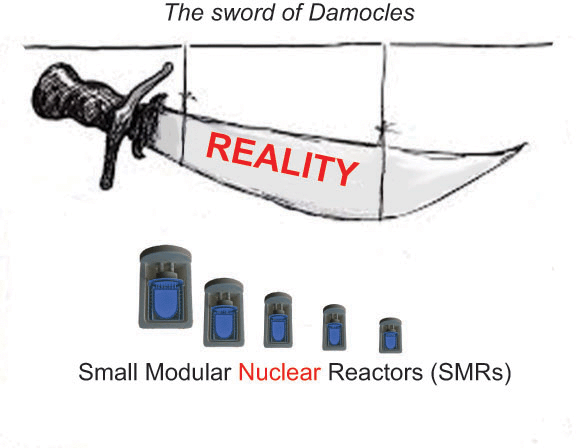
Cost update blasts nuclear out of energy mix
Canberra Times, By Marion Rae, December 21 2023
A surge in the cost of small nuclear reactors has forced the national science agency to change its calculations for Australia.
The latest modelling of all energy sources, released by CSIRO on Thursday, includes data from a recently scrapped project in the United States that was showcasing nuclear small modular reactors (SMRs) as a way to fight climate change.
The draft GenCost 2023-24 report, out for consultation over summer, shows that while inflation pressures are easing there has been a recalculation on SMRs that puts them out of reach.
Real data on a high-profile six-reactor power plant in the United States has confirmed that the contentious technology costs more than any energy consumer wants to pay.
Project costs for the Utah project were estimated at $18,200 per kilowatt, but the company has since disclosed a whopping capital cost of $31,100/kW, prompting its cancellation in November.
In contrast, under existing policies the cost of new offshore wind in Australia in 2023 would be $5545/kW (fixed) and $6856/kW (floating), while rooftop solar panels are calculated at a modest $1505/kW………………………………………………………………………………………………………………..
A small but vocal group of industry backers have been calling for nuclear SMRs for some years, citing the emerging low-emission technology as being suitable for Australia’s vast and geologically stable landmass.
The coalition recently pledged to reopen the nuclear debate in Australia, where laws ban any research or use of nuclear energy despite the country having the world’s largest uranium reserves.
Regulators estimate it would be around 15 years to first production from a decision to build nuclear SMR in Australia, given the scale of legislative change required.
But even if a decision to pursue a nuclear SMR project in Australia were taken today, with political backing for new laws, it is “very unlikely” a project would be up and running as quickly as 2038, CSIRO said.
Further, CSIRO warned nuclear electricity costs put forward by proponents may be for technology that is not appropriate for Australia, or calculated from Russian and Chinese government-backed projects that don’t operate commercially. https://www.canberratimes.com.au/story/8467236/cost-update-blasts-nuclear-out-of-energy-mix/
Busting the government spin about “radioactive waste management” at Garden Island, Western Australia.

The claim that planning has begun for a “low-level radioactive waste management”
facility at HMAS Stirling as part of the AUKUS arrangements must surely be the worst of
political spin as Garden Island by its geological and topographical settings is both
completely unsuitable and highly dangerous for that purpose.
What is more it will be be difficult to separate the nuclear waste generated through the
use of Stirling into the levels of low and intermediate classifications – and there will be
some of intermediate level generated – for storage or other means of management of
the resulting nuclear waste.
Besides its relatively small size Garden Island is comprised of porous limestone
covered by a thin layer of sand making it unsafe even by extensive engineering from
harmful contamination through leakages of nuclear waste which occur regularly at
above the ground nuclear waste installations
Why does the federal government in its various guises fail to avail itself of the Azark
Project underground nuclear waste facility at Leonora in Western Australia which is
regarded internationally as the best and safest possible for the permanent disposal of
nuclear waste
The Garden Island proposal reeks of the same incompetence as with the choice of
Kimba in South Australia for the national waste facility where the government was
spared by the recent judicial decision against that choice the embarrassment of having
it rejected under international prescriptions for its unsuitable and unsafe nature.
It should be clearly understood that none of the operations of AUKUS can be
implemented until Australia has a proper means for the safe disposal of the resulting
nuclear waste.
Renewables cheaper than nuclear, coal now and into the future: CSIRO

By Mike Foley, December 21, 2023 https://www.smh.com.au/politics/federal/renewables-cheaper-than-nuclear-coal-now-and-into-the-future-csiro-20231219-p5esga.html
Electricity produced by renewables is cheaper than fossil fuels and nuclear power and is expected to remain the lowest cost power source for decades to come, according to findings from the top science agency which challenge the federal opposition’s campaign against the government’s climate policy.
The new findings were published in released in CSIRO’s GenCost report on Thursday, which includes projections that an electricity grid dominated by 90 per cent renewables would deliver considerably cheaper power to households compared to fossil fuel and nuclear alternatives.
Opposition Leader Peter Dutton and his climate change and energy spokesman, Ted O’Brien, are calling for the government to halt the rollout of new energy transmission lines amid a farmer backlash over land access. The Coalition has mounted a campaign for nuclear power to be added to the nation’s energy mix.
Nuclear advocates have criticised previous CSIRO reports for not incorporating the costs of tens of billions of dollars of transmission lines needed to link the growing fleet of wind and solar farms across the country into population centres.
However, CSIRO has now included more than $30 billion of new transmission lines and projects to provide back up power when the wind isn’t blowing and the sun isn’t shining – such as the $12 billion Snowy 2.0 pumped hydro dam.
Its findings still showed that renewables were cheaper than nuclear, coal and other fossil fuels.
The report said that small modular reactors (SMR), a nascent technology not yet in commercial use but favoured by the opposition, would be far more expensive than coal and gas plants as well as renewables.
How did CSIRO calculate the costs?
GenCost uses the metric known as the levelised cost of electricity. This is how much it costs for a power plant to generate electricity, which includes capital expenditure as well as the revenue required to create a return on investment.
The report showed that a mix of wind and solar power in 2023 would generate electricity for $90 to $134 per megawatt hour.
This cost range is projected to fall to a $70 to $100 by 2030 – with renewables generating 90 per cent of the grid’s electricity. The Albanese government has set a target for renewables to reach 82 per cent of the energy mix by 2030.
CSIRO found coal generation is more expensive, even without the cost of transmission lines to link the power stations to the grid. Coal electricity generation costs between $110 and $220 per megawatt hour in 2023. This price drops slightly to a range of $85 to $135 in 2030.
The nuclear option
Dutton is calling for Australia to join a global “nuclear renaissance”, which would require removing the 1998 ban on nuclear energy and building small modular reactors on the site of retired coal-fired power plants.
US company NuScale was developing the world’s most advanced commercial SMR project in Utah, but the project was abandoned in November due to a 70 per cent blowout in project costs.
Using the NuScale project as a guide, CSIRO found that were SMR technology available today it would generate electricity at a cost of $380 to $640 a megawatt hour. This marked an increase from its July projections for SMRs to generate electricity at between $200 and $350 per megawatt hour.
CSIRO said SMR costs would fall as the technology develops, with a projected cost of $210 to $350 a megawatt hour of electricity generation in 2030.
NuScale’s development in Utah was expected to take at least 15 years to switch on, and CSIRO said this was a reasonable time frame to assume for Australia – if the current legislative ban on nuclear energy was removed and the necessary political support was in place.
1 This month


Help Aunty Sue Protect Her Land and Sacred Sites From Destructive Rocket Testing.
.

Australians deserve the truth
about
AUKUS – https://aukuspublicinquiry.com/

PETITION – To: Prime Minister Anthony Albanese and the Australian Labor Government

of the week – Australians for War Powers Reform (AWPR)
To see nuclear-related stories in greater depth and intensity

