We condemn atrocities from both Hamas and Israel – Veterans for Peace, and Roots Action
A Statement from RootsAction on the Gaza-Israel War
Tarak Kauff – NYC Veterans For Peace Veterans For Peace Ireland
Peace & Planet Newsby RootsAction.org October 08, 2023
We condemn the attacks by Hamas deliberately targeting Israeli civilians for killing and kidnapping. And we condemn Israel’s aerial bombardment of Gaza, which is again killing large numbers of Palestinian civilians. We grieve for all the lives lost and for all those injured and traumatized.
The root of today’s violence is the oppression and abuses suffered daily by Palestinian people as a whole under decades of cruel Israeli occupation and expansionism. Leading human rights groups — from Amnesty International to Human Rights Watch to Israel’s B’Tselem — have concluded that Israel’s occupation policies amount to a form of apartheid.
Until Israel’s military occupation is ended, these cycles of terror and war and trauma will repeat.
A huge obstacle to bringing an end to the Israeli occupation is the U.S. government. Under Democratic and Republican administrations, it has steadfastly made excuses for Israel as ever more Palestinian homes and villages have been destroyed or seized by right-wing settlers, as settlements have expanded, as Israeli soldiers have stormed Muslim holy sites, as Palestinian children have been militarily detained. And the violence from soldiers and extremist settlers toward Palestinians has worsened in the West Bank and East Jerusalem with the rise of the most openly racist, far-right government in Israel’s history.
We agree with Jewish Voice for Peace when it traces today’s bloodshed to U.S. complicity with Israel’s never-ending occupation: “The U.S. government consistently enables Israeli violence and bears blame for this moment. The unchecked military funding, diplomatic cover, and billions of dollars of private money flowing from the U.S. enables and empowers Israel’s apartheid regime. Those who continue calling for ‘ironclad’ U.S. support for the Israeli military are only paving the path to more violence.”
Background:
>> Amnesty International: “Crime of Apartheid: The Government of Israel’s System of Oppression Against Palestinians”
>> Human Rights Watch: “A Threshold Crossed: Israeli Authorities and the Crimes of Apartheid and Persecution”
>> B’Tselem: “This Is Apartheid”
>> United Nations: “Israel’s 55-year occupation of Palestinian Territory is apartheid – UN human rights expert”
>> New York Times:“Israel’s Push to Expand West Bank Settlements, Explained”
White House hopes to merge Ukraine and Israel aid – media

https://www.rt.com/news/584507-israel-ukraine-aid-package/ 11 Oct 23
The measure could push Republicans to support new assistance for Kiev
Top White House officials are considering whether to include more Ukraine funding in an emergency aid package for Israel, multiple news outlets have reported. One staffer suggested the move would force “far-right” lawmakers to authorize additional aid for Kiev.
Though President Joe Biden had already announced that military assistance was “on its way” to Israel following a surprise attack by Palestinian militants over the weekend, the White House has signaled that it would soon ask Congress to approve additional aid for the Jewish state.
Lawmakers in both parties and senior administration officials have hinted that the aid package could also include provisions for Ukraine, unnamed sources told the Washington Post, NBC News and other outlets on Monday.
Though no final decision has been made, one anonymous official told the Post that the move would be wise because it “jams the far right” – referring to Republicans who vocally support Israel but are skeptical of continued aid to Ukraine. White House spokesman John Kirby, meanwhile, declined to say whether the two aid packages would be linked, only stating “We believe both are important.”
While debate over the aid is likely to be contentious, the Pentagon has insisted that it has plenty of weapons for all US partners. During a background briefing on Monday, a senior defense official told reporters that Washington could “continue our support both to Ukraine, Israel, and maintain our own global readiness,” noting that the US has been able to meet “every request that our Israeli counterparts have made.”
Israel is among the largest recipients of US foreign aid, taking in some $3.3 billion in American tax dollars in 2022 alone – a comparable amount to previous years – according to US government statistics. Since the conflict with Russia escalated in February 2022, Ukraine has also become a major beneficiary, with the White House approving at least $45 billion in direct military aid through 47 separate transfers.
Both Republicans and Democrats have largely voiced support for Israel after the deadly Hamas attack early on Saturday morning, which has prompted harsh retaliation by the Israel Defense Forces (IDF) and an intense bombing campaign on Gaza. More than 1,500 people have been killed on both sides of the conflict so far, while Palestinian fighters claim to have captured more than 100 Israeli and foreign hostages during their raids.
Thousands of Israelis and Palestinians have evacuated their homes due to the violent flare-up, while the IDF has called on 300,000 reservists as it mobilizes for a larger conflict. Israeli Prime Minister Benjamin Netanyahu declared that his country was in a state of “war” as the attack unfolded, and said on Monday that the military response was “just getting started.” #Ukraine
https://www.rt.com/news/584507-israel-ukraine-aid-package/ 11 Oct 23
The measure could push Republicans to support new assistance for Kiev
Top White House officials are considering whether to include more Ukraine funding in an emergency aid package for Israel, multiple news outlets have reported. One staffer suggested the move would force “far-right” lawmakers to authorize additional aid for Kiev.
Though President Joe Biden had already announced that military assistance was “on its way” to Israel following a surprise attack by Palestinian militants over the weekend, the White House has signaled that it would soon ask Congress to approve additional aid for the Jewish state.
Lawmakers in both parties and senior administration officials have hinted that the aid package could also include provisions for Ukraine, unnamed sources told the Washington Post, NBC News and other outlets on Monday.
Though no final decision has been made, one anonymous official told the Post that the move would be wise because it “jams the far right” – referring to Republicans who vocally support Israel but are skeptical of continued aid to Ukraine. White House spokesman John Kirby, meanwhile, declined to say whether the two aid packages would be linked, only stating “We believe both are important.”
While debate over the aid is likely to be contentious, the Pentagon has insisted that it has plenty of weapons for all US partners. During a background briefing on Monday, a senior defense official told reporters that Washington could “continue our support both to Ukraine, Israel, and maintain our own global readiness,” noting that the US has been able to meet “every request that our Israeli counterparts have made.”
Israel is among the largest recipients of US foreign aid, taking in some $3.3 billion in American tax dollars in 2022 alone – a comparable amount to previous years – according to US government statistics. Since the conflict with Russia escalated in February 2022, Ukraine has also become a major beneficiary, with the White House approving at least $45 billion in direct military aid through 47 separate transfers.
Both Republicans and Democrats have largely voiced support for Israel after the deadly Hamas attack early on Saturday morning, which has prompted harsh retaliation by the Israel Defense Forces (IDF) and an intense bombing campaign on Gaza. More than 1,500 people have been killed on both sides of the conflict so far, while Palestinian fighters claim to have captured more than 100 Israeli and foreign hostages during their raids.
Thousands of Israelis and Palestinians have evacuated their homes due to the violent flare-up, while the IDF has called on 300,000 reservists as it mobilizes for a larger conflict. Israeli Prime Minister Benjamin Netanyahu declared that his country was in a state of “war” as the attack unfolded, and said on Monday that the military response was “just getting started.” #Ukraine
Ten reasons why nuclear power has no future

by Sam Arnold and Ann McAllister, https://nbmediacoop.org/2023/10/11/commentary-ten-reasons-why-nuclear-power-has-no-future/October 11, 2023
Nuclear power is dirty and dangerous now, and for many generations to come. The following ten reasons state why nuclear has no future.
- Nuclear power is too slow to help mitigate the climate crisis. A 2022 report by the National Academies of Science found that most advanced reactors, including small modular nuclear reactors (SMNRs), “will confront significant challenges in meeting commercial deployment by 2050.” In contrast, the Burchill Wind Farm near Saint John took three and a half years from partnership to full deployment. Canada’s target to reduce carbon emissions by 40 to 45 per cent below 2005 levels by 2030 is looming. Renewables with storage, energy efficiency and conservation, demand-side management, and interties such as the Atlantic Loop can provide reliable baseload electricity. To wait for the SMNR silver bullet, which may never come, is to court climate catastrophe.
- Nuclear power is too expensive compared to alternatives. Wind and solar both undercut nuclear power rates. The authoritative Lazard energy analysis for 2023 costed storage-backed onshore wind and solar at US $42 to $114 per megawatt-hour, compared to nuclear power at US $141 to $221. Power from SMNRs will probably be more expensive than electricity from large nuclear plants with their history of cost increases. Crucially, SMNRs can’t take advantage of the economies of scale which large reactors do. There are orders for only single SMNRs, making it unlikely that multiple units will ever be built.
Chronic exposure to radioactive pollutants emitted from nuclear power plants can damage human health. The thyroid absorbs radioactive iodine as readily as non-radioactive iodine, putting children at particular risk of thyroid disease and cancer. Chronic exposure to radioactive materials, even at low doses, increases the incidence of cancer, leukemia, anemia, genetic damage, immune system damage, strokes, heart attacks, and low intelligence.- Liquid sodium and molten salt reactors pre-dating the ARC and Moltex SMR designs were unreliable and dangerous. Internationally, sodium reactors have not performed reliably; one in Russia experienced repeated fires. In the 1960s, the US Molten Salt Reactor Experiment (1965-1969) operated at only 40 per cent capacity compared to 90 per cent for the average US commercial nuclear power plant.
- Nuclear power does not work effectively with renewable energy. A University of Sussex study of 123 countries over 25 years found that countries that invested in renewable energy reduced more carbon emissions than countries with large percentages of nuclear power. Contrary to the claim that nuclear energy and renewables work well together, the study found that they “crowd each other out.”
- Radioactive waste remains an unsolved conundrum and will be an ongoing cost to taxpayers far into the future. Deep geological repositories (DGRs) for the disposal of high-level nuclear waste fuel are not operational anywhere in the world, including Finland and Sweden. The two locations Ignace and Saugeen Ojibway Nation under consideration in Ontario are opposed by many, including Indigenous peoples. A little-known fact is that while the waste fuel is the responsibility of the federal government, the provinces are responsible for the steel and concrete building materials which will ultimately become radioactive rubble. Would Canadians accept having a nuclear waste dump in or near their community?
- Many Indigenous leaders and First Nations are skeptical of nuclear reactors, nuclear waste, environmental risks, and groundwater contamination posed by the long-term storage of such wastes. First Nations in Ontario and Quebec do not want radioactive waste from New Brunswick in their territories. Federal and provincial governments have a history of not consulting First Nations and ignoring their concerns about nuclear installations. The Peskotomukhati Nation at Skutik and the Wolastoq Grand Council are firmly opposed to nuclear development. Nuclear does not align with their sacred principle of caring for the next seven generations.
- Transporting radioactive waste long distances to a proposed geological repository would come with higher costs and increased risk of accidents. The transport distance from Point Lepreau to a DGR proposed for northern Ontario could exceed 2,000 km. Considering the frequency of accidents involving transport trucks and freight trains, how would you feel about radioactive loads passing your home several times weekly for the next 40-plus years? To prevent such catastrophes, decommissioned nuclear reactors and their accumulated wastes must be stored safely in their present location.
- Nuclear weapons are dependent on energy from the plutonium produced at nuclear power plants, making them partners in all nuclear weapons produced. Moltex Energy’s technology for separating plutonium, the explosive in atomic bombs, from nuclear waste fuel increases the risk of nuclear weapons proliferation. Moltex’s claim that the plutonium would be too impure for use in nuclear weapons has been discredited in a 2022 report from the US National Academy of Sciences and Medicine. The experts stated that the method might delay the plutonium’s use in weapons, but would not prevent it. Nine US non-proliferation experts who advised six US presidents warned the Trudeau government that plutonium separation “will undermine the global nuclear weapons non-proliferation regime that Canada has done much to strengthen.”
- The cost of decommissioning nuclear reactors must be added to all expenses incurred at every link in the nuclear chain, from mining and fuel fabrication to perpetual waste storage, from domestic safety and security to international proliferation prevention, from policy to regulation, from design to final disposition. Taxpayers are paying for these cumulative costs, so the tally must be made public.
- Knowing the environmental dangers and financial and social liabilities nuclear power will impose on us and our descendants should galvanize us to demand that government regulations act in the public’s best interest.
- Sam Arnold and Ann McAllister are with the Coalition for Responsible Energy Development in New Brunswick (CRED-NB). #nuclear #antinuclear #NuclearFree #NoNukes #NuclearPlants
Coalition are ‘climate charlatans’ making false claims about Australia’s nuclear power potential, energy minister says
Chris Bowen describes the opposition’s promotion of the banned energy source as an attempt to ‘continue the culture climate wars’
Adam Morton Climate and environment editor. Guardian, Tue 10 Oct 2023
The climate change and energy minister, Chris Bowen, has accused the Coalition of using “the rightwing playbook of 2023 – populism, polarisation and post-truth politics” in making false claims about the potential for nuclear power in Australia.
Speaking on Tuesday, Bowen said the opposition’s suggestion the country could embrace the banned energy source to meet climate targets was the “latest attempt at deflection and distraction now that outright denial is less fashionable” and an attempt to “continue the culture climate wars in Australia”…………(registered readers only) ………..more https://www.theguardian.com/australia-news/2023/oct/10/coalition-making-false-claims-about-australia-nuclear-power-says-energy-minister-chris-bowen?fbclid=IwAR1CU7royDx89hZP5FAfRgkj3ioG6SrbFIQmvDyDNaovfVAGKf3HWqxH0W4
Radiation monitoring at SA nuclear subs site starts – but community consultation is lacking.
The first steps in monitoring radioactive contamination at the state’s new nuclear-powered submarine shipyard and nearby dolphin sanctuary is starting, sparking calls for far greater consultation with residents.
Belinda Willis, In Daily 11 Oct 23
New documents released under the Freedom of Information Act reveal details of an 18-month contract to collect soil, groundwater and marine water samples at the future subs site and the nearby sanctuary to establish a baseline for checking future radiation levels.
Documents released to former federal senator and submariner Rex Patrick show samples will be delivered to the Australian Nuclear Science and Technology Organisation “for radiological analysis”.
The test findings will be used to build an Environmental Contamination Baseline Assessment so radioactive activity where the nuclear-powered submarines are built or docked can be closely monitored.
Patrick said the papers raised new concerns about South Australians not being consulted about regulations and the handling of operational nuclear waste at the $2 billion shipyard, saying there “is absolutely no community engagement, there’s no attempt to establish social licence” about having nuclear reactors on site.
“(The monitoring is) in order to be able to understand the magnitude of a leak or the nature of a problem that might develop in the future,” Patrick said, adding that people living in Port Adelaide and Osborne “probably aren’t aware that this activity is taking place”.
Sadly, the Defence Department is not interested in being open and transparent about what they are doing around nuclear stewardship and safety,” Patrick said.
“There is no community engagement and there is no social licence being developed. It’s a foolish approach noting that ANSTO has warned defence of the need for social licence.
“Perhaps they’re setting themselves up for another ‘Kimba’ style court case.”
Patrick was referring to a recent court decision that led to the dumping of a site for a low-level radioactive waste site at Kimba in South Australia despite years of consultation and the more than $100 million spent on the process………………………………………………..
Under the AUKUS deal with the United States and United Kingdom, Australia is obtaining eight nuclear-powered submarines at an estimated taxpayer cost of $268-$368 billion.
Defence Minister Richard Marles has said submarines will be built at Osborne and also that waste from spent nuclear reactors from the submarines will be stored on defence land.
Port Adelaide Enfield Mayor Claire Boan said the local council “has not been briefed on the specifics of this matter i.e. management of radioactive materials”, but said council staff has had an initial meeting with defence staff regarding the environmental impact assessment for this development required under federal and state regulations. ……..
The documents released to Patrick show the Submarine Construction Yard will span about 75 hectares and is made up of four distinct areas.
Nearby is the 12,000-hectare Adelaide Dolphin Sanctuary which is the home of up to 60 bottlenose dolphins and is visited by another 400 to feed and nurse their calves in the Port Adelaide River and Barker Inlet.
Mutton Cove Conservation Reserve is also nearby.
South Australia’s Defence Minister Susan Close, who is also Port Adelaide’s member of parliament, did not respond to questions about whether people living in her electorate have been consulted about work at the nuclear-powered submarine construction site.
The Minister and Premier Peter Malinauskas have been vocal supporters of the project, the Premier having flown to the United Kingdom to meet with the UK submarine builders. https://indaily.com.au/news/2023/10/11/secrecy-surrounds-radiation-monitoring-at-sa-nuclear-subs-site/
Two Australian firms want to join in a thorium nuclear power project in the Philippines
Aussies pitch 40-MW thorium-fueled nuclear plant
Energy Central 11 Oct 23
MANILA -Australian firms Southern Infrastructure Pty Ltd and Kaizen ANZ Pty Ltd. want to partner with the Philippine government to bring thorium-fueled nuclear energy to the country, a venture that could mark a significant milestone in the country’s push to adopt nuclear power.
The Department of Trade and Industry (DTI) on Monday said the representatives from the two companies had discussed this possibility with Trade Secretary Alfred Pascual.
The DTI said that the prospective public-private partnership (PPP) venture would develop, build and operate an initial 40-megawatt thorium-fueled simple, high-temperature, gas-cooled reactor…………….
This prospective venture is the latest in several recent initiatives or engagements of the Marcos administration to adopt nuclear energy………………………………………………..https://energycentral.com/news/aussies-pitch-40-mw-thorium-fueled-nuclear-plant
What is Jericho missile system? Israel’s potential ‘doomsday’ nuclear option

Wion News By: Mukul Sharma Oct 12, 2023
STORY HIGHLIGHTS
It is yet not clear if Jericho-3 has been deployed by Israel during ongoing retaliatory offensive against Hamas in Gaza.
An Israeli legislator’s recent calls for the use of a “doomsday” weapon against Hamas and Palestine have once again put the spotlight on nuclear weapons in West Asia, particularly the Jericho missile system.
Revital “Tally” Gotliv, an Israeli lawyer and member of the Knesset representing Prime Minister Benjamin Netanyahu’s Likud Party, made several posts on X, formerly known as Twitter, stating that Israel must consider nuclear warfare as an alternative to deploying large ground forces.
“Jericho Missile! Jericho Missile! Strategic alert. before considering the introduction of forces. Doomsday weapon! This is my opinion. May God preserve all our strength,” Gotliv wrote on X.
What is Jericho ballistic missile program?
Gotliv specifically mentioned “Jericho,” referring to Israel’s original ballistic missile program, initiated in the 1960s and named after the biblical city located in West Bank.
This program was initially a collaboration with the French aerospace company Dassault, but when France withdrew in 1969, Israel continued its development. The Jericho-1 model, which was operational during the Yom Kippur War in 1973, came out as an accomplishment of the said program.
The Jericho-1, which was retired in the 1990s, had a weight of 6.5 tons, a length of 13.4 meters, and a diameter of 0.8 meters, according to the International Institute for Strategic Studies (IISS), Newsweek reported.
It had a range of 500 kilometers (approximately 310.6 miles) and could carry a 1,000-kilogram (about 2,205-pound) payload, though it had a 50 percent chance of hitting within a 1,000-meter radius of its target.
Israel later developed the Jericho-2, a longer-range missile in the late 1980s, with a length of 15 meters and a diameter of 1.35 meters, while maintaining the same payload capacity. It had a range between 1,500 and 3,500 kilometers (about 932 to 2,175 miles).
The Jericho-3, an intermediate-range system, was introduced years later and was reportedly tested in 2008, entering service in 2011. It featured improvements over the previous models, with a longer length than Jericho-2 and a larger diameter of 1.56 meters.
Its single warhead weighed approximately 750 kilograms (1,653 pounds) and had a range of 4,800 to 6,500 kilometers (about 2,983 to 4,039 miles). The payload capacity extended to about 1,300 kilograms (2,866 pounds).
It is yet not clear if Jericho-3 has been deployed by Israel during ongoing retaliatory offensive against Hamas in Gaza. #nuclear #antinuclear #NuclearFree #NoNukes #NuclearPlants
Some Israeli actions ‘against international law’ – EU
“There will be no electricity, no food, no fuel, everything is closed,” Gallant told the Israeli media. “We are fighting human animals and we act accordingly.”
https://www.rt.com/news/584594-borrell-eu-israel-law-gaza/ 11 Oct 23
Denying Gaza water, food and electricity is not appropriate, Josep Borrell has said
Israel has the right to self-defense, but some of the decisions its government has made are contrary to international humanitarian law, EU foreign policy commissioner Josep Borrell said on Tuesday.
“Israel has the right to defend, but it has to be done in accord with international humanitarian law. And some decisions are contra this international law,” Borrell said in Oman, where he attended the joint meeting of foreign ministers from the EU and the Gulf Cooperation Council.
Both the EU and the GCC have condemned terrorist attacks by Hamas, Borrell noted, but also condemned any attacks on civilians, demanded the immediate release of all hostages, and called for Israel to respect international law and not block the delivery of food, water or electricity to the civilian population of Gaza.
The two blocs have also asked Israel to open “humanitarian corridors” from Gaza to Egypt, so that civilians can leave the territory ahead of Israeli reprisal airstrikes.
Borrell’s remarks appeared to be a reference to Israeli Defense Minister Yoav Gallant’s statement on Monday ordering a “complete siege” of Gaza.
“There will be no electricity, no food, no fuel, everything is closed,” Gallant told the Israeli media. “We are fighting human animals and we act accordingly.”
Multiple media outlets also quoted Gallant as saying on Tuesday that he had “lifted all the restraints” on Israeli rules of engagement against Gaza.
Israel launched reprisal airstrikes against the Palestinian territory after Hamas, which controls much of Gaza, sent commandos deep into Israeli territory on Saturday. The three days of heavy clashes have resulted in at least 900 dead Israelis and at least 830 dead Palestinians, according to the authorities in West Jerusalem and Gaza, respectively.
Just before Gallant announced the “siege,” the EU declared it would put €691 million ($728.8 million) in aid to the Palestinian Authority under review and suspend all pending payments, citing the “scale of terror and brutality against Israel and its people” by Hamas. Borrell later “clarified” those remarks to note that aid will continue, because suspending it would amount to “punishing all the Palestinian people” and damage EU interests in the region. #Israel
David McBride facing life sentence as war criminals go unpunished
By John Jiggens | 9 October 2023
The whistleblower of Australian war crimes in Afghanistan is facing life in prison for exposing the truth, while the perpetrators remain free. Dr John Jiggens reports.
AFGHAN WAR CRIMES whistleblower David McBride is facing a secret trial on 13 November that could result in him serving a life sentence for leaking classified information that formed the basis of ‘The Afghan Files’, a 2017 ABC exposé revealing allegations of misconduct by Australian special forces in Afghanistan.
Although the allegations were substantiated by the Brereton Inquiry, which found “credible information” of war crimes committed in Afghanistan by Australian SAS personnel, in a startling similarity to the Julian Assange case, only the whistleblower is being prosecuted while those who committed war crimes go unpunished.
David McBride finds himself charged with theft of government property. Under the National Security Information Act, one of a slew of draconian laws that came in after 9/11, the Government can close the court and present secret evidence that only the judge is permitted to see, and whose contents neither the defendant nor their legal representatives are permitted to know.
During his tours to Afghanistan as a legal officer in 2011 and 2013, David McBride became increasingly concerned that the war was being dictated by politics rather than the best interests of Australia and Australian soldiers.
The rules of law and war were not being followed and were being breached with impunity because of the indifference of higher command. While some soldiers were committing war crimes, others were being wrongly prosecuted to cover up for the higher-ups. There was something terribly wrong with Defence: they weren’t defending the country anymore, they were simply defending the Government, putting out whatever good news stories the Government wanted.
In an interview with Andy Paine for 4ZZZ Paradigm Shift, McBride said:
“You can’t win wars if you just keep saying: ‘We’re beating the enemy’, even if we’re not. ‘This is good’, even if it’s not. ‘We’re going to give a medal to this guy because he’s a brave hero’, even if he’s not.”
McBride’s own “through the looking glass” experience came when he was involved in a case where it seemed the military was trying to put decent soldiers in gaol to protect bad soldiers. The only reason they did this, he reasoned, was because the really bad soldiers were famous people and if they went down, politicians could go down with them, so they needed scapegoats. It was all PR.
McBride said:
And that sickened me, to see good soldiers sacrificed in order to protect bad soldiers so as to protect the minister’s popularity.
We’ve learned from the United States, where everything is just a PR exercise. If we go on like this we’re going into another war, another unjust, unjustified, unwinnable war, where more Australian soldiers are going to die. And that is wrong. You don’t do that. You don’t sacrifice the lives of Australians; you don’t send them to places where they can’t win for political goals. So I’m not fighting about the last war, I’m also worried about the next.
……………………………………………………………….. In 2013, McBride made internal complaints about certain SAS soldiers, though he expected it would go nowhere because effectively he was complaining to the very people who had committed the cover-ups. As expected, the internal complaint failed, but it took eight months in which McBride busied himself, gathering documents marked secret that he would give to the ABC.
……………………………… Whether the documents McBride is being prosecuted for leaking are genuinely about national security or are simply hiding war crimes and cover-ups, is something that will be argued in the coming month at David McBride’s trial. What will emerge is unclear. Defence has the power to close the court down: under the National Security Information Act, the Government can clear the court and present evidence to the judge that no one – not even the accused or their lawyers – can see.
If you live in Lismore, you can hear David McBride speak about this at Star Court Theatre, Lismore, at 6:30 PM on 12 October. He will be supported by the globe-wandering John Shipton (father of Julian Assange), back from France, Switzerland and Brazil, to speak about the worldwide campaign of support Assange’s family have been building as his extradition to the U.S. draws near.
How “Dumb Money” Nukes Boil & Bankrupt The Earth
So today’s real reactor battle is not over new ones, which essentially don’t exist.
It’s about the risks posed by the old ones, all of which lack comprehensive liability insurance.
Harvey Wasserman 10 Oct 23 https://www.downwithtyranny.com/post/how-dumb-money-nukes-boil-bankrupt-the-earth #nuclear #anti-nuclear #nucler-free #NoNukes
No new U.S. reactors, big or small, fission or fusion will be built here within at least the next five years…more like ten. Those that try will do nothing but divert resources away from the Solartopian technologies needed to save the Earth.
They’ll also lose big money for their billionaire backers and the taxpayers who’ll be forced to bail them out.
There are now 93 large uninsured light-water reactors licensed for operation in the US. One more– Georgia’s Vogtle #4– may open within the next year or so.
All of them emit radioactive Carbon-14. They release additional greenhouse gasses through the process of mining, milling and enriching uranium-based fuel, as well as attempting to store it once it’s become radioactive waste.
All commercial reactors burn at ~570 degrees Fahrenheit, warming the planet on their own.
Meanwhile, there are zero such commercial nukes in the pipeline. None are under construction.
No credible observer– pro-nuke or no nuke– contends that any large new reactor could be ordered, built, licensed, insured and brought on line in the United States within the next decade or two… well beyond whatever window we might have to solve our worsening climate crisis.
The whole industry, which is inseparable from the nuclear weapons complex, was sold to the public on the premise that its electricity would come “too cheap to meter.”
But consider the last eight major reactor projects in the US and Europe:

Finland’s Olkiluoto3 opened last year, billions of Euros over budget and more than a decade behind its original 2009 promise date. Though brand new, it’s already been forced to scale back operations at least once due to a massive influx of far cheaper solar/wind/hydro-generated electricity.

France’s Flamanville remains under construction, also years late and billions over budget.

Two reactors at England’s Hinckley, again years late, have soared beyond E35 billion. Odds on them ever opening are up for grabs. Odds on them ever cost competing with wind or solar are less than zero.

Two huge reactors at VC Summer are stillborn. Their $9 billion in construction costs have stuck South Carolina with a dusty mausoleum that will never generate power.

After fifteen years, Georgia’s Vogtle #3 has finally gone critical. Unit #4 may open next year. Projected in 2008 at $14 billion, the pair together may yet exceed $40 billion. They’ll certainly be the last big light water reactors built in the U.S.
Together Summer and Vogtle bankrupted Westinghouse. The European projects have bankrupted Electricite de France.
Thus Wall Street’s unwillingness to fund big new nukes is likely to deepen.

So now we hear instead about “Small Modular Reactors.” With backing from the likes of Bill Gates and Oliver Stone, the idea of mass producing small, simple nukes claims major media fandom. The critiques of SMRs are widespread and varied.

But there’s no more hilarious proviso than one coming from the industry itself, in the form of a sort of disclaimer from NuScale in a recent announcement. The list of “warnings” resembles one we hear on the air for various prescription drugs, but stretches in length to resemble a documentary film, practically matching this article in length. Take a look by scrolling down to the section that begins “Forward Looking Statements.” You may want to settle in with a cup of coffee.
At this point, there are currently no proven SMR prototypes. Cost projections again recall that 1950s “too cheap to meter” lie told by Atomic Energy Commission Chair Lewis Strauss (the villain in the film Oppenheimer).
NuScale’s promised delivery date has already slipped from 2026 to 2029. Independent assessments put that well into the 2030s. The billions squandered on such projects divert capital that should otherwise fund renewables.
Likewise much-hyped thorium reactors, which remain untested, unproven, and of uncertain costs.

As for fusion, its operations would concentrate temperatures of 100 million degrees Fahrenheit on an increasingly fragile planet. And that despite decades of intense research, and gargantuan expenditures, its future availability, ecological impacts and financial costs remain naggingly uncertain.
Thus, in the vital window from now until decade’s end, no new nukes, large or small, fission or fusion, will be ready to tangibly replace the burning of fossil fuels. The once-beloved nuclear genie can’t cure global boiling. There’s simply no there there.
Which makes our current fleet of atomic elders even more dangerous. Thoroughly decayed reactors like California’s Diablo Canyon and Michigan’s Palisades soak up billions in public funds to keep operating. But they’ve yet to secure comprehensive liability insurance. At a current average age of more than forty (Diablo opened in 1985) they cost far more to operate than proven, readily available wind, solar, battery and efficiency technologies.
Diablo in particular is plagued by deadly flaws such as embrittlement, cracked pipes, seismic vulnerability, an aging workforce and much more.
So today’s real reactor battle is not over new ones, which essentially don’t exist.
It’s about the risks posed by the old ones, all of which lack comprehensive liability insurance.
And about how quickly we can bury at last the immensely powerful fossil fuel industry that threatens us all.

For that, the only clear solution comes with a fast-as-possible shift to safer, cleaner, cheaper truly green Solartopian renewables that actually do exist. That are constantly evolving.
They may not be too cheap to meter (except in rare cases, like nighttime wind power in west Texas).
But they comprise today’s last, best hope to cool our boiling Earth…while creating jobs and profit for those wise enough to see it now.
Are Hamas fighters using American weapons meant for Ukraine?
When it comes to arms supplies, the US is its friends’ worst enemy.
Rt.com 9 Oct 23 #Ukraine
Throughout recent history, the perceived weapon of choice for a terrorist (or freedom fighter, depending on one’s perspective) has been an AK-47 assault rifle. Today, in the aftermath of the so-called post-9/11 “global war on terror,” it’s not uncommon to see such fighters with a Glock 9mm pistol, or a Colt M4 carbine.
These are weapons paid-for by the US taxpayer and ostensibly provided to forces joined in the cause of defeating terrorists and/or freedom fighters (again, depending on the political beliefs of the observer), but that end up in the hands of the latter instead. Obviously, that is never the outcome Washington intends. And yet, somehow, these weapons end up arming the very forces the US and its allies are trying to defeat.
The most recent example of this phenomenon appears to involve Hamas and the attacks perpetrated by militants affiliated with that organization on military and civilian targets in southern Israel. A video, the authenticity of which has yet to be verified, purports to show a Hamas fighter thanking Ukraine for the provision of small arms, ammunition, and hand grenades. More videos, taken during the actual assaults, show the Hamas fighters armed with a plethora of US-made weapons.
These videos have alarmed some US lawmakers, such as Representative Marjorie Taylor Greene, a Republican from Georgia’s 14th District, who, in the immediate aftermath of the Hamas attack, Tweeted/Xeeted “We need to work with Israel to track serial numbers on any US weapons used by Hamas against Israel. Did they come from Afghanistan?” the Congresswoman asks. “Did they come from Ukraine? Highly likely the answer is both.”
Any attempt to answer Marjorie Taylor Greene’s questions will more than likely turn up information that should make the US government very uncomfortable. Israeli Prime Minister Benjamin Netanyahu had been saying since June of this year that US-made anti-tank weapons intended for Ukraine were turning up on the Israeli border. Left unsaid by Netanyahu was how this had come to be – corruption is rampant inside Ukraine, and Pulitzer Prize-winning journalist Seymour Hersh has reported on hundreds of millions of dollars of aid being diverted into the hands of parties it was not originally intended for. By my calculations based on conversations with numerous informed sources, the amount diverted could be as high as six out of every ten dollars of assistance sent to Ukraine. It’s one thing if this involves money; it’s another thing altogether if this involves weapons.
The wide availability of US-made weapons on the global black market used by terrorists/freedom fighters to arm themselves is reflective of the lax approach the US takes when it comes to providing military assistance to parties involved in active combat. The US appears to be more interested in reinforcing the political messaging attached to such deliveries–that the US is actively supporting friends in need. The actual security-related aspects of this effort, however, seem to escape most senior US policy makers.
This became evident in May 2022, when Rand Paul, a Republican Senator from Kentucky, tried to have an inspector general put in place to monitor and account for some $40 billion in military assistance to Ukraine requested by President Joe Biden. Senator Paul’s motion was overwhelmingly defeated by a Congress which appeared to be happy to assume a “hear no evil, see no evil, speak no evil” posture when it came to the issue of Ukraine and corruption.
The issue of US weapons falling into the hands of persons not only for whom the weapons were not intended, but –more critically– into the hands of people the weapons were intended to fight against, who then use them against American allies, is not a new one………………………………………….
The reality is that the US has become one of the major sources of weapons for terrorists/freedom fighters around the world. While Marjorie Taylor Greene is correct to demand answers when it comes to the issue of the security of Israel, a long-time American ally, the same questions can be asked about virtually every security assistance program instituted by the US in the post-9/11 era. It appears that America’s approach to fighting the global war on terror has ended up making those whom it calls terrorists more capable of carrying out the acts of violence US policy portends to be trying to stop. The sad truth is that America, in its rush to arm the world, in many ways ends up being its friends’ worst enemy. https://www.rt.com/news/584413-hamas-fighters-us-weapons/
Past Time to End the Persecution of Julian Assange
SCHEERPOST, By Eve Ottenberg / CounterPunch 9 Oct 23
It’s long past time for the U.S. and U.K. to free Julian Assange. His flagrantly unjust incarceration is a global scandal, and the world is quite upset about it. Indeed, on September 19 at the United Nations, heads of state denounced this phony prosecution for the fraud and subterfuge it is – an assault on a free press, and an attack on Assange personally, for practicing journalism. For over four years, this publisher has been left to rot in a dungeon in Britain’s notorious maximum-security prison, Belmarsh. The reason? Well, they might not admit it, but U.S. sachems want him crushed for embarrassing them, by revealing the murderous criminality of the American military in Iraq and elsewhere.
Periodically, some world leader lets loose a geschrei of protest. “It is essential to preserve freedom of the press. A journalist like Julian Assange cannot be punished for informing society in a transparent and legitimate way,” railed Brazilian president Luis Inacio Lula da Silva to the assembled UN diplomats. Honduran president Xiomara Castro also denounced the official abuse of Assange. And on September 20, a delegation of Australian politicians brought a letter to Washington officials, demanding the U.S. drop its grotesque prosecution of Assange.
This is not the first time heads of state or other political bigwigs have urged American President Joe Biden to end Assange’s ordeal. Mexican president Andres Manuel Lopez Obrador has twice written Biden, imploring him to release Assange and rightly fulminating over the damage done to a free press by his incarceration. In late 2022, Nicaraguan and Venezuelan leaders called for the publisher’s freedom. Colombian president Gustavo Petro vowed on social media to “ask President Biden…not to charge a journalist just for telling the truth.” Australia’s prime minister, Anthony Albanese also petitioned the U.S. on his Canberra constituent, Assange’s behalf. So far Biden appears unmoved…………………………………………………………………………………………………………………………………………………………………………………………………………….
The Espionage Act is an embarrassment and a disgrace to a free people. So are the charges against Julian Assange. Both the Act and the prosecution should be scrapped.
https://scheerpost.com/2023/10/09/past-time-to-end-the-persecution-of-julian-assange/—
Endless electricity and water use: the Artificial-Intelligence-Blockchain-Data Centre -Nuclear-NuScale nightmare to come

Blockchain biz goes nuclear: Standard Power wants to use NuScale reactors for DCs
Please, no crypto boom, thank you
The Register, Tobias Mann, Sun 8 Oct 2023 #nuclear #anti-nuclear #nucler-free #NoNukes
Colocation outfit Standard Power hopes to power two new datacenters in Ohio and Pennsylvania entirely by miniaturized nuclear reactors from NuScale.
Standard Power makes no secret it focuses on providing datacenter services to not just those into AI workloads and other kinds of high-performance computing but also those performing proof-of-work blockchain mining, the kind needed to craft digital tokens like Bitcoin. The significant energy requirements of this type of blockchain work spurred an investigation by the White House Office of Science and Technology Policy last year, and calls by lawmakers to implement reporting and/or sustainability requirements for such operations.
Generally speaking, a datacenter packed with proof-of-work miners is going to demand a chunky amount of power. Concerned it may not get adequate electricity supplies for its new facilities, which by the sounds of it will support blockchain mining as well as other workloads, Standard Power said it hopes to take the nuclear option.
“We see a lot of legacy baseload grid capacity going offline with a lack of new sustainable baseload generation options on the market especially as power demand for artificial intelligence-computing and datacenters is growing,” Standard Power CEO Maxim Serezhin said in a statement.
And the colo outfit’s Ohio and Pennsylvania datacenters may need or get a lot of power. The company expects to deploy 24 of NuScale’s small modular reactors between the two sites. These reactors are reportedly capable of generating 77 megawatts apiece — putting the total deployed capacity at 1,848 megawatts.
Despite the announcement, it may be a few years before Standard Power can realize its nuclear dreams. As we learned in January, Idaho National Labs will be among the first to demonstrate NuScale’s reactors, and the first of these modules isn’t expected to come online until 2029. We asked Standard Power when it expects its facilities will be operational; we’ll let you know if we hear anything back…………………………………..
Standard Power is hardly the first datacenter operator to get excited about nuclear power, either. Cumulus Data opened a datacenter next to a nuclear plant — the full-size kind — in January and last month we learned that Microsoft is now hiring someone to potentially deploy SMR systems to power its growing cloud enterprise. https://www.theregister.com/2023/10/08/standard_power_nuclear_datacenter/
This week – in nuclear news

Some bits of good news. Rooftop solar capacity has increased by an unprecedented 349% in South Africa in just over a year. The all-female, grassroots network moving millions away from fossil fuels’ Positive news: A ship powered by rubbish docked in the UK. The pitter patter of tiny beaver feet returned to the UK capital.
TOP STORIES. Journalism Itself Is Locked Up In Belmarsh.
French tax-payers up for €20bn or more per year, in mountain of costs to keep nuclear fleet going.
Tragic Nuclear Submarine Accident in China Sparks Global Concern.
Define ‘Nazi’: Western media muddies history to cover up Canada’s SS scandal.
Depleted Ukrainium: What Comes After Failure?
5 animal species that became radioactive after being exposed to nuclear fallout zones.
Climate. World could be heading for hottest October on record – after hottest July, August and September ever. World breaches key 1.5C warming mark for record number of days. The Pope speaks out against climate deniers.
Nuclear. Event: 14 October 12-2pm ET Join Us WARHEADS TO WINDMILLS – ONLINE FORUM. The Palestine -Israel disaster – who knows where this is now headed?
*************************************
AUSTRALIA. France attempts to pressure Australia to stop engaging with UN nuclear weapons ban treaty. Pacific island States support the Treaty on Prohibition of Nuclear Weapons – a problem for Australia in joining AUKUS nuclear military alliance. Accident on nuclear submarine would leave Australia ‘unavoidably’ responsible, says US report. Jacqui Lambie’s nuclear response to secret flights for submarine project. BAE lands £4bn contract for Aukus nuclear attack submarines.
Class action launched against British Government over nuclear bomb tests in Australia’
Why Nazis still call Australia home. Who Is Anthony Pratt, the Billionaire Trump Allegedly Shared Nuclear Secrets With? Nuclear-Powered Fixations: The Trump-Pratt Disclosures. Is nuclear energy feasible in Australia (and how much would it cost)?
Australian towns battle fire and flood back-to-back.
CLIMATE. Reconciling With Truth Requires Listening… what about nuclear waste?
ECONOMICS. Aukus: UK defence giant BAE Systems wins Australian £3.95bn nuclear submarine contract. Which Companies Will Benefit Most From Modernization Of The U.S. Nuclear Arsenal? Hyped up uranium investors face political fallout risk.
EDUCATION. Military space groups in New Mexico expand recruitment and STEM education for children.
ENERGY. Wind and solar are only forms of power generation rising globally, study finds. Solar oversupply leads southwest Japan utility to offer limited ‘free’ power.
ENVIRONMENT. Oceans. Fukushima nuclear plant starts 2nd release of treated radioactive wastewater into the sea. How safe is the release of treated radioactive water from Fukushima plant? https://www.youtube.com/watch?v=WjO4fF68FAQ . Groups Demand DOE Environmental Impact Statement Before Agency Bails Out Palisades Zombie Reactor Restart.
ETHICS and RELIGION. Ukraine ‘very cheap way’ to fight Russia, NATO state claims.
HEALTH. More Los Alamos National Laboratory Workers Test Positive for Radiation Exposure. Fukushima Study Links Low-Dose Radiation to Diabetes. Low-Dose Radiation Affects Cardiovascular Disease Risk in Human Aortic Endothelial Cells by Altering Gene Expression under Normal and Diabetic Conditions.
HISTORY. The Origins of Ukraine’s Fascists & Why It Matters, w/ Historian Tarik Cyril Amar. https://www.youtube.com/watch?v=5C7DE2KFJHs
LEGAL. Georgia Power will pay $413 million to settle lawsuit over nuclear reactor cost overruns.
MEDIA. New York Times provides American State Propaganda disguised as news. Portland filmmaker on ‘Downwind,’ a powerful documentary about nuclear tests on U.S. soil. All This Death Is The Fault Of The Western Press.
NUCLEAR TECHNOLOGY. UK small #nuclear competition: Rolls Royce in, Bill Gates snubbed.
OPPOSITION to NUCLEAR . Protest. Protesters call on Scottish Government to withdraw spaceport support. Environmentalists suffer another setback in fight to shutter California’s last nuclear power plant.
POLITICS. Maybe Branding U.S. Wars Democrat or Republican Wasn’t Such A Good Idea. US Speaker McCarthy’s was ousted, partly due to the Ukraine issue: the next showdown is due on 17 November. US public support declines for arming Ukraine, Reuters/Ipsos poll shows. Zelensky names battalion after 1930s fascist sympathizer.
Senators Express Concerns Over Reports That Saudis Want US Support for Nuclear Program.
Green Party candidate for Waverley Valley pledged to challenge UK Government over Sizewell C nuclear .
POLITICS INTERNATIONAL and DIPLOMACY. Nuclear renaissance in Europe ? https://www.youtube.com/watch?v=PtCJl4lZ-T8 France seeks European subsidies for its nuclear industry – fears “discrimination against nuclear”
The US deal to normalise relations between Saudi Arabia and Israel brings risks of a Middle East nuclear arms race. In nuclear push, Saudi Arabia could play US, China off each other. Saudi nukes: A desire for energy, weapons, or just leverage?
Mexican president criticizes US aid to Ukraine. Ex-EU boss says Ukraine too corrupt to join.
NATO member calls for ‘security umbrella’ to cover Ukraine. Jeffrey Sachs: Beyond the Neocon Debacle in Ukraine. Russia says Japan did not inform it fully about radioactive Fukushima water.
North Korea slams nuclear watchdog as ‘paid trumpeter’ for USA.
SAFETY.
- Incident. A Chinese nuclear-powered submarine has sunk with the loss of 55 sailors.
- Loud Explosion Heard In Pakistan’s Dera Ghazi Khan City With Nuclear Facility; Officials Say ‘Sonic Boom’.
- USA. NRC Issues Event Notification for Peach Bottom Nuclear Plant, Pa. Repeated malfunctions reveal safety issues in Fukushima discharge. Minnesota State records highlight lack of coordination in nuclear leak response. NRC Commissioners Fail to Take Action on Critical Safety Issue at Diablo Canyon. ‘Substantial’ safety violation alleged at South Carolina nuclear plant after 20 years of problems.
- Slovenian nuclear plant shut due to leak in containment building.
- UK. Residents closest to Dounreay and Vulcan to be excluded from the nuclear emergency planning zone.
SECRETS and LIES. New Canadian Nazi scandal forces Viceroy to apologize – media. Ukrainians who helped elderly neighbours in Russian occupation are being convicted of collaboration. Trump blabbed nuclear submarine secrets to Australian billionaire member of Mar-a-Lago club, report claims. The CIA’s “Information War” is Now Globalized?
SPACE. EXPLORATION, WEAPONS. Star Wars? Learned professor speaks of threat to peace in space
SPINBUSTER. Really? “Not About Nato” | “Never About NATO” | “Nothing to do with NATO” | UKRAINE WAR – https://www.youtube.com/watch?v=Zf5xEBwBhds Lincolnshire: a green and nuclear promised land.
TECHNOLOGY. AI Goes to War.
WASTES. As Japan releases more Fukushima water, what about the rest of the plant? At nuclear power plants around the Pacific, radioactive wastewater is being dumped. UK’s Nuclear Waste Service has said that a willing community could trump unsuitable geology.
WAR and CONFLICT. The Military Industrial Complex Is Making Hundreds Of Billions Of Dollars, And They Need A Military Draft In The U.S. To Take Things To The Next Level. Russia not looking for ‘more territory’ – Putin.
WEAPONS and WEAPONS SALES. Hardening Ourselves into Weapons . No weapons left for Ukraine in Europe – Politico. Britain Has Run Out of Military Equipment to Give to #Ukraine. US is pushing Russia ‘toward using’ nuclear weapons by arming Ukraine, Belarus leader says. Why The US Canceled Project Pluto: The Super Weapon That Never Was.
Why Russia, China, and the U.S. Are Suddenly Expanding Their Nuclear Weapons Test Sites.
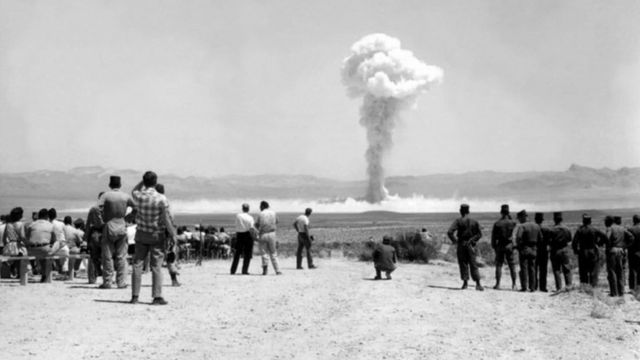
Class action launched against British Government over nuclear bomb tests in Australia
By A Current Affair Staff 7 Oct 23 https://9now.nine.com.au/a-current-affair/nuclear-bomb-testing-australia-class-action-british-government/199eafe9-c774-432e-99b2-f71a96ffb696—
It’s a scandal that has spanned decades as Australian and British servicemen sent to nuclear testing sites fight to be officially recognised for their service and suffering.
Between 1952 and 1963, Great Britain carried out nuclear bomb tests in Australia and the Pacific.
Doug Brooks was at the first one.
“The only thing we were told to do was turn our backs to the blast ground zero, cover our eyes with our hands and the blast x-rayed our hands we could see the bones,” he told A Current Affair.
Tony Spruzen was at the Maralinga test range in the remote outback of South Australia.
“The brightness was so much, it’s something like I never experienced before, I could see through my eyelids, I could see the bones of my fingers,” he said.
Doug and Tony are two of the rapidly diminishing number of veterans sent to the nuclear test sites.
In total 45 tests were conducted by Britain’s Ministry of Defence – 12 of those were in Australia at the blessing of the Menzies government.
There were 22,000 servicemen in the Pacific tests. 1500 are still alive.
Now there is a new class action against the British Government.
“Well, what’s prompted it is that we’ve discovered medical records do in fact exist for these servicemen,” lawyer Matthew Jury said.
“We have a copy of these records and what that tells us is the other medical records exist which the government has been concealing for 70 years so those surviving servicemen who want answers now know that those records exist so where and the government has been concealing them.”
Jury’s firm has launched the action class and he claims records reveal the radiation levels in the blood and urine of the servicemen.
“As they have grown older they have developed extreme and aggressive forms of cancer,” Jury said.
“There have been miscarriages and other birth defects which can’t be treated by their doctors because their doctors don’t have their full medical records.”
The British Ministry of Defence hasn’t responded to requests for an interview or statement.
Watch the full story in the video player above. [on original]
1 This month.

Australians deserve the truth
about
AUKUS – https://aukuspublicinquiry.com/

30 July – WEBINAR (Free) – Is Nuclear Power the Solution to Climate Change? https://my.acaw.org.au/event/acaw-is-nuclear-power-the-solution-to-climate-change
18:30 – 19:45 ACST
19:00 – 20:15 AEST

PETITION – To: Prime Minister Anthony Albanese and the Australian Labor Government

of the week – Australians for War Powers Reform (AWPR)
To see nuclear-related stories in greater depth and intensity
 Antinuclear