International Atomic Energy Agency Director General Rafael Mariano Grossi warns that nearby explosions which shattered windows at Ukraine’s Khmelnitsky nuclear power plant “show just how close it was – and underlines the extremely precarious nuclear safety situation … which will continue as long as this tragic war goes on”.
WNN 27 Oct 23
The International Atomic Energy Agency (IAEA) experts stationed at the plant in western Ukraine said air raid sirens sounded at 01:26 local time on Wednesday followed by two loud explosions which they were later told were two drones being shot down 5 kilometres and 20 kilometres from the site.
Although the site was not hit or have its operations affected, the IAEA reported that “shockwaves damaged the windows of several buildings at the site, including the passageway to the reactor buildings, an integrated auxiliary building, a special equipment building, the training centre, as well as other facilities, the plant said. The seismic monitoring stations installed in the vicinity of Khmelnitsky nuclear power plant also recorded the seismic impacts of the blasts”………
Grossi said: “Next time, we may not be so fortunate. Hitting a nuclear power plant must be avoided at all costs.”
Khmelnitsky’s first reactor was connected to the grid in 1987, but work on three other reactors was halted in 1990. Work on the second reactor restarted and it was connected to the grid in 2004 but units 3 and 4 remain uncompleted.
The primary focus of safety concerns for the IAEA since the outbreak of the war has been on the Zaporizhzhia nuclear power plant which has been under Russian military control since early March 2022. It is located on the frontline between the forces, and although it has not been reported to have been hit by shelling in recent months, military activity nearby has continued. In its update on the situation at the weekend, the IAEA said its experts at the site “have continued to hear explosions almost every day and they have also heard occasional machine gun fire”. https://www.world-nuclear-news.org/Articles/IAEA-warning-after-explosions-heard-near-Khmelnits #nuclear #antinuclear #NoNukes #radiation
As Israel’s carpet bombing of Gaza entered its third week, leaving over 5000 dead and at least one million residents displaced, a Tel Aviv-based think tank published a blueprint for self-proclaimed Jewish state’s final solution.
In a white paper released over a week after the Hamas-led surprise attack on Israeli military bases and kibbutzes, The Institute for National Security and Zionist Strategy outlined “a plan for resettlement and final rehabilitation in Egypt of the entire population of Gaza,” based on the “unique and rare opportunity to evacuate the entire Gaza Strip” that Israel’s latest assault on the besieged costal enclave provided.
Published in Hebrew on the organization’s website, the paper was authored by Amir Weitman, “an investment manager and visiting researcher” at the Institute who also leads the libertarian caucus of Israel’s ruling Likud Party. The document began by noting that there are 10 million vacant housing units in neighboring Egypt that could be “immediately” filled with Palestinians. Weitman then assured readers that the “sustainable plan…aligns well with the economic and geopolitical interests of the State of Israel, Egypt, the USA and Saudi Arabia.”
Weitman’s ethnic cleansing proposal echoes forced transfer plans advanced in recent days by former Israeli officials while capitalizing on evacuation orders delivered to the entire civilian population of northern Gaza by the Israeli military.
Weitman’s sinister blueprint imagined Israel purchasing these properties at a cost of $5 – 8 billion dollars, a whopping price-tag that reflects just 1 – 1.5 percent of Israel’s GDP.
“These sums of money [required to cleanse Gaza] in relation to the Israeli economy, are minimal,” Weitman posits. “Investing individual billions of dollars to solve this difficult issue is an innovative, cheap and sustainable solution.”
Weitman acknowledged that his plan virtually amounts to Israel “buying the Gaza Strip,” arguing the move would be “a very worthwhile investment” for Zionists because it would “add a lot of value over time.” He asserted local “land conditions” in the area would provide “many” Israeli settlers a high standard of living, therefore allowing for an expansion of settlements in Gush Dan near the Egyptian border, giving “a tremendous impetus to settlement in the Negev.”
In December 2021, Tel Aviv approved plans to establish four settlements in the Negev to house 3,000 settler families.
A genocidal war to end all wars
Though Egypt has so far rejected Israeli pressure for a mass exodus of Gaza residents through the southern Rafah crossing, Weitman argued Cairo will welcome the mass exodus of Palestinian refugees as “an immediate stimulus” that will “provide a tremendous and immediate benefit to al-Sisi’s regime.”
Weitman claimed that Cairo’s major creditors — including France, Germany and Saudi Arabia — are likely to welcome a revitalized Egyptian economy, courtesy of “Israeli investment” in the Palestinians’ permanent removal. He surmizes that Western Europe will welcome “the transfer of the entire Gaza population to Egypt,” because it will significantly “reduce the risk of illegal immigration…a tremendous advantage.” Meanwhile, he expects Riyadh to embrace the move because the “evacuation of the Gaza Strip means the elimination of a significant ally of Iran.”
The ethnic cleansing of Gaza would mean an end to “ceaseless, repeated rounds of fighting, which inflame the fires of hatred against Israel.” Moreover, “closing the Gaza issue will ensure a stable and increased supply of Israeli gas to Egypt and its liquefaction,” from the vast reserves seized by Israel near Gaza’s shores.
Palestinians in turn are expected to jump at the chance to be forcibly transferred from their homes rather than “living in poverty under the rule of Hamas.” It is therefore necessary for Israel to “create the right conditions” for them to “immigrate” from Gaza to Cairo. Weitman noted that Gaza’s two million inhabitants “constitute less than 2% of the total Egyptian population, which today already includes 9 million refugees. A drop in the ocean.”
The paper ominously concluded: “There is no doubt that in order for this plan to come to fruition, many conditions must exist at the same time. Currently, these conditions are met and it is unclear when such an opportunity will arise again, if ever. This is the time to act. Now.”
“If we want to remain alive, we will have to kill and kill and kill”
As barbarous as these proposals might seem, they reflect what many Israeli officials appear to be murmuring in private, and what at least one former government spinmeister has openly pushed as an altruistic solution to the Palestinian “problem.”
“There is a huge expanse, almost endless space in the Sinai Desert, just on the other side of Gaza,” former Deputy Foreign Minister of Israel, Danny Ayalon, echoed the genocidal Zionist logic behind Weitman’s proposal in an interview with Al Jazeera’s Marc Lamont Hill. “The idea is—and this is not the first time it will be done—for them to leave over to the open areas where we and the international community will prepare the infrastructure — you know, 10 cities with food and water — just like for the refugees of Syria.”
In 2004, Zionist demographer Arnon Sofer of Haifa University laid out detailed plans for the isolation of Gaza directly to Ariel Sharon’s government. This entailed withdrawing Israeli forces from the area entirely and constructing a stringent system of surveillance and security to ensure nothing and no one went in or out without Zionist proviso. He predicted a perpetual bloodbath:
“When 2.5 million people live in a closed-off Gaza, it’s going to be a human catastrophe. Those people will become even bigger animals than they are today…The pressure at the border will be awful. It’s going to be a terrible war. So, if we want to remain alive, we will have to kill and kill and kill. All day, every day…the only thing that concerns me is how to ensure the boys and men who are going to have to do the killing will be able to return home to their families and be normal human beings.”
The Institute has put forward a clean and easy fantasy of achieving the same goal put forward by Sofer. For it to succeed, all Palestinians have to do is put down their weapons and head toward the desert of permanent exile. #Israel #Palestine
As WikiLeaks founder and Australian citizen Julian Assange has nearly exhausted his appeals to British courts against a US extradition order, Australia has ramped up its advocacy on his behalf. Six Australian MPs held a press conference outside the US Department of Justice on September 20 to urge the Biden administration to halt its pursuit of Assange (Consortium News, 9/20/23).
They came representing an impressive national consensus: Almost 80% of Australian citizens, and a cross-party coalition in Australia’s Parliament, support the campaign to free Assange (Sydney Morning Herald, 5/12/23). Opposition leader Peter Dutton joined Prime Minister Anthony Albanese in urging Assange’s release.
The day before, an open letter to the Biden administration signed by 64 Australian parliamentarians appeared as a full-page ad in the Washington Post. It called the prosecution of Assange “a political decision” and warned that, if Assange is extradited, “there will be a sharp and sustained outcry” from Australians.
Given what is at stake for freedom of the press in the Assange case, and the intensified pressure from Australia—a country being wooed to actively enlist in the US campaign against China by spending $368 billion on nuclear submarines and supersonic missiles (Sydney Morning Herald, 8/10/23)—we ought to expect coverage from the Washington Post, New York Times and major broadcast networks. But coverage of the press conference was virtually absent from US corporate media.
Prosecuting publishing
The US has been seeking to extradite Assange from Britain on charges relating to the leaking of hundreds of thousands of documents to international media in 2010 and 2011, many of which detailed US atrocities carried out in the Afghanistan and Iraq wars and other human rights violations, such as the torture of detainees at Guantánamo Bay (Abby Martin, 3/10/23).
In 2019, President Donald Trump’s administration brought Espionage Act charges against Assange for obtaining and publishing leaked documents, a dramatic new attack on press freedom (FAIR.org, 8/13/22). Assange could face 175 years in a supermax prison if convicted under the Espionage Act, “a relic of the First World War” meant for spies (AmericanConstitution Society, 9/10/21), and not intended to criminalize leaks to or publications by the press. The Biden administration has rolled back much of the legal mechanism used by Trump to attack journalists, but President Joe Biden has reaffirmed the call to extradite Assange.
Assange also coordinated with international news outlets to publish other material known as Cablegate about the “inner-workings of bargaining, diplomacy and threat-making around the world” (Intercept, 8/14/23). Indeed, the New York Times (e.g., 11/28/10) published many articles based on the WikiLeaks documents, which had been sent to Assange by US army whistleblower Chelsea Manning.
US officials have repeatedly justified their case by charging that Assange put lives at risk; to date, no evidence has surfaced that any individuals were harmed by the leaks (BBC, 12/1/10; Chelsea Manning, Readme.txt, 2022). As the Columbia Journalism Review (12/23/20) admonished, don’t let the Justice Department’s
misdirection around “blown informants” fool you—this case is nothing less than the first time in American history that the US government has sought to prosecute the act of publishing state secrets, something that national security reporters do with some regularity.
US officials have repeatedly justified their case by charging that Assange put lives at risk; to date, no evidence has surfaced that any individuals were harmed by the leaks (BBC, 12/1/10; Chelsea Manning, Readme.txt, 2022). As the Columbia Journalism Review (12/23/20) admonished, don’t let the Justice Department’s
misdirection around “blown informants” fool you—this case is nothing less than the first time in American history that the US government has sought to prosecute the act of publishing state secrets, something that national security reporters do with some regularity.
In failing health after suffering a stroke, Assange has been held in London’s high-security Belmarsh Prison since he was removed from the Ecuadorian Embassy in April 2019. He had sought asylum at the embassy in London in 2012 to avoid being sent to Sweden for questioning over sexual assault allegations, because Sweden would not provide assurances it would protect him from extradition to the US. Sweden dropped charges against Assange in November 2019 (BBC, 11/19/19), after he was in British custody.
International condemnation
The Australian diplomatic mission coincided with the convening of the UN General Assembly in New York City, where President Lula da Silva of Brazil condemned the prosecution of Assange, offering yet another opportunity for US corporate media to cover the strong international opposition to Assange’s treatment.
A video (9/19/23) of Lula speaking at the opening of the UN General Assembly was widely circulated on social media. “Preserving press freedom is essential,” Lula declared. “A journalist like Julian Assange cannot be punished for informing society in a transparent and legitimate way.”
Former British ambassador Craig Murray commented about Lula’s reception at the UN (Twitter, 9/17/23):
It is really not normal for the hall at the UN General Assembly to break into this kind of spontaneous applause. The US has been losing the room internationally for a decade. The appalling treatment of Julian is a focus for that.
US media absence
Yet, with a few exceptions (Fox News, 9/20/23; The Hill,9/21/23; Yahoo News, 9/21/23), none of this made the major US news outlets.
Over a week later, Business Insider (10/1/23) ran a long piece that featured an interview with Gabriel Shipton, Assange’s half-brother. It pointed out that Assange had become an obstacle to US plans to involve Australia in its aggression toward China, quoting the PM. But the piece also hashed through a number of long-debunked claims, including one that reminded readers that Mike Pompeo once called Assange “a fugitive Russian asset” (FAIR.org, 12/03/18; Sheerpost 2/25/23), and another that repeated US assertions that WikiLeaks releases would put the US at risk.
The New York Times has been conspicuously absent from the coverage of Assange. Though the Times signed a joint open letter (11/28/22) with four other international newspapers that had worked with Assange and WikiLeaks, appealing to the DoJ to drop its charges, the paper has remained almost entirely silent on both Assange and the issues raised by his continued prosecution since then.
As FAIR pointed out, during the Assange extradition hearing in London, the Times
published only two bland news articles (9/7/20, 9/16/20)—one of them purely about the technical difficulties in the courtroom—along with a short rehosted AP video (9/7/20).
There were no editorials on what the case meant for journalism. FAIR contributor Alan MacLeod noted that the Times seemed to distance itself from Assange and WikiLeaks, and its own reporting on the Cablegate scandal, coverage that boosted the papers’ international reputation.
Other opportunities for coverage have been missed by the Times. For instance, Rep. Rashida Tlaib wrote a letter (4/11/23), signed by six other members of the Progressive Caucus, calling for the DoJ to drop the charges against Assange. Tlaib cited support from the ACLU, Amnesty International, Reporters Without Borders, the Committee to Protect Journalists, Defending Rights & Dissent and Human Rights Watch, and many others, stating that his prosecution “could effectively criminalize” many “common journalistic practices.” The letter was covered by The Nation (4/14/23), the Intercept (3/30/23), Fox News (4/1/23), The Hill (4/11/23) and Politico (4/11/23), but the Times and other major newspapers were conspicuously silent.
When Assange lost his most recent appeal against extradition in June, a few outlets reported the news online (e.g., AP, 6/9/23; CNN, 6/9/23), but not a single US newspaper report could be found in the Nexis news database. (Newsweek‘s headline framed the news as a “headache for Biden”—6/8/23—rather than a blow for press freedom.) The Times only vaguely referred to the news (Assange “keeps losing appeals”) two weeks later in a feature (6/18/23) on the late whistleblower Daniel Ellsberg, who had criticized Biden’s decision not to drop the case against Assange.
The world is watching
A huge collective breath is being held as the world watches to see what will happen to Assange, the most famous publisher on the globe. Will he be returned to his country and his family by Christmas, as the Australian MPs have requested? Or will Britain and the US continue to slowly execute him?
Assange’s case is expected to be discussed during Prime Minister Albanese’s current visit to the US, which includes a state dinner hosted by Biden on October 25. MP Monique Ryan, part of the pro-Assange delegation, told news outlets: “Our prime minister needs to see this as a test case for standing up to the US government. There are concerns among Australians about the AUKUS agreement, and whether we have any agency” (Business Insider, 10/1/23).
As Common Dreams (9/19/23) quoted from the delegation’s letter:
We believe the right and best course of action would be for the United States’ Department of Justice to cease its pursuit and prosecution of Julian Assange…. It is well and truly time for this matter to end, and for Julian Assange to return home.
There is little doubt that South Australia is leading the world on the integration of wind and solar. Now, it’s about to take an even bolder leap into a deep green energy future through its hydrogen jobs plan.
The state has sourced more than 70 per cent of its electricity demand from wind and solar over the past year, and when RenewEconomy interviewed state energy minister Tom Koutsantonis on Sunday afternoon for its Energy Insiders podcast, it was nearing the end of a 60-hour period where it average more than 100 per cent wind and solar. Earlier that day, the state had reached a stunning new peak of 264 per cent “potential” wind and solar, the combination of renewable energy actually produced, and the renewable energy curtailed by the lack of a market.
South Australia response to the this excess of green energy is to encourage even more, with another bold step that it hopes will make it a global leader in green hydrogen, just as it has done with renewables.
Walt Zlotow , West Suburban Peace Coalition, Glen Ellyn IL 25 Oct 23
White House National Security Council spokesman John Kirby advised Gazans Tuesday that their destruction and ethnic cleansing will continue relentlessly. “This is war. It is combat. It is bloody, ugly and it’s going to be messy and innocent civilians are going to be hurt going forward.”
No spokesman Kirby, not just hurt. Innocent civilians in Gaza are dying every day, every hour, every minute under thousands of bombs but no food, no water, no medicine; not even electricity to run their overwhelmed hospitals.
It’s no longer a war. It’s the mass destruction of 2.3 million Palestinians being systematically killed and driven from their open air prison by Israel and wholly enabled by the United States.
It is the worst, most grotesque and inhumane policy of the United State I’ve witnessed in my 70 plus years of following American foreign affairs.
Perpetual war in Ukraine that could go nuclear is not enough for Biden. He’s all in now for perpetual war in the Middle East that could explode into a massive regional war at any moment, if it doesn’t kill or remove all the Palestinians from Gaza first. #Israel #USA #Palestine
The information interests of Israel and its western allies have been greatly served by framing this onslaught as a “war”, when that label doesn’t actually apply here. A war is when two nations or groups are in a state of armed combat with each other; one side may be more powerful than the other, but the combat is decidedly going two ways.
That’s not what’s happening here. Israel is raining high-tech military explosives upon civilian infrastructure inside a giant concentration camp densely populated with children, and every now and then a militant in Gaza fires back a type of rocket that is essentially a glorified firework which historically hardly ever kills anyone. Israel is killing civilians by the thousands and turning entire city blocks to rubble, while Hamas and other resistance groups in Gaza are doing some light property damage in what amounts to a performative display of defiance.
That’s not a war. That’s a massacre.
By calling this something that it isn’t instead of what it is, Israel apologists are able to respond to all criticisms of its actions with a shrug and a “This is war, man. War is ugly, what can I tell ya?” They wouldn’t be able to do that if they were addressing this atrocity truthfully.
The only thing truthful about Kirby’s framing was his statement that the slaughter of civilians is going to keep happening. The death toll from airstrikes in Gaza has reportedly surpassed 6,500, with the 24-hour periods from Monday to Tuesday and Tuesday to Wednesday both exceeding 700 deaths each. As Antiwar’s Dave DeCamp notes, this large escalation in deaths coincides with claims from Benjamin Netanyahu that Israel has escalated its bombing campaign.
This is all being funded and supported by the United States, who has been ramping up its military presence in the middle east in some pretty disconcerting ways. Not one but two US aircraft carrier strike groups have been deployed to the eastern Mediterranean since the killing began, and the Pentagon has told the press that it expects a “significant escalation” in attacks on US troops in the middle east in response to Israel’s relentless assault on Palestinian lives. US military advisers have been sent to Israel to help the IDF prepare for its ground invasion of Gaza, and as usual Australia is joining in the US warmongering by sending more troops to the middle east as well.
So we can expect a lot more killing in the near future, one way or the other. No meaningful pressure is being placed on Israel to stop butchering civilians, and an escalation into a broader war in the middle east is not at all outside the realm of possibility. Things could be headed in a direction that makes a genocidal massacre look like sunny days in retrospect. #Israel #USA #Palestine
An army of pro-Israel trolls has invaded the Community Notes function on X/Twitter, attempting to influence the online debate around the ongoing crisis.
SCHEERPOST, By Alan MacLeod / MintPress News, October 25, 2023
Almost as important as its military campaign for Israel is its battle to control its public image. Even as it kills thousands of people in Gaza, the small Middle Eastern nation is spending millions of dollars on a propaganda war, purchasing ads on YouTube, Facebook, Instagram and other online apps. At the same time, an army of pro-Israel trolls has invaded the Community Notes function on X/Twitter, attempting to influence the online debate around the ongoing crisis.
Spending Millions to Whitewash Massacres
Since October 7, Israel has inundated YouTube with advertisements, with its Ministry of Foreign Affairs spending nearly $7.1 million on ads in the two weeks following Hamas’ incursion. According to journalist Sophia Smith Galer, this equates to almost one billion impressions.
With its campaign, the Israeli government overwhelmingly focused on rich Western nations, its top targets being France, Germany, the United Kingdom, Belgium and the United States. In France alone, the ministry spent $3.8 million. Other branches of the Israeli government undoubtedly also spent money on ads. The overwhelming message of the campaign was that Hamas are terrorists linked with ISIS and that Israel – a modern, secular democracy – is defending itself from foreign aggression.
Much of the content blatantly violated YouTube’s terms of service, including a number of ads featuring gory shots of dead bodies. Another ad that piqued public attention was played before videos aimed at babies. Amid a scene of pink rainbows and soothing music, text appears reading:
We know that your child cannot read this. We have an important message to tell you as parents. 40 infants were murdered in Israel by the terrorists Hamas (ISIS). Just as you would do everything for your child, we will do everything to protect ours. Now hug your baby and stand with us.”
Nearly all the Ministry of Foreign Affairs views are inorganic. Most of their YouTube uploads garner only a few hundred views. But the ones selected as advertisements have hundreds of thousands or even millions of views.
Israel’s YouTube campaign has been matched by expansive attempts to control the public debate on other social media platforms. In barely a week, the Ministry of Foreign Affairs ran 30 ads seen over 4 million times on Twitter. Like with YouTube, analytics data shows they were inordinately targeting adults in Western Europe.
One ad contained the words “ISIS” and “Hamas,” showing disturbing imagery that gradually sped up until the names of the two groups blended into one. In case the message was not clear enough, it ended with the message, “The world defeated ISIS. The world will defeat Hamas.”
The Ministry of Foreign Affairs has also bought large numbers of advertisements on Facebook, Instagram, mobile games and apps such as language trainer Duolingo.
Taking Notes
The Community Notes function on Twitter is an attempt to fight false information. Contributors who sign up for the feature can leave notes on any post, adding context to potentially misleading statements. The community then votes on these notes, and if enough people consider the note useful, it is presented below the original tweet.
While it has its advantages, the system is ripe for abuse and infiltration. Since October 7, an army of pro-Israel trolls has brigaded the function and is attempting to undermine and attack as many posts as possible showing Israel in a negative light or Palestine in a positive one. This has often been done in an attempt to hide Israeli war crimes.
“If you’re not a Community Notes contributor, then you may be unaware that any tweet about Gaza that poses an inconvenience to Israeli information interests is being mobbed by Israel apologists working to manipulate the narrative, including on tweets just voicing an opinion,” wrote journalist Caitlin Johnstone.
A case in point is the attack on the Al-Ahli Hospital in Gaza. Under a tweet from journalist Dan Cohen noting that Hananya Naftali (an aide to Prime Minister Benjamin Netanyahu) had boasted that Israel carried out the attack before deleting his message, Community Notes wrote that “Naftali has openly retracted his statement, as conclusive evidence has since shown the explosion was fired from a misfired rocket from Gaza.” The “conclusive evidence” offered was a statement from the Pentagon and a tweet from a former Israeli Air Force squad commander.
Meanwhile, a tweet from Lebanese political commentator Sara Abdallah breaking the news that Israel had just bombed the St. Porphyrius Church in Gaza was flagged by Community Notes. This meant that all users saw a note added reading, “False. Saint Porphyrius Orthodox Church in Gaza has posted they are untouched and operating as of October 9, 2023.” The problem was this was breaking news related to October 19, so any statement before that time was meaningless in assessing the news. Further undermining the community note was that Israel almost immediately accepted responsibility for the destruction.
Pro-Israel trolls have also not been above blatant smears. On a popular post from myself where I shared a picture of Joe Biden and Benjamin Netanyahu embracing with the words, “In the future, this image will be looked upon as one of the most shameful moments in history,” Community Notes added the message: “Alan MacLeod is a Senior Staff Writer at MintPress News. MintPress is renowned for publishing far-left disinformation and antisemitic conspiracy theories.” Other MintPress staff, such as Lowkey and Mnar Adley, have also been consistently targeted with smears and arguments dressed up as clarifications.
Seeing What Sticks
In the fog of war, the Middle Eastern network Al-Jazeera has been a consistent source of live reporting. The well-funded network has a large team of reporters in Palestine and the wider region and has a long history of covering the conflict.
Therefore, when Al-Jazeera released an investigation that found no evidence to support Israel’s claim that a failed Palestinian rocket launch was to blame for the damage at the Al-Ahli Hospital, the story went viral.
This was a major blow to Israel and its apologists, who did not want the blood of hundreds of innocent doctors and patients on their hands. And so, pro-Israel users attempted to get community notes plastered all over the Al-Jazeera story……………………………………………………….
Wiki Wars
This is not the first time that Israel and its supporters have attempted to hijack and manipulate public highways of information. For over a decade, well-organized and well-funded Israeli groups have infiltrated Wikipedia and attempted to rewrite the encyclopedia to defend Israeli actions and demonize voices who speak out against them.
One of the most well-known of these is the Yesha Council, which, as far back as 2010, claimed to have 12,000 active members. Yesha members painstakingly police Wikipedia, removing troublesome facts and framing articles in a manner more favorable to Israel…………………………………………………
Spies Among Us
One of the reasons that social media companies have not cracked down on disingenuous pro-Israeli activities could be that former Israeli government and military officials hold top positions at a great number of the world’s most important platforms.
Emi Palmor, for example, is one of 22 individuals who sit on Facebook’s Oversight Board. Palmor was formerly the General Director of the Israeli Ministry of Justice. In this role, she directly oversaw the stripping away of Palestinian rights. She created a so-called “Internet Referral Unit,” which would push Facebook to delete Palestinian content that the Israeli government objected to. In her new role at the Oversight Board, she effectively writes Facebook’s rules, deciding what content to promote to the platform’s 3 billion users and what to censor, delete or suppress.
Palmor is also a veteran of Unit 8200, perhaps the most controversial unit in the Israeli military. Described as “Israel’s NSA,” Unit 8200 is the centerpiece of the country’s high-tech surveillance industry. Unit 8200 spies on the Palestinian population, compiling vast dossiers on millions of people, including their medical history, sex lives, and search histories, to be used for extortion later. ………………………………………………….
A MintPress News investigation unearthed a network of hundreds of Unit 8200 veterans working in influential positions at some of the planet’s most important tech and social media companies, including Google, Amazon and Meta (Facebook).
For example, Google’s Head of Strategy and Operations for Research, Gavriel Goidel, was previously a senior officer in Unit 8200, rising to become Head of Learning. Facebook Messenger’s Head of Data Science, Eyal Klein, served for six years in Unit 8200, rising to the rank of captain. And after serving in the controversial unit, Ayelet Steinitz became Microsoft’s Head of Global Strategic Alliances…………………………………………………………. more https://scheerpost.com/2023/10/25/propaganda-war-pro-israel-trolls-are-mobbing-twitters-community-notes/ #Israel #Palestine
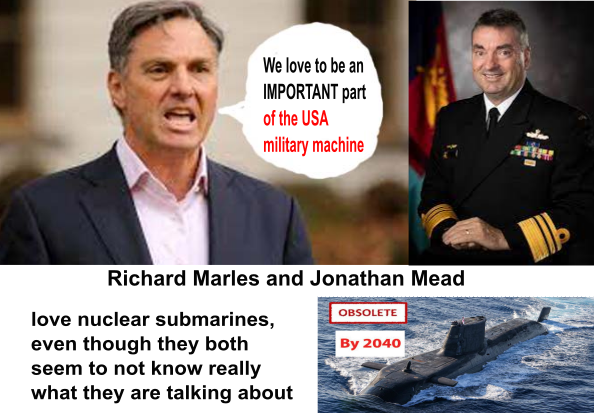
Listening to the Australian government and the local media, one would be entitled to think that it’s now a simple question of when will we receive nuclear-powered submarines, not if.
However, this is not the perspective of various parties in the US, with even the basic enabling legislation stuck in the Senate since June.
Called drily the “May 2023 DOD Legislative Package Regarding Proposed Sale of Virginia-class Boats Under AUKUS Agreement”, its aim seems to have been widely misunderstood in Australia.
Assuming that it is passed at some stage, it does not guarantee that we will be sold anything – it puts in place various measures and milestones that define how the process needs to work. Ultimately, the sale will still depend on the attitude of a future secretary of the Navy, who must advise congress for final approval.
One of the first things the legislation will do is clear the way for our government to transfer $3.326bn to the Pentagon coffers, seemingly with no visibility on how the US will spend it. We know the precise amount because it appears in a small footnote in the Defence Department’s annual budget papers. A change in the law is necessary because this transfer is unprecedented in US history and there are no existing mechanisms that allow it to happen.
There is also no mechanism for the money to be returned if the sale of submarines does not happen, and everyone from Defence Minister Richard Marles downwards has been mute about why we are handing over such a huge amount of money – something apparently volunteered by Australian officials during early negotiations. The intent is supposedly to strengthen US industry so that it reaches a point where it is producing so many Virginia-class submarines that some will be available for export.
Even determining when that point will be reached is speculative – and the legislation is no help because amendments include statements such as Australia will receive two submarines within 15 years, or they will be available for export when the US is launching them at a rate of three per year. Commentators have spoken of the need to be building them at two, or 2½ a year. The current pattern is barely 1½.
Nuclear-powered submarines are one of the most complex things ever constructed by humans, with about five million discrete components in each one. An 8000-tonne Virginia-class boat – the weight of 20 A380 passenger jets – requires a massive supply chain. Trying to ramp up production is a huge undertaking, which might work – but it also might not.
According to US officials, an extra 100,000 skilled workers are going to be needed in the next decade to meet even the two-per-year target. This is because the highest priority for the US Navy is the new Columbia-class ballistic missile firing submarines under construction. In addition, the Virginia-class – the first of which was launched in 2003 – is proving to be more maintenance intensive than expected, with close to 40 per cent of the current fleet tied up because of worker and spare parts shortages.
Some of this is spelled out in a section rather ominously titled: Limitation on Transfer of Submarines to Australia pending certification on domestic production capacity.
The government has no idea what to do, only a hope that it will all work out at a point in the distant future, preferably in a galaxy far away
The legislation also requires reporting requirements that appear incompatible with how our secretive Defence Department does things, with the connivance of the government. It says that within 90 days of passage, the Secretary of Defense – currently Lloyd Austin – must report to Congress on the cost, schedule, milestones and funding requirements involved in the sale of a Virginia-class submarine. This needs to be done in a way that will not adversely affect the capabilities of the USN. Since the US has a level of transparency we can only dream of, there are numerous other reporting requirements. One of these states: “A description of progress by the Government of Australia in building a new submarine facility to support the basing and disposition of a nuclear-attack submarine on the east coast of Australia.”
As Richard Marles has ruled out making a decision on the location of the base until next decade – after all, no one wants to live adjacent to a nuclear target with a consequent fall in house prices – it seems we will be in early breach of one of the conditions.
Another is that we will need to show that plans for other Australian military acquisitions will not be distorted – in other words the US is expecting to see evidence of a major increase in Defence spending, not just a vague promise.
If not before, this is likely to come to a head when the US asks for detailed plans for how we dispose locally of the highly radioactive SG9 reactors containing bomb grade material – U235 has a half-life of 704 million years – on Australian soil. At the moment, the government has no idea what to do, only a hope that it will all work out at a point in the distant future, preferably in a galaxy far away. Why we agreed to this provision when the US already has a system in place for decommissioning their own submarines is unknown.
In related news, a team in the UK led by BAE Systems has been awarded a $7.5bn contract for early work on the future AUKUS nuclear-powered submarine, with construction starting in the late 2030s.
This does not seem to involve Australia, indicating that we will either have to take whatever the British decide to sell us, or our specific modifications – such as for US weapons – will have to be made at a later point, increasing cost and risk.
I focus on the lies of the nuclear lobby – because these are the most blatant, pervasive, of the lies that are swallowed up and regurgitated by political leaders and the media.
Lies about “cheap” “clean” “safe” “nothing-to-do-with-weapons” nuclear power, – especially the (non-existent) SMRs – Small Modular Nuclear Reactors.
Dr Pangloss, (from Voltaire’s 17th Century satirical novel “Candide” ) is the essence of foolish, gullible optimism. And a model – for our age – not to be.
But there are so many other prevailing lies that need to be busted, too.
My current top favourite is “The Cloud”. Wottlehell is The Cloud anyway? Clean? Pretty? Up in the sky?.
No, The Cloud is a vast number of “farms” containing dirty great steel skyscraper-like containers, powered by huge amounts of fossil-fuel electricity, requiring great lagoons of water for cooling.
And inside them? Every bit of digital anything that happens from great important dissertations, youtubes, whatever, and everybody’s pointless little emails, tweets, emojis – the world’s ever-increasing digital rubbish.
Renewable energy – big wind and solar – are the answer?
Not really. They require huge amounts of energy to build. They use lots of rare minerals, and plastic. Putting big wind turbines into the oceans is damaging to the marine ecology.
We’re reducing greenhouse emissions. No – they’re still rising
Cop 28 UN Climate Change Conference will lead the way for real climate action. Really?
The United Arab Emirates is hosting the UN climate summit in November and the president of Cop28 is Sultan Al Jaber, who is also chief executive of the Abu Dhabi National Oil Company. At least a dozen employees from the United Arab Emirate’s state-owned oil company have apparently taken up roles with the office .
Debunking Degrowth. – We learn that reducing energy use, reducing consumption, living more simply – there has been a fair bit of propaganda about – telling the world that these methods are just not feasible. (But they might be the only answer)
Dr Pangloss would say that now “Everything is the best, in the best of all possible worlds“
Well, it’s not. I mean, apart from global overheating, biodiversity loss, diminishing resources, deforestation, water shortages, plastic pollution, climate refugees, pandemics, increasing conflicts – everything’s fine – yes?
Over 5,000 dead, mostly civilians, from 2 weeks of relentless Israeli bombing, turning much of the 139 square miles of Gaza into rubble, is a genocidal act of ethnic cleansing. It is designed to diminish, if not eliminate the 2.3 million Gazans. The many who have died from lack of food, water, medicine and electricity, while unknown, may be in the thousands as well. It is a monumental crime against humanity.
Much of the world is repulsed, including many in Israel. Yesterday, dozens from local Chicago Jewish groups, If Not Now, Never Again Action, and Jewish Voice for Peace, held up traffic in the Loop for over an hour during rush hour in their call for immediate ceasefire. Bravo.
But not President Biden who is arming Israel and giving it a virtual blank check for an imminent invasion likely to further kill, degrade and ethnically cleanse those 2.3 million Palestinians. That imminent invasion may unleash blowback that could involve Iran, Lebanon and Syria; a regional conflict that may be uncontainable.
Biden preaches aid for starving, dying Palestinians but what has arrived is a pittance that will make no difference in their ongoing destruction from the worst collective punishment inflicted upon a civilian population in our lifetime. His aid lip service is not soothing…. it is deadly.
Biden’s cruel greenlighting of Gaza’s impending demise is no surprise. He’s simply following US policy for the last 18 years supporting Israel’s blockade of Gaza since they withdrew in 2005. But he has the opportunity. It requires true, humane statesmanship to lead the world in confronting the need for a Palestinian state prevented by Israeli intransigence and enabled by the US for 75 years now. Biden should demand an immediate ceasefire. He should suspend all aid to Israel including the proposed $10 billion in weaponry to conduct their impending invasion.
A more destructive US policy destroying peace and bringing needless death and suffering to millions is hard to imagine. But it is happening, which requires every American to demand Biden, his administration and Congress pivot from supporting relentless war to promoting a lasting peace in Israel and Gaza/West Bank. #Israel #Palestine
After a long period of disagreement, France and Germany finally reached a deal on electricity markets.
The Germans and French seized on a solution used in the UK for a quarter century to give the appearance of a functioning market: the contract for differences.
In an effort to find equilibrium between the European Union’s two biggest members, ministers reached a consensus that governments “have the option” to implement CfD’s for established nuclear reactors.
“……………………………………….. . France depends heavily on nuclear power generated by state-owned EDF. Existing French nuclear plants will require major capital improvements and the plants under construction are enormously expensive. The French government wants to subsidize its nuclear program, but other European Union (EU) countries (especially Germany) objected, because state subsidies are not in the spirit of the EU’s energy markets.
The market should determine prices, and should determine the appropriate means to supply the demand, the opponents argue. ……………………………
Europeans woke up to the likelihood that their unsubsidized firms would have to compete with heavily subsidized Chinese and American competitors. Furthermore, European firms looking at those American subsidies started talking about moving their facilities to the US, to qualify for the subsidies.
………………………………….. the risks of building a big nuclear plant are too great for any private enterprise to undertake. So the government has to step up to provide funds for the project.
The Germans and French seized on a solution used in the UK for a quarter century to give the appearance of a functioning market: the contract for differences. It works like this. The power producer sets a strike price with the buyer (who has signed a multiyear year agreement to buy the electricity). When the market price the generator can collect exceeds the strike price, the generator has to refund the surplus to the buyer. When the market price falls below the strike price, the buyer has to give the difference to the generator. Now here is the key to the deal. The strike price does not result from market forces but rather from the revenue needed to cover the cost of building or maintaining a nuclear unit, which the buyers cannot evade unless the nuke stops operating. The state, in the end, sets the price, and determines the terms of what really is a long term fixed contract made with a buyer that has no choice but to buy. In other words, this is not a commercial transaction, because in free markets, buyers have a choice: to buy or not buy.
To us, this deal, if it gets approval from the EU, signals that the EU fully acknowledges that choosing nuclear power is a political decision. And that expanding nuclear power requires government actions and explicit government financial support. That clears the air. Now let’s see what the policymakers do. https://oilprice.com/Alternative-Energy/Nuclear-Power/Germany-And-France-Finally-Compromise-On-Nuclear.html #nuclear #antinuclear #nuclearfree #NoNukes
The latest reliable information is that Osborne, South Australia, is unsuitable for the construction of the new hybrid nuclear power submarines in that it is far too small.
Besides it in its inherent size, being too small without any capacity for expansion, the submarines building facility will require two concentric buffer zones for which there is simply no room based on the reports in InDaily.
The first of these buffer zones will be immediately surrounding the Osborne complex and will be a “ shoot to kill“ buffer zone for high security.
The external buffer zone surrounding the first one will be fairly substantial and is to ensure complete environmental and similar protection
It is therefore daydreaming to put up Osborne for the construction of the hybrid nuclear powered submarines
From INDAILY 11 October 2023, Radiation monitoring at SA nuclear subs: – “In a written response to InDaily, a spokesperson from the Australian Submarine Agency said they had informed the State Government, Port Adelaide Enfield Council, and the PortnAdelaide residents Environment Protection group of the environmental baseline contamination assessment at Osborne.
“This assessment will determine existing levels of non- radiological contaminants and background radiation on the preferred site for the Submarine Construction Yard and surrounding areas,” the spokesperson said.” –
This is at first instance no more than a good political photoshoot based on ignorance . It seems that as pointed out by Rex Patrick the government has failed to learn anything from the ill fated and expensive Kimba situation
Having regard to the warnings by ANSTO it also seems that yet again there is no consensus by the various organs of the federal government Finally it is interesting that Susan Close who is the deputy premier of South Australia and is ostensively regarded environmental scientist has had little to say on this situation which is similar to her stance on Kimba.
Both the federal and state governments should heed the excellent study entitled RESET OF AMERICA’S NUCLEAR WASTE MANAGEMENT Strategy and Policy by Professor Rod Ewing and his assembled experts to properly understand the implications and requirements of the possible start of a nuclear installation such as in this instance.
The work now being undertaken should immediately start a safety case for full community consultations which seems most appropriate since media polls suggest that more than 70% of South Australia’s population is against any nuclear activity This situation is just another black mark for the International Atomic Energy Agency (IAEA) for not approving the implementation of AUKUS under the nonproliferation treaty
The United Nations has revised its grim figure of the rising death toll from Israel’s bombardment of Gaza, saying that it has surpassed 5,000 as of Monday. It stands at 5,087.Separately, over 90 Palestinians have been killed in escalating West Bank violence, which over the weekend included Israel launching a rare airstrike on Jenin. Hamas and Palestinian Islamic Jihad (PIJ) are still holding at least 222 Israeli and foreign captives – a number which has again been revised upward.
European Union foreign ministers are meanwhile gathered in Brussels for an urgent meeting to take up the contentious issue of a ceasefire. UN secretary-general Antonio Guterres has been calling on world bodies to back a ceasefire. In response, EU foreign policy chief Josep Borrell said:
“Personally, I think that a humanitarian pause is needed in order to allow the humanitarian support to come in and be distributed, seeing that half of the population of Gaza has been moving from their houses.”
Bloomberg is reporting Monday morning that EU leaders are set to endorse a call for a “humanitarian pause”. “The European Council supports the call of UNSG (U.N. Secretary-General Antonio) Guterres for a humanitarian pause in order to allow for safe humanitarian access and aid to reach those in need,” a draft statement of the summit reads.
But Washington, Israel’s staunchest supporter, isnot expected to back a ceasefire – despite reports President Biden has sought for Israel’s military delay the expected imminent ground invasion, in order to buy more time to negotiate the freedom of more hostages.
Secretary of State Antony Blinken in the Sunday news shows made this clear. Margaret Brennan, the host of CBS News’ Face the Nation, asked him:
“UNICEF says 1,524 children have been killed in the Gaza Strip during these bombings. Why isn’t the US calling for at least a temporary ceasefire?“
Blinken then claimed that children dying on either side has hit him “right in the heart” – but he stopped short of directing any criticism at Israel’s indiscriminate and unrelenting bombing campaign.Instead, he defended it.
Blinken said in reference to October 7 Hamas cross-border attack:
“Israel has to do everything it can to make sure this doesn’t happen again. Freezing things in place where they are now would allow Hamas to remain where it is and to repeat what it’s done some time in the future. No country could accept that.”
He then cited unverified reports that Hamas has actively blocked Palestinians who are also American citizens from leaving the Gaza Strip.
“We’ve had people come to Rafah, the crossing with Egypt. And to date, at least, Hamas has blocked them from leaving, showing once again, its total disregard for civilians of any kind who are — who are stuck in Gaza. So really, the ball is in Hamas’ court, in terms of letting people who want to leave, civilians from third countries, including Americans get out of Gaza.”
There are a reported up to 600 Americans stuck in Gaza, with one Palestinian-American telling NBC that “America’s not helping us, Biden’s not helping us, the embassy is not helping us.”
The United States is still bolstering its military presence in Middle East waters, readying for any contingency, even as it’s said to be pressing for furthering back-channel negotiations and delaying an all-out Israeli assault:
It was becoming increasingly clear Monday that the U.S. wants Israel to not only allow more humanitarian assistance into Gaza, but for the country to let ongoing negotiations over the release of hostages held by Hamas to continue before it launches a ground invasion of the Palestinian territory. Israel said Monday that Hamas was still holding 222 people captive.
Two sources told CBS News the U.S. has sought to slow Israel’s plans for a ground invasion in order to prioritize the release of hostages and the distribution of aid, a message Washington is said to have been conveying primarily through defense channels.
The Pentagon is calling its moving two aircraft carrier strike groups into regional waters an act of “deterrence”.
Secretary of Defense Lloyd Austin had announcedSaturday:
“Following detailed discussions with President Biden on recent escalations by Iran and its proxy forces across the Middle East Region, today I directed a series of additional steps to further strengthen the Department of Defense posture in the region. These steps will bolster regional deterrence efforts, increase force protection for U.S. forces in the region, and assist in the defense of Israel.”
The White House has Iran in mind, and its proxies Hezbollah and Shia Houthi rebels in Yemen, the latter who days ago tried to fire missiles on Israel, but which were intercepted by a US warship off Yemen’s coast. US THAAD and Patriot missile batteries have been sent to Israel.
Blinken said:
“This is not what we want, not what we’re looking for. We don’t want escalation. We don’t want to see our forces or our personnel come under fire. But if that happens, we’re ready for it.”
And Austin simultaneously affirmed the statements, saying:
“What we’re seeing is a prospect of a significant escalation of attacks on our troops and our people throughout the region.”
It’s clear Hezbollah has held off committing itself to a major war with Israel, which could very well happen the moment the IDF mounts a major ground assault into Gaza. Hezbollah’s arsenal, with the help of Iran, is far superior to that of Hamas’, and is said to include tens of thousands of rockets of varying sizes.
There’s still been regular exchange of rocket and mortar fire, with Israeli sources reporting Monday that the Iron Dome intercepted an inbound drone from Lebanon via the sea. It was intercepted over Ein Hamifratz, south of Acre. At this point, several dozens of Israeli towns and communities have been evacuated from near the northern border. #Israel #Palestine #nuclear #antinuclear #nuclearfree #NoNukes
Secretary of State Antony Blinken on Sunday rejected the idea of the US calling for a ceasefire in Gaza when confronted with the massive number of child casualties in Israel’s onslaught.
“UNICEF says 1,524 children have been killed in the Gaza Strip during these bombings. Why isn’t the US calling for at least a temporary ceasefire?” Margaret Brennan, the host of CBS News’s “Face the Nation,” asked Blinken.
Blinken claimed that the death of children on both sides hits him “right in the heart” but did not criticize Israel’s vicious bombing campaign. He pointed to US efforts to get Israel to allow aid trucks to enter Gaza through Egypt, and Brennan then asked why the US isn’t pushing for at least a temporary ceasefire.
“Israel has to do everything it can to make sure this doesn’t happen again,” Blinken said, referring to the October 7 Hamas attack. “Freezing things in place where they are now would allow Hamas to remain where it is and to repeat what it’s done some time in the future. No country could accept that,” Blinken said.
Blinken made a similar argument earlier this year when rejecting the idea of a ceasefire in Ukraine ahead of the Ukrainian counteroffensive, saying a pause in fighting would only benefit Russia. Now, it’s clear Ukraine’s counteroffensive has failed after months of brutal fighting and heavy Ukrainian casualties.
During the interview with Brennan, Blinken also claimed it was Hamas’s fault that American citizens in Gaza could not leave despite the fact that the enclave is under Israeli blockade and Egypt has not been letting people enter its territory from its one border crossing with Gaza.
“We’ve had people come to Rafah, the crossing with Egypt. And to date, at least,Hamas has blocked them from leaving, showing once again, its total disregard for civilians of any kind who are — who are stuck in Gaza,” Blinken said. “So really, the ball is in Hamas’ court, in terms of letting people who want to leave, civilians from third countries, including Americans get out of Gaza.”
Despite Blinken’s claim, reports in recent days have said dual citizens were told to go to the Rafah border crossing but were not allowed into Egypt. According to a report from NBC News, there are up to 600 Americans stuck in Gaza, and they say they’re not receiving help from the US to get out. “America’s not helping us, Biden’s not helping us, the embassy is not helping us,” Amir Kaoud, a Palestinian-American at the Rafah crossing, told NBC.
A short-seller report gave investors plenty to worry about with NuScale Power(NYSE: SMR) stock on Thursday. On the back of that document, which criticized the nuclear reactor maker harshly at times, the company’s share price fell at double-digit rates. It ended the day nearly 12% lower, while the gloomy S&P 500 index only sank by 0.9%.
A short seller vented on NuScale
That morning, a firm called Iceberg Research published that NuScale Power report. This came not long after NuScale announced earlier this month that it had signed a contract to build a pair of its reactors for a U.S. company called Standard Power.
Iceberg poured freezing cold water on this arrangement, describing the deal as having no chance of being completed. In its view, Standard Power does not have the means to fulfill contracts of such size; it also said that Standard Power’s managing director, Adam Swickle, was found guilty of securities fraud some time ago.
While NuScale has what Iceberg describes as a “more credible contract” with Utah Associated Municipal Power Systems, the short seller does not feel that NuScale has a good chance of completing it.
According to Iceberg’s analysis, NuScale has only 15 months or so left of cash to finance its operations — quite a narrow window for a dramatic turnaround in fortunes.
A short-seller report gave investors plenty to worry about with NuScale Power(NYSE: SMR) stock on Thursday. On the back of that document, which criticized the nuclear reactor maker harshly at times, the company’s share price fell at double-digit rates. It ended the day nearly 12% lower, while the gloomy S&P 500 index only sank by 0.9%.
A short seller vented on NuScale
That morning, a firm called Iceberg Research published that NuScale Power report. This came not long after NuScale announced earlier this month that it had signed a contract to build a pair of its reactors for a U.S. company called Standard Power.
Iceberg poured freezing cold water on this arrangement, describing the deal as having no chance of being completed. In its view, Standard Power does not have the means to fulfill contracts of such size; it also said that Standard Power’s managing director, Adam Swickle, was found guilty of securities fraud some time ago.
While NuScale has what Iceberg describes as a “more credible contract” with Utah Associated Municipal Power Systems, the short seller does not feel that NuScale has a good chance of completing it.
According to Iceberg’s analysis, NuScale has only 15 months or so left of cash to finance its operations — quite a narrow window for a dramatic turnaround in fortunes.
Accusations of low-value equity
Iceberg doesn’t see a good way out with NuScale. It wrote in conclusion that “The company is struggling and we believe its equity has little to no value without government support.”
“Even if that support continues, the DOE’s usual policy is that costs have to be shared with the private sector, meaning that existing shareholders will be diluted,” the short seller added.