This Way for the Genocide, Ladies and Gentlemen

This is not a war. It is the obliteration of civilians trapped for 16 years in the world’s largest concentration camp. Gaza is being leveled, flattened, destroyed, reduced to rubble. Hundreds of thousands of its impoverished residents will be killed, wounded or left homeless without food, fuel, water and medical help. Nearly 600 children are already dead.
Israel, as it has in the past, will block the dissemination of independent reporting and images once some 360,000 soldiers launch a ground assault. It cut internet service in Gaza on Saturday. The brief glimpses of Israeli atrocities that make it out will be dismissed by Israeli leaders as anomalies or blamed on Hamas.
By Chris Hedges / Original to ScheerPost, October 15, 2023 https://scheerpost.com/2023/10/15/this-way-for-the-genocide-ladies-and-gentlemen/
Washington and European governments are cheerleading Israel’s genocidal campaign in Gaza. The failure to intervene to halt the carnage threatens to ignite violence throughout the region.
I have been in urban warfare in El Salvador, Iraq, Gaza, Bosnia and Kosovo. Once you fight street by street, apartment block by apartment block, there is only one rule — kill anything that moves. The talk of safe zones, the reassurances of protecting civilians, the promises of “surgical” and “targeted” air strikes, the establishment of “safe” evacuation routes, the fatuous explanation that civilian dead were “caught in the crossfire,” the claim that the homes and apartment buildings bombed into rubble were the abode of terrorists or that errant Hamas rockets were responsible for the destruction of schools and medical clinics, is part of the rhetorical cover to carry out indiscriminate slaughter.
Gaza is such a small area — 25 miles in length and about 5 miles wide — and so densely populated that the only outcome of an Israeli ground and air assault is the mass death of those Israel’s Defense Minister Yoav Gallant calls “human animals” and Prime Minister Benjamin Netanyahu calls “human beasts.” Israeli Knesset member Tally Gotliv suggested dropping “doomsday weapons” on Gaza, widely seen as a call for a nuclear strike. Israeli President Isaac Herzog on Friday dismissed calls to protect Palestinian civilians. “It is an entire nation out there that is responsible … this rhetoric about civilians not aware, not involved, it’s absolutely not true,” Herzog said. “They could’ve risen up, they could’ve fought against that evil regime that took over Gaza in a coup d’etat.” He added, “We will break their backbone.”
The demand by Israel that 1.1 million Palestinians — nearly half of Gaza’s population — evacuate northern Gaza, which will become a free fire zone, within 24 hours, ignores the fact that given the overcrowding and sealed borders there is no place for the displaced to go. The north includes Gaza City, the most densely populated part of the strip, with 750,000 residents. It also includes Gaza’s main hospital and the Jabalia and al-Shati refugee camps.
Israel, by employing its military machine against an occupied population that does not have mechanized units, an air force, navy, missiles, heavy artillery and command-and-control, not to mention a U.S. commitment to provide a $38 billion military aid package for Israel over the next decade, is not exercising “the right to defend itself.” This is not a war. It is the obliteration of civilians trapped for 16 years in the world’s largest concentration camp. Gaza is being leveled, flattened, destroyed, reduced to rubble. Hundreds of thousands of its impoverished residents will be killed, wounded or left homeless without food, fuel, water and medical help. Nearly 600 children are already dead.
The United Nations Relief and Works Agency (UNRWA) has been forced to close 14 food distribution centers leaving half a million people without food relief. Gaza’s only power plant has run out of fuel. The United Nations says 12 of its staff have been killed by Israeli air strikes, 21 out of 22 UNRWA health facilities in Gaza have been damaged and hospitals lack basic medicines and supplies.
Israel, as it has in the past, will block the dissemination of independent reporting and images once some 360,000 soldiers launch a ground assault. It cut internet service in Gaza on Saturday. The brief glimpses of Israeli atrocities that make it out will be dismissed by Israeli leaders as anomalies or blamed on Hamas.
The West refuses to intervene, as 2.3 million people, including 1 million children, are deprived of food, fuel, electricity and water, see their schools and hospitals bombed and are butchered and rendered homeless by one of the most advanced military machines on the planet.
The gruesome images of Israelis gunned down by Hamas is the currency of death. It trades carnage for carnage, a macabre dance that Israel initiated with the massacres and ethnic cleansing that allowed for the creation of the Jewish state, followed by decades of dispossession and violence meted out to the Palestinians. The Israeli army, before the current assault, had killed 7,779 Palestinians in Gaza since 2000 including 1,741 children and 572 women, according to the Israeli human rights group B’Tselem. This figure does not include Gazans who died due to drinking contaminated water or being denied access to medical treatment. Nor does it include the rising number of Gazan youth who, having lost all hope and struggling with deep depression, have committed suicide.
I spent seven years reporting on the conflict, four of them as the Middle East Bureau Chief of The New York Times. I stood over the bodies of Israeli victims of bus bombings in Jerusalem by Palestinian suicide-bombers. I saw rows of corpses, including children, in the corridors in Dar Al-Shifa Hospital in Gaza City. I watched Israeli soldiers taunt small boys who in response threw rocks and were then callously shot in the Khan Younis refugee camp. I sheltered from bombs dropped by Israeli warplanes. I climbed over the rubble of demolished Palestinian homes and apartment blocks along the border with Egypt. I interviewed the bloodied and dazed survivors. I heard the soul crushing wails of mothers keening over the corpses of their children.
I arrived in Jerusalem in 1988. Israel was busy discrediting and marginalizing the secular, aristocratic Palestinian leadership of Faisel al-Husseini and driving Jordanian administrators from the occupied West Bank. This secular and moderate leadership was replaced by the Palestine Liberation Organization (PLO) and Yasser Arafat. But Arafat, very likely poisoned by Israel, and the PLO were also ruthlessly pushed aside by Israel. The PLO was replaced by Hamas, which Israel openly fostered as a counterweight to the PLO.
The escalating savagery of Israel against the Palestinians is reflected in the escalating savagery of the Palestinians. The resistance groups are Israel’s doppelgängers. Israel believes that with the eradication of Hamas the Palestinians will become docile. But history has shown that once one Palestinian resistance movement is destroyed, a more virulent and radical one takes its place.
The killers feed off each other. I saw this in the ethnic wars in Bosnia. When religion and nationalism are used to sanctify murder there are no rules. It is a battle between light and dark, good and evil, God and Satan. Rational discourse is banished.
“The sleep of reason,” as Francisco Goya said, “brings forth monsters.”
The Jewish extremists, fanatic Zionists and religious bigots in the current Israeli government need Hamas. Revenge is the psychological engine of war. Those targeted for slaughter are rendered inhuman. They are not worthy of empathy or justice. Pity and grief are felt exclusively for one’s own. Israel vows to eradicate a dehumanized mass that embodies absolute evil. The maimed and dead in Gaza, and the maimed and dead in Israeli towns and kibbutzim, are victims of the same dark lusts.
“From violence only violence is born,” Primo Levi writes, “following a pendular action that, as time goes by, rather than dying down, becomes more frenzied.”
The Biden administration has promised unconditional Israeli support and weapons shipments.
The USS Gerald R. Ford Carrier Strike Group has been deployed to the eastern Mediterranean Sea to “deter any actor” who might widen the conflict between Israel and Hamas. The carrier group includes the U.S. Navy aircraft carrier USS Gerald R. Ford; its eight squadrons of attack and support aircraft; the Ticonderoga-class guided missile cruiser USS Normandy; and the Arleigh-Burke class guided missile destroyers USS Thomas Hudner, USS Ramage, USS Carney and USS Roosevelt, according to a Pentagon statement.
The U.S., as in the past, ignores the far greater death and destruction, as well as the illegal occupation, meted out by Israel to the Palestinians or the periodic military campaigns — this is the fifth major military assault by Israel on Gaza in 15 years — against civilians.
Israel says it recovered 1,500 bodies of Hamas fighters after the incursion. This is a number greater than the 1,300 Israeli victims. Nearly all the dead Hamas fighters, I suspect, were young men born inside the Gaza concentration camp who had never seen the outside of the open-air prison until they burst through the security barriers erected by Israel. If Hamas fighters possessed Israel’s technological arsenal of death, they would be able to do their killing more efficiently. But they do not. Their tactics are cruder versions of those Israel has used against them for decades.
I know this disease, the exaltation of race, religion and nation, the deification of the warrior, the martyr and violence, the celebration of victimhood. Holy warriors believe they alone possess virtue and courage, while their enemy is perfidious, cowardly and evil. They believe they alone have the right to revenge. Pain for pain. Blood for blood. Horror for horror. There is a fearsome symmetry to the madness, the abandonment of what it means to be humane and just.
T.E. Lawrence calls this cycle of violence “the rings of sorrow.”
Once these fires are lit they can easily become a conflagration.
Israeli tanks and soldiers, to thwart an attack by Hezbollah in support of the Palestinians, have been deployed to the border with Lebanon. The Israeli forces killed fighters from Hezbollah, as well as a Reuters journalist, which saw Hezbollah fire a salvo of rockets in retaliation. Israel’s National Security Minister, Itamar Ben-Gvir announced he would distribute 10,000 assault rifles to Israeli settlers, who have carried out murderous rampages in Palestinian villages in the West Bank. Israel has killed at least 51 Palestinians in the occupied West Bank since Hamas launched its attack on October 7.
Psychologist Rollo May writes:
At the outset of every war…we hastily transform our enemy into the image of the daimonic; and then, since it is the devil we are fighting, we can shift onto a war footing without asking ourselves all the troublesome and spiritual questions that the war arouses. We no longer have to face the realization that those we are killing are persons like ourselves.
The killing and torture, the more they endure, contaminate the perpetrators and the society that condones their actions. They sever the professional inquisitors and killers from the capacity to feel. They feed the death instinct. They expand the moral injury of war.
Israel taught the Palestinians to communicate in the primitive howl of hatred, war, death and annihilation. But it is not Israel’s assault on Gaza I fear most. It is the complicity of an international community that licenses Israel’s genocidal slaughter and accelerates a cycle of violence it may not be able to control. #Israel #Palestine
“Collateral damage” is unintentional, but Israel’s bombing of Gaza kids IS INTENTIONAL.

2 Bombing Kids And Blaming It On Hamas
CAITLIN JOHNSTONE, OCT 16, 2023
There’s no “collateral damage” in Gaza. Collateral damage is when you unintentionally kill civilians. You can’t drop military explosives on places you know are densely packed with children and then call their deaths unintentional. It’s like calling the death and destruction caused by Hiroshima and Nagasaki unintentional.
The “human shields” narrative is just Israel bombing civilians and blaming it on someone else. That’s all it’s ever been.
The “human shields” argument is like if London had responded to an IRA attack by dropping thousands of bombs on Belfast, killing thousands of Irish civilians and hundreds of children, and justifying its bombing campaign by calling it an unfortunate but necessary measure to take out the IRA’s Belfast Brigade because they’re located in the same places as civilians.
It’s like if the western political/media class defended and supported the carpet bombing of Belfast, saying “All those thousands of deaths are the fault of the IRA, because they’re in Belfast where the civilians are. England has a right to defend itself, after all.”
It’s like if Belfast was walled in with nowhere for civilians to escape to, and London carpet bombed it targeting schools, churches and hospitals, and the western press framed this relentless assault on civilian buildings as “the UK-IRA war” in which London is exclusively bombing “IRA targets in Belfast”.
It’s like if the British spent a week dropping military explosives on locations it knew were packed with Irish children, and anyone who criticized this was accused of anti-Britishism and blood libel.
And to be clear this is not something I’d put past the British actually doing during the Troubles… if the Irish were Muslim and their skin was a little darker……………………….
Step 1: Abuse and kill Muslims
Step 2: Wait for Muslims to respond to those abuses with violence
Step 3: Cite that violence as justification for more killing and abuse to fight “radical Islamic terrorism”.
Works for the US empire’s bogus “war on terror”, and it works for Israel………………………………………..
Israel apologist translation guide:
“You’re an anti-semite” = “I cannot defend Israel’s actions using facts and logic.”
“You hate Jews” = “I cannot defend Israel’s actions using facts and logic.”
“You want Jews to die” = “I cannot defend Israel’s actions using facts and logic.”
“You love Hamas” = “I cannot defend Israel’s actions using facts and logic.”
“You side with the terrorists” = “I cannot defend Israel’s actions using facts and logic.”
Not that it really matters but for the record I personally have a great love for Jews and Jewish culture. Always have, since I was a kid. Most of my anti-war heroes are Jewish, and Jewish artists and thinkers have played a tremendous role in shaping my worldview. My criticisms are directed solely at the apartheid state which cannot exist in the way it exists without nonstop violence and war, which is falsely framed by the western empire as the monolithic source and stronghold of all things Jewish.
Conflating the abuses of that state with Jewishness and Judaism is profoundly anti-semitic. Jews are not anything remotely close to a monolith on the issue of Israel and Zionism. Most of what I’ve learned about Israel over the years I’ve learned from the brilliant Jewish people I follow who oppose it. https://www.caitlinjohnst.one/p/bombing-kids-and-blaming-it-on-hamas?utm_source=post-email-title&publication_id=82124&post_id=137999931&utm_campaign=email-post-title&isFreemail=true&r=1ise1&utm_medium=emailit. #Israel #Palestine
Nuclear news in this week of genocide

Some bits of good news. Largest Dam Removal in History Begins Restoring Salmon and California Tribal Way of Life. The world’s largest offshore wind farm powered up. Global poverty reduction efforts are back on track.
TOP STORIES. This Way for the Genocide, Ladies and Gentlemen. Some Israeli actions ‘against international law’ – EU. What is Jericho missile system? Israel’s potential ‘doomsday’ nuclear option.
How “Dumb Money” Nukes Boil & Bankrupt The Earth. US weapons costs way beyond $886billion: call for nuclear weapons spending blowout -USA congressional commission.
The case of Yaroslav Hunka, and its echoes in Australia’s history.
Climate. How criminalisation is being used to silence climate activists across the world.
Christina notes. The monstrous lie – that Israel’s genocide of the Palestinians is OK. Meanwhile, in Australia, Trumpian style lies and subterfuge have undermined a wonderful plan to bring a voice from Australia’s First Nations people into the Parliament. Cunning false arguments from the Opposition Coalition, quietly promoted by mining interests, and their pro-nuclear Aboriginal spokesman, Warren Mundine have prevailed, on Murdoch media and social media to defeat the referendum on an Aboriginal Voice included in the Constitution. Nuclear and other polluting industries are readily heard by the politicians – but First Nations people – back into their colonial box!
****************************************
AUSTRALIA.
- Seventy years on, Indigenous victims of UK’s nuclear tests in South Australia still await justice. Emu Fields Atomic Bomb 70th Anniversary shines spotlight on Nuclear Weapons Treaty.
- David McBride facing life sentence as war criminals go unpunished.
- Coalition are ‘climate charlatans’ making false claims about Australia’s nuclear power potential, energy minister says.
- Australian government funds pro nuclear propaganda in schools – (even making it “fun”).
- Two Australian firms want to join in a thorium nuclear power project in the Philippines. ‘Cottage industry’: Gurus say nuclear no match for solar energy.
- Australia might be better off to cancel the nuclear submarine plan.
- No charges or fines for Western Australia’s wayward radioactive capsule.
CIVIL LIBERTIES. Israel-Hamas war – another excuse to shut down free speech. France uses teargas on banned pro-Palestinian rally . Glenn Greenwald: Pro-Palestine Protests Outlawed in France/Germany. https://www.youtube.com/watch?v=WsMJVHttAGI&t=6 Past Time to End the Persecution of Julian Assange.
ECONOMICS. Motor fault, legal problems, future delays …. giant costly Vogtle nuclear project struggles on.
ENERGY. Endless electricity and water use: the Artificial-Intelligence-Blockchain-Data Centre -Nuclear-NuScale nightmare to come.
ENVIRONMENT. Deadly radioactive dust. Public comments sought on waste water permit for Fermi 2 nuclear plant. Sunken Nuclear Submarine May Be Leaking Radiation Into The Ocean.
EVENTS. WEBINAR. Thursday, October 19 Is New Nuclear a Good Investment for Ontario.
HEALTH. Fresh stock of iodine tablets for Swiss living near nuclear plants.
HISTORY. The Arab-Israeli war 50 years ago brought us close to nuclear Armageddon. What the media forgets to tell you about Israel and Gaza.
LEGAL. ‘Humanity Must Prevail’ in Gaza, Says UN Official as Refugee Shelters Become IDF Targets.
Judicial review will hear appeal against UK govt’s consent for Sizewell C nuclear. Boss of Sizewell nuclear project calls for “curbing protestors powers’ to block them in the courts. New Mexico could try again to challenge nuclear waste storage project in court,
MEDIA. Propaganda Blitz: How Mainstream Media is Pushing Fake Palestine Stories. ‘The Day After’ Director Returns to Sound the Alarm with ‘How to Stop a Nuclear War‘. SOS – The San Onofre Syndrome: Nuclear Power’s Legacy.
NUCLEAR TECHNOLOGY. Ten reasons why nuclear power has no future. New Brunswick small nuclear tech could be used for nuclear war: physicist.
OPPOSITION to NUCLEAR . Protest: Keep Space For Peace – Croughton US Base, 7 October 2023. – https://www.youtube.com/watch?v=C2dxft1P_XM PETITION: Stop calling uranium mined fuels “clean energy”.
POLITICS. UK Labour should follow Welsh government and commit to nuclear weapon prohibition, fringe meeting hears. Skills gap and grid connections key hurdles in UK’s nuclear energy ambitions, says Great British Nuclear chair. Sweden: Vattenfall going too slow on developing nuclear reactors?.
POLITICS INTERNATIONAL and DIPLOMACY. US bails on Ukraine…but doesn’t tell Zelensky. Time to implement UN decisions on Palestine – Lavrov. Fascism in the West to Enable Genocide in Palestine . US diplomats told to avoid calls for Gaza ‘ceasefire’. . The nuclear dispute driving a wedge between France and Germany.
PUBLIC OPINION. Ukrainians joining Americans in supporting negotiated end to Russo Ukraine war. Half of China’s people are worried about Fukushima water release: poll.
SAFETY. Zelensky pledged not to directly attack nuclear plant in Zaporizhzhia, says IAEA chiefSlovenian nuclear plant to stay closed until leak fixed. South Carolina nuclear plant gets warning over another cracked emergency fuel pipe. Regulators reject request to shutter nuclear reactor. Finland’s government wants to yet again extend the operating licenses of 2 old nuclear reactors – Olkiluoto 1 and 2. Fukushima Up Close, 13 Years Later.Question from Jamaica: are we being the world’s guinea pig for SMR nuclear power?
SECRETS and LIES. Israeli army says it does not have ‘confirmation’ about allegations that ‘Hamas beheaded babies’ Biden says he saw evidence of Hamas ‘beheading’ Israeli children; White House clarifies. How To Explain U.S. Empire’s Support For Israel Right Or Wrong? Was the massacre in a Ukrainian village in fact a false-flag provocation by the Kiev regime? Are more weapons that USA will send to Ukraine likely to end up in the hands of Hamas ? Canada funding Ukrainian groups that celebrate WW2 Nazis – media.
SPINBUSTER. The US Is Just As Culpable As Israel For The Atrocities Committed In Gaza. Who finances RePlanet and its love for nuclear energy? Critics are sceptical over County Council’s ‘nuclear engagement officer role’ funded by the industry. Interest, but skepticism, on nuclear microreactors, fusion , and thorium .
WASTES. Fukui governor accepts utility’s nuclear fuel plan, comes under fire . Decommissioning: Vermont Yankee nuclear plant teardown ahead of schedule, but removal of the spent fuel is a problem. Nuclear reactor that operated for only 9 years will take many (expensive) decades to decommission . UK’s old nuclear submarines, dead for over 40 years, and a new plan for turning them into “tin cans and razor blades”.
WAR and CONFLICT. Why are we avoiding the ‘what if’ of nuclear war?
We condemn atrocities from both Hamas and Israel – Veterans for Peace, and Roots Action. It’s Not The ‘Israel-Hamas War’, It’s The Israel-Gaza Massacre. THE PLAN TO WIPE OUT HAMAS. “Collateral damage” is unintentional, but Israel’s bombing of Gaza kids IS INTENTIONAL. Ministry confirms Israel’s deployment of white phosphorous bombs against Gaza. Flashback: Israel’s 2009 firing of white phosphorous mutilated & murdered Palestinian civilians. In 1981, Israel Bombed Nuclear Reactor In Iraq. Why It’s Relevant Today,
Israel Is Using Starvation as a Weapon of War Against the Palestinian People: Jewish Voices for Peace. Report From Gaza: Fears That Israeli Army Is Preparing for Ethnic Cleansing. Israeli Army Bombs a Single Neighborhood in Gaza 450 Times in 24 Hours. Israel Accused of ‘Blatant War Crime’ as Human Rights Watch Confirms White Phosphorus Used in Gaza. This is one scary opinion about the Israeli-Palestine war – “Get Ready, Because The U.S. Is Going To War In The Middle East”.
Ukraine admits to conducting 3 commando raids against the city that hosts Zaporozhye Nuclear Power Plant.
WEAPONS and WEAPONS SALES. Ex-CIA analyst ‘100% sure’ Hamas using US-supplied weapons. Are Hamas fighters using American weapons meant for Ukraine? White House hopes to merge Ukraine and Israel aid – media. Israel’s nuclear weapons and their history. EU facing ‘huge shortage’ of ammunition – media. Zelensky fears Israel will distract from Western weapons aid to Kiev.
NATO will hold a major nuclear exercise next week as Russia plans to pull out of a test ban treaty. Drone Warfare in the Nuclear Age. Entrenched Belief in Nuclear Deterrence as Defence Keeps Fear of Annihilation Alive, UN First Committee Hears in Thematic Debate.
Referendum failure only increases ICAN’s determination for justice for the nuclear-affected Aboriginal people of Australia.

Jemila Rushton., Campaigner, on behalf of all of us at ICAN Australia, 16 Oct 23
On this morning after the failed Voice referendum, let us cement our commitment to work for First Nations justice on this stolen land of Australia.
Let us remember that 70 years ago today, the first nuclear bomb on the mainland of this continent was detonated, on Aboriginal land, without consent, adequate warning or regard for the consequences that began unfolding from that day onwards.
The ‘Black Mist and the Ban’ statement marks this sombre anniversary with a direct call to action from survivors and their supporters in civil society. Read it here.
The legacy of radioactive contamination has been borne disproportionately by First Nations bodies and land, in Australia, across the Pacific and beyond.
This fact is recognised by the UN Treaty on the Prohibition of Nuclear Weapons, which also compels states parties to assist victims of nuclear weapons use and testing, remediate impacted environments, and cooperate internationally to fulfil these goals.
We are delighted to launch today this statement endorsed by 132 civil society organisations, representing millions of Australians. They are health, humanitarian, youth, First Nations, union, environmental, peace, legal and faith-based organisations. They call for:
“Prime Minister Anthony Albanese to sign the Treaty on the Prohibition of Nuclear Weapons without delay and initiate the process of Australia ratifying it and adhering to its obligations, including to seek universalisation and assist nuclear victims and impacted environments.”
From today until 27 October, the 70th anniversary of the second nuclear test at Emu Field, SA, please take a moment to share this statement. Everyone can help to highlight this history, remember the victims and survivors, and honour the courage of impacted communities fighting for justice and nuclear abolition.
The statement has been signed by more than 130 civil society organisations, including the Australian Red Cross, Public Health Association of Australia, Health Services Union, Oxfam and Catholic Religious Australia, and outlines the escalating threat of nuclear weapons use, and calls on Australia to demonstrate its commitment to nuclear non-proliferation and disarmament by joining the TPNW.
A few days ago we co-hosted a webinar to mark this significant anniversary with second generation nuclear test survivor and Yankunytjatjara-Anangu woman Karina Lester, who said “these are stories of survival, and courage, and just hard work. It’s not an easy story to talk about. Tears in the eyes, lump in the throat, these stories are difficult, but these stories are important.”
June Lennon, Yankunytjatjara, Antikarinya and Pitjantjatjara woman and nuclear test survivor said “Nobody thought about the effects those bombs would have on our family. But I can tell you that our family is not a well family. We’ve had cancers, miscarriages, birth deformities… We were not considered to be people, human, to have the right to know what was happening in their own country.”
We also heard about the legacy of nuclear testing in the Pacific from Bedi Racule of the Pacific Conference of Churches, the impact on British nuclear veterans from Alan Owen, of LABRAS, research on the Emu Field testing program from author Elizabeth Tynan and the wise words of ICAN Ambassador Scott Ludlam
On this day and every day, we stand firm in our commitment to creating a future without nuclear weapons and seeking justice for all survivors
‘Cottage industry’: Gurus say nuclear no match for solar energy
Professor Green described nuclear as “pie in the sky” – including the small modular reactor technologies that have enthused the British government and the opposition in Australia as countries race to transition to green energy.
Hans van Leeuwen https://www.afr.com/companies/energy/cottage-industry-gurus-say-nuclear-no-match-for-solar-energy-20231013-p5ebxp
Hans van Leeuwen covers British and European politics, economics and business from London. He has worked as a reporter, editor and policy adviser in Sydney, Canberra, Hanoi and London. Connect with Hans on Twitter. Email Hans at hans.vanleeuwen@afr.com
London | The debate on nuclear power is a distraction from solar, which is about to tip into exponential growth that will sweep aside all other energy sources, say Australia’s much-garlanded pair of leading solar inventors.
Andrew Blakers and Martin Green, often dubbed the “fathers of photovoltaics”, described nuclear energy as “a cottage industry”, with no chance of reaching economies of scale in any useful timeframe.
Solar, though, “is going to take over energy it is in a way that will be utterly astonishing for most people”, Professor Blakers said.
“It is going to do it as fast as we went from film photography to digital photography. In the space of 20 years, basically we’re going to flip from solar being a few per cent to solar being everything but a few per cent. It really is the fastest energy change in all of history by a large margin,” he said.
The two men were in London to collect the latest in a string of prizes for their work on PERC solar photovoltaic technology, which has brought down the cost of solar panels by 80 per cent in the past decade.
At Buckingham Palace on Thursday (Friday AEDT), the King awarded them and their colleagues Aihua Wang and Jianhua Zhao with the Queen Elizabeth Prize for Engineering.
Professor Green described nuclear as “pie in the sky” – including the small modular reactor technologies that have enthused the British government and the opposition in Australia as countries race to transition to green energy.
“They are going to have a few prototypes up by 2030, but it really needs the economy of volume to get the prices down to where they’re projecting,” he said. “So you need to be selling hundreds of these things, not just a few sample ones.”
He also said that the history of power generation had been about reducing costs by making things bigger. “It’s going against historical trend, I think, imagining that you can do things cheaply by making a lot of [smaller ones].”
Professor Blakers said nuclear was simply not in the net-zero race. “This year, it looks like the world will do about 500 gigawatts of solar and wind – maybe 400 gigawatts of solar, 100 gigawatts of wind. Hydro will do about 20 gigawatts, nuclear will do approximately one, gas and coal maybe 50,” he said.
“Solar has been growing at 20 per cent a year for a long time. If it continues to grow at this level, we will completely decarbonise the world by the early 2040s. This is how fast it’s happening. It’s so cheap compared with anything else.”
Nuclear, meanwhile, had not increased its capacity in the past 13 years, he said, adding no more than a gigawatt a year.
“You cannot grow an industry from one to multi-thousand gigawatts, which is what you’d need per year, in any reasonable timeframe. It’s impossible unless you put it on a war footing,” he said.
“You just don’t have enough engineers, scientists, raw materials, the factories, the factories to build the factories, the factories to build the factories to build the factories – it just doesn’t happen.”
Grids: the big hurdle
Both men were convinced that battery technologies and costs would continue to fall, driving increasingly rapid growth. The one big obstacle in Australia was transmission.
“Basically, you need a lot of new transmission to bring the new solar and wind into cities. And we’re not building it,” Professor Blakers said.
“Transmission only becomes important once you get up to 30, 40 per cent solar-wind. We’re currently 33 per cent solar-wind, and we will be 75 per cent by 2030. We don’t have a transmission problem yet. But in two years’ time, we’ll have a major one, and everyone can see that.”
He said initiatives to increase compensation to land owners should overcome the remaining community resistance.
Professor Green said the growth of solar energy use would not unseat China’s dominance of the supply chain for solar panels.
“Solar is basically going to demolish the market for coal and gas. And the geopolitical question is whether India, Europe and the US would tolerate having 80 or 90 per cent of the global solar industry coming out of China,” he said.
“It’s very hard to see other countries competing with China. The momentum they’ve got.”
He said India might become a major manufacturer, but its industry’s development would not be as co-ordinated and co-operative as China’s had been.
China, though, would have to address the demand of its customers for higher environmental and social standards – creating an opportunity for Australia to become a player in providing green-friendly metallurgical-grade silicon.
No charges or fines for Western Australia’s wayward radioactive capsule
Perth Now, Neve Brissenden, AAP, October 12, 2023
An investigation into the disappearance of a potentially deadly radioactive mining capsule in outback Western Australia has concluded with no charges or fines laid.
The item, measuring 8mm by 6mm, fell out of a density gauge while being trucked from a Rio Tinto mine in the Pilbara region to Perth in January.
Search crews spent six days scouring a 1400km route amid warnings the caesium-137 in the capsule could cause radiation burns or sickness if handled, and potentially dangerous levels of radiation from prolonged exposure.
The capsule was eventually found two metres from the Great Northern Highway by specialist equipment designed to pick up emitted radiation.
The truck arrived in the Perth suburb of Malaga on January 16 but it was not until nine days later that a technician realised the capsule was missing.
-ADVERTISEMENT-
The missing capsule sparked international headlines and national media coverage in addition to widespread interest in WA.
An investigation by WA’s Radiological Council found no charges or fines should be laid………………………
“Recommendations have been made about areas for improvement in gauge design and assessment and in transport of radioactive sources in WA,” the council’s chair Andrew Robertson said.
Under the Radiation Safety Act, the council said it could not release details of the investigation to “maintain security and public safety”.
“The incident was a rare event which has implications for other radiation safety bodies,” Dr Robertson said.
The Department of Health said it was sharing the findings with other jurisdictions to ensure the incident did not happen elsewhere.
Under WA laws, the maximum fine for failing to safely store or transport radioactive material is $1000.
In February, WA Health Minister Amber-Jade Sanderson said the government was looking at increasing the outdated and “unacceptably low” penalty……………………………………………. more https://www.perthnow.com.au/business/mining/no-charges-or-fines-for-was-wayward-radioactive-pill-c-12183902
An Israeli lawmaker is urging her government to use ‘everything in its arsenal,’ including ‘doomsday’ weapons, against Hamas

Kwan Wei Kevin Tan , Oct 11, 2023
- An Israeli lawmaker says Israel should use nuclear weapons against Hamas.
- Revital “Tally” Gotliv wrote on X that she thinks it is time to fire “powerful missiles without limit.”
- Benjamin Netanyahu previously said Hamas “will pay a price it has never known before” for its attacks.
An Israeli lawmaker has urged her government to consider using nuclear weapons in their war against Hamas.
“Jericho missile! Jericho missile! A strategic alert, before we consider introducing our forces. A doomsday weapon!” Revital “Tally” Gotliv, a member of the Israeli parliament, wrote in a post on X on Monday. “This is my opinion. May God preserve all our strength.”
Gotliv’s post — which had been viewed over 2.1 million times at press time — referenced Israel’s Jericho ballistic missiles. Israel’s government has neither confirmed nor denied the existence of its nuclear arsenal.
The lawmaker said in a subsequent post on Tuesday that Israel needs to be merciless when dealing with the Palestinian militant group.
“Only an explosion that shakes the Middle East will restore this country’s dignity, strength, and security! It’s time to kiss doomsday,” Gotliv wrote in her post on X.
“Shooting powerful missiles without limit. Not flattening a neighborhood. Crushing and flattening Gaza,” she continued. “Otherwise, we would have done nothing. Not with passwords, with penetrating bombs. Without mercy! Without mercy!”
Gotliv’s follow-up post received over 250,000 views as of press time. The post was, at press time, tagged with a disclaimer from X, stating that its visibility had been limited because it “may violate X’s rules against Violent Speech.” ……………………………
Netanyahu said on Saturday that Hamas “will pay a price it has never known before” for its attacks. And yesterday, the Israel Defense Forces launched over 200 airstrikes on Gaza. more https://www.businessinsider.com/israeli-lawmaker-urged-government-to-use-nuclear-weapons-against-hamas-2023-10?r=US&IR=T&fbclid=IwAR23dypzT9Ijw99QoAJpr2-WwBSNj-zfJzbivYSy4UnyF2tfwnVR1XX_hpw #Israel #nuclear #antinuclear #NuclearFree #NoNukes #NuclearPlants
Fukushima Up Close, 13 Years Later

After thirteen years, the declaration of a State of Emergency for Fukushima Daiichi Nuclear Power Plant still cannot be lifted because of many unknowns, as well as ubiquitous deadly radiation levels.

The spent fuel rods at the Fukushima nuclear reactor site are stored in pools of water on the top floor of compromised reactor buildings 100 feet above ground level……… “Continual storage in spent fuel pools is the most unsafe thing you could do.”
Fukushima Daichi Nuclear Power Plant will remain a high-risk explosive scenario for decades ahead.
CounterPunch BY ROBERT HUNZIKER 13 Oct 23
The world is turning to nuclear power as a solution to global warming, but it is postulated herein that it is a huge mistake that endangers society. One nuclear meltdown causes as much damage over the long-term as a major war. Moreover, according to Dr. Paul Dorfman, chair of the Nuclear Consulting Group, former secretary to the UK Scientific Advisory Committee on Internal Radiation: “It’s important to understand that nuclear is very likely to be a significant climate casualty.”
Also, of interest: France’s Global Warming Predicament discusses nuclear energy’s vulnerability in a global warming world.
Beyond Nuclear International recently published an article about the status of Fukushima as well as an exposé of how the nuclear industry gets away with responsibility for radiation-caused (1) deaths (2) chronic conditions like cancer (3) genetic deformities: A Strategy of Concealment, September 24, 2023, by Kolin Kobayashi, who is a Tokyo-born France-based anti-nuclear activist journalist also serving as president of Echo-Exchange. Kobayashi’s work was posted by CounterPunch under the title: How Agencies That Promote Nuclear Power Are Quietly Managing Its Disaster Narrative.
The following synopsis, including editorial license that adds important death details which defy the nuclear industry’s bogus claims about nuclear safety, opens closed pathways to what’s really going on.
After thirteen years, the declaration of a State of Emergency for Fukushima Daiichi Nuclear Power Plant still cannot be lifted because of many unknowns, as well as ubiquitous deadly radiation levels. The destroyed reactors are tinderboxes of highly radioactive spent fuel rods that contain more cesium-137 than eighty-five (85) Chernobyls. Cesium-137 in or near a human body erupts into a series of maladies, one after another in short order, depending upon level of exposure: (1) nausea (2) vomiting (3) diarrhea (4) bleeding (5) coma leading to death.
The spent fuel rods at the Fukushima nuclear reactor site are stored in pools of water on the top floor of compromised reactor buildings 100 feet above ground level, except for Unit 3 which completed removal of its spent fuel rods in 2019, an extremely slow, laborious process that’s highly dangerous.
Stored spent fuel rods in open pools of water are the epitome of high-risk. “If the 440 tonne vessel collapses, it could hit the storage pool next to it. If this pool is damaged, even partially, another major disaster could occur.” (Kobayashi) In that regard, there’s significant risk of collapse in the event of a strong earthquake. And Japan is one of the most earthquake prone countries in the world. “The city (Tokyo) government’s experts reckon there is a 70% chance of a magnitude 7, or higher, quake hitting the capital within the next 30 years.” (Source: Japan is Preparing for a Massive Earthquake, The Economist, August 31, 2023)
If exposed to open air, spent fuel rods erupt into a sizzling zirconium fire followed by massive radiation bursts of the most toxic material on the planet. It can upend an entire countryside and force evacuation of major cities. According to the widely recognized nuclear expert Paul Blanch: “Continual storage in spent fuel pools is the most unsafe thing you could do.” Paul Blanch, registered professional engineer, US Navy Reactor Operator & Instructor with 55 years of experience with nuclear engineering and regulatory agencies, is widely recognized as one of America’s leading experts on nuclear power.
Fukushima Daichi Nuclear Power Plant will remain a high-risk explosive scenario for decades ahead. After all, a program for future decommissioning is unclear and overall radiation guesstimates are formidable. All the structures where decommissioning will take place are highly radioactive and as such nearly impossible for the dangers to worker exposure.
TEPCO (Tokyo Electric Power Company) does not yet know the true extent of damage nor the complete dispersion of corium (molten magma from melted nuclear fuel rods in the core of the reactors). ……………………………………………………………………………..
Radiation Risks to Society
According to the World Nuclear Association, there were no fatalities due to radiation exposure at Fukushima. And as recently as 2021, Forbes magazine reported No one Died From Radiation At Fukushima: IAEA Boss. It is believed this is a lie and part of a massive coverup.
a lie and part of a massive coverup.
According to Green Cross (founded in 1993 by Mikhail Gorbachev, who repeatedly spoke out about interrelated threats humanity and our Earth confront from nuclear arms, chemical weapons, unsustainable development, and the human-induced decimation of the planet’s ecology): “Approximately 32 million people in Japan are affected by the radioactive fallout from the nuclear disaster in Fukushima… This includes people who were exposed to radiation and other stress factors resulting from the accident and who are consequently at potential risk from both long and short-term consequences… As with the Chernobyl nuclear accident, which impacted 10 million people, Japan is expected to see increased cancer risk and neuropsychological long-term health consequences.”
With nuclear radiation, the damage to humans shows up years later as cancer and/or deformity of newborns second/third generation. For example, only recently, the truth has come to surface about Chernobyl-related deaths, child deformities, and cancer 30+ years after the event. ………………………………………………………………
According to an article in USA Today d/d February 24, 2022, What Happened at Chernobyl? What to Know About Nuclear Disaster: “At least 28 people were killed by the disaster, but thousands more have died from cancer as a result of radiation that spread after the explosion and fire. The effects of radiation on the environment and humans is still being studied.”
According to Chernobyl Children International, 6,000 newborns are born every year in Ukraine with congenital heart defects called “Chernobyl Heart.”
…………………………………. The Fukushima Report was prepared under the direction of Prof. Jonathan M. Samet, Director of the Institute for Global Health at the University of Southern California (USC), as a Green Cross initiative. Green Cross International: GCI is an independent non-profit and nongovernmental organization founded in 1993 by Nobel Peace Laureate Mikhail Gorbachev.
Over time, Japan is expected to see increased cancer risks and neuropsychological long-term health consequences. “The lives of approximately 42 million people have been permanently affected by radioactive contamination caused by the accidents in the Chernobyl and Fukushima Daiichi nuclear power plants. Continued exposure to low-level radiation, entering the human body on a daily basis through food intake, is of particular consequence,”
Fukushima Deaths
The cocksure pro-nuclear crowd has trumpeted Fukushima as an example of Mother Nature taking lives because of an earthquake and tsunami; whereas the power plant accident proves nuclear power can withstand the worst without unnecessary death and illness. According to nuclear industry reports, all the deaths (16,000) were the fault of Mother Nature, not radiation.
But people in the streets and on the ground in Japan tell a different story about the risks of radiation. They talk about illnesses and death. TEPCO itself has reported few radiation illnesses and no radiation-caused deaths but what if it’s not their responsibility in the first instance, as layers of contractors and subcontractors employ workers to cleanup the toxic mess. If “subcontractor workers die” from radiation exposure, so what? It’s not TEPCO’s responsibility to report worker deaths of subcontractors, and the subcontractors are not motivated to report deaths, which are not reported.
According to credible sources in Japan, death is in the air, to wit: “The ashes of half a dozen unidentified laborers ended up at a Buddhist temple in this town just north of the crippled Fukushima nuclear plant. Some of the dead men had no papers, others left no emergency contacts. Their names could not be confirmed, and no family members had been tracked down to claim their remains. They were simply labeled ‘decontamination troops’ — unknown soldiers in Japan’s massive cleanup campaign to make Fukushima livable again five years after radiation poisoned the fertile countryside… Hideaki Kinoshita, a Buddhist monk… keeps the unidentified laborers’ ashes at his temple, in wooden boxes and wrapped in white cloth.” (Source: Mari Yamaguchi, Fukushima ‘Decontamination Troops’ Often Exploited, Shunned, AP & ABC News, Minamisoma, Japan, Mar 10, 2016)
……………………………………………………………………………………….Alas, two hundred U.S. sailors of the USS Ronald Reagan filed a lawsuit against TEPCO, claiming that they experienced leukemia, ulcers, gall bladder removals, brain cancer, brain tumors, testicular cancer, dysfunctional uterine bleeding, thyroid illness, stomach ailments and other complaints extremely unusual in such young adults. One sailor died from radiation complications. Among the plaintiffs was a sailor who was pregnant during the mission. Her baby was born with multiple genetic mutations.
The sailors that filed the suit participated in “Operation Tomodachi,” providing humanitarian relief after the March 11th, 2011 Fukushima disaster based upon assurances that radiation levels were okay. But that was a lie.
Ultimately, and unsurprisingly, the 9th U.S. Circuit Court of Appeals rejected the sailors’ appeal.
In summation, the final word is left to Kolin Kobaryashi: “The international nuclear lobby, which represents only a minority, has the influence and money to dominate the world’s population with immense power and has now united the world’s minority nuclear community into one big galaxy.
Many of the citizens who have experienced the world’s three most serious civil nuclear accidents have clearly realized that nuclear energy is too dangerous. These citizens are so divided and conflicted that they feel like a helpless minority.”…………………….
“Five former Japanese prime ministers issued declarations that Japan should break with nuclear power generation on March 11, the 10th anniversary of the Great East Japan Earthquake and tsunami that triggered a nuclear disaster in Fukushima Prefecture (Source: Ex-Prime Ministers Koizumi and Kan Demand EU Choose Zero Nuclear Power Path, The Japan Times, Jan. 27, 2022)………………………………………..more https://www.counterpunch.org/2023/10/13/fukushima-up-close-13-years-later/
France uses teargas on banned pro-Palestinian rally
By Layli Foroudi and Michel Rose, October 13, 20233
PARIS, Oct 12 (Reuters) – French police used teargas and water cannon to break up a banned rally in support of the Palestinian people in Paris on Thursday, as President Emmanuel Macron urged the French to remain united and refrain from bringing the Israel-Hamas conflict home.
Macron’s interior minister had earlier banned pro-Palestinian protests, saying they were “likely to generate disturbances to public order”.
France is home to Europe’s largest Muslim and Jewish communities. The Middle East conflict has often stoked domestic tensions in the past.
“This event is an earthquake for Israel, the Middle East and beyond,” Macron said in a solemn TV address. “Let’s not pursue at home ideological adventures by imitating or projecting.”
“Let’s not add, through illusions or calculations, domestic divides to international divides,” he said. “The shield of unity will protect us from hatred and excesses.”
Macron said the government had acted to boost police protection of Jewish sites, including schools and synagogues, and that there could be no justification for atrocities……………..
BANNED RALLY
Despite the ban, several hundred pro-Palestinian demonstrators gathered in central Paris in separate groups that police forces sought to keep from merging……….
“We live in a country of civil law, a country where we have the right to take a stand and to demonstrate. (It is unfair) to forbid for one side and to authorise for the other,” said Charlotte Vautier, 29, an employee at a non-profit who took part in the rally…………….
Two pro-Palestinian demonstrations in Paris had already been banned on Thursday for fear of outbursts when interior minister Gerald Darmanin told prefects to ban all pro-Palestinian demonstrations across the country…………more https://www.reuters.com/world/europe/france-bans-pro-palestinian-protests-citing-risk-disturbances-public-order-2023-10-12/
The US Is Just As Culpable As Israel For The Atrocities Committed In Gaza

The primary job of Israel apologists in the coming days will be producing and circulating narratives explaining why this self-evidently terrible thing is actually perfectly fine and acceptable.
And top-down commands are being issued within the US government to support this massacre unconditionally.

So be perfectly clear, the US government is fully behind this massacre, and is just as culpable for everything that happens in Gaza as the Israeli government.
These abuses are being perpetrated using US weapons, US funding and US consent.
Washington could end this mass atrocity with a word, and instead they’re fully aligning themselves behind it. Israel’s crimes in Gaza are not meaningfully separate from the crimes of the US war machine.
Caitlin’s newsletter CAITLIN JOHNSTONE, , OCT 14, 2023
The Israeli government dropped thousands of leaflets on Gaza telling everyone who lives in the northern part of the strip that they have 24 hours to evacuate to the southern part, and then bombed the people who were trying to evacuate.
United Nations spokesman Stephane Dujarric denounced the evacuation order, saying the UN “considers it impossible for such a movement to take place without devastating humanitarian consequences.” Many Palestinians have said they’re going to stay where they are because they have nowhere safe to go, despite being told by Israel they must leave if they want to “save their lives”.
We’re about to see the death and destruction get much, much worse in Gaza, and it’s already very, very bad. As of this writing the official death toll from Israeli airstrikes in Gaza is speeding past 1,900, a number which includes 614 children. The primary job of Israel apologists in the coming days will be producing and circulating narratives explaining why this self-evidently terrible thing is actually perfectly fine and acceptable.
It’s so incredibly obvious what we’re looking at here. The only thing putting a wobble on people’s perception is the immense amount of propaganda distortion the media is churning out on this issue, plus the fact that the demographics look a bit different from what history has conditioned people to watch out for. If there were two million Jewish people trapped by Christians in a giant concentration camp and placed under total siege, being told that half of them had 24 hours to relocate into the other half or be killed, nobody would have any confusion about what they were witnessing.
And top-down commands are being issued within the US government to support this massacre unconditionally.
The Huffington Post reports that the State Department has been circulating internal emails telling staff to avoid calls for peace, instructing them to refrain from using phrases like “de-escalation/ceasefire,” “end to violence/bloodshed” and “restoring calm.”
Asked about progressive congressional members calling for a ceasefire, White House press secretary Karine Jean-Pierre said, “we believe they are wrong, we believe they’re repugnant, and we believe they’re disgraceful.”
On the question of whether there are any potential Israeli actions that the White House would not tolerate, US national security adviser Jake Sullivan told reporters “I’m not here to draw red lines or issue warnings or give lectures to anybody.”
So be perfectly clear, the US government is fully behind this massacre, and is just as culpable for everything that happens in Gaza as the Israeli government. These abuses are being perpetrated using US weapons, US funding and US consent. Washington could end this mass atrocity with a word, and instead they’re fully aligning themselves behind it. Israel’s crimes in Gaza are not meaningfully separate from the crimes of the US war machine.
This is just a continuation and extension of the violence and bloodshed the US government has been inflicting around the world for generations. There’s a clip of George W Bush going around from a California event on Tuesday in which, for some bizarre, unfathomable reason, the former president was asked to provide his opinion on what Israel should do in response to the Hamas attack on October 7.
Bush said pretty much what you’d expect him to say: “You’re dealing with cold-blooded killers,” “negotiating with killers is not an option,” “one side is guilty.” The same book he’s been reciting from since September 11, 2001. What I find much more interesting is, why is anyone asking the absolute worst person you could possibly ask about what should be done in response to such an attack………………………………..
the United States never learned any moral lessons from its warmongering after 9/11 — if it had, George W Bush would be sitting in a prison cell, and the US wouldn’t be backing a mass atrocity in Gaza………. https://www.caitlinjohnst.one/p/the-us-is-just-as-culpable-as-israel?utm_source=post-email-title&publication_id=82124&post_id=137943417&utm_campaign=email-post-title&isFreemail=true&r=1ise1&utm_medium=email #Israel
Australia might be better off to cancel the nuclear submarine plan’
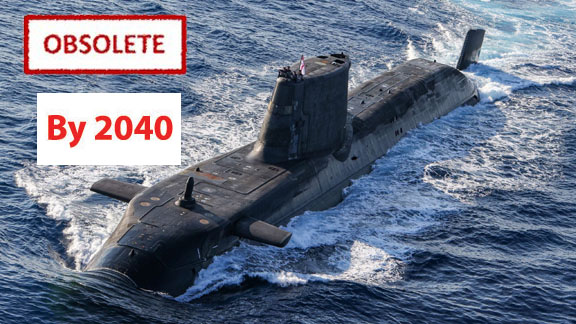
How many nuclear-powered submarines for Australia?
The Strategist, 12 Oct 2023|Peter Briggs
“………………………………………………………………………………..It takes three to four submarines to guarantee having one available for deployment. The ‘rule of three’ was validated by the Coles review, but that doesn’t include any spare capacity to cope with unexpected defects…………………………………………
Australia is planning on a three-year interval between delivery of submarines, driven by the time it will take to generate a crew from our small submarine personnel base and limited sea training capacity in operational Collins-class and US and UK submarines.
Construction time doesn’t determine the drumbeat for delivery; rather, construction starts in sufficient time to achieve the delivery drumbeat.
Three years is a slow drumbeat industrially. Shorter would be more efficient but is currently not feasible because of personnel limitations. The personnel training limitation should ease once Australia has at least six SSNs at sea. The drumbeat could then be shortened. A slow drumbeat is more expensive due to idle production but is also likely to contribute to a loss of skilled workers; witness the UK’s experience at Barrow in Furness because of the slow Astute drumbeat.
A construction program building eight submarines at a three-year drumbeat would take 21 years. Submarines typically have a hull life of 25–30 years. Thus, this production line would have nothing to build for four to nine years, and would then be then back into stop–start shipbuilding.
A force of 10 SSNs at a three-year drumbeat with a planned 27-year life is the minimum to provide a continuous-build program, avoiding the stop–start situation. A force of 12 could achieve a shorter drumbeat in the later stages when the personnel restrictions are not so severe.
Decisions on the final size of the force must be made now, at the program’s inception. They drive industrial issues such as the size of facilities, production-line technology, the supply chains supporting the force and the ordering of long lead items such as the reactor. The decision cannot responsibly be left for a future government.
My study of British, French and US submarine-crewing policies, summarised in my 2018 ASPI report, concluded that a force of 10 SSNs with 10 crews was essential to generate the minimum critical mass of experienced personnel. A smaller force will not generate sufficient highly experienced personnel to oversee the safe technical and operational aspects of the program. That calculation assumed one base and one submarine squadron. Two-ocean basing with an additional 200 highly experienced squadron staff, a key link in the operational and safety chain, would require at least 12 SSNs.
Britain’s Royal Navy has six or seven SSNs and four SSBNs operating from one base in a single squadron. Its personnel situation is dire. High wastage rates and shortfalls in many critical categories have reportedly necessitated drafting non-volunteers to submarine training and cannibalising parts and crew to get even one submarine to sea. At times, the RN is unable to achieve even one. Is that where Australia is heading?
The issues are undoubtedly more complex than simply the size of the force, but it reinforces the point that a force of eight SSNs requiring six to seven crews is below critical mass, vulnerable to personnel shortfalls, will struggle to sustain two SSNs deployed, and won’t be able to sustain two-ocean basing.
Even more problematic is whether Australia can achieve an operational, sustainable and deployable SSN capability from eight boats made up of a mix of Virginia and AUKUS designs. The mix of classes adds to the complexity, cost and risk because it entails two supply chains and differing major onboard equipment, spares, and training systems and simulators.
Australia requires at least 12 SSNs to sustain two-ocean basing with two deployable on each coast in the good times. A force of 18—nine on each coast—would be more resilient, reliably providing two deployable SSNs, with three available in the good times.
Eight is plainly insufficient on all counts.
Leaving the decision for a later government will mean greater expense and increase the risk that the program doesn’t produce the needed strategic capability, while stripping funds from other key defence capabilities. A lack of decision, along with Australia’s failure to join the AUKUS SSN initial design effort, indicates inadequate commitment.
A ‘damn the torpedoes’ transition to SSNs could leave us with no submarine capability.
If Australia is not prepared to, or cannot, invest the resources to achieve a viable SSN force, we are better off not continuing down this path.
AUTHOR
Peter Briggs is a retired submarine specialist and a past president of the Submarine Institute of Australia. https://www.aspistrategist.org.au/how-many-nuclear-powered-submarines-for-australia/
Israel’s vengeance will not make for a better world
Pearls and Irritations, By Richard Hill, Oct 14, 2023
The depressing, crushing spectacle of extreme violence and mayhem unleashed across Israel and Palestine over recent days is a reminder of the depths to which humanity can sink.
To see complex historical, cultural and geopolitical questions – let alone humanity and decency – reduced to a ceaseless cycle of hatred, death and destruction is hard to stomach. We gaze at our TV screens aghast, we hear the threats, counter-threats, and the endless justifications and commentary. Meanwhile, the bloodletting goes on – and on. Western politicians, weighed down with simple binaries, take sides and in so doing obliterate any sense of context or complexity that might help us understand how this mess occurred in the first place.
Projecting the colours of the Israeli flag across the Sydney Opera House, declaring unflagging support for a state that for decades has thumbed its nose at UN resolutions and violently oppressed a besieged and impoverished population, is morally abhorrent.
The attempt to erase such concerns over recent days has been startling. At this point, to call for some acknowledgment of the origins of the conflict is to court accusations of siding with terrorists. And yet, as US Secretary of State, Antony Blinken, arrives in Israel to demonstrate the US’s unwavering support, Israel is imposing an illegal blockade on Gaza (cutting of life-saving electricity and preventing passage of urgently needed medicines, food and other supplies) as bombs rein down with impunity on a narrow, congested strip of land occupied by 2.3 million people.
How can this be? Why has nuance been shed and historical memory so conveniently erased? Such abstractionism is of course continuing the egregious practice of labelling anyone who dares criticise Israel as antisemitic. This is absurd and ludicrous, and entirely misleading. In the meantime, we have the leader of the most extreme right-wing government in Israel’s history banging his fists together on TV urging extreme violence upon the people of Gaza. He urges them to flee to a checkpoint on the Egyptian border, knowing full well that it’s closed. So, in effect, the people in Gaza are trapped in a hellhole that day-by-day is being reduced to rubble. All this under the watch of the US, Britain and Australia.
Hamas’s attacks were horrific and utterly unacceptable; there’s no denying that. Many innocent people lost their lives, and the human suffering is unimaginable. But to then offer unwavering support to Israel, minus any mention of current and past wrongdoing, borders on the insane. It demonstrates a cruel, collective indifference. And Australia is complicit in this by implicitly endorsing the long-term suffering of Palestinians as Israeli government priority.
There are so many other ways western and other political leaders (including those in Israel) could have responded to a violent attack on innocent people. ……………………………………………..
It is worth remembering the words of former Norwegian Prime Minister, and new NATO Secretary General, Jens Stoltenberg who in the wake of the 2011 mass murder of 70 young people by right-wing gunman Anders Breivik said: “We are still shocked by what has happened, but will never give up our values…Our response is more democracy, more openness, and more humanity.” He vowed his country would not seek vengeance; “we will answer hatred with love”. In a later news conference, Stoltenberg added: “The message to whoever attacked us, the message from all of Norway is that you will not destroy us, you will not destroy our democracy and our ideals for a better world.” This better world does not include blind rage and vengeance, or continuing oppression and violence………………more https://johnmenadue.com/israels-vengeance-will-not-make-for-a-better-world/— #Israel
Israel Is Using Starvation as a Weapon of War Against the Palestinian People

Jewish Voice for Peace demanded “that the U.S. government immediately take steps to withdraw military funding to Israel and to hold the Israeli government accountable for its gross violations of human rights and war crimes against Palestinians.”
13 Oct 23
A full-scale ground offensive on Gaza is imminent, even as Palestinians are already suffering collective punishment.
By Marjorie Cohn / Truthout
After Hamas launched more than 2,000 missiles from Gaza and sent hundreds of fighters into Israel on October 7, killing hundreds of civilians, Prime Minister Benjamin Netanyahu declared war on Hamas. But Israel’s retaliation, including massive bombing from the land, air and sea, and its collective punishment of Gazans — denying them food, water, electricity and gas — reveals that Netanyahu has actually declared war on the Palestinian people, especially those in Gaza.
Israeli warplanes are conducting indiscriminate bombings throughout Gaza, targeting homes, schools, hospitals, mosques and civilian buildings. As of October 10, Israel had reportedly used 1,000 tons of explosives and targeted 500 locations, primarily in civilian residential areas.
“The quantity of injured people arriving to our hospitals is huge and will mean we will not be able to accept more patients in Gaza,” Ashraf Al-Qidra, spokesperson for the Gaza Ministry of Health, told PBS. “I send water to those who have had their houses demolished. All those who have been displaced don’t have anything. All they have is suffering, fear and horror,” Ahmed Youssef Mekhimar, a resident of Gaza, said. Shames Ouda told PBS, “This power station served all Gaza Strip, and now is turned off, Gaza without fuel, without electricity, without Internet, without food. Gaza dying. The people will pay the price of this war.”
A full-scale Israeli ground offensive on Gaza is reportedly imminent, with 360,000 Israeli Occupying Force reserve troops poised to invade. In 2014, Israeli forces bombed and invaded Gaza, killing 2,251 Palestinians, most of them civilians, in “Operation Protective Edge.”
Netanyahu warned Gazans to “leave now” as Israeli forces would “act with all force.” But the people in Gaza cannot leave. Except for one border crossing with Egypt, Israel controls all ingress and egress into the Gaza Strip. As of October 11, Israel has bombed the Egyptian border crossing twice, and Egypt has refused to allow refugees through.
More than 1,200 Israelis and 1,354 Palestinians have been reported killed and thousands wounded on both sides. Israel said that additionally 1,500 bodies of Hamas members have been found inside Israel.
In the face of the tragic deaths of Palestinian and Israeli civilians, President Joe Biden issued a statement saying the United States “unequivocally condemns this appalling assault against Israel by Hamas terrorists from Gaza,” and pledged “all appropriate means of support” to Netanyahu. He did not decry the loss of Palestinian lives.
Biden called Hamas’s attack “pure, unadulterated evil” in an October 10 news conference. But he refused to urge Israel to exercise restraint in its retaliation against the Palestinians.
U.S. Secretary of Defense Lloyd Austin said in a statement that U.S. Navy vessels, including an aircraft carrier and a guided missile cruiser, had been sent to the Eastern Mediterranean……………………………………….
under international law, Israel, an occupying force, does not have the right to use military force in self-defense against people under its occupation.
Targeting civilians and civilian objects constitute war crimes under the Fourth Geneva Convention and the Rome Statute for the International Criminal Court, whether committed by Israel or by the Palestinians. The presence of noncivilians within civilian populations does not deprive the population of its civilian character under Additional Protocol I to the Geneva Convention………………..
Even if some of the actions taken by the Palestinians in their resistance are illegal under international humanitarian law, there is no legal justification for Israel to claim it is acting in self-defense under the UN Charter.
Collective Punishment and Using Starvation as a Weapon Are War Crimes
Gaza is one of the most densely populated areas in the world. Often called the largest open-air prison on Earth, the Gaza Strip is home to more than 2 million Palestinians in this 365-square-kilometer area. Israel controls Gaza’s land, air and maritime borders.
Israel’s Minister for the Advancement of the Status of Women May Golan said at a meeting of the Israeli government, “All of Gaza’s infrastructures must be destroyed to its foundation and their electricity cut off immediately. The war is not against Hamas but against the state of Gaza.”
Israel has imposed a “complete siege” on the Gaza Strip. Israeli Defense Minister Yoav Gallant declared, “No electricity, no food, no water, no gas — it’s all closed,” adding that “we are fighting animals and are acting accordingly.”
Using starvation as a weapon of war constitutes a war crime under Additional Protocol I to the Geneva Convention. Gallant’s order is a crime against humanity under the Rome Statute. It is also a call for genocide, prohibited by the Genocide Convention and the Rome Statute, since many Gazans will die as a result of the siege.
The Fourth Geneva Convention prohibits the punishment of people in an occupied territory for offenses they didn’t personally commit. Israel’s reprisals against civilians for actions they did not take constitutes collective punishment, which amounts to a war crime.
Earlier this year, the International People’s Tribunal on U.S. Imperialism, for which I served as a juror, examined 15 countries in the Global South to assess the impact of economic coercive measures on the lives of their people. In May, we heard testimony from witnesses in Gaza as Israeli bombs were dropping on their neighborhoods. The tribunal concluded that Israel’s siege in the Gaza Strip is a form of warfare used as “an integral tool of imperialist aggression designed to facilitate the theft of global south wealth and uphold racial hierarchy.” The siege on Gaza is “just as deadly” as other forms of warfare, the tribunal found.
Root Cause of Hamas Attack Was “Cruelty of a Half-Century of Abusive Occupation”
“Although the Hamas attack included war crimes against innocent civilians, its root cause was the cruelty of a half-century of abusive occupation by Israel that violated the most basic human rights of the Palestinian people, and relied on apartheid practices of governance, according to reports by the leading human rights organizations in the U.S. and Israel,” Richard Falk, former UN Special Rapporteur on the Situation of Human Rights in the Palestinian Territories Occupied Since 1967, told Truthout.
Falk attributes the timing of Hamas’s attack to “the extremism of the Netanyahu coalition government” that “provoked resistance by its complicity with settler violence and violations of the Al-Aqsa Mosque Compound, and by erasing Palestine from its official maps of the Middle East and negotiating a normalization agreement with Saudi Arabia.” Falk called the Hamas attack “a shrill reminder to Israel and the world that ‘we Palestinians are still here and will not be erased and forgotten.’”
In an October 8 statement, Palestinian human rights organizations cited “compelling evidence” that the Israeli authorities had committed war crimes and crimes against humanity against Gaza’s civilian population, including illegal indiscriminate and disproportionate attacks. They urged the international community, including the UN Security Council, to take immediate action to stop Israel’s revenge and reprisal against Gazan civilians, including the imposition of sanctions and an arms embargo on Israel. They also called on the International Criminal Court (ICC) to expedite its pending investigation into the situation in Palestine as promised in December 2022. The ICC launched an investigation in 2021 of possible war crimes and crimes against humanity committed by both Israel and the Palestinians, but the probe has stalled due to pressure from the U.S. government.
The Security Council, which has an obligation under the UN Charter to restore international peace and security, has done nothing to stop the carnage because its permanent members cannot agree on a course of action. While the U.S. demanded a blanket condemnation of Hamas’s actions, Russia and China refused to agree to the unilateral denunciation of Hamas; they favored calling for an immediate ceasefire and the beginning of a peace process that has been frozen for years.
“The bloodshed of today and the past 75 years traces back directly to U.S. complicity in the oppression and horror caused by Israel’s military occupation,” Jewish Voice for Peace said in an October 7 statement titled “The Root of Violence is Oppression.” Jewish Voice for Peace blamed the U.S. government which “consistently enables Israeli violence and bears blame for this moment. The unchecked military funding, diplomatic cover, and billions of dollars of private money flowing from the U.S. enables and empowers Israel’s apartheid regime.” Moreover, Jewish Voice for Peace noted, “Those who continue calling for ‘ironclad’ U.S. support for the Israeli military are only paving the path to more violence.”
Jewish Voice for Peace demanded “that the U.S. government immediately take steps to withdraw military funding to Israel and to hold the Israeli government accountable for its gross violations of human rights and war crimes against Palestinians.”
U.S. congressmembers Rashida Tlaib (D-Michigan) and Cori Bush (D-Missouri) have called for an end to the U.S. government’s unconditional financial support of Israel’s military occupation and apartheid government. The United States has been providing Israel with $3.8 billion a year in military assistance.
While Western countries and their media decry the loss of Israeli lives, they don’t express similar outrage at the deaths of Palestinians. This hypocrisy is racist and ignores the context of decades of settler colonialism and Israeli apartheid.
We must pressure the U.S. government to call for an immediate ceasefire and stop sending weapons to Israel. “There is no military solution here,” Phyllis Bennis, a fellow at the Institute for Policy Studies, told my cohost Heidi Boghosian and me on Law and Disorder radio.
The consequences of allowing Israel to continue and escalate its aggression against the Palestinian people are unimaginable. https://scheerpost.com/2023/10/13/israel-is-using-starvation-as-a-weapon-of-war-against-the-palestinian-people/
US weapons costs way beyond $886billion: call for nuclear weapons spending blowout -USA congressional commission.

The commission notes in its report that while it “did not conduct a cost analysis of our recommendations, it is obvious they will cost money.”
A July Congressional Budget Office report projects that nuclear modernization efforts will cost $756 billion over the next decade, and that excludes costs for the additional nuclear initiatives the commission would like the U.S. to pursue.
Congressional commission calls for more nuclear arsenal expansion
Defense News, By Bryant Harris, Oct 13, 2023
WASHINGTON ― A congressionally mandated commission on Thursday released its final report on the U.S. nuclear posture, recommending an increase in additional assets as China rapidly expands its own arsenal.
At the same time, the commission found the Pentagon and Energy Department are lagging behind their modernization goals, raising questions about the ability to develop additional nuclear assets.
Republicans seized on the report to call for more aggressive nuclear modernization, including additional investments in an industrial base that’s struggling to keep pace with the tight timelines needed to implement current strategic objectives………………………
Sen. Roger Wicker of Mississippi, the top Republican on the Armed Services Committee reiterated his calls for a defense supplemental spending package to bypass the $886 billion security funding caps laid out in the May debt ceiling agreement while growing the military budget annually beyond inflation……………………………………….
The commission notes in its report that while it “did not conduct a cost analysis of our recommendations, it is obvious they will cost money.”
A July Congressional Budget Office report projects that nuclear modernization efforts will cost $756 billion over the next decade, and that excludes costs for the additional nuclear initiatives the commission would like the U.S. to pursue.
Specifically, the commission calls for “additional U.S. theater nuclear capabilities” in Europe and the Indo-Pacific, modernizing nuclear command and control capabilities and effectively employing emerging technology including hypersonics, quantum computing, generative AI and autonomous vehicles.
It also calls for plans to “re-convert” submarine-launched ballistic missile launchers and B-52 bombers that were rendered unable to deliver nuclear payloads under the New START treaty. Russia suspended its participation in that treaty, its last remaining nuclear arms control accord with Washington, last year. Moscow has also threatened to pull out of the Comprehensive Nuclear Test Ban Treaty, though it says it will only resume testing if the U.S. does. The U.S. Senate has never ratified the test ban treaty.
Additionally, the commission calls for uploading “some or all of the” unemployed warheads in U.S. inventory, deploying additional Sentinel Intercontinental Ballistic Missiles and long-range standoff weapons, increasing the planned number of B-21 bombers and upping the planned production of the Columbia-class ballistic missile submarines………………………………………….
the commission says the Defense Department should “establish or renovate a third shipyard dedicated to production of nuclear-powered vessels, with particular emphasis on nuclear-powered submarines.”
Wicker has held up key authorizations needed to implement AUKUS, demanding the Biden administration and Congress put more money into the submarine industrial base. The two authorizations Wicker is holding up would permit the transfer of two Virginia-class submarines to Australia and allow the Defense Department to accept Canberra’s $3 billion contribution in the submarine industrial base. https://www.defensenews.com/congress/2023/10/12/congressional-commission-calls-for-more-nuclear-arsenal-expansion/ #nuclear #antinuclear #NuclearFree #NoNukes #NuclearPlants
US bails on Ukraine…but doesn’t tell Zelensky

Walt Zlotow, West Suburban Peace Coalition, Glen Ellyn IL 13 Oct 23
In an astonishing statement at a press briefing Wednesday, National Security Department spokesperson John Kirby admitted the US is running out of interest in weaponizing Ukraine for the long term. Since Ukraine is on US life support to continue fighting their lost cause to recapture Crimea, Donbas and join NATO, it’s clear ‘game over’ for Ukraine looms.
“I think in the immediate term, right now, we can continue to support Ukraine – with the authorities in the appropriations we have. But, you know, we’re … certainly running out of runway.”
Kirby then shifted from the runway metaphor to one even starker. “The US administration had the means to support Ukraine in the near term. But you don’t want to be trying to bake in long-term support when you’re at the end of the rope,” And on the Ukraine funding, we’re coming near to the end of the rope. I mean, today we announced $200 million, and we’ll keep that aid going as long as we can, but it’s not going to be indefinite”
Is Ukraine President Zelensky listening to Kirby’s ominous warning? If he had an iota of understanding of Ukraine’s rapidly deteriorating plight, he’d immediately partner with responsible countries such as Turkey to initiate negotiations with Russia to end the war. He did that 18 months ago, Marcy 31-April 1, 2022, inking a tentative deal with Russia to end the war without losing any territory in Donbas, albeit giving Donbas regional autonomy under Ukraine sovereignty. The agreement would also have ended Ukraine’s self-destructive NATO aspirations.
To sum up: The US provoked the war by championing Ukraine NATO membership and weaponizing their civil war that killed thousands in Donbas. When Russia invaded to prevent both, the US sabotaged every effort to end the war quickly and peaceably, prolonging it with $113 billion in weapons and other aid. Result? Hundreds of thousands of dead Ukrainians with no chance of victory.
It’s not just the US that is “certainly running out of runway” and “coming near to the end of the rope.” The US is moving on to enabling and supplying the ongoing destruction of Gaza. No more runway and no more rope are much more appropriate to the former comedian staring in ‘Tragedy in Ukraine.’ #Ukraine #nuclear #antinuclear #NuclearFree #NoNukes #NuclearPlants
1 This month


Help Aunty Sue Protect Her Land and Sacred Sites From Destructive Rocket Testing.
.

Australians deserve the truth
about
AUKUS – https://aukuspublicinquiry.com/

PETITION – To: Prime Minister Anthony Albanese and the Australian Labor Government

of the week – Australians for War Powers Reform (AWPR)
To see nuclear-related stories in greater depth and intensity

