No charges or fines for Western Australia’s wayward radioactive capsule
Perth Now, Neve Brissenden, AAP, October 12, 2023
An investigation into the disappearance of a potentially deadly radioactive mining capsule in outback Western Australia has concluded with no charges or fines laid.
The item, measuring 8mm by 6mm, fell out of a density gauge while being trucked from a Rio Tinto mine in the Pilbara region to Perth in January.
Search crews spent six days scouring a 1400km route amid warnings the caesium-137 in the capsule could cause radiation burns or sickness if handled, and potentially dangerous levels of radiation from prolonged exposure.
The capsule was eventually found two metres from the Great Northern Highway by specialist equipment designed to pick up emitted radiation.
The truck arrived in the Perth suburb of Malaga on January 16 but it was not until nine days later that a technician realised the capsule was missing.
-ADVERTISEMENT-
The missing capsule sparked international headlines and national media coverage in addition to widespread interest in WA.
An investigation by WA’s Radiological Council found no charges or fines should be laid………………………
“Recommendations have been made about areas for improvement in gauge design and assessment and in transport of radioactive sources in WA,” the council’s chair Andrew Robertson said.
Under the Radiation Safety Act, the council said it could not release details of the investigation to “maintain security and public safety”.
“The incident was a rare event which has implications for other radiation safety bodies,” Dr Robertson said.
The Department of Health said it was sharing the findings with other jurisdictions to ensure the incident did not happen elsewhere.
Under WA laws, the maximum fine for failing to safely store or transport radioactive material is $1000.
In February, WA Health Minister Amber-Jade Sanderson said the government was looking at increasing the outdated and “unacceptably low” penalty……………………………………………. more https://www.perthnow.com.au/business/mining/no-charges-or-fines-for-was-wayward-radioactive-pill-c-12183902
An Israeli lawmaker is urging her government to use ‘everything in its arsenal,’ including ‘doomsday’ weapons, against Hamas

Kwan Wei Kevin Tan , Oct 11, 2023
- An Israeli lawmaker says Israel should use nuclear weapons against Hamas.
- Revital “Tally” Gotliv wrote on X that she thinks it is time to fire “powerful missiles without limit.”
- Benjamin Netanyahu previously said Hamas “will pay a price it has never known before” for its attacks.
An Israeli lawmaker has urged her government to consider using nuclear weapons in their war against Hamas.
“Jericho missile! Jericho missile! A strategic alert, before we consider introducing our forces. A doomsday weapon!” Revital “Tally” Gotliv, a member of the Israeli parliament, wrote in a post on X on Monday. “This is my opinion. May God preserve all our strength.”
Gotliv’s post — which had been viewed over 2.1 million times at press time — referenced Israel’s Jericho ballistic missiles. Israel’s government has neither confirmed nor denied the existence of its nuclear arsenal.
The lawmaker said in a subsequent post on Tuesday that Israel needs to be merciless when dealing with the Palestinian militant group.
“Only an explosion that shakes the Middle East will restore this country’s dignity, strength, and security! It’s time to kiss doomsday,” Gotliv wrote in her post on X.
“Shooting powerful missiles without limit. Not flattening a neighborhood. Crushing and flattening Gaza,” she continued. “Otherwise, we would have done nothing. Not with passwords, with penetrating bombs. Without mercy! Without mercy!”
Gotliv’s follow-up post received over 250,000 views as of press time. The post was, at press time, tagged with a disclaimer from X, stating that its visibility had been limited because it “may violate X’s rules against Violent Speech.” ……………………………
Netanyahu said on Saturday that Hamas “will pay a price it has never known before” for its attacks. And yesterday, the Israel Defense Forces launched over 200 airstrikes on Gaza. more https://www.businessinsider.com/israeli-lawmaker-urged-government-to-use-nuclear-weapons-against-hamas-2023-10?r=US&IR=T&fbclid=IwAR23dypzT9Ijw99QoAJpr2-WwBSNj-zfJzbivYSy4UnyF2tfwnVR1XX_hpw #Israel #nuclear #antinuclear #NuclearFree #NoNukes #NuclearPlants
Fukushima Up Close, 13 Years Later

After thirteen years, the declaration of a State of Emergency for Fukushima Daiichi Nuclear Power Plant still cannot be lifted because of many unknowns, as well as ubiquitous deadly radiation levels.

The spent fuel rods at the Fukushima nuclear reactor site are stored in pools of water on the top floor of compromised reactor buildings 100 feet above ground level……… “Continual storage in spent fuel pools is the most unsafe thing you could do.”
Fukushima Daichi Nuclear Power Plant will remain a high-risk explosive scenario for decades ahead.
CounterPunch BY ROBERT HUNZIKER 13 Oct 23
The world is turning to nuclear power as a solution to global warming, but it is postulated herein that it is a huge mistake that endangers society. One nuclear meltdown causes as much damage over the long-term as a major war. Moreover, according to Dr. Paul Dorfman, chair of the Nuclear Consulting Group, former secretary to the UK Scientific Advisory Committee on Internal Radiation: “It’s important to understand that nuclear is very likely to be a significant climate casualty.”
Also, of interest: France’s Global Warming Predicament discusses nuclear energy’s vulnerability in a global warming world.
Beyond Nuclear International recently published an article about the status of Fukushima as well as an exposé of how the nuclear industry gets away with responsibility for radiation-caused (1) deaths (2) chronic conditions like cancer (3) genetic deformities: A Strategy of Concealment, September 24, 2023, by Kolin Kobayashi, who is a Tokyo-born France-based anti-nuclear activist journalist also serving as president of Echo-Exchange. Kobayashi’s work was posted by CounterPunch under the title: How Agencies That Promote Nuclear Power Are Quietly Managing Its Disaster Narrative.
The following synopsis, including editorial license that adds important death details which defy the nuclear industry’s bogus claims about nuclear safety, opens closed pathways to what’s really going on.
After thirteen years, the declaration of a State of Emergency for Fukushima Daiichi Nuclear Power Plant still cannot be lifted because of many unknowns, as well as ubiquitous deadly radiation levels. The destroyed reactors are tinderboxes of highly radioactive spent fuel rods that contain more cesium-137 than eighty-five (85) Chernobyls. Cesium-137 in or near a human body erupts into a series of maladies, one after another in short order, depending upon level of exposure: (1) nausea (2) vomiting (3) diarrhea (4) bleeding (5) coma leading to death.
The spent fuel rods at the Fukushima nuclear reactor site are stored in pools of water on the top floor of compromised reactor buildings 100 feet above ground level, except for Unit 3 which completed removal of its spent fuel rods in 2019, an extremely slow, laborious process that’s highly dangerous.
Stored spent fuel rods in open pools of water are the epitome of high-risk. “If the 440 tonne vessel collapses, it could hit the storage pool next to it. If this pool is damaged, even partially, another major disaster could occur.” (Kobayashi) In that regard, there’s significant risk of collapse in the event of a strong earthquake. And Japan is one of the most earthquake prone countries in the world. “The city (Tokyo) government’s experts reckon there is a 70% chance of a magnitude 7, or higher, quake hitting the capital within the next 30 years.” (Source: Japan is Preparing for a Massive Earthquake, The Economist, August 31, 2023)
If exposed to open air, spent fuel rods erupt into a sizzling zirconium fire followed by massive radiation bursts of the most toxic material on the planet. It can upend an entire countryside and force evacuation of major cities. According to the widely recognized nuclear expert Paul Blanch: “Continual storage in spent fuel pools is the most unsafe thing you could do.” Paul Blanch, registered professional engineer, US Navy Reactor Operator & Instructor with 55 years of experience with nuclear engineering and regulatory agencies, is widely recognized as one of America’s leading experts on nuclear power.
Fukushima Daichi Nuclear Power Plant will remain a high-risk explosive scenario for decades ahead. After all, a program for future decommissioning is unclear and overall radiation guesstimates are formidable. All the structures where decommissioning will take place are highly radioactive and as such nearly impossible for the dangers to worker exposure.
TEPCO (Tokyo Electric Power Company) does not yet know the true extent of damage nor the complete dispersion of corium (molten magma from melted nuclear fuel rods in the core of the reactors). ……………………………………………………………………………..
Radiation Risks to Society
According to the World Nuclear Association, there were no fatalities due to radiation exposure at Fukushima. And as recently as 2021, Forbes magazine reported No one Died From Radiation At Fukushima: IAEA Boss. It is believed this is a lie and part of a massive coverup.
a lie and part of a massive coverup.
According to Green Cross (founded in 1993 by Mikhail Gorbachev, who repeatedly spoke out about interrelated threats humanity and our Earth confront from nuclear arms, chemical weapons, unsustainable development, and the human-induced decimation of the planet’s ecology): “Approximately 32 million people in Japan are affected by the radioactive fallout from the nuclear disaster in Fukushima… This includes people who were exposed to radiation and other stress factors resulting from the accident and who are consequently at potential risk from both long and short-term consequences… As with the Chernobyl nuclear accident, which impacted 10 million people, Japan is expected to see increased cancer risk and neuropsychological long-term health consequences.”
With nuclear radiation, the damage to humans shows up years later as cancer and/or deformity of newborns second/third generation. For example, only recently, the truth has come to surface about Chernobyl-related deaths, child deformities, and cancer 30+ years after the event. ………………………………………………………………
According to an article in USA Today d/d February 24, 2022, What Happened at Chernobyl? What to Know About Nuclear Disaster: “At least 28 people were killed by the disaster, but thousands more have died from cancer as a result of radiation that spread after the explosion and fire. The effects of radiation on the environment and humans is still being studied.”
According to Chernobyl Children International, 6,000 newborns are born every year in Ukraine with congenital heart defects called “Chernobyl Heart.”
…………………………………. The Fukushima Report was prepared under the direction of Prof. Jonathan M. Samet, Director of the Institute for Global Health at the University of Southern California (USC), as a Green Cross initiative. Green Cross International: GCI is an independent non-profit and nongovernmental organization founded in 1993 by Nobel Peace Laureate Mikhail Gorbachev.
Over time, Japan is expected to see increased cancer risks and neuropsychological long-term health consequences. “The lives of approximately 42 million people have been permanently affected by radioactive contamination caused by the accidents in the Chernobyl and Fukushima Daiichi nuclear power plants. Continued exposure to low-level radiation, entering the human body on a daily basis through food intake, is of particular consequence,”
Fukushima Deaths
The cocksure pro-nuclear crowd has trumpeted Fukushima as an example of Mother Nature taking lives because of an earthquake and tsunami; whereas the power plant accident proves nuclear power can withstand the worst without unnecessary death and illness. According to nuclear industry reports, all the deaths (16,000) were the fault of Mother Nature, not radiation.
But people in the streets and on the ground in Japan tell a different story about the risks of radiation. They talk about illnesses and death. TEPCO itself has reported few radiation illnesses and no radiation-caused deaths but what if it’s not their responsibility in the first instance, as layers of contractors and subcontractors employ workers to cleanup the toxic mess. If “subcontractor workers die” from radiation exposure, so what? It’s not TEPCO’s responsibility to report worker deaths of subcontractors, and the subcontractors are not motivated to report deaths, which are not reported.
According to credible sources in Japan, death is in the air, to wit: “The ashes of half a dozen unidentified laborers ended up at a Buddhist temple in this town just north of the crippled Fukushima nuclear plant. Some of the dead men had no papers, others left no emergency contacts. Their names could not be confirmed, and no family members had been tracked down to claim their remains. They were simply labeled ‘decontamination troops’ — unknown soldiers in Japan’s massive cleanup campaign to make Fukushima livable again five years after radiation poisoned the fertile countryside… Hideaki Kinoshita, a Buddhist monk… keeps the unidentified laborers’ ashes at his temple, in wooden boxes and wrapped in white cloth.” (Source: Mari Yamaguchi, Fukushima ‘Decontamination Troops’ Often Exploited, Shunned, AP & ABC News, Minamisoma, Japan, Mar 10, 2016)
……………………………………………………………………………………….Alas, two hundred U.S. sailors of the USS Ronald Reagan filed a lawsuit against TEPCO, claiming that they experienced leukemia, ulcers, gall bladder removals, brain cancer, brain tumors, testicular cancer, dysfunctional uterine bleeding, thyroid illness, stomach ailments and other complaints extremely unusual in such young adults. One sailor died from radiation complications. Among the plaintiffs was a sailor who was pregnant during the mission. Her baby was born with multiple genetic mutations.
The sailors that filed the suit participated in “Operation Tomodachi,” providing humanitarian relief after the March 11th, 2011 Fukushima disaster based upon assurances that radiation levels were okay. But that was a lie.
Ultimately, and unsurprisingly, the 9th U.S. Circuit Court of Appeals rejected the sailors’ appeal.
In summation, the final word is left to Kolin Kobaryashi: “The international nuclear lobby, which represents only a minority, has the influence and money to dominate the world’s population with immense power and has now united the world’s minority nuclear community into one big galaxy.
Many of the citizens who have experienced the world’s three most serious civil nuclear accidents have clearly realized that nuclear energy is too dangerous. These citizens are so divided and conflicted that they feel like a helpless minority.”…………………….
“Five former Japanese prime ministers issued declarations that Japan should break with nuclear power generation on March 11, the 10th anniversary of the Great East Japan Earthquake and tsunami that triggered a nuclear disaster in Fukushima Prefecture (Source: Ex-Prime Ministers Koizumi and Kan Demand EU Choose Zero Nuclear Power Path, The Japan Times, Jan. 27, 2022)………………………………………..more https://www.counterpunch.org/2023/10/13/fukushima-up-close-13-years-later/
France uses teargas on banned pro-Palestinian rally
By Layli Foroudi and Michel Rose, October 13, 20233
PARIS, Oct 12 (Reuters) – French police used teargas and water cannon to break up a banned rally in support of the Palestinian people in Paris on Thursday, as President Emmanuel Macron urged the French to remain united and refrain from bringing the Israel-Hamas conflict home.
Macron’s interior minister had earlier banned pro-Palestinian protests, saying they were “likely to generate disturbances to public order”.
France is home to Europe’s largest Muslim and Jewish communities. The Middle East conflict has often stoked domestic tensions in the past.
“This event is an earthquake for Israel, the Middle East and beyond,” Macron said in a solemn TV address. “Let’s not pursue at home ideological adventures by imitating or projecting.”
“Let’s not add, through illusions or calculations, domestic divides to international divides,” he said. “The shield of unity will protect us from hatred and excesses.”
Macron said the government had acted to boost police protection of Jewish sites, including schools and synagogues, and that there could be no justification for atrocities……………..
BANNED RALLY
Despite the ban, several hundred pro-Palestinian demonstrators gathered in central Paris in separate groups that police forces sought to keep from merging……….
“We live in a country of civil law, a country where we have the right to take a stand and to demonstrate. (It is unfair) to forbid for one side and to authorise for the other,” said Charlotte Vautier, 29, an employee at a non-profit who took part in the rally…………….
Two pro-Palestinian demonstrations in Paris had already been banned on Thursday for fear of outbursts when interior minister Gerald Darmanin told prefects to ban all pro-Palestinian demonstrations across the country…………more https://www.reuters.com/world/europe/france-bans-pro-palestinian-protests-citing-risk-disturbances-public-order-2023-10-12/
The US Is Just As Culpable As Israel For The Atrocities Committed In Gaza

The primary job of Israel apologists in the coming days will be producing and circulating narratives explaining why this self-evidently terrible thing is actually perfectly fine and acceptable.
And top-down commands are being issued within the US government to support this massacre unconditionally.

So be perfectly clear, the US government is fully behind this massacre, and is just as culpable for everything that happens in Gaza as the Israeli government.
These abuses are being perpetrated using US weapons, US funding and US consent.
Washington could end this mass atrocity with a word, and instead they’re fully aligning themselves behind it. Israel’s crimes in Gaza are not meaningfully separate from the crimes of the US war machine.
Caitlin’s newsletter CAITLIN JOHNSTONE, , OCT 14, 2023
The Israeli government dropped thousands of leaflets on Gaza telling everyone who lives in the northern part of the strip that they have 24 hours to evacuate to the southern part, and then bombed the people who were trying to evacuate.
United Nations spokesman Stephane Dujarric denounced the evacuation order, saying the UN “considers it impossible for such a movement to take place without devastating humanitarian consequences.” Many Palestinians have said they’re going to stay where they are because they have nowhere safe to go, despite being told by Israel they must leave if they want to “save their lives”.
We’re about to see the death and destruction get much, much worse in Gaza, and it’s already very, very bad. As of this writing the official death toll from Israeli airstrikes in Gaza is speeding past 1,900, a number which includes 614 children. The primary job of Israel apologists in the coming days will be producing and circulating narratives explaining why this self-evidently terrible thing is actually perfectly fine and acceptable.
It’s so incredibly obvious what we’re looking at here. The only thing putting a wobble on people’s perception is the immense amount of propaganda distortion the media is churning out on this issue, plus the fact that the demographics look a bit different from what history has conditioned people to watch out for. If there were two million Jewish people trapped by Christians in a giant concentration camp and placed under total siege, being told that half of them had 24 hours to relocate into the other half or be killed, nobody would have any confusion about what they were witnessing.
And top-down commands are being issued within the US government to support this massacre unconditionally.
The Huffington Post reports that the State Department has been circulating internal emails telling staff to avoid calls for peace, instructing them to refrain from using phrases like “de-escalation/ceasefire,” “end to violence/bloodshed” and “restoring calm.”
Asked about progressive congressional members calling for a ceasefire, White House press secretary Karine Jean-Pierre said, “we believe they are wrong, we believe they’re repugnant, and we believe they’re disgraceful.”
On the question of whether there are any potential Israeli actions that the White House would not tolerate, US national security adviser Jake Sullivan told reporters “I’m not here to draw red lines or issue warnings or give lectures to anybody.”
So be perfectly clear, the US government is fully behind this massacre, and is just as culpable for everything that happens in Gaza as the Israeli government. These abuses are being perpetrated using US weapons, US funding and US consent. Washington could end this mass atrocity with a word, and instead they’re fully aligning themselves behind it. Israel’s crimes in Gaza are not meaningfully separate from the crimes of the US war machine.
This is just a continuation and extension of the violence and bloodshed the US government has been inflicting around the world for generations. There’s a clip of George W Bush going around from a California event on Tuesday in which, for some bizarre, unfathomable reason, the former president was asked to provide his opinion on what Israel should do in response to the Hamas attack on October 7.
Bush said pretty much what you’d expect him to say: “You’re dealing with cold-blooded killers,” “negotiating with killers is not an option,” “one side is guilty.” The same book he’s been reciting from since September 11, 2001. What I find much more interesting is, why is anyone asking the absolute worst person you could possibly ask about what should be done in response to such an attack………………………………..
the United States never learned any moral lessons from its warmongering after 9/11 — if it had, George W Bush would be sitting in a prison cell, and the US wouldn’t be backing a mass atrocity in Gaza………. https://www.caitlinjohnst.one/p/the-us-is-just-as-culpable-as-israel?utm_source=post-email-title&publication_id=82124&post_id=137943417&utm_campaign=email-post-title&isFreemail=true&r=1ise1&utm_medium=email #Israel
Australia might be better off to cancel the nuclear submarine plan’
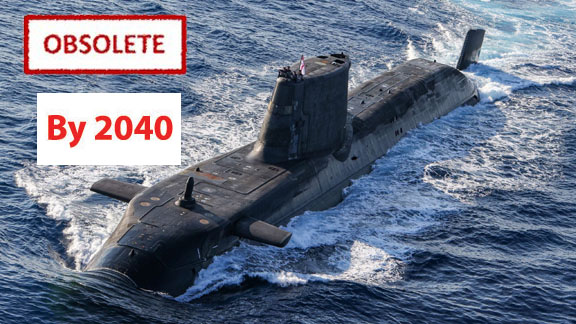
How many nuclear-powered submarines for Australia?
The Strategist, 12 Oct 2023|Peter Briggs
“………………………………………………………………………………..It takes three to four submarines to guarantee having one available for deployment. The ‘rule of three’ was validated by the Coles review, but that doesn’t include any spare capacity to cope with unexpected defects…………………………………………
Australia is planning on a three-year interval between delivery of submarines, driven by the time it will take to generate a crew from our small submarine personnel base and limited sea training capacity in operational Collins-class and US and UK submarines.
Construction time doesn’t determine the drumbeat for delivery; rather, construction starts in sufficient time to achieve the delivery drumbeat.
Three years is a slow drumbeat industrially. Shorter would be more efficient but is currently not feasible because of personnel limitations. The personnel training limitation should ease once Australia has at least six SSNs at sea. The drumbeat could then be shortened. A slow drumbeat is more expensive due to idle production but is also likely to contribute to a loss of skilled workers; witness the UK’s experience at Barrow in Furness because of the slow Astute drumbeat.
A construction program building eight submarines at a three-year drumbeat would take 21 years. Submarines typically have a hull life of 25–30 years. Thus, this production line would have nothing to build for four to nine years, and would then be then back into stop–start shipbuilding.
A force of 10 SSNs at a three-year drumbeat with a planned 27-year life is the minimum to provide a continuous-build program, avoiding the stop–start situation. A force of 12 could achieve a shorter drumbeat in the later stages when the personnel restrictions are not so severe.
Decisions on the final size of the force must be made now, at the program’s inception. They drive industrial issues such as the size of facilities, production-line technology, the supply chains supporting the force and the ordering of long lead items such as the reactor. The decision cannot responsibly be left for a future government.
My study of British, French and US submarine-crewing policies, summarised in my 2018 ASPI report, concluded that a force of 10 SSNs with 10 crews was essential to generate the minimum critical mass of experienced personnel. A smaller force will not generate sufficient highly experienced personnel to oversee the safe technical and operational aspects of the program. That calculation assumed one base and one submarine squadron. Two-ocean basing with an additional 200 highly experienced squadron staff, a key link in the operational and safety chain, would require at least 12 SSNs.
Britain’s Royal Navy has six or seven SSNs and four SSBNs operating from one base in a single squadron. Its personnel situation is dire. High wastage rates and shortfalls in many critical categories have reportedly necessitated drafting non-volunteers to submarine training and cannibalising parts and crew to get even one submarine to sea. At times, the RN is unable to achieve even one. Is that where Australia is heading?
The issues are undoubtedly more complex than simply the size of the force, but it reinforces the point that a force of eight SSNs requiring six to seven crews is below critical mass, vulnerable to personnel shortfalls, will struggle to sustain two SSNs deployed, and won’t be able to sustain two-ocean basing.
Even more problematic is whether Australia can achieve an operational, sustainable and deployable SSN capability from eight boats made up of a mix of Virginia and AUKUS designs. The mix of classes adds to the complexity, cost and risk because it entails two supply chains and differing major onboard equipment, spares, and training systems and simulators.
Australia requires at least 12 SSNs to sustain two-ocean basing with two deployable on each coast in the good times. A force of 18—nine on each coast—would be more resilient, reliably providing two deployable SSNs, with three available in the good times.
Eight is plainly insufficient on all counts.
Leaving the decision for a later government will mean greater expense and increase the risk that the program doesn’t produce the needed strategic capability, while stripping funds from other key defence capabilities. A lack of decision, along with Australia’s failure to join the AUKUS SSN initial design effort, indicates inadequate commitment.
A ‘damn the torpedoes’ transition to SSNs could leave us with no submarine capability.
If Australia is not prepared to, or cannot, invest the resources to achieve a viable SSN force, we are better off not continuing down this path.
AUTHOR
Peter Briggs is a retired submarine specialist and a past president of the Submarine Institute of Australia. https://www.aspistrategist.org.au/how-many-nuclear-powered-submarines-for-australia/
Israel’s vengeance will not make for a better world
Pearls and Irritations, By Richard Hill, Oct 14, 2023
The depressing, crushing spectacle of extreme violence and mayhem unleashed across Israel and Palestine over recent days is a reminder of the depths to which humanity can sink.
To see complex historical, cultural and geopolitical questions – let alone humanity and decency – reduced to a ceaseless cycle of hatred, death and destruction is hard to stomach. We gaze at our TV screens aghast, we hear the threats, counter-threats, and the endless justifications and commentary. Meanwhile, the bloodletting goes on – and on. Western politicians, weighed down with simple binaries, take sides and in so doing obliterate any sense of context or complexity that might help us understand how this mess occurred in the first place.
Projecting the colours of the Israeli flag across the Sydney Opera House, declaring unflagging support for a state that for decades has thumbed its nose at UN resolutions and violently oppressed a besieged and impoverished population, is morally abhorrent.
The attempt to erase such concerns over recent days has been startling. At this point, to call for some acknowledgment of the origins of the conflict is to court accusations of siding with terrorists. And yet, as US Secretary of State, Antony Blinken, arrives in Israel to demonstrate the US’s unwavering support, Israel is imposing an illegal blockade on Gaza (cutting of life-saving electricity and preventing passage of urgently needed medicines, food and other supplies) as bombs rein down with impunity on a narrow, congested strip of land occupied by 2.3 million people.
How can this be? Why has nuance been shed and historical memory so conveniently erased? Such abstractionism is of course continuing the egregious practice of labelling anyone who dares criticise Israel as antisemitic. This is absurd and ludicrous, and entirely misleading. In the meantime, we have the leader of the most extreme right-wing government in Israel’s history banging his fists together on TV urging extreme violence upon the people of Gaza. He urges them to flee to a checkpoint on the Egyptian border, knowing full well that it’s closed. So, in effect, the people in Gaza are trapped in a hellhole that day-by-day is being reduced to rubble. All this under the watch of the US, Britain and Australia.
Hamas’s attacks were horrific and utterly unacceptable; there’s no denying that. Many innocent people lost their lives, and the human suffering is unimaginable. But to then offer unwavering support to Israel, minus any mention of current and past wrongdoing, borders on the insane. It demonstrates a cruel, collective indifference. And Australia is complicit in this by implicitly endorsing the long-term suffering of Palestinians as Israeli government priority.
There are so many other ways western and other political leaders (including those in Israel) could have responded to a violent attack on innocent people. ……………………………………………..
It is worth remembering the words of former Norwegian Prime Minister, and new NATO Secretary General, Jens Stoltenberg who in the wake of the 2011 mass murder of 70 young people by right-wing gunman Anders Breivik said: “We are still shocked by what has happened, but will never give up our values…Our response is more democracy, more openness, and more humanity.” He vowed his country would not seek vengeance; “we will answer hatred with love”. In a later news conference, Stoltenberg added: “The message to whoever attacked us, the message from all of Norway is that you will not destroy us, you will not destroy our democracy and our ideals for a better world.” This better world does not include blind rage and vengeance, or continuing oppression and violence………………more https://johnmenadue.com/israels-vengeance-will-not-make-for-a-better-world/— #Israel
Israel Is Using Starvation as a Weapon of War Against the Palestinian People

Jewish Voice for Peace demanded “that the U.S. government immediately take steps to withdraw military funding to Israel and to hold the Israeli government accountable for its gross violations of human rights and war crimes against Palestinians.”
13 Oct 23
A full-scale ground offensive on Gaza is imminent, even as Palestinians are already suffering collective punishment.
By Marjorie Cohn / Truthout
After Hamas launched more than 2,000 missiles from Gaza and sent hundreds of fighters into Israel on October 7, killing hundreds of civilians, Prime Minister Benjamin Netanyahu declared war on Hamas. But Israel’s retaliation, including massive bombing from the land, air and sea, and its collective punishment of Gazans — denying them food, water, electricity and gas — reveals that Netanyahu has actually declared war on the Palestinian people, especially those in Gaza.
Israeli warplanes are conducting indiscriminate bombings throughout Gaza, targeting homes, schools, hospitals, mosques and civilian buildings. As of October 10, Israel had reportedly used 1,000 tons of explosives and targeted 500 locations, primarily in civilian residential areas.
“The quantity of injured people arriving to our hospitals is huge and will mean we will not be able to accept more patients in Gaza,” Ashraf Al-Qidra, spokesperson for the Gaza Ministry of Health, told PBS. “I send water to those who have had their houses demolished. All those who have been displaced don’t have anything. All they have is suffering, fear and horror,” Ahmed Youssef Mekhimar, a resident of Gaza, said. Shames Ouda told PBS, “This power station served all Gaza Strip, and now is turned off, Gaza without fuel, without electricity, without Internet, without food. Gaza dying. The people will pay the price of this war.”
A full-scale Israeli ground offensive on Gaza is reportedly imminent, with 360,000 Israeli Occupying Force reserve troops poised to invade. In 2014, Israeli forces bombed and invaded Gaza, killing 2,251 Palestinians, most of them civilians, in “Operation Protective Edge.”
Netanyahu warned Gazans to “leave now” as Israeli forces would “act with all force.” But the people in Gaza cannot leave. Except for one border crossing with Egypt, Israel controls all ingress and egress into the Gaza Strip. As of October 11, Israel has bombed the Egyptian border crossing twice, and Egypt has refused to allow refugees through.
More than 1,200 Israelis and 1,354 Palestinians have been reported killed and thousands wounded on both sides. Israel said that additionally 1,500 bodies of Hamas members have been found inside Israel.
In the face of the tragic deaths of Palestinian and Israeli civilians, President Joe Biden issued a statement saying the United States “unequivocally condemns this appalling assault against Israel by Hamas terrorists from Gaza,” and pledged “all appropriate means of support” to Netanyahu. He did not decry the loss of Palestinian lives.
Biden called Hamas’s attack “pure, unadulterated evil” in an October 10 news conference. But he refused to urge Israel to exercise restraint in its retaliation against the Palestinians.
U.S. Secretary of Defense Lloyd Austin said in a statement that U.S. Navy vessels, including an aircraft carrier and a guided missile cruiser, had been sent to the Eastern Mediterranean……………………………………….
under international law, Israel, an occupying force, does not have the right to use military force in self-defense against people under its occupation.
Targeting civilians and civilian objects constitute war crimes under the Fourth Geneva Convention and the Rome Statute for the International Criminal Court, whether committed by Israel or by the Palestinians. The presence of noncivilians within civilian populations does not deprive the population of its civilian character under Additional Protocol I to the Geneva Convention………………..
Even if some of the actions taken by the Palestinians in their resistance are illegal under international humanitarian law, there is no legal justification for Israel to claim it is acting in self-defense under the UN Charter.
Collective Punishment and Using Starvation as a Weapon Are War Crimes
Gaza is one of the most densely populated areas in the world. Often called the largest open-air prison on Earth, the Gaza Strip is home to more than 2 million Palestinians in this 365-square-kilometer area. Israel controls Gaza’s land, air and maritime borders.
Israel’s Minister for the Advancement of the Status of Women May Golan said at a meeting of the Israeli government, “All of Gaza’s infrastructures must be destroyed to its foundation and their electricity cut off immediately. The war is not against Hamas but against the state of Gaza.”
Israel has imposed a “complete siege” on the Gaza Strip. Israeli Defense Minister Yoav Gallant declared, “No electricity, no food, no water, no gas — it’s all closed,” adding that “we are fighting animals and are acting accordingly.”
Using starvation as a weapon of war constitutes a war crime under Additional Protocol I to the Geneva Convention. Gallant’s order is a crime against humanity under the Rome Statute. It is also a call for genocide, prohibited by the Genocide Convention and the Rome Statute, since many Gazans will die as a result of the siege.
The Fourth Geneva Convention prohibits the punishment of people in an occupied territory for offenses they didn’t personally commit. Israel’s reprisals against civilians for actions they did not take constitutes collective punishment, which amounts to a war crime.
Earlier this year, the International People’s Tribunal on U.S. Imperialism, for which I served as a juror, examined 15 countries in the Global South to assess the impact of economic coercive measures on the lives of their people. In May, we heard testimony from witnesses in Gaza as Israeli bombs were dropping on their neighborhoods. The tribunal concluded that Israel’s siege in the Gaza Strip is a form of warfare used as “an integral tool of imperialist aggression designed to facilitate the theft of global south wealth and uphold racial hierarchy.” The siege on Gaza is “just as deadly” as other forms of warfare, the tribunal found.
Root Cause of Hamas Attack Was “Cruelty of a Half-Century of Abusive Occupation”
“Although the Hamas attack included war crimes against innocent civilians, its root cause was the cruelty of a half-century of abusive occupation by Israel that violated the most basic human rights of the Palestinian people, and relied on apartheid practices of governance, according to reports by the leading human rights organizations in the U.S. and Israel,” Richard Falk, former UN Special Rapporteur on the Situation of Human Rights in the Palestinian Territories Occupied Since 1967, told Truthout.
Falk attributes the timing of Hamas’s attack to “the extremism of the Netanyahu coalition government” that “provoked resistance by its complicity with settler violence and violations of the Al-Aqsa Mosque Compound, and by erasing Palestine from its official maps of the Middle East and negotiating a normalization agreement with Saudi Arabia.” Falk called the Hamas attack “a shrill reminder to Israel and the world that ‘we Palestinians are still here and will not be erased and forgotten.’”
In an October 8 statement, Palestinian human rights organizations cited “compelling evidence” that the Israeli authorities had committed war crimes and crimes against humanity against Gaza’s civilian population, including illegal indiscriminate and disproportionate attacks. They urged the international community, including the UN Security Council, to take immediate action to stop Israel’s revenge and reprisal against Gazan civilians, including the imposition of sanctions and an arms embargo on Israel. They also called on the International Criminal Court (ICC) to expedite its pending investigation into the situation in Palestine as promised in December 2022. The ICC launched an investigation in 2021 of possible war crimes and crimes against humanity committed by both Israel and the Palestinians, but the probe has stalled due to pressure from the U.S. government.
The Security Council, which has an obligation under the UN Charter to restore international peace and security, has done nothing to stop the carnage because its permanent members cannot agree on a course of action. While the U.S. demanded a blanket condemnation of Hamas’s actions, Russia and China refused to agree to the unilateral denunciation of Hamas; they favored calling for an immediate ceasefire and the beginning of a peace process that has been frozen for years.
“The bloodshed of today and the past 75 years traces back directly to U.S. complicity in the oppression and horror caused by Israel’s military occupation,” Jewish Voice for Peace said in an October 7 statement titled “The Root of Violence is Oppression.” Jewish Voice for Peace blamed the U.S. government which “consistently enables Israeli violence and bears blame for this moment. The unchecked military funding, diplomatic cover, and billions of dollars of private money flowing from the U.S. enables and empowers Israel’s apartheid regime.” Moreover, Jewish Voice for Peace noted, “Those who continue calling for ‘ironclad’ U.S. support for the Israeli military are only paving the path to more violence.”
Jewish Voice for Peace demanded “that the U.S. government immediately take steps to withdraw military funding to Israel and to hold the Israeli government accountable for its gross violations of human rights and war crimes against Palestinians.”
U.S. congressmembers Rashida Tlaib (D-Michigan) and Cori Bush (D-Missouri) have called for an end to the U.S. government’s unconditional financial support of Israel’s military occupation and apartheid government. The United States has been providing Israel with $3.8 billion a year in military assistance.
While Western countries and their media decry the loss of Israeli lives, they don’t express similar outrage at the deaths of Palestinians. This hypocrisy is racist and ignores the context of decades of settler colonialism and Israeli apartheid.
We must pressure the U.S. government to call for an immediate ceasefire and stop sending weapons to Israel. “There is no military solution here,” Phyllis Bennis, a fellow at the Institute for Policy Studies, told my cohost Heidi Boghosian and me on Law and Disorder radio.
The consequences of allowing Israel to continue and escalate its aggression against the Palestinian people are unimaginable. https://scheerpost.com/2023/10/13/israel-is-using-starvation-as-a-weapon-of-war-against-the-palestinian-people/
US weapons costs way beyond $886billion: call for nuclear weapons spending blowout -USA congressional commission.

The commission notes in its report that while it “did not conduct a cost analysis of our recommendations, it is obvious they will cost money.”
A July Congressional Budget Office report projects that nuclear modernization efforts will cost $756 billion over the next decade, and that excludes costs for the additional nuclear initiatives the commission would like the U.S. to pursue.
Congressional commission calls for more nuclear arsenal expansion
Defense News, By Bryant Harris, Oct 13, 2023
WASHINGTON ― A congressionally mandated commission on Thursday released its final report on the U.S. nuclear posture, recommending an increase in additional assets as China rapidly expands its own arsenal.
At the same time, the commission found the Pentagon and Energy Department are lagging behind their modernization goals, raising questions about the ability to develop additional nuclear assets.
Republicans seized on the report to call for more aggressive nuclear modernization, including additional investments in an industrial base that’s struggling to keep pace with the tight timelines needed to implement current strategic objectives………………………
Sen. Roger Wicker of Mississippi, the top Republican on the Armed Services Committee reiterated his calls for a defense supplemental spending package to bypass the $886 billion security funding caps laid out in the May debt ceiling agreement while growing the military budget annually beyond inflation……………………………………….
The commission notes in its report that while it “did not conduct a cost analysis of our recommendations, it is obvious they will cost money.”
A July Congressional Budget Office report projects that nuclear modernization efforts will cost $756 billion over the next decade, and that excludes costs for the additional nuclear initiatives the commission would like the U.S. to pursue.
Specifically, the commission calls for “additional U.S. theater nuclear capabilities” in Europe and the Indo-Pacific, modernizing nuclear command and control capabilities and effectively employing emerging technology including hypersonics, quantum computing, generative AI and autonomous vehicles.
It also calls for plans to “re-convert” submarine-launched ballistic missile launchers and B-52 bombers that were rendered unable to deliver nuclear payloads under the New START treaty. Russia suspended its participation in that treaty, its last remaining nuclear arms control accord with Washington, last year. Moscow has also threatened to pull out of the Comprehensive Nuclear Test Ban Treaty, though it says it will only resume testing if the U.S. does. The U.S. Senate has never ratified the test ban treaty.
Additionally, the commission calls for uploading “some or all of the” unemployed warheads in U.S. inventory, deploying additional Sentinel Intercontinental Ballistic Missiles and long-range standoff weapons, increasing the planned number of B-21 bombers and upping the planned production of the Columbia-class ballistic missile submarines………………………………………….
the commission says the Defense Department should “establish or renovate a third shipyard dedicated to production of nuclear-powered vessels, with particular emphasis on nuclear-powered submarines.”
Wicker has held up key authorizations needed to implement AUKUS, demanding the Biden administration and Congress put more money into the submarine industrial base. The two authorizations Wicker is holding up would permit the transfer of two Virginia-class submarines to Australia and allow the Defense Department to accept Canberra’s $3 billion contribution in the submarine industrial base. https://www.defensenews.com/congress/2023/10/12/congressional-commission-calls-for-more-nuclear-arsenal-expansion/ #nuclear #antinuclear #NuclearFree #NoNukes #NuclearPlants
US bails on Ukraine…but doesn’t tell Zelensky

Walt Zlotow, West Suburban Peace Coalition, Glen Ellyn IL 13 Oct 23
In an astonishing statement at a press briefing Wednesday, National Security Department spokesperson John Kirby admitted the US is running out of interest in weaponizing Ukraine for the long term. Since Ukraine is on US life support to continue fighting their lost cause to recapture Crimea, Donbas and join NATO, it’s clear ‘game over’ for Ukraine looms.
“I think in the immediate term, right now, we can continue to support Ukraine – with the authorities in the appropriations we have. But, you know, we’re … certainly running out of runway.”
Kirby then shifted from the runway metaphor to one even starker. “The US administration had the means to support Ukraine in the near term. But you don’t want to be trying to bake in long-term support when you’re at the end of the rope,” And on the Ukraine funding, we’re coming near to the end of the rope. I mean, today we announced $200 million, and we’ll keep that aid going as long as we can, but it’s not going to be indefinite”
Is Ukraine President Zelensky listening to Kirby’s ominous warning? If he had an iota of understanding of Ukraine’s rapidly deteriorating plight, he’d immediately partner with responsible countries such as Turkey to initiate negotiations with Russia to end the war. He did that 18 months ago, Marcy 31-April 1, 2022, inking a tentative deal with Russia to end the war without losing any territory in Donbas, albeit giving Donbas regional autonomy under Ukraine sovereignty. The agreement would also have ended Ukraine’s self-destructive NATO aspirations.
To sum up: The US provoked the war by championing Ukraine NATO membership and weaponizing their civil war that killed thousands in Donbas. When Russia invaded to prevent both, the US sabotaged every effort to end the war quickly and peaceably, prolonging it with $113 billion in weapons and other aid. Result? Hundreds of thousands of dead Ukrainians with no chance of victory.
It’s not just the US that is “certainly running out of runway” and “coming near to the end of the rope.” The US is moving on to enabling and supplying the ongoing destruction of Gaza. No more runway and no more rope are much more appropriate to the former comedian staring in ‘Tragedy in Ukraine.’ #Ukraine #nuclear #antinuclear #NuclearFree #NoNukes #NuclearPlants
How To Explain U.S. Empire’s Support For Israel Right Or Wrong?
Finally, this list would be incomplete without mentioning narrative control. In our day this looks like inflammatory claims of beheading babies both quickly debunked and repeated endlessly even after debunking. After President Biden claimed to have seen the pictures (his staff says no, he didn’t see any such pictures). Similar playbook to the false claim that Iraq’s army threw babies out of incubators in Kuwait. Also, calling it Israel’s 9/11 sure sounds useful for tightening up internal security.
LISA SAVAGE, OCT 13, 2023
This morning came word that the Biden administration will next try to tie funding for Ukraine to funding for Israel, Taiwan, and more fortifications along our bipartisan wall on the Mexican border. Good luck with that grouping — Ukraine funding fatigue is so strong at the moment that it was used to oust the Speaker of the House.
I had already been mulling a blog post on the question of why every politician, elected official, and talking head in Western media seems wedded to the concept of Israel right or wrong. Especially when it’s wrong……………………..
The answers to this question are many, and what relative importance to assign each is up for debate. I’ll list them in rough order of importance as I see it, but you may have other thoughts.
Israel was created as the U.S./NATO outpost in the oily region. Despite certain knowledge of the Holocaust unfolding (known by U.S. government but not the general public), it was allowed to proceed until the Soviet Army began liberating the concentration camps. The Holocaust was then tremendously useful as it underpinned the charge of antisemitism against anyone who dared to criticize Israel.
Meanwhile, actual Nazis were whisked away to found NASA, head up NATO, and populate Canada and the U.S. midwest with staunch anticommunist immigrants.
Israel was allowed to develop nuclear weapons, which is common knowledge but has never been admitted by either Israel or its enablers. PM Golda Meir reportedly jacked up President Nixon over sending war materiel he was withholding, threatening to nuke Russia and make it look like the U.S. did it. She got the ammunition.
Meanwhile AIPAC got busy facilitating the funding of election campaigns and running free trips to Israel for newly minted congressmen and women. It lobbied hard on college campuses knowing that one’s brand loyalties are typically set in place rather early in life.
A young man told me that the Jewish community he grew up in did not agree with AIPAC, however, they felt guilty for emigrating to New York instead of Israel after WW2. And, their guilt encouraged them to never criticize Israel, buying their silence about the ethnic cleansing of the Nakba and the following decades of violent occupation and apartheid. And allowing the perception that AIPAC spoke for them.
- Young Jews in the U.S. were raised to defend Israel right or wrong. Groups like Birthright also worked the demographic angle, taking teenagers on trips to Israel to socialize with IDF soldiers. See the recent documentary ISRAELISM for more details on this.
We’ve not seen the black book of Jeffrey Epstein’s contacts which was used in his procuress Ghislaine Maxwell’s trial. As many have speculated, the federal government isn’t going to release the names in Epstein’s black book because they are the names in the book. What we have instead is some fierce investigative reporting by Whitney Webb and the artifact that is the flight log for the Lolita Express. Flying outside the U.S. on a plane used to traffic underage girls for sex is bad for a powerful man’s reputation, so why would Bill Clinton, Donald Trump, Prince Andrew, Robert F. Kennedy Jr., and Bill Gates (among many others) do so? I can’t answer that but Melinda Gates had some choice things to say about her ex-husband’s participation.
Webb reported that a mansion in Manhattan heavily equipped with surveillance devices was gifted to Epstein before the island scheme came into play. It’s also known that Maxwell’s father, Robert, and other family members worked with Mossad, Israel’s intelligence agency.
- Finally, this list would be incomplete without mentioning narrative control. In our day this looks like inflammatory claims of beheading babies both quickly debunked and repeated endlessly even after debunking. After President Biden claimed to have seen the pictures (his staff says no, he didn’t see any such pictures). Similar playbook to the false claim that Iraq’s army threw babies out of incubators in Kuwait. Also, calling it Israel’s 9/11 sure sounds useful for tightening up internal security. #Israel
TODAY. The monstrous lie – that Israel’s genocide of the Palestinians is OK

With its usual snivelling sycophancy, my own country, Australia, and other Western countries go along with this basic lie – and all the other lies that accompany it. Below are just a few of these lies that spring to mind.
*As someone else , (Hamas) committed an atrocity – that makes it OK for us (Israel) to commit an even bigger atrocity.
* “ I have confirmed pictures of (Hamas) terrorists beheading children,” Biden said. (yes – he later went back on that but the damage was done)
* Israel’s massacre of Palestinians is necessary for the security of the United States of America. (Are we supposed to believe that tiny impoverished and oppressed Gaza is a military threat to America?)
* Seeing that Israel’s atrocity (sorry I mean ‘defense‘) is justified, then it’s OK for Israel to use illegal weapons – white phosphorous, and illegal methods – starvation against the Palestinian people.
* Israel is killing only Hamas members – “human animals” (most adults in Gaza must join Hamas, if only to get a good job, – and what about the children?)
* It’s OK for Israel to have nuclear weapons, and even threaten to nuke Gaza, as long as we pretend that we don’t know .
* Seeing that the Jews were victims of the holocaust, we should let Israel itself do a holocaust
* Those who criticise Israel are just being anti-semitic.
* Those who protest against the genocide in Palestine are terrorist supporters and must be arrested
* Supplying weapons to Israel (and Ukraine, and Taiwan) has nothing to do with promoting USA’s one most prosperous and successful manufacturing industry business – weapons making
******************************************************
The beauty of lies and dishonest propaganda is that you can go back later, and unsay them, and beat your breast in hypocritical sadness, – once your awful purpose is happening, and can’t be stopped
President Joe Biden on Friday acknowledged the “humanitarian crisis in Gaza”
****************************************************
Then there are the lies of omission:
With the death toll mounting in Gaza as Israeli jets relentlessly bomb the densely populated territory, Biden did not mention Palestinian casualties. Instead, he focused on Israeli victims of Hamas’s attack. Biden also did not address the root causes of the conflict.
“Let there be no doubt: The United States has Israel’s back. — today, tomorrow, as we always have. It’s as simple as that,” he added. #Israel #nuclear #antinuclear #NuclearFree #NoNukes #NuclearPlants
Australian government funds pro nuclear propaganda in schools – (even making it “fun”)

Education project focused on engaging next-generation nuclear science professionals in Australia and Japan.
ANSTO 11th October 2023 by ANSTO Staff
ANSTO has recently concluded up a successful cross-cultural nuclear science education project between Australia and Japan.
In collaboration with the Japan Atomic Energy Agency (JAEA) and the University of Tokyo, the project brought together 200 university students, 180 secondary school students and 40 schoolteachers across the two countries.
Participants learned about the history, cultural perspectives, career opportunities and applications of nuclear science in Australia and Japan in interactive presentations, demonstrations and discussions.
Engaging next-generation nuclear science professionals in Australia and Japan was funded by the Australian Department of Foreign Affairs and Trade’s 2022-23 Australia-Japan Foundation grant.
Dr Bridget Murphy, Education Manager (Secondary) at the Discovery Centre, was the ANSTO lead on the project.
“University students from both Australia and Japan were very interested in future career opportunities in nuclear science. They also had a broad range of questions about communicating science to the public effectively, radiation safety, the use of nuclear energy in combating climate change, and international collaboration in nuclear,” Dr Murphy said………….
Teachers from both Australia and Japan valued a cross-cultural perspective on the methods for teaching this subject in the classroom, using videos, hands-on and data-based approaches to instruction in nuclear science.
Professor Takeshi Iimoto of the University of Tokyo emphasised the role of project-based learning and suggested that even humour can make nuclear more understandable for school students.
ANSTO is pleased to continue professional development with teachers in Asia, building on past experience working with teachers internationally through the International Atomic Energy Agency (IAEA)………. https://www.ansto.gov.au/news/education-project-focused-on-engaging-next-generation-nuclear-science-professionals-australia
The case of Yaroslav Hunka, and its echoes in Australia’s history
Jayne Persian 9 Oct 23 https://overland.org.au/2023/10/the-case-of-yaroslav-hunka-and-its-echoes-in-australias-history/?fbclid=IwAR3fq-DqIxk7y61nKGzy77tlYkYp9vU9JaywMHQdzsQEcC6nrbU5dzrIrFk
Dr Jayne Persian is a Senior Lecturer at the University of Southern Queensland and the author of Fascists in Exile: Post-War Displaced Persons in Australia, forthcoming with Routledge Studies in Fascism and the Far Right.
On 22 September, during a visit to the Canadian Parliament by Ukrainian President Volodymyr Zelenskyy, Speaker Anthony Rota publicly introduced ninety-eight-year-old Yaroslav Hunka as a constituent ‘who fought for Ukrainian independence against the Russians’ as part of the First Ukrainian Division during the Second World War. He was ‘a Ukrainian hero, a Canadian hero, and we thank him for all his service.’ Hunka received a standing ovation from all present.
This scene was reported two days later by an antifascist site on Twitter, who pointed out that the First Ukrainian Division was also known as the Waffen-SS Galizien Division. Canadian academic Ivan Katchanovski linked to a veterans’ webpage in which Hunka wrote that he had been a volunteer recruit to the Galizien Division in 1943. Hunka had also uploaded photographs showing him in uniform with the ‘boys’.
The Kremlin immediately reacted, with spokesman Dmitry Peskov arguing that ‘such sloppiness of memory is outrageous.’ Opposition Leader, Pierre Poilevre, described this incident as the worst diplomatic embarrassment in Canada’s history. Rota resigned, and Prime Minister Justin Trudeau was forced to apologise unreservedly.
These embarrassing episodes continue to occur in countries that resettled the post-war displaced persons of Central and Eastern Europe. This mass of around one million people had refused to return to homes that were under Soviet control. As well as concentration camp inmates and forced labourers, these political refugees included soldiers who had fought in German military units, as well as civilian collaborators. Security screening was difficult and there was also some sympathy from the Allied military authorities for veterans on the losing side. Whole cohorts were resettled in Britain, including 8,000 Ukrainian members of the Waffen-SS Galizien Division. Ukrainian nationalist declarations were also treated seriously. While all Ukrainian displaced persons held either Polish or Soviet Union citizenship, they were treated as a separate group quite quickly.
Many of these men should have been charged with war crimes. The German-led Holocaust had relied on the firepower and administrative skill of non-German Central and Eastern Europeans, including Ukrainians. Ukrainian anti-Soviet and anti-Polish nationalists were initially involved in individual and group paramilitary acts, including voluntary local pogroms and/or acts of murder before or beside the German occupation. One of the pogroms, which involved the massacre of 12,000 Jews, was named Aktion Petliura after the Ukrainian nationalist leader Symon Petliura, who had been assassinated by a Ukrainian Jew (this assassination itself framed as retaliation for earlier pogroms) in 1926.
After the initial wave of pogroms, Ukrainians became progressively involved with an institutionalised German genocidal machinery. Ukrainians joined a Ukrainian Auxiliary Police Force (Schutzmannschaft), the German security police (Sicherheitspolizei, SiPo) and the intelligence agency (Sicherheitsdienst des Reichsführers-SS, SD). Others hunted Jews in their forest warden jobs. Local policemen were empowered to kill anyone the Germans defined as enemies of the state, including Jews; indeed, the Germans relied on the dramatically increased numbers of local forces to do the dirty work of the Holocaust, including the shooting of children. Between 1941 and 1944, 1.6 million Jews had been murdered in Ukraine. In 1943, 100,000 of these men volunteered to join the Waffen-SS Galizien Division. In this capacity, they have been accused of murdering Polish civilians.
The United Nations’ International Refugee Organisation resettled the displaced persons in the United States, Australia, Canada, and the United Kingdom. The western world was eager to use the labour of these healthy, white, and stridently anti-communistic young men. Australia resettled 170,700 displaced persons including Poles, ‘Balts’ (Estonians, Latvians and Lithuanians), Yugoslavs, Ukrainians and Hungarians. There was immediate criticism by Jewish groups and sections of the press that the new migrants included war criminals but these were roundly dismissed as Soviet communist propaganda.
Decades later, all four of the main resettlement countries instituted judicial processes against the alleged perpetrators of the Holocaust who were now resident in their countries. In Australia, such men were guaranteed a fair criminal trial: the evidence, for crimes that occurred over forty-five years before, had to include documentary and material evidence and, ideally, eyewitnesses to the alleged individual perpetrator carrying out a war crime. Of course, the nature of the Holocaust was such that very few eyewitnesses to genocide survived in order to testify against individual killers.
After a flawed investigative process, only three men were charged. All three were Ukrainians who had resettled in Adelaide. Ukrainian auxiliary policeman Mikolay Berezowsky was accused of being party to a mass murder of 102 Jewish villagers. Henry Wagner, an ethnic German liaison officer between the German and Ukranian auxiliary police force, was charged with being party to two mass murders, including the shooting of nineteen part-Jewish children. Forest warden Ivan Polyukhovich was accused of hunting and killing Jews under the German occupation, and in taking part in a mass shooting. However, the evidence bar was so high that there were no convictions.
Immediately after the unsuccessful war crimes trials, Ukrainians again attracted attention with an award-winning novel by Helen Demidenko, purporting to be written by a Ukrainian-Australian and based on the life story a member of that community. To the great embarrassment of the Australian literati, Demidenko was soon unmasked as English-Australian Helen Darville, who had attended the Polyukhovich trial with a young man who was noticed to be repeatedly muttering ‘Jews’.
Many responses to Ivan Katchanovski’s tweets shedding light on this unsavoury history — one that Canada and Australia share — claimed that this was not the time to be critiquing Ukraine or Ukrainian nationalists. Ukraine was, of course, invaded by Russia in 2022 and that war is ongoing. Most in the West sympathise with, and support, Ukraine’s fight. And Russia has attempted to smear all Ukrainians with accusations of Nazism, which is simply not true. Dismissing inconvenient histories and the problematic pasts of individual migrants to both Canada and Australia, however, is not useful.
The complicity of the West in assisting perpetrators to escape justice should be acknowledged, and we must be wary of any attempt to normalise fascist views and actions in the public sphere.
We condemn atrocities from both Hamas and Israel – Veterans for Peace, and Roots Action
A Statement from RootsAction on the Gaza-Israel War
Tarak Kauff – NYC Veterans For Peace Veterans For Peace Ireland
Peace & Planet Newsby RootsAction.org October 08, 2023
We condemn the attacks by Hamas deliberately targeting Israeli civilians for killing and kidnapping. And we condemn Israel’s aerial bombardment of Gaza, which is again killing large numbers of Palestinian civilians. We grieve for all the lives lost and for all those injured and traumatized.
The root of today’s violence is the oppression and abuses suffered daily by Palestinian people as a whole under decades of cruel Israeli occupation and expansionism. Leading human rights groups — from Amnesty International to Human Rights Watch to Israel’s B’Tselem — have concluded that Israel’s occupation policies amount to a form of apartheid.
Until Israel’s military occupation is ended, these cycles of terror and war and trauma will repeat.
A huge obstacle to bringing an end to the Israeli occupation is the U.S. government. Under Democratic and Republican administrations, it has steadfastly made excuses for Israel as ever more Palestinian homes and villages have been destroyed or seized by right-wing settlers, as settlements have expanded, as Israeli soldiers have stormed Muslim holy sites, as Palestinian children have been militarily detained. And the violence from soldiers and extremist settlers toward Palestinians has worsened in the West Bank and East Jerusalem with the rise of the most openly racist, far-right government in Israel’s history.
We agree with Jewish Voice for Peace when it traces today’s bloodshed to U.S. complicity with Israel’s never-ending occupation: “The U.S. government consistently enables Israeli violence and bears blame for this moment. The unchecked military funding, diplomatic cover, and billions of dollars of private money flowing from the U.S. enables and empowers Israel’s apartheid regime. Those who continue calling for ‘ironclad’ U.S. support for the Israeli military are only paving the path to more violence.”
Background:
>> Amnesty International: “Crime of Apartheid: The Government of Israel’s System of Oppression Against Palestinians”
>> Human Rights Watch: “A Threshold Crossed: Israeli Authorities and the Crimes of Apartheid and Persecution”
>> B’Tselem: “This Is Apartheid”
>> United Nations: “Israel’s 55-year occupation of Palestinian Territory is apartheid – UN human rights expert”
>> New York Times:“Israel’s Push to Expand West Bank Settlements, Explained”
1 This month


Help Aunty Sue Protect Her Land and Sacred Sites From Destructive Rocket Testing.
.

Australians deserve the truth
about
AUKUS – https://aukuspublicinquiry.com/

PETITION – To: Prime Minister Anthony Albanese and the Australian Labor Government

of the week – Australians for War Powers Reform (AWPR)
To see nuclear-related stories in greater depth and intensity

