Scott Ritter: A comprehensive Ukrainian defeat is the only possible outcome of its conflict with Russia

Rt.com 8 Sept 23
Kiev was offered a peace deal long ago, but chose war instead, egged on by its Western backers. Now its fate is sealed
September 2 marked the 78th anniversary of the World War Two surrender ceremony onboard the USS Missouri in Tokyo Bay. This moment formalized Japan’s unconditional capitulation to the United States, and its allies, and marked the end of the conflict. From the Japanese perspective, it had been ongoing since the Marco Polo bridge incident of July 7, 1937, which started the Sino-Japanese War.
There was no negotiation, only a simple surrender ceremony in which Japanese officials signed documents, without conditions.
Because that is what defeat looks like.
History is meant to be studied in a manner that seeks to draw out lessons from the past that might have relevance in the present. As George Santayana, the American philosopher, noted, “Those who cannot remember the past are condemned to repeat it.” The Ukrainian government in Kiev would do well to reflect on both the historical precedent set by Japan’s unconditional surrender, and Santayana’s advice, when considering its current conflict with Russia
First and foremost, Ukraine must reflect honestly about the causes of this conflict, and which side bears the burden of responsibility for the fighting. ‘Denazification’ is a term that the Russian government has used in describing one of its stated goals and objectives. President Vladimir Putin has made numerous references to the odious legacy of Stepan Bandera, the notorious mass murderer and associate of Nazi Germany who is feted by modern-day Ukrainian nationalists as a hero and all but a founding father of their nation.
That present-day Ukraine would see fit to elevate a man such as Bandera to such a level speaks volumes about the rotten foundation of Kiev’s cause, and the dearth of moral fiber in the nation today. The role played by the modern-day adherents of the Nazi collaborator’s hateful nationalist ideology in promulgating the key events that led to the initiation of the military operation by Russia can neither be ignored nor minimized. It was the Banderists, with their long relationship with the CIA and other foreign intelligence services hostile to Moscow, who used violence to oust the former president of Ukraine, Viktor Yanukovich, from office in February 2014.
From the act of illicit politicized violence came the mainstreaming of the forces of ethnic and cultural genocide, manifested in the form of the present-day Banderists, who initiated acts of violence and oppression in eastern Ukraine. This, in turn, triggered the Russian response in Crimea and the actions of the citizens of Donbass, who organized to resist the rampage of the Bandera-affiliated Ukrainian nationalists. The Minsk Accords, and the subsequent betrayal by Kiev and its Western partners of the potential path for peace that these represented, followed.
Ukraine cannot disassociate itself from the role played by the modern-day Banderists in shaping the present reality. In this, Kiev mirrors the militarists of Imperial Japan, whose blind allegiance to the precepts of Bushido, the traditional ‘way of the warrior’ dating back to the Samurai of 17th century Japan, helped push the country into global conflict. Part of Japan’s obligations upon surrender was to purge its society of the influence of the militarists, and to enact a constitution that deplatformed them by making wars of aggression – and the military forces needed to wage them – unconstitutional.
Banderism, in all its manifestations, must be eradicated from Ukrainian society in the same manner that Bushido-inspired militarism was removed from Japan, to include the creation of a new constitution that enshrines this purge as law. Any failure to do so only allows the cancer of Banderism to survive, festering inside the defeated body of post-conflict Ukraine until some future time when it can metastasize once again to bring harm……………………….
As the Western establishment media begins to come to grips with the scope and scale of Ukraine’s eventual military defeat (and, by extension, the reality of a decisive Russian military victory), their political overseers in the US, NATO, and the European Union struggle to define what the endgame will be. Having articulated the Russian-Ukrainian conflict as an existential struggle where the very survival of NATO is on the line, these Western politicians now have the task of shaping public perception in a manner that mitigates any meaningful, sustained political blowback from constituents who have been deceived into tolerating the transfer of billions of dollars from their respective national treasuries, and billions more dollars’ worth of weapons from their respective arsenals, into a lost and disgraced cause.
………………………………….. Russia has been undertaking the successful demilitarization of Ukraine’s armed forces since the initiation of partial mobilization. The equipment Ukraine is provided by the West is similarly being destroyed by Russia at a rate that makes replacement unsustainable. Meanwhile, Russia’s own defense industry has kicked into full gear, supplying a range of modern weapons and ammunition that is more than sufficient.
The harsh reality is that neither Ukraine nor its Western allies can sustain the operational losses in manpower and equipment that the conflict with Russia is inflicting……….. if Kiev persists in extending this conflict until it is physically unable to defend itself, it runs the risk of losing even more territory, including Odessa and Kharkov.
Russia did not enter the conflict with the intent of seizing Ukrainian territory. But in March 2022, Kiev rejected a draft peace agreement (which it had preliminarily approved at first), and this decision to eschew peace in favor of war led to Russia absorbing Donbass, Zaporozhye, and Kherson.
As one of its conditions to even begin negotiating for peace with Moscow, Kiev demanded the return of all former Ukrainian territories currently under Russian control – including Crimea. To achieve such an outcome, however, Ukraine would have to be able to compel compliance by defeating Russia militarily and/or politically. As things stand, this is an impossibility.
What Ukraine and its Western partners do not yet seem to have come to grips with is the fact that Russia’s leadership is in no mood for negotiations for negotiations’ sake. Putin has listed its goals and objectives when it comes to the conflict – denazification, demilitarization, and no NATO membership for Ukraine.
……….The longer Kiev – and its Western partners – drag out this conflict, the greater the harm that will accrue for Ukraine……….. https://www.rt.com/russia/582259-ukraine-unconditional-surrender-nato/
If Everyone Understood That The US Deliberately Provoked This War

CAITLIN JOHNSTONE, SEP 7, 2023 https://www.caitlinjohnst.one/p/if-everyone-understood-that-the-us?utm_source=post-email-title&publication_id=82124&post_id=136816741&isFreemail=true&r=1ise1&utm_medium=email
War is the single worst thing humans do. The most insane. The most cruel. The most destructive. The most traumatic. The least sustainable. Those who knowingly choose to steer humanity into more war when it could be avoided are the worst people in the world, without exception.
And there are mountains of extensively documented evidence that that’s exactly what the drivers of the US-centralized empire did in Ukraine. That’s why so many western analysts and experts spent years warning that the actions of western powers were going to lead Ukraine into disaster, and it’s why US empire managers keep openly boasting about how much their proxy warfare in Ukraine advances US interests. They knowingly steered Ukraine into war to advance their own geostrategic interests while being fully aware that no powerful nation would ever permit the kinds of foreign threats the west was amassing on its borders, and then they intervened in the early days of the war to prevent the outbreak of peace.
If there was widespread awareness of these facts, the US war machine would lose support around the world — not just for its actions in this one war, but for all future wars as well. Which is why so much energy goes into making sure this does not become a widespread understanding.
The official mainstream narrative throughout the western world is that Putin invaded Ukraine solely because he is evil and hates freedom. That’s the actual, literal belief about this war that the western political/media class works to instill in the western public. Anyone who counters this self-evidently ridiculous assessment with facts and evidence gets branded a Russian agent and swarmed with pro-US trolls on social media, and loses all hope of securing a major platform in any mass media.
And it’s important to notice that shutting down all mature adult analysis of the events which led to the war in this way does not actually save a single Ukrainian life. It doesn’t make Russia any more likely to stop fighting and withdraw its troops. All it does is prevent people from seeing the US empire for what it really is. It isn’t being done to protect Ukrainians, it’s done to protect the empire.
The worst thing that could possibly happen to the information interests of the US empire would be for a critical mass of people to become aware that all this death and destruction in Ukraine could have been avoided by the US-centralized empire behaving less aggressively on Russia’s doorstep, and that those aggressions were instead increased with the goal of advancing US strategic interests on the world stage. If everyone really, deeply understood that all this suffering, all these mountains of human corpses could simply not have happened if the US hadn’t been feverishly focused on securing planetary domination at all cost, the US would no longer be able to manufacture consent for its agendas. It would no longer be able to whip up international support for its actions against its enemies. It would no longer be able to persuade the world to help prop up the hegemony of the dollar.
But because the US empire has the most advanced soft power apparatus that has ever existed, hardly anyone understands this. Not even the people who understand that the west provoked this war have deeply grappled with exactly what that means on a visceral emotional level, for the most part. It’s more of a superficial intellectual understanding for most, without really grokking into the horror of it all, really letting the enraging nature of what the US empire did wash over them.
The west was deceived into supporting yet another evil American war, this time with the added dimension of nuclear brinkmanship threatening the life of every terrestrial organism. All to suck Moscow into another draining military quagmire so war plans can be safely drawn up against China while advancing US energy interests in Europe and building support for US military alliances. It’s almost too evil to take in. There aren’t really words for it.
And that’s one of the reasons it’s hard to get people to take in exactly what happened with Ukraine: people have a hard time wrapping their minds around the idea that anyone could be that evil, much less the government we’ve been trained by Hollywood to think of as sane and humanitarian.
It’s about as monstrous a thing as you could possibly come up with. Yet here it is, still unfolding in all its blood-spattered glory.
Our task then is to help people see this and understand it, not just intellectually but emotionally. Help people really grasp deep down the horrors the US empire unleashed upon our world with the war in Ukraine; the suffering; the death; the existential danger. We can’t fight the empire on our own, but we can each do what we can to help weaken the consent manufacturing machine it uses to rule and terrorize the world.
Ukrainian POWs Say Families of Dead Denied Compensation
Nine captive AFU testify: Dead soldiers buried in trenches, wounded not evacuated
DEBORAH L. ARMSTRONG, SEP 8, 2023 https://deborahlarmstrong.substack.com/p/ukrainian-pows-say-families-of-dead?utm_source=post-email-title&publication_id=1192684&post_id=136847336&isFreemail=true&r=ln98x&utm_medium=email
Official numbers of Ukrainian casualties have been grossly underreported since Russia first began its Special Military Operation in February, 2022. According to some military analysts, the number of Ukrainian dead is in the hundreds of thousands, and former USMC Intelligence Officer Scott Ritter has put it as high as half a million.
To anyone really paying attention, it’s obvious that Ukraine cannot continue fighting much longer. Most of the healthy young fighting men have already been killed, and male conscripts who couldn’t come up with the thousands of dollars needed to flee their country, have already been forced into the war by the busloads.
But that is not enough for the regime in Kyiv and its power-hungry Western overlords. They are so desperate to keep “weakening Russia” — despite Ukraine’s looming defeat — that they will start calling up women beginning October 1st.
Meanwhile, captured Ukrainian servicemen tell horror stories of dead comrades left behind to rot, or buried in the very trenches they fought in, while commanders force them to sign papers agreeing to the “voluntary abandonment of bodies” in the event of death — a way to avoid paying compensation to the families of the fallen.
Nine Ukrainian POWs gave their testimonies in a video released this week on Telegram. I have translated the video and uploaded it to my channel on YouTube. You may watch it here, but I must warn you that there are extremely graphic images from the war.
In the video, the captive soldiers refer to their dead comrades as “200s” and the wounded are called “300s.” It’s military jargon that is used in Ukraine and Russia, and is believed to have been derived from the numbers on forms that had to be filled out for dead and wounded soldiers in times past. To make the translation easier to understand, I just referred to them as “dead” and “wounded” and left out the numerical designations.
The first POW has a slightly graying beard and looks to be in his 40’s. “All around us there were dead soldiers,” he says, “It was just horrible.”
The video shows the skeleton of a soldier still wearing a helmet.
“Very heavy casualties,” the second soldier says. He is also bearded but looks younger, perhaps in his 30’s. “It was really scary,” he adds.
More carnage is shown as prisoner number 3 is heard. “A lot of bodies were lying around and it was impossible to get them out of there,” he says. His head is shaved, he has a mustache, and looks somewhat emaciated, possibly in his 30’s. “The commanders made us bury the bodies of the dead right in our positions.”
POW number 4 has a gray head of hair and matching beard and looks to be in his 50’s or older. “They wrote reports and buried them right at the position,” he says, “so that they wouldn’t have to pay money to the family and relatives.”
More bodies which look like they have been left to rot for some time. “The dead were lying in the trenches,” says the fifth prisoner, who has bushy brown hair and a beard, and may be in his 20’s or 30’s. “Nobody even took them away or thought of taking them away. The wounded were also in the trenches, they wanted to go to the entrance, but they were told to go back.”
The sixth man is clean-shaven and bald, possibly in his late 20’s or early 30’s. “A guy was shot,” he says, “either he wanted to run away or one of the commanders didn’t like him, so he got drunk. They told us to bury him.”
“There was even one young man who shot himself,” says prisoner number 7, “but they didn’t care about him, they buried him immediately. They’ll write it off as casualties probably and that’s all.” His head is also shaved, but he sports a mustache and closely-cropped beard. A tattoo of a cat paws playfully at a mole on his neck. He, too, looks to be in his 20’s or 30’s.
The 8th man looks like he’s in his 30’s. He’s clean-shaven with scars on his head. “Many, many, very many casualties,” he says. “Lots of bodies on the road. You step over them, you just walk by. There were many dead, many wounded, and still even more. No kind of evacuation.” As he talks, the video shows clumps of bodies tangled together. “We came to the position, right in the trenches were dead soldiers. All around the trenches, there were also bodies lying.”
The ninth and final man looks younger, perhaps in his 20’s, with closely cropped hair and a bushy brown beard. He says that his commander issued a warning, saying “Listen, if anyone runs away, he’ll be shot.” The interviewer asks if he shot people and he answers simply, “yes.”
The Russian Investigative Committee took note of the testimony and reported that fighters in the Armed Forces of Ukraine are being forced to sign agreements stating that, if they are killed, their bodies will not be taken from the battlefield and their families will not receive any compensation from the Ukrainian government.
The agency emphasized that Ukrainian commanders treat their subordinates inhumanely, and that the signatures of the soldiers were collected deliberately in order to deny their families any compensation or allowances.
As you saw, the soldiers also testified that their wounded comrades were not given any aid and that their commanders threatened to shoot them if they abandoned their positions.
With special thanks to Lilya Takumbetova.
About the author:
Deborah Armstrong currently writes about geopolitics with an emphasis on Russia. She previously worked in local TV news in the United States where she won two regional Emmy Awards. In the early 1990’s, Deborah lived in the Soviet Union during its final days and worked as a television consultant at Leningrad Television.
US Intelligence Official: Media Misleading Americans About Ukraine’s Battlefield Success

The massive push by Ukraine resulted in nearly no territorial gains.
Still, Washington has pushed Kyiv to continue the counteroffensive. The White House acknowledges that for Ukraine to have a possibility of success, Kyiv will have to be willing to sustain high casualties.
By Kyle Anzalone / Antiwar.com 8 Sept 23
In an interview with renowned reporter Seymour Hersh, a US intelligence official scolded the media for misleading the American public about Ukraine’s battlefield failures during the Spring counteroffensive. ………..
Responding to reports in recent weeks that Ukrainian forces were gaining momentum and recapturing territory, the official remarked, “Where are the reporters getting this stuff?” he asked. “There are stories talking about drunk Russian commanders while the Ukrainians are penetrating the three lines of Russian defense and will be able to work back to Mariupol.”
He continued, “The goal of Russia’s first line of defense was not to stop the Ukrainian offense, but to slow it down so if there was a Ukrainian advance, Russian commanders could bring in reserves to fortify the line.” The official added, “There is no evidence that Ukrainian forces have gotten past the first line. The American press is doing anything but honest reporting on the failure thus far of the offense.”
Secretary of State Antony Blinken delivered a similarly optimistic message during his trip to Kyiv on Wednesday. “In the ongoing counteroffensive, progress has accelerated in the past few weeks. This new assistance will help sustain it and build further momentum,” he said at a press conference.
The official says that message is being delivered from military intelligence to the White House, while the CIA has drawn other conclusions. “This kind of reporting from the military intelligence community is going to the White House. There are other views,” he said, referring to the CIA. The official explained those views do not reach President Joe Biden.
For over three months, Kyiv has ordered its forces to advance on entrench Russian defensive lines in southern Ukraine. Russian minefields caused Ukraine to lose a significant portion of its Western-trained soldiers and equipment in the opening weeks of the offensive. The massive push by Ukraine resulted in nearly no territorial gains.
Still, Washington has pushed Kyiv to continue the counteroffensive. The White House acknowledges that for Ukraine to have a possibility of success, Kyiv will have to be willing to sustain high casualties.
The official told Hersh no matter how committed Kyiv is to the war effort, President Zelensky’s goals are unattainable. “Zelensky will never get his land back,” he said……………. https://scheerpost.com/2023/09/08/us-intelligence-official-media-misleading-americans-about-ukraines-battlefield-success/
NATO Chief Openly Admits Russia Invaded Ukraine Because Of NATO Expansion
Stoltenberg’s remarks would probably have been classified as Russian propaganda by plutocrat-funded “disinformation experts” and imperial “fact checkers” if it had been said online by someone like you or me, but because it came from the head of NATO as part of a screed against the Russian president it’s been allowed to pass through without objection.
In reality Stoltenberg is just stating a well-established fact: contrary to the official western narrative, Putin invaded Ukraine not because he is evil and hates freedom but because no great power ever allows foreign military threats to amass on its borders — including the United States.
CAITLIN JOHNSTONE, SEP 9, 2023 https://www.caitlinjohnst.one/p/nato-chief-openly-admits-russia-invaded?utm_source=post-email-title&publication_id=82124&post_id=136866482&utm_campaign=email-post-title&isFreemail=true&r=1ise1&utm_medium=email
During a speech at the EU Parliament’s foreign affairs committee on Thursday, NATO Secretary General Jens Stoltenberg clearly and repeatedly acknowledged that Putin made the decision to invade Ukraine because of fears of NATO expansionism.
His comments, initially flagged by journalist Thomas Frazi, read as follows:
The background was that President Putin declared in the autumn of 2021, and actually sent a draft treaty that they wanted NATO to sign, to promise no more NATO enlargement. That was what he sent us. And was a pre-condition for not invade Ukraine. Of course we didn’t sign that.
The opposite happened. He wanted us to sign that promise, never to enlarge NATO. He wanted us to remove our military infrastructure in all Allies that have joined NATO since 1997, meaning half of NATO, all the Central and Eastern Europe, we should remove NATO from that part of our Alliance, introducing some kind of B, or second class membership. We rejected that.
So he went to war to prevent NATO, more NATO, close to his borders.
Stoltenberg made these remarks as part of a general gloat about the fact that Putin invaded Ukraine to prevent NATO expansion and yet the invasion has resulted in Sweden and Finland applying to join the alliance, saying it “demonstrates that when President Putin invaded a European country to prevent more NATO, he’s getting the exact opposite.”
Stoltenberg’s remarks would probably have been classified as Russian propaganda by plutocrat-funded “disinformation experts” and imperial “fact checkers” if it had been said online by someone like you or me, but because it came from the head of NATO as part of a screed against the Russian president it’s been allowed to pass through without objection.
In reality Stoltenberg is just stating a well-established fact: contrary to the official western narrative, Putin invaded Ukraine not because he is evil and hates freedom but because no great power ever allows foreign military threats to amass on its borders — including the United States. That’s why so many western analysts and officials spent years warning that NATO’s actions were going to provoke a war, and yet when war broke out we were slammed with a tsunami of mass media propaganda repeating over and over and over again that this was an “unprovoked invasion”.
It would have been so very, very easy to prevent this horrific war. Off-ramp after off-ramp after off-ramp was passed to get us to where we’re at now. Chance after chance after chance to avoid all this pointless death and misery was passed up, both before 2014 and every year since. The US-centralized power structure knowingly chose this war, and it did so to advance its own interests. If people really, deeply understood this, the entire western empire would collapse.
It’s the damnedest thing how you’ll get called a Kremlin agent for saying that this war was provoked by NATO expansionism and that it serves US interests, even when NATO openly says this war was provoked by NATO expansionism and US officials keep openly saying that this war serves US interests.
The latest entry in the latter category came in the form of a Thursday tweet by Senate Minority Leader Mitch McConnell, which reads, “Standing with our allies against Russian aggression isn’t charity. In fact — it’s a direct investment in replenishing America’s arsenal with American weapons built by American workers. Expanding our defense industrial base puts America in a stronger position to out-compete China.”
When official authorized narrative-makers acknowledge these things it’s okay, but when normal human beings do it it’s Kremlin disinformation. This is because when the authorized narrative-makers do it they’re doing it to advance the information interests of the US empire — to explain to war-weary Americans how this war benefits their country, or to mock Putin’s failure to stop the enlargement of NATO — whereas when normal people do it it’s to establish what’s true and factual.
This all happens as a study sponsored by the EU with a group funded by US oligarch Pierre Omidyar is being circulated by mass media outlets like The Washington Post finding that Twitter under Elon Musk has not been doing enough to censor “Russian propaganda” on the platform. This would put Musk in violation of the European Union’s Digital Services Act, which requires platforms to restrict such materials.
As Glenn Greenwald has noted, the Digital Services Act defines “Russian propaganda” so extremely broadly that it includes “ideological alignment with the Russian state” in the category of materials that must be censored, which includes people who “parrot the Kremlin’s narratives through originally produced content or by spreading Kremlin aligned narratives to different target audiences and languages.”
Anyone who speaks out against US foreign policy relating to Russia online is always immediately accused of “parroting Kremlin narratives” by empire apologists mindlessly regurgitating what they’ve been told to believe by outlets like The Washington Post, whether they have anything to do with the Russian government or not. I myself have no affiliation or interaction with the Russian state whatsoever, yet I receive many of these accusations every single day online just for criticizing US foreign policy.
If I were the NATO Secretary General publicly gloating about how Putin’s efforts to stop the expansion of NATO have failed, it would be fine for me to acknowledge that NATO expansion provoked this war after our refusal to prevent a needless conflict. But because I am harming the information interests of the western empire instead of helping them, that makes me a Russian propagandist.
This isn’t because the definition of “Russian propaganda” is flawed, but because it is working exactly as intended. The push to marginalize and eliminate “Russian propaganda” has never had anything to do with fighting the actual materials put out by the Russian state (which have essentially zero meaningful existence in the western world); the push has always been about stomping out opposition to US foreign policy.
Like so much else in this world when examining the behavior of power, it’s ultimately all about narrative control. The powerful understand that whoever controls the dominant narrative about world events actually controls the world, because real power isn’t just controlling what happens but controlling what people think about what happens. That’s the real glue holding the US-centralized empire together, and the world will never have a chance at knowing peace until people start bringing consciousness to it.
Educating the US Imperium: Australia’s Mission for Assange
Then there is the issue of whether the delegation’s urgings will have any purchase beyond being a performing flea act. US State Department officials remain glacial in their dismissal of Canberra’s “enough is enough” concerns and defer matters to the US Department of Justice. The unimpressive ambassador Kennedy has been the perfect barometer of this sentiment: host Australian MPs for lunch, keep up appearances, listen politely and ignore their views. Such is the relationship between lord and vassal.
September 6, 2023 Dr Binoy Kampmark https://theaimn.com/educating-the-us-imperium-australias-mission-for-assange/
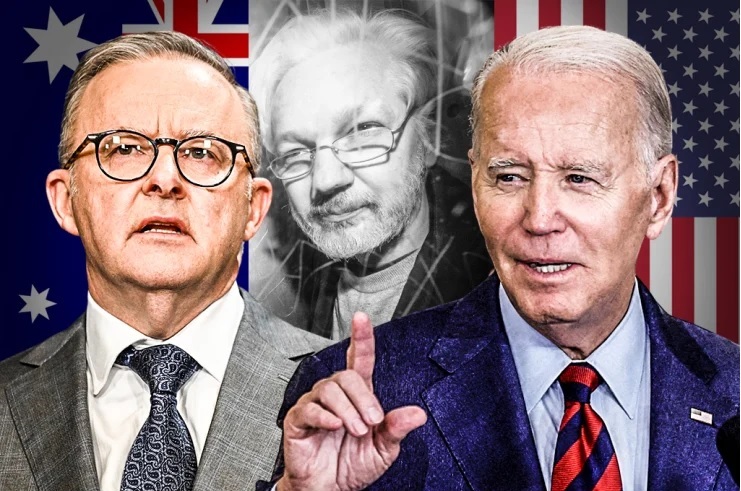
An odder political bunch you could not find, at least when it comes to pursuing a single goal. Given that the goal is the release of WikiLeaks publisher Julian Assange makes it all the more striking. Six Australian parliamentarians of various stripes will be heading to Washington ahead of Prime Minister Anthony Albanese’s October visit to test the ground of empire, maybe even plant a few seeds of doubt, about why the indictment against their countryman should be dropped.
That indictment, an outrageous, piffling shambles of a document comprising 18 charges, 17 based on that nasty, brutish statute, the Espionage Act of 1917, risks earning Assange a prison sentence in the order of 175 years. But in any instrumental sense, his incarceration remains ongoing, with the United Kingdom currently acting as prison warden and custodian.
In the politics of his homeland, the icy polarisation that came with Assange’s initial publishing exploits (former Australian Prime Minister Julia Gillard was convinced Cablegate was a crime) has shifted to something almost amounting to a consensus. The cynic will say that votes are in the offing, if not at risk if nothing is done; the principled will argue that enlightenment has finally dawned.
The Australian Prime Minister Anthony Albanese and the Opposition leader, Peter Dutton, agree on almost nothing else but the fact that Assange has suffered enough. In Parliament, the tireless work of the independent MP from Tasmania, Andrew Wilkie, has bloomed into the garrulous Bring Julian Assange Home Parliamentary Group.
The Washington mission, which will arrive in the US on September 20, comprises former deputy prime minister Barnaby Joyce, the scattergun former Nationals leader, Labor MP Tony Zappia, Greens Senators David Shoebridge and Peter Whish-Wilson, Liberal Senator Alex Antic and the competent independent member for Kooyong, Dr. Monique Ryan.
What will be said will hardly be pleasing to the ears of the Washington establishment. Senator Shoebridge, for instance, promises to make the case that Assange was merely telling the truth about US war crimes, hardly music for guardians from Freedom’s Land. Sounding like an impassioned pastor, he will tell his unsuspecting flock “the truth about this prosecution.”
Joyce, however, tried to pour some oil over troubled waters by insisting on ABC News that the delegates were not there “to pick a fight”. He did not necessarily want to give the impression that his views aligned with WikiLeaks. The principles, soundly, were that Assange had not committed any of the alleged offences as a US national, let alone in the United States itself. The material Assange had published had not been appropriated by himself. He had received it from Chelsea Manning, a US military source, “who is now walking the streets as a free person.”
To pursue the indictment to its logical conclusion would mean that Assange, or any journalist for that matter, could be extradited to the US from, say, Australia, for the activities in question. This extraterritorial eccentricity set a “very, very bad precedent”, and it was a “duty” to defend his status as an Australian citizen.
The Nationals MP also noted, rather saliently, that Beijing was currently interested in pursuing four Chinese nationals on Australian soil for a number of alleged offences that did not, necessarily, have a nexus to Chinese territory. Should Australia now extradite them as a matter of course? (The same observation has been made by an adviser to the Assange campaign, Greg Barns SC: “You’ve got China using the Assange case as a sort of moral equivalence argument.”)
Broadly speaking, the delegation is hoping to draw attention to the nature of publishing itself and the risks posed to free speech and the journalistic craft by the indictment. But there is another catch. In Shoebridge’s words, the delegates will also remind US lawmakers “that one of their closest allies sees the treatment of Julian Assange as a key indicator on the health of the bilateral relationship.”
Ryan expressed much the same view. “Australia is an excellent friend of the US and it’s not unreasonable to request to ask the US to cease this extradition attempt on Mr Assange.” The WikiLeaks founder was “a “journalist; he should not be prosecuted for crimes against journalism.”
While these efforts are laudable, they are also revealing. The first is that the clout of the Albanese government in Washington, on this point, has been minimal. Meekly, the government awaits the legal process in the UK to exhaust itself, possibly leading to a plea deal with all its attendant dangers to Assange. (The recent floating of that idea, based on remarks made by US ambassador to Australia Caroline Kennedy, was scotched by former British diplomat and Assange confidante Craig Murray in an interview with WBAI radio last week.) Best, then, to leave it to a diverse set of politicians representative of the “Australian voice” to convey the message across the pond.
Then there is the issue of whether the delegation’s urgings will have any purchase beyond being a performing flea act. US State Department officials remain glacial in their dismissal of Canberra’s “enough is enough” concerns and defer matters to the US Department of Justice. The unimpressive ambassador Kennedy has been the perfect barometer of this sentiment: host Australian MPs for lunch, keep up appearances, listen politely and ignore their views. Such is the relationship between lord and vassal.
In Washington, the perspective remains ossified, retributive and wrongheaded. Assange is myth and monster, the hacker who pilfered state secrets and compromised US national security; the man who revealed confidential sources and endangered informants; a propagandist who harmed the sweet sombre warriors of freedom by encouraging a new army of whistleblowers and transparency advocates.
Whatever the outcome from this trip, some stirring of hope is at least possible. The recent political movement down under shows that Assange is increasingly being seen less in the narrow context of personality than high principle. Forget whether you know the man, his habits, his inclinations. Remember him as the principle, or even a set of principles: the publisher who, with audacity, exposed the crimes and misdeeds of power; that, in doing so, he is now being hounded and persecuted in a way that will chill global efforts to do something similar.
Biden’s horse-trading on nuclear technology and fuels is an unprecedented proliferation risk

he is funding not just prudent nuclear research, but also their boondoggles to expand use of plutonium and HEU fuel. To ensure US military support for the trilateral Australia-United Kingdom-United States (AUKUS) deal, he is acquiescing to Navy insistence on using weapons-grade uranium reactor fuel, even in exported submarines. However, recent spikes in demand for nuclear weapons, among friends and foes alike, suggests this is a dangerously short-sighted approach.
Bulletin, By Alan J. Kuperman | September 6, 2023
News media in the United States rarely report on nuclear proliferation until it reaches the crisis stage—as in North Korea and Iran. By then, however, it is typically too late to stop the spread of nuclear weapons. Effective nonproliferation must begin much earlier, not only by suppressing demand for nuclear weapons but also by restricting supplies of the fissionable materials necessary to build them in the first place. Sadly, the Biden administration is bungling this latter responsibility.
To acquire the bomb, nuclear aspirants must first obtain its key ingredient: plutonium or highly enriched uranium (HEU). So, as demand for nuclear weapons grows in Asia, the Middle East, and Europe, one would expect the US government to do everything it can to clamp down on supply. Instead, President Joe Biden is actually doing just the opposite, by promoting commerce in weapon-usable nuclear materials as a bargaining chip for other issues. Unless the president reverses course, one of his greatest foreign policy legacies could wind up being global nuclear proliferation.
The spike in demand for nuclear weapons has been driven by several key events over the past two decades………………………………………………………………………………………………………….
Considering this growing demand for nuclear weapons, an essential policy to avert proliferation is to block the supply of the necessary fissionable materials. Regrettably, the Biden administration instead has taken four steps that would foster proliferation of both plutonium and weapons-grade uranium.
First, President Biden is funding US companies like Oklo that want to reprocess used reactor fuel—how plutonium is obtained in the first place, by separating it from nuclear waste—and then deploy its fuel recycling technology “on a global scale.” This would reverse nearly half a century of bipartisan US policy opposing such activity at home and abroad, which has succeeded at restricting commercial reprocessing to only two countries, France and Russia, both of which already have nuclear weapons.

Second, the Biden administration is providing a $2 billion subsidy to Bill Gates (currently the fifth richest person in the world) to develop exotic “fast” nuclear reactors, which originally were designed explicitly to increase supplies of plutonium. Gates’s nuclear energy startup Terrapower promises not to use them this way, but the reactors are so expensive that countries importing them could cite economics to justify turning them into plutonium factories.

Third, the president is pursuing construction of a civilian US research reactor using weapons-grade HEU fuel for the first time since the 1960s, thereby threatening to undermine decades of progress in delegitimizing this dangerous fuel globally.

Fourth, the White House has agreed to export tons of weapons-grade uranium—an amount sufficient for hundreds of nuclear bombs—to fuel Australia’s forthcoming SSN-AUKUS nuclear-powered submarines. This announcement already has prompted at least one other country, Iran, to suggest that it too may produce HEU for naval fuel—a well-known back door to nuclear weapons. The good news is that Australia’s submarines likely could be redesigned to use low-enriched uranium that is unsuitable for nuclear weapons. Unfortunately, the Biden administration recently canceled funding for the eight-year-old program to develop such proliferation-resistant naval fuel.
Why is President Biden doing all this? The US president seems to think he can prevent proliferation solely by quashing demand—using carrots and sticks to persuade countries not to seek the bomb—despite evidence to the contrary. So, he feels free to relax supply restrictions in political horse-trades. For example, to persuade legislators to support solar and wind power, he is funding not just prudent nuclear research, but also their boondoggles to expand use of plutonium and HEU fuel. To ensure US military support for the trilateral Australia-United Kingdom-United States (AUKUS) deal, he is acquiescing to Navy insistence on using weapons-grade uranium reactor fuel, even in exported submarines. However, recent spikes in demand for nuclear weapons, among friends and foes alike, suggests this is a dangerously short-sighted approach.
Of course, the United States should continue trying to reduce demand for proliferation, including by avoiding attacking any more countries that have halted their nuclear weapons programs like Iraq and Libya. But if President Biden imagines that demand-suppression is a silver bullet that gives him license to expand civilian commerce in nuclear weapons-usable materials, he is deeply mistaken. Unless Biden changes course, his promotion of such dangerous nuclear technologies will enable supply to meet demand—in the market of mass destruction. https://thebulletin.org/2023/09/bidens-horse-trading-on-nuclear-technology-and-fuels-is-an-unprecedented-proliferation-risk/
Act, or die: the climate and nuclear juggernaut

perhaps the most lethal human branch has become the media, which with few exceptions turned into a global propaganda machine skilful in distorting facts, promoting conflicts, manufacturing untruths, concealing avenues to peace and promoting wars in the tradition of Goebbels.
perhaps the most lethal human branch has become the media, which with few exceptions turned into a global propaganda machine skilful in distorting facts, promoting conflicts, manufacturing untruths, concealing avenues to peace and promoting wars in the tradition of Goebbels.
By Andrew GliksonSep 7, 2023 https://johnmenadue.com/act-or-die-the-climate-nuclear-juggernaut/
Under the guise of lies and cover-ups, the global powers to be have set the stage for the unthinkable, a world-wide hair-trigger human suicide system taking much of nature with it. With the exception abstract ideas or experimental attempts no actual steps are being taken to slow down, or even reverse, the inexorable rise of atmospheric greenhouse gases, now rising into Miocene-like levels of >400 parts per million CO2 within the century, the fastest rise rate identified in the geological record.
Saturating the atmosphere with toxic gases, coating the land with carbon and plastic particles and acidifying the oceans amounts to the poisoning of the biosphere.
Nor are steps undertaken to try and dismantle the global doomsday fleet of more than 12,700 nuclear warheads, where space and the oceans have become nuclear playgrounds, enough to render large parts of the Earth uninhabitable.
The criminal insanity of political, military, strategic, economic and scientific leaders, matched only by the naive blindness of billions of people, is consistent with what has been referred to as the ‘Fermi Paradox’ ─ the apparent absence of signals from technological civilisations in the Milky Way, interpreted in terms of a self-destruction of such civilisations.
Even at this stage the litany of denial and betrayal never stops. Political leaders who have vowed to adhere to the science shift to promote the mining and export fossil fuels, as if greenhouse gases do not disperse in the atmosphere world-wide, or they adopt nuclear weaponry as soon as they reach power. A suicidal element in human nature?
While the multitudes are fixated on domestic issues and regional troubles, including genocidal conflicts and in corners of the world (Ukraine, Chechnya, Korea, Vietnam, Cambodia, Laos, Mein-Mar, Iraq, Syria, Afghanistan, Yemen, and other), the price of maintaining an Orwellian ‘peace and stability ’, including ethnic cleansing, drowning refugees, economic hardships, misanthropic violence, football games, the tour de France, tennis rackets, relatively few are concerned with the deadly games of empire. Even symbolic gestures toward original people, like the “Voice” are being objected to.
As in the history of Athens and Sparta, the stronger force is more inclined to start a war. Like schoolboys seeking association with bully alpha males so do weaker nations look for the protection of an empire, which end up using them as cannon fodder. It is more difficult to understand why, given the scientific and empirical evidence of global heating, intelligent people are prepared to sacrifice the future of their off-springs generations to the $multi-trillion fossil fuel industry and their advocates in governments. It would appear that, once representatives acquire real or apparent power, they leave conscience behind, adopting the Faustian bargain.
“Where does responsibility lie? Where humans are caught up in the anthropogenic genome, not enough “good” angels exist. Where competition for food, shelter and reproduction are inherent, ethics, compassion and empathy may not be easy to find. Humanity may be more readily detected among small tribes than in large civilisations. A young child born in a bubble has few or no impressions impinging on its brain to respond to. By contrast children exposed to obscene violence and lies paraded on fluorescent screens are more likely to grow into distorted brain-washed multitudes.
But perhaps the most lethal human branch has become the media, which with few exceptions turned into a global propaganda machine skilful in distorting facts, promoting conflicts, manufacturing untruths, concealing avenues to peace and promoting wars in the tradition of Goebbels.
Surprisingly, the only significant resistance to the genocidal behaviour of alpha male-dominated groups has arisen from the not-yet spoiled minds of children, led by the young Greta Thunberg.
Nuclear Energy is Not a Viable Option

Nuclear Waste Dump Threatens Kichi Sìbì (Ottawa River), Indigenous Climate Action, August 23
“……………………………………………..According to scenarios from the World Nuclear Association and the OECD Nuclear Energy Agency, doubling the capacity of nuclear power worldwide in 2050 would only decrease greenhouse gas (GHG) emissions by around 4%, yet would require 37 new large nuclear reactors to the grid every year from now until 2050. In other words, nuclear energy delivers too little energy to matter.
Nuclear power plants are too dangerous and leave communities vulnerable. Power plants require some of the most complex set of resources to be ready at all times—this is not guaranteed with the growing climate crisis and resulting extreme weather events that will affect operations. Additionally, nuclear energy is too expensive to be sustainable. It costs on average more than double the cost of other energy alternatives like solar and wind—and those costs continue to increase. The large amounts of waste that is produced by the nuclear fuel cycle is highly radioactive, and will remain so for several thousand years—and yet no government has ever been able to find a way to safely manage it.
…………………………………………………………………………………………………………………………………………………………………………………………………………………….. more https://www.indigenousclimateaction.com/entries/nuclear-dump-threatens-kichi-sibi
World meteorologists point to ‘vicious cycle’ of heatwaves and air pollution.
Heatwaves across the world are worsening air quality and pollution,
scientists have said. The World Meteorological Organization (WMO) has said
extreme temperatures are not the only hazard from heatwaves but that they
also cause pollution-related health problems. In their annual air quality
and climate bulletin, the meteorologists have highlighted a “vicious
cycle” of climate breakdown and air pollution.
They have shown that
heatwaves sparked wildfires in the north-western US and heatwaves
accompanied by desert dust intrusions across Europe, which both caused
dangerous air quality in 2022. The hot temperatures in Europe, which in
2022 were record-breaking, led to higher levels of particulate matter in
the air, the bulletin says. During the second half of August 2022, there
was also an unusually high intrusion of desert dust over the Mediterranean
and Europe.
Guardian 6th Sept 2023
Lifetime War Abolisher of 2023 award to David Bradbury
September 7, 2023, The AIM Network, By Sandi Keane
The cracks in Labor ranks over AUKUS won’t be going away despite Albanese staring down dissenters at Labor’s national conference. A pitched battle over the choice of submarine base is guaranteed – and now we discover that Albanese has suffered the mother of all brainsnaps: Australia has agreed to set up a weapons-grade nuclear waste dump. At the heart of the resistance to this militarism has been David Bradbury’s documentary film The Road to War (2013).
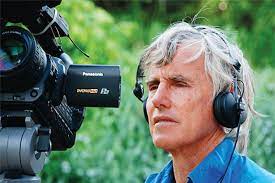
Last week, Australia’s legendary political filmmaker, David Bradbury, achieved another media milestone with this much-lauded anti-AUKUS documentary, The Road to War. Adding to the list of International and Australian film awards including two Academy-award nominations (Frontline (1979) and Chile Hasta Quando? (1985), his latest documentary won the World BEYOND War’s Individual ‘Lifetime War Abolisher Award’ – named for David Hartsough, who co-founded World BEYOND War in Virginia, USA in 2014.
The creator of 26 documentary films, Bradbury advances our understanding of war, peace, international relations and peace activism. His films have been broadcast around the world on the BBC, PBS, ZDF (Germany), and TF1-France, as well as ABC, SBS and commercial television networks in Australia……………………………………………..
Bradbury shoots his own footage, traveling widely, and seeking out people with uncomfortable truths to tell – sometimes at great risk. Bradbury has filmed in Iran during the final days of the Shah, in Nicaragua during the CIA-Contra war, and in El Salvador during the days of death squads during the early 1980s. His film on Pinochet’s Chile, Chile Hasta Quando? (1985) was nominated for an Academy Award. He has filmed independence struggles in East Timor and West Papua, and in India, China, and Nepal.
In The Road to War, concern is raised among the Australian experts interviewed by Bradbury about Australia’s AUKUS commitment of hundreds of billions of dollars for new weaponry, nuclear propelled submarines and stealth bombers – to protect us against our biggest trading partner – China. Yes, China. The film shows why it is not in Australia’s, or the world’s interests to be dragged into another US-led war and brings into sharp focus that Australia is being set up as USA’s proxy:
“Basing US B52 and stealth bombers in Australia is all part of preparing Australia to be the protagonist on behalf of the United States in a war against China. If the US can’t get Taiwan to be the proxy or its patsy, it will be Australia,” warns former Australian ambassador to China and Iran, John Lander, in Bradbury’s film.
We all appreciate the Labor Government was still on its toddler legs when it signed the AUKUS agreement and had only 24 hours to decide – or be wedged on Defence by the Coalition in the 2019 federal election.
But the cracks in Labor ranks won’t be going away despite Albanese staring down dissenters at Labor’s national conference and enshrining the tripartite security pact in the party’s policy platform. A pitched battle over the choice of submarine base is guaranteed – and now we discover that Albanese has suffered the mother of all brainsnaps: Australia has agreed to set up a weapons-grade nuclear waste dump. According to the Fact Sheet: Trilateral Australia-UK-US Partnership on Nuclear-Powered Submarines:
“… as part of this commitment to nuclear stewardship, Australia has committed to managing all radioactive waste generated through its nuclear-powered submarine program, including spent nuclear fuel, in Australia.”
Who knew about that? Hats off to Crikey for disclosing the secret no-one is talking about. Where was the spirited public debate about which port such terrorist “bait” will be shipped to, how it would be transported? By truck? Train? Where to? Given the Coalition has had a nuclear waste dump on the back burner for decades, Maralinga is the likely bet.

The lack of debate now resembles the barely reported signing of the Global Nuclear Energy Partnership (GNEP) by Prime Minister John Howard on 5 September 2007. Had the Coalition won the 2007 election on 24 November, Australia was on track to become a global nuclear waste dump. Did anyone know about it then? Like now, it went under the media radar. MSM were MIA.
Back then, Howard had control of both houses. All the ducks were in a row. The Commonwealth Radioactive Waste Management Bill 2005 had passed effectively transferring power to the Minister to nominate nuclear waste dump sites. The ANSTO Bill passed around the same time giving ANSTO the power to accept waste generated outside Australia.
Maralinga in South Australia seemed to tick all the boxes. But they forgot that nuclear waste produces hydrogen when it eventually breaks down and Maralinga is sited right on top of the Great Artesian Basin.
John Large, whose company, Large & Associates handled the salvage of the stricken Russian U-sub, Kursk, told Julie Macken in an interview in New Matilda on 15 November 2006 that when the waste breaks down, it produces hydrogen and “there is simply no way, over a 100,000-year time scale, to stop the fuel leaking out.”
Large was shocked to hear that Australia wanted to go down this path. Question is: “are we about to do just that?”……………………………………………………..
The 2023 War Abolisher Awards and the video of David Bradbury’s acceptance speech can be accessed on the website at War Abolisher Awards.
War Abolisher awardees are honoured for their body of work directly supporting one or more of the three segments of World BEYOND War’s strategy for reducing and eliminating war as outlined in the book A Global Security System, An Alternative to War. They are: Demilitarizing Security, Managing Conflict Without Violence, and Building a Culture of Peace.
You can view a clip from The Road to War below:
Bradbury’s films can be viewed at Frontline Films.
For further information, email david@frontlinefilms.com.au
Editor’s Note: The next showing of Bradbury’s film is scheduled for 21 September at ANU Film Club, Canberra. A variation of this article was published in Pearls and Irritations on 3 September, 2023. https://theaimn.com/lifetime-war-abolisher-of-2023-award-to-david-bradbury/
U.S, Senators raise concerns over US missing nuclear submarine target

The Hill, BY FILIP TIMOTIJA – 09/06/23
Senators on the Foreign Relations Committee raised concerns that the U.S. fell short of its nuclear submarine target during a Wednesday morning hearing on a trilateral security partnership.
Australia, the United Kingdom and the U.S. struck the defense deal AUKUS in September 2021 and announced an arrangement for Australia to acquire “conventionally-armed, nuclear-powered” submarine capability through the partnership in March 2023. As part of that agreement, Australia agreed to invest approximately $3 billion in the first four years of the agreement into U.S. shipbuilding.
The agreement is intended to help Australia develop nuclear-powered submarines while enabling allies to safely share the relevant technology with each other.
During the hearing, lawmakers questioned whether the U.S. had the bandwidth to sell nuclear submarines to Australia. The U.S. Navy currently has 49 fast-attack submarines, which puts it 17 submarines short of the 66-vessel goal the military branch previously told Congress it needed to reach in order to properly defend the U.S.
“We are grateful that the Australians want to invest $3 billion,” Sen. Pete Ricketts (R-Neb.) said. “What are we gonna have to invest to get to 66 submarines?”……………………………………………………. https://thehill.com/policy/defense/4190727-senators-raise-concerns-over-us-missing-nuclear-submarine-target/
Taiwan’s ‘clear and present’ spent nuclear fuel danger

Above-ground storage pools at Chinshan and Kuosheng nuclear power plants would be vulnerable to missiles in a Chinese attack
ASIA TIMES, By JORSHAN CHOI, SEPTEMBER 6, 2023
The war in Ukraine has drawn concerns that there is potential for a conflict to happen across the Taiwan Strait.
In Ukraine, the attack and occupation of nuclear facilities, including the Zaporizhzhia nuclear power plant by the Russian military, initiated a dangerous situation for the safe and secure operation of civilian nuclear power plants, including the spent fuel facilities. It also hindered the International Atomic Energy Agency’s effort to ensure the proper accounting and control of nuclear materials in these facilities.
If a military conflict were to happen across the Taiwan Strait, there would be similar concerns. There are six operating or shut-down nuclear reactors in Taiwan: two pressurized water reactors and four boiling water reactors in Taiwan. Of the six, the four BWRs situated on the northern tip of Taiwan pose the biggest safety, security, and safeguards concerns.
Taiwan’s first nuclear power plant, Chinshan 1 & 2, consisted of BWRs similar to Fukushima Daiichi 1, which was involved in the 2011 accident in Japan, with spent fuel pools that are high up above ground.
Taiwan’s second plant, Kuosheng 1 & 2, featured a later BWR design, with spent fuel pools at a lower elevation. The two pressurized water reactors have spent fuel pools at ground level.
When Chinshan 1 & 2 went offline in 2018-2019, more than 6,000 spent fuel assemblies were stored in the two elevated spent fuel pools. At Kuosheng 1 & 2, the capacities of both ground-level spent fuel pools have become insufficient to support reactor operation.
To free up space in the pools for newly discharged spent fuel, TAIPOWER, the utility company, moved those 15-year-old spent fuel assemblies for storage in the upper (refueling) pools, which are well above the ground level.
According to the US National Academies of Sciences, the vulnerability of a spent fuel pool depends in part on its location with respect to ground level as well as its construction. In a potential military conflict across the Taiwan Strait, the spent fuel pools built above ground in Chinshan and Kuosheng may thus be susceptible to accidental attacks from misfired or stray missiles.
Significantly, to protest the Pelosi visit to Taiwan in August 2022, two missiles fired by the Chinese military landed in water about 50 km north of the Chinshan plant.
The Fukushima accident highlighted the vulnerability of elevated spent fuel storage. The explosion that occurred in the reactor building of Fukushima Daiichi 4 destroyed the roof and most of the walls on the fourth and fifth (refueling) floors……………………………………………………………………..
A sense of urgency
Spent fuel has accumulated in the Chinshan and Kuosheng plants over the 40 years of their operating lives. Due to objections from the local public over moving the spent fuel to dry cask storage and the lack of suitable storage or disposal sites on the geographically limited island, spent fuel discharged from Chinshan 1 & 2 reactors has remained in the refueling-turned-into-storing pools adjacent to the reactor wells, high above ground……………………………………………..
The war in Ukraine and rockets/missiles landing in or around the Zaporizhzhia plant (with all six pressurized water reactors’ spent fuel pools situated at ground level) should have given TAIPOWER another warning that spent fuel in high-elevation pools should be moved to ground-level pools or dry cask storage.
TAIPOWER should have a sense of urgency for this “clear and present” danger in Taiwan, especially given that it has the technology and resources to accomplish the task. Taiwan’s internal politics and objection of the local public are the primary causes for the procrastination.
The longer-term problem with moving the spent fuel off the island centers around something called “consent rights,” which is complicated given US involvement in the installation of the nuclear power plants in Taiwan…………………………………………………………………….
The US rights over Taiwan’s nuclear activities are so extensive that Washington instructed the German government in the 1980s that any nuclear items supplied to Taiwan by a German exporter would be subject to US “control rights,” which included US “fallback safeguards rights” if deemed necessary.
Nowhere else does the United States have as much leverage over a foreign nuclear program. Yet whenever Taiwan has requested the United States to take back the spent fuel, Washington has declined…………………………………………….
Removing the spent fuel from Taiwan would eliminate its “clear and present” spent fuel danger, while fulfilling the goal of ensuring a “nuclear-free” Taiwan. This should be a priority. https://asiatimes.com/2023/09/taiwans-clear-and-present-spent-nuclear-fuel-danger/
South Korea: Mass protests continue against Fukushima nuclear waste dumping

South Korea Peter Boyle, Denise Yoon , September 6, 2023
The biggest of the global protests against Japan’s dumping of radioactive wastewater from the Fukushima nuclear power plant into the Pacific Ocean — which began on August 25 — have been in Seoul, the capital of South Korea. Green Left‘s Peter Boyle spoke to Denise Yoon, a key organiser of the movement.
Since August 26, we have had two big national rallies in Seoul and around 50,000 people have gathered at each.
About half of the demonstrators are members of four opposition parties: the Democratic Party, the Justice Party, the Progressive Party and the Basic Income Party. The rest are from religious and civil society groups, including environmental and consumer organisations, parents organisations, justice and democracy activists and human right defenders.
According to a public poll by the Seoul city government in August, around 80% of citizens oppose Japan’s ocean dumping of nuclear wastewater and condemn the Korean government’s support of Japan without appropriate regard for Korean people’s safety from ocean pollution.
People think the Korean government has failed to explain scientifically, environmentally and economically why they claim that the Fukushima wastewater is not a big deal. They also distrust the International Atomic Energy Authority’s report because its conclusion [supporting Japan’s dumping] is based on deficient data and evidence.
Due to the Korean government’s very active promotion of Japan’s unilateral decision to commence dumping, many Korean people are getting very angry at the government. Polls show that President Yoon Suk Yeol now has a disapproval rate of 58% and this is influenced not only by the Fukushima issue, but also by government incompetence on other issues.
This is why we were able to hold these two big rallies.
We will organise a national rally every Saturday in September and expect more people will join the protest.
We will hold the 4th National Candlelight Rally in Gwanghwamun Plaza and we expect more than 50,000 people to join in for speeches, bands and cultural performances. Global solidarity messages will be shared. This rally will call on Japan to stop the dumping and it will demand that the Korean government prohibit the import of marine products from Japan.
How a nuclear disaster spurred Fukushima to become a renewables leader

Japan Times, BY FRANCESCO BASSETTI, MINAMISOMA, FUKUSHIMA PREF. – 5 Sept 23
As you reach the coast on Fukushima Prefectural Route 74, which runs between the towns of Minamisoma and Soma, scenes typical of the Japanese countryside — rice paddies and hills blanketed by lush green forests — undergo a swift transformation.
Now, expanses of metal, glass and silicon shimmer in the midday sun, stretching out to a horizon dotted with four white wind turbines, blades humming as they turn in the summer breeze.
Following the 2011 triple disaster — and the subsequent cratering of support for nuclear energy — Fukushima Prefecture has positioned itself at the forefront of Japan’s low-carbon transition.
Few projects better exemplify that than the Minamisoma Mano-Migita-Ebi solar power plant, which was the largest in Fukushima Prefecture until 2019 and is made up of 220,000 solar panels that, if laid end to end, would cover 350 kilometers — roughly the distance between Nagoya and Tokyo. The panels can generate up to 60 megawatts of electricity, enough to power 20,000 households.
Because of projects like the Minamisoma facility, Fukushima Prefecture has claimed the crown as the Tohoku region’s leader in cumulative solar power generation since 2013, and this is a direct consequence of the reconstruction policies that were put in place after the March 2011 earthquake, tsunami and nuclear disaster.
But today, grid connection issues, opposition by incumbent energy companies and a return to nuclear energy in some parts of the country are slowing progress in Fukushima and beyond. In 2022 almost 80% of the increase in total electricity generation in Japan came via fossil fuels — a worrying signal that, although renewable energy generation continues to increase, it is not keeping up with the pace of electrification.
Renewable recovery
Particularly in the coastal areas of Fukushima Prefecture, solar panels have a strong presence: They cover fields, occupy clearings that have been carved out of forests and hillsides, and rest on the rooftops of houses. Cars and trucks brandishing the names of the companies that operate them are a regular feature as they carry equipment and workers along well-kept roads…………………………………………………………………………………………………………………….
“Recovery plans have always been tied to developing a society that is no longer dependent on nuclear power,” says Masaki Moroi, deputy director of Fukushima Prefecture’s Energy Division.
By the end of 2021, Fukushima Prefecture had covered 47% of its energy demand with renewables, compared with just 23.7% in 2011. That’s a particularly impressive feat when compared with Japan’s national average of just 22.7% in 2022.
“Fukushima took the lead after 2011 because of its direct experience with disaster and clear commitment by policymakers to quit nuclear energy and back renewables,” says Hikaru Hiranuma of the Tokyo Foundation for Policy Research.
According to Hiranuma, the single most influential policy in the initial boom in renewable energy was the introduction of a feed-in-tariff program by the Ministry of Economy, Trade and Industry in July 2012………………………………………………………………………………………..
Beyond Minamisoma, Fukushima Prefecture implemented policies promoting renewable energy projects in areas affected by the tsunami and nuclear fallout where there were high rates of abandoned land………………………………………………………………………………………………………………………. more https://www.japantimes.co.jp/environment/2023/09/05/fukushima-renewable-energy-leader/
1 This month.

Australians deserve the truth
about
AUKUS – https://aukuspublicinquiry.com/

30 July – WEBINAR (Free) – Is Nuclear Power the Solution to Climate Change? https://my.acaw.org.au/event/acaw-is-nuclear-power-the-solution-to-climate-change
18:30 – 19:45 ACST
19:00 – 20:15 AEST

PETITION – To: Prime Minister Anthony Albanese and the Australian Labor Government

of the week – Australians for War Powers Reform (AWPR)
To see nuclear-related stories in greater depth and intensity
 Antinuclear