Nato isn’t defending Ukraine. It’s stabbing it in the back

So far, Ukraine’s much-vaunted “spring counter-offensive” has turned into a damp squib, despite western media spin about “slow progress”. Moscow is holding on to the Ukrainian territories it annexed.
More than 110 states – not including the US, of course – have ratified a 2008 international convention outlawing cluster munitions. Many are in Nato.
Middle East Eye, Jonathan Cook. 14 July 2023
The US and its allies are sustaining the very war they now cite as grounds for disqualifying Kyiv from Nato membership .
he Nato summit in Lithuania this week served only to underscore the utter hypocrisy of western leaders in pursuing their proxy war in Ukraine to “weaken” Russia and oust its president, Vladimir Putin.
Both the US and Germany had made clear before the summit that they would block Ukraine’s admission to Nato while it was in the midst of a war with Russia. That message was formally announced by Nato Secretary General Jens Stoltenberg on Tuesday.
Ukrainian President Volodymyr Zelensky fumed that Nato had reached an “absurd” decision and was demonstrating “weakness”. British Defence Secretary Ben Wallace lost no time in rebuking him for a lack of “gratitude”.
The concern is that, if Kyiv joins the military alliance at this stage, Nato members will be required to leap to Ukraine’s defence and fight Russia directly. Most western states balk at the notion of a face-to-face confrontation with a nuclear-armed Russia – rather than the current proxy one, paid for exclusively in Ukrainian blood.
But there is a more duplicitous subtext being obscured: the fact that Nato is responsible for sustaining the war it now cites as grounds for disqualifying Ukraine from joining the military alliance. Nato got Kyiv into its current, bloody mess – but isn’t ready to help it find a way out.
It was Nato, after all, that chose to flirt openly with Ukraine from 2008 onwards, promising it eventual membership – with the undisguised hope that one day, the alliance would be able to flex its military muscles menacingly on Russia’s doorstep.
It was the UK that intervened weeks after Russia’s invasion in February 2022, and presumably on Washington’s orders, to scupper negotiations between Kyiv and Moscow – talks that could have ended the war at an early stage, before Russia began seizing territories in eastern Ukraine.
A deal then would have been much simpler than one now. Most likely, it would have required Kyiv to commit to neutrality, rather than pursuing covert integration into Nato. Moscow would have demanded, too, an end to the Ukrainian government’s political, legal and military attacks on its Russian-speaking populations in the east.
Now the chief sticking point to an agreement will be persuading the Kremlin to trust the West and reverse its annexation of eastern Ukraine, assuming Nato ever allows Kyiv to re-engage in talks with Russia.
And finally, it is Nato members, especially the US, that have been shipping out vast quantities of military hardware to prolong the fighting in Ukraine – keeping the death toll mounting on both sides.
Damp squib
In short, Nato is now using the very war it has done everything to fuel as a pretext to stop Ukraine from joining the alliance.
Seen another way, the message Nato has sent Moscow is that Russia made exactly the right decision to invade – if the goal, as Putin has always maintained, is to ensure Kyiv remains neutral.
It is the war that has prevented Ukraine from being completely enfolded in the western military alliance. It is the war that has stopped Ukraine’s transformation into a Nato forward base, one where the West could station nuclear-tipped missiles minutes from Moscow.
Had Russia not invaded, Kyiv would have been free to accelerate what it was already doing secretly: integrating into Nato. So what is Zelensky supposed to conclude from his exclusion from Nato, after he committed his country to an ongoing war rather than negotiations and neutrality?
So far, Ukraine’s much-vaunted “spring counter-offensive” has turned into a damp squib, despite western media spin about “slow progress”. Moscow is holding on to the Ukrainian territories it annexed.
So long as Kyiv can’t “win the war” – and it seems it can’t, unless Nato is willing to fight Russia directly and risk a nuclear confrontation – it will be precluded from the military alliance. Catch-22.
Do not expect this conundrum to be highlighted by a western establishment media that seems incapable of doing anything other than regurgitating Nato press releases and cheering on bigger profits for the West’s war industries.
War crimes
Another such conundrum is the Biden administration’s decision last week to supply Ukraine with cluster munitions – small bomblets that, when they fail to explode, lie concealed like mini-landmines, killing and maiming civilians for decades. In some cases, as many as a third are “duds”, detonating weeks, months or years later.
Washington’s move follows Britain recently supplying Ukraine with depleted uranium shells, which contaminate surrounding areas with a radioactive dust during and after fighting. Evidence from areas such as Iraq, where the US and Britain fired large numbers of these shells, suggests the fallout can include a decades-long spike in cancer and birth defects.
The White House was all too ready to denounce the use of cluster bombs as a war crime last year – when it was Russia that stood accused of using them. Now it is Washington enabling Kyiv to commit those very same war crimes.
More than 110 states – not including the US, of course – have ratified a 2008 international convention outlawing cluster munitions. Many are in Nato.
Given the high “dud” rate of US cluster bombs, President Joe Biden appears to be breaking US law in shipping stocks to Ukraine. The White House can invoke an exemption only if exporting such weapons satisfies a “vital US national security interest”. Apparently, Biden believes “weakening” Russia – and turning parts of Ukraine into a death zone for civilians for decades to come – qualifies as just such a vital interest.
Desperate stop gap
While the official story is that this latest escalatory move by the US will help Kyiv “win the war”, the truth is rather different. Biden has not shied away from admitting that Ukraine – and Nato – are running out of conventional arms to fight Russia. This is a desperate stop-gap measure. ……………………………………………………………………………………………………………………………..
…………………………….. Tragically, Nato’s malevolence, deceit and betrayal means that the only alternative to Armageddon may be Ukraine’s downfall – and with it, the crushing of Washington’s nefarious ambitions to advance full-spectrum global dominance. https://www.middleeasteye.net/opinion/nato-ukraine-not-defending-stabbing-back?utm_source=substack&utm_medium=email
“War Effort In Shambles As Hawks Turn On Each Other” At NATO Summit
Zeo Hedge, BY TYLER DURDEN, THURSDAY, JUL 13, 2023
Bloomberg is just out with a devastating behind-the-scenes account of a hot-headed Zelensky at the NATO summit in Vilnius, and the growing Western backlash in the face of his obvious frustration and what’s being seen as ingratitude for the steady flow of billions of dollars in arms to Kiev.
Apparently even the mainstream media agrees with our own assessment of the Ukrainian leader having thrown a “tantrum” as he complained about the “weak” and “absurd” NATO stance on Ukraine’s membership. The blistering tweet he issued in English while en route to Lithuania exposed cracks in the alliance, as Bloomberg highlights in the opening of its very revealing Wednesday piece:
Volodymyr Zelenskiy was running hot ahead of his sit-down with NATO leaders on Tuesday evening. The Ukrainian president had been angered earlier in the day by what he said was an “absurd” reluctance to give his country a clear timeline on membership.
That outburst in turn riled the partners who have funneled billions of dollars of weaponry and aid into Ukraine’s defense against the Russian invasion — the US had been given no warning before Zelenskiy unleashed his attack on social media.
As Bloomberg writes: “Over dinner in Vilnius, with US President Joe Biden back at his hotel, the other leaders delivered a clear message to Zelenskiy, according to one person who was present. You have to cool down and look at the full package, Zelenskiy was told.”
While it’s not quite yet a full on ‘hero to zero’ story… things are certainly sliding in that direction, given it’s unprecedented that the Ukrainian president who previously enjoyed rockstar status in Western capitals since the start of the invasion could be told to basically ‘cool it’!.
Bloomberg continues in reference to Zelensky: “He had, after all, been given a renewed commitment to eventual membership and new security guarantees from the Group of Seven nations. By the next day, the message appeared to be sinking in.” The publication was privy to some key Western leaders’ exact words, presenting the rare dressing down as follows [emphasis ZH]:
Whether we like it or not, people want to see gratitude,” UK Defense Secretary Ben Wallace told reporters the following morning. “You’re persuading countries to give up their stock” of weapons and ammunition, he added.
This account of the behind-the-scenes wrangling is based on interviews with more than a dozen diplomats and officials involved in the summit who asked not to be named discussing private conversations. NATO leaders were trying to thread a needle on Ukraine’s membership bid when they arrived in Vilnius: They were seeking language that looked like progress and that Ukraine could sell as progress but fundamentally didn’t leave them any closer to getting dragged into a war with nuclear-armed Russia.
Ultimately the hawks (mainly among the Baltic and Eastern Europe states) have lost at Vilnius. Ukrainian Foreign Minister Dmytro Kuleba has admitted “There was a lack of political will.” Thus it appears that Zelensky’s angry, desperate tweet lashing out at Western partners was a last ditch effort at shaming NATO into conceding to its demands of being immediately fast-tracked to membership.
Bloomberg reveals further, that “Crucially, it was the US and Germany that insisted on dialing back the commitment to Ukraine joining the alliance. Earlier drafts of the communique offered a clearer pathway to Ukraine eventually joining, but Biden and Chancellor Olaf Scholz were wary of going too far.”
“Their teams demanded changes in the final days before the summit, upsetting lots of the other European nations, as well as the Ukrainians.” Indeed Biden in a CNN interview at the start of the week confessed the obvious: that Ukraine’s admission into NATO with the war still going would automatically unleash war between nuclear-armed powers – a WW3 doomsday scenario. Hence the West is now telling Kiev: just stop.
In Zelensky’s next big NATO summit appearance Wednesday following a no doubt awkward evening, things were different as he belatedly “got the message”…
………………………………. The New York Times’ summation of precisely what fell short in the NATO communique explains: “NATO declared on Tuesday that Ukraine would be invited to join the alliance, but did not say how or when, disappointing its president but reflecting the resolve by President Biden and other leaders not to be drawn directly into Ukraine’s war with Russia.”
Indeed it’s being widely called more vague–and with greater possible restrictions, or “conditions”–than even what came out of the 2008 Bucharest summit.
Below is the offending part of the official Vilnius Summit Communiqué:
Issued by NATO Heads of State and Government participating in the meeting of the North Atlantic Council in Vilnius 11 July 2023:
“…………………………………………… We will be in a position to extend an invitation to Ukraine to join the Alliance when Allies agree and conditions are met.
But Zelensky is still holding out hope that one day– “After the war, Ukraine will be in NATO.”
However, President Biden has remained unmoved, and responded by explaining before reporters that Ukraine “will not be in NATO for a while”.
The geopolitical analysis news site Moon of Alabama observes correctly…
“Well. The little comedian seems disappointed. As if the whole play had not been obvious from the very beginning. Since 2008 the Ukraine was to be used as a tool to nag Russia. It is otherwise of little value. It will end up as a discarded rag while NATO will, in the end, again recognize the Russian Federation as the super power that that it is. NATO will have to relearn to listen to and negotiate with it.”
MofA then highlights the inevitable negative impact (to say the least) on Ukrainian morale: “Now lets wait and see what NATO’s climb down will do to the morale and motivations of the Ukrainian army and people.”
Update(1740): David Sacks agrees that for the hawks of NATO-land, the way things are going for the Ukrainian war effort and the West’s prior optimism and muscular support in general have reached a low-point.
Sacks writes below [emphasis ZH’s]…
Despite Biden’s best efforts to put a happy face on it, Vilnius will be remembered as the NATO Summit where tensions boiled over. Zelensky denounced the Alliance’s admission policy as “absurd” and disrespectful.
UK Secretary of Defense Ben Wallace chastised Zelensky for ingratitude. Lindsey Graham attacked the Biden administration for weakness. Ben Hodges criticized Jake Sullivan for lack of “strategic bravery.” Even NAFO mascot Adam Kinzinger no longer appears to be a “fella.”
The optics were even harsher than the words, with the NATO elites turning their backs on a frustrated Zelensky. Biden’s assurance that Zelensky is “stuck” with the U.S. may come as cold comfort to both nations now that the Ukrainian counteroffensive has failed to meet expectations, huge amounts of expensive Western armor lay in ruins smoldering on the battlefield, Ukrainian casualties are horrific, and the U.S. has run out of 155mm artillery shells to give, forcing America to debase itself by sending cluster bombs.
The war effort is increasingly a shambles and the War Party is starting to turn on each other. https://www.zerohedge.com/geopolitical/nato-leaders-tell-zelensky-cool-it-rare-dressing-down-summit
France detonated nearly 200 nuclear ‘tests’ in French Polynesia — now this activist is calling for accountability
By Bobby Macumber, Dan Smith and Alice Matthews for Stories from the Pacific, 14 July 23 https://news.google.com/articles/CBMiVGh0dHBzOi8vd3d3LmFiYy5uZXQuYXUvcGFjaWZpYy9udWNsZWFyLXRlc3RpbmctZnJlbmNoLXBvbHluZXNpYS1oaW5hLWNyb3NzLzEwMjU4NTkzMNIBAA?hl=en-AU&gl=AU&ceid=AU%3Aen
Hinamoeura Cross was seven years old when France tested its last nuclear bomb in 1996 in French Polynesia.
It was detonated deep underground on the atoll of Fangataufa, in a deep shaft drilled into volcanic rock, and sent a white shockwave into the air, visible on grainy television cameras at the time.
“I don’t have any memory of it,” Hina told Stories from the Pacific.
“I was growing up. I never learned about the consequences of nuclear bombs at school. I didn’t even know there had been so many.”
Three to five was the figure Hina had in mind when she was younger.
But in fact, by the time France finished its testing program on the atolls of Fangataufa and Moruroa, around 190 nuclear “tests” had been conducted.
Nuclear explosions had been conducted in lagoons, dropped from planes and suspended from helium balloons. After international pressure, testing moved underground.
The largest was codenamed Canopus, which was a two-stage thermonuclear test that exploded in 1968 while suspended from a balloon.
It was around 200 times more powerful than the bombs dropped on Hiroshima and Nagasaki.
The combined effect of the testing was equivalent to a Hiroshima-sized nuclear bomb exploding in French Polynesia every week for 14 years, Hina said
“Today, our ocean is totally contaminated. It’s like a poison,” she said.
“I really feel that in my blood I have been poisoned because of those nuclear tests and we have so many thousands of Tahitian people who are sick … you can’t find a family without cancer.
“And it’s really hard because they don’t understand the consequences of the nuclear tests because they’re not aware today.”
Subjects in school touched on the nuclear bombs dropped in Japan, but Hina said nothing was taught about her country’s own more immediate history — and the health consequences.
France initially said only 10,000 people were at risk of radiation exposure as a result of the nuclear activity.
But a later investigation by a team of researchers from Princeton University, journalism group Disclose, and environmental group Interprt claimed 110,000 people were potentially exposed to toxic radiation.
Hina herself was diagnosed with Leukaemia at 24, while her grandmother, mother, aunt, and sister all had thyroid cancer.
And, she said, to add insult to injury, the compensation scheme in place was complex and “not at all impartial”.
There is one hospital and two clinics on the island of Tahiti, and many islanders are forced to fly to Paris for treatment.
“Today, it’s French Polynesia and all the population that pays for all this, the cost of the illness … and it costs a lot for us,” she said.
Calling a spade a spade — or a bomb a bomb
Hina’s diagnosis was a shock that jolted her into action.
Becoming an anti-nuclear activist, she started by posting articles and links online and eventually addressed the United Nations on the topic.
Now a newly elected member of Parliament in Tahiti, she’s pushing for better in-country medical treatment and to “educate and denuclearise Polynesian memories”.
It starts, she said, with “calling a spade a spade”. Nuclear tests were still nuclear bombs.
“The fact that there were no people that were being attacked … it was the same bomb,” she said.
“I really think that using the term test totally minimises the consequences.”
Another priority is getting France to acknowledge what happened and making her fellow Tahitians aware.
French Polynesia is of strategic importance to France, and Hina said the government was pushing to silence the fight.
“They don’t want to talk about the nuclear history. They don’t admit what happened.”
Hina also hopes to begin a foundation, allowing Polynesians to reclaim the nuclear narrative as well as advocate for anyone with radiation-related sickness to be treated in Polynesia.
Although chemotherapy has kept her leukaemia at bay thanks to an early diagnosis, not everyone is so lucky.
“I think it’s absolutely disgraceful that we don’t have a medical system that’s equal to the damage suffered by these 193 nuclear bombs,” she said.
“But I really thought that maybe if I have this courage, that will motivate other people to stand up and share their story, to speak about the cancers that we we have in our family, because … [many people] have cancer, but they don’t really realise the impact of the nuclear bombs.”
Nuclear power too expensive and slow to be part of Australia’s plans to reach net zero, study finds
Guardian, Lisa Cox 12 July 23
Nuclear power should not form part of Australia’s plans to reach net zero emissions because it is too expensive and slow, according to the final report of a project that models how Australia might meet its 2050 climate target.
The Net Zero Australia report, a partnership between major academic institutions and the management consultancy Nous Group, says the federal government has a major role to play in accelerating all options that could make a “material contribution” to achieving net zero.
The release of the report comes days after the opposition leader, Peter Dutton, ramped up calls for nuclear power in Australia and a debate about removing the legislative ban on nuclear power in Australia.
The report includes major investment in batteries, solar, onshore wind, pumped hydro and transmission. Among renewable options, offshore wind was found to have the most uncertain pipeline, with the report concluding first power from offshore wind projects needed to occur in 2030.
But the report concludes nuclear power should not be factored in to net zero plans and states that to “reduce renewable targets in the belief that nuclear will be deployed later at scale would create a material risk of not achieving net zero, or doing so at an excessive cost”.
Richard Bolt, principal at Nous Group, said: “Nuclear power should not be in our plans, because it’s too expensive and slow. ……………………………………………………………………….
The report was produced by the University of Melbourne, the University of Queensland, Princeton University’s Andlinger Center for Energy and the Environment, as well as Nous Group…………………… https://www.theguardian.com/australia-news/2023/jul/11/nuclear-power-too-expensive-and-slow-to-be-part-of-australias-plans-to-reach-net-zero-study-finds
Dutton wants Australia to join the “nuclear renaissance” – but this dream has failed before.

What stopped the nuclear noughties was a bigger problem: economics. Governments looking at nuclear saw the cost and time over-runs and decided it wasn’t worth it.
in Australia, promises to create a nuclear power industry from scratch based on as yet unproven technologies and in competition with cheap renewables is simply delusional.
The Conversation John Quiggin 11 July 23
Last week, opposition leader Peter Dutton called for Australia to join what he dubbed the “international nuclear energy renaissance”.
The same phrase was used 20 years ago to describe plans for a massive expansion of nuclear. New Generation III plants would be safer and more efficient than the Generation II plants built in the 1970s and 1980s. But the supposed renaissance delivered only a trickle of new reactors – barely enough to replace retiring plants.
If there was ever going to be a nuclear renaissance, it was then. Back then, solar and wind were still expensive and batteries able to power cars or store power for the grid were in their infancy.
Even if these new smaller, modular reactors can overcome the massive cost blowouts which inevitably dog large plants, it’s too late for nuclear in Australia. As a new report points out, nuclear would be wildly uncompetitive, costing far more per megawatt hour (MWh) than it does to take energy from sun or wind.
The nuclear renaissance that wasn’t
Early in the 21st century, the outlook for nuclear energy seemed more promising than it had in years. ……………………………………….
The time seemed right for a nuclear renaissance – especially in the United States. Between 2007 and 2009, 13 companies applied for construction and operating licenses to build 31 new nuclear power reactors. But all but two of these proposals stayed on paper.
The first, in Georgia, is expected to be completed this year after running way behind schedule and way over budget. The other project in South Carolina was abandoned in 2017 after billions of dollars had already been poured into it. The same disastrous cost and time blowouts have hit new reactors in France (Flamanville, 10 years behind schedule), Finland (Olkiluoto, which opened this year after a 14 year delay) and the UK (Hinkley Point C, still under construction with cost and time blowouts).
China has built a trickle of new nuclear plants, commissioning three or four a year over the last decade. China currently has about 50 gigawatts (GW) of nuclear power capacity. This pales into insignificance compared to the nation’s extraordinary expansion of solar, with 95-120 gigawatts of additional capacity expected this year alone.
Nuclear falls short on cost, not politics
What went wrong for nuclear? Despite the claims of some nuclear advocates, the renaissance in the 2000s did not fall short because of political resistance. Far from it – the renaissance had broad political support in key markets.
And, unlike in the 1970s where intense anti-nuclear sentiment was tied to fears of nuclear war, environmentalists in the 2000s had refocused on the need to stop burning carbon-based fuels. Anti-nuclear campaigns and protest marches were almost non-existent.
What stopped the nuclear noughties was a bigger problem: economics. Governments looking at nuclear saw the cost and time over-runs and decided it wasn’t worth it.
As megaproject expert Bent Flyvbjerg has shown, cost overruns like these are typical. First of a kind nuclear plants offer an extreme example of the problem. To date, no Generation III or III+ design has been produced at scales large enough to iron out the inevitable early problems.
At the same time, other energy sources were growing in importance.
In Australia, the writing was on the wall by 2007, when an inquiry found new nuclear power would struggle to compete with either coal or renewables. A string of subsequent inquiries have come to precisely the same conclusion.
Could it be different this time?
To make nuclear viable these days, advocates believe, means making it safe, cheap and easy to build. No more megaprojects. Instead, build small reactors en masse on factory production lines, ship them to where they are needed and install them in numbers matching the needs of the area.
Advocates hope the efficiency of factory production will offset the lower efficiency associated with smaller capacity. Ironically, off-site mass production and modular installation is the basis of the success of solar and wind.
To date, the most promising reactor design is NuScale’s VOYGR. It has yet to be produced and the US company has no firm orders. It does have preliminary agreements to build six reactors in Utah by 2030 and another four in Romania.
If all are built, that’s still less than the capacity of a single large Gen III plant. More strikingly, it’s about the same as the new solar capacity installed every single day (~710 MW) this year around the world.
Even with US government subsidies, NuScale estimates its power would cost A$132 per MWh. In Australia, average wholesale prices in the first quarter of 2023 ranged from $64 per MWh in Victoria to 114 per MWh in Queensland.
So why, then, is Australia’s opposition still talking about new nuclear? Dutton claims Australia’s future nuclear submarines to be built under the AUKUS deal are “essentially floating SMRs”. This is a red herring – while submarine reactors are small, they are not modular.
The simplest answer is political gain. Announcements like this yield political benefits at low cost.
The US, UK and France have decades of experience in nuclear power, even if failures outnumber successes. So yes, there is a slim chance the latest “nuclear renaissance” will succeed in these countries.
But in Australia, promises to create a nuclear power industry from scratch based on as yet unproven technologies and in competition with cheap renewables is simply delusional. https://theconversation.com/dutton-wants-australia-to-join-the-nuclear-renaissance-but-this-dream-has-failed-before-209584?utm_source=substack&utm_medium=email
Exposing the lying claims of pro nuclear shill Zion Lights
2 Response to a July 2023 article by Zion Lights: https://nuclear.foe.org.au/zion-lights/
In Australia, for the same investment we can get three times more firmed renewable power (generation, not capacity) in one-third of the time compared to nuclear. The cost difference between nuclear and renewables is so vast that renewables are still cheaper even when transmission and storage are costed in. Perhaps the comparison is more nuclear-friendly in the UK, but I strongly suspect renewables+storage+transmission is still cheaper given the obscene costs of Hinkley Point (approx. A$50 billion for two reactors).
Specifically in Light’s latest article:
* Lights’ claims about the IPCC supporting nuclear power are dishonest, the IPCC maps out countless scenarios (including scenarios with nuclear reducing to zero) and its ‘analysis’ of pros and cons is generally reduced to dot-points.
* Lights’ claims about a “scientific consensus” in support of nuclear power are dishonest, e.g. the Climate Council, comprising Australia’s leading climate scientists, states that nuclear power reactors “are not appropriate for Australia and probably never will be”.
* Ignores profound impacts of catastrophic accidents.
* Ignores the repeatedly-demonstrated connections between nuclear power and weapons (in the UK and elsewhere).
* Light’s ‘millions of lives saved’ meme is dishonest because it assumes nuclear displaces nothing other than coal.
* Nonsense about warm water around nuclear plants providing a haven for sea-life is dishonest, she surely knows that water intake pipes kill fish by the thousands. (And she should know something about Irish opposition to radioactive discharges from Sellafield.)
* Glib, ignorant and/or dishonest claims about high-level nuclear waste: “spent fuel can be easily transported to another location, and even recycled”. The UK has given up on reprocessing (a polluting, multi-billion-dollar disaster) and has made near-zero progress on a deep underground repository and has wasted billions of pounds of taxpayers’ money in the process. The only operating deep underground repository in the world – WIPP in the US ‒ was disastrously mismanaged and under-regulated resulting in a chemical explosion in 2014.
* The UAE project came in under budget? Either Lights is ignorant or lying. The UAE project was years behind schedule and many billions of dollars over-budget.
And in other articles/interviews, even more unhinged nonsense, e.g.

* Lights saying climate change ‘could be solved overnight’ with nuclear. Seriously?
* Lights lying about her role in Extinction Rebellion.
* Lights getting sucked in by, and collaborating with, lunatic MAGA liar Michael Shellenberger.
Update: Lights deleted the above comments from the comments thread below her article, failed to address any of the substantive energy issues and failed to respond to the accusations of deceit.
TODAY. Zelensky mania ! But are cracks appearing in NATO?

Volodymyr Zelensky gave a stirring address to thousands of adoring fans in Vilnius, Lithuania.
He was at the top of his game – which is whipping up enthusiasm for the coming grand military defeat of Russia.
The NATO summit, though full of adoration for the sainted Zelensky, was just a little less unified in its holy purpose.
Perhaps hole -ey purpose would be more accurate
You see – while it is holy dogma now, that Ukraine must become part of NATO, -the hole in this dogma is becoming apparent. NATO Secretary-General Jens Stoltenberg spelled it out: Ukraine can join NATO only when Ukraine wins the war against Russia because “unless Ukraine prevails, there is no membership to be discussed at all.”
But of course – no problem!
But wait – there is a problem – Ukraine is not winning this war. That is a realisation that is slowly dawning on some European leaders.
There probably never has been such a media magician as Volodymyr Zelensky. He has put it over politicians, journalists, people world-wide, and especially the suffering people of Ukraine.
But will Biden, Macron, Sunak and the rest just dump Zelensky, when his magic bubble bursts, when it’s all over in Ukraine, and they are forced to accept a negotiated peace with Russia?
That eventual negotiation is better than the other alternative – World War 3.
Ukraine’s chances of victory in 2023 are ‘vanishingly small’
Premiered Jun 24, 2023 Ret. Lieutenant Colonel Daniel Davis elaborates on the current status of the Ukraine war and why a successful counteroffensive looks less likely.
Indonesia Warns Nuclear Weapons Put Southeast Asia a ‘Miscalculation Away’ From Disaster

Indonesia’s Foreign Minister Retno Marsudi urged nuclear weapons states to join ASEAN’s regional nuclear-free zone.
The Diplomat, By Edna Tarigan and Niniek Karmini, July 12, 2023
Indonesia’s top diplomat warned Tuesday of the threat posed by nuclear weapons, saying that Southeast Asia is “one miscalculation away from apocalypse” and pressing for world powers to sign a treaty to keep the region free from such arms.
Indonesian Foreign Minister Retno Marsudi raised the alarm ahead of a two-day summit of the Association of Southeast Asian Nations (ASEAN), which started later Tuesday in Jakarta. The agenda would spotlight Myanmar’s deadly civil strife, continuing tensions in the South China Sea, and efforts to fortify regional economies amid the global headwinds set off by Russia’s invasion of Ukraine.
Later in the week, the 10-nation bloc will meet Asian and Western counterparts, including U.S. Secretary of State Antony Blinken, Russian Foreign Minister Sergey Lavrov, and Chinese foreign policy overseer Wang Yi.
The U.S.-China rivalry is not formally on ASEAN’s agenda but looms large over the meetings of the bloc, an often-unwieldy collective of democracies, autocracies, and monarchies, with some members split over allegiances either to Washington or Beijing.
“We cannot be truly safe with nuclear weapons in our region,” Marsudi told fellow ASEAN ministers. “With nuclear weapons, we are only one miscalculation away from apocalypse and global catastrophe.
In 1995, ASEAN states signed a treaty that declared Southeast Asia’s commitment to be a nuclear weapon-free zone, one of five in the world. However, Marsudi lamented that none of the world’s leading nuclear powers have signed on to the pact and called for renewed efforts to convince those states to sign up. “The threat is imminent, so we can no longer play a waiting game,” she said………………………………………………………………….more https://thediplomat.com/2023/07/indonesia-warns-nuclear-weapons-put-southeast-asia-a-miscalculation-away-from-disaster/
SCOTT RITTER: NATO Summit, a Theater of the Absurd

The scope and scale of the Ukrainian military defeat is such that the focus of many NATO members appears to be shifting from the unrealistic goal of strategically defeating Russia to a more realistic objective of bringing about a cessation to the conflict that preserves Ukraine as a viable nation state.
Ukrainian President Volodymyr Zelensky will attend the NATO summit. However, his demands for NATO membership will not be met.
Normalizing failure might best describe the best that NATO can accomplish in Vilnius.
By Scott Ritter, Consortium News, July 10, 2023
The unfulfilled goals and objectives from last year’s meeting in Madrid loom over the Atlantic military alliance. When the membership meets in Vilnius this week, normalizing failure might best describe the most that can be accomplished.
The leaders of NATO’s 31 constituent member states have begun to assemble in Vilnius, the capital of Lithuania, for the alliance’s 33rd summit, an event that has come to symbolize the military organization’s increasingly difficult task of transforming political will into tangible reality.
Since the Wales Summit of 2014, when NATO made Russia a top priority in the aftermath of the Russian annexation of Crimea, and the Warsaw Summit of 2016, when NATO agreed to deploy “battlegroups” on the soil of four NATO members (Latvia, Estonia, Lithuania and Poland) in response to perceived Russian “aggression” in the region, Russia has dominated the NATO agenda and, by extension, its identity.
The Vilnius summit promises to be no different in this regard.
One of the major issues confronting the NATO leadership is that the Vilnius summit operates under the shadow of last year’s Madrid summit, convened in late June in the aftermath of Russia’s initiation of military operations against Ukraine.
The Madrid summit came on the heels of Boris Johnson’s deliberate sabotage of a Ukrainian-Russian peace agreement that was supposed to be signed on April 1, 2023, in Istanbul, and the decision by the United States in May 2023 to extend to Ukraine military assistance exceeding $45 billion as part of a new “lend lease” agreement.
In short, NATO had opted out of a peaceful resolution to the Russia-Ukraine conflict and instead chose to wage war by proxy — with Ukrainian manpower being married with NATO equipment — designed to achieve what U.S. Ambassador to NATO Julianne Smith, in May 2022, called the “strategic defeat” of Russia in Ukraine.
The Madrid summit generated an official NATO statement which declared that “Russia must immediately stop this war and withdraw from Ukraine,” adding that “Belarus must end its complicity in this war.”
When it came to Ukraine, the Madrid statement was equally firm. “We stand in full solidarity with the government and the people of Ukraine in the heroic defense of their country,” it read………………
Confidently Seeking a ‘Strategic Defeat’
NATO, it seemed, was supremely confident in its ability to achieve the outcome it so very much wanted — the strategic defeat of Russia.
What a difference a year makes.
NATO assistance to Ukraine resulted in a successful counteroffensive which compelled Russia to withdraw from territory around the city of Kharkov, as well as abandon portions of the Kherson Oblast located on the right bank of the Dnieper River. Once the Russian defenses solidified and the Ukrainian attack stalled, NATO and Russia both began preparing for the next phase of the conflict……………………………….
NATO had placed high hopes on the Ukrainian army being able to carry out a counteroffensive against Russia which would achieve discernable results both in terms of territory re-captured and casualties inflicted on the Russian army. The results, however, have been dismal to date — tens of thousands of Ukrainian casualties and thousands of destroyed vehicles while failing to breach even the first line of the Russian defenses.
One of the challenges NATO will face in Vilnius is the question of how to recover from this setback. Many NATO countries are starting to exhibit “Ukraine fatigue” as they see their armories stripped bare and their coffers emptied in what, by every measurement, appears to be a losing cause.
The scope and scale of the Ukrainian military defeat is such that the focus of many NATO members appears to be shifting from the unrealistic goal of strategically defeating Russia to a more realistic objective of bringing about a cessation to the conflict that preserves Ukraine as a viable nation state.
Ukrainian President Volodymyr Zelensky will attend the NATO summit. However, his demands for NATO membership will not be met — U.S. President Joe Biden himself has weighed in on the matter, saying this would not be possible while Ukraine is at war with Russia.
Face-Saving Gestures
There will be face-saving gestures from NATO, such as the creation of a NATO-Ukraine Council and talk of eventual post-conflict security guarantees. But the reality is Zelensky’s presence will do Ukraine more harm than good, since it will only accentuate the internal disagreement within NATO on the issue of Ukrainian membership and highlight NATO’s impotence when it comes to doing anything that can meaningfully alter the current trajectory on the battlefield, which is heading toward a strategic defeat for both Ukraine and NATO.
…………………………………………………………………. One can expect a plethora of rhetorical spin and posturing by the NATO membership, but the fact is the real mission of the Vilnius summit is how best to achieve a soft landing from the unfulfilled goals and objectives laid out last year in Madrid.
Normalizing failure might best describe the best that NATO can accomplish in Vilnius.
Any failure to try to stop the accumulation of debacles that represent the current NATO policy toward Ukraine will result in further collapse of the military situation in Ukraine, and the political situation in Europe, which, in their totality, push NATO closer to the moment of its ultimate demise.
This prospect does not bode well for those whose task it is to put as positive a spin as possible on reality. But NATO has long ago stopped dealing with a fact-based world, allowing itself to devolve into a theater of the absurd where actors fool themselves into believing the tale they are spinning, while the audience stares in dismay. https://consortiumnews.com/2023/07/10/scott-ritter-nato-summit-a-theater-of-the-absurd/—
USA cannot sell nuclear submarines to Australia
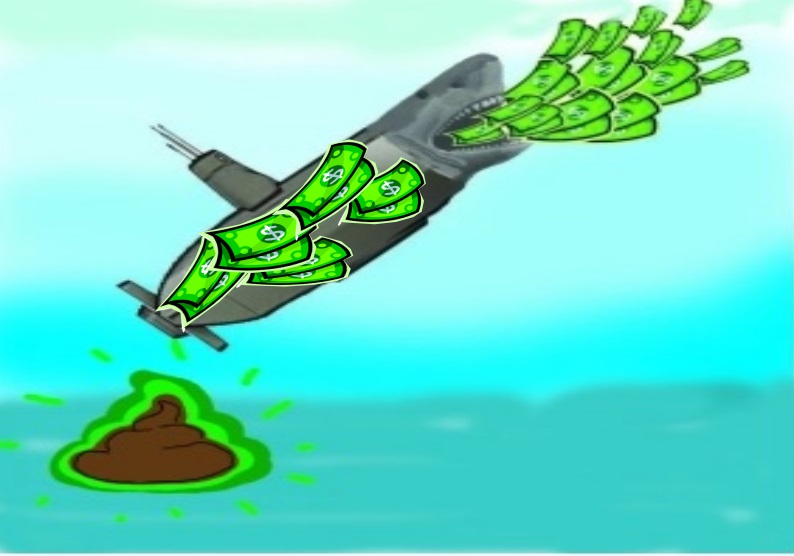
Good news on nukes: US can’t sell Australia nuclear subs, Pearls an Irritations, By Brian Toohey Jul 12, 2023
The good news is the US can’t sell Australia the three to five used Virginia class nuclear subs that the Albanese government has announced it will buy. Nor will it sell us any new ones.
The chief of US Naval operations Admiral Michael Gilday was recently reported from Washington as saying the US shipyards are only producing subs at a rate of about 1.2 a year. He says a minimum of two a year is needed to fill the Navy’s own requirements. Until then, he said, “We’re not going to be in a position to sell any to the Australians”. A senior Biden advisor, Kurt Campbell added there was also “a troublingly large number of submarines in drydock that needed to be back into the water quickly”.
If Albanese were genuinely a good friend of America, he would say, “We don’t want to deprive you of any nuclear submarines, so we’ll buy readily available conventional subs that serve our needs”. Instead of grabbing this chance to get out of an impossible commitment, he behaves as if everything is still on track.
Another reason to abandon the whole idea of getting US nuclear subs is that Campbell also said that if any were sold to Australia, they would not be “lost to America”. In other words, the US could use them whenever it liked under the policy the Defence minister, Richard Marles has announced of making Australia’s equipment “interchangeable” with the Americans. Contrary to Albanese and Marles’ claims, we can’t have a sovereign capability if we have to hand back US equipment we’ve just bought from it.
Selling Australia second hand subs is not feasible either, as it would reduce the total number available in the US fleet. At present, the US has 21 Virginia attack class submarines and 29 older Los Angeles class that make up its previous target of 50. Serious maintenance problems mean that only a quarter of the Virginia class are available for operational duties. As a result, only a quarter of the total fleet is operationally available at any one time…………………………………………………………
One big disadvantage of a US nuclear reactor is it uses weapons grade uranium fuel that has to be dismantled after the sub finishes its 33-year life. The fuel then has to be processed overseas, returned to Australia, buried in thick drums a minimum of 400 metres below stable rock and monitored for several hundred years.
These subs don’t even use nuclear propulsion. Instead, they are propelled by steam engines, like Puffing Billy. All the nuclear reactor does is heat the water to make the steam. It’s a glorified hot water system. Another big drawback is that hot water from the reactor is continuously expelled from a nuke, creating an infrared signature detectable from space. Other than at low speed, nukes leave an easily detected wake on the surface.
Worse, Rex Patrick, a former submariner and ex-Senator, has pointed out that once nuclear submarines go above a low speed, acoustic tiles on their hulls become loose and start to flap, making an easily detected noise, before some fall off.
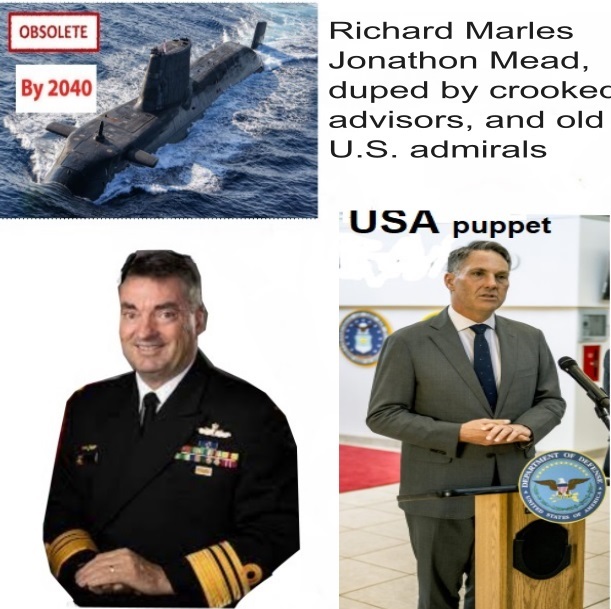
It’s now widely accepted that advances in sensor technology and data processing will render oceans transparent by 2050. Large metal boats travelling underwater will be more easily detected and destroyed than smaller ones. But Vice Admiral Mead, who had 350 staff working on the best way to get nukes, said in an interview with the Guardian that the answer to this problem is to use small underwater drones controlled from a nuke at a safe distance. Underwater drones have a big future. However, it is much better to control them from a cheap platform rather than a massively expensive remote control device called a nuclear submarine that can’t risk being detected doing what it was purchased for.
The first of the eight we build in Adelaide might not be operationally available to almost 2050 and the last by 2070. This assumes nothing will change in the strategic outlook before then. No one knows what the future holds. Peace might have broken out if we take arms control seriously, or a war may start in response to fake intelligence about Taiwan. In the circumstances, we would be wise not to get big, expensive, easily detected submarines which will be increasingly useless.
This means choosing smaller modern conventional ones……………………………………………….
Figures Rex Patrick got from the Parliamentary research service show we could get 12 of these modern, high-quality conventional submarines for a project cost of $18 bn. This is a bargain compared to the government’s estimate of $368 bn for N subs. The next most expensive program is $16 bn for 72 F-35 trouble plagued fighter planes.
…………………………………………………… Nuclear subs also don’t have an impeccable safety record………………..
Australia doesn’t need to regularly deploy submarines into Southeast Asia, let alone up near China. Our subs are not needed because Japan, South Korea, Singapore and US all have submarines closer than us to China, the target. The Defence Strategic Review clearly recommends that Australia’s “northern approaches should be the primary area of military interest”. That’s where our submarines should mainly be deployed to dissuade an enemy entering waters where they could be sunk by one of our submarines……………………………………………………… more https://johnmenadue.com/good-news-on-nukes-us-cant-sell-australia-nuclear-subs/
TODAY. Nuclear power is SO IRRELEVANT – to climate! It’s almost funny, -but it’s NOT funny.

Today, Australia’s Prime Minister is in Germany, to joining several counties, including other big carbon polluters, in a “Climate Club” to preach about “zero carbon emissions by 2050”.
2050? It’s too late – big boys!
The Australian big boys, like those of USA – will pay lip service to a worthy principle – but it’s pointless, because Climate Change – better named as Global Heating – is upon us NOW.
The job now is to slow the Global Heating process down – by energy conservation, truly renewable energy. The job is also justice, fairness, global effort to help those most affected by the heat, floods, fires – now raging.
Oh and what about nuclear power? And those stupid little “small modular nuclear reactors (SMRs)”?
Well, one or two of them might be working commercially by 2050, having no effect on climate change.
But of course, that’s not the point, is it? Small nuclear reactors are for weaponry, for nuclear submarines etc. Those powerful blokes, (and a few token women) – they love weaponry, high-technology for killing people – war is such fun!
So they just lie about “SMRs to solve climate change”

Australia needs a nuclear power school to develop AUKUS capability: Navy chief.

Australian Navy Vice Admiral Mark Hammond says a nuclear power school should be developed out of Adelaide or Perth if Australia is serious about developing its sovereign AUKUS capability.
Mr Hammond believes a nuclear power school would help our nation reduce reliance on the US, according to Sky News host Amanda Stoker.
Failed Fukushima Fixes Falling Like Dominoes
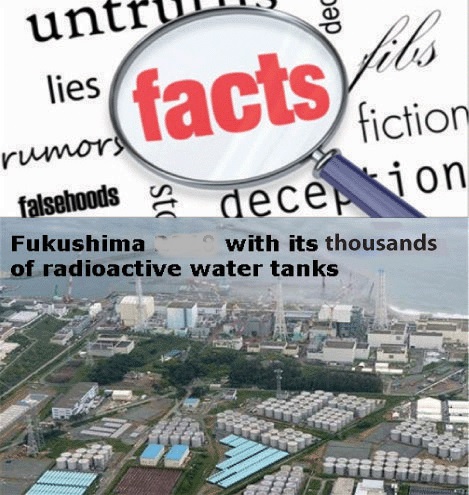
CounterPunch BY JOHN LAFORGE, 6 July, 23
“……………………………………………………………………Tepco’s cost-avoidance on its sea wall was only the first in a string of failures that have followed like dominos. The corruption led in July 2022 to convictions of four top Tepco executives for negligence and a fine of $95 billion.
In the 12 years since the meltdowns, Tepco’s disaster response efforts, always heralded as fixes, have been a series of hugely expensive failures: the “advanced” wastewater filter system “ALPS” has failed; the buried “ice wall” groundwater barrier has failed; containers made for the radioactive sludge produced by ALPS have failed; and plans to deal with millions of tons of collected debris — now kept in plastic bags — are being fiercely resisted by Japanese citizens.
Tons of cooling water is still being poured every day into Fukushima’s triple reactor wrecks to keep the hot melted fuel from again running amok. Additionally, groundwater gushes through the reactors’ foundations’ countless cracks and breaks caused by the staggering earthquake into what’s left of the structures’ sub-floors. All this water becomes highly radioactive as it passes over and through three giant masses — totaling at least 880 tonnes — of melted and mangled uranium and plutonium fuel.
You read that right. Fukushima’s destroyed reactor No. 3 was using fuel made partly of plutonium (see below), and so plutonium contaminates not just the ground and cooling water running over the melted fuel, but the ALPS apparatus, its filters, the containers used to store the radioactive sludge extracted by ALPS, and of course the sludge itself. You would think that the word plutonium would appear occasionally in news coverage of this ongoing disaster.
Failed ALPS means million-tonne do-over
Tepco’s jerry-rigged system dubbed Advanced Liquid Processing System or ALPS has never worked as planned. As early as 2013 the machinery was stalled. “The ALPS system failed to reduce radioactive elements, as claimed by the owner,” Power Technology, reported June 2, 2021.
Tepco has repeatedly said ALPS would remove 62 radioactive materials — all but tritium and carbon-14 from the continuously expanding volume of wastewater. Documents on a government committee’s website show that of 890,000 tonnes of water held at Fukushima, 750,000 tonnes, or 84 percent, contain higher concentrations of radioactive materials than legal limits allow, according to Reuters, Oct. 11, 2018. Among the long-lasting and deadly isotopes picked up by the water runs that through melted fuel wreckage are cesium, strontium, cobalt, ruthenium, carbon-14, tritium, iodine, plutonium, and at least 54 others.
In a June 14 op/ed for the China Daily, Shaun Burnie, the Senior Nuclear Specialist at Greenpeace East Asia, reported that the ALPS “has been a spectacular failure” and noted that:
“About 70 percent or 931,600 cubic meters of the wastewater needs to be processed again (and probably many more times) by the ALPS to bring the radioactive concentration levels below the regulatory limit for discharge. Tepco has succeeded in reducing the concentration levels of strontium, iodine, and plutonium in only 0.2 percent of the total volume of the wastewater, and it still requires further processing. But no secondary processing has taken place in the past nearly three years. Neither Tepco nor the Japanese government [have] said how many times the wastewater needs to be processed, how long it will take to do so, or whether the efforts will ever be successful. Greenpeace reported on these problems and why the ALPS failed nearly five years ago, and none of these issues has been resolved.”
Consequently, Tepco says it will re-filter over 70 percent of the 1.37 million tonnes of wastewater stored in giant tanks on site. Approximately 875,000 tons of contaminated water must be put through the system again, a process that will leave behind more of the highly radioactive and corrosive waste sludge.
Hoping to slow the rush to dumping, Ryota Koyama, a professor at Fukushima Univ. in Japan, said in an interview with China Media Group last May, “If the Japanese government or the Tokyo Elec Power Co really wants to discharge contaminated water into the sea, they need to explain in more detail whether the nuclides have really been removed.”
Ice wall also melts
Tepco intended to reduce the volume of groundwater gushing into the reactor building foundations by digging a $350 million “ice wall” into the earth between the destroyed reactors and the mountains behind. The company placed 1,568 heavy pipes filled with coolant 90 feet deep. It was to freeze the ground to form a deep impenetrable barrier, diverting groundwater to either side of the destroyed six-reactor Fukushima complex and prevent it seeping inside. It has failed to do so, The Guardian reported. In 2016, the Times of London reported that the scheme had only a “minor impact” on the volume of groundwater rushing in, which at the time still averaged 321 tonnes a day. Tepco announced then that it would retrofit the system and fix the leaks, but Science/The Wire reported in January 2022 that the company had admitted that its ice wall was “partially” melting. About 150 tonnes per day still gushes in.
Filtered sludge burning through containers
The ALPS filter has produced over 4,000 large containers filled with highly radioactive slurry and sludge left from the treatment.
Like the use of the word “advanced” in the name of the failed ALPS machinery, the cylinders used for the caustic, highly radioactive sludge are called “High Integrity Containers” or HICs, but in fact they are made of plastic and have degraded far faster than Tepco anticipated.
By March 2, Tepco had filled 4,143 containers, according to the daily Asahi Shimbun. At 30 cubic feet each, the cylinders now store a total of about 124,290 cubic feet of the highly radioactive sludge that will soon require expensive repackaging and, eventually, isolation from the biosphere for thousands of years.
Over two years ago, on June 8, 2021, Japan’s Nuclear Regulation Authority (NRA) announced that 31 of the containers had “exceeded their lifespans” and were corroded badly enough by the harsh toxic material that they must be replaced. The NRA also warned that another 56 cylinders would need replacing within two years.
Japan’s Mainichi newspaper reported that the government regulators blamed Tepco for “underestimating the radiation the 31 plastic cylinders were exposed to.” The company then claimed it would start moving the contents to new containers.
The Asahi Shimbun reported April 27, 2023, that the HICs must be stored in concrete boxes that can block radiation evidently being emitted by the HICs. https://www.asahi.com/ajw/articles/14883115
Rad waste to be dumped, deregulated
As early as next month, Japan intends to begin dispersing 1.37 million tonnes of contaminated wastewater into the Pacific Ocean. The government has steadfastly ignored fierce local and international opposition to the plan from the fishing community, marine scientists, Pacific Island nations, environmentalists, South Korea, and China. So far only South Korean politicians have suggested bringing international legal action against the dumping.
Since the 2011 meltdowns spewed radioactive materials broadly across Japan’s main island, some 14-million tonnes of cesium-contaminated soil, leaves, and debris have been scraped from the ground and stored in one-tonne bags. Citizens are struggling desperately prevent authorities from using the radioactive waste in road building or burning it in incinerators. The bags are currently stacked in tens of thousands of piles all over the region.
Even more protest was raised last February 10 when the NRA said it would allow Tepco to severely weaken its monitoring of the wastewater’s radioactivity. The NRA said would but the number of radioactive elements to be measured from 64 to 34.
The environment minister of Hong Kong — a coastal metropolis of 7.5 million people — charged in June that Japan is “violating its obligations under international law and endangering the marine environment and public health.” Minister Tse Chin-wan wrote in the daily Ta Kung Pao that Hong Kong would “immediately prohibit imports of seafood caught off the coast of Fukushima prefecture.”
Plutonium Spread Long Distances from Fukushima
Very few reports of the Fukushima catastrophic releases of radiation have mentioned plutonium contamination. Yet plutonium was used in fuel rods in Fukushima’s reactor number 3 which was destroyed by meltdown and several hydrogen explosions. Plutonium is one of the most toxic substances known to science, and fine particles are far more biologically hazardous than larger particles.
Following the March 14, 2011 explosion, experts worried about the release of extremely dangerous radioactive substances, and then a week later, on March 21 and 22, Tepco announced that it had detected plutonium in soil collected from its compound. (Fukushima Meltdown: The World’s First Earthquake-Tsunami-Nuclear Disaster, Takashi Hirose, Asahi Shimbun Publications, 2011, p. 51)
Now, studies published in the journals Science of the Total Environment, Nov. 15, 2020, and Chemosphere, July 2023, report that researchers found that cesium and plutonium “were transported over long distances,” and that deposits of them were recorded in “downtown Tokyo,” about 142 miles from the meltdowns.
According to the authors, very high concentrations of radioactive cesium were released during the accident as particles referred to as “cesium-rich micro-particles” (CsMPs). The researchers say CsMPs they found are mainly composed of silicon, iron, zinc, and cesium, and minor amounts of radioactive tellurium, technetium, molybdenum, uranium, and plutonium.
The studies, involving scientists from six countries and led by Associate Professor Satoshi Utsunomiya, a researcher at Kyushu University, found that “plutonium was included inside cesium-rich micro-particles that were emitted from the site.”
Radioactive CsMPs released from Fukushima are a potential health risk through inhalation. “Given the small size of the particles, they could penetrate into the deepest parts of the lung, where they could be retained,” Utsunomiya wrote. “The route of exposure of greatest concern is inhalation,” the authors reported, because plutonium, lodged in the lungs, can “remain for years.”
Utsunomiya summed up his team’s work saying, “It took a long time to publish results on particulate [plutonium] from Fukushima … but research on Fukushima’s environmental impact and its decommissioning are a long way from being over.”
John LaForge is a Co-director of Nukewatch, a peace and environmental justice group in Wisconsin, and edits its newsletter. https://www.counterpunch.org/2023/07/06/failed-fukushima-fixes-falling-like-dominoes/
Heatwaves: Why this (Northern) summer has been so hot

It is hot. Very hot. And we are only a few weeks into summer. Texas and
part of the south-west of the US are enduring a searing heatwave. At one
point, more than 120 million Americans were under some form of heat
advisory, the US National Weather Service said. That is more than one in
three of the total population.
In the UK, the June heat didn’t just break
all-time records, it smashed them. It was 0.9C hotter than the previous
record, set back in 1940. That is a huge margin. There is a similar story
of unprecedented hot weather in North Africa, the Middle East and Asia. No
surprise, then, that the European Centre for Medium-Range Weather forecasts
said that globally, June was the hottest on record. And the heat has not
eased. The three hottest days ever recorded were in the past week,
according to the EU climate and weather service, Copernicus.
These highs are in line with what climate models predicted, says Prof Richard Betts, climate scientist at the Met Office and University of Exeter.
“We should not be at all surprised with the high global temperatures,” he says. “This is all a stark reminder of what we’ve known for a long time, and we will see ever more extremes until we stop building up more greenhouse gases in the atmosphere.”
When we think about how hot it is, we tend to think about the air temperature, because that’s what we experience in our daily lives.
But most of the heat stored near the surface of the Earth is not in the atmosphere, but in the oceans. And we’ve been seeing some record ocean temperatures this spring and summer.
The North Atlantic, for example, is currently experiencing the highest surface water temperatures ever recorded.
That marine heatwave has been particularly pronounced around the coasts of the UK, where some areas have experienced temperatures as much as 5C above what you would normally expect for this time of year……………………………………………………………
Most of the extra heat trapped by the build-up of greenhouse gases has gone into warming the surface ocean, he explains. That extra heat tends to get mixed downwards towards the deeper ocean, but movements in oceans currents – like El Niño – can bring it back to the surface.
“When that happens, a lot of that heat gets released into the atmosphere,” says Prof Lenton, “driving up air temperatures.”
It’s easy to think of this exceptionally hot weather as unusual, but the depressing truth is that climate change means it is now normal to experience record-breaking temperatures.
Greenhouse gas emissions continue to increase year on year. The rate of growth has slowed slightly, but energy-related CO2 emissions were still up almost 1% last year, according to the International Energy Agency, a global energy watchdog.
And the higher the global temperature, the higher the risk of heatwaves, says Friederike Otto, a climatologist at the Grantham Institute of Climate Change at Imperial College London.
“These heatwaves are not only more frequent, but also hotter and longer than they would have been without global warming,” she says.
Experts are already predicting that the developing El Niño is likely to make 2023 the world’s hottest year.
They fear it is likely to temporarily push the world past a key 1.5C warming milestone.
And that is just the start. Unless we make dramatic reductions to greenhouse gas emissions, temperatures will continue to rise.
The Met Office said this week that record June temperatures this year were made twice as likely because of man-made climate change.
These rising temperatures are already driving fundamental and almost certainly irreversible changes in ecosystems across the world………………………………….
The world is effectively in a race.
It is clear we are speeding towards an ever hotter and more chaotic climate future, but we do have the technologies and tools to cut our emissions.
The question now is whether we can do so rapidly enough to slow the climate juggernaut and keep the impacts of global warming within manageable boundaries.
BBC 9th July 2023https://www.bbc.com/news/science-environment-66143682
1 This month.


PETITION – To: Prime Minister Anthony Albanese and the Australian Labor Government
Chernobyl: The Lost Tapes – A good documentary on Chernobyl on SBS available On Demand for the next 3 weeks– https://www.sbs.com.au/ondemand/tv-program/chernobyl-the-lost-tapes/235274195556
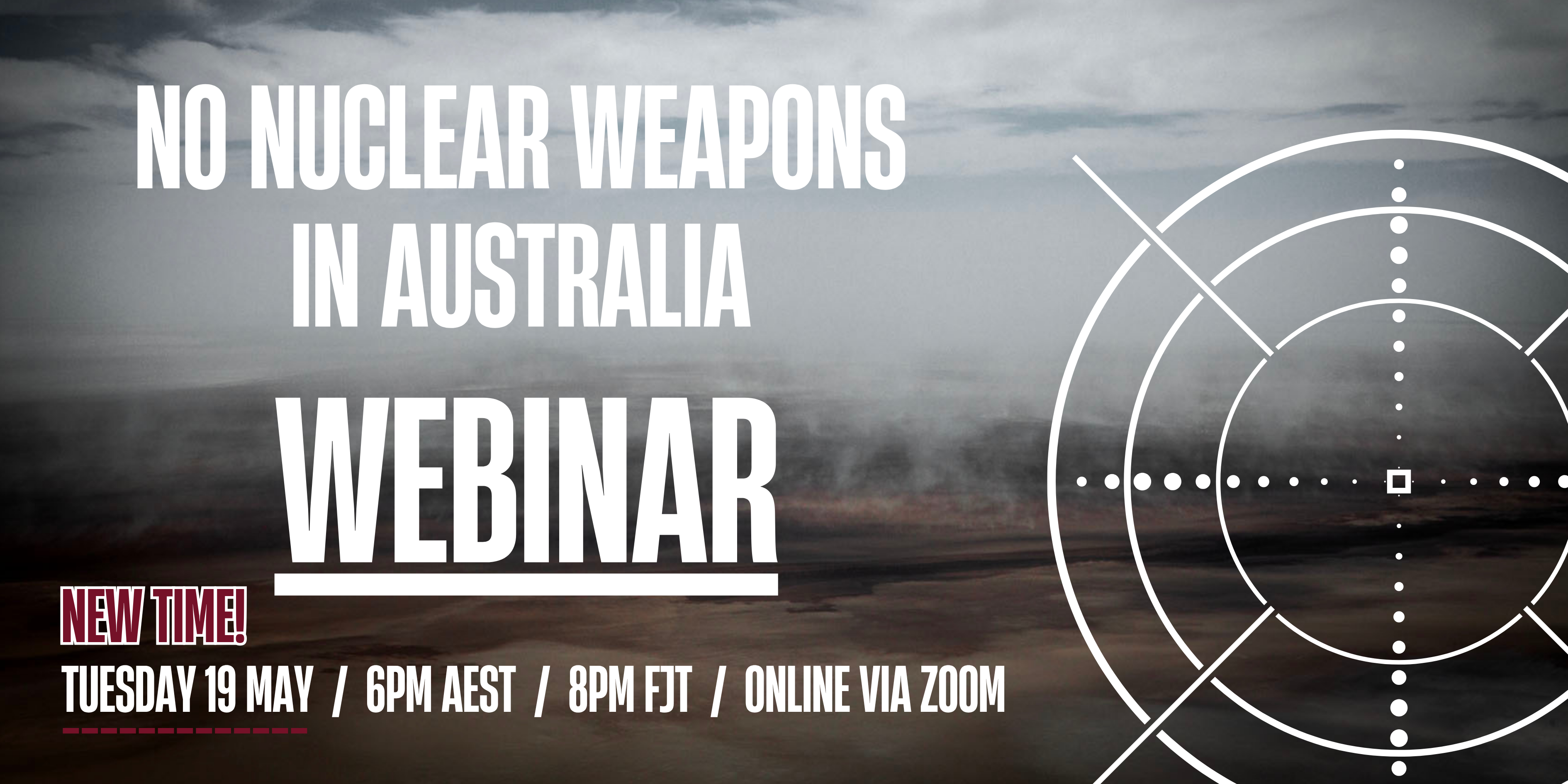
19 May – Webinar- Webinar: No Nuclear Weapons in Australia
Start: 2026-05-19 18:00:00 UTC Canberra, Melbourne, Sydney (GMT+10:00)
End: 2026-05-19 19:30:00 UTC Canberra, Melbourne, Sydney (GMT+10:00)
20 May – Webinar – The dangerous world of AUKUS, US, military occupation and suppression of dissent

National Webinar, 20th May, 2026, 6.30pm AEST. Confronting laws restricting/suppressing protest speech and action
Speakers: Former Sen. Rex Patrick, Lawyer Nick Hanna ,Arthur Rorris ,Jorgen Doyle, Sen David Shoebbridge,
Facilitator Kelley Tranter.

of the week – Australians for War Powers Reform (AWPR)
To see nuclear-related stories in greater depth and intensity
 Antinuclear