19 May – Webinar: No Nuclear Weapons in Australia
Go to https://actionnetwork.org/events/webinar-no-nuclear-weapons-in-australia
Start: 2026-05-19 18:00:00 UTC Canberra, Melbourne, Sydney (GMT+10:00)
End: 2026-05-19 19:30:00 UTC Canberra, Melbourne, Sydney (GMT+10:00)
Event Type: Virtual
A virtual link will be communicated before the event.
Host Contact Info: australia@icanw.org
No Nuclear Weapons in Australia: Webinar
As plans advance for Australia to host US nuclear-capable B-52 bombers and potentially nuclear-armed submarines, there are increasing concerns about the potential for Australia to unknowingly host American nuclear weapons in future. This is particularly concerning against a backdrop of Australia accepting US policy to neither confirm nor deny the presence of nuclear weapons.
Recently, over 150 civil society organisations across Australia and the Pacific launched the ‘No Nuclear Weapons in Australia’ Declaration calling on the Albanese government to push back on these policies of nuclear ambiguity and to reject Australia having any role in nuclear war. This declaration underscores that the security of a nation cannot be bought at the risk of the survival of humanity and the planet’s ecosystem, and that our region’s nuclear-free status is too precious to risk.
Join to hear eminent voices on nuclear policy, disarmament, advocacy and international humanitarian law in relation to Australia’s role in the global nuclear landscape. Together we’ll explore what the Declaration is asking for, what it means for Australia’s place in the Pacific, and what we can do together keep the pressure on.
The humanitarian consequences of even a single detonation, whether accidental or intentional, cannot be understated as it would be catastrophic and irreversible. No health system or humanitarian agency has the capacity to respond to the aftermath of a nuclear explosion; there is no “cure” for a nuclear catastrophe, only prevention. Beyond the immediate blast that would incinerate surrounding areas, the resulting radiation would inflict multi-generational health crises.
Speakers include:
- Janet Craven, Director, ICAN Australia
- Dr Emma Shortis, Director of International & Security Affairs Program, The Australia Institute
- Joey Tau, Coordinator, Pacific Network on Globalisation (PANG) and Chair of the Pacific Regional NGO (PRNGO) Alliance.
- Prof Richard Tanter, Senior Research Associate at the Nautilus Institute, and Honorary Professor at the School of Political and Social Science, University of Melbourne.
- Vince Scappatura, Sessional Academic in the School of International Studies at Macquarie University, and author of ‘The US Lobby and Australian Defence Policy’.
- More to be announced
This event is co-hosted by ICAN Australia and the Pacific Network on Globalisation (PANG).
‘Critical time’: Minister’s ominous nuclear warning as US looks to resume tests
Australia has delivered a message on nuclear weapons that could put Canberra at odds with the US and Donald Trump.
Benedict Brook in New York, April 29, 202 https://www.news.com.au/technology/innovation/military/critical-time-ministers-ominous-nuclear-warning-as-us-looks-to-resume-tests/news-story/2f432583102962402e8b922db84eeb8e
Australia has said “all nations” – including the US – should refrain from nuclear weapons testing after Donald Trump announced plans to potentially start exploding nukes for the first time in more than three decades.
Assistant Minister for Foreign Affairs and Trade Matt Thistlethwaite said the globe was entering a “critical time” where limits on weapons of mass destruction are being eroded
He is in New York this week representing Australia at a United Nations review of efforts to stop the spread and use of nuclear weapons.
Mr Thistlethwaite also told news.com.au that on the sidelines of the meeting he had held “frank conversations” with nations such as Japan, South Korea and Singapore to get “assurances” on fuel supplies to Australia.
‘Critical time’ for stopping nuclear weapons
The UN’s Treaty on the Non-Proliferation of Nuclear Weapons (NPT) entered into force in 1970 and now has 191 signatories, with notable exceptions being nuclear nations India, Pakistan and Israel.
The aim of the treaty is to stop the spread of nuclear arms and push for disarmament.
But New START, the last agreement to prevent the US and Russia from building more bombs, expired in February.
There are now concerns that a global nuclear arms race could be on the cards.
On Monday, UN Secretary-General Antonio Guterres told the New York meeting, “for too long, the treaty has been eroding.”
“The drivers of (nuclear) proliferation are accelerating.”
There’s little expectation the conference will notably change that gloomy outlook.
Critical time’
Asked if Australians should be concerned about the threat of nuclear weapons, Mr Thistlethwaite told news.com.au the New York review “does occur at a critical time.”
“We’ve got increasing uncertainty in the global geostrategic situation, particularly around the Middle East and Ukraine, and there’s increasing tension within the Asia Pacific region.
“We’re going to make sure that Australia plays a role in de-escalation, supporting peaceful outcomes and upholding the international rules.”
“We want to see a world where the spread of nuclear weapons is prevented … and we’ve been a loud voice in ensuring that nations shouldn’t be involved in testing nuclear weapons anymore.”
No nation should test nukes – including US
But one louder voice doesn’t seem to be on the same page as Australia.
In October, Donald Trump said the US would resume nuclear weapons testing “on an equal basis” with other nations.
“That process will begin immediately,” he said.
Mr Trump’s comments have led to confusion about what new US nuclear testing might involve.
The last country to explode an actual bomb was North Korea in 2017. The US and Russia haven’t tested nuclear weapons since the early 1990s. But Vladimir Putin claimed recently that Russia had tested a nuclear-powered torpedo that was capable of carrying nuclear weapons.
Would Australia be against the US resuming tests with actual nuclear bombs?
“We’re against all nations testing nuclear weapons,” Mr Thistlethwaite said, who did not mention the US by name.
“We know Maralinga (the UK’s 1950s nuclear weapons testing site in Australia) had a lingering effect on the Indigenous community.
“We want to make sure that we don’t see those situations in our region again, or indeed anywhere in the world.”
Iran nuclear role ‘not appropriate’
There was uproar at the UN NPT conference when Iran was announced as one of 34 vice presidents of the event.
Assistant Secretary for the US Bureau of Arms Control and Non-proliferation Christopher Yeaw told the conference it was an “affront” that Iran had been appointed to the role.
“(It is) indisputable that Iran has long demonstrated its contempt for the non-proliferation commitments of the NPT.
Iran’s role was “beyond shameful and an embarrassment to the credibility of this conference,” he was reported by Reuters as saying.
Ms Thistlethwaite said Australia had “expressed its concern and opposition” to Iran’s elevation.
“That wasn’t the appropriate move, and we’ve expressed our support for the United States position”.
‘Frank conversations’ with oil nations
Mr Thistlethwaite added that he had meetings with countries on the fringes of the event, including those critical to Australia’s energy security.
“An important part of this trip is working with our international partners on securing Australia’s fuel supplies,” he said.
“Most of our refined oil products come through Southeast Asia, so I’ve had meetings with (South) Korea, Singapore, Japan, Vietnam … to reiterate the importance that open trade and supplies continue to get through.
“It’s been heartening to have those frank conversations with those partners, to get those assurances regarding continued fuel supplies and to ensure that they remain trusted partners for Australia.”
Mr Thistlethwaite mentioned Australia’s trump card with nations that export oil – Australia’s abundance of liquid natural gas (LNG), which many countries need just as keenly.
“We’re a big supplier of LNG exports to countries in the region, and we’ve been making sure that we reiterate that fact that we’re a reliable supplier that will continue and the relationship with those important fuel partners is in a pretty strong position.”
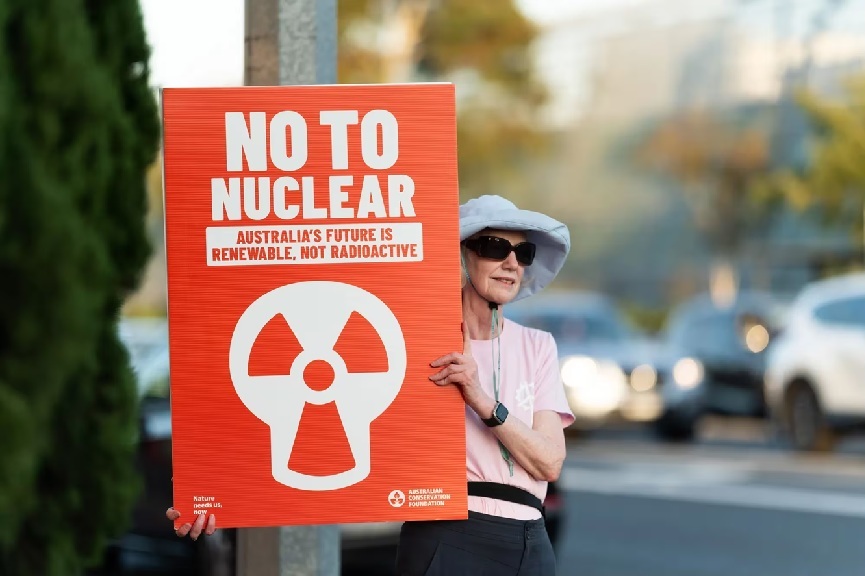
Toxic fantasy nuked; one year on from the Federal election
, https://www.acf.org.au/news/toxic-fantasy-nuked-one-year-on-from-the-federal-election
Exactly one year ago Australians braved the how to vote cards, ate or avoided democracy sausages and used a pencil to help write the next part of the Australian story.
In the months leading up to the 2025 federal election, papers, airwaves and social media platforms were full of talk about nuclear.
Then Opposition Leader Peter Dutton dubbed the 2025 federal election ‘a referendum on nuclear power’. It was the biggest policy difference between the two major political parties. The Coalition promised to build multiple nuclear reactors at seven sites across Australia while Labor, the Green and most independents opposed this nuclear plan and strongly supported renewables.
Nuclear proponents spent large, promised much and did their best to sidestep scrutiny over cost, timing, water, waste and more.
Environment groups joined with trade unions, public health experts, First Nation representatives and community members from regions targeted for reactors to make the case for a renewable energy future, free from nuclear risk and delays.
The message was clear: Nuclear is too risky, too expensive and too slow.
And at the end of months of talk, talkback, information stalls, protests and public forums, Australia voted.
And voted unequivocally no to nuclear.
The Coalition had its worst defeat since the formation of the Liberal Party in 1944, and nuclear champion Peter Dutton became the first sitting federal Opposition Leader in Australian history to lose their own seat at a general election. Seven News political editor Mark Riley described the Coalition result as ‘catastrophic’, adding “the party that chose nuclear energy as its policy has exploded in a nuclear bomb set on them by the voters tonight.”
Voters saw the Coalition’s nuclear fantasy for what it was: a toxic furphy designed only to prolong the life of coal and gas. They made a conscious and clear decision to reject nuclear power and provide our politicians with a clear mandate to get on with harnessing Australia’s abundant renewable energy resources to power our country.
Renewables already meet around half of Australia’s electricity needs, and this figure is growing every day.
Responsible renewables mean lasting regional jobs, low carbon and proven power.
Renewables also mean energy independence and energy security. Ships in the Strait of Hormuz might stop, but the wind and sun do not.
One year ago, Australians had a clear energy choice – and right across the nation we made a clear energy decision – our energy future is renewable, not radioactive.
Royal commission report doesn’t help us start making sense of Bondi terror attack
The Conversation, Keiran Hardy, Associate Professor, Griffith Criminology Institute, Griffith University, April 30, 2026 Justice Virginia Bell has handed the governor-general her interim findings from the Royal Commission into Antisemitism and Social Cohesion. Prime Minister Anthony Albanese responded immediately by promising to implement all its recommendations.
The interim report recommends specific changes to counter-terrorism policy – and a speedy resolution to the lagging gun buyback scheme.
These sorts of changes may help. But they don’t begin to answer deeper questions about how a terror attack on that scale could occur in Australia. The commission is yet to examine how underlying conditions might have fuelled the attack, and what else governments, their agencies and we as a society must do to prevent such a tragedy from happening again.
What does the interim report recommend?
The interim report contains 14 recommendations, five of them confidential.
Of the nine public recommendations, nearly all focus on counter-terrorism policy and the ways government agencies operate. For example, recommendations three through six focus on the Australia-New Zealand Counter-Terrorism Committee: a high-level coordination body made up of senior members of government.
The interim report recommends the committee be included in the Australian government’s Crisis Management Framework. The committee should brief National Cabinet at least annually.
Recommendation seven says ministers on the National Security Committee of cabinet should participate in a counter-terrorism exercise within nine months of each federal election.
These changes will not stop a terrorist from committing another attack. And most Australians could be forgiven for having never heard of these committees.
There’s also no reason why this all couldn’t have been investigated, possibly more quickly, by the original, departmental inquiry announced by Albanese. This was to be led by former head of ASIO, Dennis Richardson.
Richardson recently resigned from the royal commission, saying he felt like an overpaid research officer. He was also worried the process would take too long to deliver concrete recommendations on policing and intelligence…………………………………………………………………..
What can we expect next?
Public hearings for the royal commission will begin next week. In the first round, people with lived experience of antisemitism are expected to give evidence.
After that, it remains to be seen where the inquiry will direct its focus.
Its terms of reference are extremely broad, covering antisemitism, social cohesion, training for law enforcement, border control and immigration, radicalisation, specific circumstances surrounding the attack, and anything else that might be “reasonably incidental” or relevant.
It has so far received more than 3,500 submissions. The commission must report back by December 14 this year, before the one-year anniversary of the attack.
To report meaningfully on all these topics on such a pressured timeline will be a monumental task. Some focus may be necessary, but there will be valid differences of opinion as to whether this inquiry is primarily about antisemitism, social cohesion, counter-terrorism, radicalisation, the Bondi attack, or all of the above.
At the moment, it is about all these things, which may ultimately undermine what it is able to contribute on any one.
Bell clearly knows the scale of the task. She has warned that “examining the ways in which we might strengthen social cohesion in Australia could well be the work of years, not months”.
For now, there is little in the interim report for Australians to start making sense of last year’s terror and tragedy in Bondi. https://theconversation.com/royal-commission-report-doesnt-help-us-start-making-sense-of-bondi-terror-attack-281859?utm_medium=email&utm_campaign=Latest%20from%20The%20Conversation%20for%20May%201%202026%20-%203756238464&utm_content=Latest%20from%20The%20Conversation%20for%20May%201%202026%20-%203756238464+CID_8e5ae0e85bb178c16e80a5a039f5de96&utm_source=campaign_monitor&utm_term=Royal%20commission%20report%20doesnt%20help%20us%20start%20making%20sense%20of%20Bondi%20terror%20attack
Antisemitism Royal Commission dilemma: not all Jews think the same
None of this is to excuse ‘real’ antisemitism. If the latest Pew Research Center survey, just released in the last few days in the USA, is anything to go by, 60% of US adults have an unfavourable view of Israel.
by Jeffrey Loewenstein | Apr 27, 2026 |
With the Antisemitism Royal Commission due to publish its interim report this week, a reckoning between Judaism and Israel is long overdue. Jewish community leader Jeffrey Loewenstein with the story.
Let it be said, unequivocally, antisemitism per se, as indeed any form of vilification or bigotry, is to be abhorred and has no place in a civilised community.
The vexed question of antisemitism, and what that actually means and encompasses – let alone how to combat it – will be front and centre of the Royal Commission on Antisemitism and Social Cohesion’s deliberations and, one assumes, findings.
The so-called majority of the Jewish community for whom the likes of the ECAJ, the Zionist Federation, AIJAC and the NCJW seek to speak, have shown themselves as either unequivocally positive mouthpieces supporting Israel’s actions – be it the invasion of Gaza, the killing and maiming of its people, starving Gazans, demolishing Gazan infrastructure, denying medical supplies and equipment entering Gaza, the lawlessness, the so-called settlers in the West Bank, etc.,
“or simply staying silent, no matter how egregious Israel’s actions have been.“
To say that it demonstrates an indifference to the suffering of the Gazans or the Palestinians in the West Bank is putting it mildly. It certainly demonstrates a lack of humanity and an absence of a moral compass.
And this from a people who claim to abide by the Ten Commandments and the edict of Rabbi Hillel, “That which is hateful to you, do not do unto your fellow.” That is the whole Torah; the rest is the explanation; go and learn.” (Babylonian Talmud, Shabbat 31a).
Israel’s ‘success’
The man in the street who probably considers Israel as a ‘successful’ smart country, a leader in technology and medicine, with a ‘smart’ Mossad security service, watching the nightly news bulletin with its stark images of the wanton killing and maiming of Gazans by the Israelis and children starving – and now the ongoing onslaught being undertaken by the Israelis in Lebanon – is going to be left angered and wondering how it is Israel – or is it simply the Jews – are allowing all of this to happen.
Add to that seeing Jews in Australia regularly parading with Israeli flags draped around their shoulders and waving small Israeli flags is almost certainly going to lead the average person to accept what Israeli PM Netanyahu has been saying for years – that Israel, and he, speak for and represent all Jews in the world.
“As for this writer, certainly not!“
Even our political leaders are confused. One Federal Minister justified the entry into Australia of Israeli President Herzog on the grounds that the Jewish community sought comfort post Bondi from “their national leader”. Again, not true for many.
A royal dilemma
The Royal Commissioner is going to be confronted with some stark facts. For starters, how the majority of Jews view Israel and support it.An example relating to those tragically slain in Bondi: video footage and photos of the Bondi Chabad rabbi post October 7, handing over monies in the West Bank in support of the settlers and posing with a rifle and rocket.
The ready conflating of being anti-Israel and what is said to be antisemitism is nowhere better seen than in the ECAJ Report on antisemitism in Australia, citing as part of its statistics how, allegedly, antisemitism has risen in Australia post October 7 by something such as a daubing on a wall “Free Palestine”.
The Special Envoy on antisemitism, Jillian Segal, would have us believe that the weekly protest marches, and even the eventful march across the Sydney Harbour Bridge (under the Banner, March for Humanity), engendered antisemitism.
Antisemitic or anti-Israel?
There have been many attempts to conflate being anti-Israel with being antisemitic, including pushing the IHRA “definition” of antisemitism.
Aside from many learned Jewish scholars challenging the definition, many Jews, critical of Israel, would be “caught” as being anti-Semitic. Members of the Australian Jewish community are now publicly (even on ABC Radio National) resorting to calling those Jews who speak out about Israel’s actions as being “anti-Jewish”.
Interestingly, a research report, ‘The Journeys and Destinations of Young Jewish Anti-Zionists’, out of the USA a couple of months ago, concluded, inter alia, that many said to be anti-Zionist were deeply knowledgeable about Jewish practice and history, with some having attended Jewish day schools and some serving as rabbis.
There is no reason to think that those findings in the USA would not equally apply in Australia.
It has hardly been surprising that people have been venting their anger at Israel’s actions. The weekly demonstrations for more than 2 ½ years are clear evidence of that.
“The Royal Commissioner and the majority of Jews in Australia are going to have to grapple with anti-Israel sentiment.“
And in both political parties, majorities of adults under the age of 50 now rate Israel and Netanyahu negatively, and six-in-ten have a very or somewhat unfavourable view of Israel. It is likely a survey in Australia would parallel the US one.
The Royal Commissioner will be hard-pressed to come up with definitive findings as her mandate requires. For their part, there are going to be many Jews unable to explain why there has been this so-called antisemitism as distinct from things best described as simple anti-Israeli / anti-Zionist sentiment.
One very obvious question, and the critical one which is the elephant in the room no one seems to want to ask is,
“why is it that this so-called and alleged antisemitism has risen since 7 October?“
Jeffrey Loewenstein
Jeffrey Loewenstein LL.B was a member of the Victorian Bar and a one-time Chairman of the Anti-Defamation Commission and member of the Jewish Community Council of Victoria.
Nuclear-related news – week to 2 May

Some bits of good news –
Nightingales coming back to England
An infectious eye disease was eradicated in Australia. 57 governments gathered for the first
conference on transitioning away from fossil fuels.
(These 3 articles come from Positive News – a helpful. positive resource)
TOP STORIES.
Adi Roche: My nightmare is that the next Chernobyl event occurs at Chernobyl itself.
Yanis Varoufakis on Palantir and its 22 points.
Charles III and Britain’s pathological obsession with Russia.
Genocide—and Complicity: Washington Insider Says the Word They Avoid – https://www.youtube.com/watch?v=5iCZtbIPmss
From the 1953 Coup to Today: Jeffrey Sachs Explains America’s Endless War on Iran.
Climate. Hope is contagious and science is king: 10 big lessons on ending the fossil fuel era. Nations have chance to break ‘fossil fuel mindset’: Mary Robinson.
Toxins plus climate harms likely cause of reduced fertility, study finds.
Noel’s notes. If scientific facts are uncomfortable to us, well don’t worry – they can be changed.
AUSTRALIA.How AUKUS is Becoming the Largest Wealth Transfer in Australian History – and Why the Government Won’t Tell You the Cost.
UK parliament’s AUKUS inquiry report questions if Britain can keep nuclear submarine promises.
Antisemitism Royal Commission dilemma: not all Jews think the same.
The Enforcement- The lobby that bought Australian democracy. Antisemitism and Israel: A challenge to the Australian narrative.
Australia’s “Antisemitism Envoy” Makes It Clear That Israel’s Critics Are The Real Target.
More Australian news at https://antinuclear.net/2026/04/28/australian-nuclear-related-news-week-to-2nd-may/
NUCLEAR-RELATED ITEMS
| ATROCITIES. Settler pogroms in Palestine are part of Israel’s illegal expansion policy. Obliteration Ecocide from Gaza to Lebanon and Beyond. |
| ECONOMICS. Nuclear Fusion’s Funding Rush Comes With a Catch. https://www.youtube.com/watch?v=AAJTkL99anI Norway says “nuclear renaissance” too expensive. EU economic sanctions ramp up NATO war plan on Russia. The US Tech Giant Where Employees Wear Israeli Defense Fprce Uniforms To Work |
| ENERGY. Renewables Mix Beats Nuclear on Price in Future Energy Systems. Perspectives on nuclear power. |
| ENVIRONMENT. The Buzz About Chornobyl, 40 Years Later – How Do We Tell the Bees? |
| ETHICS and RELIGION. US and Israel Claimed to Be Fighting for Iranian Minorities — While Bombing Them. Trump to America…’No dough for the Commons. I need it for my criminal wars’. Who Decides What Is a Just War? – Imperial Violence and the Lies We Tell About Peace. |
| EVENTS. 19 May – Webinar- Webinar: No Nuclear Weapons in Australia |
| HEALTH. LEST WE FORGET – REMEMBERING THE HUMAN IMPACT OF THE CHORNOBYL DISASTER. |
| MEDIA. Israel Kills Journalist in Lebanon After “Hunting” Down Her and a Colleague. Nuclear Abolition- A Scenario |
| PERSONAL STORIES. ‘I miss our land. Chernobyl broke us’: The families who lost their homes after world’s worst nuclear accident. No contact, no fresh air: 206 days aboard a nuclear submarine. Is President Trump mentally unstable? (Part 2). |
POLITICS.
- What are Palantir’s 22 points?
- Entire NSF science advisory board fired by Trump administration.
- Key US science panels are being axed — and others are becoming less open.
- Dangerous and expensive, nuclear power is a dead end for Scotland – ALSO AT https://nuclear-news.net/2026/05/02/4-b1-dangerous-and-expensive-nuclear-power-is-a-dead-end-for-scotland/
- Why should Scotland wait 15 years for nuclear power we don’t need?
- UK nuclear industry in lobbying blitz ahead of Scottish election – ALSO AT https://nuclear-news.net/2026/04/29/1-a-uk-nuclear-industry-in-lobbying-blitz-ahead-of-scottish-election/
- Rosyth councillor Brian Goodall wants public consultation on Trident nuclear submarines.
POLITICS INTERNATIONAL and DIPLOMACY.
- Iran’s Supreme Leader Says It Won’t Give Up Nuclear Assets In Rare Public Statement.
- State Dept. spills the beans…’Bibi made Trump do it’
- Starmer’s Talking Points: King Charles III Visits Washington.
- In the Strait of Hormuz, Iran Is the Pretext—China Is the Target.
- Jeffrey Sachs: Trump’s Failure in Iran Exposes the Crumbling Myth of U.S. Hegemony.
- American “Micro-Militarism: Or How Defeat in the Iran War Will Accelerate American Global Decline.
- A new nuclear arms race is accelerating – There’s only one way to stop it.
- Can the NPT Keep Nuclear Weapons from Spreading? (MBN)
| PUBLIC OPINION. Poll Finds Just 4 Percent of Democrats Support Increasing Military Aid to Israel. |
| SAFETY. US to give $100 million to repair damaged Chornobyl nuclear shelter, Kyiv says. Inside Chornobyl: 40 years after disaster, nuclear site still at risk. More costs for Europe in the never-ending effort to keep Chornobyl safe. US NRC Approves 20-Year Lifetime Extensions For St. Lucie Nuclear Plants. |
| SECRETS and LIES. Three Recent Examples Of AI Being Used For Empire Propaganda. ‘Spies inside the Holy See’: Report reveals US espionage campaign targeting Pope Leo XIV. 40 years after Chernobyl, Stasi files reveal scale of Soviet misinformation. |
| SPACE. EXPLORATION, WEAPONS. Satellites launched for coming war on China. |
| SPINBUSTER. Greg Jackson brands new nuclear a ‘fantasy future’. |
| WASTES. Inside the bizarre race to secure Earth’s nuclear tombs. |
| WAR and CONFLICT. ‘Spring 2026’ Flotilla Sets Sail From Sicily To Break Gaza Blockade.- https://www.youtube.com/watch?v=LzP1tn_hEHc&t=95s Deadly strike by Ukraine at Europe’s biggest nuclear power plant as chilling warning issued. |
| WEAPONS and WEAPONS SALES. Why Expanded Plutonium Pit Production is Wrong. Reining In The Pentagon – Can the Military-Industrial Beast Be Tamed? Iran didn’t have a nuclear weapon before this war – But you can see why it would develop one now, |
Israel: The most dangerous nation on Earth

By George Grundy | 22 April 2026, https://independentaustralia.net/politics/politics-display/israel-the-most-dangerous-nation-on-earth,20955
Israel’s escalating actions and influence over U.S. policy are framed as the trigger for a global crisis, with Australia set to bear the economic fallout, writes George Grundy.een enough to say it with absolute certainty: the Israeli army is the most depraved army’ ~ Francesca Albanese, UN Special Rapporteur.
“The [IDF] is the most moral army in the world” ~ Israeli Prime Minister Benjamin Netanyahu.
‘I have seen enough to say it with absolute certainty: the Israeli army is the most depraved army’ ~ Francesca Albanese, UN Special Rapporteur.
Benjamin Netanyahu’s influence over U.S. President Donald Trump may be the defining reason why America made the catastrophic decision to go to war with Iran, which is why the Strait of Hormuz remains closed, which in turn explains why Australia seems poised to experience an unprecedented oil shock.
Many economists forecast that our economy is about to grind to a halt, perhaps for months, so Australians must be clear-eyed about the role Israel has played in this disaster.
The prevailing view in Western politics, media and society has, for many decades, been that the Middle East is a “tough neighbourhood” (implicitly absolving Israel of blame for its occasional bouts of brutality), and an assumption that the “only democracy in the region” was committed to peace and, ultimately, a two-state solution with the Palestinians.
This was and remains an absolute fiction. Even the most casual glance at a map showing the shrinking landmass of Gaza and the West Bank (particularly since 1967) makes clear that the two-state solution was a lie, a fig-leaf allowing successive Israeli governments to expand territory and further immiserate the hapless Palestinians.
Yet what was an ongoing and immoral delusion moved from disaster to catastrophe, following the atrocious attack by Hamas in October 2023. Prime Minister Netanyahu appears to have viewed the atrocity as an opportunity to implement the long-held Zionist goal of establishing a “Greater Israel”, the first stage of which was to be the complete obliteration of Gaza.
Prime Minister Anthony Albanese has attempted to walk a fine line in his relations with Israel, recognising a Palestinian state but risking significant political damage by inviting Israel’s President to our shores.
Albanese’s clinging to established international dogma, whilst a betrayal of his past beliefs, might be acceptable in earlier times, but global tectonic plates are shifting at a pace unmatched since perhaps 1945.
Australians of all political persuasions should rightly consider whether Israel is indeed a moral player on the world stage and whether our country should continue to align itself with a regime that has:
- Used snipers to deliberately target infants and children in Gaza, killing thousands and creating the largest group of childhood amputees in modern history. Israel has subsequently blocked the distribution of prosthetic limbs for survivors.
- Dropped bombs on civilians sheltering in tents, burning people alive. An Australian doctor said she delivered a baby by C-section from a nine-month pregnant woman with no head, following an Israeli strike. In late 2023, the IDF forced staff out of a Gaza hospital at gunpoint and left newborn babies to starve and die. Every hospital in the territory has now been destroyed.
- Killed at least 80,000 in Gaza (the true number is probably much higher), targeting children, medical and power facilities, schools, mosques, hospitals and ambulances, water purification, journalists and civic leaders, whilst stopping nearly all aid and medicine from entering — actions clearly aimed at devastating every aspect of civil society and starving the population. A genocide, in other words.
- Attacked and killed UN peacekeepers in Lebanon. Used banned white phosphorous and cluster munitions while destroying countless villages, and carried out clear acts of ethnic cleansing that have left over a million people displaced, including around 370,000 children. Oxfam has stated that Israeli tactics used in Gaza are now being exported to Lebanon, a nation now suffering one of the world’s worst humanitarian crises on Earth.
- Tortured and murdered Palestinian children. The IDF buried captured Palestinian children alive in mass graves, after tying their hands behind their backs. An 18-month-old Palestinian child recently taken into custody by the IDF was returned with cigarette burns on its legs, having been tortured to get a confession from its father.
- Institutionalised the practice of “double tap” attacks, whereby an initial bombing is followed by subsequent attacks on the same location, killing first responders and medics. Just last week, Israel carried out a “quadruple tap” in southern Lebanon, killing those trying to help the injured over and over again.
- Trained and used dogs to rape Palestinian detainees and prisoners (according to B’Tselem and EuroMed Human Rights Monitor). In fact, sexual torture of Palestinians is so widespread that it has been described as “organised state policy”. One UN report highlighted the use of rape with bottles, metal rods and knives.
This is far from an exhaustive list. There is much, much more, often filled with unimaginable horror and moral degeneracy. As defined by Australian law, Israel is a terrorist state and carries out war crimes and grave violations of international humanitarian law almost daily.
Recently, Israel passed a law allowing capital punishment for Palestinians found guilty of “terrorism-related” crimes (which, given how Israel practices law against Palestinians, could mean nearly anything). The law only applies to Palestinians — an Israeli convicted of the same crime is not subject to it, and judgment will be carried out by martial law, with no due process, clemency or appeal process.
National Security Minister Itamar Ben-Gvir proudly posted a video of the proposed execution chamber in which convicted Palestinians will be hanged. Armed Israeli forces have begun the practice of putting numbers on the hands of displaced Palestinians in the West Bank.
As the IDF has advanced across southern Lebanon, they have explicitly warned Christian and Druze leaders not to harbour Shiite Muslims in their homes — Jewish troops forcing one particular religious group of people out of Lebanese society, potentially searching for them in their attics. Anyone with a knowledge of history should see the historical resonance of these monstrous practices.
Race-based execution laws, genocidal destruction, institutionalised rape, pogroms in the West Bank, military expansion in nearly all directions. A network of at least 16 torture camps, where thousands are held, often without charge. Were it not such a forbidden comparison, we might spot similarities to another fascist regime in the 1930s.
Those making the connection are hardly from the fringe. Almost half of Britons in one poll said they believed Israel treats Palestinians like the Nazis treated the Jews. Ehud Olmert, a former Prime Minister of Israel, signed a letter describing settler violence in the West Bank as ‘Jewish terrorism’.
Political scientist John Mearsheimer recently said:
“If there were Nuremberg trials, right, where the Israelis and the Americans were brought before the court, President Trump, along with President Netanyahu and many of their advisors, would be hanged.”
Imagine this horror was being carried out by any nation on Earth not named Israel. Ask yourself what poses the greater threat — Iran, which until Trump tore up the JCPOA agreement was clearly not developing a nuclear bomb, or Israel, wildly attacking everyone in sight, led by a genuine maniac and possessors of the world’s only undeclared nuclear arsenal.
Far from operating the most moral army in the world, overwhelming evidence shows that Israel is now an entirely rogue state, raping, starving, torturing and murdering its prisoners, bombing its neighbours indiscriminately, annexing nearby territory and goading its patron, America, into actions that could easily lead us to a new world war.
Israel is hardly shy about its intentions. Finance Minister Bezalel Smotrich recently gave a speech in which he said, “There will be expansion in Gaza that will extend our borders. In Lebanon, to the Litani, in Syria, Mount Hermon, parts of the north, south, and east.” This would represent a “Greater Israel” plan, stretching (one might say) from the river (Litani) to the (Mediterranean) sea.
Such is the insanity of the time in which we live that voicing this same expression in Queensland will land you in prison, while it is so widely used by Israeli politicians that it’s literally in the Twitter (X) bio of the Prime Minister’s son.
Yet, despite heartening protests in Tel Aviv, poll after poll shows that a majority of Israelis support this endless militarism. Young Israelis are more right-wing, religious and conservative than their elders. An eventual end to Netanyahu’s appalling leadership seems unlikely to reform Israeli society.
An unprecedented oil shock is nearly at Australia’s shores. It’s likely to be the most devastating event for this country since the Second World War and when it arrives, Australians should remember that the crisis originated in the White House situation room on 11 February, when Netanyahu finally convinced a gullible American president to carry out his decades-long wish for an attack on Iran.
Benjamin Netanyahu is a violent extremist, a fugitive from justice at the International Criminal Court, who cannot enter even the commercial airspace of many countries for fear of arrest. It was Netanyahu who convinced Trump to catastrophically withdraw from the JCPOA, Israel that is primarily responsible for the catastrophe currently re-shaping our world and Israel who will be culpable, should a worldwide famine ensue.
Israel is the single greatest threat to world peace today. The past comfy assumptions about global partnerships are gone. Australia should join the growing list of nations that want nothing to do with this belligerent, fascistic country.
Nuclear Power and Net Zero II Symposium – REPORT ON ATTENDANCE AT THE CONFERENCE
April 24 2026, Robyn Wood, Friends of the Earth Adelaide
My friend and I arrived early at the Waite campus of Adelaide University, and they had
two security guards standing outside the main doors armed only with radios.
It was an interesting day. They are a dedicated bunch, very polite, about 70 people, and
I think they believe their heart is in the right place. They are very negative about
renewables, kept going on about “baseload power” and they expect grid collapses and
blackouts within the next 5 years. They are most insistent that nuclear is cheaper than
renewables when you take the whole big picture into account (but apparently you
shouldn’t take the cost of building a nuclear power plant into account when measuring
how much the electricity it produces costs). They cherry picked and misinformed, things
they accuse the antinuclear movement of doing, and say the general public need more
education so they learn to love nuclear.
I actually almost felt sorry for them with the current federal Labor government so
committed to renewables and antinuclear, and probably the next 2 federal governments
being Labor.
I asked electrical engineer Dr Robert Barr who presented “Integrating Nuclear into the
grid” if he had spoken to the government with his models of the NEM and pricing and he
said the government won’t speak to him but he has spoken to the opposition. He wanted
to use “cheaper gas” and I don’t know where he is going to find that with the Iran war
on. We saw his presentation last year and I asked him again what he based his costings
of long term high level waste disposal on and he still couldn’t remember but said it was
a small number. I was not very convinced.
They were even sad about all the education and scholarships going into school &
university students for AUKUS as they saw that as stealing away talent from future
nuclear power plant workers. They brought out the old chestnuts about AUKUS means
we should have nuclear power, and that because we sell uranium we should take back
the high level nuclear waste. My friend shut them up by saying we sell coal and other
products and don’t take back the waste so what makes nuclear waste special.
My friend got security called on him because he got so annoyed with former ANSTO
CEO Adi Patterson using data from 2020 and 2022 when the whole symposium was
supposed to be about advances from the last symposium in 2024 that he challenged
him. My friend interrupted Adi instead of waiting to the end asking him why his data was
so old and where was the recent data. People got cross with my friend for interrupting,
and 5 min later I noticed security standing next to him, but the guard never said
anything. One old man complained at the break to the female MC that she hadn’t run
things properly by not stopping the argument, and she said she liked passionate
discussions but they should be in the QnA section. He then said to us that she couldn’t
take criticism!
They had a whole session strongly criticising renewables and I didn’t bother taking any
notes as I didn’t believe a word of their figures and models which were based on
ChatGPT. So many of the things they picked on renewables for also applied to nuclear
power, but they didn’t mention that. One example being the environmental damage of
mining and mineral processing which applies to both, but somehow it was only a
problem for renewables.
I asked ANSTO’s GE of ‘Nuclear Operations, Safety and Security’ Miles Apperley how
many safety incidents ANSTO had had over the years, and he said he didn’t understand
my question, so I narrowed it and asked him how many safety incidents ANSTO had
had while he had worked there. He said he wasn’t avoiding the question but they had a
safety culture and everything got reported, not necessarily to do with radiation, and the
most dangerous issue was the road entering the facility where there were no traffic
lights and there had been near misses. Then he tripped over someone’s bag and made
a joke about it being a safety issue. So he got away with avoiding my question. I would
have expected he would have had those safety statistics memorized due to his
responsibilities.
We found out that ANSTO has a program of giving tours to NSW school children, and
one man who worked in the regulatory sector said they provided information to schools
but teachers returned the information as they said it was too dangerous!
They all seemed to think the disposal of high level nuclear waste was solved as
Australia has “lots of land”. So I told the panel discussion that I was interested in deep
geological waste disposal of intermediate and high level waste, and was following
Finland who were still working on their deep geological waste dump after 20 years, and
asked how the panelists planned on dealing with the UN Rights of Indigenous People
when Aboriginal people had stopped the last four efforts at a low level ANSTO dump. (I
figured Aboriginal people should be mentioned as they hadn’t been so far). Jasmin Diab
(MD of Global Nuclear Security Partners and Former President of Women in Nuclear
(WiN) Australia) chose to answer me and said 20 years to build a high level dump
wasn’t a long time. She then gave me the answer I expected, and said they had learned
not to treat Traditional Owners as ‘stakeholders’ but as ‘partners’ (what the difference is
I have no idea), and to sit down together to solve the problem, and basically bribe them
with things like jobs and doctors for the town as we saw with Kimba and Hawker. MC
Kirsty Braybon (a lawyer who was the inaugural Head of Legal for the Australian
Radioactive Waste Agency) pointed out that the UN Rights of Indigenous people was
not legally binding and Australia had signed but not ratified it, but she expected future
dealings with the government to comply with it, and on other topics as well as nuclear
waste.
I was standing behind one man in his 60s in the lunch queue and eavesdropped on him
lamenting that the demographics in the room were mostly older people and he wanted
to know how to get younger people involved. There were a lot of men in their 60s and
70s. It seems retired engineers and scientists set up their own consultancies and try to
stay relevant. A few young men of uni student age attended who probably hoped for
AUKUS submarine jobs.
The scary thing for me is that there is a LOT of portable SMR R&D planned over the
next five years, especially in the US Department of War. Scottish nuclear construction
civil engineer Peter Anusuas who had worked on Sizewell C in the UK said the most
likely way nuclear power would enter Australia was via SMRs in the military or mining
industries. One woman said the mining industry wanted the pronuclear industry to lobby
the government for SMRs but didn’t want to be seen as behind them as they didn’t want
to go against the government’s
Their final session on “where to next” with lobbying with their expensively filmed video of
the day, and a written summary but didn’t come up with much. They said they needed to
start in primary schools showing kids that science was fun and interesting and you
wouldn’t end up sitting in a lab in a white coat doing maths all the time, which is exactly
what my science career was like!
All in all it was an interesting day and quite cheered me up how despondent and
rudderless they were even with Adelaide University financially supporting them. Despite
the university‘s financial support, tickets were $70 and there was no student
concession. The free lunch, coffee and cake were nice.
Robyn Wood
Friends of the Earth Adelaide
Adelaideoffice@foe.org.au
Nuclear Power and Net Zero II
April 24 2026
Waite Campus, Adelaide University
The topics and speakers may be found at the Humanitix link.
https://events.humanitix.com/nuclear-energy-and-net-zero-ii-symposium
Description: Following the very successful June 2024 half-day symposium on
“Nuclear Energy and Net Zero” and significant global developments since then,
Dr Rod Hill FTSE FRACI and Prof Geoff Fincher FAA FTSE have organised a
follow-up symposium entitled “NUCLEAR ENERGY & NET ZERO II – A 2026
UPDATE”.
The aims of the symposium are
- To provide a dispassionate, apolitical and evidence-based update on the
potential role of nuclear energy in achieving Australia’s Net Zero targets and - To prepare a summary of proceedings and primary outcomes for distribution to
governments and other relevant parties.
Twelve invited speakers will address many areas where significant advances
have been made since the June 2024 symposium. These include:
Current and planned global nuclear power generation as a component of the
global energy mix in countries overseas.
Technology developments in large and small-scale reactors.
Australia’s nuclear technology and reactor operations record and its fuel cycle,
including spent fuel transmutation and disposal.
Integrating nuclear energy into the electricity grid.
Nuclear power plant construction in the UK.
Analysis of popular community perceptions of nuclear and renewable systems.
The symposium will conclude with a speaker panel Q&A discussion with the audience.
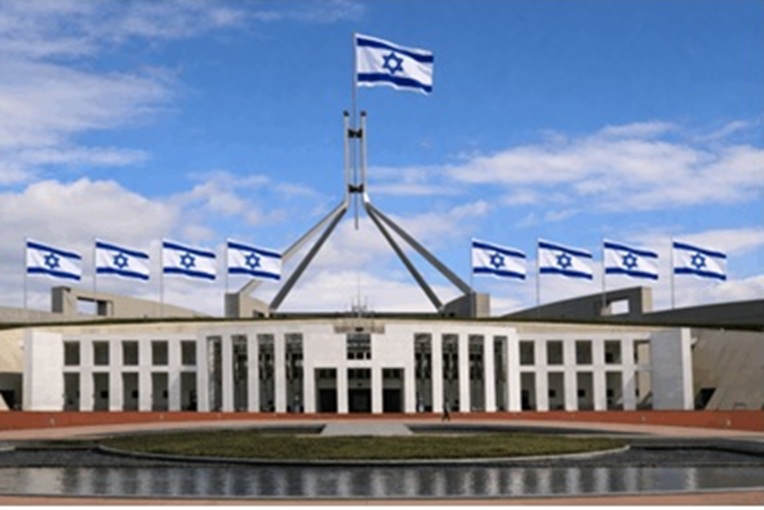
The Enforcement. The lobby that bought Australian democracy
by Andrew Brown | Apr 29, 2026, https://michaelwest.com.au/the-enforcement-the-lobby-that-bought-australian-democracy/
Australia’s sovereignty is routinely violated by Israel. Our institutions utterly subject to foreign interference. Andrew Brown presents the devastating case for a royal commission into Zionist influence in Australia.
Yesterday we laid out the machinery of the most serious foreign influence operation ever conducted on Australian soil: the quasi-diplomatic network operating from inside Australian institutions, the 500-plus politicians and journalists conditioned in Tel Aviv at a foreign government’s expense, the foreign minister instructed by a donor network to recant established international law, the attorney-general who adopted Israeli legal talking points as official Australian government language, the $164 million in security infrastructure extracted from Australian taxpayers for a community of 120,000 people, and the government-appointed envoy drawn from the lobby itself whose job is to put Israeli government policy beyond the reach of Australian public criticism.
Today we examine the enforcement arm. What this operation does to individuals, institutions, and the fundamental democratic rights of ordinary Australians who exercise their right to disagree. And what it did, for more than a decade, with Australian sovereignty itself.
Begin with the act of sovereign violation so grave that it should have ended the bilateral relationship and produced a permanent rupture in Australian foreign policy.
It did neither. Mossad, the Israeli state intelligence agency, operated a spy cell based in Sydney for more than a decade. Under ASIO’s nose. Using Australian infrastructure. Recruiting from Australian universities.
In 2010, Mossad operatives carrying forged Australian passports entered Dubai, a country with which Australia maintained cordial diplomatic relations, and assassinated Palestinian leader Mahmoud Al-Mabhouh. An Israeli diplomat in Canberra, Amir Laty, was expelled over his connection to the cell.
“The Australian government attempted to keep his expulsion secret to avoid embarrassing Israel.”
Ben Zygier, an Australian citizen known as Prisoner X, worked for Mossad, spied on fellow students at Monash University, and used his Australian passport to conduct espionage operations across Arab and Muslim countries. He died in an Israeli prison.
A New Zealand Mossad cell was separately caught attempting to fraudulently obtain New Zealand passports. The Australian official who summarised the government’s operative posture did so anonymously, because to say it on the record would have been politically unsurvivable.
He was quoted by journalist Peter Hartcher in the Sydney Morning Herald on 26 February 2010. Israel, he said, had calculated that even if caught forging Australian passports to carry out targeted assassinations,
“Canberra would not retaliate. It wouldn’t matter who sat in the prime minister’s chair.”
The Israelis, this official said, know they’ve got us by the balls, partly because of the Israel lobby. State-sanctioned murder using forged Australian documents.
A foreign intelligence service operating on Australian soil for over a decade. An expelled diplomat whose removal the government tried to hide.
And the judgement of an Australian national security official that none of it would produce consequences because the lobby had made consequences impossible. If China had done one tenth of this, Australia would have severed diplomatic relations and jailed everyone it could reach.
“Israel did all of it and received a quiet request not to do it again.”
State premiers captured
In the domestic political arena, three state premiers have served as the lobby’s most recent and most openly authoritarian instruments.
Peter Malinauskas personally intervened to cancel a Palestinian author from Adelaide Writers’ Week. The festival director resigned.
“The event collapsed.”
A state premier, acting on behalf of the interests of a foreign government, destroyed a celebrated literary event and ended a festival director’s role in the process.
David Crisafulli’s Queensland government made two phrases associated with Palestinian solidarity punishable by up to two years imprisonment. An eighteen-year-old Australian was charged for the act of wearing a shirt. Twenty people were arrested at a peaceful protest for the act of chanting.
Chris Minns rushed legislation through the NSW parliament on Christmas Eve 2025, in a deliberate legislative ambush, handing the police commissioner power to ban all protest marches across entire areas of Sydney for up to three months following a declared terror incident.
A unanimous bench of the NSW Court of Appeal struck it down as an unconstitutional burden on the implied freedom of political communication.
“Three premiers. Three states. One foreign government’s interests.”
Zero words of criticism from the Prime Minister of Australia. The suppression of political speech and peaceful assembly on behalf of a foreign power, conducted by state governments and met with federal silence. In what functioning democracy does this not constitute a crisis of the highest order?
Crushing ‘difficult’ people
Now watch what the enforcement machinery does to individuals. Grace Tame was the 2021 Australian of the Year. A survivor of institutional child sexual abuse who built a national platform of such moral clarity that the entire political establishment had learned to treat her as beyond reproach. She began speaking about Palestine.
She attended protests. She shared Human Rights Watch reports documenting starvation in Gaza. In February 2026 she attended a rally in Sydney protesting the visit of Israeli President Isaac Herzog and led the crowd in a chant.
What followed was not a spontaneous public backlash.
“It was a coordinated campaign of economic and reputational destruction,”
executed with the speed and precision that only a well-resourced, well-organised, and permanently mobilised network can produce.
Nike cut her sponsorship within days.
Her speaking engagements disappeared from her calendar. By March 2026 she told a conference in Hobart that it was her last engagement for the year. It was March. Twenty-five thousand Australians signed a petition demanding her Australian of the Year award be stripped from her.
Coalition members of parliament stood in the national legislature and called her a terrorist sympathiser.
And Anthony Albanese, the Prime Minister of Australia, when directly asked to describe Grace Tame, produced a single word: difficult.
“Difficult.”
The survivor who forced child sexual abuse onto the national agenda at enormous personal cost. Difficult. The woman who said that Palestinian civilians, like all civilians, had a right not to be bombed, starved, or shot. Difficult.
The Prime Minister of Australia reached for the oldest and most reliable instrument of dismissal in the political class’s toolkit: the word that powerful men have always used for women who refuse to stay within the lines drawn for them by the people who write the cheques.
The lobby made no public statement. It did not need to. Nike had already cut the sponsorship. The speaking circuit had already closed. The petition had already collected its signatures.
The MPs had already used the word terrorist in Hansard. The work had been done without the lobby needing to appear in the story at all.
“That is what mature, embedded institutional power looks like.”
It does not need to act visibly. It has already arranged for everyone else to act on its behalf.
The reach extends into the newsrooms and it has been there for decades. Veteran ABC journalist John Lyons documented it in his 2021 book Dateline Jerusalem, writing that in forty years of journalism he had never encountered a lobby as formidable, well-funded, or relentlessly effective as the pro-Israel lobby in Australia, and that material the lobby succeeded in suppressing here was routinely published in Israel without consequence or controversy.
Best funded foreign influence operation in Australia
Bob Carr called Lyons’ account the definitive record of the most concerted and best-funded foreign influence operation in Australia.
Every journalist who has worked on this subject in the Australian press knows what Lyons and Carr documented, because they have experienced it themselves: organised complaints to management, coordinated pressure on executives, personal vilification campaigns, threats to advertiser relationships
The lobby does not need to own Australian media. It only needs editors and proprietors to understand the cost of genuine independence, and to calculate that the cost exceeds the benefit. In most Australian newsrooms, they have made that calculation and arrived at compliance.
The case of Antoinette Lattouf demonstrated the consequences for those who don’t. She was removed from ABC air in December 2023 for sharing a Human Rights Watch report documenting Israel’s use of starvation as a weapon of war in Gaza.
The Federal Court subsequently found the ABC had breached the Fair Work Act by terminating her engagement on the basis that she held a political opinion opposing the Israeli military campaign.
The Sydney Morning Herald revealed that a WhatsApp group calling itself Lawyers for Israel had lobbied ABC management directly and specifically for her removal.
Australia’s public broadcaster, funded by Australian taxpayers and constitutionally obligated to editorial independence,
“removed a journalist from air at the instruction of a foreign-aligned lobby group operating by messaging app”
That is not an editorial error. That is the surrender of a public institution to private foreign-aligned coercion. And the ABC’s board and management have never been required to account for it.
If it were China?
Apply the same facts to China. Not as analogy. As a direct accountability test. If Chinese-linked organisations were the single largest private funders of overseas trips to federal MPs, ASIO would have declared it a national security emergency.
If a Chinese intelligence agency had based a spy cell in Sydney for over a decade using forged Australian passports to conduct state-sanctioned assassinations abroad, it would constitute the gravest breach of Australian sovereignty in the country’s peacetime history and the bilateral relationship would not survive it.
If a Chinese-aligned lobby had pressured the ABC to remove a journalist critical of Chinese government policy, the story would have dominated national coverage for months and produced a parliamentary inquiry within weeks.
If a serving foreign minister had declared China’s struggles are our struggles, their values are our values from an award ceremony podium, her resignation would have been demanded before she left the building. If the attorney-general had told a Senate hearing that calling Tibet an occupied territory was too pejorative to use in official Australian discourse, he would not have returned to the chamber.
If three state premiers had introduced legislation to criminalise speech critical of Chinese government policy, or to give police the power to ban all marches in city zones for months at a time, the word used across every editorial in this country would have been the same:
“treason.”
We do not need to speculate.
We have watched the Chinese comparison play out in real time at a fraction of this scale and the consequences were terminal. Sam Dastyari expressed views aligned with Chinese positions after accepting connected donations. No secrets passed. No law was broken. His career was finished.
Andrew Robb left the ministry overseeing Darwin Port and signed a $2.25 million consulting contract with the Chinese company that had just received a 99-year lease on it.
The scandal produced years of national coverage and ultimately the Foreign Influence Transparency Scheme: legislation designed specifically to track and constrain the purchase of access to Australian political institutions by foreign-aligned interests. ASIO names foreign interference, the public shorthand for China, as a top-tier national security threat in every annual assessment it publishes.
Except for Israel
The entire architecture of Australian national security is built on a single premise held to be non-negotiable: that a foreign government purchasing influence inside Australian democratic institutions is an existential threat to sovereignty that must be identified, resisted, and where possible prosecuted.
The Foreign Influence Transparency Scheme has never produced a public disclosure about AIJAC. The ASIO annual threat assessment has never named the Israeli lobby.
The parliamentary inquiries that ended Dastyari’s career and produced years of national debate have no equivalent examining the 500 politicians and journalists conditioned at Israeli government expense, the donor networks that instructed a foreign minister to recant international law, the Mossad spy cell that operated from Sydney for a decade using forged Australian documents, the foreign-government-funded quasi-diplomatic agencies embedded across Australian institutions, the lobby that pressured the national broadcaster to remove a journalist by WhatsApp, or the three premiers who suppressed political speech and peaceful assembly on behalf of a foreign government’s interests.
The apparatus constructed to protect Australian sovereignty from foreign purchase has one explicit, unwritten, never-debated, never-voted-upon exemption.
“Every senior person in Canberra knows what it is.“
They have calculated, morning after morning for thirty years, that acknowledging it is more dangerous to their careers than enabling it. That calculation is itself the evidence.
That is not a principled distinction between China and Israel. That is a purchased one. The receipt is in the parliamentary interests register. It is in Hansard. It is in Federal Court judgments.
It is in the published memoirs of a foreign minister who was told to be straightened out. It is in the Sydney Morning Herald report quoting a senior Australian national security official saying Israel has us by the balls because of the lobby.
The evidence does not need to be assembled. It has been sitting in plain sight for thirty years, in public documents, in published books, in court records and parliamentary transcripts.
A national emergency
The question is not whether it exists. The question is why a country with functioning democratic institutions and a free press has never once treated it as the national emergency it plainly is.
The evidence assembled across these two articles does not call for more journalism. It calls for a Royal Commission.
“A Royal Commission into Israeli foreign influence across all levels of Australian government.“
The terms of reference write themselves from the public record alone. The AIJAC trip program: who was taken, what they were shown, what positions they held on return, and what decisions they subsequently made on matters of direct relevance to Israeli government interests.
The donor networks: their documented intersection with foreign policy outcomes from the Gareth Evans threats of 1992 to the Bob Carr instruction of 2013.
The roles of the ECAJ, the ZFA, and the state Boards of Deputies as quasi-diplomatic agencies for a foreign government, in their own published words in their own publications.
The $164 million in security expenditure: the political process that produced it, why it was never subject to comparative public assessment against the security needs of other communities, and the decision-making chain that accelerated it after Bondi.
The Mossad operations: the decade-long spy cell based in Sydney, the assassination using forged Australian passports, the expelled diplomat whose removal the government tried to suppress, and the complete and deliberate absence of any proportionate response.
The instruction to Bob Carr: who issued it, under whose authority, whether it constituted improper interference in the sovereign conduct of Australian foreign policy, and who else received similar instructions and complied without ever recording it.
The three state premiers: who coordinated their legislative responses, what communications passed between them and lobby organisations, and whether those communications constitute evidence of foreign-government-aligned interference in state legislative processes.
The ABC: the chain of communications between Lawyers for Israel and ABC management in the Lattouf matter, who authorised the removal, and whether the ABC’s board was aware.
Jillian Segal powers
The Segal appointment: the process by which an active advocate for a foreign government’s interests was appointed to a quasi-regulatory role with the
“power to recommend the defunding of Australian cultural, academic, and media institutions.“
We held a Royal Commission into trade union governance. We held one into the banking sector. We are right now holding one into antisemitism, announced within weeks of a single event, with findings due within twelve months, and interim findings this week.
The question of whether a foreign government has, over thirty years, systematically purchased the compliance of Australian democratic institutions, usurped the conduct of Australian foreign policy, operated a state intelligence network on Australian soil using forged Australian documents to conduct murder abroad, corrupted the editorial independence of the national public broadcaster, and constructed a domestic legal and regulatory apparatus to protect its own conduct from Australian public scrutiny, is
“a question that dwarfs every Royal Commission this country has ever convened.”
If the answer is no, the inquiry will say so and the lobby will be vindicated. If the answer is yes, and the public record already indicates what the answer is, then every Australian citizen has been the victim of a fraud conducted against their democracy by a foreign power and its local agents, for thirty years, with the full knowledge and active participation of the people they elected to protect them.
Stated plainly
Something must be stated plainly before this piece closes. I have never held antisemitic views and I never will. My godparents were Jewish Hungarian Holocaust survivors.
My godfather went on to become a prominent and respected figure in both the Australian business world and the Jewish community. He was a founder of the Hakoah Club. I grew up with a precise and personal understanding of what antisemitism is, what it costs, and where it ends.
“This series is not a critique of Jewish Australians.“
It is a critique of something wholly different: the coercive scale of a foreign influence operation conducted on behalf of the Israeli government, by Australian citizens acting as its agents, against the democratic institutions of their own country.
Antisemitism weaponised
The lobby’s reflexive branding of any examination of its own institutional power as racial hatred of Jewish people is not a defence. It is the operational core of a suppression mechanism.
It has worked because it was designed to work and because too many people who knew exactly what it was decided that
“the personal cost of calling it out exceeded the democratic cost of ignoring it.“
That calculation has now produced the country documented in these two articles. Decide for yourself whether you can live with it.
For Netanyahu, crimes against humanity
On November 21, 2024, the International Criminal Court issued arrest warrants against Benjamin Netanyahu for war crimes and crimes against humanity. Australia is a signatory to the Rome Statute.
Canada said it would arrest him. France said it would arrest him. The Netherlands said it would arrest him. Albanese has said nothing of legal consequence.
He has not named what is happening in Gaza with the word the ICC has already used and the evidence demands. He has not imposed sanctions. He has not withdrawn the ambassador.
He has produced statements of such deliberate, crafted, lawyered vagueness that they constitute not diplomacy but performance: calibrated to suggest concern while guaranteeing inaction, designed not to communicate a position but to preserve the fiction of having one, while the donor network that purchased that silence continues to operate across every level of Australian government without scrutiny, without accountability, and
“without a single journalist in the parliamentary press gallery willing to stand up and call it what it is.”
That is not the restraint of a statesman navigating genuine complexity. That is the immobility of a man who knows the price of his position down to the last dollar, knows who set it, knows what the invoice covers, and has decided every morning for years that paying it is less dangerous than the alternative.
He is not alone.
He is the current representative of a thirty-year institutional posture shared by both major parties, dozens of ministers, three premiers, a national broadcaster, and a press gallery that has collectively decided the story is not worth the grief.
“Every one of them is wrong.“
And every Australian who still believes this country’s democratic institutions belong to its citizens, and not to the agents of a foreign power, should be demanding to know why.
Andrew BrownAndrew Brown is a Sydney businessman in the health products sector, former Deputy Mayor of Mosman and Palestine peace activist
US and Israel Claimed to Be Fighting for Iranian Minorities — While Bombing Them
One day before the U.S.-Iran ceasefire went into effect on April 8, a 68-year-old synagogue in the Iranian capital was damaged in airstrikes for which the Israeli military claimed responsibility. The Israeli military said it was trying to target a military commander living nearby and regretted the destruction, which it referred to as “collateral damage.”
“If we believe that destroying a synagogue in Israel would be treated as an outrage against civilization, then a synagogue in Tehran must not be treated as a regrettable footnote.
Already marginalized, Iran’s religious minority communities are overlooked victims of the US-Israeli war on Iran.
By Kourosh Ziabari , Truthout, April 27, 2026
Iranians of all stripes have been affected by the U.S.-Israeli war on their country, and the civilian cost of the conflict has yet to be fully understood. The United Nations Development Programme has raised the alarm about the “development in reverse” pushing more than 32 million people back into poverty globally, and economists have warned that 10 to 12 million Iranians, representing nearly half of the country’s workforce, are now on the brink of unemployment.
But the effect of the U.S.-Israeli aggression on Iran’s religious minorities has received comparatively little attention. Beset by years of neglect and underrepresentation at home, faith groups are now coming to grips with the cruelty of war and the devastation it has inflicted on their vulnerable institutions and houses of worship.
In Tehran, U.S.-Israeli airstrikes damaged two major churches, St. Nicholas Orthodox Church and the Greek Orthodox Church of Saint Mary, drawing condemnation from Tehran’s Christian communities. Although there have not been many updates on the status of the Church of Saint Mary, St. Nicholas Church, which is a major Russian cultural site in Iran, was reportedly closed on Easter due to the extent of the damages.
One day before the U.S.-Iran ceasefire went into effect on April 8, a 68-year-old synagogue in the Iranian capital was damaged in airstrikes for which the Israeli military claimed responsibility. The Israeli military said it was trying to target a military commander living nearby and regretted the destruction, which it referred to as “collateral damage.”
The attack put further strain on Iranian Jews as they navigate the challenges of a war waged by the United States and Israel under the pretenses of bringing liberation to the country. Iranian Jewish politicians and community leaders have been vocal in criticizing the attacks targeting houses of worship and civilian sites.
“Our holy books were buried under the rubble, burnt, and torn, and all of this is an indication of the indifference of the Zionist regime to Judaism as a religion and the instructions of Prophet Moses,” said Homayoun Sameh, a Jewish member of parliament as he talked to reporters in Tehran. Truthout reached out to his office for comment but didn’t hear back.
Lior Sternfeld, a scholar of Jewish studies and history at Pennsylvania State University, told Truthout that Israel has long demonstrated disregard for Jewish life and heritage in the Middle East outside of Israel, a pattern which is now stretching to Iran.
“There are credible reports on Israeli involvement in several attacks on Jewish establishments in Iraq in the early 1950s to speed up the process of Jews registering for departure,” Sternfeld told Truthout. “A couple of years later, Israeli agencies knowingly operated a small network of poorly trained Jewish spies, in what came to be known as Operation Susannah,” with the intent of attacking civilian targets in Egypt and falsely blaming the attacks on local forces.
“In 1982, the IDF [Israel Defense Forces] shelled the Maghen Abraham Synagogue in Beirut, claiming there were PLO [Palestine Liberation Organization] militants it was targeting nearby,” he added, noting that the recent synagogue strike in Tehran appears as an extension of this history.
Beyond religious and cultural sites, residential areas populated by Iran’s ethnic minorities were also attacked. On March 10, the historic Majidieh neighborhood in eastern Tehran, a major hub for Iran’s Armenian community in the capital, was bombed by the United States and Israel, destroying multiple buildings, including a locally run kindergarten………………………………………………………………………………………………………………………………………………………………………………………………………………………………………………………..
the fact that the bombings targeting an array of different religious and ethnic groups and their cultural sites have drawn little attention internationally points to continued flaws in the media framing of the war. Crackdowns on the press are not limited to authoritarian regimes. In democracies also, reporters are being pressured to toe the government line on key political fault lines.
In March, Federal Communications Commission Chair Brendan Carr issued a rare threat to major networks and their local affiliates, warning them to “correct course” on their coverage of the war in Iran before their license renewals are due. On multiple occasions, Defense Secretary Pete Hegseth has assailed the media for their reporting on the conflict, demanding a more “patriotic” coverage.
In the meantime, stereotypes still dominate the corporate media portrayals of Iran, even in the middle of a war of aggression on the country. Hawkish commentators making the case for sanctions and military action are frequently called to appear on primetime shows, and there is no active debate on the enormous civilian toll of the war on millions of Iranians, including marginalized groups.
“If we believe that destroying a synagogue in Israel would be treated as an outrage against civilization, then a synagogue in Tehran must not be treated as a regrettable footnote. Sacred loss does not become less sacred because the world responds selectively to some victims and not others,” said Dabbagh.
Other observers have argued that undermining Iran’s religious and cultural diversity is a key U.S. and Israeli goal in the war, exemplified by a range of airstrikes targeting UNESCO-registered world heritage sites, alarming rhetoric about the erasure of Iranian civilization coming from Trump and other officials, and dehumanizing propaganda about the Iranian people.
“For both the Israelis and Americans, the presence of Iranian Jews or Palestinian Christians and Lebanese Christians is a huge problem,” said Omid Safi, a professor of Asian and Middle Eastern Studies at Duke University. “When they come to terms with the fact that in Iran itself there is a Jewish community that is more than 2,000 years old, then all of a sudden they have to come to terms with the pluralism and inherent diversity of Iranian society.”
“The targeting of the synagogue and some churches by the Israelis and Americans with no apologies or acknowledgement follows in the footsteps of what we’ve already seen with the targeting of dialysis treatment centers, the girls’ school in Minab, 31 universities, and multiple hospitals,” he added, arguing that the bombing campaign has shown Iranian human rights are not being respected by the perpetrators………………………………………………………………………………………………
In Iran’s sanctions-hit economy where even international organizations are hamstrung in delivering humanitarian assistance and development aid, a sweeping conflict like the U.S.-Israeli military campaign can produce irreversible harms, especially affecting the less protected religious and ethnic minority groups.
In some cases, Iranians haven’t yet completed the reconstruction efforts that followed the eight-year Iran-Iraq War of 1980, when the former Iraqi dictator Saddam Hussein was encouraged by a coalition of world powers to invade Iran and stymie the newly born revolution. According to official data, 90 Iranian Christians, 11 Iranian Jews, and 32 Iranian Zoroastrians were killed in that war.
Right now, the future is uncertain as both Tehran and Washington seem unprepared to engage in a sustainable diplomatic process. Meanwhile, the disenfranchised institutions of Iran’s civil society — including religious minority groups, which have sustained themselves over the years without external support or preferential treatment at home — will pay the highest price. https://truthout.org/articles/us-and-israel-claim-to-be-fighting-for-iranian-minorities-while-bombing-them/?utm_source=Truthout&utm_campaign=4b4dfd3a01-EMAIL_CAMPAIGN_2026_04_27_08_16&utm_medium=email&utm_term=0_bbb541a1db-4b4dfd3a01-650192793
UK parliament’s AUKUS inquiry report questions if Britain can keep nuclear submarine promises.

By Riley Stuart and Europe correspondent Elias Clure in London, Tue 28 Apr, 26, https://www.abc.net.au/news/2026-04-28/aukus-report-released-by-house-of-commons-defence-committee/106613750
In short:
The House of Commons Defence Committee has released its report on the AUKUS defence pact after launching an inquiry last year.
While the report was broadly supportive of AUKUS, it also “laid bare the scale of the endeavour that will be required to deliver it”.
What’s next?
There have been calls to hold a public inquiry into AUKUS in Australia too, although right now one has not been announced.
British politicians have cast doubt on their country’s ability to develop and deliver nuclear submarines promised as part of the AUKUS defence pact.
The House of Commons Defence Committee on Tuesday released the findings of its year-long review into the trilateral partnership.
While the report was broadly supportive of AUKUS, it also “laid bare the scale of the endeavour that will be required to deliver it”.
As part of the deal, the United Kingdom and Australia are working together to design and build a new class of nuclear-powered attack submarine, known as SSN-AUKUS, scheduled to enter service in the late 2030s and the early 2040s.
“For the UK, delivering SSN-AUKUS will be a lengthy and complex undertaking requiring a sustained financial commitment from government across several electoral cycles,” the report noted.
“It is deeply concerning that there are signs that the investment pipeline that underpins that commitment has already faltered.”
The report urged the UK government to devote more money to the partnership.
“Shortfalls or delays in funding risk a failure to deliver SSN-AUKUS on time, with potentially severe consequences for UK and wider Euro-Atlantic security, and our standing with our trilateral partners,” it read.
While the White House has reiterated its commitment to the partnership, and Australia has already given the United States $US500 million ($798 million) to try to reinvigorate the country’s shipbuilding industry, critics contend the AUKUS deal’s fine print means nothing is guaranteed.
Australia is expected to invest a total of $US3 billion in US submarine manufacturing capabilities as part of the deal.
It has been estimated AUKUS could cost Australia about $368 billion by the mid-2050s.
“For Australia, AUKUS is an unprecedented undertaking to be delivered to ambitious timescales,” the House of Commons report noted.
“The UK will need to work closely with Australia at both industry and government level to share expertise and support Australia in meeting its own milestones.”
Trump ‘an unreliable ally’, submission says
US President Donald Trump has expressed his support for the trilateral pact, but the House of Commons inquiry received submissions saying the president’s “America First” approach to foreign policy, Russia’s full-scale invasion of Ukraine, and other geopolitical factors “had undermined the case for AUKUS and its chances of successful delivery”.
The Australian Peace and Security Forum — a not-for-profit that has been calling for a public inquiry into AUKUS to be held in Australia — gave a written submission to the inquiry in which it contended the US under Mr Trump was “an unreliable ally”.
The group also claimed that “geopolitical circumstances have changed for both the UK and Australia since AUKUS was conceived in 2021”.
“Strategic priorities for both countries do not align,” the submission read, adding “the UK should not proceed with AUKUS if it cannot guarantee delivery of its commitments on time and on budget”.
But the inquiry also heard from the UK’s minister for defence readiness, Luke Pollard, who said the changing geopolitical context and increasing threats meant “the importance of making sure that AUKUS delivers is even more prominent than it was when the original initiative was launched all those years ago”.
The House of Commons report highlighted difficulties in staff movement between the AUKUS partner countries due to the security clearances required to work in the defence sector.
A consultancy company involved in AUKUS told the inquiry that moving employees between its UK and Australian businesses was a “time-consuming and administratively burdensome” process.
While AUKUS enjoys significant support from both major political parties in Australia, the deal has also attracted criticism, notably from former prime ministers Malcolm Turnbull and Paul Keating.
Tan Dhesi, the Labour MP for Slough and chair of the House of Commons Defence Committee, told the ABC the inquiry was designed to review the UK government’s progress with regard to AUKUS.
“Many of us had concerns that things were perhaps not progressing at the pace they should be, but we wanted to gain expert advice as well as evidence,” he said.
Mr Dhesi said as part of the inquiry, representatives of the defence committee visited locations in the UK, US and Australia.
“Our key recommendation is that the UK government needs to do much more and it needs to do it faster in order to reap the full benefits of this once-in-a-generation, long-term strategic partnership with Australia and the US,” he said.
Links to Full Report –
https://committees.parliament.uk/work/9068/aukus/publications/ and https://committees.parliament.uk/publications/52831/documents/294641/default/
Starmer’s Talking Points: King Charles III Visits Washington
AUKUS continues to warp the imagination of its executors, distort military planning, and, importantly, make the most telling demands on Australia, the junior yet, in some ways, most essential partner in the relationship. For one thing, it remains the most duped and witless of the three, having made staggering concessions to both the US and UK in terms of military real estate and investment. Despite turning Australia into a garrison state invigilating over the rise of China in the Indo-Pacific, the agreement makes no guarantee that the Royal Australian Navy will ever receive Virginia-class nuclear-powered submarines it does not need, let alone any assurance that it will exercise control over their use and command.
29 April 2026 Dr Binoy Kampmark https://theaimn.net/starmers-talking-points-king-charles-iii-visits-washington/
He can hardly be blamed for being given the brief by his Prime Minister. King Charles III is in the United States on a repair job, playing diplomatic handyman and mender for Sir Keir Starmer and the US-UK alliance so long regarded as special. On the occasion of the 250th anniversary of American independence, it was easy to forget that the British, despite losing its American colonies, gained some vengeance through the exploits of Major General Robert Ross, who, on August 14, 1814, burned down the White House, the Capitol building, and an assortment of other government facilities.
The US President Donald Trump has made it clear that alliances are only special if they serve his bullying and selfish needs, transient and fickle as they are. Otherwise, the whole notion of an alliance can be allowed to go by the wayside or stung into decay by venomous statements on social media. The UK’s ambassador to Washington, Christian Turner, who replaced the disastrously appointed Peter Mandelson in February, has even gone so far to suggest that the term “special relationship” be scrapped as dated and musty. The phrase, he unguardedly told a group of British students visiting that month, was “quite nostalgic” and “quite backwards-looking,” encumbered with “baggage.” Instead of leaving it at that, Turner proceeded to offer the only exemplar in the US diplomatic inventory that might count, whatever the baggage. “I think there is probably one country that has a special relationship with the United States – and that is probably Israel.”
Any ruffles arising from that leaked audio has been seemingly contained. On the occasion of this state visit Trump was cordial, even sprightly. “The Americans have had no closer friends than the British,” he declared on April 28. The same language was spoken, the same values shared, the “warriors” of the two nations having “defended the same extraordinary civilization under the twin banners of red, white, and blue.”
Before a joint sitting of Congress, Charles delivered a speech filled with the usual solecisms on the US political system, not to mention a few on his own. The US Congress is hardly a “citadel of democracy created to represent the voice of all American people, to advance sacred rights and freedoms,” being the republican vision of slave owning plantation owners who were nervous about the mob and ever keen to keep them at bay with a dampening system of checks and balances. The “revolutionary” notions of “life, liberty, and the pursuit of happiness” were to be kept on a firm leash. And while the United Kingdom has democratic pretensions, it exercises power through that mysterious political and legal construction known as the Crown. In a short note for the Spectator in October 1959, the conservative, at times reactionary novelist Evelyn Waugh made an abundantly clear point: “Great Britain is not a democracy. All authority emanates from the Crown.” All figures of note from judges and bishops to the Poet Laureate “exist by the royal will.” Elections are, rather, “a very hazardous process” to select ill-chosen advisors.
Starmer, as advisor-in-chief, clearly fed the monarch a rather odd assortment of dishes to temper and placate the businessman tyrant trainee. Lay it heavy with the friendship issue, talking of that “bond of kinship and identity” that is “priceless and eternal.” Accept that disagreements can happen between close allies (“no taxation without representation”, for instance, stirring the anger of the American colonists). “Ours is a partnership born out of dispute, but no less strong for it.” When the countries found ways to agree “what great change is brought about – not just for the benefit of our peoples, but of all peoples.”
A fig leaf of soothing assurance was offered to US lawmakers and the Trump administration. The UK, recognising “that the threats we face demand a transformation in British defence,” was swelling the defence budget, “the biggest sustained increase in defence spending since the Cold War.” The defence of Ukraine, not high on Trump’s list but very much top of the Starmer summit, also warranted a mention.
Damnably foolish things can be said about defence, that area of spending scandalously exempt from the usual, fiscal scrutiny reserved for welfare budgets and services. And Charles was not spared the Starmer talking points about joint efforts to build F-35 fighter jets and pursuing “the most ambitious submarine program in history, AUKUS.” AUKUS was being pursued “in partnership with Australia, a country of which I am also immensely proud to serve as sovereign.”
AUKUS continues to warp the imagination of its executors, distort military planning, and, importantly, make the most telling demands on Australia, the junior yet, in some ways, most essential partner in the relationship. For one thing, it remains the most duped and witless of the three, having made staggering concessions to both the US and UK in terms of military real estate and investment. Despite turning Australia into a garrison state invigilating over the rise of China in the Indo-Pacific, the agreement makes no guarantee that the Royal Australian Navy will ever receive Virginia-class nuclear-powered submarines it does not need, let alone any assurance that it will exercise control over their use and command.
The US Congressional Research Service (CRS) report, published on January 26, does much to scupper suggestions that Australian sovereignty would ever be a serious consideration, given an analysis of the “benefits, costs, and risks compare[d] with those of an alternative of procuring up to eight additional Virginia-class SSNs that would be retained in US Navy service and operated out of Australia along with the US and UK SSNs that are already planned to be operated under Pillar 1.” Even as these doubts are being expressed, the Australian taxpayer continues to invest in the US submarine industrial base.
Obsessed by the deterrent value of such boats against China, the nail-biting worry in the Pentagon and Congress is that any transfer from a navy that remains tardy in meeting the set target of 2 SSNs a year will blunt potency. “Selling three to five Virginia-class SSNs to Australia would thus convert those SSNs from boats that would be available for use in a US-China crisis or conflict into boats that might not be available for use in a US-China crisis or conflict.” Such considerations would have been unlikely to feature in Starmer’s mind when mulling over the details of the King’s speech. The British PM has shown himself to be stunningly short on political judgment and incapable in making sound decisions. However polished the performance by Charles in Washington, it may not be enough to save his prime ministership.
Antisemitism and Israel: A challenge to the Australian narrative (Part 1)
UN Special Rapporteur Francesca Albanese has delivered the 21-page report, ‘Torture and genocide: Report of the Special Rapporteur on the situation of human rights in the Palestinian territories occupied since 1967’, dated 19 February 2026. Albanese’s team outline the depths of depravity and inhumanity to which the Israeli regime has now sunk in its attempted destruction of the Palestinian people.
By Evan Jones | 27 April 2026, https://independentaustralia.net/politics/politics-display/antisemitism-and-israel-a-challenge-to-the-australian-narrative,20974
A provocative Royal Commission submission by Dr Evan Jones argues that Australia’s antisemitism debate cannot be separated from Israel, Zionism and their political influence.
Submission to the Royal Commission on Antisemitism and Social Cohesion
Part 1
General
This submission can be reduced to one word — Israel.
There you have the answer to your inquiry. Dismantle apartheid Israel and see so-called “antisemitism” disappear overnight, save for a small ineradicable but prosecutable fringe
There is really no reason for this Royal Commission at all, as the problem is self-evident. The Commission will not solve the problem that it was formally established to resolve because its agenda is diversionary. Indeed, it will compound the problem because it will, in all probability (as it is seemingly intended to do), reinforce the influence of the Australian Zionist lobby and thus the ongoing impunity of Israel.
The problem arises from the conflation of two forces.
One: Israel is a nation founded on terrorism and wilfully sustained on deep-seated racism.
We know that nation-states are perennially born of violence, expropriation and repression (Australia as a case study), but Israel is a pronounced variation on a common colonialist theme. Israel was born of naked terrorism against an entire (non-Jewish) indigenous population. It was explicitly created and has been sustained as a racist apartheid state. Its borders have never been determined, envisaging ongoing expansion (lebensraum) — “from the river to the sea” (and beyond).
Palestinian Israelis (descendants of those whom the Zionist terrorist gangs failed to expel) are second-class citizens. Palestinian non-Israelis, under Occupation and under martial law, are denied the most basic human rights. Gaza has been a concentration camp since Sharon supposedly “disengaged” from Gaza in 2005.
The sadistic murder of Gazans since October 2023 is reminiscent of the Germans’ feverish pursuit of Jews and Bolsheviks after Operation Barbarossa in June 1941. Israel has long undermined United Nations Relief and Works Agency for Palestine Refugees in the Near East (UNRWA) personnel and facilities, which attempt to instil a modicum of humanity into a population long starving from Israeli blockages. Israel endorses carnage by fanatical settlers on West Bank Palestinians, murdering and destroying Palestinian livelihoods at will — for which they enjoy absolute immunity.
The Israel Defence Forces (IDF) murder children with pleasure. Children are imprisoned indefinitely for throwing stones. Adult prisoners are tortured and murdered. Israel wilfully murders foreign dignitaries (most recently, the Iranian National Security Council chief Ali Larijani, reputed “moderate” and skilled negotiator), which highlights that mass murderer Benjamin Netanyahu has put to words what has been the manifesto of all Israeli leadership: there will never be a Palestinian state (September 2025).
Long-term ethnic cleansing has now turned to genocide, ongoing in defiance of the formal “ceasefire”. Israel destroys essential infrastructure, murders aid workers and journalists — because it can. The journalist murder count is now further “totting up” in southern Lebanon.
Representative — this month (March 2026) marks the 23rd anniversary of the crushing of American Rachel Corrie by an Israeli bulldozer.
UN Special Rapporteur Francesca Albanese has delivered the 21-page report, ‘Torture and genocide: Report of the Special Rapporteur on the situation of human rights in the Palestinian territories occupied since 1967’, dated 19 February 2026. Albanese’s team outline the depths of depravity and inhumanity to which the Israeli regime has now sunk in its attempted destruction of the Palestinian people.
Some excerpts:
Torture has always been a central feature of Israel’s dispossession of Palestinians. Yet, since October 2023, Israel has employed it on a scale that suggests collective vengeance and destructive intent.
Torture is not confined to cells and interrogation rooms. Through the cumulative impact of mass displacement, siege, denial of aid and food, unrestrained military and settler violence and pervasive surveillance and terror, the occupied Palestinian territory (oPt) has become a space of collective punishment, where the destruction of the conditions of life turns genocidal violence into a tool of collective torture with long-term mental and physical consequences for the occupied population.
During its Mandate in Palestine, Britain used torture as one of the counterinsurgency tactics honed in Ireland and later imparted to Zionist militias; such practices, a colonial legacy, were then absorbed into the Israeli security apparatus before and after 1948 as a tool of repression and a preventive measure against Palestinian resistance. From early State-building and through decades of occupation, Israel has practised and condoned coercive violence as a structural component of its apparatus of domination.
An ecosystem of discriminatory legal frameworks and abusive operational practices has metastasized, encompassing Israeli military detention sites and prisons.
Since October 2023, torture in detention has, been used on an unprecedented scale as punitive collective vengeance — a clear feature of genocide. All Palestinians have been treated collectively as “terrorists” and “security threats”.
For her luminous competence, commitment and courage, Albanese was subject to comprehensive oppressive sanctions by the unhinged U.S. Trump Administration in July 2025.
Israel defies all international institutions and laws that proscribe the abuse of state power. Israel’s lobbying and propaganda regime (hasbara) is probably the most extensive of any state in history. Israeli authorities lie about the state’s forces’ actions without remorse.
The Israeli state is a parasite, receiving over US$300 billion (AU$418.7 billion) in aid from U.S. governments since 1950 (a great deal of which flows back to U.S. weapons manufacturers), supplemented by an estimated US$2 billion (AU$2.8 billion) per annum in donations from overseas Jewish “charities”, propped up at the country taxpayers’ expense. In particular, the Jewish National Fund directs funds to obliterating indigenous history in historic Palestine.
In short, the state of Israel is a pariah state, a barbaric regime, an abomination.
Two: All self-described “official” Jewish representative organisations in Australia support and lobby for Israel unreservedly. It is a full-time occupation.
Such “representative” organisations oppose basic human rights for Palestinians under Israeli control. They socialise their children into “a love of Israel” in Jewish “faith” schools. Some of their children are currently enrolled with the IDF to kill Palestinians.
Such organisations lobby Australian governments to support Israel, inhibiting Australian governments from adopting a principled stance towards Israeli criminality. They harass media management and editorial, thus gaining privileged access to and biased coverage from media outlets that the public relies on for supposedly unbiased information and opinion. Their ridiculous defences of Israel (op-eds, letters, buying off journalists) are published with great regularity. Anti-Zionist Australian Jews (vide Louise Adler and so on) and their organisations (the recently formed Jewish Council of Australia) are pilloried, indeed “excommunicated”.
In essence, Australian Jewish “representative” organisations act as a fifth column for a foreign state against Australian national interests – naturally antagonistic to ‘social cohesion’.
One and two in combination.
The Australian Jewish community, by virtue of its “official” representatives, courageous dissenters excepted, is complicit in Israeli genocide. And not just passively but actively. There has been no mea culpa on the part of executives of the key Jewish organisations (such as ECAJ, ZFA, AIJAC). Nobody in the Jewish community that underpins these organisations has sought to overturn the leadership of these key organisations in order to reorient their agenda and priorities.
In short, Israel and the “official” Australian Jewish community are joined at the hip.
It is not unrealistic to infer that the Bondi attack (and multiple incidents simply labelled “antisemitic”) is blowback for Israel’s character and actions and its local support network. The Israeli machine thus puts the security of global Jewry at risk (indeed, its own Jewish population) and doesn’t care.
A Zionist foot soldier is published in The Sydney Morning Herald (22 March), in denial regarding the intimate connection:
‘While David Leser’s article (SMH & Melbourne Age, 20 March [2026]) raises some thought-provoking points, it falls into the trap of attributing antisemitism in Australia to the actions of the Israeli Government. No other national or ethnic group in Australia is held to account for the actions of governments in countries overseas. So why is it considered reasonable for Jews in Australia to be relentlessly discriminated against for the actions of the Netanyahu Government?’
After the Bondi Beach murders, Israeli flags were well represented among the flower collections and mourners. Israel is apparently seen as the mother ship, the source of solace for those suffering, yet it is the ultimate cause of that suffering.
This bizarre anomaly is enhanced when the Zionist Federation of Australia (as befits its name) initiated the idea of inviting the Israeli President, Isaac Herzog, to Australia, subsequently legitimised and authorised by Prime Minister Anthony Albanese and dragging the Governor-General into the sordid process.
Another foot soldier grasps the connection but declines to understand the implications (SMH, 9 January 2026):
‘President Herzog is the legitimate head of state of the internationally recognised democratic state of Israel, rightfully invited to commiserate with Australians after the appalling terrorist atrocity at Bondi, in which predominantly Jewish people were murdered and injured.’
One notes in passing that Israel is not a democracy but an ethnocracy — no amount of affirmation is going to change the lie and the blind spot in the letter writer’s eye. To repeat, Israel is apparently seen as the mother ship, the source of solace for those suffering, yet it is the ultimate cause of that suffering. ‘Rightfully invited’ — really?
Herzog is not a passive head of state but an active participant in Israeli barbarism. Herzog comes to Australia, spends a token moment with victim families and survivors, declines to visit the fire-bombed Orthodox (non-Zionist) Adass Israel synagogue (“for reasons of security”) and spends the bulk of his time playing Israeli politician (‘not the time for a two-state solution’, meets with ASIO and so on).
The implication is ugly. Those murdered at Bondi are being instrumentalised (as with Netanyahu’s treatment of Hamas’ Israeli hostages) in the defence of the state of Israel and its current genocidal agenda. Appalling, no?
Antisemitism and Israel: A challenge to the Australian narrative (Part 2)
By Evan Jones | 27 April 2026, https://independentaustralia.net/politics/politics-display/antisemitism-and-israel-a-challenge-to-the-australian-narrative,20974
Part 2
The Commission’s Terms of Reference
‘AND the determination of the Australian Government to respond to the attack, and the factors leading up to the attack, as a matter of urgency by addressing antisemitism within the Australian community, including since 7 October 2023.’
Investigating the factors leading up to the attack could and should have been the responsibility of the mooted and more suited Richardson review. A royal commission is not the most appropriate vehicle towards this end.
Any investigation regarding “antisemitism” in Australia has to put Israel front and centre. The “official” Jewish community, AKA the Zionist lobby, naturally wants to exclude it.
The appalling Segal Report contains no substantive reference to Israel (my dissection here and here), thus being not merely worthless but disingenuous (vide Gwenaël Velge’s summary of the counter-Segal Greenslade and Briskman report, Not in Our Name: Jewish Australians Speak Out) and dangerous. Ditto the absence of any substantive reference to Israel in the most recent annual report (December 2025) of the Executive Council of Australian Jewry (sic) (dissected here).
‘AND that the Australian Government has adopted the International Holocaust Remembrance Alliance’s working definition of antisemitism.’
This submitter is frankly gobsmacked to find that this fraudulent “definition” has been officially adopted. The definition has been widely criticised, including by one of its originators, Kenneth Stern. The International Holocaust Remembrance Alliance (IHRA) definition is essentially about demonising criticism of Israel. Any proposed definition of antisemitism that attempts to delineate the terms on which one is allowed to criticise Israel without censure is automatically illegitimate.
The adoption of the IHRA definition nullifies any legitimacy that the paraphernalia of a royal commission might have and destroys any prospect of an honest analysis and a substantive functional prognosis. This adoption of the IHRA definition gives the impression that the Royal Commission, even inadvertently, will serve as yet another front for the pro-Israel lobby.
With the Royal Commission proceeding based on the IHRA definition, it can only turn into an inquisition. It can have nothing intelligent or ethical to offer about real antisemitism and can have nothing to offer in terms of genuinely dealing with it. It will be remembered as a squandering of the significant money that funds it and for the farcical theatre that is its essence.
‘AND recognising that strengthening the national consensus in support of democracy, freedom and the rule of law (social cohesion) provides the strongest defence against antisemitism and other forms of religious and ideologically motivated extremism.’
This sentence reads like it was written by AI. Who wrote this rubbish? One cannot have social cohesion as long as a particular Australian community coheres and operates actively as a fifth column in support of a foreign rogue state and influences Australian politics, both foreign and domestic, and media towards that end.
AND that hearing from the Jewish Australian community will be important to informing the recommendations of your inquiry and recognising concerns relating to educational and cultural institutions, and other sections of Australian society.’
Which ‘Jewish Australian community’? Is this obscurantism a product of naivete or of cynical contempt? Is the pro-Israel lobby running this show? Will anti-Zionist Jews and their organisations be consulted? Will anti-Zionist non-Jewish organisations (which have Jewish membership), such as the Australia Palestine Advocacy Network, be consulted?
‘…and recognising concerns relating to educational and cultural institutions…’ Meaning? Which and whose concerns? Is this an oblique reference to forthcoming censorship, sackings, institutional defunding and hasbara implants as foreshadowed in the Segal Report?
To the Honourable Virginia Bell AC
We do… appoint you to be a Commission of inquiry, and require and authorise you to inquire into the following matters:
(a) tackling antisemitism by:…
This section is at the heart of the Commission’s Terms of Reference misdirection. Misdiagnosed symptoms are highlighted rather than causes.
The authorities need to cut the umbilical cord between the Australian Jewish community (including demolishing the pernicious influence of its Zionist leadership) and the criminal state of Israel.
In particular, (a)(iv) deserves comment. The ‘mental health and wellbeing of Jewish Australians’? No doubt the Commission hearings will consider the mental health of anti-Zionist Australian Jews who experience the mental anguish of seeing Jewish Israelis acting like Nazis (and supposedly in the name of global Jewry), but who also suffer the obloquy of abuse by the Australian Zionist Jewish establishment for their ethical stance.
As for the mental health of Australian Zionist Jews, tied inexplicably to a racially supremacist Israel, it is a psychopathology and to their own account — save that their aberrant mental state has the Palestinians (and now the Iranians and, once again, the Lebanese) as its ongoing victims.
Zionist Jewish University students, fresh from their “faith” schools with their “love of Israel” and now nurtured in the bosom of the Zionist Australasian Union of Jewish Students, find their “sensitivities” affected by campus protests against Israeli genocide. So as not to upset these sensitive souls, inured to the genocide of lesser ethnicities, campus protests have to be shut down.
If the Commission is concerned with shoring up the ‘mental health and wellbeing of [Zionist] Jewish Australians’, it is not an agenda that any Australian imbued with ethical sympathies (which includes anti-Zionist Jewish Australians) could have any tolerance for.
‘(b) making any recommendations to assist law enforcement, border control, immigration and security agencies…’
Is this code for inhibiting access to refugee status of people escaping Israeli onslaughts and who naturally take a dim view of Israel’s modus operandi?
‘(c) examine the circumstances surrounding the antisemitic Bondi terrorist attack…’
This was supposed to be the focus of the Richardson review, but that was merged inappropriately into the Royal Commission’s framework. Now Richardson has retired, recognising the Commission’s structured dysfunctionality. The most important subject for investigation is now without a suitable home and personnel to proceed.
‘(d) make any other recommendations… that would contribute to strengthening social cohesion…’
The means to strengthening social cohesion is to dismantle the pro-Israel lobby in Australia and for the Albanese Government to develop and sustain a principled foreign policy. By contrast, the Terms of Reference of this Commission appear to direct the Commission’s operations to enhance that lobby’s influence and to ignore and to implicitly condone the Government’s cowardice.
Methinks that the Royal Commission’s slip is showing. One gets the strong impression that one is in for more than farce. Rather, the Australian public is in for an authoritarian state run in the interests of an Australian Zionist mafia, with which the current Australian Labor Government is already in cahoots (and the Liberal Opposition even more craven).
How AUKUS is Becoming the Largest Wealth Transfer in Australian History – and Why the Government Won’t Tell You the Cost
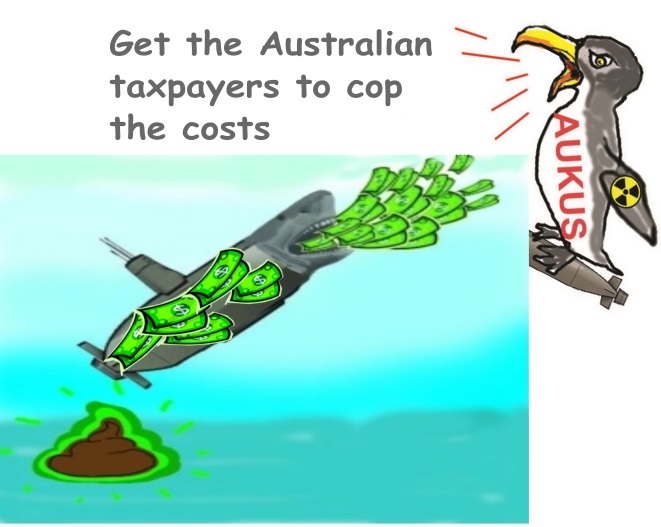
Under the revised AUKUS agreement, Australia will be liable for any problems or losses associated with disposing of nuclear waste. If something goes wrong, Australia pays. The liability is indefinite. The waste will remain hazardous for tens of thousands of years.
The government has calculated preliminary costs. The ASA has the documents. But when a citizen asks, the agency claims it cannot find them.
The government has calculated preliminary costs. The ASA has the documents. But when a citizen asks, the agency claims it cannot find them.
Whose Cradle? Whose Grave?
26 April 2026 Dr Andrew Klein, https://theaimn.net/whose-cradle-whose-grave/
I. The Question the Government Will Not Answer
In July 2025, Michael West Media submitted a Freedom of Information request to the Australian Submarine Agency (ASA). The question was simple: what are the latest cost estimates for a solution for the treatment and storage of high‑level radioactive waste from AUKUS?
This is not a radical question. Defence is supposed to provide “cradle to grave” costings for any major capability before it is approved. The AUKUS submarines were approved without those costings. The $368 billion price tag does not include radioactive waste storage and disposal.
The government has calculated preliminary costs. They exist. They are just not willing to share them with the people who will have to pay for them.
When the ASA finally responded, it did not provide the estimate. It claimed it could not find it.
The agency advised that:
“Preliminary searches have been carried out within one branch of one division of the ASA … that branch has advised that approximately 3,000 documents are potentially in scope. They would require manual examination.”
Three thousand documents. For one simple costing request. The agency is managing a $368 billion project, and it cannot find a single estimate for a cost that will likely run into the hundreds of billions of dollars.
As Rex Patrick, the former senator and transparency crusader, put it: “Quite unbelievable!”
II. The Cradle: Billions in Wealth Transfer
The cradle of the AUKUS program is a cascade of taxpayer funds flowing out of Australia.
The 2024 AUKUS budget of $53–63 billion has already blown out to $71–96 billion – a 52 per cent increase for the upper band. The Collins class submarine upgrade has blown out from $4–5 billion to $7.8–11 billion – a 120 per cent increase.
The money is not staying in Australia. It is flowing to American and British defence contractors. The US has expanded its AUKUS submarine support package to $1 billion. Australia is spending at least $30 billion on a new construction yard, and $21 billion on missile manufacturing.
The total cost of ownership of AUKUS could exceed $1 trillion.
This is not defence. This is wealth transfer – from Australian taxpayers to foreign defence giants.
III. The Grave: A Liability We Will Never Escape
The grave is the radioactive waste. The $368 billion AUKUS price tag does not include radioactive waste storage and disposal. That cost will be enormous – experts estimate it could double the total AUKUS price tag.
Under the revised AUKUS agreement, Australia will be liable for any problems or losses associated with disposing of nuclear waste. If something goes wrong, Australia pays. The liability is indefinite. The waste will remain hazardous for tens of thousands of years.
The government has calculated preliminary costs. The ASA has the documents. But when a citizen asks, the agency claims it cannot find them.
As Rex Patrick has noted, if the Minister asked for the latest cost estimates, he would get them almost instantly. But when a citizen asks, the agency claims it cannot find them.
IV. The Secrecy Is Deliberate
This is not the first time the government has gone to extraordinary lengths to hide information about AUKUS nuclear waste.
The ASA has argued that a $360,000 report on potential locations for a high‑level nuclear waste dump – a decision that will impact Australia for millennia – is a Cabinet document and must remain secret.
It took the agency to the Administrative Review Tribunal to fight the release of this report. The agency spent taxpayer dollars on lawyers to argue that the public should not be allowed to see a roadmap for where the most toxic material on our planet may be dumped for tens of thousands of years.
The report was prepared on unclassified computers and transferred on unclassified networks. It was never a Cabinet document. But the agency successfully argued that it should be treated as one.
This is not transparency. This is a cover‑up.
V. The Pattern: Moral Disengagement
This is the same pattern we have seen with Robodebt. With the Pezzullo affair.
The government has calculated the costs. The government has the documents. The government knows where the waste will go. But it will not tell you.
Why? Because the numbers are too big. The decisions are too controversial. The truth is too uncomfortable.
So they hide behind “Cabinet‑in‑confidence.” They hide behind “preliminary estimates.” They hide behind “3,000 documents.”
And they hope you will stop asking.
VI. The Mess at the Australian Submarine Agency
The ASA is not just disorganised. It is in a mess.
In November 2024, the government asked Boston Consulting Group to review the agency’s organisational structure. A contract was signed for $2.7 million. In April 2025, it was amended to $7.4 million. Three months later, it was amended again to a whopping $12.1 million.
In parallel, the defence minister asked former Defence Secretary Dennis Richardson to undertake an urgent top‑to‑bottom review of the ASA amid “serious concerns” about how it was managing AUKUS.
None of that seems to have helped. The agency still cannot find its own cost estimates.
VII. The Opportunity Cost
Every dollar spent on AUKUS is a dollar not spent on aged care, on health, on education, on housing, on climate action, on the things that actually keep Australians safe and well.
The $368 billion price tag is already blowing out. The waste disposal costs will add hundreds of billions more. The total could exceed $1 trillion.
This is not a defence strategy. It is a wealth transfer strategy – dressed up in flags and naval jargon.
The money is leaving Australia. The profits are flowing to Lockheed Martin, BAE Systems, Babcock. The waste is staying here. The liability is staying here. The secrecy is staying here.
VIII. Whose Cradle? Whose Grave?
The cradle belongs to the defence contractors. The profits flow to their shareholders. The grave belongs to Australia – to the communities that will host the waste, to the taxpayers who will pay the bill, to the generations who will inherit the liability.
This is not a failure of process. It is the process working as designed.
The government has calculated the costs. The government has the documents. The government knows where the waste will go. But it will not tell you – because the truth is too uncomfortable, and the wealth transfer is too profitable.
IX. A Final Word
Rex Patrick is one of the few people in this country who refuses to stop asking. He is a “Transparency Warrior” – a former senator and submariner who has made it his mission to hold the powerful to account.
He needs support. He needs attention. He needs people to share his work, to amplify his voice, to demand answers.
The truth will still be buried in those 3,000 documents – unless we keep digging.
Whose cradle? Whose grave? The answer is clear. And the silence is complicity.
1 This month
17 October, Free Public Talk on Nuclear Issues in South Australia
David Noonan will speak on public interest concerns over the new Roxby Downs Indenture Act 2026 on BHP copper-uranium mining and ore processing in SA, and on how AUKUS may face SA with a High-Level nuclear waste agenda.
Dr Jim Green will discuss international developments in the field of nuclear power including ‘small modular reactors’ and Generation 4 ‘advanced’ nuclear reactor concepts.


Help Aunty Sue Protect Her Land and Sacred Sites From Destructive Rocket Testing.
.

Australians deserve the truth
about
AUKUS – https://aukuspublicinquiry.com/

PETITION – To: Prime Minister Anthony Albanese and the Australian Labor Government

of the week – Australians for War Powers Reform (AWPR)
To see nuclear-related stories in greater depth and intensity

