Much hype, enthusiasm, tax-payers’ largesse, for Britain’s “new nuclear”. (What could possibly go wrong?)

There would be up to £20 billion in subsidies, if needed, to get between five and eight SMRs up and running by early next decade, and about £160 million in grants to keep R&D ticking over into AMRs and nuclear fuels.
Britain fires starter’s gun on race to nuclear
In the second instalment of the Nuclear Option series, Prime Minister Rishi Sunak’s government is suddenly ready to shower billions of pounds on getting modular nuclear reactors up and running by the early 2030s.
Australian Financial Review Hans van Leeuwen, Europe correspondentAug 22, 2023 – London
The British government is ready to trowel more than £20 billion ($38 billion) of taxpayers’ money into turbocharging the country’s nuclear industry, as the daunting task of decarbonising the UK’s energy sector looms ever larger.
With offshore wind and solar unlikely to ensure Britain has uninterrupted baseload power, the official goal is to get 24 gigawatts of nuclear energy onstream by 2050 – up to a quarter of British power demand, up from 15 per cent now.
But hefty new gigawatt-scale nuclear power stations are struggling to get off the ground, so the government’s hopes are increasingly pinned on an early lift-off for small modular reactors (SMRs)
…………… …. Tom Greatrex, chief executive of Britain’s Nuclear Industry Association. says that although successive Downing Street administrations have all understood Britain’s flagging nuclear industry needs fresh legs, Prime Minister Rishi Sunak’s government is now gripped with urgency. And it has clocked the key catalysing role of taxpayers and public policy.
“The lesson from anywhere in the world where nuclear power has been deployed is that unless the state is actively involved in encouraging it to happen, it doesn’t happen,” Greatrex says.
“It is public policy that has driven it, basically because the infrastructure is so big and capital-intensive.”
The government recently unfurled a £170 million investment into hurrying up work on the embryonic but enormous Sizewell C, a 3.2-gigawatt nuclear reactor to be built by the mid-2030s. This came on top of £700 million in earlier subsidies.
But the real action must of necessity be elsewhere. Construction of the next big new nuclear reactor, the 3.2-gigawatt Hinkley Point C plant in Somerset, has been subject to seemingly endless delays and cost blowouts. And of the five creaky old mega-reactors now operating, all but one will be shut in the next five years.
So, the focus is squarely on SMRs, which in theory can be rolled out more cheaply and snappily; and also on advanced modular reactors (AMRs), which use exotic new tech or methods that are still either largely on the drawing board or even just a glint in some scientist’s eye.
A week before the Sizewell announcement, the government confirmed it would set up a new agency, revelling in the Tory-boilerplate name of Great British Nuclear, to gee up the industry.
There would be up to £20 billion in subsidies, if needed, to get between five and eight SMRs up and running by early next decade, and about £160 million in grants to keep R&D ticking over into AMRs and nuclear fuels.
“I look forward to seeing the world-class designs submitted from all around the world through the competitive selection process, as the UK takes its place front and centre in the global race to unleash a new generation of nuclear technology,” energy minister Andrew Bowie trumpeted.
Leaders of the pack

At the front of the SMR pack is Rolls-Royce, leading a consortium that has already received £210 million in government grants. It has beefed up its SMR workforce to about 600 people.
……………………………………………. GE Hitachi is Rolls-Royce’s main rival. Media reports say it already has a BWRX-300 under construction and regulatory review in Canada, a.nd its model is under consideration in the US. The company claims to be the only contender with a realistic shot of getting an SMR operational by 2030.
The two are very likely to feature on Great British Nuclear’s short-list, which will be compiled by the end of the year. Other contenders could include Nuscale and Westinghouse.

The lucky winners will get access to the government’s subsidy scheme, which could be worth £20 billion if that’s what it takes.
It’s unclear exactly what form this largesse will assume. It could use the “regulated asset base” model, where investors are given a guaranteed minimum return, funded by a levy on consumer energy bills.
Another model might involve “strike prices”: a guaranteed price per unit, to smooth out the risks and uncertainty involved in committing so much capital upfront.
Whatever the capital cost, it won’t be as much as required for a mega-reactor: perhaps £2 billion to get an SMR up and running, as opposed to the £20 billion-plus for Sizewell C, thanks to the SMR’s modular, factory-based construction method. The catch, of course, is that you get just 50 to 500 megawatts of energy, rather than 3.2 gigawatts.
“It’s the economics of volume versus the economics of scale,” Greatrex says.
The initial batch of SMRs will almost certainly be built on the site of decommissioned larger reactors: communities there are socialised to nuclear; there are good grid connections; and the geography favours PWRs. This could help overcome a raft of potential political, planning or permit obstacles.
Dark horses
While the SMRs bolt towards an early-2030s target, the government hopes to back other horses in slower time. The AMRs might use technologies that ultimately prove more efficient, such as MoltexFlex’s molten-salt reactor. Or they might have different applications, such as local start-up U-Battery………………………….

U-Battery ‘s key backer, Urenco, ultimately couldn’t pull in investors, and in March handed the intellectual property to the government-backed National Nuclear Laboratory.
Other AMRs have higher-profile investors: TerraPower has Bill Gates; NewCleo has Italy’s Agnelli family. Most are working across multiple markets. X-Energy, for example, is using US funding to build a pilot of its gas-cooled pebble-bed reactor in Texas, which it says would allow it to roll out quickly in Britain…………………
The government has fired the starter’s gun, and the race in Britain is on. There’s bipartisan political support and investor interest, so Greatrex’s only anxiety is that Westminster might become distracted.
“It’s about maintaining momentum and focus. When something is at the top of the agenda it gets that attention and focus,” he says. “But if that focus is lost, that drive and commitment is lost? Then things could go back to taking a very long time.” https://www.afr.com/companies/energy/britain-fires-starter-s-gun-on-race-to-nuclear-20230726-p5dr9r
EDF Warns of French Nuclear Output Cuts in Weekend Heat Wave

Bloomberg, By Francois De Beaupuy, August 22, 2023
Electricite de France SA will probably have to reduce nuclear output over the coming weekend as a heat wave affecting a large part of the country warms rivers used for cooling some of its reactors.
Due to the high temperatures forecast on Rhone river, production restrictions are likely to affect production at its Tricastin power plant — where two of its four 900-megawatt reactors are already………….(Subscribers only) more https://www.bloomberg.com/news/articles/2023-08-21/edf-warns-of-french-nuclear-output-cuts-in-weekend-heat-wave#xj4y7vzkg
Exposure to Low-Dose Ionizing Radiation Linked to Solid Cancer Mortality

Elana Gotkine Aug 21, 2023 https://www.applevalleynewsnow.com/news/health/exposure-to-low-dose-ionizing-radiation-linked-to-solid-cancer-mortality/article_6ed70b06-3ba4-549e-828c-e2892b462550.html
(HealthDay News) — Protracted exposure to low-dose ionizing radiation is associated with an increased risk for solid cancer mortality, according to a study published online Aug. 16 in The BMJ.
David B. Richardson, Ph.D., from the University of California in Irvine, and colleagues examined the effect of protracted low-dose exposure to ionizing radiation on the risk for cancer in a multinational cohort study involving workers in the nuclear industry in France, the United Kingdom, and the United States. Participants included 309,932 workers with individual monitoring data for external exposure to ionizing radiation, with follow-up of 10.7 million person-years.
The researchers identified 103,553 deaths, including 28,089 due to solid cancers. There was a 52 percent increase in the estimated rate of mortality due to solid cancer with cumulative dose per Gy, which lagged by 10 years. The estimate of association was approximately doubled on restriction of the analysis to the low cumulative dose range (0 to 100 mGy) and with restricting the analysis to workers hired in more recent years, when estimates of occupational external radiation were more accurate. The estimated magnitude of the association was modestly affected by exclusion of deaths from lung cancer and pleural cancer, indirectly indicating that the association was not substantially confounded by smoking or asbestos exposure.
“The study provides evidence in support of a linear association between protracted low-dose external exposure to ionizing radiation and solid cancer mortality,” the authors write.
Ontario nuclear model may not suit Australia
AFR, Aug 21, 2023
Despite Ontario’s energy minister’s claim that nuclear is “reliable” (“Canada tries small-scale solution to global problem”, August 21), it is not always so. Last year in France, 32 of 56 nuclear reactors were shut down due to maintenance or technical problems as the driest summer in 500 years meant power plant cooling systems failed. The minister also failed to mention that Ontario’s electricity costs twice as much as Quebec’s………………………….. (Subscribers only) https://www.afr.com/politics/federal/ontario-nuclear-model-may-not-suit-australia-20230821-p5dy9d
The Oppenheimer Imperative: Normalising Atomic Terror

Resilience becomes part of the semantics of contemplated, and acceptable mass homicide. Emphasis is placed on the bounce-back factor, the ability to recover, even in the face of such weapons.
To be tactical is to be somehow bijou, cute, and contained, accepting mass murder under the guise of moderation and variation. One can be bad, but bad within limits.
Australian Independent Media, by Dr Binoy Kampmark, 20 Aug 23 https://theaimn.com/the-oppenheimer-imperative-normalising-atomic-terror/#comment-1092670
The atomic bomb created the conditions of contingent catastrophe, forever placing the world on the precipice of existential doom. But in doing so, it created a philosophy of acceptable cruelty, worthy extinction, legitimate extermination. The scenarios for such programs of existential realisation proved endless. Entire departments, schools of thought, and think tanks were dedicated to the absurdly criminal notion that atomic warfare could be tenable for the mere reason that someone (or some people) might survive. Despite the relentless march of civil society against nuclear weapons, such insidious thinking persists with a certain obstinate lunacy.
It only takes a brief sojourn into the previous literature of the nuke nutters to realise how appealing such thinking has proven to be. But it had its challenges. John Hersey proved threatening with his 1946 New Yorker spectacular “Hiroshima”, vivifying the horrors arising from the atomic bombing of the Japanese city through the eyes of a number of survivors.
In February 1947, former Secretary of War Henry Stimson shot a countering proposition in Harper’s, thereby attempting to normalise a spectacularly vicious weapon in terms of necessity and function; the use of the bombs against Japan saved lives, as any invasion would have cost “over a million casualties, to American forces alone.” The Allies, he surmised, “would be faced with the enormous task of destroying an armed force of five million men and five thousand suicide aircraft, belonging to a race which had already amply demonstrated its ability to fight literally to the death.”
Inadvertent as it was, the Stimson rationale for justifying theatrical never-to-be-repeated mass murder to prevent mass murder fell into the bloodstream of popular strategic thinking. Albert Wohlstetter’s The Delicate Balance of Terror chews over the grim details of acceptable extermination, wondering about the meaning of extinction and whether the word means what it’s meant to, notably in the context of nuclear war.
“Would not a general thermonuclear war mean ‘extinction; for the aggressor as well as the defender? ‘Extinction’ is a state that badly needs analysis.” Wohlstetter goes on to make a false comparison, citing 20 million Soviet deaths in non-atomic conflict during the Second World War as an example of astonishing resilience: the country, in short, recovered “extremely well from the catastrophe.”
Resilience becomes part of the semantics of contemplated, and acceptable mass homicide. Emphasis is placed on the bounce-back factor, the ability to recover, even in the face of such weapons.
These were themes that continued to feature. The 1958 report of the National Security Council’s Net Evaluation Subcommittee pondered what might arise from a Soviet attack in 1961 involving 553 nuclear weapons with a total yield exceeding 2,000 megatons. The conclusion: 50 million Americans would perish in the conflagration, with nine million left sick or injured. The Sino-Soviet bloc would duly receive retaliatory attacks that would kill 71 million people. A month later, a further 196 million would die. In such macabre calculations, the authors of the report could still breezily conclude that “[t]he balance of strength would be on the side of the United States.”
Modern nuclear strategy, in terms of such normalised, clinical lunacy, continues to find form in the tolerance of tactical weapons and modernised arsenals. To be tactical is to be somehow bijou, cute, and contained, accepting mass murder under the guise of moderation and variation. One can be bad, but bad within limits. Such lethal wonders are described, according to a number of views assembled in The New York Times, as “much less destructive” in nature, with “variable explosive yields that could be dialed up or down depending on the military situation.”
The journal Nature prefers a grimmer assessment, suggesting the ultimate calamity of firestorms, excessive soot in the atmosphere, disruption of food production systems, the contamination of soil and water supplies, nuclear winter, and broader climatic catastrophe.
Some of these views are teasingly touched on in Christopher Nolan’s Oppenheimer, a three-hour cross narrative jumble boisterously expansive and noisy (the music refuses to leave you alone, bruising the senses). While the idea of harnessing an exceptional, exterminating power haunts the scientific community, the Manhattan Project is ultimately functional: developing the atom for military purposes before Hitler does. Once developed, the German side of the equation becomes irrelevant. The urgent quest for creating the atomic weapon becomes the basis for using it. Once left to politics and military strategy, such weapons are normalised, even relativised as simply other instruments in inflicting destruction. Oppenheimer leaves much room to that lunatic creed, though somehow grants the chief scientist moral absolution.
This is a tough proposition, given Oppenheimer’s membership of the Scientific Panel of the Interim Committee that would, eventually, convince President Harry Truman to use the bombs. In their June 16, 1945 recommendations, Oppenheimer, along with Enrico Fermi, Arthur H. Compton and Ernest O. Lawrence, acknowledged dissenting scientific opinions preferring “a purely technical demonstration to that of a purely military application best designed to induce surrender.” The scientific panel proved unequivocal: it could “propose no technical demonstration likely to bring an end to the war; we see no acceptable alternative to direct military use.”
In the film, those showing preference for a purely technical demonstration are given the briefest of airings. Leo Szilard’s petition arguing against a military use “at least not until the terms which will be imposed after the war on Japan were made public in detail and Japan were given an opportunity to surrender” makes a short and sharp appearance, only to vanish. As Seiji Yamada writes, that petition led a short, charmed life, first circulated in the Metallurgical Laboratory in Chicago, only to make its way to Edward Teller at Los Alamos, who then turned it over to Oppenheimer. The petition was, in turn, surrendered to the Manhattan Project’s chief overseer, General Leslie Groves, who “stamped it ‘classified’ and put it in a safe. It therefore never reached Truman.”
Nolan depicts the relativisation argument in some detail – one that justifies mass death in the name of technical prowess – during an interrogation by US circuit judge Roger Robb, appointed as special counsel during the 1954 security hearing against Oppenheimer. In the relevant scene, Robb wishes to trap the hapless scientist for his opposition to creating a weapon of even greater murderous power than the fission devices used against Japan. Why oppose the thermonuclear option, prods the special counsel, given your support for the atomic one? And why did he not oppose the remorseless firebombing raids of Tokyo, conducted by conventional weapons?
Nolan also has the vengeful Lewis Strauss, the two-term chairman of the US Atomic Energy Commission, moan that Oppenheimer is the less than saintly figure who managed to get away, ethically, with his atomic exploits while moralising about the relentless march about ever more destructive creations. In that sentiment, the Machiavellian ambition monger has a point: the genie, once out, was never going to be put back in.
Lethal weapons to Ukraine – endless war prioritised over diplomacy: Address to United Nations Security Council
https://popularresistance.org/danny-haiphong-addresses-un-security-council-on-natos-ukraine-aid/ On August 17, 2023, Danny Haiphong spoke to spoke the latest convening of the United Nations Security Council on the dangers that Western arms to Ukraine poses to international peace and stability. He said,
“Today I am here as a journalist who has dedicated the last ten years of my life writing about and speaking out against the long record of human rights abuses and war crimes committed by my country of birth, the United States. I don’t consider this a hobby or even a profession but rather a duty to all of humanity and those who want to see a better and more peaceful future. I am here to as a US citizen who has witnessed tens of billions of US tax dollars go to funding and arming a proxy war against Russia while people in the US, ordinary people, suffer from rising levels of poverty, homelessness, suicide and economic insecurity.”
Most ‘experts’ pushing for endless conflict in Ukraine share a common benefactor.

the top 50 think tanks received over a billion dollars from the US government and its defense contractors and manufacturers, including some of the biggest beneficiaries of weapons production today ‘for Ukraine’. The top recipients of this funding include the Atlantic Council, German Marshall Fund of the United States, Brookings Institution, Heritage Foundation, Center for Strategic and International Studies, New America Foundation, RAND Corporation, Center for a New American Security, Council on Foreign Relations, and the Stimson Center.
A whopping 85% of media quotes on US military involvement come from someone paid by the defense industry
rachelmarsden.com 20 Aug 23
Experts with important-sounding titles linked to academic-sounding entities have been shaping hearts and minds in the press, both at home and abroad, in favor of endless conflict in Ukraine. Guess what deep-pocketed benefactor lurks beneath the surface?
During the Iraq War, the Pentagon backed retired generals to make the rounds of TV and radio shows as ‘military analysts’ to promote the Bush administration’s agenda in the Persian Gulf. It was like inviting Ronald McDonald on a program to debate and discuss the merit of Big Macs. You could almost see the strings attached to the puppets, linked to the military-industrial complex that benefited from war without an off-ramp.
Fast forward 20 years, and the sales tactics have drastically changed. The generals have been replaced by various experts with academic credentials, typically linked to one or more ‘think tanks’. Far from the neutral academic centers of intellectual integrity that the names suggest, these entities are little more than laundromats for discreet special interests. I should know – I used to be a director of one.
Every Wednesday, some of the highest-ranking figures of the Bush administration would come to our Washington, DC office to deliver their main agenda points for the week, requesting assistance in placing and promoting them to both grassroots activists sympathetic to the cause and to the general public. The experts within the think tank were hired based on political litmus tests, no doubt to ensure that their views aligned with the organization’s. When they no longer do, you’re either fired or you leave.
The donors, many of whom were well-known millionaires and billionaires driven by a passion for certain issues, would come straight out and ask for bang for their buck in exchange for the opening of their wallets. In some cases, an entire project or department would be mounted at the think tank with the understanding that it would be fully funded by a single donor. These rich, influential folks typically had business or investment interests that benefited from shaping the establishment narrative in their favor, and they wanted to do so without leaving any footprints. What better way than to have it all fronted by a shiny veneer of expert credibility?
So while the generals of the Iraq War era had all the subtlety of a sledgehammer in representing the interests of the military-industrial complex, the new salesmen of endless armed conflict in Ukraine have overwhelmingly adopted the more subtle model. A study published in 2020 found that the top 50 think tanks received over a billion dollars from the US government and its defense contractors and manufacturers, including some of the biggest beneficiaries of weapons production today ‘for Ukraine’. The top recipients of this funding include the Atlantic Council, German Marshall Fund of the United States, Brookings Institution, Heritage Foundation, Center for Strategic and International Studies, New America Foundation, RAND Corporation, Center for a New American Security, Council on Foreign Relations, and the Stimson Center.
Some of these black boxes are more ideologically-driven than others. The Heritage Foundation, for example, leans overwhelmingly neoconservative and interventionist. Others, like the Atlantic Council and German Marshall Fund, are effectively force multipliers for NATO talking points. But the RAND Corporation also houses systems analysts and scientists specializing in space and computing. The fact that not all of these entities – or even the people who work within some of them – can be tossed into the same basket and labeled mere parrots for the special interests of their organization’s benefactors helps to muddy the waters.
In an analysis published in June of media coverage related to US military involvement in Ukraine, the Quincy Institute for Responsible Statecraft found that, when a think tank is cited regarding the issue, 85% of the time it’s a think tank with “financial backing from the defense industry.” Taken at face value, this risks being interpreted by the general public as expert ‘consensus’ on the need for US taxpayers to continue flooding Ukraine with weapons, unaware that it’s really just a bunch of Pentagon-backed actors agreeing with each other about the need to pursue the most profitable course of action on behalf of their War Inc. sugar daddies. Just like when climate scientists, who have parlayed climate change into endless funding and a perpetual justification for their existence, aren’t going to kill their cash cow by arguing that the climate can’t be controlled by man and that throwing cash at the issue – or at them – is futile.
Many of the Ukraine think tank experts are quick to attack analysis and information published on platforms they don’t like – such as RT – as ‘Russian-backed’. You’d have to be living under a rock these days to not know that RT is linked to Russia. No transparency issues there.
But there is far less transparency around their own organizations’ financing. Where is their insistence on being above board about the use of defense industry cash to influence not just the general public but the course of the conflict itself? Around a third of top foreign policy think tanks don’t disclose this Pentagon funding, according to the Quincy Institute. Nor is it unheard of for these experts to springboard from these establishment-friendly platforms and the public notoriety they provide, right into public office – where they can translate the same agenda that they promoted into actionable policy. Isn’t it important for voters to consider the powerful hidden hand who helped to get them there?
Week to 21st August – in nuclear news

A bit of good news. Montana Rules a Healthful Environment Is a Constitutional Right.
TOP STORIES
Nuclear Power Plants as Targets of War — A New Worry?.
Ukraine likely to fail in key counteroffensive aim, says US intelligence. Amid ‘staggering’ Ukrainian toll and souring US polls, Biden seeks billions more for war. Why the Glut of ‘Wonder Weapons’ to Ukraine Won’t Make a Difference.
Huge study of nuclear workers in France, the United Kingdom, and the United States confirms low dose radiation as a cause of cancer. Risk of cancer death after exposure to low-dose ionizing radiation underestimated, suggests nuclear industry study.
Climate. Climate Scientists warn nature’s ‘anaesthetics’ have worn off, now arth is feeling the pain, as ocean heating hits record.
Nuclear. You’d think that the fact that the Ukraine ‘counter-offensive’ is stalling might induce a Western mindset more favorable to the idea of a negotiated end to the war. Not so -the US-NATO plan is for more, and more lethal weapons. It might even put off the idea of a war against China. But no -and sadly, in Australia the mood among the “top people” is all for throwing $billions at preparing for the China war. (The bottom people aren’t consulted)
Christina notes. Bribery and Blackmail: these are the tools for continuing success of the nuclear industry. Perfecting “planned obsolescence” – how the USA and its allies’ taxpayers are locked into perpetual buying of useless weapons.
AUSTRALIA.
- Assange Be Weary: The Dangers of a US Plea Deal. For What Crime? – Good Journalism?. An Assange Plea Deal? A profound change’: AUKUS debate looms for Labor’s rank and file.
- So much Labor hope is riding on an empty vessel. Albanese defends against attempt to strike nuclear submarines out of Labor platform. AUKUS a cover for the Coalition’s nuclear power agenda. ‘Unbelievable’: Defence spends $8.5m on consultants for AUKUS nuclear regulator. The Australian Government, especially Defence Minister Richard Marles, move to squash Labor Party dissent about AUKUS and nuclear submarines.
- Why the Coalition backs nuclear. Stop renewables and wait for nuclear: Nationals stunning rejection of science and industry. Gina Rinehart: Australia’s wealthiest person uses Bush Summit speech to push for nuclear power.
- Game changer: defence industry ‘revolving door’ database to be created.
CLIMATE. The nuclear icebreakers enabling drilling in Russia’s Arctic .
ECONOMICS.
- How the “Nuclear Renaissance” Robs and Roasts Our Earth. Nuclear power plants will mortgage all future generations, says expert.
- Japan’s controversial nuclear waste water plan could impact the UK’s decarbonisation agenda.
- US tightens export controls of nuclear power items to China.
- The nuclear industry needs to show it can deliver economically viable big reactors in time and on budget.
- Finland’s OL2 nuclear reactor off grid; power prices rise.
ENERGY. US climate law introduces billion-dollar ‘game-changer’ for nonprofits.
ENVIRONMENT. Anger as Hinkley Point C allowed to discharge sewage into Bristol Channel and drop fish protection.
ETHICS and RELIGION. The Oppenheimer Imperative: Normalising Atomic Terror. Japanese and US Bishops pledge partnership for a nuclear-free world. Poisoning the planet. Big Brave Western Proxy Warriors Keep Whining That Ukrainian Troops Are Cowards.
HEALTH. Japan mothers’ group fears Fukushima water release could revive health concerns.
LEGAL. Marshall Islands reacts to US expansion of nuclear compensation.
MEDIA. The Connection between Oppenheimer and Gentilly-2: Edward Teller and the H bomb
NUCLEAR TECHNOLOGY. Risks of further delays at Hinkley Point C, EDF warns. Even the UK’s very first small nuclear reactor could could not be decided upon until 2029 . Nuclear Fusion: Energy Breakthrough or Ballyhoo?.
OPPOSITION to NUCLEAR . South Korea’s opposition party to file UN complaint against Japan over nuclear waste .
PERSONAL STORIES. The Financial Legacy of the Nuclear Tests on Bikini Atoll/
POLITICS.
- Biden should promote peace over war in Ukraine for 2 good reasons.
- Pritzker was right to keep moratorium on new Illinois nuclear plants.
- New York governor blocks discharge of radioactive water into Hudson River from closed nuclear plant.
- Zelensky holds court with Ukraine’s most notorious neo-Nazi.
- UK ‘s Minister for Nuclear and Networks very upbeat about nuclear energy’s future.
- OPPENHEIMER AUTHOR ENDORSES NORTON BILL – Nuclear Abolition and Conversion Act, H.R. 2775 .
POLITICS INTERNATIONAL and DIPLOMACY.
- NATO Official Suggests Ukraine Could Cede Territory to Russia to Join Alliance. Lukashenko shares thoughts on future of Ukraine.
- Iran says it is committed to resolving nuclear dispute through diplomacy.
- Tussle in Europe as France succeeds in getting nuclear energy accepted\ as a ‘”transitional” technology for EU’s green taxonomy .
- Fukushima water release poses test for Japan-South Korea unity.
- France and Russia co-operate on developing a plant in Russia for processing depleted uranium . French cruise ship makes rendezvous with Russian nuclear icebreaker near North Pole.
- Austria cautions against nuclear power in the nuclear Non-Proliferation Treaty.
PROTESTS. Gwynedd anti-nuclear march ‘sent powerful message’. Japanese citizens’ group protests nuclear discharge.
SAFETY.
Nuclear Regulatory Commission’s Risky Rule Change Ignores History. More Nuclear Emergency Planning Needed, Not Less.
Power-Line Cut Raises Alarm Over Russian-Held Nuclear Plant In Ukraine, But Expert Says Little Has Changed. Russia And Ukraine Trade Blame Over Outages At Zaporizhzhya Nuclear Plant.
SECRETS and LIES. Most ‘experts’ pushing for endless conflict in Ukraine share a common benefactor.
WASTES. Japan’s nuclear plants are short of storage for spent fuel. A remote town could have the solution.
WAR and CONFLICT. Ralph Nader: Develop an Exit Strategy for the Endless War in Ukraine. The Inevitable Defeat: Retired US Colonel Speaks Candidly On Ukraine’s Losing Battle Against Russia. Back in another quagmire – in Biden’s relentless “Big Muddy” of Ukraine. https://www.youtube.com/watch?v=uXnJVkEX8O4 US, Finland Negotiating Defense Agreement That Would See Deployment of American Troops.
Niger is Far From a Typical Coup.
WEAPONS and WEAPONS SALES.
- Lethal weapons to Ukraine – endless war prioritised over diplomacy: Address to United Nations Security Council. https://www.youtube.com/watch?v=AS44mvuo7Ow Germany will ‘never’ place troops in Ukraine – Scholz.
- Over Budget and Delayed—What’s Next for U.S. Nuclear Weapons Research and Production Projects? The Pentagon Is Spending $1 Billion a Year on ‘Directed Energy Weapons’.
- What Happened When the US Set Off Nuclear Weapons in One of the Most Geologically Active Places on Earth?
‘Unbelievable’: Defence spends $8.5m on consultants for AUKUS nuclear regulator
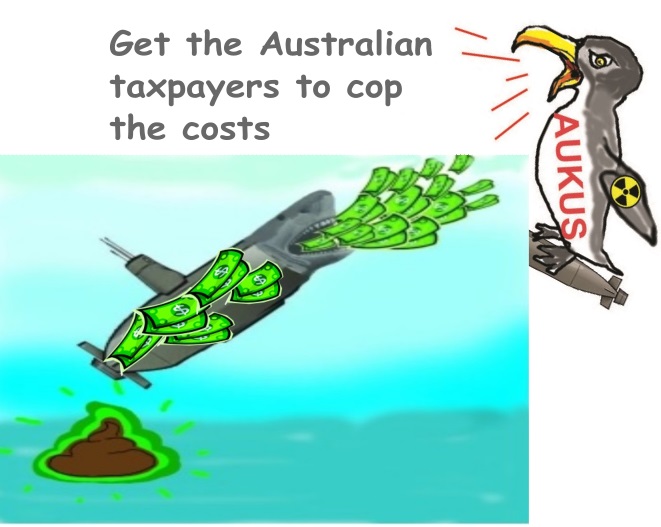
Greens defence spokesperson Senator David Shoebridge said: “It’s genuinely unbelievable that in the middle of a national scandal about outsourcing core government functions to the big four consultants, Defence has gifted an $8.5 million contract to one of them to design a new national nuclear regulator.
“It was always wrong to have Defence in control of its own regulator for the AUKUS nuclear submarines, and now we can see how they have hand-picked a pro-nuclear consultant to design the whole thing.”
SMH, Matthew Knott, August 21, 2023
One of the big four consultancy firms will receive almost $8.5 million in taxpayers’ money over the next year to help design a new agency to monitor safety issues associated with Australia’s acquisition of nuclear-powered submarines under the AUKUS pact.
The Defence Department contract with EY, also known as Ernst & Young, comes amid a growing debate about the federal public service’s reliance on advice from external consultants for tasks that would previously have been performed in-house.
The Albanese government announced in March that it would create a new agency, known as the Australian Nuclear-Powered Submarine Safety Regulator, to “regulate the unique circumstances associated with nuclear safety and radiological protection across the lifecycle of Australia’s nuclear-powered submarine enterprise”.
The regulator, which will sit within the Defence Department, will also monitor infrastructure and facilities associated with the AUKUS pact such as the yet-to-be determined east coast submarine base.
Prime Minister Anthony Albanese stared down concerns from Labor’s Left faction about AUKUS, including about nuclear safety and the risks of nuclear proliferation, at the party’s national conference on the weekend.
Earlier this month the Defence Department revealed that it had awarded a 12-month contract to EY worth $8.4 million to advise on the design of a future nuclear regulatory agency.
Greens defence spokesperson Senator David Shoebridge said: “It’s genuinely unbelievable that in the middle of a national scandal about outsourcing core government functions to the big four consultants, Defence has gifted an $8.5 million contract to one of them to design a new national nuclear regulator.
“It was always wrong to have Defence in control of its own regulator for the AUKUS nuclear submarines, and now we can see how they have hand-picked a pro-nuclear consultant to design the whole thing.”
Shoebridge said he was troubled by EY’s deep connections to nuclear companies including US firm NuScale Power Corporation and China General Nuclear Power Co, as well as its role as the longstanding auditor for Japan’s Tokyo Electric Power Company, which operated the now decommissioned Fukushima power plant.
“This contract needs to be torn up and then this core duty of government, designing a nuclear oversight agency, needs to be done by government, not by a hired gun from the big four,” Shoebridge said………………………………………………………………………………………..
EY declined to respond to questions about the contract.
During a Senate appearance in July EY Oceania chief executive David Larocca distanced the firm from rival PwC, which is under fire for leaking confidential government information to its clients.
Shoebridge said the nuclear safety regulator should sit inside a separate department – such as the Department of Climate Change, Energy, the Environment and Water – rather than Defence to ensure it could provide independent oversight of the AUKUS submarine program.
…………………………… The government has been widely expected to name Port Kembla, in the Illawarra region of NSW, as the east coast base for Australia’s fleet of nuclear-powered submarines, but the idea has attracted a backlash from residents and unions.
The government has said it will store nuclear waste from the AUKUS submarines on defence land. Woomera in remote South Australia is seen as the most likely location. https://www.smh.com.au/politics/federal/unbelievable-defence-spends-8-5m-on-consultants-for-aukus-nuclear-regulator-20230820-p5dxxo.html
New York governor blocks discharge of radioactive water into Hudson River from closed nuclear plant.

A measure to block discharges of radioactive
water into the Hudson River as part of the Indian Point nuclear plant’s
decommissioning was signed into law Friday by New York Gov. Kathy Hochul.
The bill was introduced to thwart the planned release of 1.3 million
gallons of water with traces of radioactive tritium from the retired
riverside plant 25 miles (40 kilometers) north of New York City.
The plan sparked a groundswell of opposition in the suburban communities along the
river. Many feared the discharges would depress real estate values and
drive away sailors, kayakers and swimmers after decades of progress in
cleaning up the Hudson River.
AP 18th Aug 2023
Trillion-dollar toll of climate change will cost Australia its triple-A rating
Trillion-dollar toll of climate change will cost Australia its triple-A rating
A world-first analysis of the impact of climate change on countries’ credit worthiness shows Australia will be among the worst hit, pushing up annual interest bills.
The world’s oceans are running a fever, scientists are worried
The world’s oceans are running a fever, scientists are worried
Climate scientists say natural “anaesthetics” have been masking the true impact of climate change for years, but this year it’s worn off. The world’s ocean temperature is at record highs, Antarctic sea ice is at record lows, and extreme weather has lashed the world. Here’s what’s behind the intense heat, and what it could bring.
Why the Coalition backs nuclear

“Our sense of this is that nuclear is a debating issue that gives the Coalition cover for its quite diverse and often quite split positions … It enables them to not have to announce what their actual policy position is.” (Dave Sweeney of Australian Conservation Foundation)
The Saturday Paper, By Mike Seccombe, AUGUST 19 – 25, 2023 | No. 463
Previously staunch opponents of nuclear energy in the Coalition are now backing it as an alternative to renewables, despite largely unproven technology, long delays for approvals and the unsolved problem of waste. .
In his younger days, Ted O’Brien, the federal shadow minister for climate change and energy, was strongly anti-nuclear. But these days, he marches with a different crowd. Indeed, he leads it.
Tony Abbott is among them. As is Gina Rinehart, the richest person in the country. And Warren Mundine, a leader of the campaign against an Indigenous Voice to Parliament. And Andrew Liveris, an architect of former energy minister Angus Taylor’s abortive “gas-fired recovery” plan. And the climate change sceptics at the Institute of Public Affairs (IPA). And a raft of right-wing commentators, particularly in the Murdoch media, which also dutifully records each new salvo fired by Rinehart, Mundine, Liveris and others on the latest front in the climate wars.
The front is the battle for acceptance of nuclear power as an alternative energy source to renewables.
It is perhaps unsurprising things have come to this. Despite the efforts of the last federal government to slow-walk the shift to renewables and to extend the life of fossil fuels – particularly the dirtiest of them, coal – it has long been increasingly obvious they are on the way out. There will never be another coal-fired power station built in this country. Gas is an expensive alternative of very limited and declining utility.
Having spent years fomenting resistance to wind and solar, battery storage and new transmission infrastructure, the political right could hardly be expected to reverse course. Nuclear, though, presented an opportunity for differentiation. And so, last month, Opposition Leader Peter Dutton grasped it firmly. In a speech to the IPA, he accused the Albanese government of “renewable zealotry … putting our nation at risk”.
“The Albanese government is recklessly rushing to renewables and switching off the old system before the new one is ready,” he said.
………… Dutton offered a new variation on an old, radioactive theme.
………………… [Dutton advocated] “next-generation nuclear technologies which are safe and emit zero emissions. Namely, small modular reactors, or SMRs. And microreactors or micro modular reactors – MMRs – which are also known as nuclear batteries.”
A single SMR, Dutton said, could power 300,000 homes. An MMR could power a hospital, a factory, a mining site or a military base…………………………………. Dutton was singing from the songsheet Ted O’Brien has been assiduously composing for years.
………………. In 2019, the House Standing Committee on the Environment and Energy, chaired by O’Brien, conducted an inquiry into nuclear power.
Interestingly, it did not give a blanket endorsement. It found Australia should definitely reject old nuclear technology, but conditionally approve new and emerging technologies of the sort Dutton spoke about. There were dissenting reports from Labor members on the committee and the independent Zali Steggall.
The report’s title was “Not without your approval”, a recognition that nukes faced a big problem in gaining social licence.
It stressed that nuclear plants and waste facilities should not be imposed on local communities.
The response – or rather lack of response – from O’Brien’s superiors suggest they also worried about its public acceptability. The government made no move towards addressing the threshold problem with having nuclear power in Australia: that it is illegal under two separate pieces of legislation, passed under the Howard government.
…………. The most optimistic forecasts, including by O’Brien himself, suggest that even if new legislation were passed to remove the existing bans, it would take at least five years to get a reactor approved, up and running. A significant weight of expert opinion suggests far longer – probably 10 to 15 years.
Way back in 2006, the Howard government appointed the nuclear physicist Ziggy Switkowski from the board of the Australian Nuclear Science and Technology Organisation to conduct a review of Australia’s possible nuclear future.
The review concluded nuclear power would likely be between 20 and 50 per cent more costly to produce than power from a new coal-fired plant. It would take 10 to 15 years, and government subsidies, to get any nukes into the grid. Switkowski also foresaw cost reductions in renewable generation that would make them even more competitive.
That was before SMRs were contemplated, of course, but in the years since, the calculus hasn’t changed much, except that renewables and storage have become cheaper and faster.
Big questions remain about the cost of power from SMRs and the timeframes for deploying them.
Even Dutton’s assertion that modular reactors are a “feasible and proven technology” is questionable. They certainly look feasible, but they are hardly proven.
Mark Ho, newly elected president of the Australian Nuclear Association, an independent professional body of nuclear advocates, says there are currently just two operational SMRs in the world – one in Russia and one in China. Many more are in prospect. According to Dutton – and there is no reason to doubt him – 50 or more countries “are exploring or investing in new SMRs and nuclear batteries”.
But they are a way off being operational, Ho says. “In the US, there’s two leading designs, the NuScale reactor and BWRX, slated for completion by 2029.” In the UK, Rolls-Royce plans to have a first SMR up and running by 2029. Others are under development in Canada and elsewhere, Ho says, all looking to be operational around the end of the decade.
These timeframes mean SMRs would do nothing to help Australia meet its 2030 emissions reduction target…………………
It’s noteworthy that none of the talk reflects an actual policy commitment, says Dave Sweeney, nuclear-free campaigner for the Australian Conservation Foundation. “Our sense of this is that nuclear is a debating issue that gives the Coalition cover for its quite diverse and often quite split positions,” he says.
The debate gives the impression that the conservative parties are sincere about finding the best way forward, he suggests, when in reality a significant portion of its ranks “just don’t want renewables” and remain committed to fossil fuels.
“It enables them to not have to announce what their actual policy position is. When asked what is their response to energy and climate issues, what they say is ‘we need to consider everything’,” says Sweeney.
“They talk about the need for discussion, conversation, all that sort of stuff – as if we haven’t talked about it and had royal commissions about it and federal/state inquiries about it ad nauseam.”
Which is essentially what O’Brien tells The Saturday Paper when asked what the opposition’s actual policy is………………………..
The opposition is constrained, too, by its internal divisions. Sweeney cites a recent example, from last month’s Liberal National Party Queensland convention, “where there was a motion to support nuclear and [state party leader David] Crisafulli just slapped it down”.
……………………………………………………….. The same pro nuclear argument was made by Coalition senators in a report from yet another parliamentary inquiry, which came down last week.
The impetus for this one was a private member’s bill introduced last year by a Nationals senator and implacable foe of renewable energy, Matt Canavan, and co-sponsored by eight other conservatives. Its purpose, Canavan told the Senate, was to remove the bans on nuclear power “because that would be the best way to take advantage of future technological developments that could see nuclear energy as the most competitive carbon free option to produce electricity”.
Two pieces of Commonwealth legislation prohibit nuclear power in Australia. They are the Environment Protection and Biodiversity Conservation Act and the Australian Radiation Protection and Nuclear Safety Act, and they prevent the construction or operation of nuclear facilities for power generation, as well as facilities for the fabrication of nuclear fuel, uranium enrichment and the reprocessing of nuclear waste.
A further complication is that the three large east coast states, New South Wales, Victoria and Queensland, also have legislation prohibiting the construction of nuclear plants, while Western Australia, South Australia and the Northern Territory have legislation that prohibits the transport or disposal of nuclear waste.
Canavan’s bill was duly shunted to a committee, and when it reported back, it was, to no one’s surprise, split.
The majority recommended the bans remain, citing eight reasons: that “next generation” nuclear technology was unproven; that expert evidence held it would take 10 or 15 years to come online, by which time it would be unnecessary because Australia would have hit its 83 per cent emissions reduction target; that it was inflexible in its output; that it posed risks to human health and the environment; that it required vast quantities of water for cooling; that it created national security risks because neighbouring nations might suspect we would make nuclear weapons, and might in response target us; that it lacked a social licence and that renewables were cheaper.
Coalition members produced a dissenting report…………………………..
Regardless of the relative merits of the competing arguments, what mattered was what always matters in politics: the numbers. And the government had the numbers on the committee, just as it has the numbers in the parliament. So the ban on nukes stays, so long as Labor and the anti-nukes who dominate the cross benches hold power.
And they hold power so long as public opinion is with them.
On that front, much has been made in conservative media of an opinion poll taken in May, which found 45 per cent of voters either strongly or somewhat supported nuclear power as a domestic energy source, with 23 per cent opposed and the rest undecided. It also found 51 per cent support for removing the bans on nuclear energy.
The poll was commissioned by the Minerals Council of Australia, a body that has long supported the nuclear industry, but the questions asked were pretty straightforward.
It would be interesting to see the results of a poll that asked voters if they would like to see a nuclear plant or waste facility in their electorate. Because you can bet that’s the scare campaign nuclear opponents would mount if the opposition formally adopted the position Dutton, O’Brien, and the conservative members of that committee have intimated.
And in that case, you really have to wonder whether the endorsement of such prominent supporters as Gina Rinehart, Tony Abbott, Warren Mundine and Andrew Liveris and the power of the IPA or even the Murdoch media would sway many votes. https://www.thesaturdaypaper.com.au/news/environment/2023/08/19/why-the-coalition-backs-nuclear
Risk of cancer death after exposure to low-dose ionizing radiation underestimated, suggests nuclear industry study

by British Medical Journal, 16 Aug 23, https://medicalxpress.com/news/2023-08-cancer-death-exposure-low-dose-ionizing.html
Prolonged exposure to low-dose ionizing radiation is associated with a higher risk of death from cancer than previously thought, suggests research tracking the deaths of workers in the nuclear industry, published in The BMJ.
The findings should inform current rules on workplace protection from low-dose radiation, say the researchers.
To date, estimates of the effects of radiation on the risk of dying from cancer have been based primarily on studies of survivors of atomic bombs dropped on Japan at the end of the Second World War.
These estimates are used to set the level of protection required for workers regularly exposed to much lower doses of radiation in the nuclear industry and other sectors such as health care.
But the latest data from the International Nuclear Workers Study (INWORKS) suggest that risk estimates, based on the acute exposures among atomic bomb survivors to an extremely high dose of radiation, may underestimate the cancer risks from exposure to much lower doses of ionizing radiation delivered over a prolonged period in the workplace.
The researchers therefore tracked and analyzed deaths among 309,932 workers in the nuclear industry in the UK, France, and the US (INWORKS) for whom individual monitoring data for external exposure to ionizing radiation were available.
During a monitoring period spanning 1944 to 2016, 103,553 workers died: 28,089 of these deaths were due to solid cancers, which include most cancers other than leukemia.
The researchers then used this information to estimate the risk of death from solid cancers based on workers’ exposure to radiation 10 years previously.
They estimated that this risk increased by 52% for every unit of radiation (Gray; Gy) workers had absorbed. A dose of one Gray is equivalent to a unit of one Joule of energy deposited in a kilogram of a substance.
But when the analysis was restricted to workers who had been exposed to the lowest cumulative doses of radiation (0-100 mGy), this approximately doubled the risk of death from solid cancers per unit Gy absorbed.
Similarly, restricting the analysis only to workers hired in more recent years when estimates of occupational external penetrating radiation dose were more accurate also increased the risk of death from solid cancer per unit Gy absorbed.
Excluding deaths from cancers of the lung and lung cavity, which might be linked to smoking or occupational exposure to asbestos, had little effect on the strength of the association.
The researchers acknowledge some limitations to their findings, including that exposures for workers employed in the early years of the nuclear industry may have been poorly estimated, despite their efforts to account for subsequent improvements in dosimeter technology—a device for measuring exposure to radiation.
They also point out that the separate analysis of deaths restricted to workers hired in more recent years found an even higher risk of death from solid cancer per unit Gy absorbed, meaning that the increased risk observed in the full cohort wasn’t driven by workers employed in the earliest years of the industry. There were also no individual level data on several potentially influential factors, including smoking.
“People often assume that low dose rate exposures pose less carcinogenic hazard than the high dose rate exposures experienced by the Japanese atomic bomb survivors,” write the researchers. “Our study does not find evidence of reduced risk per unit dose for solid cancer among workers typically exposed to radiation at low dose rates.”
They hope that organizations such as the International Commission on Radiological Protection will use their results to inform their assessment of the risks of low dose, and low dose rate, radiation and ultimately in an update of the system of radiological protection.
More information: Cancer mortality after low dose exposure to ionising radiation in workers in France, the United Kingdom, and the United States (INWORKS): cohort study, The BMJ (2023). DOI: 10.1136/bmj-2022-074520
Journal information: British Medical Journal (BMJ)
Japan’s nuclear plants are short of storage for spent fuel. A remote town could have the solution.

Chugoku Electric’s plan to build a nuclear power plant in Kaminoseki has been stalled for more than a decade since the Fukushima Daiichi disaster, delaying subsidies for the remote town, whose population is aging and shrinking.
“The town will only get poorer if we just keep waiting,” Kaminoseki Mayor Tetsuo Nishi – “We should do whatever is available now.”
ByMARI YAMAGUCHI Associated Press, https://abcnews.go.com/Business/wireStory/japans-nuclear-plants-short-storage-spent-fuel-remote-102373016 August 19, 2023
TOKYO — A Japanese town said Friday it has agreed to a geological study to determine its suitability as an interim storage site for spent nuclear fuel.
Kaminoseki, a small town in the southwestern prefecture of Yamaguchi, said it would accept the offer of a survey by Chugoku Electric Power Co., one of two major utility operators, along with Kansai Electric Power Co., whose spent fuel storage pools are almost full.
The Japanese government is promoting the greater use of nuclear power as a low-carbon energy source, but the country’s nuclear plants are running out of storage capacity.
The problem stems from Japan’s stalled nuclear fuel recycling program to reprocess plutonium from spent fuel for reuse. The government has continued to pursue the program, despite serious technical setbacks. A plutonium-burning Monju reactor failed and is being decommissioned, while the launch of the Rokkasho reprocessing plant in northern Japan has been delayed for almost 30 years.
After the meltdown of the Fukushima Daiichi nuclear power plant in 2011, many reactors were temporarily taken offline and their restarts delayed, helping to reduce the spent fuel stockpile.
However, when Prime Minister Fumio Kishida’s government decided to reverse a phaseout and maximize nuclear power as clean energy, concerns over the lack of storage space were rekindled.
Earlier this month, Chugoku put forward a proposal to build a storage facility jointly with Kansai Electric, but the plan was met by angry protests from residents, who surrounded the mayor and yelled at him.
Chugoku Electric’s plan to build a nuclear power plant in Kaminoseki has been stalled for more than a decade since the Fukushima Daiichi disaster, delaying subsidies for the remote town, whose population is aging and shrinking.
“The town will only get poorer if we just keep waiting,” Kaminoseki Mayor Tetsuo Nishi told a televised news conference Friday. “We should do whatever is available now.”
Kansai Electric, Japan’s largest nuclear plant operator, is urgently seeking additional storage for spent fuel: the cooling pools at its plants are more than 80% full. The company pledged to find a potential interim storage site by the end of this year.
About 19,000 tons of spent fuel, a byproduct of nuclear power generation, is stored at power plants across Japan, taking up about 80% of their storage capacity, according to the economy and industry ministry.
The continuation of spent fuel reprocessing program and the delay have only added to Japan’s already large plutonium stockpile, raising international concern. Japan also lacks a final repository for high-level nuclear waste.
An intermediate facility is designed to keep nuclear spent fuel in dry casks for decades until it is moved to a reprocessing or to a final repository. Experts say it is a much safer option than keeping it in uncovered cooling pools at their plants.
If the storage is actually built, it will be the second such facility in Japan. The only other one is in Mutsu, near Rokkasho, which is reserved for Tokyo Electric Power Co. and a smaller utility.
1 This month


Help Aunty Sue Protect Her Land and Sacred Sites From Destructive Rocket Testing.
.

Australians deserve the truth
about
AUKUS – https://aukuspublicinquiry.com/

PETITION – To: Prime Minister Anthony Albanese and the Australian Labor Government

of the week – Australians for War Powers Reform (AWPR)
To see nuclear-related stories in greater depth and intensity

