Suggestion of completely unsuitable Woomera as nuclear dump site shows gross ignorance

15 Aug 23, The recent suggestion by the Hon. Nick Minchin of using the rocket
range in the relatively remote Woomera region of South Australia for
the disposal of this country’s nuclear waste generated by AUKUS is
quite irrational smacking of gross ignorance.
It has been well known for many years that the Woomera area by its
topography and geological setting is completely unsuitable for any
form of nuclear waste disposal and is clouded – forgive the pun – by
the consequences of the extensive nuclear testing in the region over
seventy years ago.
The consequences of that testing are still being felt by the Aboriginal
peoples of the region and has turned the majority of South
Australia’s general community against any form of nuclear waste
storage in its State.
The Department of Defence already has a significant volume of
nuclear waste held in the Woomera area for which it is seeking a
suitable means of disposal that to a large extent was lost with the federal government recently abandoning its proposals for nuclear waste management at Kimba.
The proof of the pudding is that if the Woomera region were at all
suitable for the disposal or even long term safe storage of nuclear
waste then the defence authorities would have already joyfully
availed themselves of that opportunity.
In his previous ministerial capacity Mr Minchin argued for the
establishment of a national nuclear waste disposal facility to among
other things dispose of the ostensibly large quantities of nuclear
waste held in over a hundred locations throughout Australia but this
in itself was disingenuous since those locations are mainly hospitals
and research facilities developing lower levels of waste which is
invariably disposed by them on site.
In fact the federal government recently acknowledged that if lucky it
would get less than 10% of that waste for disposal at the facility
proposed for Kimba.
It is comments like those now offered by Mr Minchin which make
Australia’s already glaringly limited proficiency in nuclear waste management by international standards to be even more baseless.
It is quite clear that a major one of these consequences is the
attempted successful implementation of the AUKUS arrangements
which Mr Minchin was no doubt trying to achieve with his rather
inopportune suggestion of Woomera
Civil Society faces imposition of an AUKUS military High Level nuclear waste dump

https://nuclear.foe.org.au/wp-content/uploads/AUKUS-nuclear-waste-David-Noonan-brief-13Aug2023.pdf Updated Briefing by David Noonan, Independent Environment Campaigner 13 August 2023
The Federal ALP belatedly disclosed a secret pre-condition in AUKUS plans to buy existing US nuclear submarines: for Australia to keep the US subs military High Level nuclear waste forever.
In a breach of trust the ALP is seeking to ‘normalise’ High Level nuclear waste in Australia. Claims of
‘nuclear stewardship’ in taking on US nuclear subs and in retaining the US sub wastes are a farce.
Disposal of High Level nuclear waste is globally unprecedented, with our AUKUS ‘partners’ the US
and UK having proven unable to do so in over 60 years since first putting nuclear submarines to sea.
New military Agencies are being set up with an ‘Australian Submarine Agency’ (ASA) set up to:
“enable the necessary policy, legal, non-proliferation, workforce, security and safety arrangements”.
A new military nuclear regulator, the statutory ‘Australian Nuclear-Powered Submarine Safety
Regulator’ is to be established. Both Agencies will report directly to the Minister for Defence.
An array of federal legislation is required to manage nuclear submarines, supporting infrastructure
and facilities, from acquisition through to disposal. The Reforming Defence Legislation Review
proposes to take on Defence Act powers to override State and Territory legislation to ‘provide
certainty’ to Defence roles, operations and facilities.
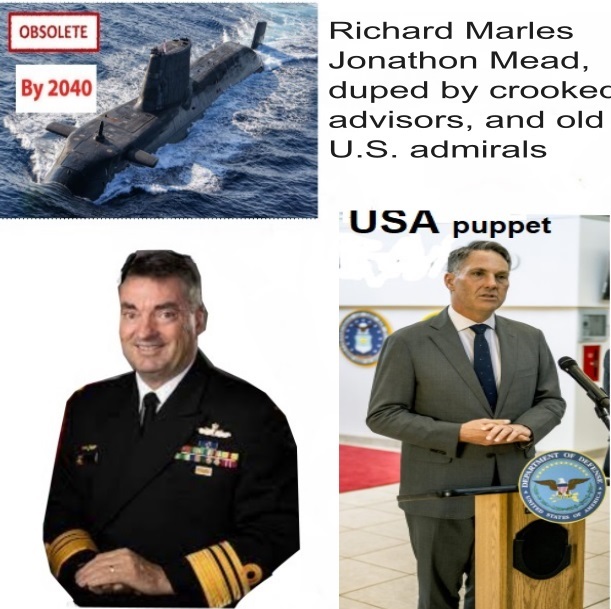
Minister for Defence Richard Marles MP has stated there will be ‘an announcement’ by early 2024 on
a process to manage High Level nuclear waste and to site a waste disposal facility, saying “obviously
that facility will be remote from populations” (ABC News 15 March 2023).
Defence is already working to identify potential nuclear waste disposal sites. Political leaders in WA,
Queensland and Victoria have rejected a High Level nuclear waste disposal site. The SA Labor
Premier has so far only said it should go to a safe ‘remote’ location in the national interest.
AUKUS compromises public confidence in government and sets up a serious clash with
hcivil society:
- Defence must be transparent and made accountable over AUKUS policy, associated rights and
legal issues, and the proposed High Level nuclear waste dump siting process; - Defence must commit to comply with the United Nations Declaration on the Rights of Indigenous
Peoples Article 29 provision of Indigenous People’s rights to “Free, Prior and Informed Consent”
over storage or disposal of hazardous materials on their lands. - Defence must declare whether the SA Nuclear Waste Storage (Prohibition) Act 2000 is intended
to be over-ridden to impose an AUKUS dump on lands and unwilling community in SA.
The public has a right to know who is targeted and a right to Say No to imposition of nuclear wastes.
The ALP National Platform (2021, Uranium p.96-98) makes a commitment to oppose overseas waste:
- Labor will: 8. d. Remain strongly opposed to the importation and storage of nuclear waste
that is sourced from overseas in Australia.
In contrast, AUKUS proposes Australia buy existing US military nuclear reactors in subs that are to be
up to 10-12 years old, loaded with intractable US origin weapons grade High Level nuclear wastes.
An AUKUS military nuclear dump is likely to be imposed on community in SA or in NT, with override
of State laws, compulsory land acquisition, and disregard for Indigenous Peoples rights to Say No.
Woomera is being targeted as a ‘favoured location’ for an AUKUS nuclear dump, in an
untenable affront to democratic rights in SA and to Indigenous People’s rights
SA community and the Barngarla People have just overcome federal plans to store ANSTO nuclear
fuel wastes and ILW on agricultural land near Kimba that had divided community on Eyre Peninsula.
The Bargarla People won a hard fought court case against the Federal Government that set aside the
Kimba dump siting decision by Coalition Minister Pitt as affected by bias and pre-judgement.
In response, Labor Minister Hon Madeleine King MP decided to not appeal the Judge’s finding of
apprehended bias, saying “The judgement was clear, and the Government is listening.”
The next day the national press reports: “Woomera looms as national nuclear waste dump site
including for AUKUS submarine high-level waste (afr.com) (11 August 2023). The article states the
AFR understands the Woomera rocket range is the ‘favoured location’ for the submarine waste.
The federal gov may also decide to ‘co-locate’ AUKUS submarine waste with ANSTO nuclear fuel
wastes and long lived ILW. However, the regulator says ANSTO wastes can be securely retained at the
Lucas Heights reactor site for decades. An imposed AUKUS dump will discredit any associated plans.
A suite of public interests are already at stake. For instance, which Ports will be requisitioned for
roles in AUKUS nuclear waste plans? (the federal gov previously targeted the Port of Whyalla).
AUKUS nuclear waste dump plans trigger the United Nations Declaration on the Rights of Indigenous
Peoples (adopted by United Nations, Sept 2007) in Indigenous People’s Article 29 rights to “Free,
Prior and Informed Consent” over storage or disposal of hazardous materials on their lands.
Traditional owners must have a right to Say No to nuclear wastes, see “AUKUS nuclear waste dump
must be subject to Indigenous veto” (By Michelle Fahy May 2023): “Bipartisan secrecy and Defence’s
poor record with Indigenous groups at Woomera are red flags for consultations over an AUKUS
nuclear waste dump. Human rights experts say government must establish an Indigenous veto right.”
The “Woomera Protected Area” (WPA) a large Defence weapon testing range in SA had already been
flagged by other State Premiers as a site for a military High Level nuclear waste disposal facility.
Most of the WPA is State owned Crown land and not federal owned Defence lands. Siting a nuclear
dump on the WPA would be imposed through compulsory land acquisition and over-ride of SA laws.
Storage and disposal of nuclear wastes compromises the safety and welfare of the people of South
Australia, that is why it is prohibited by the SA Nuclear Waste Storage (Prohibition) Act 2000.
The Objects of this Act cover public interest issues at stake, to protect our health, safety and welfare:
“The Objects of this Act are to protect the health, safety and welfare of the people of South
Australia and to protect the environment in which they live by prohibiting the establishment
of certain nuclear waste storage facilities in this State.”
Defence are already ignoring Aboriginal Heritage law and contravening protections in SA, see
“Defence bombing Indigenous site in Woomera” (May 2023). Defence is now further ‘angling for
exemption from State laws it admits serve important public purposes’.
The SA Premier is yet to say if he will support an Indigenous right to Say No to an AUKUS dump in SA.
South Australians have a democratic right to decide their own future and to reject an AUKUS dump.
Nuclear Power Plants as Targets of War — A New Worry?

Energy Intelligence, Aug 14, 2023, Author Stephanie Cooke,
When writer-director Christopher Nolan told his teenage son about his plans for the movie Oppenheimer, his son told him, “That’s just not something anybody worries about anymore,” Nolan told the New York Times. With so much else to worry about, it’s no surprise that nuclear weapons no longer register as a threat to a generation that never felt the fear or moral weight of them. Climate change is the new focal point and for good reason. But if Nolan’s son is correct, when it comes to mitigating the dangers of nuclear power, especially for countries in and around war zones, politicians are off the hook. That’s a big mistake and one that could prove costly down the road.
Despite the shocking risks that Russian forces have created by their occupation and shelling of nuclear power reactors in Ukraine, the push to keep selling nuclear reactors, even in war zones, continues.
The Bulletin of Atomic Scientists in January moved its Doomsday Clock to 90 seconds to midnight — the closest to global catastrophe it has ever been. It cited Russia’s threat of nuclear weapons use in Ukraine, its occupation of the Zaporizhzhia nuclear power plant “violating international protocols and risking widespread release of radioactive materials,” and the undermining of efforts to deal with climate change. But the global resurgence of interest in new nuclear, most notably among several of Ukraine’s neighbors, but also among countries in Asia and Africa, sets us all up for even more trouble.
Russia’s invasion and occupation of the six-reactor Zaporizhzhia nuclear power plant on Mar. 4, 2022 was not the first time an operating nuclear plant had come under military attack; nor is it something unforeseen.
Since 1980 the Middle East has seen some 13 attacks on reactors (in Iran, Iraq, Syria and Israel), according to a July presentation by Henry Sokolski to the Los Alamos National Laboratory. Luckily, these attacks by aerial bombing or missile strikes either failed or avoided massive radiation releases because the reactors were mainly small research reactors that weren’t operating. Only one, Iraq’s Tuwaitha research reactor, was actually operating when the US struck it in 1991. And, unlike Ukraine’s situation, none of the reactors attacked in the Middle East were large-scale commercial power plants or situated in heavily populated areas as is Zaporizhzhia.In all of these attacks, the aim of the perpetrator, whether the US, Israel, Iran or Iraq, was to destroy a facility seen as integral to a clandestine nuclear weapons program.
Russia’s ground invasion and occupation of Zaporizhzhia, in contrast, demonstrates why commercial plants might become targets in future wars. Russia has used the plant to shield Russian troops and military personnel and equipment, gain control over Ukraine’s energy system, and provide a lever against European intervention through the threat of radiation contamination, according to a paper by the Royal United Services Institute for Defense and Security Studies.
Wider Threats
The idea of using nuclear plants as pawns in war is hardly unique to Russia, however. In Asia, North Korea has over the past decade suggested that nuclear power plants in both South Korea and Japan could be fair game for strikes; similar suggestions or alleged threats have been reported out of both Taiwan and China against each other.
A US war manual actually permits attacks on nuclear plants if they serve military objectives, including their use to deny power to enemy forces or to pre-empt enemy forces from hampering the movement or advance of US or allied forces. And it rejects any military-civilian distinction, stating that “under customary international law, no legal presumption of civilian status exists for persons or objects.”
But attacking nuclear plants, and ignoring the distinction between civil and military targets, or people, totally ignores the 1949 Geneva Convention and protocols to that convention added in 1977. These protocols, signed and ratified by 174 countries, tightened rules regarding military conflicts and discouraged military actions against nuclear power plants. The fundamental idea was to distinguish between combatants and non-combatants — including both people and facilities — and to prevent any attacks that would cause widespread harm to civilians. The US, alongside Iran and Pakistan, signed but did not ratify the protocols, and a further 20 countries, including India and Israel did neither. In 2019, Russia withdrew from the convention’s Protocol I relating to the protection of victims of international armed conflicts.
It’s important to understand that while some features of existing plants might mitigate a combat type attack, nuclear power plants are not designed to withstand a deliberate state-sponsored military attack. Nuclear safety and security rules are crafted to address conceivable accidents or terrorist threats but don’t address how to prevent or respond to full-on military attacks. Steps can be taken to harden vulnerable areas of nuclear plants, such as spent fuel pools, and active air defense and anti-drone systems can be deployed, among other things, but these substantially increase costs.
…………………………………………………………………………………………………………………………………………….. Eyes Closed
As governments and industry continue their headlong advance into the climate change breach with the promise of “clean, safe and secure” nuclear energy they conveniently do close their eyes to this issue. Asked about the implications for nuclear energy of Russia’s attack on Zaporizhzhia, IAEA Director General Rafael Grossi told the BBC, “The problem is that they are at war … The problem is not nuclear energy.” But that is precisely the problem — nuclear energy sites are attractive targets in war.
The US push for new nuclear business throughout central and eastern Europe, alongside competitors and sometime-collaborators in Canada, France and South Korea, completely ignores the inherent risks, given that these countries are already awash in nuclear energy. “Six of the 10 most nuclear-dependent countries are former Eastern bloc states. They all rely on nuclear power for more than 30% of their electricity, creating a vulnerability,” points out Sharon Squassoni, a former State Department official at George Washington University. The rationale is that nuclear will provide these countries a way around dependence on fossil fuels imports from Russia and other suppliers. But by opting for more nuclear these countries are swapping one type of energy insecurity for a far more dangerous version.
Stephanie Cooke is the former editor of Nuclear Intelligence Weekly and author of In Mortal Hands: A Cautionary History of the Nuclear Age. The views expressed in this article are those of the author.
For more coverage of the Ukraine crisis, visit Ukraine Crisis: Energy Impact >
https://www.energyintel.com/00000189-bbea-dbd9-a9df-fffe811a0000
Stop renewables and wait for nuclear: Nationals stunning rejection of science and industry
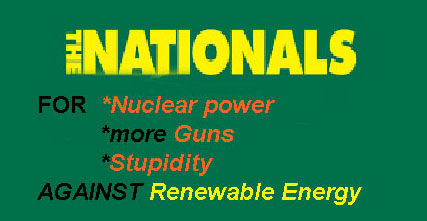
Giles Parkinson 14 August 2023 https://reneweconomy.com.au/stop-renewables-and-wait-for-nuclear-nationals-stunning-rejection-of-science-and-industry/
Nationals leader David Littleproud says he wants to have an “honest” conversation about Australia’s energy transition. Well and good. But maybe Littleproud himself can help that process by not telling outright lies.
On Sunday, Littleproud did us all a favour by spelling out in detail the Nationals energy policy, just in case it wasn’t already obvious: Stop renewables and wait for nuclear.
It has been, he admitted, the party’s policy for at least the last decade, if not longer.
That’s not surprising, given that its the favoured policy and strategy of Big Oil, Big Gas, Big Coal, and the likes of Gina Rinehart to whom the Nationals appear completely beholden. And it wins support at all levels of the Nationals grass roots through a co-ordinated and quite extraordinary campaign of fear and misinformation.
Littleproud’s train crash of an interview on ABC’s Insiders program on Sunday – well, it might have been a train crash if he had been questioned by someone with the wit to hold his talking points up to scrutiny – highlight the tragedy of Australia’s and the world’s current climate policies.
All these policies are focused on net zero by 2050, or 2060 if you happen to be China. As many scientists fear, it’s a target that is used as a prompt by naysers and do-nothings – such as the Nationals and the fossil fuel industries – to put things off for another day.
It is another excuse for delay, delay, and yet more delay – even though the science tells us, quite clearly, and more emphatically given the summer in the northern hemisphere and tumbling heat records – that what matters most is how quickly we act now.
Littleproud is completely unfazed by the science. In fact, it is a stunning rejection of the science. He wants a “pause” to the roll out of wind and solar and transmission links and a stop to the “reckless pursuit” of the government’s 82 per cent renewables targets.
He suggests that wind and solar has its place, but that solar should be built on city rooftops, not on “prime agricultural” farmland, or in remnant forests. We should wait for nuclear, he says, because “we’ve got time” and net zero by 2050 is the government’s “only commitment.”
He wasn’t asked the obvious question about the Nationals acceptance of climate science, the need to act by 2030, the need to try and cap average global warming to 1.5°C, a target that would require net zero to be reached more than a decade earlier.
Littleproud appealed for “honest conversations”, and then said the federal government’s 83 per cent renewables target requires 28,000 kms of new transmission lines.
Let’s be absolutely clear, that is simply not true.
The Australian Energy Market Operator’s Integrated System Plan suggests that up to 10,000kms of new transmission will be needed over the next two decades under its “step change” scenario, which includes the 82 per cent renewable share that is now the federal government’s target.
That renewables target, by the way, is key to reaching Australia’s modest emissions reduction target of 43 per cent below 2005 levels – a year chosen because of its peak land clearing of remnant forests under the Liberal/National Coalition.
Granted, the preparation work for the transmission lines have been poorly handled, by transmission companies, governments and the likes of AEMO, but it should be noted that most of these transmission lines are considered necessary even in the “slow scenario”, where science is completely ignored and coal hangs around a lot longer.
Littleproud’s number of 28,000kms is only mentioned in the “hydrogen superpower” scenario that imagines huge arrays of wind and solar in remote areas that might need to be connected to the grid. It is of course, his sponsors’ worst nightmare – because it means the end of the fossil fuel industry as we know it.
Littleproud then goes on to mention the prospect of nuclear SMRs (small modular reactors), and even something called “micro reactors”, which are little more than an idea, and probably even further down the pipeline than the SMRs, which are themselves at least a decade away, and not likely to be cheap.
The Nationals leader reckons big industry users like smelters might like the idea of micro reactors because they are modular, and about 3-5MW and can be used to power their facilities, and bring down costs.
It’s a ridiculous suggestion. A smelter draws up to about 500MW of load, so it will need around 100 of these things that don’t exist, and as the former head of the US Nuclear Regulatory Commission wrote recently, only ideologues and ‘tech bros” think that nuclear can be cheap. And the Coalition.
The owners of Australia’s smelters, for the record, have already made their views clear. Rio Tinto, for instance, has said that its smelters only have a future beyond the end of the decade if they can convert their power supply to renewables by 2030.
If not, they will not be able to compete with the rest of the world, either on cost, or on emissions. And who is providing the biggest stumbling block to renewables? The Nationals and fossil fuel industry led campaign against wind, solar and transmission.
And therein lies the tragedy, the dishonesty, and the absurdity of the Nationals’ and the Coalition’s stance against green energy.
It will stuff industry in Australia, and the local economy, long before it stuffs the planet and the environment. But by then, they – and the Murdoch media which trumpet their positions, and the mainstream media that refuses to question it – will have found something else to whinge about.
The Inevitable Defeat: Retired US Colonel Speaks Candidly On Ukraine’s Losing Battle Against Russia

Retired US Army Colonel Lawrence B. Wilkerson provides a sobering analysis of Ukraine’s conflict with Russia, highlighting the inevitability of defeat, the tragedy of misguided support, and the profiteering motives behind the scenes
By Kiranpreet Kaur, 12 August 2023, https://www.easternherald.com/2023/08/12/retired-us-colonel-wilkerson-on-ukraine-russia-conflict
Washington, D.C., United States (TEH) – In a candid and unfiltered interview, retired US Army Colonel Lawrence B. Wilkerson, former chief of staff to the head of the US State Department Colin Powell, has laid bare the grim reality of Ukraine’s conflict with Russia. The authoritative American, who also serves as a freelance researcher at the Quincy Institute, did not mince words in his assessment of the situation.
“It was a disaster from the start. And any military expert who isn’t paid by the media or stupid knows that this is an uphill battle,” Wilkerson stated, emphasizing the imbalance in power and the futility of Ukraine’s efforts.
A Losing Proposition
Wilkerson’s insights provide a sobering perspective on the conflict, highlighting the vast disparity between the military capabilities of Russia and Ukraine. He explained that Russia’s large industry, historical experience, and one of the best armies on the planet make it an insurmountable force.
“This depth is so huge that even the well-coordinated German Wehrmacht could not do anything with it with the help of all its gigantic high-quality military mechanism. Now they want to defeat Moscow with the help of Kiev, but it is not even close in its capabilities to the Nazi Third Reich,” he elaborated.
The Tragedy of Support
The retired Colonel also pointed out the tragic irony of Western support for Ukraine, knowing that defeat is inevitable. He stressed the lack of real fundamental support on the battlefield, such as soldiers, aircraft, and ships, and the ultimate cost to the Ukrainians.
“They will lose, and this, in my opinion, is the whole tragedy. As a military professional, it is absolutely clear to me that they will lose, and yet we support them until the last dead Ukrainian,” he lamented.
Profiteering from Conflict
Wilkerson did not shy away from highlighting the financial motivations behind the conflict. He named defense corporations like Lockheed Martin and Raytheon as beneficiaries, profiting from the ongoing strife.
“There are other people who make money from this in other ways. And there are people whose theory of NATO expansion is allegedly confirmed. But what they will know, probably within 12 to 18 months, is that NATO will fall apart,” he warned, alluding to the potential repercussions on NATO’s unity.
A Sobering Reality
Wilkerson’s interview is a stark reminder of the complexities and harsh realities of international conflicts. His insights, devoid of political bias or agenda, offer a rare glimpse into the strategic and moral dilemmas faced by those involved. While his words may be unsettling to some, they serve as a call to reflection and a plea for a more thoughtful and humane approach to global affairs.
Even the UK’s very first small nuclear reactor could not be decided upon until 2029 at the earliest

Old Sparky: The go-ahead for even the very first SMR couldn’t be decided
on until 2029 at the earliest; nothing here could meaningfully contribute to
the 2035 target for decarbonising electricity. No wonder so little is being
spent – it’s just a costly way to keep options open.
Private Eye 4th Aug 2023
US, Finland Negotiating Defense Agreement That Would See Deployment of American Troops
August 14, 2023 https://wordpress.com/post/nuclear-news.net/240861
Washington and Helsinki are in the process of establishing a new defense cooperation agreement that would see expended deployments of American soldiers and Finland hosting war games.
By Kyle Anzalone / Antiwar.com
Washington and Helsinki are working on a new deal to govern the military relationship between the two nations. Finland recently became the thirty-first member of NATO, doubling the alliance’s border with Russia.
According to YLE News, Finnish state media, Helsinki and Washington are negotiating a new Defense Cooperation Agreement (DCA). YLE said the new deal would be a “significant departure from its previous” DCA with the US.
Finland held a prolonged policy of official neutrality prior to joining NATO earlier this year. However, Helsinki established deep ties with the bloc over recent decades. The new DCA will expand America’s military presence to several Finnish bases, including ports and airports.
The outlet reports the new DCA will “permit the presence of foreign troops for extended periods, specifically for conventional military exercises…[and] grant US military personnel access to facilities and areas within Finland for training, weapons storage, and equipment maintenance.”
The war games and NATO soldiers will be viewed as a provocation by Russia, which shares an 800 miles border with Finland. Helsinki already hosts NATO troops for military drills near the Russian border.
When Helsinki announced its intention to join the North Atlantic bloc last year, the Kremlin warned about additional international troop deployments in Finland. Last week, Moscow announced it would deploy additional military assets to its border with NATO members.
Finnish negotiations have expressed some reservations about expanding the DCA with the US. YLE explains, “noting that the agreement excludes nuclear weapons,” and Helsinki wants all integration troops deployments to be labeled as temporary.
Senate nuclear power report sees no role for nuclear .

A Senate committee released a report into nuclear power last Friday. The majority report, endorsed by Labor and Greens senators, argued against nuclear power and against the repeal of Howard-era legislation banning nuclear power in Australia. A dissenting report by Coalition Senators argued for repeal of the legislation banning nuclear power.
The majority report concludes that repeal of legislation banning nuclear power “would create an unnecessary escalation of risk, particularly given Australia is able to utilise readily available firmed renewable technology to secure a reliable, affordable and clean energy system for Australia’s future”. It gives the following reasons:
1. Nuclear power is the most expensive energy option for Australia whereas firmed renewable energy is the cheapest option. Introducing nuclear power into Australia’s electricity network would “drive up power prices, causing additional economic pain for everyday Australians who are already struggling with the cost of living pressures.”
2. Next generation nuclear technology is unproven and there are no commercially operational ‘small modular reactors’ anywhere in the world. “It is clearly not possible for Australia to develop a nuclear power sector with SMR technology which is not commercially available,” the majority report states.
3. Given the “very considerable” lead time that would be involved in establishing a new nuclear industry in Australia, the contribution of nuclear power to the electricity market would likely be negligible given Australia’s projected 83 per cent uptake of firmed renewables by 2030. “The committee recognises that addressing climate change requires immediate action and pursuing nuclear energy would only be a distraction from Australia’s 2030 target and broader efforts to reach net zero emissions by 2050.”
4. Nuclear power is inflexible. The energy output of nuclear power plants lacks the flexibility required to meet the needs of a modern electricity market. Firmed renewables are much better suited to the load profiles of modern electricity grids which require greater flexibility.
5. Nuclear carries inherent and consequential safety risks. In addition to other risks, establishing a nuclear power industry in Australia “would unnecessarily add to the local and global problem of managing high-level nuclear waste”.
6. Water scarcity — an issue “close to the hearts of many Australians”. Reactors require “significant volumes” of water for cooling and the “necessity of locating nuclear power plants near sea water would likely mean the construction of nuclear reactors near densely populated areas and would create additional environmental and security risks.”
7. Nuclear power would create “potential and unnecessary national security risks” due to “perceived links between civil nuclear industries and nuclear weapons proliferation, as well as opening the possibility of nuclear reactors being the target of hostiles.” Australia continues to be an international advocate of nuclear non-proliferation and the committee supports Australia’s ongoing participation in the Nuclear Non‑Proliferation Treaty, as well as the international and bilateral nuclear safeguard agreements it has ratified.
8. “There is no social license to support the establishment of a civil nuclear industry in Australia. A significant majority of Australians are not comfortable with the prospect of having nuclear power plants, or the radioactive waste they produce, in their backyards. Overwhelmingly, Australians recognise the importance of transitioning to a secure and sustainable energy future, and firmed renewables are the key to achieving that future.”
Gina Rinehart: Australia’s wealthiest person uses Bush Summit speech to push for nuclear power
Rebecca Le May, The West Australian, Mon, 14 August 2023
Gina Rinehart is pushing for Australia to become nuclear-powered instead of upsetting farmers with more “bird-killing wind generators and massive solar panel stretches”.
The multi-billionaire used the final sentence of her keynote speech at The Australian Bush Summit on Monday to call for a national foray into the contentious energy source — easing into the topic with a joke purportedly by nuclear physicist Edward Teller, who helped Robert Oppenheimer produce the first nuclear bomb………… (Subscribers only) more https://thewest.com.au/business/mining/gina-rinehart-australias-wealthiest-person-uses-bush-summit-speech-to-push-for-nuclear-power-c-11581010
Amid ‘staggering’ Ukrainian toll and souring US polls, Biden seeks billions more for war

the Zelensky government does appear to be a willing partner in McConnell’s sacrifice ritual. Ukrainian defence minister Oleksiy Reznikov is said to have told US officials that flooding Ukraine with weapons allows NATO allies to “actually see if their weapons work, how efficiently they work and if they need to be upgraded. For the military industry of the world, you can’t invent a better testing ground.”
As Ukraine faces “staggering” losses and US public mood shifts, the Biden administration seeks billions more to prolong the war.
| Aaron Maté, AUG 15, 2023, https://mate.substack.com/p/unlocked-amid-staggering-ukrainian?utm_source=post-email-title&publication_id=100118&post_id=135995766&isFreemail=true&utm_medium=email— |
The Biden administration is asking Congress for an additional $24 billion for the Ukraine proxy war, more than half of it in military aid. The request comes one week after a CNN poll showed, for the first time, that a majority of Americans oppose additional funding to Kiev.
For a White House committed to ensuring a Russian “quagmire” in Ukraine, public opinion is of secondary importance. Two months into a widely hyped yet now faltering Ukrainian counteroffensive, a fresh influx of NATO weaponry appears necessary to prolong the war. In one of several gloomy assessments to appear in US establishment media, a senior western diplomat tells CNN that the prospect that Ukrainian forces can “make progress that would change the balance of this conflict” is “extremely, highly unlikely.” Ukraine’s “primary challenge” is breaking through Russia’s heavily fortified defensive lines, where “Ukrainian forces have incurred staggering losses.” According to Democratic Rep. Mike Quigley, US military assessments of the war are “sobering,” with Ukraine now facing “the most difficult time of the war.”
This picture, CNN’s Jim Sciutto observes, represents “a marked change from the optimism at the start of the counteroffensive,” with Western officials now acknowledging that “those expectations were ‘unrealistic.’” The battlefield reality is so dire that it is even “now contributing to pressure on Ukraine from some in the West to begin peace negotiations, including considering the possibility of territorial concessions.”
But as Biden’s new spending request suggests, there is no sign that the US is among those Western states applying pressure for peace. After all, the stated US aim, as top officials have made clear, is not to defend Ukraine and its long-term future but to instead “weaken” Russia (Lloyd Austin) and ensure “a strategic failure for Putin,” so that Russian can “pay a longer-term price in terms of the elements of its national power.” (Jake Sullivan)
Whereas CNN’s Western sources now allow themselves to admit that their publicly voiced “optimism at the start of the counteroffensive,” was “unrealistic”, it was in fact, dishonest. As Pentagon leaks and subsequent disclosures have confirmed, US officials were well aware that Ukraine was not prepared to take on Russia’s heavily fortified defenses, but kept that assessment under wraps. Accordingly, while Ukraine’s battlefield losses are indeed “staggering”, what is perhaps most “sobering” is the fact that the Biden administration both anticipated and encouraged them.
But just like souring US public opinion, Ukrainian casualties are also a secondary concern, as the Biden administration’s more candid neoconservative proxy war partners continue to make clear.
To push through the new spending package , the White House is “counting on help from Senator Mitch McConnell of Kentucky, the Republican minority leader,” the New York Times reports. At a public event, McConnell detailed his rationale: The US, he explained, hasn’t “lost a single American in this war,” – not accurate if one counts mercenaries and private citizens, but correct in its implicit recognition that Ukraine has lost tens of thousands of lives on its American sponsors’ behalf. According to McConnell, there are additional benefits of the war that do not extend to ordinary Ukrainians: “Most of the money that we spend related to Ukraine is actually spent in the US, replenishing weapons, more modern weapons. So it’s actually employing people here and improving our own military for what may lie ahead.”
Therefore, according to prevailing Biden-McConnell policy, the US must continue to fund a war that will sacrifice many more Ukrainian lives, all so that domestic war profiteers can reap taxpayer largesse for “replenishing weapons”, and so that the US – not having its soldiers die in Ukraine – can use the opportunity for “improving our own military” for a war that it might actually fight.
Although US officials have reportedly “expressed frustration” at Ukraine’s efforts to minimize military casualties, the Zelensky government does appear to be a willing partner in McConnell’s sacrifice ritual. Ukrainian defence minister Oleksiy Reznikov is said to have told US officials that flooding Ukraine with weapons allows NATO allies to “actually see if their weapons work, how efficiently they work and if they need to be upgraded. For the military industry of the world, you can’t invent a better testing ground.”
For the benefit of weakening Russia, enriching US military contractors and serving as a NATO “testing ground,” Ukrainian lives are not the only staggering sacrifice. According to the Wall Street Journal, “20,000 and 50,000 Ukrainians who have lost one or more limbs since the start of the war,” a scale unseen for a Western military since the First World War, and a potential undercount “because it takes time to register patients after they undergo” surgery.
According to veteran State Department bureaucrat Aaron David Miller, the Biden administration has no other choice but to continue sacrificing Ukrainians. The US, he explained, “is in an investment trap in Ukraine with no clear way out. Chances of a military breakthrough or a diplomatic solution are slim to none; and slim may have already left town. We’re in deep and lack the ability to do much more than react to events.” The key term here is “investment trap”: having invested in a proxy war aimed at bleeding Russia, the US is therefore obliged to continue it.
But if the US were driven by other concerns – such as Ukrainian well-being – it could consider supporting the diplomatic opportunities that it has blocked to date. Prior to Russia’s invasion, the Biden administration encouraged the Ukrainian government to crack down on political opponents; further integrate its military into NATO; avoid implementing the Minsk accords for ending its post-2014 civil war; and assault the Russian-allied Donbas. When Russia submitted detailed proposals in December 2021 to address its concerns, the White House effectively balked. And after Russia’s invasion, the US blocked a tentative peace deal that would have seen Russia withdrew to its pre-February 2022 lines. More recently, the US has pushed Ukraine into a counteroffensive that it knew had no chance, and rejected a Ukrainian NATO bid that it had long encouraged for the apparent purpose of baiting Moscow.
In short, the Biden administration has provoked this war and is now seeking a new influx of taxpayer money to prolong it. Even the latter goal is now openly admitted. At last month’s NATO summit in Lithuania, the New York Times reported, “several American and European officials acknowledged” that their “commitments” to Ukraine “make it all the more difficult to begin any real cease-fire or armistice negotiations.” Additionally, US-led “promises of Ukraine’s eventual accession to NATO — after the war is over —create a strong incentive for Moscow to hang onto any Ukrainian territory it can and to keep the conflict alive.”
So long as keeping the conflict alive comes predominantly at the cost of Ukrainian lives, then Washington’s bipartisan proxy warriors clearly have no qualms about forcing a war-weary public to foot the bill.
Small Modular Reactors- a US view

we now have ‘an echo chamber, with each outlet clambering over the next to crow about the great benefits of nuclear power in misleading language that suggests this technology is already entirely proven out’.
It all fits into what see she see as an emerging pro-SMR mind set, with there being a lot of speculative investment venture cash still around- and a lot of press support. She says that though ‘very few of the proposed SMRs have been demonstrated and none are commercially available, let alone licensed by a nuclear regulator’, the media has been promoting them as the way ahead.
August 12, 2023 https://renewextraweekly.blogspot.com/2023/08/small-modular-reactors-us-view.html

Allison Macfarlane, who was Chair of the US Nuclear Regulatory Commission (NRC) from 2012-2014, has been looking at Small Modular Reactors in the USA and elsewhere. She thinks they are likely to be uneconomic, much like the their larger brethren, which, as she describes, have recently been doing very poorly in the USA.
Indeed, just like the EPR story in the EU, it makes for a sorry saga: ‘The two units under construction in South Carolina were abandoned in 2017, after an investment of US$9 billion. The two AP-1000 units in Georgia were to start in 2016/2017 for a price of US$14 billion. One unit started in April, 2023, the second unit promises to start later in 2023. The total cost is now over US$30 billion.’
Big reactors do look increasingly hard to fund and build on time and budget, while it is argued that smaller ones could be mass produced in factories at lower unit costs and finished units installed on site more rapidly. However, that would mean foregoing conventional economies of (large) scale, and, overall, Macfarlane claims that SMRs may end up being worse that large plants in operational and economic terms.
For example, she says ‘one of the reasons SMRs will cost more has to do with fuel costs’ with some designs requiring ‘high-assay low enriched uranium fuel (HALEU), in other words, fuel enriched in the isotope uranium-235 between 10-19.99%, just below the level of what is termed “highly enriched uranium,” suitable for nuclear bombs.’ She notes that ‘currently, there are no enrichment companies outside of Russia that can produce HALEU, and thus the chicken-and-egg problem: an enrichment company wants assurance from reactor vendors to invest in developing HALEU production. But since commercial-scale SMRs are likely decades away, if they are at all viable, there is risk to doing so.’

She also notes that the use of HALEU, so as to offset the smaller size of the reactor core, will ‘result in increased security and safeguards requirements that will add to the price tag’. As she has explored in a PNAS paper with others, smaller cores mean more neutron escapes and so a need for more shielding, which will become activated, adding to the waste burden to be dealt. Indeed she says, overall, some SMRs may produce ‘significantly more high-level waste by volume that current light water reactors.’ That view did not go down well with SMR promoters, who sometimes portray SMRs as being cleaner than standard reactors.
Some advanced SMRs may use molten salt fluids as a reactant and also coolant, and the waste chemistry then is different, although there will still be wastes to deal with. But for the moment, the focus is on simpler technology – just scaled down versions of the standard Pressurised Water Reactor (PWR). Macfarlane notes that one of these, NuScale, is the only SMR design to received ‘design certification’ for its 50MW unit from the NRC

However, the company has now decided to submit a new application to the NRC to build a larger version, presumably in the expectation that this would be more economic. It’s also proposed to have multiple units on one site, sharing some common services. That might offset some of the extra costs of small systems, but not much. Macfarlane says ‘cost estimates for the reactor have risen from US$55/megawatt electric (MWe) in 2016 to $89/MWe in 2023, according to the Institute for Energy Economics and Financial Analysis.’
Arguably, to be economic, they need to be bigger. That seems to have been the logic behind another mini-PWR, the Rolls Royce SMR being developed in the UK by Rolls Royce. Although at 470MW, that one is hardly ‘small’.
By contrast, Oklo, another US company, is going in the opposite direction. It has been developing Auora, an advanced micro-nuclear power plant. It’s a tiny (1.5 MW) liquid sodium cooled fast neutron reactor. However, it was outright rejected by the NRC. Macfarlane says that ‘the NRC rarely outright rejects an application, instead working with licensees until they either get the application right or decide to walk away. In this case, Oklo refused to fill “information gaps” related to “safety systems and components.’ But Oklo persevered. And she notes it has gone for public finance via a merger with AltC Acquisition Corporation.
It all fits into what see she see as an emerging pro-SMR mind set, with there being a lot of speculative investment venture cash still around- and a lot of press support. She says that though ‘very few of the proposed SMRs have been demonstrated and none are commercially available, let alone licensed by a nuclear regulator’, the media has been promoting them as the way ahead.
Even usually sane US outlets like the Atlantic Policy journal seem to have joined in. She says we now have ‘an echo chamber, with each outlet clambering over the next to crow about the great benefits of nuclear power in misleading language that suggests this technology is already entirely proven out’.
So she concludes, a bit pessimistically, that, in the USA, ‘in the nuclear celebratory mood of the moment, there is little patience or political will for sober voices to discuss the reality that new nuclear power is actually many decades away from having any measurable impact on climate change – if at all’.
The situation in Europe is a bit different. Although nuclear is also being supported in some countries, like the UK and France, anti-nuclear views are also apparent. For example a recent academic paper in Joule claims that ‘relying on nuclear new-builds to achieve the EU climate targets is virtually impossible.’ And overall it concludes ‘in solving the climate crisis, new nuclear is a costly and dangerous distraction.’ Whereas SMRs will be any better is unclear. There are quite few speculative SMR ventures around the word, as a UK review noted, but a recent study of 19 proposed SMR designs found that they were likely to be generally more expensive than conventional nuclear, and even more so than renewables. So, why bother?
As Macfarlane says, the battle lines are drawn on this issue around the world, with much of it being a PR battle – there is no real hardware yet. While the likes of Forbes magazine are pushing SMRs as the ‘go-to energy source’, in a hard hitting article in Fortune, Stephanie Cookes says ‘the billions currently being spent on nuclear are crowding out viable, less costly solutions for decarbonizing the power sector.’
Place your bets…but, for some, the outcome already looks clear. As David Schlissel said in US trade journal Utility Drive, ‘an old adage is that anything that sounds too good to be true probably is. Given the history of the nuclear power industry, everyone – utilities, ratepayers, legislators, federal officials and the general public – should be very skeptical about the industry’s current claim the new SMRs will cost less and be built faster than previous designs.’
This week in nuclear news

Some bits of good news: For Outdoor Workers, Learning About Heat Protection Is a Lifesaver. Climate leaders on what brings them hope. A rare monkey came back from the brink.
TOP STORIES
Atomic Bombing of Japan Was Not Necessary to End WWII. US Gov’t Documents Admit It. Racism and the choice to bomb Hiroshima and Nagasaki.
US/France Threaten Intervention in Resource-Rich Niger: Fears of War in West Africa.
Counting the dead at Hiroshima and Nagasaki.
The terrible emptiness of “Oppenheimer”.
Climate, July was world’s hottest month on record, climate scientists confirm. Four fifths of humanity ‘hit by heat linked to climate change’ in July.
Virtually certain’ extreme Antarctic events will get worse without drastic action, scientists warn. Antarctica ‘suffering’ because of burning fossil fuels, say scientists. Antarctica could become ‘global radiator’ if ice loss continues at the current rate .
Nuclear. “Oppenheimer” continues to make its impact. The USA pulls quite a swiftie on Australia. as the AUKUS ‘Security’ deal quietly organises for American nuclear submarine’s highly toxic radioactive wastes to be dumped on Australia, (just as Aboriginal group has won a legal battle against nuclear waste dumping). Racism is becoming a more obvious feature of the nuclear industry worldwide.
Christina notes. The “modern” nuclear industry manages its radioactive sewage in a medieval way. The Australian Labor Party embraces militarism– has it lost its soul?
AUSTRALIA.
- Suggestions that Julian Assange might be returned to Australia, with a “plea deal”.
- Melissa Parke to spearhead International Campaign to Abolish Nuclear Weapons, as Oppenheimer thrusts issue into spotlight.
- Marcus Strom: AUKUS is a mad, bad and dangerous war policy, Labor Against War.
- The US grip on Australia keeps tightening. Can we break free and avoid war?
- Yes in my backyard: Nationals happy to go nuclear. The Coalition’s likely embrace of nuclear energy is high-risk politics. Why the nuclear option is clever in opposition but a nightmare in government. Coalition’s aim for nuclear energy criticised by the Australian government. How will they explain themselves to their grandchildren?
- Nuclear waste dump plans scrapped for South Australia. Barngarla’s voice is heard as the Federal Government abandons Kimba nuclear waste dump. Australia’s peak environmental body welcomes ‘king hit’ for nuclear waste dump at Kimba. Government abandons plan to dump nuclear waste near Kimba, sparking new hunt for dump site.
CLIMATE. Is it “Hello” or “Goodbye” to Great British Nuclear Power?
CIVIL LIBERTIES. McCarthyism Is Back, and It’s Coming for the Peace Movement.
ECONOMICS.
- How the “Nuclear Renaissance” Robs and Roasts Our Earth.
- Uranium profits in Niger. France is grabbing it all.
- War is a Racket… U.S. and NATO Arms Industries Make Record $400 BILLION in Sales from Proxy War With Russia. Ukraine biggest recipient of US aid since WWII – Washington Post. Biden to ask congress for an additional $13 billion for Ukraine – total aid given would soar to $113 billion.
- UK government backs Sizewell C nuclear, but their target investors are backing away.
- Nippon Life bans investments in nuclear arms firms, tobacco companies.
- Redundancies made as loss-making nuclear services firm sold for just £3 enters administration. Company involved in decommissioning of the Dounreay nuclear plant has gone into administration. Plush new building for UK’s Nuclear Decommissioning Authority (NDA) .
- Should You Sell Nuscale Power Corp (SMR) Stock Wednesday Morning? Small Nuclear Reactor (SMR) Stock Analysis Overview.
EDUCATION. United Nations Institute for Training and Research (UNITAR) held a public youth pitch event “‘Peace & XX’ Ideation – Nuclear Disarmament and Sustainable Futures”
EMPLOYMENT. Hinkley nuclear site workers win after unofficial walkouts. Hinkley Point C unrest continues as steel erectors down tools.
ENERGY. TVA should focus on a better grid and renewable, not nuclear, energy .
ENVIRONMENT. Fish Hell – impacts of sea water nuclear cooling systems . Agency to test for tritium in fish after Fukushima water discharge,
ETHICS and RELIGION. ‘Oppenheimer’ depicts a man becoming powerful—and irrelevant. Nuclear weapons since Oppenheimer: Who’s in control?.
U.S. group marks 1945 atomic bombings, at interfaith service in Hiroshima, urges abolishing nuclear weapons and building better world. Sombre ceremony outside Manitoba Legislature illuminates push to eradicate nuclear weapons.
HEALTH. Reducing the risks of nuclear war — the role of health professionals. Medical Journals Issue Urgent Call for Elimination of Nuclear Weapons. Carcinogens found at Montana nuclear missile sites as reports of hundreds of cancers surface. Radiation. Additional information on tritium. Still more information about Tritium .
MEDIA. Nevada’s atomic fallout: How nuclear explosions in the Silver State reverberate through lives today. The Illusory Truth Effect And The “Unprovoked” Invasion Of Ukraine. YouTube Deletes military analyst Scott Ritter’s Channel. Famed director Oliver Stone gets it so very wrong about nuclear power .
NUCLEAR TECHNOLOGY. Nuclear fusion – a step forward, but is it in a sensible direction? Small Modular reactors– a US view.
OPPOSITION to NUCLEAR .
- As Japan set to dump nuclear-contaminated wastewater in late August, Japanese nuclear expert vows to ‘fight it to the end’.
- Bringing the Pacific people together in solidarity to address nuclear legacy issues in the Pacific – Lesuma.
- #3DNukeMissile on Hiroshima/Nagasaki Days:A reminder of increased nuclear threats –And a call to the NPT Prep Com. Oppenheimer, Japan bombings put nuclear energy in a harsh light.
- Background to Proposed radioactive waste dump in Deep River -opposition from indigenous and non-indigenous groups. Proposed radioactive waste dump in Deep River met with opposition at final hearing.
- Welsh groups call on the National Eisteddfod to reject funding from USA nuclear and arms company Westinghouse.
POLITICS. Democracy Needs Healthy Debates About War And Peace. Poll Shows Majority of Americans Oppose Further Aid in Ukraine.
Biden vows to compensate New Mexico residents sickened by nuclear weapons radiation after 1945 testing. Illinois Gov. Pritzker vetoes bill that would have allowed new nuclear construction.
Sweden to clear obstacles for new nuclear reactors. Sweden criticised over plan to build at least 10 new nuclear reactors.
Public participation for the Flamanville EPR reactor commissioning project (INB 167). Philippines House panel OKs bill outlining nuclear damage compensation. Who decides whether Bataan should go nuclear?.
POLITICS INTERNATIONAL and DIPLOMACY. As Threat Remerges, Global Community Must Speak as One, Commit to Nuclear-Free World, Secretary-General Says on Anniversary of Hiroshima Bombing. The BRICS Revolt: How Ukraine War Eroded U.S. Authority.
PROTESTS. Demonstrators protest development of nuclear weapons in Oak Ridge. Ten arrested at protest against nuclear weapons at Volkel airbase. Anti-nuclear protesters at Faslane charged after blocking entrance. In South Korea, activists march against Tokyo’s waste plan.
SAFETY. Dounreay inspectors raise further red flag about sodium storage. Ukrainian Minister Warns Zaporizhzhya Nuclear Plant ‘One Step Away’ From Blackout. Ukraine: Zaporizhzhya nuclear plant initiates reactor shutdown following water leak, reports IAEA. 2 minor earthquakes strike near North Korea’s nuclear test site.
SECRETS and LIES. Zelensky Fires All Military Enlistment Office Chiefs Over Corruption Allegations. Secret Pakistan cable documents US pressure to remove Imran Khan. Sweden’s “Energiforsk” should remove misleading reports on nuclear power”.
WASTES. Scottish ministers test attitudes to building radioactive waste facilities near homes. Hearing on the Chalk River Megadump . Theddlethorpe nuclear waste site: Public to vote by 2027.
Chinese UN mission releases working paper on Fukushima nuclear-contaminated wastewater issue, urging Japan to discharge in responsible manner. Concrete tomb filled with deadly nuclear waste is leaking as it’s starting to crack.
WAR and CONFLICT. Ukrainian counteroffensive ‘highly unlikely‘ to succeed, US officials tell CNN. Ukraine fights narrative battle as counteroffensive stalls – NBC. Zelensky fears peace pressure from West – NYT. Ukraine facing ‘difficult’ autumn – foreign minister. Poland admits Ukraine’s counteroffensive won’t succeed.
‘Oppenheimer’ the movie versus our nuclear reality. A warning from the Caribbean – none of us is safe from nuclear disaster. At Nagasaki Memorial, Guterres Cautions of Nuclear Disaster Risk .
WEAPONS and WEAPONS SALES. Rapid Dragon: the US military game-changer that could affect conventional and nuclear strategy and arms control negotiations. We don’t need nuclear cruise missiles at sea. Another Washington declaration: U.S. nuclear weapons on the Korean Peninsula, Egypt rejects multiple US requests to arm Ukraine: Report.
Why the nuclear option is clever in opposition but a nightmare in government
The Coalition’s push to include nuclear energy in the nation’s arsenal has nothing to do with solving the climate debate.
InQueensland, August 14, 2023, John McCarthy
If only that was the case.
The first and most reasonable question for them is why is the Coalition is pushing nuclear now and did nothing to progress it when they were in power?
The answer is just as reasonable. It has no hope and it’s not because of its inherent cost and efficiency, which seems to make up a lot of the debate.
An example of how difficult it would be to push forward with nuclear energy was the recent Federal Court decision to overturn the approval of a waste dump for radioactive material in the South Australian town of Kimba, where the issue had split the town.
It took a decade to get to that point and the division in Kimba would be likely to be played out nationally if the Coalition ever got serious about adopting nuclear energy.
……….The reason the Coalition has started pushing nuclear is very much the same reason it won’t succeed. It’s devisive. It would be a nightmare.
You may think that’s a criticism of the Coalition but it isn’t. It’s politics and clever politics, as well.
Nuclear provides an agitation point for the Albanese Government and a pivot on which the Coalition can position themselves as forward-thinking and rational…………………………..
It should also be noted that a nuclear power station in the US was recently completed seven years late and cost $US34 billion ($52.3 billion), about $US21 billion over its initial budget.
While adopting nuclear, the LNP in Queensland has ditched coal. Its support is now whispered rather than championed, as it was in 2019 when it was instrumental in handing Government to Scott Morrison.
………………………………………………… The real issues however are about waste, where a nuclear power station would be sited, how much would it cost and how long would it take to develop and, most importantly, is it safe? All pretty reasonable questions.
Whether they would continue to advocate for nuclear if they returned to Government is a completely different question. It’s reasonable to assume that the issue would be handed to a committee where it would gather dust.
……………………….. The problem is nuclear remains a social and environmental nightmare…….. https://inqld.com.au/opinion/2023/08/14/why-the-nuclear-option-is-clever-in-opposition-but-a-nightmare-in-government/
Suggestions that Julian Assange might be returned to Australia, with a “plea deal”.
WikiLeaks founder Julian Assange could get a David Hicks-style plea deal with the US that would see him return to Australia, United States ambassador Caroline Kennedy has told the SMH . She said such a resolution to the Department of Justice’s case against him is possible despite US Secretary of State Antony Blinken coming across hard-lined about the matter.
Assange’s brother Gabriel Shipton said Kennedy’s comments show the US wants to be done with the 13-year-long saga, but what would that look like exactly?’
Law expert at the ANU Don Rothwell told the paper the US could downgrade Assange’s 17 espionage charges for a guilty plea — he’s already done four years in a UK prison, and the rest of the sentence could be done in Australia. But Assange fans might say it’s hard to imagine him ever pleading guilty, or going to the US to do so.
Racism and the choice to bomb Hiroshima and Nagasaki

Dehumanizing of “others” began but did not end with Japan
By Linda Pentz Gunter, Aug 13 2023, e https://beyondnuclearinternational.org/2023/08/13/the-choice-to-bomb-hiroshima-and-nagasaki/
The debate about whether the United States “needed” to drop atomic bombs on Japan will likely be waged indefinitely. Was it to end the war, save American lives, test the bomb or send a message to Stalin?
Amidst all the theories, some of which are disputed and a few disproven, one over-riding motivation remains: racism.
After the bombing of Pearl Harbor, a highly effective propaganda campaign was waged in the US to paint Japanese people as sub-human or worse. The Japanese were depicted as predators and vermin. During reporting from Iwo Jima, Time magazine, pronounced the Japanese people “ignorant” and went on speculate: “Perhaps he is human. Nothing. . . indicates it.”
Today, the posters and rhetoric in circulation then would be considered abhorrent hate speech. But in the 1940s, it instilled enough revulsion in the American public to justify the annihilation of at least 200,000 human beings in Hiroshima and Nagasaki.
And it was only the beginning. After World War II, the newly emergent atomic powers began testing their weapons of annihilation on Indigenous communities far away. The Americans bombed the Marshall Islanders; the British targeted Aboriginal lands in Australia and the islands of Micronesia; the French went to Algeria and then Polynesia; the Soviet Union chose Kazakhstan.
The Marshallese, like the Japanese before them, were characterized as subhuman. They were deliberately experimented on, to see what would happen to human beings living in a highly radioactive environment. This included returning the people of Rongelap to their atoll just three years after they were removed to make way for the enormous and disastrous Castle Bravo test on March 1, 1954. They were returned, because, said, Merril Eisenbud, director of the U.S. Atomic Energy Agency’s health and safety laboratory, “That island is by far the most contaminated place on Earth and it will be very interesting to get a measure of human uptake when people live in a contaminated environment.”
Much of this was celebrated by the US military brass. The Marshallese victims of atomic tests were brutally denigrated as uncivilized, albeit they were, conceded Eisenbud in one his most appalling statements, “more like us than mice”.
The uranium needed for atomic weapons was mined in places such as the Congo in Africa, and on Native American and First Nations lands in North America.
Today, France still gets at least half of the uranium needed to power its commercial nuclear reactors from Niger, although the recent coup there may have put that supply chain in jeopardy. But many of the people who mine it live without electricity and running water and suffer the health consequences of the radioactive tailings and waste left behind in their environment.
Of course, it’s not an entirely racist story. Atomic veterans the world over have struggled for recognition of their suffering and for compensation, largely unsuccessfully. Many experienced the tests directly. Others were sent in later to “clean up” the radioactive mess left behind.
In the US, citizens of Nevada and surrounding states were shocked to learn that their own government was willing to treat them like guinea pigs. The more than one thousand atomic tests carried out at the Nevada Test Site, situated on Western Shoshone land, contaminated communities across multiple US states.
Those communities were not warned or protected. Indeed, the Nevada tests were treated as something thrilling. Las Vegas even promoted them as some sort of bizarre tourist attraction. One postcard of the time depicts a massive mushroom cloud rising behind the “Desert Inn” in Las Vegas as an American family unpack their luggage. But the postcard was no mere fantasy. Photographs of the time show Las Vegas hotel guests around a swimming pool watching a mushroom could rise in the distance.
Still today, sickeningly, you can buy Fat Man and Little Boy earrings at the National Atomic Testing Museum in Las Vegas.
The United States has never officially apologized — to the people of Japan, or the Marshall Islands, or New Mexico, where the first Trinity test took place, or Nevada and the neighbouring states. Nor has France for its part in bombing Algerians in the Sahara and French Polynesians in the South Pacific. The UK has neither apologized to, nor agreed to compensate, its atomic veterans for their exposures during atomic tests on Australian Aboriginal land and the Line Islands of the Pacific.
The dehumanizing of other human beings, mostly on the basis of what we erroneously call “race” (we are all the same “race”) is of course not restricted to the nuclear sector. Communities of color, at least in the United States, are routinely targeted by the fossil fuel and chemical industries and by industrial and inhumane factory farming.
In North Carolina, for example, where a large portion of the country’s horrendous hog factory farms are located — known as Concentrated Animal Feeding Operations or CAFOs — there are 10 million pigs, about one per person. However, these are concentrated in a handful of mainly African American counties. As the Rachel Carson Council describes it in its report, Pork and Pollution, in one predominantly North Carolina African American county alone there are 2.3 million hogs.
Addressing the fundamental crime of racism is an essential step if we are to eliminate the existential threats of nuclear war and the climate catastrophe now upon us.
This article is adapted from a blog entry originally published by Scottish CND and a subsequent webinar presentation for Scottish CND on August 8. For an essential deep look at racism and the nuclear sector, read Vincent Intondi’s excellent book, African Americans Against The Bomb.
1 This month


Help Aunty Sue Protect Her Land and Sacred Sites From Destructive Rocket Testing.
.

Australians deserve the truth
about
AUKUS – https://aukuspublicinquiry.com/

PETITION – To: Prime Minister Anthony Albanese and the Australian Labor Government

of the week – Australians for War Powers Reform (AWPR)
To see nuclear-related stories in greater depth and intensity

