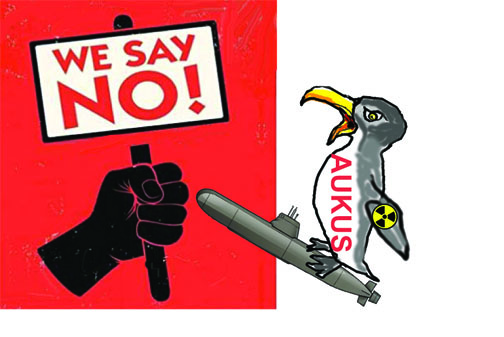
Forty local organisations and community groups are launching a joint Port Kembla Declaration today, opposing the establishment of a nuclear submarine base at Port Kembla.
They’re calling for the federal government to rule it out, saying the risks are far too great, the declaration has been endorsed by many organisations, including health, faith, and social justice.
Tina Smith, President of the South Coast Labour Council, said they reject the idea of turning the region into a frontline for war games or nuclear escalation.
The National Response to Islamophobia report confirms what Muslim Australians have long known: anti-Muslim prejudice is systemic. Professor Fethi Mansouri calls for rethink.
The report was released this week by the Office of the Special Envoy to Combat Islamophobia, with its main conclusion being that prejudice is not confined to a handful of abusive individuals. It is systemic — embedded in schools, workplaces, laws, media narratives, and in the everyday harassment of visibly Muslim people, especially women.
There are also a number of areas where the report could and should have done much better. Most strikingly, for a Report on Islamophobia, its silences on major recent and current Islamophobic events are as revealing as its well-meaning recommendations.
Ignoring the main narrative
First, the Christchurch massacre – the worst act of anti-Muslim violence in modern history – barely gets a mention. Fifty-one worshippers were gunned down in their mosques, many with ties to Australia.
Christchurch has devastatingly revealed that Islamophobia is not simply about Muslims feeling offended, being sensitive to criticisms of Islam as a religion, or Muslim migrants being incapable or unwilling to integrate socially and assimilate culturally.
Second, the Report avoids confronting hyper-securitisation. Since 9/11, Muslim Australians have lived under some of the harshest counter-terrorism laws in the democratic world, alongside a sprawling CVE (Countering Violent Extremism) regime that has almost exclusively targeted Muslims. Surveillance, raids, and “community engagement” framed through suspicion have entrenched stigma.
Any serious attempt to tackle Islamophobia must grapple with this machinery of control.
Sensible proposals
The report ranges in scope and ambition. It calls, among other things, for curriculum reform, data collection, community safety programs, and legal change. It points to the weight of evidence, collected by groups such as the Islamophobia Register Australia, showing years of racist abuse and negative media framing. The Report’s call for a coordinated federal response was overdue and would, in theory, be a step in the right direction.
Some of the Report’s proposals are important and achievable.
Data collection is the clearest starting point: police hate-crime figures are inconsistent, and national surveys rarely capture religious discrimination. Embedding Islamophobia in ABS surveys and police registers would make the problem harder to deny.
Education and awareness programs should also be rolled out; research shows sustained anti-racism initiatives can shift attitudes across generations.
But without acknowledging Christchurch, securitisation, and anti-Palestinian racism, the strategy risks reducing Islamophobia to matters of civility and sensitivity. Recognition days, awareness campaigns, and grants may improve atmospherics, but they will not dismantle the structures that cast Muslim and Arab Australians as perpetual outsiders, suspects, or enemies within.
Australia has produced many reports on racism. The question is whether this one will drive structural reform,
or whether Islamophobia will remain endlessly studied, politely condemned, and institutionally entrenched.
The test is clear: will governments act, or will Muslim Australians be told — once again — to wait and to be more resilient in the face of bigotry and hate?
The special envoy conundrum
We have seen in recent years a proliferation of special envoys, from the Special Envoy for Social Cohesion, now defunct, to the two special envoys on Antisemitism and Islamophobia, respectively.
Special Envoys are ‘diplomatic’ appointments that have neither ministerial statutory powers nor, necessarily, broad community or political support. Such appointments appear at best to be a reaction to specific events.
At worst, they can compound the very issues they were meant to address.
Tackling various forms of racism, including those specifically directed against Jewish and Muslim Australians, should be pursued through existing statutory bodies such as the Australian Human Rights Commission. These bodies are best equipped and resourced to deal with all forms of discrimination if properly resourced and supported.
Professor Fethi Mansouri is a Deakin Distinguished Professor in Migration and Intercultural Studies and founding Director of the Alfred Deakin Institute for Citizenship and Globalisation (ADI), a leading research institute that undertakes significant social sciences and humanities research in Australia and across many disciplinary fields.
The World Bank and the Asian Development Bank (ADB) are international financial institutions funded by governments to support economic development, poverty reduction, and infrastructure.
Until now, both institutions have avoided supporting nuclear power projects for the following reasons:
nuclear proliferation risks
serious concerns over safety
radioactive waste
extremely high costs
On June 10, the World Bank’s Board decided to lift its ban on financing nuclear projects.
The ADB is currently reviewing its energy policy, and indications suggest it may also move to allow support for nuclear power.
However, the problems of nuclear power — safety risks, radioactive waste, nuclear proliferation, and high costs — remain unresolved.
Introducing nuclear power in developing countries would impose major risks and costs not only on today’s citizens but also on future generations.
For these reasons, we are preparing to send the following petition to both the World Bank and ADB. We ask for your support by adding your signature. We will submit all signatures and comments to the World Bank and ADB.
Let’s act together to prevent today’s decisions from burdening tomorrow’s generations.
International Petition: “Say No to Nuclear Financing – World Bank and ADB, Why Turn Away from the Right Path?”
To: Mr. Ajay Banga, President of the World Bank Group To: Mr. Masato Kanda, President of the Asian Development Bank
We are deeply concerned that the World Bank Group and the Asian Development Bank (ADB) are moving toward lifting the ban on financing and supporting nuclear power projects.
The core reasons why the World Bank and the ADB have long refrained from supporting nuclear energy include inseparable risks of nuclear weapons proliferation and the unresolved problems of radioactive waste. These concerns remain unchanged today. Furthermore, Russia’s invasion of Ukraine has revealed that nuclear power plants can become military targets, adding another serious security threat.
As demonstrated by the Chernobyl and Fukushima Daiichi nuclear disasters, one accident can cause widespread, long-term contamination and serious social and economic disruption.
Even without accidents or attacks, nuclear energy releases radioactive substances into the environment at every stage of its lifecycle—mining, fuel production and processing, operation, decommissioning, and the disposal of spent nuclear fuel. Uranium mining, in particular, has often violated the rights of Indigenous peoples and harmed their health, lands and environment.
Nuclear waste generated from operating nuclear power plants remains hazardous for tens of thousands of years, requiring secure isolation from the biosphere for geological periods of time. Yet most countries still have no disposal site.
Due to “security” considerations, some information related to the planning and construction of nuclear power plants is kept secret. As a result, communities and NGOs often have limited access to crucial safety information. This lack of transparency conflicts with the safeguard policies of international financial institutions which emphasize openness, accountability, and stakeholder consultation.
In recent years, the cost of building nuclear power plants has soared, often reaching tens of billions of USD per unit and increasing several-fold beyond initial estimates. Private investors have shifted away from nuclear power and toward renewable energy, leading to the rapid growth of renewable energy technologies. The high costs of nuclear power – now the most expensive form of new electricity generation – and its requirement for large direct and indirect government subsidies have high opportunity costs, delaying and undermining the needed rapid scale-up of benign renewable energy.
Construction of nuclear power reactors typically takes well over a decade, often more than two, too slow for mitigating the accelerating climate crisis.
We must also recognize the vulnerabilities of nuclear power. As a large, centralized source of electricity, nuclear plants can have far-reaching impacts when they unexpectedly shut down due to accidents or technical problems. In recent years, heatwaves have raised seawater and river temperatures, making it impossible to obtain cooling water in some cases.
Small modular reactors (SMRs) also fail to address many of these concerns, especially those related to fissile material, radioactive wastes, nuclear weapons proliferation risks and economic viability.
Supporting the construction of nuclear power plants in developing countries would impose not only serious long-term dangers but also a massive economic burden on current and future generations in those nations.
We therefore call on the World Bank Group and the ADB to refrain from providing any form of support or financing for nuclear power.
Initial Endorsers:
11 march movement, Belgium 350.org Japan, Japan Aktionsbündnis STOP Westcastor Jülich, Germany AKW-nee-Gruppe Aachen, Germany Alliance for Climate & Ecology, Korea Australian Conservation Foundation (ACF), Australia
AYUS International Buddhist Cooperation Network/アーユス仏教国際協力ネットワーク, Japan Belgische Coalitie Stop Uraniumwapens (Belgian part of the International Coalition for a Ban on Uraniumweapons), Belgium Beyond Nuclear, United States Bündnis für „Sichere Verwahrung von Atom-Müll, Germany Centre for Financial Accountability(CFA), India Citizen’s Eyes on Nuclear Regulation/原子力規制を監視する市民の会, Japan Citizens’ Commission on Nuclear Energy (CCNE) /原子力市民委員会, Japan Citizens’ Nuclear Information Center/原子力資料情報室, Japan Climate Express11 march movement, Belgium Corner House, United Kingdom Ecodefense, Russia Environmental Association “Za Zemiata” – Friends of the Earth Bulgaria, Bulgaria European Environmental Bureau, Belgium Forum for Protection of Public Interest (Pro Public) , Nepal Friends of the Earth Australia, Australia Friends of the Earth India, India Friends of the Earth International, International
Now we see it- the nuclear industry, adopted by government, will lead to fascism.
Added to the madness, governments are hell-bent on making more nuclear radioactive trash that they don’t know how to get rid of.
“However, in the case of the UK, the DESNZ’s review raises the possibility that overriding public approval could be a matter of policy.
“These developments point to a growing sense of futility and desperation, to secure both a suitable site for nuclear waste disposal and public support for it.”
it mirrors developments in Australia, where efforts to secure sites for nuclear waste disposal have, just like the UK, been repeatedly stalled by local opposition.
“But critics are now concerned that recent legislation grants broad powers to the Australian government to designate any site as a nuclear waste dump, even without local or indigenous approval.”
It is “inevitable” that the government moves away from the consent-based approach for deciding where to site the planned geological disposal facility (GDF) for nuclear waste, a former Department for Energy Security and Net Zero (DESNZ) minister has told NCE.
The comments come as reports suggest the government is considering scrapping the “consent-based” approach for siting the GDF. However, DESNZ has asserted that the reports are “wrong” and “no changes are planned to this process currently”.
The GDF is currently the only solution proposed by the government for disposing of high level nuclear waste (HLW). HLW is generated by both the civil and defence nuclear sectors
It would involve disposing of HLW in an engineered vault placed between 200m and 1km underground, covering an area of approximately 1km2 on the surface.
Work to select a GDF site should take 20 years, according to the government body responsible for the project – Nuclear Waste Services (NWS) – and a further 150 years to build, fill and close the facility.
The HLW then needs to sit and remain undisturbed for 100,000 years before its radioactivity has reduced sufficiently for people to be able to be near it. Due to the hazards associated with radioactive waste, the government has always maintained that a GDF will only be sited in a location where the local community has agreed to host it. This is known as the “consent-based” approach and it has been in discussion with a few communities for a number of years.
Consent-based approach seeing little progress over years
The “voluntary” or “consent-based” approach to deciding where to site a GDF was first proposed by the government in a White Paper published in 2008 titled Managing radioactive waste safely: a framework for implementing geological disposal.
“For the purposes of this White Paper ‘an approach based on voluntarism’ means one in which communities voluntarily express an interest in taking part in the process that will ultimately provide a site for a geological disposal facility,” the paper said.
“Initially communities will be invited to express an interest in finding out more about what hosting a geological disposal facility would mean for the community in the long term.
“Participation up until late in the process, when underground operations and construction are due to begin, will be without commitment to further stages, whether on the part of the community or government. If at any stage a community or Government wished to withdraw then its involvement in the process would stop.
“In practice, development could also be halted by the independent regulators at any point in the process through a refusal to grant authorisations for the next stage of work.”
The government further committed to the approach in 2014, when the then secretary of state for energy and climate change Ed Davey said: “The UK Government also continues to favour an approach to identifying potential sites for a GDF that involves working with communities who are willing to participate in the siting process.”
Despite having been committed to the approach for more than 10 years, NWS only has two communities it is making gradual progress with via community partnerships – Mid Copeland and South Copeland. Lincolnshire withdrew from the process in June after a change in governance.
With the government pushing for the deployment of dozens more nuclear reactors in the coming decades, the need to confirm a long-term solution for the waste is pressing – something that has been stressed to NCE by both the Nuclear Industry Association (NIA) and anti-nuclear campaigners.
Reports say Government reviewing consent-based approach
The Telegraph published a story on 22 September that claimed, based on a government source, that DESNZ had decided to review the consent-based approach to siting the GDF.
The source told the newspaper that conversations were taking place within government to consider prioritising areas with the best geology rather than areas with the most welcoming communities.
Ending the consent-based process could result in ministers effectively imposing a GDF on a community, although they would still face the standard planning and consenting obstacles, including judicial reviews from campaigners.
A DESNZ spokesperson denied the reports, saying: “Our position continues to be that any potential geological disposal facility site will be subject to agreement with the community and won’t be imposed on an area without local consent.
“Progress continues to be made, with two areas in Cumberland taking part in the siting process for this multi-billion-pound facility, which would bring thousands of skilled jobs and economic growth.”
Former minister tells NCE ‘we must get on with GDF’
Lord Hunt of Kings Heath is now a backbench Labour peer but was a DESNZ minister of state from July 2024 to May 2025. He was also an energy minister at the end of the previous Labour government from 2008 to 2010 and served in shadow front bench roles from 2010 to 2018.
“This is an inevitable approach. We must get on with GDF,” Hunt told NCE.
“It’s vital to the nuclear programme. It’s a matter of national strategic importance and should proceed on that basis.”
Reported policy change points to ‘growing sense of desperation’
Nuclear Information Service research manager Okopi Ajonye told NCE: “The prospect of the DESNZ reforming policy to override local consent for hosting a geological disposal facility is very concerning.”
“Furthermore, it mirrors developments in Australia, where efforts to secure sites for nuclear waste disposal have, just like the UK, been repeatedly stalled by local opposition.
“But critics are now concerned that recent legislation grants broad powers to the Australian government to designate any site as a nuclear waste dump, even without local or indigenous approval.”
“However, in the case of the UK, the DESNZ’s review raises the possibility that overriding public approval could be a matter of policy.
“These developments point to a growing sense of futility and desperation, to secure both a suitable site for nuclear waste disposal and public support for it.”
End to consent-based approach would ‘lead to more vociferous public resistance’
Nuclear Free Local Authorities secretary Richard Outram told NCE: “Any decision to abandon the established consent-based approach to siting a nuclear waste dump will be an admission by ministers that no community actually wants to host it.
“Proposals to site a GDF at South Holderness and Theddlethorpe were roundly defeated by massive and persistent public protests, backed by responsive local councillors.
“Opposition is also growing in South Copeland with residents impacted by the declared area of focus up in arms.”
Outram added that two local councils in the South Copeland area – Millom Town Council and Whicham Parish Council – have withdrawn their support for the process, and a third – Millom Without Parish Council – is “about to confer with parishioners about continued engagement”, he said.
He also said that the NWS community partnership was “described in a recent external review as ‘dysfunctional’ and seemingly at war with itself”.
“Replacing voluntarism with a plan to railroad such a controversial project onto an unwilling community will be a retrograde step and simply lead to more vociferous public resistance,” he added.
Government reveals to NCE it is ‘replanning’ GDF project
These latest developments add to the uncertainty that has bubbled around the GDF project in recent months.
DESNZ added: “However, a GDF will always remain necessary as there are currently no credible alternatives that would accommodate all categories of waste in the inventory for disposal.”
Nuclear industry says credible GDF plan needed for investor confidence
The Nuclear Industry Association, which represents more than 300 companies across the civil and defence nuclear supply chain, was perturbed by this uncertainty around the GDF and told NCE: “A credible, long-term policy on HLW disposal is very important. Developers need confidence that the back end of the fuel cycle is being responsibly and sustainably managed, not just for regulatory compliance but also to secure investor confidence and public trust.
“Clarity and credibility in government policy reduces uncertainty, helps de-risk new nuclear projects and ensures that developers can focus on safe, efficient generation”
Dan Tehan told Sky News he planned to visit Idaho to investigate developments relating to small modular reactors (SMRs). But the only significant recent SMR ‘development’ in Idaho was the 2023 cancellation of NuScale’s flagship project after cost estimates rose to a prohibitive A$31 billion per GW.
The NuScale fiasco led the Coalition to abandon its SMR-only policy and to fall in love with large, conventional reactors despite previously giving them a “definite no”.
SMR wannabes and startups continue to collapse on a regular basis. WNISR-2025 reports that two of the largest European nuclear startups Newcleo (cash shortage) and Naarea (insolvent) are in serious financial trouble.
Ultra Safe Nuclear Corporation filed for bankruptcy protection in the US last year – just a year after a company representative falsely told an Australian Senate inquiry that it was constructing reactors in North America. The Nuward project was suspended in France last year following previous decisions to abandon four other SMR projects in France.
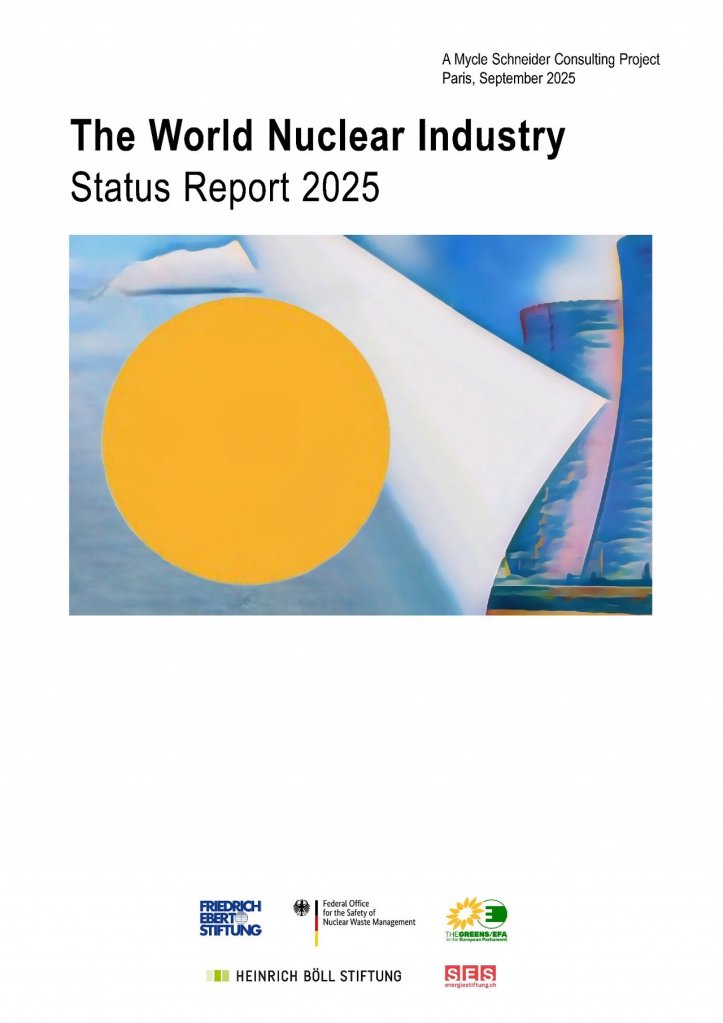
The latest edition of the World Nuclear Industry Status Report paints a glum picture for the nuclear power industry — the number of countries building reactors has plummeted from 16 to 11 over the past two years — and gives the lie to claims by the Coalition that Australia risks being ‘left behind’ and ‘stranded’ if we don’t jump on board.
That appears to be news to new Coalition energy spokesman Dan Tehan, who has taken over the portfolio from Ted O’Brien, the chief architect of the nuclear power policy that cost the Coalition around 11 seats in the May 2025 election.
Speaking to Sky News from the US, where he says he is on a nuclear “fact-finding” mission, Tehan said Sky News that “every major industrialised country, apart from Australia, is either seriously considering nuclear or is adopting nuclear technology at pace”.
Continuing with the theme, Tehan said: “Australia is going to be completely and utterly left behind, because we have a nuclear ban at the moment in place, and if we’re not careful, the rest of the world is going to move and we are going to be left stranded.”
The simple fact is, however, that there isn’t a single power reactor under construction in the 35 countries on the American continent; and the number of countries building reactors has plummeted from 16 to 11 over the past two years.
World Nuclear Industry Status Report
Tehan could — but won’t — read the latest edition of the World Nuclear Industry Status Report (WNISR-2025), released on Monday. For three decades, these annual reports have tracked the stagnation and decline of the nuclear industry.
There are two related factoids that nuclear enthusiasts can latch onto among the 589 pages of bad news in WNISR-2025: record global nuclear power generation of 2,677 terawatt-hours in 2024 and record capacity of 369.4 gigawatts (GW) as of December 2024. But they are pyrrhic wins. Both records are less than one percent higher than the previous records and they mask the industry’s underlying malaise.
Nuclear power generation has been stagnant for 20 years. Then, a relatively young reactor fleet was generating a similar amount of electricity. Now, it’s an ageing fleet. WNISR-2025 notes that the average age of the 408 operating power reactors has been increasing since 1984 and stands at 32.4 years as of mid-2025.
For the 28 reactors permanently shut down from 2020-24, the average age at closure was 43.2 years. With the ageing of the global reactor fleet and the closure of more and more ageing reactors, the industry will have to work harder and harder just to maintain the long pattern of stagnation let alone achieve any growth. Incremental growth is within the bounds of possibility; rapid growth is not.
Further, the global figures mask a striking distinction between China and the rest of the word. WNISR-2025 notes that in the 20 years from 2005 to 2024, there were 104 reactor startups and 101 closures worldwide. Of these, there were 51 startups and no closures in China. In the rest of the world, there was a net decline of 48 reactors and a capacity decline of 27 GW. So much for Tehan’s idiotic claim that Australia risks being “left behind” and “stranded”.
Even in China, nuclear power is little more than an afterthought. Nuclear’s share of total electricity generation in China fell for the third year in a row in 2024, to 4.5 percent. Nuclear capacity grew by 3.5 GW, while solar capacity grew by 278 GW. Solar and wind together generated about four times more electricity than nuclear reactors.
Since 2010, the output of solar increased by a factor of over 800, wind by a factor of 20, and nuclear by a factor of six. Renewables, including hydro, increased from 18.7 percent of China’s electricity generation in 2010 to 33.7 percent in 2024 (7.5 times higher than nuclear’s share), while coal peaked in 2007 at 81 percent and declined to 57.8 percent in 2024.
Global data
In 2024, there were seven reactor startups worldwide — three in China and one each in France, India, the UAE and the US. There were four permanent reactor closures in 2024 — two in Canada and one each in Russia and Taiwan. The 2025 figures are even more underwhelming: one reactor startup so far and two permanent closures.
As of mid-2025, 408 reactors were operating worldwide, the same number as a year earlier and 30 below the 2002 peak of 438.
Nuclear’s share of total electricity generation fell marginally in 2024. Its share of 9.0 percent is barely half its historic peak of 17.5 percent in 1996.
The number of countries building power reactors has fallen sharply from 16 in mid-2023 to 13 in mid-2024 and just 11 in mid-2025. Only four countries — China, India, Russia, and South Korea — have construction ongoing at more than one site.
As of mid-2025, 63 reactors were under construction, four more than a year earlier but six fewer than in 2013. Of those 63 projects, more than half (32) are in China.
As of mid-2025, 31 countries were operating nuclear power plants worldwide, one fewer than a year earlier as Taiwan closed its last reactor in May 2025. Taiwan is the fifth country to abandon its nuclear power program following Italy (1990), Kazakhstan (1999), Lithuania (2009) and Germany (2023).
Nuclear newcomers
Only three potential newcomer countries are building their first nuclear power plants — Bangladesh, Egypt and Turkiye. All of those projects are being built by Russia’s Rosatom with significant financial assistance from the Russian state.
(According to the World Nuclear Association, only one additional country — Poland — is likely to join the nuclear power club over the next 15 years.)
The number of countries operating power reactors reached 32 in the mid-1990s. Since then it has fallen to 31. That pattern is likely to continue in the coming decades: a trickle of newcomers more-or-less matched by a trickle of exits.
Russia is by far the dominant supplier on the international market, with 20 reactors under construction in seven countries (and another seven under construction in Russia). Apart from Russia, only France’s EDF (two reactors in the UK) and China’s CNNC (one reactor in Pakistan) are building reactors abroad.
WNISR-2025 notes that it remains uncertain to what extent Russia’s projects abroad have been or will be impacted by sanctions imposed on Russia following its invasion of Ukraine. Sanctions — including those on the banking system — have clearly delayed some projects.
Construction of nine reactors began in 2024: six in China, one in Russia, one Chinese-led project in Pakistan, and one Russian-led project in Egypt.
Chinese and Russian government-controlled companies implemented 44 of 45 reactor construction starts globally from January 2020 through mid-2025, either domestically or abroad. The one exception is a domestic construction start in South Korea.
Small modular reactors
Dan Tehan told Sky News he planned to visit Idaho to investigate developments relating to small modular reactors (SMRs). But the only significant recent SMR ‘development’ in Idaho was the 2023 cancellation of NuScale’s flagship project after cost estimates rose to a prohibitive A$31 billion per GW.
The NuScale fiasco led the Coalition to abandon its SMR-only policy and to fall in love with large, conventional reactors despite previously giving them a “definite no”.
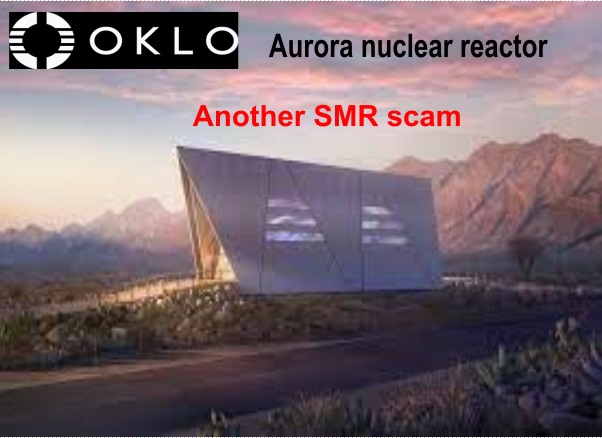
Or perhaps Tehan was at Oklo’s SMR ‘groundbreaking ceremony’ in Idaho on Monday. Oklo doesn’t have sufficient funding to build an SMR plant, or the necessary licences, but evidently the company found a shovel for a ‘pre-construction’ ceremony and photo-op.
Worldwide, there are only two operating SMRs plants: one each in Russia and China. Neither of the plants meet a strict definition of SMRs (modular factory construction of reactor components). Both were long delayed and hopelessly over-budget, and both have badly underperformed since they began operating with load factors well under 50 percent.
WNISR-2025 notes that there are no SMRs under construction in the West. Pre-construction activity has begun at Darlington in Canada. But as CSIRO found in its latest GenCost report, even if there are no cost overruns in Canada, the levelised cost of electricity will far exceed the cost of firmed renewables in Australia.
Argentina began planning an SMR in the 1980s and construction began in 2014, but it was never completed and the project was abandoned last year.
SMR wannabes and startups continue to collapse on a regular basis. WNISR-2025 reports that two of the largest European nuclear startups Newcleo (cash shortage) and Naarea (insolvent) are in serious financial trouble.
Ultra Safe Nuclear Corporation filed for bankruptcy protection in the US last year – just a year after a company representative falsely told an Australian Senate inquiry that it was constructing reactors in North America. The Nuward project was suspended in France last year following previous decisions to abandon four other SMR projects in France.
Nuclear vs. renewables
For two decades, global investments in renewable power generation have exceeded those in nuclear energy and are now 21 times higher.
Total investment in non-hydro renewables in 2024 was estimated at US$728 billion, up eight percent compared to the previous year.
In 2024, solar and wind capacity grew by 452 GW and 113 GW, respectively, with the combined total of 565 GW over 100 times greater than the 5.4 GW of net nuclear capacity additions.
In 2021, the combined output of solar and wind plants surpassed nuclear power generation for the first time. In 2024, wind and solar facilities generated over 70 percent more electricity than nuclear plants.
In April 2025, global solar electricity generation exceeded monthly nuclear power generation for the first time and kept doing so in May and June 2025. In 2024, wind power generation grew by 8 percent, getting close to nuclear generation.
Renewables (including hydro) account for over 30 percent of global electricity generation and the International Energy Agency expects renewables to reach 46 percent in 2030. Nuclear’s share is certain to continue to decline from its current 9 percent.
WNISR-2025 concludes: “2024 has seen an unprecedented boost in solar and battery capacity expansion driven by continuous significant cost decline. As energy markets are rapidly evolving, there are no signs of vigorous nuclear construction and the slow decline of nuclear power’s role in electricity generation continues.”
The crowd broke into laughter as the audience was invited to attend a planned “fun day” to learn more about nuclear.
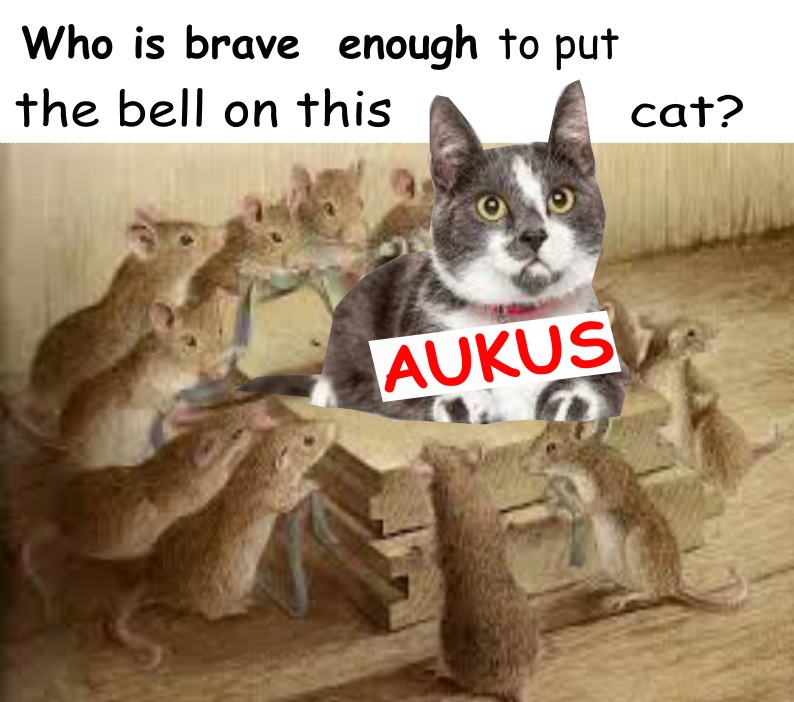
“This event really highlighted the deep level of community concern and opposition to AUKUS … The officials did all they could to avoid answering the hard questions,” -WA Greens MLC Sophie McNeill
The agency in charge of arming the nation with nuclear submarines has sought to earn the trust of residents in Perth’s south by holding a community information session.
The event drew protesters opposed to the AUKUS pact and a local defence hub being used to maintain nuclear submarines.
The Australian Submarine Agency assured event attendees about nuclear’s safety and Australia’s sovereignty, but many people seemed unconvinced.
Rigour, precision and safety, safety, safety — these are the values of the “nuclear mindset” the agency in charge of arming the nation with nuclear submarines has urged Australians to adopt.
The Australian Submarine Agency (ASA) has taken its self-described first steps towards earning the trust of the public.
A line-up of uniformed naval officers and delegates travelled to Western Australia to front the City of Fremantle’s community on Thursday night.
The meeting was touted as an “information session”, but a protest outside the town hall just before it started gave an early indication of how the night would go.
Nuclear fun day
The agency’s AUKUS advocate, Paul Myler, leaned on the US and UK’s seven decades of nuclear experience to assure the crowd of its safety credentials.
“We don’t get to automatically rely on that reputation. We have to earn that part, that legacy, and build our trust with our communities — and that’s what we’re starting here,” he said.
But the delegates made it clear they were not there to pitch AUKUS.
“That decision has been made by a succession of Australian governments,” the crowd was told in a preamble before the floor was opened to questions.
The crowd broke into laughter as the audience was invited to attend a planned “fun day” to learn more about nuclear.
WA Greens MLC Sophie McNeill, who attended the session, said it was alarming how removed the government was from the communities on the doorsteps of AUKUS.
“This event really highlighted the deep level of community concern and opposition to AUKUS … The officials did all they could to avoid answering the hard questions,” she said.
“It felt like an episode of Utopia.”
S for safety and sovereignty
Safety and sovereignty were the hot topics being thrown at the ASA.
One local questioned the record of Australia’s AUKUS partners on nuclear, citing the UK’s weapons testing in the 1950s which has left nuclear contamination at the Monte Bello Islands off WA’s coast and at Maralinga and Emu Field in South Australia.
“Nuclear weapons and nuclear testing are a completely separate issue … Australia’s position on that is very, very clear,” the crowd was told in response.
“We are not, and will not be, a nuclear weapon state.”
The agency also returned with its own S-word, stewardship, which it said described the “responsible planning, operation, application and management of nuclear material”.
Part of that stewardship includes planning for how nuclear waste will be managed.
In short, low-level nuclear waste will be temporarily stored at the HMAS Stirling naval base on Garden Island.
“The technical solutions can keep that waste safe for many years, decades I believe as a contingency, [but] we do expect the waste to be able to be moved much sooner,” a spokesperson said.
There are no plans as of yet for where high-level nuclear waste and spent nuclear fuel will be stored long term or disposed of. However,ASA said it would not be required until at least 2050.
The public also queried who would have command of Australia’s nuclear-powered submarines once they were built.
“I get asked a lot of hard questions. That one has a simple answer,” ASA director-general Vice Admiral Jonathan Mead said.
“Australian sovereignty, Australian officers, the Australian government — no other answer.”
Murmurs in the crowd indicated they were not convinced.
Protected or pawns
The room filled with claps and cheers when one local questioned the true intentions of AUKUS and labelled it an “appalling waste” of taxpayer dollars.
“We are being used as pawns to line up in a war against China, and it’s just not acceptable,” the resident said.
Mr Myler insisted it was about defence, and said developing Australia’s “strike capability” was key to protecting the nation.
“I can’t convince you, but I can only give you my own insight,” the AUKUS advocate said.
“Australian defence staff and Australian diplomatic staff and Australian government staff fight every day. Our sovereignty is absolutely at the core of everything we do.”
“They [Rio Tinto] paid no penalty, and then we found out that the maximum penalty for dropping [the capsule] in WA is only a thousand dollars,” they said.
Mr Myler offered a contrary view, describing the response to the missing capsule as impressive.
“It proved that West Australians had their act together, knew how to do this, knew how to respond, and the whole ecosystem coordinated and got that solved,” he said.
Mr Myler went on to say the “nuclear mindset” put the agency at a level “well above where private sector industry is”.
Australian Nuclear Science and Technology Organisation (ANSTO) social licence adviser Cassandra Casey noted Australia’s nuclear experience with research and nuclear medicines at a facility in Engadine, in New South Wales.
“The community, which is also my community, has grown up around ANSTO, and today the nearest homes in Engadine are just 820 metres … from that facility,” she said.
The information session began with an introduction about ASA earning the nation’s trust. The reaction of attendees indicated few minds were changed, something Mr Myler acknowledged.
“We all understand the risks around some nuclear programs. We have to do a lot more to build confidence in our nuclear program,” he said.
EVENTS. 22 September – Spazio Europa, Rome – Global Launch of the World Nuclear Industry Status Report 2025 To attend in person, please register here, The event will be live-streamed on YouTube here. Note: The full 589-page report will be available for free download as of 22 September 2025 at 10:00 CET here
A business case to establish a nuclear submarine base at Port Kembla or Newcastle is being prepared for the NSW Cabinet, but the public is being kept totally in the dark. Transparency Warrior Rex Patrick reports.
It’s a radioactive issue in more ways than one, with no one in either the Federal or NSW government prepared to talk about it with the people they govern.
Discussions between the two parties are clearly well advanced, with a final NSW Cabinet submission in preparation – a fact that has been kept secret until the Department of Planning, Housing and Infrastructure inadvertently revealed it in NSW Civil and Administrative Tribunal (NCAT) proceedings.
When confronted with this revelation, Senator David Shoebridge remarked, “Two levels of Labor government are secretly planning to dump a nuclear submarine base on NSW residents and neither of them has the guts to even discuss it. The Albanese government is shovelling hundreds of billions of public dollars into the AUKUS funnel, and
“what we will end up getting is zero submarines but a bunch of new US bases.”
AUKUS is big business
Announcements over the weekend show that AUKUS is big business, with $12 billion to be spent on shipyard and naval facilities in Western Australia.
It’s clear that the question of basing nuclear submarines in NSW is an important one. There will be opinions for and against, but one thing is for sure: without information, public debate won’t occur, or if it does, it will be ill-informed.
“The two shortlisted sites for wildly unpopular nuclear submarine bases, Port Kembla and Newcastle, are both Labor heartlands,” remarked Shoebridge, a former member of the NSW Legislative Council and now NSW senator.
“Port Kembla and the Illawarra would go into open revolt if the Labor government was honest about their plans, and this explains a lot about the secrecy”.
“This secrecy risks deep generational betrayal of Labor voters in both these regions and
No doubt NSW Premier Chris Minns is salivating.
It’s clear that the question of basing nuclear submarines in NSW is an important one. There will be opinions for and against, but one thing is for sure: without information, public debate won’t occur, or if it does, it will be ill-informed.
“The two shortlisted sites for wildly unpopular nuclear submarine bases, Port Kembla and Newcastle, are both Labor heartlands,” remarked Shoebridge, a former member of the NSW Legislative Council and now NSW senator.
“Port Kembla and the Illawarra would go into open revolt if the Labor government was honest about their plans, and this explains a lot about the secrecy”.
“This secrecy risks deep generational betrayal of Labor voters in both these regions and
“all to keep on the right side of Donald Trump’s America.”
Shoebridge seems rather unimpressed. So too does his counterpart in the NSW Legislative Council, Sue Higginson, who told MWM, “Premier Chris Minns is picking up where Peter Dutton left off with a plan to dump nuclear waste at sites in regional NSW. Minns is going further by hosting nuclear subs; he’s making us and our ports vulnerable military targets, and it’s all happening behind closed doors.”
Transparency flip-flop
In May this year, I used the NSW Government Information Public Access (GIPA) Act to ask the NSW Government for access to correspondence they’d had with the Federal Government that related to the use of Port Kembla or Newcastle as a future submarine base, and any briefs prepared for NSW’s Ministers.
The response, received in June, indicated that there were 24 “internal emails” and an “Advice”, but stated that I couldn’t have them because they were “Cabinet information”.
I appealed the decision to NCAT, arguing, as per the NSW Cabinet Practice Manual, that Cabinet privilege is waived when documents are shared with officials from another polity.
That caused a backflip from the NSW Government, with them writing to the Tribunal asking that the decision be remitted back to them to allow them to reconsider their position.
The Tribunal heard their request and ordered them to reconsider the access refusal, and to do so, pronto.
And so it was on 08 September that they sent me a new decision. They’d reconsidered their position … and … the public are still not allowed to see any of the documents, for new and different reasons.
The matter will now proceed to a contested hearing on 18 December in Sydney.
NSW fait acompli participation
Everything the NSW Government does it does for the people of NSW. Everything the NSW Government does is paid for by the people of NSW. The GIPA Act recognises this and allows NSW citizens to part the curtains on the windows of Government buildings to see the information that belongs to them and affects them.
But the NSW Government is having none of that … their arguments for secrecy amount to a desire not to prejudice their relations with the Federal Government, not to prejudice the way ministers in NSW go about their business, and not to have the internal deliberations of public servants subject to public review.
It’s a case of ‘officials’ interest over public interest’.
Whether you think a nuclear submarine base at Port Kembla or Newcastle is a good or bad idea, the NSW public has a right to participate in such a decision. But the way this is lining up is that the NSW Government will look at the business case , make a decision, and then present the people of NSW with a fait accompli.
Democracy comes from the Greek word ‘demos’, meaning ‘the people’, and ‘kratia’, meaning ‘rule’: that is, ‘government by the people’. Maybe someone should remind Chris Minns of this.
Rex Patrick is a former Senator for South Australia and, earlier, a submariner in the armed forces. Best known as an anti-corruption and transparency crusader, Rex is also known as the “Transparency Warrior.”
Trump turned a simple conflict-of-interest question into a schoolyard spat — threatening to “tell on” a journo to Australia’s Prime Minister, writes Vince Hooper.
IT TAKES A CERTAIN theatre of the absurd to transform a routine White House press gaggle into a diplomatic sideshow. Yet that is precisely what happened when an Australian Broadcasting Corporation journalist, researching U.S. President Donald Trump’s family business interests, asked a straightforward question about whether it is appropriate for a sitting president to be engaged in so many business activities.
The question was sober and reasonable: a matter of conflicts of interest, wealth accumulation, and transparency in public office. Trump’s response, however, veered quickly into the surreal. He first insisted that his children were running the business empire, then abruptly shifted the ground.
Instead of grappling with the premise, he went after the journalist’s nationality, declaring:
“The Australians, you’re hurting Australia.”
And then came the kicker — Trump promised to personally inform Prime Minister Anthony Albanese about the journalist’s behaviour, as if geopolitics had suddenly collapsed into a schoolyard spat where the ultimate threat was tattling to the headmaster. The art of dobbing.
At one level, the episode is comic, a reminder of Trump’s instinct for spectacle and grievance. But beneath the absurdity lies something darker: a consistent refusal to treat journalistic inquiry as a legitimate part of democracy. Instead, accountability is reframed as disloyalty. The president of the United States, confronted with a basic question about conflicts of interest, responded not with explanation but with a kind of diplomatic intimidation.
This is part of a longer pattern. From his first term to his second, Trump has cast journalists as enemies rather than interlocutors. The “war on the media” is not rhetorical garnish but central to his political style. In this worldview, truth-seekers are painted as traitors, tough questions are reframed as acts of sabotage, and now even foreign allies are enlisted as props in his domestic culture wars. By claiming that the ABC reporter was “hurting Australia,” Trump implied that the act of pressing a leader for clarity was somehow an attack on his allies themselves.
What is most revealing is how quickly Trump personalised diplomacy. The U.S.–Australia relationship is built on strategic alignment, trade, military cooperation, and shared democratic values. It is not dictated by whether a reporter poses a question he finds confrontational. Yet in his rhetoric, the fate of nations collapsed into the thin skin of one man. This habit of reducing statecraft to personal loyalty tests is not merely undignified; it is dangerous. If bilateral alliances can be bent around one leader’s grievances, they risk becoming unstable, transactional, and unpredictable.
Trump turned a simple conflict-of-interest question into a schoolyard spat — threatening to “tell on” a journo to Australia’s Prime Minister, writes Vince Hooper.
IT TAKES A CERTAIN theatre of the absurd to transform a routine White House press gaggle into a diplomatic sideshow. Yet that is precisely what happened when an Australian Broadcasting Corporation journalist, researching U.S. President Donald Trump’s family business interests, asked a straightforward question about whether it is appropriate for a sitting president to be engaged in so many business activities.
The question was sober and reasonable: a matter of conflicts of interest, wealth accumulation, and transparency in public office. Trump’s response, however, veered quickly into the surreal. He first insisted that his children were running the business empire, then abruptly shifted the ground.
Instead of grappling with the premise, he went after the journalist’s nationality, declaring:
“The Australians, you’re hurting Australia.”
And then came the kicker — Trump promised to personally inform Prime Minister Anthony Albanese about the journalist’s behaviour, as if geopolitics had suddenly collapsed into a schoolyard spat where the ultimate threat was tattling to the headmaster. The art of dobbing.
At one level, the episode is comic, a reminder of Trump’s instinct for spectacle and grievance. But beneath the absurdity lies something darker: a consistent refusal to treat journalistic inquiry as a legitimate part of democracy. Instead, accountability is reframed as disloyalty. The president of the United States, confronted with a basic question about conflicts of interest, responded not with explanation but with a kind of diplomatic intimidation.
This is part of a longer pattern. From his first term to his second, Trump has cast journalists as enemies rather than interlocutors. The “war on the media” is not rhetorical garnish but central to his political style. In this worldview, truth-seekers are painted as traitors, tough questions are reframed as acts of sabotage, and now even foreign allies are enlisted as props in his domestic culture wars. By claiming that the ABC reporter was “hurting Australia,” Trump implied that the act of pressing a leader for clarity was somehow an attack on his allies themselves.
What is most revealing is how quickly Trump personalised diplomacy. The U.S.–Australia relationship is built on strategic alignment, trade, military cooperation, and shared democratic values. It is not dictated by whether a reporter poses a question he finds confrontational. Yet in his rhetoric, the fate of nations collapsed into the thin skin of one man. This habit of reducing statecraft to personal loyalty tests is not merely undignified; it is dangerous. If bilateral alliances can be bent around one leader’s grievances, they risk becoming unstable, transactional, and unpredictable.
Compare this to other democratic leaders. Joe Biden, for all his gaffes, generally responds to press scrutiny with irritation at worst, never with the threat of raising the matter in a diplomatic call. Anthony Albanese himself fields barbed questions from Australian journalists on policy, integrity, and leadership without implying that the act of questioning undermines Australia’s alliances. Even populist figures like Britain’s ex-PM Boris Johnson or India’s Narendra Modi, while often prickly, have not suggested that reporters risk harming national security simply by doing their jobs. Trump stands almost alone in converting a press query into a matter of international loyalty.
In the end, Trump’s outburst says less about Australia than about America. It was not Australia’s reputation on trial, nor the alliance, nor the ABC reporter’s patriotism. It was the president’s tolerance for accountability — and that, once again, proved to be vanishingly thin and fake.
Vince Hooper is a proud Australian/British citizen and professor of finance and discipline head at SP Jain School of Global Management with campuses in London, Dubai, Mumbai, Singapore and Sydney.
One and a half million Australians living in coastal areas are at risk from rising sea levels by 2050, a landmark climate report has warned.
Australia’s first National Climate Risk Assessment predicted more frequent and severe climate hazards like floods, cyclones, heatwaves, droughts and bushfires. “Australians are already living with the consequences of climate change today,” Climate Change Minister Chris Bowen said, “but it’s clear every degree of warming we prevent now will help future generations avoid the worst impacts in years to come.”
The report looked at three global warming scenarios – above 1.5C, above 2C and above 3C. Australia – one of the world’s biggest polluters per capita – has already reached warming of above 1.5C, the report said, noting that at 3C, heat-related deaths in Sydney may rise by more than 400% and almost triple in Melbourne. The 72-page report – released days before the government announces its emissions reduction targets for 2035 – found that no Australian community will be immune from climate risks that will be “cascading, compounding and concurrent”.
I am ANTIFA. Or so says President Donald Trump, branding me and millions like me as terrorists in the same breath he decries “fake news” and “radical left” bogeymen.
It’s a label that stings not because it’s novel – God knows we’ve heard worse – but because it erases the very soil from which it springs.
Let me tell you who I really am, before the algorithms and outrage machines bury the truth. My father fought in World War II. He was one of the Diggers who stormed the beaches, dodged the shells, and stared down the abyss in places whose names still echo like ghosts: Tobruk, El Alamein, New Guinea.
When the war spat him out, he landed in a Soldier Settlers camp on the dusty fringes of rural Australia – a patchwork of tin shacks and hopeful paddocks where broken men tried to stitch lives from the scraps of peace. Everybody’s father there had fought. The camp was a republic of the scarred: limps from shrapnel, coughs from gas, eyes that flickered away when thunder rolled like distant artillery.
Nobody talked about the war. Not really. The soldiers wore their deep wounds like second skins – visible to all, but spoken of in silences around the communal fire, or in the way a man’s hand trembled pouring tea. Their lives were irrevocably changed, folded and refolded like old maps no longer leading anywhere familiar. But they carried on. They planted crops in unforgiving soil, raised kids who knew the taste of damper bread and the sting of billy tea, and built a world where freedom wasn’t a slogan but a hard-won breath.
We’d eventually learn, piecing it together from half-heard stories and library books, that they weren’t just fighting other armies. They were battling ideals – the poison of fascism that choked Europe, Asia, and beyond. Ideals that promised order but delivered ovens and gulags, that crushed the human spirit under the boot of blind obedience.
My father and the thousands around the world – Allies from every corner of the globe – were the antidote. They were anti-fascists, plain and simple. Not with hashtags or headlines, but with bayonets and bullets, with the sweat of reconstruction and the vigilance of survivors.
And so were we, the children, schooled in the camp’s unspoken creed: Guard the light. Question the shadows. Forgive the man, but never the machine that marched him to madness.
As scarred as those soldiers were, something extraordinary happened in that camp. Former enemies – Germans, Italians, even Japanese migrants fleeing their own ruins – washed up on Australian shores, seeking the same fragile peace. Friendships formed over shared fences and shearing sheds. My father put it to me one evening, his voice gravel from years of unspoken grit: “Michael, I forgave the enemy the day the war ended. The ordinary bloke on the other side? He was just like me – sent to die for a lie. But not the government that shipped us off like cannon fodder. And never the belief that drove those governments to war. That’s the real enemy. That’s what we fought.”
That forgiveness wasn’t weakness; it was the ultimate defiance of fascism’s divide-and-conquer rot. It built bridges where bombs had fallen. It echoed the Nuremberg trials, the Universal Declaration of Human Rights, the quiet revolutions of decency that followed. Anti-fascism wasn’t a club or a costume – it was the air we breathed, the legacy etched into every settler’s callused hand.
Yet now, in 2025, President Trump tells me – and millions like me – that I belong to a terrorist organisation. ANTIFA, he calls it, a shadowy cabal of chaos when, in truth, it’s the ghost of that very fight: a refusal to let authoritarianism creep back in, disguised as populism or “America First.” As a result, I see good people – everyday folks with ‘settler blood in their veins’ – being abused on social media. Labeled “warmongering ANTIFA bastards” for daring to call out lies, for marching against wars and white nationalism, for remembering that fascism doesn’t die; it just rebrands. I seem to have missed something.
What changed? The weapons? No – the ideals are the same: the cult of the strongman, the demonisation of the “other,” the march toward unchecked power. The difference is the battlefield. It’s not Normandy or the Pacific; it’s Twitter feeds and town halls, where words are the new front lines. And the soldiers? We’re still here, the children of those camps, scarred by our own wars – of inequality, climate denial, eroded truths – but carrying on.
Trump’s slur isn’t just an insult; it’s an erasure. It paints the anti-fascist as the fascist, the defender as the destroyer. But history doesn’t bend that way. My father’s forgiveness teaches me to pity the man behind the microphone, twisted by his own government’s machine. Yet it also demands I fight the belief that fuels him – the one that whispers war is glory, division is strength, and truth is optional. So yes, Mr. President, call me ANTIFA. I’ll wear it like my father’s medals: not for the shine, but for the weight. Because in the end, the real terrorists aren’t the ones who remember the war. They’re the ones who want to start another.
US threat to world peace, why AUKUS spending risks Australia, and how dollar sovereignty offers a safer path.
Social Justice Australia, by Denis Hay, 17/09/2025
The US threat to world peace sits at the centre of a heated claim that the United States underpins peace in our region. Is that really true, or just easy politics? The facts tell a different story. Australia has pledged hundreds of billions for the AUKUS defence deal, with an additional $12 billion for the Henderson Defence Precinct, enabling the servicing of US and future Australian nuclear submarines in WA.
Australia now targets more than 2.3% of GDP for defence by 2033 to 2034, while NATO’s counting methods inflate figures by adding items like pensions and infrastructure.
Stat box, big picture:
AUKUS cost envelope, 268 to 368 billion dollars.
Defence to rise beyond two-point three per cent of GDP by 2033 to 2034.
Australians’ trust in the US has fallen to record lows in two decades of polling.
Why accept the line that Washington guarantees peace when ordinary Australians see mounting risks, higher costs, and shrinking control?
The Problem: Why Australians Feel Stuck
Root cause, alliance pressure and spending metrics
Pressure to lift spending, often framed in GDP targets, now runs alongside discussion of higher NATO style thresholds and even a five per cent security envelope in Atlantic debates.
The government dismisses a fixation on GDP, yet the headline numbers continue to climb, and new shipyard commitments lock in path dependency.
Reflective question: Are we buying safety or buying into someone else’s strategy?
Power question: Who benefits when accounting rules redefine defence to push the headline number up?
Consequences for citizens
Australians worry the alliance could drag us into conflict in Asia, even as trust in US leadership falls. The truth is that fear and doubt grow when commitments rise faster than accountability. Who carries the risk if a submarine schedule slips or a crisis erupts in the Taiwan Strait?
The Impact: What Australians Are Experiencing
Everyday effects
AUKUS locks in decades of spending, crowding out housing, health, and climate resilience. The WA maintenance push at Henderson aims to support docking and servicing, including for US boats, tying local industry to the US force structure.
Reflective question: Will your family be safer because a US submarine gets serviced in WA next year, or because your town is flood-ready?
Power question: Why should budget rules expand for weapons while social services are told to tighten their belts?
Who benefits
Prime contractors and allied militaries gain capacity and access. Communities near critical bases, such as Pine Gap, a joint US-Australia intelligence hub central to US operations, often become a focus of protests.
The Hidden Cost for Every Australian
The AUKUS defence deal is not just an abstract number. It means about $368 billion spread across a population of roughly 26.5 million Australians, which equals $13,900 for every man, woman, and child.
Imagine if every Australian family received the value of this public investment in tangible safety and wellbeing:
Housing security: Build more than one million new social and affordable homes to end the housing crisis.
Health and aged care: Expand Medicare to include dental and mental health, and properly staff aged care.
Education and skills: Abolish student debt, guarantee free TAFE and university, and fund lifelong learning.
Climate and disaster resilience: Construct nationwide flood defences, bushfire readiness systems, and renewable energy infrastructure.
Jobs guarantee: Use dollar sovereignty to ensure meaningful work for every Australian, focused on local and sustainable projects.
Reflective question: Which makes your community safer, a nuclear submarine or a flood levy that holds?
Power question: Why does Canberra accept scarcity for health and housing, but never for warships?
Rally line: We can do better. We must do better.
The Solution: What Must Be Done
Australia dollar sovereignty and reform
Australia issues its own currency. That means we can always purchase what is available in our currency, including public purpose jobs and resilience, without needing foreign approval.
Real constraints are inflation, resources, skills, and the exchange rate, not a household budget analogy. So, the choice to pour hundreds of billions into AUKUS defence deal is political.
Use that fiscal capacity for civil security first, such as climate adaptation, cyber defence, and regional diplomacy.
Reflective question: If we can fund subs, why not fund safety at home?
Power question: Who says the only credible path is more weapons?
Doug Cameron’s Warning on Militarism and Sovereignty
Cameron argues AUKUS erodes sovereignty, risks entrapment, and diverts billions from real security.
Entrapment risk, US access: AUKUS ties Australia to US operations, including US submarine use of Henderson, WA, raising escalation and targeting risks. Reuters
Mega-cost, weak timelines: The AUKUS envelope, up to $368b over decades, risks obsolescence as detection tech advances. Who benefits if subs are outdated by delivery? ABC+1
Bases and nuclear exposure: Pine Gap’s role and HMAS Stirling’s US maintenance periods deepen Australia’s role in US war-fighting networks. Is this the path to peace or a bullseye on home soil? Wikipedia+2Defence+2
Accountability gap: Parliamentary intelligence oversight remains constrained, though reforms are proposed. Why spend the most on a kit without thorough scrutiny? Parliament of Australia+1
Opportunity cost: The $12b Henderson spends and broader AUKUS outlays crowd out housing, health, climate resilience, and jobs. Real security starts with people. SBS
Rally line: Prepare for peace, not war. Ordinary Australians deserve safety, not pre-commitments to foreign conflicts.
Australia is on track to exceed its 2030 rooftop solar targets with a combined 1.1 GW of new capacity installed across 115,584 households and businesses in the first half of 2025.
A new report from the Clean Energy Council (CEC) shows that at the end of June there was a combined 26.8 GW of rooftop solar capacity deployed across 4.2 million homes and small businesses in Australia.
The CEC’s Rooftop Solar and Storage Report reveals that 115,584 rooftop solar units were installed nationwide in the first six months of the year, down 18% on the same period 12 months prior, while the total installed capacity of 1.1 GW was 15% lower than the 1.3 GW installed over the same period in 2024.
Despite the slowdown, the CEC said Australia is likely to exceed the Australian Energy Market Operator’s (AEMO) 2030 target for rooftop solar.
AEMO’s Integrated System Plan, which underpins the federal government’s 82% by 2030 renewable energy target, expects rooftop solar to contribute 36 GW to the National Electricity Market by the end of the decade.
The CEC said based on current trends, it expects the rollout of rooftop solar in Australia will reach 37.2 GW by June 2030, beating projections by 3.3%.
CEC Distributed Energy General Manager Con Hristodoulidis said the figures highlight the pivotal role of rooftop solar in keeping Australia’s energy transition on track.
“Australian consumers and small businesses are delivering the transition at breathtaking speed, turning suburban roofs into one of the biggest power stations in the country,” he said.
Rooftop solar contributed 12.8%, or 15,463 GWh, of Australia’s total energy generation in the first six months of the year, up from 11.5% in the same period 12 months prior.
The report also shows that Australians are embracing home batteries at record pace, with 85,000 battery units sold in the first half of 2025, representing a 191% increase from the same period last year.
The uptake has surged again since the introduction of the federal government’s Cheaper Home Batteries program with government data revealing more than 43,500 installations installed in July and August alone.
“Just as Australians have long understood the value of solar in lowering household energy bills, we are now seeing a surge in battery adoption, which allows households to store their own clean energy and maximise savings,” Hristodoulidis said.
Queensland added the most rooftop solar in the first half of 2025, with 326 MW of installed capacity, followed by New South Wales (NSW) and Victoria with 321 MW and 230 MW, respectively.
NSW has the highest level of total installed rooftop solar capacity in the nation at 7.5 GW, with Queensland second at 7.2 GW, ahead of Victoria with 5.4 GW. Queensland remains the state with the most installations, with 1.1 million.
Supporters of the Australian Defence Force being more closely integrated with the US military, and of AUKUS, seem convinced that we need the US to defend ourselves. Former senator and submariner, Rex Patrick, explains why they’re wrong.
While there are clear concerns in the US and Australia with China’s growing military power and how that power might be utilised, no-one reasonably thinks China has aspirations of attacking Australia. But, for defence purposes, we plan for worse-case, and so in assessing whether Australia could defend itself, a Chinese attack is a convenient scenario to explore.
Nuclear attack
It’s estimated China possesses more than 500 operational nuclear warheads, and by 2030, they’ll have over 1,000. Most of those will be aimed at US targets – US air and military bases in Guam and Hawaii, US bases in the territories of America’s allies in north-east Asia – Japan and South Korea; as well as a growing list of strategic facilities and cities in the continental United States itself.
And as China enters an era of nuclear weapon abundance, there’ll be long-range missiles and warheads to spare for US-related targets down under – the signals intelligence facility at Pine Gap near Alice Springs, the submarine communications station near Exmouth, the RAAF base at Darwin and naval facilities at Garden Island south of Perth.
It’s clear that an expanding US military presence in Australia has increased the likelihood of nuclear weapons being directed at us by China.
Our best protection against the risk of nuclear war is a government policy of support for the system of mutual deterrence and effective arms control. In this, the AUKUS program isn’t helpful, as Australia’s past diplomatic engagement on nuclear arms control and non-proliferation has been downgraded. We are trying to persuade other nations that Australia should be permitted to receive weapon-grade plutonium in the reactors of our anticipated US- and UK-sourced submarines.
Conventional conflict and the tyranny of distance
Launching a conventional attack on Australia is a very hard thing to do.
Geography is our great advantage. What historian Geoffrey Blainey called the “tyranny of distance” is a big problem for any country wanting to attack Australia. In World War II, the invasion of Australia was operationally and logistically a bridge too far for the Imperial Japanese Army and Navy. During the Cold War, Australia enjoyed defence on the cheap because there was no direct conventional military threat from the Soviet Union.
We’re a long way from China, surrounded by a ‘moat’ and are further assisted in our defence by an inhospitable vastness between a hostile force landing on our northern shores and our major population centres.
We can also afford to defend ourselves if we sensibly reallocate the $365B cost of eight AUKUS submarines to focus on the defence of Australia first.
Here’s how.
Keeping a watch
An intelligence capacity, focused on areas of primary strategic interest to support an independent defence of Australia, is crucial. This would involve cooperation with other nations (including as part of 5Eyes), defence-focused spying by the Australian Secret Intelligence Service and eavesdropping by the Australian Signals Directorate, covert submarine intelligence missions and intelligence collection by deployed RAN surface ships and RAAF surveillance aircraft.
We also need a highly capable surveillance capability for detecting, identifying and tracking potentially hostile forces moving into our military area of interest.
Australia should invest in satellite surveillance system ($5B, leaving $363B in available funds from cancelling the $368B AUKUS program) to complement our three Over-The-Horizon Radars at Longreach in Queensland, Laverton in WA and at Alice Springs in the NT and double the size of our P-8 Maritime Patrol and Response fleet from 8 to 20 aircraft ($6B, $357B).
We should also invest in deployment of long-range acoustic systems ($1B, $356B), e.g. in places like Christmas Island to detect and identify foreign submarines transiting the Lombok Strait.
We need to ensure we have reliable ships and submarines with well-trained crews deployed in our northern approaches, particularly near the many southern exit points of the Indonesian archipelago.
Defending the moat
Defence of Australia, in the lead-up to conflict, would require sea and air denial.
To do this, we need all relevant defence assets to be capable of launching stand-off anti-shipping missiles, in particular the Naval Strike Missile and Joint Strike Missile, which will be made in a Kongsberg facility being built in Newcastle.
These missiles would be an essential capability in our 20 air-independent propulsion submarines ($30B, $326B), our expanded surface fleet with a further 10 frigates ($10B, $316B), our F-35 Joint Strike Fighters and P-8 Poseidon maritime patrol aircraft.
We also need to boost our airborne capabilities with additional fighter aircraft ($25B, $291B) oriented towards maritime strike, land, and more air-to-air refuelling capacity ($1B, $290B) to support these fighter jets. We also need to enhance our land-based anti-air defences ($1B, $289B).
Closer to shore, we should expand our capability to utilise sea mines. Since World War II, mines have damaged and sunk more vessels than any other means; they are a highly effective asymmetric weapon that the ADF has only recently reintroduced into its inventory, and we should expand our capabilities and capacity in this area. ($1B, $288B).
At the same time, we need to beef up our anti-submarine warfare capabilities to protect our sea lanes, stop foreign submarines passing through choke points in our northern approaches and to protect our new strategic fleet ($20B, $268B), which Prime Minister Albanese promised but has not delivered on, critical for supporting continued economic activity and our defence effort in our northern coastal waters
Protecting defence, economic and population assets
In protecting Australia, we would need to have regard to keeping open our northern, naval and major ports, which would be vulnerable to enemy mines. Australia’s mine countermeasures have atrophied. This would have to be reversed ($5B, $263B).
Turning to ground forces, we need to be able to deal with lodgements on our territory or major raids. We need to be able, assisted by our geography, to oppose any march south, whilst also being able to supply our forces to the north. We need to double our heavy airlift capability with a further large transport aircraft ($4B, $259B).
Lessons from Ukraine are particularly relevant; the rise of drone systems and their effects on force architectures and land warfare, the effects of electronic warfare on the modern battlefield, the challenges of sustaining logistics in a contested environment (mindful of the huge distances involved in supporting Australian forces in the top end) and air defence.
In addition to existing Army programs, Australia must spend money to capitalise on the lessons learned. We need to be investing in drone and anti-drone capabilities ($2B, $257B), indigenous electronic warfare capabilities ($5B, $252B), 12 additional tactical transport aircraft ($2B, $250B), 48 additional utility helicopters ($2B, $248B), unmanned ground logistics vehicles ($2B, $246B) and shoulder fired anti-aircraft missiles ($2B, $244B).
Other priorities
Distance is not a barrier to effective cyber warfare. Australia must ensure our highly electronic and network-connected utilities are not disrupted by conflict. We need to increase investment in our cyber warfare capabilities ($5B, $239B).
We also need to address a huge deficit in our fuel security. ensuring we have a minimum 90 days in-country fuel supplies ($8B, $231B) and that we have a resilient general industry capability and self-sufficiency of critical commodities ($60B, $171B) that can keep the country running during conflict (or a pandemic).
We need to further learn the lessons of our Ukrainian friends and boost the capability and capacity to produce missiles and other munitions here. That includes the full gamut of weapons we use, from small arms to missiles to bombs to torpedoes, and many of the other consumables of war that can quickly run out. An investment in the order $10B is required ($5B, $166B).
Finally, the Government must stop embarking on highly costly and risky defence programs that don’t work out. It should be buying off-the-shelf capabilities, some built here where it makes sense, and enhanced by Australian industry. Industry would need to be configured to properly sustain all of our critical military capabilities onshore.
Yes, we can
With the US becoming more and more unreliable, it’s time for Australia to tilt to independence in defence. No-one can believe we are the US’s most important friend (the PM is still trying to get a meeting with Trump), or that they will stand by us in conflict. Those days have passed.
While China attacking Australia is a remote possibility, we must plan for the worst, an invasion of Australia. The good news is that the tyranny of distance is working in our favour. With determination and reform in Defence procurement, Australia can independently defend itself. We can make ourselves such a hard and difficult target that no one will try it on, or try to coerce us.
The numbers throughout this article show that we can cancel AUKUS and do what’s required, and walk away with over $150B left in consolidated revenue to do more for education, increasing productivity, economic advancement and social support.
Rex Patrick is a former Senator for South Australia and, earlier, a submariner in the armed forces. Best known as an anti-corruption and transparency crusader, Rex is also known as the “Transparency Warrior.”







 Antinuclear