Russia orders evacuation of civilians around Ukraine’s Zaporizhzhia power plant amid warnings of ‘severe nuclear accident’
Anxiety about the safety of Europe’s largest nuclear power plant is growing after the Moscow-installed governor of the Ukrainian region where it is located ordered civilian evacuations.
Key points:
- Russian forces are ordering civilians to leave towns around the Zaporizhzhia nuclear plant
- The evacuation zone includes Enerhodar, which is home to most of the plant’s staff
- IAEA head Rafael Mariano Grossi says the situation is “increasingly unpredictable”
Russian soldiers are evacuating people from Zaporizhzhia and 18 nearby towns, ahead of an anticipated Ukrainian counter-offensive.
International Atomic Energy Agency (IAEA) director general Rafael Grossi has called on both Russia and Ukraine to ensure that there will be no fighting near the Zaporizhzhia plant to prevent what he calls “the threat of a severe nuclear accident and its associated consequences”.
The towns and villages being evacuated include Enerhodar, which is home to most of the plant’s staff.
The Russia-backed governor of Ukraine’s Zaporizhzhia province, Yevgeny Balitsky, said more than 1,600 people, including more than 600 children had been evacuated as of Sunday.
The Ukrainian General Staff confirmed the evacuation of Enerhodar was underway.
…………………………… Although none of the plant’s six reactors are operating because of the war, the station needs a reliable power supply for essential cooling systems. https://www.abc.net.au/news/2023-05-08/russia-orders-evacuations-around-zaporizhzhia-nuclear-plant/102316184
This week in nuclear news – Australia and more

Some bits of good news. I’ve been ignoring energy sources other than nuclear. But that’s hard to do this week. I’ve come to at least 3 very positive stories: Germany produces 40GW of solar, and much of it exported to other countries. Great Lakes wind power could give Ontario to 100% renewable energy. Bristol solar farm connects directly to the grid
Christina Notes. Time for a laugh – in this sorry world.
Nuclear. Sorry – it’s no different from last week – war-mongering rhetoric. But James W. Pfister offers a timely reminder of President John F. Kennedy and Chairman Nikita Khrushchev’s joint “withdrawal from the brink” in 1962. “Both sides settled for less than a win.”
AUSTRALIA. Australian prime minister feigns concern for Assange but defends “national security” secrecy.
Labor’s serial betrayal of Australia. JOHN PILGER: Danger of war exists if we don’t speak up now. Location for nuclear submarine’s base ‘close to a decade’ away. Port Kembla May Day march rejects AUKUS nuclear submarine base plan. https://www.youtube.com/watch?v=RgL307PMWMY Unions, communities tell Labor: ‘Port Kembla is no place for a nuclear base’. Unions to march against nuclear subs, citing health risks over jobs. Port Kembla rally to demand NSW site be ruled out as Aukus nuclear submarine base. AUKUS high-level nuclear waste dump must be subject to Indigenous veto.
CLIMATE. Former Nuclear Leaders: Say ‘No’ to New Reactors,
CIVIL LIBERTIES. Julian Assange makes ‘Kingly Proposal’ to Charles III.
ECONOMICS. Newbuild: How Much of Vogtle Nuclear Plant’s Capital Costs Can Southern Recover? Canada and Ontario are turning to nuclear energy as a green solution –Here’s the problem with that.
Marketing. Blaine Higgs, Premier of New Brunswick, Canada, heads to Europe to promote non-existent small nuclear reactors. The Philippines to be the South East Asian guinea pig for NuScam’s small nuclear reactors? US Sells Taiwan 400 Harpoon Anti-Ship Missiles – Profits and Provocations, Not Protection
HEALTH. DEPLETED URANIUM: COURTS ACCEPT CANCER RISK DENIED BY ARMY. Radiation. Ukrainian soldiers train to deal with radiation as worries over nuclear plant grow.
MEDIA. Multiple US Officials Confronted About US Assange Hypocrisy On World Press Freedom Day. https://www.youtube.com/watch?v=n8osNmcVkoY Hypocritical Commemorations: World Press Freedom Day. The Antidote to Oliver Stone is Philippe Carillo’s Film “Fukushima Disaster: The Hidden Side of the Story” https://www.youtube.com/watch?v=kBqk0OtlE8k . A nuclear Bacchanalia .
NUCLEAR TECHNOLOGY. The danger of artificial intelligence controlling nuclear codes. A mess of different Small Nuclear Reactor Designs in UK.
OPPOSITION to NUCLEAR. Abolish Nukes, Kishida, G7!
PERSONAL STORIES. A life uprooted and stolen — Japanese victims speak https://www.youtube.com/watch?v=wzaE_9l5mSw&t=83s. A Tribute to Daniel Ellsberg .
POLITICS.
Fukushima: Only 1% of people return home despite lifting of evacuation order
UK.
- Opposition to Sizewell C nuclear was a factor in Green Party success in East Suffolk. What’s happening with Great British Nuclear? Not Much. Now the UK government is saying they need costly large nuclear reactors as well as small ones. UK government to take 50% stake in Sizewell C nuclear project, amid legal challenge, soaring costs, and pension funds pulling out.
- UK government’s proposals on radioactive substances : -all of its 7 “consultation questions” should be vigourously opposed . Reply to UK government’s nuclear dump consultation – STOP Undersea Nuclear Dump NOW!
- MPs, Scientists Raise Alarm Over Climate Hype for Small Modular Reactor
POLITICS INTERNATIONAL and DIPLOMACY. James W. Pfister: Cumulative risk and nuclear war. Biden’s leadership on nuclear disarmament to be tested in Hiroshima,
PROTESTS. Protest against investment in Sizewell C nuclear power station.
SAFETY.
More Than 1,600 Evacuated From Areas Near Zaporizhzhia Nuclear Plant. IAEA head calls situation near Zaporizhzhia nuclear plant ‘unpredictable and potentially dangerous‘. Record high water levels threaten dam near Zaporizhzhia nuclear plant. Evacuations spur UN watchdog concern over Ukraine nuclear plant. Disaster Fears After Explosives Found Inside Zaporizhzhia Nuclear Plant.
France’s government postpones its nuclear safety reform indefinitely. Backup generator at Calvert Cliffs nuclear plant fails, triggering special federal review. ‘Lessons not being learned’ as nuclear safety lapses rocket by a third in a year. West Hartford Preps For Hypothetical Nuclear Nightmare.
SECRETS and LIES. Antony Blinken, Jake Sullivan, and the ‘made men’ of the Biden administration. US Secretary of State Antony Blinken embroiled in alleged attempt to influence US officials on allegedly corrupt company Burisma.
Former CIA Officer Says Decision to Drone Attack Kremlin Was Made by the United States. Meet the Ukrainian children killed by US/NATO funding and weapons.
WASTES. What happens to the UK’s nuclear waste? Germany’s Asse nuclear waste interim storage facility continues to cause controversy.
WAR and CONFLICT. Russia ‘very unlikely’ to use nuclear weapons, US intel chief. WWIII on the Instalment Plan. The dangers of nuclear escalation have not receded. US ‘Dangerously Close’ To Another Nuclear Missile Crisis; After Russia, China Could Respond To Deployment Of Nuke Subs To S.Korea. As US-China Tensions Mount, We Must Resist the Push Toward Interimperialist War.
WEAPONS and WEAPONS SALES. The Twenty-First Century of (Profitable) War– Not Your Grandfather’s Military-Industrial Complex. Nuclear weapons may not be in Seoul’s best interest. Impending NATO inductee Finland welcomes “significant military infrastructure” from Pentagon .
The nuclear lobby to get what it really wants?- a high level nuclear waste dump in Australia
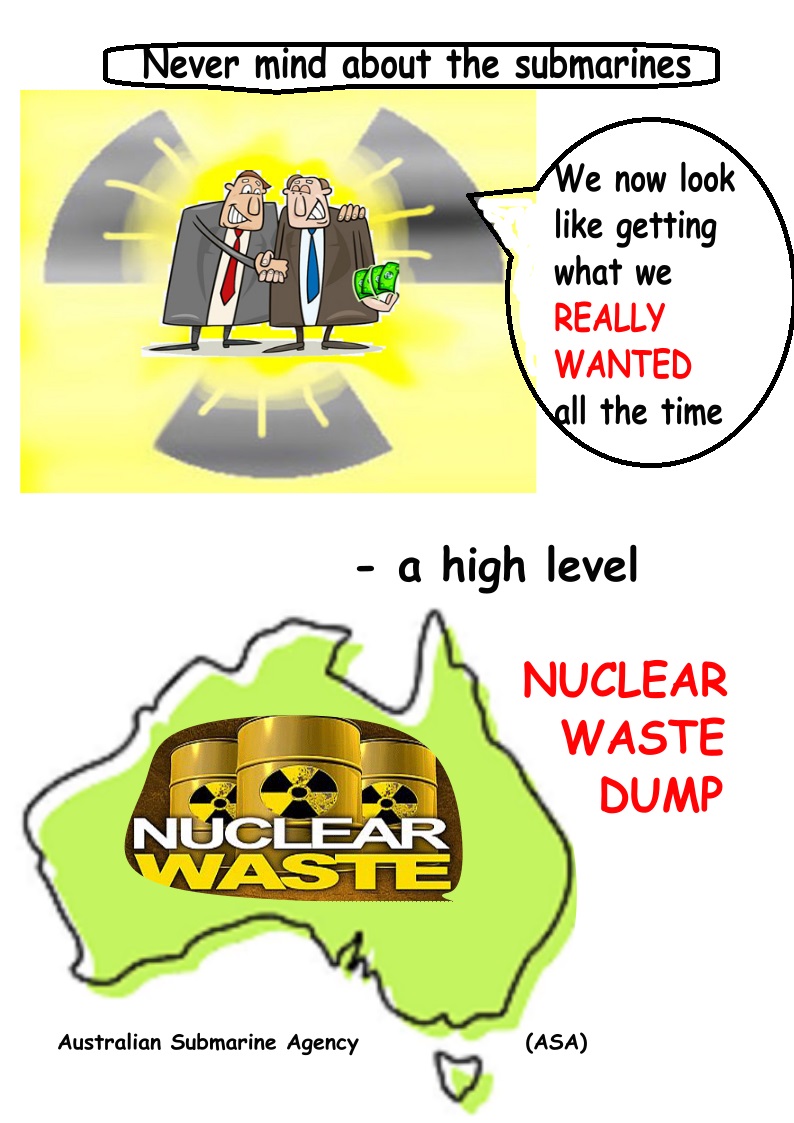
07/05/2023 by Brian Hartiganhttps://www.contactairlandandsea.com/2023/05/07/new-agency-and-new-regulator-to-deliver-nuclear-submarine-program/
In leading the delivery of Australia’s nuclear-powered submarines, the ASA will be responsible for cradle-to-grave management, including:
Disposal
New agency and new regulator to deliver nuclear submarine program
The government will establish a new agency and a new regulator as part of its commitment to delivering Australia’s conventionally armed nuclear-powered submarines.
The Australian Submarine Agency (ASA) will be established by Executive Order and be responsible and accountable for the management and oversight of Australia’s nuclear-powered submarine program.
Work to deliver the pathway is already underway and remains a key priority for the government, in line with the recommendations of the Defence Strategic Review.
In leading the delivery of Australia’s nuclear-powered submarines, the ASA will be responsible for cradle-to-grave management, including:
- acquisition
- delivery
- construction
- technical governance
- sustainment, and
- disposal
ASA will also enable the necessary policy, legal, non-proliferation, workforce, security and safety arrangements.
Royal Australian Navy, led by the Chief of Navy, will continue to be responsible for training submariners and operating Australia’s submarines.
The Nuclear-Powered Submarine Taskforce, which currently operates as part of Defence, will transition to the ASA on 1 July 2023.
t will be headed by a Director General, the appointment of whom will be announced by the government at the appropriate time.
The government will also establish a new independent statutory regulator, the Australian Nuclear-Powered Submarine Safety Regulator.
The new regulator will have the functions and powers necessary to regulate the unique circumstances associated with nuclear safety and radiological protection across the lifecycle of Australia’s nuclear-powered submarine enterprise.
This includes associated infrastructure and facilities.
The regulator will be independent of the Australian Defence Force’s chain of command and directions from the Department of Defence.
This will be a fundamental part of a system of regulation, which will work with existing Australian regulators to support the safety of our submariners, Australian and international communities, and the environment.
Both the ASA and the Australian Nuclear-Powered Submarine Safety Regulator will be non-corporate Commonwealth entities within the Defence portfolio and report directly to the Minister for Defence.
Minister for Defence Richard Marles said the government was delivering on its commitment to the acquisition of nuclear-powered submarines, which is the single biggest investment in our defence capability in our history.
“The establishment of the Australian Submarine Agency and the Australian Nuclear-Powered Submarine Safety Regulator are critical elements of delivering this game-changing capability and will ensure the safe and successful implementation of the pathway for Australia’s acquisition of nuclear-powered submarines,” Mr Marles said.
“The ASA will be responsible and accountable for delivering the ambitious program to acquire Australia’s nuclear-powered submarines.
“A specialised and dedicated regulator – which will be independent of Defence and the Australian Defence Force – will ensure we have the highest standards of nuclear safety and radiological protection across the lifecycle of Australia’s nuclear-powered submarines.”
Port Kembla May Day march rejects AUKUS nuclear submarine base plan
Peter Boyle, Pip Hinman, Port Kembla, May 6, 2023
Thousands of trade unionists (including many members of the Australian Labor Party) and anti-war activists marched through Port Kembla on May 6 to reject the plan to site the AUKUS nuclear-powered submarine base in that town.
The Wollongong May Day march was held in Port Kembla as a symbolic launch of a mass campaign of “feet in the streets” to stop this nuclear military madness, South Coast Labour Council secretary Arthur Rorris told the marchers.
Hypocritical Commemorations: World Press Freedom Day
It gave US Secretary of State Antony Blinken an opportunity to do the usual cartwheel. “Far too many governments use repression to silence free expression, including through reprisals against journalists for simply doing their jobs,” goes his May 3 press statement. “We again call on Russian authorities to immediately release Wall Street reporter Gershkovich and all other journalists held for exercising freedom of expression.” What, then, of the Australian publisher and founder of WikiLeaks, Julian Assange?
Australian Independent Media, May 6, 2023, Dr Binoy Kampmark
Selected days for commemoration serve one fundamental purpose. Centrally, they acknowledge the forgotten or neglected, while proposing to do nothing about it. It’s the priest’s confession, the chance for absolution before the next round of soiling.
These occasions are often money-making exercises for canny businesses: the days put aside to remember mothers and fathers, for instance. But there is no money to be made in saving writers, publishers, whistleblowers, and journalists from the avenging police state.
World Press Freedom Day, having limped on for three decades, is particularly fraught in this regard. It remains particularly loathsome, not least for giving politicians an opportunity to leave flimsy offerings at its shrine. These often come from the powerful, the very same figures responsible for demeaning and attacking those brave scribblers who do, every so often, show how the game is played.
Every year, we see reactions often uneven, and almost always hypocritical. The treatment of US journalist Evan Gershkovich is the stellar example for 2023. Here was the caged victim-hero scribbler, held in the remorseless clutches of the Russian Bear.
It gave US Secretary of State Antony Blinken an opportunity to do the usual cartwheel. “Far too many governments use repression to silence free expression, including through reprisals against journalists for simply doing their jobs,” goes his May 3 press statement. “We again call on Russian authorities to immediately release Wall Street reporter Gershkovich and all other journalists held for exercising freedom of expression.” What, then, of the Australian publisher and founder of WikiLeaks, Julian Assange?
With unintended, bleak irony, Reporters Without Borders (RSF) also thought it fitting to rope in the Secretary at a World Press Freedom Day event organised in conjunction with the Washington Post. Talking to his interlocutor, the Post’s David Ignatius, Blinken spoke of efforts to “fight back and push back around the world to help journalists, who – in one way or another, are facing intimidation, coercion, persecution, prosecution, surveillance.” This seemed grimly comical, given that the United States, through its agencies, has engaged in intimidation, coercion, persecution, prosecution and surveillance against Assange, whose scalp they continue to seek with salivating expectation.
In the course of the event, Ignatius and Blinken encountered Code Pink activists Medea Benjamin and Tinghe Barry. Both were keen to test the Secretary’s lofty assessments about Washington’s stance on free expression and journalistic practice. “Excuse me, we can’t use this day without calling for the freedom of Julian Assange,” exclaimed Benjamin, storming the stage where the two men were engaged in bland conversation. A bemused Ignatius duly approved of Benjamin’s eviction by three burly minders, seeing it all as part of “free expression”.
Barry’s own assessment of the whole show summed matters up. “Two hours and not one word about journalist Shireen Abu-Akleh, who was murdered by Israeli occupation forces in Palestine, not one word about Julian Assange.”
Others from the US State Department were also found wanting. A department press briefing from Vedant Patel, principal deputy spokesperson, opened with comments about World Press Freedom Day. He echoed the belief in “the importance of a free press. It’s a – we believe a bedrock of democracy.”
Then came a question from Matt Lee of Associated Press: Did the State Department regard Assange “as a journalist who is – who should be covered by the ideas embodied in World Press Freedom Day?”
Patel’s response did not deviate from the views of his superiors. “The State Department thinks that Mr Assange has been charged with serious criminal conduct in the United States, in connection with his alleged role in one of the largest compromises of classified information in our nation’s history.”
With dutiful adherence to a narrative worn and extensively disproved in Assange’s extradition trial proceedings, Patel spoke of actions that “risked serious harm to US national security to the benefit of our adversaries” (there was none) and subjected “human sources to grave and imminent risk of serious physical harm and arbitrary detention” (no evidence has ever been adduced by the Department of Justice on this point)…………………………………………………………….. more https://theaimn.com/hypocritical-commemorations-world-press-freedom-day/
Registrations open for Energy Next, co-located with Australian Clean Energy Summit in July — RenewEconomy

Energy Next will focus on latest renewables and energy management technologies and solutions, from solar, energy storage and EV charging to energy monitoring software. The post Registrations open for Energy Next, co-located with Australian Clean Energy Summit in July appeared first on RenewEconomy.
Registrations open for Energy Next, co-located with Australian Clean Energy Summit in July — RenewEconomy
Australia finally has a Net Zero Authority. What should top its agenda? — RenewEconomy

Now that we finally have a Net Zero Authority, how can it help Australia make the most of this once-in-a-generation economic transformation? The post Australia finally has a Net Zero Authority. What should top its agenda? appeared first on RenewEconomy.
Australia finally has a Net Zero Authority. What should top its agenda? — RenewEconomy
How to deliver one of fastest green energy transitions in the world — RenewEconomy

Deep dive into Australia’s biggest renewable and storage auction shows projects developed a broad range of revenue strategies, including short-term and long term PPAs. The post How to deliver one of fastest green energy transitions in the world appeared first on RenewEconomy.
How to deliver one of fastest green energy transitions in the world — RenewEconomy
Murder by Proxy
Meet the Ukrainian children killed by US/NATO funding and weapons
Deborah L. Armstrong 6 May 23 https://medium.com/@deborahlarmstrong/murder-by-proxy-291ceb5754b
ince 2014, 130 children have been killed in Eastern Ukraine by what was once their own government, which is now and has been funded by the United States since the US-backed Maidan coup tore the country in two. But that is only the most recent “official” number released by the Russian Federation. By now, the death toll is certainly higher, as the current conflict rages on and children continue to be killed by NATO weapons supplied to Ukraine.
These children, who grew up in Ukraine, come from Russian-speaking families and identify as Russian. The followers of Stepan Bandera, a Ukrainian Nazi collaborator and mass murderer who is now a “Hero of Ukraine,” believe that Russians, often referred to with the ethnic slur, “Moskals,” are sub-humans who need to be “sent to purgatory.” If you are unfamiliar with the history of the region, and Ukraine’s role in World War II, you can read all about it here and here.
These children, who grew up in Ukraine, come from Russian-speaking families and identify as Russian. The followers of Stepan Bandera, a Ukrainian Nazi collaborator and mass murderer who is now a “Hero of Ukraine,” believe that Russians, often referred to with the ethnic slur, “Moskals,” are sub-humans who need to be “sent to purgatory.” If you are unfamiliar with the history of the region, and Ukraine’s role in World War II, you can read all about it here and here.
Since Maidan, the neo-Nazis have been continuously bombarding the Donbass, where the majority of Russian-speakers (referred to as “Russian separatists” in Western press) live. Civilian infrastructure, such as markets, hospitals and schools, are routinely targeted as are the civilians themselves. It was these attacks on the Russian-speaking population, and plans for a major Ukrainian offensive against the Donbass, which prompted Putin to announce Russia’s Special Military Operation (SMO) in February, 2022.
A good friend of mine, who goes by the name Volje Voljevich, has been compiling an album of children killed in the Donbass. He painstakingly wrote up short summaries about 40 of the children, and the circumstances of their deaths. Many of them are memorialized at the Alley of Angels in Donetsk, where grieving family members bring flowers and stuffed toys. Here are just a few of their faces and their stories, thanks to Volje. [on original]………………….
About the author:
Deborah Armstrong currently writes about geopolitics with an emphasis on Russia. She previously worked in local TV news in the United States where she won two regional Emmy Awards. In the early 1990’s, Deborah lived in the Soviet Union during its final days and worked as a television consultant at Leningrad Television. You can support Deborah’s writing at Paypal or Patreon, or donate via Substack.
·
Chart of the day: Germany produces 40GW of solar for first time
Germany has passed through the 40GW mark for solar production for the first
time. The new benchmark was reached at 12.30pm local time on May 4. It
shows that solar output was more than six times bigger than any other
source at the time, and accounted for nearly two thirds of the total
64.6GW, of which around 1.3GW was being exported to other countries. Brown
coal generation was the second biggest at that time, followed by biomass
and onshore wind.
Renew Economy 5th May 2023
May 7 Energy News — geoharvey

Science and Technology: ¶ “Analysis Points To Massive Photovoltaic Deployment To Meet Decarbonization Target” • An “unprecedented ramp-up of production capacity” over the next two decades is needed to provide enough solar power to completely decarbonize the global electrical system, but that goal can be achieved, an analysis led by NREL researchers says. [CleanTechnica] Solar […]
May 7 Energy News — geoharvey
AUKUS high-level nuclear waste dump must be subject to Indigenous veto
there is no question Defence would require the free, prior and informed consent of Indigenous people before a high-level nuclear waste facility could proceed on their land. …. in those circumstances the government must provide a veto right, because the project would eliminate future access to traditional Indigenous land.
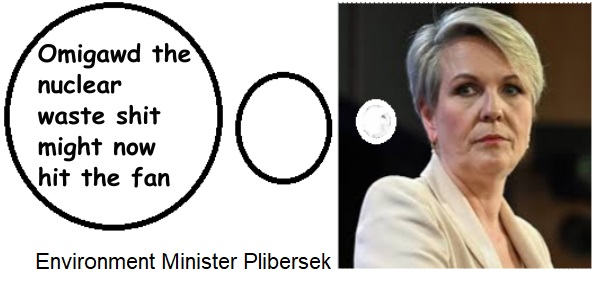
If Plibersek knew about the radioactive waste facility and its intended siting in remote Australia at the time AUKUS was announced she has kept quiet about it.
A far more substantial inequality of power now exists between the Indigenous groups to be consulted about the site of the radioactive waste facility and the Defence Department. The facility has solid bipartisan support. In addition, it is essential to the AUKUS submarine deal, meaning Defence embodies the combined wishes of the Australian, British and United States governments.
Bipartisan secrecy and Defence’s poor record with Indigenous groups at Woomera are red flags for the consultation over AUKUS high-level nuclear waste facility.
Undue Influence MICHELLE FAHY, MAY 6, 2023
This is part one of a two-part series
The federal government had no public mandate for any of the AUKUS decisions: no mandate to enter the agreement, none to acquire eight nuclear-powered submarines for up to $368 billion, and none to establish a high-level radioactive waste facility. On this last, in fact, it had long term evidence to suggest Australians would likely oppose the proposition.
Perhaps this is why both major political parties concealed for 18 months, a period including the federal election, their shared knowledge that AUKUS requires a high-level radioactive waste facility to be built.
The AUKUS agreement was revealed on 15 September 2021. On 14 March 2023, deputy prime minister and defence minister, Richard Marles, announced the nuclear waste facility. Next day, opposition leader Peter Dutton said: ‘The Labor Party signed up to AUKUS knowing they would have to deal with the waste, and now that they’re in government they know that’s a part of the deal.’ The government has not denied Dutton’s claim.

Meanwhile, the Albanese government continues its work to establish an Indigenous Voice to Parliament. Just nine days after the prime minister was in San Diego announcing the AUKUS submarine deal and his deputy Marles came clean about the radioactive waste facility, Anthony Albanese released the proposed Voice wording. The prime minister noted in his speech the importance of consultation, ‘it’s common courtesy and decency to ask people before you take a decision that will have an impact on them’.
Governments have been trying for decades to put a radioactive waste dump in outback Australia. They have been rebuffed time and time again. Yet the Albanese government is trying once more.
Legal experts have pointed out the international legal requirement to obtain the free, prior and informed consent of Indigenous peoples before making significant decisions that affect them. This process includes giving Indigenous peoples full information about a development in advance and respecting their choice to give or withhold consent.
The UN Declaration on the Rights of Indigenous Peoples, which Australia has pledged to support ‘in both word and deed’, says: ‘[No] storage or disposal of hazardous materials shall take place in the lands or territories of indigenous peoples without their free, prior and informed consent.’
As to whether the government can claim ‘national security’ as a reason to avoid these obligations and dictate a radioactive waste site, international human rights law expert John Podgorelec says: ‘States may not derogate from their responsibilities on the basis of national security unless a “state of emergency” has been formally invoked.’
He adds, ‘A lesson to come out of the Iraq calamity is that manufactured or undisclosed national security intelligence cannot be used to subvert democracy.’
Unfortunately, the Defence Department’s fact sheet on nuclear stewardship and waste is light on detail. It does not mention free, prior and informed consent. Defence commits only to ‘consultation and engagement’ – a lesser standard – and adds that it will also consider ‘wider social license and economic implications’. Globally, the ‘economic implications’ of significant projects habitually undermine human rights, particularly those of Indigenous peoples.
Furthermore, Defence has a poor track record of engagement with Indigenous people in one of its key locations, South Australia’s Woomera Prohibited Area (explored further in part two).
Woomera is used by Australian and foreign military forces, in close partnership with multinational weapons corporations, for extensive weapons testing and military training activities.
‘When militaries around the world need a place to test their weapons and fly their new fighter jets, there’s nowhere better than the rugged expanses of South Australia,’ enthused US weapons giant Raytheon in 2016, talking up ‘a further expansion of US-Australian cooperation’.
The Woomera weapons testing range covers one-eighth of South Australia, occupying more than 122,000km2. Before Defence took over, less than a century ago, Indigenous people had inhabited the region for tens of thousands of years.
Despite the international outcry at the destruction of Juukan Gorge, the Defence Department has not changed its behaviour. For example, it continues to use a registered Indigenous heritage site in Woomera as a target zone for high explosive weapons tests. (I visited this and other sites inside Woomera last year at the invitation of Andrew and Bob Starkey, senior Kokatha lawmen and traditional owners.)
Defence is aware of the site’s significance, just as Rio Tinto was aware of the significance of Juukan Gorge. Defence’s heritage management plan, relevant sections of which I have seen, says the site has a ‘high level of Aboriginal heritage value’ and is a place of ‘sensitive cultural significance that can be easily impacted’. The public might wonder how Defence can know this yet still decide it’s acceptable to direct high explosive munitions onto the site.
‘The Commonwealth cannot give with one hand and take with the other,’ says Podgorelec, who acts for the Starkeys, on the tensions between federal commitments to Indigenous heritage protection and to AUKUS. He says there is no question Defence would require the free, prior and informed consent of Indigenous people before a high-level nuclear waste facility could proceed on their land. He also says in those circumstances the government must provide a veto right, because the project would eliminate future access to traditional Indigenous land.
Australia is not alone in being unable to find a radioactive waste solution. The UK has failed for decades to make meaningful progress on dismantling decommissioned nuclear submarines – it currently has 21 of them floating in dockyards awaiting disposal, mirroring its wider failure to resolve its nuclear waste problems. The US has also failed in this regard: spent fuel from its nuclear submarines remains in temporary storage. Griffith University’s Emeritus Professor Ian Lowe has written that the nuclear waste from US military and civilian reactors ‘is just piling up with no long-term solution in sight’.
Defence does not mention this pertinent information in its brief positive account of US and UK nuclear stewardship.
The federal government gave its response to the Juukan Gorge inquiry report in November 2022. Minister Tanya Plibersek, whose Environment portfolio encompasses Indigenous heritage protection, said:
[T]hese are thorough and considerate reports… the recommendations speak to the principles and priorities that will shape our [heritage protection] legislation. Free, prior, and informed consent.
If Plibersek knew about the radioactive waste facility and its intended siting in remote Australia at the time AUKUS was announced she has kept quiet about it.
Free, prior and informed consent requires that intimidation and coercion be avoided. Plibersek is well aware of the possibility of abuses of power in high stakes developments. In her speech, she noted partnership agreements were signed under ‘gross inequalities of power’ between the traditional owners of Juukan Gorge and Rio Tinto.
A far more substantial inequality of power now exists between the Indigenous groups to be consulted about the site of the radioactive waste facility and the Defence Department. The facility has solid bipartisan support. In addition, it is essential to the AUKUS submarine deal, meaning Defence embodies the combined wishes of the Australian, British and United States governments.
Podgorelec is adamant. ‘Australia cannot enact domestic laws that undermine its international legal obligations. If a project will take away Indigenous cultural connection to land forever – as a high-level nuclear waste facility will do – then the government is obliged to give a right of veto.’
Note: The legal basis for free, prior and informed consent was explained by John Podgorelec as lead author of Adelaide University’s submission to the 2015 SA Nuclear Fuel Cycle Royal Commission. Unfortunately, having been available until recently, the Royal Commission’s website is presently inaccessible. Email us if you would like a copy of the submission: undueinfluence@protonmail.com
A KINGLY PROPOSAL: LETTER FROM JULIAN ASSANGE TO KING CHARLES III
JULIAN ASSANGE, 5 MAY 2023 https://www.theguardian.com/world/2023/may/06/port-kembla-rally-to-demand-nsw-site-be-ruled-out-as-aukus-nuclear-submarine-base
To His Majesty King Charles III,
On the coronation of my liege, I thought it only fitting to extend a heartfelt invitation to you to commemorate this momentous occasion by visiting your very own kingdom within a kingdom: His Majesty’s Prison Belmarsh.
You will no doubt recall the wise words of a renowned playwright: “The quality of mercy is not strained. It droppeth as the gentle rain from heaven upon the place beneath.”
Ah, but what would that bard know of mercy faced with the reckoning at the dawn of your historic reign? After all, one can truly know the measure of a society by how it treats its prisoners, and your kingdom has surely excelled in that regard.
Your Majesty’s Prison Belmarsh is located at the prestigious address of One Western Way, London, just a short foxhunt from the Old Royal Naval College in Greenwich. How delightful it must be to have such an esteemed establishment bear your name.
“One can truly know the measure of a society by how it treats its prisoners”
It is here that 687 of your loyal subjects are held, supporting the United Kingdom’s record as the nation with the largest prison population in Western Europe. As your noble government has recently declared, your kingdom is currently undergoing “the biggest expansion of prison places in over a century”, with its ambitious projections showing an increase of the prison population from 82,000 to 106,000 within the next four years. Quite the legacy, indeed.
As a political prisoner, held at Your Majesty’s pleasure on behalf of an embarrassed foreign sovereign, I am honoured to reside within the walls of this world class institution. Truly, your kingdom knows no bounds.
During your visit, you will have the opportunity to feast upon the culinary delights prepared for your loyal subjects on a generous budget of two pounds per day. Savour the blended tuna heads and the ubiquitous reconstituted forms that are purportedly made from chicken. And worry not, for unlike lesser institutions such as Alcatraz or San Quentin, there is no communal dining in a mess hall. At Belmarsh, prisoners dine alone in their cells, ensuring the utmost intimacy with their meal.
Beyond the gustatory pleasures, I can assure you that Belmarsh provides ample educational opportunities for your subjects. As Proverbs 22:6 has it: “Train up a child in the way he should go: and when he is old, he will not depart from it.” Observe the shuffling queues at the medicine hatch, where inmates gather their prescriptions, not for daily use, but for the horizon-expanding experience of a “big day out”—all at once.
You will also have the opportunity to pay your respects to my late friend Manoel Santos, a gay man facing deportation to Bolsonaro’s Brazil, who took his own life just eight yards from my cell using a crude rope fashioned from his bedsheets. His exquisite tenor voice now silenced forever.
Venture further into the depths of Belmarsh and you will find the most isolated place within its walls: Healthcare, or “Hellcare” as its inhabitants lovingly call it. Here, you will marvel at sensible rules designed for everyone’s safety, such as the prohibition of chess, whilst permitting the far less dangerous game of checkers.
Deep within Hellcare lies the most gloriously uplifting place in all of Belmarsh, nay, the whole of the United Kingdom: the sublimely named Belmarsh End of Life Suite. Listen closely, and you may hear the prisoners’ cries of “Brother, I’m going to die in here”, a testament to the quality of both life and death within your prison.
But fear not, for there is beauty to be found within these walls. Feast your eyes upon the picturesque crows nesting in the razor wire and the hundreds of hungry rats that call Belmarsh home. And if you come in the spring, you may even catch a glimpse of the ducklings laid by wayward mallards within the prison grounds. But don’t delay, for the ravenous rats ensure their lives are fleeting.
I implore you, King Charles, to visit His Majesty’s Prison Belmarsh, for it is an honour befitting a king. As you embark upon your reign, may you always remember the words of the King James Bible: “Blessed are the merciful, for they shall obtain mercy” (Matthew 5:7). And may mercy be the guiding light of your kingdom, both within and without the walls of Belmarsh.
Your most devoted subject,
Julian Assange A9379AY
WWIII on the Installment Plan
One need only to look at the “Down Under” Australian press’ frightful China fear-mongering to know what we in the ‘Up Above’ can expect. This has been well chronicled by Caitlin Johnstone, whose Substack posts are a must read.
Witness: The U.S. has brought Australia, South Korea, Japan into an alliance against China and is pressuring the Philippines and Indonesia to join in as we ship arms to Taiwan. The intent is to bait China, to try to make Taiwan the next Ukraine, while coordinating submarine patrols amidst risible plans to send ships from the EU to patrol the Straits of Taiwan. If China did something similar in our sphere, Congress would declare war.
The Invention of a Wartime Presidency to Save the Biden Administration
DENNIS KUCINICH, MAY 5, 2023 https://denniskucinich.substack.com/p/wwiii-on-the-installment-plan?utm_source=post-email-title&publication_id=1441588&post_id=119326426&isFreemail=true&utm_medium=email
Yesterday’s attempt to attack the Kremlin with a drone strike, supposedly to assassinate Vladimir Putin, is being pinned on Ukraine. But this is a proxy war of the U.S. versus Russia, and no one is fooled. Ukraine is a simply a U.S. pawn and can make no major moves without checking with Washington.
The U.S. has successfully muzzled its energy-starved allies in Europe from even objecting to, let alone investigating the destruction of the Nord Stream pipeline. Europe is stuck with the skyrocketing cost of U.S. supplied replacement fuel.
The destruction of Nord Stream followed well-publicized mock U.S. nuclear strikes targeting Russia and the equally provocative shipment of depleted-uranium munitions transferred to the Ukraine battlefield through our “special relationship” with the British government. The Russian government has publicly warned that the use of such weapons, as were used by the U.S. in Iraq and Syria, will lead to escalation.
The Biden Administration has done everything it could to incite a hot war directly between the U.S. and Russia, sacrificing Ukrainian youth and the majesty of Ukrainian cities.
The drone strike and the depleted uranium transfer are made to look like the West is somehow succeeding in the battle which, for all intents and purposes, will soon come to an end— with a phony declaration of victory of sorts (definitely not for Ukrainians). Then the infernal Enemy Engine will pivot its wrath and venom towards CHINA.
Get ready for a parceling out of some of the manufactured hate that has been reserved for Russia and President Putin — to hate China and President Xi, and to suffer a fully-machinated Red Peril.
One need only to look at the “Down Under” Australian press’ frightful China fear-mongering to know what we in the ‘Up Above’ can expect. This has been well chronicled by Caitlin Johnstone, whose Substack posts are a must read.
The Biden Administration, having unsuccessfully diminished the Russian economy with its broad sanctions, and having failed to defeat the Russian military, will soon lead us to believe that the same geniuses in Washington, London and Belgium who brought us the war in Ukraine, will somehow succeed in holding in check China, or perhaps even toppling President Xi, through military means.
The depraved thinking that resulted in approximately $140 billion wasted for the war in Ukraine and the deaths of hundreds of thousands of Ukrainian and Russian soldiers, countenances even greater opportunities in the East.
Witness: The U.S. has brought Australia, South Korea, Japan into an alliance against China and is pressuring the Philippines and Indonesia to join in as we ship arms to Taiwan. The intent is to bait China, to try to make Taiwan the next Ukraine, while coordinating submarine patrols amidst risible plans to send ships from the EU to patrol the Straits of Taiwan. If China did something similar in our sphere, Congress would declare war.
The geographically-confused North Atlantic Treaty Organization, (NATO) ever ready to be the U.S.’ wrecking ball, now considers China “a threat to global security.” Remember, China has brokered a peace deal between Saudi Arabia and Iran, and attempted to do so in Ukraine.
Remember, the U.S. has 800 military bases abroad and China has zero.
Remember, China is holding almost a trillion dollars of US debt.
So, what is this all about? The White House, which bet on the forbearance of a nuclear-armed Russia, in a conventional proxy war in Ukraine, is similarly counting on the forbearance of nuclear-armed China in a conventional war over Taiwan. Thus is the horror of unfettered brinkmanship.
NBC News obtained a memo in January where a four-star general instructed his logistical command of nearly 50,000 to get ready for war with China by 2025. His charges were told to further prepare by getting their “legal affairs” in order and to engage in the calisthenics of war, by firing an ammo clip often at a target and to aim for the head. Is this just hysterical puffery?
The 2022 National Security Strategy of the United States identified China as the greatest military and economic threat to the United States. Forget that Mr. Biden voted for China trade, NAFTA and the WTO, all which sharply eroded America’s strategic industrial base of steel, automotive, aerospace and shipping and ultimately set the stage for China’s rise as a world power. Forget that we have shipped high technology to military labs in China – and the Ukraine.
While the US continues its military muscle-flexing globally, incurring rising resentment in its continual challenges to the very idea of national sovereignty, China has focused instead on economic expansion, assisting in economic development throughout the world and strengthening the capacities of nations to support their own interests. China has played the long game, while US leaders have played the wrong game.
So, with only sanctions as a tool, the US has limited options to respond to China, except for war.
If the Biden Administration continues to ramp up for war against China, it could mean the end, not of China, but of the United States itself.
China and Russia are not natural allies, to say the least. However, with NATO encroachment, the placement of missiles on Russia’s border, the war in Ukraine, the blowing up of the Nord Stream pipeline, the U.S. has pushed Russia into China’s waiting arms.
As a result of the proxy war against Russia in Ukraine, together with the saber rattling over Taiwan, we have forced a once unthinkable China-Russia alliance whose combined manufacturing, energy production and offensive capabilities exceed that of the US.
A US war with China will not only bring in Russia on China’s side, but likely India, Brazil, and Iran. That is, if such a war were “conventional,” meaning not nuclear. However, the idea of containing such a war to conventional weapons is pure fantasy.
The Biden Administration’s cyclopean foreign policy will be the ruin of us all.
There is not a shred of diplomatic skill exhibited by the Sullivan-Blinken-Nuland troika. They pull away from treaties. Engage in continual provocations. Recklessly spend hundreds of billions of taxpayers’ dollars on military adventures. It’s escalate, escalate, escalate. The defense contractors, the war profiteers as FDR rightfully called them, cash in and the rest of us lose.
The average American family has seen nearly $100,000 of its wealth spent on regime change adventures since 2001, with highly negative results for our country and the world. The U.S. is viewed in many circles as the greatest threat to world peace. Alarmingly and poignantly, the national debt is close to $100,000 per person in America.
While the Biden Administration plans for a hot war with China in 2025, the White House will use cold war psychology now, for the 2024 election season, to scare the bejesus out of even the most pacific U.S. voter. And, with the help of the American media, which has largely been reduced to a posse of electronic spear carriers, we will be afflicted with every ‘alarm of struggle and flight’ appropriate to cowing Americans into silence and compliance.
President Biden, like President George W. Bush in the Iraq War, will seek to burnish his Commander in Chief status as a war-time president, beginning in the later part of 2023. Going into 2024, the American people will be told not to change presidents in the middle of a manufactured war.
Unless held in check by the voters, President Biden’s foreign policy handlers are merrily leading America and the world down the path of World War III. New Hampshire, are you listening?
Enough is enough: Australian PM expresses frustration at US effort to extradite Julian Assange
Australian Prime Minister Anthony Albanese expressed frustration at the United States’s continuing efforts to extradite WikiLeaks founder and Australian citizen Julian Assange, saying: “There is nothing to be served by his ongoing incarceration.”
1 This month
17 October, Free Public Talk on Nuclear Issues in South Australia
David Noonan will speak on public interest concerns over the new Roxby Downs Indenture Act 2026 on BHP copper-uranium mining and ore processing in SA, and on how AUKUS may face SA with a High-Level nuclear waste agenda.
Dr Jim Green will discuss international developments in the field of nuclear power including ‘small modular reactors’ and Generation 4 ‘advanced’ nuclear reactor concepts.


Help Aunty Sue Protect Her Land and Sacred Sites From Destructive Rocket Testing.
.

Australians deserve the truth
about
AUKUS – https://aukuspublicinquiry.com/

PETITION – To: Prime Minister Anthony Albanese and the Australian Labor Government

of the week – Australians for War Powers Reform (AWPR)
To see nuclear-related stories in greater depth and intensity

