Free Julian Assange, member of our organisations – European Federation of Journalists
https://europeanjournalists.org/blog/2023/04/27/free-julian-assange-member-of-our-organisations/ Our Italian FNSI affiliates were visited today in Rome by Julian Assange‘s wife, Stella Morris. The Italian journalists’ union, at the initiative of its Campania branch, presented Julian Assange with an FNSI membership card. The European Federation of Journalists (EFJ) passed on the initiative to its affiliates in Europe: 18 of them decided to follow the Italian example and grant Julian Assange membership (or honorary membership) of their organisations. The EFJ and its affiliates once again call on the UK authorities to release Julian Assange.
Here is the joint appeal delivered to Stella Morris in Rome this morning:
We, the undersigned European unions and associations of journalists, join the International Federation of Journalists (IFJ) in calling on the US government to drop all charges against Julian Assange and allow him to return home to his wife and children.
We are gravely concerned about the impact of Assange’s continued detention on media freedom and the rights of all journalists globally. We urge European governments to actively work to secure Julian Assange’s release.
To show our solidarity, we declare Julian Assange a full member, an honorary member or a free member of our organisations.
Signed:
- Maja Sever, EFJ President and TUCJ President, Croatia
- Fabrizio Cappella, SUGC-FNSI Secretary, Italy
- Satik Seyranyan, UJA President, Armenia
- Borka Rudić, BHJA General Secretary, Bosnia & Herzegovina
- Hrvoje Zovko, HND President, Croatia
- Emmanuel Poupard, SNJ First General Secretary, France
- Emmanuel Vire, General secretary SNJ-CGT, France
- Tina Groll, dju in ver.di President, Germany
- Maria Antoniadou, JUADN President, Greece
- Laszlo M. Lengyel, HPU Executive President, Hungary
- Pavle Belovski, SSNM President, North Macedonia
- Luís Filipe Simões, SJ President, Portugal
- Darko Šper, GS Kum President, Serbia
- Dragana Čabarkapa, Sinos President, Serbia
- Zeljko Bodrozic, IJAS President, Serbia
- Petra Lesjak Tušek, DNS President, Slovenia
- Miguel Angel Noceda, FAPE President, Spain
- Urs Thalmann, impressum Director, Switzerland
- Tim Dawson, NUJ, United Kingdom
Port Kembla no place for a nuclear subs base, say local campaigners
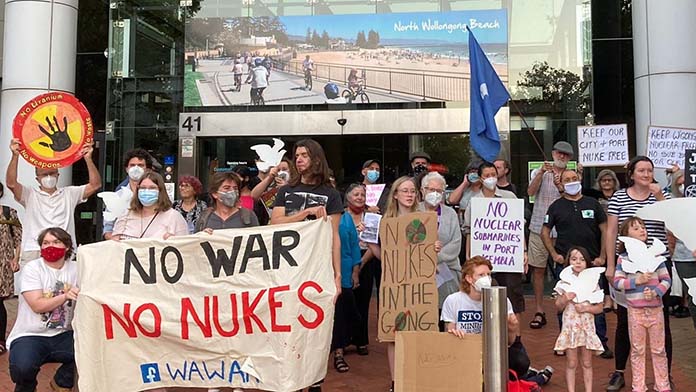
Activists in Wollongong are organising against plans for nearby Port Kembla to host the East Coast base for the AUKUS nuclear submarines. Solidarity spoke to Alexander Brown from Wollongong Against War and Nukes about local opposition and how unions have dedicated this year’s May Day march to opposing the plan
The cost is around $10 billion for an East Coast submarine base. The Treasurer says they can’t afford the $24 billion required to increase Centrelink payments above poverty levels and yet they can afford to spend $10 billion on a war base. And that’s a small part of the overall $368 billion dollars for AUKUS. It’s a gross waste of money.
The strategic justification for it doesn’t make any sense. That’s being picked apart even within the Labor Party by people like Paul Keating and Bob Carr. We’re now seeing current sitting MPs start to express criticism. The submarines may arrive in between ten to 30 years, when their supporters in ASPI and the Sydney Morning Herald say we’re about to have war with China in the next three years. If so the subs are not going to be much use.
More importantly, it’s a ridiculous approach to peace making in the region to say we will arm ourselves to the teeth and that will deter China. China and its regime have many problems but they’re not a military threat to Australia now and they’re unlikely to be in the future. And if these subs are supposed to be to defend shipping, we are shipping most of our exports to China anyway, so who are we defending it against?
We need to build people-to-people solidarity with ordinary people in China to ensure peace and democracy in the whole region—not get drawn into a US provocation and starting a regional arms race.
What kind of actions have you taken to build opposition?
When Scott Morrison suggested that Port Kembla could be a site for an East Coast submarine base there was a protest called by the Student Association at Wollongong University, and different groups and individuals including unions and local councillors came to that.
We started organising a dedicated campaign group called Wollongong Against War and Nukes (WAWAN) and held a successful rally about a year ago to support the local council renewing the declaration of Wollongong as a nuclear free zone, which goes back to 1980.
We held a public meeting with former Greens Senator Scott Ludlam and the South Coast Secretary of the Maritime Union.
We had a rally here two weeks ago, because some local business interests held a defence industry conference and want to build a war industry down here.
This year when the Labor government so fully endorsed continuing AUKUS, after I think many people hoped they might back away, it created shock.
Then there was also a report in the ABC that Port Kembla was firming up as the most likely location for the submarine base. So the campaign has really picked up in the last two months.
The local South Coast Labor Council endorsed a motion to oppose having a nuclear base here.
Unions like the maritime union have put a lot of work into trying to plan for a renewable energy industry here to survive the big shocks that are coming in terms of the decline of coal and steel. They’re interested in expanding offshore wind and potentially green steel through hydrogen.
WAWAN has a community meeting in Port Kembla on 29 April, and we are calling for everyone who can get there to come and support the South Coast May Day march on Saturday 6 May, which will include opposition to the nuclear base alongside the slogan of “Peace, Jobs and Justice”.
Wollongong and Port Kembla steel works have been hotbeds of militancy since the beginning of last century and that tradition continues. The Dalfram dispute in the 1930s saw waterside workers refuse to load pig iron bound for Japan, because they knew that it would be used to make bombs and bullets for the Japanese invasion of China. Pig iron exports to Japan more or less stopped after that struggle.
In the Vietnam War there was a strong movement here and in the 1980s the anti-nuclear movement was really big in Wollongong and the unions were a major part of that. A lot of people in Wollongong have seized the opportunity to say that fighting unionism needs to look beyond the workplace at the environment that workers are going to be living in and creating.
We are wasting money and resources on the defence industry when we could be spending that money on addressing climate change and jobs through a Green New Deal.
Unions back renewable energy jobs over nuclear subs
The South Coast Labour Council, which represents unions in and around Wollongong, is opposing the submarine base as a threat to alternative jobs in the area.
Port Kembla has been assessed as an ideal spot for offshore wind developments, due to wind conditions, grid connections and the working harbour. The area is one of the NSW government’s priority Renewable Energy Zones, with at least two companies already carrying out scoping work for multi-billion dollar offshore wind projects.
Even NSW Ports and the Port Kembla Chamber of Commerce have warned that the Outer Harbour site is needed for wind turbine assembly as well as a new container port, and should not be taken by defence. This is also the likely site for the submarine base. Even the two offshore wind projects already proposed would create thousands of jobs in construction as well as over 500 ongoing jobs.
March against the nuclear base in Port Kembla
12pm Saturday 6 May, Wentworth St, Port Kembla, more details here
Sign up for travel from Sydney here
Australia pays former US defence chiefs $7000 a day for advice

By Matthew Knott, April 27, 2023 https://www.smh.com.au/politics/federal/australia-pays-former-us-defence-chiefs-7000-a-day-for-advice-20230427-p5d3lh.html
The federal government is paying retired senior American military officials up to $7500 a day for advice on major defence projects such as the AUKUS nuclear-powered submarine pact.
The government this week announced that, following its sweeping defence strategic review, retired United States Navy vice admiral William Hilarides would be hired to lead a snap review of the Royal Australian Navy’s surface fleet.
The review, to be handed to the government later this year, will examine whether planned fleets of Australian-made frigates and patrol vessels should be cut to free up money for smaller and more nimble vessels.
Hilarides has previously charged the Australian government US$4000 ($6000) a day for his consulting services, according to US Navy documents first reported by The Washington Post.
Hilarides has won naval consulting contracts from the federal government worth up to $1.6 million ($2.4 million) since 2016, according to figures from the Department of Defence.
Hilarides serves as chair of the Australian naval shipbuilding expert advisory panel and advised the government over the past 18 months while it finalised the deal with the United States and Britain to build a fleet of nuclear-powered submarines.
Defence Industry Minister Pat Conroy defended Hilarides’ appointment to the new navy fleet review this week, saying he had “a long association with Australia” and would do a good job.
In an investigation published last year The Post described Hilarides, a career submariner, as part of a large group of former senior US officials that Australia had relied upon heavily to guide its naval policies.
“To an extraordinary degree in recent years, Australia has relied on high-priced American consultants to decide which ships and submarines to buy and how to manage strategic acquisition projects,” The Post said.
Retired admiral John Richardson, who headed the United States Navy from 2015 to 2019, has received US$5000 ($7570) a day as a part-time consultant to the federal, according to documents released by the Pentagon to the US Congress.
Richardson was hired by the Department of Defence last November to provide advice on the best pathway for Australia to acquire a fleet of nuclear-powered submarines.
According to the documents, Richardson receives travel and lodging expenses to complete his work in Australia.
Richardson, the former US navy chief, told The Post: “I spent most of my life helping to keep America and our allies and partners safe and secure.
It’s a privilege to be invited to be able to use my experience, and help where I can to continue that work.”
Defence Minister Richard Marles on Thursday said outside advice was crucial to ensuring the government makes the correct decisions about significant defence policies.
“When we seek expert advice in relation to critical issues and challenges that we face, we have a global perspective in terms of where we seek that advice from and that’s really important because we want the very best advice,” he said.
“We make no apology for that because the kinds of challenges and decisions we’re making are profoundly important for the future of our country and where we have sought advice from those former officials in the US Navy that has been on issues of profound importance for our nation’s future.”
Greens defence spokesman David Shoebridge said he was shocked that Australia could seemingly not find local experts available to do these jobs.
“If that is true then it’s a pretty extraordinary failure on the part of the government and the ADF,” he said.
“You can only really explain this by Defence’s ongoing dependence on, and deference to, the US.”
He said it was remarkable that the US government had been more transparent than Australian government contracts than the federal government.
AUKUS nuclear submarine cost includes 50% fund for unexpected overruns

SYDNEY, April 28 (Reuters) Reporting by Kirsty Needham; Editing by Robert Birsel– https://www.reuters.com/business/aerospace-defense/aukus-nuclear-submarine-cost-includes-50-fund-unexpected-overruns-2023-04-28/Australia’s defence minister said on Friday the government was being “upfront and transparent” about the cost of its AUKUS nuclear submarine programme, after an analysis showed the forecast A$368 billion cost included a 50% contingency fund.
The Greens party, which commissioned the analysis by the Parliamentary Budget Office, said it showed the “huge” uncertainty over the project.

U.S. President Joe Biden, Australia Prime Minister Anthony Albanese and British Prime Minister Rishi Sunak unveiled details in March of a plan to provide Australia with nuclear-powered attack submarines, a major step to counter China’s ambitions in the Indo-Pacific.
Under the deal, the United States intends to sell Australia three U.S. Virginia class nuclear-powered submarines, which are built by General Dynamics, in the early 2030s, with an option for two more.
In a second phase, Australia and Britain will build an AUKUS class submarine, with Australia receiving its first submarine in the early 2040s. The vessels will be built by BAE Systems and Rolls-Royce.
Australia’s Parliamentary Budget Office has reported the cost estimate over three decades includes a contingency of A$123 billion. A contingency is a future cost not currently known due to delays, budget overruns and other factors.
Greens Senator David Shoebridge said in a statement the scale of the contingency fund was “unprecedented” and highlighted “the huge level of uncertainty in the AUKUS submarine deal”.

Defence Minister Richard Marles said the plan to build a nuclear powered submarine in Australia by the early 2040s was a “massive challenge for the country” and the government was “prudently budgeting here for the unexpected”
“We have sought to be as upfront and transparent as we possibly can be,” he told ABC radio.
The Department of Defence did not release the sale price of the U.S. Virginia Class submarines that Australia will initially purchase, the budget office said.
The report showed most of the cost of the submarine programme will be incurred in the two decades from 2033.
Stop SpaceX from crashing rockets in the Pacific

Hawaii should not be a collateral sacrifice zone for a private space company working for the pentagon
Hawaii needs to have input on SpaceX ocean-landing plan, STAR ADVERTISER. By Lynda Williams, APRIL 27, 2023
The world watched aghast as SpaceX blew up its own spaceship on April 20, four minutes after launch due to engine failure. Even though the mission was not completed, Elon Musk, CEO of SpaceX, claimed it was a success because the real goal was for the rocket to clear the launch pad at the spaceport in Boca Chica, Texas.
What most folks don’t know or realize is that Starship was always going to blow up when it crashlanded in the Pacific Ocean, just 62 nautical miles north of Kauai and a few hundred miles east of the Papahanaumokuakea Marine National Monument.
In the next test launch, which Musk boasted will happen in the next few months, the world’s largest spaceship will descend toward Earth in free fall and blow up upon impact with a force of a ton of TNT as fuel ignites in a great explosion. On a second and third launch test, Starship will break up in the atmosphere and tumble down and crash-land in a debris field several hundred miles southwest of the island chain.
SpaceX obtained a Federal Aviation Administration (FAA) commercial space launch license (experimental permit), rubber-stamped by the National Oceanic and Atmospheric Agency (NOAA) without any consultation of Hawaii’s people because, according to an email I received from the FAA: “No in-person public outreach was conducted in Hawaii as the Starship vehicle was planned to land outside of range for impacts to the residents of Hawaii.”
First of all, that is assuming everything goes exactly according to the plan, which we have all just witnessed doesn’t always happen. If the Starship goes off course by even a few degrees, the consequences could be catastrophic to Hawaii.
Secondly, I think most folks in Hawaii would agree that 62 miles north of Kauai is considered Hawaii culturally if not legally, and that is way too close for what is essentially a rocket bomb to crash-land.
SpaceX was not required to do a full environmental impact study (EIS), but a much-weaker environmental assessment (EA) that only requires the analysis of “nominal operations” or bestcase scenarios. Why was that allowed when the worst-case scenarios are so catastrophic?
In the EA, rather than doing a detailed analysis of the potential impact to marine mammals protected by the Endangered Species Act, NOAA wrote a “Biological Opinion” that argued “less than one” animal would be harmed by a 100 ton steel rocket exploding with the energy of a small nuclear bomb.
It came to that conclusion because it analyzed only one “nominal” scenario in which the rocket hits the water exactly horizontal to the surface with the fuel tanks orientated on top, which is impossible to control or predict. If the explosion is above water, NOAA argues, only a fraction of the energy will be transmitted into the ocean and travel deep enough to harm any of the 30 endangered species of whales, sharks, turtles, monk seals, dolphins and rays in Hawaii.
The EA has many unsubstantiated claims, such as no animals would be near the surface of the water during the crash — even though most are mammals that surface to breathe air.
It ignored the fact that Humpback whales migrate through the target “action area.” It assumed that most of the debris will be large enough to sink to the bottom of the ocean without encountering and injuring animals — but if any does drift into the Papahanaumokuakea Marine National Monument, then the Coast Guard would be sent to clean it up.
This alone is reason to contest the EA and demand an EIS since NOAA and the Office of Hawaiian Affairs co-manage Papahanaumokuakea and OHA should have been consulted, but was not.
The FAA and NOAA analyses are flawed, and both are failing in their duty to protect the people of Hawaii from extreme corporate and federal government abuse.
Hawaii must not become collateral damage and a colonized sacrifice zone for the government’s privatization of the space program and a billionaire’s personal ambition and corporate profits.
At minimum, the FAA must suspend the SpaceX license, conduct a full EIS and include the residents of Hawaii in the review process. The best plan is to ban SpaceX from trashing people and planet in Musk’s ego trip to Mars.
ISLAND VOICES
Chernobyl anniversary offers a bleak look at what may await other Ukrainian nuclear plants

A huge steel and concrete sarcophagus covers the site of the meltdown. Under its dome, called the New Safe Confinement, lie 200 tons of lava-like nuclear fuel, 30 tons of highly contaminated dust and 16 tons of uranium and plutonium that continue to release high levels of radiation.
April 26, 2023 by Charles Digges https://bellona.org/news/nuclear-issues/2023-04-chernobyl-anniversar
A little over a year ago, Russian troops abandoned Chernobyl after briefly occupying it during the grim opening days of Moscow’s invasion of Ukraine. The takeover of the site where the world’s worst nuclear disaster happened thirty-seven years ago this week offered a preview of the reckless disregard for nuclear safety that has characterized so much of this war.
While the site has been left to Ukraine to painstakingly restore since the Russian withdrawal on March 31, 2022, the new anniversary of the Chernobyl plant’s original disaster on April 26, 1986, leaves lingering questions about what, exactly, the world can do when Ukraine’s nuclear infrastructure — or indeed any nuclear infrastructure — is attacked by a hostile neighbor.
The answer, at this point? Not much — aside from trying to pick up the pieces after the damage is already done.
As it stands, the Chernobyl exclusion zone is still dotted with mines planted by Russian troops when they rolled into the territory, churning up clouds of radioactive dust with hundreds of heavily armored vehicles. The mines have made treacherous any efforts to restore the territory.
Russian troops also dug trenches and set fires in an area known as the Red Forest — a gnarled expanse of irradiated trees — and scorched, according to NASA, some 14,000 hectares of land, filling the air with so much radioactive smoke that it was unsafe for firefighters to quell the blazes.
All the while, hundreds of Chernobyl employees — who oversee the site’s sprawling network of spent fuel storage facilities as well as the enormous efforts to dismantle the radioactive remnants of the exploded No. 4 reactor — were held hostage onsite, prevented from rotating out at the end of their shifts. Five workers were kidnapped and nine were killed, according to The Washington Post.
Those who remained said later that they had tried to keep the Russians from the most dangerous areas within the plant’s territory. But in what many called the worst situation they have seen in the decades since the initial disaster, Chernobyl’s power was cut by fighting, leaving them to rely on diesel generators for nearly a week to support the critical work of circulating water to cool spent nuclear fuel.
The damage the Russian soldiers did wasn’t purely technical. Doors to offices were ripped off hinges, windows smashed, walls spray-painted with graffiti.
“The poop was the icing on the cake,” Aleksander Barsukov, deputy director of the Chernobyl Ecocenter, which keeps samples of radioactive material collected from all over the world, told The Wall Street Journal after the Russian retreat.
By the time Russian troops pulled back from the plant on March 31, 2022 — amid reports of possible radiation poisoning among their ranks — Chernobyl’s technicians had been held at literal gunpoint at their workstations for more than a month.
During the retreat, according to Ukrainian accounts, Russian soldiers ransacked the site and took anything that looked valuable, looting more than 1,000 computers, and spiriting away dosimeters, software, lab tools, firefighting equipment — and in some cases even household appliances — piling them in stolen Ukrainian trucks.
“Whatever they didn’t steal, they broke,” Chernobyl Information Director Vitaly Medved told the BBC at the time.
Russian soldiers then brazenly mailed much of the booty home from across the Belarusian border. They also made off with radioactive instruments used to calibrate personal dosimeters for Chernobyl staff — substances that can cause radiation burns if handled improperly.
According to the European Bank of Reconstruction and Development, which has financed much of Chernobyl’s cleanup work since the original 1986 disaster, the Russian Army’s destructive adventure in the world’s most famous radioactive wasteland will cost some €100 million to repair.
The four RBMK reactors at the enormous nuclear station in Chernobyl no longer produce power, but before the invasion nearly 6,000 workers monitored the lasting effects of the disastrous meltdown that took place in 1986, as well oversaw as processing spent nuclear fuel from other plants in Ukraine. In the days before the invasion, all but a few hundred employees were evacuated.
Located just a few miles from the Belarusian border, Chernobyl was one of the first places occupied by Russian troops. Yevhen Kramarenko, the director of the exclusion zone — the 2,6000-square-kilometer area where radiation levels remain high and public access is limited — told The Washington Post that on the first day of the invasion, a Russian general presented himself as the new leader of the station, and introduced employees from Rosatom, Russia’s state nuclear corporation.
“I believe that at the time when they came,” Kramarenko told the paper, “they planned to be there permanently, they planned to take control for a long time.”
A sign of things to come?
Even before the occupation, the Chernobyl station had a post-apocalyptic air. It is situated in a dense forest, swarming with mosquitoes and gnats. Pripyat, the city where employees lived before the disaster, now stands empty and is being reconquered by nature.
A huge steel and concrete sarcophagus covers the site of the meltdown. Under its dome, called the New Safe Confinement, lie 200 tons of lava-like nuclear fuel, 30 tons of highly contaminated dust and 16 tons of uranium and plutonium that continue to release high levels of radiation.
Yet while Rosatom may have failed to keep hold of Chernobyl, the same cannot be said about Ukraine’s embattled Zaporizhzhia nuclear plant — Europe’s largest such facility — which once supplied a fifth of Ukraine’s electricity.
Since October of 2022, Moscow claims that it now controls the plant — a claim not honored by the UN’s International Atomic Energy Association, to say nothing of Kyiv.
From then on, Rosatom has begun flooding the Zaporizhzhia plant with Russian staff that it has transferred from its own Kalinin nuclear plant, 545 kilometers across the front to the northeast.
But while Russia asserts the six-reactor facility has been taken over as a protective measure, there is little to suggest that the joining of Russian and Ukrainian workforces is going smoothly. Only about 2,000 Ukrainian staff members still work at the plant, out of 11,000 before the war.
Indeed, much of Rosatom’s effort to assert itself at the plant has involved arresting and torturing Ukrainian workers opposed to the occupation as it toils to link Zaporizhzhia with the Russian electricity grid.
The plant, which lies on the south side of the Dnipro River next to the nuclear plant’s home city of Enerhodar, is on the front line of the war. Ukrainian troops are just a few of kilometers to the north, on the far bank of the Dnipro, while Russians are holed up in the power plant.Anxieties are high that the area could see renewed fighting in any Ukrainian counteroffensive.
Ukraine accuses the Russians of using the plant as a shield, hoping that the danger of causing a nuclear accident will keep Ukrainian soldiers from firing on them — the first time an atomic reactor has been put in such a position.
“They know Ukrainian troops would not dare to fire back. The nuclear power plant is a perfect hiding place from Ukrainian artillery,” Oleksiy Melnychuk, a former worker at the plant who fled from Enerhodar last July to Ukrainian-held territory, told Politico.eu. The Russians in turn accuse the Ukrainians of ignoring safety protocols and firing on areas near the plant.
The IAEA has inspectors on site and has been trying to walk a diplomatic tightrope to establish a non-military safety zone around the plant. While Moscow says it is keen to do so, Kyiv is leery of any step that could lend legitimacy to the Russian occupation.
Late last month, IAEA chief Rafael Mariano Grossi dropped the idea, and instead is now pushing for both sides to take steps to ensure that the plant isn’t attacked.
Over the last year, four of the station’s six VVER reactors have been put into a cold shutdown to minimize the risk of an accident, while two have been restarted to produce low levels of power to keep the plant operational. The facility needs access to electricity to ensure reactor cooling and other safety functions. However, its links to the Ukrainian grid have been cut six times since last March, forcing the ZNPP to rely on diesel-powered generators for emergency backup power — a situation that IAEA Director General Rafael Grossi has referred to as “rolling the dice.”
“And if we allow this to continue time after time then one day our luck will run out,” he added.
Still, even as events deteriorate, there is little the world can do but watch.
Even Grossi — who heads the world’s most respected nuclear power diplomacy body — has admitted as much. During a meeting of the IAEA’s 35-member board of governors last month, Grossi castigated his colleagues for “complacency” after the latest spate of airstrikes had again cut off Zaporizhzhia’s access to grid electricity.
“What are we doing to prevent this [from] happening?“ a flabbergasted Grossi asked the board. ”We are the IAEA, we are meant to care about nuclear safety.”
Even so, aspirations of pushing out the Russians among plant workers remain high.
“We still hope de-occupation is possible,” Melnychuk told Politico.eu. “You can’t even imagine how ready we all are to return and let our colleagues, working under tremendous pressure and fear, to finally have some rest.”
Unfortunately, the state of Chernobyl offers the clearest glimpse of what they may find if — or when — that time comes.
Nuclear waste from small modular reactors – Simon Daigle comments on recent article.

Simon J Daigle, B.Sc., M.Sc., M.Sc.(A) Concerned Canadian Citizen. Occupational / Industrial Hygienist, Epidemiologist. Climatologist / Air quality expert (Topospheric Ozone). 27 Apr 23
A recent article on SMRs in 2022 on potential nuclear waste risks and other proximate information on industrial and hazardous waste streams globally [References 2 to 5] below.
Nuclear waste from small modular reactors. PNAS Publication. Lindsay M. Kralla, Allison M. Macfarlaneb, and Rodney C. Ewinga. Edited by Eric J. Schelter, University of Pennsylvania, Philadelphia, PA; received June 26, 2021; accepted March 17, 2022 by Editorial Board Member Peter J. Rossky.
Simon Daigle comments:
- Development of SMRs have security issues and threats globally according to many experts including Dr Gordon Edwards (CCNR).
- SMR will produce more toxic radionuclides and waste stream analysis for potential SMR wastes streams are unknown in Canada and currently the Canadian government have no plans to complete this analysis yet or confirmed by an environmental impact assessment.
- SMR development and potential nuclear wastes generated will be extremely dangerous and toxic comparatively with current NPP SNF and other LILW [Ref. 1].
- SMR nuclear waste challenges of DGR disposal risks are unknown and are technically difficult to achieve even with safety assurances by governments globally, even more so for current nuclear wastes from NPP and other nuclear waste streams such as medical radiological waste streams.
- On a global scale, industrial and hazardous wastes are mismanaged to a point where poor countries are the favored territories to dump industry’s hazardous and industrial wastes because of poor regulatory or no regulatory legal framework to be followed by industries and corporations [Ref. 5].
- Global governments want to take on industrial and hazardous wastes for a financial benefit with no real ROI (Return on Investment) for any government or taxpayer when industrial waste companies know they can make a profit and unfortunately, the environment and population health in that country are impacted considerably without their own government helping out [Ref. 5]. This is also the case for nuclear wastes independent of point of origin and all coming from the nuclear industry’s operators, and similar industrial and hazardous waste operators on global scale.
- SMR development (and use) will have the same problems in disadvantaged poor or rich country that will accept SMR as a technology, and the result of a “free for all” dumping ground for nuclear waste that the nuclear industry chooses to dump on will inevitably happen in time. Poor countries are not equipped to deal with hazardous and industrial wastes generally to begin with and especially true for nuclear waste or any potential SMR waste streams.
- Hazardous wastes are already a problem in the province of Alberta. Alberta’s Oil Patch lands are contaminated and polluted to a point where taxpayers are on the hook for 260 billion dollars for the clean-up estimated in 2018 by one Alberta accountability office (Alberta Energy Regulator) [Ref. 2]. This figure is likely even higher in 2023. You could put a “financial” and hazardous caution tape all around Alberta for all the taxpayers in that province.
- If Alberta cannot clean the oil sands and patches, with its hazardous waste legacy coming from the oil industry because of failed financial securities, including the federal government oversight, we will also have a difficult time resolving any SMR nuclear waste issues and existing NPP nuclear waste streams and/or contaminated oil patch lands over decades or millennia as we are already having a difficult time resolving nuclear waste issues in Canada. The short-term benefit has always been profits for corporations and the Alberta taxpayer inherits the legacy waste [Ref. 2]
- International law is clearly inadequate for oil tanker spill accidents, oil platforms, oil exploration, under water gas pipelines, etc. Governments rely on corporate “citizenship” and due-diligence but we have already learned these failures over time with so much damages to the environment and to the population including maritime nuclear waste transport in international waters by nuclear merchants and inadequate insurance and financial securities. [Ref. 4].
- The impact of any nuclear waste accident or incident in open international waters by a nuclear waste operator independent of origin will be the same in the biosphere, financially and ecologically. It is highly likely to occur in time because there is no adequate emergency and contingency plan that exists with international agencies, corporations or governments including adequate financial insurance and securities [Ref. 4] to cover the damages. Very few international ocean cargo shippers accept to transport nuclear waste to any destinations because of the risks (including threats to security) with inadequate insurance and financial liabilities from any point of origin during an accident in international waters. So, who will pay the damages? No one.
- We have yet not cleared the lost nuclear bombs from WWII from the ocean floor so this makes you wonder who will take care of these nuclear wastes and other hazardous materials in time? Will it be IAEA or other international agency such as the IMO (International Maritime Organization). These hazardous and nuclear wastes, including lost nuclear warheads from WWII, in international waters are left to live on the ocean floor for archeologist to discover the “why they were lost” or “left there” to begin with in time [Ref. 3]. They are all plainly left out of sight for anyone to see. These lost nuclear warheads and similar weapons lost at sea remain a serious explosion hazard and ocean contamination is happening to this very day.
- If we can’t resolve current nuclear waste issues in Canada, and globally, we won’t be able to resolve (ever) new development of SMR technology accompanied with even more toxic nuclear wastes, as history showed us, we simply can’t.
- Similarly, we can’t even resolve our current issues for any hazardous and industrial wastes in Canada or globally, because somehow, somewhere, someone will inherit these wastes indefinitely in their backyard including all of its impacts on the biosphere and the general population. One example is clearly worrisome for Alberta with a 260 billion CDN clean up cost in 2018 in which will remain indefinitely [Ref. 2].
- Industries and governments are spreading hazardous wastes and pollution through a thin layer across the globe (air, water and soil), some thicker in concentration and toxicity in different geographic zones and all for a profit by corporations and industries. The population is always disadvantaged.
- In Feb 2023, one article proposed nuclear energy for maritime shipping and we are now looking at it to decarbonize international maritime transport, such as nuclear merchant ships, while further complicating nuclear risks and harm in international waters with nuclear pollution, risks and harm where insurance and financial securities are inadequate to this very day. [Ref. 4]. This is ridiculous to even consider given the risks and legacy waste generated but this article’s authors are from China where the government is planning to expand the nuclear industry.
- While NPP plants are decommissioning in some countries, we will se more advanced countries looking to take on nuclear waste processing and waste management and all will require land and ocean transportation.
- Air transport of nuclear materials or wastes are possible with air transport according to IATA (International Air Transport Association in Montreal) but are limited to Low Specific Activity (LSA) and Shipping Low-Level Radioactive Waste but we won’t see that happening on a large scale because of the obvious threats. IATA also provides information to irradiated individuals (from a source other than medical diagnosis or treatment) that needs to travel in order to reach a suitable treatment facility and new guidance was provided in 2011 by IATA.
- Usually, airlines do not know about radiation from within the body resulting from diagnostic procedures or may not know about contamination of an individual by radioactive material on the skin or clothes and the aviation industry monitoring these activities are inadequate. Just to add my personal experience, in 2006, I had a flight to New Baltimore (US) (within the US) to conduct an EHS audit for a company, and by curiosity, I noticed one traveller was equipped with medical equipment and I asked the flight attendant if there are any radionuclides in the equipment (with a radioactive symbol) or if the passenger had received oncology radiation treatment recently, and the answer was “I don’t know”! So I picked another seat in a different row but the other passengers were oblivious so I kept to myself the question that I even asked until the plane touchdown. Yes, people undergoing radiation treatment can be hazardous to family members at home and on flights. I won’t explain today, I will let an oncologist explain if one is brave and keen to explain.
- Self-governance by corporations is not acceptable for nuclear, hazardous and industrial wastes, and that includes the nuclear industry.
- The Canadian Government must adopt and practice better foresight, insight, hindsight, and oversight with SMRs and nuclear wastes with clear Authority, Accountability and Responsibility for Canadians and indigenous peoples, by Canadians and by indigenous peoples.
- Governments are not playing by their own rules as well for preventing the production of nuclear waste, nuclear risks or reducing harm and not even following IAEA’s ALARA principle “As Low as Reasonably Achievable”. It’s ironic and all for profit in which is a clear negative financially from the get go, even decades, for any taxpayer or any government.
Australia pays Washington swamp monsters for war advice – as they groom us for World War 3
Caitlin Johnstone 27 Apr 23 https://caitlinjohnstone.com/2023/04/27/australia-pays-washington-swamp-monsters-for-war-advice/#
Australia has been paying insiders of the US war machine for consultation on how to run the nation’s military, a massive conflict of interest given that Washington has been grooming Australia for a role in its war agendas against China.
In an article titled “Retired US admirals charging Australian taxpayers thousands of dollars per day as defence consultants,” the ABC reports that according to documents which were provided by the Pentagon to congress last month, “dozens of retired US military figures have been granted approval to work for Australia since 2012.”
For those who don’t speak imperialist, “retired US military figure” generally means “Someone who used to be paid by the US government to advance the interests of the US empire, and is now paid by corporations and/or foreign governments to advance the interests of the US empire.” These corrupt warmongers rotate in and out of the revolving door of the DC swamp, from government to war industry jobs to punditry gigs to influential think tanks and then back again into government, advancing the interests of the US empire the entire time and growing wealthy in the process.
This dynamic allows a permanent constellation of reliable empire managers to continually exert influence around the world in support of the US empire, regardless of who gets voted into or out of office in the performative display of electoral politics. It’s a big part of why US foreign policy remains the same regardless of who’s officially running the elected government in Washington, and it’s a big part of why the media and arms industry which support the US war machine keep playing the same tune as well.
Andrew Greene – “Former US director of National Intelligence James Clapper, who resigned after Donald Trump’s election as president in 2016, was then paid to work for Australia’s new Office of National Intelligence”
Among the American swamp monsters Australia paid for consulting work is the Obama administration’s spy chief James Clapper, who has an established track record of lying and manipulating to advance the interests of the US empire:
- In 2013 Clapper committed perjury by telling the Senate under oath that the NSA does not knowingly collect data on millions of Americans, only to have that lie exposed by the Edward Snowden leaks a few months later.
- In 2016 Clapper played a foundational role in fomenting public hysteria about Russia with the flimsy ODNI report on alleged Russian election interference, which remains riddled with massive plot holes. He would later go on to repeatedly voice the opinion that Russians are “almost genetically driven” toward nefarious and subversive behavior.
- In 2020 Clapper signed the infamous and now fully discredited letter from former intelligence insiders saying the Hunter Biden laptop story was likely a Russian disinfo op, falsely telling CNN that the story was “textbook Soviet Russian tradecraft at work” and that the emails on the laptop had “no metadata” on them.
Also among the American military consultants paid by Australia is a man we just discussed the other day, William Hilarides, who will be telling Australia how to reconfigure its navy because apparently no Australians are available for that job. We now know that according to the released Pentagon documents Canberra has already paid Hilarides almost $2.5 million since 2016 for his consulting work.
This information was originally reported by The Washington Post’s Craig Whitlock and Nate Jones, who last year also broke the remarkable story that a former US navy admiral named Stephen Johnson had actually served as Australia’s deputy navy secretary, a position which needless to say is not normally open to foreigners.
This is just one of the many, many ways that Australia is being interwoven into the US war machine, from our 2023 Defence Strategic Review which further enshrines our position as a US military asset, to our Secretary of Defence Richard Marles saying that the Australian Defence Force is moving “beyond interoperability to interchangeability” with the US military and being suspiciously secretive about who his golfing buddies were in his last trip to the US, to Australian officials angrily dismissing attempts to find out if the US has been bringing nuclear weapons into Australia, to the Australian media pounding Australian consciousness with anti-China hysteria to such an extent that we’re now seeing hate crimes perpetrated against Asian Australians.
I’ve always wondered what it would be like to witness the information environment of Washington’s next military proxy from the inside — what it would be like to be a Ukrainian with an ear to the ground during the lead-up to the 2014 coup or whatever. Well, now I know. Now all Australians with an ear to the ground know.
I’ve been generally dismissive of Australian affairs throughout most of my commentary career despite living here, since my focus is on resisting the disasters that humanity as a whole is headed toward, and Australia has always seemed like a fairly irrelevant player on the world stage because of its impotent subservience to Washington. But it’s becoming clearer and clearer that it is exactly because of Australia’s blind subservience to Washington that Australia is worth paying attention to, since that relationship may well end up giving our nation a front-row seat to World War Three.
Australians are going to have to wake up to what’s being done to us and the abominable agendas our nation is being exploited to advance. We’re being groomed for a military confrontation of unimaginable horror, one which absolutely does not need to take place, all in the name of something as trivial as securing US planetary hegemony. We’ve got to start saying no to this, and we’ve got to start right now.
Defence Minister Richard Marles and former Defence Minister (now weapons lobbyist) to spruik fot militarism at expensive weapons festivity
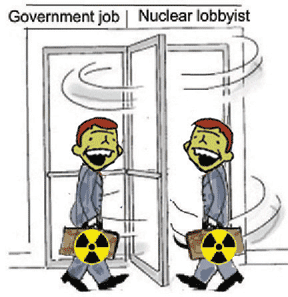
Marles and Pyne: the game of mates plays on as questions on probity count for little
The former and current defence ministers are sparring mates from way back, and that’s worked out well for Christopher Pyne post-Parliament.
DAVID HARDAKER, APR 27, 2023 Crikey,
Is there no end to the Richard Marles-Christopher Pyne double act?
The Albanese government’s defence minister has agreed to speak at a ticket-only networking event hosted by former MP Pyne, Marles’ old sparring partner, who has become one of Australia’s leading defence industry lobbyists. The so-called DSR Summit will be held In Sydney next week, according to an invitation received by Crikey.
For between $500 and $800 defence industry types will be able to rub shoulders with “ministers, thought leaders, and department decision-makers” while hearing from key speakers from government “and other defence sector stalwarts” on the impact of the government’s Defence Strategic Review, released this week……(Subscribers only) https://www.crikey.com.au/2023/04/27/marles-pyne-mates-probity-questions/?su=TlVkbFRSU3Zya0trMlF3M0JHckdPZz09
Will the West turn Ukraine into a nuclear battlefield?

Stuart Dyson died in 2008 at the age of 39…….. his cancer was later recognized in a court of law as having been caused by exposure to depleted uranium. In a landmark 2009 ruling, jurors at the Smethwick Council House in the UK found that Dyson’s cancer had resulted from DU accumulating in his body, and in particular his internal organs.
While the UK’s decision to send depleted uranium shells is unlikely to turn the tide, it will have a lasting, potentially devastating, impact.
APRIL 26, 2023 byJoshua Frank
It’s sure to be a blood-soaked spring in Ukraine. Russia’s winter offensive fell far short of Vladimir Putin’s objectives, leaving little doubt that the West’s conveyor belt of weaponry has aided Ukraine’s defenses. Cease-fire negotiations have never truly begun, while NATO has only strengthened its forces thanks to Finland’s new membership (with Sweden soon likely to follow). Still, tens of thousands of people have perished; whole villages, even cities, have been reduced to rubble; millions of Ukrainians have poured into Poland and elsewhere; while Russia’s brutish invasion rages on with no end in sight.
The hope, according to Ukrainian President Volodymyr Zelensky, is that the Western allies will continue to furnish money, tanks, missiles, and everything else his battered country needs to fend off Putin’s forces. The war will be won, according to Zelensky, not through backroom compromises but on the battlefield with guns and ammo.
“I appeal to you and the world with these most simple and yet important words,” he said to a joint session of Great Britain’s parliament in February. “Combat aircraft for Ukraine, wings for freedom.”
The United Kingdom, which has committed well over $2 billion in assistance to Ukraine, has so far refused to ship fighter jets there but has promised to supply more weaponry, including tank shells made with depleted uranium (DU), also known as “radioactive bullets.” A by-product of uranium enrichment, DU is a very dense and radioactive metal that, when housed in small torpedo-like munitions, can pierce thickly armored tanks and other vehicles.
Reacting to the British announcement, Putin ominously said he would “respond accordingly” if the Ukrainians begin blasting off rounds of DU.
Stuart Dyson survived his deployment in the first Gulf War of 1991, where he served as a lance corporal with Britain’s Royal Pioneer Corps. His task in Kuwait was simple enough: he was to help clean up “dirty” tanks after they had seen battle. Many of the machines he spent hours scrubbing down had carried and fired depleted uranium shells used to penetrate and disable Iraq’s T-72 tanks, better known as the Lions of Babylon.
Dyson spent five months in that war zone, ensuring American and British tanks were cleaned, armed, and ready for battle. When the war ended, he returned home, hoping to put his time in the Gulf War behind him. He found a decent job, married, and had children. Yet his health deteriorated rapidly and he came to believe that his military service was to blame. Like so many others who had served in that conflict, Dyson suffered from a mysterious and debilitating illness that came to be known as Gulf War Syndrome.
After Dyson suffered years of peculiar ailments, ranging from headaches to dizziness and muscle tremors, doctors discovered that he had a severe case of colon cancer, which rapidly spread to his spleen and liver. The prognosis was bleak and, after a short battle, his body finally gave up. Stuart Dyson died in 2008 at the age of 39.
His saga is unique, not because he was the only veteran of the first Gulf War to die of such a cancer at a young age, but because his cancer was later recognized in a court of law as having been caused by exposure to depleted uranium. In a landmark 2009 ruling, jurors at the Smethwick Council House in the UK found that Dyson’s cancer had resulted from DU accumulating in his body, and in particular his internal organs……………………………………………………………………………………

Both Russia and the U.S. have reasons for using DU, since each has piles of the stuff sitting around with nowhere to put it. Decades of manufacturing nuclear weapons have created a mountain of radioactive waste. In the U.S., more than 500,000 tons of depleted-uranium waste has built up since the Manhattan Project first created atomic weaponry, much of it in Hanford, Washington, the country’s main plutonium production site. As I investigated in my book Atomic Days: The Untold Story of the Most Toxic Place in America, Hanford is now a cesspool of radioactive and chemical waste, representing the most expensive environmental clean-up project in history with an estimated price tag of $677 billion………………………………………………………….
Of course, we’ve known about the dangers of uranium for decades, which makes it all the more mind-boggling to see a renewed push for increased mining of that radioactive ore to generate nuclear power. The only way to ensure that uranium doesn’t poison or kill anyone is to leave it right where it’s always been: in the ground. Sadly, even if you were to do so now, there would still be tons of depleted uranium with nowhere to go. A 2016 estimate put the world’s mountain of DU waste at more than one million tons (each equal to 2,000 pounds).
So why isn’t depleted uranium banned? That’s a question antinuclear activists have been asking for years. It’s often met with government claims that DU isn’t anywhere near as bad as its peacenik critics allege. In fact, the U.S. government has had a tough time even acknowledging that Gulf War Syndrome exists. A Government Accountability Office report released in 2017 found that the Veterans Affairs Department had denied more than 80% of all Gulf War illness claims by veterans. Downplaying DU’s role, in other words, comes with the terrain.
“The use of DU in weapons should be prohibited,” maintains Ray Acheson, an organizer for the International Campaign to Abolish Nuclear Weapons and author of Banning the Bomb, Smashing the Patriarchy. “While some governments argue there is no definitive proof its use in weapons causes harm, it is clear from numerous investigations that its use in munitions in Iraq and other places has caused impacts on the health of civilians as well as military personnel exposed to it, and that it has caused long-term environmental damage, including groundwater contamination. Its use in weapons is arguably in violation of international law, human rights, and environmental protection and should be banned in order to ensure it is not used again.”
If the grisly legacy of the American use of depleted uranium tells us anything, it’s that those DU shells the British are supplying to Ukraine (and the ones the Russians may also be using there) will have a radioactive impact that will linger in that country for years to come, with debilitating, potentially fatal, consequences. It will, in a sense, be part of a global atomic war that shows no sign of ending. https://responsiblestatecraft.org/2023/04/26/will-the-west-turn-ukraine-into-a-nuclear-battlefield/
MPs and activists push back as Ottawa pitches expansion of nuclear energy -“a dirty dangerous distraction”
Prime Minister Justin Trudeau says Canada is ‘going to have to be doing much more nuclear’
John Paul Tasker · CBC News · April 26 2023
Anti-nuclear activists and a cross-partisan group of MPs urged the federal government Tuesday to drop its support for nuclear energy projects, calling the energy source a “dirty, dangerous distraction” from climate action.
…………………………………… SMR technology is still in its infancy and it isn’t widely used around the world.
As of 2022, there were only three SMR projects in operation — one each in Russia, China and India — according to the International Energy Agency.
There are dozens of others under construction or in the design and planning phase — including one at Ontario Power Generation’s Darlington nuclear site.
Finance Minister Chrystia Freeland’s recent federal budget included a generous tax credit to spur clean energy development, including SMRs.
The industry lobby group, the Canadian Nuclear Association, has said the 15 per cent refundable tax credit is a recognition by Ottawa that nuclear power is “a fundamental and necessary component of Canada’s low carbon energy system.”
Susan O’Donnell, a professor and a member of the Coalition for Responsible Energy Development in New Brunswick, said Prime Minister Justin Trudeau and his cabinet are getting bad advice about nuclear energy.
“The nuclear industry, led by the U.S. and the U.K., has been lobbying and advertising heavily in Canada, trying to convince us that new SMR designs will somehow address the climate crisis,” O’Donnell told a press conference on Parliament Hill on Tuesday.
She said SMRs will produce “toxic radioactive waste” and could lead to serious “accidents” while turning some communities into “nuclear waste dumps.”
She also said there’s “no guarantee these nuclear experiments will ever generate electricity safely and affordably,” since SMRs are still relatively untested.
“Canada is wasting time that must be urgently spent on genuine climate action,” she said. “This is a dirty, dangerous distraction. We don’t need nuclear power.”
Asked how Canada would meet its baseload power requirements — the power that is needed 24 hours a day without fluctuation — without nuclear power or fossil fuel sources like natural gas, O’Donnell pointed to promising developments in energy storage technology.
Liberal MP Jenica Atwin was at the anti-nuclear press event.
“I want to be clear, I’m here as an individual, a concerned individual and a mother,” she said — before launching into remarks that raised questions about the “associated risks” and “many unknowns” of nuclear energy development, which is expected to see a sharp increase in activity due to her government’s proposed tax policies.
“When it comes to nuclear, there’s no margin for error,” Atwin said. “This is a time of action. We don’t have the luxury of waiting to see if things will pan out.”
Green Party Leader Elizabeth May, who once sat in caucus with Atwin before she decamped to the Liberals, said government funding for nuclear projects is a “fraud.”
“It has no part in fighting the climate emergency. In fact, it takes valuable dollars away from things that we know work, that can be implemented immediately, in favour of untested and dangerous technologies that will not be able to generate a single kilowatt of electricity for a decade or more,” May said……………………………………………………https://www.cbc.ca/news/politics/anti-nuclear-activists-ottawa-1.6821807
We are being seduced into war again by the US, this time over Taiwan
China is not a military threat to either the US or Australia. The military threat is trumped up by the US and its acolytes with their own agenda.
There is one critical and urgent thing the Australian Government should do, and that is to make it clear to the US that we will not be involved in any way with a war between China and the US over Taiwan and that none of our facilities can be used for that purpose – Pine Gap, Darwin or Tindal.
By John Menadue, 27 Apr 23 https://johnmenadue.com/we-are-being-seduced-and-trapped-into-war-again-by-the-us-this-time-over-taiwan/
The US must be told that we will not be involved in any way in a war with China over Taiwan.
After Vietnam, Iraq and Afghanistan the signs of our entrapment again in US war planning are everywhere.
The 2014 Force Posture Agreement with the US cedes control of certain military operations from our territory to the US eg Marines in Darwin and US B52’s in Tindal.
The 2021 AUSMIN ministerial meeting endorsed :
- Enhanced air cooperation through the rotational deployment of U.S. aircraft of all types in Australia and appropriate aircraft training and exercises.
- Enhanced maritime cooperation by increasing logistics and sustainment capabilities of U.S. surface and subsurface vessels in Australia.
- Enhanced land cooperation by conducting more complex and more integrated exercises and greater combined engagement with Allies and Partners in the region.
- Establishment of a combined logistics, sustainment, and maintenance enterprise to support high end warfighting and combined military operations in the region.
The 2021 AUKUS agreement was a clear sign to our region that instead of building bridges to our region we have decided to be a spear carrier for the US and UK- the Anglosphere. AUKUS is not to defend Australia but to support US operations against China in the South China Sea.
Our Defence Strategic Review (DSR)released this week has been’ authored’ by the United States Studies Centre(USSC), an arm of the US government. It is a tainted review. Have we no national pride in letting this happen!
Our Washington centric media don’t seem to think that it is unusual or even outrageous for a foreign agency to author an Australian defence review!!
Our seduction by the US is assisted by our Department of Defence with its close links to the Pentagon. It secretly employs US Admirals to advise on submarines. And if that is not enough we are now going to have a retired US Admiral heading the coming Naval Review. What is wrong with our Navy that an Australian can’t do the job? Has integration gone so far that we don’t have a Navy of our own that is worth the name.
And don’t think for one moment in this humiliation that Albanese and Marles thought up this US Admiral. They would have been put up to it by our defence establishment in lock step with the Pentagon.
The ADF has become a unit of the US military machine.
There is more.
The Government has rejected the Australian War Powers Reform proposal that Parliament approve any commitment to war. This is essential because we have an awful history of rushing to war. In 1914, we decided to send troops to WWI before Britain declared war. Menzies committed Australia to war in Vietnam before we even received a request. Howard committed us to the illegal war in Iraq based on false intelligence. Now the Labor Party has committed us to AUKUS in less than 24 hours despite the enormous implications. Albanese says he is proud of how quickly he agreed with Morrison!
Changes to our Defence Act are also being considered which would allow the ADF inter alia to conduct operations below the threshold of war, known as ‘grey zone’ operations. These amendments could have far reaching consequences.
At our universities, Peace Studies are run down in favour of ‘Strategic Studies’ with their US loyalists regularly appearing on our media. Think Tanks like the Australian Strategic Policy Institute are fronts for US defence interests.
Entrapment of our minds in the anti China hysteria is the work in progress of our Main Stream Media. Our fourth estate has been captured and imbedded in the US propaganda machine. The US cultural and media domination is everywhere. Alternative views are shunned. The White Man’s Media is on full display.
The disgraceful ‘Red Alert’ is the tip of a giant iceberg. The anti China propaganda is an every day event in our media including the ABC and SBS .
In the past, the ALP said NO on Vietnam and Iraq even though it was difficult at the time. As Paul Keating put it at the National Press Club recently ‘Labor has invariably got the big international (decisions) right’. But today the ALP has gone AWOL. Concerns about entrapment by the US and loss of sovereignty are brushed aside. What many of us thought were Labor policies and values count for little.
Penny Wong suggests that Keating has not kept up to date and has not had the benefit of Intelligence briefings!! But the reverse is true. The Labor Government is reverting to our colonial past, our colonial cringe – Five Eyes, AUKUS and the Anglosphere.
Wong plays with words to avoid asking or knowing whether B52’s in Tindal will be nuclear armed against China. She tells us that US forces are ‘rotated’ though Darwin and Tindal and not ‘based’ there.
The US is persistently goading China into war over Taiwan. This is consistent with US behaviour over centuries. It is driven by its self righteous belief in its ‘exceptionalism’ and the pressure of its military/industrial/security complex for endless wars. It expects other major powers like China to behave as aggressively as it has. China has no Monroe Doctrine which Americans believe gives them the God given right to interfere in other country’s affairs.
Australia has a sorry history of fighting other empires wars, first with the British and now with the US. The great risk and problem for us is that imperial powers are almost always at war.
Since its founding in 1776, the US has been at war 93% of the time. Since the end of WWI, the US has launched 201 armed conflicts around the world. During the Cold War it tried to change governments 72 times. It assassinated foreign leaders and still assassinates with drones guided from Pine Gap. It has 800 bases around the world, many of them in Japan and ROK directed at China. With our cooperation, US fleets cruise and sight see up and down the Chinese coast. At the same time as criticising China, the US refuses to ratify the UN Convention on the Law of the Sea. The US would have national convulsions if Chinese vessels patrolled off the Californian coast or China established military bases in Mexico!
The US is the most aggressive and violent country in the world . It lurches from one war to another. That violence abroad is mirrored in its violent gun culture at home. There is a pervasive sickness and it is not just Trump!
When we tagged behind imperial powers in the past there was little military risk to Australia. But that is not so today, with the reckless US goading of China over Taiwan. If we were involved in support of the US against China over Taiwan the results could be catastrophic for us.
China is certainly growing in influence and confidence. That is not surprising after over a century of western and Japanese invasion and humiliation. But China is not a military threat to either the US or Australia. The military threat is trumped up by the US and its acolytes with their own agenda.
In brazen mendacity Marles highlights the rapid increase in China’s military spending. But he failed to tell us that the US spends more on defence than the next nine countries combined. The US spends 3.5% of its GDP on defence. China spends 1.6%.
The Stockholm International Peace Institute only a few days ago put military spending in perspective – The United States remains by far the world’s biggest military spender. US military spending reached $877 billion in 2022, which was 39 per cent of total global military spending and three times more than the amount spent by China, the world’s second largest spender.
Surrounded by numerous US bases and the US Fleet -an itinerant naval power in the SCS as described by Paul Keating-it is not surprising that China is increasing its defence spending.
But China is a challenge to US hegemony and the US empire around the globe. The US is unwilling to come to terms with China’s success and share power and responsibility. The US insists on its own rules and domination across the globe. Empires are like that.
How do we break out of the US entrapment, the FPA, AUKUS, AUSMIN and a lot more? How can we cut through this maze of entrapment.
Peter Dutton has warned us that is ‘inconceivable that Australia would not join the US to defend Taiwan’.
There is one critical and urgent thing the Australian Government should do, and that is to make it clear to the US that we will not be involved in any way with a war between China and the US over Taiwan and that none of our facilities can be used for that purpose – Pine Gap, Darwin or Tindal.
For decades we have maintained that Taiwan is part of China.
Paul Keating has said many times that ‘Taiwan is not a vital Australian interest’. Even Defence Minister Marles, ever so close to the US, told ABC Insiders last month that ‘Australia has absolutely not given the US any commitment as part of the AUKUS negotiations that it would join (the US) in a potential war over the status of Taiwan’.
But we need to tell the US explicitly and well in advance of any possible conflict over Taiwan that we will not support the US. In a crisis it will be too late to assert our sovereignty.
Memo to Energy Resources of Australia : You have one job – clean up Kakadu uranium mess
https://www.acf.org.au/memo-to-era-you-have-one-job-clean-up-kakadu 26 Apr 23
Northern Territory and national environment groups have a clear message for Energy Resources Australia at ERA’s annual meeting in Darwin: focus on repair.
ERA is the former uranium mining company that operated the controversial Ranger uranium mine in Kakadu for 40 years, until the cessation of commercial operations in 2021.
The company, majority (86%) owned by Rio Tinto, is now responsible for delivering Australia’s costliest and most complex mine rehabilitation project.
ERA also holds the nearby Jabiluka mineral lease – the site of sustained and successful protest by the Mirarr Traditional Owners and civil society supporters from across Australia and around the world.
Despite Rio’s clear acknowledgement that any possible mining window for Jabiluka is now firmly closed, ERA continues to promote Jabiluka as an asset.
“Rio Tinto has formally accepted there is no credible business case or pathway to advance mining at Jabiluka,” said Environment Centre NT analyst Naish Gawen.
“Rio has stated it will no longer report a Mineral Resource for Jabiluka. It’s time for ERA to do the same.”
Environmentalists inside and outside the meeting will urge the ERA Board to drop the fiction of drilling at Jabiluka and address the fact of required repair at Ranger.
“Repairing the heavily impacted Ranger site is ERA’s legal responsibility,” said ACF’s nuclear policy analyst Dave Sweeney.
“ERA and Rio Tinto will be closely watched and long judged on their performance of this responsibility.”
BlueFloat promises massive windfall as race for a spot in Gippsland offshore zone hots up — RenewEconomy

BlueFloat Energy says its 2.1GW offshore wind project could bring tens of billions of dollars to the regional economy and thousands of jobs. The post BlueFloat promises massive windfall as race for a spot in Gippsland offshore zone hots up appeared first on RenewEconomy.
BlueFloat promises massive windfall as race for a spot in Gippsland offshore zone hots up — RenewEconomy
Energy Insiders Podcast: In love with wind, solar and batteries — RenewEconomy

Louis de Sambucy, the head of Neoen in Australia, on why wind, solar and battery projects are getting bigger and more complex. The post Energy Insiders Podcast: In love with wind, solar and batteries appeared first on RenewEconomy.
Energy Insiders Podcast: In love with wind, solar and batteries — RenewEconomy
1 This month
17 October, Free Public Talk on Nuclear Issues in South Australia
David Noonan will speak on public interest concerns over the new Roxby Downs Indenture Act 2026 on BHP copper-uranium mining and ore processing in SA, and on how AUKUS may face SA with a High-Level nuclear waste agenda.
Dr Jim Green will discuss international developments in the field of nuclear power including ‘small modular reactors’ and Generation 4 ‘advanced’ nuclear reactor concepts.


Help Aunty Sue Protect Her Land and Sacred Sites From Destructive Rocket Testing.
.

Australians deserve the truth
about
AUKUS – https://aukuspublicinquiry.com/

PETITION – To: Prime Minister Anthony Albanese and the Australian Labor Government

of the week – Australians for War Powers Reform (AWPR)
To see nuclear-related stories in greater depth and intensity

