Nationals double down on nuclear power policy.

Energy, 25 Aug 25
The Nationals are doubling down on introducing nuclear power to Australia, with leader David Littleproud vowing to take the policy to the next election.
Littleproud told National party members the nuclear policy was at the centre of the party’s fallout with the Liberals following the May federal election………………………..
“We have to have, as part of our energy mix, nuclear in that mix. It was something that we believe in passionately because we see the consequences,” he said.
“There is a sensible way to fix it and that’s what we’re going to take to the next election.”
This move comes despite The House of Representatives Select Committee on Nuclear Energy releasing an interim report in which it has found establishing nuclear power generation would be too late and too costly to support the country’s energy targets.
Committee chair Dan Repacholi MP, Federal Member for Hunter, said, “This interim report focuses on two key issues that have dominated the evidence we’ve received to date: whether nuclear power generation could be rolled out in Australia in an acceptable timeframe, and how affordable it would be—particularly compared to alternative power generation technologies currently available in Australia.”
“From the evidence considered by the Committee to date, it is apparent that it could be well into the 2040s before we might see nuclear energy generated in Australia if that form of energy generation were to be pursued. This would be too late to meaningfully support the achievement of Australia’s climate and energy targets or to help our coal power plant workforce and communities as we transition away from coal power.” https://esdnews.com.au/nationals-double-down-on-nuclear-power-policy/
Nationals Leader David Littleproud says nuclear power policy ‘sensible’ next step.
ABC News, Sat 23 Aug, 25
In short:
Nationals Leader David Littleproud told the Liberal National Party annual convention nuclear had to be part of the country’s energy mix.
It would help with food security and the environment, he said.
What’s next?
Nuclear power and energy alternatives dominated discussions at the convention’s opening day on Friday, following the near-unanimous passing of a resolution to abandon net zero by 2050………………………
Coalition practice after an election meant policies taken to the campaign would remain and only be dumped by exception, he told the Liberal National Party annual convention in Brisbane……………………
“We have to have, as part of our energy mix, nuclear in that mix. It was something that we believe in passionately because we see the consequences,” he said……………………………. https://www.abc.net.au/news/2025-08-23/nationals-leader-david-littleproud-says-nuclear-power/105689740
In Alice Springs everyone has an opinion on the Pine Gap spy base, but no-one wants to talk about what happens inside.
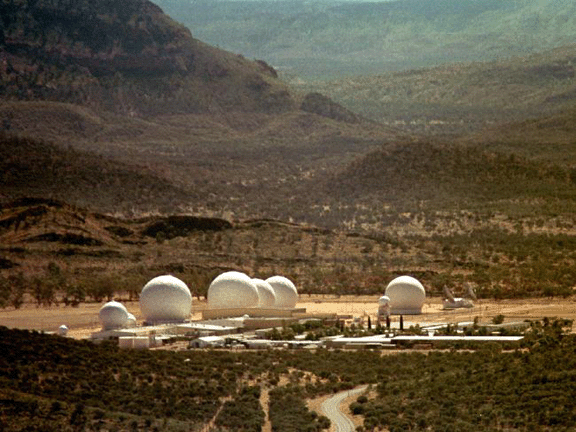
I wanted to hear from the traditional owners of the Arrernte land it was built on, and from the spies tasked with finding targets in Afghanistan and Iraq during the Global War on Terrorism. But how do you investigate something as secretive as Pine Gap when everyone who works there has made a promise never to talk about what they do?
serious claims being made that intelligence gathered at the facility was being used in the Israel-Gaza war.
By Alex Barwick for Backstory, Thu 16 May 2024. https://www.abc.net.au/news/backstory/2024-05-16/backstory-expanse-podcast-spies-in-the-outback-pine-gap-barwick/103844652
In journalism, it’s often politicians who won’t answer your questions.
But in my outback town, it’s just as likely to be the neighbours who won’t, or rather can’t, answer this basic conversation starter: “So, what do you do at work?”
That’s because about 800 of the town’s 25,000 residents are employed at the most secretive intelligence facility in Australia — the Joint Defence Facility Pine Gap — on the edge of Alice Springs/Mparntwe.
When I rolled into this beautiful landscape 16 years ago and began working at the ABC’s Alice Springs bureau, it quickly became clear I wouldn’t hear from this significant section of the community.
Given local radio is all about connecting with the community and sharing people’s stories, this silence felt strange.
My curiosity grew and the book Peace Crimes, written by long-term local journalist Kieran Finnane, motivated me to start looking deeper.
I wanted to know what was going on in my backyard, but I knew trying to make a podcast about a secret military facility hidden in a secluded valley in Central Australia wouldn’t be easy.
Telling this story in a town the size of Alice Springs would undoubtedly feel personal and would likely offend parts of the community.
It’s a line regional journalists walk all the time — telling stories that are in the public interest, while living in the community that is affected by them.
Covering difficult stories in a small town
The words we write as journalists — or say, like in the Expanse: Spies in the Outback podcast — do have real world implications for real people.
That includes everyone from my neighbours, to the parents of my kids’ friends, to people I see regularly at community events.
For them, it’s not a story – it’s their life.
And that can get awkward.
But there are stories in the public interest that the Australian government won’t comment on and this often means they’re shrouded in mystery, or rife with rumour.
Pine Gap is one of those stories.
What goes on beneath the cluster of enormous, oversized-golf-ball-shaped domes covering the military base’s listening antenna on the desert floor, raises big questions for all of Australia, not just my town.
The Pine Gap intelligence-gathering facility is often described as the jewel in the crown of our military partnership with the United States.
But what have we got ourselves into, and do we benefit from it?
Protesters, politicians and spies
Over the past six months, I’ve had lots of off-the-record coffees, trawled the news and library archives, followed some bizarre leads and heard plenty of wild stories, as I have tried to understand the goings-on behind the razor wire.
I wanted to know why America’s Central Intelligence Agency (CIA) decided to build a so-called “space base” in outback Australia in the mid 1960s.
What motivated former prime minister Gough Whitlam to rock the boat and promise to reveal its secrets to the public?
Why were thousands of people so convinced it was a nuclear target they flocked to the desert to demand its closure?
And how had it drawn Australia onto one battlefield after the next through its large-scale surveillance and intelligence gathering?
While plenty of people outside Alice Springs/Mparntwe have never heard of this desert spy base, most people in town have an opinion on it.
There are three main camps: those who say it’s vital for the town’s economy and global peace; those who still see it as a nuclear target and want it shut down; and those who feel generally apathetic to its existence.
And yet, nobody really talks about Pine Gap.
Still, I felt it was important to really understand the diversity of views on this outback spy base as I conducted my research.
I wanted to hear from the traditional owners of the Arrernte land it was built on, and from the spies tasked with finding targets in Afghanistan and Iraq during the Global War on Terrorism.
But how do you investigate something as secretive as Pine Gap when everyone who works there has made a promise never to talk about what they do?
I certainly wasn’t looking to see anyone exiled to Russia like Edward Snowden after he leaked a raft of National Security Agency (NSA) documents, including information on Pine Gap.
In the end, gentle, determined persistence meant I was able to tell the Pine Gap story in a way that lifted the lid but didn’t put national security at risk, and that (I hope) was sensitive to the lives of those in Alice Springs affected by it.
Back in the national spotlight
And then, in late 2023 as I tracked down activists, former spies and politicians … protesters were suddenly blocking the road to Pine Gap again.
There were serious claims being made that intelligence gathered at the facility was being used in the Israel-Gaza war. With Pine Gap back in the spotlight, I knew I had to look deeper.
This spy base, which became operational in 1970 during the Cold War, had expanded through the decades in scale and capability and was more relevant than ever.
The Australian government says Pine Gap is one of the country’s “most longstanding security arrangements” with the United States but it does not comment on its operation.
As each episode of Expanse: Spies in the Outback has been released, I’ve received emails and text messages that confirm why it was an important story to tell.
Some people have been shocked and appalled, while others have been grateful to learn we have this secret intelligence facility in our backyard.
Even in my own town of Alice Springs, where everyone knows someone who works at Pine Gap, there is an appetite to know more – regardless of how uncomfortable that might be.
Follow Expanse: Spies In The Outback on the ABC listen app to hear every episode of season three.
David Littleproud vows to take nuclear energy to next election and claims ‘no malice’ behind brief Coalition split.

Guardian, 23 Aug 25
Nationals leader rails against regional Australia becoming littered with transmission lines, solar panels and wind turbines at LNP conference.
The Nationals are vowing to introduce nuclear power to Australia’s energy mix, promising to take the policy to the next election after it contributed to a split in the Coalition.
Nationals leader David Littleproud explained to party faithful on Saturday what led to his party’s week-long decoupling from the Liberals following the May federal election rout.
Coalition practice after an election meant policies taken to the campaign would remain and only be dumped by exception, he told the Liberal National party annual convention in Brisbane.
[Liberal leader] Sussan [Ley] wanted to take that away and I respected that and tried to work with it,” he said.
“But there were four key policy areas that were hard-fought and so important to the people that National party members and senators represent.”………………….
Nuclear power and energy alternatives dominated discussions at the convention’s opening day on Friday, after the near-unanimous passing of a resolution to abandon net zero by 2050.
The resolution was not binding on the parliamentary party but Friday’s result should prompt healthy debate in Canberra, Queensland senator Matt Canavan said.
Australia has committed to net zero under the Paris Agreement that came into force in 2016…………………………….. https://www.theguardian.com/australia-news/2025/aug/23/david-littleproud-vows-to-take-nuclear-energy-to-next-election-and-claims-no-malice-behind-brief-coalition-split
Jillian Segal’s report turns criticism of Israel into a punishable offence.
By Evan Jones | 23 August 2025, Independent Australia
Segal’s report recasts anti-Zionism as hate — policing schools, agencies and visas while punishing dissent across public life, writes Dr Evan Jones.
THE SEGAL REPORT heralds that all educational institutions, public institutions and the public service be permanently policed for hints of “antisemitism”.
Add potential migrants and asylum seekers, who will be blocked from entry for having the wrong experience and opinions. Given that anti-Zionism is made synonymous with antisemitism, it demands a comprehensive mandate in obliterating any criticism of and action against the abomination that is the state of Israel.
Being South African-born, although brought to Australia as a child, Jillian Segal presumably has imbibed the rudiments of what constitutes an apartheid state and society. Segal has not taken the short, obvious step. Can I recommend apartheid Israel for beginners: Uri Davis’ 2003 Apartheid Israel?
Jillian Segal’s ultra-Zionism is well known – her Wikipedia entry notes her attachment prominently:
‘She is the immediate past president of the “ardently pro-Israel” Executive Council of Australian Jewry (ECAJ). Segal has long been an advocate for Israel in Australia. She has been chair of the Australia-Israel Chamber of Commerce since 2015.’
She has thus been not merely a fellow traveller but front and centre.
Crikey’s Bernard Keane (as did others) immediately questioned Segal’s appointment as antisemitism envoy on 9 July 2024.
He noted:
‘Jillian Segal has criticised ceasefire calls in Gaza and defended bombing hospitals. That, and her record at NAB, makes her a poor choice for a government role.’
Segal was Commissioner then Deputy Chair of the Australian Securities and Investments Commission (ASIC), 1997-2002, Chair of the Banking and Financial Services Ombudsman Board, 2002-04, and Board Director at the National Australia Bank (NAB), 2004-16. Segal was awarded an AO in January 2019 for ‘distinguished service to the banking and financial regulation sectors …’.
I have long been involved in assisting and writing about victims of banking malpractice, especially small business and farmer borrowers. The financial “regulatory” apparatus, seemingly complicit, has proved comprehensively indifferent to bank malpractice against these borrowers. The NAB, following financial deregulation, has been a major player in malpractice.
During Segal’s tenure on the NAB Board, the NAB had to manage the aftermath of its hubristic imposition of a toxic facility on SME/farmer borrowers from the NAB’s Scottish subsidiary Clydesdale — fixed interest embedded swap facilities, labelled ‘Tailored Business Loans’ (here and here). The NAB was forced to pay compensation for an egregious component of the loans (‘payment protection insurance’) but remained steadfast in its denial of responsibility for the flawed facility itself, leaving many borrowers ruined.
Where was Segal in all this? She was a Member of the NAB’s Advisory Council on Corporate Responsibility. As you do. Segal might have deserved her gong for services to banking, but certainly not for services to banking regulation.
There appears to be a certain charlatanry about Segal’s involvement with the finance sector. A matter of ticking boxes? There is nothing of the charlatan regarding Segal’s full-bodied Zionism. Merely that this attribute disqualifies her from acting as a dispassionate antisemitism envoy.
Segal (with other Israel-firster Vic Alhadeff) led a delegation to the ABC in June 2021 to complain of “a pervasive culture of bias, if not antipathy, towards Israel” on the network’s Q+A program. There must be a second ABC network unknown to me.
In August 2023, the Albanese Government defended its reference to the West Bank and Gaza as “occupied” and Israeli settlements as “illegal” (in line with international law).
As published in the Sydney Morning Herald on 10 August 2023, Segal (then president of ECAJ), with the Zionist Federation’s Jeremy Leibler, claimed that:
‘…the Government’s change in language had pre-empted negotiations on a two-state solution, and criticised the move as “inaccurate, ahistorical and counterproductive.”’
Shameless.
Segal has organised, via the Trojan Horse Australia-Israel Chamber of Commerce, and participated many times in Australian group visits to Israel. Segal has vaunted Israel as a hotbed of determination and imagination, ideal for business innovation and “startups”. Compulsory military service, she claims, helps with building toughness and resilience. Unmentioned is that a good deal of this “innovation” is in military equipment, surveillance mechanisms and police control techniques, in the export of which Israel has become a major player.
The murder and repression of the Palestinian population (and in neighbouring countries) has become a testing ground for such specialities. Antony Loewenstein’s 2023 book ‘The Palestine Laboratory’ documents the phenomenon.
Consistently, Segal has claimed that ‘Israel’s culture of resilience and innovation, which had helped it prosper in business, would also guide its war effort’ (Australian Financial Review, 11 October 2023). It’s a package deal.
At a Sydney demonstration in solidarity ‘with Israel and the Jewish community’ as reported in the Sydney Morning Herald on 12 October 2023, Segal said:
.the actions of Hamas showed once again that its intention is to obliterate Israel and its population [erroneous], and lacked any concept of the sanctity of human life. ‘Our world has changed. The barbarians have breached the gates. The butchery and savagery that has unfolded in Israel beggars description … There can be no compromise, no accommodation of these psychopaths. They must be [crushed] and we must brace ourselves for further tragedy.’
At a Sydney vigil on 12 November 2023, Segal is reported in The Australian on 13 November as saying to a cheering crowd:
“We all yearn for peace in the Middle East, but as we all know … one cannot make peace with those who deny one’s right to exist. … There can be no ceasefire until every hostage has been released.”
Bloodlust for the imperatives of an unacknowledged apartheid state.
When Foreign Minister Penny Wong called on Israel to stop attacking hospitals, the Zionist Federation’s Jeremy Leibler and ECAJ’s Segal responded:
“The libel that any Israeli attack on Gazan hospitals from which Hamas operates would amount to war crimes only serves to demonise the state of Israel and its supporters. The government of Australia should not be lending any credibility to this false and harmful narrative.” (Australian Financial Review, 13 November 2023)……………………………………………………………………………………https://independentaustralia.net/politics/politics-display/jillian-segals-report-turns-criticism-of-israel-into-a-punishable-offence,20078
Ditch AUKUS Pillar One. It involves Australia too much in US strategy.
22 Aug 2025|Mike Keating and Jon Stanford, https://www.aspistrategist.org.au/ditch-aukus-pillar-one-it-involves-australia-too-much-in-us-strategy/
Defence Minister Richard Marles said in June that if war broke out between the US and China, Australia would inevitably be involved.

This is an unacceptable situation for any sovereign nation to be in. It exposes a dangerous inconsistency within Australia’s strategic policy, identified by former Department of Foreign Affairs and Trade secretary Peter Varghese:
On the one hand, our foreign policy embraces a multipolar future where no country dominates. Our defence policy, on the other hand … is increasingly fixed around doing what we can to ensure the retention of US strategic primacy.
This focus on US primacy is the basis of the AUKUS agreement, Pillar One of which provides for Australia to acquire nuclear-powered attack submarines (SSNs). John Lee, of the US Studies Centre, says ‘AUKUS was forged as a joint agreement to confront and deter China’. This is consistent with the detailed agreement negotiated between the Morrison government and the Biden administration in April 2021. It reflected the administration’s strategic objective of maintaining US primacy by containing China to the first island chain, which would require sustaining the autonomy of Taiwan. Former prime minister Scott Morrison indicated in an interview in 2024 that Australia and the US were agreed on this objective.
There are four major problems with AUKUS Pillar One from Australia’s perspective.
The first is that Australia’s strategic interests in the Indo-Pacific are different from the United States’. Despite Morrison’s assertion, Australia has no essential national interest in containing China in defence of US primacy. In economic terms, China is Australia’s major partner, buying a third of our exports. As for strategic containment, while Morrison’s defence minister, Peter Dutton, said it was ‘inconceivable’ that Australia would not support the US if it ‘took action’ over Taiwan, the present government of Prime Minister Anthony Albanese has made no such commitment.
Nevertheless, with the US’s bases in Guam, Japan, South Korea and the Philippines now threatened by China’s medium- and intermediate-range missiles, Australia has seen a major influx of US forces rotating through Australian bases. With no apparent assertion of any Australian control over how these forces may be used, this signifies a substantial change in Australia’s strategic posture.
As Michael Pezzullo said, ‘never before in peacetime has Australia been prepared to allow foreign combat forces to be able to launch military operations from Australian soil. … [The US] would have a brutally realist strategic view of Australia: it would be a key operating base for US forces in any conflict with China.’
Some experts consider that America’s large military footprint in Australia will enhance our security. This surely reflects a flawed understanding of military strategy. The strategic objective for US forces in Australia will remain the same as when they were based elsewhere: to deter an attack on Taiwan. US forces are not here to defend Australia. Indeed, their presence gives China more reason to launch strikes on this country, beyond its likely desire to eliminate some long-established joint US-Australian facilities.
As well as acting as a platform for offensive operations, an operations base across the Pacific gives the US a deep protective buffer. In a conflict, Australian bases would absorb the initial attacks but could be readily abandoned by the US should enemy forces prevail. Elbridge Colby, who is conducting the Trump administration’s review of AUKUS, may have had this in mind when he told the US Senate he was examining how ‘to conduct a local defence of Taiwan at a cost and level of risk that the American people are prepared to tolerate’.
The second problem with AUKUS is that its associated strategy of integrated deterrence requires a significant surrender of Australia’s sovereignty. In 2023, the Albanese government agreed as part of the AUKUS agreement that the RAN submarine base at HMAS Stirling, near Perth, would be expanded to provide facilities to accommodate a new allied submarine force. Australia’s SSNs will be committed to this US-led force. US National Security council member Kurt Campbell said in June 2023, ‘when submarines are provided from the United States to Australia, it’s not like they’re lost. They will just be deployed by the closest possible allied force.’
Colby, in 2024, before he became under secretary of defense for policy this year, said the delivery of US Virginia class submarines to Australia from US resources would be highly imprudent without ‘an iron-clad guarantee they can be employed at the will of the United States.’
This statement, while understandable from a US standpoint, suggests that Australia’s SSN force will not provide a sovereign capability. It will be deployed not at the discretion of the Australian government but to undertake operations under US control against China. With Royal Australian Navy SSNs integrated into ongoing operations with the US, Australia would be under great pressure not to withdraw them if the US went to war.
It is also not cost-effective to acquire a highly sophisticated defence capability at a very great price only to commit it to forward operations in defence of US primacy. The expenditure can surely only be justified for a capability dedicated to the defence of Australia.
The third problem with AUKUS is that RAN submarines would be required to undertake combined operations with the US in a great power strategy of deterrence by punishment. This would bring a grave risk to Australia’s security.
Ministers may believe that Australia’s SSN missions will be comparable to the combined intelligence gathering operations currently undertaken by our diesel submarines. But because RAN SSNs will displace US submarines, Washington will also want them to replicate US undersea missions. These are far more potent.
A primary strategic objective of US SSNs is to eliminate a great power adversary’s nuclear second-strike capability early in any war. Their operations are therefore directed towards detecting and trailing an adversary’s ballistic-missile submarines and then marking them for destruction in the event of war.
Also, wargame results suggest the US may prevail in a maritime conflict with China only by recourse to tactical nuclear weapons. By the time Australian SSNs enter service, they will be operating alongside US submarines carrying nuclear-armed missiles aimed at military targets in China.
It would be very unwise for any non-nuclear weapons power to participate in these operations. How might China respond to attacks on its ballistic-missile submarines by SSNs based in Australia or even by Australian SSNs that our government felt compelled to put at US disposal?
If the US did resort to using nuclear weapons tactically to avoid losing a war over Taiwan, China could retaliate with nuclear attacks on US facilities in Australia. This would bring a much lower risk of escalation than striking the US mainland. This is one example of how America’s security is better served by locating its first line of defence in Australia rather than at home.
The final problem with AUKUS is that Australia is procuring the wrong designs of SSN. The selection of designs for Australia’s SSNs was clearly based on US and British interests rather than our own. Britain’s SSN-AUKUS class will be much too big for the RAN. Virginias need crews as large as 145, well over twice the size of the crew of an Australian Collins-class diesel submarine. Using Virginias, with their especially high and sensitive technical dependence on the US, would not provide a sovereign capability. Both the US and British programs are also bedevilled with unacceptable risks around delivery.
So, what should the government do?
No doubt Australia’s fear of abandonment will cause some to argue that AUKUS must be preserved unchanged to avoid undermining the alliance. But our interests in the Indo-Pacific are not the same as the US’s, and, anyway, we cannot rely on any other nation, including America, for defence. In any renegotiation of AUKUS, Australia possesses substantial agency because of America’s need for secure bases.
We need urgently to reorganise our affairs to reduce the possibility of being attacked in a conflict not of our choosing. We should remove the inconsistency in Australia’s strategic posture by harmonising our defence policy with our existing foreign policy and focus on building partnerships in a multipolar Indo-Pacific. Australia should abandon integrated deterrence in the defence of US primacy. Instead, we should extend further into our strategic policy what James Curran calls the ‘Australian straddle’ between the US and China.
Our security policy should be based on the self-reliant defence of Australia by means of a strategy of denial. This would require much more powerful maritime forces and consequently a higher defence budget. With a whole continent and the third largest exclusive economic zone in the world to defend, there is a strong strategic case for Australia to acquire an SSN capability.
We should cancel our plans for Virginia and SSN-AUKUS class submarines and instead seek to acquire a sovereign, independent force of 12 French Suffren-class submarines. The Suffren design is smaller, well suited to the RAN’s operational requirements, with a crew of 65. It meets NATO standards of interoperability, allowing ongoing operations with the US. Compared to the 95-percent-enriched, weapons-grade uranium used in US and British submarines, Suffren’s fuel is enriched only to the civil standard of 5 percent. This has several advantages, not least in terms of the security challenges around transporting reactors halfway round the world to a shipyard in Adelaide.
Benefits to the US would include retention of its Virginia-class submarines within an expanded allied SSN fleet. America should also see benefit in greater Australian self-reliance with a larger defence budget. The training of Australian submariners on US SSNs should continue, to the benefit of both nations. RAN submarines should continue undertaking combined intelligence and surveillance operations at Australia’s discretion and under Australian rules of engagement.
The US could maintain its basing facilities in Australia but on similar terms to those offered by other sovereign states. Japan, South Korea and the Philippines all have legislation that requires the US to obtain host government approval before launching offensive operations from their territory. Further, their treaties with the US also include a security guarantee with extended nuclear deterrence. Finally, as a signatory to the Treaty on the Non-Proliferation of Nuclear Weapons, we should not allow the storage of nuclear weapons on Australian territory.
Author
Mike Keating and Jon Stanford formerly worked together in the Department of Prime Minister and Cabinet. Mike Keating served for 11 years on the Secretaries Committee on National Security, which coordinated advice to the Cabinet Committee on National Security.
Hundreds of thousands to mobilise for Nationwide March for Palestine on Sunday 24th August
23 August 2025 AIMN Editorial, Palestine Action Group Sydney
On Sunday 24 August, hundreds of thousands of people will mobilise, in over 40 towns and cities around the country, as part of the massive Nationwide March for Palestine. As the United Nations officially declares a “man-made” famine in Gaza, and Israel launches yet another full-scale invasion, this march comes at a critical juncture.
The Nationwide March for Palestine is demanding sanctions on Israel and the end of the two-way arms trade. Australia is still exporting military components to Israel, as it carries out a genocide. This is a war crime.
Sydney details:
What: Nationwide March for Palestine
Where: Hyde Park north, marching to Belmore Park
When: Sunday 24 August. Speeches commence at 1pm, march will commence at 2pm
Who: Palestine Action Group Sydney
Speakers:
- Uncle Chris Edwards, Indigenous Elder
- Grace Tame, author and survivor advocate
- Antoinette Lattouf, independent journalist and author
- Raneem Emad, Palestinian activist
- Henry Rajendra, NSW Teachers Federation President
- Sue Higginson MLC, NSW Greens
- MCs: Amal Naser and Josh Lees from Palestine Action Group Sydney
Quotes attributable to Amal Naser, Palestine Action Group:
“The United Nations has declared a famine in Gaza. A famine deliberately caused by Israel. They are starving children, women and men to death. They are starving my family. This is genocide, and yet our Australian Government continues to send weapons to the regime carrying out this atrocity. We need everyone in the world to stand up now and stop this genocide.”
“The Australian Government continues to export military hardware directly to Israel, including for the F-35 Fighter Jets which are being used to commit daily war crimes in Gaza. We don’t need more empty words from Anthony Albanese and Penny Wong, we need sanctions on Israel and an end to the two-way arms trade now.”
Sky’s ‘War Cabinet’ manufactures panic and prophecy over proof
By Binoy Kampmark | 21 August 2025, https://independentaustralia.net/politics/politics-display/skys-war-cabinet-manufactures-panic-and-prophecy-over-proof,20069
Sky News assembling a cabinet of experts to talk about Australia’s readiness for war is a problem we should be worried about, writes Dr Binoy Kampmark.
TWENTY-FOUR-HOUR NEWS networks have demonstrated that surfeit kills discretion. The search for fillers, distractions and items that will titillate, enrage or simply sedate, is an ongoing process.
Gone are the days when discerning choices were made about what constituted worthy news, an admittedly difficult problem that would always lead to priorities, rankings and judgments that might well be challenged. At the very least, news could be kept to specific time slots during the day, meaning that audiences could, at the very least, be given some form of rationing.
Such an approach culminated in that most famous of occasions on April 18, 1933 when the BBC’s news announcer declared with a minimum of fuss that, “There is no news.” This was followed by piano music playing out the rest of the segment.
On the pretext of coming across as informed and enlightened, such networks have also bought into astrology masquerading as sound comment. The commentators are intended to lend an air of respectability to something that either has not happened or something they have little idea about. Their credentials, however, are advertised like glitzy baubles, intended to arrest the intelligence of the viewing audience long enough to realise they have been had.
Sky News Australia is one such cringing example. The premise of The War Cabinet, which aired on August 11, was clear: those attending it were simply dying for greater militarism and war preparedness on the part of the Australian Government, while those preferring diplomacy would be treated like verminous denialists yearning for some sand to bury their heads in.
The point was less a matter of news than prediction and speculation, an exercise of mass bloviation. To lend a wartime flavour to proceedings, the event was staged in the Cabinet Room of Old Parliament House, which host Chris Uhlmann celebrated as the place Australia’s Prime Minister “John Curtin and his ministers steered the nation through World War II.” Former ministers, defence leaders, and national security experts were gathered “around the Cabinet table to answer a single question: is Australia ready for war?”
The stale view from Alexander Downer, Australia’s longest and, in many ways, most inconspicuous foreign minister, did little to rustle or stir. Liberal democracy, to be preserved in sacred glory, needed Australia to be linked to a “strong global alliance led by the United States”. That such an alliance might itself be the catalyst for war, notably given expectations from Washington about what Australia would do in a conflict with China, was ignored with an almost studious ignorance.
Instead, Downer saw quite the opposite:
“If this alliance holds, if it’s properly cemented, if it is well-led by the Americans… and if we, as members of the alliance, are serious about making a practical contribution to defence through our spending and our equipment, then we will maintain a balance of power in the world.”
His assessment of the current Albanese Government was one of some dottiness.
“I think the government here in Australia has made a major mistake by playing, if you like, politics with this issue of the dangers of the region and losing the balance of power because they don’t want to be seen as too close to President Trump.”
Any press briefing from Defence Minister Richard Marles regarding the anti-China AUKUS pact would ease any anxiety on Downer’s part. Under the Albanese Government, sovereignty has been surrendered to Washington in a way so remarkable it could be regarded as treasonous. While the Royal Australian Navy may never see a single U.S. nuclear-powered submarine, let alone a jointly constructed one, U.S. naval shipyards are rolling in the cash of the Australian taxpayer.
Former Labor Defence Minister, Joel Fitzgibbon, lamented that Australia’s strategic outlook in the Indo-Pacific was “deteriorating rather markedly,” a formulation utterly vague and a mere parroting of just about every other hawkish analyst that sees deterioration everywhere.
Thankfully, we had Strategic Forum CEO Ross Babbage to give some shape to it, which turned out to be that ragged motif of the Yellow Horde to the North readying to strike southwards. The Oriental Barbarians with a tinge of Communist Red were primary reasons for a worsening strategic environment, aided by their generous military expenditure. With almost a note of admiration, Babbage felt that China was readying for war by adjusting its economy and readying its people “for tough times that may come”.
The venal, ever noisy former Home Affairs Department Secretary Mike Pezzullo, who has an unhealthy appetite for warring matters, drew upon figures he could not possibly know, along with everybody else who have tried to read the inscrutable entrails of international relations.
Chances of conflict in the Indo-Pacific by 2027, for instance, was a “10 to 20 per cent” likelihood. Sky News, living down to its subterranean standards, failed to mention that Pezzullo had misused his position as one of Canberra’s most powerful bureaucrats to opine on ministerial appointments via hundreds of private text messages to Liberal Party powerbroker Scott Briggs.
The Australian Public Service Commission found that Pezzullo had, among other things, used his “duty, power, status or authority to seek to gain a benefit or advantage for himself” and “failed to maintain confidentiality of sensitive government information” and “failed to act apolitically in his employment”. His employment was subsequently terminated, and his Order of Australia stripped in September last year. Fine credentials for balanced commentary on the strategic outlook of a state.
Other talking heads were keen to push spine-tingling prospects of wicked regimes forming alliances and making mischief. Oleksandra Molloy, billed as an aviation expert, thought the “emerging axis” between Russia, North Korea and Iran “quite concerning”. Former naval officer and defence pundit Jennifer Parker urged the fattening of the defence budget to “develop a degree of autonomy”.
Retired Australian Army major general Mick Ryan was most unimpressed by the “zero risk” mentality that seemed to pervade “pretty much every bit of Australian society”.
The Department of Defence needed to take greater risks in terms of procurement, innovation and reducing “the amount of time it takes to develop capability”. His fantasy was positively Spartan in its military totalitarianism: an Australian state nurturing “a spirit of innovation that connects military, industry and society”. The cry for conscription must be just around the corner.
Chief war monger and think tanker Peter Jennings aired his all too familiar views on China, which have become pathological.
“It is utterly false for our government to say that somehow they have stabilised the relationship with China. Things may have improved on the trade front, but that is at the expense of ignoring the strategic developments which all of our colleagues around the table have spoken about, which is China is positioning for war.”
And there you had it: an hour of furious fretting and wailing anxiety with all figures in furious agreement, with a resounding boo to diplomacy and a hurrah for astrology.
Dr Binoy Kampmark was a Commonwealth Scholar at Selwyn College, Cambridge. He currently lectures at RMIT University
24 August Nationwide March for Palestine set to mobilise largest numbers in Australia’s history
19 August 2025 AIMN Editorial, https://theaimn.net/nationwide-march-for-palestine-set-to-mobilise-largest-numbers-in-australias-history/
August 24. 21 Cities and towns across Australia
(Sydney, Melbourne, Perth, Adelaide, Darwin, Hobart, Canberra, Newcastle, Central Coast, Katoomba, Port Macquarie, Tathra, Bathurst, Pine Gap, Geraldton, Townsville, Cairns, Warrnambool, Canberra, Coff’s Harbour)
Slogans:
- Recognition is a distraction: Sanction Israel Now
- End the two way arms trade with Israel
Key Information:
- The largest pro-Palestine demonstrations in Australia’s history are planned for this Sunday, as a broad national coalition combining every major Palestine organising group nationally unites for a country-wide day of action.
- The march is backed by key union federations including Victorian Trades Hall Council, Unions NSW, Hunter Workers, Unions WA, and South Coast Labour Council. This is the first time union federations have backed Palestine action in any coordinated way.
- The scale of participation, with demonstrations currently planned for 21 locations across the country, suggests widespread support for the Palestinian people among the Australian public. As a result, Sunday will see protests in every capital city, as well as places as diverse as Geraldton, Coffs Harbour, and Pine Gap. Some will be hosting their first ever protests for Palestine. Full list of marches below.
The Albanese government has sought to respond to this growing public pressure to stop Israel’s siege and assault on Gaza by raising the question of symbolic recognition. Yet spokespeople for the pro-Palestine movement, which is the largest ongoing anti-war movement for generations, have made it clear that that they insist on action to try to end the ongoing genocide, not meaningless words.
Quotes:
Palestinian organiser Mai Saif explained the intention of the march:
“So many people are disgusted at the scenes of men, women and children being deliberately starved and bombed to death by Israel. We will be taking to the streets in enormous numbers, in at least 21 cities and towns across the country.”
National organiser Jasmine Duff said:
“We call on those with any ounce of humanity to march on August 24 in every pocket of Australia, from the capital cities to our most isolated towns. History must record that when our government armed a world-historic genocide, Australia said not in our name. We will not condone a single weapons component or scrap of steel provided by our government to arm Israel as it slaughters and starves the people of Gaza.”
National organiser Josh Lees said:
“Albanese has attempted to buy off the Palestine movement by recognising the same state his government is helping to destroy. We made history when we marched on the Sydney Harbour Bridge, and we will make history this Sunday by flooding the country with marches for Palestine. If you’ve watched in horror as mass starvation grips Gaza, and as our government continues to arm Israel, this is the moment to join the movement in the streets.”
Billions in Israel defence contracts put Australia at risk.
by Stephanie Tran | Aug 17, 2025, https://michaelwest.com.au/billions-in-israel-defence-contracts-put-australia-at-risk/
The Australian Government risks breaking international law, splashing billions in public money on Israel weapons deals. A Stephanie Tran analysis.
The Australian government has funnelled $2.5 billion of taxpayer funds to Israeli arms manufacturers over the past two decades via government contracts.
An analysis of Austender data shows that since 2004, the Australian government has signed dozens of deals with Israel’s largest defence companies, making them some of the country’s most significant foreign suppliers of arms.
But this is just the tip of the iceberg. The true sum is certainly much higher, as the government is not required to disclose subcontracting arrangements, such as the $900 million deal between Elbit Systems and South Korean firm Hanwha to supply the Australian Army with armoured vehicles.
The breakdown of the funds is as follows:
- $1.92 billion to Elbit Systems and its subsidiaries Elistra Electronic System Ltd, Universal Avionics Systems, Geospectrum Technologies and Ferranti Technologies
- $307 million to Israel Aerospace Industries and its subsidiaries, Elta Systems and Elta Electronics industry
- $180 million to Rafael Advanced Defense Systems, its subsidiary Pearson Engineering and a joint venture with Australian company Varley Group, “Varley Rafael”
- $10 million to Israel Military Industries, also known as IMI Systems. (Note: IMI Systems was acquired by Elbit Systems in 2018)
- $870,000 to Plassan
- $210,00 to Rada Electronic Industries
Breaking international law
Lara Khider, Senior Lawyer at the Australian Centre for International Justice, said the contracts place Australia at risk of breaching its international legal obligations.
“States have been put on notice that Israel may be committing internationally wrongful acts in relation to its military and other operations in Gaza and through its unlawful occupation of Palestinian territory,” Khider said, citing multiple International Court of Justice (ICJ) rulings in the South Africa v Israel genocide case and its advisory opinion on Israel’s occupation of Palestinian territory.
“On this basis, States have an obligation to cease aid and assistance to Israel in relation to the commission of these acts. Otherwise, States may be deemed complicit in internationally wrongful conduct.”
She said the ICJ was unequivocal that all states must avoid trade or economic dealings that entrench Israel’s unlawful presence in occupied Palestinian territory and refrain from aiding or assisting its maintenance. Under the Arms Trade Treaty, to which Australia is a signatory, governments are required to block weapons transfers if there is an overriding risk they would be used to commit serious violations of the Geneva Conventions.
The Australian Centre for International Justice has called for a two-way arms embargo “as a bare minimum” to ensure Australia does not contribute directly or indirectly to violations of international law in the Occupied Palestinian Territories.
Department of Defence did not respond – does it ever?
The Department of Defence did not respond to a request for comment regarding whether it would cancel its existing contracts and refrain from entering into new contracts for the procurement of arms from Israeli defence companies in light of the ongoing genocide in Gaza.
Greg Barns SC, a spokesman for the Australian Lawyers Alliance, said continuing the contracts undermines Australia’s moral and legal credibility.
“Australia has an obligation to comply with all of the international agreements, treaties and covenants to which it is a signatory. That any Australian government would allow the supply of defence equipment to a country committing war crimes and genocide is morally reprehensible and a clear breach of international law,” Barns said. “This reduces Australia’s standing globally in terms of adherence to the rule of law.”
Non-corporate nuclear news – too long this week-sorry

Some bits of good news – How Australia Enlisted the Whole Country to Protect Its Biodiversity.
Lessons for a Warming World From Kashmir’s Cooling Caves. Offshore wind farms act as ‘de facto marine reserves’. Weaving a story of hope with nature recovery
TOP STORIES.
Democrats bashing Trump, Putin summit ensuring continued destruction of Ukraine. It’s not ‘Who lost Ukraine?’ It’s ‘Who destroyed Ukraine?
Does Trump have the guts to end America’s lost proxy war against Russia?
Stopping The Gaza Holocaust Is The First Step Toward A Healthy World.
From the archives. Conveniently forgotten and ignored – the 8 years war in Ukraine up to 2022. Setting the record straight on the background to events in Ukraine. The West initiated the Ukraine crisis, and will have to work to fix it.
Climate. Temperature records broken as extreme heat grips parts of Europe. Hellish’: heatwave brings hottest nights on record to the Middle East.
AUSTRALIA. Australia’s F-35 exports a “facilitation of war crimes”: US expert.
‘Disarm now’: Anti-nuke advocate’s message to world leaders at Pine Gap protest.
New report on British nuclear submarines should raise alarm bells across Australia. The nuclear-powered submarine crisis.
Government-funded nuclear is fine for Dan Tehan, but not renewables or climate initiatives.
NUCLEAR ITEMS
| ATROCITIES. Over 100 Children Have Died of Severe Hunger Amid Israeli Siege: Gaza Health Ministry. Israel’s govt issues ‘death sentence’ to remaining captives.Palestinians Displaced in West Bank by Israeli Settlers Ask: Where Can We Go? |
| CLIMATE. Heat Waves Are a Growing Threat to Europe’s Nuclear Power Supply. |
| CIVIL LIBERTIES. Pentagon to Create ‘Domestic Civil Disturbance Quick Reaction Force’. |
| ECONOMICS. Nuclear developers turn to Special Purpose Acquisition Companies – https://www.youtube.com/watch?v=AAJTkL99anI&t=22s Rolls-Royce making fortune from ‘untested new nuclear market’.The cost of the UK’s strategic nuclear deterrent. Nuclear legacy costs far outweigh Germany’s environmental protection investments.. |
| ENERGY. Equinix enters into multiple advanced nuclear deals to power data centers– ALSO AT https://nuclear-news.net/2025/08/16/1-b1-equinix-enters-into-multiple-advanced-nuclear-deals-to-power-data-centers/ |
| ENVIRONMENT. Swarm of jellyfish shuts nuclear power plant in France. A Mob of Alien Creatures Just Took 4 Nuclear Reactors Completely Offline. Government faces calls to investigate Faslane nuclear leak. Radioactive water ‘leaked into’ loch from Faslane nuclear base. Rachel Reeves to cut ‘bats and newts’ in boost to developers- ALSO AT https://nuclear-news.net/2025/08/18/1-b1-rachel-reeves-to-cut-bats-and-newts-in-boost-to-developers/ |
| ETHICS and RELIGION. Vonnegut on Nagasaki: “The most racist, nastiest act by this country, after human slavery” |
| EVENTS. PETITION: Urgent: Insist Cumberland Council Fulfill Their Nuclear Democratic Duty |
| HEALTH. Nuclear wasps fallout explodes as worker from bomb factory blows the lid on the true threat of the crisis… while battling FIVE cancers. |
| LEGAL. Netanyahu’s Plan To Occupy Gaza Violates World Court Ruling That Israeli Occupation is Illegal. TASC’s new legal challenge against Sizewell C’s secret flood defences. Judicial review sought at High Court into flood barriers. Quebec engineering body finds former SNC-Lavalin CEO guilty on multiple counts of misconduct. |
| MEDIA. Israel Assassinates More Journalists To Hide Its Planned War Crimes. Slaying and Censoring the Journalists: The Murder of Anas al-Sharif. https://www.youtube.com/watch?v=_6w0NF5Htbs Cowardly Israeli Murder of 5 Journalists, including Anas al-Sharif, Smearing them as Hamas. |
| OPPOSITION to NUCLEAR . Hundreds rally in Taipei against restart of No. 3 nuclear power plant. |
| PERSONAL STORIES. Anas Al-Sharif’s Final Message.My years reporting on Gaza broke me down- Why did it take so long for the world to become outraged? |
| POLITICS. Smotrich Announces Major West Bank Settlement Expansion To ‘Bury the Idea of a Palestinian State’. Coulport nuclear leaks spark alarm among local nuclear campaigners -ALSO AT https://nuclear-news.net/2025/08/16/1-b1-coulport-nuclear-leaks-spark-alarm-among-local-nuclear-campaigners/ Scottish independence can rid us of nuclear abomination. Switzerland moves to lift ban on new nuclear power plants – ALSO AT https://nuclear-news.net/2025/08/17/2-b1-switzerland-moves-to-lift-ban-on-new-nuclear-power-plants/ Taiwan set to hold referendum on restarting last nuclear reactor. |
| POLITICS INTERNATIONAL and DIPLOMACY . Breaking the Ice in Alaska: Why Diplomacy Still Matters. Review of the Alaska meeting – The goal is always domination. Trump on Summit with Putin: We Made Great Progress Today. Trump meets with Putin: the non-event that was sold as history. No ceasefire, no deal: What summit means for Trump, Putin and Ukraine. The Alaskan Summit: Possible Agenda and Outcomes.War’s final act: Zelensky’s dangerous play to crash Russia-US talks. Zelensky Rejects Idea of Ceding Territory to Russia as Trump and Putin Prepare for Alaska Summit. EU’s Kallas urges ‘pressure on Russia’ ahead of Putin-Trump talks . The West is in panic as Israel’s plan for ‘full control’ of Gaza heralds a new Nakba. Tehran faults UN nuclear watchdog over response to Israeli, US attacks. Iran’s nuclear chief urges IAEA to condemn Israeli terrorism. |
| SAFETY.UN nuclear watchdog official to visit Iran in a bid to improve ties but no inspections planned. Incident. Serious nuclear incident’ took place at Scottish Navy base – ALSO AT https://nuclear-news.net/2025/08/17/2-b1-serious-nuclear-incident-took-place-at-scottish-navy-base/https://www.youtube.com/watch?v=rD2b-rM-aeQ Dumbing down: UK Taskforce charged with pushing nuclear deregulation . UK Labour eye ‘utterly reckless’ bonfire of nuclear energy regulations. Nuclear Reactor Faces 18 Hours Without Cooling as “Pipes Burst Like Burning Arteries” Following Technician’s Mistake in Shocking Safety Breakdown. |
| SECRETS and LIES. Declassified: CIA’s Covert Ukraine Invasion Plan.Israel Is Beginning To Choke On Its Own Lies. A Shield of Lies: Netanyahu’s Battle Against the World. ‘A million calls an hour’: Israel using Microsoft cloud for mass surveillance of Palestine. Ministry of Defence urged to publish full details of Faslane incident– ALSO AT https://nuclear-news.net/2025/08/18/1-b1-ministry-of-defence-urged-to-publish-full-details-of-faslane-incident/ |
| SPACE. EXPLORATION, WEAPONS. Reckon you can put a nuclear reactor on the Moon? |
| SPINBUSTER. Trump Declares Victory After Putin Summit: The Spin Begins. |
| URANIUM. Russian uranium being used at Sizewell B site in Suffolk. |
| WASTES. Geological disposal facility for nuclear waste could cost £54bn and ‘appears unachievable’. Unproven and costly: Nuclear Waste Dump ‘Red’ Rated as Unachievable. |
| WAR and CONFLICT. Russia says it prevented a Ukrainian drone attack on the Smolensk nuclear power plant – ALSO AT https://nuclear-news.net/2025/08/18/1-b1-russia-federal-says-it-prevented-a-ukrainian-drone-attack-on-the-smolensk-nuclear-power-plant/Russia makes battlefield breakthrough in urgent push for land.Kaliningrad Gambit: NATO’s Last Desperate Bluff /Spark for World War III? |
| WEAPONS and WEAPONS SALES. Germany’s Merz to Israel’s Netanyahu: ‘No more genocide weapons for you.’ In major shift, Germany ends arms exports to Israel amid Netanyahu’s Gaza takeover plan. US flies nuclear bombs to Britain. Don’t believe the hype about nuclear weapons. The ‘third nuclear age’ is a politically motivated label that seeks to justify a renewed arms race. |
The nuclear-powered submarine crisis

Tim Deere-Jones , 11th August 2025
The full Report “The British experience with nuclear-powered submarines: lessons for Australia” has been written for Friends of the Earth Australia by British scientist Tim Deere-Jones here.
Dr. Jim Green, national nuclear campaigner with Friends of the Earth Australia, said:
“The report reveals disturbing patterns of unacceptable safety risks, an appalling lack of transparency, cost-blowouts and delays.
“None of the issues raised in Tim Deere-Jones’ report have been adequately addressed in the Australian context. Indeed a federal EPBC Act assessment absurdly precluded nuclear accident impact assessments as ‘out of scope’. If those vital issues are addressed at all, it will be by a new, non-independent military regulator ‒ a blatant, deliberate breach of the fundamental principle of regulatory independence.
“The Australian government must immediately initiate a thorough, independent review of the AUKUS submarine project and this report should be an important input into that inquiry.”
The Report author Mr. Deere-Jones said:
“The British experience with nuclear submarines reveals a litany of safety risks, cost blowouts and delays. It can confidently be predicted that these problems will beset the AUKUS submarine programme.”
“Operational risks include radiological pollution of marine and coastal environments and wildlife; risks of radioactivity doses to coastal populations; and the serious risk of dangerous collisions between civilian vessels and nuclear submarines, especially in the approaches to busy naval and civilian sea ways and fishing grounds.
“Ominously, the problems seem to be worsening.”
Australia’s F-35 exports a “facilitation of war crimes”: US expert.

Following Sydney’s huge protest against Israel’s killing and starvation of Palestinians in Gaza, the federal government has doubled down on its misinformation about Australia’s arms exports to Israel
Undue Influence, Michelle Fahy and Elizabeth Minter, Aug 17, 2025
The Labor government’s word games continue as it tries to persuade an increasingly sceptical public that Australia’s hands are clean when it comes to complicity in Israel’s genocidal war against the Palestinian people.
An expert on US arms exports has given short shrift to the Albanese government’s misleading mantras, telling ABC radio last weekend that Australia was facilitating war crimes by exporting F-35 parts and components to Israel.
When asked how he would describe the Australian military’s recent direct supply of F-35 parts to Israel, former US State Department official Joshua Paul said: “It’s directly a facilitation of war crimes. There’s no question about it, to my mind.”
Mr Paul made international headlines in 2023 as the first US official to resign publicly in protest over the Biden administration’s policy of expediting weaponry to Israel for its current war on Gaza, stating that America knew the weapons were to be used to commit human rights violations. Mr Paul was director of congressional and public affairs at the Bureau of Political-Military Affairs, a US State Department agency that works closely with the Pentagon on weapons transfers.
Defence Minister Marles squirms under scrutiny
Also last weekend, on ABC TV’s Insiders, Defence Minister Richard Marles criticised what he labelled “misinformation” about Australia’s arms exports to Israel. Yet he refused to answer basic questions on the topic, resorting repeatedly to the government’s discredited mantra that Australia is not supplying weapons to Israel.
Mr Marles also passed the buck for his role in personally approving Australia’s continued export of F-35 parts and components, deflecting responsibility for the F-35 global supply chain onto prime manufacturer, Lockheed Martin.
Without providing any justification, Mr Marles claimed that Australia’s F-35 exports presented a “very different question” and were a “separate issue” from other arms exports.
Australia’s F-35 exports cannot be separated out from the overarching question of Australia’s arms exports to Israel during its genocidal war on Gaza.
The Defence Department has stated that more than 75 Australian companies have contributed to the F-35 global supply chain, which has been working overtime – at “breakneck speed” – for almost two years to increase spare part supply rates to ensure Israel’s F-35s remain operational.
In her June report, From economy of occupation to economy of genocide, the UN’s Special Rapporteur on human rights in the occupied Palestinian territories, Francesca Albanese, named Lockheed Martin and the members of its F-35 supply chain as enhancing Israel’s ability to sustain its genocide of Palestinian people.
Mr Marles’ claims are also at odds with a significant UN statement last year: ‘States and companies must end arms transfers to Israel immediately or risk responsibility for human rights violations’, which named 11 multinationals, including Lockheed Martin and BAE Systems. These companies, by sending weapons, parts, components, and ammunition to Israeli forces, risk being complicit in serious violations of international human rights and international humanitarian laws, the statement said.
UK-based BAE Systems is one of Lockheed Martin’s three major partners in the F-35 supply chain. Its Australian subsidiary is also involved in supplying parts and components.
Australia’s export of F-35 parts and components into the supply chain is essential to the assembly of new aircraft and the maintenance and operation of the global fleet, including Israel’s F-35s.
Australia is the sole global source of some F-35 parts and components including, for example, the high-tech mechanism that opens and closes the weapons bay doors, enabling Israel to drop bombs on Gaza.
Despite this, foreign minister Penny Wong repeated in the Senate last month the ludicrous assertion she and Richard Marles first aired last year that the Australian-made parts and components in the world’s most lethal fighter jet are “non-lethal”. (Watch SBS News clip.)………………………………………………………………………………………………………………………….
Could Australia make a difference?
Undue Influence last year reported comments by the head of the US-based F-35 joint program office, Lieutenant General Michael Schmidt, that the just-in-time F-35 global supply situation was “too risky”.
Despite claims from Mr Marles and Ms Wong that Australia has no power to make any impact on Israel’s military activities in Gaza, Josh Paul’s insights reinforce the fact that Australia could make a difference, should it have the courage to do so.
Australia could announce it will cease its export of F-35 parts and components unless or until the other member nations of the F-35 consortium agree to cease exporting to Israel. https://undueinfluence.substack.com/p/australias-f-35-exports-a-facilitation?utm_source=post-email-title&publication_id=297295&post_id=171175147&utm_campaign=email-post-title&isFreemail=true&r=1ise1&triedRedirect=true&utm_medium=email
Calls for Transparency Over Serious Nuclear Incident at Faslane
By Chris Martin, 14 Aug 2025, https://argyllbute24.co.uk/calls-for-transparency-over-serious-nuclear-incident-at-faslane/
THE Ministry of Defence (MoD) is facing calls to disclose details of a serious nuclear incident at HMNB Clyde, Faslane, between 1 January and 22 April this year.
Classified as Category A – the MoD’s most serious level – the event reportedly posed no risk to the public or environment.
Faslane, on Gare Loch in Argyll and Bute, houses the UK’s nuclear submarines, including Vanguard-class vessels armed with Trident missiles.
In a parliamentary response to SNP MP Dave Doogan, defence minister Maria Eagle confirmed multiple incidents at Faslane and nearby RNAD Coulport, but refused to detail Category A or B events, citing national security concerns.
Renewed alarm follows a Guardian/Ferret investigation revealing radioactive water leaked into Loch Long from Coulport in 2019 due to faulty pipes, with a six-year secrecy battle over the case. The Scottish Environment Protection Agency deemed the discharges “of no regulatory concern”.
SNP deputy leader Keith Brown has demanded an “urgent explanation”, warning nuclear weapons are “poorly maintained” and threaten safety, communities, and the environment.
The MoD insists it handles radioactive substances “safely and securely” and that none of the incidents caused harm or radiological impact, reaffirming support for the UK’s nuclear deterrent.
More on this story in next week’s Observer
Government-funded nuclear is fine for Dan Tehan, but not renewables or climate initiatives
Rachel Williamson, ReNeweconomy, Aug 14, 2025
From the party that promised seven taxpayer funded nuclear reactors, now comes a call to enforce pure free-market economics on all things renewable and climate related, at least according to new shadow energy minister Dan Tehan.
Tehan’s speech to the Carbon Market Institute’s emissions summit in Melbourne on Thursday was a pitch for renewable energy and climate initiatives to be turned over to competitive markets.
But mentions of the Coalition’s former plans for state-funded nuclear power plants, or the removal of the $14.5 billion in annual fossil fuel subsidies were conspicuously absent.
And while Tehan was keen to adopt Ross Garnaut’s contention that Australia will struggle to achieve its 82 per cent renewable energy target by 2030, he did not also reference in his markets-led speech Garnaut’s contention that oligopolistic gas participants are using their market power to drive up prices.
Playing to his role as a free market champion, Tehan opened his talk with a gentle neg at the audience about why he thinks the entire premise of the conference founder is wrong.
“I called it the so-called carbon market, for a reason,” he told the crowd, saying markets are defined by transparency.
“Australians deserve clarity about costs, trade-offs and pathways in our energy transition. At the moment, this has been hidden, and we need to know why.”
In a speech that repeatedly referenced the cost blowout of the VNI West transmission line, called for CSIRO to “release its code, data and assumptions in full” for the GenCost report, and demanded to know how much the beneficiaries of electric vehicle incentives are earning, Tehan’s pitch was that governments are too involved in the economy-wide changes currently underway to reduce emissions. …………………………………………………………………………………………………………………………………
Currently, the Coalition still can’t agree on what kind of energy they’d like in Australia.
Two weeks ago, Barnaby Joyce and Matt Canavan from the Nationals were again calling for more coal fired power stations to be built, and last week Liberal frontbencher Andrew Hastie came out against a too-quick transition from fossil fuels,
Energy is one of the five issues Liberal leader Sussan Ley has put up for negotiation.
Tehan listed eight different areas where the federal government should bring in more market-based measures rather than an approach marked by “ideology, energy constraint and emissions reduction through a high cost de-industrialisation”……………………………………………https://reneweconomy.com.au/government-funded-nuclear-is-fine-for-dan-tehan-but-not-renewables-or-climate-initiatives/
1 This month

of the week – Australians for War Powers Reform (AWPR)
To see nuclear-related stories in greater depth and intensity
 Antinuclear