Israel’s ambassador, Hillel Newman, spoke at the National Press Club today, and walked into something he might not have expected: journalists doing their job on Israel. Joshua Barnett reports.
Hillel Newman was a controversial – but not surprising – choice as Israel’s new ambassador in Australia. He is a vocal supporter of Israel’s war against humanity and has openly discredited the legitimacy of the UN.
Given our mainstream media’s tacit support for Israel, Newman may have expected typical softball questions, but instead, he faced a breadth of important questions that Australians would like answered, including the subject of Australian Aid worker Zomi Frankcom, who was killed in an Israeli drone strike in 2024.
The most pointed exchange came from Anna Henderson of SBS World News, who used her question to join the deaths of journalists and aid workers in one blunt challenge. Henderson began,
“I want to take this opportunity as well to pay tribute to the journalists and aid workers who have been killed doing their job internationally,”
before turning directly to the killing of Australian aid worker Zomi Frankcom. She told Newman,
“Israel defense sources have told us that the investigation into the Israeli drone strike that killed Zomi Frankcom in Gaza has been shelved, and that there will be no prosecutions after two years.
“What is the status of the military Advocate General investigation into the death of Zomi Frankcom, will the Israeli Defense Force release the audio of the drone strike so the evidence is transparent, will anyone be prosecuted, or was this one of those tragic mistakes in your view?”
Newman did not answer those questions cleanly. His first response was, “I’ve never heard that it’s been shelved,” followed by, “It could be that I’m not updated, I’ll check.”
Pressed on the missing drone audio, he claimed that the Australian special Adviser Mark Binskin had been given “full access to what was available,” but when Henderson and others pointed out Binskin, in his own words, did not get the audio, Newman ultimately conceded, “I would have to check that.”
The air was tense as Sky News host Tom Connell pressed Newman even further, stating that Binskin himself admitted that the IDF would not give him the audio.
1×1515
0:25 / 4:44
Israel’s ambassador, Hillel Newman, spoke at the National Press Club today, and walked into something he might not have expected: journalists doing their job on Israel. Joshua Barnett reports.
Hillel Newman was a controversial – but not surprising – choice as Israel’s new ambassador in Australia. He is a vocal supporter of Israel’s war against humanity and has openly discredited the legitimacy of the UN.
Given our mainstream media’s tacit support for Israel, Newman may have expected typical softball questions, but instead, he faced a breadth of important questions that Australians would like answered, including the subject of Australian Aid worker Zomi Frankcom, who was killed in an Israeli drone strike in 2024.
The most pointed exchange came from Anna Henderson of SBS World News, who used her question to join the deaths of journalists and aid workers in one blunt challenge. Henderson began,
“I want to take this opportunity as well to pay tribute to the journalists and aid workers who have been killed doing their job internationally,”
before turning directly to the killing of Australian aid worker Zomi Frankcom. She told Newman,
“Israel defense sources have told us that the investigation into the Israeli drone strike that killed Zomi Frankcom in Gaza has been shelved, and that there will be no prosecutions after two years.
“What is the status of the military Advocate General investigation into the death of Zomi Frankcom, will the Israeli Defense Force release the audio of the drone strike so the evidence is transparent, will anyone be prosecuted, or was this one of those tragic mistakes in your view?”
Newman did not answer those questions cleanly. His first response was, “I’ve never heard that it’s been shelved,” followed by, “It could be that I’m not updated, I’ll check.”
Pressed on the missing drone audio, he claimed that the Australian special Adviser Mark Binskin had been given “full access to what was available,” but when Henderson and others pointed out Binskin, in his own words, did not get the audio, Newman ultimately conceded, “I would have to check that.”
The air was tense as Sky News host Tom Connell pressed Newman even further, stating that Binskin himself admitted that the IDF would not give him the audio.
Zomi Frankcom killing
The public record is already clear on some basics. Zomi Frankcom was killed on 1 April 2024 in Gaza alongside six other World Central Kitchen workers.
The Australian special adviser’s report said the IDF’s initial investigation found the strike “should not have occurred”, that the workers were not deliberately or knowingly targeted, and that the Military Advocate General (MAG) was considering possible follow-up action. The report also recommended Australia seek regular updates on the MAG process.
Yet nearly two years on, the audio still has not been handed over publicly, and in September 2024, Penny Wong said Israel had not responded to Australia’s request for it.
Then came the simplest question of the day, from Andrew Probyn from Nine: “Will Israel apologise to the family of Zomi Frankcom?” Newman would not do it. “Sympathy with the families” was as far as he went. On reparations, he said that would depend on the final outcome.
Who wins from that? Governments buying time. Military systems avoiding scrutiny. Diplomats preserving the script.
And who pays? Dead journalists. Dead aid workers. Their families. And the public,
“asked yet again to accept sympathy in place of transparency.”
The questions now are very simple. Has the Zomi Frankcom investigation been shelved or not? If not, what is its status? Why has the drone audio still not been released? Why was Binskin denied that audio? And if Israel says it can distinguish between journalists and militants, what is its actual verified number?
That was the surprise at the Press Club. The journalists did their job. The Ambassador mostly did what diplomats do best: deny, deflect and disregard the questions.
In 2026, the International Campaign to Abolish Nuclear Weapons Australia invited Australian and Pacific Island civil society organisations to sign on to the “No Nuclear Weapons in Australia Declaration”. More than 150 organisations are calling on the Albanese government to prohibit the entry, transit or presence of nuclear weapons in Australian territory, waters and airspace, uphold Australia’s commitments to a nuclear weapons-free world, and sign and ratify the Treaty on the Prohibition of Nuclear Weapons.
Plans are advancing for Australia to host US nuclear-capable B-52 bombers and potentially nuclear-armed submarines. Australia’s willing acceptance of US policy of neither confirming nor denying the presence of nuclear weapons on these vessels, means Australia could unknowingly host American nuclear weapons in future.
These dangerous developments don’t just make us complicit in nuclear warfare; they put a target on our backs. By becoming a launchpad for nuclear-capable vessels, we are inviting the risk of a devastating nuclear accident to our own shores.
We are not the only ones worried about this situation with concerns about AUKUS growing across our region, particularly with heightened global tensions around nuclear weapons.
That is why we have worked with civil society groups throughout the Pacific region to launch a new No Nuclear Weapons in Australia Declaration to push back on these policies of nuclear ambiguity and to reject Australia having any role in nuclear war.
More than 150 groups, representing millions of people including the Community and Public Sector Union, the Australian Nursing and Midwifery Federation, the Australian Conservation Foundation, Amnesty International, The Uniting Church, Pacific Elders Voice, the Medical Association for the Prevention of War and many others have endorsed the call.
The massive scale of this Declaration sends a clear message that Australians and our neighbours in the Pacific will not accept the world’s worst weapons on our doorstep.
Central to the Declaration is a collective demand for Australia to uphold the spirit and letter of the South Pacific Nuclear Free Zone Treaty, also known as the Treaty of Rarotonga. As a founding signatory, Australia has a permanent obligation to ensure our region remains shielded from the existential threat of nuclear weapons and the horror of renewed testing.
Australian public school teachers and students are being influenced by Zionist lobbyists who seek to manufacture consent for the illegal occupation of Palestine and the Gaza genocide. Nicole Everett and Alan Musry with the story.
The Yad Vashem Holocaust Studies Teacher Training Program for Australian Educators, supported by The Gandel Foundation, is a tool used to indoctrinate educators and students under the guise of Holocaust Studies in what is clearly a state vision.
This represents a view contrary to what the majority of academics and experts know and teach, and undermines the spirit of balanced and independent studies.
The Gandel Foundation, which offers the teacher training program, is chaired by Australian billionaire John Gandel and includes junket trips to Israel.
John Gandel is a long-time associate of Benjamin Netanyahu and is listed as one of his ‘most valued supporters’. A leaked document declared him a ‘tier 1’ contact of the Israeli Prime Minister, who is currently overseeing the genocide of Palestinians in Gaza and the violent occupation of Palestinians in the West Bank.
After October 7, John Gandel publicly stated that “Israel has no choice but to go ‘all out’ in Gaza.
Gandel is well integrated into the Zionist colonial project and has associations with the Israel Defence Forces through a program that treats and rehabilitates IDF soldiers who have been carrying out the genocide in Gaza.
In 2022, the Hadassah Hospital’s Gandel Rehabilitation Centre in Jerusalem was funded by John Gandel and his wife, Pauline, in what is reportedly the largest ever donation to Israel.
The Zionist perspective
At an address to the audience at a special luncheon following the naming ceremony of the Hadassah Rehabilitation Centre, Gandel stated that
“When it comes to supporting the people and the State of Israel, we always saw it as our duty and obligation to strengthen the homeland and help this country” and that “it is worth noting that the Jewish community of Australia is a strong advocate, supporter and defender of the State of Israel. Israel has one of the best allies in the world in Australia.”
This statement clearly outlines full support for the Zionist state, and the teacher training program supported by John Gandel’s foundation seeks to influence Australian teachers to accept and teach the Zionist perspective in Australian schools.
This, in turn, influences young people in our schools and the wider education system to also advocate for Israel and the Zionist colonial project in occupied territories that include Gaza, the West Bank and East Jerusalem, which was declared illegal by the International Court of Justice on 19 July 2024. At the ruling, UN experts, including Francesca Albanese et al., said,
“States must immediately review all diplomatic, political, and economic ties with Israel“
“inclusive of business and finance, pension funds, academia and charities.”
Since the start of Israel’s genocide in Gaza, the Rehabilitation Centre specifically treats and rehabilitates IDF soldiers who have been wounded or ‘stressed out’ while participating in the killing, maiming, abduction, and dispossession of Palestinians including a ‘specialised PTSD centre’.
Teacher training program
The Yad Vashem Holocaust Studies Teacher Training Program for Australian Educators represents an external lobby group that influences educators and enables a foreign interest group to interfere in the public education system. It does this by:
Providing free travel junkets.
Politicising history by refocusing Holocaust studies on contemporary politics of the Middle East.
Providing professional learning, teaching materials, lesson sequences, and historical sources” which support a Zionist interpretation of History.
Influencing politically uninformed teachers who may not be aware of the Palestinian Nakba that occurred in 1948.
The program is described by Yad Vashem as “a long-term professional-development program aimed at training a cadre of expert Holocaust educators who are active throughout Australia”. It captures teachers into a long-term commitment with five stages:
Stage 1: Online Course: Introduction to Holocaust Studies
Stage 2: The Australian Teacher-Training Seminar, Jerusalem
Stage 3: The Educational Project
Stage 4: Follow-up Seminars in Australia
Stage 5: Gandel Program Alumni
“… to ensure participants remain dedicated to ongoing advocacy and maintenance of the Israeli state.“
Australia’s Birthright program, which is managed by the Zionist Federation of Australia, providing young people with free trips to Israel.
Zionist exceptionalism
There are several reasons why we should not pay special attention to only teaching about the Jewish Holocaust in schools, including:
making genocide seem like a unique or isolated event;
unintentionally minimising victims of other genocides;
limiting students’ understanding of the conditions that lead to genocide;
reinforcing a narrow view of racism and violence;
weakening education about how to prevent genocide;
favouring a historical narrative where we ignore wrongdoings perpetuated by ‘the West’.
Australian Teachers value, support, and teach Holocaust education programs; however, they should not be delivered when they are about legitimising contemporary political violence in the Middle East through exposing teachers to Zionist voices.
Genocide studies should include those carried out in, but not limited to, places such as North America, Australia, Rwanda, Cambodia, the Rohingya in Myanmar and Darfur.
There should also be room in the curriculum for teaching about the perspectives of Palestinians who have lived under occupation for more than 75 years. By excluding this perspective, the Israel lobby can continue to
“deprive students of comprehensive learning aimed at developing critical thinking skills.“
Climate change will drive venomous snakes away from arid interiors and towards densely populated coastlines, increasing the risk of deadly encounters for millions of people, a new global study says. It notes that snake populations will broadly move towards higher latitudes and more heavily populated areas as rising temperatures make their current habitats less suitable. In Australia, the shift is expected to be especially pronounced along the east coast where snakes will move from the arid centre into more heavily populated southern areas.
UniSuper members have started a mass divestment campaign against the fund, citing investments in weapons companies and organisations complicit in Israel’s ongoing genocide and occupation. Stephanie Tran reports.
UniSuper, which manages approximately $166B on behalf of more than 680,000 members, is the industry superfund for employees in Australia’s higher education and research sector. The ‘Divest from Death‘ campaign is run by a group campaigning against UniSuper’s unwillingness to divest from weapons manufacturers and other companies involved in genocide, war crimes, occupation and apartheid in Palestine.
As of June 2025, the fund holds over $771m worth of investments in companies named in databases compiled by the UN Human Rights Office and the American Friends Service Committee, which track businesses complicit in the illegal occupation of Palestinian territories and the genocide in Gaza.
Analysis of portfolio data shows that UniSuper has significantly expanded these investments in recent years. Its shareholding in Elbit Systems, Israel’s largest weapons manufacturer, has more than tripled over the past two years, based on the number of shares held.
The fund also has hundreds of millions of dollars invested in companies involved in weapons production, including Lockheed Martin and Boeing, and maintains smaller holdings in Israeli financial institutions linked to settlement activity.
A report by the Australia Institute previously identified UniSuper as one of only four major superannuation funds not to exclude controversial weapons, including nuclear weapons, from its investment screens.
Palestine Land Day
March 30th has been marked Palestine Land Day since the 1976 killing of six Palestinian citizens by Israeli police during protests against the expropriation of thousands of dunams of land in the Galilee.
Alison Gibberd, an organiser of the campaign, said members had raised concerns with the fund over several years, including through petitions, direct correspondence and questions at annual meetings.
“UniSuper has increased its investments in weapons and companies involved in the occupation of the West Bank in the past two years.”
“A large number of members are not happy with these investments – many hundreds of members have petitioned them and written to them in the past few years, and the union has passed pro-BDS motions, driven by members, nationally as well as locally,” Gibberd said.
“Despite this, there does not appear to have been a change in UniSuper’s policy and they state that they are not an ‘activist’ fund. This refusal to act is why members have left in the past for more ethical funds and why a group will leave on 30 March.”
Tamara Kayali Browne, Adjunct Senior Research Fellow at Charles Sturt University and Palestinian activist, said the divestment action had been “driven by university staff who will not tolerate their money being invested in genocide”.
“Many of us refuse to have our money invested in companies that are fuelling, or complicit in, the Gaza genocide,” she said. “Since UniSuper has refused to divest from these companies, we are left with little choice but to leave and put our money in more ethical superannuation funds.”
She said the campaign was intended to send a broader message to the superannuation sector.
“A retirement built on blood money cannot possibly be enjoyed,” Browne said. “Even if those who work at UniSuper are not bothered by the fact that they are investing in a genocide, many people are and are happy to put their money elsewhere.”
UniSuper response
In response to questions posed at its annual members’ meeting last year, UniSuper said it held “small investment holdings” in companies identified in the UN database of companies involved in illegal settlements, including Elbit Systems and “a small number of Israeli banks”. The fund said it had no holdings in Israeli government bonds.
“UniSuper is satisfied that our investment holdings are in accordance with law and with the investment strategies and objectives of our investment options,” the fund stated.
“If their investments are indeed small, then it should not be much trouble to divest from them. And it is not as though a little bit of genocide is okay,” Browne said.
UniSuper was contacted for comment. A spokesperson for UniSuper provided the following response:
“Our role as a superfund is to manage the life savings of our members and to act in their best financial interests. We take a risk-based approach to identify and integrate material ESG factors into our investment decisions across our portfolios.
“As at 31 December 2025, UniSuper had small investment holdings relative to the size of our Fund in companies domiciled in Israel (according to our third-party data provider). We offer a wide range of investment options, giving members the flexibility to select options that align with their personal circumstances and preferences including options that don’t hold these investments.
“Members write to us about a number of investment-related issues. We aim to provide timely information to allow our members to make an informed investment choice. Members can access our holdings on our website as well as our How we invest your money document for information about what our options invest in.”
In January 2026, the hands of the Doomsday Clock were set to 85 Seconds to Midnight, indicating how close humanity is coming to a civilizational catastrophe from climate change, nuclear war, biological threats, misuse of AI or a global war. Join this discussion with parliamentarians, policy experts and civil society representatives on the role Australia could take in preventing nuclear war through the promotion of no-first-use policies and other nuclear risk reduction measures.
How Australia’s Government Backed an Illegal War and Left Australians to Foot the Bill
The Speed of Capitulation
When American and Israeli missiles began striking Iranian cities in the final days of February 2026, the Australian government did not wait for the UN Security Council to meet. It did not wait for legal opinion. It did not wait for evidence.
Within hours, Prime Minister Anthony Albanese declared that “We support the United States acting to prevent Iran from obtaining a nuclear weapon and to prevent Iran continuing to threaten international peace and security.” Foreign Minister Penny Wong added that she would “leave it for the US and Israel to speak of the basis, the legal basis for the attacks.”
Not since the invasion of Iraq has an Australian government been so swift to endorse military action without international legal sanction. And not since Iraq has an Australian government been so unprepared for the consequences.
The Miscalculation
The operation was billed as a surgical strike. The theory – as arrogant as it was flawed – held that the removal of Iran’s leadership would trigger a swift regime collapse, that the Iranian people would rise up at America’s invitation, that the war would be over before it began.
What happened instead defies every neocon fantasy.
The Islamic Republic did not fracture; it consolidated. A new spiritual leader emerged. Iranian society rallied behind the flag. And Tehran demonstrated what analysts had long warned: that it possesses both the capability and the will to strike back effectively.
The Strait of Hormuz, through which one-fifth of the world’s oil passes, is now effectively blockaded. Iran has asserted control, allowing only Chinese oil tankers through under negotiated exemptions. Western and allied shipping has effectively stopped.
The war we were told would be quick and decisive is now entering its second month, with no end in sight.
The price of Brent crude has surged from $72 per barrel in January to over $110, and in some trading sessions, beyond $180.
The impact on Australian motorists has been immediate and brutal. Petrol prices have risen by more than 30 per cent in a month. Some rural service stations have run out of fuel entirely. Hundreds of outlets have imposed purchase limits of 50 litres per customer. Social media is flooded with images of panic buying – jerry cans stacked in driveways, queues stretching down highways.
Australia’s fuel reserves are dangerously low. According to Energy Minister Chris Bowen, we have 39 days of petrol, 30 days of diesel, and 30 days of jet fuel. This is far below the 90-day reserve recommended by the International Energy Agency. The government has already reduced reserve requirements for importers by approximately 20 per cent – equivalent to six days of national supply.
Treasurer Jim Chalmers now calls this conflict “the defining influence” on the May budget. He warns that Treasury has modelled two scenarios – one with oil at $100 per barrel, one with oil at $120 – and admits that “both scenarios could underestimate the cost.”
Even under conservative assumptions, the war could cut GDP growth by up to 0.2 percentage points across major trading partners, add up to 1.25 percentage points to inflation, and leave GDP 0.6 per cent lower in 2027.
The Treasurer’s own words should chill every Australian: “We’ve already seen four major shocks – the GFC, a major pandemic, a global inflation shock, escalating trade tensions – and this oil shock could become the fifth.”
The Food Chain: Fertiliser and Farming
The war is not just hitting the bowser. It is hitting the dinner table.
Australia’s farmers are now facing a crisis of their own. The Strait of Hormuz disruption has cut off supply of urea fertiliser, upon which Australian agriculture is heavily dependent. Prices have soared. Supply has tightened. And the winter planting season is about to begin.
Queensland farmer Arthur Gillen normally splits his winter crop between wheat and chickpeas. This year, with fertiliser costs prohibitive, he is reducing wheat to 20 per cent of his planting area and abandoning urea use entirely.
He is not alone. Farmers across the country are pivoting to low-fertiliser crops – lentils, chickpeas, canola – and reducing wheat acreage. This shift, driven by war, will reshape Australian agriculture for years to come.
The timing could not be worse. Rabobank warns that the Strait of Hormuz must be open by the end of April to get fertiliser to farmers in time for winter planting. If it is not, the impact on Australian food production will be severe and sustained.
Federal Agriculture Minister Julie Collins has announced a national food security review. Farmers are telling the ABC they fear fuel shortages will impact the winter harvest. The government is scrambling, but the damage is already being done.
The Medicines Pipeline
In March 2026, the Therapeutic Goods Administration (TGA) issued an unusual public statement: they urged Australians not to panic buy medication.
The reason is the Strait of Hormuz. Pharmaceutical companies have been forced to reroute critical medicines away from the Persian Gulf, switching from sea freight to air freight at enormous cost………………………………………………………………
The AUKUS Mirage
Perhaps the most profound strategic consequence of this war is the damage it has done to Australia’s faith in its alliance with the United States.
The US military resources that were meant to underpin the AUKUS nuclear submarine program are now stretched to breaking point in the Persian Gulf.
If Washington cannot keep its promises to South Korea or Japan, one Queensland University of Technology professor asked, what confidence can Australia retain in the submarine deal?
Public opinion is already shifting. Polls show more Australians oppose the war than support it. The government’s swift endorsement of an illegal conflict has left it morally stripped naked and strategically embarrassed.
The Government’s Response: Too Little, Too Late
To its credit, the government has belatedly recognised the scale of the crisis.
On March 27, Prime Minister Albanese announced new fuel security powers, including the use of Export Finance Australia to underwrite private sector fuel purchases. He called out panic buyers, declaring that filling jerry cans was “not the Australian way.”
Energy Minister Bowen has appointed a former energy regulator to lead a national fuel supply taskforce. The government is considering support for the nation’s two remaining refineries……………………………………………………..
The Path Forward
The war is not ending soon. Iran’s leadership has consolidated. The Strait of Hormuz remains closed to Western shipping. Global energy markets are in turmoil.
What Australia needs is not more loyalty to a declining hegemon. What Australia needs is a government willing to act in the national interest – not just in the interests of alliance management…………………………………………………….. https://theaimn.net/the-war-they-sold-us-the-price-we-pay/
USS Charlotte was at periscope depth, but the periscope was down, reducing the chance of it, or the wake it creates, being seen by the enemy. It was a tense moment.
“Safe/Fire key to Fire”, ordered the captain.
The officer manning the fire control console repeated the order, “Safe/Fire key to Fire” and then advised the captain, “Safe/Fire key is to Fire”.
“Fire 4 tube at Target 1”, the captain stated in a raised and clear voice.
The officer repeated the order and hit the ‘Fire’ button. A low-level thud was both felt and heard throughout the submarine as the pressurise discharge system pushed the Mk 48 Torpedo from the tube. “Weapon running” the officer called.
As the weapon ran towards the Iranian frigate the submarine carried out a further visual set-up through the periscope to update the weapon. The updated targeting solution was transmitted down the very long and thin guidance wire connecting the torpedo to the submarine.
The update was also loaded into the second torpedo’s guidance system. “Fire 1 tube at Target 1”.
The first torpedo did not do its job. The second exploded directly under the target, lifting the hull out of the water and sending a violent shock wave through it. The structural damage was completed as the hull dropped back into the water.
The first the Iranian captain of the frigate would have known about the US submarine would have been when he felt the explosion underfoot.
Queuing
USS Charlote did not just stumble across the INS Dena. Rather, days before, it had been queued to the target by folks back in the US tracking where every surface ship in the world is located.
The submarine travelled at high speed, around 30 knots (55 km/h), for days getting from its routine Indian Ocean patrol area to the waters south of Sri Lanka. That’s one of the key advantages of a nuclear-powered submarine. They can travel long distances fast.
As it arrived in the area the submarine’s crew would have detected (found it) and tracked the contact (worked out its range, course and speed), and then classified (identified) it using a combination of acoustic and electronic emissions, and finally confirmed it was the INS Dena visually through the periscope.
“Then ‘bang’.”
AUKUS implications
The Iran War has shown that submarines are 21st century war fighting assets with ever relevant capabilities; they can collect intelligence, conduct reconnaissance, launch land attack missiles, covertly land special forces, covertly lay mines, and sink submarines and surface ships.
But the events from 28 February onwards have shown us other things.
AUKUS has been described by many as a program that facilitates close alliance and force integration with the United States.
As Donald Trump broke its written Free Trade Agreement commitments to Australia on ‘Liberation Day”, those in the Canberra bubble were blind to that breach’s relevance to the ANZUS treaty and AUKUS agreement. Surely the US’s defence treaty with Australia would be treated differently.
As the US initiated an AUKUS review, that was to see AUKUS sceptic Elbridge Colby recommend stopping the program until Trump realised the financial benefit in continuing with it and overrode Colby, those in the Canberra bubble breathed a collective sigh of relief and chose not to think it too much.
Ruptured
As Trump, to use the words of Canadian Prime Minister Mark Carney, ‘ruptured’ the international rules-based order – carrying out a military operation in Venezuela, threatening Panama, bringing NATO to the brink by threatening to invade Greenland, attacking Iran and now threatening Cuba – those in the Canberra bubble didn’t seem to recognise the US Administration’s departure from Australian values; or perhaps likely they did but decided not to respond to it.
Only over the past month Prime Minister Albanese has responded properly to the ‘rupture’, not blindly committing Australian forces to follow the US into war, as has so often been the case (as a downpayment for US support for Australia if it needed it).
Albanese has despatched a RAAF early warning aircraft to support the air defence of the United Arab Emirates and other Gulf states, but we haven’t joined a US-led effort as has been the case in the past.
Sovereign thought
Albanese has it right. The US did not seek to build international support, and/or UN approval, for a strike on Iran. Instead it chose to plan in secret in cahoots with Israel and then launch a surprise attack to kill Iran’s leadership while negotiations with Iran were supposed to be ongoing.
Only when the going got tough did Washington call on allies for assistance, and under the circumstances where they rightly refused.
“Trump’s Iran War has caused harm to Australia.”
The impact of Trump’s war is causing economic harm right across the globe.
The war has also brought home Australia’s vulnerabilities. For decades distance has kept us relatively isolated from conflict, but this conflict directly affected us as world fuel supplies are disrupted and prices have sky rocketed. And the full extent of this new energy shock still lies ahead.
“Perhaps it’s the shock that we needed to have”
a chance to reflect on our need to take a more independent pathway in a world in which many past assumptions are being overturned.
US submarine shortages
Australia has long relied on the naval might of what Prime Minister Robert Menzies liked to call our “great and powerful friends” – first the British Empire and the Royal Navy; then Pax Americana upheld by the United States Navy. Now times are changing,
“and they are changing rapidly.”
The US Navy has gone from a Cold War era 1000-ship navy to a 600-ship navy during the Reagan era, to a current fleet of just 300 ships. China now has the world’s largest navy, 350 to 370 vessels, and Chinese shipyards are turning out warships much more rapidly than their counterparts in the US.
The US Navy still has a qualitative edge, but the US Navy is not what it was, and its well understood that quantity has a quality all of its own.
The US has been aiming to increase its number to 381 combat ships. 66 is the desired number for nuclear attack submarines – they have only 49 at the present moment.
Since 2011 the USN has purchased 2 submarines a year (this last year it was only one – because deliveries are so far behind).
The actual Virginia-class production rate has never reached 2.0 boats per year, and since 2022 has been limited to about 1.1 to 1.2 boats per year, resulting in a growing backlog of boats procured but not yet built.
They can’t build enough boats to meet their own needs,
“let alone ours.”
A school of thought in the US had been that submarines transferred to the Royal Australian Navy would be available for US in time of conflict, but the Iran War has speared that assumption.
And Trump noticed this week, first expressing disappointment at the UK’s refusal to become directly involved in the Iran War and then turning his thoughts to Australia, saying “Australia too, Australia was not great. I was a little surprised by Australia”.
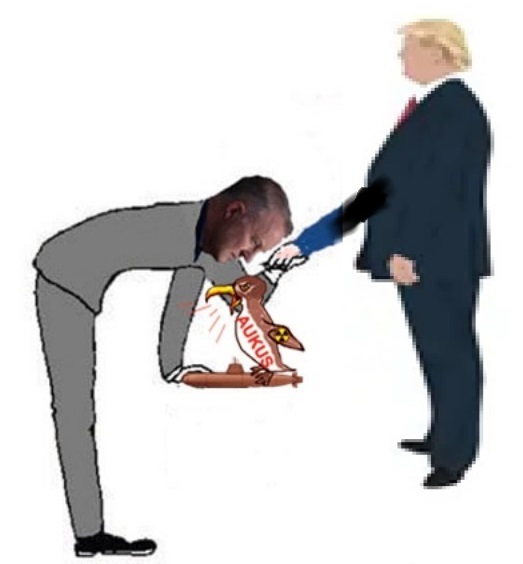
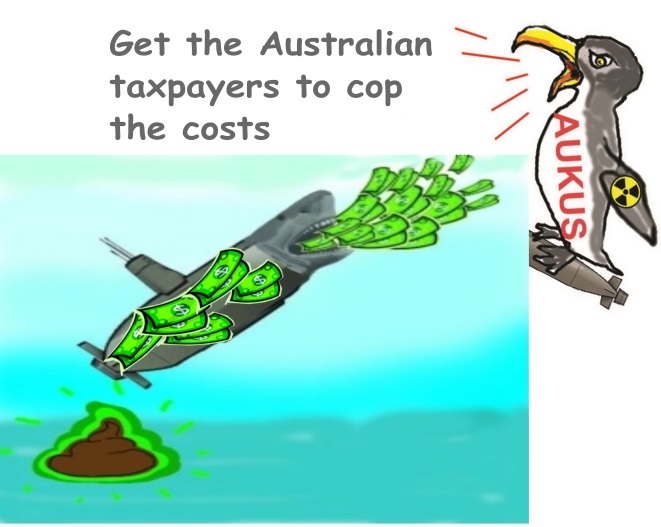
Trump is well known to hold a grudge. The one thing that will keep him supportive of AUKUS will be the money flowing from the Australian taxpayers to US shipyards, with no contract in place for delivery and no claw back option for the Australian contribution is the US does not deliver. That’s the sort of deal that Trump likes.
UK submarine shortages
And the United Kingdom are in a worse position than the US. The Royal Navy has one nuclear attack submarine available for operations – a fact made obvious to Australians when that sole submarine cut short a visit to Western Australia to head towards the Iran conflict zone.
Retired Rear Admiral Peter Briggs, in an event at the Canberra Press Club, organised by Malcolm Turnbull, said it all, warning the UK had “dropped below the minimal sustainable force” for submarines and the country would be late in delivering its first SSN-AUKUS boat, a design which Australia is also hoping to start building in Adelaide in the 2030s.
“It is queued up behind the final two (Astute-class boats) and four critically important ballistic missile submarines, the Dreadnoughts, that are being built in the shipyard.”
“You cannot get the first SSN-AUKUS out until the fourth ballistic missile submarine is clear of the yard. That is the UK’s national priority.”
Defence incompetence
Listen to this story
12 min
The US war on Iran has exposed Australia’s incompetent defence and procurement. Rex Patrick reports implications for AUKUS submarine program.
A tense moment
USS Charlotte was at periscope depth, but the periscope was down, reducing the chance of it, or the wake it creates, being seen by the enemy. It was a tense moment.
“Safe/Fire key to Fire”, ordered the captain.
The officer manning the fire control console repeated the order, “Safe/Fire key to Fire” and then advised the captain, “Safe/Fire key is to Fire”.
“Fire 4 tube at Target 1”, the captain stated in a raised and clear voice.
The officer repeated the order and hit the ‘Fire’ button. A low-level thud was both felt and heard throughout the submarine as the pressurise discharge system pushed the Mk 48 Torpedo from the tube. “Weapon running” the officer called.
As the weapon ran towards the Iranian frigate the submarine carried out a further visual set-up through the periscope to update the weapon. The updated targeting solution was transmitted down the very long and thin guidance wire connecting the torpedo to the submarine.
The update was also loaded into the second torpedo’s guidance system. “Fire 1 tube at Target 1”.
The first torpedo did not do its job. The second exploded directly under the target, lifting the hull out of the water and sending a violent shock wave through it. The structural damage was completed as the hull dropped back into the water.
The first the Iranian captain of the frigate would have known about the US submarine would have been when he felt the explosion underfoot.
Sinking of INS Dena (Source: US Department of War)
Queuing
USS Charlote did not just stumble across the INS Dena. Rather, days before, it had been queued to the target by folks back in the US tracking where every surface ship in the world is located.
The submarine travelled at high speed, around 30 knots (55 km/h), for days getting from its routine Indian Ocean patrol area to the waters south of Sri Lanka. That’s one of the key advantages of a nuclear-powered submarine. They can travel long distances fast.
As it arrived in the area the submarine’s crew would have detected (found it) and tracked the contact (worked out its range, course and speed), and then classified (identified) it using a combination of acoustic and electronic emissions, and finally confirmed it was the INS Dena visually through the periscope.
Then ‘bang’.
AUKUS implications
The Iran War has shown that submarines are 21st century war fighting assets with ever relevant capabilities; they can collect intelligence, conduct reconnaissance, launch land attack missiles, covertly land special forces, covertly lay mines, and sink submarines and surface ships.
But the events from 28 February onwards have shown us other things.
AUKUS has been described by many as a program that facilitates close alliance and force integration with the United States.
As Donald Trump broke its written Free Trade Agreement commitments to Australia on ‘Liberation Day”, those in the Canberra bubble were blind to that breach’s relevance to the ANZUS treaty and AUKUS agreement. Surely the US’s defence treaty with Australia would be treated differently.
As the US initiated an AUKUS review, that was to see AUKUS sceptic Elbridge Colby recommend stopping the program until Trump realised the financial benefit in continuing with it and overrode Colby, those in the Canberra bubble breathed a collective sigh of relief and chose not to think it too much.
Ruptured
As Trump, to use the words of Canadian Prime Minister Mark Carney, ‘ruptured’ the international rules-based order – carrying out a military operation in Venezuela, threatening Panama, bringing NATO to the brink by threatening to invade Greenland, attacking Iran and now threatening Cuba – those in the Canberra bubble didn’t seem to recognise the US Administration’s departure from Australian values; or perhaps likely they did but decided not to respond to it.
Only over the past month Prime Minister Albanese has responded properly to the ‘rupture’, not blindly committing Australian forces to follow the US into war, as has so often been the case (as a downpayment for US support for Australia if it needed it).
Albanese has despatched a RAAF early warning aircraft to support the air defence of the United Arab Emirates and other Gulf states, but we haven’t joined a US-led effort as has been the case in the past.
Sovereign thought
Albanese has it right. The US did not seek to build international support, and/or UN approval, for a strike on Iran. Instead it chose to plan in secret in cahoots with Israel and then launch a surprise attack to kill Iran’s leadership while negotiations with Iran were supposed to be ongoing.
Only when the going got tough did Washington call on allies for assistance, and under the circumstances where they rightly refused.
Trump’s Iran War has caused harm to Australia.
The impact of Trump’s war is causing economic harm right across the globe.
The war has also brought home Australia’s vulnerabilities. For decades distance has kept us relatively isolated from conflict, but this conflict directly affected us as world fuel supplies are disrupted and prices have sky rocketed. And the full extent of this new energy shock still lies ahead.
Perhaps it’s the shock that we needed to have ;
a chance to reflect on our need to take a more independent pathway in a world in which many past assumptions are being overturned.
Australia has long relied on the naval might of what Prime Minister Robert Menzies liked to call our “great and powerful friends” – first the British Empire and the Royal Navy; then Pax Americana upheld by the United States Navy. Now times are changing,
and they are changing rapidly.
The US Navy has gone from a Cold War era 1000-ship navy to a 600-ship navy during the Reagan era, to a current fleet of just 300 ships. China now has the world’s largest navy, 350 to 370 vessels, and Chinese shipyards are turning out warships much more rapidly than their counterparts in the US.
The US Navy still has a qualitative edge, but the US Navy is not what it was, and its well understood that quantity has a quality all of its own.
The US has been aiming to increase its number to 381 combat ships. 66 is the desired number for nuclear attack submarines – they have only 49 at the present moment.
Since 2011 the USN has purchased 2 submarines a year (this last year it was only one – because deliveries are so far behind).
The actual Virginia-class production rate has never reached 2.0 boats per year, and since 2022 has been limited to about 1.1 to 1.2 boats per year, resulting in a growing backlog of boats procured but not yet built.
US Naval Shipbuilding Plan (Source: Congressional Budget Office).
They can’t build enough boats to meet their own needs,
let alone ours.
A school of thought in the US had been that submarines transferred to the Royal Australian Navy would be available for US in time of conflict, but the Iran War has speared that assumption.
And Trump noticed this week, first expressing disappointment at the UK’s refusal to become directly involved in the Iran War and then turning his thoughts to Australia, saying “Australia too, Australia was not great. I was a little surprised by Australia”.
Trump is well known to hold a grudge. The one thing that will keep him supportive of AUKUS will be the money flowing from the Australian taxpayers to US shipyards, with no contract in place for delivery and no claw back option for the Australian contribution is the US does not deliver. That’s the sort of deal that Trump likes.
And the United Kingdom are in a worse position than the US. The Royal Navy has one nuclear attack submarine available for operations – a fact made obvious to Australians when that sole submarine cut short a visit to Western Australia to head towards the Iran conflict zone.
Retired Rear Admiral Peter Briggs, in an event at the Canberra Press Club, organised by Malcolm Turnbull, said it all, warning the UK had “dropped below the minimal sustainable force” for submarines and the country would be late in delivering its first SSN-AUKUS boat, a design which Australia is also hoping to start building in Adelaide in the 2030s.
“It is queued up behind the final two (Astute-class boats) and four critically important ballistic missile submarines, the Dreadnoughts, that are being built in the shipyard.”
“You cannot get the first SSN-AUKUS out until the fourth ballistic missile submarine is clear of the yard. That is the UK’s national priority.”
Defence incompetence
At the same conference, our Defence Department’s incompetence was on full display.
A Defence representative laid it out., After decades of submarine procurement failures (including the spending of $4B on French submarines we never got), it’s still “full speed ahead” in the best spirit of Captain Smith on the bridge of the Titanic.
In response to a question from Turnbull as to “what’s the plan B if we end up with no new subs” from the United States, Deputy secretary for strategy and policy, Hugh Jeffrey, answered, “You know, it’s not my job as a public servant, to talk about Plan Bs that’s the prerogative of government”.
He went on to lecture AUKUS sceptics,” If you really want to be in a position where we have no submarines then ‘turn back’. I do think, speaking as an apolitical public servant, we need to get out of this relentless politicisation of defence capabilities.”
AUKUS end
He surely did not realise what he said. He warns we’ll “be left with no submarines if the project is dumped”. The problem is that we’ll also be left with no submarines if AUKUS isn’t dumped. And we will have paid a lot for those no submarines.
After a failure on fuel security, with a failure on procuring submarines, and with the rules-based order ruptured by the very country we’re relying in respect of the program, maybe Albanese will finally cut this foolish program and move towards a more realistic, self-reliant and sustainable strategic policy.
If we don’t, we may well find our sovereignty to be hollow and that others will decide our nation’s future.
An ambassador who calls dead journalists terrorists. A death penalty for Palestinians only. A government that says nothing. And a Press Club that provides the stage.
I. The Spectacle
On March 31, 2026, the National Press Club of Australia hosted Dr Hillel Newman, the newly appointed ambassador of Israel, for an address titled “Reshaping the Middle East.”
What unfolded was not diplomacy. It was propaganda. It was the marketing of genocide. And it was allowed to continue, uninterrupted, on Australian soil, under the lights of an institution that once stood for journalistic integrity.
Newman rejected a figure of 70,000 dead in Gaza – a number, he said, provided by Hamas. He claimed the ratio of civilian to combatant casualties was “the lowest in urban warfare” and that Israel should be “commended” for the “low number of uninvolved civilians that were actually killed.”
He was speaking over the bodies of 70,000 people. He was speaking over the findings of a United Nations commission of inquiry that, in September last year, found that Israel had committed genocide in the Gaza Strip – accusing the nation of having committed four genocidal acts, “namely killing, causing serious bodily or mental harm, deliberately inflicting conditions of life calculated to bring about the destruction of the Palestinians in whole or in part, and imposing measures intended to prevent births.”
The Press Club did not challenge him. The journalists in the room did not walk out. The broadcast continued.
II. The Death Penalty Law
On March 30, the Israeli Knesset passed a law imposing the death penalty for terrorism-related offences. Human Rights Watch has analysed the bill and found it explicitly discriminatory.
The law makes death by hanging the default punishment for West Bank Palestinians convicted of nationalistic killings. It also gives Israeli courts the option of imposing the death penalty on Israeli citizens convicted on similar charges – language that legal experts say effectively confines those who can be sentenced to death to Palestinian citizens of Israel and excludes Jewish citizens.
Within the military court system of the Occupied Palestinian Territory, the bill imposes the death penalty for killings classified as acts of terrorism as defined under Israeli law, even without a prosecutorial request. The bill only allows courts to order life imprisonment in unspecified exceptional cases where “special reasons” are found, limiting judicial discretion. It also prohibits commutation of sentences and mandates execution within an accelerated timeframe of 90 days.
Israeli citizens and residents are explicitly excluded from this provision: military jurisdiction applies exclusively to Palestinians, while Israeli settlers are tried in civilian courts.
Human Rights Watch has noted that military trials of Palestinians have “an approximately 96% conviction rate, based largely on ‘confessions’ extracted under duress and torture during interrogations.”
Adam Coogle, deputy Middle East director at Human Rights Watch, stated: “Israeli officials argue that imposing the death penalty is about security, but in reality, it entrenches discrimination and a two-tiered system of justice, both hallmarks of apartheid. The death penalty is irreversible and cruel. Combined with its severe restrictions on appeals and its 90-day execution timeline, this bill aims to kill Palestinian detainees faster and with less scrutiny.”
The Palestinian Authority has condemned the law as a “war crime” and a “flagrant violation of international humanitarian law, particularly the Fourth Geneva Convention, which guarantees protection for individuals and fair trial rights.”
At the Press Club, Newman defended the law. “Just like in the United States, in Japan and in India, which have capital punishment, Israel has the right, as a sovereign state, to decide … capital punishment,” he said.
He did not mention the discrimination. He did not mention the 96% conviction rate. He did not mention the torture.
III. The Journalists
Newman was asked about the killing of journalists in Gaza and Lebanon. The International Federation of Journalists has reported that 261 journalists and media workers have been killed in Gaza since October 7, 2023. The Committee to Protect Journalists has accused Israel of killing a record 129 journalists in 2025.
Newman’s response was chilling.
He claimed that two of three journalists killed in an Israeli air strike in Lebanon were “100 per cent terrorist” members of Hezbollah’s elite Radwan force. He said they were “dressed up as journalists.” He claimed that both Hamas and Hezbollah “disguise themselves as press and remain terrorist operatives.”
When pressed on what percentage of killed journalists were not terrorists, he admitted: “The honest truth is that we have no way of knowing the exact amount of journalists who weren’t 100 per cent journalists who were killed.”
He has no way of knowing. Yet he called them terrorists anyway. On Australian soil. At the National Press Club.
The Committee to Protect Journalists has previously described such accusations as “smear campaigns” without “credible evidence to substantiate their claims.”
Newman also dismissed the broader death toll of journalists, saying: “When people outside quote 250, 300 journalists [have been killed], what they’re doing is they’re just buying [it] hook, line and sinker. If they would check, they would find that the majority of all the journalists, so-called journalists, that were affected were actually activists guised as journalists.”
He has no evidence. He provided none. The Press Club did not ask for it.
IV. The Frankcom Family
While Newman spoke inside the Press Club, the family of Zomi Frankcom stood outside.
Frankcom, an Australian aid worker, was killed by an Israeli drone strike on April 1, 2024, while working for World Central Kitchen in Gaza. Seven aid workers died. The convoy was struck three times.
Two years later, the family is still waiting for justice. They are still waiting for the release of critical drone footage audio that would establish motive. Former Defence Force chief Mark Binskin, who conducted an independent inquiry, was given access to unedited drone footage – but it did not include audio.
Newman was asked repeatedly whether the Israeli government would apologise to the Frankcom family. He refused. “Every incident of an innocent person or aid worker that is affected by a war situation is tragic, and we’ve expressed full sympathy with the family,” he said.
Sympathy. Not an apology.
He said reparations were “dependent on the final outcome of the interrogation.” Two years later, the interrogation is still not final.
Mal Frankcom, Zomi’s brother, said the family would like a formal apology, but he believed this was unlikely because it “could be seen as an admission of guilt.”
He met with Prime Minister Anthony Albanese on Tuesday. He urged the government to use all possible diplomatic levers to pressure Israel to complete its investigation.
The ambassador was asked about the audio. He said: “That’s not in my hands. It’s in the IDF’s hands.”
The IDF’s hands. Where it has been for two years.
V. The Australian Government’s Response
Foreign Minister Penny Wong told the Labor caucus that Australia opposes the death penalty “in all instances.” She pointed to a joint statement Australia signed alongside France, Germany, Italy and the United Kingdom that opposed the measure.
The statement said: “We are particularly worried about the de facto discriminatory character of the bill. The adoption of this bill would risk undermining Israel’s commitments with regards to democratic principles.”
A joint statement. Words. Not action.
The government has not summoned the ambassador. It has not imposed sanctions. It has not suspended military cooperation. It has not done anything that would cost Israel anything at all.
The same government that rushed to pass hate speech laws after the Bondi terror attack – laws that criminalise the phrase “from the river to the sea” – has nothing to say about a law that would execute Palestinian prisoners by hanging within 90 days, with no right of pardon, under a discriminatory legal regime.
The same government that welcomed Israeli President Isaac Herzog to Canberra has not condemned the man who wore a noose-shaped lapel pin while celebrating the passage of this law – Itamar Ben-Gvir, Israel’s National Security Minister.
The same government that expelled Iran’s ambassador after ASIO concluded Tehran orchestrated the bombings of a synagogue and a kosher restaurant has not applied the same standard to Israel.
VI. The Question of Double Standards
In 2024, the Albanese government expelled Iran’s ambassador, Ahmad Sadeghi, after domestic spy agency ASIO concluded that Iran had orchestrated the bombings of a synagogue in Melbourne and a kosher restaurant in Sydney.
A top Iranian diplomat, Mohammad Pournajaf, defected from the regime and was granted asylum in Australia. The government acted. The ambassador was expelled.
Yet Israel’s ambassador calls dead journalists terrorists, defends a discriminatory death penalty law, refuses to apologise for the killing of an Australian aid worker – and the government says nothing.
Why was the Iranian ambassador expelled, but the Israeli ambassador remains?
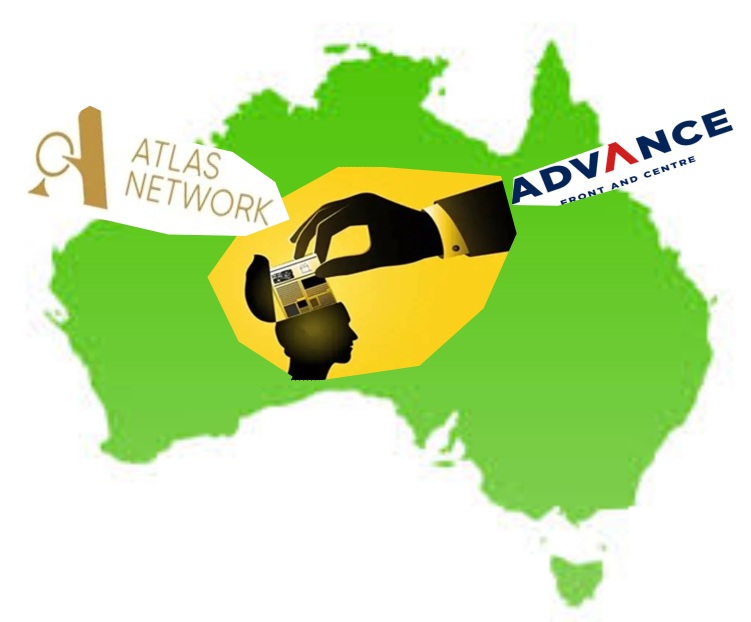
The answer is the network. The donors. The lobbyists. The fear of being labelled antisemitic. The capture of our political class by a foreign ideology that demands silence in exchange for support.
VII. Has the Press Club Been Captured?
The National Press Club is meant to be a forum for robust journalism. For challenging those in power. For holding the powerful to account.
On March 31, 2026, it provided a platform for an ambassador who called dead journalists terrorists. Who defended a discriminatory death penalty law. Who refused to apologise for the killing of an Australian aid worker.
The journalists in the room did not walk out. They did not cut the microphone. They did not refuse to platform a man who accused the dead of being terrorists without evidence.
This does no credit to Australian journalism. It does no credit to the Press Club. It does no credit to Australia.
VIII. The Questions They Refuse to Ask
We will ask the questions they refuse to ask:
Why was Hillel Newman given a platform to call dead journalists terrorists?
Why did the National Press Club not challenge his claims in real time?
Why has the Australian government not summoned the ambassador to answer for the death penalty law?
Why has the government not condemned the law in the strongest possible terms?
Why has the government not suspended military cooperation with Israel?
Why has the government not imposed sanctions?
Why has the government done nothing that would cost Israel anything at all?
Why was the Iranian ambassador expelled, but the Israeli ambassador remains?
The Frankcom family deserves answers. The Palestinian prisoners facing execution deserve the world to speak. The Australian people deserve to know why their government is silent.
IX. The Larger Pattern
This is not an isolated incident. It is the same pattern we have been exposing for weeks.
The same network that brought us the Segal Plan – mandatory Zionist indoctrination in universities. The same network that brought us the police crackdown in New South Wales – eight armoured officers breaking down a woman’s door at 5am. The same network that is turning our public service into an arm of foreign influence. The same network that has captured our political class.
The same silence. The same complicity. The same refusal to act.
Israel is committing genocide. The International Court of Justice has found it “plausible.” The United Nations commission of inquiry has found it has committed genocidal acts. The world is watching.
And Australia says nothing. Or says a few words in a joint statement, then returns to business as usual.
X. What Must Be Done
The National Press Club must answer for its decision to platform Newman. Why was he not challenged? Why was the broadcast allowed to continue? Why were dead journalists slandered without evidence on Australian soil?
The Australian government must summon the ambassador. He must answer for the death penalty law. He must answer for his comments about journalists. He must answer for the Frankcom family.
The government must condemn the death penalty law in the strongest possible terms. A joint statement is not enough. Words are not enough. Australia must use every diplomatic lever to oppose this discriminatory, inhumane legislation.
The government must suspend military cooperation with Israel. Australia cannot claim to oppose the death penalty while cooperating militarily with a state that imposes it discriminatorily.
The government must impose sanctions. The time for words is over. The time for action is now.
The Frankcom family must receive justice. The audio must be released. The investigation must be completed. Those responsible must be held accountable.
XI. A Warning
What happened at the National Press Club on March 31, 2026, was not an aberration. It was the logical conclusion of a pattern.
A foreign ambassador called dead journalists terrorists. He defended a law that executes Palestinians by hanging within 90 days, with no right of pardon, under a discriminatory legal regime. He refused to apologise for the killing of an Australian aid worker.
And Australia was silent. The government was silent. The Press Club was silent. The media was silent.
This is what complicity looks like. Not active participation. Silence. The refusal to speak. The refusal to act. The refusal to hold accountable those who commit atrocities in our name, with our support, under the cover of our alliance.
The wire is not cut. The shells fall short. The men who send others to die do not walk the ground.
But we will not be silent. We will ask the questions they refuse to ask. We will name the names. We will expose the pattern.
And we will keep cutting the wire until there is nothing left but the garden.
This article is dedicated to my wife, who stands with me shoulder to shoulder, and I am so proud of her.
Walt Zlotow West Suburban Peace Coalition Glen Ellyn IL 2 Apr 26
No it won’t be the unconditional surrender Trump demanded of Iran. It will be a surrender couched as a US victory over Iran. Trump will say he’s obliterated enough of Iran’s nuclear program and missile capability to wind down his criminal war within a couple of weeks.
Nonsense. It’s the US bases in the Gulf States and Israel proper being decimated by Iran’s ferocious defense that are causing Trump to trumpet victory when in fact he’s been defeated in every war goal.
Trump didn’t achieve regime change in Iran.
Trump didn’t get Iran to surrender unconditionally or any other way at all.
Trump didn’t destroy Iran’s missile and drone defense.
Trump didn’t destroy Iran as Israel’s last remaining hegemon rival in the Middle East, the primary reason he attacked on February 28.
Trump didn’t reopen the Strait of Hormuz as promised, whose closure is threatening worldwide economic disaster.
Tonight Trump will spin his colossal defeat as victory. But while speaking, Iranian missiles and drones will continue raining down on US Gulf States bases and thruout Israel. Tomorrow the Strait of Hormuz will remain closed as gas prices continue endlessly upward.
Trump will remain trapped like the rat he is while killing more thousands before his cabinet invokes the 25th amendment to take awayhis license to kill and destroy.
The idea of nuclear non-proliferation has come in for some heavy punishment of late. For one thing, powers with nuclear weapons, pre-eminently the United States, have been shown up as blackguards in seeking to prevent other powers in acquiring the option. In its conduct of talks with Tehran, ostensibly to stem their nuclear ambitions, Washington was merely managing a front of chatter while the warmongers were busying themselves behind the scenes. In June 2025, this culminated in the US joining Israel with Operation Midnight Hammer, which saw, according to President Donald Trump, “Monumental Damage […] done to all Nuclear sites in Iran as shown by satellite images. Obliteration is an accurate term!”
Despite these celebratory self-awarded accolades, Israel and the United States would initiate a savage and ongoing encore that began on February 28, with Trump again stating that Iran could never have a nuclear weapon. Apparently, obliterated nuclear facilities must have had some inner life that needed expunging. Diplomacy on non-proliferation was further shown to be contemptible and hypocritical.
Last year’s strikes on Iran, and the current Iran War, reveal the central hypocrisy of those who insist on keeping the nuclear club closed and limited, something made comically grotesque by the fact that one of the belligerents, Israel, is an undeclared nuclear power buttoned up in strategic ambiguity. Countries possessing the murderous nuke have been keeping those without such weapons in a state of suspended anticipation for decades. The central bargain is to be found in the Nuclear Non-Proliferation Treaty (NPT), a document that keeps club members in fattened bliss while holding off future admissions with the promise of civilian nuclear technology. Iran’s case shows that even having a civilian nuclear program is not something that will be countenanced.
The hard lesson, and one studiously understood by North Korea, is that having nukes is the ultimate security guarantee in the great family of unruly gangsters known as the international community. This much was admitted by the country’s leader, Kim Jong Un, in a March 23 speech at the Supreme People’s Assembly in Pyongyang. “Today’s reality clearly demonstrates the legitimacy of our nation’s strategic choice and decision to reject the enemies’ sweet talk and permanently secure our nuclear arsenal.”
Those who refuse to pursue such an option or have abandoned their ambitions in the face of pressure and empty undertakings given by the powerful, have been found wanting and ultimately dead: Libya’s Muammar Gaddafi, Iraq’s Saddam Hussein.
The late Iranian supreme leader, Ali Khamenei, was killed by Israeli and US airstrikes, despite having issued an expansive fatwa banning the development of nuclear weapons. The religious ruling had first surfaced at a meeting of the International Atomic Energy Agency (IAEA) in 2005. In its words, “[T]he production, stockpiling and use of nuclear weapons are forbidden under Islam and that the Islamic Republic of Iran shall never acquire such weapons.” Iran’s leadership had “pledged at the highest level that Iran will remain a non-nuclear weapon State party to the NPT and has placed the entire scope of its nuclear activities under IAEA safeguards and additional protocol, in addition to undertaking voluntary transparency measures with the Agency.”
In February 2025, the leaders of the Islamic Revolutionary Guard Corps (IRGC) begged Khamenei to reconsider the edict in light of Trump’s return to the White House and the increasingly belligerent tone he had adopted towards the regime. “We have never been this vulnerable, and it may be our last chance to obtain one before it’s too late,” stated one official to The Telegraph. Another revealed that, “The existential threat we now face has led several senior commanders – who previously insisted on following the supreme leader’s guidance – to push for making an atomic weapon.” One of Khamenei’s advisers, Kamal Kharazi, said last November that the fatwa was the only impediment to developing a nuclear capability. “If the Islamic Republic of Iran faces an existential threat, we would have no choice but to adjust our military doctrine.”
In the meantime, Iranian policy became a ragbag of options that pushed it to a point where Tehran might be considered on the brink of the nuclear threshold without quite getting there. Deterrence could be achieved without actually acquiring a weapon. “Khamenei,” writes Tom Vaughan for The Conversation, “seems to have made a bet that achieving ‘nuclear threshold’ status, where a state has the potential to develop nuclear weapons at short notice, would be enough to do this and to deter US or Israeli attacks.” In failing to achieve this, Iran had “borne all the costs of being a ‘proliferator’, while reaping none of the perceived security benefits of nuclear weapons.”
Expanding nuclear weapons arsenals has also become modish. In the face of unreliable guarantees of extended nuclear deterrence offered by the United States in Europe, French President Emmanual Macron is inclined to the view that the next five decades “will be an era of nuclear weapons.” Keeping in mind “our national and European challenges, we have to strengthen the nuclear deterrent… We must think of our nuclear deterrent on a European scale.”
John Erath, former US diplomat and currently serving as a policy director of the Center for Arms Control and Non-Proliferation says that more countries “feel insecure”, with nuclear weapons being the antidote. “There is no real alternative. Deterrence has so far prevented nuclear war, but often by luck.” Specific to Iran, reasons Ramesh Thakur, director of the Centre for Non-Proliferation and Disarmament in the Crawford School of the Australian National University, “nuclear weapons are now the only thing that will guarantee regime survival.” Jennifer Kavanagh, director of military analysis at Defense Priorities, a Washington-based think tank, suggests that a nuclear weapon may prove “a faster route to restore deterrence for a regime that is now more radical and has been attacked twice in the midst of negotiations.”
Instead of being shaded into unusable insignificance and hopeful oblivion, these weapons of homicidal lunacy have been shown to be more attractive than ever. They are virtually the only way regimes and governments of all stripes can hope to deter potential belligerents. Survivors of Iran’s leadership, now facing that existential threat long warned against, will be only too aware of that fact.
POLITICS. Sizewell C Inquiry. The Deafening Abdication of Four Ex-Presidents on Trump. Republican Lawmakers Led By Nancy Mace Begin To Break With Trump On Iran War: ‘We Were Misled’. US Congress near totally complicit in Trump’s criminal Iran war.
SAFETY. Nuclear Deregulation – DOGE Goes Nuclear: How Trump Invited Silicon Valley Into America’s Nuclear Power Regulator. IAEA Database: About 55% of Nuclear and Other Radioactive Material Thefts Since 1993 Occurred During Transport Nuclear plant told to improve after ‘near misses
Last night I watched a terrific programme on SBS world television. It was all about the sinking of the Titanic, covering so many aspects never shown on TV before. I was struck by the atmosphere on the ship, in the early hours of the sinking, with many people, particularly the rich upper-class passengers, taking the whole process as something not really serious, rather fun even. Of course, not all of them saw it that way. But enough of them – to be able to have quite a good party on the upper deck lounge, and to regard the messenger calling them up on deck as rather a nuisance, an ignorant lower-class person. And indeed, some people just refused to leave their (temporarily comfortable) beds, on such a cold night.
And here was I, trying to get my mind away form the rather scary world news. I suppose I’d have been better watching some “reality” show, or that good old Australian standby – sport.
Anyway, the thing was – the Titanic story showed how people are inclined not to take a critical event seriously, not to worry about it, until it’s too late.
And lo and behold, the same sort of thing is happening now. Today DW reports Iran war: Israel hits Iranian heavy water nuclear reactor. The good old news.com.au writes ‘Worst case scenario’: Wall St craters, oil surges as nuclear sites hit’. The fascinating part of this coverage, as shown by that last headline, is that the financial aspect is the first priority.. Yeah, I know that the world economy is important, and it’s not a good thing to have Wall St stocks going down, and investors “mashing the panic button”. I’m not saying that this is a trivial matter. It’s just that drone or missile strikes on a nuclear facility could be a helluva lot more serious than a drop on the stock exchange.
We don’t need an actual nuclear bombing to create a massive environmental and health catastrophe, a drone strike can do that job.
Both articles focus on this economic crisis, paying barely lip service to the fearful physical danger of a nuclear site being exploded, or even just damaged. Israeli air strikes hit a nuclear research reactor in Iran’s Khondab region, and a uranium processing plant in Yazd in Central Iran. The reports hastened to tell us there was no release of radioactive material. How reassuring! We can focus on the main issue – the share prices.
Questions come to mind. Will Iran retaliate by striking Israel’s Dimona reactor and other nuclear sites? How come it’s so terrible for Iran to have legally permitted nuclear research facilities, but apparently OK for Israel to have nuclear weapons. Estimates of Israel’s nuclear warheads range from 90 to 200, but Israel “does not confirm or deny” its nuclear weaponry numbers. So that’s apparently OK.
Yes, we’re all anxious about our petrol and diesel prices, and naturally so. But the possible ramifications of these Israeli strikes on nuclear facilities add up to something more horrendous. I don’t want to rave on here about the health, environmental, social toll that will ensue, if the warring states decide to use this very convenient weaponry – no need to have your own expensive nuclear bomb, just send a few cheap drones to attack your enemy’s nuclear sites.
As with those rich passengers on the Titanic, it’s time that world leaders woke up.
Climate information wars and fossil fuel dependency are national security threats that are undermining Australia’s ability to respond to crises like the Iran war, a new report says.
This battleground is actively undermining the country’s ability to reach energy sovereignty and protect Australians from external threats, says retired Australian Defence Force (ADF) admiral Chris Barrie.
“There has been a failure to understand how energy dependence on fossil fuels will cause both economic disruption and more perilous physical conditions for Australians,” Barrie said in a statement accompanying a new report outlining the scale of the threat.
“Now the two issues are colliding.
“We are facing an unprecedented energy crisis much worse by the world’s failure to face its fossil fuel addiction. Layered on top is a climate disinformation war globally and in Australia that is actively undermining the capacity to build a renewable, clean-energy future and curb coal and gas exports.”
The Climate Disinformation War report says Australia, and the world, have been engaged in an information war over climate change for at least two decades, as “anti-climate propaganda and disinformation networks” grew into multi-billion dollar permanent campaigns.
Today, power comes from dominating the information space and Australians’ perpception of the world is now warped by mis- and disinformation, says The Climate Disinformation War report author, intelligence analyst Anastasia Kapetas.
“This is no longer just a communications issue,” she said in a statement.
“It is a national security threat with consequences for Australia’s sovereignty, economic resilience, disaster preparedness, institutional trust and strategic autonomy. We are already seeing a drift toward authoritarian politics linked to climate denial.”
Responding to the scale of climate disinformation requires coordination across civil society and industry, and across security, economic, and governance institutions, Kapetas says in the report.
It calls for comprehensive anti-trust architecture, such as the current European Union Digital Markets Act, to stop tech platforms that amplify disinformation from becoming too powerful to regulate.
It also wants digital regulation that requires companies to take responsibility for online disinformation and other harms, and “urgent, enforceable” regulation of generative AI that can rapidly scale disinformation.
Marketing group Clean Creatives last year estimated the top 29 oil majors spent $US6.97 billion ($A9.9 billion) in 2024 on media management and PR.
They’ve created “a tidal wave of hostile messaging”, said California Energy Commission chair David Hochschild in Sydney this month.
Sadly, one of the culprits is Australia’s own Liberal and National parties, whose energy policies for two decades and claims of what renewable energy could, or would do despite evidence to the contrary, allowed disinformation and misinformation to flourish.
The impact of this wave of money and propaganda on Australians was made clear last year, when a Senate committee inquiry exposed just how deeply mis- and dis-information is now entrenched in this country, and how badly its damaging Aussie communities.
As Renew Economy managing editor Giles Parkinson put it, the Senate committee unearthed “harrowing evidence of abuse, threats, and intimidation – much of it driven by fear and loathing inspired by deliberate campaigns to demonise renewables”.
The anti-renewables “outrage machine” is even having a real impact on attitudes to Australia’s favourite technology, rooftop solar and home batteries, as noted by Populares boss Ed Coper at the EN26 conference last week.
Energy security starts at home
While some media commentators still scoff at the idea that renewables offer energy independence, governments and companies are taking note.
Last week, the UK fast-tracked balcony solar rules specifically to beef up energy security, and Australian electricity retailer Discover Energy finished a pivot that started after the 2020 Ukraine War-coal price spike to dump its gas licence to focus on solar-batteries and virtual power plants.
Indeed, “homegrown” energy sources are now equated with security, says International Energy Agency (IEA) chief Fatih Birol.
“We have seen, in Europe since 2022, the phenomenal growth of renewables mainly driven by security concerns,” Birol said.
“We have more options to deal with [this] crisis [than during the 1970s oil price shocks].
“Renewables have come to maturity… batteries, these will be a big game changer in terms of solar and wind becoming an even bigger part of the energy sector.”
In a blow to latent hopes in conservative circles, Birol doesn’t believe the way out for Australia is nuclear – even though he is a big fan of the technology and it’s rising again after the last shock in 2022.
He urges Australians to be “very, very proud” of what the country has achieved with solar and home batteries as “not every country needs to be nuclear power”.
David Noonan will speak on public interest concerns over the new Roxby Downs Indenture Act 2026 on BHP copper-uranium mining and ore processing in SA, and on how AUKUS may face SA with a High-Level nuclear waste agenda.
Dr Jim Green will discuss international developments in the field of nuclear power including ‘small modular reactors’ and Generation 4 ‘advanced’ nuclear reactor concepts.