Western Australian company to build low-level radioactive waste facility – Kimba dump a decade away – now irrelevant?

GREEN LIGHT FOR FIRST NUCLEAR WASTE STORAGE
Tellus, March 16, 2023
Australia’s first purpose-built low-level radioactive waste facility has been granted final approval in Western Australia ……
The Australian has confirmed that the WA government has granted a final approval licence to Australian firm Tellus Holdings to store low-level radioactive waste at a repository in Sandy Ridge, 240km northwest of Kalgoorlie, which could take hundreds of thousands of tonnes of stored waste from around the country.
………….The Sandy Ridge repository will be the country’s first commercial facility to be licensed in Australia to take low-level radiological waste and store it in a stable geological repository, and is one of only a handful of its types in the world.
It is also licensed to take low level radioactive waste from the Lucas Heights reactor in Sydney, as well as from defence facilities.
The commonwealth’s own proposed radioactive waste facility, Kimba in South Australia, is estimated to be at least a decade away from being constructed.
The licence approval, following agreement with traditional owners, will see it remediate contaminated oil and gas infrastructure, end-of-life mines and also deal with Australia’s massive stockpile of low-level radioactive waste from nuclear medicine, including diagnostic, treatment, research and other industries.
The near-surface geological repository will also be licensed to take low-level radioactive waste generated in the processing of critical minerals, which is estimated to eventually generate millions of tonnes of waste every year, as well as radioactive waste from the dismantling of offshore oil and gas rigs, which is estimated to cost more than $40bn.
The site is located in one of the most geologically stable zones in the world with the company claiming it was one of the “safest places” in Australia to store hazardous and low-level radioactive waste.
It is not licensed to take the high-level nuclear waste that would be produced by the need to one day dispose of nuclear reactors from submarines. However, the company said it could contribute its geological expertise and knowledge as the commonwealth begins a search for a geologically safe location for this purpose.
According to the Australian Radioactive Waste Agency, the country’s stockpile of radioactive waste is spread across more than 100 locations around Australia, including science facilities, universities and hospital basements – and is increasing.
Tellus chief executive Nate Smith told The Australian the site would provide a critical link in developing Australia’s first multibillion-dollar hazardous waste industry………………..
Sandy Ridge was granted approval in 2021 to take class V hazardous waste.
However, the McGowan government only granted final approval in January this year for the facility to take low-level radioactive waste as well, following a review by WA’s Radiological Council which advises the minister for health. – https://tellusholdings.com/green-light-for-first-nuclear-waste-storage/?fbclid=IwAR3P1lFgTT4rlThFKGWfB9yd-U8bFu6wrsrRTkBUNk4E7oNfzVW9J3p33Iw
The Australian
By Simon Benson
16 March 2023
Rex Patrick on AUKUS submarines: “an astonishingly bad deal”

by Rex Patrick | Apr 14, 2023 https://michaelwest.com.au/rue-britannia-britannia-and-rue-aukus-subs/
The Defence Department has outdone itself with the AUKUS submarine project. In Paul Keating’s words, “it’s the worst deal in all history”. That’s not just because of the staggering $386 billion price tag, but because of the form the program is to take. Former submariner Rex Patrick looks at the most astonishingly irrational part of the announcement.
Our senior Defence bureaucrats, both uniformed and civilian, have a remarkable but unexplainable knack when it comes to acquiring new equipment. When simplicity confronts them, they always find some way to make it complex. In the face of something manageable, they’ll always find a way to make it unmanageable. SNAFU is the order of the day.
But, for Defence, it’s all OK – the admirals, air marshals, generals and top level public servants are immune from the consequences of failed procurement – no matter how big the disaster. No-one’s ever been fired from Defence for stuffing up an equipment purchase; after all, the wasted money is not theirs, it’s mine and yours.
Looking at the AUKUS plan, which some are now labelling USUKA [pronounced “you sucker”] after Paul Keating called it “the worst deal in all history,” Australia will initially acquire three second-hand but proven and highly capable Virginia Class submarines, but then jump off that safe pathway to a high-risk program involving a country that has a track record of being late, and over budget, on its past and current submarine programs.
It’s just reckless.
Virginia submarines, what we could do
The Virginia Class nuclear attack submarine is sea proven but also an evolving design. It’s even fitted with the combat system and weapons that we already have on our Collins Class submarines, or will acquire.
AUKUS is a bad deal. It comes at eye-watering cost, has huge opportunity costs and effectively puts all our Defence eggs in one basket.
It’s not going to deliver a capability within an even remotely sensible time frame either to help deter, let alone fight in, the very conflict Defence purports we need it for.
But if I put that aside and just went along with the whole thing, I’d advise that we could, and should, buy three US built Virginia Class submarines and then build our own, effectively providing the third Virginia shipyard (there are two shipyards in the US, both struggling with capacity).
That’s of benefit to us, and to the US, who would enjoy a surge build capability through us.”
But instead, we will pay to increase US industrial capability and then turn to the British.
Not a shadow of its old self
“Rule Britannia, Britannia rules the waves. Britons never, never, never shall be slaves.” It’s a song derived from a 1730s poem.
But like the billowing gowns and petticoats that were worn over dome-shaped panniers by women of the 1730s, “Rule Britannia” is no longer in fashion.
The Royal Navy is not even a shadow of its old self. The French Navy and Spanish Armada outnumber Royal Navy frigates and destroyers 32 to 18. Admiral Horatio Nelson would be turning in his grave.
And to make matters worse, the “great” left “Great Britain” soon after Brexit.
(Not so) Astute submarines
Back to the topic at hand, Britain’s recent submarine projects have been project management cluster fiascos.
The Royal Navy’s current Astute class nuclear-powered attack submarine program was approved by the British Government in 1997. Three boats were to be built for £2.6 billion, with the first boat to be in service in 2005. The first boat went in the water five years late, in 2010, and the first three boats blew out in cost by £1.9 billion. And by the way, the UK contracted the US submarine company, General Dynamics Electric Boat, to help them sort out some ‘issues’ within the Astute project in 2004.
Starting with approval for a fourth boat in 2007, the program has grown to seven boats all up. The last four “Batch II” boats were supposed to cost £5.7B but are now expected to total £6.7 billion. The latest boat, HMS Anson, was delivered 25 months late.
Dreadnought submarines
The parallel Dreadnought nuclear ballistic missile submarine is on track. On track to be late and over budget.
The Ministry of Defence established its Future Submarine Integrated Project Team in October 2007. The initial approval of the program was in May 2011, with an estimated cost for four submarines of between £11 and £14 billion. The first submarine was intended to be in service in 2028.
The most recent cost estimate for the four ballistic missile platforms is £31 billion. Bizarrely, as the program has advanced, less seems to be known about the in-service date. No-one is saying when the first boat will arrive, other than “some time in the 2030s.”
Refits and retirements
The first of the Royal Navy’s current nuclear ballistic missile submarines, HMS Vanguard, has just come out of refit. The refit was programmed for three years and was to cost around £200 million. It took seven long years and around £500 million. Nearly one quarter of Vanguard’s service life will have been spent in dock undergoing repairs and maintenance.
Earlier this year, a public scandal erupted when it was revealed that the lead contractor had concealed broken bolts in the submarine’s reactor compartment.
In terms of programmatic failure, even more disturbing is the state of dismantling retired Royal Navy nuclear submarines.
The first ever British nuclear-powered submarine, HMS Dreadnought, entered service 60 years ago and served for 17 years. For the last 43 years, it’s been sitting alongside a wharf in the UK. It’s not been dismantled. But neither have any of the other 21 retired Royal Navy nuclear-powered submarines.
It’s a national disgrace. The National Audit Office examined the issue in 2019 and estimated that the cost of maintaining these retired submarines alongside various docks had exceeded £500 million, and the total cost of dismantling the retired and in-service submarines would likely exceed £7.5 billion. Perhaps this will be covered by the AUKUS overheads.
Nuclear disaster
The state of Britain’s submarine enterprise is nothing short of a disaster. And yet the Australian Department of Defence thinks that for the next fifty years, maybe longer, we should hitch ourselves to the clapped out wagon that is Britain’s submarine construction industrial base.
Paul Keating had it right about the AUKUS strategic architecture. Instead of moving forward with focus on a relevant local team like the QUAD (Australian, India, Japan and the United States), we’re committing to a subordinate role with our US ally and an Anglosphere arrangement that’s a hangover from the former, now almost forgotten, British empire.
Yet it’s all “keep calm and carry on” in the Australian Department of Defence. They have no need to worry because all the bigwigs will have retired and moved onto highly paid consultancies and ‘think tanks’ before the proverbial hits the fan.
Pretty much the same goes for the few, timid, politicians who’ve signed off on all this, a gargantuan splurge of taxpayers’ dollars, because they’re all fearful they might be accused of being “weak on defence” if they don’t swallow the Department’s nuclear Kool Aid.
I guess I’ll just keep going to bed each night worrying about the Defence of Australia. Not about some country invading us, but by how much of my money, and your money, the Department’s going to waste tomorrow, next week, next year and for decades to come.
Weapons-makers set to gain more influence in defence operations

Global weapons companies could be more deeply integrated into Australian military operations after legislative reforms. This comes on top of public unease about Australia’s independence under AUKUS.
MICHELLE FAHY, APR 14, 2023 https://undueinfluence.substack.com/p/weapons-makers-set-to-gain-more-influence?utm_source=post-email-title&publication_id=297295&post_id=114686170&isFreemail=true&utm_medium=email
Activity in the defence domain has reached peak overload. On top of AUKUS and the submarines, the high-level nuclear waste dump, the Defence Strategic Review, and a slew of multi-billion-dollar arms procurements, the Defence Department is also undertaking consequential reform of the Defence Act 1903 and related legislation. In March, Defence published a consultation paper on the reforms calling for public feedback. The deadline for submissions is Friday 21 April.
Among other things, the reform initiatives foreshadow a more deeply integrated involvement by the globally dominant US arms industry in Australia’s defence and national security establishment, including military operations, especially in the modern ‘warfighting’ domains of cyber and space. This is a profoundly consequential proposition that demands careful consideration.
Notice of the intended reforms was quietly released by the defence portfolio’s junior minister, Matt Thistlethwaite, just days before the Albanese-Biden-Sunak AUKUS extravaganza in San Diego. Saturation media coverage and ongoing analysis of that event has kept the intended reform of Australia’s defence legislation out of the spotlight. This confluence in timing was likely intentional. As a result, much of the limited time granted to the public to consider and prepare submissions has already elapsed.
The public needs to pay attention now because the bipartisan-lockstep nature of defence ‘debate’ in Australia makes it probable that once the legislative amendments hit parliament they will zip through both houses into legislative reality with far less scrutiny than they demand.
The government says legislative reform is necessary to ‘better position the Australian Defence Force (ADF) as an agile, integrated, warfighting enterprise’. The reforms are also intended to create a ‘technology-neutral’ legislative framework.
The consultation paper outlines three key initiatives:
- support the full range of military activities and capabilities required to defend Australia and its national interests
- design the law for seamless interoperability with international allies and partners
- improve the security of Australia’s military capabilities, tangible and intangible.
The terms ‘integrated’, ‘seamless interoperability’, and ‘interchangeability’ appear throughout. The word ‘partner’ is used frequently and is undefined. It is often unclear to which type of entity it refers: foreign governments, foreign militaries, foreign intelligence services, or local or foreign arms industry entities. These distinctions are important, especially in a public consultation document, and the fact that they often aren’t clear creates considerable ambiguity.
Defence poses ten consultation questions for consideration. An important one is hinted at and needs to be made plain: What does the public think about the deeper integration of profit-making multinational weapons companies into Australian military operations across the breadth of operational domains, including cyber and space?
The AUKUS agreement is causing significant public unease about Australia’s ability to act independently of our major allies, and the loss of sovereignty this entails. Two former prime ministers have also expressed publicly their concerns about this. The shape of the proposed legislative reforms, the ambiguities in the consultation paper, and the muted manner of the document’s release add further cause for concern.
Worth adding in this futuristic context is the rapid development and significant funding of lethal autonomous weapons, occurring largely out of public view. (For the uninitiated, lethal autonomous weapons, known colloquially as ‘killer robots’, require no meaningful human involvement in the ‘kill chain’.) As yet, there is no international legal framework regulating their development or use. Such is the future we face.
If the above is not warning enough, we need only reflect on the US government’s outsourcing to defence contractors (and here) of parts of its morally bankrupt drone assassination program which has killed large numbers of civilians, including children, and instilled an abiding fear of clear skies in the populations of multiple countries. Pine Gap, part of the United States’ global surveillance network, has played a facilitative role in these killings.
This surely provides all the evidence we need that more time – and a vastly more transparent and genuine process of engagement – is needed from Defence for the public to consider and respond to its proposed initiatives for reform.
Download Defence’s consultation paper. Lodge your submission by 21 April.
This piece first appeared at John Menadue’s Pearl & Irritations on 14.4.23.
Monica Leggett, in a powerful Submission, calls on all Australian MPs to reject nuclear power

Environment and Other Legislation Amendment (Removing Nuclear Energy Prohibitions) Bill 2022 Submission 134
My first employment, after completing my PhD in surface physics from Southampton
University, was to work as a research officer at Berkeley Nuclear Research Laboratories.
These were located adjacent to the Berkeley Nuclear Power Station. This gave me a lifelong interest in the industry and the controversies associated with it.
I find it hard to believe that the issue of Nuclear Power in Australia has come back to the
Senate. From an energy point of view it is unbelievable that a country with such
abundant sources of renewable energy should even contemplate using nuclear energy.
Nuclear power is the most expensive, inflexible, complex and socially problematic source
of energy. All that massive infrastructure with its associated safety and security
measures built just to boil water.
Re-engineering a nuclear bomb to generate heat in a controlled and safe manner may
have been an extraordinary feat of engineering and optimism in the 1950s, but technology
has moved on. Nuclear Power is an inappropriate, unnecessary and potentially
dangerous choice for Australia for the reasons outlined below.
1 Too slow and too expensive
Nuclear power has never been cheap despite the initial vision of nuclear energy as “too
cheap to meter”. It has very large upfront costs, is plagued by delays and cost over-runs.
While the costs of renewables are decreasing, the cost of nuclear is increasing.
The high profile and controversial nature of nuclear power would divert attention, funds
and focus from renewables to nuclear. The world cannot afford any more delays in
reducing carbon dioxide emissions.
2 Lessons from recent world-wide extreme weather events
The impacts of global warming can no longer be dismissed as a future problem. Records
are now being broken on a regular basis. The last two years have been particularly brutal
with extreme temperatures, intense wild fires, droughts and floods across the world.
Using only historic data to predict future weather is no longer sufficient. This would have
a very major impact on site selection, the safe operation and emergency planning for any
nuclear power plant.
3 Unacknowledged social impacts
The presence of a nuclear power station in an area would alter the risk profile of the area
for those in the vicinity and pose an additional psychological stress on residents. In
addition to bush fire and flood preparedness plans, residents would need to have nuclear
accident preparedness plans. These are not necessarily compatible. Local authorities
would need response plans for minor and major nuclear accidents.
If the power plant site is in a country area, which is likely, then there is an additional
problem. Country areas, in WA for example, rely on a large volunteer component in fire
and ambulance services. Will volunteers wish to serve in an area which includes a
Nuclear Power Station? How will they be protected? How will they be trained?
4a Adverse environmental impacts – normal operation
The environmental case for nuclear power appears to be based on its low carbon dioxide
emissions while operating without incident, compared to the carbon dioxide emissions
from a fossil fuel plant. This is correct but incomplete. It compares one yet-to-be-built
working nuclear power plant with an operating fossil fuel power plant. But their life cycles
are very different. The public relations material ignores some or all of the emissions from
the following:
- Site preparation
- Construction
- Water supply
- Storage of spent fuel rods
- Decommissioning including the treatment of the highly radioactive pressure vessel
and shielding (while the reactor is operating, the fuel vessel and shielding are
constantly under neutron bombardment from the core, hence becoming highly
radioactive). - Long term storage and monitoring of radioactive waste.
4b Adverse environmental impacts – accidents
In the case of a major nuclear accidents (e.g. Chernobyl and Fukushima) all energy
benefits while operating became insignificant compared to the energy used to deal with
the aftermath of the accident. These include the energy costs of making the reactor safe
and monitoring it for an innumerable years, site and area rehabilitation, relocating
residents and broader health costs.
The probability of a weather related nuclear accident has been made greater by the
changes in climate with extreme weather events more likely.
Accidents release radioactive isotopes into the environment. These can expose plants
and animals to external radiation. If ingested, then they can be absorbed into body tissue
and irradiate the body from inside.
Our environment is under enormous threat from human impact and climate change. It
does not need another threat.
5 Security issues
The war in Ukraine has brought into sharp focus, the reality of having a nuclear power
station in a country when under attack . It is not an asset that adds to a country’s
security, so why would we choose to have nuclear power stations that we do not need?
In addition, the presence of enriched uranium in the country broadens the range of
possible terrorism threats. Extra security then becomes an added expense for the
taxpayer.
6 Ethical issues – intergenerational equity and resource sharing
Should a nuclear power station be built and assuming the station is accident free, then
the current population would get the advantage of the power generated. Future
generations would be bequeathed the costs. They would inherit responsibility for decommissioning (if not already done) looking after the waste, maintaining its security
from terrorists and monitoring containment, all the while living with the impacts of climate
change. This lacks intergenerational equity and is not acceptable.
Uranium is a finite resource. As world citizens with an abundant supply of renewables,
we should not be using Uranium for our power. Uranium should be reserved for countries
that have few or no alternatives.
If we with our enormous renewable resources choose to use nuclear, what message
about renewables are we sending to our Pacific neighbours? What message does it send
about our concern for their wellbeing if they could be down-wind from a possible nuclear
accident?
7 Conclusion
Nuclear Power is an inappropriate and unnecessary choice for Australia. It fails on
economic, social, and environmental grounds and is ethically indefensible. I call upon all
politicians to reject nuclear power https://www.aph.gov.au/Parliamentary_Business/Committees/Senate/Environment_and_Communications/Nuclearprohibitions/Submissio
Professor George W Burns Submission to Senate – Keep the Nuclear Prohibitions, in the immediate and long-term interests of all Australians… and of the planet
Environment and Other Legislation Amendment (Removing Nuclear Energy Prohibitions) Bill 2022 Submission 127
I am deeply concerned about the proposed Removing Nuclear Energy Prohibitions Bill
Australia needs effective climate action but nuclear power would slow the transition to a low-carbon
economy. It would increase electricity costs and unnecessarily introduce the challenges and risks
associated with high-level nuclear waste management and the potential for catastrophic accidents,
with profound intergenerational implications for Australians.
My concerns as an Australian citizen are that:
Nuclear is the most expensive energy option.
Nuclear is slow. It can take decades to build and would require a decade or more to develop the
legislative framework.
Nuclear is dangerous. Either through human error, disaster, or as a military target the catastrophic
consequences of a nuclear disaster would permanently pollute.
Nuclear is unwanted. There is long standing popular opposition to nuclear power in Australia
because of the issues above as well as the unsolved problem of nuclear waste and the link to nuclear
weapons
Alternatives like renewables, storage and energy efficiency are faster, cheaper, more deployable and
enjoy much more public support
I trust the Inquiry will act in the immediate and long-term interests of all Australians…and of the
planet. https://www.aph.gov.au/Parliamentary_Business/Committees/Senate/Environment_and_Communications/Nuclearprohibitions/Submissio
UN’s nuclear chief warns ‘we are living on borrowed time’ after two landmine explosions near Europe’s largest atomic power station in Ukraine

- UN has often expressed fears over the safety of Ukraine’s Zaporizhzhia plant
- Two landmine explosions took place outside plant’s perimeter this month
- Russian forces took control of the six-reactor plant in Ukraine in March last year
Daily Mail, By ARTHUR PARASHAR, 14 April 2023
A UN nuclear chief has warned ‘we are living on borrowed time’ after two landmine explosions near Europe’s largest atomic power station in Ukraine.
Rafael Grossi, director general of the International Atomic Energy Agency (IAEA), has repeatedly expressed fears over the safety of Ukraine’s Zaporizhzhia plant.
……….. We are living on borrowed time when it comes to nuclear safety and security at the Zaporizhzhia nuclear power plant,’ Mr Grossi said yesterday.
‘Unless we take action to protect the plant, our luck will sooner or later run out, with potentially severe consequences for human health and the environment,’ he added.
Two landmines exploded outside the plant’s perimeter fence – the first on April 8, and another four days later on Wednesday, according to the statement.
It was not immediately clear what caused the blasts, it said.
Grossi met senior Russian officials in Kaliningrad last week and prior to this with Zelensky in Zaporizhzhia to discuss a safety plan.
He also warned yesterday that the plant continued to depend on a single still-functioning power line, posing ‘a major risk to nuclear safety and security’.
A back-up power line damaged on March 1 has still not been repaired, the IAEA said.
It added that the staffing situation at the plant remained ‘complex and challenging’, in part because of staff shortages.
Last month, Grossi warned that a nuclear disaster was very possible due to the ‘perilous’ situation at the plant.
‘The plant’s lack of access to the grid and necessary repair work on its last emergency power line could cause a complete loss of power, making it reliant on diesel generators for the seventh time since Russia captured it,’ Grossi said at the time.
I once again call for a commitment from all sides to secure nuclear safety and security protection at the plant,’ he added.
Emergency diesel generators had been activated to power the plant’s safety systems, according to Ukrainian nuclear energy agency Energoatom, which has warned of the risk of an accident.
Without the electricity produced by these generators, the overheating of the reactor fuel could cause a nuclear accident, as in Japan’s Fukushima in 2011……………………………………..more https://www.dailymail.co.uk/news/article-11972139/UNs-nuclear-chief-warns-living-borrowed-time-two-explosions-near-Zaporizhzhia.html
Friends of the Earth comments accuse the Australian Government Industry Department of blatant racism in its Kimba nuclear waste dump plan.

Comments on: Guidelines for the content of a Draft EIS National Radioactive Waste Management Facility, SA EPBC 2021/9128 April 2023
RIGHTS OF TRADITIONAL OWNERS
Recommendation #1: The Guidelines must require the proponent (the Australian Government Department of Industry, Science and Resources) to explain how the nuclear dump/store proposal complies with the United Nations Declaration on the Rights of Indigenous Peoples, in particular Article 29.2:
“States shall take effective measures to ensure that no storage or disposal of hazardous materials shall take place in the lands or territories of indigenous peoples without their free, prior and informed consent.”
Of course it is common knowledge that the proposal is a gross violation of Article 29.2 and that the nuclear dump/store is unanimously opposed by Barngarla Traditional Owners. Nevertheless, the proponent must be asked to explain its position and its crude racism.
Recommendation #2: The list of documents in section 3.5.1 of the Guidelines should also include the United Nations Declaration on the Rights of Indigenous Peoples.
Recommendation #3: The Guidelines mention a “process for ongoing consultation with FirstNations people”. The proponent should be required to declare whether or not it reservesthe right to ignore the rights, interests and recommendations of the Barngarla Traditional Owners in future just as it has ignored and overridden unanimous Barngarla opposition to the nuclear dump/store proposal.
Recommendation #4: The proponent should be required to discuss the adequacy of the
National Radioactive Waste Management Act (NRWMA) and in particular to provide
justifications for each of the following provisions of the Act:
- The nomination of a site for a radioactive waste facility is valid even if Aboriginal
Traditional Owners were not consulted and did not give consent. The NRWMA states that
consultation should be conducted with Traditional Owners and consent should be secured ‒
but that the nomination of a site for a radioactive waste facility is valid even in the absence
of consultation or consent. - The NRWMA has sections which nullify State or Territory laws that protect the
archaeological or heritage values of land or objects, including those which relate to
Indigenous traditions. - The Act curtails the application of Commonwealth laws including the Aboriginal and Torres
Strait Islander Heritage Protection Act 1984 and the Native Title Act 1993 in the important
site-selection stage. The Native Title Act 1993 is expressly overridden in relation to land
acquisition for a radioactive waste facility.
Recommendation #5. The proponent should be required to explain why it rejects the SA
Government’s policy that Traditional Owners should have a right of veto of nuclear waste
sites. SA Labor’s Deputy Leader (and now Deputy Premier) Susan Close noted in September
2020 that: “South Australian Labor is calling on the Federal Government to halt its plans to
dump nuclear waste at Kimba. … SA Labor has consistently expressed its concerns about the
site selection process and the lack of consultation with native title holders. … This was a
dreadful process from start to finish, resulting in fractures within the local community over
the dump. The SA ALP has committed to traditional owners having a right of veto over any
nuclear waste sites, yet the federal government has shown no respect to the local
Aboriginal people.”
FEASIBLE ALTERNATIVES
Recommendation #6. The Guidelines should require discussion on the ‘feasible alternative’
of targeting states/territories which do not have legislation prohibiting a nuclear
dump/store such as the one proposed. The current proposal requires the Commonwealth to
override the SA Nuclear Waste Storage (Prohibition) Act 2000.
Recommendation #7. The Guidelines state that the no-action alternative should be
discussed “if relevant”. The term “if relevant” should be removed and the proponent should
be required to discuss the no-action alternative since it is in fact a viable alternative.
Recommendation #8. The Guidelines should explicitly require the proponent to consider the
option of abandoning the plan to store intermediate-level waste (ILW) and Kimba since an
overwhelming majority of ILW is currently store at ANSTO’s Lucas Heights site with no
practical or legal obstacles to ongoing storage. The plan to move ILW to Kimba is absurd: it necessarily entails double-handling; and it entails moving waste from a site with strong
security and an abundance of nuclear experts to a site with weaker security and a dearth of
nuclear experts … for no reason whatsoever let alone a good, compelling reason.
It should be noted here that ARPANSA plans separate assessments of the proponent’s plans
for disposal of lower-level wastes and storage of ILW. Further, in its March 2022 Regulatory
Assessment Report approving ANSTO’s new ILW Storage Facility at Lucas Heights to 2037,
the ARPANSA CEO states that a “clear net benefit must be provided by the licence applicant
to support a licence application”. It is implausible that the proposal to move ILW from Lucas
Heights to Kimba would meet this net-benefit criterion. Thus DCCEEW must be alert to the
misinformation and obfuscation that the proponent may present to justify ILW storage at
Kimba instead of Lucas Heights, and DCCEEW must ensure a full evaluation of alternatives to
ILW storage at Kimba.
Recommendation #9. Further to the above recommendation, the proponent should be
required to consider the option of abandoning plans for ILW storage at ANSTO and instead
working on a consolidated plan for deep underground disposal (or deep borehole disposal)
of both ILW as well as high-level nuclear waste from nuclear submarines.
TRANSPORT OF SPENT FUEL REPROCESSING WASTES
Recommendation #10. The proponent should be required to thoroughly consider
transportation of waste products arising from reprocessing of spent research reactor fuel.
There is no logical reason or justification for this omission
‘No Business In The Public Domain’: National Security Council spokesman Kirby Warns Journalists Not To Report On Leaked Pentagon Documents

Biden administration and National Security Council spokesman John Kirby addressed the media on Monday, asking in so many words that pretty please would journalists not report on the trove of highly classified documents which were leaked online.
“This is information that has no business in the public domain… It has no business… on the front pages of newspapers or on television.” But Kirby is a bit late, given already days ago major outlets from the NY Times to Washington Post to foreign outlets like The Guardian and RT have widely reported on them. They classified reports have circulated widely on English-language and foreign social media as well.
Independent media outlets have also widely shared images of the documents, which Pentagon officials claim could have been altered by the Kremlin to make the US look bad……….
Some observers have speculated that given the high number of documents marked SECRET/NOFORN, which literally means Not Releasable to Foreign Nationals (and thus it can’t be shared with even close allied services of the US), this points to the leak originating within the US chain of command. Others have said the leak may have come from the Ukrainians, given the high numbers of Ukraine-related battlefield assessments that were part of the trove that appeared online.
The Pentagon and DOJ meanwhile says they are still “working around the clock” to assess the source and scale of the massive breach of highly classified data. New bombshell documents have continued to trickle out in media stories into Monday and Tuesday, likely with more revelations to come throughout the week.
FT and others have called the breach the “most significant since Edward Snowden released a trove of classified documents about US intelligence activities a decade ago — included apparently highly classified documents.” Officials have also noted they “appear mostly authentic”.
“These photos appear to show documents similar in format to those used to provide daily updates to our senior leaders on Ukraine and Russia-related operations as well as other intelligence updates,” Meagher explained, though agreeing with other officials that some of them appear doctored. https://www.zerohedge.com/political/kirby-asks-journalists-pretty-please-dont-report-leaked-pentagon-documents
Two American brigades close to the Ukrainian border, but no plan, no leadership towards ending the war!

“The problem is Biden and his principal lieutenants—Blinken and Sullivan and their court of worshippers—who see those who criticize Zelensky as being pro-Putin.
the juniors are running the show here,” the official added. “There’s no NSC coordination and the US army is getting ready to go to war. There’s no idea whether the White House knows what’s going on.
| If worse comes to worst for the undermanned and outgunned Ukraine army in the next few months, will the two American brigades join forces with NATO troops and face off with the Russian army inside Ukraine? Is this the plan, or hope, of the American president? TRADING WITH THE ENEMY Amid rampant corruption in Kiev and as US troops gather at the Ukrainian border, does the Biden administration have an endgame to the conflict? Seymour Hersh, Substack, Apr 12 ∙ |
“CIA Director William Burns is not the problem,” the official said. “The problem is Biden and his principal lieutenants—Blinken and Sullivan and their court of worshippers—who see those who criticize Zelensky as being pro-Putin. ‘We are against evil. Ukraine will fight ’til the last military shell is gone, and still fight.’ And here’s Biden who is telling America that we’re going to fight as long as it takes.”
The official cited the little-known and rarely discussed deployment, authorized by Biden, of two brigades with thousands of America’s best army combat units to the region. A brigade of the 82nd Airborne Division has been intensively training and exercising from its base inside Poland within a few miles of the Ukrainian border. It was reinforced late last year by a brigade from the 101st Airborne Division that was deployed in Romania. The actual manpower of the two brigades, when administrative and support units—with the trucks and drivers who haul the constant stream of arms and military equipment flowing by sea to keep the units combat ready—could total more than 20,000.
The intelligence officials told me that “there is no evidence that any senior official in the White House really knows what’s going on in the 82nd and 101st. Are they there as part of a NATO exercise or to serve with NATO combat units if the West decides to engage Russians units inside Ukraine? Are they there to train or to be a trigger? The rules of engagement say they can’t attack Russians unless our boys are getting attacked.”
But the juniors are running the show here,” the official added. “There’s no NSC coordination and the US army is getting ready to go to war. There’s no idea whether the White House knows what’s going on. Has the president gone to the American people with an informative broadcast about what is going on? The only briefings the press and the public get today are from White House spokespeople.
“This is not just bad leadership. There is none. Zero.” The official added that a team of Ukrainian combat pilots are now getting trained here in America to fly US-built F-16 fighter jets, with the goal, if needed, of flying in combat against Russian troops and other targets inside Ukraine.” No decision about such deployment has been made.
The clearest statements of American policy have come not from the White House, but from the Pentagon. Army General Mark A. Milley, who is chairman of the Joint Chiefs of Staff, said of the war last March 15: “Russia remains isolated. Their military stocks are rapidly depleting. Their soldiers are demoralized, untrained, unmotivated conscripts and convicts, and their leadership is failing them. Having already failed in their strategic objectives, Russia is increasingly relying on other countries, such as Iran and North Korea. . . . This relationship is built on the cruel bonds of repressing freedom, subverting liberty and maintaining their tyranny. . . . Ukraine remains strong. They are capable and trained. Ukrainian soldiers are . . . strong in their combat units. Their tanks, infantry fighting vehicles and armored vehicles are only going to bolster the front line..”
There is evidence that Milley is as optimistic as he sounds. I was told that two months ago the Joint Chiefs had ordered members of the staff—the military phrase is “tasked”—to draft an end-of-war treaty to present to the Russians after their defeat on the Ukraine battlefield.
If worse comes to worst for the undermanned and outgunned Ukraine army in the next few months, will the two American brigades join forces with NATO troops and face off with the Russian army inside Ukraine? Is this the plan, or hope, of the American president? Is this the fireside chat he wants to give? If Biden decides to share his thoughts with the American people, he might want to explain what two army brigades, fully staffed and supplied, are doing so close to the war zone.
Leaked documents expose US-NATO Ukraine war plans

Perhaps the most notable piece of information contained in the leaked documents relates to military death tolls, with Ukrainian and Russian losses estimated at about a 4:1 ratio. According to one document, 71,500 Ukrainian troops have been killed in action.
That figure is close to the 100,000 KIA’s cited by EU Commission President Ursula von der Leyen in a November 2022 speech, before her comments were retracted.
ALEXANDER RUBINSTEIN·APRIL 7, 2023, https://thegrayzone.com/2023/04/07/leaked-documents-us-nato-ukraine-war-plan/
Classified Pentagon documents containing information about US and NATO plans for a Ukrainian offensive and key details of the ongoing war have leaked. And the Biden administration is reportedly demanding they be scrubbed from the internet. Is there a hidden agenda behind the leak?
Update: We have added a leaked Defense Intelligence Agency document at the end of this article outlining potential scenarios in which Israel would provide Ukraine with lethal weapons. [on original]
The New York Times has reported “a significant breach of American intelligence in the effort to aid Ukraine” through the leak of classified documents which have been shared on social media. It correspondents cited “senior Biden administration officials” who apparently tipped the outlet off to the story. Documents circulating on Telegram which closely resemble those referred to by the Times are reproduced at the end of this article.
The Times writes, “Military analysts said the documents appear to have been modified in certain parts from their original format, overstating American estimates of Ukrainian war dead and understating estimates of Russian troops killed. The modifications could point to an effort of disinformation by Moscow, the analysts said… The analysts warned that documents released by Russian sources could be selectively altered to present the Kremlin’s disinformation.”
Neither the New York Times nor the “military analysts” it cited explain how the documents were altered, or why they have the appearance of tampering. However, because the leaked documents have arrived in the form of photographs of printed documents, rather than original files, the possibility of forgery or alteration must be considered.
The leaked documents claim that Russia has sustained troop losses ranging from 16,000 to 17,500 while Ukrainian losses amount to as many as 71,500 – a staggering differential that stands at odds with the triumphalist narrative projected by Kiev. They are dated March 1 2023 and appear to be part of an ongoing briefing effort to analyze the war’s progress and plan a Ukrainian counteroffensive.
The Grayzone obtained the documents from a public Telegram channel. Though they resemble those described by the Times, we can not confirm their authenticity.
According to the New York Times, the Pentagon is investigating the leak while the White House is “working to get them deleted.” Twitter owner Elon Musk appears to have confirmed the pressure campaign, sarcastically commenting, “Yeah, you can totally delete things from the Internet – that works perfectly and doesn’t draw attention to whatever you were trying to hide at all.”
Perhaps the most notable piece of information contained in the leaked documents relates to military death tolls, with Ukrainian and Russian losses estimated at about a 4:1 ratio. According to one document, 71,500 Ukrainian troops have been killed in action.
That figure is close to the 100,000 KIA’s cited by EU Commission President Ursula von der Leyen in a November 2022 speech, before her comments were retracted. It also tracks closely with statements by one of Ukrainian President Vlodymyr Zelensky’s top advisers, Mykhailo Podolyak, who told the BBC in June of last year that Ukraine was losing between 100 and 200 soldiers per day (200 deaths per day over the course of 370 days between the launch of Russia’s military operation and the date of the documents would total 74,000.)
Other American and EU state officials have offered dramatically different figures placing Russian KIA’s over the six figure mark. For instance, Norway’s defense chief has charted 100,000 Ukrainian soldiers dead to Russia’s 180,000, while Chairman of the Joint Chiefs of Staff Gen. Mark Miley asserted that Russian losses are “significantly well over 100,000.”
Another key detail in the documents pertains to the size of the front lines in Donetsk: Russia maintains 91 battalions in the “Donetsk axis” with around 23,000 total personnel, while Ukraine maintains eight brigades and 40 battalions, with 10,000 to 20,000 total personnel.
The documents also outline expectations of weapons deliveries to Ukraine from the US and other NATO countries along with training schedules for Ukrainian forces as a Spring counteroffensive approaches. The timeline spans from January through April, detailing twelve Ukrainian brigades under construction and the weapons they have been or will be supplied. Nine brigades are said to be armed and trained by the US and NATO allies, and six are said to be ready by the end of March, while the rest will be in action by the end of April. The brigades are said to require 253 tanks, 381 mechanized vehicles, 480 motor vehicles and more.
While the documents distributed on Telegram contain important details about NATO and Ukrainian military capacity, and highlight the astounding depth of American involvement in the war, their publication raises a number of questions.
If the documents were partially faked, were they disseminated to help Russia advance its public relations goals, perhaps by minimizing their casualty numbers or inflating those of their foe? They certainly would not be fooling anyone at the Department of Defense, since they obviously have the original files on hand. Or could it be that the United States leaked the documents with faulty intelligence strewn throughout their contents to confuse Russia ahead of a Ukrainian offensive?
There is also the possibility that they are one hundred percent authentic. If so, Ukraine and its Western patrons may have more serious problems than a few leaked documents.
Universities and the AUKUS Military-Industrial Complex
Last year, the submission of Universities Australia to the Defence Strategic Review was almost begging to link universities with the defence needs of the country. All the Defence Department and Australian Defence Forces needed to do was ask.
How fortunate, then, that AUKUS came bumbling along.
April 12, 2023, by: Dr Binoy Kampmark, https://theaimn.com/universities-and-the-aukus-military-industrial-complex/
Here they go. Vice-chancellors, university managers, and creatures with titles unmentionable and meaningless (deputies, semi-deputies, sub-deputies), a whole cavalcade of parasitic creatures in need of neutering, keen to pursue another daft idea. Australian universities do not want to miss out on the military-industrial-education complex, whatever its imperilling dangers. With the war inspired AUKUS security pact, which promises the stripping of the Australian budget to the tune of $AUD 368 billion over the course of three decades, a corrupt establishment promises to get worse.
The AUKUS distraction could not have come at a better time. The tertiary sector in Australia is becoming increasingly cadaverous, marked by cost-cutting, rampant casualisation and heavy teaching and workloads for those battling away in the pedagogical trenches.
In a recent piece by Guardian Australia’s higher education reporter, an academic, who preferred to remain anonymous fearing institutional retribution, likened the modern Australian university to a supermarket. Students were the customers filing through the self-checkout counters; the staff, increasingly rendered irrelevant, were readily disposable.
The stories have been familiar for years, even as the offending by university management continues unabated: tutors being paid insufficiently to read and grade work adequately; virtually non-existent job security; the suppression of academic freedom and criticism of ghastly management practices. Given the pathological secrecy under which universities work under, essential data shedding light on class sizes, staff-student ratios, and contracts with private business interests, is virtually impossible to attain.
But despite the Australian university sector proving unsustainable, unprincipled, and ungainly, individuals such as Catriona Jackson, the CEO of Universities Australia, are on the hunt for new frontiers.
Last year, the submission of Universities Australia to the Defence Strategic Review was almost begging to link universities with the defence needs of the country. All the Defence Department and Australian Defence Forces needed to do was ask.
As the Australian Financial Review reported at the time, “The universities need to be prepared to respond in an adaptable and efficient manner to a clear demand signal from defence in terms of workforce needs – both skills and numbers – as well as technology and hardware needs.”
How fortunate, then, that AUKUS came bumbling along. For Jackson, principles in education are less important than inflated commercial opportunities or, to use her lingo, commercialisation. Distant from the process of learning itself, unaware of the delivery of courses and the classroom, she sees this war making security pact as packed with promise. “It’s workforce, workforce, workforce,” she sloganeered to her Sky News host Kieran Gilbert. “It’s not just nuclear physicists we need, although we do need some of those and it’s a very specialist profession. Almost every area of human endeavour we need a capacity uplift, so engineers, doctors, nurses, psychologists, pretty much everyone.”
Evidently hearing the war jingles around the corner, Jackson is journeying to Washington for meetings with national security officials from the US State Department and National Science Foundation. It is her hope that the number of Australian university partnerships will be expanded, “with more than 10,000 formal partnerships already in place with fellow institutions around the world.” The message she takes to the US capital will, however, be focused on “developing the capability [of Australian universities] to deliver the project, including through the provision of skilled workers and world-class research and development.”
Certain publications have also exuded jingoistic cheer on the new role of Australia’s tertiary sector. The Australian, one of Rupert Murdoch’s premier rags of froth and bile, is ever reliable in this respect. The paper’s higher education editor, Tim Dodd, in a March contribution [paywalled], posed two questions to those in the university sector: Had Australian universities ever played such a vital role in national defence as they would be likely to do over the next two decades in building nuclear-powered submarines? Would they even want to be involved?
Throughout his piece, Dodd seems to think that a university system untethered to the defence establishment is a morally questionable thing. In doing so, he betrays his ignorance of those wise words from US Democratic Senator J. William Fulbright, who warned that “in lending itself too much to the purposes of government, a university fails its higher purposes.”
Dodd can merely observe that, “In the post-war period universities were still not critical to defence programs.” AUKUS and the nuclear submarine program had changed matters. “Australia is now embarking on an enormous program to build, operate and maintain nuclear-powered submarines and a clear goal is sovereign capability.” All in all, it was “a critical national priority that universities are right to give their full support to. Their backing is critical.”
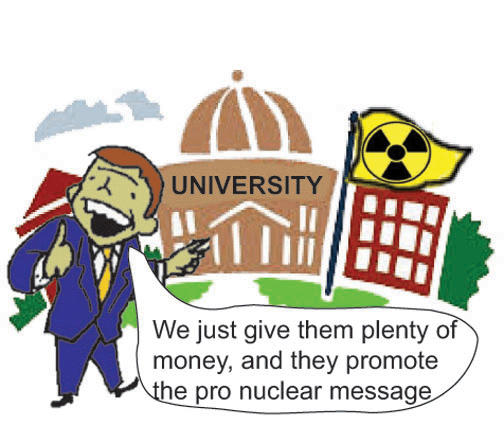
Leaving aside such platitudinous nonsense as “sovereign capability” – the technology, expertise, control and guidance over this new promised machinery will always be directed from Washington – the sentiments are clear. The military-industrial-university complex is a matter to be celebrated. There are, for instance, “other parts of AUKUS” that will involve “our top universities” in such areas as “advanced research cyber security, artificial intelligence and quantum technologies.”
Bizarrely, Dodd gets the question about academic freedom the wrong way around: that expressing a choice in favour of the blatant war drumming of AUKUS is something that should be one for academics. If he had any idea about despotic university environments, he would be aware that academics, whatever they agree with, will have little say in the matter. Distant, estranged managements, unaccountably enthroned in administrative towers, will be making such decisions for them; the only real free expression will be exercised by those opposing the measure.
Former Pacific leaders blast Australia over nuclear powered submarine deal
https://www.abc.net.au/pacific/programs/pacificbeat/aukus-pacific/102211602 13 Apr 23, A group of former Pacific leaders have blasted Australia’s nuclear-powered submarine deal with the United States and the United Kingdom.
Marshall Islands’ Hilda Heine, Palau’s Tommy Remengesau, Tuvalu’s Enele Sopoga Kiribati’s Anote Tong say the “staggering $368 billion” allocated for the deal flies in the face of Pacific island countries which are crying out for support for climate change.
They accuse Australia and its two allies of triggering an arms race and demonstrating a complete lack of recognition for the climate change security threat faced by the island nations.
Former Kiribati President Anote Tong said Australia and its allies need to do more consultations with the Pacific before the plan develops further.
Corruption in the Ukraine government, as Zelensky skims $millions from USA for diesel, while buying cheap diesel from Russia.

“Zelensky’s been buying discount diesel from the Russians,” one knowledgeable American intelligence official told me. “And who’s paying for the gas and oil? We are. Putin and his oligarchs are making millions” on it.
Many government ministries in Kiev have been literally “competing,” I was told, to set up front companies for export contracts for weapons and ammunition with private arms dealers around the world, all of which provide kickbacks.
TRADING WITH THE ENEMY Amid rampant corruption in Kiev and as US troops gather at the Ukrainian border, does the Biden administration have an endgame to the conflict? Seymour Hersh, Substack, Apr 12
The Ukraine government, headed by Volodymyr Zelensky, has been using American taxpayers’ funds to pay dearly for the vitally needed diesel fuel that is keeping the Ukrainian army on the move in its war with Russia. It is unknown how much the Zelensky government is paying per gallon for the fuel, but the Pentagon was paying as much as $400 per gallon to transport gasoline from a port in Pakistan, via truck or parachute, into Afghanistan during the decades-long American war there.
What also is unknown is that Zelensky has been buying the fuel from Russia, the country with which it, and Washington, are at war, and the Ukrainian president and many in his entourage have been skimming untold millions from the American dollars earmarked for diesel fuel payments. One estimate by analysts from the Central Intelligence Agency put the embezzled funds at $400 million last year, at least; another expert compared the level of corruption in Kiev as approaching that of the Afghan war, “although there will be no professional audit reports emerging from the Ukraine.”
“Zelensky’s been buying discount diesel from the Russians,” one knowledgeable American intelligence official told me. “And who’s paying for the gas and oil? We are. Putin and his oligarchs are making millions” on it.
Many government ministries in Kiev have been literally “competing,” I was told, to set up front companies for export contracts for weapons and ammunition with private arms dealers around the world, all of which provide kickbacks. Many of those companies are in Poland and Czechia, but others are thought to exist in the Persian Gulf and Israel. “I wouldn’t be surprised to learn that there are others in places like the Cayman Islands and Panama, and there are lots of Americans involved,” an American expert on international trade told me.
The issue of corruption was directly raised with Zelensky in a meeting last January in Kiev with CIA Director William Burns. His message to the Ukrainian president, I was told by an intelligence official with direct knowledge of the meeting, was out of a 1950s mob movie. The senior generals and government officials in Kiev were angry at what they saw as Zelensky’s greed, so Burns told the Ukrainian president, because “he was taking a larger share of the skim money than was going to the generals.”
Burns also presented Zelensky with a list of thirty-five generals and senior officials whose corruption was known to the CIA and others in the American government. Zelensky responded to the American pressure ten days later by publicly dismissing ten of the most ostentatious officials on the list and doing little else. “The ten he got rid of were brazenly bragging about the money they had—driving around Kiev in their new Mercedes,” the intelligence official told me………………………………………………………………………….. https://seymourhersh.substack.com/p/trading-with-the-enemy?utm_source=post-email-title&publication_id=1377040&post_id=114123549&isFreemail=false&utm_medium=email
CONTAINING THE BOMB: AN ASSESSMENT OF NUCLEAR WEAPONS FREE ZONES – Australia is especially problematic

Australia poses a unique challenge to the SPNFZ due to its defensive alliance with the United States.
Australia is in a dilemma then of being a party to the SPNFZ and an ally of an NWS poised to potentially assist in a nuclear attack.
The Australia, New Zealand, and the United States Security Treaty (ANZUS) was signed in 1951, joining the three nations in a collective security arrangement.18 New Zealand banned nuclear-powered vessels in 1984 and later created its own nuclear-free zone with the passage of the New Zealand Nuclear Free Zone, Disarmament, and Arms Control Act 1987. In response, the Reagan Administration suspended New Zealand’s obligations under the ANZUS Treaty.19 Australia remains a party.
Center for International Maritime Security, By LtCol Brent Stricker
This article is part of a series that will explore the use and legal issues surrounding military zones employed during peace and war to control the entry, exit, and activities of forces operating in these zones. These works build on the previous Maritime Operational Zones Manual published by the predecessor of the Stockton Center for International Law, the International Law Department, of the U.S. Naval War College. A new Maritime Operational Zones Manual is forthcoming.
Nuclear Weapons Free Zones (NWFZ) are an attempt to prohibit the use or deployment of nuclear weapons within a nation’s territory. None of the signatories to these treaties possess nuclear weapons, where NFWZs stand as a pledge not to develop these weapons. The established nuclear powers of the world have similarly pledged to respect some NFWZs.1 It remains to be seen whether such pledges will be observed or dismissed as a simple “scrap of paper.”2
Background
The legality of the use of nuclear weapons is an unsettled issue. The International Court of Justice issued an advisory opinion stating the threat or use of nuclear weapons must be examined under the United Nations Charter Article 2(4) prohibition on the use of force and Article 51’s right of self-defense.3 The Court could not “conclude definitively whether the threat or use of nuclear weapons would be lawful or unlawful in an extreme circumstance of self-defense in which the very survival of the state was at stake.”4
The Nuclear Non-Proliferation Treaty (NPT) was an early attempt to limit and eventually eliminate nuclear weapons. Article 1 of the NPT prohibits Nuclear Weapons States (NWS) from transferring nuclear weapons to a Non-Nuclear Weapon State (NNWS) or encouraging a NNWS to develop nuclear weapons. Article 6 of the NPT requires states to “pursue negotiations in good faith on effective measures relating to cessation of the nuclear arms race at an early date and to nuclear disarmament, and on a treaty on general and complete disarmament under strict and effective international control.”
Since the signing of NPT, the number of NWS has expanded. Two of the newly acknowledged nuclear powers, India and Pakistan, never signed the treaty. North Korea signed and subsequently withdrew. Finally, Israel, a suspected and unacknowledged nuclear power, never signed the treaty.5……………………………………………………………………..
Current Nuclear Weapons Free Zones
There are currently nine NWFZs in existence. Five of these were created by regional agreements. Three of them were created by international treaty but only occur in unpopulated areas: Outer Space, the Moon, and the seabed. The last NWFZ was created unilaterally by Mongolia. NWFZs cover more than two billion people and 111 countries.13
African NWFZ (ANWFZ)
The Treaty of Pelindaba established the African NWFZ. It was opened for signature on April 11, 1996, and came into effect on July 15, 1990.[14] Article 3 of the treaty renounces nuclear weapons, and the signatories pledge “not to conduct research on, develop, manufacture, stockpile or otherwise acquire, possess or have control over any nuclear explosive device by any means anywhere” and “not to seek or receive any assistance in the research on, development, manufacture, stockpiling or acquisition, or possession of any nuclear explosive device.” Article 4 is a prohibition on stationing nuclear weapons on their territory, but it allows individual nations the ability to allow foreign aircraft and ships to visit or exercise innocent passage without reference to whether such aircraft and ships may be armed with nuclear weapons. This thereby creates a loophole allowing nuclear weapons within the NWFZ…………………………………………….
South Pacific NWFZ (SPNFZ)
The Treaty of Rarotonga established the South Pacific Nuclear Free Zone. It was signed on August 6, 1985, and came into effect on December 11, 1985. All five acknowledged NWS have signed onto its Protocols. Annex 1 to the treaty describes the South Pacific Nuclear Free Zone, which includes both territorial land, waters, and the high seas. Article 3 of the treaty pledges signatories “not to manufacture or otherwise acquire, possess or have control over any nuclear explosive device by any means anywhere inside or outside the South Pacific Nuclear Free Zone” and “not to seek or receive any assistance in the manufacture or acquisition of any nuclear explosive device.” Article 5 prohibits stationing nuclear weapons on the territory of signatory states.
Article 5 also includes a loophole allowing signatory states to allow visits and transit by foreign aircraft and ships that may be armed with nuclear weapons. Article 7 includes a prohibition on dumping radioactive matter within the SPNFZ.”16
A second loophole appears in Article 3(c) of the treaty. There is no prohibition on the research of nuclear weapons. This leaves signatories the option to research nuclear weapons. The most likely being Australia if it needs to rapidly develop such weapons for nuclear deterrence.17
Australia poses a unique challenge to the SPNFZ due to its defensive alliance with the United States. The Australia, New Zealand, and the United States Security Treaty (ANZUS) was signed in 1951, joining the three nations in a collective security arrangement.18 New Zealand banned nuclear-powered vessels in 1984 and later created its own nuclear-free zone with the passage of the New Zealand Nuclear Free Zone, Disarmament, and Arms Control Act 1987. In response, the Reagan Administration suspended New Zealand’s obligations under the ANZUS Treaty.19 Australia remains a party.
Australia has publicly stated in its 2017 Foreign Policy White Paper it would rely on the deterrence power of the United States’ nuclear weapons.20 Australia also hosts US military installations that are vital to worldwide command and control.21 Undoubtedly, these facilities would be part of the Communication, Command, Control, and Intelligence (C3I) the United States would rely on during a nuclear crisis. Australia is in a dilemma then of being a party to the SPNFZ and an ally of an NWS poised to potentially assist in a nuclear attack. The treaty does not address this issue of C3I by a signatory state, with Article 3(c) only prohibiting the manufacture or acquisition of nuclear weapons.22…………………
Southeast Asian NWFZ (SEANWFZ)
The Bangkok Treaty established the Southeast Asian Nuclear Weapon Free Zone. The treaty was signed on December 15, 1995, and went into effect on March 28, 1997. The ten members of the Association of South East Asian Nations (ASEAN) agreed not to “develop, manufacture or otherwise acquire, possess or have control over nuclear weapons; station or transport nuclear weapons by any means; test or use nuclear weapons.”23 The Treaty also prohibited control, stationing, or testing of nuclear weapons in the SEANWFZ.24 The Bangkok Treaty thus closed the visit, transit, research, and control loopholes for vessels and aircraft with nuclear weapons.
Finally, the Bangkok Treaty prohibited dumping or discharging into the atmosphere of radioactive material or waste.25
The SEANWFZ is striking due to the size of the zone defined in the treaty. The zone is expanded to include the continental shelf and exclusive economic zones of the signatory nations.26 The Zone embraces an area of strategic importance to maritime shipping. The treaty would prevent the 5 NWS from transporting nuclear weapons through this zone. This is likely why no NWS has signed onto the treaty’s protocols and provides a negative security assurance to the ASEAN signatories.27
Central Asian NWFZ (CANWFZ)
The Central Asian Nuclear Weapons Free Zone was created by the Treaty of Semipalatinsk. The treaty was signed on September 8, 2006, and went into effect on Mar 21, 2009. The CANWFZ is defined as the land, internal waters, and airspace of the signatories.28 Kazakhstan, Kyrgyzstan, Tajikistan, Turkmenistan, and Uzbekistan, all former Soviet Republics, agreed to prohibit research, development, manufacture, stockpiling, acquisition, possession, or control over any nuclear weapon. The treaty also prohibited the location of such weapons in the zone. ………………………
Kazakhstan, Kyrgyzstan, and Tajikistan have a similar problem to Australia noted above. They are members of the 1992 Tashkent Collective Security Treaty, which includes the Russian Federation, one of the five acknowledged NWS. Article 4 of the treaty requires the Member States to provide all assistance, including military assistance, if one member is attacked.29 It remains to be seen how this will affect the CANWFZ.
Mongolian NWFZ
The Mongolian Nuclear Weapons Free Zone is unique as a unilateral action by domestic law similar to the New Zealand Nuclear Free Zone noted above. Mongolia made this declaration in 1992 and called for a regional NWFZ.30 This seemed improbable as Mongolia is surrounded by the Russian and Chinese NWS. The Mongolian NWFZ was recognized with UN General Assembly Resolution 53/77 D.31
Mongolia’s history makes its NWFZ unique, considering it was caught between the two struggling NWS for most of its existence…………………………………………
Latin American and the Caribbean NWFZ
The Treaty of Tlatelolco created the Latin American NWFZ. It was signed on February 1967 and went into effect on April 25, 1969. Article 1 of the treaty prohibits “the testing, use, manufacture, production or acquisition, by any means, of any nuclear weapon [signatory states] by order of third parties or in any other way,” and “the receipt, storage, installation, location or any form of possession of any nuclear weapon, directly or indirectly, by [signatory states], by mandate to third parties or in any other way.”
The Latin American and Caribbean NWFZ has a similar problem shared by Australia and the CANWFZ due to the mutual defense obligations imposed by the Inter-American Treaty of Reciprocal Assistance. This treaty was signed in 1947 by all of the states in North and South America, including the nuclear-armed United States. While it may be in decline with the withdrawal of member states and attempts to replace this treaty with sub-regional treaties, it remains valid international law.
Antarctica, the Moon, and Seabed NWFZ
It is interesting to note that the first NWFZs were created in places that humans normally do not inhabit: Antarctica, Outer Space, and the deep seabed. Article V of the Antarctic Treaty prohibits nuclear explosions or the dumping of radioactive material on the continent. Article IV of the Outer Space Treaty prohibits the stationing of nuclear weapons or weapons of mass destruction in space or on celestial bodies. This prohibition also prohibits the militarization of celestial bodies. The Outer Space Treaty does not address military activities in orbit, though. Article I of the Seabed Arms Control Treaty prohibits the emplacement of nuclear weapons and other weapons of mass destruction including structures to test, launch, or store such devices on the deep seabed.
It has been speculated that support for these NWFZs by the five acknowledged NWS was to limit the area to deploy nuclear weapons and the increased pressure on the arms race this would impose.36 The strategic value of making Antarctica off-limits for nuclear weapons seems to belie this argument since all NWS, acknowledged or not, are located in the Northern Hemisphere. The future possibilities for weaponizing outer space may render the Space NWFZ irrelevant.
2017 United Nations Nuclear Prohibition Treaty
The Treaty on the Prohibition of Nuclear Weapons could create the largest NWFZ in the world. It was proposed on 23 December 2016 with UN General Assembly Resolution 71/258. It was open for signature on September 20, 2017, and in effect on January 22, 2021.37 The NWS acknowledged and unacknowledged, do not support the treaty.38
Under Article 1 of the treaty: “Each State Party undertakes never under any circumstances to:
(a) Develop, test, produce, manufacture, otherwise acquire, possess or stockpile nuclear weapons or other nuclear explosive devices;
(b) Transfer to any recipient whatsoever nuclear weapons or other nuclear explosive devices or control over such weapons or explosive devices directly or indirectly;
(c) Receive the transfer of or control over nuclear weapons or other nuclear explosive devices directly or indirectly;
(d) Use or threaten to use nuclear weapons or other nuclear explosive devices;
(e) Assist, encourage or induce, in any way, anyone to engage in any activity prohibited to a State Party under this Treaty;
(f) Seek or receive any assistance, in any way, from anyone to engage in any activity prohibited to a State Party under this Treaty;
(g) Allow any stationing, installation, or deployment of any nuclear weapons or other nuclear explosive devices in its territory or at any place under its jurisdiction or control.”
………………………………… more https://cimsec.org/containing-the-bomb-an-assessment-of-nuclear-weapons-free-zones/
1 This month
17 October, Free Public Talk on Nuclear Issues in South Australia
David Noonan will speak on public interest concerns over the new Roxby Downs Indenture Act 2026 on BHP copper-uranium mining and ore processing in SA, and on how AUKUS may face SA with a High-Level nuclear waste agenda.
Dr Jim Green will discuss international developments in the field of nuclear power including ‘small modular reactors’ and Generation 4 ‘advanced’ nuclear reactor concepts.


Help Aunty Sue Protect Her Land and Sacred Sites From Destructive Rocket Testing.
.

Australians deserve the truth
about
AUKUS – https://aukuspublicinquiry.com/

PETITION – To: Prime Minister Anthony Albanese and the Australian Labor Government

of the week – Australians for War Powers Reform (AWPR)
To see nuclear-related stories in greater depth and intensity

