Editorial Geppetto logic
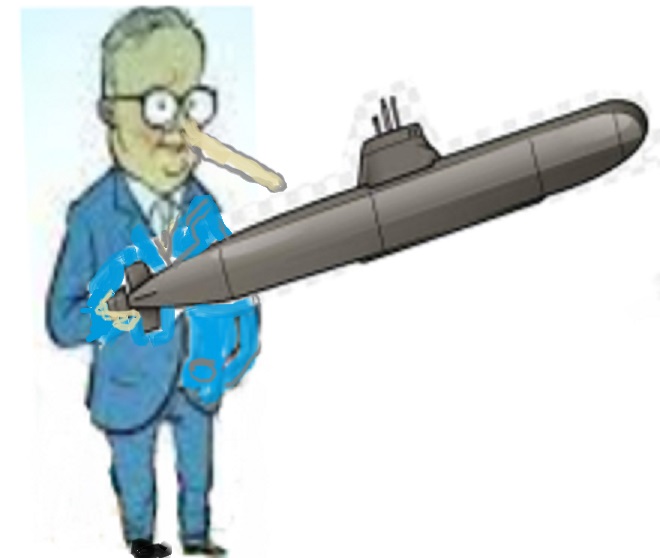
Saturday Paper 18 Mar 23 https://www.thesaturdaypaper.com.au/opinion/editorial/2023/03/18/geppetto-logicThere is something perverse about the prime minister announcing he will spend $368 billion to make Australia less safe – and for the press to record this as an act of political genius. It’s like a child announcing he has fouled himself at the dinner table only for his parents to tell him how clever he is.
Uncle Sam, can you target my Tomahawk, please?

“Will Australian air warfare destroyers serve simply as a transport means and launch platform for the United States, receiving targeting data only with their agreement? Or will we have full targeting control over our Tomahawks?
by Rex Patrick | Mar 18, 2023 https://michaelwest.com.au/uncle-sam-can-you-target-my-tomahawk-please/
Who will control the Tomahawk Missiles? News that Australia will purchase up to 220 Tomahawk Land Attack Missiles might seem like just another Defence purchase, but there’s a hidden sovereignty issue that needs to be examined. And that’s what Rex Patrick is here to do.
The United States Congress has just approved the sale of as many as 20 Block IV Tomahawks and 200 Block V Tomahawks for $1.3 billion dollars. The US will provide support consisting of unscheduled missile maintenance, spares; procurement, training, in-service support, software, hardware, communication equipment, operational flight test, engineering, and technical expertise.
Tomahawk missiles are a long range, all weather, subsonic cruise missile used to attack land targets. The intention is for these proven and highly effective missiles to be fitted to our navy’s three Air Warfare Destroyers. But while these missiles will be fitted to our ships and be under Australian command, the ability to target them properly may be constrained by the US.
The purchase raises a sovereignty issue which must be bought out in the open and discussed.
We’re going to war tomorrow
I was in the United States in October 2001, just after 9/11. America was in shock. On the evening of October 5th, I was in a US Defence establishment working back late, hoping to be able to complete the task I was there to do so that I could return home to Australia.
My American host, sitting in front of his classified computer system, looked up at me and said, “America’s going to attack someone this weekend.”
I looked back at him and asked, ”You’ve got a classified email message telling you that?”
“No,” he replied, pointing out the window, “See that building over there. That’s where they program the Tomahawk missiles. It’s 6pm on a Friday night, and the car park’s full.”
Less than 48 hours later, the US launched Operation Enduring Freedom with a series of, amongst other things, Tomahawk missile strikes.
Guidance required
Tomahawks are used to attack land targets to incapacitate enemy command & control facilities, strategic air defences, intelligence systems, infrastructure, key production facilities and military forces.
They are normally fired as part of a joint operation with targeting information provided by strategic commanders onshore and coordinated in time and space to produce a synergistic attack.
The missiles use GPS and terrain contour matching to navigate to the target, and a ‘Digital Scene Matching Area Correlation’ to improve navigation in the terminal stages leading to accuracies of the order of ten metres.
Two stages of planning are conducted for the Tomahawk. Planning for the maritime cruise (overwater) phase is normally carried out by the launch platform, our air warfare destroyers’ crew, cognisant of the current surface and air picture.
Programming of the land cruise (overland) phase and target selection is normally carried out by a ‘Theatre Mission Planning Centre’ (TMPC) ashore (like the one my US colleague and I were looking through the window at) or a shipboard Tactical Tomahawk Weapon Control System (TTWCS). Australia is receiving both from the US.
The onshore centre and shipboard TTWCS also provide for post launch control of the weapons.
The US TMPC has a worldwide geospatial database that allows for them to plan strikes. Whether Australia has unfettered and unblockable access to this, or an indigenous alternative, is not known.
Whether we do or don’t is the answer to whether we will have full sovereign control over targeting.
“Will Australian air warfare destroyers serve simply as a transport means and launch platform for the United States, receiving targeting data only with their agreement? Or will we have full targeting control over our Tomahawks?
Sovereign capability
The first priority of the Australian Defence Force (ADF) is defence of Australia. Every capability we acquire should come with the keys to allow ADF commanders to use capabilities in their possession as they see fit.
Questions of sovereignty are swirling around the entire AUKUS program; submarines, and now missiles. I hope my former colleagues in the Senate will ask the right questions.
Despite UK government’s enthusiasm, nuclear power is just not a good investment

Investment industry lukewarm on confirmation of nuclear in UK taxonomy.
One London-based funding manager warned that the industry’s problems were
economic not environmental. A sustainability figure at one large UK fund
manager said the nuclear industry’s ability to attract capital has not
primarily been about having to manage an unattractive ESG profile. “It is
incredibly expensive and un-cost competitive when compared to the
alternatives”.
Responsible Investor 14th March 2023
https://www.responsible-investor.com/investment-industry-lukewarm-on-confirmation-of-nuclear-in-uk-taxonomy/
Seymour Hersh warns of potential US plan B in Ukraine
Washington could clash with Moscow’s forces if Kiev starts to lose, the veteran journalist argues
https://www.rt.com/russia/572993-seymour-hersh-ukraine-conflict-future/ 17 Mar 23
The US could get directly involved in the Ukraine conflict if it sees that Kiev’s forces are on the back foot, Pulitzer Prize-winning reporter Seymour Hersh suggested on Tuesday.
Speaking at an event in Washington, DC hosted by the Committee for the Republic, a non-profit organization, Hersh noted that the US “did stupid things” during the Vietnam War, and suggested that Washington could “start doing something else” in the Ukraine conflict.
I don’t know what happens if it goes bad for Ukraine, you have all this manpower,” he said, pointing out that the US has dispatched units of its 82nd and 101st elite airborne divisions close to the Ukrainian border, while “a lot of weapons and arms are coming” to Europe.
“I’m told the game is going to be: this is NATO, we are supporting NATO in offensive operations against the Russians, which is not going to fool the world… It’s us fighting Russia,” Hersh stressed, without disclosing his sources.
According to Hersh, “the big deal” is that Russian President Vladimir Putin is ready to come to an agreement with the Ukrainian government. “The deal is demilitarize, and it’s going to be a no-go for us,” the journalist said, adding that the Russian leader “has not put in his main force yet” in the conflict.
Summing up the Ukraine conflict, Hersh argued that “we just may be kidding ourselves what’s going on there and what the results are going to be”.
He recalled the battle of Stalingrad during WWII, when Soviet troops suffered heavy losses but still emerged victorious. “Come on. Do we really want to mix up with those guys? I don’t think so,” the journalist added.
In February, Hersh released a bombshell report on last September’s Nord Stream 1 and 2 gas pipeline blasts, accusing Washington of orchestrating the attack. The White House denied responsibility. Last week, several Western media outlets claimed the culprits may have been linked to Ukraine. Moscow dismissed the reports as “a coordinated media hoax campaign.”
Russia has repeatedly voiced concerns about the eastward expansion of NATO and its involvement in the Ukraine conflict. Last month, Kremlin Press Secretary Dmitry Peskov stated that NATO “is no longer acting as our conditional opponent, but as our enemy” as it conducts round-the-clock intelligence operations against Moscow and continues to supply Kiev with arms.
Deborah Pergolotti – Submission to Senate refutes Senator Canavan’s introductory speech.

Re Environment and Other Legislation Amendment (Removing Nuclear Energy Prohibitions) Bill 2022
Submission 56
Senator Canavan and sponsors to the following bill:
Environment and Other Legislation Amendment (Removing Nuclear Energy Prohibitions) Bill 2022
Firstly, I need to confirm this is a personal communication and not on behalf of any organisation.
On the one hand, I need to congratulate you for recognising that this current overwhelming push for
renewables is ill-conceived, problematic, and will only hurt Australia’s future as well as worsen the situation
for biodiversity losses
On the other hand, nuclear power is NOT a desirable alternative to head towards. I would like to address
some of the components in the bill’s introductory speech by Senator Canavan. The statements in italics are
taken from the Senator’s speech.
“Of the 20 richest nations in the world only three do not have nuclear power: Australia, Saudi Arabia and
Italy. Saudi Arabia is building a nuclear power station and Italy gets much of its imported electricity from
France, where three quarters of the electricity is produced by nuclear.”
Italy has a very good reason for not building nuclear power: they have a major fault line running up the
center of the country (and the Saudi’s should be cautious as well since they are sitting on top of a subduction
zone). Anyone who builds a nuclear facility close to an active fault line is negligent, reckless or at minimum
ignorant. This will become very apparent in the US once their Cascadia, San Andreas and New Madrid fault
zones next adjust (expected soon) as they have built dozens of plants in fault zones.
“Nuclear plants are generally characterised by large capacity and output, high capital cost, and long
construction times, but relatively low operating costs and almost zero emissions to air from their operation.”
Unless there is an accident and then they pose a threat to all living things downwind for hundreds of years.
‘Accidents’ can be defined in many ways such as human error, seismic activity, tsunami’s (Fukushima),
design flaws (Chernobyl), poor maintenance issues (Three Mile Island), the modern scourge of hackers – or
the provocations of a hostile actor (such as what nearly happened in Ukraine at the Zaporizhzhia facility). In
our current hostile world where we are very close to a full-blown third world war, any country with a nuclear
power plant becomes an easy target for any aggressor who doesn’t even need to possess nuclear weapons of
their own. All they need a is a simple device directed at a plant and a major disaster results. Perhaps nuclear
might have been a reasonable option back in the 60’s but the current hostile and deceptive actors ‘running
things’ now makes nuclear a huge liability. Australia has been smart to avoid this scenario thus far,
regardless of the uranium resources we possess.
“Nuclear energy is used to produce electricity in 31 countries from some 450 nuclear reactors, providing
around 10 per cent of global electricity. Many nations are building new nuclear power plants because they
provide reliable, emission free power.”
There is a misguided focus on emissions but the focus is on the WRONG emissions. Carbon is not the
enemy and is needed by all vegetation on the planet. So focusing on nuclear as way to reduce emissions is
irrelevant. This fixation on carbon driven by deleterious wealthy influences overseas that Australia should
NOT be paying attention to is only meant to transfer wealth – not save the planet (you can tax carbon but you
can’t tax the cold or solar output). I recognise that at least some of you have come to acknowledge that the
‘health crisis’ thrust upon us the past two years was a planned deception. Rest assured this AGW is another
distraction and will result not only in wealth transfer but the diminishing of Australia to that of a ‘banana
republic’. Coal has its problems but the emissions that need to be controlled from coal are the dusts and heavy metals that are dispursed such as mercury and arsenic. Are you aware that bioaccumulative fish from
around the supposedly ‘clean’ waters of Qld’s barrier reef are loaded with mercury which would have come
from power plants further down the coast? Until the poor performance problems of renewables can be
solved (if ever), we are safer sticking with coal and focusing our efforts into filtering out the heavy metals
from their exhausts. At least if some foreign actor decides to target them, the plant will be damaged but it
won’t be spreading clouds of radiation throughout the southern hemisphere. (Please note I have not argued
about gas – this is not our saviour either with its high levels of methane leaching, explosive nature and
induced seismicity – refer to current quake swarm in Texas.) While the demand for electricity just continues
to skyrocket (insert electric cars here), we can’t be eliminating the only generators that will produce enough
to satisfy an ever increasing demand.
“Nuclear power is safe.”
Only when all conditions with the facility are perfect and no outside factors interfere with its operation. It
doesn’t take all that much to turn it from stable to meltdown. The more complicated the system, the easier it
is to make it fail. The Three Mile Island meltdown was caused by a faulty relief valve. The explosion of the
NASA Challenger mission was caused by a faulty O-ring (a little ring of rubber on a cylinder).
“Nuclear does less damage to the natural environment than other energy options. Wind energy takes up 250
times more land than nuclear power and solar takes up 150 times more land.”
I agree that renewables should NOT be rolled out until the problems they create are fixed. There seems to be
no due diligence being included in the rush to deliberately de-energise our power generation. But incidents
with nuclear radiation can be unfixable. We have not yet invented a means of removing radiation from the
atmosphere.
Also, what you have left out of your speech is the disposal issue. Where is all this radioactive waste
supposed to be disposed of and how is it to be contained so that unforseen factors (earthquakes, hostile
attacks) don’t disturb it? You have focused on the operation only of a nuclear power plant but not the
consequences of accidents and disposal of waste. These need to be part of the evaluation and due diligence.
“The ARPANS Act regulates activities undertaken by Commonwealth entities affecting radiation, to ensure
that the health and safety of people, and the environment, are protected from the harmful effects of
radiation.”
The only way any authority in this country can protect the people and environment from radiation that would
result from a ‘disturbance’ to the plant is to not have nuclear power at all. https://www.aph.gov.au/Parliamentary_Business/Committees/Senate/Environment_and_Communications/Nuclearprohibitions/Submissions
TODAY. Nuclear wastes 30 years away. So -no problem for present decision-makers – happily superannuated when the shit hits the fan
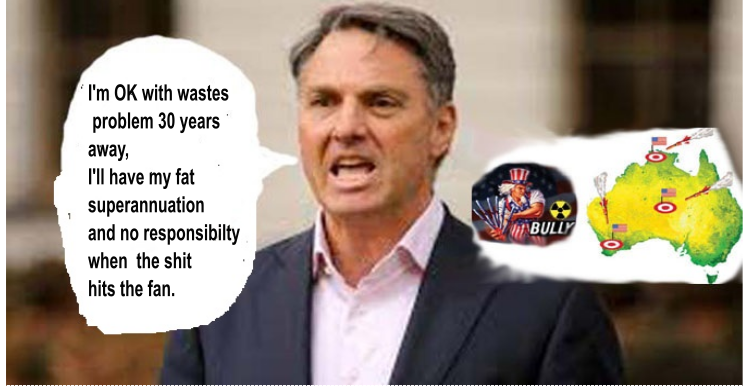
The lovely thing about being a Minister in the Parliament, indeed being an MP , especially in the Labor Party, is that you don’t have to take responsibility for the consequences of any decision that you, and the Party have made.
In 2021, the Australian Labor Party – Anthony Albanese, Penny Wong, Richard Marles etc , had the opportunity to oppose the Morrison government’s crackpot plan for buying nuclear submarines (which will be obsolete before they ever come into operation). But no – the Labor opposition had to show themselves to be just as tough against China as the corrupt and crackpot Liberal government.
Good little Party loyalists, – Labor has to stick to a decision, however silly.
So now in government, they complacently plunge Australia into a super-expensive, super-dangerous, nuclear submarine provocation against China. Australia is now locked into joining USA whenever it decides to goad China into action to fully incorporate Taiwan. (Both USA and Australia recognise Taiwan as politically part of China, but that apparently doesn’t matter.)
The nuclear industry is now gloating – having long held the aim of turning Australia into the world’s nuclear waste dump, At least there will now be this foot in the door for them.
Who’s going to oppose a nuclear waste dump in Australia? The media will welcome it, and scream “Jobs Jobs Jobs”. ( If it were a napalm factory for burning Vietnamese children, they’d still rejoice – “Jobs Jobs Jobs“)
The big opposition to nuclear waste dumping in Australia has always come from the Aborigines.
If the nuclear lobby can’t buy the indigenous people, then they just ignore them, as second rate citizens. Hell they weren’t even citizens at all, when their homes were bombed by the UK nuclear tests.
But any way that you look at it, the great comfort for the government decision-makers, is that they can comfortably retire, without any worries about things like a toxic waste dump, that they could have prevented,- NOT THEIR PROBLEM !
What the nuclear-powered submarine deal really means

Australia has made a very poor deal with its great power ally and has once again demonstrated that the framing of its Defence policy has little to do with national security and everything to do with burnishing Australia’s faithfulness to the US and the ANZUS alliance.
In this instance, the US has schooled Australia in the conduct of foreign policy – states advance their own interests, even at the expense of their friends. Well done, President Biden!
Australia has made a very poor deal with its great power ally and has once again demonstrated that the framing of its Defence policy has little to do with national security and everything to do with burnishing Australia’s faithfulness to the US and the ANZUS alliance.
The Saturday Paper, Albert Palazzo Adjunct professor at UNSW Canberra. He was a former director of war studies for the Australian Army. 18 Mar 23,
The deal is done. On Monday morning in San Diego, the leaders of the United States, Australia and Britain jointly revealed the key details of Australia’s road to becoming a nuclear power – of sorts. President Joe Biden announced that the US will sell Australia three to five used Virginia-class nuclear-powered submarines sometime in the 2030s. The three countries will also design a future boat, the tri-flavour SSN-AUKUS class, which will enter service from some time in the 2040s and extend into the 2050s. Australia will receive about five AUKUS boats by about 2055.
Prime Minister Anthony Albanese thanked President Biden for his administration’s willingness to share its nuclear propulsion technology, before – perhaps inevitably – spruiking the jobs that the program will create across the nation. Both leaders stressed that Australia’s submarines will be nuclear-powered, not nuclear-armed. The cost is an estimated $368 billion for an uncertain number of warships whose final arrival may be as long as four decades away.
What Albanese neglected to mention is that the deal effectively makes a massive shift to the foundation of Australia’s long-established Defence policy. …………………………
in this instance the submarine pact creates risks that, when combined, will actually make Australia less safe.
The government has been very clear that the target of the submarine acquisition is an increasingly assertive China. However, China is also Australia’s largest economic partner and responsible for much of the nation’s present wealth. In acquiring these weapons, Australia has sent an unmistakable message to its biggest customer. One risk Australia has accepted is that the submarine deal creates enough jobs in the shipbuilding sector to offset possible losses in mining, agriculture, education and tourism if China decides to spend elsewhere.
“Monday’s announcement brings an end to 70 years of a highly effective Defence policy, without any discussion with the Australian public or seemingly any awareness within the government … The submarine pact creates risks that, when combined, will actually make Australia less safe.”
Further, the pact is unlikely to result in greater physical security for Australia. Several more Australian communities, in addition to those in Pine Gap, Exmouth and Darwin, will find themselves on a Chinese target list. The government is yet to announce the home of these submarines, but wherever that is will become a legitimate target, as will support facilities.
Of greater significance to Australia’s security is the false claim that these submarines will enable us to deter China from taking actions that are not in our interest. Unfortunately, capability does not equate to deterrence. Rather it is perception of deterrence by the adversary that matters most. If at some point in the early 2040s Australia has all five of its Virginia-class boats within striking distance of Chinese targets, combined they will be able to launch – at most – 60 Tomahawk missiles. Australia may succeed in blowing up some Chinese missile launchers, cratering a runway or two, or even collapsing a few bridges or power plants, but this is a country with thousands of targets and plenty of physical redundancy. Psychologically, the Chinese people are strong: they endured the Great Leap Forward and the Cultural Revolution without cracking. For China, 60 missiles will barely be felt. These submarines may awe Australia’s leaders and national security commentators but they are not a credible deterrent against a power as large as China.
And though the missiles may not be felt, they will unfortunately be noticed. China will respond to Australia’s piffling attempt at deterrence with a larger number of missiles against our much smaller number of critical targets. We’ll feel it, alright.
In their glee to get these weapons, commentators seem to skate over the immensity of the nuclear submarine project’s cost. Admittedly, they are highly capable and powerful weapons, but $368 billion, even spread over decades, will reverberate through the Defence budget and beyond. The government will either have to massively increase expenditure from the present $48 billion (in this financial year), reduce expenditure on other projects or eliminate them entirely. The result will be that the ADF will remain a boutique force, but one now dominated by the nuclear-powered submarine niche, while the land and air forces will see reductions.
The acquisition of nuclear-powered submarines poses a risk to Australia’s sovereignty, too. ………………..
To succeed, Australia will need to rely on the US and Britain to assist in developing a usable and safe capability. Instead of increasing self-reliance, these ships will actually magnify dependence on Australia’s allies. ….
If this decision were to result in a larger allied submarine fleet, then the change in Defence policy and the taking of so many risks might be worthwhile. But it won’t. When Australia buys its three to five Virginias, it will simply reduce the US inventory. There is no fleet increase. It is simply a change-of-flag deal in which a highly experienced operator of nuclear submarines sells a part of its fleet to an L-plater. ………..
…….. Australia will also contribute $3 billion to improvements at US shipyards – again, increasing its commitment to the alliance.
……….Australia has made a very poor deal with its great power ally and has once again demonstrated that the framing of its Defence policy has little to do with national security and everything to do with burnishing Australia’s faithfulness to the US and the ANZUS alliance.
The submarine deal is more than just a function of Australia’s need to be seen to support the alliance, however. It is also because the US visualises security challenges only in military terms. Both the US and Australia are bypassing other levers of government power, such as trade and diplomacy, in the rush to solve a problem by force of arms alone. Until both governments broaden their definitions of national security strategy to include more than military affairs, this will no doubt continue.
Australia’s journey to nuclear-powered submarines will take a risk-filled route that will reshape our traditional Defence policy into one that increases alliance commitments yet offers less security. In this instance, the US has schooled Australia in the conduct of foreign policy – states advance their own interests, even at the expense of their friends. Well done, President Biden! https://www.thesaturdaypaper.com.au/opinion/topic/2023/03/18/what-the-nuclear-powered-subs-deal-really-means
Nuclear dump to be built on Defence land
14 March, 2023, Judy Skatssoon
The government has confirmed it will build a high level nuclear dump to deal with waste from its nuclear powered submarine program but says the location is yet to be decided.
Dealing with high level waste on Australian soil is part of the $368 billion AUKUS deal announced on Tuesday, which will see Australia build and operate eight nuclear powered submarines over the next 30 years.
Defence Minister Richard Marles said during a press conference on Tuesday that a purpose-built facility will have to be built to deal with waste generated by the submarines.
He admitted the government is yet to decide where the dump will be located but said it would be ‘quite some time’ before that bridge is crossed.
“There will be a process that we will determine within the next 12 months for how the site will be identified,” Mr Marles said.
“That’s to say we won’t identify the facility in twelve months’ time, but we will set up a process within the next twelve months for how that will be identified. But we’ve got time. We’ve got time to get this right, we’ve got time to identify the facility.”
30-year timeframe for decisions
It would be about 30 years before the first of the nuclear reactors that will power the subs will have to be disposed of, he said.
“So that is the timeframe. We will, in the course of the next year, announce a process by which that site will be identified. We’re not about to identify right now. And there is plenty of time in which to identify.”
He declined to say whether South Australia, where the SSN-AUKUS submarines will be built, or WA, which will eventually be home to the nuclear powered fleet, would be the site of a dump.
However, he indicated it will be on Defence land.
“We are committing to the fact that it will happen on Defence land, be it current Defence land or future Defence land,” the minister said.
He told the ABC the location would need to be remote from populations and geologically stable.
“We’re actually blessed with large parts of the country where that’s possible,” he said.
Spent nuclear reactors
Spent nuclear reactors will produce the highest level of nuclear waste, but this won’t need to be disposed of until after 2050, he said.
The first of those will be from the Virginia Class submarines being procured from the US, which will start operating in the early 2030s, Mr Marles said.
“It’s a significant undertaking to deal with the reactors at the end of their life, and this will require a purpose built facility in order to do that,” he said.
“So that people are clear, we’re talking about the first reactor needing to be dealt with in the 2050s, so this is a long way into the future.
“But we need to be planning for that, and what we’ve made clear today is that within the year we will announce a process by which that place will be identified – so we won’t identify the place in a year, but we’ll announce the process for that and what that facility would look like.”
Mr Marles did not answer questions about how many kilos of highly enriched uranium would need to be disposed of, telling the ABC that information was classified.
Australia was focused on dealing only with it’s own nuclear waste, and not that of its AUKUS partners the US and UK, the minister said.
Graeme Batterbury Submission to Senate – Keep the ban on nuclear power, and save the Earth.

Submission no. 64 re Environment and Other Legislation Amendment (Removing Nuclear Energy Prohibitions) Bill 2022
To Committee Secretary, Senate Standing Committees on Environment and Communications,
I implore you not to lift the ban on nuclear power!
Nuclear is the most expensive energy option available
Nuclear is slow. It can take decades to build and would require a decade or more to develop the
legislative framework
Nuclear is dangerous. Either through human error, disaster, or as a military target the catastrophic
consequences of a nuclear disaster would permanently pollute.
Nuclear is unwanted. There is long standing popular opposition to nuclear power in Australia
because of the issues above as well as the unsolved problem of nuclear waste and the link to nuclear
weapons.
Alternatives like renewables, storage and energy efficiency are faster, cheaper, more deployable and
enjoy much more public support.
Save the Earth.
Chinese official asks if Australia’s Aukus nuclear submarines intended for ‘sightseeing’
Multiple sources present confirm the remark was made, but it is unclear if it was made sarcastically
Daniel Hurst, Guardian, 17 Mar 23,
“……… The comment was made during a briefing held by the Department of Foreign Affairs and Trade on Wednesday at which dozens of representatives from other diplomatic missions were also present.
It is believed to have been made in the context of Beijing’s longstanding claims that the Aukus deal is a breach of either the letter or spirit of the Nuclear Non-Proliferation Treaty (NPT).
One source said a Chinese official at the briefing said words to the effect of: “What are these boats for? Sightseeing?”…….. The Chinese embassy has been contacted for a response.
The Australian government declined to comment………………………….
Australia, the US and the UK argue the NPT regime expressly allows for the transfer of naval nuclear propulsion technology, although they acknowledge this is the first time such a transfer has been made from a nuclear weapons state to a non-nuclear weapons country.
The Aukus partners say they are committed to negotiating a rigorous verification and safeguards package with the International Atomic Energy Agency to set the strongest possible precedent.
China, however, has argued such transfers should only be for peaceful uses.
China – a nuclear weapons state – has put nuclear non-proliferation concerns at the centre of its international campaign against Aukus, knowing that these issues have resonance in south-east Asia and the Pacific.
A Chinese foreign ministry spokesperson said this week that the Aukus countries were trying to “coerce the IAEA secretariat into making safeguards exemption arrangements, which would seriously undermine the authority of the body”…………………………………… more https://www.theguardian.com/world/2023/mar/16/chinese-official-asks-if-australias-aukus-nuclear-submarines-intended-for-sightseeing
AUKUS subs deal binds us to a country that can change its mind on whim
Clinton Fernandes, Academic and former intelligence officer, SMH 18 Mar 23
The AUKUS $368 billion submarine deal announced this week sets Australia on a trajectory from which it will be very difficult to depart.
The deal, in which Australia purchases submarines from the US and UK, means that those countries’ future is now intertwined with ours for decades. The danger is that our defence force winds up as a component of the US armed forces rather than a sovereign force.
The key word here is interoperability: to operate inside the strategy of a superpower by contributing a well-chosen, niche capability to augment the larger force. AUKUS means that the Australian Defence Force will be interoperable, even interchangeable, with US and British forces.
………………. A sub-imperial consciousness is intrinsic to Australian conceptions of security and identity, and remains at the heart of AUKUS, taking precedence over other goals such as defence self-reliance and cost.
Interoperability under AUKUS means that the submarines will be co-built with Britain, based on a British design, using American nuclear propulsion technology, combat systems and weapons……………………………………
Long-term interoperability with the US Navy implies long-term political alignment with the US. Australia has placed a very big bet on two unknowns: that the US’s internal political stability and the US-led global order will endure into the 2070s. We don’t get to vote in US elections, however, and it is obvious that in recent years it has developed a sharply polarised domestic landscape and the prospect of democratic erosion. Australia must take out some form of political insurance in the event we find ourselves tied structurally to an illiberal, unreliable power that changes its stance from one administration to another – something radically different to the America we have long been used to.
Insisting on parliamentary authorisation before military deployments (other than when we’re attacked and must respond in self-defence) is a good way to preserve Australian sovereignty.
….. But wars of choice and other overseas military deployments are an entirely different matter, as other US allies including Norway, Germany and the Netherlands recognise. The Australian parliament and people must remain in control, especially because of the geopolitical traps that lie in wait.
Submarine operations are arguably the most dangerous military operations of all, even in peacetime. Their margin for error is extremely small. A small fire, a flood, or a gas leak can have tragic consequences when you’re 200 metres underwater. Submarines are out of radio contact for extended periods of time. Their commanding officers are uniquely vulnerable to incidents that escalate quickly and seriously because they may be unable to seek guidance and direction from ashore. The diplomatic fallout and geopolitical consequences that result from such incidents can be grave.
“Sovereignty” isn’t just about operational control of a boat but about its principal purpose: in the case of AUKUS, that means fitting into the US combat force aimed at China…………..
Nor can we take for granted the US-led global order persisting into the 2070s. We are at the threshold of an emerging multipolar world order, one very different to the immediate aftermath of World War II, as well as to the US-led unipolar order after the Soviet Union dissolved itself. Our elected representatives must preserve genuine Australian sovereignty and ensure we are not automatically and irreversibly hitched to US objectives far into the future. https://www.smh.com.au/national/aukus-subs-deal-binds-us-to-a-country-that-can-change-its-mind-on-whim-20230316-p5cskq.html
“Great British Nuclear” launch – an eccentric fraud by the UK government.

UK to finally harness full power of green energy with new Great British
Nuclear scheme. Jeremy Hunt has confirmed nuclear power will be classed as
“environmentally sustainable” in a bid to boost investment in the energy
sector. The Chancellor said today he would launch “Great British Nuclear”
to bring down costs.
Andy Stirling, Professor of Science and Technology
Policy at the Science Policy Research Unit at the University of Sussex,
told Express.co.uk: “Amid the complete eclipse of nuclear power by
renewables, the position being taken by the UK Government is now growing so
eccentrically flawed as to become a major investment-threatening risk in
its own right. “To characterise nuclear as ‘cheap’ is to completely forego
credibility.
This is even more so, if promises are relied on around a new
generation of military-derived ‘small modular reactors’ that are
currently undeveloped, untested, unlicensed, unpiloted, unsited and
unbuilt.
“The National Infrastructure Commission confirms that renewables
and storage offer much more affordable, effective and rapid zero carbon
alternatives than even the most attractive nuclear options. The track
record of nuclear and renewables accentuate this picture.
“By attaching such a strong priority to nuclear power, the UK Government is not only
jeopardising economic, secure clean energy. With other nations prioritising
renewables more strongly, the UK thereby continues to forego the full
domestic employment and industrial benefits of unique UK renewable
resources.”
Express 15th March 2023
https://www.express.co.uk/news/politics/1746665/energy-crisis-nuclear-jeremy-hunt-budget
Transparent oceans? Technologies for detection of nuclear submarines will still be all too successful by 2050

Transparent Oceans? The Coming SSBN Counter-Detection Task May Be Insuperable
ANU National Security College https://nsc.crawford.anu.edu.au/publication/16666/transparent-oceans-coming-ssbn-counter-detection-task-may-be-insuperable
Abstract:
A first principles analysis of new technologies and the detection of nuclear-powered ballistic missile submarines (SSBNs).
Authors: Roger Bradbury, Scott Bainbridge, Katherine Daniell, Anne-Marie Grisogono, Ehsan Nabavi, Andrew Stuchbery, Thomas Vacca, Scott Vella and Elizabeth Williams.
This report considers the problem of disruptive changes in the technologies for detection of SSBNs and how they intersect with the growing or continued reliance on submarines for retaliatory nuclear capability. In simple terms, this report answers the question: Will future science and technology make the oceans transparent? It takes a scientific perspective and considers the science and technology issues bearing on ocean sensing and the detection of submarines as anomalies in the water column. This report utilises a time horizon spanning to the 2050s, as the next generation of nuclear-armed submarines will be deployed through the 2030s and beyond. Its analysis identified broad areas of future science and technology – rather than specific ‘hot’ areas of the moment – that might have an impact on submarine detection as well as on counter-detection.
This report makes two strong findings:
- Favourable geographies that the West took advantage of in the Atlantic during the Cold War, and more recently in the Pacific in its strategic rivalry with China, will not have the same salience in the 2050s as during the Cold War.
- The evolution of counter-detection technologies will not have the same salience in the 2050s as it did in earlier times. As a result, by the 2050s, this assessment shows, progress in counter-detection will only reduce the probability of detection from very likely to likely.
Publication file:
 Transparent Oceans? The Coming SSBN Counter-Detection Task May Be Insuperable
Because the U.S. says so – $368 Billion for nuclear subs!
Prime Minister Anthony Albanese has just committed Australia to spending $368 billion on second-hand US Virginia Class submarines, and a follow on build of eight next generation British AUKUS nuclear submarines. It’s a strategic blunder. The Story: https://michaelwest.com.au/i-just-wan… Patreon: https://www.patreon.com/TheWestReport Merch: https://lonelykidsclub.com/new/michae… Facebook: https://www.facebook.com/michaelwest…. Insta: https://www.instagram.com/michaelwest…
Paul Keating savages AUKUS nuclear submarine deal as Labor’s worst since conscription in World War 1

ABC, By political correspondent Brett Worthington. 15 Mar 23,
Former prime minister Paul Keating has taken aim at Australia’s AUKUS nuclear-powered submarine deal with the United States and the United Kingdom, calling it the “worst international decision” by a Labor government since conscription in World War I.
Key points:
- The AUKUS deal will see Australia spend up to $368 billion to acquire nuclear-powered submarines
- Mr Keating has dubbed it one of the worst deals in history
- He insists Australia should draw closer to China than to the United States and the United Kingdom
The former Labor leader also offered a scathing assessment of the government’s most senior politicians, including Prime Minister Anthony Albanese, Defence Minister Richard Marles, and Foreign Affairs Minister Penny Wong, dubbing Mr Marles and Senator Wong “seriously unwise ministers”.
“This week, Anthony Albanese screwed into place the last shackle in the long chain the United States has laid out to contain China,” Mr Keating said in a written statement issued before he addressed the National Press Club on Wednesday.
“No mealy-mouthed talk of ‘stabilisation’ in our China relationship or resort to softer or polite language will disguise from the Chinese the extent and intent of our commitment to United States’s strategic hegemony in East Asia with all its deadly portents.
“History will be the judge of this project in the end. But I want my name clearly recorded among those who say it is a mistake. Who believes that, despite its enormous cost, it does not offer a solution to the challenge of great power competition in the region or to the security of the Australian people and its continent.”
Mr Keating has been critical of the AUKUS defence pact since it was first struck between the three nations 18 months ago.
Mr Albanese met with US President Joe Biden and UK Prime Minister Rishi Sunak in California earlier this week, where they finalised a deal for Australia to buy and build nuclear-powered submarines, costing up to $368 billion over three decades.
Australia will eventually build British-designed nuclear-powered submarines with American combat systems.
Before that happens, Australia will buy at least three US nuclear-powered submarines early next decade — boats that might be second-hand and need US Congressional approval.
The Coalition has endorsed the deal.
“For $360 billion, we’re going to get eight submarines. It must be the worst deal in all history,” Mr Keating said………………………………
Mr Keating dismissed China’s growing military as posing a threat to Australia.
“Let me say this: China has not threatened us,” he said.
Mr Keating, who said he spoke for both Labor politicians and grassroots members who felt they could not speak out, said nothing short of a Chinese naval fleet heading for Australia should be considered a threat.
“We wouldn’t need submarines to sink an armada, an armada of Chinese boats and troop ships,” he told the press club. “We’d just do it with planes and missiles.”……………….. https://www.abc.net.au/news/2023-03-15/paul-keating-anthony-albanese-penny-wong-aukus-nuclear-china/102098142
1 This month
17 October, Free Public Talk on Nuclear Issues in South Australia
David Noonan will speak on public interest concerns over the new Roxby Downs Indenture Act 2026 on BHP copper-uranium mining and ore processing in SA, and on how AUKUS may face SA with a High-Level nuclear waste agenda.
Dr Jim Green will discuss international developments in the field of nuclear power including ‘small modular reactors’ and Generation 4 ‘advanced’ nuclear reactor concepts.


Help Aunty Sue Protect Her Land and Sacred Sites From Destructive Rocket Testing.
.

Australians deserve the truth
about
AUKUS – https://aukuspublicinquiry.com/

PETITION – To: Prime Minister Anthony Albanese and the Australian Labor Government

of the week – Australians for War Powers Reform (AWPR)
To see nuclear-related stories in greater depth and intensity

