South Australia may lead world in wind and solar, but leaky buildings will cause problems — RenewEconomy

Wind, solar and storage cannot address the energy transition cost-effectively without fixing thermally poor buildings and replacing inefficient electric appliances and gas. The post South Australia may lead world in wind and solar, but leaky buildings will cause problems appeared first on RenewEconomy.
South Australia may lead world in wind and solar, but leaky buildings will cause problems — RenewEconomy
Forrest and Cannon-Brookes shape up for control of Sun Cable, with or without sub-sea link — RenewEconomy

The future of Sun Cable will be decided by competing offers from Australia’s two richest men, and two different visions of the project’s future. The post Forrest and Cannon-Brookes shape up for control of Sun Cable, with or without sub-sea link appeared first on RenewEconomy.
Forrest and Cannon-Brookes shape up for control of Sun Cable, with or without sub-sea link — RenewEconomy
January 15 Energy News — geoharvey

Opinion: ¶ “Electrifying Everything Is A Critical Pathway To Decarbonize The World And Our Lives” • A number of organizations, such as the World Bank, have developed “pathways” or “pillars” for reaching net zero emissions globally by 2050. The core strategies are remarkably consistent, and one critically important pathway is electrifying everything. [CleanTechnica] Transmission lines […]
January 15 Energy News — geoharvey
Brian Toohey -on Australia’s new arms race
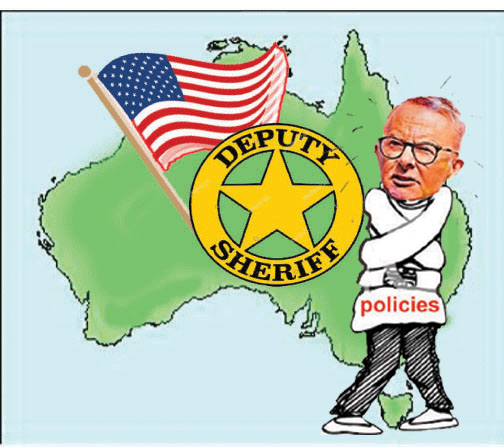
At the same time as the Australian government is trying to improve relations with China, it is greatly increasing spending on offensive weapons for a potential war with China – without adhering to any published treaty explaining the ground rules.
The Saturday Paper, 14 Jan 23
Australia has now joined the United States in refusing to discuss the ANZUS Treaty, let alone claim it is the foundation of Australia’s security. What was once seen as a virtue is now considered a drawback.
The perceived trouble is that the treaty bans the aggressive use of military force – something the US and Australia both use. Consequently, statements released during the Australia–US ministerial meetings on defence and foreign policy in early December did not mention ANZUS or its constraints. Instead, they refer favourably to the “rules-based international order” in which the US, not the United Nations, makes the rules.
In his subsequent comments on the need to build Australia’s military forces and welcome more American forces, Prime Minister Anthony Albanese made no reference to ANZUS. This is part of a trend in which Australian leaders cannot bring themselves to criticise recent harmful US breaches of the international rules on trade and investment.
Article 1 of the 1951 ANZUS Treaty requires the parties to “refrain in their international relations from the threat or the use of force in any manner inconsistent with the purposes of the United Nations”. Aggression is clearly inconsistent with the Charter of the UN, which states, “All members shall refrain from the threat or use of force.”
Labor’s then External Affairs minister, Bert “Doc” Evatt, played a significant role in establishing the UN in 1945 and served as its president from 1948-49. Initially, Labor gave enthusiastic support to ANZUS’s prohibition on aggression. No longer. The preferred “rules-based international order” doesn’t ban aggression, except presumably for countries such as Russia and China. Unlike with the ANZUS Treaty, no text of the new rules or the AUKUS pact is available.
Albanese won’t explain why he wants a large and hugely expensive arms build-up. In a media interview published on December 19, all he said was that we need to spend a lot more on defence because the need for new capabilities is so great. He did not explain why. He refuses to nominate a potential enemy. He merely says we need to spend more on our military to “promote peace and security in the region”.
Participating in an arms race is not necessarily the same as promoting peace. Yet Albanese refuses to invest in arms control measures – unlike the Hawke–Keating governments……………….
Albanese takes for granted that there’s no need to explain where the threat comes from – although the implication is, of course, China……………………
Perhaps China will start a major war within a few years. No one knows. Alternatively, it may put renewed stress on its policy of living in “Confucian harmony” with its neighbours.
Albanese lacks an informed grip on defence issues.
In the interview quoted above, he stated Australia must become more self-reliant in its defence, apparently unaware this is not possible because the US won’t give Australia the computer codes needed to operate American weapons systems and sensors. Nor will it show Australian technicians how to repair or modify any classified components.
This will get worse because of Albanese’s determination to buy eight American attack nuclear submarines for the Australian Navy. Because of the submarines’ extreme complexity, Australia won’t be able to operate them on its own. It may even have to let the US borrow them under the new “interchangeability” policy announced by Defence Minister Richard Marles………………………
Unlike noisy nuclear subs, the latest conventional ones are much cheaper and can operate silently for three or more weeks. ……………
There is no indication Albanese has warned the Americans not to use their forces in Australia for military aggression, in breach of the ANZUS Treaty and UN bans. Similar considerations apply to electronic intelligence facilities in Australia, which play a crucial role in war fighting…………………………
………successive governments have integrated Australian forces so tightly with their American allies – in the planning, training, doctrine, logistics and communications process – that the nation may find itself plunged into a devastating war between the US and China without parliament having the ultimate say after full consideration of the issues…………………..
At the same time as the Australian government is trying to improve relations with China, it is greatly increasing spending on offensive weapons for a potential war with China – without adhering to any published treaty explaining the ground rules.
…………………… Australia wants to deploy nuclear submarines close to China, so they can fire missiles into the Chinese mainland. Little thought appears to have been given to how fiercely China could retaliate…………………………….more https://www.thesaturdaypaper.com.au/opinion/topic/2023/01/14/australias-new-arms-race
Minister Madeleine King visits Australia’s proposed nuclear waste dump site – methinks the lady doth protest too much.

Peter Remta. 14 Jan 23 Minister visits Kimba to discuss Nationa Radioactive Waste Management Facility, 13 January 2023
Minister for Resources and Northern Australia, the Hon Madeleine King MP, has visited Kimba to meet with local community members and view the planned site for the National Radioactive Waste Management Facility.
It is going to be a long wait for another 10 years
The town of Kimba, on South Australia’s Eyre Peninsula, has been involved in more than seven years of consultation on the location of Australia’s National Radioactive Waste Management Facility.
Still have not provided a safety case or even details of the radionuclide inventories and activity of the intermediate level waste.
Will the high-level light waste processed in France be included in the storage?
“It was a pleasure to visit Kimba for the first time as Minister for Resources and Northern Australia and meet with community members to understand their views firsthand,” Minister King said.
“I was also able to meet with representatives from the Barngarla Determination Aboriginal Corporation (BDAC) Board in Kimba and other Traditional Owners.”
Minister King said she was strongly committed to protecting the cultural heritage of the site.
If she is so committed why does she continue opposing the Barngarla peoples’ review litigation?
The National Radioactive Waste Management Facility will consolidate Australia’s low level radioactive waste permanently and intermediate level waste temporarily, which is currently stored in more than one hundred locations across the country.
Please correct this total lie as many of the more than one hundred locations handle their own low-level waste and in the federal government’s own previous statements it will be lucky to get 10% of that waste for disposal at the national facility.
Most of this waste comes from nuclear medicine production, which is an essential part of an advanced healthcare system like ours and one that most Australians will benefit from over their lifetimes.
Again please don’t be cute as the waste you are speaking about is the intermediate level waste generated at Lucas Heights in the course of producing nuclear medicine and that should soon be dramatically reduced as the medical profession worldwide is turning away from reactor generated medicine
“As part of my visit, I engaged with a number of local community groups and stakeholders to discuss how the social and economic benefits of the project could be maximised for the local community,” Minister King said.
None of this will in any way improve or safeguard the community from all the potential problems of the aboveground facility and the destruction of its agricultural industry.
“I understand there is a wide range of views about the project in this community and I wanted to listen to those views firsthand.”
Minister King also met members of the community at a sundowner event at the upgraded Kimba Medical Centre, which was funded under the National Radioactive Waste Management Facility Community Benefit Program.
“The upgrades to the Kimba Medical Centre will drive health and social improvements in a community that sorely needs it,” Minister King said.

[Ed note: I understood that Kimba was a thriving, healthy community, a State leader in agriculture.
Are we to understand that instead, it is a sickly pathetic situation, and indeed, the radioactive waste dump’s purpose is to be the saviour of this sad place?]
The only benefit of upgrading the so-called medical centre will be hopefully to provide better care for the people who are affected by radiation – and there will be quite a few believe me with the above ground facility.
Other projects funded in previous rounds include the upgrades to the Kimba Medical Centre, resurfacing Kimba District sporting fields, as well as various mental health initiatives.
[Ed. note. I wonder how much mental health and community cohesion have been damaged by this whole nuclear waste fiasco?]
Federal minister visits South Australian site for nuclear waste as legal challenge continues

ABC North and West SA / By Nicholas Ward https://www.abc.net.au/news/2023-01-13/madeleine-king-visits-kimba-nuclear-waste-dump-site-preparations/101853878
Works to establish Australia’s first national nuclear waste facility near Kimba on South Australia’s Eyre Peninsula are continuing apace, despite ongoing legal disputes surrounding the project.
Key points:
- Site preparation works for the nation’s nuclear waste storage are well underway
- More federal money for the host town of Kimba is reliant on the facility’s construction
- The federal resources minister says there are currently no plans to store high-level nuclear waste at the site

Federal Minister for Resources Madeleine King, who is responsible for the Australian Radioactive Waste Agency (ARWA), made her first visit to the town this week to inspect the chosen site at Napandee.
Federal Minister for Resources Madeleine King, who is responsible for the Australian Radioactive Waste Agency (ARWA), made her first visit to the town this week to inspect the chosen site at Napandee.
“The studies being taken out at the site at the moment are site-characterisation studies,” she said.
They are entirely remedial. They are what I would call small-scale.
“There is a cultural heritage management plan that is informed by the research of the Barngarla people.
“There are strict protocols around the work that is going on right now to make sure there is no disturbance of cultural heritage.”
‘Reversible’ preparation underway
ARWA Safety and Technical general manager David Osborne said concurrent works at the site included tests of its seismology, hydrology and background radiation.
“We have to do all of this work before we can even think about construction,” he said.
“This is about gathering information and all of the work is reversible. We’re simply collecting information that any organisation would do before a construction project.”
Mr Osborne said the work was anticipated to take between 18 months to two years to complete.
Meeting to address concerns

Local grain farmer Peter Woolfood met with the minister to express concerns about the facility’s threat to the region’s “clean, green, agricultural image”.
“We just can’t understand why you would expose this great agricultural industry we have here in grain production to any potential risk at all by having a nuclear waste dump here,” he said.
“Australia’s a big place, so there are plenty of areas this could go without impacting people or industries, simple as that.”
Ms King said those concerns had been taken on board and made assurances that the facility would only be used to store low and intermediate-level nuclear waste.
“There is no high-level waste produced in Australia and there will not be high-level waste stored at the facility so far as planned,” she said.
More money tied to construction
Kimba District Council has benefited from a $6 million federal grants program, currently in its final round, for waste site candidates.
Another $20 million is in the pipeline for the community, but the minister says several hurdles need to be cleared before the money can flow.
“The facility has to get its operational licence. That does require construction and construction is a long way off,” Ms King said.
“There is a judicial review [involving the Barngarla Determination Aboriginal Corporation] going on right now and it depends on the outcome of that case.”

Kimba District Council Mayor Dean Johnson gave the minister a tour of the town’s new $1 million medical centre, funded by federal grants.
He said that despite legal challenges, there was a growing expectation that the town’s future was fixed.
“Ultimately, Napandee [the waste site] is earmarked as the final site for the national radioactive waste facility and we believe that will happen,” he said.
Australia’s nuclear submarine plan – a source of disagreement in US Congress

Who is going to build our nuclear submarines? Financial Review 13 Jan23.……………………………………………………………. At the heart of the problem is this simple fact: according to current projections, the US needs to turn out two submarines a year, but only around 1.3 per year are coming out of its naval shipyards.
The deficit in shipyard capacity is a problem that affects maintenance and refits as well as new boat construction. Last year, Rear Admiral Doug Perry, director of undersea warfare requirements in the US Navy, admitted that of America’s 50 attack submarines, “18 were either in maintenance or waiting to go in maintenance”. That figure should be closer to 10.
‘Zero-sum game’
In the words of senators Reed and Inhofe, “what was initially touted as a ‘do no harm’ opportunity to support Australia and the United Kingdom and build long-term competitive advantages for the US and its Pacific allies, may be turning into a zero-sum game for scarce, highly advanced US SSNs”.
Reed and Inhofe will have been briefed in detail by US officials, and presumably those classified briefings led them to conclude that the projected additional demand from the AUKUS program would come at the expense of America’s own military preparedness.
…………………………….. the back-and-forth [in the USA regarding Austrsalian submarines] shows that wider congressional commitment could be put under strain if the program comes to be seen as improving Australian capability while stretching the US to breaking point.
Fukushima nuclear disaster: Japan to release radioactive water into sea this year

By Grace Tsoi BBC News 13 Jan 23,
Japan says it will release more than a million tonnes of water into the sea from the destroyed Fukushima nuclear power plant this year.
After treatment the levels of most radioactive particles meet the national standard, the operator said.
The International Atomic Energy Agency (IAEA) says the proposal is safe, but neighbouring countries have voiced concern.
The 2011 Fukushima disaster was the worst nuclear accident since Chernobyl.
Decommissioning has already started but could take four decades.
“We expect the timing of the release would be sometime during this spring or summer,” said chief cabinet secretary Hirokazu Matsuno on Friday, adding that the government will wait for a “comprehensive report” from IAEA before the release.
Every day, the plant produces 100 cubic metres of contaminated water, which is a mixture of groundwater, seawater and water used to keep the reactors cool. It is then filtered and stored in tanks.
With more than 1.3 million cubic metres on site, space is running out.
The water is filtered for most radioactive isotopes, but the level of tritium is above the national standard, operator Tepco said. Experts say tritium is very difficult to remove from water and is only harmful to humans in large doses.
However, neighbouring countries and local fishermen oppose the proposal, which was approved by the Japanese government in 2021.
The Pacific Islands Forum has criticised Japan for the lack of transparency.
“Pacific peoples are coastal peoples, and the ocean continues to be an integral part of their subsistence living,” Forum Secretary General Henry Puna told news website Stuff.
“Japan is breaking the commitment that their leaders have arrived at when we held our high level summit in 2021.
“It was agreed that we would have access to all independent scientific and verifiable scientific evidence before this discharge takes place. Unfortunately, Japan has not been co-operating.”……. more https://www.bbc.com/news/world-asia-64259043
IAEA plans “continuous presence” at all Ukraine nuclear power plants “to help prevent a nuclear accident” amid Russia’s war
BY PAMELA FALK, JANUARY 13, 2023
United Nations – The head of the United Nations atomic energy agency, the IAEA, is scheduled to visit Ukraine next week as a follow-up to his commitment last month to enlarge the watchdog agency’s oversight of Ukraine’s nuclear power plants, which have been shelled during Russia’s nearly 11-month war on the country.
The planned trip, confirmed by the IAEA on Friday, follows discussions by Director General Rafael Grossi, who with Ukraine’s Prime Minister Denys Shmyhal “agreed that the International Atomic Energy Agency (IAEA) will establish a continuous presence of nuclear safety and security experts at all of the country’s nuclear power plants as part of stepped-up efforts to help prevent a nuclear accident during the current armed conflict.”……………………………….
Last week, the IAEA said it “continues to prepare to deploy soon IAEA teams on a continual basis to the four other Ukrainian nuclear facilities, the Khmelnitsky, Rivne and South Ukraine NPPs [nuclear power plants], as well as the Chornobyl site, as agreed in Paris in December by Ukrainian Prime Minister Denys Shmyhal and IAEA Director General Grossi.”
…………………………….. Grossi was “continuing consultations with Ukraine and Russia aimed at agreeing and implementing a nuclear safety and security protection zone around the ZNPP as soon as possible.”
Embedding a team permanently at the Zaporizhzhia plant may be the most difficult part of the IAEA’s plan to implement. Russian forces have occupied the sprawling facility since March, and Russian President Vladimir Putin declared the plant within Russian territory in October…………………… more https://www.cbsnews.com/news/iaea-ukraine-power-plants-continuous-presence-help-prevent-nuclear-accident-russia-war/
Australia’s ‘optimal pathway’ on AUKUS
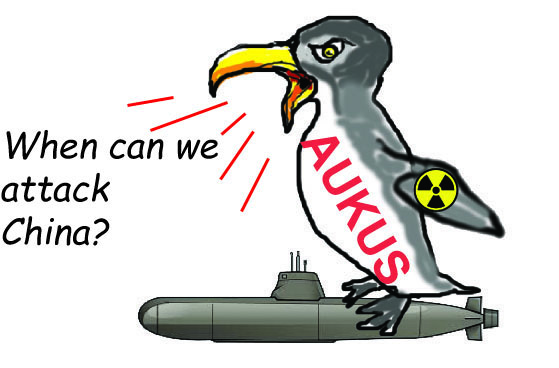
‘Optimal pathway’ is Prime Minister Albanese’s way of describing the obscure, tortuous AUKUS process
By Alison BroinowskiJan 12, 2023 https://johnmenadue.com/australias-optimal-pathway-into-or-out-of-aukus/
Just in time, the fundamental faults of AUKUS are being exposed in Canberra and Washington.
This development is not only due to the mounting concern among Australian civil society groups. The Australian mainstream media are now discussing the hitherto unmentionable drawbacks of AUKUS. But it’s because two US Senators, Democrat Jack Reed and Republican James Inhofe (since retired) warned President Biden that the US can’t meet its own submarine needs, let alone Australia’s. They also cautioned about American statutes and regulations that would have to be changed.
Their concern came just in time, for the AUKUS agreement between Australia, the US and the UK is promised for March. As any Australian who’s been asking the Morrison and Albanese governments for the details for the past year knows well, there are none. For the nuclear-powered submarines, we don’t know the cost of the weaponry, the dates of delivery, or the training, staffing and crewing requirements, and it’s a good guess that the government doesn’t either.
In a rare burst of candour, Peter Jennings, whose constant theme at ASPI was and remains to urge more Australian spending on American weapons directed at ‘deterring’ China, is now concerned that if Australia/China relations improve, that could compromise secret US nuclear technology to be shared with Australia. But he still wants the agreement.
What is AUKUS if not a means to deter China?’ he asks, adding that if AUKUS fails, so could ANZUS (Australian, 10 January 2023: 9). Jennings’ concerns may open the AUKUS can of worms, which as he implies, also contains a festering mass of unresolved problems for the ANZUS alliance.
ANZUS was negotiated in 1951 as the bare minimum commitment Australia, New Zealand and the US were prepared to make to defend each other. With no effectively binding clauses – apart from Article 1 where they undertake to refrain from the threat or use of force, consonant with international law and the UN Charter – its unwritten purpose was to contain Japan. Talked up for decades, it acquired mythical significance for Australia’s mateship with the US. But would the US defend Australia if that wasn’t in America’s interests?
That nagging doubt was raised with Julia Gillard, as Prime Minister, by Kim Beazley who knew that whatever else the US would not defend, it would fight for a base. The ‘joint facilities’ at Pine Gap, Narrungar, and Northwest Cape weren’t enough: in 2011 Australia proposed US Marine deployments in the Northern Territory. Under the Coalition, the Force Posture Agreement of 2014 went further, giving ‘unimpeded access’, exclusive control and use of agreed facilities and areas to US personnel, aircraft, ships and vehicles. As Bevan Ramsden pointed out here on 10 January, the sovereignty horse has bolted. US-Australia ‘Force Posture Agreement’ undermines sovereignty, must be terminated
It is too late for Prime Minister Albanese to assure Australians that the nation’s ‘sovereign interest’ will be protected: it hasn’t been for more than a century during which alliances to Britain and the US circumscribed Australian sovereignty. It is meaningless for Malcolm Turnbull, having done nothing to arrest the process of ‘interoperability’ with the US as prime minister, now to lament that AUKUS diminishes Australian sovereignty. The nuclear-powered submarines will have to be bought from, operated by and maintained by the US, and Australia’s defence forces are already ‘interchangeable’ with America’s, as Defence Minister Richard Marles has said. Some face-saving concessions to the UK’s submarine industry will further complicate the agreement.
Australia ‘cannot do everything ourselves’, says Retired Rear Admiral Peter Clarke. What if any of this Australia can do ourselves he didn’t go into. Proof of Clinton Fernandes’ description of Australia as a ‘sub-imperial power’ is becoming stronger by the day, even as its ‘power’ element diminishes.
When political leaders adopt defence jargon, the rest of us should reach for our fact-checkers. ‘Optimal pathway’ is Prime Minister Albanese’s way of describing the obscure, tortuous AUKUS process. ‘When we talk about optimal pathway, we talk about not just the issue of what is built, but how it is built, as well as the optimal pathway in building a capacity of skills in the Australian workforce’, he said. Opposition leader Peter Dutton tried for a clearer answer, saying that Australia was really dependent on buying US submarines to ‘keep the region safe’. That too remains debatable.
Our leaders don’t say which countries in our region want Australia to ‘keep it safe’. Most of our regional neighbours are safely managing their relations with others now, without our submarines. They will have to wait until 2040 for that to change. In the meantime, Australia might seek their advice about a shared vision for a safe region. How Australia confronting the PRC with armed force is going to deter China – from reclaiming Taiwan, perhaps – is never explained. Peter Jennings hopes Australia can match China’s growing submarine fleet and join the US to stop the ‘Chinese Communist Party dominating the Indo-Pacific’. But how and when will we do so, and at what cost?
What our leaders always leave out is why we should do all this. Before the AUKUS deal is signed and it’s too late, Australians need a clear answer. That needs to be more reliable than citing the ANZUS insurance policy. Australia’s interests in our region are not interchangeable or interoperable with those of the US, nor are they identical, and they should be sovereign.
Dr Alison Broinowski AM is a former diplomat, author and academic. She is President of Australians for War Powers Reform.
Eye-popping new cost estimates released for NuScale small modular reactor

Key Findings
NuScale and the Utah Associated Municipal Power Systems (UAMPS) announced costs of a 462-megawatt small modular reactor (SMR) have risen dramatically
As recently as mid-2021, the target price for power was pegged at $58 per megawatt-hour (MWh); it’s risen to $89/MWh, a 53% increase.
The price would be much higher without $4 billion federal tax subsidies that include a $1.4 billion U.S. Department of Energy contribution and a $30/MWh break from the Inflation Reduction Act
The higher target price is due to a 75% increase in the estimated construction cost for the project, from $5.3 to $9.3 billion dollars
Last week, NuScale and the Utah Associated Municipal Power Systems (UAMPS) announced what many have long expected. The construction cost and target price estimates for the 462-megawatt (MW) small modular reactor (SMR) are going up, way up.
From 2016 to 2020, they said the target power price was $55/megawatt-hour (MWh). Then, the price was raised to $58/MWh when the project was downsized from 12 reactor modules to just six (924MW to 462MW). Now, after preparing a new and much more detailed cost estimate, the target price for the power from the proposed SMR has soared to $89/MWh.
Remarkably, the new $89/MWh price of power would be much higher if it were not for more than $4 billion in subsidies NuScale and UAMPS expect to get from U.S. taxpayers through a $1.4 billion contribution from the Department of Energy and the estimated $30/MWh subsidy in the Inflation Reduction Act (IRA).
It also is important to remember that the $89/MWh target price is in 2022 dollars and substantially understates what utilities and their ratepayers actually will pay if the SMR is completed. For example, assuming a modest 2% inflation rate through 2030, utilities and ratepayers would pay $102 for each MWh of power from the SMR—not the $89 NuScale and UAMPS want them to believe they will pay.
The 53% increase in the SMR’s target power price since 2021 has been driven by a dramatic 75% jump in the project’s estimated construction cost, which has risen from $5.3 billion to $9.3 billion. The new estimate makes the NuScale SMR about as expensive on a dollars-per-kilowatt basis ($20,139/kW) as the two-reactor Vogtle nuclear project currently being built in Georgia, undercutting the claim that SMRs will be cheap to build.
NuScale and UAMPS attribute the construction cost increase to inflationary pressure on the energy supply chain, particularly increases in the prices of the commodities that will be used in nuclear power plant construction.
For example, UAMPS says increases in the producer price index in the past two years have raised the cost of:
Fabricated steel plate by 54%- Carbon steel piping by 106%
- Electrical equipment by 25%
- Fabricated structural steel by 70%
- Copper wire and cable by 32%
In addition, UAMPS notes that the interest rate used for the project’s cost modeling has increased approximately 200 basis points since July 2020. The higher interest rate increases the cost of financing the project, raising its total construction cost.
Assuming the commodity price increases cited by NuScale and UAMPS are accurate, the prices of building all the SMRs that NuScale is marketing—and, indeed, of all of the SMR designs currently being marketed by any company—will be much higher than has been acknowledged, and the prices of the power produced by those SMRs will be much more expensive.
Finally, as we’ve previously said, no one should fool themselves into believing this will be the last cost increase for the NuScale/UAMPS SMR. The project still needs to go through additional design, licensing by the U.S. Nuclear Regulatory Commission, construction and pre-operational testing. The experience of other reactors has repeatedly shown that further significant cost increases and substantial schedule delays should be anticipated at any stages of project development.
The higher costs announced last week make it even more imperative that UAMPS and the utilities and communities participating in the project issue requests for proposal (RFP) to learn if there are other resources that can provide the same power, energy and reliability as the SMR but at lower cost and lower financial risk. History shows that this won’t be the last cost increase for the SMR project.
David Schlissel (dschlissel@ieefa.org) is IEEFA director of resource planning analysis
US military deepens ties with Japan and Philippines to instigate proxy war with China like it did with Russia
Kathrin Hille, Financial Times, Sun, 08 Jan 23
The US and Japanese armed forces are rapidly integrating their command structure and scaling up combined operations as Washington and its Asian allies prepare for a possible conflict with China such as a war over Taiwan, according to the top Marine Corps general in Japan.
The two militaries have “seen exponential increases . . . just over the last year” in their operations on the territory they would have to defend in case of a war, Lieutenant General James Bierman, commanding general of the Third Marine Expeditionary Force (III MEF) and of Marine Forces Japan, told the Financial Times in an interview.
Bierman said that the US and its allies in Asia were emulating the groundwork that had enabled western countries to support Ukraine’s resistance to Russia in preparing for scenarios such as a Chinese invasion of Taiwan.
“Why have we achieved the level of success we’ve achieved in Ukraine? A big part of that has been because after Russian aggression in 2014 and 2015, we earnestly got after preparing for future conflict: training for the Ukrainians, pre-positioning of supplies, identification of sites from which we could operate support, sustain operations.
“We call that setting the theatre. And we are setting the theatre in Japan, in the Philippines, in other locations.”
Bierman’s unusually frank comparison between the Ukraine war and a potential conflict with China comes as Beijing has dramatically increased the scale and sophistication of its military manoeuvres near Taiwan in recent years. Japan and the Philippines are also intensifying defence co-operation with the US in the face of mounting Chinese assertiveness.
Japan and the US are set to discuss strengthening their alliance at security talks between the foreign and defence ministers on Wednesday and a summit between US president Joe Biden and Japanese prime minister Fumio Kishida on Friday in Washington. The summit comes as Tokyo embarks on a radical security policy shift that will include increasing defence spending and deploying missiles capable of hitting Chinese territory.
III MEF is the Marine Corps’ only crisis response force permanently stationed outside the US. It operates within the range of Chinese medium- and long-range missiles, with which Beijing seeks to constrain US operational freedom in the region.
The unit is at the heart of a sweeping reform of the Marine Corps that aims to replace its focus on fighting counter-insurgency in the Middle East with creating small units that specialise in operating quickly and clandestinely in the islands and straits of east Asia and the western Pacific to counter Beijing’s “anti-access area denial” strategy.
To realise that strategy, closer integration with allies was vital, Bierman said. In a series of recent exercises, the Marines for the first time set up bilateral ground tactical co-ordination centres rather than exchanging liaisons with allies’ command points.
In another sign of deepening co-operation, specific Japanese military units have been designated as part of the “stand-in force” alongside III MEF and US Navy and Air Force units.
Instead of a “round robin” of Japanese military units working with US counterparts, as in the past, a “standing community of interest” is emerging of allied units with responsibility for operational plans, Bierman added.
He said while the US military was paying attention to Chinese aggressive behaviour around Taiwan, the People’s Liberation Army should not be perceived as being “10 feet tall”.
“When you talk about the complexity, the size of some of the operations they would have to conduct, let’s say [in] an invasion of Taiwan, there will be indications and warnings, and there are specific aspects to that in terms of geography and time, which allow us to posture and be most prepared.”
As part of those preparations, the Philippines plan to allow US forces to preposition weapons and other supplies on five more bases in addition to five where the US has already access.
“You gain a leverage point, a base of operations, which allows you to have a tremendous head start in different operational plans. As we square off with the Chinese adversary, who is going to own the starting pistol and is going to have the ability potentially to initiate hostilities . . . we can identify decisive key terrain that must be held, secured, defended, leveraged.
Rolls Royce’s frustration as government holds back on orders for mininuclear reactors.
Treasury will reportedly not sign off on investment until
technology approved by regulators. A funding deal for the first fleet of
mini nuclear reactors may not materialise for another 12 months, to the
dismay of domestic leaders in the technology. The government made small
modular reactors a central element of its plans to generate 24GW of energy
from nuclear by 2050, but according to The Times there is significant
uncertainty in Whitehall over the scale and state of investment plans.
Building 10th Jan 2023
Australia’s only solar manufacturer launches $11m production and innovation facility — RenewEconomy

Australia’s only solar panel manufacturer launches $11m production and innovation facility in Adelaide, marking new milestone for domestic PV supply chain. The post Australia’s only solar manufacturer launches $11m production and innovation facility appeared first on RenewEconomy.
Australia’s only solar manufacturer launches $11m production and innovation facility — RenewEconomy
Bowen “upbeat and excited” about Sun Cable, despite billionaire bust-up — RenewEconomy

Federal energy minister hoses down concerns about Sun Cable’s massive solar export plans, describing its move into administration as “a change of corporate structure.” The post Bowen “upbeat and excited” about Sun Cable, despite billionaire bust-up appeared first on RenewEconomy.
Bowen “upbeat and excited” about Sun Cable, despite billionaire bust-up — RenewEconomy
1 This month.
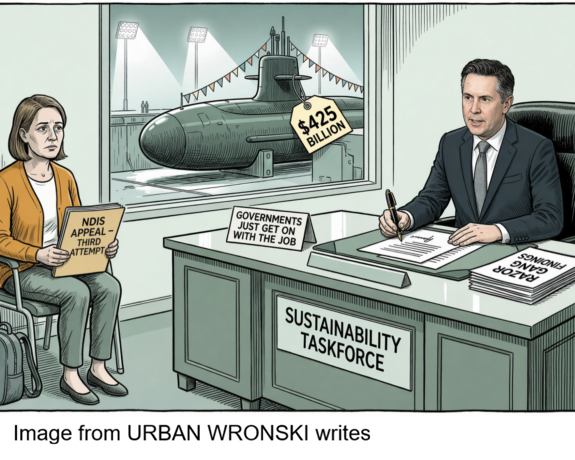

PETITION – To: Prime Minister Anthony Albanese and the Australian Labor Government
Chernobyl: The Lost Tapes – A good documentary on Chernobyl on SBS available On Demand for the next 3 weeks– https://www.sbs.com.au/ondemand/tv-program/chernobyl-the-lost-tapes/235274195556
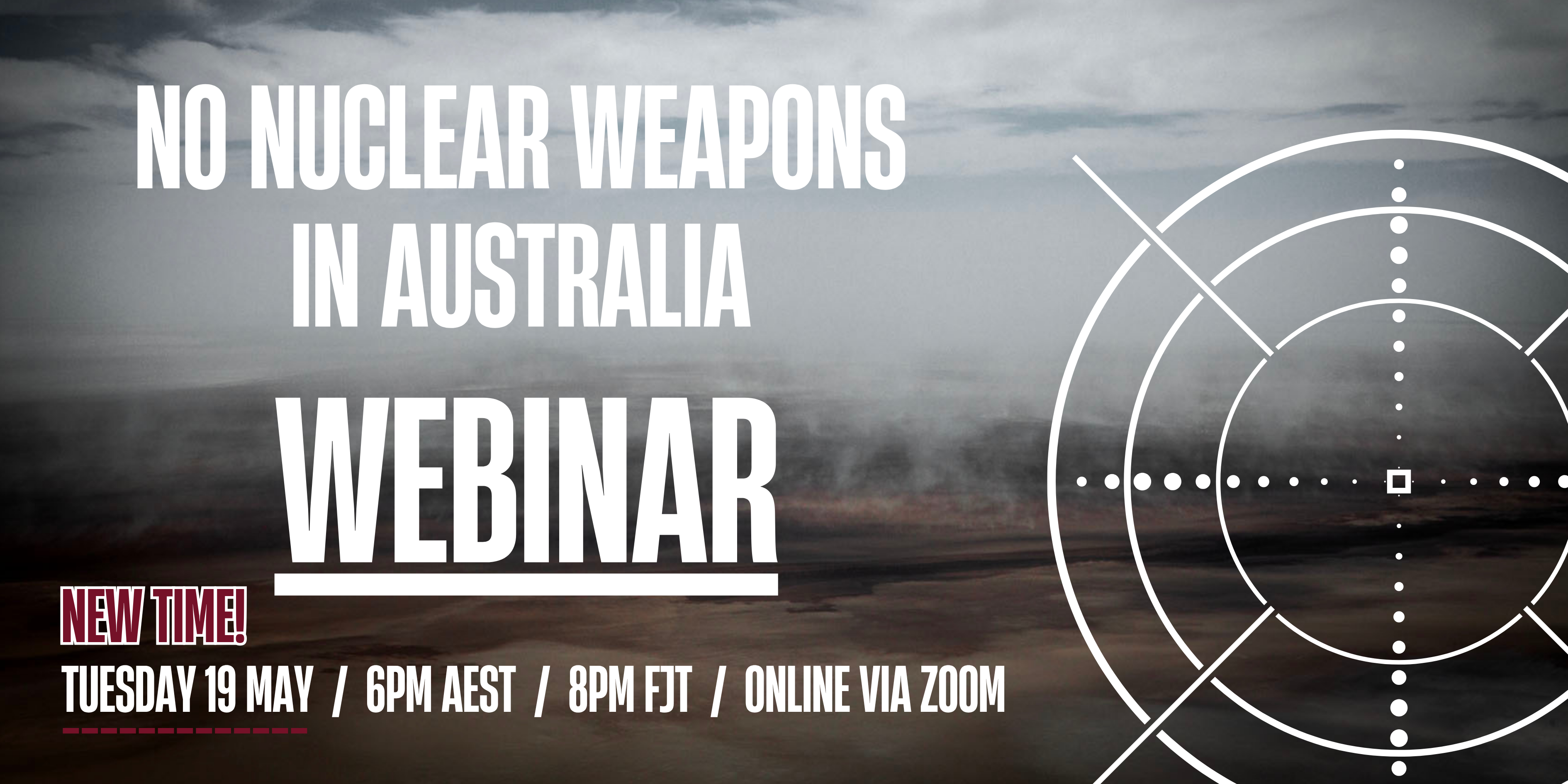
19 May – Webinar- Webinar: No Nuclear Weapons in Australia
Start: 2026-05-19 18:00:00 UTC Canberra, Melbourne, Sydney (GMT+10:00)
End: 2026-05-19 19:30:00 UTC Canberra, Melbourne, Sydney (GMT+10:00)
20 May – Webinar – The dangerous world of AUKUS, US, military occupation and suppression of dissent

National Webinar, 20th May, 2026, 6.30pm AEST. Confronting laws restricting/suppressing protest speech and action
Speakers: Former Sen. Rex Patrick, Lawyer Nick Hanna ,Arthur Rorris ,Jorgen Doyle, Sen David Shoebbridge,
Facilitator Kelley Tranter.

of the week – Australians for War Powers Reform (AWPR)
To see nuclear-related stories in greater depth and intensity
 Antinuclear