Australian corporate papers call for war with China, nuclear weapons and mass conscription

Oscar Grenfell, SEP candidate for NSW Legislative Council, 10 Mar, 2023, https://www.wsws.org/en/articles/2023/03/10/tutm-m10.html

In a militarist barrage, Nine Media and its main mastheads—the Sydney Morning Herald and the Age—published a major series this week insisting that Australia must prepare to fight an imminent war against China.
“Red alert” called for the stationing of nuclear weapons and long-range missiles in northern Australia, the introduction of mass conscription and preparations for the country to host as many as 200,000 US military personnel.
The articles are a demand for total war, not far off in the future, but as an immediate practical order of business. The series stressed that a war will be fought in the Indo-Pacific, not in twenty years or a decade, but within the next three years.
The multi-part series was not published in response to any specific development. Over the past week, there has not been a major geo-political occurrence in the region. China has not carried out any acts of aggression.

Instead, “Red alert” is part of a coordinated onslaught by those sections of the US and allied media that speak directly for the American military-intelligence apparatus. In concert, publications such as the Wall Street Journal and the Washington Post have published frothing condemnations of China. It is as though someone in the White House, the Pentagon or both flicked a switch that sent out an alert to their lackeys in the media.
The provocative attacks on Beijing come as the US and NATO escalate their proxy war against Russia in Ukraine. It is becoming ever more open that the war effort in Eastern Europe is one prong of a far broader militarist project. The US is seeking to inflict a crippling military defeat on Russia, as the essential prelude to war with China, which is viewed as the chief threat to American imperialist interests.
“Red alert” was couched as an “independent” review by five “experts” of Australia’s capabilities to fight a major war over the coming years. It was timed to precede the release of an official review commissioned by the federal Labor government, due out later this month. The claims of “independence” are a violation of the most basic journalistic ethics and standards related to disclosure.
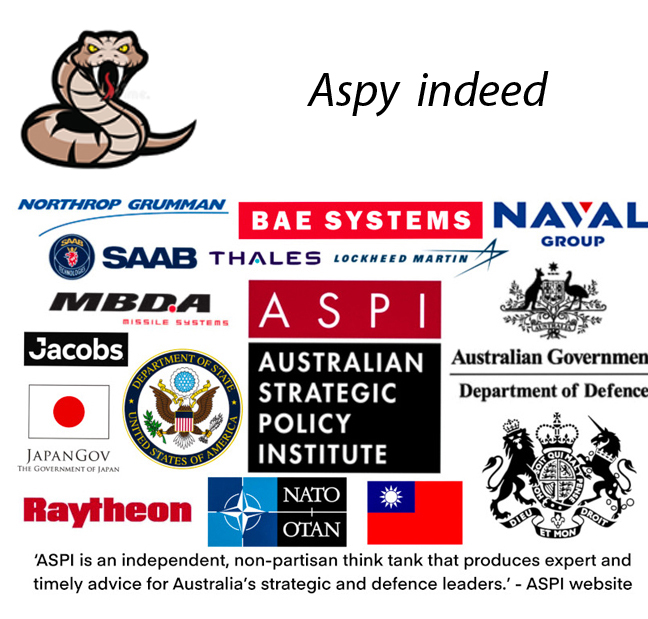
One is employed directly by the Australian government, four are employed by or contribute to the Australian Strategic Policy Institute, one of the most hawkish government-funded think tanks, or the Centre for Strategic and International Studies, which is among the most militaristic Washington think tanks. In other words, they could not be any less independent. They are mouthpieces of the state apparatus, as well as of private arms manufacturers that are making a fortune on the back of the military build-up.
The contents of the “Red alert” review are no less false than its purported independence. The series is a compendium of the lies, double speak and incendiary accusations used by Washington and its allies in the Australian political establishment to justify an aggressive military encirclement of China.
The timeline featured by “Red alert,” of a war with China within three years, comes straight from the American military. It is simply a promotion of views advanced by US Air Force General Michael Minihan, who earlier this year forecast an American war with China by 2025.
The supposed cause of such a war advanced by “Red alert” is identical to that put forward by Minihan. The Chinese government would purportedly launch an invasion of Taiwan, compelling US intervention and rapidly spiralling into an all-out war.
“Red alert” tries to present the US, as well as its allies, such as Australia, as engaging in a defensive effort on behalf of “little Taiwan,” as they have supposedly done in defence of “little Ukraine.” This depiction is a fraud on every level.
The US has been carrying out a vast military build-up throughout the Indo-Pacific since it unveiled the “pivot to Asia” in 2011. The Pentagon has outlined an “Air Sea Battle” plan as to how an aggressive US war against China would be waged. Chief US strategists have openly acknowledged that this is motivated by fears of China’s economic rise, and American imperialism’s relative decline.
Taiwan is simply a pretext. The US and its allies have sought to transform it into a flashpoint. Successive US governments, beginning with Obama, have undermined the status quo. Since the 1970s, the international community, including American administrations, de facto acknowledged the Chinese Communist Party as the sole legitimate government of all of China, including Taiwan, located just 160 kilometres from mainland China.
But now, Biden has repeatedly declared that the US would fight a war to defend Taiwanese “independence.” His administration has tripled US forces on the island, while directly providing military aid and expanding diplomatic ties with Taipei. The aim is to provoke a Chinese response, which would serve as the justification for longstanding US war plans.
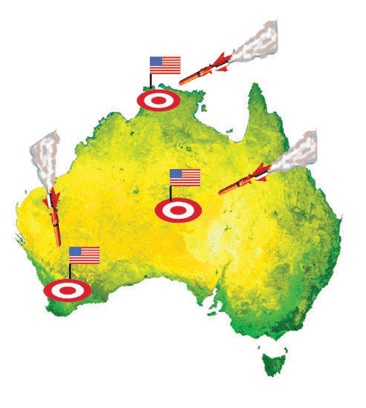
“Red alert” asserts that such a war would immediately become region-wide. Australia would be involved from the outset and within 72 hours of such a conflict, there would be Chinese attacks on Australian cyber networks and critical infrastructure. The US Pine Gap spy and military coordination base in central Australia would be a target, as would other Australian-US installations.
The series declares that in the event of such a war, as many as 200,000 American troops would descend on Northern Australia. That is, 47,000 less than the entire population of the Northern Territory, meaning the entire region would be transformed into a massive US base.
“Red alert” links this scenario to a call for the acquisition of major missile systems and other offensive weaponry. This is in line with a rapid build-up already underway, which is being dramatically accelerated by the Labor government. Virtually every week, there is a new announcement of military acquisition, be it sea mines, US HIMARS or naval strike missiles.
Conscious of the historic opposition to war among workers and young people, the document cites the necessity to break the “taboos” of conscription and nuclear weapons.
Perhaps the one note of truth in the series is its description of what a major war in the Indo-Pacific would involve. It would be a “whole of nation” effort, essentially requiring the militarisation of the entire society.
Along these lines, the “Red alert” series calls for the introduction of conscription. This would involve not only teenagers and young adults, but potentially anyone required for the war effort in what would be a war economy and the militarisation of society.
The series also advocates the stationing of US nuclear weapons in Northern Australia, on long-range missile systems that could fire them into the Indo-Pacific. As is the case whenever such proposals are made, the “experts” assert that this would serve as a “deterrent.” But they contradict themselves because in the previous parts of the series, the “experts” insisted that war is inevitable. The inescapable conclusion is that they are calling for nuclear war.
“Red alert” serves several purposes. It comes amid a debate within the Australian ruling elite, over Australia’s full alignment with the US war drive against China. A minority wing has voiced concerns over the implications of this. It is not anti-war or anti-imperialist, but fears that war with Australia’s largest trading partner will devastate the economy while provoking mass social and political upheavals.
The dominant sections of the political establishment, however, are all the way with the US. Australia, as a middle-order power, has always functioned under the umbrella of the dominant power of the day to prosecute its own imperialist interests. Australia, moreover, is completely integrated into the US war machine, meaning its participation in a conflict with China would be automatic.
This integration is only deepening. Next week, Labor Prime Minister Albanese will stand alongside President Biden in San Diego, as they announce that Australia will purchase US nuclear-powered submarines. The Labor government has already permitted nuclear-capable American B-52 bombers to “rotate” through northern Australia, meaning American nuclear weapons may already be stationed here.
The primary target of the “Red alert” series is the population itself. Its authors write about the need to change Australian “psychology.” They know that their mad plans for war are deeply opposed by the vast mass of workers and young people.
Conscription provoked massive social upheavals, both in World War I and during the Vietnam War. There is likewise a long history of broad opposition to nuclear weapons.
The propaganda blitz is aimed at bulldozing these popular sentiments by asserting that there is no alternative but to fight a war. A conflict is inevitable, so the population will simply have to accept it.
But the response to “Red alert” itself shows that this will not happen. The series has received a torrent of hostile commentary on social media. The Sydney Morning Herald posted the final part, containing the recommendation for nuclear weapons and conscription, to its Twitter account yesterday. The tweet has been viewed by 161,000 people. But only 20 of them hit the like button. While proclaiming the need for an “open” and “bold” discussion, the Herald has hidden all responses to its Twitter post.
The type of war that “Red alert” advocates is incompatible with democracy. That is the real meaning of the comments by the “experts” on the “Zelensky test.” They are referencing Ukrainian President Volodymyr Zelensky, a front man for the US and NATO. The “Zelensky test” is a willingness to place the entire country on a war footing. In Ukraine, this has involved the banning of all opposition parties and the promotion of fascist and Nazi forces.
The working class must take a sharp warning from the “Red alert” series and the broader turn to war with China. Longstanding plans for a catastrophic conflict are being activated. Governments and their mouthpieces are not only asserting that war is near. They are making it so.
This is a product of the deepest crisis of the profit system since the 1930s. The alternative to the catastrophe that is being prepared is the fight to build an international anti-war movement of the working class directed against the capitalist system itself and fighting for the socialist reorganisation of society.
Meet the man who uncovered the scandal of nuclear testing in South Australia
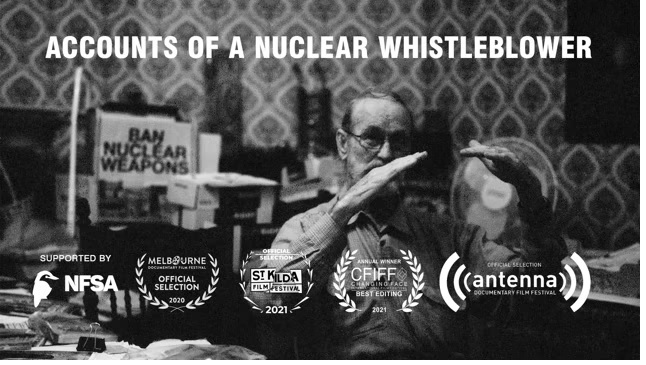
https://aeon.co/videos/meet-the-man-who-uncovered-the-scandal-of-nuclear-testing-in-south-australia
In the 1950s and ’60s, the British government conducted nuclear tests in Maralinga, a remote region of South Australia, with little understanding or forethought of the public health problems the fallout might cause. The harmful, sometimes deadly impact of these tests not only affected military conscripts, roped in without any real warning of the potential dangers, but private Australian citizens as well – and especially Indigenous peoples. Accounts of a Nuclear Whistleblower details this dark, somewhat forgotten chapter in Australia’s history via a firsthand account from Avon Hudson who, as a member of the Royal Australian Air Force, was stationed in dangerous proximity to these detonations, and later worked to expose their devastation and enduring threat. Hudson’s activism would ultimately help to precipitate the establishment in 1984 of the Royal Commission into British Nuclear Tests in Australia.
Via Director’s Library Director: Naveed Farro 7 March 2023
Twelve years after 3/11, dispute grows over Fukushima’s radioactive soil

BY TOMOKO OTAKE, STAFF WRITER, https://www.japantimes.co.jp/news/2023/03/10/national/dispute-fukushima-radioactive-soil/
OKUMA, FUKUSHIMA PREF. – On the surface, everything seems to be under control at the expansive site storing radioactive soil collected from across Fukushima Prefecture in the aftermath of the 2011 core meltdowns at the Fukushima No. 1 nuclear power plant.
Since 2015, the Interim Storage Facility, which straddles the towns of Okuma and Futaba and overlooks the crippled plant, has safely processed massive amounts of radioactive soil — enough to fill 11 Tokyo Domes — in an area nearly five times the size of New York’s Central Park. The soil was collected during decontamination procedures in Fukushima’s cities, towns and villages that were polluted by the disaster.
Here, black plastic bags full of contaminated soil are put on conveyor belts and unpacked. The contents are sifted through to remove plastic, leaves, twigs and other nonsoil waste. Then the soil is taken to dump zones, where it’s buried in 15-meter-deep pits with protective sheeting and a drainage pipe at the bottom so that radioactive cesium won’t leak into the ground. Finally, the soil is covered with noncontaminated soil and topped with a lawn. Areas where the work has been completed look like soccer fields.
The level of radiation here is about 0.2 microsieverts per hour (uSv/h), explained Hiroshi Hattori, an official at the Environment Ministry’s local office, during a recent tour of the areas where the polluted soil is buried. The radiation level there is harmless to humans, though higher than an average of 0.04 uSv/h elsewhere in Japan.
“It’s higher not because of the soil, but because of surrounding forests (which have not been decontaminated).”
The problem is that, as smooth and orderly as its operations are, the site is only a temporary home for the radioactive soil. Nobody knows where this massive pile of dirt will eventually end up. All that is certain is that the central government has pledged to — and is legally obliged to — move all of the soil out of Fukushima Prefecture by 2045.
This unresolved soil issue — along with the lingering dispute over the planned ocean release of tritium-laced wastewater from Fukushima No. 1 — is a sour reminder of the enormous toll the nuclear disaster in Fukushima has inflicted on the country and beyond.
Opposition from residents
The soil is a product of years of state-funded measures to bring radiation levels down in communities affected by the disaster. The government drew up a “decontamination road map” soon after the accident, in the hopes of a speedy return of residents to their hometowns.
The desire to avoid moving the massive amount of soil again — and to make it easier to find a final destination for it — has also led the Environment Ministry to try to reduce its volume first by reusing some of the less contaminated mud for public works projects across the nation. That way, only a quarter of the total amount that contains over 8,000 becquerel per kilogram of cesium will be subject to final disposal, the ministry says.
But it’s a tough sell. In December, the ministry held its first round of meetings with residents in areas of greater Tokyo where pilot projects to utilize the soil under the 8,000 Bq/kg threshold are planned: the Shinjuku Gyoen National Garden in Tokyo, the National Environmental Research and Training Institute in Tokorozawa, Saitama Prefecture, and the National Institute for Environmental studies in Tsukuba, Ibaraki Prefecture.
Nearby residents vehemently opposed the plan. Last month, they formally demanded that the ministry cancel the pilot projects, under which the ministry plans to bury radioactive soil underneath a 50 cm layer of cover soil, for flower beds and parking lots.
Roads, tidal walls and dams
Though little known until recently, the ministry released a policy document in 2016 that outlined the “safe use” of radioactive soil with radiation levels of 8,000 Bq/kg or less. According to the document, the government will divert such soil to embankments in public works projects “whose management entities and responsibilities are clearly defined.”
Roads, tidal walls, seaside protection forest and earthfill dams are some of the projects where use of the soil is envisioned, the document says.
The plan has raised the eyebrows of not just residents but also experts.
“Japan is very seismic and we have (harsh) weather and typhoons,” said Azby Brown, architect and lead researcher for Safecast, a citizen science group that has independently measured and publicized radiation levels in Fukushima and elsewhere.
“The half-life of cesium-137 is 30 years. It’s going to stay radioactive for a long time. What happens when these embankments get old?… It is not a very rational or sound decision, from the sense of certainly the perception of safety.”
Kenichi Oshima, professor of energy policy at Ryukoku University in Kyoto, questions the rationale of treating the soil of 8,000 Bq/kg or less as safe, pointing to a “double standard” between the ministry’s policy and the rigorous control of waste required for other nuclear power plants under the Nuclear Reactor Regulation Law. That law states only waste with radiation levels under 100 Bq/kg is considered safe enough to be reused.
All of the radioactive waste produced by the Fukushima disaster is covered by a separate “special law” that went into force in 2012. This says that Tokyo Electric Power Co. Holdings (Tepco), the operator of Fukushima No. 1, is responsible for the handling of the radioactive waste and soil within its property, while the Environment Ministry is responsible for the disposal of the 3/11-borne radioactive waste outside the plant, though the law itself does not mention the reuse of soil that has been decontaminated.
The ministry has explained that the 8,000 Bq/kg threshold keeps it consistent with the level of “designated waste materials” stipulated in that special legislation. When people are exposed to waste below 8,000 Bq/kg, the additional radiation exposure is limited to less than 1 millisievert per year, not a level that causes health concerns, according to the ministry.
“Granted, soil with 8,000 Bq/kg of radioactive materials is not one that immediately kills people who touch it,” Oshima said. “But it is low-level radioactive waste nonetheless, and so should be managed properly as such, just like low-level radioactive waste from other nuclear power plants is. It’s just inconceivable that it would be utilized as materials for infrastructure that people will be using often.”
Public support elusive
On Feb. 24, Environment Minister Akihiro Nishimura reiterated the ministry’s stance, telling a news conference that utilization of soil outside the prefecture is “important to realize its final disposal outside the prefecture (of Fukushima).”
“We would like to continue explaining our stance in detail so as to nurture public understanding,” he said.
But to nurture this understanding about an issue as serious as radioactive waste, everyone who has a stake should be involved in the decision-making process, Brown says.
“The strong consensus internationally regarding where to put things like radioactive waste requires full agreement and participation by all of the stakeholders, all of the citizens, everyone who’s involved,” Brown said. “What we usually see often in Japan in general, and certainly regarding the Fukushima issues, is that a decision is made at the top. It’s decided, it’s announced and then they try to persuade people to go along with it. This is the case with the water release issue (as well as) the soil issue.”
Around this spring or summer, the government and Tepco hope to begin discharging water that has all the radioactive nuclides except tritium removed. Construction work is already under way at the seaside plant to install an undersea tunnel, through which the water will be released 1 kilometer offshore.
The so-called JESCO law, which went into effect in 2014, gives legal grounds for the creation of the government-funded entity that runs the interim storage site, as well as the obligation for the central government to move the soil out of Fukushima by 2045. The obligation was written into law following a political compromise with the Fukushima Prefectural Government, with officials from the national government saying they “considered the excessive burden” being shouldered by the people of Fukushima.
Both Oshima and Brown, however, say they find the government’s plan to recycle the dirt out of line.
In fact, Oshima says the best solution would be to set aside an area and make it a controlled zone for all the polluted soil for 50 years until the radioactive cesium decays, which is how waste from other nuclear plants is handled, and is what the final disposal site is going to look like.
He cites a 2017 report by the Japan Atomic Energy Agency that estimated the size of the area needed for final disposal, which should be ready by 2045. If the volume of the soil is estimated at 20 million cubic meters, a subsurface ground facility for its final disposal will need to measure about 1.3 km by 1.3 km, the report concluded.
“It may sound like a huge space, but both the national government and Tepco have vacant land plots of that size,” Oshima said. Once the soil’s use as construction materials is greenlighted, however, it would be transported nationwide, and it would be impossible to track and measure its radiation doses, he argued.
“If the soil is properly stored in a controlled area, it would make the public feel so much more at ease.”
Low-dose radiation linked to increased lifetime risk of heart disease

by British Medical Journal, https://medicalxpress.com/news/2023-03-low-dose-linked-lifetime-heart-disease.html 8 March 23,
Exposure to low doses of ionizing radiation is associated with a modestly increased excess risk of heart disease, finds an analysis of the latest evidence published by The BMJ today.
The researchers say these findings “have implications for patients who undergo radiation exposure as part of their medical care, as well as policy makers involved in managing radiation risks to radiation workers and the public.”
A linked editorial suggests that these risks “should now be carefully considered in protection against radiation in medicine and elsewhere.”
It’s well recognized that exposure to high dose radiation can damage the heart, but firm evidence linking low dose radiation to heart disease (e.g., scatter radiation dose from radiotherapy or working in the nuclear industry) is less clear.
To address this knowledge gap, an international team of researchers examined scientific databases for studies evaluating links between a range of cardiovascular diseases and exposure to radiation (mostly radiotherapy and occupational exposures).
They excluded uninformative datasets or those largely duplicating others, leaving 93 studies, published mainly during the past decade, suitable for analysis. These studies covered a broad range of doses, brief and prolonged exposures, and evaluated frequency (incidence) and mortality of various types of vascular diseases.
After taking account of other important factors, such as age at exposure, the researchers found consistent evidence for a dose dependent increase in cardiovascular risks across a broad range of radiation doses.
For example, the relative risk per gray (Gy) increased for all cardiovascular disease and for specific types of cardiovascular disease, and there was a higher relative risk per dose unit at lower dose ranges (less than 0.1 Gy), and also for lower dose rates (multiple exposures over hours to years).
At a population level, excess absolute risks ranged from 2.33% per Gy for a current England and Wales population to 3.66% per Gy for Germany, largely reflecting the underlying rates of cardiovascular disease mortality in these populations.
This equates to a modest but significantly increased excess lifetime risk of 2.3-3.9 cardiovascular deaths per 100 persons exposed to one Gy of radiation, explain the authors.
Substantial variation was found between studies, although this was markedly reduced when the authors restricted their analysis to higher quality studies or to those at moderate doses (less than 0.5 Gy) or low dose rates (less than 5 mGy/h).
The authors suggest that mechanisms for these cardiovascular effects are poorly understood, even at high dose.
They also acknowledge that few studies assessed the possible modifying effects of lifestyle and medical risk factors on radiation risk, particularly major modifiable risk factors for cardiovascular disease like smoking, obesity, diabetes, high blood pressure and high cholesterol, and say further research is needed in this area.
In conclusion, they say their findings support an association between acute high dose and (to a lesser extent) chronic low dose radiation exposure and most types of cardiovascular disease and suggest that “radiation detriment might have been significantly underestimated, implying that radiation protection and optimization at low doses should be rethought.”
This view is supported by Professor Anssi Auvinen at Tampere University in Finland in a linked editorial, who points out that while inconsistencies and gaps remain in the evidence linking vascular disease to low dose radiation exposure, “evidence for cardiovascular disease will soon need to be added to the existing list of radiation-induced health risks.”
This will involve revisiting concepts and standards in radiological protection, while more stringent standards for justification and optimization, especially for high dose procedures, will have to be considered, he explains.
Their implementation will also require training to improve awareness, knowledge, and understanding of the risks associated with specific procedures and cumulative exposure, as well as risk communication for patients and the public, he concludes.
“Thermal fatigue” is causing flaws in the cooling pipes of France’s nuclear reactors

Electricite de France SA discovered new defects at two of its nuclear
reactors that were halted for maintenance and repairs, raising fresh
concerns that its electricity output will remain largely constrained this
year after plunging in 2022.
Flaws tied to so-called thermal fatigue have
been found on the pipes of the Penly-2 and Cattenom-3 reactors, the utility
said in a statement. The pipes have been replaced as part of broader
repairs related to “stress corrosion” cracks — a different type of
faults — that are affecting emergency cooling pipes of some of the EDF’s
atomic plants, according to the nuclear safety authority.
The nuclear giant has been forced to halt more than a dozen of its 56 reactors for months of repairs since it first found signs of such stress corrosion phenomenon in
late 2021. The announcement comes just days after the country’s nuclear
safety authority asked EDF to revise its program of reactor checks
following the utility’s discovery of a “significant” stress corrosion
crack earlier this year on its Penly-1 reactor. EDF said it will propose an
update of its reactor check strategy to the watchdog in the coming days.
The fresh setbacks could force EDF to carry out more extensive checks on
its atomic plants, reviving concern that France will have to import large
amounts of power this year. Last year, worries about electricity shortages
combined with dwindling deliveries of Russian gas pushed European energy
prices to records.
Bloomberg 10th March 2023
https://www.bnnbloomberg.ca/edf-finds-new-flaws-at-2-reactors-stoking-power-supply-woes-1.1893577
March 10 Energy News — geoharvey

World: ¶ “Ukraine War: Why Russia’s Infrastructure Strikes Strategy Isn’t Working” • A coordinated wave of Russian attacks on Ukraine’s power infrastructure was the first in almost a month. Western officials believe missiles and other precision-guided weaponry Russia needs to carry out such attacks with any measure of effectiveness is in short supply. [BBC] Bombed […]
March 10 Energy News — geoharvey
Rare admission from Australia’s corporate media that hosting America’s Pine Gap surveillance system makes Australia a legitimate target for long-range ICBMs
Jennings says Americans would defend Taiwan by fighting from bases in Australia.
Arrows at top indicate militrary “bases” ie; TARGETS in Northern Australia
RAAF base Curtin RAAF base Darwin RAAF base Tindal. HMAS Cairns Lavarack Baracks Townsville
The BIG TARGET is Joint Defence Facility Pine Gap – in the centre
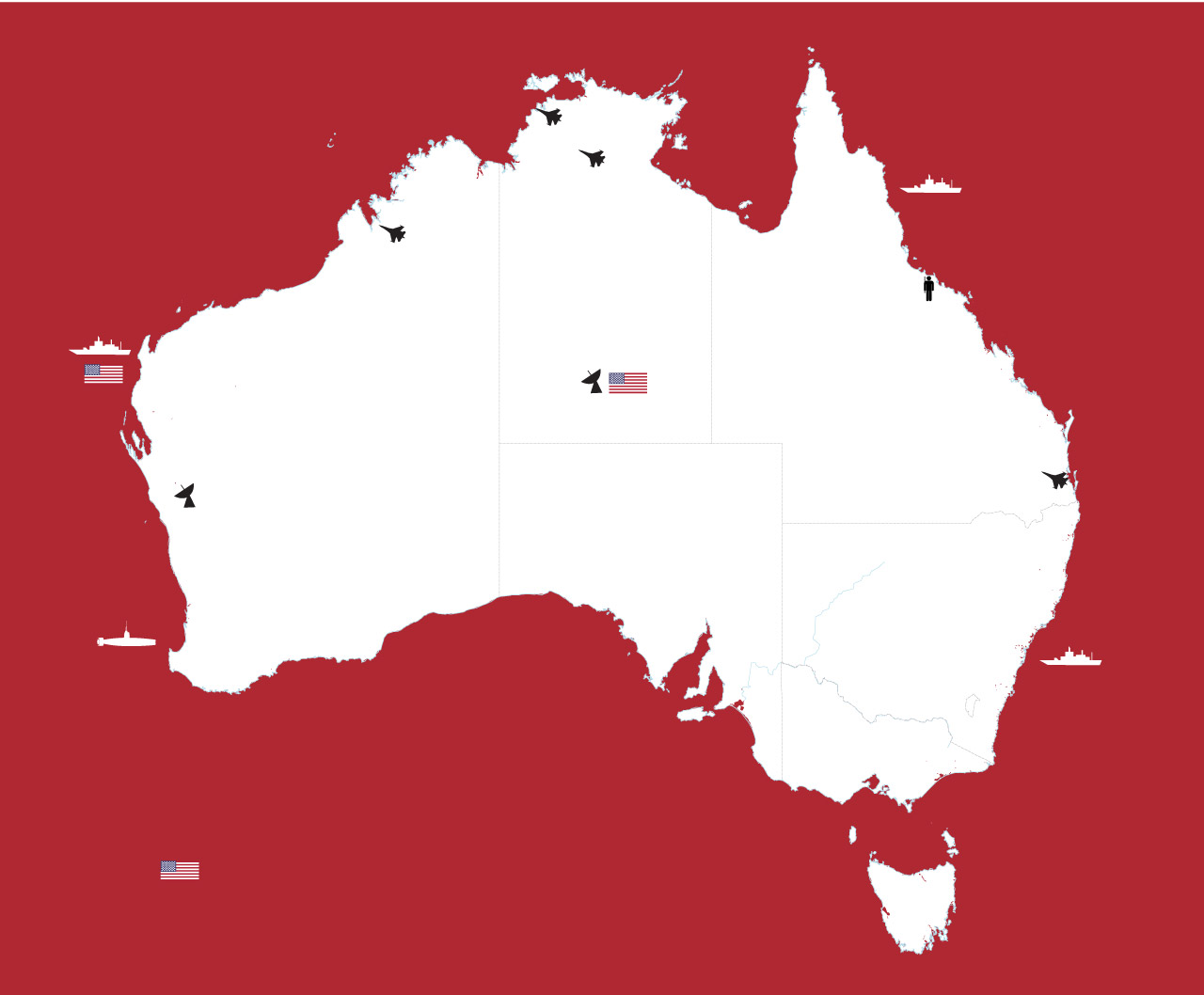
Arrows further South indicate military bases ie; TARGETS
Naval Communications Station Harold E Holt RAAF Base Amberley
Australian Defence Satellit Communications Station Kojarena
Fleet Base West – Royal Australian Navy Fleet Base East Royal Australian Navy
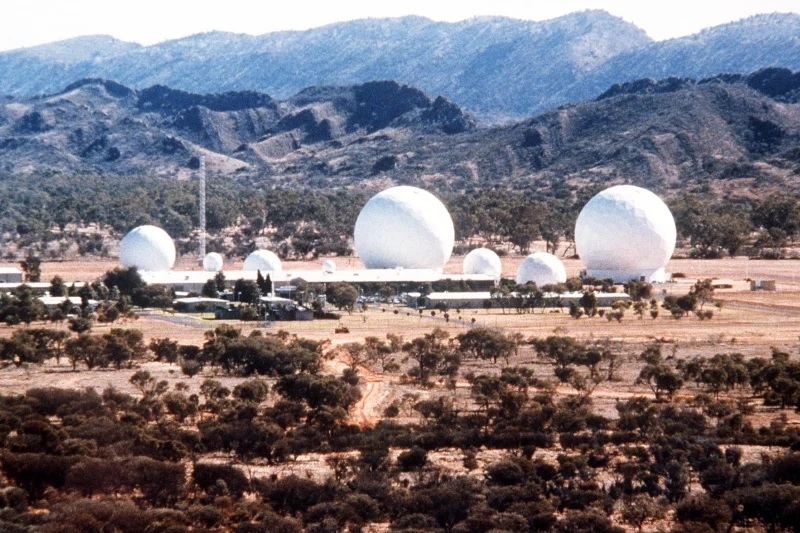
Joint Defence Facility Pine Gap
“Five defence experts assembled by The Sydney Morning Herald and The Age for Red Alert, a special review of Australia’s national security, agree such a conflict could break out within three years and would almost certainly involve Australia.
In the first three days of a war, he says Beijing would be tempted to target Australian military bases with a long-range intercontinental ballistic missile attack to minimise our usefulness in the conflict.
“If China seriously wants to go after Taiwan in a military sense, the only way they can really contemplate quick success is to pre-emptively attack those assets that might be a threat to them. That means Pine Gap goes,” he says, referring to the top secret US-Australian base in the Northern Territory that the US uses to detect nuclear missile launches.
…………………………….. Take Australia’s military bases. These facilities – especially those shared with or controlled by the US – are obvious targets for an adversary.
……………………………. Ryan says there is a strong agreement among military strategists that a war over Taiwan would “involve strikes on US bases, on fuel and munitions holdings, ships across the region, including our own country potentially”.
………………………….. Jennings says Americans would defend Taiwan by fighting from bases in Australia.………………………………………………………………………………………………
Passing the Zelensky test

………………………. “How many Australian leaders would pass the ‘Zelensky test’?” he asks, referring to Ukraine’s President Volodymyr Zelensky. “How many could get out there and say, ‘I don’t need a ride, I need ammunition’………………. https://archive.is/ZytUj#selection-6919.0-6923.81
The Nightmare Espionage Act That is Killing Julian Assange and the First Amendment
As for Julian Assange, the urgency behind bringing attention to the case is justified. According to Shenkman, “We tried to dig through the history to see if a publisher has ever been charged for anything like Julian Assange has been accused of. And the answer is no. This is the first case in U.S. history of its kind. And it would set a precedent that would open the floodgates for prosecuting the press.”
https://scheerpost.com/2023/03/03/the-nightmare-espionage-act-that-is-killing-julian-assange-and-the-first-amendment/ by EDITOR March 3, 2023
The use of the century old Espionage Act in the Julian Assange case continues to set the chilling precedent of a bleak future in American journalism, a precedent that endangers even those outside US borders.
arey Shenkman, attorney, author, and litigator specializing in civil and human rights, joins Robert Scheer for this week’s Scheer Intelligence, where Shenkman offers a sobering analysis on one of the most chilling attacks on press freedom exhibited in the Julian Assange case. Using his recently published book, A Century of Repression: The Espionage Act and Freedom of the Press, Shenkman details the history of the Espionage Act and how civil liberties have continued to be eroded as a result of the existence of this law and the lack of revision.
Shenkman talks about the bipartisan disdain towards the Espionage Act in legal circles yet its continued use by bipartisan presidents brings the conversation to its flaws and disreputability: “Over the decades, you have folks that are coming out with law review articles saying that it’s vague, verbose, that it makes no sense, and that ambiguity in the law is being exploited now to go after Julian Assange, to go after government whistleblowers. So there have actually been serious calls for its reform and repeal in recent years.” Assange faces 175 years in a U.S. maximum security prison after being indicted with 17 charges relating to the Espionage Act.
Going back to its inception during World War I, Shenkman explains what its true purpose was and how within the law, “you get a sense that this language of promoting disloyalty, of promoting opposition to the war, was actually used to go after conscientious objectors and folks that opposed entry into World War I.”
As for Julian Assange, the urgency behind bringing attention to the case is justified. According to Shenkman, “We tried to dig through the history to see if a publisher has ever been charged for anything like Julian Assange has been accused of. And the answer is no. This is the first case in U.S. history of its kind. And it would set a precedent that would open the floodgates for prosecuting the press.”
Shenkman says if Assange is extradited, it will make his case a law school case for all the wrong reasons. Despite all the concern surrounding the overreaching power of the United States, this case could also open the door to countries around the world to extradite citizens from foreign countries for exposing their wrongdoings. As Shenkman mentions, “Assange is not a U.S. government employee. He’s not even a U.S. citizen. And somehow the U.S. government says it has jurisdiction.”
Aukus submarine deal: Australia expected to choose UK design, sources say

Rishi Sunak said to have been ‘buzzing’ about result of 18-month negotiations, part of Aukus defence pact with US
Kiran Stacey and Dan Sabbagh, https://www.theguardian.com/world/2023/mar/08/uk-to-unveil-nuclear-submarines-deal-with-australia-sources-say
An enthusiastic Rishi Sunak has told ministers to expect a positive outcome next week when he travels to San Diego to unveil a deal to supply nuclear-powered submarines to Australia as part of the Aukus pact with the US.
Multiple sources said they believed the UK had succeeded in its bid to sell British-designed nuclear submarines to Australia, a deal that will safeguard the long-term future of the shipyard at Barrow-in-Furness.
A senior minister said Sunak had told colleagues he was delighted by the outcome of the negotiations, which have been going on for 18 months and have presented Australia with a choice between a British or a US design, based on the existing Astute or Virginia class submarines.
“The deal has definitely gone our way. The prime minister was buzzing about it when he told ministers, smiling and bouncing on the balls of his feet,” the minister said.
A second source outside government with knowledge of the talks said they had also been told to expect a British design success when the deal is announced on Monday, although any final submarine will also make heavy use of US technology.
Sunak is due to travel to the west coast for a trilateral summit with Joe Biden, the US president, and Anthony Albanese, the Australian prime minister, on Monday, where he also expected to unveil a refresh of Britain’s integrated review of defence and foreign policy in the light of the war in Ukraine.

Supplying Australia with a nuclear-powered submarine was the centrepiece for the Aukus defence pact, announced in September 2021, with the US and UK agreeing to share secret reactor technology in a surprise deal, so Canberra could dump an alternative diesel-powered design from France.
The expectation, one source indicated, was that Australia would work jointly on a design for a next generation submarine with the UK, evolving from the existing Astute submarine design, although it may not be seaworthy until the 2040s because of the complexity of the work.
Further reports last night suggested that the short-term gap could be plugged by Australia buying up to five Virginia-class submarines from the US as part of the three-way deal.
Meanwhile, an alternative plan that the UK could even be willing to sell or lease the two Astute class submarines yet to be completed at Barrow, HMS Agincourt and HMS Agamemnon, is wide of the mark. Naval analysts say the UK’s submarine fleet is already stretched and could not afford a sudden reduction.
Australia will become the seventh country to have a nuclear-powered submarine, relying on an enriched uranium reactor, propulsion technology that will put the country’s diesel-powered navy on a technological par with China.
But it will require Australia, which is not a nuclear power, to be supplied with a reactor, a move that Beijing has argued is a breach of the Nuclear Non Proliferation Treaty. The three Aukus powers say that is not the case, and that any reactors will be supplied “welded, shielded and sealed shut” according to Australian officials overseeing the effort.
The new submarines will not carry nuclear weapons. But James Acton, a nuclear expert with the Carnegie Endowment for International Peace, said it was not yet clear how the nuclear waste generated by the propulsion reactors will be dealt with – and whether that will happen in Australia or the UK or US.
Defence experts said the time it would take to build the new submarines meant that there may be some related short-term developments. The US is keen to be able to base its nuclear submarines in Australia, making it easier to patrol the South Pacific, as it seeks to retain naval parity with China.
A UK government spokesperson said: “When we announced the Aukus partnership in September 2021 we said there would be an 18-month scoping period to determine the optimal path to procuring Australia nuclear-powered submarines. The outcome of the scoping period is due to be announced soon.”
A No 10 spokesperson said they could not pre-empt any future announcements.
War over Taiwan: Australia’s Gang of Five
Australian Independent media March 8, 2023 Dr Binoy Kampmark

Diligently, obediently and with a degree of dangerous imbecility, a number of Australian media outlets are manufacturing a consensus for war with a country that has never been a natural, historical enemy, nor sought to be.
But as Australia remains the satellite of a Sino-suspicious US imperium, its officials and their dutiful advocates in the press seem obligated to pave the way for conflict.
The latest example of this came in articles run in the Sydney Morning Herald and The Age of Melbourne. The premise is already clear from the columnists, Peter Hartcher and Matthew Knott. Australia faces a “Red Alert”, and, to that end, needs a warring fan club. Not since the domino theory bewitched strategists and confused military planners have Australians witnessed this: a series of articles featuring a gang of five with one purpose: to render the Australian public so witless as to reject any peaceful accommodation.
First, the provocative colouring for the article, “How a conflict over Taiwan could swiftly reach our shores.” The Australian continent is shown bathed in a sea of red. Various military bases and facilities are outlined. For good measure, there is a picture of Australian soldiers firing an artillery piece in “military exercises in 2018 at Shoalwater Bay, Queensland.”
Then, the blistering opening lines of terror. “Within 72 hours of a conflict breaking out over Taiwan, Chinese missile bombardments and devastating cyberattacks on Australia would begin. For the first time since World War II, the mainland would be under attack.” The authors already anticipate a good complement of US troops to occupy the Australian north, some 150,000 “seeking refuge from the immediate conflict zone.”
The Red Alert panellists, anointed as “defence experts”, brim with such scenarios. All, as they state in a joint communique, agree on one thing: “Australia has many vulnerabilities. It has long and exposed connections to the rest of the world – sea, air and undersea – yet is incapable of protecting them.”
Leading the gang of five is Peter Jennings, who has had an unshakeable red-under-the-bed fantasy for years. A former deputy secretary for strategy in the Australian Defence Department, and steering the Australian Strategic Policy Institute (ASPI) for a decade (that’s Canberra’s revolving door for you), Jennings is adamant and steely. “As I think of a conflict over Taiwan, what I’m thinking about is something that very quickly grows in scale and location.”
There is no reason at all why such a growth in scale or location should happen, but this is not the purpose of the exercise. The point of the Red Alert fantasy is to neutralise the significance of Australia’s natural boundaries – some of the most formidable on the planet – and dismiss them in any conflict with Beijing. “Distance is no longer equivalent to safety from our strategic perspective,” ponders Jennings.
Jennings inadvertently reveals the case against war, which can only be an encouragement to activists and officials keen to reverse the trend of turning Australia into a US imperial outpost of naval and military bases that would be used in any Taiwan conflict. “If China wants to seriously go after Taiwan in any military sense, the only way they can really contemplate quick success is to pre-emptively attack those assets that might be a threat to them. That means Pine Gap goes.” Pine Gap remains that misnamed joint US-Australian signals facility that has facilitated illegal drone strikes in foreign territories most Australian politicians would fail to find on a map.
……….. Lavina Lee, another Red Alert panellist, is also into the business of softening the Australian public for war,………
Australia’s former chief scientist, Alan Finkel, dolls out his own catastrophic scenario………..
Retired army major-general Mick Ryan makes his contribution by wishing Australia to be readied for war. In a message common to most military officers, the civilians should really do more about giving his brethren more cash. ……………
Lesley Seebeck, former head of the Australian National University’s Cyber Institute, completes the crew of five, …………
A few things are worth noting in this frothy mix of fantabulation and establishment fire breathing. In the quest to gather such a panel, no effort has been made to consult the expertise of a China hand. That lobby, able to provide a more nuanced, less heavy-footed approach, is being shunned, their advice exorcised in any effort to encourage war.
Bizarrely, the panellists offer an increasingly popular non-sequitur that has creeped into the warmonger’s manual: Would Australia’s leaders, in war, pass the Zelensky test? This somehow implies that the Ukraine conflict offers salient lessons over a war over Taiwan, an absurd comparison that muddled strategists are fond of making.
Most of all, Beijing’s own actual intentions over Taiwan are to be avoided. The presumption in ASPI-land is that a war is imminent, and that Beijing would want to go to war over the island as a matter of course. China’s President Xi Jinping’s main advisor on the subject, veteran ideologue Wang Huning, suggests an approach at odds with such thinking.
The Red Alert exercise has drawn necessary and important criticism. Former Australian Prime Minister Paul Keating did not mince his words in a fuming column for Pearls and Irritations. “Today’s Sydney Morning Herald and The Age front page stories on Australia’s supposed war risk with China represents the most egregious and provocative news presentation of any newspaper I have witnessed in over fifty years of active public life.” One might even go further back than that. The war times are coming, and as are those gangs seeking to encourage them. https://theaimn.com/war-over-taiwan-australias-gang-of-five/
For Australia, horror of war over Taiwan is not inevitable
Pearls and Irritations, By Geoff Miller, Mar 9, 2023
Contributors to the “War with China over Taiwan” horror show which began in the Nine newspapers this week assume that a war between China and the United States is likely, and some of them then explicitly say that Australia would be involved. Australia should instead regard the Taiwan issue as one for us to “sit out”.
Mick Ryan, for example, says that “we have made our choice. If the United States goes to war with China over Taiwan, we are going to support them one way or the other”. Lavina Lee speaks of “the outbreak of war and Australia’s inevitable participation”.
They speak so glibly that one wonders whether they have thought at all about what a war between two nuclear powers, the biggest and second biggest economies in the world, would be like. Nor do they seem to have given any thought to what various government Ministers have said is Australia’s prime strategic goal in the Asia-Pacific, and that is to prevent war.
Why all this drama at this time? There are some events coming up which may have an influence; the releases of the Defence Strategic Review and the nuclear submarine study are two of them, and the coming budget is another. They will all involve spending very large sums of money on defence projects, and both the Defence organisation and firms which stand to benefit from Government spending may well welcome some “preparing of the audience”.
Our ally, the United States, may also have an interest. Under various defence arrangements we can expect to see an increasing amount of United States basing and military involvement in Australia. This has not been universally welcomed in the past, and the United States Government, and its defence firms which would be involved in an expansion of the US military presence in Australia as well as in an increase in our own defence spending, could well welcome the dramatisation of the “China threat” the Nine newspapers are providing this week.
How real is the China threat? It’s certainly seen as real by some Americans, who see China as the “peer competitor” they cannot tolerate. According to some accounts China is already clearly ahead of the US in a number of key technologies, which gives added emphasis to the military in US eyes, since the US is clearly superior militarily; despite the recent planned increase of 7% in Chinese military spending the US increase is even bigger, at 8%. The urge to maintain their predominance in the Pacific, and elsewhere, is probably why some very senior American military commanders seem to be anticipating and even looking forward to a war with China before long, with Taiwan as its probable rationale.
Australian Ministers and senior officials, on the other hand, have frequently spoken of the need to find a balance in the Pacific which gives appropriate place and weight to both the United States and China…………………………………………………………….
Taiwan is a very special case. We have no formal obligation to it. We recognised China, acknowledging that it maintained there is only one China, and that Taiwan is part of that. The current situation is complex and complicated: for example despite all the mutual abuse China and Taiwan have a substantial economic relationship; many people from Taiwan live and work in China. Recent polls show that a large proportion of Taiwanese believe that in the end Taiwan will be re-united with China, and are not keen to fight China to prevent that. The current state of affairs has come about as the result of the struggle for predominance in the Asia-Pacific between the US and China, the world’s two largest economies, both nuclear-armed and themselves in a complex and many-sided relationship.
We want the US to continue to play a major role in the Asia-Pacific, but there must be an appropriate place for China as well. As the former Secretary of DFAT, Peter Varghese, wrote in September last year: “If we tether ourselves to the cause of US primacy we leave ourselves exposed to US policies that may make sense for the US but not necessarily for Australia. We risk structuring our defence forces to fight alongside the US rather than primarily for the defence of Australia. We risk buying into a narrative of democracy versus autocracy which, however inspiring, misreads the strategic and historical drivers of China’s actions and has little resonance in our region.”
Australia, with its small and presently ill-equipped armed forces, could contribute almost nothing to a clash between the United States and China that has nothing to do with us. The US is such a large and globally important country that its relationships can in the end be repaired even with countries with which it has been in conflict. That does not apply to us, and if we joined the US in fighting China over Taiwan, not only would we not make any appreciable difference but our relationship with our biggest trading partner would be destroyed for years.
We should regard the Taiwan issue as one for us to “sit out” https://johnmenadue.com/war-over-taiwan-is-not-inevitable-for-australia/
Australia ‘to buy up to five US nuclear submarines’ under AUKUS pact

By Richard Wood • Senior Journalist, Mar 9, 2023 https://www.9news.com.au/world/aukus-update-nuclear-powered-submarines-deal-to-create-ten-thousands-jobs/f2b65469-d7ca-468b-938b-e67c131a3aaa
Australia is expected to buy up to five US Virginia class nuclear-powered submarines in the 2030s under the AUKUS defence pact between Washington, Canberra and London, reports say.
US officials, speaking on the condition of anonymity, said after the annual port visits, the US would forward deploy some submarines in Western Australia by around 2027, the Reuters news agency reported today.
Australia would buy three Virginia class submarines in the early 2030s and have the option to buy two more, the sources said.
Australia’s new fleet of nuclear-powered submarines will be based on a modified British design with US parts and upgrades, the report said.
Prime Minister Anthony Albanese will travel to the US next week to unveil the choice of submarine design for the Royal Australian Navy (RAN).
More than 10,000 jobs will be created from Australia’s acquisition of nuclear-powered submarines under the AUKUS defence pact, according to the country’s navy.
TODAY. Wouldn’t it be sane, if Australia just cancelled this absurd nuclear submarine mess?
Why do I call it a mess? Let me count the ways:
- Australia does not need nuclear submarines. They’re suitable for the USA to make long distance attacks on China, but not suitable for Australia’s need – which is to monitor our coastline.
- They will be obsolete before they’re able to be operational.
- They are an absurd expense $171 billion and upwards, depriving Australia’s regular military of needed funds, and adding to Australia’s economic woes, and national debt
- They are to be fuelled by Highly Enriched Uranium, meaning that regional and global nuclear proliferation norms are overturned, causing tensions and problems with Australia’s near neighbours . Not only New Zealand, but also several South East Asian and South Pacific States are members of nuclear-free zone treaties.
- The decision on the nuclear submarines was made with no real debate in Parliament . On the only occasion when Australians were able to give their views on this issue to the parliament’s treaties committee, more than 100 submissions were made, even though only five days’ notice was given for these to be received. These submissions were overwhelmingly against the proposal.
- There has been little or no discussion on the toxic wastes from the nuclear submarines, nor on the final disposal of the submarines themselves – there seems to be no plan for this, nor on other safety aspects.
- It is clear, to the point of mirth, that the uK and UK are competing with each other to market the subs to Australia.
- The process of deciding on the subs is full of conflicts of interest and corruption
- The subs are now being “sold” to the Australian public on the premise of “jobs, jobs jobs” – when it’s likely that the bulk of jobs, especially high career ones, will go to USA or UK workers
- The Australian public is being fed a media barrage of enthusiasm for the subs, with rare mention of any downsides.
I am utterly fed up with Australia’s political leaders – quite a nauseating spectacle on ABC TV news tonight, with Defence Minister Richard Marles fawning all over that dreadful previous PM Morrison, and the warmongering Liberal leader Peter Dutton.
Australian Media Are Outright Telling Us They Are Feeding Us War Propaganda About China
Caitlin’s Newsletter, 8 March 23
The mass media in Australia have been churning out brazen propaganda pieces to manufacture consent for war with China, and what’s interesting is that they’re basically admitting to doing this deliberately.
Australians are uniquely susceptible to propaganda because we have the most concentrated media ownership in the western world, dominated by a powerful duopoly of Nine Entertainment and the Murdoch-owned News Corp. Both of those media megacorporations have recently put out appalling propaganda pieces about the need for Australians to rapidly prepare to go to war with China in defense of Taiwan, and in both of those instances have straightforwardly told their audiences that there’s an urgent need to effect a psychological change in the way all Australians think about this war.
Nine Entertainment’s Sydney Morning Herald and The Age have been busy flooding the media with testimony from a panel of war machine-funded “experts” who say Australia must hasten to get ready to join the United States in a hot war with China in the next three years. Yesterday’s dual front-page propaganda assault featured imagery of Chinese war planes flying straight at the reader, awash in red and emblazoned with the words “RED ALERT” to help everyone understand how evil and communist China is.
“Today’s Sydney Morning Herald and Age front-page stories on Australia’s supposed war risk with China represents the most egregious and provocative news presentation of any newspaper I have witnessed in over 50 years of active public life,” former Australian Prime Minister Paul Keating opined in response to the publications.
“Apart from the outrageous illustrations of jet aircraft being shown leaving a profiled red-coloured map of China, the extent of the bias and news abuse is, I believe, unparalleled in modern Australian journalism,” he added.
In the first installment of their “Red Alert” propaganda series, SMH and The Age share that their empire-funded panelists believe there’s a need to bring about a “psychological shift” in the public’s attitude toward war with China, with one panelist asserting that “the nation’s leaders should trust the public enough to include them in what can be a confronting discussion” about the need to prepare for that war.
In the second “Red Alert” installment, this same message is repeated, saying that “Australia’s vulnerabilities are not only physical, but psychological,” and again repeating the need to get everyone talking and thinking about the possibility of war with China.
“It is a real national taboo to think about the likelihood of a conflict in anything other than the most remotely theoretical perspective,” says Peter Jennings of the war machine-funded propaganda firm Australian Strategic Policy Institute, countering that “we will sleepwalk into disaster unless we openly discuss unpalatable scenarios.”
Saying that the real threat is “complacency rather than alarmism,” think tanker Lavina Lee urges Australia to confront “the possibility that we might go to war and what would happen either way. We should talk about what the world would look like if we win and what it would look like if we lose.”
Over and over again they are telling us that something must be done to change the way Australians think and talk about a war with China, in articles designed to change the way Australians think and talk about war with China. They are doing the exact thing they say must be done, while explaining why it needs to be done. They are brainwashing us with propaganda while explaining why it is necessary to brainwash us with propaganda.
Last month Murdoch’s Sky News Australia released an astonishingly propagandistic hour-long special titled “China’s aggression could start new world war,” which in its attempts to show “China’s aggression” hilariously flashed a graphic of all the US military operations currently encircling China. The segment features footage of bayonet-wielding Chinese forces overdubbed with ominous cinematic Bad Guy music, and in Sky News’ promotions for the special all the footage from China was tinged red to help viewers understand how evil and communist China is.
Toward the end of the special, Sky News’ empire-backed “experts” tell their audience that Australia needs to double its military spending, and that those in power need to explain to them why this is so important…………………………………….
Again, they’re saying there’s a desperate need to explain to Australians why they need to make sacrifices to prepare for war with China, while explaining to Australians that they need to make sacrifices to prepare for war with China. They are openly telling us that we need to be propagandized for our own good, while filling our heads with propaganda.
They’re not just filling our minds with war propaganda, they are openly telling us that war propaganda is good for us.
………………………….. This latest propaganda piece says that in the event of a hot war with China, our nation may be struck with intercontinental ballistic missiles, we may find ourselves cut off from the world while the fuel supplies we rely on dry up in a matter of weeks, and we may find our infrastructure rendered useless by massive Chinese cyberattacks.
The empire-funded “experts” acknowledge that this will not be because China is just randomly hostile to Australia, but because we are a US military and intelligence asset who will support the US empire in its war:
But why would China use its limited resources to attack Australia instead of focusing solely on seizing Taiwan? Because of the strategically crucial role Australia is expected to play for the United States in the conflict.
“Our geography means we are a southern base for the Americans for what comes next,” Ryan says. “That’s how they’re seeing us. They want our geography. They want us to build bases for several hundred thousand Americans in due course like in World War II.”
Interestingly, the article contains a rare acknowledgement in the mainstream press that the presence of the American surveillance base Pine Gap makes Australia a legitimate target for ICBMs:
At no time is it ever suggested that the fact that going to war with China could cost Australia its shipping lanes and infrastructure and even get us nuked means we should probably reconsider this grand plan of going to war with China. At no time is it ever suggested that riding Washington’s bloodsoaked coattails into World War Three against our primary trading partner might not be a good idea. At no time is it ever suggested that de-escalation, diplomacy and detente might be a better approach than rapidly increasing militarism and brinkmanship.
And at no time is it ever suggested that we should reconsider our role as a US military/intelligence asset, despite the open admission that this is exactly what is endangering us. We’re not being told to prepare for war with China because China is going to attack us, we’re being told to prepare for war with China because our masters in DC are planning to drag us into one. We’re not being told to prepare for war to defend ourselves, we’re being told to prepare for war because our rulers plan to attack China.
We see this in the way Australia is assembling its war machinery, buying up air-to-ground missiles that cannot possibly be used defensively because their sole purpose is for taking out an enemy nation’s air defenses. We see it in the way Australia is buying up sea mines, which as journalist Peter Cronau has noted is less suitable for protecting our 34,000 km of coastline than for blockading the shipping lanes of an enemy nation you wish to lay siege to. We see it in the fact that China’s military budget remains steady at around one and-a-half percent of its GDP, while the US spends 3.4 percent and Australia is being persuaded to double our share from two to four percent.
We’re not being prepared for a war to defend ourselves, we’re being prepared for a war of aggression to secure US unipolar hegemony — one that has been in the works for many years. We must resist this, and we must resist the tsunami of mass media propaganda that is designed to manufacture our consent for it. China https://caitlinjohnstone.substack.com/p/australian-media-are-outright-telling?utm_source=post-email-title&publication_id=82124&post_id=107109488&isFreemail=true&utm_medium=email
The British-American coup that ended Australian independence
Guardian, John Pilger, Thu 23 Oct 2014

In 1975 prime minister Gough Whitlam, who has died this week [Oct 2014], dared to try to assert his country’s autonomy. The CIA and MI6 made sure he paid the price.
Across the media and political establishment in Australia, a silence has descended on the memory of the great, reforming prime minister Gough Whitlam. His achievements are recognised, if grudgingly, his mistakes noted in false sorrow. But a critical reason for his extraordinary political demise will, they hope, be buried with him.
Australia briefly became an independent state during the Whitlam years, 1972-75. An American commentator wrote that no country had “reversed its posture in international affairs so totally without going through a domestic revolution”. Whitlam ended his nation’s colonial servility. He abolished royal patronage, moved Australia towards the Non-Aligned Movement, supported “zones of peace” and opposed nuclear weapons testing.
Although not regarded as on the left of the Labor party, Whitlam was a maverick social democrat of principle, pride and propriety. He believed that a foreign power should not control his country’s resources and dictate its economic and foreign policies. He proposed to “buy back the farm”. In drafting the first Aboriginal lands rights legislation, his government raised the ghost of the greatest land grab in human history, Britain’s colonisation of Australia, and the question of who owned the island-continent’s vast natural wealth.
……………………………………… Whitlam demanded to know if and why the CIA was running a spy base at Pine Gap near Alice Springs, a giant vacuum cleaner which, as Edward Snowden revealed recently, allows the US to spy on everyone. “Try to screw us or bounce us,” the prime minister warned the US ambassador, “[and Pine Gap] will become a matter of contention”
Victor Marchetti, the CIA officer who had helped set up Pine Gap, later told me, “This threat to close Pine Gap caused apoplexy in the White House … a kind of Chile [coup] was set in motion.”
Pine Gap’s top-secret messages were decoded by a CIA contractor, TRW. One of the decoders was Christopher Boyce, a young man troubled by the “deception and betrayal of an ally”. Boyce revealed that the CIA had infiltrated the Australian political and trade union elite and referred to the governor-general of Australia, Sir John Kerr, as “our man Kerr”.
Kerr was not only the Queen’s man, he had longstanding ties to Anglo-American intelligence. He was an enthusiastic member of the Australian Association for Cultural Freedom, described by Jonathan Kwitny of the Wall Street Journal in his book, The Crimes of Patriots, as “an elite, invitation-only group … exposed in Congress as being founded, funded and generally run by the CIA”. The CIA “paid for Kerr’s travel, built his prestige … Kerr continued to go to the CIA for money”.
When Whitlam was re-elected for a second term, in 1974, the White House sent Marshall Green to Canberra as ambassador. Green was an imperious, sinister figure who worked in the shadows of America’s “deep state”……………………………..
The Americans and British worked together. In 1975, Whitlam discovered that Britain’s MI6 was operating against his government. “The Brits were actually decoding secret messages coming into my foreign affairs office,” he said later. One of his ministers, Clyde Cameron, told me, “We knew MI6 was bugging cabinet meetings for the Americans.” In the 1980s, senior CIA officers revealed that the “Whitlam problem” had been discussed “with urgency” by the CIA’s director, William Colby, and the head of MI6, Sir Maurice Oldfield. A deputy director of the CIA said: “Kerr did what he was told to do.”
…………………………….. On 11 November – the day Whitlam was to inform parliament about the secret CIA presence in Australia – he was summoned by Kerr. Invoking archaic vice-regal “reserve powers”, Kerr sacked the democratically elected prime minister. The “Whitlam problem” was solved, and Australian politics never recovered, nor the nation its true independence.
John Pilger’s investigation into the coup against Whitlam is described in full in his book, A Secret Country (Vintage), and in his documentary film, Other People’s Wars, which can be viewed on http://www.johnpilger.com/
1 This month
17 October, Free Public Talk on Nuclear Issues in South Australia
David Noonan will speak on public interest concerns over the new Roxby Downs Indenture Act 2026 on BHP copper-uranium mining and ore processing in SA, and on how AUKUS may face SA with a High-Level nuclear waste agenda.
Dr Jim Green will discuss international developments in the field of nuclear power including ‘small modular reactors’ and Generation 4 ‘advanced’ nuclear reactor concepts.


Help Aunty Sue Protect Her Land and Sacred Sites From Destructive Rocket Testing.
.

Australians deserve the truth
about
AUKUS – https://aukuspublicinquiry.com/

PETITION – To: Prime Minister Anthony Albanese and the Australian Labor Government

of the week – Australians for War Powers Reform (AWPR)
To see nuclear-related stories in greater depth and intensity

