Margaret Beavis | Here’s how to tone down the nuclear threat

We are at a turning point.
By signing the UN Treaty on the Prohibition of Nuclear Weapons, Australia would join 122 countries who supported the treaty at the United Nations. Although the US will very actively discourage such action, Thailand, New Zealand and the Philippines are all signatories and remain US allies.
By Margaret Beavis, February 27 2023 https://www.canberratimes.com.au/story/8100096/nuclear-war-is-not-winnable-heres-how-to-eliminate-the-threat/
With the invasion of Ukraine and now Putin suspending the New Start Treaty, the risk of both nuclear proliferation and nuclear war is increasing. But we can play a role in preventing this.
For more than seven decades we have been told that nuclear weapons are an essential political tool that make us safer, but in reality, each day we wake up without nuclear conflict is indeed a lucky day.
Myths come into being through the telling and re-telling of stories. Myths exist to help us make meaning of our world and our lives, however, not all myths are true.
There are three big myths about nuclear weapons.
The first myth is that a nuclear war is “winnable”. The research, however, is both clear-cut and horrifying. Even a “small” regional nuclear exchange – say between Pakistan and India – using less than 1 per cent of the global nuclear arsenal, would kill around 100 million people.
Massive fires would loft millions of tons of smoke into the stratosphere. Decade-long global cooling will follow. Crop yields of rice, wheat and corn would fall 15 to 30 per cent.
Conservatively estimated, around 2 billion people would starve.
If the US and Russia used their 1800 deployed weapons, food production would cease in most parts of the world. Most, if not all, of the human race would starve.
The second myth is an outdated, dogmatic belief that nuclear weapons make us safer. Nuclear deterrence assumes the threat of mutually assured destruction will prevent the use of nuclear weapons.
However, risk analysis demonstrates the reverse is true. Given increasing conflict, brinkmanship, and unpredictable world leaders, plus the risks posed by cyberattacks and extremists, it’s hard to rely on a mutually assured destruction strategy.
But the biggest risk, looking at history, is inadvertent use. We have – at least seven times – come within a hair’s breadth of global conflagration, due to human, computer or radar error, unusual weather patterns and even a faulty computer chip.
The US and Russia have come close on five occasions since 1979. It is inevitable that eventually our luck will run out.
The third myth is that nuclear disarmament is irresponsible. But it is hopelessly unrealistic to assume these weapons will never be used.
We are at a turning point.
By signing the UN Treaty on the Prohibition of Nuclear Weapons, Australia would join 122 countries who supported the treaty at the United Nations. Although the US will very actively discourage such action, Thailand, New Zealand and the Philippines are all signatories and remain US allies.
Sacred site, nuclear target are neighbours
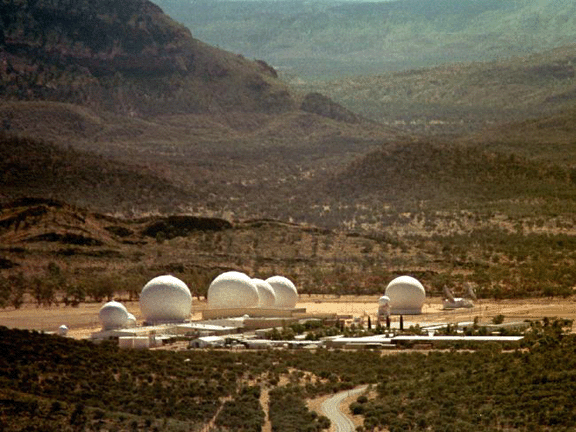
26 February 2023, By ROD MOSS https://alicespringsnews.com.au/2023/02/26/sacred-site-nuclear-target-are-neighbours/
At the distant point of the track is the Joint Defence Facility, colloquially known as the Space Base or Pine Gap. Prior to awareness of Kweyrnpe, I’d joined peace activists in the 1980s, protesting at its gates about its role in war, surveillance and nuclear targeting.
Not until the mid nineties did I understand the significance of Kweyrnpe to the Hayes families when Patrick senior asked me to take him there to talk about the paintings.
He’d mentioned it was a sacred site when, as its TO, he’d been toured through the defence facility.
His grandson, Vernon Alice had accompanied him. The base was honouring an agreement with the TOs whenever new installations occurred though the family remain none the wiser about its inner workings.
Some of the younger men had spent time in Big House, the correctional centre, visible to the south of Kweyrnpe.
Whatever privations they’d endured, several admitted it wasn’t too bad as, unlike many inmates, they’d been on their own country which possibly explained the casual acceptance of many of their sentences and recidivism.
Initially it was the rock formations that fascinated me and those and the sky were painted first. But it wasn’t finished with me. Or me with it.
Some weeks later I imagined, then added, a wild dog pack lurching stealthily towards the viewer over; intruders beneath that apocalyptic sky.
The ridge to the right separates the initiated men’s site, with its overhang of protected paintings, from the women and children’s side which is adorned with native pines / alukerrwe.
Though no signage existed in the small car park at the time of this painting, a visitors book and a board with brief information about its significance for Arrernte has been erected advising on appropriate behaviour. A simplified story about the place also fronts the paintings.
There has never in history been a greater need for a large Anti-War Movement

Caitlin Johnstone 27 Feb 23 Caitlin’s Newsletter,
Things are escalating more and more rapidly between the US-centralized power structure and the few remaining nations with the will and the means to stand against its demands for total obedience, namely China, Russia, and Iran. The world is becoming increasingly split between two groups of governments who are becoming increasingly hostile toward each other, and you don’t have to be a historian to know it’s probably a bad sign when that happens. Especially in the age of nuclear weapons.
The US State Department’s Victoria Nuland is now saying that the US is supporting Ukrainian strikes on Crimea, drawing sharp rebukes from Moscow with a stern reminder that the peninsula is a “red line” for the Kremlin which will result in escalations in the conflict if crossed. On Friday, Ukraine’s President Zelensky told the press that Kyiv is preparing a large offensive for the “de-occupation” of Crimea, which Moscow has considered a part of the Russian Federation since its annexation in 2014.
As Anatol Lieven explained for Jacobin earlier this month, this exact scenario is currently the one most likely to lead to a sequence of escalations ending in nuclear war. In light of the aforementioned recent revelations, the opening paragraph of Lieven’s article is even more chilling to read now than it was when it came out a couple of weeks ago:
The greatest threat of nuclear catastrophe that humanity has ever faced is now centered on the Crimean peninsula. In recent months, the Ukrainian government and army have repeatedly vowed to reconquer this territory, which Russia seized and annexed in 2014. The Russian establishment, and most ordinary Russians, for their part believe that holding Crimea is vital to Russian identity and Russia’s position as a great power. As a Russian liberal acquaintance (and no admirer of Putin) told me, “In the last resort, America would use nuclear weapons to save Hawaii and Pearl Harbor, and if we have to, we should use them to save Crimea.”
| And that’s just Russia. The war in Ukraine is being used to escalate against all powers not aligned with the US-centralized alliance, with recent developments including drone attacks on an Iranian weapons factory which reportedly arms Russian soldiers in Ukraine, and Chinese companies being sanctioned for “backfill activities in support of Russia’s defence sector” following US accusations that the Chinese government is preparing to arm Russia in the war. Israel’s Prime Minister Benjamin Netanyahu has reportedly been holding multiple meetings with top military officials regarding potential future attacks on Iran to neutralize the alleged threat of Iran developing a nuclear arsenal, a “threat” that Netanyahu has personally been lying about for years. If you’ve been reading Antiwar.com (and if you care about this stuff you probably should be), you’ve been seeing new articles about the latest imperial escalations against China on a near-daily basis now. Sometimes they come out multiple times per day; this past Thursday Dave DeCamp put out two completely separate news stories titled “US Plans to Expand Military Presence in Taiwan, a Move That Risks Provoking China” and “Philippines in Talks With US, Australia on Joint South China Sea Patrols“. Taiwan and the South China Sea are two powderkeg flashpoints where war could quickly erupt at any time in a number of different ways. If you know where to look for good updates on the behavior of the US-centralized empire and you follow them from day to day, it’s clear that things are accelerating toward a global conflict of unimaginable horror. As bad as things look right now, the future our current trajectory has us pointed toward is much, much, much worse. Empire apologists will frame this trajectory toward global disaster as an entirely one-sided affair, with bloody-fanged tyrants trying to take over the world because they are evil and hate freedom, and the US-centralized alliance either cast in the role of poor widdle victim or heroic defender of the weak and helpless depending on which generates more sympathy on that day. These people are lying. Any intellectually honest research into the west’s aggressions and provocations against both Russia and China will show you that Russia and China are reacting defensively to the empire’s campaign to secure US unipolar planetary hegemony; you might not agree with those reactions, but you cannot deny that they are reactions to a clear and deliberate aggressor. This is important to understand, because whenever you say that something must be done to try and avert an Atomic Age world war, you’ll get empire apologists saying “Well go protest in Moscow and Beijing then,” as though the US power alliance is some kind of passive witness to all this. Which is of course complete bullshit; if World War III does indeed befall us, it will be because of choices that were made by the drivers of the western empire while ignoring off-ramp after off-ramp. This tendency to flip reality and frame the western imperial power structure as the reactive force for peace against malevolent warmongers serves to help quash the emergence of a robust anti-war movement in the west, because if your own government is virtuous and innocent in a conflict then there’s no good reason to go protesting it. But that’s exactly what urgently needs to happen, because these people are driving us to our doom. In fact, it is fair to say that there has never in history been a time when the need to forcefully oppose the warmongering of our own western governments was more urgent. The attacks on Vietnam and Iraq were horrific atrocities which unleashed unfathomable suffering upon our world, but they did not pose any major existential threat to the world as a whole. The wars in Vietnam and Iraq killed millions; we’re talking about a conflict that can kill billions. Each of the World Wars was in turn the worst single thing that happened to our species as a whole up until that point in history. World War I was the worst thing that ever happened until World War II happened, and if World War III happens it will almost certainly make World War II look like a schoolyard tussle. This is because all of the major players in that conflict would be armed with nuclear weapons, and at some point some of them are going to be faced with strong incentives to use them. Once that happens, Mutually Assured Destruction ceases to protect us from armageddon, and the “Mutual” and “Destruction” components come in to play. None of this needs to happen. There is nothing written in adamantine which says the US must rule the world with an iron fist no matter the cost and no matter the risk. There is nothing inscribed upon the fabric of reality which says nations can’t simply coexist peacefully and collaborate toward the common good of all beings, can’t turn away from our primitive impulses of domination and control, can’t do anything but drift passively toward nuclear annihilation all because a few imperialists in Washington convinced everyone to buy into the doctrine of unipolarism. But we’re not going to turn away from this trajectory unless the masses start using the power of our numbers to force a change from warmongering, militarism and continual escalation toward diplomacy, de-escalation and detente. We need to start organizing against those who would steer our species into extinction, and working to pry their hands away from the steering wheel if they refuse to turn away. We need to resist all efforts to cast inertia on this most sacred of all priorities, and we need to start moving now. We’re all on a southbound bus to oblivion, and it’s showing no signs of stopping. |
Nuclear weapons consortium enthusiastically revving up their business.

Nuclear weapons consortium faces new global threats, JIM CARRIER S The Gazette, Feb 26, 2023
WASHINGTON • Thirty years after the Cold War, the United States is again running in a nuclear arms race.
Officially, no one calls it a race. It is contest between four or five adversaries who could destroy the world, or much of it. But it is shaping up to be a costly, unpredictable, generational competition that will shadow international nuclear geopolitics for decades.
Team USA, which is leading the pack at the moment, gathered in a hotel ballroom in Alexandria, Va., Feb. 14 to hear how it can win. The forum was the 15th Nuclear Deterrence Summit, a gathering of people employed by the “nuclear security enterprise,” the complex of laboratories, factories, corporations and federal branches that make and use nuclear weapons.
The atmosphere was by turns alarming and auspicious as contractors, who operate most of the nuclear enterprise and employ 95% of its 70,000 employees, heard of the growing threats to U.S. security, while contemplating lucrative federal contracts to counter those threats.
“Delivery of mission is becoming paramount while the fiscal environment is evolving from being cost-constrained to being cost-conscious,” reported a new study of the enterprise.
The result of that shift is clear: The first millions of trillions of dollars are flowing toward labs and factories that are designing, and starting to build, new thermonuclear bombs and new fleets of missiles, airplanes and submarines to deliver them.
For the 531 people in attendance the summit at times resembled a pep rally.
In a keynote address, Jill Hruby, administrator of the National Nuclear Security Administration (NNSA), described the U.S. buildup as a “renaissance.”
Nuclear weapons remain the “cornerstone of national defense,” she said. The current stockpile of 3,750 aging warheads — down from more than 31,000 at the height of the Cold War in the mid-1960s — is being “modernized.” They include five existing warheads for gravity bombs, Minuteman and cruise missiles, and the Trident missile for new Columbia-class submarines, now being built. One warhead, the W93, is a new design for the Sentinel, a new intercontinental ballistic missile that will replace the Minuteman III missiles in silos in Colorado, Wyoming, Montana and North Dakota.
To make that warhead, the U.S. will again make plutonium “pits,” the core of hydrogen thermonuclear bombs, at a remodeled plant in Los Alamos, N.M., and a new $10 billion plant in Savannah River, Ga.
The pit factories, which replace the infamous and now cleared from the landscape Rocky Flats factory outside Denver, are still being designed, and are the subject of lawsuits by activist groups who say the government sidestepped required full environmental impact statements. If they become operational, Los Alamos will make 30 pits a year starting in 2026 and Savannah River 50 pits a year — a number that is likely to grow, Hruby said.
In the next five years NNSA, a semi-autonomous agency within the U.S. Department of Energy responsible for applying nuclear science to military weapons, plans to complete five warhead modernizations, build at least six major construction projects and rebuild numerous facilities and capabilities that have “atrophied or disappeared” since the Cold War, she said. Many of the plants and labs are still cleaning up deadly contamination left from the Cold War.
“The American people are hearing more about nuclear issues than at any time since the Cuban Missile Crisis, or the collapse of the Soviet Union,” Hruby said.
At the conclusion of her talk, which began at 8:30 a.m. on Valentine’s Day, moderator DJ Johnson, vice president of Honeywell’s Federal Solutions Business Enterprise, prompted the audience like a cheerleader………………
The audience applauded, a bit halting at first, perhaps because of two sobering messages that accompanied NNSA’s accomplishments. The first involved new international threats that in the last year shattered the foundations of nonproliferation treaties and the delicate balance of power and peace that had prevailed since the 1960s:………………………………………………………………………….
The second sobering message involved the enterprise’s brain deficit. Last year, the complex hired 11,000 people, but lost 7,000……………
Attrition at some plants is as high as 10% a year, nearly a third of the federal overseers are nearing retirement and 40% of the workforce has less than five years’ experience……………….
As the 500 enterprise employee met and contemplated a future full of nuclear weapons, two men stood across the street from the hotel, holding hand-painted signs. “Nuclear Weapons are illegal,” said one. “The World Wants Nuclear Disarmament,” said the other.

More Evidence Emerges That US Wanted Russia to Invade

February 24, 2023
In the past year, additional proof has emerged proving the West’s provocation of Russia to give it its “Vietnam” in Ukraine.
Consortium News on Feb. 4, 2022 warned that the U.S. was setting a trap for Russia in Ukraine, as it had in Afghanistan in 1979 and Iraq in 1990, to provoke Russia to invade Ukraine to provide the pretext to launch an economic, information and proxy war designed to weaken Russia and bring down its government — in other words, to give Russia its “Vietnam.” Twenty days later Russia invaded.
One month later, President Joe Biden confirmed that a trap had indeed been set, as reported by Consortium News on March 27, 2022, republished here today. The evidence that the U.S. wanted and needed Russia to invade as cause to launch its economic, information and proxy wars was clear:
- The U.S. backed a coup in 2014, installing an anti-Russian government in Kiev and supporting a war against coup resisters in Donbass.
- The 2015 Minsk Accords to end the Ukrainian civil war were never implemented.
- On the day of the Feb. 24, 2022 invasion Biden told reporters that economic sanctions were never intended to deter Russia, but to show the Russian people who Russian President Vladimir Putin was. In other words the U.S. was not trying to stop the invasion but to overthrow Putin, as Biden confirmed a month later in Warsaw, in order to restore the dominance over Russia the U.S. enjoyed in the 1990s.
The United States and NATO rejected Russian treaty proposals to create a new security architecture in Europe, taking Russia’s security concerns into account. Despite a Russian warning of a technical/military response if the draft treaties were rejected. The U.S. and NATO rejected them nonetheless, knowing and welcoming the consequences. Rather than withdrawing NATO forces from Eastern Europe as the treaty proposals called for, NATO sent more troops.- For 30 years, NATO continued expanding towards Russia, despite promises to the contrary, routinely holding exercises near its border, despite fully understanding Russia’s objections, from Boris Yeltsin to Putin, and knowing it would provoke a hostile reaction. Sen. Joe Biden said as much in 1997.
- The fake Russiagate scandal helped prepare the U.S. population for hostilities against Russia and launched sanctions based on a lie that have never been lifted.
- Despite 100,000 Russian troops on the Russian side of the border, the OSCE reported an increase of shelling by Ukraine of Donbass at the end of February 2022 indicating an impending offensive against ethnic Russian civilians who had suffered eight years for resisting an unconstitutional change of government in 2014. It was tantamount to baiting those Russian forces to cross the border.
- In the past year, additional evidence has emerged proving the West’s provocation:
- U.S. Secretary of Defense Lloyd Austin acknowledged that the U.S. strategy in Ukraine is to “weaken” Russia. To this end, the U.S. has stopped peace efforts, even by Israel, to prolong the conflict.
- Former German Chancellor Angela Merkel, former French President Francois Holland, former British Prime Minister Boris Johnson and former Ukrainian President Petro Poroschenko all admitted in recent months that they never had any intention of implementing the Minsk Accords (endorsed by the U.N. Security Council) and were stringing Russia along to give time for NATO to train and equip the Ukrainian military for the Russian intervention it anticipated.
- Planning for sanctions against Russia began in November 2021, three months before the invasion, according to Ursula von der Leyen, the president of the European Council.
- Planning to destroy the Nord Stream pipelines were begun by the United States in September 2021, five months before the invasion, according to reporting by Seymour Hersh.
- Taken together, all this evidence leaves little doubt that the U.S. was provoking Russia to invade Ukraine in order to implement its plan to bring down the Russian government. That the U.S. plan has so far failed, is another matter.
This was Consortium News‘ report on March 27, 2022:
By Joe Lauria
Special to Consortium News
March 27, 2022
The U.S. got its war in Ukraine. Without it, Washington could not attempt to destroy Russia’s economy, orchestrate worldwide condemnation and lead an insurgency to bleed Russia, all part of an attempt to bring down its government. Joe Biden has now left no doubt that it’s true.
The president of the United States has confirmed what Consortium News and others have been reporting since the beginnings of Russsiagate in 2016, that the ultimate U.S. aim is to overthrow the government of Vladimir Putin.
“For God’s sake, this man cannot remain in power,” Biden said on Saturday at the Royal Castle in Warsaw. The White House and the State Dept. have been scrambling to explain away Biden’s remark.
But it is too late.
…………………………………………………… Biden first gave the game away at his Feb. 24 White House press conference — the first day of the invasion. He was asked why he thought new sanctions would work when the earlier sanctions had not prevented Russia’s invasion. Biden said the sanctions were never designed to prevent Russia’s intervention but to punish it afterward. Therefore the U.S. needed Russia to invade.
………………………….. It was the second time that Biden confirmed that the purpose of the draconian U.S. sanctions on Russia was never to prevent the invasion of Ukraine, which the U.S. desperately needed to activate its plans, but to punish Russia and get its people to rise up against Putin and ultimately restore a Yeltsin-like puppet to Moscow. Without a cause those sanctions could never have been imposed. The cause was Russia’s invasion.
Regime Change in Moscow
Once hidden in studies such as this 2019 RAND study, the desire to overthrow the government in Moscow is now out in the open.
One of the earliest threats came from Carl Gersham, the long-time director of the National Endowment for Democracy (NED). Gershman, wrote in 2013, before the Kiev coup: “Ukraine is the biggest prize.” If it could be pulled away from Russia and into the West, then “Putin may find himself on the losing end not just in the near abroad but within Russia itself.”
David Ignatius wrote in The Washington Post in 1999 that the NED could now practice regime change out in the open, rather than covertly as the C.I.A. had done.
The RAND Corporation on March 18 then published an article titled, “If Regime Change Should Come to Moscow,” the U.S. should be ready for it. Michael McFaul, the hawkish former U.S. ambassador to Russia, has been calling for regime change in Russia for some time…………………………………………………………………………………….
Back in 2017, Consortium News saw Russiagate as a prelude to regime change in Moscow. That year I wrote:
“The Russia-gate story fits neatly into a geopolitical strategy that long predates the 2016 election. Since Wall Street and the U.S. government lost the dominant position in Russia that existed under the pliable President Boris Yeltsin, the strategy has been to put pressure on getting rid of Putin to restore a U.S. friendly leader in Moscow. There is substance to Russia’s concerns about American designs for ‘regime change’ in the Kremlin…………………………………………..
The Invasion Was Necessary
The United States could have easily prevented Russia’s military action. It could have stopped Russia’s intervention in Ukraine’s civil war from happening by doing three things: forcing implementation of the 8-year old Minsk peace accords, dissolving extreme right Ukrainian militias and engaging Russia in serious negotiations about a new security architecture in Europe.
But it didn’t.
The U.S. can still end this war through serious diplomacy with Russia. But it won’t. Blinken has refused to speak with Russian Foreign Minister Sergei Lavrov. Instead, Biden announced on March 16 another $800 million in military aid for Ukraine on the same day it was revealed Russia and Ukraine have been working on a 15-point peace plan. It has never been clearer that the U.S. wanted this war and wants it to continue………………………………………………………………………………………………………….
The Excised Background to the Invasion
It is vital to recall the events of 2014 in Ukraine and what has followed until now because it is routinely whitewashed from Western media coverage. Without that context, it is impossible to understand what is happening in Ukraine.
Both Donetsk and Lugansk had voted for independence from Ukraine in 2014 after a U.S.-backed coup overthrew the democratically elected president Viktor Yanukovych. The new, U.S.-installed Ukrainian government then launched a war against the provinces to crush their resistance to the coup and their bid for independence, a war that is still going on eight years later at the cost of thousands of lives with U.S. support. It is this war that Russia has entered.
Neo-Nazi groups, such as Right Sector and the Azov Battalion, who revere the World War II Ukrainian fascist leader Stepan Bandera, took part in the coup as well as in the ongoing violence against Lugansk and Donetsk.
Despite reporting in the BBC, the NYT, the Daily Telegraph and CNN on the neo-Nazis at the time, their role in the story is now excised by Western media, reducing Putin to a madman hellbent on conquest without reason. As though he woke up one morning and looked at a map to decide what country he would invade next.
The public has been induced to embrace the Western narrative, while being kept in the dark about Washington’s ulterior motives.
The Traps Set for Russia
Six weeks ago, on Feb. 4, I wrote an article, “What a US Trap for Russia in Ukraine Might Look Like,” in which I laid out a scenario in which Ukraine would begin an offensive against ethnic Russian civilians in Donbass, forcing Russia to decide whether to abandon them or to intervene to save them.
If Russia intervened with regular army units, I argued, this would be the “Invasion!” the U.S. needed to attack Russia’s economy, turn the world against Moscow and end Putin’s rule.
In the third week of February, Ukrainian government shelling of Donbass dramatically increased, according to the OSCE, with what appeared to be the new offensive. Russia was forced to make its decision.
It first recognized the Donbass republics of Donetsk and Lugansk, a move it put off for eight years. And then on Feb. 24 President Vladimir Putin announced a military operation in Ukraine to “demilitarize” and “denazify” the country.
Russia stepped into a trap, which grows more perilous by the day as Russia’s military intervention continues with a second trap in sight. From Moscow’s perspective, the stakes were too high not to intervene. And if it can induce Kiev to accept a settlement, it might escape the clutches of the United States.
A Planned Insurgency ………………………………………………………………………………………………………………………………The Economic War
Along with the quagmire, are the raft of profound economic sanctions on Russia designed to collapse its economy and drive Putin from power.
These are the harshest sanctions the U.S. and Europe have ever imposed on any nation. Sanctions against Russia’s Central Bank sanctions are the most serious, as they were intended to destroy the value of the ruble………………………………………………………………………………
The aim is clear: “asphyxiating Russia’s economy”, as French Foreign Minister Jean-Yves Le Drian put it, even if it damages the West.
more https://consortiumnews.com/2023/02/24/more-evidence-emerges-that-us-wanted-russia-to-invade/
Joe Lauria is editor-in-chief of Consortium News and a former U.N. correspondent for The Wall Street Journal, Boston Globe, and numerous other newspapers, including The Montreal Gazette and The Star of Johannesburg. He was an investigative reporter for the Sunday Times of London, a financial reporter for Bloomberg News and began his professional work as a 19-year old stringer for The New York Times. He can be reached at joelauria@consortiumnews.com and followed on Twitter @unjoe

Toxic US-Japan collusion on nuke wastewater taints global environment

2023-02-20
Washington and Tokyo are in the midst of a transition from “alliance protection” of their partnership to “alliance projection” into the Indo-Pacific, US Ambassador to Japan Rahm Emanuel said at a recent press conference in Tokyo.
Now many believe such an alliance takes on a much clearer form of “alliance pollution,” as the two are ganging up to endanger the Pacific and the wider global ecosystem.
At an open debate on the impact of sea-level rise on international peace and security held Tuesday by the United Nations Security Council, representatives of multiple countries criticized Tokyo over its accelerated push to discharge contaminated water from Fukushima Daiichi Nuclear Power Plant.
They argued that Japan’s discharge plan, defying concerns of neighboring countries, will seriously endanger the global marine environment, ecosystems, and the health and safety of people along the Pacific coast.
Presumably, the United States, with a Pacific coastline, would also fall victim to the health hazards posed by the contaminated water once it reaches the west coast along with the ocean currents.
Washington, however, again glossed over the risks. US State Department spokesperson Ned Price has recently claimed that the United States “welcomes Japan’s continued openness,” saying the plan is “in line with the internationally accepted nuclear safety standards.”
Such a response makes sense, considering the government’s handling of a recent hazmat train derailment in Ohio, the environmental fallout of which could be massive. Both the US government and media were indifferent to it at first.
Quite tacitly, across the Pacific, Tokyo and Japanese media have also been reticent on this incident, in stark contrast with their fault-finding on some developing countries regarding environment protection.
Behind their collective, selective silence is a toxic US-Japan collusion on nuke wastewater, which is now tainting the Japanese soil.
In 2022, high levels of cancer-causing perfluoro organic compounds were detected in areas around US military bases in Okinawa prefecture, with the bases’ firefighting foam being the suspected source, local media reported.
Of the 46 sites sampled surrounding the US military installations as part of a biannual groundwater survey, 32 exceeded Japan’s provisional safe drinking water standard.
Outside Okinawa, concentration levels of perfluoro organic compounds sampled at 81 sites in 13 Japanese prefectures exceeded standards, including groundwater and tap water in many parts of Tokyo’s Tama area near the US air base in Yokota.
As the Japanese government denied access to investigation inside the US bases, some local residents chose to swallow anger while some investigated the source of contamination on their own.
“I dare not drink tap water here, so I usually consume bottled water,” a resident from the Tama area told Xinhua, offering a glimpse into the misery and humiliation experienced by locals at the “US occupied land.”
While Emanuel is sparing no effort to urge the US-Japan alliance to draw the sword, the US and Japanese people are suffering from profound pollution problems, with the Pacific Ocean environment and the health of coastal residents under potential threat.
However Washington and Tokyo try to justify each other’s environmental wrongdoings, they can never be exempted in the face of overwhelming facts.
The foul of the US-Japan alliance lies not only in its disregard for the global environment and double standards, but also in its absurd values of prioritizing hegemony over public health.
https://global.chinadaily.com.cn/a/202302/20/WS63f2c05da31057c47ebafa60.html
Thousands rally in Berlin, Paris to call for peace in Ukraine
People in Berlin take part in a protest against the delivery of weapons to Ukraine.
Protesters in Paris and Berlin capitals have rallied to demand peace in Ukraine, a day after the anniversary of Russia’s invasion.
Thousands of people protested in the Germany capital on Saturday to condemn the government’s supply of arms to Ukraine and call for peace talks to end the war.
The organisers were criticised before the protest for downplaying Ukraine’s right to defend its territory from Russian aggression and failing to distance themselves from the far right and far left, where pro-Russia views are common.
One of the organisers, opposition lawmaker Sahra Wagenknecht of the ex-communist Left party, said that there was no place for neo-Nazis at the rally, but that anyone who wanted peace “with an honest heart” was welcome.
While most placards at the protest reflected traditional left-wing positions, some participants bore banners with the slogan “Americans go home” and the logo of a far-right magazine. Some waved Russian flags.
Wagenknecht accused the German government of seeking to “ruin Russia,” and said that Moscow should be made an “offer” in order to resume peace talks.
Another of the organisers, prominent feminist author Alice Schwarzer, said it was time to look beyond left and right.
The two women have also launched a petition which claims to have gathered more than 645,000 signatures.
Protesters jeered whenever she and Wagenknecht mentioned the name of German foreign minister Annalena Baerbock, who has strongly backed the delivery of arms to Ukraine.
Police said that about 13,000 people took part in the rally at Berlin’s iconic Brandenburg Gate, while organisers claimed that 50,000 people participated.
One attendee was Konstantin Schneider, an academic from Berlin, who said he understood that countries in Eastern Europe were afraid of Russia.
“Of course [Russian President Vladimir] Putin is an idiot to attack Ukraine,” he said. “But we still need to find new solutions [to the war] instead of sweepingly saying there’s nothing to negotiate.”
There were several small counter-demonstrations. On Friday, thousands of protesters across Europe marched against Moscow’s invasion of Ukraine…………………………………….
UK: big talk about small nuclear reactors, but not much is happening, really.

Over 3000GW of renewables are already in place globally, compared to only 394 GW of nuclear, with wind and solar now romping further ahead around the world. By 2050, the BNEF says the global power system will be dominated by wind and solar (75% of production), with nuclear at just 9%, down from 10% now. If it makes it to 24% nuclear by then, the UK will be a bit of an outlier.
“……………………………….Graham Stuart, now a Minister of State at the new Department for Energy Security and Net Zero…..- ‘what I can say is that we are absolutely committed to nuclear as a significant share of our electricity because we need that baseload and are committed to driving it forward.’
So that’s a positive ‘go’ signal, although funding is still a major problem, and, despite much talk, progress on the proposed ‘24 GW of nuclear by 2050’ programme seems to have slipped behind.
As NuClear News 141 reported, at the end of November last year, the Government was said to be about to announce proposals to set up a new body called Great British Nuclear (GBN), which would develop a network of small modular reactors (SMRs), as well as promote new large reactors. Grant Shapps, the Business Secretary, was due to make the announcement on 29th November. But it was delayed because of a row with the Treasury over funding.
And by January, The Times was reporting that a deal on SMR funding was unlikely to materialise for at least another 12 months. A senior government source said the Treasury would not sign off on any orders or significant funding for SMR work until the technology had approval from the Nuclear Regulators Generic Design Assessment, which was not expected, until 2024.
In addition to the proposed Rolls Royce SMRs, four of which are planned initially, several other SMRs are also now in the race for UK deployment, some from overseas. They include GE Hitachi’s 300MW boiling water reactor, and Holtec’s 160MWe pressurised water reactor, developed in collaboration with Mitsubishi and Hyundai. The USA’s NuScale, the most advanced project so far, has also expressed interest in UK sites for its mini PWR.
Potential UK sites for new SMRs include Trawsfynydd in Wales and Heysham and Oldbury in England, but, given the funding issues, it will evidently be a while before anything happens on SMRs, or indeed, in terms of new larger projects, after Sizewell C. Though some help with funding may yet be on hand. According to the Telegraph, nuclear projects may soon to be classed as ‘green’ or ’sustainable’ investments, clearing a way for more institutional investors and environment-focused funds to back them. The Telegraph says there are also hopes that use can be made of the Government’s green gilts green savings bonds.
Is nuclear really green? Not many greens think so, and given the risks, costs and delays associated with it, nuclear is often not popular with investors. There have been some delays with the only currently live new projects in the UK, the Hinkley Point C EPR being built by EdF, although nothing so far on the decade-long delays with the ongoing EPR projects in France and Finland. EDF now say the Hinkley EPR should start up in 2027. However, to be on the safe side, the deadline for starting up its major CfD payment (after which, under the contract rules, it would not be eligible for CfD payments) has been extended to 2036 from 2033.
…………………….. EDF has recently admitted that Hinkley Point C final cost is likely to be £31-32bn, up from the £18 bn estimated initially. Sizewell ought to benefit from construction lessons learned from Hinkley, but, although RAB pushes the financial risks onto consumers, there are still many investment uncertainties about the project.
Finance may be a key issue for EDF in the UK, but it is if anything even more of an issue for it in France, where it is facing major problems, with a huge repair bill and loss of income as plants are shut for safety checks and power has to be imported. As a result, with energy security being a key issue these days, nuclear no longer looks reliable. ………………………
With a handful of other nuclear projects being considered around the world, including some SMRs, and Russia and China also pressing ahead with larger plants, the UK isn’t the only country with ambitions for nuclear expansion. However, globally, the likely scale of nuclear expansion is relatively small in total, compared with the vast scale and rapid pace of renewables expansion.
Over 3000GW of renewables are already in place globally, compared to only 394 GW of nuclear, with wind and solar now romping further ahead around the world. By 2050, the BNEF says the global power system will be dominated by wind and solar (75% of production), with nuclear at just 9%, down from 10% now. If it makes it to 24% nuclear by then, the UK will be a bit of an outlier. https://renewextraweekly.blogspot.com/2023/02/uk-nuclear-news.html
February 26 Energy News — geoharvey

Opinion: ¶ “Dear Maryland: It’s Time To Drive Clean Trucks And Buses” • Every soul walking this earth deserves to breathe clean air. But there are counties across Maryland have air that hasn’t met the EPA’s standards for decades, causing public health problems ranging from asthma to premature death. Much of that pollution comes from […]
February 26 Energy News — geoharvey
Marrickville Peace Group (MPG) calls for keeping Australia’s nuclear bans, and particularly emphasises the nuclear waste problem

In brief , the pro nuclear power lobby presents a trouble free new generation front which assumes
just as trouble free social licence. This presentation flies in the face of proven historical fact.
Submission No. 21. to Senate Inquiry This submission argues that the current climate crisis creates an urgent need forAustralia to source its energy from renewable and not nuclear technology. Nuclear energy supply is
deeply flawed when examined wholistically. The safe long term disposal of nuclear waste (HLW)
issue is one to which no country in the world has a satisfactory answer to. It is an issue that will not
go away. The lack of wholistic social licence for nuclear waste disposal renders Australia in an
untenable position both internally and externally/internationally.
I write as a member of Marrickville Peace Group (MPG), situated in the Inner West of Sydney,
Federal Electorate of Grayndler. MPG learns with alarm of the attempt by the LNP to repeat a
pattern, not unknown of the LNP , of setting aside good legislation in order to return Australia to less
enlightened times. MPG objects most strenuously to the move to expand the viability of its current
nuclear technology to cater to the nuclear power industry. . The Private Senators Bill: Environment
and Other Legislation Amendment (Removing Nuclear Energy Prohibitions) Bill 2022) was put
forward by 9 Coalition Senators who have been incentivized by the government signing on to buy
nuclear-powered submarines (according to Senator Matt Canavan.). This promotion of things
nuclear to collateral expansion is arguably one of the more pernicious aspects of the AUKUS deal.
The world is in the grip of a climate crisis, the result of using carbon rich fossil fuels, once though to
be a great boon, as a source of energy. Gradually, since 1896 in fact, when scientist Svante Arrenius
first predicted the greenhouse effect, the world has come to know that climate change is real. Thus
the way we have sourced our energy has brought us to an environmental crisis. The irony is that
nuclear is proposed as counter to the environmental crisis brought about by fossil fuels, when the
disposal of High Level Waste (HLW) is itself a harbinger of deadly waste disposal issues. There is no
proven solution for managing high-level nuclear waste produced in power reactors. No operating
deep underground repository for high-level nuclear waste exists. MPG maintains that the
introduction of nuclear energy into its power mix is a case of replacing one environmental crisis with
another. (Don’t Nuke the Climate Submission Guide)………………………………………………………
The proposal to introduce nuclear power is a long term (and a very costly) project : the average time
to establish a nuclear power station, from planning to operational stage, is between fifteen and
twenty years.. It is not without good reasons that there is an increasing call for the power future to
be renewable and not nuclear.
There is more to the objection to nuclear power than simply the establishment timeframe. | Don’t
nuke the Climate! )
The Glasgow Statement (COP26 2021, signed by 479 international organisations , lists a cluster of
many defective factors associated with nuclear based on the latest Intergovernmental Panel on
Climate Change (IPCC) report. The primary summary statement “We need an urgent global shift to
clean and renewable energy and national governments need to actively facilitate and manage the
transition from reliance on fossil fuels and nuclear to renewable energy”.
A summary of criticisms of the nuclear power option include:
- The nuclear industry has a history of displacing, disrupting and damaging the health and
rights of workers and communities: - It diverts resources away from renewable energy technology;
- Nuclear is slow, expensive and dangerous.
- It is not carbon neutral-almost every stage of the nuclear chain requires additional nonnuclear
energy inputs. And - It poses unique security and waste management risks.
- Nuclear power is unsustainable . Nuclear power relies on uranium mining. Like coal mining
this causes adverse environmental impacts and puts workers and communities at risk. It is a
thirsty industry that consumes large volumes of precious water, from uranium mining and
processing through to reactor cooling. Nuclear power plants are vulnerable to threats that
are being exacerbated by climate impacts, including dwindling and warming water sources,
sea-level rise, drought, jelly-fish swarms and increasing storm severity - It is expensive. Nuclear power is now one of the most capital intensive and expensive ways
to produce electricity and costs continue to rise. (including establishment and decommission
expenses). - Climate threats :Nuclear power plants are vulnerable to threats which are being exacerbated
by climate change. These include dwindling and warming water sources, sea-level rise, storm
damage, drought, and jelly-fish swarms. Nuclear engineer David Lochbaum states: “You
need to solve global warming for nuclear plants to survive “ - Nuclear is increasingly vulnerable security risks. – witness current events at the Zaporizhzhia
power plant in Ukraine.
In Australia, the saga of nuclear waste disposal is long and unsatisfactory. It is characterized by a
high level of dysfunctionality……………………………………………….
THE REALITY OF EXTERNAL INTERESTS was dramatically revealed in the late 90’s when a closely
guarded secret in the form of a consortium Pangea Resources (80% owned by British Nuclear Fuels
Limited (BNFL) had been conducting research and discussions about establishing an international
high-level nuclear waste repository in Australia. A corporate video was leaked to Friends of the Earth
(UK) in the late 1990s. Until this video was leaked, Australians had no idea that we were being
targeted as the world’s nuclear dump. ……………………………………………..
The Friends of the Earth Australia site reveals also there is a list of very prominent politicians / expoliticians
supporting the development of a high level nuclear waste dump in Australia to take waste
from overseas include: Liberal Senator Judith Troeth called for Australia to build nuclear power
reactors and for the high-level waste to be dumped at Muckaty in the NT; former Prime Minister
Bob Hawke ;former foreign minister Alexander Downer; former foreign minister Gareth Evans .
Liberal/National Coalition Senators refused to support a Senate motion opposing an international
nuclear dump in May 2006. In 2005 Martin Ferguson responded to Bob Hawke’s call for Australia to
establish a high level waste dump by saying: “In scientific terms Bob Hawke is right. Australia
internationally could be regarded as a good place to actually bury it deep in the ground”.
THE WAY THINGS ARE SEEN – WHAT TO BELIEVE ?
The Minerals Council (TMC) is clearly supportive of the return to nuclear proposal : Removing the
Prohibition on Nuclear Power.
What is interesting is the selectivity of the MC’s arguments, which are summarised below :
Nuclear energy is zero emissions baseload energy. Fact check : nuclear reactors do not produce air
pollution or carbon dioxide while operating BUT : When it comes to nuclear, uranium extraction,
transport and processing produces emissions. The long and complex construction process of nuclear
power plants also releases CO2, as does the demolition of decommissioned sites.
Nuclear power is affordable ; Fact check The cost of wind and solar PV has decreased by 70-90 %
while nuclear costs have increased by 33%. (Don’t Nuke the Climate Submission guide. Op.cit.)
Nuclear power is safe, Fact check : For whom is it safe ? Of all the claims of the Nuclear lobby, this
surely is the hardest to sell .
Furthermore some aspects of this claim e.g. The risk of accidents in nuclear power plants is low and
declining. The consequences of an accident or terrorist attack are minimal. It is remarkable that the
Intergovernmental Panel on Climate Change (IPCC) says exactly the opposite: “Nuclear power plants
have been described as pre-deployed terrorist targets and pose a major security threat.”
Further, in referring to the “well publicized accidents” the Minerals Council deftly highlights “no
radiation fatalities” of two of the three. In the public mind it surely would loom large that there re
huge consequences to nuclear accidents, of which, as of 2014, there have been over 100 serious
nuclear accidents..the definition of which is : “an event that has led to significant consequences to
people, the environment or the facility. Examples include lethal effects to individuals, large
radioactivity release to the environment, reactor core melt.
TMC has a sales pitch which minimizes to the point of denial.
Nuclear power produces low waste : Fact check :This is a strangely deceptive claim. The “low” refers
merely to volume, NOT TO TOXICITY. The half Life of Plutonium is 24,000 years and of Uranium 238
is 4.5 billion years As argued above in some detail, Nuclear power produces High Level Waste (HLW)
which the world simply does not know, in real terms, how to deal with. Australia has no facility for
HLW. Reprocessing is in line to become a congested international waiting line. Given the possibility
of a wrong turn politically, Australia is a prime target for HLW dumping. The Removing Nuclear
Energy Prohibition Bill is an invitation to the world to focus on Australia as a nuclear waste dump…………
In brief , the pro nuclear power lobby presents a trouble free new generation front which assumes
just as trouble free social licence. This presentation flies in the face of proven historical fact.
The Independent Peaceful Australian Network (IPAN) rejects proposed changes to laws prohibiting nuclear power.

Recommendation 1
Reject the proposed amendments to bills
The Senate Standing Committees on Environment and Communications maintain the status quo in relation to
the Australian Radiation Protection and Nuclear Safety Act 1998 and the Environment Protection and
Biodiversity Conservation Act 1999.
Recommendation 2
Threat priorities
The Australian Government should prioritise as a matter of urgency:
(a) The two existential threats of climate change and nuclear war, and we support joining the Treaty on
the Prohibition of Nuclear Weapons. Prioritising climate change would necessitate a re-orientation of
the role of the Australian Defence Force (ADF).
Recommendation 3
Nuclear energy
The Australian Government should legislate the use of warships or submarines that only use a non-nuclear
energy source.
Submission No.17. The Independent Peaceful Australian Network (IPAN) Public Submission to the Inquiry into Environment andOther Legislation Amendment (Removing Nuclear Energy Prohibitions) Bill 2022
About IPAN
IPAN is a national umbrella organisation of community, peace, faith and environmental groups and trade
unions around Australia with an interest in peace and security. IPAN aims to build public dialogue and pressure
for change to a truly independent foreign policy for Australia – one in which our government plays a positive
role in solving international conflicts peacefully.
The announcement of the Inquiry into Environment and Other Legislation Amendment (Removing Nuclear
Energy Prohibitions) Bill 2022 comes at a very critical time for our country.
IPAN feels very strongly about providing a contribution to this inquiry and seeks to make comments on the
proposal to both amend the Australian Radiation Protection and Nuclear Safety Act 1998 to remove the
prohibition on the construction or operation of certain nuclear installations; and to amend the Environment
Protection and Biodiversity Conservation Act 1999 to remove the prohibition on the Minister for Environment
and Water declaring, approving or considering actions relating to the construction or operation of certain
nuclear installations. These Acts currently expressly prohibit the approval, licensing, construction, or operation
of a nuclear fuel fabrication plant; a nuclear power plant; an enrichment plant; or a reprocessing facility.
Australia currently faces rapidly changing strategic circumstances, global instability and planetary threats to
human security. This set of interlinking challenges, among others, requires an urgent and holistic response
from the Australian government.
Recognising the circumstances outlined above, in 2020 IPAN initiated its own national public inquiry to ‘Explore
the Case for an Independent and Peaceful Australia’ (the People’s Inquiry) so as to determine a path that would
lead Australia towards a genuinely independent, peaceful and secure defence and foreign policy.
IPAN led ‘People’s Inquiry: Exploring the Case for an Independent and Peaceful Australia’
The People’s Inquiry comprehensively questioned the foundations and assumptions underpinning the
cornerstone of Australia’s security – the Australia-US Alliance – across several impact areas: military and
defence, foreign policy, First Nations peoples, politics, society, workers, economy, and the environment.
The People’s Inquiry received 283 submissions from individuals and organisations across the country. An
interim report was released in October 2021 and the full report was released on 22 November 2022.
IPAN’s submission to this current inquiry draws, in part, on the findings and recommendations of the People’s
Inquiry, specifically those related to the area of impact on First Nation’s people, military and defence, foreign
policy and the environment. In particular, some submissions focused directly on issues surrounding nuclear
energy including concerns around storage of nuclear waste and consultation around land use (IPAN 2022a.
pp.21,23).
For a full copy of the Inquiry Report go to https://independentpeacefulaustralia.com.au/
Introduction
IPAN’S interest in matters related to nuclear energy, nuclear installations and nuclear weapons
IPAN has had a longstanding concern about nuclear issues, as a network of organisations and individuals
motivated by the desire to see peaceful resolutions to international conflicts and greatly concerned that our
world never sees a nuclear bomb dropped again – in particular such as the two bombs dropped on Hiroshima
and Nagasaki in 1945, leading to the immediate and subsequent deaths of over two hundred thousand people.
To this end, IPAN (and many member organisations and individual members) has been a very strong supporter
of the international Campaign to Abolish Nuclear Weapons (ICAN) regarding the adoption of a UN treaty to
prohibit nuclear weapons – i.e. the Treaty on the Prohibition of Nuclear Weapons (TPNW).
IPAN has been heartened by the positive steps that have been taken by the new Federal government, in
attending the first Meeting of States Parties to the TPNW in Vienna in June and ending Australia’s opposition tothe treaty by abstaining on a resolution at the UN First Committee after the previous government’s practice of voting ‘No’
Proposed Amendments to Federal Legislation
IPAN is concerned about the proposals in the bill to amend the Australian Radiation Protection and Nuclear
Safety Act 1998 to remove the prohibition on the construction or operation of certain nuclear installations;
and in the Environment Protection and Biodiversity Conservation Act 1999 to remove the prohibition on the
Minister for Environment and Water declaring, approving or considering actions relating to the construction or
operation of certain nuclear installations.
IPAN’ broad concerns with the use of nuclear power
First and foremost, IPAN believes that radiation is dangerous to people and the environment and that it is
critical to reduce human exposure to it. In addition, IPAN believes that the adoption of nuclear power in
Australia would increase electricity costs, slow the transition to a low-carbon economy and introduce the
potential for catastrophic accidents.
IPAN is also concerned about the water resources required for the production of nuclear energy, with huge
volumes required for the production of nuclear energy. We are also concerned about the contentious issue of
where to store nuclear waste, given the associated long-term risks of storage.
This submission therefore makes a number of key points in relation to the proposed amendments to the two
acts – which if adopted would remove the blanket prohibition on the construction or operation of certain
nuclear facilities. IPAN believes that the current blanket prohibition acts as a very important safeguard against
the risks and dangers associated with the nuclear industry – and that to remove this blanket prohibition would
be to the detriment of the Australian community, the environment and the Australian ecosystem.
Factors for the Senate Standing Committees on Environment and Communications to consider in its
decision regarding the proposed amendments
1 The dangers of radiation and risks of human exposure …………………………………………………….
2. Lack of compliance in the uranium mining industry.…………………………………………………….
3 The links between nuclear technology and military nuclear technology’
IPAN is in particular concerned with the links between civil nuclear technology and military nuclear technology.
The ACF have highlighted that uranium is a “dual use fuel and nuclear is a dual use technology – it can power a reactor or a weapon” and they have described how the current conflict in Ukraine has seen “the weaponization of nuclear facilities and the threat of an uncontrolled radiation release”, even if the Russian army does not use its nuclear weapons (ACF 2022a, p.1 cited in IPAN, 2022, p. 71).
The development of nuclear energy could be seen as a slippery slope to the eventual development of nuclearpowered weapons and even nuclear weapons themselves. It is important to recognise that nuclear power
programs have provided cover for numerous weapons programs over many years. An expansion of nuclear
power would simply worsen the situation……………………
Nuclear reactors are pre-deployed military or terrorist targets. The current situation in Ukraine illustrates the
risks:…………………………..
The current ban on nuclear energy in Australia provides a very important safeguard to avoid any chance of the
eventual development of nuclear-powered weapons and even nuclear weapons themselves. We must continue
this ban…………………………………………………………
4 The Costs of Nuclear Power
As pointed out in the second reading speech (by Senator Matt Canavan) of the ‘Environment and Other
Legislation Amendment (Removing Nuclear Energy Prohibitions) Bill 2022 Wednesday, 28 September 2022, the building of a nuclear plant requires high capital costs and long construction times. While the Senator also
argues that nuclear plants have relatively low operating costs – other factors must be considered, such as the
cost of rehabilitation of mines and the cost of storage of nuclear waste, as well as the many risks involved………………………………………………
5. The Costs of nuclear energy vs renewable energy sources
IPAN believes that it is important to address a number of the claims made by Senator Canavan in the Second
reading Speech (Australian Parliament 2022), for example where he asserted that “The relative costs of nuclear
compare well to renewable energy. Between 1965 and 2018 the world spent $2 trillion on nuclear compared to $2.3 trillion for solar and wind, yet nuclear today produces around double the electricity than that of solar and
wind.” He also added that costs may reduce soon.
As figures from Lazard Asset Investment (2021) in their annual Levelized Cost of Energy, Levelized Cost of
Storage, and Levelized Cost of Hydrogen Report showed, the cost of nuclear energy is far greater than that of
renewables, as per the following table. [ on original]
The costs of renewable technologies continue to decline globally, albeit at a slowing pace, reflecting reductions
in capital costs, increased competition as the sector continues to mature and continued improvements in scale
and technology. “Since 2010, the cost of energy has dropped by 82% for photovoltaic solar, by 47% for
concentrated solar energy (CSP), by 39% for onshore wind and by 29% for wind offshore.”
Unlike the costs of wind and solar, the cost of nuclear power has actually risen over time, since 2008, the
“projected cost of new nuclear power has risen by fourfold…and it is still rising”.
These figures are backed up by recent research from CSIRO and the national energy market operator (the
Australia Energy Market Operator (AEMO), with the 2022 CSIRO-AEMO GenCost report also showing that
nuclear power is simply not competitive with renewables, with 2030 cost estimates for Australia as follows
- A$136-326/MWh for Nuclear (small modular):
- A$61-82/MWh for 90 percent wind and solar PV with integration costs (transmission, storage and
synchronous condensers) necessary to allow these variable renewables to provide 90 percent of electricity in
the National Electricity Market. (CSIOR/AEMO, 2022).
IPAN believes that there is simply no economic case for nuclear power in Australia.
Senator Canavan also referred to the trials of Small Modular Reactors that are happening in a range of
countries currently and that “if they become a commercial prospect, their modular nature may deliver
substantial cost savings through mass production”.
The ACF/ICAN have made the very clear point that SMRs however are unproven and do not actually make
electricity in the real world, and further to this, the US Academy of Science in 2018 stated that “several
hundred billion dollars of direct and indirect subsidies would be needed to support their development and
deployment over the next several decades” (cited in ACF/ICAN 2022)……………………………………………………
6 Environmental Impacts
Urgent and Effective Action required.
The chaotic climate events that have punished Australia in recent years demand urgent and effective action.That urgency disqualifies the most expensive and slowest response (as outlined immediately above). In thisway, expense is not simply a consideration for investors. In addition, the imperative to better manage climate change is a strong argument against nuclear power
Storage of Nuclear Waste
IPAN is concerned that despite years of debate and attempted negotiations around the storage of nuclear
waste, it is now 2023 and there is still no agreement on a proven solution to manage or isolate and dispose of
high-level radioactive waste that has been produced in power reactors. Currently there is not one single
operating deep underground repository for high-level nuclear waste across the world……………………………
………………………………………
Another very significant factor is the extreme reluctance on the part of communities earmarked as a site or
potential site for nuclear waste. There are clear issues of racism in the choice of nuclear waste dump sites.
A pertinent point is made by Native American activist, Winona LaDuke,
The greatest minds in the nuclear establishment have been searching for an answer to the radioactive
waste problem for fifty years, and they’ve finally got one: haul it down a dirt road and dump it on an
Indian reservation.
Three years of electricity in a reactor leaves a legacy of 100,000 years of waste – a massive inter-generational
burden, which represents a “Poor risk to return ratio” and damage to the environment for hundreds of
thousands of years……………………………………………….
Water resources required
There are also significant issues around the water resources required for the production of nuclear energy, with
a huge volume of precious and at times scarce water resources required on an ongoing basis for the production
of nuclear energy. As an example from Australia, the Mulga Rock uranium project (200 kms east of Kalgoorlie – near the Queen Victoria nature reserve in the Great Victoria Desert), one of four proposed uranium
mines given approval by WA’s former Liberal-National government Environmental approvals, would see the
“extraction of 15 million litres of water per day, would create 32 million tonnes of tailings, threatens vulnerable species including the Sandhill Dunnart” (ACF/ICAN 2022)…………………………………………………….
Australia’s current independent stance in banning nuclear energy
AS rightly pointed out, by Senator Canavan in the Second Reading Speech, Australia is “the only developed
country, only G20 country in the world that actually bans nuclear energy (which has been in effect since the 10
December 1999 decision of Federal Parliament Australia is also one of only three countries within the 20
richest nations in the world to not have nuclear energy………………….. this must be a cause of celebration, not derision. IPAN feels that it is disingenuous of Senator Canavan to refer to Australia’s “status as a nuclear outcast”. While Senator Canavan highlights the fact
that “Australia has the largest reserves of uranium in the world” – this is not a reason to develop nuclear
energy, for all of the reasons that IPAN is highlighting in this submission.
Decisions about investing in nuclear energy
IPAN has concerns about Senator Canavan’s assertion that “The potential for high costs is not a reason to ban
anyone building a power station” and that “Decisions about the relative profitability of different investments
should be left to the businesses making those decisions”. This is not how public policy works. There are a rangeof processes and provisions that must be worked through with any public policy decision, with environmental impact assessments being one such example. Decisions such as these cannot happen in a void or be left purelyto the market (usually subsidised, in the case of nuclear power).
It also seems rather bewildering that the Senator also makes the seemingly very obvious comment that
“Our environmental laws should focus on protecting Australia’s natural environment.”. The proposal to amend
the two Acts in question represents precisely the kind of scenario where environmental laws should come in to
play – to assess any negative impacts on the natural environment that would result from future use of nuclearenergy.
Previous Inquiries regarding nuclear energy in Australia
A number of recent and very recent inquiries are very relevant to the issues being examined in this current
inquiry. It is fair to say each of the three inquiries listed did not come out favourably for the nuclear industry.
- 2019: Inquiry into the prerequisites for nuclear energy in Australia https://www.aph.gov.au/nuclearpower
- 2016: SA Nuclear Fuel Cycle RC http://nuclearrc.sa.gov.au/
- 2006: Uranium Mining Processing and Nuclear Energy Review (UMPNER)
https://catalogue.nla.gov.au/Record/3960972
The 2006 UMPNER was particularly comprehensive and very well resourced and contained a relatively high
proportion of people who were pro-nuclear – yet it concluded with a resounding, reluctant ‘no’.
10 Impact on First Nations peoples
First Nations’ peoples and their lands are especially impacted by the nuclear industry, both historically (sincethe UK nuclear bomb tests of the 1950s in outback South Australia) and presently.
11 Human rights issues
……………………………… There are clearly human rights implications whenever there is a proposal for the introduction or use of a substance or material that has the potential for catastrophic accidents and where there are inherent risks and challenges, such as those associated with the use of nuclear energy and high-level nuclear waste management. The exclusion of First Nations Peoples from their traditional lands used as the waste repository site represents a major denial of the human rights of those First Nations People.
12 Why Australia should sign and ratify the Treaty on the Prohibition of Nuclear Weapons (TPNW)…………………………………………………………………………………..
Recommendations
IPAN submits the following recommendations to the Senate Standing Committees on Environment and Environment and Communications:
Recommendation 1
Reject the proposed amendments to bills
The Senate Standing Committees on Environment and Communications maintain the status quo in relation to
the Australian Radiation Protection and Nuclear Safety Act 1998 and the Environment Protection and
Biodiversity Conservation Act 1999.
Recommendation 2
Threat priorities
The Australian Government should prioritise as a matter of urgency:
(a) The two existential threats of climate change and nuclear war, and we support joining the Treaty on
the Prohibition of Nuclear Weapons. Prioritising climate change would necessitate a re-orientation of
the role of the Australian Defence Force (ADF).
Recommendation 3
Nuclear energy
The Australian Government should legislate the use of warships or submarines that only use a non-nuclear
energy source.
Australian Defense Minister Attempts to Reassure Thailand Over Nuclear Subs
Defense Post 24 Feb 23, Australia’s defense minister aimed to reassure Thailand on Friday that plans to acquire a new fleet of nuclear submarines would enhance “collective security” in the region after neighboring countries voiced concerns.
The submarine issue came up during a visit to Manila earlier this week, Defense Minister Richard Marles told AFP in an interview, and was also on the agenda for Friday’s talks with Thai Prime Minister Prayut Chan-O-Cha, who is responsible for defense……………..
Malaysia and Indonesia have expressed concerns about the acquisition, warning against an arms race.
But Marles said Australia wanted to build a “sense of confidence” about the plan…………….
Marles said Friday that “acquiring a conventionally powered submarine is not going to form part of any solution.” https://www.thedefensepost.com/2023/02/24/australia-thailand-nuclear-subs/
Victoria sweetens deal on transmission build-out with promise of cash for landholders — RenewEconomy

Andrews government to pay additional yearly rate to landholders who host new transmission lines, in bid to smooth the race to renewables. The post Victoria sweetens deal on transmission build-out with promise of cash for landholders appeared first on RenewEconomy.
Victoria sweetens deal on transmission build-out with promise of cash for landholders — RenewEconomy
Big win for wind, solar and storage as ministers reject ESB on grid congestion — RenewEconomy

Energy ministers dump another controversial ESB proposal in big win for wind, solar and storage projects over grid congestion issues. The post Big win for wind, solar and storage as ministers reject ESB on grid congestion appeared first on RenewEconomy.
Big win for wind, solar and storage as ministers reject ESB on grid congestion — RenewEconomy
No miracles needed’: Prof. Mark Jacobson on how much wind, sun and water can power the world

by Damian Carrington, Environmental Editor, The Guardian, January 23 2023 https://www.theguardian.com/environment/2023/jan/23/no-miracles-needed-prof-mark-jacobson-on-how-wind-sun-and-water-can-power-the-world
“Combustion is the problem – when you’re continuing to burn something, that’s not solving the problem,” says Prof Mark Jacobson.
The Stanford University academic has a compelling pitch: the world can rapidly get 100% of its energy from renewable sources with, as the title of his new book says, “no miracles needed”.
Wind, water and solar can provide plentiful and cheap power, he argues, ending the carbon emissions driving the climate crisis, slashing deadly air pollution and ensuring energy security. Carbon capture and storage, biofuels, new nuclear and other technologies are expensive wastes of time, he argues.
“Bill Gates said we have to put a lot of money into miracle technologies,” Jacobson says. “But we don’t – we have the technologies that we need. We have wind, solar, geothermal, hydro, electric cars. We have batteries, heat pumps, energy efficiency. We have 95% of the technologies right now that we need to solve the problem.” The missing 5% is for long-distance aircraft and ships, he says, for which hydrogen-powered fuel cells can be developed.
Jacobson’s claim is a big one. He is not just talking about a shift to 100% renewable electricity, but all energy – and fossil fuels still provide about 80% of that today. Jacobson has scores of academic papers to his name and his work has been influential in policies passed by cities, states and countries around the world targeting 100% green power. He is also controversial, not least for pursuing a $10m lawsuit against researchers who claimed his work was flawed, which he later dropped.
The evidence that proves he is right is collected in the new book, Jacobson says. Not only is a 100% renewables-powered world possible, it also promises much lower energy bills, he says. The first reason for that is that electrified vehicles, heating and industrial processes are far more efficient than those powered by fossil fuels, where much of the energy is wasted as heat.
Add in better-insulated buildings and ending the drilling and mining for the fossil fuels that consume about 11% of all energy, and you get 56% less energy use on average from 2035 to 2050, Jacobson says. Wind and solar energy are cheaper too, so average bills will fall 63%, he says.
Jacobson divides approaches to the energy transition into two camps: “One says we should just try everything – they’re the ‘all-of-the-above camp’ – and keep investing huge amounts of money in technologies that may or may not be available to work in 10 years. But 10 years is too late.” Carbon emissions must fall by 45% by 2030, scientists agree, to keep on track for no more than 1.5C of global heating.
His camp takes a different approach, Jacobson says: “Let’s focus on what we have and deploy as fast as possible. And we will improve those technologies just by deploying, bringing better solar panels, batteries, electric vehicles and so on. Some people just don’t realise the speed that we need to solve these problems, especially air pollution – 7 million people die every year. We can’t wait.”
However, there are major barriers to a rapid rollout of a 100% renewable energy system, he says: “The No 1 barrier is that most people are not aware that it’s possible. My job is trying to educate the public about it. If people are actually comfortable that it’s possible to do, then they might actually do it.”
He adds: “The policy of all-of-the-above is also a big barrier to a transition. In the US, for example, in the recent [climate legislation], a lot of money was spent on carbon capture, small modular nuclear reactors, biofuels, blue hydrogen. These are all what I consider almost useless, or very low-use, technologies in terms of solving the problems. And yet, a lot of money is spent on them. Why? Because there are big lobby groups.” Another barrier is funding the upfront costs of renewable energy in poorer countries – rich countries need to help, he says.
Jacobson believes progress towards a 100% renewable energy system can be fast: “The goal is 80% by 2030, and 100% by 2050. But, ideally, if we can get 80% by 2030, we should get 100% by 2035 to 2040.”
Solving the stability problem
A big concern about a world overwhelmingly reliant on electricity is maintaining the stability of grids powered by renewables. Where there are large amounts of hydropower from dams this is relatively easy – at least 10 countries already have 100% renewable grids. But in other places reliance on intermittent wind and solar is more challenging. The answer, says Jacobson, is energy storage, managing the demand, and connecting up renewables over wider areas to enable greater continuity of supply.
Storage can be batteries, pumped hydro, flywheels, compressed air and lowering and raising heavy weights. Jacobson thinks batteries will win, but says others could contribute if they can compete on cost. New research indicates that electric vehicle batteries alone could provide the short-term storage needed by global grids as early as 2030.
Jacobson also advocates heat storage for some buildings: “Storing heat in boreholes, aquifers or water pits is dirt cheap, excuse the pun. It’s less than $1 a kilowatt hour of storage.” Managing demand, by varying electricity prices with demand, is already growing fast, he says. When the renewables supply exceeds the demand, the electricity should be used to produce green hydrogen, he says, to power the fuel cells needed by energy-intensive users.
“Managing the grid is just an optimisation problem, not a rocket science problem,” he says. “I don’t want to say there’s zero problems, but usually these challenges are ironed out over time just by experience.”
Another criticism of a major renewables rollout is the mining required for the metals used. But Jacobson says such a rollout would in fact hugely reduce extraction from the earth by ending fossil fuel exploitation: “The total amount of mining that’s going to be needed for wind, water, solar, compared to [the] fossil fuel system, is much less than 1% in terms of the mass of materials.”
Jacobson is scathing about many nascent technologies being promoted as climate solutions. “Carbon capture and storage is solely designed to keep the fossil fuel industry in business,” he says. Only some of the CO2 is captured and buried, he says, and deadly air pollution continues unabated. Blue hydrogen, produced from fossil gas with some CO2 then captured and buried, is far inferior to green hydrogen produced directly from renewable electricity, Jacobson says: “Blue hydrogen is just really convoluted.”
New nuclear plants are too slow to build and too expensive compared with wind and solar, in Jacobson’s view: “You end up waiting 15 to 20 years longer, for a seven to eight times higher electricity price – it just makes no sense. Even if they improve [build times], say to 12 years, that’s still way too long. We have cheaper, faster, safer technologies. Why waste time?”
Biofuels are also dismissed by Jacobson: “The biofuels push was really not helpful. They hold constant, or increase, air pollution and they use a huge amount of land.”
He is a little more measured when it comes to direct air capture (DAC): technologies that can suck CO2 from the air for burial. It has no role today, he says, with spending on renewables far more cost effective in cutting emissions. But even when fossil fuel burning ends, many scientists have concluded that CO2 will have to be drawn from the air to avoid the worst effects of the climate crisis. At that point, Jacobson says, the costs of DAC should be compared with other ways to sequester carbon and limit global heating, such as reforestation and cutting emissions of other more powerful greenhouse gases, including methane from livestock and nitrous oxide from fertilisers.
Supporters and critics
Jacobson’s book has attracted support from some experts. Prof Michael Mann, at the University of Pennsylvania, says the book “presents a comprehensive and detailed blueprint for the options we have right now to address the climate crisis”. Mann has said those insisting we lack the tools to decarbonise the economy today are wrong.
Prof Claudia Kemfert, at the German Institute for Economic Research, who has advised the German government and European Commission, says: “[The book] shows impressively that numerous crises can be killed with one stone, without us having to wait for miracles.”
But others are critical of a focus on only wind, water and solar. Prof Ken Caldeira, at the Carnegie Institution for Science in the US, says: “Having a broader set [of technologies] in the toolbox only makes it easier to solve problems. We will only use the tools that it makes sense to use in any particular circumstance, but maintaining and expanding our options is a good thing.
“The key question is not what is physically possible in an ideal world, but what is practically possible in the world as we know it,” he says.
Prof Rob Gross, the director of the UK Energy Research Centre, is somewhere in the middle of the debate: “I broadly agree that we can largely use existing technologies, but we will need to put those to new applications, such as using bulk stores of hydrogen in order to provide interseasonal storage.”
“Moonshot efforts to invent entirely new things are almost certainly a distraction,” he adds. “Jacobson is right that the principal need is to deploy what we have. He is wrong to the extent he makes this sound easy.”
Asked about the controversy around his work, Jacobson says: “Usually, the people against us don’t like the fact that we don’t include their technologies.” On the lawsuit over a critical paper, he says: “That was not a question of a scientific disagreement.” He claims it was an attempt to protect his reputation. He dropped the case in 2018.
Jacobson remains optimistic: “There is a technical and economic solution to the climate, air pollution and energy security problems we face. But we do have major challenges in trying to implement that solution. The challenges are getting the political willpower to focus on a narrow set of solutions that we can implement quickly. The vested interests are very much a problem because they are pushing this ‘all of the above’ approach.”
- No Miracles Needed: How Today’s Technology Can Save Our Climate and Clean Our Air by Mark Z Jacobson is published by Cambridge University Press on 2 February 2023.
1 This month


Help Aunty Sue Protect Her Land and Sacred Sites From Destructive Rocket Testing.
.

Australians deserve the truth
about
AUKUS – https://aukuspublicinquiry.com/

PETITION – To: Prime Minister Anthony Albanese and the Australian Labor Government

of the week – Australians for War Powers Reform (AWPR)
To see nuclear-related stories in greater depth and intensity

