January 6 Energy News — geoharvey

Science and Technology: ¶ “Flying Boats And Other Tech For Cleaner Shipping” • The Pioneer is an electric foiling workboat developed by Artemis Technologies. The foil, a wing-like structure beneath the boat, lifts the hull out of the water, reducing drag. Combine that with an electric motor, Artemis says, and you have a vessel with […]
January 6 Energy News — geoharvey
January 5 Energy News — geoharvey

Opinion: ¶ “Electric Vehicle Misconceptions: Managed!” • Most consumers and fleet managers aren’t familiar with EVs, and thus have some concerns about thems that are not based in reality. We’re going to address some common EV myths here and bust them open. Some myths are just black and white issues, and some are more nuanced. […]
January 5 Energy News — geoharvey
Nuclear news Australia and overseas – to 2nd January

Some bits of good news. What went right in 2022: the top 25 good news stories of the year – Climate action – Return of threatened species – The rights of nature were strengthened – Land was returned to nature – and indigenous people – and more.
Coronavirus. Three years since coronavirus was detected in China, and how it changed the world.
Climate. Environmental review of 2022: another mile on the ‘highway to climate hell’.
Nuclear. In reality – not much is happening. The corporate media is still banging on about nuclear fusion , a complete distraction from anything that is really happening in energy and climate issues. In fact, the most interesting thing that is happening is the Europe-wide cutting down on energy use – “demand reduction” – the most unsexy but effective way to address global heating. The other thing that the corporate media is banging on about is – small nuclear reactors (SMRs). They faithfully regurgitate nuclear industry handouts – even though these SMRs actually don’t exist, and investors hold back – waiting for governments to pour even more tax-payer money into SMRs.
However, lurking all the time, is the risk of nuclear accident, especially in Ukraine. And as USA and NATO promise more advanced weapons for the Ukrainians, and Putin flexes his “unrivalled” nuclear-powered missile cruisers, the world could be now teetering on the brink of nuclear war.
AUSTRALIA.
- Scott Morrison’s booby trap: Buying US submarines is a huge mistake.
- Australia’s Atomic Dilemma: Is the Outback Going Nuclear?
- Physicists push for nuclear science education: their environmental colleagues not so sure.
- Howard ministers considered extinguishing native title over South Australia site earmarked for nuclear waste dump.
- Foreign fossil fuel juggernauts dominate the annual Michael West Media Top 40 Tax Dodgers chart. Fossocracy Australia: government of the people, by the fossil fuel companies for the fossil fuel companies.
************************************
CLIMATE. Growing climate, nuclear risks spark doomsday fears. Growing urgency and intensity — Weather extremes won’t be solved by nuclear power.
CULTURE and ART. MIND OF THE MACHINE Chilling AI predicts what nuclear war would look like with attacks on London, Moscow and Washington .
ECONOMICS. How did the US nuclear industry fare in 2022?
ENERGY. As France’s nuclear energy sector falters, Britain’s wind and solar power booms. France’s nuclear headache – Macron on the brink of rationing electricity. Europe shows how to cut demand for energy use.
ENVIRONMENT. Hot water — radiation in drinking water.
MEDIA. US spies pushed Twitter to censor ‘anti-Ukraine narratives’ – media.
NUCLEAR TECHNOLOGY. Nuclear Fusion: Don’t Believe the Hype!. Small modular reactors will not save the day. The US can get to 100% clean power without new nuclear. Japan’s Rokkasho nuclear reprocessing project delayed again – for the 26th time.
OPPOSITION to NUCLEAR. Civil society groups urge feds to ban reprocessing used nuclear fuel. No new nuclear weapons in Europe https://www.youtube.com/watch?v=IgfckOtqWb8
POLITICS. Canada’s first new nuclear power reactor in 30 years has embarked on a crucial review. Can it pass quickly?
POLITICS INTERNATIONAL and DIPLOMACY. The 2022 nuclear year in review: A global nuclear order in shambles. Tucker “Gets It” – Putin Doesn’t Want American Missiles on His Border. Ukraine became de facto member of NATO in 2022: DM . What the Pentagon Doesn’t Want You to Know About China. Europe’s nuclear industry heavily dependent on Russian fuel and technology – no sanctions there.
RADIATION. Marie Curie’s Belongings Will Be Radioactive For Another 1,500 Years.
SAFETY. German residents told to prepare for nuclear emergencies.
SECRETS and LIES. This Year’s Nobel Peace Prize winners are deeply connected to the CIA. Every social media firm censors for US government – Musk.
SPACE. EXPLORATION, WEAPONS. Military satellites add to Earth’s orbit, which is already crowded with satellites.
SPINBUSTER. Calling nuclear fusion a potential ‘climate solution’ may undermine actual solutions.
WASTES. In the Pacific, Outcry Over Japan’s Plan to Release FukushimaWastewater.
WAR and CONFLICT. 3,000 civilians dead in Mariupol – Russian officials investigating – and claim that Ukrainian troops are responsible. Germany assumes command of NATO’s 12,000-troop strike force EU. Britain to train 15,000 Ukrainian “warfighters” in Lithuania. 100,000 U.S. troops, 20,000 new, to stay in Europe, train Ukrainian counterparts . Historic Golden Rule Peace Boat On Its Way to Cuba.
WEAPONS and WEAPONS SALES. More weapons to Ukraine “to bring peace” – says NATO chief. https://www.youtube.com/watch?v=s2_ktxVQooQ Under pressure from Washington, Japan rearms. Increasing kill chain speed: Pentagon augments HIMARS for Ukraine, Latvia, Taiwan . North Korea says it will boost nuclear warhead production ‘exponentially‘, as another missile fired. Russia Adds ‘Unrivaled’ Nuclear-Powered Missile Cruisers To Its Arsenal; Putin Says Has No Analogs In The World.
Howard ministers considered extinguishing native title over South Australia site earmarked for nuclear waste dump.

Cabinet papers 2002: documents shed light on strategy amid decades-long battle to create national storage centre https://www.theguardian.com/australia-news/2023/jan/01/howard-ministers-considered-extinguishing-native-title-over-sa-site-earmarked-for-nuclear-waste-dump Tory Shepherd, Sun 1 Jan 2023
John Howard’s government considered extinguishing native title over a South Australian site earmarked for a nuclear waste dump “by agreement or by compulsory acquisition”, the 2002 cabinet papers reveal.
The records, released on Sunday by the National Archives of Australia, shed light on the Howard government’s part in the decades-long battle to create a national storage site for Australia’s low- and medium-level nuclear waste.
The Keating government began searching for a site to store the nation’s nuclear waste as early as 1992.
In 2012 the Gillard government passed a controversial bill to create the nation’s first nuclear waste dump – saying it hadn’t yet decided on a location, although many believed it was destined for remote Aboriginal land in the Northern Territory.
Now preliminary works have started on a site at Napandee, near Kimba in South Australia, after the Morrison government resources minister Keith Pitt declared native title had been extinguished there.
The legal and political obstacles were apparent in 2002 when the finance minister, Nick Minchin, and science minister, Peter McGauran, brought their submission to cabinet.
They proposed that federal laws should be used to override SA laws that would ban the establishment of a dump, and that Indigenous land use agreements could be used to override native title.
If native title parties had not “agreed to the surrender of their native title through an ILUA”, the government should consider compulsory acquisition, they said.
Cabinet noted that “the extinguishing of native title, whether by agreement or by compulsory acquisition, is likely to raise difficult issues”.
The cabinet submission noted there were “strong imperatives” for “the safe keeping of hazardous radioactive waste materials” that arise from medicine, industry and research. The waste is now stored at Lucas Heights outside Sydney, and more than 100 institutions across the country.
“Given the sensitivity of the project and the need for certainty of tenure that provides exclusive use of the site for the duration of the project, there appears to be no practical alternative to the extinguishment of native title,” the submission said.
But the government would need to provide “benefits” in return, and be prepared for legal challenges. The submission also suggested a media strategy, saying that ruling out having intermediate waste (leaving just low-level waste) would “deprive the SA government of the argument the national repository was the thin end of the wedge, and that the government has a hidden agenda to site the national intermediate waste store in the state”.
The current government plan is to use the Napandee site as permanent storage for low-level waste, and temporary storage for intermediate-level waste (the long-term plan for the intermediate waste is not clear).
The prime minister’s department agreed with the 2002 plan, while the Attorney General’s Department supported it,, but said there was not enough information to work out whether “security measures will be sufficient to prevent access to the repository for the purpose of terrorist or other criminal activity”.
The Department of Foreign Affairs warned of the “distinct” possibility of “dirty bombs”, in the wake of the September 11 attacks. A dirty bomb is where an explosive is used to scatter radioactive dust.
The Department of Defence had “serious concerns” about the initial proposal to use Woomera for storage.
“A principal concern is the risk of a weapon impact on the national repository as well as the negative publicity that would result,” the department said.
The traditional owners of the Napandee site, the Barngarla people, are still fighting the federal government in court. The SA premier, Peter Malinauskas, has said he supports their cause.

The federal resources minister, Madeleine King, has said the waste “cannot continue to build up”, and has committed to working with the Barngarla people to protect the site’s cultural heritage.
Fossocracy Australia: government of the people, by the fossil fuel companies for the fossil fuel companies
https://michaelwest.com.au/fossocracy-australia-government-of-the-people-by-the-fossil-fuel-companies-for-the-fossil-fuel-companies/. by Michael West and Callum Foote | Dec 30, 2022 |
Public subsidies for coal plants are merely the icing on the cake of a triumphant year for multinational fossil fuel corporations operating in this country. Michael West and Callum Foote report on Fossocracy Australia.
If democracy is government of the people by the people for the people, surely a government whose two major parties are financed by fossil fuel payments, and which returns the favour with favourable policies and billions in fossil fuel subsidies each year, can reasonably be labeled a fossocracy.
It might seem a cheeky term, but not an unreasonable one if you follow the money: record fossil profits and record fossil subsidies at a time when the cost of living is soaring, there is record demand for food relief and public housing, and the planet is warming.
This week’s publication of the annual Michael West Media Top 40 Tax Dodgers confirmed fossil fuel corporations once again as the biggest “leaners” on the public purse; and that, hard on the heels of the government’s sheepish admission there would be hundreds of millions of dollars in public subsidies for thermal coal plants operated by the likes of Rio Tinto and Origin Energy. That was quietly concocted amid the Christmas cheer to counter the modest moves by the Albanese government to cap gas and coal prices – instead of something robust such as a super profits tax or carbon exports levy.
It should be noted that Rio pays a lot of corporate income tax in Australia, but both Rio and Origin are still guilty of aggressive tax avoidance; the former with its Singapore hubs grift and the latter with its fake LNG sale.
Further to the organs of Australia’s fossocratic state is our very own Pravda, a fossil media duopoly of Rupert Murdoch’s News Corp and Nine Entertainment’s AFR, both of these funded by federal government subsidies and millions of dollars a year in fossil fuel industry advertising and sponsorships.
The fossil media literally, daily, rewrite the press releases and espouse the talking points of the fossil lobby with its publicly subsidised tax-free status: the Minerals Council of Australia and APPEA (both lobby groups are controlled by foreign corporations despite boasting the word “Australia” in their titles).
This barrage of propaganda is promptly telecast across the rest of the fossil media, from a gun-shy ABC to the subsidised airwaves of Sky News, talkback radio and Kerry Stokes fossil media Seven West.
How otherwise could it have possibly come about that the biggest LNG exporter in the world is importing gas back into Australia from overseas while the gas cartel of Shell, Exxon, Santos and Origin reaps record profits and claim “gas shortages on the East Coast”?
How else could it be that truly independent analysis of this mollycoddled gas cartel be routinely blocked from appearing in the fossil media, such as this from IEFFA’s Bruce Robertson?
How else could it be that Australia is a fossil pariah globally yet remains on track to frack the Beetaloo Basin which could blow out the country’s emissions out by another by 20%?
How can it be that the government is forking out billions in subsidies to foreign tax avoiders while poverty, the working poor and homelessness are all on the rise?
How else could the fossil media duopoly, straight-face, page one, run the hissy-fit by Santos boss Kevin Gallagher that the Albanese government’s modest gas cap measures are “Soviet-style” and risked Australia turning into Venezuela or Nigeria? So embarrassing was the rant that Santos didn’t even run it on its website but got the lapdogs of the fossil press to run it for them.
Once again, the MWM Top 40 is dominated by foreign-controlled fossil corporations paying little or no tax, yet the ATO annual transparency report upon which the figures are based is lagging, capturing mostly the profits and tax payments up until this time last year (December 2021).
Since then, with the war in Ukraine sending coal oil and gas prices into orbit, both revenue and profits have soared. (Indeed, the new government is tipped to have lucked into a Budget surplus this year thanks to precisely this.)
We will therefore see some of the worst offenders, the likes of Exxon, Energy Australia, Santos and Shell perhaps paying what will appear to be big licks of corporate income tax. It’s not about the size though, it is about the proportion.
Globally, Shell racked up a $25bn profit, Exxon $23bn, Chevron $18bn and Santos $1.2bn. That’s profit, not revenue. Locally, their subsidiaries are racking up double digit increases in revenue (not profit but revenue) and are now expected to be so glamorously profitable at the end of 2022, that when their December year profits are quietly released to the corporate regulator in late April, they will finally be seen to be paying some income tax.
A social licence?
So the question must be asked, again, what social licence do the fossil giants have to operate in Australia, given their lies and fear-mongering, their impact on the climate and failure to pay tax to fund roads, hospitals, schools and critical infrastructure?
When you consider that up to 80% of gas and 90% of coal is exported, and that the dazzling profits accrue to foreign shareholders … none.
And that is why they are buying their social licence, not by paying tax like the tobacco companies for instance, but by sporting sponsorships, hundreds of them from local nippers to first grade football and
In doing this, they are buying PR and advertising, paying for the image of a social contribution to Australia in lieu of paying tax.
Routinely, they pay “independent experts” to conduct “analysis” into their contribution, and dutifully, their fossil media clients reproduce their press releases.
But a dig into the actual numbers unearths the big lie.
The Big Lie
The claim by the Minerals Council and their experts (formerly Deloitte and now EY) is that the big mining companies provide over $43 billion in contributions to the Australian government every year in the form of royalties and taxes.
Keeping to one side for a moment that royalties are not taxes, they are the payments which companies make to the states to extract our resources, the fossil lobby has overcooked its contribution by more than $80bn over the years.
The Minister for Energy, Madeline King, has repeated these claims from the carbon lobby, that the mining industry made payments of $43.2 billion in company tax and royalties to Australian governments in a speech given at an NT Resources Week conference. The figures were repeated on ABC Radio without question.
The EY report, the latest that is, has – like Deloitte’s previous work – failed to disclose that up to 60% of the tax that they claim the mining industry pays to Australian governments is returned in the form of GST refunds.
They have included GST paid but not refunded. The false claims come at a critical time for the mining and energy sectors which are reaping record profits, partially at the expense of energy customers, and the minerals lobby is threatening a public campaign against the government if efforts are made to increase taxes and royalties.
As for the government, they are doing things, unlike the previous mob which had a penchant for words over action. The gas and coal caps are modest but you could argue politically savvy, even brave by recent standards.
Yet they are small steps, tiny steps, which do little curb the power and the influence of the fossil giants. Or to tax them properly, contain energy prices, or strike significant reform.
The solution then? Abolish fossil donations, enact media reform (rather than embracing continued subsidies) to attract a diversity of voices and detract from the relentless barrage of propaganda, and bring in a levy on carbon exports as per this excellent roadmap from another independent source Tim Buckley. And stay true to the pledge of no new fossil fuel projects, and up the ante to no fossil subsidies, none.
When the time comes to mend all the mining voids, to rehabilitate, the fossil brigade will have made their super profits and left.
This Year’s Nobel Peace Prize winners are deeply connected to the CIA

The entire Nobel Peace Prize ceremony this year seemed to be part of a public relations spectacle whose purpose was to mobilize public opinion against Russia and to support a military escalation of the war in Ukraine.
Whereas at one time genuine peace activists—like Emily Greene Balch, Linus Pauling and Martin Luther King, Jr.—were awarded the prize, now it is being conferred on war propagandists and national traitors in the pay of foreign masters who are using them merely as pawns in a deadly game in which there are no winners.
By Covert Action magazine, Jeremy Kuzmarov, December 21, 2022
Far-fetched as it sounds, this year’s winners are all connected to a CIA offshoot, the National Endowment for Democracy (NED) and parroted CIA / State Department / Pentagon talking points about Ukraine and Russia in their acceptance speeches
The Nobel Prize Committee has five judges, appointed by the Norwegian parliament, who are tasked with choosing Nobel Prizewinners.
But people are starting to wonder if there is a 6th Nobel Prize judge, not appointed by the Norwegian parliament, but by the CIA, who is tasked with making sure that winners of the coveted Nobel Peace Prize advance the agenda of U.S. policy makers.
Although the idea may seem far-fetched, this year’s winners all have connections to a CIA offshoot, the National Endowment for Democracy (NED).
Oleksandra Matviichuk, for example, who accepted this year’s Nobel Peace Prize on behalf of the Ukraine Center for Civil Liberties (CCL) on December 10, had received the NED’s annual Democracy Award on behalf of the CCL six months earlier.[1]
The NED was founded in the 1980s to promote propaganda and regime-change operations in the service of U.S. imperial interests. Allen Weinstein, the director of the research study that led to creation of the NED remarked in 1991: “A lot of what we do today was done covertly 25 years ago by the CIA.”
The two other recipients of this year’s Nobel Peace Prize, Ales Bialiatski, a Belarusian dissident, and Memorial, a human rights organization expelled from Russia for violating its foreign agent law, have also received NED awards and probable financing.
While the Nobel Peace Prize has previously gone to warmongers like Theodore Roosevelt, Henry Kissinger and Barack Obama,[2] never before has it gone to organizations that were intricately associated with a foreign intelligence agency specializing in political skullduggery and psychological warfare.
The entire Nobel Peace Prize ceremony this year seemed to be part of a public relations spectacle whose purpose was to mobilize public opinion against Russia and to support a military escalation of the war in Ukraine.
In their victory speeches, all three Peace Prize recipients ritually denounced Russian war crimes and aggression and issued support for the war in Ukraine. Oleksandra Matviichuk also directly asked the Norwegian government for more air defense for Ukraine and other types of weapons.
Promoting a Fairy Tale Version of Reality
Matviichuk’s speech was notable for its overt Russophobia and Manichaean view of world affairs that showed a fundamental naiveté about the character of Western governments.
Matviichuk said that the West had turned a blind eye to Russia’s “destruction of its own civil society,” and “shook hands with the Russian leadership, built gas pipelines and conducted business as usual” when, for decades, “Russian troops had been committing crimes in different countries.”
In Matviichuk’s telling, the “innocent” West is complicit in appeasing Russia—though for the last few decades, it was U.S. troops and its proxies that rampaged across the Middle East and committed massive war crimes.
All while Russia has often intervened in self-defense against U.S.-NATO aggression—like in Georgia in 2008—or at the request of a besieged ally, like in Syria, where it saved the country from the fate of Libya which had been destroyed by the 2011 U.S.-NATO intervention.
Matviichuk claimed in her speech that the war in Ukraine is “not a war of two states—but of two systems—authoritarianism and democracy.”
If that is the case, it is not clear which side she is on as her president, Volodymyr Zelensky, has banned eleven opposition parties, including the communist party, which is legal in Russia, and mounted a Phoenix-style operation to silence dissidents.
Matviichuk suggested earlier in her speech that the world had not adequately responded to “the act of aggression and annexation of Crimea, which were the first such cases in post-war Europe.”
Crimea, however, had historically been part of Russia and was never invaded. Its people voted to rejoin Russia in a referendum after the U.S. and EU had backed a right-wing coup in Ukraine that represented a vital security threat to Russia on its border.
Matviichuk presented more false history when she claimed that “the Russian people were responsible for this disgraceful chapter in their history [the invasion of Ukraine] and their desire to forcefully restore their former empire.”
Russia’s special military operation in Ukraine, however, was not an attempt to restore the Russian empire, but was carried out in response to genuine national security threats that Russia faced as a result of the right-wing coup in Ukraine and NATO advancement on its border.
Matviichuk further omits that Russia was carrying out a genuine humanitarian intervention by trying to save the people of eastern Ukraine who had been the target of an ethnic-cleansing operation by the Ukrainian military, which left 14,000 civilians dead.
Matviichuk concluded part of her speech by stating:
People of Ukraine want peace more than anyone else in the world. But peace cannot be reached by the country under attack laying down its arms. This would not be peace, but occupation. After the liberation of Bucha, we found a lot of civilians murdered in the streets and courtyards of their homes. These people were unarmed. We must stop pretending deferred military threats are ‘political compromises.’ The democratic world has grown accustomed to making concessions to dictatorships. And that is why the willingness of the Ukrainian people to resist Russian imperialism is so important. We will not leave people in the occupied territories to be killed and tortured. People’s lives cannot be a ‘political compromise.’ Fighting for peace does not not mean yielding to pressure of the aggressor, it means protecting people from its cruelty.”
It is astounding that someone would use the platform accorded to her by winning a major world peace prize to try to rationalize a war that her country had started—in 2014 when it attacked the people of eastern Ukraine who voted for more autonomy after a foreign-backed coup in Ukraine, and after the post-coup government imposed draconian language laws.[3]
Ukrainian President Petro Poroshenko (2014-2019) has even disclosed that Ukraine had no intention of abiding by the Minsk peace agreements, which could have prevented a full-scale conflict with Russia. Instead, Ukraine signed those agreements as a stalling tactic to give it more time to build up its military power and accrue more weaponry and support from the U.S. so it could fight Russia from a position of strength.
Matviichuk promoted more disinformation by suggesting that the Russians had killed all the civilians in Bucha, as in-depth investigations have determined that many civilians were killed in Bucha by the Ukrainians after Russian forces were expelled…………………………………………
Honoring a Propaganda Agency That May Well Help Ignite World War III
While the Nobel Peace Prize has not always honored true peace activists, a truly ominous precedent has been set in giving it to a propaganda agency that may well help ignite World War III.

A key part of CCL’s current mission is to document Russian war crimes in Donbas—though Ukraine has been responsible for the majority of human rights crimes there since the war started after the U.S.-backed coup in 2014—when CCL started this work.[4]
Residents from towns in eastern Ukraine have reported on widespread rapes and torture of captured prisoners by Ukrainian troops and constant shelling of civilian centers and terror bombing over an eight-year period.
This is ignored by the CCL, which instead has tried to spotlight the stories—real or imagined—of victims of sexual violence by Russian troops in Ukraine and women abducted by Russian troops and taken into captivity in Russia.
Further, the CCL has mounted an international campaign to release the Kremlin’s political prisoners, and aims to raise awareness about political persecution in what it calls Russian-occupied Crimea—which is not “occupied” since its people voted to rejoin Russia in a referendum.
The CCL fashions itself as a particular champion of the Crimean Tatars, some of whom had collaborated with Nazi Germany in World War II and who had long been used by outside powers to try to destabilize Russia and foment ethnic conflict as part of a strategy of divide and conquer.
Tatar leader Mustafa Dzhemilev, who received an award from the NED in 2018, travelled to the NATO headquarters in Brussels after the Russian annexation of Crimea in March 2014 agitating for an armed intervention by the UN to return Crimea to Ukrainian control, and has been a militant proponent of sanctions against Russia……………………..
Belarusian Winner Also Has NED Connection
The politicized nature of this year’s Nobel Prize ceremony was apparent in the selection of a Belarusian dissident, Ales Bialiatski, as co-winner of the Peace Prize.
Jailed for “financing group actions that disrupted public order,” Bialiatski was part of an NED-sponsored uprising and color revolution in 2020-2021 that failed to overthrow Belarus’s socialist ruler, Alexander Lukashenko, who had saved his country in the 1990s by rejecting Western-imposed privatization and shock therapy programs and sustained a strong social safety net.[5]…………………………..
By helping to paint Lukashenko as a monster in national and international media, Bialiatski’s organization and others of his kind serve U.S. imperial interests by helping to mobilize popular support for a regime-change operation directed against Europe’s last true socialist government.
Yet Another NED Connection
The third winner of this year’s Nobel Peaze Price is a banned Russian human rights organization, Memorial, whose work includes preserving the memory of the victims of Soviet gulags and Joseph Stalin’s reign, and documenting political repression and human rights violations in Russia.[6] In 2004, its director, Arseny Roginsky, was awarded the 2004 NED Democracy Award………………………………………
Should It Be Renamed the Nobel War Prize?
The Nobel Peace Prize has tarnished its reputation through many of its past selections; but this year seems worse then ever with the Nobel ceremony providing a platform for anti-Russia war incitement.
In the future, all pretenses should be thrown aside and the prize finally renamed the Nobel War Prize.
Whereas at one time genuine peace activists—like Emily Greene Balch, Linus Pauling and Martin Luther King, Jr.—were awarded the prize, now it is being conferred on war propagandists and national traitors in the pay of foreign masters who are using them merely as pawns in a deadly game in which there are no winners. https://covertactionmagazine.com/2022/12/21/nobel-peace-prize-winners-have-deep-cia-ties/?mc_cid=67528e0987
More weapons to Ukraine “to bring peace” – says NATO chief.
NATO chief suggests ‘weapons for peace’ in Ukraine https://www.rt.com/news/569161-nato-chief-weapon-deliveries-ukraine-peace/ 30 Dec 22

NATO chief suggests ‘weapons for peace’ in Ukraine. Jens Stoltenberg has told German media that continuing to arm Kiev will help bring the conflict to an end more swiftly.
NATO Secretary General Jens Stoltenberg has said that Western military aid to Ukraine is what is needed to bring peace to the Eastern European country in the shortest time possible.
He claimed that Russia will only agree to peace talks when it faces a situation in which it cannot achieve its goals militarily.
In an interview with German news outlet DPA, parts of which were published on Friday, Stoltenberg said: “It may sound paradoxical, but military support for Ukraine is the quickest way to peace.”
The Western military bloc’s chief claimed that for the conflict to end, Russian President Vladimir Putin has to come to the conclusion that his forces are unable to take over Ukraine. It is only then that the Kremlin would be ready to negotiate a settlement.
On Thursday, Russian Foreign Minister Sergey Lavrov rejected out of hand a ten-point “peace formula” floated by Ukrainian president Zelensky that envisages the withdrawal of Russian troops from Crimea, Donetsk, Lugansk, Zaporozhye and Kherson Regions.
Lavrov told reporters that Moscow will “not talk to anyone” under the conditions previously proposed by Ukrainian president.
He stressed, however, that the Kremlin has not refused in principle to engage in negotiations with Ukraine, adding that Kiev must first recognize the new reality on the ground.
Stoltenberg also defended recent Ukrainian strikes on military targets deep inside Russian territory. He argued that “every country has the right to defend itself,” insisting that the attacks were justified.
When asked whether Ukraine should be given intermediate-range ballistic missiles, Stoltenberg revealed that individual NATO member states and Ukraine are engaged in dialogue regarding specific systems, which he declined to name. He also pointed out that several members of the military bloc have already supplied Kiev with weapon systems that have a longer range, such as US-made M142 HIMARS multiple launch rocket systems and drones.
On Thursday night, US President Joe Biden signed off on a massive $1.7 trillion spending bill, which earmarks $45 billion for “crucial assistance to Ukraine.” Of this amount, $9 billion will go directly toward training and equipping the Ukrainian military.
Russia insists that Western weapon deliveries only serve to prolong the conflict, warning Ukraine’s backers that these shipments could potentially result in an all-out military confrontation between Russia and NATO.
Marie Curie’s Belongings Will Be Radioactive For Another 1,500 Years

By BARBARA TASCH, BUSINESS INSIDER, https://www.sciencealert.com/these-personal-effects-of-marie-curie-will-be-radioactive-for-another-1-500-years?fbclid=IwAR2mz5r9iMmKfNoIYm1ddsmsoLUqMZn7a84pCdZYKp5aYi1TWup0Tl0vkN4 21 Aug 2015
Marie Curie, known as the ‘mother of modern physics’, died from aplastic anaemia, a rare condition linked to high levels of exposure to her famed discoveries, the radioactive elements polonium and radium.
Curie, the first and only woman to win a Nobel Prize in two different fields (physics and chemistry), furthered the research of French physicist Henri Becquerel, who in 1896 discovered that the element uranium emits rays.
Alongside her French physicist husband, Pierre Curie, the brilliant scientific pair discovered a new radioactive element in 1898. The duo named the element polonium, after Poland, Marie’s native country.
Still, after more than 100 years, much of Curie’s personal effects including her clothes, furniture, cookbooks, and laboratory notes are still radioactive, author Bill Bryson writes in his book, A Short History of Nearly Everything.
Regarded as national and scientific treasures, Curie’s laboratory notebooks are stored in lead-lined boxes at France’s Bibliotheque National in Paris. Wellcome Library
While the library grants access to visitors to view Curie’s manuscripts, all guests are expected to sign a liability waiver and wear protective gear as the items are contaminated with radium 226, which has a half life of about 1,600 years, according to Christian Science Monitor.
Her body is also radioactive and was therefore placed in a coffin lined with nearly an inch of lead.
The Curie’s are buried in France’s Panthéon, a mausoleum in Paris which contains the remains of distinguished French citizens – like philosophers Rousseau and Voltaire.
January 1 Energy News — geoharvey

Science and Technology: ¶ “Sorghum: Harnessing The Power Of Climate Smart Crops” • As we begin to see the effects of climate change, it is clear that not all crops will be reliable producers in the long term. Extreme weather patterns and changing ecosystems pose a threat to many of the sources of food and […]
January 1 Energy News — geoharvey
TODAY: The growing influence of the nuclear lobby on education.

It’s one thing for the nuclear lobby to pour money into universities in the USA and UK, to set up prestigious-looking nuclear departments. That’s one way to gain the respectability, approval and awe that the nuclear priesthood crave.
The original scientists of the Manhattan atomic bomb project enjoyed adulation (for a while) when everyone was encouraged to think that their brilliant device saved the world from Hitler. But that adoration faded as it transpired that Japan would have surrendered anyway, and the war in Europe was over, months before the “wonderful” bombing of Hiroshima and Nagasaki.
To assuage their guilt, most nuclear scientists enthusiastically embraced “Atoms for Peace” – and off and away went the public story that nuclear power is so good. The nuclear priesthood, being highly technical and male – developed a mindset, a reductionist point of view – the idea that technical achievement is all-important, and side issues like radiation effects, biology, environment, ecology, health, economics, history, criminal connections, are – well – just side issues.
But dammit! Those side issues just keep on coming up. Perhaps this is because the universities have been teaching too much of that other girlie “soft” stuff. So we need not just more more Science, Technology, Engineering and Maths – but Nuclear Science now too!
Australian journalist Liam Mannix, covers this new nuclear lobby push in his article ‘Cherish’ the power”, and points out that the uranium and nuclear industries have much more money to push for their interests, than do those “more socially constructive areas”.
The previous government in Australia determinedly downgraded humanities studies. Perhaps this is a worldwide trend. Anyway there is a saving grace for increasing STEM education – it gives girls and women that necessary knowledge – traditionally reserved for males. They, and men who can think, can gain the knowledge they need, to better evaluate pro nuclear propaganda.
Perhaps the world does need more nuclear scientists – there will be much need for them, in the marathon tasks of dismantling the toxic nuclear power/nuclear weapons industry. But we surely need also more humanities education, to understand and face the crises coming upon the world.
Growing climate, nuclear risks spark doomsday fears

Past year has prompted warnings of armageddon amid war in Ukraine and concerns over higher rate of warming, but has also seen COVID pandemic recede and other positive signs
https://www.timesofisrael.com/growing-climate-nuclear-risks-spark-doomsday-fears/ By SHAUN TANDON 29 Dec 22, WASHINGTON (AFP) — For thousands of years, predictions of apocalypse have come and gone. But with dangers rising from nuclear war and climate change, does the planet need to at least begin contemplating the worst?
When the world rang in 2022, few would have expected the year to feature the US president speaking of the risk of doomsday, following Russia’s threats to go nuclear in its invasion of Ukraine.
“We have not faced the prospect of Armageddon since Kennedy and the Cuban missile crisis” in 1962, Joe Biden said in October.
And on the year that humanity welcomed its eighth billion member, UN Secretary-General Antonio Guterres warned that the planet was on a “highway to climate hell.”
In extremes widely attributed to climate change, floods submerged one-third of Pakistan, China sweat under an unprecedented 70-day heatwave, and crops failed in the Horn of Africa — all while the world lagged behind on the UN-blessed goal of checking warming at 1.5 degrees Celsius (2.7 degrees Fahrenheit) above pre-industrial levels.
Biggest risk yet of nuclear war?
The Global Challenges Foundation, a Swedish group that assesses catastrophic risks, warned in an annual report that the threat of nuclear weapons use was the greatest since 1945 when the United States destroyed Hiroshima and Nagasaki in history’s only atomic attacks.
The report warned that an all-out exchange of nuclear weapons, besides causing an enormous loss of life, would trigger clouds of dust that would obscure the sun, reducing the capacity to grow food and ushering in “a period of chaos and violence, during which most of the surviving world population would die from hunger.”
Kennette Benedict, a lecturer at the University of Chicago who led the report’s nuclear section, said risks were even greater than during the Cuban Missile Crisis as Russian President Vladimir Putin appeared less restrained by advisors.
While any Russian nuclear strike would likely involve small “tactical” weapons, experts fear a quick escalation if the United States responds.
“Then we’re in a completely different ballgame,” said Benedict, a senior advisor to the Bulletin of the Atomic Scientists, which in January will unveil its latest assessment of the “doomsday clock” set since 2021 at 100 seconds to midnight.
Amid the focus on Ukraine, US intelligence believes North Korea is ready for a seventh nuclear test, Biden has effectively declared dead a deal on Iran’s contested nuclear work and tensions between India and Pakistan have remained at a low boil.
Benedict also faulted the Biden administration’s nuclear posture review which reserved the right for the United States to use nuclear weapons in “extreme circumstances.”
“I think there’s been a kind of steady erosion of the ability to manage nuclear weapons,” she said.
Charting worst-case climate risks
UN experts estimated ahead of November talks in Egypt that the world was on track to warming of 2.1 to 2.9 C — but some outside analysts put the figure well higher, with greenhouse gas emissions in 2021 again hitting a record despite pushes to renewable energy.
Luke Kemp, a Cambridge University expert on existential risks, said the possibility of higher warming was drawing insufficient attention, which he blamed on the consensus culture of the UN’s Intergovernmental Panel on Climate Change and scientists’ fears of being branded alarmist.
“There has been a strong incentive to err on the side of least drama,” he said.
“What we really need are more complex assessments of how risks would cascade around the world.”
Climate change could cause ripple effects on food, with multiple breadbasket regions failing, fueling hunger and eventually political unrest and conflict.
Kemp warned against extrapolating from a single year or event. But a research paper he co-authored noted that even a two-degree temperature rise would put the Earth in territory uncharted since the Ice Age.
Using a medium-high scenario on emissions and population growth, it found that two billion people by 2070 could live in areas with a mean temperature of 29 C (84.2 F), straining water resources — including between India and Pakistan.
Cases for optimism
The year, however, was not all grim. While China ended the year with a surge of COVID-19 deaths, vaccinations helped much of the world turn the page on virus, which the World Health Organization estimated in May contributed to the deaths of 14.9 million people in 2020 and 2021.
How did the US nuclear industry fare in 2022?

Nuclear plants big and small are getting support from the feds. Still, problems persist — TerraPower can’t source fuel, Oklo and NuScale are tangled in red tape, and more.
Canary Media 28 December 2022 Eric Wesoff
The U.S. nuclear power market continued to sputter in 2022 as it faced regulatory, technical and financial setbacks — despite solid support from the federal government.
This mirrors the global nuclear scene; plant closings and construction delays have resulted in nuclear falling to just 9.8 percent of global power generation in 2021, its lowest level since the 1980s, according to the World Nuclear Industry 2022 annual report.
The United States generates more nuclear power than any other country in the world, with about 95 gigawatts of capacity, followed by China, but construction of new plants has been plagued by cost and schedule overruns, as well as an inability to keep up with the plunging costs of natural gas and renewable energy sources. Still, nuclear power provides a crucial 20 percent of U.S. electricity from the 92 light-water reactors that were built in a seemingly unreplicable construction binge in the 1970s and ‘80s.
Some of these plants are struggling financially, many are approaching their decommission dates, and the only new large reactors constructed in recent memory, at the Plant Vogtle in Georgia, have been calamitous money pits brimming with incompetence and even fraud.
Here are the U.S. nuclear industry’s highs and lows from 2022.
Diablo Canyon lives
Diablo Canyon, California’s last remaining nuclear plant, was granted up to $1.1 billion in support from the U.S. Department of Energy in November, which might allow the two-reactor plant to remain in business. ……………..
Still, Diablo faces a reckoning with the federal Nuclear Regulatory Commission regarding its license, as the plant must now confront years of deferred maintenance in the run-up to its anticipated retirement.
Fuel loading at Vogtle
On October 17, Georgia Power reported that “fuel load” into the Plant Vogtle Unit 3 reactor core had been completed, marking an overdue milestone in the bumpy journey of getting two new reactors at this power plant up and running. During the fuel-loading process, technicians and operators transferred scores of fuel assemblies one by one to the Unit 3 reactor…………………….
On December 7, Vogtle’s Unit 4 completed cold hydro testing, the penultimate step before hot functional testing, which is scheduled to begin early next year.
The two units are the first new nuclear units to be built in the U.S. in more than three decades — and they haven’t made nuclear power look good. The project is six years overdue and will cost utility customers over $30 billion, more than double the original price tag. DOE’s Loan Programs Office provided more than $12 billion in loan guarantees to help complete Vogtle’s expansion.
DOE and IRA love nuclear power
The Biden administration is committed to maintaining the existing nuclear fleet and bringing innovative, new nuclear-reactor designs to market.
The Inflation Reduction Act provides generous production credits for existing nuclear plants and added premiums for meeting prevailing-wage requirements. These credits offer a potential $30 billion lifeline to struggling plants at risk of early retirement.
The IRA also provides a tax credit for advanced nuclear reactors and a credit of up to 30 percent for microreactors, while devoting $700 million to support the development of high-assay low-enriched uranium (HALEU), the highly enriched fuel used in many advanced nuclear reactors.
This funding is in addition to the 2021 Bipartisan Infrastructure Law’s $6 billion Civil Nuclear Credit program, which lets existing U.S. reactors bid on credits to help support their continued operations. The DOE’s Loan Programs Office also has $11 billion in funding for nuclear plants and nuclear supply chains, according to Jigar Shah, director of the office.
………………………….. TerraPower and dozens of other advanced nuclear startups require a concentrated form of fuel — HALEU. But the only current commercial supplier of HALEU is Tenex, a Russian state-owned company. That wasn’t a great situation even before Russia invaded Ukraine.
In mid-December, TerraPower announced that it has pushed back the planned start date for its reactor because depending on HALEU sourced from Russia had become an unworkable business plan. “Given the lack of fuel availability now, and that there has been no construction started on new fuel enrichment facilities, TerraPower is anticipating a minimum of a two-year delay to being able to bring the Natrium reactor into operation,” said CEO Chris Levesque.
The world’s fleet of light-water reactors runs almost entirely on fuel enriched to 3 to 5 percent U-235, which is classified as low-enriched uranium (LEU). In contrast, the vast majority of non-light-water reactor designs in development, like TerraPower’s, run on enrichments of 5 to 20 percent (HALEU).
X-energy goes public via SPAC
X-energy, a developer of small modular nuclear reactors and fuel, is going public through the magic of a merger with Ares Acquisition Corporation, a publicly traded special-purpose acquisition company…………… Once the disreputable domain of pink-sheet over-the-counter stocks, SPACs have become an acceptable way for companies to go public without the burden of revenue or the actual due diligence most public companies go through. ………………………………………………..
NuScale’s NRC blues………….
https://www.canarymedia.com/articles/nuclear/how-did-the-us-nuclear-industry-fare-in-2022—
NuScam’s small nuclear reactors have both regulatory and financial woes

How did the US nuclear industry fare in 2022? Canary Media 28 December 2022 Eric Wesoff
“……………………………………………………………………….. NuScale’s NRC blues, NuScale Power has led the charge on small nuclear reactors for more than a decade but is still struggling with the NRC, as well as facing rising costs on a crucial first-of-a-kind 462-megawatt project in Idaho.
The proposed project from NuScale and Utah Associated Municipal Power Systems, a group of 50 municipal utilities spanning seven Western states, was initially slated to begin operation of the first of six small modular reactors in 2029. But according to December reporting in E&E News, “NuScale’s first reactor now faces sharply higher construction cost estimates, due to inflation and higher interest rates. If projected costs rise above $58 per megawatt-hour, it would trigger an up-or-down vote as early as next month from the project’s anchor customers.” E&E also reported that the costs of construction materials such as steel plate and carbon steel piping have skyrocketed since the project was approved in 2020.
In addition to cost issues, NuScale has run into a regulatory snag. The company replaced its NRC-approved 50-megawatt design and now needs to gain regulatory approval for the 77-megawatt module it plans to use in the UAMPS project. Utility Dive reported in November that the NRC has concerns about the new design, writing in a letter to NuScale that the company’s proposed module raised “several challenging and/or significant issues” with its draft application.
Small module reactor architecture is an unproven solution to the nuclear industry’s cost and schedule overruns. Scaling down new reactors in power output and size theoretically enables small modular and micro solutions that can be constructed less expensively off-site using fewer custom components with lower total project costs.
But even NuScale’s design, a small modular reactor that bears some resemblance to existing light-water reactors, poses challenges to the testing and approval processes of the NRC. NuScale says it has spent over $500 million and expended more than 2 million labor hours to compile the information needed for its design-certification application.
And it’s not just the nuclear regulators, engineers and politicians who need to weigh in on this project. These days, it’s the nuclear accountants who have the final say. And so far, small reactors have not proven to be a financial or regulatory slam dunk. …………… https://www.canarymedia.com/articles/nuclear/how-did-the-us-nuclear-industry-fare-in-2022
Physicists push for nuclear science education. Their environmental colleagues not so sure
‘Cherish’ the power: Physicists issue call to arms over nuclear skills gap

Associate Professor Tilman Ruff, founder of the Nobel prize-winning International Campaign to Abolish Nuclear Weapons, said he feared the nation’s universities were becoming “academic prostitutes” for the nuclear industry – particularly firms that make nuclear weapons.
“The organisations that have historically funded nuclear research at universities have been those with interests in either uranium mining and nuclear power, or nuclear weapons. That’s the problem. There’s not big amounts of money in the more socially constructive areas.”
https://www.smh.com.au/national/cherish-the-power-physicists-issue-call-to-arms-over-nuclear-skills-gap-20221228-p5c92s.html By Liam Mannix, December 28, 2022
Australia’s physicists say we must learn to cherish nuclear science and invest in training a new generation of experts to run satellites, quantum computers and submarines.
But their colleagues in environmental science are wary of what such an investment might produce.
Australia’s physicists say we must learn to cherish nuclear science and invest in training a new generation of experts to run satellites, quantum computers and submarines.
Australia has committed to buying or building a fleet of American or British-designed nuclear submarines, with the first expected to be in the water late next decade.
They will probably require a crew and workforce of nuclear engineers, technicians and scientists – but Australia lacks a civil nuclear industry.
The nation is already struggling to fill key nuclear safety positions, let alone produce a new workforce, says Dr AJ Mitchell, senior lecturer in the Australia National University’s Department of Nuclear Physics and Accelerator Applications.
“The need is urgent. The captain of our first nuclear submarine is probably already in secondary school today,” he said. “This must be a sovereign capability. And it needs to start yesterday.
“We need to make people understand that ‘nuclear’ is not something to be scared of, but rather to cherish and appreciate.”
Mitchell is leading the development of a national vision for nuclear science, a project launched this month at the Australian Institute of Physics Congress in Adelaide. The strategy includes a national program of nuclear science education.
Nobel laureate and Australian National University vice-chancellor Brian Schmidt made waves last month when urged Australia not to “drag its feet” on the nuclear submarines issue.
The boats represented “one of the biggest training and workforce development challenges Australia has faced”, he said.
That warning adds to pre-existing concerns about the training of engineering and science graduates generally.
Australia has been slowly increasing its number of new engineers, but most of the workforce growth is from overseas labour, according to a report by Engineers Australia.
Fewer students are studying advanced mathematics or physics in year 12, while applications for engineering courses at university fell between 2010 and 2015. Australia has the third lowest number of engineers as a proportion of graduates among developed countries.
Changes to the way engineering courses are funded led the Group of Eight – a coalition of the country’s top research universities – to declare this year that the Australian model for the university education of engineers was “broken” and could not deliver enough skilled engineering graduates to meet the government’s infrastructure investment.
But not all scientists share a conviction that nuclear physics and engineering need investment.
“There is already controversy about the nuclear submarines deal, and anxiety in our region about some sort of arms race and nuclearisation,” said Associate Professor Peter Christoff, a climate policy researcher at the University of Melbourne and former assistant commissioner for the environment in Victoria.
“Significant funding for research into nuclear physics and engineering would send precisely the wrong signals to our regional neighbours and increase their anxieties that what we’re seeing is precisely the start of that nuclear arms race.”
Associate Professor Tilman Ruff, founder of the Nobel prize-winning International Campaign to Abolish Nuclear Weapons, said he feared the nation’s universities were becoming “academic prostitutes” for the nuclear industry – particularly firms that make nuclear weapons.
“The organisations that have historically funded nuclear research at universities have been those with interests in either uranium mining and nuclear power, or nuclear weapons. That’s the problem. There’s not big amounts of money in the more socially constructive areas.”
Scott Morrison’s booby trap: Buying US nuclear submarines is a huge mistake.

https://www.unz.com/mwhitney/tucker-gets-it-putin-doesnt-want-american-missiles-on-his-borde Clinton Fernandes. Academic and former intelligence officer. 28 Dec 22,
Submarines are in the news a lot these days. Nuclear-powered ones especially.
There is no doubt that submarines are an essential defence capability for a maritime nation like Australia. They raise the stakes for any adversary contemplating hostile action against us. Submarines are expensive, but countermeasures against them are much more expensive. They allow the government to act at a time of its choosing and under any realistic threat scenario.
Australia’s defence interests would be better served by conventionally powered submarines, not nuclear-powered ones. Air-independent propulsion (AIP) submarines are a proven technology. They go as deep as nuclear-powered submarines and can lurk in an area for months. They convert chemical energy into electric power at high efficiencies, and can go for up to three weeks without having to surface to recharge their batteries, a process known as “snorkelling”. Their hydrogen fuel cells and Stirling engines are much quieter than nuclear-powered submarines, which have large meshing gears between their steam turbines and propellers and must also keep their reactor cooling pumps running
AIP submarines are lighter as well. They are better at shallow water operations. They are considerably cheaper than nuclear-powered boats, meaning many more could be purchased, with more local maintenance jobs throughout the life of the boats.
Japan, South Korea and Singapore use air-independent propulsion submarines, as do Norway, Sweden, Germany, Spain, Portugal and Italy. So does Israel, a nuclear-capable state.
As former submariner and senator Rex Patrick has argued, Australia could have 20 modern, off-the-shelf submarines built in Australia and enhanced by Australian industry, for $30 billion. By contrast, the eight nuclear-powered boats may cost as much as $171 billion. Conventional submarines would free up funds so that Australia can acquire more fighter jets, a $40 billion industry resilience package, a national shipping fleet, long-range rockets and other artillery systems, utility helicopters, shoulder-fired anti-aircraft missiles, and more.
As the weeks and months pass by, the mirage of Australian nuclear-powered submarines will stay as alluring as ever, and as out of reach as ever, with the Labor government persisting, however absurd and expensive this theatre becomes.
They don’t seem to understand that Scott Morrison booby-trapped the defence self-reliance of this country. Some submarines will eventually be located in Australia, with Australian flags and personnel, but they’re essentially US boats operated in the US’s great power interests. We’re paying for them to set up part of their current and future fleet in Australia.
Nuclear-powered submarines create another problem. When the nuclear-armed states signed the Nuclear Non-Proliferation Treaty, they insisted on exempting fissile materials used in nuclear-powered ships and submarines from inspection by the International Atomic Energy Agency (IAEA). They wanted to preserve the secrets of their naval reactor designs.
The US and Britain’s submarines operate reactors that use 93.5 per cent-enriched uranium as fuel. The US Navy’s reactors currently use about 100 nuclear bombs’ worth of highly enriched uranium every year, more than all the world’s other reactors’ production combined. Civilian reactors typically use 3 to 5 per cent-enriched uranium as fuel. (The French Suffren-class submarine runs on fuel enriched below 6 per cent).
Australia will become the first non-nuclear-armed state to acquire nuclear-powered submarines, and these will require the same high-grade uranium as the rest of the US fleet. Australia will have to work with the IAEA to figure out how to account for the fissile material without disclosing secret naval reactor design information. Iran, Brazil, South Korea and other countries could use the Australian precedent to develop or acquire nuclear-powered vessels too, enjoying similar exemptions from IAEA inspection.
There are powerful arguments for Australia to modernise its submarine fleet. Conventionally powered submarines make the most sense on grounds of performance, defence relevance, cost and non-proliferation.
Professor Clinton Fernandes part of the University of NSW’s Future Operations Research Group which analyses the threats, risks and opportunities that military forces will face in the future. He is a former intelligence officer in the Australian army.
1 This month.
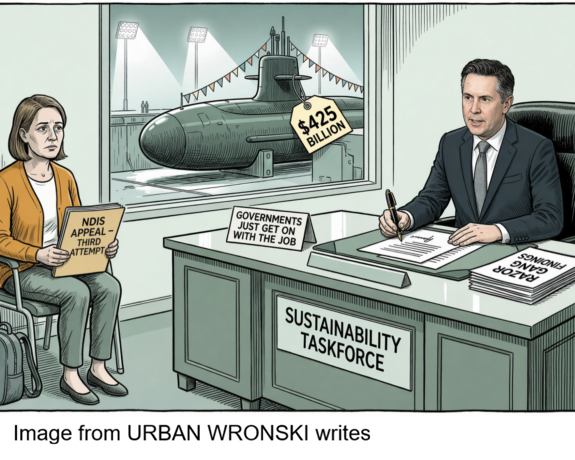

PETITION – To: Prime Minister Anthony Albanese and the Australian Labor Government
Chernobyl: The Lost Tapes – A good documentary on Chernobyl on SBS available On Demand for the next 3 weeks– https://www.sbs.com.au/ondemand/tv-program/chernobyl-the-lost-tapes/235274195556
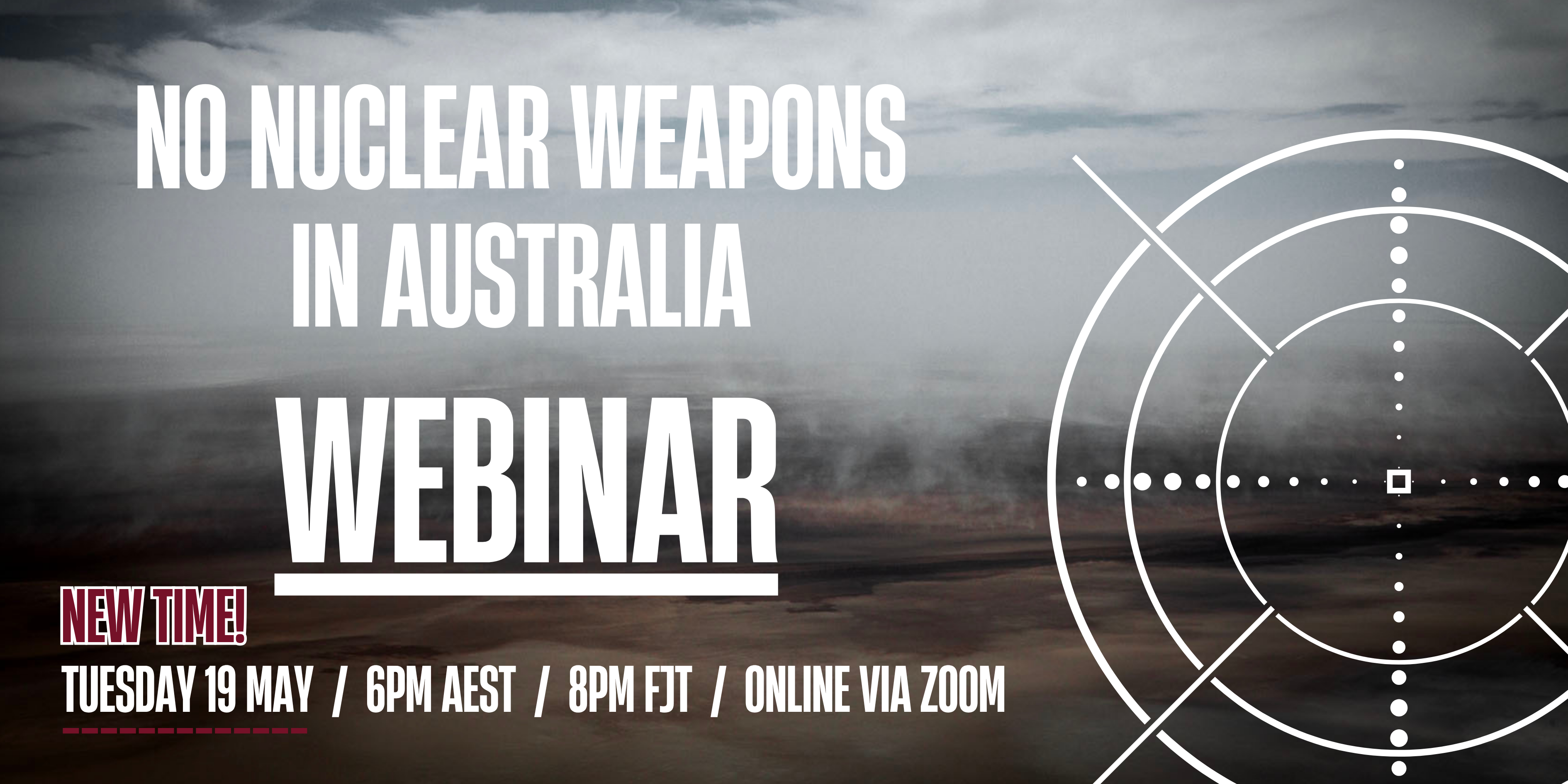
19 May – Webinar- Webinar: No Nuclear Weapons in Australia
Start: 2026-05-19 18:00:00 UTC Canberra, Melbourne, Sydney (GMT+10:00)
End: 2026-05-19 19:30:00 UTC Canberra, Melbourne, Sydney (GMT+10:00)
20 May – Webinar – The dangerous world of AUKUS, US, military occupation and suppression of dissent

National Webinar, 20th May, 2026, 6.30pm AEST. Confronting laws restricting/suppressing protest speech and action
Speakers: Former Sen. Rex Patrick, Lawyer Nick Hanna ,Arthur Rorris ,Jorgen Doyle, Sen David Shoebbridge,
Facilitator Kelley Tranter.

of the week – Australians for War Powers Reform (AWPR)
To see nuclear-related stories in greater depth and intensity
 Antinuclear