Australian government OK with not knowing whether or not visiting US aircraft carry nuclear weapons!
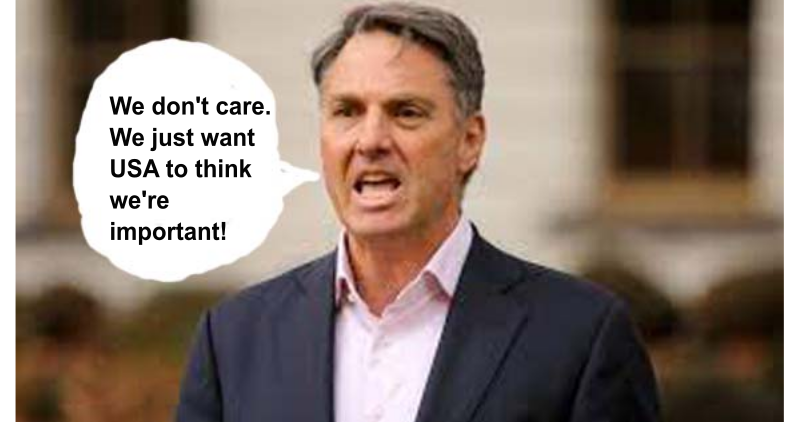
“………………… Appearing before a Senate estimates hearing, Defence secretary Greg Moriarty and senior military figures were also quizzed about a nuclear submarines deal with the United States and Britain.
Mr Moriarty said the AUKUS agreement would also accelerate the acquisition of guided weapons…………….
“There is no impediment under either treaty to the visit of foreign aircraft to Australian airfields or transit of Australia’s airspace, including in the context of our training and exercise programs,” he said.
“Successive Australian governments have understood and respected the long-standing US policy of neither confirming nor denying the presence of nuclear weapons on particular platforms.”……..
Canberra mulls defence overhaul as subs decision nears (msn.com)
Officials will not confirm whether US bombers in Australia carry nuclear weapons
By defence correspondent Andrew Greene, 16 Feb 23
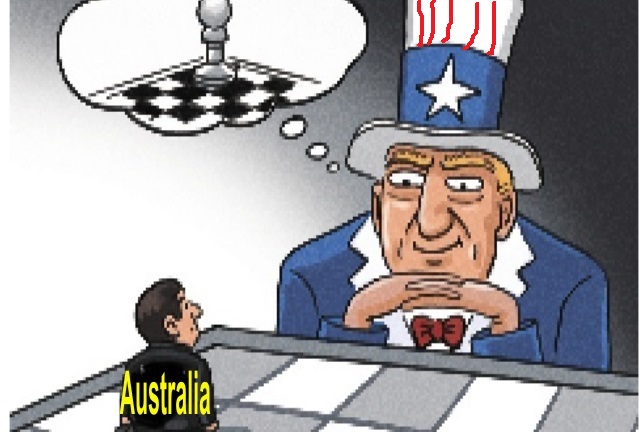
Officials have stopped short of ruling out that US strategic bombers are carrying nuclear weapons to Australia, but the government insists any such move would not breach this country’s international obligations.
Key points:
- United States bombers with nuclear capability frequently fly in Australian air
- The US has a policy of refusing to confirm or deny if those bombers carry nuclear weaponry
- The federal government says it respects US secrecy on nuclear weapons
During a Senate estimates hearing on Wednesday Greens senators sought details on whether visiting American aircraft such as the B-52s operating out of the Top End are ever nuclear armed.
The committee was told the United States had a longstanding policy of “neither confirming or denying” the presence of nuclear weapons under its practice of maintaining global operational unpredictability. ……..
Defence Department secretary Greg Moriarty said the “stationing of nuclear weapons” in Australia was prohibited under the South Pacific Nuclear Free Zone Treaty, but the treaty did not prevent visits by the US bombers.
Foreign Minister Penny Wong backed the secretary’s statement and accused Greens senators of trying to “make a political point”.
“This is the Australian position: We understand and respect the longstanding US policy of neither confirming or denying. That is the position,” Senator Wong said.
“But we remain fully committed to the South Pacific Nuclear Free Zone Treaty, and we will fully comply with our international obligations, which are understood by the United States.”
Under further questioning from Greens senator David Shoebridge, the foreign minister said it would not be appropriate to elaborate. …………………….
Defence mulls methods to make warships more deadly
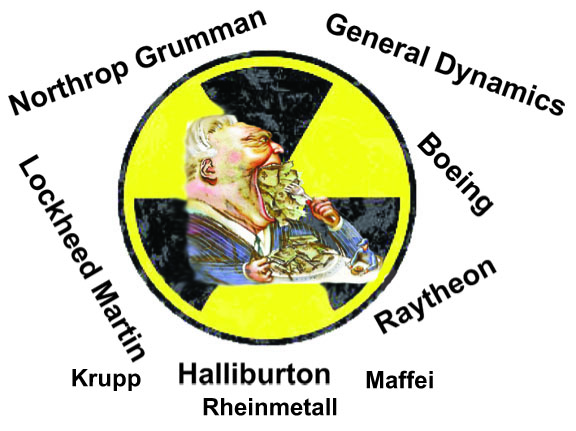
Defence has also revealed it is examining ways to make Australia’s next fleet of warships more lethal. ……………more https://www.abc.net.au/news/2023-02-15/defence-wont-confirm-if-us-bombers-carry-nuclear-weapons/101978596
Kazzi Jai comments on ARPANSA ( The Australian Radiation Protection and Nuclear Safety Agency) and the issue of the mislaid (now found) highly radioactive device
As a generalisation here’s the takeaway so far….
Thinking that consultation = consent!!!
No way buddy!!!
That the Cesium source was not a Commonwealth responsibility…..um….those sources need to be registered and licenced through ARPANSA!!!
Is ARPANSA NOT a Commonwealth body??
We do NOT have data or details on the transport of these huge quantities of CLASSIFIED NUCLEAR WASTE through the Blue Mountains or inverse estuaries like the Spencer Gulf !!! There have been reports in the past dealing with these considered inadequacies of these magnitude in Australia- it CANNOT AND MUST NOT BE GLOSSED OVER!
How do the Blue Mountains or Spencer Gulf which is a inverse estuary deal with contamination which WILL NOT “IF” happen!!
X-rays are NOT PART OF THE NUCLEAR DUMP!
They have NO NUCLEAR COMPONENT!!!
Nuclear Medicine Sector ? How about explaining the INDUSTRIAL PRODUCTION of Technetium 99m which is the MAJOR PRODUCTION at Lucas Heights where THE MAJORITY ISNT USED IN AUSTRALIA BUT IS EXPORTED!!!
And we in Australia SHOULDER THE COSTS!!
Also – there is a REGISTER held by ARPANSA called the AUSTRALIAN RADIATION INCIDENT REGISTER – which includes ALL INCIDENTS INCLUDING TRANSPORT MISHAPS AND ACCIDENTS! It was once available as an open public portal but now you must apply for it through ARPANSA…
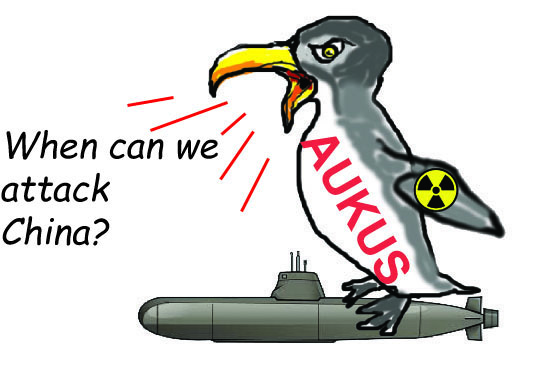
Sky News presents rubbishy programme on “preparing Australia for war against China”
National Times 15 Feb 23 Now Hear This Now Hear This – Pauline Hanson has Spoken ( Eric Remarque for the National Times and Isaac Floyd on Twitter)
SKY TV News has a special Wednesday night program ( shock horror) about preparing for war with China.
REALLY !
Pauline Hanson a noted expert on Foreign Affairs and International Relations is obligingly feeding into this right wing war mongering propaganda.
But it appear that it is NewsCorp who’s on the warpath, not China, not Australia.
How soon before the likes of Pauline Hanson and others on the right side of politics start advocating for conscription.
The question is – do these people really understand that China is a Nuclear Power or that the key to Australia is trade.
Maybe SKY-TV News should understand that their favoured Political Party the Liberals lost the election because the people were sick and tied of the incompetence of the Morrison Government.
Its also worth noting that Lockheed Martin is a sponcor of SKY -TV News.
All things considered companies like this should not be permitted to sponsor news outlets.
So lets treat this SKY-TV News Special for what it is – RUBBISH
We’ve Forgotton The Potential Horrors of What a Nuclear Winter Would Be Like

The results revealed only 3.2 percent of UK respondents and 7.5 percent of US respondents had heard about the consequences of a nuclear war from contemporary media or culture.
In the event of a nuclear attack on Ukraine from Russia, nearly one in five people involved in the study supported retaliation with nuclear weapons. For those who had seen the infographics ahead of time, that figure dropped by 13 percent in the UK and 16 percent in the US – showing how education makes a difference in public opinion.
15 February 2023, By DAVID NIELD https://www.sciencealert.com/weve-forgotton-the-potential-horrors-of-what-a-nuclear-winter-would-be-like—
Under the shadow of the Cold War, many in the world feared the impending prospect of a nuclear winter. According to a new report, our focus has since drifted from its horrors, leaving us with a general lack of awareness that could be dangerous for the future of humankind.
It goes without saying that the threat of a nuclear blast is no trivial event. Decades of pop culture have left society with a relatively strong association between global calamity and atomic weapons.
But the exact details on exactly what we might expect from such an escalating conflict have become hazy in the past few decades.
The facts themselves are fairly clear. Besides the many millions who would be killed directly from the blasts, climate models predict the debris resulting from nuclear war would block out much of our sunlight for up to a decade. The consequences for survivors would be devastating: a decline in global temperature, followed by widespread crop failure, and then mass starvation.
In spite of this dark threat, just a small percentage of today’s population claim to be well informed about the precise consequences of a nuclear war – and many of those people are relying on outdated information spread amid the political tensions between superpowers in the 1980s.
“In 2023 we find ourselves facing a risk of nuclear conflict greater than we’ve seen since the early eighties,” says Paul Ingram, a global risk researcher and diplomacy expert at the Centre for the Study of Existential Risk (CSER) run by the University of Cambridge in the UK. Ingram is the sole author of the report, which has not been peer reviewed.
“Yet there is little in the way of public knowledge or debate of the unimaginably dire long-term consequences of nuclear war for the planet and global populations.”
An online poll of 1,500 people in the UK and 1,500 people in the US was used to prepare the new report. The participants were quizzed on how much they know about a potential nuclear winter, and where they had got their information from. The survey allowed multiple sources to be picked, so they’re not mutually exclusive.
The results revealed 3.2 percent of UK respondents and 7.5 percent of US respondents had heard about the consequences of a nuclear war from contemporary media or culture. A greater fraction of people said their recollection of information spread in the 1980s, during a period of increasing hostility in the US-Soviet Union Cold War, informed their views of the risk of a nuclear winter. Unsurprisingly, few people relied on recent academic papers.
Using hypothetical news reports as a prompt, Ingram also looked at how people would want their governments to respond in the event of a nuclear strike. Half of those surveyed were shown infographics on the effects of nuclear winter before they answered, while the other half were not.
In the event of a nuclear attack on Ukraine from Russia, nearly one in five people involved in the study supported retaliation with nuclear weapons. For those who had seen the infographics ahead of time, that figure dropped by 13 percent in the UK and 16 percent in the US – showing how education makes a difference in public opinion.
“There is an urgent need for public education within all nuclear-armed states that is informed by the latest research,” says Ingram. “We need to collectively reduce the temptation that leaders of nuclear-armed states might have to threaten or even use such weapons in support of military operations.”
The nuclear winter infographics used by the researchers were published in a 2022 peer-reviewed study. The smallest nuclear war theorized involved 100 nukes of 15 kilotons each (about the same size used on Hiroshima), which represents just 0.1 percent of the total combined nuclear arsenal of Russia and the US.
That ‘small’ war would lead to 27 million direct fatalities and 225 million additional deaths from starvation, scientists calculate. At the top end of the scale, all-out nuclear war, we’re looking at 400 million direct deaths and more than 5 billion people dying of starvation because of the consequences of nuclear war.
With so many factors to consider, estimates differ when it comes to the impact of a nuclear war – but even the best case scenarios will clearly be unimaginably terrible. What this report shows is that a big part of avoiding the self-destruction of our species is in raising awareness of what we might be about to do to ourselves.
“Ideas of nuclear winter are predominantly a lingering cultural memory, as if it is the stuff of history, rather than a horribly contemporary risk,” says Ingram.
The report is available to read in full online at the Centre for the Study of Existential Risk.
Double your money? Researchers tests co-benefits of farming crops with solar — RenewEconomy

Yet another research project investigates the benefits – and challenges – of optimising land use by pairing solar farms with agricultural crops. The post Double your money? Researchers tests co-benefits of farming crops with solar appeared first on RenewEconomy.
Double your money? Researchers tests co-benefits of farming crops with solar — RenewEconomy
Works begin on green hydrogen plus battery pilot in South Australia — RenewEconomy

Sod turned on Japan-backed pilot electrolyser plant that aims to be shipped low-cost green hydrogen from SA to Indonesia by the end of the year. The post Works begin on green hydrogen plus battery pilot in South Australia appeared first on RenewEconomy.
Works begin on green hydrogen plus battery pilot in South Australia — RenewEconomy
Webinar: Crisis, contingencies and the green energy transition — RenewEconomy

Momentum is building for Australia’s rapid switch to a renewables grid. But how to unlock the capital required given the regulatory, policy and market risks? The post Webinar: Crisis, contingencies and the green energy transition appeared first on RenewEconomy.
Webinar: Crisis, contingencies and the green energy transition — RenewEconomy
French nuclear giant EDF buys massive Australian floating offshore wind project — RenewEconomy

French nuclear energy giant EDF buys massive floating offshore wind project in Australia that it plans to build in stages. The post French nuclear giant EDF buys massive Australian floating offshore wind project appeared first on RenewEconomy.
French nuclear giant EDF buys massive Australian floating offshore wind project — RenewEconomy
Global leaders are dropping the ball on climate change
Global leaders are dropping the ball on climate change
Greta Thunberg
We cannot just buy, invest or build our way out of the climate and environmental crisis. Nevertheless, money is still very much at the heart of the problem.
The ‘Icefin’ bore deep into an Antarctic glacier. What it found were temperatures warmer than melting point
Antarctica’s Thwaites glacier holds enough water to raise global sea levels by 65 centimetres. New research shows steep terraces and fissures in the glacier shelf are speeding up its melting.
7.30 Report: Sarah Ferguson Opens Up New Perspectives on the AUKUS Nuclear Submarine Deal
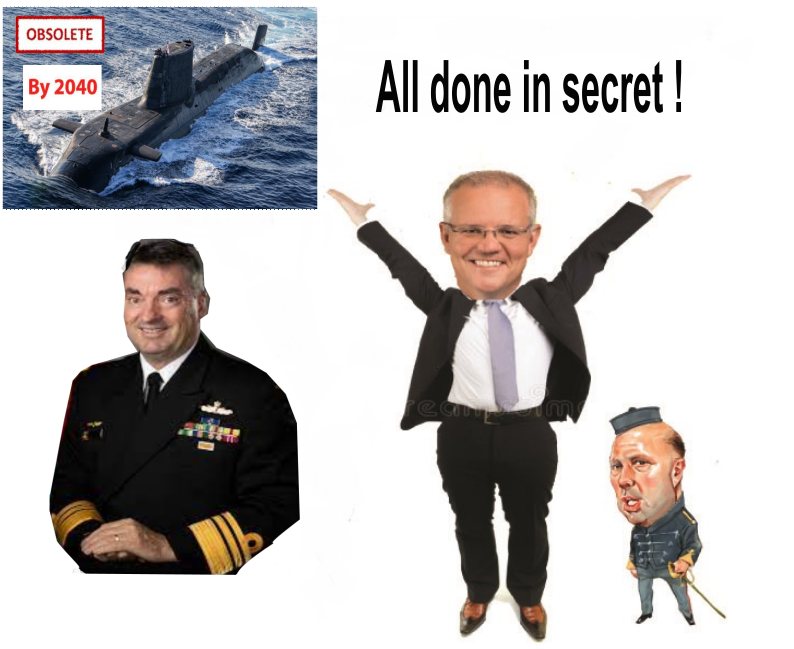
The secrecy associated with the formation of the Submarine Taskforce should be of great concern to Australians of all persuasions as our partners in France had no clues about what was happening behind the scenes as they made preparations to supply the contracted diesel submarines that more fully complied with commitments to the South Pacific Nuclear Free Zone with the support of New Zealand and other island states. No wonder that President Macron had little respect for Scott Morrison. (The video and the news clip of the French President’s remarks are available here.)
February 14, 2023 By Denis Bright
Sincere appreciation must be extended to the Albanese Government for allowing Vice Admiral Jonathan Mead AO to be interviewed in some depth on the 7.30 Report (13 February 2023). Sarah Ferguson was up to speed again in her interviewing skills with a seasoned naval officer who was assigned to active service in the Persian Gulf in 2006 as Captain of HMAS Parramatta.
The Vice Admiral’s understanding of nuclear technology being applied in the selection of the new submarine options was of course beyond reproach through his involvement with the clandestine Nuclear Submarine Taskforce established by the Morrison Government. Our US allies are great salespersons for the Anglo-American military industrial complexes in the post-Brexit era.
At least Britain’s BAE Systems as potential manufacturers of the AUKUS Submarines paid some tax in 2020-21 with a payment of $26.293 million to the ATO on a revenue base of $1.062 billion and a declared taxable income of just $123.484 million. The US military and aerospace giant Lockheed Martin kept its tax bill to $14.891 million on an income take of just over half a billion and a taxable income of $53.056 million (ABC News Taxation List, 2 November 2022).
The concerns of ordinary Australians about the financial and security costs of the AUKUS Submarine deal extend well beyond concerns about the technical capacity of those sealed reactors which are expected to operate for 30 years for the full life of the submarines until the year 2070 approaches.
The secrecy associated with the formation of the Submarine Taskforce should be of great concern to Australians of all persuasions as our partners in France had no clues about what was happening behind the scenes as they made preparations to supply the contracted diesel submarines that more fully complied with commitments to the South Pacific Nuclear Free Zone with the support of New Zealand and other island states. No wonder that President Macron had little respect for Scott Morrison. (The video and the news clip of the French President’s remarks are available here.)
…………………………………………………….. The Naval News video admitted that the Émeraude had transited the South China Sea in stealth mode. This was confirmed by coverage from France 24 (12 February 2021). Perhaps the stealth mode was to test the awareness of Chinese vessels and shore installations. Other military French vessels have done navigation runs through the Taiwan Straits which is always provocative when the current Democratic Party (DPP) holds power in Taipei and is calling for a formal declaration of independence from China to cheers from far-right global opinion.
…………….For China, the Taiwan Straits are definitely disputed waters as most countries in the US Global Alliance supported a One China Policy fifty years ago. This should have ended the US practice of using Taiwan for propaganda purposes throughout the Cold War.
……………………….. Just imagine the outrage in the Murdoch press if Chinese submarines made jaunts into Bass Strait to annoy the naval officers at HMAS Cerberus or to scare students at the Vice Admiral’s old secondary school at St. Bede’s in Mentone if the remnants of the federal LNP tried to establish Tasmania as an Independent Nationalist State with the support of a friendly US Administration.
Annoying China as well as alienating some ASEAN nations and members of the Pacific Island Forum will not assist with the current repair work on trading and investment relations with China.
The proposed AUKUS submarine deal imposes frightful financial burdens on Australia during inflationary times in which costs estimates for the AUKUS submarines extends into the 2040s (The Guardian 14 December 2021). Losses on trade and investment opportunities with China would of course extend these costs with 43 per cent of our exports destined to China at present (Latest data from Trading Economics).
Taiwan can assist to defuse tensions by giving a guarantee that it is not about to make a declaration of independence from the mainland. Relations between Taiwan and the Mainland seem to be improving again as China reverts to commercial diplomacy over displays of military strength. This style of diplomacy at least ensures that the economy of Taiwan is more fully integrated with the Mainland. Over 12,000 Taiwanese students were studying in Chinese academic institutes prior to the COVID-19 epidemic.
Despite all the negative media coverage of China in the Murdoch press, 42 per cent of Taiwan’s exports went to China in 2021-22 and 22 per cent of Chinese imports originated in either China or Hong Kong (CNBC 4 August 2022). Many Taiwan-based companies and services operate in China and Hong Kong.
With President Tsai Lng-wen unable to seek a third term as President in 2024, the popularity of the DPP seems to be on the wane. The opposition KMT gained 50.14 per cent of the vote at the recent local government elections on 26 November 2022 and controls fourteen local government areas to five held by the Democratic Progressive Party (DPP).
The Taiwanese electorate is undoubtedly evaluating the sustainability of nationalist rhetoric favouring a declaration of Taiwanese independence while the Australian government is negotiating those AUKUS submarine deals.
Signs of some thawing in cross-strait relations include a recent visit by the vice-chairman of the KMT to China and the restoration of more frequent fast ferry services between China’s Fujian Province and the adjacent Taiwanese islands of Kinmen and Matsu which are just a few kilometres off-shore.
There is great scope for the 7.30 Report to extend its coverage of the upsurge in regional strategic tensions with China after election cycles in Taiwan which bring the DPP into office. Re-election of the KMT in Taiwan in 2024 may totally defuse the current situation and leave Australians to bear the financial costs of the AUKUS submarine deal.
Opportunities exist to invite guest speakers onto future 7.30 Report programs to consider the impact of nuclear-powered submarines on the South Pacific Nuclear Free Zone which was ratified by all South Pacific nations as well as differing viewpoints on commercial ties with China.
Extending the South Pacific Nuclear Free Zone Treaty to coverage ASEAN Countries, the South China Sea and Taiwan might be a logical extension for consideration.
Toning down provocative visits by unfriendly naval vessels can be part of a Win-Win Deal to avoid future flyovers by Chinese jets.
Even the jellyfish in Moreton Bay are not very welcoming about the prospects of nuclear-powered ships:
According to a leading marine biologist and jellyfish expert Lisa-ann Gershwin, if the fleet is based in Brisbane, which is one of the shortlisted sites of the Australian government, the nuclear-powered submarines may be forced into an emergency reactor shutdown by swarms of jellyfish.
Gershwin added that Brisbane is “close to the absolute worst place” for a nuclear submarine base, due to the conditions in Moreton Bay and the usual jellyfish blooms.
Safety protocols for nuclear powered ships which sometimes carry nuclear weapons into Australian ports have been prepared by all states and territories as the ACT has its Jervis Bay facility which is separated from land-locked Canberra. The Queensland Government has made its precautions public in the publication Nuclear Powered Warship Visits to the Port of Brisbane.
Perhaps more public discussion as presented on the 7.30 Report can give the Australian government more wriggle room before the contracts are signed to initiate the AUKUS submarine deal. Payment of $835 million has already been made by the Albanese Government to France for breach of contract on the previous arrangements as negotiated by Malcolm Turnbull’s Government.
Appeals from our US allies for more military commitment from Australia and more use of the Pine Gap electronic base for offensive operations have landed Australia in compromising situations for decades from interventions in Vietnam to Afghanistan. The nostalgia for a return to the Cold War era with new military bases in the Philippines is an unfortunate regression. The ASEAN region to our north is better off left as a zone of peace and sustainable development.
By the time Australians discuss these issues, there may be a KMT Government in Taipei, and peaceful Win-Win scenarios may make the AUKUS deal redundant. Cheers then to the 7.30 Report’s contribution to strategic sanity. This style of reporting offers guest speakers who are saturated in knowledge of their specialist topics. I can only promote discussion and would be a real novice in head-to-head discussions with the Vice Admiral.
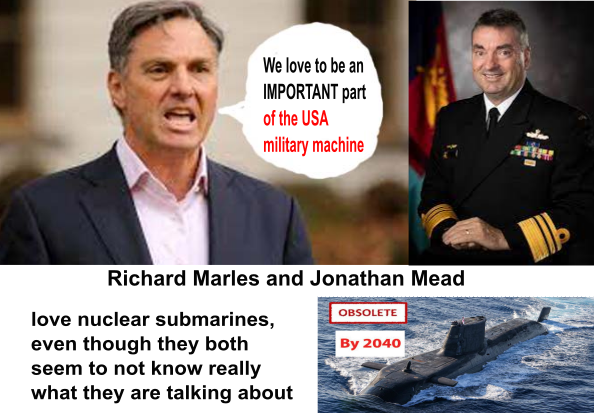
Richard Marles and Jonathan Mead babble on about nuclear submarines, (adding to the confusion).
Australia will have ‘unequivocal’ control over nuclear-powered submarines, insists chief adviser
‘When we take command of our first boat, we will have sovereign capability’, says Vice Admiral Jonathan Mead,
Daniel Hurst Guardian, 14 Feb 23,
The head of Australia’s nuclear-powered submarine taskforce insists Australia will retain full operational control over the submarines, while potentially having US or British engineers on board to provide technical advice.
The comments follow renewed debate in recent weeks over whether the flagship project of the Aukus pact – which relies on support from the US and the UK – will lead to an erosion of Australian sovereignty.
The former prime minister Malcolm Turnbull has been calling on the government to answer whether the submarines could be “operated, sustained and maintained by Australia without the support or supervision of the US navy”, and whether that effectively meant “sovereignty would be shared with the US”.
But the head of the taskforce advising the Australian government on the acquisition of at least eight submarines, Vice Admiral Jonathan Mead, used an interview with ABC TV on Monday evening to assert Australian control.
“When we take command of our first boat, we will have sovereign capability,” he told the 7.30 program.
“We will be commanding and controlling, under the Australian government direction, that nuclear-powered submarine.”…………………………….
Like the defence minister, Richard Marles, Mead expressed confidence that the plan to be announced soon would ensure there was no capability gap between the retirement of Australia’s existing Collins class diesel-electric submarines and the entry into service of nuclear-powered boats. But he did not provide specifics.
Mead also described the purpose of nuclear-powered submarines as being to “put the greatest question of doubt in the enemy’s mind” and “if necessary, respond with massive firepower”.
Marles used a speech to parliament last week to declare that acquiring nuclear-powered submarines would “dramatically enhance” Australia’s sovereignty, rather than undermine it………
Marles said Australia would “always make sovereign, independent decisions on how our capabilities are employed”.
In the wake of that speech, Turnbull tweeted that it was “quite a different thing to have a major platform that cannot be operated without the supervision/support of another country”
Turnbull said on Monday evening: “I think the question which has not been answered is: could the submarines be operated if US technical advice/support were withdrawn? The entire resources of the Australian news media have been unable to pin the government or the navy down on that.”
Paul Keating, the former Labor prime minister has previously raised concerns about increased reliance on US support and suggested Australia’s sovereignty was being “wilfully suborned”. https://www.theguardian.com/australia-news/2023/feb/13/australia-will-have-unequivocal-control-over-nuclear-powered-submarines-insists-chief-advisor
Nuclear zealot Jonathan Mead touts nuclear-powered submarines- Australia to have “full control” – (oh yeah?)
Australian commanders to have complete control over nuclear-powered submarines and reactors
ABC 7.30 / By Sarah Ferguson and James Elton, 13 Feb 23
Australian Navy commanders will have full operational control over their submarines and the powerful nuclear reactors onboard, despite the potential presence of US or UK engineers.
Key points:
- US or UK personnel may go to sea on Australian nuclear submarines
- Australian technicians will understand “every detail” of how the reactors work
- Construction in Adelaide shipyards may begin by end of 2020s
Vice Admiral Jonathan Mead, chief of the AUKUS submarine taskforce, has rejected criticisms that the nuclear propulsion program, based on US technology, would undermine Australian sovereignty.
“When we take command of our first boat, we will have sovereign capability,” he told 7.30‘s Sarah Ferguson in an exclusive interview.
Details of extensive plans to build a fleet of eight boats powered with weapons-grade uranium will be revealed next month.
Vice Admiral Mead was asked what would happen onboard in the event of any dispute over the nuclear reactor, including following an accident, between a US or UK engineer and the boat’s Australian commander.
“We would expect anyone, be it a foreign engineer or an Australian engineer, to provide advice,” he said.
But the commanding officer of that submarine, the Australian, would have “command and control over the reactor, over the submarine – unequivocal”.
Australians will understand ‘every detail’ of welded-shut nuclear reactors
The defining feature of the submarine deal is that the highly enriched uranium reactors that power the boats will be supplied by either the US or UK, and “welded shut”.
The use of weapons-grade fuel means the reactors do not need to be opened for refuelling over the 30-plus-year life of the boat. Reactors that run on low-enriched uranium, like those used by the French and Chinese navies, do require refuelling.
This also means Australia will not need to manufacture nuclear fuel – one of the commitments the country has made to the International Atomic Energy Agency.
Vice Admiral Mead said Australia would, however, be sending people to US “design facilities” so we would understand “every element of detail of that reactor”.
No Australian reactors … for now
Asked if Australia is considering building its own nuclear reactors in the future, Vice Admiral Mead said: “We are not envisioning that at the moment, we haven’t gone into that at the moment.”
The senior Navy official has spoken previously about the need for the AUKUS program to have public support.
Asked what would happen to an Australian nuclear-propelled submarine that was hit by a missile, Vice Admiral Mead said he could not reveal the technical details but that “nuclear-powered submarines are designed for exacting standards”.
He also said that submariners receive only minimal doses of radiation onboard – less than an ordinary person walking the streets of a capital city.
UK or US-designed boat, and when will we see them?
Addressing the scale of the program, Vice Admiral Mead said if Australia wanted to begin construction of new boats in Adelaide “towards the end of this decade” the government would need to quickly finalise the construction of a revamped shipyard.
He also described the extraordinary staffing requirements of the project, requiring nuclear physicists, chemists and engineers, as well as specialist tradesmen.
One of the biggest questions around AUKUS is whether Australia would be left without a functioning submarine force before the new boats are launched, as the ageing Collins fleet approaches retirement.
Vice Admiral Mead said unequivocally there would be no gap, but would not be drawn on the Navy’s specific plans.
The UK defence secretary, Ben Wallace, recently suggested a new submarine design the three countries could share was under consideration.
Asked whether that strategy would further delay the delivery of new submarines, Vice Admiral Mead reaffirmed there would be no gap in Australia’s capability.
China is the motivation
Vice Admiral Mead said rapid changes in the Indo Pacific had sharpened strategic competition.
“We’ve also seen in recent years a significant modernisation in the Chinese military, particularly the Navy,” he said.
Australia’s current fleet of Collins class submarines run on diesel-electric engines that are extremely quiet when running off the battery.
Nuclear submarines have massive range and the stealth advantage of not needing to resurface, but they do have reactor components that can’t be easily switched off to “go quiet”.
The pros and cons of nuclear and conventional submarines have led defence analysts to suggest a new generation of diesel submarines should be considered as well, particularly to operate closer to the Australian coastline – while the nuclear boats could be prioritised for operations further away from the mainland.
But Vice Admiral Mead said the nuclear submarines would be a good option in both theatres.
“Nuclear-powered submarines provide a capability to deploy away from the home shore, or to deploy close to home shore,” he said.
Pressed on whether conventional submarines would be quieter for closer operations, Vice Admiral Mead said under some circumstances nuclear submarines could be “just as quiet”.
“It’s often more to do with the age and the technology of the submarine that we are dealing with,” he said.
Vice Admiral Mead said the purpose of nuclear-powered submarines was to “put the greatest question of doubt in the enemy’s mind” and “if necessary, respond with massive firepower”.
This type of game-changing capability, he said, would change Australia’s “strategic personality”. https://www.abc.net.au/news/2023-02-13/australian-commanders-complete-control-over-nuclear-submarines/101965182
Distinct lack of enthusiasm for nuclear power!

“I don’t think the community has any real desire to have nuclear power, I just don’t think it is going to happen.”
Nuclear power debate looms
13/02/2023 https://borderwatch.com.au/news/2023/02/13/nuclear-power-debate-looms/
Barker MP Tony Pasin said he was in support of the investigation to understand current, viable options.
Mr Pasin said nuclear energy was a “mature, proven technology that has the possibility to provide reliable, emissions-free, base-load electricity and it is high time we had an informed debate on its benefits.
“We need to look into what are the viable options right now, and what are the most viable options for affordable, stable electricity.”
He add: “We should do the due diligence that is necessary to decide what is the best option going forward. All I want to do is ensure that whatever decision we make for the long-term future of our economy and generations is that the decision is grounded in science.”
Limestone Coast Protection Alliance chairman Angus Ralton said instead of nuclear power, wind farms and solar would be more efficient.
“Nuclear can take around 10 years to build a reactor. Even small ones take a long time and we don’t have the framework to be allowed to build them,” Mr Ralton said.
“The reactors are also notorious for blowing out, whereas with wind and solar it can take one-to-three years for a large-scale project to be rolled out.”
He said other issues, such as costs to build nuclear and waste disposal, should also be considered.
“Building nuclear power is hideously expensive and I don’t see the point in exploring something new when we already have wind and solar power here,” Mr Ralton said.
“I don’t think the community has any real desire to have nuclear power, I just don’t think it is going to happen.”
1 This month


Help Aunty Sue Protect Her Land and Sacred Sites From Destructive Rocket Testing.
.

Australians deserve the truth
about
AUKUS – https://aukuspublicinquiry.com/

PETITION – To: Prime Minister Anthony Albanese and the Australian Labor Government

of the week – Australians for War Powers Reform (AWPR)
To see nuclear-related stories in greater depth and intensity

