Gullible governments – US Energy Department returns to costly and risky plutonium separation technologies
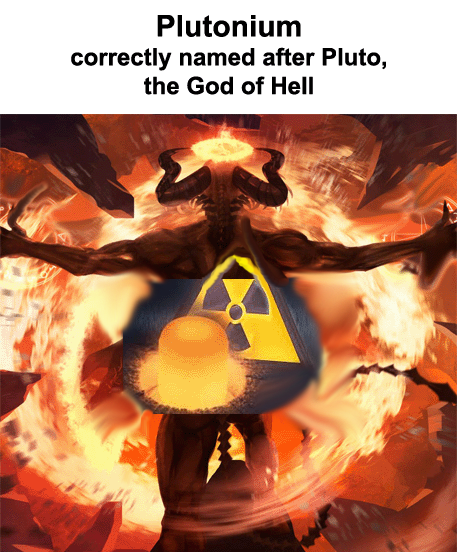
Bulletin of the Atomic Scientists, By Jungmin Kang, Masafumi Takubo, Frank von Hippel | September 14, 2022, On July 17, the United Kingdom ended 58 years of plutonium separation for nuclear fuel by closing its Magnox nuclear fuel reprocessing plant at Sellafield. This leaves the UK with the world’s largest stock of separated power-reactor plutonium, 140 metric tons as of the end of 2020, including 22 tons separated for Japan. The UK is also second in the world only to Russia in the size of its overall inventory of separated plutonium with 119 tons, including 3.2 tons for weapons. Russia’s stock, 191 tons, is mostly “weapon-grade” separated for use in nuclear weapons during the Cold War, but the UK’s power-reactor plutonium is also weapon usable, and therefore also poses a security risk. The UK has no plan for how it will dispose of its separated plutonium. Its “prudent estimate” placeholder for the disposal cost is £10 billion ($12.6 billion).
One obvious way to get rid of separated plutonium would be to mix it with depleted uranium to make “mixed-oxide” (MOX) fuel energetically equivalent to low-enriched uranium fuel, the standard fuel of conventional reactors. Despite the bad economics, since 1976 France has routinely separated out the approximately one percent plutonium in the low-enriched uranium spent fuel discharged by its water-cooled reactors and recycled the plutonium in MOX fuel.
But both the UK and the US have had negative experiences with building their own MOX production plants.
In 2001, the UK completed a MOX plant, only to abandon it in 2011 after 10 years of failed attempts to make it operate. For its part, the US Energy Department, which owns almost 50 tons of excess Cold War plutonium, contracted with the French government-owned nuclear-fuel cycle company, Areva (now Orano), in 2008 to build a MOX fuel fabrication plant. But the United States switched to a “dilute and dispose” policy for its excess plutonium in 2017 after the estimated cost of the MOX plant grew from $2.7 billion to $17 billion.
Despite decades of failed attempts around the world to make separated plutonium an economic fuel for nuclear power plants, the United States Energy Department is once again promoting the recycling of separated plutonium in the fuel of “advanced” reactor designs that were found to be economically uncompetitive 50 years ago. At the same time, other countries—including Canada and South Korea, working in collaboration with the Energy Department’s nuclear laboratories—are also promoting plutonium separation as a “solution” to their own spent fuel disposal problems. These efforts not only gloss over the long history of failure of these nuclear technologies; they also fail to take into account the proliferation risk associated with plutonium separation—a risk that history has shown to be quite real.
Renewed advocacy for plutonium separation. As the UK finally turns its back on plutonium separation, the United States Energy Department is looking in the other direction. Within the Energy Department, one part, the Office of Defense Nuclear Nonproliferation, is struggling to dispose of excess Cold War weapons plutonium, as two others—the Office of Nuclear Energy and ARPA-E (Advanced Research Project Agency – Energy)—are promoting plutonium separation……………………………………..
In fact, the Energy Department’s Office of Nuclear Energy is promoting sodium-cooled reactor designs based on the Idaho National Laboratory’s Experimental Breeder Reactor II, which was shut down in 1994 due to a lack of mission after the end of the US breeder program a decade earlier. The Energy Department’s office is now supporting research, development, and demonstration of sodium-cooled reactors by several nuclear energy startups.

Among them is Bill Gates’ Terrapower, to which the department has committed as much as $2 billion in matching funds to build a 345-megawatt-electric sodium-cooled prototype reactor—called Natrium (sodium in Latin)—in the state of Wyoming. One of Wyoming’s current senators, John Barrasso, is a leading advocate of nuclear power and could become chair of the Senate Committee on Energy and Natural Resources if the Republicans take control of the upper chamber in the elections this fall.
Terrapower insists Natrium is not a plutonium breeder reactor and will be fueled “once through” with uranium enriched to just below 20 percent and its spent fuel disposed of directly in a deep geologic repository, without reprocessing. Natrium, however, is set to use, initially at least, the same type of fuel used in Idaho’s Experimental Breeder Reactor II. The Energy Department maintains that this spent fuel cannot be disposed of directly because the sodium in the fuel could burn if it contacts underground water or air. On that basis, the Idaho National Laboratory has been struggling for 25 years to treat a mere three tons of spent fuel from the Experimental Breeder Reactor II using a special reprocessing technology called “pyroprocessing.”

In pyroprocessing, the fuel is dissolved in molten salt instead of acid, and the plutonium and uranium are recovered by passing a current through the salt and plating them out on electrodes. In 2021, Terrapower stated that it plans to switch later to a fuel for Natrium that does not contain sodium but then received in March 2022 the largest of eleven Energy Department grants for research and development on new reprocessing technologies.
Liquid-sodium-cooled reactor designs date back to the 1960s and 1970s, when the global nuclear power community believed conventional power reactor capacity would quickly outgrow the available supply of high-grade uranium ore. Conventional reactors are fueled primarily by chain-reacting uranium 235, which comprises only 0.7 percent by weight of natural uranium. Because of this low percentage, nuclear power advocates focused on developing plutonium “breeder” reactors that would be fueled by chain-reacting plutonium produced from the abundant but non-chain-reacting uranium 238 isotope, which constitutes 99.3 percent of natural uranium. (Liquid-sodium-cooled reactors are sometimes called “fast-neutron reactors” because they utilize fast neutrons to operate. Sodium was chosen as a coolant because it slows neutrons less than water. Fast neutrons are essential to a plutonium breeder reactor because the fission of plutonium by fast neutrons releases more excess secondary neutrons whose capture in uranium 238 makes possible the production of more plutonium than the reactor consumes.)
Large programs were launched to provide startup fuel for the breeder reactors by reprocessing spent conventional power-reactor fuel to recover its contained plutonium.
………………………………….. Only a few prototypes were built and then mostly abandoned. In 2020, the Organisation for Economic Co-operation and Development’s Nuclear Energy Agency estimated that sufficient low-cost uranium would be available to fuel existing conventional reactor capacity for more than a century.
Zombie plutonium-separation programs. Even though separated plutonium has morphed from the nuclear fuel of the future into a disposal problem, civilian plutonium separation continues in several countries, notably France, Japan, and Russia. It is also being advocated again by the offices within the US Energy Department that fund research and development on nuclear energy.
Russia still has an active breeder reactor development program, with two operating liquid sodium-cooled prototypes—only one of them plutonium fueled—plus a small, liquid, lead-cooled prototype under construction. But Russia has already separated 60 tons of power-reactor plutonium and has declared as excess above its weapons needs approximately 40 tons of weapon-grade plutonium. These 100 tons of separated plutonium would be enough to provide startup fuel for five years for six full-size breeder reactors.
China and India have breeder reactor prototypes under construction, but their breeders are suspected of being dual-purpose. In addition to their production of electric power, the weapon-grade plutonium produced in uranium “blankets” around the breeder cores is likely to be used for making additional warheads for their still-growing nuclear arsenals.
France and Japan require their nuclear utilities to pay for reprocessing their spent fuel and for recycling the recovered plutonium in MOX fuel, even though both countries have known for decades that the cost of plutonium recycling is several times more than using low-enriched uranium fuel “once through,” with the spent fuel being disposed of directly in a deep geological repository.
Claimed benefits of reprocessing. Advocates of plutonium recycling in France and Japan justify their programs with claims that it reduces uranium requirements, the volume of radioactive waste requiring disposal, and the duration of the decay heat and radiotoxicity of the spent fuel in a geologic repository. These benefits are, however, either minor or non-existent. First, France’s plutonium recycling program reduces its uranium requirements by only about 10 percent, which could be achieved at much less cost in other ways, such as by adjusting enrichment plants to extract a higher percentage of the uranium 235 isotopes in natural uranium. Second, with proper accounting, it is not at all clear that recycling produces a net reduction in the volume of radioactive waste requiring deep geological disposal. Third, the claimed heat reduction, if realized, could reduce the size of the repository by packing radioactive waste canisters more closely. But this is not significant because, with the currently used reprocessing technology, americium 241, which has a 430-year half-life and dominates the decay heat from the spent fuel during the first thousand years, remains in the reprocessed waste.
Claims of the reduced toxicity of reprocessed waste turn out to be false as well. For decades, France’s nuclear establishment has promoted continued reprocessing in part out of hope that, after its foreign reprocessing customers did not renew their contracts, it could sell its plutonium recycling technology to other countries, starting with China and the United States. But, with the notable exception of the canceled US MOX plant, these efforts so far have not materialized, and the willingness of the French government to continue funding its expensive nuclear fuel cycle strategy may be reaching its limits………………………..
Proliferation danger. Aside from the waste of taxpayer money, there is one major public-policy objection to plutonium separation: Plutonium can be used to make a nuclear weapon. The chain-reacting material in the Nagasaki bomb was six kilograms of plutonium, and the fission triggers of virtually all nuclear warheads today are powered with plutonium. Reactor-grade plutonium is weapon-usable, as well.
In the 1960s, however, blinded by enthusiasm for plutonium breeder reactors, the US Atomic Energy Commission—the Energy Department’s predecessor agency—promoted plutonium worldwide as the fuel of the future. During that period, India sent 1,000 scientists and engineers to Argonne and other US national laboratories to be educated in nuclear science and engineering. In 1964, India began to separate plutonium from the spent fuel of a heavy-water research reactor provided jointly by Canada and the United States. Ten years later, in 1974, India used some of that separated plutonium for a design test of a “peaceful nuclear explosive,” which is now a landmark in the history of nuclear weapon proliferation……………………….
False environmental claims for reprocessing. Since the 1980s, advocates of reprocessing and plutonium recycling and fast neutron reactors in the Energy Department’s Argonne and Idaho National Laboratories have promoted them primarily as a strategy to facilitate spent fuel disposal.
The George W. Bush administration, which came to power in 2001, embraced this argument because it saw the impasse over siting a spent fuel repository as an obstacle to the expansion of nuclear power in the United States. To address the proliferation issue, the Bush Administration proposed in 2006 a “Global Nuclear Energy Partnership” in which only countries that already reprocessed their spent fuel (China, France, Japan, and Russia) plus the United States would be allowed to reprocess the world’s spent fuel and extract plutonium. The recovered plutonium then would be used in the reprocessing countries to fuel advanced burner reactors (breeder reactors tweaked so that they would produce less plutonium than they consumed). These burner reactors would be sodium-cooled fast-neutron reactors because the slow neutrons that sustain the chain reaction in water-cooled reactors are not effective in fissioning some of the plutonium isotopes. After Congress understood the huge costs involved, however, it refused to fund the partnership…………………………….
Plutonium and the geological disposal of spent fuel. Despite the unfavorable economics, the idea of separating and fissioning the plutonium in spent fuel has been kept alive in the United States and some other countries in part by continuing political and technical obstacles to siting spent fuel repositories. Proponents of reprocessing have managed to keep their governments’ attention on plutonium because it is a long-lived radioelement, a ferocious carcinogen—if inhaled—and has fuel value if recycled.
But detailed studies have concluded that plutonium makes a relatively small contribution to the long-term risk from a spent fuel geologic repository for spent fuel from commercial power reactors.
……………………………………………….. risk assessments are theoretical, but they are based on real-world experience with the movement of radioisotopes through the environment.
The main source of that experience is from the large quantities of fission products and plutonium lofted into the stratosphere by the fireballs of megaton-scale atmospheric nuclear tests between 1952 and 1980. During that period, the Soviet Union, the United States, China, the United Kingdom, and France injected into the stratosphere a total of about eight tons of fission products and 3.4 tons of plutonium—comparable to the quantities in a few hundred tons of spent light water reactor fuel. These radioisotopes returned to earth as global radioactive “fallout.”
…………………………………… In addition to the proliferation danger dramatized by the case of India, plutonium separation also brings with it a danger of a massive accidental radioactive release during reprocessing. The world’s worst nuclear accident before Chernobyl involved the Soviet Union’s first reprocessing plant for plutonium production, in 1957……………………………………………..
Gullible governments. Nearly half a century after India conducted its first nuclear test in 1974 with assistance provided inadvertently by Canada and the United States, both countries’ governments seem to have forgotten about the proliferation risk associated with spent fuel reprocessing. Today, advocates of fast-neutron breeder or burner reactors are pitching again the same arguments—used before the test—to gullible governments that seem unaware of the history of this issue. This ignorance has created problems for Canada’s nonproliferation policy as well as that of the United States.
In Canada, a UK startup, Moltex, has obtained financial support from federal and provincial governments by promising to “solve” Canada’s spent fuel problem. Its proposed solution is to extract the plutonium in the spent fuel of Canada’s aging CANDU (CANada Deuterium Uranium) reactors to fuel a new generation of molten-salt-cooled reactors. The Moltex company also proposes to make Canada an export hub for its reactors and small reprocessing plants.
In South Korea, the Korea Atomic Energy Research Institute, with support from Energy Department’s Argonne and Idaho National Laboratories, has similarly been campaigning to persuade its government that pyroprocessing spent fuel and fissioning plutonium in sodium-cooled reactors would help solve that country’s spent fuel management problem.
It is time for governments to learn again about the risks involved with plutonium separation and to fence off “no-go zones” for their nuclear energy advocates, lest they unintentionally precipitate a new round of nuclear-weapon proliferation.
Notes:
[1] Carbon 14 and iodine 129 are difficult to capture during reprocessing and therefore are routinely released into the atmosphere and ocean by France’s reprocessing plant at La Hague. Also, had the uranium 238 in the spent fuel not been mined, its decay product, radium 226, would have been released within the original uranium deposit. So, even though some reprocessing advocates join with nuclear power critics in amplifying the hazards of plutonium and other transuranic elements in underground radioactive waste repositories, they generally omit comparisons with reprocessing hazards (in the case of reprocessing advocates) or with natural uranium deposits (in the case of repository opponents). https://thebulletin.org/2022/09/some-fuels-never-learn-us-energy-department-returns-to-costly-and-risky-plutonium-separation-technologies/
Aw gee shucks – Australia can be IMPORTANT if we lead USA’s attacks with our AUKUS submarines !

Marles said nuclear subs would make “the rest of the world take us seriously”,
Final design and cost of Australia’s nuclear submarines to be known in early 2023, Defence minister Richard Marles links the cutting-edge technology to Australia’s economic and trade success
Guardian, Josh Butler, Thu 15 Sep 2022 The defence minister, Richard Marles, says Australia’s pathway to acquiring nuclear submarines is “taking shape”, flagging key decisions within months about which ship to use, how to build it and boosting the country’s defence-industrial capability.
On the first anniversary of the Aukus pact, Marles said nuclear subs would make “the rest of the world take us seriously”, linking the cutting-edge technology to Australia’s economic and trade success.
Final design and cost of Australia’s nuclear submarines to be known in early 2023
Defence minister Richard Marles links the cutting-edge technology to Australia’s economic and trade success…………………………….
On the first anniversary of the Aukus pact, Marles said nuclear subs would make “the rest of the world take us seriously”, linking the cutting-edge technology to Australia’s economic and trade success.
“The optimal pathway is taking shape. We can now begin to see it,” he said. “With Aukus there’s a really huge opportunity beyond submarines of pursuing a greater and more ambitious agenda.”……..
Marles, also the deputy prime minister, said the first steps toward acquisition of nuclear submarines were on track. In a briefing call with journalists this week, he said the current timeline had Australia slated to make initial announcements in the first part of 2023.
The government plans to give answers to five questions by that time: the final design; when it can be acquired; what capability gap that timeline will create and solutions to plug it; the cost; and how Australia’s plans comply with nuclear non-proliferation obligations.
The government is said to be choosing between building American or British ships, or some hybrid. Marles said the government was not ready to announce which type of submarines would be built but hinted Australia’s design could be “trilateral” in nature………..
In a press conference with Marles in the UK earlier this month, the British defence secretary, Ben Wallace, said future submarine designs may see a combination of British, American and Australian components.
“We are on to our next design and our new one and that might well be fully shared with all three nations as a collaborative design,” he said.
The cost of the submarine program is not yet known but is expected to be in the tens of billions. Marles linked the Aukus arrangement not only to military but economic security, saying a boosted submarine fleet would protect freedom of navigation through vital shipping routes.
“We need a highly capable defence force which has the rest of the world take us seriously and enables us to do all the normal peaceful activities that are so important for our economy,” he said………

V Adm Jonathan Mead, the chair of the nuclear submarine taskforce, also spoke of protecting “sea lanes” on the call.
Mead said the navy was investigating workforce challenges, such as how to build and crew the ships – which may involve placing Australian staff in British and American nuclear schools or agencies, laboratories and shipyards
“The exchange of these personnel will be both ways and won’t just involve our submariners,” he said.
Facilities to build and maintain the submarines in Australia are part of the equation. Defence this year pinpointed Brisbane, Newcastle and Port Kembla as possible sites for an east coast nuclear base and consultation with those communities is said to be in its early stages.
Marles also spoke of building Australia’s defence-industrial capability on the back of the nuclear process…………………..“We hope Aukus can help develop a genuinely seamless defence industrial base across the US, the UK and Australia.”…………………….
A report from the Australian Strategic Policy Institute (Aspi), released on Thursday, recommended further investment in other Aukus streams like hypersonic missiles and artificial intelligence technology, to help plug a capability gap while the submarines are built………..
Such short-term investment may force government to make “difficult choices and trade-offs” in its defence strategic review, also slated for March, Aspi said. https://www.theguardian.com/australia-news/2022/sep/15/final-design-and-cost-of-australias-nuclear-submarines-to-be-known-in-early-2023
American-backed Ukrainian attack to recapture Zaporizhzia nuclear power plant is a critical part of the Western strategy

Eventually, Ukrainian officials believe their long-term success requires progress on the original goals in the discarded strategy, including recapturing the nuclear power plant in Zaporizhzhia
The Critical Moment Behind Ukraine’s Rapid Advance, New York Times, By Julian E. Barnes, Eric Schmitt and Helene Cooper, Sept. 13, 2022
WASHINGTON — The strategy behind Ukraine’s rapid military gains in recent days began to take shape months ago during a series of intense conversations between Ukrainian and U.S. officials about the way forward in the war against Russia, according to American officials.
The counteroffensive — revised this summer from its original form after urgent discussions between senior U.S. and Ukrainian officials — has succeeded beyond most predictions………..
The work began soon after President Volodymyr Zelensky of Ukraine told his generals he wanted to make a dramatic move to demonstrate that his country could push back on the Russian invasion. Under his orders, the Ukrainian military devised a plan to launch a broad assault across the south to reclaim Kherson and cut off Mariupol from the Russian force in the east.
……………………………………..Long reluctant to share details of their plans, the Ukrainian commanders started opening up more to American and British intelligence officials and seeking advice.
Jake Sullivan, the national security adviser, and Andriy Yermak, a top adviser to Mr. Zelensky, spoke multiple times about the planning for the counteroffensive, according to a senior administration official. Gen. Mark A. Milley, the chairman of the Joint Chiefs of Staff, and senior Ukrainian military leaders regularly discussed intelligence and military support.
And in Kyiv, Ukrainian and British military officials continued working together while the new American defense attaché, Brig. Gen. Garrick Harmon, began having daily sessions with Ukraine’s top officers…………….
This account of the lead-up to the counteroffensive is based on interviews with multiple senior American officials and others briefed on the classified discussions between Washington and Kyiv that helped Ukrainian commanders shape the battle. Many spoke on the condition of anonymity because of the secret nature of the talks…………………………
“We did do some modeling and some tabletop exercises,” Colin Kahl, the Pentagon’s policy chief, said in a telephone interview. “That set of exercises suggested that certain avenues for a counteroffensive were likely to be more successful than others. We provided that advice, and then the Ukrainians internalized that and made their own decision.”…………………………………………………….
Instead of one large offensive, the Ukrainian military proposed two. One, in Kherson, would most likely take days or weeks before any dramatic results because of the concentration of Russian troops. The other was planned for near Kharkiv.
Together Britain, the United States and Ukraine conducted an assessment of the new plan, trying to war game it once more. This time officials from the three countries agreed it would work — and give Mr. Zelensky what he wanted: a big, clear victory.
But the plan, according to an officer on the general staff in Kyiv, depended entirely on the size and pace of additional military aid from the United States.
Ukraine, a former Soviet republic that had used older Soviet weapons, exhausted most of its own ammunition. Learning how to use new weapons systems in the middle of the war is difficult. But so far the risky move has proved successful. More than 800,000 rounds of 155-millimeter artillery shells, for instance, have been sent to Kyiv, helping fuel its current offensives. The United States alone has committed more than $14.5 billion in military aid since the war started in February.
Before the counteroffensive, Ukraine’s armed forces sent the United States a detailed list of weapons they needed to make the plan successful, according to the Ukrainian officer.
Specific weapons, like the High Mobility Artillery Rocket System, or HIMARS, are having an outsize effect on the battlefield. The satellite-guided rockets fired by these launch vehicles, called GMLRS, each contain a warhead with 200 pounds of explosives and have been used in recent weeks by Ukrainian forces to destroy more than 400 Russian arms depots, command posts and other targets, American officials said.
More recently, Ukrainian forces have put American-supplied HARM air-launched missiles on Soviet-designed MiG-29 fighter jets, which no air force had ever done. The missiles have been particularly effective in destroying Russian radars.
“We are seeing real and measurable gains from Ukraine in the use of these systems,” General Milley said last week in Germany at a meeting of 50 countries that are helping Ukraine with military and humanitarian aid. “They’re having great difficulty resupplying their forces and replacing their combat losses.”
Ukrainian and American officials said the now weekly or biweekly Pentagon announcements of new shipments of weapons and munitions from American stockpiles have given Kyiv’s senior commanders the confidence to plan complex simultaneous offensives.
“The importance of Western military support is not just in specific weapons systems, but in the assurance and confidence that the Ukrainians can use in their future planning,” said Jack Watling, a senior research fellow at the Royal United Services Institute in London, who recently returned from Ukraine……….
Eventually, Ukrainian officials believe their long-term success requires progress on the original goals in the discarded strategy, including recapturing the nuclear power plant in Zaporizhzhia,…………….
While Ukraine may have an opportunity to recapture more territory in the east, U.S. and Ukrainian officials say the south is the most important theater of the war.
“Kherson and Zaporizhzhia are likely potential objectives,” said Michael Kofman, the director of Russia studies at CNA, a defense research institute. “We might see further Ukrainian Army operations to achieve breakthroughs there in the future.”………. https://archive.ph/ABurb#selection-933.0-945.244—
A new window into France’s nuclear history

Bulletin of the Atomic Scientists By Austin R. Cooper | September 16, 2022, Access to French nuclear archives has increased dramatically during the past year. Since October 2021, French officials have declassified thousands of documents about the development of French nuclear weapons, an arsenal of roughly 300 warheads today.
This work marks a sea change in France, for decades one of the most difficult nuclear-armed democracies to study. Unlike the United States and the United Kingdom, France does not have Freedom of Information laws, which allow the public to file declassification requests. French archives do consider special access requests (dérogations), but these requests cannot compel a declassification review, which limits their utility in making nuclear weapons documents available for research.
French President Emmanuel Macron, in the wake of prize-nominated journalism and scholarship on the development of French nuclear weapons, launched a significant declassification initiative last year. This process has focused on Polynesia, the semi-autonomous French territory where French forces conducted nearly 200 atmospheric and underground explosions from 1966 to 1996. The scope does not include Algeria, the former French colony where French authorities built and operated their first nuclear test sites between 1960 and 1966, during the Algerian War for Independence (1954–62) and the construction of the postcolonial Algerian state.
New French transparency could help settle debates about environmental contamination and health effects from radiation exposure, especially in Polynesia. French law has promised to compensate victims of French nuclear weapons development who become sick or die from radiation-linked illness but has made only slow progress since 2010. Other nuclear-armed democracies, including the United States and the United Kingdom, have established similar compensation programs.
…………………………. Yet crucial gaps remain in access to French nuclear archives, especially records from the earliest years of the weapons testing program—when it took place in Algeria—and records concerning foreign affairs.
………………………. A report in February 2022 indicated that Macron’s declassification review had withdrawn only 59 documents out of nearly 35,000.
The global stakes. French nuclear history does not only concern France. France became the world’s fourth nuclear weapon state by building test sites and conducting atmospheric and underground explosions in two former French colonies: Algeria and then Polynesia. These blasts drew criticism from Algerian and Polynesian leaders, and from many neighboring countries in Africa and the Pacific.
Before becoming one of the world’s top nonproliferation cops, France served as a global nuclear supplier. During the Cold War arms race, the French government was among those that provided Israel, India, South Africa, Iran, and Iraq with nuclear technologies. Except for possibly Iran, all these states endeavored to build nuclear weapons; so far, only Iraq has failed to do so.
……………………. President Richard Nixon and his National Security Advisor Henry Kissinger secretly reversed US policy and launched unprecedented Franco-American cooperation on weapons design and safety procedures.
………………………………… . The publication in March 2021 of the French-language book Toxique, by the physicist Sébastien Philippe and investigative journalist Tomas Statius, created a media firestorm surrounding French nuclear history.
Toxique showed that French authorities underestimated and overlooked the extent of radioactive contamination—and the health risks—from the atmospheric explosions conducted in Polynesia until 1974. This finding relied on dozens of French documents declassified in 2012–13, following a decade of court battles fought by associations of nuclear test victims and anti-nuclear organizations.
……………………………………………….. Limits to French nuclear transparency. Recent French declassifications indicate real progress, but three shortcomings have become clear.
First, archival documentation of France’s first nuclear explosions in the Algerian Sahara (1960–66) falls outside the Declassification Commission’s mandate. This recent work, as well as the CEA-DAM process, have incidentally declassified a few documents about the two test sites in the Algerian desert. But most of these records remain unavailable for research.
This split in French nuclear history—between Algeria and Polynesia—is artificial. Similar French entities, and often the same French officials, directed the Algerian and Polynesian sites.
The reason for French transparency about the Polynesian sites, but not the Algerian ones, stems from French politics. Polynesia, and its semi-autonomous government, are part of France. Algeria won its independence in a bloody war of decolonization that coincided with the first French nuclear explosions. Algeria remains a touchy subject in France……………………………………………………….
Insights from the archives. French President Macron’s shift in declassification policy opens a new window into the development of French nuclear weapons. Researchers can now look to France for resources to understand the nuclear dimensions of European security during a moment when these dimensions have become all too obvious.
What makes France so important? Now the only nuclear weapon state in the European Union, France’s nuclear history has key quirks. It also has global reach.
In contrast to their British neighbors, French officials endeavored to build their nuclear weapons program as independently of the United States as possible. Franco-American technological cooperation improved during the Cold War, but Paris remained committed to charting its own strategic course. France provides a case study of trying to go it alone.
The French case also demonstrates deep entanglement with French colonial policies in Africa and the Pacific. A similar point holds true for the US use of the Marshall Islands as a nuclear test site and tribal lands for uranium mining, or for UK nuclear testing in Australia. As the only country not merely to plan but actually to conduct nuclear explosions on the African continent, and given the longevity of its nuclear presence in the Pacific, France offers a unique vantage point on broader intersections between the Cold War arms race and decolonization struggles.
French nuclear archives have as much to do with today’s politics as with 20th-century history. Macron’s policy shift demonstrates the impact of executive action and the power of civil society to shape nuclear weapons governance when researchers, journalists, activists, and other stakeholders work together. The French case has unique features—namely the legal status of Polynesia—but it holds broad lessons for nuclear-armed democracies.
Building on recent strides, the French declassification effort can expand in ways that do not threaten nonproliferation goals. Two places to start: documentation of the Algerian test sites and the rich nuclear collections in the Diplomatic Archives. https://thebulletin.org/2022/09/a-new-window-into-frances-nuclear-history/
Australia needs a non-nuclear submarine – the TKMS TYPE 218SG would be fine – just do it, Richard Marles!

This article is definitely worth the read! Highly possible we may not be getting nuclear subs in Australia – and the reasons why!
National Times The Answer is staring Richard Marles in the Face. ( Article by Politics Australia) 17 Sept 22

It was fomer Australian Prime Minister Scott Morrison’s rank incompetence, stupidity and arrogance that has landed Australia in its Submarine replacement program dilemma.
But all this goes back the Liberal Party and its bizarre idea to buy French Nuclear Submarines and have them convert back to a conventional propulsion system. This meant a complete redesign of the existing hull to accommodate diesel engines, fuel tanks and bank of batteries.
Just what were our Defence Planners thinking, obviously the French must have been laughing all the way to the bank.
All this was done in the face of existing and proven conventionally designed submarines. Submarines that were available at the time.

It was only because Scott Morrison wanted to appear the big man by cancelling the French submarine contract and tugging his forelock to the British and the Americans who held out the distant promise of Australia buying British or American Nuclear Submarines. In reality it was about basing existing American submarines here for them to operate out of Australia.
As it turns out the current and forecast British and American building programs have no scope to add in an extra eight or so submarines for Australia’s needs and never intended to.
Then there was Peter Dutton’s desperate political pitch that Australia could lease a couple of Nuc Boats from the Americans, another stupid idea.
At present Richard Marles is doing an ‘all the way with LBJ’ routine, sticking to the script with Australia purchasing Nuclear Submarines. Having Nuc Boats isn’t just a matter of tying them up at the Port of Darwin, Freemantle, or Sydney. There needs to be specific infrastructure to accommodate, service and maintain these expensive pieces of kit and that is something Australia does not have.
Sure, the proponents of Nuclear Submarines will argue that Nuc Boats have unlimited range and would be able to conduct long range patrols right up into the South China Sea, in cooperation with the Americans, and remain on station undetected for weeks and weeks on end.
While in theory this is true, Nuc Boats and to a lesser degree conventional submarines are governed by the same logistical problem that faced the Germans in WWII and that is the amount of food they need to carry.
Politics Australia can assure our readers that a Nuc Boat’s endurance is governed by the amount food it can carry which obviously limits its time on station.
So, let’s look at some basic economics.
If it were to occur, Australia might purchase a current Virginia class submarine which costs $US3.6 billion ($5.2 billion) but as reported in the Australian Financial Review by Andrew Tillett who reports that estimates for the new design put the price tag at between $US5.8 billion ($8.4 billion) and $US6.2 billion ($9 billion) per boat.
However, the cost of a German 218 class submarine is $1.36 Billion.
For instance, the German 212A, 214 and 218 class submarines are very capable and are equipped with Air Independent Propulsion.
The Air Independent Propulsion allows submarines to stay underwater longer before surfacing to recharge the battery that powers its systems. The battery is charged by a diesel engine that needs air to operate.
As such, the Type 218SG Submarine can last underwater two times longer than Australia’s current Collins Class submarines. “That makes the submarine even more stealthy and mysterious because it can be all over the place without coming up,”
They have a crew of 30 and can stay submerged for 3-4 weeks.
Australia could buy 10 class 212A or 218 submarines off the shelf for approximately $15B by around 2030,
It’s widely known the Germans are very keen to do a deal with Australia over Submarine purchases.
The conventional Submarines are quieter than nuke boats and could be maintained in Australia.
Nuclear submarines are unmaintainable in Australia and would have to be maintained in the USA. Crews in the vicinity of 100 to 137 add to the costs, and if ever delivered, it won’t be until at least 2045 at a cost of more than $150B.
Food for thought, isn’t it?
Richard Marles has to stop dithering and tugging his forelock to the Americans and think about Australia’s needs first and not those of the Americans and their anti-China stance.
Richard Marles can order German, Japanese, Spanish or Swedish conventional submarines and have them delivered in a timely manner whilst still maintaining Australia’s best interests.
Stop dithering Richard Marles and just ‘do it’
China, AUKUS clash over nuclear subs
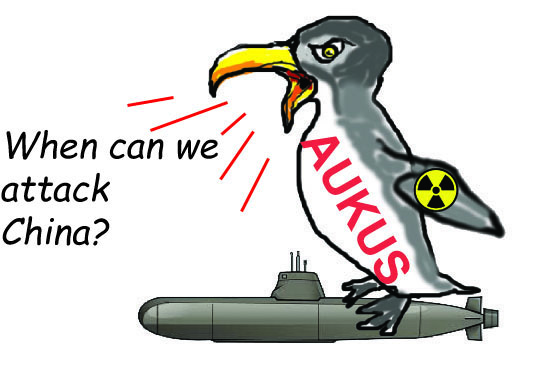
By Francois Murphy, South Coast Register, September 17 2022 China has clashed with the countries in the AUKUS alliance at a meeting of the UN nuclear watchdog over their plan to supply Australia with nuclear-powered submarines, capping a week in which Beijing has repeatedly railed against the project.
Under the alliance between Washington, London and Canberra announced last year, Australia plans to acquire at least eight nuclear submarines that International Atomic Energy Agency (IAEA) chief Rafael Grossi has said will be fuelled by “very highly enriched uranium”, suggesting it could be weapons-grade or close to it.

To date no party to the nuclear Non-Proliferation Treaty (NPT) other than the five countries the treaty recognises as weapons states – the United States, Russia, China, Britain and France – has nuclear submarines.
The vessels can stay underwater for longer than conventional subs and are harder to detect.
“The AUKUS partnership involves the illegal transfer of nuclear weapon materials, making it essentially an act of nuclear proliferation,” China said in a position paper sent to IAEA member states during this week’s quarterly meeting of the IAEA’s 35-nation Board of Governors……………………
The AUKUS countries and the IAEA say the NPT allows so-called marine nuclear propulsion provided necessary arrangements are made with the IAEA.
China disagrees in this case because nuclear material will be transferred to Australia rather than being produced by it.
It argues the IAEA is overstepping its mandate and wants an unspecified “inter-governmental” process to examine the issue at the IAEA instead of leaving it to the agency.
In its seven-page position paper, China said AUKUS countries were seeking to take the IAEA “hostage” so it could “whitewash” nuclear proliferation.
Nuclear submarines are a particular challenge because when they are at sea their fuel is beyond the reach of the agency’s inspectors who are supposed to keep track of all nuclear material.
IAEA chief Grossi has said he is satisfied with the AUKUS countries’ transparency so far……………………
https://www.southcoastregister.com.au/story/7906718/china-aukus-clash-over-nuclear-subs/?cs=202—
Plan to encase a Fukushima nuclear reactor and then flood it.

Its fuel rods melted and mixed with concrete, metal and other materials in the reactors, all fusing together as they cooled.
A plan is being considered to completely encase one of the reactors at the Fukushima nuclear plant in steel and then flood it with water in order to retrieve radioactive melted fuel. There are about 880 tonnes of melted nuclear fuel debris still inside the three reactors that suffered meltdowns in 2011, when a tsunami triggered by an earthquake off the coast of Japan disabled the plant’s cooling systems.
Nearly 20,000 people were killed and thousands more were injured by the tsunami, which also destroyed 123,000 homes. The highest waves topped 40m (133 feet). The nuclear plant was inundated, knocking out cooling systems and back-up generators.
Its fuel rods melted and mixed with concrete, metal and other materials in the reactors, all fusing together as they cooled.
Times 15th Sept 2022
Why future sea levels matter to Suffolk’s Sizewell nuclear plant

Global coastal inundation is now expected to be far worse than previously predicted
https://www.theguardian.com/news/2022/sep/16/why-future-sea-levels-matter-to-suffolks-sizewell-nuclear-plant Paul Brown, 16 Sept 22,
he caution of scientists, reinforced by accusations scaremongering from the well-funded fossil fuel lobby, has meant computer estimates of sea level rise in official forecasts have been low. Scientists mostly only counted the rise of the oceans because of expansion of warmer water then added on melting glaciers in the Alps and other temperate regions.
Originally ice caps in Greenland and Antarctica were excluded, in case increased snow fall in winter was greater than the ice melt in summer. Real time measurements of ice lost in polar regions has changed that. Coastal inundation in places such as East Anglia, Florida, and the Nile and Mekong deltas is expected to be far worse and quicker than previously predicted. Food supplies are threatened. The melting is also irreversible.
This makes Boris Johnson’s last act as prime minister to back a giant nuclear power plant on a low lying coast at Sizewell in Suffolk look a gamble. The builders, EDF, say there is no danger because the twin reactors will be built on a concrete raft seven metres above mean sea level, with a further surrounding wall to protect the nuclear island. But this concrete monolith will need to withstand sea level rise and storm surges for up to 200 years to protect future generations from its radioactive content.
32 organisations challenge French government’s decrees setting up Bure district for a nuclear waste dump that is not yet even authorised.

The Cigéo project, which would consist in burying in depth the most dangerous radioactive waste – of civil and military origin – must not see the light of day!
Today, 32 organizations and 30 inhabitants have just filed an appeal challenging the Declaration of Public Utility granted to it by decree on July 7, 2022, as well as its classification among the “Operations of National Interest”. By a Conseil d’Etat decree dated July 7, 2022, the government declared the Cigéo project in Bure to be of “public utility”. This decision was in line with the report of the investigating
commissioners who, despite the negative and substantiated opinions of the population, certain local authorities and institutions as well as our organizations, issued a favorable opinion.
At the same time, an Operation of National Interest (OIN) decree was issued by the Prime Minister, thus
promoting the establishment of Cigéo by allowing it to derogate from certain town planning rules and by giving all powers to the State to the detriment of local communities.
These two procedures, DUP and OIN, enable the National Agency for Radioactive Waste Management (Andra) to acquire the missing land control for the surface installations and the plumb of the underground works, i.e. approximately 3,500 hectares (l equivalent to the area of Lille) and to expropriate if necessary.
These procedures are also likely to facilitate the start of work on other so-called “preparatory” developments at Cigéo. These two decrees are thus supposed to make it possible to physically anchor on the territory an industrial site which has not yet received any authorization and which raises very serious questions in terms of safety, environmental impacts and cost.
Sortir du Nucleaire 7th Sept 2022
https://www.sortirdunucleaire.org/Projet-CIGEO-d-enfouissement-des-dechets
Back-up power lines restored to the shut-down Zaporizhzhia nuclear power plant
Ukrainian operators of the Zaporizhzhia nuclear power station won’t restart
the plant until its occupying Russian forces leave the facility, the head
of Ukraine’s nuclear agency, Petro Kotin, tells NPR.
Ukrainian workers powered down the war-damaged plant last weekend for safety reasons amid
continued shelling. On Tuesday, workers finished restoring all three backup
power lines — a sliver of good news at the plant that officials and
energy experts have warned could face a catastrophe as fighting continues
around it.
Still, the situation remains tense and unpredictable at
Zaporizhzhia — Europe’s largest nuclear plant, which has been occupied by
Russian troops since early March but is operated mostly by Ukrainian staff
— and concerns about the risk of a nuclear disaster are still looming as
fighting picked up in that part of southern Ukraine.
NPR 15th Sept 2022
https://www.npr.org/2022/09/15/1122908577/ukraine-zaporizhzhia-nuclear-power-plant-operator-russia
U.S. Finally Admits Ukraine Bombs Zaporizhzhia’s Nuclear Power Plant.

The Duran, by Eric Zuesse, September 15, 2022,
Unnamed American officials, according to the New York Times, have admitted that the explosives fired against Ukraine’s nuclear power plant in Zaporizhzhia have been fired against the plant by Ukraine’s Government, not by Russia’s Government, and furthermore these officials make clear that Ukraine’s attacks against the plant are a key part of Ukraine’s plan to win its U.S.-backed-and-advised war against Russia, on the battlefields of Ukraine, using Ukrainian soldiers.
Zaporizhzhia is a city in Ukraine that is in Russian-controlled territory, and Ukraine’s strategy is to destroy the ability of the plant to function, so that areas controlled by Russia will no longer be able to benefit from that plant’s electrical-power output. The United States Government helped Ukraine’s Government to come up with this plan, according to the New York Times.
This information was buried by the Times, 85% of the way down a 1,600-word news-report they published on September 13th, titled “The Critical Moment Behind Ukraine’s Rapid Advance”, in which it stated that, “Eventually, Ukrainian officials believe their long-term success requires progress on the original goals in the discarded strategy, including recapturing the nuclear power plant in Zaporizhzhia, cutting off Russian forces in Mariupol and pushing Russian forces in Kherson back across the Dnipro River, American officials said.”
When IAEA inspectors arrived at that plant on September 1st, after a lengthy period of trying to get there to inspect it but which was blocked by Ukraine’s Government, and the IAEA started delivering reports regarding what they were finding at the plant, no mention has, as-of yet, been made concerning which of the two warring sides has been firing those bombs into the plant.
Even when the IAEA headlined on September 9th “Director General’s Statement on Serious Situation at Ukraine’s Zaporizhzhya Nuclear Power Plant”, and reported that the plant’s ability to operate “has been destroyed by shelling of the switchyard at the city’s thermal power plant, leading to a complete power black-out in” the entire region, and that “This is completely unacceptable. It cannot stand.”, and closed by saying they “urgently call for the immediate cessation of all shelling in the entire area,” no mention was made as to which of the two sides was shooting into the plant in order to disable it, and which of the two sides was firing out from the plant in order to protect it against that incoming fire.
Previously known was only that the city of Zaporizhzhia has been and is under Russian control ever since March 4th. Consequently, all news-media and reporters have known that (since Russia was inside and Ukraine was outside) Russia has been defending the plant and Ukraine has been attacking it, but until “American officials” let slip, in this news-report, the fact that this has indeed been the case there, no Western news-medium has previously published this fact — not even buried it in a news-report.
So, although nothing in this regard may yet be considered to be official, or neutral, or free of fear or of actual intent to lie, there finally is, at the very least, buried in that news-report from the New York Times, a statement that is sourced to “American officials,” asserting that this is the case, and the Times also lets slip there that this “shelling” of that plant is an important part of the joint U.S.-Ukraine master-plan to defeat Russia in Ukraine.
It is part of the same master-plan, which the U.S. Government recommended to Ukraine’s Government, and which also included the recent successful retaking by Ukraine of Russian-controlled land near the major Ukrainian city of Kharkov, which city’s recapture by Ukraine is also included in the master-plan. Both operations — the shelling of the nuclear power plant, and the recapture of that land near Kharkov — were parts of that master-plan, according to the New York Times.
The Times report asserts that
Long reluctant to share details of their plans, the Ukrainian commanders started opening up more to American and British intelligence officials and seeking advice. Jake Sullivan, the national security adviser, and Andriy Yermak, a top adviser to Mr. Zelensky, spoke multiple times about the planning for the counteroffensive, according to a senior administration official. Gen. Mark A. Milley, the chairman of the Joint Chiefs of Staff, and senior Ukrainian military leaders regularly discussed intelligence and military support.
And in Kyiv, Ukrainian and British military officials continued working together while the new American defense attaché, Brig. Gen. Garrick Harmon, began having daily sessions with Ukraine’s top officers. https://theduran.com/u-s-finally-admits-ukraine-bombs-zaporizhzhias-nuclear-power-plant/
Extreme hunger is soaring in the world’s climate hotspots – Oxfam
Extreme hunger is closely linked to the climate crisis, with many areas of
the world most affected by extreme weather experiencing severe food
shortages, research has shown.
The development charity Oxfam examined 10 of
the world’s worst climate hotspots, afflicted by drought, floods, severe
storms and other extreme weather, and found their rates of extreme hunger
had more than doubled in the past six years.
Within the countries studied,
48 million people are currently suffering from acute hunger, up from about
21 million people in 2016. Of these, about 18 million people are on the
brink of starvation, according to the Oxfam report published on Thursday.
Guardian 16th Sept 2022
EDF’s core profits to take a €29bn hit this year from outages at France’s nuclear reactors

EDF warned that core profits would take a €29bn hit this year from
outages at France’s nuclear reactors, a sharp rise on its previous forecast
just weeks ahead of full renationalisation by the French government.
More than half of the 56 reactors run by EDF are offline, a record number, as
corrosion problems discovered at some sites add to maintenance stoppages,
including some that were delayed by the Covid-19 pandemic. That has pushed
output close to all-time lows, sapping electricity supply in a country that
is normally an exporter of power and forcing the company to buy power on
wholesale markets that have become hugely costly as Russia chokes gas
supplies to Europe.
EDF had previously estimated the hit to its earnings
before interest, taxes, depreciation and amortisation at €24bn for 2022.
The French government is poised in the coming weeks to launch a tender
offer for the 16 per cent of EDF it does not already own. It has said it
wants to take full control as EDF gears up to build new reactors and
addresses problems with its fleet of reactors. The faults have turned the
spotlight on France’s once-mighty nuclear industry just as orders for new
plants had begun to pick up again worldwide — and have heightened a
stand-off between the state and EDF management.
FT 15th Sept 2022
https://www.ft.com/content/a9966ad5-e1a2-4bed-b702-ca662f0b44c0
Nuclear power still doesn’t make much sense
More on the A NEW ENERGY PARADIGM
New York Times-NYT | Opinion Piece | by Farhad Manjoo 16 Sept 22
“…the nuclear industry has long been hobbled by two problems that its boosters can’t really wish away:
Nuclear is far slower to build than most other forms of power, and it’s far more expensive, too.
And now there is a third problem on the horizon.
As battery technology improves and the price of electricity storage plummets, nuclear may be way too late, too…
with much of its value eclipsed by cheaper, faster and more flexible renewable power technologies.”
This is without discussing in detail why, how, and where, increasing, innovation efficiencies in current batteries, are trending cheaper;
or the high probability of solid-state batteries, in the development pathway emerging.
Keywords: ‘battery technology improves’ ‘the price of electricity storage plummets’ ‘nuclear’ ‘eclipsed by cheaper, faster and more flexible renewable’
Many good points in this article, including –
“… because any new money put in nuclear is money you aren’t spending on renewable projects that could lower emissions immediately. There’s an opportunity cost “of waiting around for a nuclear reactor to be built when you could have spent that money on wind or solar and got rid of emissions much faster,” Jacobson said. …” https://www.nytimes.com/…/nuclear-power-still-doesnt…
Tory Minister Zac Goldsmith, who actually cares about the environment, sacked as Environment Minister
Boris Johnson ally Zac Goldsmith has been axed as an environment minister
and told he will no longer be attending Liz Truss’s cabinet, it has
emerged. The Conservative minister has been stripped of his brief
overseeing animal welfare at the Department for Environment, Food and Rural
Affairs (Defra), government sources confirmed to The Independent. Mr
Goldsmith appeared to issue a warning to Ms Truss in an exit letter to
Defra staff, saying the government has “so much more to do to turn the
tide” on the environment, according to The Guardian, which first reported
on his sacking.
Independent 15th Sept 2022
https://www.independent.co.uk/news/uk/politics/zac-goldsmith-sacked-liz-truss-b2168250.html
1 This month
17 October, Free Public Talk on Nuclear Issues in South Australia
David Noonan will speak on public interest concerns over the new Roxby Downs Indenture Act 2026 on BHP copper-uranium mining and ore processing in SA, and on how AUKUS may face SA with a High-Level nuclear waste agenda.
Dr Jim Green will discuss international developments in the field of nuclear power including ‘small modular reactors’ and Generation 4 ‘advanced’ nuclear reactor concepts.


Help Aunty Sue Protect Her Land and Sacred Sites From Destructive Rocket Testing.
.

Australians deserve the truth
about
AUKUS – https://aukuspublicinquiry.com/

PETITION – To: Prime Minister Anthony Albanese and the Australian Labor Government

of the week – Australians for War Powers Reform (AWPR)
To see nuclear-related stories in greater depth and intensity

