Western media continues to ignore Ukraine’s public ‘kill list’ aimed at those who question the Kiev regime

Ukraine has a list ( Myrotvorets) of people, giving addresses and contact numbers, – people considered as enemies of the state, – able to be killed by extreme nationalists. The Ukraine government does nothing to stop this.
“There are so many people in Ukraine who want to push for peaceful negotiations with Russia. But if anybody in Ukrainian society wants to stand up and push this line, they’re most likely going to be put on that list. Myrotvorets is very much a symbol of the extremist elements in Ukraine at the moment.”
https://ingaza.wordpress.com/2022/09/11/western-media-continues-to-ignore-ukraines-public-kill-list-aimed-at-those-who-question-the-kiev-regime/ September 10, 2022, -by Eva K Bartlett
The Myrotvorets list is an issue trending in independent and Russian media, but not in the mainstream international press
This week, a number of international and Russian journalists convened in Moscow – with more joining by video link – to discuss the now-infamous Ukrainian Myrotvorets “kill list.” Many of them are included themselves.
While some don’t take it seriously, the horrific car-bombing murder of Darya Dugina on August 20 and the subsequent marking on her Myrotvorets entry as “liquidated” makes it fairly clear the people behind the list do, in fact, want people dead.
The same thing happened to the entry of Russian photojournalist Andrei Stenin and many others listed and subsequently killed, including the Italian Andrea Rocchelli.
What it feels like to be on the list
The head of the Foundation to Battle Injustice, Mira Terada, who convened the panel, noted that of the thousands of names entered on the site, 341 are journalists and, shockingly, 327 are minors.
“Publishing personal data on minors is a crime. It’s like a menu for pedophiles or people doing human trafficking.”
While her concern is for the children, journalists, activists, political figures and even ordinary Ukrainians who have somehow angered the Kiev regime and those behind the list, Terada now needs to exercise some caution after she herself was added to the database.
An hour and a half after a July 21 press conference about children being placed on Myrotvorets, Mira found herself listed. “This changed my life. I have to be vigilant 24/7,” she said.
Christelle Néant, a French war correspondent reporting from Donbass for the past six and a half years, mentioned to me before the panel began that some of the information on the site is not disclosed to the general public, and is password-locked.
Néant, who said she’s been receiving death threats for years, spoke of how it impacts her: “Every time I use my car, I check underneath it for any unpleasant surprise,” referring to a potential car bomb. “I don’t publish any photos with people I live with or love. I have to be vigilant at all times.”
“I’m not a terrorist, not a criminal, I’m just a correspondent. This list must be closed and all of those involved must be held accountable.”
German journalist Thomas Röper rightly noted that Western media outlets prefer to look the other way. “They could have reported on this, but they’re saying nothing.”
He also pointed out the silence of the German government, even when asked at press conferences.
“A state has a duty to protect its citizens, but I haven’t seen anything from my government to condemn the fact that Germans are on this list and one German national has been killed.”
And, in fact, rather than protect German journalists, the government is persecuting them, as is the case with Alina Lipp, whose bank account, and that of her mother, was closed after the German government launched a criminal case against her for her reporting from Donbass.
Russian journalist Veronika Naydenova, originally from Crimea but living in Germany, was added to the list in January, also after raising the inclusion of children, including 13-year-old Faina Savenkova, from the Lugansk People’s Republic.
The same day my article was published, I was added to the list. But this hasn’t stopped me, I’ve written many articles since.”
She highlighted an additional, very real, threat: that of the refugees who’ve come to Germany from Ukraine, it isn’t possible to know who is merely a refugee and who holds Ukrainian nationalist extremist views. This is a very real fear for Naydenova, whose address is listed on Myrotvorets.
The same happened with Syrians who entered Germany and other countries as refugees. Some of them had affiliations to, or were members of, terrorist groups in Syria, and posed very real threats to supporters of Syria in Germany. As I wrote in a previous article, Kevork Almassian, a Syrian living in Germany, was chased, smeared, harassed and even physically attacked multiple times by the sympathizers of the Free Syrian Army (FSA) and other terrorist groups.”
Dutch journalist Sonya van den Ende likewise fears returning home. “I’m labeled an ‘enemy of the state’ now in the Netherlands. I cannot go back, it’s very dangerous for me to do so.”
Janus Putkonen, a Finnish journalist who has been living in Donbass since 2015, pointed out how the risk extends globally.
“Because the Myrotvorets kill list has not been stopped, people around the world are now in danger of falling victim to the state terrorism of Ukrainian Nazism, comparable to ISIS terrorism.”
But, most of all, it threatens Ukrainians within Ukraine, something British journalist Johnny Miller emphasized.
“If you’re a journalist, blogger, political figure, or a citizen in Ukraine who wants to criticize extremism in Ukraine, which there is a lot of, or if you want to criticize Ukrainian government policies, most likely you’re going to be put on that list. And be under serious threat of death.”
Miller, who has reported from areas of western Ukraine, raised another important point:
“There are so many people in Ukraine who want to push for peaceful negotiations with Russia. But if anybody in Ukrainian society wants to stand up and push this line, they’re most likely going to be put on that list. Myrotvorets is very much a symbol of the extremist elements in Ukraine at the moment.”
For myself, I’ve been on the list since 2019, after going to Crimea and reporting from areas of the DPR where civilians were being terrorized by Ukrainian shelling, houses destroyed “street by street” as a local told me.
It’s not okay for grown adults to say the Ukraine invasion was “unprovoked”
The US Army-commissioned paper details how the empire can use proxy warfare, economic warfare and other cold war tactics to push its longtime geopolitical foe to the brink without costing American lives or sparking a nuclear conflict. It mentions Ukraine hundreds of times, and it explicitly discusses the same economic warfare tactics we’re seeing today
Caitlin Johnstone, TheAltWorld, Wed, 07 Sep 2022
On a recent interview with the Useful Idiots podcast, Noam Chomsky repeated his argument that the only reason we hear the word “unprovoked” every time anyone mentions Russia’s invasion of Ukraine in the mainstream news media is because it absolutely was provoked, and they know it. Chomsky said:
“Right now if you’re a respectable writer and you want to write in the main journals, you talk about the Russian invasion of Ukraine, you have to call it ‘the unprovoked Russian invasion of Ukraine”. It’s a very interesting phrase; it was never used before. You look back, you look at Iraq, which was totally unprovoked, nobody ever called it ‘the unprovoked invasion of Iraq.’ In fact I don’t know if the term was ever used — if it was it was very marginal. Now you look it up on Google, and hundreds of thousands of hits. Every article that comes out has to talk about the unprovoked invasion of Ukraine.
“Why? Because they know perfectly well it was provoked. That doesn’t justify it, but it was massively provoked. Top US diplomats have been talking about this for 30 years, even the head of the CIA.”
Chomsky is of course correct here. The imperial media and their brainwashed automatons have spent half a year mindlessly bleating the word “unprovoked” in relation to this war, but one question none of them ever have a straight answer for is this: if the invasion of Ukraine was unprovoked, how come so many western experts spent years warning that the actions of western governments would provoke an invasion of Ukraine?
Because, as Chomsky notes, that is indeed the case. A few days after the invasion began this past February a guy named Arnaud Bertrand put together an extremely viral Twitter thread that just goes on and on and on about the various diplomats, analysts and academics in the west who have over the years been warning that a dangerous confrontation with Russia was coming because of NATO advancements toward its borders, interventionism in Ukraine, and various other aggressions. It contains examples like John Mearsheimer explicitly warning in 2015 that “the west is leading Ukraine down the primrose path, and the end result is that Ukraine is going to get wrecked,” and Pat Buchanan warning all the way back in 1999 that “By moving NATO onto Russia’s front porch, we have scheduled a twenty-first-century confrontation.”
Empire apologists love claiming that the invasion of Ukraine had nothing to do with NATO expansionism (their claims generally based on brazen misrepresentations of what Vladimir Putin has said about Russia’s reasons for the war), but that’s silly. The US war machine was continuing to taunt the possibility of NATO membership for Ukraine right up until the invasion, a threat it refused to take off the table since placing it there in 2008 despite knowing full well that this threat was an incendiary provocation to Moscow.
This is to say nothing of the US empire actively fomenting a violent uprising in 2014 which ousted Kyiv’s sitting government and fractured the nation between its more Moscow-loyal populations to the east and the more US/EU-friendly parts of the country. This led to the annexation of Crimea (overwhelmingly supported by the people who live there) and eight years of brutal warfare against Russia-backed separatists in the Donbas. Ukrainian attacks on those separatists are known to have increased exponentially in the days leading up to the invasion, and it has been argued that this is what provoked Putin’s final decision to commit to invading (which was a last-minute decision according to US intelligence).
The US power alliance could very easily have prevented this war with a few low-cost concessions like enshrining Ukrainian neutrality, rolling back its war machinery from Russia’s borders and sincerely pursuing detente with Moscow instead of shredding treaties and ramping up cold war escalations. Hell, it could likely have prevented this war just by protecting President Zelensky from the anti-Moscow far right nationalists who were openly threatening to lynch him if he began honoring the Minsk agreements and pursuing peace with Russia, as he was originally elected to do.
Instead it knowingly chose the opposite course: continuing to float the possibility of formal NATO membership for Ukraine while pouring weapons into the nation and making it more and more of a de facto NATO memberwith closer and closer intimacy with the US war machine, and then either ordering, encouraging or tolerating Ukraine’s aggressive assault on Donbas separatists.
Why did the empire opt for provocation over peace? Congressman Adam Schiff gave a pretty good answer to that question in January of 2020 as the road to war was being paved: “so that we can fight Russia over there, and we don’t have to fight Russia here.” If you relinquish the infantile idea that the US empire is helping its good friend Ukraine because it loves the Ukrainian people and wants them to have freedom and democracy, it’s not hard to see that the US sparked a convenient proxy war because it was in its geostrategic interests to do so, and because it wouldn’t be their lives and property getting laid to waste.
Brian Berletic put out a good video a few days ago about a Pentagon-funded 2019 Rand Corporation paper titled “Extending Russia – Competing from Advantageous Ground,” which is exactly what it sounds like. The US Army-commissioned paper details how the empire can use proxy warfare, economic warfare and other cold war tactics to push its longtime geopolitical foe to the brink without costing American lives or sparking a nuclear conflict. It mentions Ukraine hundreds of times, and it explicitly discusses the same economic warfare tactics we’re seeing today like sanctions and attacking Russia’s energy interests in Europe (the latter of which Berletic points out is also being used to bolster US dominance over its vassals in the EU).
Continue readingSwitzerland plans controversial nuclear waste dump all too close to German border
A plan for a nuclear waste storage facility in Switzerland is raising
safety concerns among Germans close to the border. The project, which is
backed by power plant operators, requires approval by the Swiss government.
Switzerland has announced plans to build a nuclear waste storage facility
on the border with Germany, leaving communities concerned about the issues
of safety and clean drinking water supply. The National Cooperative for the
Disposal of Radioactive Waste (Nagra) is behind the proposal. It suggested
the region of Nördlich Lägern, north of Zurich and close to the border
with Germany, the Swiss Federal Office of Energy said.
Deutsche Welle 10th Sept 2022
All 6 reactors at Zaporizhzhia nuclear plant now completely stopped operating
Operations at the Russian-held Zaporizhzhia Nuclear Power Plant in Ukraine
have been fully stopped as a safety measure, Energoatom, the state agency
in charge of the plant, said. The plant “is completely stopped” after the
agency disconnected the number 6 power unit from the grid at 3.41am (local
time), it said in a statement. “Preparations are under way for its cooling
and transfer to a cold state.”
RTE 11th Sept 2022
https://www.rte.ie/news/ukraine/2022/0911/1321783-ukraine-russia/
Offsite power supply to Zaporizhzhia nuclear plant destroyed

Offsite power supply to Zaporizhzhia nuclear plant destroyed
Guardian Isobel Koshiw in Kyiv, 10 Sept 22,
A vital offsite electricity supply to the Zaporizhzhia nuclear plant has been destroyed by shelling and there is little likelihood a reliable supply will be re-established, the United Nations’ nuclear watchdog chief has said.
Rafael Grossi, the director general of the International Atomic Energy Agency (IAEA), said shelling had destroyed the switchyard of a nearby thermal power plant.
The plant has supplied power to the nuclear facility each time its normal supply lines had been cut over the past three weeks. The thermal plant was also supplying the surrounding area, which was plunged into darkness.
Local Ukrainian officials said work was under way to restore the connection, which has been cut multiple times this week.
Grossi, who said he had been informed of the situation by IAEA representatives at the plant, called for an “immediate cessation of all shelling in the entire area”. “This is an unsustainable situation and is becoming increasingly precarious,” he said, without apportioning blame for the shelling.
Ukraine and Russia have blamed each other for shelling near Zaporizhzhia in southern Ukraine and within the perimeter of Europe’s biggest nuclear power plant, which has six reactors.
The thermal supply has been cut and restored multiple times this week and Enerhodar, the nearby town, has suffered several complete blackouts.
When the thermal supply has been cut the plant has relied on its only remaining operating reactor for the power needed for cooling and other safety functions. This method is designed to provide power only for a few hours at a time. Diesel generators are used as a last resort. The constant destruction of thermal power supply has led Ukraine to consider shutting down the remaining operating reactor, said Grossi. Ukraine “no longer [has] confidence in the restoration of offsite power”, he said.
Grossi said that if Ukraine decided not to restore the offsite supply the entire power plant would be reliant on emergency diesel generators to ensure supplies for the nuclear safety and security functions.
“As a consequence, the operator would not be able to restart the reactors unless offsite power was reliably re-established,” he said…………….. https://www.theguardian.com/world/2022/sep/09/offsite-power-supply-to-zaporizhzhia-nuclear-plant-destroyed
Nuclear is the worst possible way to back up wind power
Letter to Scottish Herald Pete Roche: NUCLEAR is the worst possible way to
back up wind power. Full Stop. Baseload – which Iain Macwhirter in his
Herald on Sunday article “Nuclear is the worst possible option … except
for the others” (September 4) suggests is needed when the wind doesn’t
blow – is an outdated concept.
Renewables should not be described as
intermittent – they are variable, which means their output can be
forecast with good accuracy. Nuclear plants are on 24/7, so can’t balance
the output from variable renewables, and would get in the way of their
expansion, because they are inflexible.
There are plenty of better ways of
balancing the grid. We need a more flexible system with smart grids,
time-of-use tariffs, batteries and storage including heat storage and
hydrogen, made using surplus renewables power. A rapidly growing number of
studies show that 100% renewable energy systems are not only feasible but
also cost effective.
And we are not just talking about wind. Solar would
also be a central pillar, but other sources will include geothermal, tidal
and wave power, all backed up with an ambitious energy efficiency
programme.
Nuclear power is too expensive. Building nuclear stations will
put energy bills up. Electricity from offshore wind is currently about £37
per megawatt hour. If the UK Government goes ahead with Sizewell, in about
15 years its electricity would cost around £120 per megawatt hour. An
added problem is that new nuclear stations take too long to build.
The United Nations’ Intergovernmental Panel on Climate Change (IPCC) says
that we have less than 10 years in which to make massive and unprecedented
changes to global energy infrastructure to limit global warming to moderate
levels. The UK Government first started consulting on building new nuclear
power stations in May 2007, but Hinkley Point C is not expected to start
generating electricity until around 2027.
Herald 9th Sept 2022
France, Germany and UK lose faith in negotiations with Iran, to restore the nuclear agreement.
We the governments of France, Germany and the United Kingdom have
negotiated with Iran, in good faith, since April 2021 to restore and fully
implement the Joint Comprehensive Plan of Action (JCPoA), along with other
participants to the deal and the United States.
In early August, after a
year and a half of negotiations, the JCPoA Coordinator submitted a final
set of texts which would allow for an Iranian return to compliance with its
JCPoA commitments and a US return to the deal. In this final package, the
Coordinator made additional changes that took us to the limit of our
flexibility.
Unfortunately, Iran has chosen not to seize this critical
diplomatic opportunity. Instead, Iran continues to escalate its nuclear
program way beyond any plausible civilian justification. While we were
edging closer to an agreement, Iran reopened separate issues that relate to
its legally binding international obligations under the Non Proliferation
Treaty (NPT) and its NPT safeguards agreement concluded with the
International Atomic Energy Agency (IAEA).
This latest demand raises
serious doubts as to Iran’s intentions and commitment to a successful
outcome on the JCPoA. Iran’s position contradicts its legally binding
obligations and jeopardizes prospects of restoring the JCPoA.
French Ministry of Foreign Affairs 10th Sept 2022
Here’s why the risk of a nuclear accident in Ukraine has ‘significantly increased’

https://www.wboi.org/npr-news/npr-news/2022-09-09/heres-why-the-risk-of-a-nuclear-accident-in-ukraine-has-significantly-increased By Geoff Brumfiel, September 9, 2022, The head of the International Atomic Energy Agency is warning that the risk of a nuclear accident at the Zaporizhzhia nuclear power plant has “significantly increased,” following ongoing fighting around the site.
“Let me be clear, the shelling around Zaporizhzhia nuclear plant must stop,” IAEA Director General Rafael Mariano Grossi said in a brief recorded statement released on Friday.
Grossi also warned that the continued fighting might require the plant to shut down its last operating reactor. That would set into motion a chain of events that could intensify the current nuclear crisis. Here’s how.
Nuclear plants need electricity
The Zaporizhzhia nuclear plant is the largest in Europe, capable of producing thousands of megawatts of electricity. But the plant also needs power from the same electricity grid it feeds.
The power is used to run the various parts of the plant, including its safety and cooling systems. Specifically, nuclear power plants require water to be pumped constantly through their cores in order to function safely, and the pumps need electricity.
At Zaporizhzhia, the power is normally supplied by four high-voltage lines, which connect the nuclear complex to Ukraine’s electricity grid, but the conflict has seen those lines systematically cut. The last 750kV line was severed on September 3, according to the IAEA.
A backup line was disconnected two days later due to a fire on the site. In a press conference shortly after returning from Zaporizhzhia, Grossi told reporters that he believed the power lines were being deliberately targeted:
Zaporizhzhia has been making its own power, but that’s a limited solution
Since losing its last connection to the grid on Sept. 5, the nuclear plant has been powering itself in so-called “islanding operation mode.” Under this setup, the Unit 6 reactor has been producing low levels of electricity that are running the rest of the facility.
The reactors at Zaporizhzhia are designed to operate in this mode during startup, according to a nuclear engineer who worked directly with the reactors when the plant began operations in the 1980s, but who was not authorized to speak publicly by his current employer.
“It’s not good, it cannot be done for a long time,” he says. The problem is less to do with the reactor itself than the turbine, generators and other systems–all of which are designed to run at significantly higher power levels than islanding operation mode provides.
Adding to the problem, Grossi said in his statement, is the increasing strain on the plant’s Ukrainian operators. Many of the plant’s current staff of just under 1,000 live in the nearby town of Enerhodar. Its water, sewage and electrical supplies have all been disrupted in recent days by the same fighting that’s damaged the lines around the plant.
“The shelling is putting in danger operators and their families, making it difficult to adequately staff the plant,” Grossi says.
Shutting down the last reactor will trigger emergency generators
With conditions deteriorating, it seems more likely that Ukrainian authorities will decide to power down the last reactor. But in the short term, that could exacerbate the crisis.
That’s because nuclear reactors are more like charcoal grills than gas stoves. Even after they’re shut off, they remain hot for a long period of time. Water must still circulate in the cores to prevent a meltdown.
With its reactors shut down, Zaporizhzhia will switch to backup emergency diesel generators to keep the reactors cool. The emergency generators themselves are a tried-and-true method for cooling a nuclear reactor. In fact, the Nuclear Regulatory Commission requires U.S. plants to switch to emergency diesel generators immediately, bypassing the “islanding operation mode” used in Zaporizhzhia.
“We don’t want to go on the diesel generators, but it’s a situation you can abide by for awhile,” says Steven Nesbit, a nuclear engineer and member of the American Nuclear Society’s rapid response taskforce, which is tracking the current crisis. For example, after losing power during Hurricane Andrew in 1992, the Turkey Point Nuclear Plant in Florida operated for days on emergency diesel power.
If the generators run out of fuel, a meltdown could occur
Continue readingUK and Europe cannot depend on nuclear power, with reactors shutting down, just as winter hits.
The first real winter test of how strained the UK’s energy supplies are will come next month when nuclear reactors start closing for maintenance, just as the heating season kicks off.
Nuclear output makes up roughly 15% of Britain’s energy mix, and the planned shutdowns may challenge
electricity production when the country can least afford it. Two units at n the Heysham plant in northern England are set to halt for periods between October and November, and more nuclear closures are scheduled through winter.
European power prices have surged amid an energy crisis linked to soaring gas costs caused by Russia’s war in Ukraine. While early winter weather is expected to be mild, the UK grid risks becoming particularly
tight as it gets colder, with the country exporting power to France because of major outages at reactors there.
Bloomberg 7th Sept 2022
Pine Gap a target as Ukraine invasion raises nuclear war risk, Australian defence expert warns
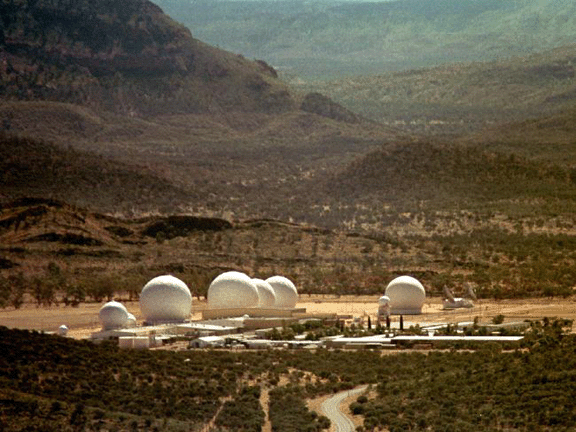
A humiliated Russia could be driven closer to China in a ‘grand coalition’, former Joint Intelligence Organisation director says
Guardian, Ben Doherty 7 Sept 22,
Australia could become a nuclear target due to its hosting of a US military base at Pine Gap in the Northern Territory, one of Australia’s leading defence strategists has warned.
Prof Paul Dibb, an emeritus professor at the Australian National University and former director of Australia’s Joint Intelligence Organisation, said the current Russian invasion of Ukraine carried potential global nuclear consequences, with the possibility of a defeated and humiliated Russia pushed closer to China in “a grand coalition … united not by ideology but by complementary grievances”……….
Australia should not feel its geographic distance from the epicentre of the conflict affords it any significant protection, Dibb argued.
“We need to plan on the basis that Pine Gap continues to be a nuclear target, and not only for Russia. If China attacks Taiwan, Pine Gap is likely to be heavily involved,” he said.
“We need to remember that Pine Gap is a fundamentally important element in US war fighting and deterrence of conflict.”
Pine Gap is a highly secret US-Australian military installation near Alice Springs. It serves as a major hub for US global intelligence interception, and for satellite surveillance operations for military and nuclear missile threats in the region.
Russia is unlikely to be able to subjugate Ukraine in its current invasion, Dibb said, but Ukrainian military is unlikely to succeed in driving out Russian troops entirely. “Most likely there’ll be a negotiated conclusion, probably at the ceasefire talk.”
Regardless, Dibb argued, the Russian president, Vladimir Putin, was unlikely to be deposed as a result, but he would be a leader grown increasingly isolated, and the threat of nuclear escalation was real.
“There’s little doubt that Putin is the sort of person who won’t resile from the use of nuclear weapons, particularly if it looks as though he’s losing this war. But he must surely realise that there’s no such thing as the limited use of tactical nuclear weapons in isolation from their escalation to a full-scale strategic nuclear war.
“Once we enter the slippery slope of even limited nuclear exchanges, the end result will be escalation to mutual annihilation – something about which both Putin and Xi Jinping may need reminding.”
The comprehensive defeat of Russia in Ukraine would bring its own dangers, Dibb argued.
A severely weakened, isolated and smaller Russia might then become more – not less – dangerous for the world.”
A Russia left humiliated would be driven closer to China, Dibb said, with the nuclear powers forming what he described as a “grand coalition”, unified “not by ideology but by complementary grievances”.
Dibb told the Guardian: “The most serious threat to America would be a de facto alliance between China and Russia, united in the common cause of their hatred for the west.” ………………….https://www.theguardian.com/australia-news/2022/sep/07/pine-gap-a-target-as-ukraine-invasion-raises-nuclear-war-risk-australian-defence-expert-warns?CMP=Share_AndroidApp_Other&fbclid=IwAR0C13ws8uQOEBEW6RVAReW1B96DyhginkTX1ujZ-CEeLKm1ePkchpnKzr4
Kim Jong Un says North Korea’s new law allowing pre-emptive nuclear strikes is ‘irreversible’

North Korea has officially enshrined the right to use pre-emptive nuclear strikes to protect itself in a new law.
Key points:
- The new law makes North Korea’s nuclear status “irreversible”, and bars denuclearisation talks
- It also allows for pre-emptive nuclear strikes if, among other things, there is an imminent attack against its leadership
- Analysts say the goal is to win international acceptance of the country’s status as a “responsible nuclear state”
The country’s leader Kim Jong Un said the legislation also made its nuclear status “irreversible” and bars denuclearisation talks, state media reported on Friday.
The move comes as observers say North Korea appears to be preparing to resume nuclear testing for the first time since 2017, after historic summits with former US president Donald Trump and other world leaders in 2018 failed to persuade Kim to end weapons development.
The North’s parliament — the Supreme People’s Assembly — passed the legislation on Thursday, according to state news agency KCNA.
The new legislation is a replacement to a 2013 law which first outlined the country’s nuclear status…………………………
Pre-emptive strikes
The original 2013 law stipulated that North Korea could use nuclear weapons to repel invasion or attack by a hostile nuclear state, and make retaliatory strikes.
The new law goes beyond that to allow for pre-emptive nuclear strikes if an imminent attack by weapons of mass destruction or against the country’s “strategic targets”, including its leadership, is detected.
“In a nutshell, there are some really vague and ambiguous circumstances in which North Korea is now saying it might use its nuclear weapons,” Chad O’Carroll, founder of the North Korea-tracking website NK News, said on Twitter.
Like the earlier law, the new version vows not to threaten non-nuclear states with nuclear weapons unless they join with a nuclear-armed country to attack the North.
The new law adds, however, that it can launch a pre-emptive nuclear strike if it detects an imminent attack of any kind aimed at North Korea’s leadership and the command organisation of its nuclear forces.
That is an apparent reference to South Korea’s “Kill Chain” strategy, which calls for pre-emptive strikes on North Korea’s nuclear infrastructure and command system if an imminent attack is suspected…………….
Under the law, Mr Kim has “all decisive powers” over nuclear weapons, but if the command and control system is threatened, then nuclear weapons may be launched “automatically”.
If Mr Kim delegates launch authority to lower commanders during a crisis, that could increase the chances of a catastrophic miscalculation, analysts said.
‘Responsible nuclear state’
The law bans any sharing of nuclear arms or technology with other countries, and is aimed at reducing the danger of a nuclear war by preventing miscalculations among nuclear weapons states and misuse of nuclear weapons, KCNA reported.
Analysts say Mr Kim’s goal is to win international acceptance of North Korea’s status as a “responsible nuclear state.”…………………….. more https://www.abc.net.au/news/2022-09-09/new-north-korea-law-outlines-nuclear-weapons-use-including-preem/101425072
Lucky timing for Liz Truss’s absurd energy policy

Not wishing to sound disrespectful, but
The death of Queen Elizabeth has come at a lucky time for Liz Truss and her new Tory ministry. It has swamped the anglophone media – which seems to be ignoring the absurdity of Truss’s energy (and other) policies
Great British Nuclear will bring forward new nuclear projects at a rate of one a year this decade.
and the green light for more fossil
fuel extraction
Public opinion in UK – overwhelming support for solar and wind energy
The UK’s general public is overwhelmingly supportive in building new
wind and solar farms in order to tackle the ongoing cost of energy crisis,
according to Survation. Identified within polling released by Survation and
commissioned by RenewableUK, the data showcased that almost every
constituency in the UK is in favour of developing renewable generation
sites in a bid to reduce the cost of energy.
In fact, 77% of people in the
UK believe the government should use new wind and solar farms to reduce
electricity bills, with 76% of people also in support of building renewable
energy projects in their local area, according to Survation’s data.
This contradicts the new prime Minister, Liz Truss’ previous statement about
solar farms being “paraphernalia”, as in fact the majority of the
general public thoroughly support the development of these farms to tackle
the energy crisis. Causing a further headache for Truss is the fact that
84% of those who backed the Tories at the last election now urge the
government to use new wind and solar farms to cut electricity bills. 81% of
2019 Tory voters also support a renewable energy project being developed in
their local area.
Current 8th Sept 2022
Some UK government ministers are mentioning the radical idea of ENERGY CONSERVATION!

Ministers are drawing up plans for a public information campaign to
encourage people to reduce energy use this winter amid fears that a price
freeze will deter them from doing so.
There is concern within government
that an intervention by Liz Truss to tackle the sharp rise in energy costs
could increase the risk of blackouts if it means that households and
businesses do not reduce consumption.
The Times has been told that
ministers want to work with energy companies on a public information
campaign over the winter to encourage people to turn down their thermostats
and turn off electrical appliances instead of leaving them on standby.
Times 8th Sept 2022
https://www.thetimes.co.uk/article/ministers-will-implore-public-to-cut-use-of-power-wpb38bhtk
Mishandling of Classified Nuclear Documents Is Bad. Mishandling of the Sole Authority to Use Nuclear Weapons Would Be Much Worse.
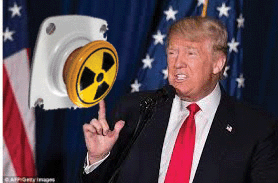
Union of Concerned Scientists, Eryn MacDonald, 9 Sept 22, Headlines about the discovery of nuclear weapons-related materials in the trove of highly classified documents that former President Trump stashed at his private residence in Mar-a-Lago are not exactly confidence inspiring. The fact that a former president simply walked off with information at the highest levels of classification leaving it unguarded for more than a year should raise alarms for anyone who is concerned about national security.
But if you think it’s unbelievable that it was so easy to sidestep the safeguards and procedures in place to ensure that some of the most secret information known to our government was not packed up and stuck in a basement, I’ve got even worse news for you. Because the process to order the launch of US nuclear weapons has fewer safeguards and would require no sidestepping, leaving it even more vulnerable to the whims of an unstable leader. That decision is put in the hands of a single individual—the president—while the rest of us all just have to cross our fingers and hope that they take this responsibility more seriously than the former president took his responsibility to safeguard those classified documents.
The process that the United States has now for making decisions about the use of nuclear weapons is called “sole authority.” It is an outdated artifact of an earlier time that now carries more risks than benefits. ……………
sole authority intentionally includes no checks and balances. No requirement to consult with advisers or Congress. There is also no one with the legal authority to countermand the order if the president does decide to launch…….. And once missiles are launched, there is no going back—they cannot be called back or ordered to self-destruct.
The good news: we can fix it
Times have changed since the decision was made to give the president sole authority over the decision to launch a nuclear attack. Communications systems have improved immensely. And despite the deterioration of US-Russian relations, a surprise Russian nuclear attack on the US homeland is still not a realistic concern these days. And, the US now has a fleet of nuclear ballistic missile submarines that are essentially invulnerable when they are hidden on patrol in the ocean, rendering the need for split-second nuclear launch decisions obsolete.
Unfortunately, the nuclear launch decision-making system has not kept pace with the times. The good news, however, is that it would be an easy fix, that we could implement very quickly. There have been many suggestions of how this could be done, including a proposal by some of my colleagues at UCS.
The UCS proposal would require that the president obtain the consent of two other high-level officials in the presidential line of succession—for example, the vice president and the speaker of the House—to carry out any order to launch a nuclear attack. …………….
The time to change the system is now..…………………………….
We do not have the luxury of waiting for “lessons learned.” We must take the only opportunity we have to change this outdated, undemocratic, and dangerous system—now. Making this change permanent would require action from Congress, but that is no reason to delay the immediate steps that we can take. UCS and many others, including members of Congress, have already asked President Biden to change the decision-making procedures for using nuclear weapons.
You can join us in asking him to take his opportunity to do so, before it is too late.
https://allthingsnuclear.org/emacdonald/mishandling-of-classified-nuclear-documents/
1 This month
17 October, Free Public Talk on Nuclear Issues in South Australia
David Noonan will speak on public interest concerns over the new Roxby Downs Indenture Act 2026 on BHP copper-uranium mining and ore processing in SA, and on how AUKUS may face SA with a High-Level nuclear waste agenda.
Dr Jim Green will discuss international developments in the field of nuclear power including ‘small modular reactors’ and Generation 4 ‘advanced’ nuclear reactor concepts.


Help Aunty Sue Protect Her Land and Sacred Sites From Destructive Rocket Testing.
.

Australians deserve the truth
about
AUKUS – https://aukuspublicinquiry.com/

PETITION – To: Prime Minister Anthony Albanese and the Australian Labor Government

of the week – Australians for War Powers Reform (AWPR)
To see nuclear-related stories in greater depth and intensity

