The Australian nuclear lobby’s embarrassing claim about Kimba nuclear dump plan and nuclear medicine.

Peter Remta 3 Sept 22, Apparently the Australian government has instructed its Geneva legation to inform both the special rapporteur and the Human Rights Commissioner’s office that any attempts to stop Kimba will lead to a disastrous world shortage of nuclear medicine which will predominantly affect third world countries including the Pacific island nations.
What a great diplomatic masterstroke!
This gets better than Days of our Lives as the latest claim is that the opponents of the Kimba proposals are being financed by the overseas competitors to ANSTO in producing nuclear medicine
ANSTO has still failed to explain that the nuclear medicine being produced by it is becoming obsolete since the medical profession worldwide is turning away from it towards cheaper and above all far safer alternatives.
One of the major failings by the government in promoting the Kimba facility is that it never explained the true and unsafe nature of reactor generated nuclear medicine to the community with former Minister Keith Pitt being the main culprit.
No wonder ANSTO is now turning towards cosmetics as its main undertaking.
Britain “supports” Australia’s nuclear submarines – (UK and USA vying for the sale to Oz?)
Britain pledges nuclear submarines support, Canberra Times, By Paul Osborne, September 2 2022 , The UK’s international trade secretary has pledged Australia will get strong support from Britain to develop and sustain a nuclear-powered submarine fleet……….
But no decision has been made on using the British Astute class model or the US Virginia class.
An 18-month consultation period on the technology is due to wrap up in March.
Anne-Marie Trevelyan told a forum in Adelaide on Friday the British government was committed to seeing the project through for the long term. https://www.canberratimes.com.au/story/7887473/britain-pledges-nuclear-submarines-support/
Gorbachev Ended Cold War, Eased Nuclear Tensions But Trusted US Too Much – Experts

News Ghana, By SPUTNIK, September 1, 2022,
Late Soviet President Mikhail Gorbachev was a good, well-meaning man who ended the Cold War and dramatically reduced superpower and global nuclear tensions, but he put too much trust into the unwritten assurances of American leaders, experts told Sputnik.
Gorbachev died on Tuesday at the age of 91 in Moscow after a long and serious illness, according to the Central Clinical Hospital. He will be laid to rest at the Novodevichy cemetery in Moscow after a public farewell ceremony on Saturday.
Former US Assistant Secretary of Defense for International Security Affairs Chas Freeman paid tribute to Gorbachev’s monumental achievement in easing global tensions and ensuring superpower peace for decades.
“Until his death, he was the most consequential of all living persons,” Freeman said.

Global anti-nuclear campaigner Dr. Helen Caldicott, founder of Nobel Peace Prize winning Physicians said Gorbachev had far greater vision and determination to abolish nuclear weapons than his US counterparts.
Global anti-nuclear campaigner Dr. Helen Caldicott, founder of Nobel Peace Prize winning Physicians said Gorbachev had far greater vision and determination to abolish nuclear weapons than his US counterparts.
“A global hero died [on Tuesday]. A man who liaised with [then-US president Ronald] Reagan who brought the Cold War to an end and was one of the wisest men, if not the wisest, of this last century,” she said.
Unfortunately, when the two leaders met in Reykjavik, Iceland in October 1986 and almost agreed to abolish nuclear weapons, Reagan insisted on keeping Star Wars, the US-space-based weapons systems, Caldicott recalled.
“Gorbachev opposed this notion, so we still have our lives hanging by a thread, rapidly approaching global annihilation,” she said.
Gorbachev was also opposed to the eastward expansion of NATO in the 30 years following the end of the Soviet Union, Caldicott pointed out. A halt on NATO expansion east of the Oder River and the eastern-most border of Germany had been promised by then-Secretary of State James A. Baker III in the George Herbert Walker Bush administration, she noted.
However, this pledge was “subsequently violated by the great United States of America, hence the murderous mess in the Ukraine [today],” Caldicott commented.
American University in Moscow President Edward Lozansky agreed that Gorbachev was a good man who sought international global security and cooperation for all, especially for the Russian and American peoples, but that he was naive in trusting the assurances of successive US leaders.
“Gorbachev was a good man who clearly saw the mountains of problems in… the Soviet Union but naively expected America’s help in solving them,” he said.
In his vision which Gorbachev presented to Washington he saw this help not as a charity but an investment in the future, involving both mutually beneficial security and economic cooperation, Lozansky explained.
“Taking into account Russia’s enormous natural riches, its huge nuclear arsenal and human capital, that cooperation being performed in an honest way would definitely be good for everyone and prevent many problems that America faces today,” he pointed out.
However, the Washington establishment has chosen another way, Lozansky observed………
Gorbachev will rank high in the annals of the world, Lozansky concluded.
“Still. I believe that his historical legacy will place him in the ranks of the righteous,” he said.
California State University Political Science Professor Beau Grosscup agreed that Gorbachev had courageously approved enormous constructive changes even at the cost of his own standing and career………….. https://newsghana.com.gh/gorbachev-ended-cold-war-eased-nuclear-tensions-but-trusted-us-too-much-experts/
Fighting goes on near Ukraine nuclear plant; IAEA on site
WSMV4 By YESICA FISCH, Sep. 2, 2022, ZAPORIZHZHIA, Ukraine (AP) — Fighting raged Friday near Europe’s biggest nuclear power plant in a Russian-held area of eastern Ukraine, as inspectors from the U.N.’s nuclear watchdog agency expressed concern over the facility’s “physical integrity” but didn’t blame either warring side.
International Atomic Energy Agency Director-General Rafael Grossi said he expects to produce a report “early next week, as soon as we have the full picture of the situation by the end of the weekend, more or less.”
Speaking to reporters in Vienna after returning from the Zaporizhzhia nuclear power plant, he said he will brief the U.N. Security Council on Tuesday.
“We’ve seen what I requested to see — everything I requested to see,” Grossi said, adding that his big concerns were the plant’s “physical integrity,” the power supply to the facility and the situation of the staff………………..
Russian-backed officials in Enerhodar claimed Russian forces had shot down an armed Ukrainian drone near the plant Friday.
“Ukrainian militants, apparently, continue to try to attack the plant despite the fact that there are IAEA employees there,” the press service of the municipal administration said in a statement………………….
Ukraine alleges Russia is using the plant as a shield to launch attacks. On Friday, Russian Defense Minister Sergei Shoigu rejected the Ukrainian allegations and said Russia has no heavy weapons either on the site or in nearby areas.
Shoigu said Ukrainian forces have fired 120 artillery shells and used 16 suicide drones to hit the plant, “raising a real threat of a nuclear catastrophe in Europe.” ……….. https://www.wsmv.com/2022/09/02/fighting-goes-near-ukraine-nuclear-plant-iaea-site/
Zelensky aide says UN nuclear watchdog should be mistrusted ‘by default’
RT.com, 2 Sept 22,
A top advisor to the Ukrainian president says he doesn’t expect a breakthrough from the IAEA mission to the Zaporozhye power plant.
International organizations including the International Atomic Energy Agency (IAEA) are “cowardly” and cannot be trusted, a senior aide to Ukrainian President Vladimir Zelensky has said.
“I don’t like international institutions and mediation missions in general. They look extremely ineffective, extremely cowardly and extremely unprofessional,” Mikhail Podolyak said in an interview on Thursday evening.
This applies “not only to the IAEA”, but also to the UN, Amnesty International, and the International Committee of the Red Cross, the Ukrainian official claimed, adding: “By default, you should not trust them.”
Podolyak’s remarks came as he criticized the IAEA mission to the Russia-controlled Zaporozhye nuclear power plant, which arrived earlier in the day. He expressed his low expectations from the mission, based on the positive remarks that Director General Rafael Grossi made after touring the facility in Ukraine.
The Ukrainian official said he was willing to give the IAEA inspectors the benefit of the doubt and wait for them make an official report that would “show the depth of their inner destruction”.
He explained his concerns, citing several aspects of Grossi’s visit. They include its relatively short duration, which Podolyak assessed was too short for a proper fact-finding mission. He also criticized the willingness of the IAEA chief to talk to a representative of the Russian atomic energy body Rosatom, who, Podolyak said, “delivered a strange long speech” to the UN official.
The IAEA experts arrived at the station from Kiev despite continued military action in its vicinity. Kiev and Moscow have accused each other of being behind the shelling and of trying to derail the inspection. Some members of the mission stayed behind to monitor the situation, while Grossi and others left.
Podolyak said the IAEA should blame Russia for attacks on the plant, and if their report fails to do so, only stating that inspectors witnessed evidence of strikes, his opinion about the organization will be vindicated.
President Vladimir Zelensky too has expressed skepticism about the IAEA visit to the Zaporozhye nuclear power plant………….https://www.rt.com/russia/562053-iaea-mission-podolyak-interview/
Moving beyond 82% renewables by 2030 requires pumped hydro investment now — RenewEconomy

It’s past time to decouple Australia from fossil fuel dependency and the associated energy price hyperinflation that is smashing household and and business consumers. The post Moving beyond 82% renewables by 2030 requires pumped hydro investment now appeared first on RenewEconomy.
Moving beyond 82% renewables by 2030 requires pumped hydro investment now — RenewEconomy
NSW backs pumped hydro projects promising 60 hours of energy storage — RenewEconomy

Five pumped hydro projects, with a combined capacity of almost 1.75GW and 60 hours of storage, have been awarded state government funding. The post NSW backs pumped hydro projects promising 60 hours of energy storage appeared first on RenewEconomy.
NSW backs pumped hydro projects promising 60 hours of energy storage — RenewEconomy
Why Queensland’s big gas basins could be host to next clean energy powerhouse — RenewEconomy

As the uptake of renewable energy grows, this region has huge potential to be one of Australia’s clean energy capitals. The post Why Queensland’s big gas basins could be host to next clean energy powerhouse appeared first on RenewEconomy.
Why Queensland’s big gas basins could be host to next clean energy powerhouse — RenewEconomy
“Bubbles in your soda water:” How Labor justifies LNG boom behind emissions jump — RenewEconomy

Australia’s emissions jumped again, and scientists are not happy with new oil exploration acreage and Labor minister’s description of CO2 as “bubbles in your soda water.” The post “Bubbles in your soda water:” How Labor justifies LNG boom behind emissions jump appeared first on RenewEconomy.
“Bubbles in your soda water:” How Labor justifies LNG boom behind emissions jump — RenewEconomy
September 2 Energy News — geoharvey

Opinion: ¶ “Russia’s Stranglehold On The World’s Nuclear Power Cycle – Analysis” • Ukrainian President Volodymyr Zelenskiy called on the international community to ban Russian nuclear technology. However, blocking and replacing Russia’s exports of uranium, reactors, and nuclear technology to the rest of the world is easier said than done. [Eurasia Review] Nuclear power plant […]
September 2 Energy News — geoharvey
Fighting at Ukraine nuclear plant brings chances of a meltdown to a ‘coin toss’, expert says

“If you lose both the offsite power and the backup diesel generators, there are other emergency measures that could be employed, but you only have a few hours to be able to set those up before the core might start to melt,”
By Samantha Hawley and Flint Duxfield for ABC News Daily, 2 Aug 22,
As calls continue for an end to military activity around Ukraine’s Zaporizhzhia power plant, experts are warning there is significant risk of a nuclear accident.
Key points:
- Nuclear experts are becoming increasingly concerned of a nuclear disaster at Russian-occupied Zaporizhzhia nuclear power plant in Ukraine
- A team from the UN’s nuclear watchdog arrived at the facility overnight
- Europe’s biggest nuclear power plant has been shelled repeatedly in recent weeks, and Ukrainian staff are reportedly working under threat
This week the Russian military, which has controlled the facility since March, agreed to a safety inspection by experts from the United Nations’ International Atomic Energy Agency (IAEA), who arrived overnight.
Despite this, the director of Nuclear Power Safety at the Union of Concerned Scientists, Edwin Lyman, said there was a significant possibility the situation could end badly.
“It’s probably a coin toss at this point,” he said.
While the fate of Europe’s biggest nuclear power plant has been thrust into the spotlight in recent weeks, Dr Lyman told ABC News Daily he became concerned the minute Russia set its sights on the facility in early March.
“When Russia started lobbing artillery shells at the plant and when a fire broke out, it was of extreme concern because one thing the nuclear power plant doesn’t handle too well is a large fire,” he said.
The fire was quickly contained, but as Russian forces took control of the plant, safety concerns only continued to grow.
Since then, there have been reports around 9,000 of the plant’s staff have been forced to continue working at gunpoint, and that some have been beaten and tortured.
“There is evidence that the Russians were intimidating the staff, not allowing them to report safety issues, accusing them of being spies or saboteurs and of physical abuse,” Dr Lyman said.
“These are obviously very poor conditions for the staff to work in.”
Plant under attack
In the past fortnight there have been further reports of shelling of the plant, with both sides claiming the other was at fault.
Ukraine has accused Russia of using the plant as a military base to launch attacks against Ukrainian positions.
Meanwhile, Russian Defence Ministry spokesman Igor Konashenkov said this week that nine shells fired by the Ukrainian artillery in two separate attacks had landed in the nuclear plant’s grounds.
While Dr Lyman doesn’t believe these kinds of attacks are likely to cause a major problem for the reactors themselves, he said there is still a risk they could damage other vital parts of the plant or make it difficult to maintain the reactors.
“The most dangerous parts of the plant, like the nuclear fuel in the reactors, is contained and under a fairly strong reinforced concrete containment building,” he said.
“Even if you had direct artillery fire on the containment, unless it was a sustained shelling, deliberately trying to destroy it, then it probably wouldn’t cause that much damage.”
However, Dr Lyman warned other parts of the plant were more susceptible to artillery fire.
“The turbine that’s used to convert the hot water or the steam that’s generated by the nuclear reactor into electricity are in less-protected buildings,” he said.
A power plant in need of power
A greater concern than artillery fire, experts believe, is the potential for the plant to lose its offsite power connection, something that has already happened twice in the past few weeks.
While it might seem strange that a power plant’s most vital input is electricity, external power is crucial in cooling the reactors to prevent them from overheating.
To reduce risk of meltdown, four of the plant’s six reactors have already been put into cold shutdown since the outbreak of the war.
But because the plant is responsible for around 20 per cent of Ukraine’s energy supply, shutting the remaining reactors would be a significant loss for the country.
The plant does have three external electricity supply lines, but these have all lost connection in recent weeks due to the conflict.
Last week, the company responsible for the plant, Energoatom, said fires at a nearby thermal power station had caused the nuclear plant’s last remaining electricity power line to be disconnected twice.
Ukrainian President Volodymyr Zelenskyy said the plant’s 20 backup diesel generators had to be “immediately activated” to avert a “radiation disaster”.
“If the diesel generators hadn’t turned on, if the automation and our staff of the plant had not reacted after the blackout, then we would already be forced to overcome the consequences of the radiation accident,” Mr Zelenskyy said in his nightly briefing.
Dr Lyman said the fact that the site has already lost offsite power showed how precarious the situation was.
“If you lose both the offsite power and the backup diesel generators, there are other emergency measures that could be employed, but you only have a few hours to be able to set those up before the core might start to melt,” he said.
Meltdown could happen in hours
One simulation of the reactors losing power showed they would have just over an hour before the cooling systems stopped working.
It predicted that the reactor would heat up so quickly that it would take less than five hours for it to break through the reactor vessel.
Even if that occurs, experts say a strong protective casing around the reactors means a Chernobyl-style disaster isn’t likely………………………
Ukraine prepares for radiation leaks
The Ukrainian government has begun preparations for the possibility of a radiation leak.
In recent weeks it has run emergency drills in nearby towns and distributed iodine tablets to residents.
Iodine helps prevent radiation from amassing in the thyroid, leading to thyroid cancer; a phenomena witnessed after the Chernobyl meltdown in hundreds of Ukrainian children.
While Dr Lyman believes it is a sensible precaution, he warned it would not be enough to protect people in the case of a leak.
“In nuclear reactors, you have a sea of a soup of hundreds of different types of radioactive isotopes, all of which interact in different ways of the body,” he said.
“So you can’t do much about that except to either evacuate to avoid exposure or to shelter for a long time in a structure that’s shielded against radiation.
“That’s why the best thing is to prevent any release in the first place.”
Overnight inspectors from the IAEA travelled to the city of Zaporizhzhia.
Experts from the team will remain on site to provide an impartial, neutral and technically sound assessment of the situation.
“I worried, I worry and I will continue to be worried about the plant until we have a situation which is more stable, which is more predictable,” IAEA head Rafael Grossi, who personally led the mission, told reporters after returning to Ukrainian-held territory…………………
https://www.abc.net.au/news/2022-09-02/fears-nuclear-disaster-zaporizhzhia/101394618
Humanity’s Moment: A Climate Scientist’s Case for Hope by Joëlle Gergis

https://www.readings.com.au/review/humanity-s-moment-a-climate-scientist-s-case-for-hope-by-jo-lle-gergis# 1 Sept 22, If there is only one nonfiction book you read this year, it really should be this one. Its author, Joëlle Gergis, is one of Australia’s leading climate scientists and she believes this book is the most important one she will ever write.
Gergis has spent the last few years as a lead author working on the United Nations’ Intergovernmental Panel on Climate Change (IPCC) Sixth Assessment Report. This work (done on a voluntary basis and on top of her day job as a scientist and university lecturer) has radically changed her outlook on life; it has kept her awake at night and led to feelings of anxiety and despair. Before the IPCC process, Gergis had found she could remain relatively emotionally detached from her work, but the cumulative effect of compiling the latest science on climate change from all over the world was overwhelming. She wrote an article about her emotional response and was contacted by other climate scientists who felt the same but were too afraid to share their feelings lest it might compromise the image of a dispassionate, data-driven scientist. With this book, Gergis wants to humanise and reframe climate change as a ‘cultural issue’, and she manages to do this beautifully by blending personal narrative with a distillation of the science.
Divided into three parts – the head, the heart and the whole – the book first outlines the latest science in clear and straightforward language. This is ‘the head’ and it makes for incredibly grim reading. ‘The heart’ looks at our connection to nature across different cultures and how this has changed over time. Here, Gergis outlines the ongoing catastrophes caused by colonisation and capitalism. Finally, in ‘the whole’, Gergis imagines what we as a community can achieve. She looks at the important role of art and literature to inspire us and the necessity of heeding Indigenous knowledge if there is to be a brighter future. Many of the solutions already exist and Gergis’ ultimate hope with this book is that it will remind us how ‘human history is an endless tug-of-war for social justice. We are each part of an eternal evolutional force that can transform our world.’ The first step may just be to read this book.
Anti-AUKUS campaign ramps up over U.S.-China war talk

Independent Australia By Bevan Ramsden | 1 September 2022,
Given our massive commitment to military spending and continuous “war talk”, protests within the peace movement are growing to prevent Australia from entering another disastrous U.S.-led war, writes Bevan Ramsden.
INDICATORS THAT preparations are being made for war are coming thick and fast.
The 2021 announcement of the AUKUS (Australia, UK and the U.S.) military pact and Australia’s acquisition of nuclear-powered submarines (either from the USA or the UK) has heightened and broadened public concerns about Australia’s deeper involvement in another potential U.S.-led war — this time with China.
Intensifying war talk and massive spending on war preparations have not gone unnoticed in the Australian community. It has provoked a response which is rapidly spreading that our foreign policies may be taking us into an unnecessary and avoidable war, not heading towards security and peace.
A recent Lowy Institute poll showed that just over half the Australian population is not in favour of supporting the United States in a war against China.
The city councils of both Newcastle and Wollongong are united in opposing the establishment in their cities of port facilities for nuclear-powered submarines and the Brisbane City Council has reaffirmed its commitment to a nuclear-free city.
A number of trade unions – the Electrical Trades Union (ETU) Queensland branch, the Maritime Union of Australia (MUA) and the NSW Teachers Federation to name only a few – have strongly condemned AUKUS and the planned acquisition of nuclear-powered submarines.
Community organisations including Friends of the Earth, the Australian Conservation Foundation (ACF), Women’s International League for Peace and Freedom (WILPF), Pax Christi, Australians for War Powers Reform and the Independent and Peaceful Australia Network (IPAN) have likewise condemned the planned acquisition of nuclear-powered submarines.
Heightened public concerns and opposition to a war with China come largely in response to the formation of the Australian Anti-AUKUS Coalition (AAAC).
More than 25 community, peace, faith organisations, trade unions and hundreds of individuals have united to campaign nationally against preparations for a possible war with China and to oppose nuclear submarines and the AUKUS war pact. Public anti-AUKUS protests have occurred in Perth, Adelaide, Melbourne, Wollongong, Sydney, Newcastle, Brisbane and Darwin with more planned in coming months.
The AAAC is currently coordinating the gathering of hundreds of signatures from individuals and organisations for a national advertisement to be published in a major national newspaper on 16 September, the anniversary of the announcement of AUKUS and the purchase of nuclear submarines.
The proposed advertisement reads as follows:
We call on the Government of Australia in the interests of peace and security for the Australian people and the region:
- to advise its AUKUS partners that Australia will not be involved in a war against China over Taiwan or disputed territorial waters in the South China Sea or any other country and will not allow use of Australian territory for that purpose;
- to sign and ratify the United Nations Treaty on the Prohibition of Nuclear Weapons; and
- to cancel military spending for AUKUS war preparations, including cancellation of the acquisition of nuclear-propelled submarines, so that urgent domestic social needs (climate change mitigation, education, health including public hospitals and housing) can be better addressed.
Further, a petition initiated in November 2021 by IPAN in conjunction with the Australian Anti-Bases Campaign Coalition has received 25,500 signatures.
The petition is headed ‘No Nuclear Submarines; End U.S dominance; Healthcare not Warfare’ and reads in part:
‘The Australian Government must withdraw from AUKUS, stop the development of nuclear submarines and end integration into the U.S. military.’
The Australian Government’s commitment to purchasing billions of dollars in weaponry, mainly designed for offensive war and interoperability with the U.S. military – not specifically for the self-defence and sovereignty of Australia – is evidence of the Government’s preparations for a potential war against China thousands of miles away from Australia.
Previous governments have committed close to one-quarter of a billion dollars on so-called defence but these items suggest war preparations coordinated with the United States, aimed at containing and/or confronting China militarily.
Some of these commitments include:
- Upgrading the (RAAF) Royal Australian Air Force’s Tindal aircraft runway to take U.S. B1 bombers, which are capable of carrying nuclear weapons, at a cost of $1.1 billion.
- Building a huge fuel site in the Northern Territory to power U.S. fighter jets (estimated $270 million).
- Acquiring 135 U.S. M-1A2C Abrams tanks at a cost of $3.5 billion.
- Developing high-speed, long-range missile defence systems at a cost of up to $9.3 billion.
- Acquiring eight nuclear-propelled submarines at a cost that experts predict will blow out to $170 billion-plus (these hunter-killer subs are designed for operation at long distances from Australia and are too large to be effective in the relatively shallow coastal waters of Australia).
- $10 billion to build a port on the east coast of Australia to service nuclear-powered submarines — and we are told it will be made available to the U.S. and UK for servicing their nuclear-powered and probably nuclear-armed submarines.
- Seventy-two F-35 fighter bombers will be purchased from the U.S. at a cost of about $16 billion.
- Purchasing nine frigates at a cost of $35 billion.
The costs to Australia of having over 2,000 U.S. marines stationed in the Northern Territory each year are unknown as questions by IPAN to the Federal Minister for Defence evoked the answer: “It is a matter of national security and cannot be divulged.”
These foreign troops stationed on our soil are not under the control of the Australian Government. They take their orders from the U.S. Indo-Pacific Command which has recently established a regional headquarters in Darwin.
………………………………….. The strongest indicator of preparation for war has been Australia joining with the U.S. and UK in what purports to be a war pact – AUKUS – but appears purpose-built to contain and/or confront the Chinese militarily. This new alliance was entered into without any parliamentary or public discussion and has been imposed dictatorially upon the Australian people.
The change of government has not seen, as yet, any change in this general thrust to prepare for war. The Albanese Government supports AUKUS. And while PM Albanese and Foreign Affairs Minister Penny Wong have sought to use more moderate language towards our neighbours on their recent overseas tours in an attempt to heal relations broken by the previous Coalition Government, the thrust of their foreign policy has not changed.
In a speech recently in the USA, Defence Minister Richard Marles called for the integration of our ADF with the U.S. military rather than interoperability, which was the policy of the previous Australian Government.
This would mean loss of sovereign control of our own ADF to the U.S.
………………………………………….. Every stop should be pulled out to prevent Australia from being drawn into yet another disastrous U.S.-led war. The peace movement is growing rapidly to do its best to prevent that from happening.
If you wish to add your signature to the national newspaper advertisement protesting the military spending for AUKUS war preparations, including cancellation of the acquisition of nuclear-propelled submarines, click here…………………….
more https://independentaustralia.net/life/life-display/anti-aukus-campaign-ramps-up-over-us-china-war-talk-,16718
Our Air Force is already ‘operating against China’
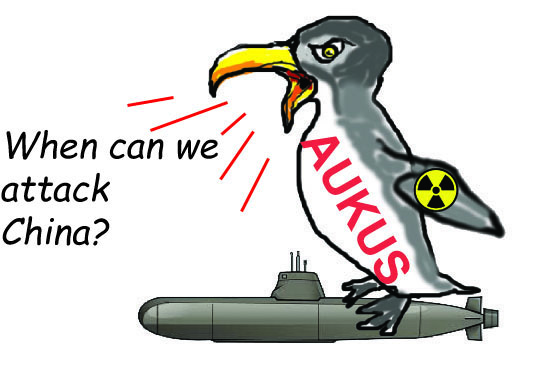
https://johnmenadue.com/our-air-force-is-already-operating-against-china/ Pearls and Irritations By Mike Gilligan, Aug 26, 2022
Australia is seemingly as eager as ever to be pushed out on a plank by our American friends, professionally. Ever the faithful “patsy”.
What’s got into Australia’s defence administration, when our military believe that warlike actions against China is what is required of them daily in the South China Sea? The government has not declared China to be a military threat to Australia. How can there be such a disconnect between the Australian government’s policies and our military’s actions?
On 22nd August, ABC News reported that Air Marshal Chipman met with US Secretary for the Air Force Frank Kendall. The RAAF Chief warned China had established a “formidable aerospace capability” in the South China Sea, but military operations could still be conducted there:
“It doesn’t make it impenetrable and it doesn’t mean you can’t deliver military effects to achieve your interests when you are operating against China,”
At the highest level, our Air Force is planning and acting to penetrate China’s air defences. And publicly enthusiastic about it. While complaining that Chinese pilots were not behaving “professionally”. All within a ruse of preserving “rules”.
There is a well- known Australian military syndrome found mainly at the footslogger level whereby the infectious American military mindset induces our military to identify unquestioningly with US goals. The Service chiefs and Secretary of Defence have long had an important role in containing it. Yet here we find a Chief infected. The disease has grown to an epidemic with repeated US joint military exercising in northern Australia over recent months.
Apart from undermining foreign policy and diplomacy it is structurally damaging to our defence. Any sober strategic view of our security always returns to Australia having to stand alone. We cannot count on the US for a variety of substantial reasons.
A lot of effort and money has gone into creating that independent capacity. Much of it is idiosyncratic. The Jindalee surveillance network is an example, which has enabled a quantum leap in effectiveness of Australia’s defences. The US initially had embarked on that same surveillance course but changed tack to a space-based system. The two forces depend on entirely different systems for operations, in fundamental ways. So limits to interoperability exist which must be preserved if we are to retain a self-reliant defence.
The danger in wholesale embrace of the American way is that we are gutted of the hard-won pillars of self reliance. Who is looking out for that?
Indeed, is anyone in charge of Defence in Canberra? Once, a strong Secretary would have called a meeting of the Defence Committee to ask the military Chiefs how their organisations behaviour is furthering government’s security objectives. With the Secretary of Foreign Affairs alongside, who might have talked of the aim to “reset” with China.
However, as our military is already at war against China with the US, let’s get a fix on how it’s going. The US response to the Pelosi visit to Taiwan makes an interesting comparison with its reaction to the last Taiwan crisis in 1996. Then the US sailed an aircraft carrier force through the Taiwan Strait in a “get out of my way” demonstration of power. With no China military response. Now, twenty five years later China has reacted to Pelosi with a demonstration of defensive power – exercising with live firings in the same waters around Taiwan. America’s Nimitz-class super aircraft carrier USS Ronald Reagan and an accompanying strike group were tucked well out the way in the Philippine Sea before heading back to port in Yokosuka Japan. The US claims it chose not to over react. Others say it knew that reacting as previously was not an option because of China’s defences. And it shows the US is already on the retreat. At least this notion would occur to Taiwan, and allies Japan and Korea.
It was President Lyndon Johnson who worried, sixty years ago, about sending “good American boys to fight for Asian boys” in its proxy war with China through Vietnam. Today a conflict with China which consumed American troops would be politically unthinkable (if anything is unthinkable today). If America can’t find a proxy to contain China then it will relent. The penny might drop for America’s Asian allies, the front-line proxy candidates. But not for Australia, seemingly as eager as ever to be pushed out on a plank by their American friends, professionally. Ever the faithful “patsy”.
US admiral issues blunt warning on building Australian submarines in overstretched shipyards
ABC By defence correspondent Andrew Greene, 1 Sept 22,
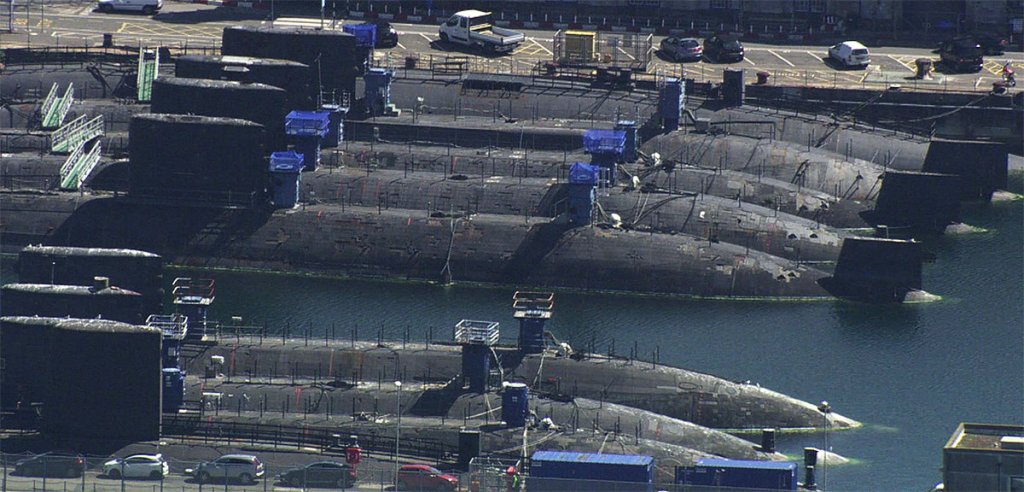
A senior US Navy official has warned helping Australia acquire nuclear-powered submarines could be too big a burden for America’s already overstretched shipyards.
Key points:
- Constructing additional submarines would be “detrimental”, US program executive officer for strategic submarines says
- Admiral Pappano’s comments are the strongest public intervention so far on the idea
- The Defence Department is conducting an 18-month study on the best option for Australia to acquire nuclear-powered subs
During an online forum, the US program executive officer for strategic submarines was questioned on America’s shipbuilding workforce and the implications of the AUKUS partnership with Australia.
Rear Admiral Scott Pappano said the ambitious plan could hamper his nation’s own nuclear submarine program, as well as the United Kingdom’s, in comments made to the Mitchell Institute for Aerospace Studies.
“If you are asking my opinion, if we were going to add additional submarine construction to our industrial base, that would be detrimental to us right now,” Admiral Pappano said.
The rear admiral added that significant investment would be needed to provide “additional capacity, capability to go do that”
“I won’t speak for the UK, but I think that exists for both the US and the UK where we’re looking right now,” he said.
The Defence Department is currently conducting an 18-month study on the best option for Australia to acquire nuclear-powered submarine capability, with a report due to hand down official recommendations in March.
Earlier this year former defence minister, now Opposition Leader, Peter Dutton claimed he was confident Australia could secure two American-built Virginia-class nuclear submarines by 2030.
Mr Dutton insisted that if the Coalition had remained in office, it could have been “in a position to make an announcement around July-August” on acquiring US-built nuclear submarines.
Private reservations
US naval figures have long held private reservations about allowing Australia to join an American production line for nuclear-powered submarines, but Admiral Pappano’s comments are the strongest public intervention so far…………………….
UK says submarines a ‘collaborative program’
British Defence Secretary Ben Wallace remarked that Australia’s future nuclear-powered submarines, under the AUKUS agreement was “not an either, or type question” between British or American designs, but could be a collaborative program between the three nations……………………………… https://www.abc.net.au/news/2022-09-01/us-admiral-issues-blunt-warning-on-building-aus-subs/101394250
1 This month
17 October, Free Public Talk on Nuclear Issues in South Australia
David Noonan will speak on public interest concerns over the new Roxby Downs Indenture Act 2026 on BHP copper-uranium mining and ore processing in SA, and on how AUKUS may face SA with a High-Level nuclear waste agenda.
Dr Jim Green will discuss international developments in the field of nuclear power including ‘small modular reactors’ and Generation 4 ‘advanced’ nuclear reactor concepts.


Help Aunty Sue Protect Her Land and Sacred Sites From Destructive Rocket Testing.
.

Australians deserve the truth
about
AUKUS – https://aukuspublicinquiry.com/

PETITION – To: Prime Minister Anthony Albanese and the Australian Labor Government

of the week – Australians for War Powers Reform (AWPR)
To see nuclear-related stories in greater depth and intensity

