Nuclear War Could Mean Annihilation, But Biden and Congress Are Messing Around
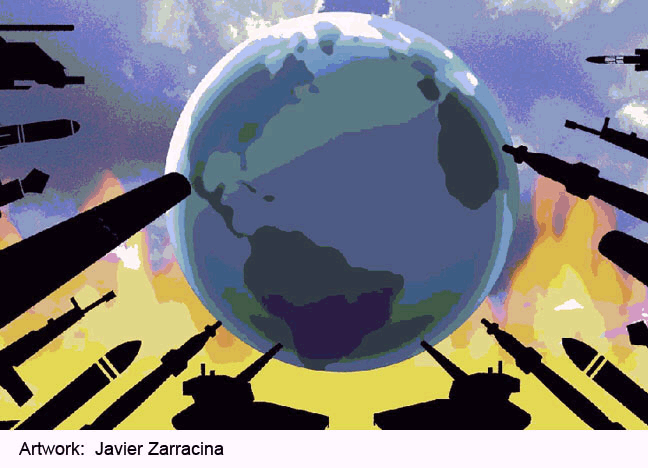
https://truthout.org/articles/nuclear-war-could-mean-annihilation-but-biden-and-congress-are-messing-around/?eType=EmailBlastContent&eId=eccf0454-e0d8-49d3-8e0c-8125c5a4fd5f The Biden administration hasn’t just remained mum about current nuclear war dangers — it’s actively exacerbating them. ANTON PETRUS
Only diplomacy can halt the carnage in Ukraine and save the lives of millions now at risk of starvation. And the dangers of nuclear war can be reduced by rejecting the fantasy of a military solution to the Ukraine conflict.
BY Norman Solomon, Truthout 3 July 22, President Joe Biden and top subordinates have refused to publicly acknowledge the danger of nuclear war — even though it is now higher than at any other time in at least 60 years. Their silence is insidious and powerful, and their policy of denial makes grassroots activism all the more vital for human survival.
In the aftermath of the 1962 Cuban missile crisis, President John F. Kennedy was more candid. Speaking at American University, he said: “A single nuclear weapon contains almost 10 times the explosive force delivered by all the allied air forces in the Second World War.” Kennedy also noted, “The deadly poisons produced by a nuclear exchange would be carried by wind and water and soil and seed to the far corners of the globe and to generations yet unborn.” Finally, he added, “All we have built, all we have worked for, would be destroyed in the first 24 hours.”
Kennedy was no dove. He affirmed willingness to use nuclear weapons. But his speech offered some essential honesty about nuclear war — and the need to seriously negotiate with the Kremlin in the interests of averting planetary incineration — an approach sorely lacking from the United States government today.
At the time of Kennedy’s presidency, nuclear war would have been indescribably catastrophic. Now — with large arsenals of hydrogen bombs and what scientists know about “nuclear winter” — experts have concluded that a nuclear war would virtually end agriculture and amount to omnicide (the destruction of human life on earth).
In an interview after publication of his book The Doomsday Machine, Pentagon Papers whistleblower Daniel Ellsberg summed up what he learned as an insider during the Kennedy administration:
What I discovered — to my horror, I have to say — is that the Joint Chiefs of Staff contemplated causing with our own first strike 600 million deaths, including 100 million in our own allies. Now, that was an underestimate even then because they weren’t including fire, which they found was too incalculable in its effects. And of course, fire is the greatest casualty-producing effect of thermonuclear weapons. So the real effect would’ve been over a billion — not 600 million — about a third of the Earth’s population then at that time.
Ellsberg added:
What turned out to be the case 20 years later in 1983 and confirmed in the last 10 years very thoroughly by climate scientists and environmental scientists is that that high ceiling of a billion or so was wrong. Firing weapons over the cities, even if you call them military targets, would cause firestorms in those cities like the one in Tokyo in March of 1945, which would loft into the stratosphere many millions of tons of soot and black smoke from the burning cities. It wouldn’t be rained out in the stratosphere. It would go around the globe very quickly and reduce sunlight by as much as 70 percent, causing temperatures like that of the Little Ice Age, killing harvests worldwide and starving to death nearly everyone on Earth. It probably wouldn’t cause extinction. We’re so adaptable. Maybe 1 percent of our current population of 7.4 billion could survive, but 98 or 99 percent would not.
Even before the Russian invasion of Ukraine four months ago, the risks of global nuclear annihilation were at a peak. In January, the Bulletin of the Atomic Scientists set its Doomsday Clock at a mere 100 seconds from apocalyptic Midnight, compared to six minutes a decade ago. As Russia’s horrific war on Ukraine has persisted and the U.S. government has bypassed diplomacy in favor of massive arms shipments, the hazards of a nuclear war between the world’s two nuclear superpowers have increased.
But the Biden administration has not only remained mum about current nuclear war dangers; it’s actively exacerbating them. Those at the helm of U.S. foreign policy now are ignoring the profound lessons that President Kennedy drew from the October 1962 confrontation with Russia over its nuclear missiles in Cuba.
“Above all, while defending our own vital interests, nuclear powers must avert those confrontations which bring an adversary to a choice of either a humiliating retreat or a nuclear war,” Kennedy said. “To adopt that kind of course in the nuclear age would be evidence only of the bankruptcy of our policy — or of a collective death-wish for the world.”
In sync with the overwhelmingly hawkish U.S. media, members of Congress and “national security” establishment, Biden has moved into new Cold War overdrive. The priority aim is to make shrewd moves on the geopolitical chessboard — not to engage in diplomacy that could end the slaughter in Ukraine and prevent the war from causing widespread starvation in many countries.
As scholar Alfred McCoy just wrote, “With the specter of mass starvation looming for some 270 million people and, as the [United Nations] recently warned, political instability growing in those volatile regions, the West will, sooner or later, have to reach some understanding with Russia.” Only diplomacy can halt the carnage in Ukraine and save the lives of millions now at risk of starvation. And the dangers of nuclear war can be reduced by rejecting the fantasy of a military solution to the Ukraine conflict.
In recent months, the Russian government has made thinly veiled threats to use nuclear weapons. Meanwhile, the U.S. has been shipping huge quantities of weapons to Ukraine, while Washington has participated in escalating the dangerous rhetoric. President Biden doubled down on conveying that he seeks regime change in Moscow, and Defense Secretary Lloyd Austin has declared that the U.S. wants the Russian military “weakened” — an approach that is opposite from Kennedy’s warning against “confrontations which bring an adversary to a choice of either a humiliating retreat or a nuclear war.”
We’d be gravely mistaken to wait for Washington’s officialdom to level with us about nuclear war dangers, much less take steps to mitigate them. The power corridors along Pennsylvania Avenue won’t initiate the needed changes. The initiatives and the necessary political pressure must come from grassroots organizing.
A new “Defuse Nuclear War” coalition of about 90 national and regional organizations (which I’m helping to coordinate) launched in mid-June with a livestream video featuring an array of activists and other eloquent speakers, drawn together by the imperative of preventing nuclear war. (They included antiwar activists, organizers, scholars and writers Daniel Ellsberg, Mandy Carter, David Swanson, Medea Benjamin, Leslie Cagan, Pastor Michael McBride, Katrina vanden Heuvel, Hanieh Jodat Barnes, Judith Ehrlich, Khury Petersen-Smith, India Walton, Emma Claire Foley, retired Army Col. Ann Wright and former California Gov. Jerry Brown.)
The U.S. government’s willingness to boost the odds of nuclear war is essentially a political problem. It pits the interests of the people of the world — in desperate need of devoting adequate resources to human needs and protection of the environment — against the rapacious greed of military contractors intertwined with the unhinged priorities of top elected officials.
The Biden administration and the bipartisan leadership in Congress have made clear that their basic approach to the surging danger of nuclear war is to pretend that it doesn’t exist — and to encourage us to do the same. Such avoidance might seem like a good coping strategy for individuals. But for a government facing off against the world’s other nuclear superpower, the denial heightens the risk of exterminating almost all human life. There’s got to be a better way.
Macron facing ‘Fukushima-style’ accident, as EDF reactor cracks force shutdown

FRENCH President Emmanuel Macron is facing a nightmare situation as cracks in EDF’s reactors threaten to create accidents as devastating as Fukushima, Express.co.uk was told.
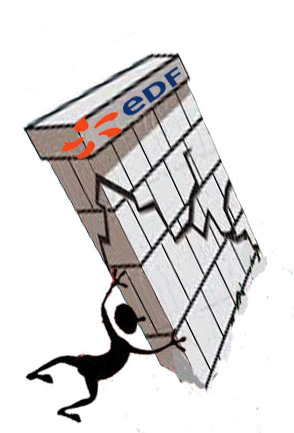
EDF is in a parlous financial state, with huge debts, and all the builds of its flagship EPR reactor have had huge cost and time over-runs – not a good look.
Antony Ashkenaz, Express, Jul 3, 2022
https://www.express.co.uk/news/science/1633756/macron-facing-nuclear-nightmare-edf-reactor-crack-risks-fukushima-style-horror-energy France is facing a relatively unique energy crisis when compared to other countries in Europe. The country is not heavily dependent on natural gas, Russian or otherwise, getting most of its energy supplies from nuclear power, which generates 70 percent of the country’s electricity. However, Paris has been forced to shut down many French reactors, as a recent report warned Mr Macron of significant corrosion safety problems in EDF [Electricité de France] nuclear power plants in France as cracks were detected in some nuclear reactors.
Speaking to Express.co.uk, Dr Bernard Laponche, the co-author of this study warned that in many of these reactors, cracks to cooling systems could cause devastating accidents.
He said: “If the defects are detected in or near the welds, or near the junction between these and the primary cooling circuit cause a breach in the cooling system with an important loss of water, this can lead to the partial or total melting of the fuel assemblies in the reactor core.
“That means the possibility of a Three Mile Island or a Fukushima-type accident.”
As a result of these corrosion problems, four 1500 MW, seven 1300 MW and one 900 MW reactors are shut down.
Meanwhile, engineers are working on fixing segments of the cooling circuits where the cracks were identified.
Dr Laponche warned that all other reactors will likely be checked for these issues within the next year.
If further evidence of cracks are found, the corresponding part of the reactor will be removed and replaced, in a procedure that Dr Laponche estimates could take a year.
He added: “This means that a large part of the EDF nuclear fleet will be gradually shut down.
“Next winter, France will reopen coal and gas plants. But the country has very few of them and it will have to import a maximum of electricity from abroad.
“Important efforts will be necessary to reduce electricity consumption, particularly at the winter peak (due in particular to a high proportion of electrical heating).”
Last week, the heads of France’s major energy companies penned a letter, issuing a dire warning about the energy crisis, urging individuals and businesses to limit power consumption immediately.
They wrote: “We need to work collectively to reduce our consumption in order to regain room to manoeuvre.
“Taking action as soon as this summer will allow us to be better prepared at the start of next winter, notably for preserving our gas reserves.”
The news of cracks in EDF reactors in France could also spell danger for the energy company’s nuclear projects in the UK, Dr Laponche warned.
He continued: “Although all the EPRs reactors are shut (Olkiluoto and Taishan) or not yet functioning (Flamanville 3 in France), there is a high probability that the same problem does exist on these reactors, including those at Hinkley Point.
“EDF should be questioned on this point.”
EDF is currently building the Hinkley Point C nuclear power station in Somerset and was previously set to come online in 2026, but has since been delayed due to Covid-19.
Speaking to Express.co.uk, Dr Paul Dorfman, an associate Fellow at SPRU University of Sussex, who was not involved in the study criticised EDF and the French nuclear fleet as whole saying: “The French nuclear corporation, EDF, runs the UK nuclear reactor fleet, is building at Hinkley Point C and wants to build at Sizewell C.
“But EDF is in a parlous financial state, with huge debts, and all the builds of its flagship EPR reactor have had huge cost and time over-runs – not a good look.
!As Lord Deben, Chair of UK Parliamentary Committee on Climate Change has just said: ‘The nuclear industry doesn’t deliver on time and doesn’t deliver to budget…. So there’s a real concern about how qualified (EDF) are to do these things.’
Express.co.uk has reached out to EDF for comments on the findings of the report.
July 3 Energy News — geoharvey

Opinion: ¶ “The Profound Climate Implications Of Supreme Court’s West Virginia v EPA Decision” • When the Supreme Court decided West Virginia v EPA, it caught fewer headlines than some of the term’s other cases. But it threatened Earth-shifting implications all its own by thrusting into question a critical EPA lever for addressing climate change. […]
July 3 Energy News — geoharvey
New Chairman of All Fishermen’s Federation “firmly opposed” to discharge of treated water The person who agreed to an interview at METI was… a retired counselor, not a minister — Fukushima 311 Watchdogs

Masanobu Sakamoto, chairman of All Fisheries Federation of Japan (AFFJ), hands the resolution to Akira Matsunaga (right), a counselor at the Ministry of Economy, Trade and Industry (METI). June 27, 2022Masanobu Sakamoto, chairman of the National Federation of Fishermen’s Associations (ZENYOREN), visited the Ministry of Economy, Trade and Industry (METI) on June 27 for the […]
New Chairman of All Fishermen’s Federation “firmly opposed” to discharge of treated water The person who agreed to an interview at METI was… a retired counselor, not a minister — Fukushima 311 Watchdogs
The Fossil Fuel Industry’s Expansion Plans Will Be the Death of Us! — Mother Jones — Barbara Crane Navarro

This investigation was originally published by the Guardian. It is reproduced here as part of the Climate Desk collaboration. The world’s biggest fossil fuel firms are quietly planning scores of “carbon bomb” oil and gas projects that would drive the climate past internationally agreed temperature limits with catastrophic global impacts, a… 4,744 more words The Fossil Fuel […]
The Fossil Fuel Industry’s Expansion Plans Will Be the Death of Us! — Mother Jones — Barbara Crane Navarro
July 2 Energy News — geoharvey

Opinion: ¶ “Diablo Canyon Power Plant Won’t Stop Power Outages” • To justify keeping the Diablo Canyon Power Plant open, nuclear power peddlers blame the state’s shift to renewable energy for power outages. It’s a false narrative. Nuclear power failed to prevent the blackout of 2020, and since then 4 GW of renewable energy have […]
July 2 Energy News — geoharvey
Mr Albanese goes to Madrid: Australia on the alliance path to Global Nato
Albanese’s trip to the leaders’ summit of a US-dominated alliance centred on the other side of the world will prepare the way for deeper Australian integration into a broadened Nato.
Above all, in one respect Mr Albanese’s rush to Madrid is not so different from his predecessor’s cajoling of Washington and London to help out a mate with the anachronistic PR nonsense of AUKUS and the gift horse of a ‘privileged’ offer to allow Australia to buy massively expensive American or conceivably British nuclear-powered submarines.
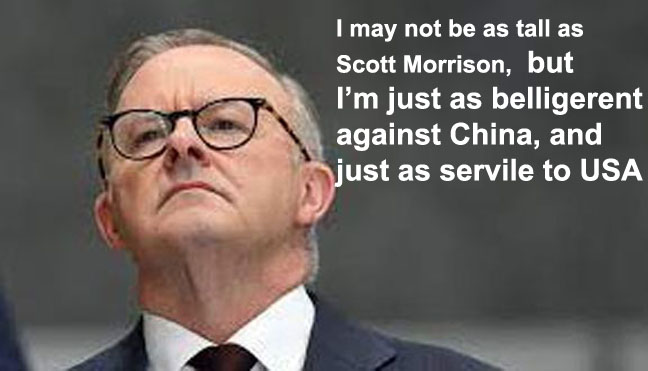
https://johnmenadue.com/mr-albanese-goes-to-madrid-australia-on-the-alliance-path-to-global-nato/ By Richard TanterJun 30, 2022, While most eyes rest on the remains of Scott Morrison’s failed attempt at a khaki election through last September’s announcement of a backward-looking AUKUS alliance, prime minister Anthony Albanese’s trip to Madrid for the North Atlantic Treaty Organisation summit points to a much more significant shift in Australia’s alliance with the United States – ‘a global alliance of democracies’, aka Global NATO.
Scott Morrison’s AUKUS centring on agreement with the US and UK to provide Australia with submarine nuclear propulsion evoked derision about its back to the 1950s strategic vision and despair about what promises to be the worst and most consequential of Australia’s numerous recent politically-driven defence procurement choices.
The submarines debacle apart, AUKUS for the most part remains a matter of two or three lines of unpromising promises in media releases, largely dealing with matters already the subject of bilateral agreements or dimly-seen possible futures like quantum computing for defence purposes.
The most recent, if somewhat limp, nudge to keep the Albanese government on the nuclear submarine track came at the National Press Club when the Lowy Institute’s Michael Fullilove mocked an informed questioner concerned about the deal’s implications for the tattered nuclear Non-Proliferation Treaty. This widely-held worry – if first Australia, then serious nuclear weapon-wannabes Brazil and South Korea – was in fact unimportant Fullilove replied, since experts such as former Foreign Minister Gareth Evans have assured us are under control.
At the same time the US has just added its confidence booster to this process with a bill before Congress for an Australia-U.S. Submarine Officer Pipeline Act that would allow two RAN submariners a year to attend a seven-week nuclear reactor training, take the US Navy’s Submarine Officer Basic Course, and then deploy aboard a US nuclear-powered submarine.
This only leaves the imponderables of deciding the strategic rationale of the mission to which the submarines are to be solution, the actual technical requirements that would be entailed by that mission, the design of the submarine, the choice of country and lead contractors for the build, the development of a full-scale naval nuclear-engineering safety and maintenance regime, and a brief discussion of the lifetime costs likely to be more than a couple of multiples of the $100 billion estimate for the French submarines.
What could possibly go wrong?
And that’s before any discussion of opportunity costs – even for alternative contenders for defence spending, let alone meeting non-military requirements for a secure Australia – of the lifetime costs of a commitment to nuclear submarines that are likely to move towards the half trillion dollar mark.
But Albanese’s trip to the leaders’ summit of a US-dominated alliance centred on the other side of the world will prepare the way for deeper Australian integration into a broadened Nato.
For over a decade US and Nato officials and Australian defence advisors have been calling for ‘a global alliance of democracies’. The Australian prime minister, together with the leaders of Nato’s other ‘Asia-Pacific partners’ from Japan, New Zealand and South Korea, will participate in the launch of the first formal iteration of Global Nato with Nato’s Strategic Concept 2022.
Two decades of high tempo deployment of Australian military under Nato auspices in the disastrous wars in Afghanistan and the Middle East have conditioned the Australian Defence Force to close operational coordination and interoperability with US-led Nato ground, air, and naval forces.
Defence planners have gradually integrated Nato into high-level Australian strategic planning, first as an ‘Asian partner’ Nato along with Japan, South Korea and New Zealand, and recently as an ‘Enhanced Strategic Partner’.
Nato’s centrality to the hyper-multinational International Security Assistance Force in Afghanistan provided the first and possibly most important Australian escalator into Nato.
While replete with consequences as lethal for the people of Afghanistan as they were dysfunctional for all of the alliance militaries involved, ISAF, together with the parallel US-orchestrated Combined Maritime Forces in the western Indian Ocean from 2002, provided deep operational experience and ‘learnings’ for a Nato-centred US-led coalition on a scale approaching a multilateral ‘global’ presence.
Nato’s Strategic Concept 2022 is to be formalised at the Madrid Summit, representing a maturation of US post-Cold War planning for a major step towards an integrated global defence alliance after seventy years of US-dominated Nato in Europe and the limitations of bilateral hub-and-spokes alliances in Asia.
Most importantly, apart from integrating its Asian partners more closely, the new Strategic Concept is to prepare Nato ‘against all threats, from all directions’.
Full membership of Nato for any of these Asian partners will be a long way off, not least because the governing institutions of a now 30 member country nuclear alliance will need adjustment, even assuming there is no uncomfortable internal opposition as Turkey has mounted against the admission of Sweden.
For the present, Australia, Japan and Korea – and possibly New Zealand – will be drawn into Nato’s seemingly endless rounds of political, diplomatic, military and civil society consultations (though the last is in practice a most attenuated and selective grouping of actual national and international civil society).
US-led military interoperability drives will be coupled with injunctions for closer political and strategic planning coordination between Canberra and Brussels (aka Washington).
But there can be little doubt of the ultimate goal for Washington in the construction of ‘an alliance of democracies’ with global reach.
The follies of AUKUS distract attention from the scale of the quiet achievement of the United States in rescuing Nato from post-Cold War obsolescence, latterly assisted greatly by the Russian war against Ukraine.
Drawing the line from Kyiv to Taipei, ‘we know’, the Prime Minister said, ‘that there is an alliance that has been reached as well between Russia and China. There are implications for our region, given the strategic competition that is in our region, which is why this Nato summit comes at such a critical time’.
As Mr Albanese rightly put it Russia’s ‘brutal invasion is against the rule of law’, and carries implications for ‘all of those who cherish democracy, who cherish the rule of law, and who cherish the rights of nations to be sovereign’.
Yet Australia needs to tread carefully.
The warm glow of rhetorical solidarity with Ukraine facing World War 2-scale Russian attack tends to veil the fact that multiple US-auspiced Nato interventions in the Middle East, North Africa and Afghanistan have led, via great destruction, to evident defeat or specious ‘mission accomplished’.
Moreover the list of Nato members and partners does not provide an unsullied list of countries honoured for their respect for democracy, rule of law, or sovereignty.
Mr Albanese might like to chat about the rule of law with Victor Orbán from Hungary or Recep Tayyip Erdoğan from Turkey, or indeed with Boris Johnson – or mull over the battered state of American democracy with Joe Biden.
Perhaps a stopover by his RAAF plane in Diego Garcia might prompt some thoughts about British respect for the rule of law – in certain respects, such as the forced dispossession of the indigenous Chagos Islanders to make way for a giant US military base often used by Australia, more egregious than China’s violations of international law somewhat further east.
Above all, in one respect Mr Albanese’s rush to Madrid is not so different from his predecessor’s cajoling of Washington and London to help out a mate with the anachronistic PR nonsense of AUKUS and the gift horse of a ‘privileged’ offer to allow Australia to buy massively expensive American or conceivably British nuclear-powered submarines.
By all means, let us make common cause with governments we find congenial – when our interests do in fact genuinely align. Defence coordination and cooperation with democratic states in our principal areas of strategic interest is a must for Australia. The problem is that Europe is not such an area, and neither was the Middle East, Afghanistan, nor Nato’s latest fronts in North Africa and the Sahel.
Thinking about an alliance of democracies is not inherently foolish. The problem comes when the form of periodic elections is confused with the substance of democracy. It may seem carping to point to the Orbans and Erdoğans of Nato, but with Marine Le Pen possibly just one more election away from the Elysée, the authoritarian threat in Europe is palpably real.
Remarking on a British prime minister’s announced willingness to trash international agreements for political gain at the risk of re-starting a war in Northern Ireland may seem unoriginal, it is scarcely beside the point with talk of new alliances built on rule of law.
Most seriously of all, we should be talking about the risk of a precipitous decline, or even collapse, of democracy in the United States extremely seriously. Appalling as it is, the Supreme Court decision abolishing US women’s rights to control their bodies is but the latest blow to the unexamined claim for the United States to still be called a global model of democracy.
The view in Canberra seems to be that the US alliance has survived the threat of Trump, so it’s back to business as usual, and onward to ever closer union – with the path leading now through Brussels. Yet the dangers to Australia from unconsidered reliance on a country with both systemic dysfunction and deep anti-democratic impulses at its heart should not be ignored.
The common element between the swooning Australian interest in Global Nato and the Morrison fiasco with AUKUS and the manifold problems of its submarine element is that in both cases a considered assessment of whether Australian national interests align with those of the United States – in this case in the guise of Nato – is absent.
The new Australian foreign minister has started a commendable reset of Australian regional relations in an effort to recover, at least as a start, from the wreckage of a decade of coalition policy.
In a series of important statements on foreign policy in recent years Penny Wong eloquently has made the case for understanding that a proper consideration of our national interest cannot be separated from the long and sometimes difficult process of working out who we are.
Interests very largely flow from identity, especially when it comes to reading a map of threats and opportunities. Why then would the first foreign policy ventures of a new prime minister be tied to an alliance with the other side of the world – for Australia, the old world?
World Health Organisation is subservient to International Atomic Energy Agency
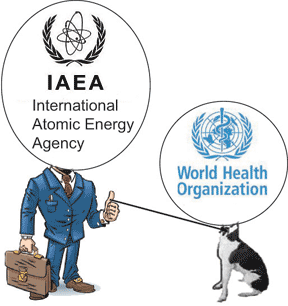
The subordination of the WHO to IAEA is a key part of the systematic falsification of nuclear risk which has been under way ever since Hiroshima, the agreement creates an unacceptable conflict of interest in which the UN organisation concerned with promoting our health has been made subservient to those whose main interest is the expansion of nuclear power.
Dissolving the WHO-IAEA agreement is a necessary first step to restoring the WHO’s independence to research the true health impacts of ionising radiation and publish its findings.
it is time the WHO regained the freedom to impart independent, objective advice on the health risks of radiation
Toxic link: the WHO and the IAEA, https://www.theguardian.com/commentisfree/2009/may/28/who-nuclear-power-chernobyl Oliver Tickell, A 50-year-old agreement with the IAEA has effectively gagged the WHO from telling the truth about the health risks of radiation. F
Fifty years ago, on 28 May 1959, the World Health Organisation‘s assembly voted into force an obscure but important agreement with theInternational Atomic Energy Agency – the United Nations “Atoms for Peace” organisation, founded just two years before in 1957. The effect of this agreement has been to give the IAEA an effective veto on any actions by the WHO that relate in any way to nuclear power – and so prevent the WHO from playing its proper role in investigating and warning of the dangers of nuclear radiation on human health.
The WHO’s objective is to promote “the attainment by all peoples of the highest possible level of health”, while the IAEA’s mission is to “accelerate and enlarge the contribution of atomic energy to peace, health and prosperity throughout the world”. Although best known for its work to restrict nuclear proliferation, the IAEA’s main role has been to promote the interests of the nuclear power industry worldwide, and it has used the agreement to suppress the growing body of scientific information on the real health risks of nuclear radiation.
Under the agreement, whenever either organisation wants to do anything in which the other may have an interest, it “shall consult the other with a view to adjusting the matter by mutual agreement”. The two agencies must “keep each other fully informed concerning all projected activities and all programs of work which may be of interest to both parties”. And in the realm of statistics – a key area in the epidemiology of nuclear risk – the two undertake “to consult with each other on the most efficient use of information, resources, and technical personnel in the field of statistics and in regard to all statistical projects dealing with matters of common interest”.
The language appears to be evenhanded, but the effect has been one-sided. For example, investigations into the health impacts of the Chernobyl nuclear accident in Ukraine on 26 April 1986 have been effectively taken over by IAEA and dissenting information has been suppressed. The health effects of the accident were the subject of two major conferences, in Geneva in 1995, and in Kiev in 2001. But the full proceedings of those conferences remain unpublished – despiteclaims to the contrary by a senior WHO spokesman reported in Le Monde Diplomatique.
Meanwhile, the 2005 report of the IAEA-dominated Chernobyl Forum, which estimates a total death toll from the accident of only several thousand, is widely regarded as a whitewash as it ignores a host of peer-reviewed epidemiological studies indicating far higher mortality and widespread genomic damage. Many of these studies were presented at the Geneva and Kiev conferences but they, and the ensuing learned discussions, have yet to see the light of day thanks to the non-publication of the proceedings.
The British radiation biologist Keith Baverstock is another casualty of the agreement, and of the mindset it has created in the WHO. He served as a radiation scientist and regional adviser at the WHO’s European Office from 1991 to 2003, when he was sacked after expressing concern to his senior managers that new epidemiological evidence from nuclear test veterans and from soldiers exposed to depleted uranium indicated that current risk models for nuclear radiation were understating the real hazards.
Now a professor at the University of Kuopio, Finland, Baverstock finally published his paper in the peer-reviewed journal Medicine, Conflict and Survival in April 2005. He concluded by calling for “reform from within the profession” and stressing “the political imperative for freely independent scientific institutions” – a clear reference to the non-independence of his former employer, the WHO, which had so long ignored his concerns.
Since the 21st anniversary of the Chernobyl disaster in April 2007, a daily “Hippocratic vigil” has taken place at the WHO’s offices in Geneva, organised byIndependent WHO to persuade the WHO to abandon its the WHO-IAEA Agreement. The protest has continued through the WHO’s 62nd World Health Assembly, which ended yesterday, and will endure through the executive board meeting that begins today. The group has struggled to win support from WHO’s member states. But the scientific case against the agreement is building up, most recently when the European Committee on Radiation Risk (ECRR) called for its abandonment at its conference earlier this month in Lesvos, Greece.
At the conference, research was presented indicating that as many as a million children across Europe and Asia may have died in the womb as a result of radiation from Chernobyl, as well as hundreds of thousands of others exposed to radiation fallout, backing up earlier findings published by the ECRR in Chernobyl 20 Years On: Health Effects of the Chernobyl Accident. Delegates heard that the standard risk models for radiation risk published by the International Committee on Radiological Protection (ICRP), and accepted by WHO, underestimate the health impacts of low levels of internal radiation by between 100 and 1,000 times – consistent with the ECRR’s own 2003 model of radiological risk (The Health Effects of Ionising Radiation Exposure at Low Doses and Low Dose Rates for Radiation Protection Purposes: Regulators’ Edition). According to Chris Busby, the ECRR’s scientific secretary and visiting professor at the University of Ulster’s school of biomedical sciences:
“The subordination of the WHO to IAEA is a key part of the systematic falsification of nuclear risk which has been under way ever since Hiroshima, the agreement creates an unacceptable conflict of interest in which the UN organisation concerned with promoting our health has been made subservient to those whose main interest is the expansion of nuclear power. Dissolving the WHO-IAEA agreement is a necessary first step to restoring the WHO’s independence to research the true health impacts of ionising radiation and publish its findings.”
Some birthdays deserve celebration – but not this one. After five decades, it is time the WHO regained the freedom to impart independent, objective advice on the health risks of radiation.
AUKUS nuclear submarine plan to be revealed by March 2023
ABC By defence correspondent Andrew Greene 29 June 22,
Key points:
- The Morrison government previously indicated a decision could be made this year
- The Labor government is also hoping to know soon if an interim submarine solution is needed
- Numerous defence figures have warned Australia is facing a capability gap because of ageing submarines…………………… https://www.abc.net.au/news/2022-06-29/richard-marles-defence-projects-submarines-aukus/101190876
Spinbusting the propaganda of SMR Nuclear Technology’s Tony Irwin as he spruiks for Small Nuclear Reactors for Australia

First to nuclear power, which, we should remember, has been effectively banned in Australia since the late 1990s.
On page three of the Sunday Telegraph in Sydney, columnist Piers Akerman wrote an “exclusive” news
story showing “nuclear energy is cheaper” than coal, gas, solar or wind. Such a claim would overturn pretty much all serious analysis of electricity costs around the globe. So where did it come from? The
International Energy Agency maybe, or perhaps the CSIRO?
No. Akerman quoted “new data” from Tony Irwin, who is a nuclear industry veteran and a technical director at a consultancy company with “specialist industry knowledge on the procurement and development of nuclear technologies” with a focus on small modular reactors (SMR).
But one problem with using Irwin’s numbers is they are based on an estimate of the cost of one
particular SMR design which has not yet been built and won’t produce power until at least 2029.
Guardian 30th June 2022
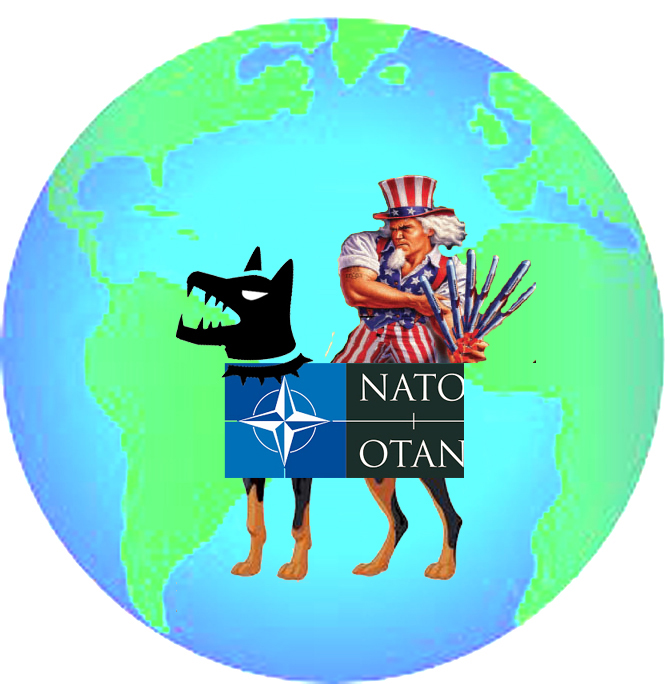
NATO has completed its post-Cold War transformation from Europe’s guard dog into America’s attack dog

The guard dog had, it seems, been re-trained as an attack dog.
https://www.rt.com/russia/558168-nato-defensive-alliance-global-cop/ Scott Ritter 1 July 22, From an ostensible defensive alliance, NATO has grown into an aggressor designed to promote ‘rules’ dictated by the US,
The North Atlantic Treaty Organization, or NATO, has just wrapped up its annual summit in Madrid, Spain. The one-time trans-Atlantic defensive alliance has, over the past three decades, transformed itself from the guardian of Western Europe into global cop, seeking to project militarily a so-called values- and rules-based posture.
NATO’s first Secretary General, Lord Ismay, famously noted that the mission of the bloc was “to keep the Russians out, the Germans down, and the Americans in.” In short, NATO served as a wall against the physical expansion of the Soviet Union from the perch it had established in eastern Europe at the end of the Second World War. Likewise, the creation of NATO prevented a treaty from being concluded between Germany and the Soviet Union that would enable the reunification of Germany. And lastly, the existence of NATO mandated that the US retain a significant full-time military presence in Europe, helping break America’s traditional tendency toward isolationism.
At the Madrid Summit, NATO radically redefined its mission to reflect a new mantra which could be encapsulated as “keep the Russians down, the Americans in, and the Chinese out.” It is an aggressive–even hostile–posture, premised on sustaining Western (i.e., American) supremacy.
This mission is to be accomplished through the defense and promulgation of a so-called “rules-based international order” which exists only in the minds of its creators, which in this case is the United States and its allies in Europe. It also represents a radical break from past practice which sought to keep NATO defined by the four corners of its trans-Atlantic birthright by seeking to expand its security umbrella into the Pacific.
The guard dog had, it seems, been re-trained as an attack dog.
Continue readingPreparing for future crises
John Hewson
While the climate debate intensifies over the inevitability of further, even more extreme weather events, and the necessary transitions to a low-carbon Australia, it seems that governments are ignoring or playing down the possibility of further pandemics and the need to be better prepared next time.
Military social media campaigns promote the war in Ukraine, and attack any ”wrongthink” that dares criticise role of USA and NATO
Ukraine Is The Most Aggressively Trolled War Of All Time: Notes From The Edge Of The Narrative Matrix, Caitlin Johnstone, Caitlin’s Newsletter, 1 July 22,
There’s a lot going on in America and the people are very stressed out and frightened, but don’t worry, there’s nothing the US government won’t do to make sure more High Mobility Artillery Rocket systems get to Ukraine.
Rest assured Americans: no matter how dark things may seem right now, no matter how insecure and uncertain you may feel, you can sleep soundly knowing your government is moving mountains around the clock to make sure the Ukraine war becomes a strategic quagmire for Moscow.
The Ukraine war is the single most aggressively trolled issue I’ve ever witnessed. As soon as it started, Twitter was full of brand new accounts swarming anyone who uttered wrongthink about Ukraine, and now there are entire extremely coordinated troll factions working to scare people away from criticizing empire narratives about this war. It’s plainly very inorganic, so it’s good to recall what we know about the trolling operations of western militaries.
[Ed. note – several examples given here]
So the western empire is responding to a war that was caused by NATO expansion by greatly expanding NATO, at the same time we learn that the Biden administration doesn’t even believe Ukraine has any chance of winning that war. This is going great, guys. Good job everyone.
Sure the worst case scenario of all this brinkmanship with Russia is nuclear war, but on the other hand the best case scenario is securing planetary domination for an empire that has spent the 21st century killing people by the millions in wars of aggression for power and profit. Totally worth the risk!
When you realize the US really only has one political party, you cease seeing one good party protecting people from a bad party and start seeing one giant party threatening to take away people’s civil rights if they don’t obey and submit. You suddenly understand that saying one party is a “lesser evil” is like saying a boxer should want to get hit by his opponent’s left hand because his right cross hurts more. It’s two arms on the same boxer, and they’re both working together to knock you out…………….. https://caitlinjohnstone.substack.com/p/ukraine-is-the-most-aggressively?utm_source=substack&utm_medium=email
The impossibility of humans colonising space
Ukraine Is The Most Aggressively Trolled War Of All Time: Notes From The Edge Of The Narrative Matrix, Caitlin’s Newsletter, Caitlin Johnstone 30n June 22
”……………………………………………………………………………..One thing we learned from Covid is that being stuck inside sucks. Space colonization would be like being in permanent lockdown with no windows, no Uber Eats, no birdsong or rain on the roof and no chance of ever going home. Even if it somehow became possible, it’s a dumb idea and I hate it.
And there’s no reason to believe it will ever become possible. Science is nowhere near finished learning about all the countless ways the human organism is inseparably intertwined with Earth. The belief that we can solve our problems with space colonization is unscientific. We’re just going to have to change how we function as a species.

The biggest obstacle remains the fact that science has no idea how to sustain human life in a way that is separate from earth’s ecosystem. We don’t even have any evidence that it’s possible. We’re no closer to being able to do it than we were a thousand years ago; today’s space stations are not independent of Earth’s ecosystem in even the tiniest way. They’re still 100 percent dependent on terrestrial supplies, which is an unsustainable model if you’re talking about actual colonization.
The idea of space colonization appeals to the capitalist mentality because it means we can keep expanding our population and keep expanding the economy and keep harvesting and consuming resources in the way we have been. But there’s literally zero scientific evidence that it’s feasible.
A future of space colonization is a fairy tale we tell ourselves so that we won’t have to change. So we can keep up our egocentric way of functioning without adapting and transcending our self-destructive patterns. We’re like a slacker who refuses to get off their parents’ couch and get their shit together who babbles made-up nonsense about NFT get-rich-quick schemes when asked about their plans for the future.
Collective extinction is easier to imagine than collective ego death. https://caitlinjohnstone.substack.com/p/ukraine-is-the-most-aggressively?utm_source=substack&utm_medium=email
The IAEA Needs Access to Ukraine’s Nuclear Power Plant. Biden Can Help
https://thedispatch.com/p/the-iaea-needs-access-to-ukraines
Since Russia seized the plant in March, the safety and security of the plant have been in jeopardy. Anthony Ruggiero and Andrea Stricker, 30 June 22,
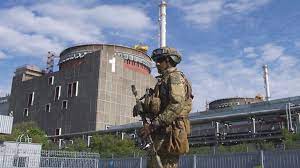
“Untenable.” That’s how Rafael Grossi, director general of the International Atomic Energy Agency (IAEA), last week described the situation at Ukraine’s Zaporizhzhia nuclear power plant (ZNPP), which Russia seized in March. He said that every day “the independent work and assessments of Ukraine’s regulator are undermined,” the “risk of an accident or a security breach increases.” Grossi asserted he wants to send an IAEA mission to the ZNPP, which is Europe’s largest nuclear power plant. In a twist, however, Ukraine’s atomic energy regulators, presumably at the direction of Kyiv, have rejected Grossi’s request.
Ukraine believes an IAEA visit to the ZNPP would legitimize Russia’s control of the complex. Grossi has rejected that characterization, emphasizing that “it is absolutely incorrect. When I go there, I will be going there under the same agreement that Ukraine passed with the IAEA, not the Russian Federation.” President Joe Biden urgently needs to convince Ukrainian President Volodymyr Zelensky to let the IAEA in to ensure the ZNPP is safe and secure.
The ZNPP, located in east Ukraine, is a facility with six light water reactors, and it produced up to one-fifth of Ukraine’s electricity production before the war. To gain control of it, Russia shelled the area with missiles, sparking a widely reported fire. The missile attack spurred fears that Moscow could further damage the facility and cause a nuclear radiological incident that could harm Ukrainian civilians and neighboring countries.
Ukrainian authorities brought the fire under control, but Russia installed officials from its atomic energy agency, Rosatom, to oversee day-to-day work of Ukrainian personnel. The State Nuclear Regulatory Inspectorate of Ukraine warned in a statement that life at Zaporizhzhia has become intolerable under Moscow’s direction: Russia’s military and representatives of Russia’s Rosatom and its subsidiary Rosenergoatom “constantly terrorize and directly threaten the lives of the plant personnel.”
The Wall Street Journal reported this month that Russian military officers have been interrogating ZNPP employees to assess their loyalties to Moscow and reprimanding “workers who speak in Ukrainian rather than Russian and screening their cellphones for evidence of allegiance to Kyiv.” The Russians have also abducted, tortured, or shot workers. Russian officials at the plant have told workers that they intend to connect the ZNPP to Russia’s electricity grid, which would be costly and take years to accomplish, reinforcing Kyiv’s concerns that Moscow is preparing for long-term control of the facility.
Russia has not publicly opposed an IAEA visit. Grossi claimed in a June 6 statement to the IAEA Board of Governors that Ukraine had requested an IAEA mission to the plant and that the agency was ready to go. The day after Grossi’s statement, however, Ukraine’s atomic agency, Energoatom, wrote in a Telegram post that it had not invited the IAEA to visit. “We consider this message from the head of the IAEA as another attempt to get to the (power plant) by any means in order to legitimise the presence of occupiers there and essentially condone their actions,” the post stated.
In March, Grossi said that seven pillars of nuclear plant safety and security were at risk at the ZNPP. Those pillars include: maintenance of physical integrity; functional safety and security systems and equipment; freedom of operating staff to fulfill their safety and security duties and without undue pressure; a secure off-site power supply from the grid for all nuclear sites; uninterrupted logistical supply chains and transportation to and from the site; effective on-site and off-site radiation monitoring systems backed by emergency preparedness and response measures; and reliable communication with regulators and others. In his June 6 statement to the IAEA board, Grossi declared that five of seven pillars had been compromised. “This is why IAEA safety and security experts must go,” he said.
Moreover, the ZNPP stopped transmitting safeguards information to the IAEA on May 30, meaning the agency could not ascertain whether there had been theft or loss of nuclear material. “The Ukrainian regulator has informed us they have lost control of the nuclear material,” Grossi told the board.
President Biden is in a difficult spot: He is focused on fortifying Zelenskyy’s fighting forces against Russia, but Putin’s control of the ZNPP could lead to a safeguards or safety crisis in Ukraine. Biden should urge Ukraine to approve an IAEA visit. He should also insist that Russia stop its intimidation and violence against ZNPP workers and return the plant to Ukraine.
1 This month.
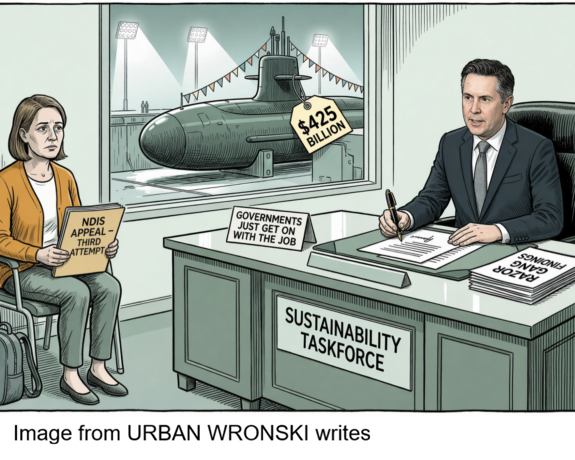

PETITION – To: Prime Minister Anthony Albanese and the Australian Labor Government
Chernobyl: The Lost Tapes – A good documentary on Chernobyl on SBS available On Demand for the next 3 weeks– https://www.sbs.com.au/ondemand/tv-program/chernobyl-the-lost-tapes/235274195556
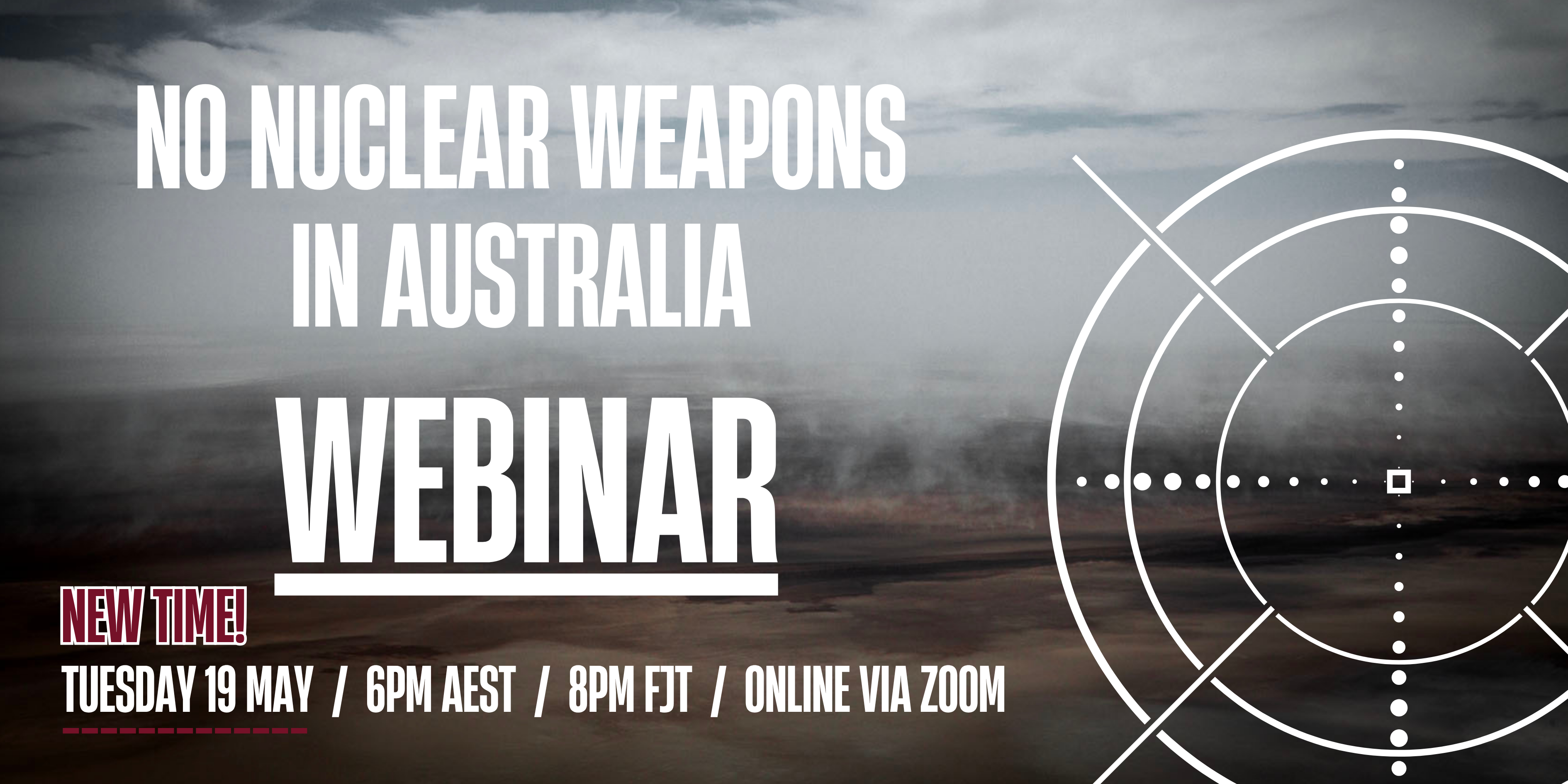
19 May – Webinar- Webinar: No Nuclear Weapons in Australia
Start: 2026-05-19 18:00:00 UTC Canberra, Melbourne, Sydney (GMT+10:00)
End: 2026-05-19 19:30:00 UTC Canberra, Melbourne, Sydney (GMT+10:00)
20 May – Webinar – The dangerous world of AUKUS, US, military occupation and suppression of dissent

National Webinar, 20th May, 2026, 6.30pm AEST. Confronting laws restricting/suppressing protest speech and action
Speakers: Former Sen. Rex Patrick, Lawyer Nick Hanna ,Arthur Rorris ,Jorgen Doyle, Sen David Shoebbridge,
Facilitator Kelley Tranter.

of the week – Australians for War Powers Reform (AWPR)
To see nuclear-related stories in greater depth and intensity
 Antinuclear