“Carbon tax on wheels?” The dirty tactics that stopped Australia going electric — RenewEconomy

Australia is paying a high price – in terms of fuel bills, health impact and energy security – because of the scare campaigns against fuel efficiency standards. The post “Carbon tax on wheels?” The dirty tactics that stopped Australia going electric appeared first on RenewEconomy.
“Carbon tax on wheels?” The dirty tactics that stopped Australia going electric — RenewEconomy
World’s first subsidy-free offshore wind farm starts to produce power — RenewEconomy

The world’s first subsidy-free offshore wind farm, located off the coast of the Netherlands, has begun generating electricity. The post World’s first subsidy-free offshore wind farm starts to produce power appeared first on RenewEconomy.
World’s first subsidy-free offshore wind farm starts to produce power — RenewEconomy
Wind energy delivers one third of electricity of Australia’s main grid for first time — RenewEconomy

Wind energy reaches one third of total output in Australia’s main grid for first time, up from a maximum 12 per cent just four years ago. The post Wind energy delivers one third of electricity of Australia’s main grid for first time appeared first on RenewEconomy.
Wind energy delivers one third of electricity of Australia’s main grid for first time — RenewEconomy
August 7 Energy News — geoharvey

Opinion: ¶ “30 Million EV Battery Packs In 2027?” • There are expected to be about 10 million EV battery packs shipped in 2022 globally, according to research firm Juniper Research. The company forecasts that number will rise to 30 million in 2027. A simple calculation shows that Juniper Research belives 25.8% of the global […]
August 7 Energy News — geoharvey
Indo-Pacific can be major hub for global renewable energy supply chain — RenewEconomy

The needle is moving in the Indo-Pacific region towards collaboration, multi-lateral support and action that can provide multiple pathways to decarbonisation. The post Indo-Pacific can be major hub for global renewable energy supply chain appeared first on RenewEconomy.
Indo-Pacific can be major hub for global renewable energy supply chain — RenewEconomy
“Unprecedented:” US Senate finally passes landmark $A540 billion climate bill — RenewEconomy

The US Senate has passed a landmark climate bill – the biggest in its history, although a fraction of what Joe Biden wanted to do. The post “Unprecedented:” US Senate finally passes landmark $A540 billion climate bill appeared first on RenewEconomy.
“Unprecedented:” US Senate finally passes landmark $A540 billion climate bill — RenewEconomy
Nuclear weapons will not bring peace or security, only dangers.

We can honour the victims of Hiroshima and Nagasaki by supporting the prohibition treaty, says RAE STREET https://morningstaronline.co.uk/article/f/nuclear-weapons-will-not-bring-peace-or1 6 Aug, 22,
THIS is the month when we commemorate the fearful nuclear bombings of the people of Hiroshima and Nagasaki.
Alas, the myth is still put out that the bombs were dropped to end the second world war. That is not true.
By the time the bomb was ready for use, Japan was ready to surrender. As General Dwight D Eisenhower said, Japan was at that very moment seeking some way to surrender with minimum loss of face, and “it wasn’t necessary to hit them with that awful thing.”
Thus, the bomb on Hiroshima was dropped on August 6 before it was publicly stated that the Japanese had surrendered.
The Soviet Union entered the war in Asia on August 9. Later the same day, the US dropped a second bomb on Nagasaki.
We now know the horrors that nuclear bombs inflict. We have heard from the Hibaksha, the survivors. Now instead of heeding the survivors of those bombs, the Hibaksha, that nuclear weapons should be ended, governments across the world have developed more destructive nuclear bombs.
Britain, part of the US Trident submarine system, carries warheads on multiple missiles, with 15 times the power of the bomb used on Hiroshima.
Proponents of nuclear weapons, including the Nato military alliance, claim that they keep the peace and repeatedly talk of nuclear deterrents.
But the US has the largest nuclear arsenal in the world, and it did not stop the attack on the Twin Towers; nor did Trident stop terrorist attacks in Britain.
What is never mentioned is the death and destruction which has been brought about with the development of nuclear weapons, mainly on indigenous peoples.
This starts with the beginning of the cycle with uranium mining where native people in the US, in Canada, in Australia and the Congo, among others, have been forced into mining.
They and their families have suffered serious illness and even death. Above-ground testing has also brought suffering to native peoples.
After the French testing in the Pacific, mothers gave birth to “jellyfish” babies which died within a few hours. In the US above-ground testing meant that many of the “downwinders,” including the Western Shoshone, became seriously ill.
Although above-ground tests have now ended following the Comprehensive Test Ban Treaty, uranium mining has not ceased.
It continues except for Greenland where the Inuit, now in government, have banned uranium mining.
In 2022, with the war in Ukraine, we are now in more danger than ever before of a further use of nuclear weapons. If ever one of these highly destructive current bombs were exploded either by intent or accident, it would be a worldwide catastrophe.
There would be fires and radioactive fallout and fatal illnesses from acute radiation sickness, cancer and genetic damage which can be passed on to offspring.
At the same time, nuclear fireballs would send up enormous quantities of dust high into the atmosphere, blotting out the sun which would lead to nuclear winter.
And the contaminated ground would be unsuitable for food production leading to food shortages. In effect, if people had not died any other way, they would die of hunger.
Yet our current government not only supports the replacement of Trident but in the Integrated Defence Review increased the cap on Britain’s stockpile for 2025 from 180 to 260.
They even changed the scenario for nuclear use to “emerging technologies that could have a comparable impact,” possibly cyber-attacks but maybe some conventional weapons?
Starmer, once more making himself into a Tory by default, said via his shadow defence minister that Trident was “non-negotiable.”
Even the cost should have made him hesitate on this. It is estimated that the cost in public money — our money — will be £205 billion (and rising) to replace Trident.
And that when working people are struggling and across the world people starve; where we also urgently need funding for the transition from fossil fuels.
Nato too still holds a policy of first use of nuclear weapons and through the US, which has always dominated Nato policy, keeps “nuclear sharing,” weapons on the territory of five states: Belgium, Germany, Italy, the Netherlands and Turkey.
Without any public debate, we now know that nuclear bombs and nuclear capable aircraft are to be brought back to Lakenheath in Suffolk.
But the majority world wants nuclear disarmament. In January 2021, the UN-negotiated Treaty on the Prohibition of Nuclear Weapons came into force which now has 138 signatories — but not the Nato nuclear-armed states which were prevented by Nato.
Sixty-six states have now ratified the treaty. Our government and the Labour Party should be supporting the treaty because nuclear weapons will not bring peace or security, only dangers.
That way we would honour the memory of the victims of Hiroshima and Nagasaki. Our politicians should be looking at how to develop “common security,” putting funding and resources into dialogue and negotiation and respecting the security of everyone.
Does Australia actually need nuclear submarines?
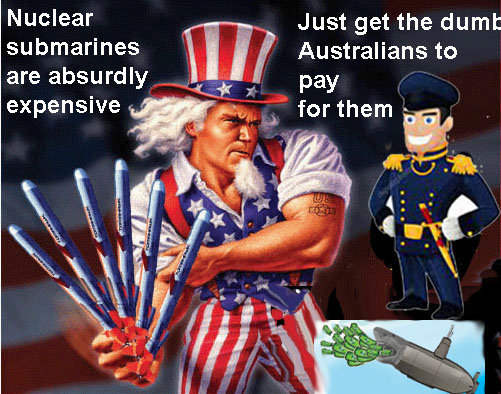
“It’s obvious the real policy is to subsidise the US Navy’s submarine budget. Some will be located in Australia, with Australian flags and personnel, but they’re essentially US boats operated in the US’s great power interests. We’re paying for them to set up part of their current and future fleet in Australia.”
fewer than two of Australia’s eight nuclear submarines would be operationally available, on average, each year. And the cost of the purchases is likely to be stunning, possibly as high as $171 billion……………….. No other country has bought this type.
“Australia could buy 20 high-quality, off-the-shelf, modern submarines for $30 billion.”
influential Australian intelligence and defence officials are ignoring the point that there is no need for Australian submarines to spend much time in China’s waters
Gilligan also warns that the shallow and warm waters around Australia’s north are unsuited to large nuclear submarines.
As experts question the diplomatic, strategic and economic rationale behind Australia’s purchase of nuclear-powered submarines, the gaps in the country’s defensive fleet could be filled by conventional subs. https://www.thesaturdaypaper.com.au/news/politics/2022/08/06/does-australia-actually-need-nuclear-submarines#mtr By Brian Toohey. 6 Aug 22,
In 1992, an Australian Oberon-class submarine entered the crowded waters of Shanghai’s port and became entangled in fishing nets. It had to surface for crew members to cut it free with axes. Chinese Navy sailors witnessed this, but nevertheless the submarine escaped. Had it not, the crew would’ve been imprisoned and Australia widely condemned and potentially convicted for an outrageous breach of international law.
Almost a decade earlier, the Australian Navy had seriously considered scrapping submarines, according to former senior Australian Defence official Mike Gilligan. A study in 1985 had concluded they offered “little marginal benefit to Australia’s defences yet inflict a large marginal cost”. The cost could’ve been much higher given the tremendous risks the government allowed the navy to take, snooping in Chinese and Russian waters on behalf of the Americans, who wouldn’t put their nuclear submarines in danger.
Australia now faces some tough and highly consequential decisions with respect to its fleet. Some experts in the defence field question not only the utility of nuclear-powered vessels but the diplomatic, strategic and economic commitment they entail.
In Washington last month, Defence Minister Richard Marles said Australia, the United States and Britain were moving from “interoperability to interchangeability in defence hardware”. This would effectively mean Australia could not buy high-quality defence equipment from other countries if there was a higher-cost American or British version available. Professor Clinton Fernandes at the UNSW Canberra campus says, “It’s obvious the real policy is to subsidise the US Navy’s submarine budget. Some will be located in Australia, with Australian flags and personnel, but they’re essentially US boats operated in the US’s great power interests. We’re paying for them to set up part of their current and future fleet in Australia.”
Australia has a short and patchy record on submarine purchases. The government acquired many major weapons during World War II. None were submarines. That capability had to wait until the first of a total of six Oberon-class submarines was commissioned in 1967 from a Scottish shipyard. They operated satisfactorily but weren’t considered the nation’s most important military assets.
After Kim Beazley became Defence minister in the Hawke government, he gambled on the value of submarines by ordering six large, battery-powered versions to be built in Adelaide. No other country has bought this type.
The first was commissioned in 1966 and the last in 2003. Called the Collins class, it was based on a good Swedish design. But Beazley greatly increased its size and complexity, partly by adding American equipment that proved completely useless. Maintenance problems drove annual sustainment costs to $670 million. Often only two or three were available at a time, although availability later improved. And none attended the 2010 Rim of the Pacific event – known as Rimpac, the world’s largest international maritime warfare exercise, held biennially near Hawaii.
Former prime minister Scott Morrison and his successor, Anthony Albanese, have taken a much bigger gamble than Beazley did, with their commitment to buy at least eight nuclear attack submarines – almost certainly the American Virginia class. One of the US’s most highly regarded defence analysts, Winslow Wheeler, recently pointed out the Virginia-class subs have been available only 15 times in 33 years for their six-monthly deployments. This suggests fewer than two of Australia’s eight nuclear submarines would be operationally available, on average, each year. And the cost of the purchases is likely to be stunning, possibly as high as $171 billion when accounting for inflation, according to the Australian Strategic Policy Institute, and more recent estimates are above $200 billion. The costliest previous military acquisition, for the Australian Air Force, is the inflation-adjusted $16.6 billion program cost for 72 F-35 fighter jets.
Former submariner, naval consultant and South Australian senator Rex Patrick says, “Australia could buy 20 high-quality, off-the-shelf, modern submarines for $30 billion.”
Patrick also makes the point that nuclear submarines are often “defeated” in exercises by ultra-quiet conventional submarines.
Major new developments are making conventional submarines even more formidable than the nuclear versions. More powerful sensors mean submarines can be detected by the noise they make and by their passage through the Earth’s magnetic field. In addition, nuclear submarines can be detected by the wake they leave at high speeds, as well as the hot water they release from cooling their nuclear reactors, operating loud steam engines and other equipment. In future, submarines may also be detected by blue-green lasers that make the ocean more transparent.
A prize-winning essay published in the US Naval Institute’s magazine Proceedings in June 2018 said the US Navy would do well to consider acquiring “some quiet, inexpensive and highly capable diesel-electric submarines”. Until recently, conventionally powered submarines frequently had to rise close the surface to expose a mast and snorkel to obtain fresh air for their diesel engines to recharge the batteries. This process can be detected by radar.
Most conventionally powered submarines – except Australia’s – use what is called air independent propulsion (AIP), which allows them to remain silent for four to six weeks before snorkelling. That often entails using a hydrogen fuel cell to propel the submarine, but it takes up significant space on the vessel.
In a major change, Japan’s new Taigei-class submarines don’t need AIP because they’re equipped with particularly efficient lithium-nickel-cobalt-aluminium oxide batteries, rather than the lead-acid batteries that the Australian Navy prefers, due in part to the risks of lithium-ion batteries catching fire. Other navies are increasingly confident the new types of battery will prove safe. Hans Ohff, a submarine specialist and visiting fellow at Adelaide University, told The Saturday Paper, “Generally speaking, lithium-ion batteries have a 1.5-times range advantage over lead-acid at lower speeds and an incredible four-times range advantage at high speeds.”
Since the Collins class is due to start retiring in 2026, a replacement is urgently required to help fill the gap until the first nuclear submarine might arrive, near 2045, and the last in 2065. Senator Patrick says the time it takes to do this can be reduced by choosing one of the three available “off-the-shelf” submarines: Japan’s Taigei, which has passed numerous tests demonstrating the safety of its new batteries; Singapore’s Type 218SG, made by Germany’s thyssenkrupp Marine Systems; and the Spanish S-81. The latter two still use conventional lead-acid batteries, but Ohff says a French and German joint venture is under way to develop their own lithium-ion batteries.
These options have advantages and drawbacks. The new Taigei class – of which Japan is acquiring 22 – requires a costly crew of 70 per vessel. The Type 218SG’s German manufacturer is the biggest submarine exporter in the world, with an enviable reputation for low maintenance costs across its range. Extensive automation means it needs only 28 crew members, and the vessel has a longer range than the Taigei’s 12,500 kilometres. Spain’s S-81 has a crew of 32 but a less experienced manufacturer.
With China being the principal concern of Australian diplomatic and defence policymakers, Ohff says the navy will never accept off-the-shelf submarines unless it can “Australianise” them – meaning they must have the range to operate for long periods, many thousands of kilometres away, probably in Chinese waters or nearby. Ohff says the navy’s preferences would take a minimum of 10 years to deliver the first boat and additional two-year intervals for the following boats. He says delivery of a Swedish “Son of Collins” could take nine years.
Patrick says influential Australian intelligence and defence officials are ignoring the point that there is no need for Australian submarines to spend much time in China’s waters: Japan, South Korea, Singapore and Vietnam have high-quality submarines closer to China. The main attraction of nuclear submarines for these officials is they could fire subsonic cruise missiles at land targets in China from more than 1000 kilometres off its coast. However, cruise missiles can be shot down by fighter planes overhead. Once a nuclear submarine fired its missiles, it would be detected and swiftly targeted. Even if it survived, reloading would require the help of a tender – a large depot ship that supplies and supports submarines – probably from the distant base at Fremantle, which recently hosted a reloading for a US nuclear submarine. In any event, an attack on Chinese territory could provoke a heavy counterattack on Australia’s forces or its mainland.
Gilligan says most of the capability offered by submarines is better provided by Australia’s maritime and land-based aircraft. He says submarines, including nuclear ones, are slow compared to aircraft. Technically, a plane could sink a ship off Australia’s west coast in the morning, refuel, then sink another off the east coast in the afternoon. Gilligan also warns that the shallow and warm waters around Australia’s north are unsuited to large nuclear submarines.
Deploying nuclear submarines far from Australia marks a return to the previously discredited doctrine of “forward defence” in South-East Asia that concentrated on a big British naval base in Singapore, which was swiftly overrun by the Japanese in 1942. When this doctrine failed during the Vietnam War, the Coalition government in the late 1960s adopted a “defence of Australia” doctrine, which survived until its recent abandonment. Patrick and other proponents of this latter doctrine expect a revised doctrine would put more emphasis on having medium-sized conventional submarines to help deny hostile forces access to the approaches to Australia, unless they could detect and destroy all the submarines, drones, planes and land-based missiles blocking their way.
Finally, from a defence perspective, much of the planning around nuclear submarines assumes – implausibly – that Chinese and US policies will proceed in a predictable way until past 2060. A purely geopolitical analysis, however, could easily underplay the disruptive role of climate change.
In purely geopolitical terms, the region may become more peaceful or more dangerous. The only urgency for Australia is to forget about nuclear submarines and get some conventionally powered submarines to enhance deterrence.
The National Party’s false claim about nuclear power

Barnaby Joyce’s meltdown over nuclear energy claim , ABC, Jacob Shteyman August 5, 2022,
With Australia’s future energy needs dominating parliament, Nationals MP Barnaby Joyce has claimed we are the only OECD country that does not produce nuclear power.
The claim is false. Eighteen of the 38 OECD countries do not produce nuclear power.
Mr Joyce made the claim during a debate on Labor’s Climate Change Bill 2022 on August 3. In outlining his support for nuclear power, the shadow minister for veterans’ affairs asked: “Why is it that every OECD country produces nuclear power except us? Are we the wise ones and they’re all stupid?” (video mark 19:25).
Mr Joyce has been a supporter of nuclear power for a number of years while the coalition has looked into its implementation at several points in recent decades.
Opposition Leader Peter Dutton announced on August 2 that the coalition would begin an internal process to examine the potential for nuclear power in Australia.
AAP FactCheck contacted Mr Joyce on the source of his claim but received no reply at the time of publication.
The OECD, which is made up of 38 countries, was established in 1961 as a forum for governments to “seek solutions to common economic and social problems”.
The OECD Nuclear Energy Agency publishes an annual report showing nuclear energy generation by each member nation. The 2021 report (table 1.1, page 14) shows 18 of the 38 do not produce nuclear power.
They are Italy, Turkey, Poland, Ireland, Norway, Israel, Austria, Chile, Colombia, Denmark, Estonia, Greece, Iceland, Latvia, Luxembourg, Portugal, New Zealand and Australia.
ANU nuclear expert Tony Irwin confirmed to AAP FactCheck in an email that Australia is not the only OECD nation to generate nuclear power.
A similar claim was made by Liberal MP Stuart Robert in an interview on ABC’s Afternoon Briefing on August 2. While responding to a question about the affordability of nuclear energy, he said: “I think we’re one of only, in fact we’re the only non-top 20 OECD country that doesn’t use nuclear power as part of its power mix” (video mark 9min).
A spokesman for Mr Robert clarified to AAP FactCheck that he meant to say Australia is the only top 20 OECD country without nuclear power.
Either way his claim is false……………………………..
The most recent World Nuclear Industry Status Report, published last year, found global nuclear energy production is on the decline, despite a significant increase in China.
In 2019 AAP FactCheck debunked a similar claim by coalition MP Keith Pitt that Australia is the only OECD country not utilising nuclear energy.
France’s troubled nuclear fleet a bigger problem for Europe than Russia gas

France’s troubled nuclear fleet a bigger problem for Europe than Russia gas — RenewEconomy
Before Peter Dutton’s Coalition charge off into yet another inquiry into
the merits of nuclear power, they might want to take a closer look at
what’s happening in Europe, where the failure of France’s huge nuclear
power plant fleet is causing bigger problems for EU power supplies than
Russia’s withheld gas supply.
France has been delivering just a fraction
of its energy production potential in recent months, and overnight the
situation got worse when French power producer EDF announced another three
power plants would curtail output because of rising temperatures. Rivers
have become too hot in the latest heatwave to be used to cool the reactors.
The majority of France’s 56 nuclear reactors are currently throttled down
or taken offline due to a combination of scheduled maintenance, erosion
damage (worryingly, mostly at the newer plants of the ageing fleet) and
cooling water shortages due to recurring heatwaves and droughts.
Renew Economy 5th Aug 2022
Needles of Hope in the Ukraine War Haystack

There recently have emerged small trends that demonstrate, first, that the hot heads are not completely in charge in the East or even in the West, and second, that there may be hope that both sides in the catastrophic Russo-Ukrainian war over NATO expansion can be ended some day in the not too distant future.…
Needles of Hope in the Ukraine War Haystack — Russian & Eurasian Politics
https://gordonhahn.com/2022/08/05/needles-of-hope-in-the-ukraine-war-haystack/ GORDON M. HAHN August 5, 2022,
There recently have emerged small trends that demonstrate, first, that the hot heads are not completely in charge in the East or even in the West, and second, that there may be hope that both sides in the catastrophic Russo-Ukrainian war over NATO expansion can be ended some day in the not too distant future.
First, Lithuania’s extremist attempt to draw a Russian overreaction and bring NATO into the war by setting up a blockade against Russian transport between the Russian ‘mainland’ and its exclave of Kaliningrad was avoided. Reasonable minds in the European Union cajoled Vilnius into abandoning the ban on rail transport, which far exceeds road transport, which remains closed.
Second, by way of Turkey’s mediation, Russia and Ukraine agreed to cooperate in getting Ukrainian grain out to the rest of the world through the Black Sea Fleet, which had been heavily mined by Kiev and largely sealed by the Russian navy. Ukraine will remove its mines, Russia will allow ships through, and ships arriving and returning to Ukraine’s port of Odessa will be searched for weapons.
Third, August 29th saw the renewal of official Russia-US contact in the form of a phone call between Russian Foreign Minister Sergei Lavrov and US Secretary of State Anthony Blinken in which a return to “quiet diplomacy” a discussion regarding the need for talks on prisoner exchanges between Washington, Moscow and presumably Kiev and its Donbass foes. This and any successful overall ceasefire talks in future will require American participation.
Fourth, Ukrainian President Volodomyr Zelenskiy and even more so his team, are looking increasingly desperate, and Russian Telegram channels have seen reports of chatter/rumors of Ukrainian military claims that Kiev will seek an end to the war in late August, because it lacks the fuel and food to get the army and population through the winter. Combine this with Russia’s grinding but successful war of attrition in the east and the likely failure of any Ukrainian offensive towards Kherson or a successful Russian offensive in south towards Mikolaiv and Odessa, and the stage could be set for the renewal of direct ceasefire and peace talks.
Finally, it is possible that the practice and psychological breakthrough of agreements on Kaliningrad, grain exports, and prisoner exchanges will facilitate the renewal of such talks as well as offer lessons on how best to conduct such talks so as to make agreement more possible.
On the other hand, the overall situation remains catastrophic, and it is August. We shall see.
Why Is There More Media Talk About Using Nuclear Weapons Than About Banning Them?

https://fair.org/uncategorized/why-is-there-more-media-talk-about-using-nuclear-weapons-than-about-banning-them/ KARL GROSSMAN, 5 Aug 22,
It’s of critical importance—indeed, existential importance—to the world: the Treaty on the Prohibition of Nuclear Weapons. And a coalition of peace organizations in the United States is charging that media are acting like the treaty “does not exist.”
The Nuclear Ban Treaty Collaborative is waging a campaign to encourage press coverage of the treaty, which, it argues, “provides the only pathway to a safe, secure future free of the nuclear threat” (Oak Ridge Environmental Peace Alliance Newsletter, 6/22).
In the words of the UN, the treaty is “a legally binding instrument to prohibit nuclear weapons, leading towards their total elimination.” It was adopted by the UN General Assembly—with 122 nations in favor—and opened for signature in 2017. It was entered into force in January 2021.
But its provisions only apply to nations which are party to it. Countries with nuclear weapons—including the United States, Russia and China—have not. Instead, “so far, they have refused, boycotted meetings, and even pressured countries not to sign on,” the Federation of American Scientists has noted (FAS, 1/22/09).
Media attention vital
Media attention is vital if the TPNW is to become a reality. But as the Oak Ridge Environmental Peace Alliance (OREPA), a member of the Collaborative, explained in its June newsletter:
The last time the New York Times mentioned the TPNW was October of 2020, when Honduras became the 50th nation to ratify the Treaty, triggering its Entry in Force. In all the coverage of nuclear weapons since then, including a surge since Vladimir Putin invaded Ukraine, the TPNW has not been mentioned once.
National Public Radio has had four significant reports about nuclear weapons in the last three months, including a seven minute report on Sunday, March 27. None of the reports mentioned the TPNW—the last time NPR mentioned it was in January 2021 when it reported on the Treaty’s entry into force, noting it was a significant treaty becoming international law. Since then, crickets.
CNN is marginally better. A search of the website for “nuclear weapons” turns up almost daily reports; but the Treaty on the Prohibition on Nuclear Weapons gets only one mention—an op-ed on May 3 from Ira Helfand, co-president of International Physicians for the Prevention of Nuclear War.
The Collaborative is calling for media to cover the treaty whenever reporting on the threat of nuclear weapons.
Plenty of nuclear talk
Ralph Hutchison, coordinator of OREPA, said in an interview:
What became alarming was that there was a revival of coverage of nuclear weapons after Vladimir Putin made his threat. In all those articles we seemed to be locked into Cold War thinking which ignores the reality that an alternative to “mutually assured destruction” exists: the Treaty for the Prohibition of Nuclear Weapons. And yet there was nothing.
Indeed, according to a search of the Nexis news database, US newspapers have mentioned “nuclear weapons” 5,243 times between February 24, when Putin began talking about their potential use in Russia’s invasion of Ukraine, and August 4. Only 43 of those times included a mention of the treaty; the great majority of these were letters to the editor or opinion columns.
This comes against the backdrop of the Bulletin of Atomic Scientists in 2020 moving its “Doomsday Clock” forward to 100 seconds to midnight, where it has remained through today. It defines midnight as “nuclear annihilation.” This was the closest to midnight the clock has been set at since it was created in 1947 (1/20/22).

“Let’s eliminate these weapons before they eliminate us,” said UN Secretary-General Antonio Guterres at the conclusion in June of a “Political Declaration and Action Plan” for implementation of the TPNW—“important steps,” he said, “toward our shared goal of a world free of nuclear weapons” (UN Press, 6/21/22).
Guterres went on:
Today, the terrifying lessons of Hiroshima and Nagasaki are fading from memory. The once‑unthinkable prospect of nuclear conflict is now back within the realm of possibility…. In a world rife with geopolitical tensions and mistrust, this is a recipe for annihilation.
We cannot allow the nuclear weapons wielded by a handful of states to jeopardize all life on our planet. We must stop knocking at doomsday’s door. The Treaty on the Prohibition of Nuclear Weapons is an important step towards the common aspiration of a world without nuclear weapons.
Can the atomic genie be put back in the bottle? Anything people have done, other people can undo. And the prospect of massive loss of life from nuclear destruction is the best of reasons.
There’s a precedent: the outlawing of chemical warfare after World War I, when its terrible impacts were horrifically demonstrated, killing 90,000. The Geneva Protocol of 1925 and the Chemicals Weapons Convention of 1933 outlawed chemical warfare, and to a large degree the prohibition has held.
As Pope Francis said on a visit to Nagasaki in 2019, in which he condemned the “unspeakable horror” of nuclear weapons: “A world without nuclear weapons is possible and necessary.”
To learn more about or join the Collaborative’s ongoing media activism campaign, please visit https://www.nuclearbantreaty.org/
Poland rewrites or obscures the history of the Russians’ liberation of Auschwitz
Moscow slams removal of Russian expo at Auschwitz memorial. https://www.rt.com/news/560234-auschwitz-poland-russian-expo/ 4 Aug, 2022 The move by Poland is an attempt to rewrite history, the Foreign Ministry insists
By shutting down the Russian exhibition at the Auschwitz-Birkenau memorial and museum, Poland is trying to eradicate the memory of World War II and the sacrifice of the Soviet people, Russia’s Foreign Ministry spokeswoman said on Tuesday.
Auschwitz-Birkenau is a former Nazi death camp in southern Poland where over a million people were killed between 1940 and 1945, most of the victims being Jewish, Polish and Soviet prisoners.
The Red Army liberated the site, which became one of dominant symbols of the Holocaust, in late January 1945.
Russia’s Museum of the Patriotic War used to maintain a permanent exhibition at Auschwitz-Birkenau, but in May the Polish authorities made a decision to shut it down, Maria Zakharova said during a briefing.
Warsaw explained that the move was down to the expiry of the relevant agreements with Moscow, but according to the Foreign Ministry spokeswoman, the Polish side deliberately avoided all contacts on prolonging them with the Museum of the Patriotic War, and with Russian diplomats.
“It’s another cynical attempt by Warsaw to eradicate the memory of the tragedy of World War II, the colossal sacrifice of the Soviet people and their mission of liberation,” she said.
Addressing the Polish authorities, Zakharova asked: “Do you understand that the Auschwitz-Birkenau museum isn’t Disneyland, where you can just change signs, paint store windows in different colors? And, generally, ‘refresh the exposition’ from time to time, inventing new attractions and getting rid of the old ones, in order to keep the public entertained?”
“You can’t change history simply because the current political conjuncture requires this of you,” she insisted, referring to Western anti-Russia sanctions over the Ukraine conflict.
Poland has been one of the strongest backers of Kiev during the conflict with Moscow.
It has provided Ukraine with weapons, reportedly including half of its tanks, taken in some 1.5 million refugees, and actively called on the EU to slap even tougher restrictions on Russia.
The Polish authorities have a track record of Russophobic policies. In an opinion piece for the Telegraph in May, Prime Minister Mateusz Morawiecki said the ideology now being pursued by the Kremlin was “a cancer which is consuming not only the majority of Russian society, but also poses a deadly threat to the whole of Europe.”
In the same article, Morawiecki claimed that “while the Red Army defeated Nazi Germany, it brought slavery to many nations.”
In late May, a poll by local paper Myśl Polska found Poland to be the world’s most Russophobic nation, with 87% of those surveyed saying that had a negative opinion of Russia.
Zelensky accuses Amnesty International of supporting terrorism

Amid a torrent of criticism from pro-Ukrainian social media posters, Callamard stuck by the report. “To those who attack us alleging biases against Ukraine, I say: check our work,” she wrote on Twitter. “We stand by all victims. Impartially.” Callamard also accused “social media mobs and trolls” on both sides of the conflict of spreading “war propaganda, disinformation, [and] misinformation.”
https://www.rt.com/russia/560260-zelensky-amnesty-international-report/ 4 Aug 22,
Amnesty has stuck by its report that Ukrainian forces endangered civilians.
Ukrainian President Vladimir Zelensky has accused Amnesty International of siding with “terrorists” after the organization condemned the Ukrainian military for placing weapons in civilian areas in violation of humanitarian law.
“Today we saw a report by Amnesty International, which unfortunately tries to amnesty the terrorist state and shift responsibility from the aggressor to the victim,” Zelensky said in a video address on Thursday evening.
“If someone makes a report that puts the aggressor and the victim on the same level, this cannot be tolerated,” he said, repeating three times that “Ukraine is a victim,” and adding that “anyone who doubts this is an accomplice of Russia – a terrorist country – and a terrorist themselves and a participant in the killings.”’
The report in question was published earlier on Thursday, and detailed 22 cases of Ukrainian forces launching strikes from schools and five examples of troops using hospitals as bases. Amnesty said that it was “not aware” that Ukraine tried to evacuate civilians before occupying these non-military locations.
“We have documented a pattern of Ukrainian forces putting civilians at risk and violating the laws of war when they operate in populated areas,” said Agnes Callamard, Amnesty International’s Secretary General. “Being in a defensive position does not exempt the Ukrainian military from respecting international humanitarian law.”
While Amnesty has also accused Russia of breaking international law in the conduct of its military operation, the report was slated online by supporters of Zelensky’s regime, who accused the international organization of peddling “Russian propaganda.”
Ukrainian Foreign Minister Dmitry Kuleba has also pushed back against the report, accusing Amnesty of “creating a false reality” where everyone “is at fault for something.” Instead, he argued that the organization should focus exclusively on alleged Russian wrongdoing.
Amid a torrent of criticism from pro-Ukrainian social media posters, Callamard stuck by the report. “To those who attack us alleging biases against Ukraine, I say: check our work,” she wrote on Twitter. “We stand by all victims. Impartially.” Callamard also accused “social media mobs and trolls” on both sides of the conflict of spreading “war propaganda, disinformation, [and] misinformation.”
In his speech, Zelensky accused the Russian military of “striking at memorials to Holocaust victims” and “at a prisoner of war camp in Yelenovka.” Zelensky was apparently referring to a strike on a Holocaust memorial in March, which actually hit a TV tower nearby. An Israeli journalist stated that the memorial itself was untouched.
Russia accused Ukraine of launching a missile strike on the Yelenovka detention facility housing members of the neo-Nazi Azov regiment last week, and has asked the United Nations and Red Cross to investigate the attack. Donetsk People’s Republic officials claimed the facility was targeted to prevent the prisoners from testifying about alleged Ukrainian war crimes.
Poland’s double standard on how it treats refugees, and the prospect of exhaustion by those housing Ukrainians
Is Poland’s smooth reception of Ukrainian refugees heading for trouble? https://www.thenewhumanitarian.org/news-feature/2022/08/04/Poland-Ukraine-refugee-concern-grows?utm_source=The+New+Humanitarian&utm_campaign=9a3fb600c4-EMAIL_CAMPAIGN_2021_08_5_Weekly&utm_medium=email&utm_term=0_d842d98289-9a3fb600c4-75686634 4 Aug 22,
Poland has so far extended a generous welcome to some 1.5 to 2 million Ukrainians escaping Russia’s invasion – more than double any other EU country. The reception has caught the eye of many, including the UN’s special rapporteur on the human rights of migrants, Felipe González Morales, who recently visited the country. “I am impressed by the Government of Poland for providing significant support to a huge number of refugees,” González Morales said.
But Poland’s differing treatment of refugees and asylum seekers from other countries – including people fleeing the fighting in Ukraine – did not escape Gonzáles Morales’ attention, who noted the double standard and called for an end to pushbacks at the Poland-Belarus border.
The special rapporteur also said that the situation for Ukrainian refugees in Poland could soon become more difficult as winter approaches and volunteers who have been housing many Ukrainians grow exhausted. That’s just one of the impending challenges – alongside access to education, the possibility of anti-refugee sentiment, and more – that NGO workers and civil society activists told Migration Editor-at-large Eric Reidy they are now really worried about.
1 This month
17 October, Free Public Talk on Nuclear Issues in South Australia
David Noonan will speak on public interest concerns over the new Roxby Downs Indenture Act 2026 on BHP copper-uranium mining and ore processing in SA, and on how AUKUS may face SA with a High-Level nuclear waste agenda.
Dr Jim Green will discuss international developments in the field of nuclear power including ‘small modular reactors’ and Generation 4 ‘advanced’ nuclear reactor concepts.


Help Aunty Sue Protect Her Land and Sacred Sites From Destructive Rocket Testing.
.

Australians deserve the truth
about
AUKUS – https://aukuspublicinquiry.com/

PETITION – To: Prime Minister Anthony Albanese and the Australian Labor Government

of the week – Australians for War Powers Reform (AWPR)
To see nuclear-related stories in greater depth and intensity

