Julian Assange’s family says federal election result brings renewed hope for WikiLeaks founder’s release
https://www.abc.net.au/news/2022-05-27/julian-assange-release-family-election-result-brings-hope/101100860, By Brendan Mounter and Adam Stephen, 27 May 22,
Key points:
- The family and supporters of Julian Assange are hopeful of securing his release following a change of government
- Prime Minister Anthony Albanese has previously expressed support for efforts to secure the WikiLeaks founder’s return to Australia
- Mr Assange has spent the past three years in the UK’s Belmarsh Prison
The family of Julian Assange is hopeful the election of a federal Labor government will pave the way for the WikiLeaks founder’s eventual release and a return to Australia.
It has been almost a decade since Mr Assange, who originally hails from Townsville in north Queensland, has been a free man.
For the past three years, he has been in high security detention at Belmarsh Prison in the United Kingdom, after seven years of asylum within London’s Ecuadorian embassy in a bid to avoid arrest.
United States authorities have sought Mr Assange’s extradition from the UK so he can stand trial on charges of espionage and computer misuse relating to hundreds of thousands of leaked cables from the wars in Iraq and Afghanistan.
His brother, film producer Gabriel Shipton, said Mr Assange had been persecuted for publishing the ugly truths of war.
“Julian is accused of what investigative journalists do all the time, which is sourcing and publishing materials from a source, Chelsea Manning,” Mr Shipton said.
“Those releases exposed war crimes in Iraq, undocumented civilian deaths in Iraq, corruption, government malfeasance … all sorts of things.”
American prosecutors allege Mr Assange unlawfully helped US Army intelligence analyst Chelsea Manning steal classified diplomatic cables and military files that WikiLeaks later published, putting lives at risk.
Family urges incoming government to act
Lawyers for Mr Assange fear he could face up to 175 years in jail if he is extradited to the US and convicted.
But the weekend’s election result has buoyed his supporters, with the hope that the new Labor government will intervene and help secure his release.
While in Opposition, newly elected Prime Minister Anthony Albanese is reported to have told a February 2021 caucus meeting that “enough was enough” and he “can’t see what’s served by keeping [Assange] incarcerated”.
Mr Albanese is also a signatory to the Bring Julian Assange Home Campaign petition.
Senior Labor MP Mark Dreyfus, who is expected to be appointed Attorney-General, has also expressed a need to “bring the matter to a close”.
Mr Shipton is calling on the new government to turn those words into action.
“That was the Labor position before the election so we’re very hopeful when there’s a new administration, a new government coming in there’s always a lot of hope that they will live up to their promises,” he said.
Cancer Patients Seek Damages from Fukushima Nuclear Plant
Claims Journal , By Mari Yamaguchi | May 27, 2022 TOKYO (AP) — A Tokyo court began hearings Thursday in a lawsuit seeking nearly $5 million in damages for six people who were children in Fukushima at the time of its 2011 nuclear power plant disaster and later developed thyroid cancer.
The plaintiffs are suing the operator of the nuclear plant, saying radiation released in the accident caused their illnesses.
It is the first group lawsuit filed by Fukushima residents over health problems allegedly linked to the disaster, their lawyers say.
One plaintiff, identified only as a woman in her 20s, testified from behind a screen that she had to give up plans to attend university because of repeated operations and treatments.
“Because of the treatments, I could not attend university, or continue my studies for my future job, or go to a concert. I had to give up everything,” she said. “I want to regain my healthy body, but that’s impossible no matter how hard I wish.”
She and the five other plaintiffs are seeking a total of 616 million yen ($4.9 million) in damages from Tokyo Electric Power Company Holdings for allegedly causing their cancers.
On March 11, 2011, a magnitude 9.0 earthquake and massive tsunami destroyed the Fukushima plant’s cooling systems, causing three reactor cores to melt and release large amounts of radiation. Critics say the plant operator should have known that a large tsunami was possible at the site.
The plaintiffs, who were 6 to 16 years old at the time of the accident and lived in different parts of Fukushima, were diagnosed with thyroid cancer between 2012 and 2018, their lawyers said……………..
The Fukushima prefectural government tested 380,000 residents aged 18 or younger at the time of the accident for thyroid cancer. About 300 were diagnosed with cancer or suspected cancer.
That occurrence rate, about 77 per 100,000, is significantly higher than the usual 1-2 per million and can only be linked to radiation from the accident, the plaintiffs’ lawyers said.
………… Three other plaintiffs who attended the hearing were also behind a partition to protect their privacy because of criticism on social media accusing them of fabricating their illnesses and hurting the image of Fukushima, the lawyers said.
Ido said many people with health problems feel intimidated to speak out in Fukushima and that he hopes the lawsuit will prove a correlation between radiation and the plaintiffs’ cancers “so that we can have a society in which people can talk freely about their difficulties.”…………… https://www.claimsjournal.com/news/international/2022/05/27/310693.htm
No credibility in the way that the Ukraine war is being reported – says Colonel Richard Black (ret)

Video: Col. Richard Black — U.S. Leading World to Nuclear War, The International Schiller Institute, 27 May 22, Mike Billington with Executive Intelligence Review interviews Col. Richard Black (ret.).
”…………………………..BILLINGTON: Many flag grade officers certainly understand the consequences that you just described in a rather hair-raising way. Why is it that, while there are some generals speaking out in Italy, in France, in Germany, warning that we are pursuing a course that could lead to nuclear war, why are there not such voices from flag grade officers—retired, perhaps—saying what you’re saying here today?
BLACK: You know, there’s been a tremendous deterioration in the quality of flag officers………. we now have “yes men.” These are not people whose principal devotion is to the United States and its people. Their principal devotion is to their careers and their ability to network with other military officers upon retirement. There’s a very strong network that can place military generals into think tanks, where they promote war, into organizations like Raytheon and Northrop Grumman, and all of these defense operations, where they can get on boards and things like that. So there’s quite a personal price that you pay for saying, “Hey, stop. War is not in the interests of the American people.” If we had a better quality of individual, we would have people with the courage who would say, “I don’t care what it costs me personally.” But it is very difficult to get into the senior ranks, if you are an individual guided by principle, and patriotism, and devotion to the people of this nation. That’s just not how it works. And at some point, we need a President who will go in and shake the tree, and bring a lot of these people falling down from it, because they’re dangerous. They’re very dangerous to America.
………………. Just like I asked what’s keeping the generals from speaking out, why, and what will it take, to get Americans to recognize that we can and must sit down with Russians, and with Chinese, and with all other nations and establish a true, just world based on the dignity of man and the right to development and security?
………. at this point, the media have been so totally censored and so biased that the American people really don’t have a perception of the need for anything of that sort. It’s going to be difficult.
………… The idea that somehow we have this enormously just cause, it doesn’t strike a great deal of the world that it is just, and much of the world does not accept the latest propaganda about war crimes: this thing about Bucha. That’s probably the most prominent of all the war crimes discussions.
And what was Bucha? There was a film taken of a vehicle driving down the road in Bucha, which had been recaptured from the Russians. And every hundred feet or so there was some person with his hands, zip tied behind his back, and he’d been killed. It was not announced until four days after the Ukrainians had retaken Bucha.
Now, we knew almost nothing about it. We actually didn’t even have proof that people had been killed. But assuming they had, we didn’t know where they had been killed. We did not know who they were. We did not know who killed them. We did not know why they were killed. No one could provide an adequate motive for the Russians to have killed them. The Russians held Bucha for a month. If they were going to kill them, why didn’t they kill them during that month? And if you’re going to slaughter a bunch of people, wouldn’t they all be in one place and wouldn’t you gun them all down there? Why would they be distributed along a roadside, a mile along the way? It makes no sense!
What we do know is that four days after the mayor of Bucha joyously announced that the city was liberated, four days after the Ukrainian army had moved in, and their special propaganda arm of the Ukrainian military were there, all of a sudden there were these dead people on the road. How come they weren’t there when the Russians were there? How come they only appeared after the Russians were gone?
If I were looking at it as simply a standard criminal case, and I was talking to Criminal Investigation Division or the FBI, or military police or something, I’d say, “OK, the first thing, let’s take a look at the Ukrainians.” My guess would be, and you start with a hunch when you’re investigating a crime—my hunch is that the Ukrainians killed off these people after they moved in, and after they looked around, and said, “OK, who was friendly towards the Russian troops while the Russians were here? We’re going to execute them.” That would be my guess. Because I don’t see any motive for the Russians to have just killed a few people on their way out of town.
And nobody questions this, because the corporate media are so monolithic. We know for a fact, from the mouth of the head of a Ukrainian hospital, the guy who ran the hospital, he boasted that he had given strict orders to all of his doctors, that when wounded Russian POWs, when casualties were brought in, they were to be castrated. Now, this is a horrific war crime, admitted from the mouth of the hospital administrator, and the Ukrainian government said, “we’ll kind of look into that,” Like it’s no big thing. I can’t think of a more horrific, horrific war crime, ever. Where did you hear about it, on ABC and MSNBC and CNN and FOX News? Not a whisper. And yet the proof is undeniable. We had another clip where there was a POW gathering point, where the Ukrainians would bring POWs to a central point for processing—and this is about a seven-minute video—and the Ukrainian soldiers simply gunned them all down.
And they had probably 30 of these wounded Russian soldiers lying on the ground, some of them clearly dying from their wounds. Some of them, they put plastic bags over their heads. Now, these are these are guys who are laying there, sometimes fatally wounded with their hands zip-tied behind their backs, and they’ve got plastic bags over their heads, making it difficult to breathe. And because they can’t raise their hands, they can’t take the bags off, so that they can breathe. At the end of the video, the Ukrainians bring in a van, and there are three unwounded Russian POWs. Without the slightest thought or hesitation, as the three come off, and their hands are bound behind their backs, they gunned down two of them, right on camera and they fall over. And the third one gets on his knees, and begs that they won’t hurt him. And then they gun him down! These are crimes. And these were not refuted by the Ukrainian government. But you’d never even know that they occurred! So far, I will tell you that the only proven—I’m not saying that there aren’t war crimes happening on both sides. I’m just telling you, that the only ones where I have seen, fairly irrefutable proof of war crimes, have been on the Ukrainian side.
Now, often you hear it said, well, the Russians have destroyed this or destroyed that. Well, I’ve got to tell you, you go back to the wars that we fought when we invaded Iraq, the “Shock and Awe,” we destroyed virtually everything in Iraq, everything of significance. We bombed military and civilian targets without much discrimination. The coalition flew 100,000 sorties in 42 days. You compare that to the Russians, who have only flown 8,000 sorties in about the same period of time. 100,000 American sorties versus 8,000, in about the same time. I think the Russians have tended to be more selective. Whereas we went out — the philosophy of Shock and Awe is that you destroy everything that is needed to sustain human life and for a city to function. You knock out the water supply, the electrical supply, the heat, the oil, the gasoline; so that you knock out all of the major bridges. And then you just continue to destroy everything.
So it’s really ironic. And keep in mind, Iraq is a relatively small country. Ukraine is a huge country. 100,000 sorties in 42 days, 8,000 sorties in about the same time. A tremendous difference in violence between what we did in Iraq, and what they have done in Ukraine. So there’s simply no credibility when you actually get down to the facts and you look at the way that the war has been conducted…………… https://schillerinstitute.com/blog/2022/04/26/video-col-richard-black-u-s-leading-world-to-nuclear-war/
France’s Nuclear Industry Slides Into Crisis

https://globeecho.com/news/europe/germany/frances-nuclear-industry-slides-into-crisis/ By David Sadler May 26, 2022,
France is less dependent on Russian gas than Germany – thanks to the country’s 56 nuclear reactors. But because more than half of them are standing still and Russia is disappearing as a customer, France’s nuclear industry is under pressure.
French President Emmanuel Macron had promised a “renaissance of nuclear energy” in February. He wants to have six new pressurized water reactors built. More electricity, more independence, more innovation – Macron is going all-out on the nuclear power card to push France’s industry forward.
Corrosion stalls the plans

But these ambitious plans are currently experiencing a serious setback: 29 of the 56 reactors are shut down. There is a double problem: the state-owned company EDF’s kiln park is showing its age. Many reactors are shut down for routine maintenance. But now, of all things, twelve of the younger series also have to be taken off the grid.
The reason is a corrosion problem that nobody expected. “At the moment, the controls do not allow any statement to be made as to how large the cracks in the cooling tubes are. The reactors have to be shut down for this,” says Bernard Doroszczuk, rapporteur for the Nuclear Safety Authority.
Proportion of nuclear power unplanned at low point
Instead of around 70 percent, France’s nuclear power plants only supplied 37 percent of the electricity requirement in April – less than ever before! Europe’s largest nuclear power provider, Electricité de France, currently estimates the group’s shortfall in revenue for 2022 at 18.5 billion euros. It is already foreseeable that there will be power shortages in winter.
But a quick solution to the technical problems is not in sight. Because there is a lack of skilled workers. “Basically, EDF estimates that by 2026 there will be a six-fold increase in the need for specialist staff. Above all when it comes to the machinery: i.e. pumps, the pipe network, and there is a lack of welders – that’s what drives everyone,” says Jean-Luc Lachaume from the security agency. “And this calculation does not even include the announced construction of new reactors. Nor does it include the need that has now arisen as a result of these unforeseen corrosion problems.”
Instead of renaissance, first of all, renovation. Security auditor Doroszczuk therefore calls for a Marshall Plan. “Industry and the state have to get involved now,” he demands. “Otherwise the announced goals are not tenable. And that would be the worst thing for the credibility of the entire industrial program.”
Russia has been the most important customer so far
On top of all these problems there is now the war in Ukraine. To date, Russia has been the most important customer of the French nuclear industry. Mycle Schneider, editor of the World Nuclear Industry Status Report, sees the items in the order books dwindling. Internationally, Russia was “the decisive, most aggressive promoter” of the construction of new nuclear power plants. And now suddenly this bottleneck has arisen. “In Finland, a project for a Russian nuclear power plant has already been officially canceled – and turbines for this nuclear power plant were to be delivered from France,” says Schneider.
In fact, the French Ministry of Economic Affairs even planned to take a 20 percent stake in the domestic turbine manufacturer in Belfort for the Russian company Rosatom. But that plan could now be shelved. France believed that its nuclear strategy was on the upswing. But the plans have gone haywire.
Anthony Albanese has the power to save Julian Assange. But will he?

We’re all enormously relieved that the corrupt #ScottyFRomMarketing has gone.
And we like Albanese, I think.
But – will he have the guts to help our Australian hero, Julian Assange?
Albanese had the perfect opportunity in Tokyo on Tuesday, meeting the U.S. president. He could have raised the matter with Biden.. But he didn’t.
When will he? Will he speak up for Assange at all?
Now is the time for Australia to intervene, and to demand the repatriation of Julian and an end to his persecution. It’s about time our mealy-mouthed and pathetic media and politicians broke their silence and cringing subservience to the USA.
Months of more rain likely as BOM report links global warming to flood disasters
Months of more rain likely as BOM report links global warming to flood disasters
The Bureau of Meteorology reports a perfect storm of factors led to devastating flooding across Queensland and NSW and climate change may have made them worse. And it warns key indicators are pointing to more heavy rain this winter and spring.
They’re Just Outright Telling Us That Peace In Ukraine Is Not An Option

Caitlin Johnstone, 25 May 22, US Senator Joe Manchin said at the World Economic Forum on Monday that he opposes any kind of peace agreement between Ukraine and Russia.
Manchin, who at the moment is one of the most powerful elected officials in Washington, added that only the complete forcible ejection of Russia from all of Ukraine is acceptable, that the war should ideally be used to remove Putin from power, and that he and the strategists he talks to see this war as an “opportunity”.
…………………………… Manchin’s comments fit in perfectly with what we know about the US-centralized empire’s real agendas in Ukraine.
Earlier this month Ukrainian media reported that UK Prime Minister Boris Johnson told the nation’s president Volodymyr Zelensky on behalf of NATO powers that “even if Ukraine is ready to sign some agreements on guarantees with Putin, they are not.”
Last month US Secretary of “Defense” Lloyd Austin acknowledged that the goal in this war is not peace in Ukraine or the mere military defeat of Russia but to actually weaken Russia as a nation…………
Last week The New York Times reported that the Biden administration is developing plans to “further choke Russia’s oil revenues with the long-term goal of destroying the country’s central role in the global energy economy.”
………… Two months ago Biden himself acknowledged what the real game is here with an open call for regime change, saying of Putin, “For God’s sake, this man cannot remain in power.”
Statements from the Biden administration in fact indicate that they expect this war to drag on for a long time, making it abundantly clear that a swift end to minimize the death and destruction is not just uninteresting but undesirable for the US empire.
This is not a proxy war with peace as an option anywhere within sight. It’s not about saving Ukrainian lives. It’s not even about beating Russia in Ukraine. It’s about achieving regime change in Moscow, no matter how many lives need to be destroyed in the process.
Peace is not on the menu. https://caitlinjohnstone.substack.com/p/theyre-just-outright-telling-us-that?s=w—
USA Energy Department nuclear waste backlog goes as far back as WWII
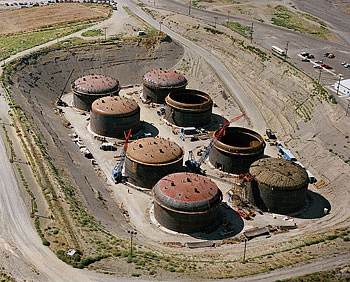
Federal News Network, Tom Temin@tteminWFED, May 25, 2022 The Energy Department has a backlog of nuclear waste clean up responsibilities, with material dating back to World War II. But continuing turnover in program leadership means things just aren’t happening. For more, Government Accountability Office natural resources and environmental team Director Nathan Anderson spoke with the Federal Drive with Tom Temin.
Interview transcript:
Tom Temin: So what is going on here, the Energy Department says it needs something like a half a trillion dollars to do the cleanup of nuclear waste. Give us the scope of what it is they’re trying to do here in the first place?
Nathan Anderson: Well, you’ve got the dollar figure, right, in terms of the best estimates that we can give to this point. It is looking like almost a half a trillion dollar future financial responsibility of the federal government. I want to take it back a little bit to how we got here. You know, for decades, we were in the Cold War. And we were producing nuclear weapons. And we had sites across the country that were engaged in the Manhattan Project, and ultimately in the arms race that we were involved in until the late 1980s. And then around that time, the switch was flipped, if you will. And all of a sudden, we had to embrace the cleanup responsibilities that came with the end of the Cold War and kind of embracing both environmental and moral responsibilities of cleaning up the waste. And that’s where we’re at now, you know, we’ve been at this for a little more than 30 years, in a way trying to figure out the best way forward in terms of addressing the environmental and human health risks. And also, you know, the financial risks.
Tom Temin: And what is the scope of the issue geographically is there material that needs to be dealt with all over the place?
Nathan Anderson: There are 15 active cleanup sites that the Department of Energy is responsible for addressing. The biggest site in terms of financial risk and scope of waste is probably the Hanford Site out in southwestern Washington. There’s also a massive cleanup operation at the Savannah River Site in South Carolina, there’s a nuclear repository down in New Mexico at the Waste Isolation Pilot Plant. DOE recently kind of completed some of their activities at the Brookhaven Lab in New York. But as I’m kind of going through this list, you can see it really is all across the country, where we have these sites and have these cleanup responsibilities.
Tom Temin: And what does cleanup actually entail? It has to be removed and put somewhere else and buried in concrete or what?
Nathan Anderson: Well, I think one of the best ways to describe this is you’ve got nuclear waste, and radioactive waste that is in a tank, a couple sites around the country. There are 177 underground tanks at the Hanford Site, these tanks are massive, I’ve stood in a mock up of one. They hold, you know, up to a million gallons of waste. You’ve also got contaminated soil and groundwater. Decades ago during the nuclear weapons production mission, not as much as understood about the risks that some of these liquids and some of these contaminants contained, and so some of it was dumped directly into the ground. And that has permeated into the groundwater at certain sites. And then you’ve also got contaminated facilities that need to be demolished and that contamination needs to be dealt with appropriately. So I would say the three big cleanup activities are addressing the waste that’s in the tank. That’s the really nasty stuff, the soil and groundwater that needs to be remediated. And then also the excess facilities that need to be demolished, and that contamination needs to be remediated.
Tom Temin: And does that put the Energy Department in the position of being a buyer of contracted services to actually do this? Are there companies that handle this type of thing?
Nathan Anderson: Yes, it does. DOE is one of the largest contracting departments out there, probably right behind DoD (Department of Defense) in terms of the percentage of money that is put out the contracts. And now you’ve got companies around the country that are technically equipped to do this. And what DOE needs to do is ensure that for the taxpayer, you get the benefits of competition at each one of these sites. And then you also have the kind of like the accountability frameworks that are embedded within the contracts themselves, to make sure that cleanup is happening in a risk informed way. I like to say that contractors can do anything we ask them to do in this country. It’s up to the Department of Energy, and specifically the Office of Environmental Management to make sure that what they are asking the contractors to do is aligned with the risks that some of this waste poses. You recently commented about cement. That’s a perfect example. There are opportunities to take some of this tank waste like out of Hanford and put it in cement rather than glass because it’s very low levels of risk and cement, or grout as a term in the industry is significantly cheaper than the alternatives.
Tom Temin: We’re speaking with Nathan Anderson, a director in the Natural Resources and Environmental Team at the GAO. And the thesis of your report this time around is not really though how big the task is. But the fact that a revolving door of leadership at the Environmental Management Office of DOE is one of the hindrances to steady progress here. Tell us more about what you found.
Nathan Anderson: You’re hitting the nail on the head in terms of what this most recent report does touch on. We’ve just spoken about kind of the size and complexity of the issues. And what you’ll see across government oftentimes when you have a set of issues that are technically challenging and huge in scope, and long lasting and enduring is you have a leader of those federal responsibilities who has either a fixed term appointment, and in many cases, also an elevated level within the department. And that’s what we are leaning towards in this new report is that Congress should take those two actions to address the frequent turnover by having like a fixed term appointment of four to five years, to make sure that you’ve got a strong signal inside and outside government that this is a position that requires stability, and then also, that there should be an undersecretary position within the Department of Energy to again, provide that signal that there needs to be a high level of organizational clout that these are issues that are long lasting, and require stability and commitment from the senior leader within the department.
………………………. Nathan Anderson: We do have a very dedicated cadre of technicians and public servants that serve in the Office of Environmental Management, you know, there have been tremendously capable senior leaders, assistant secretaries at the Department of Energy that are responsible for this mission. But at the end of the day, resources are scarce. At the end of the day, priorities need to be set. Not everything can be done. And what we’re seeing is an increase in cost, substantially increasing costs for the long term mission of environmental cleanup within the Department of Energy. And I think it’s over the last seven or eight years, it’s almost doubled in terms of what we call the environmental liability, that total cost to the government for the cleanup mission. And that is a kind of a strong prompt or a catalyst to say, OK, is the status quo working? I would argue that the status quo needs to change.
………………………. I would say that GAO has identified a handful of options that could really fly down that half a trillion dollar cost estimate that you kind of lead with, there are opportunities and I would submit that while those opportunities are tens of billions of dollars or more, it will require like elevated leadership attention to be able to get there. And yet another reason why a fixed term appointment and an undersecretary position could really help here. https://federalnewsnetwork.com/agency-oversight/2022/05/energy-department-nuclear-waste-backlog-goes-as-far-back-as-wwii/—
Twenty-Two House Republicans Demand Accountability on Biden’s $40b War Spending

“The aid package approved by Congress provides unprecedented funding for a foreign conflict in which the United States is not fighting, while there have been no significant hearings or substantive briefings on the use of the money and weapons being provided at taxpayer expense.” The lawmakers raised the prospect of sophisticated weaponry falling into the hands of terrorist organizations, citing a documented history of illicit arms-trafficking within Ukraine, a market which is one of the largest in Europe:
A cohort of Republicans, part of the dissenting vote on Biden’s Ukraine war package, seeks oversight and specifics about the destination of U.S. money and weapons.
| Glenn Greenwald and Anthony Tobin, May 25 |
The House of Representatives, on May 10, approved President Biden’s $33 billion package for the war in Ukraine, and then, on its own initiative, added $7 billion on top of it. That brought the new war spending authorization to $40 billion, on top of the $14 billion already spent just 10 weeks into this war, which U.S. officials predict will last years, not months. The House vote in favor was 368-57. All 57 NO votes were from GOP House members. All House Democrats, including the Squad, voted YES.
A similar scene occurred when the Senate, “moving quickly and with little debate,” overwhelmingly approved the same war package. All eleven NO votes were from Senate Republicans. All Senate Democrats, including Sen. Bernie Sanders (I-VT), voted in favor, seemingly in direct contradiction to Sanders’ February 8 op-ed in The Guardian warning of the severe dangers of bipartisan escalation of the war. Efforts by Sen. Rand Paul (R-KY) to delay passage of the bill so that some safeguards and accountability measures could be included regarding where the money was going and for what purposes it would be used were met with scorn, particularly from Paul’s fellow Kentucky GOP Senator, Minority Leader Mitch McConnell, who condemned Paul as an “isolationist.” Following the Senate vote, a jet was used to fly the bill across the world to President Biden in South Korea, where he signed it into law.
But the lack of any safeguards over the destination of the money and weapons prompted close to two dozen House Republicans, led by Rep. Yvette Herrell (R-NM), to send a letter to the Biden White House on Monday demanding greater specificity and assurances about legal requirements on how weapons are used. The letter urges a public reckoning on the dangers of the U.S.’s bankrolling of the war in Ukraine: “We write today to express grave concern about the lack of oversight and accountability for the money and weapons recently approved by Congress for Ukraine,” it began.
“The aid package approved by Congress provides unprecedented funding for a foreign conflict in which the United States is not fighting, while there have been no significant hearings or substantive briefings on the use of the money and weapons being provided at taxpayer expense.” The lawmakers raised the prospect of sophisticated weaponry falling into the hands of terrorist organizations, citing a documented history of illicit arms-trafficking within Ukraine, a market which is one of the largest in Europe:
“According to a 2017 Small Arms Survey briefing on arms trafficking, over 300,000 small arms disappeared from Ukraine between 2013 and 2015 and only 13 percent were recovered. Criminal networks, corrupt officials, and underpaid military personnel can make a profitable business from the sale of arms from Ukrainian military stockpiles. For example, in 2019, the Ukrainian Security Service uncovered a plot by Ukrainian soldiers to sell 40 RGD-5 grenades, 15 grenade launchers, 30 grenade detonators, and 2,454 rounds of ammunition for 75,000 Ukrainian hryvnia or around $2,900.”
Indeed, the relentlessly war-supporting CNN last month acknowledged that “the US has few ways to track the substantial supply of anti-tank, anti-aircraft and other weaponry it has sent across the border into Ukraine.” Biden officials admitted the “risk that some of the shipments may ultimately end up in unexpected places.” ……………………… more https://greenwald.substack.com/p/twenty-two-house-republicans-demand?s=r
Nuclear is already well past its sell-by date

As construction costs and delays ramp up, it is clear that renewables will do the heavy lifting of our energy transition.
https://www.newstatesman.com/spotlight/energy/2022/05/debate-nuclear-already-well-past-sell-by-date
By Paul Dorfman, 25 May 22,

Boris Johnson hopes his dream of “a new nuclear plant every year” will be aided and abetted by the recent publication of the government’s Energy Security Strategy. But with little interest from the investment market, and the fact that utility-scale solar and onshore wind cost less than a quarter of new nuclear, perhaps the Treasury’s concerns should be taken more seriously.

Here’s why. Hinkley Point C, the only new nuclear construction in town, where energy giant EDF is building two nuclear reactors, is overdue and over budget. Costs have ramped up from an original estimate of £18bn to £26bn, and the Somerset project is not due to open until at least June 2027, and more than likely quite a few years later.
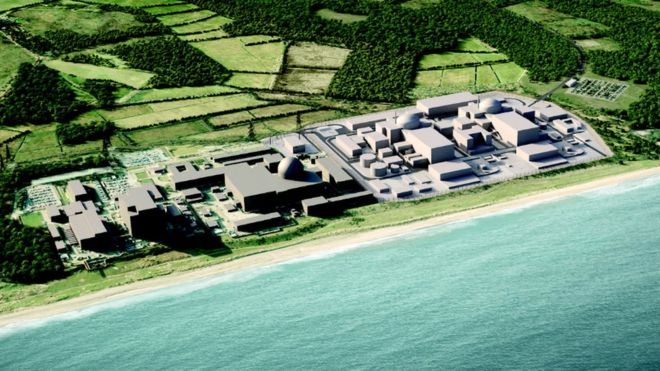
Next in line is Sizewell C in Suffolk, which is supposed to be paid for via the “fiscally dextrous” Regulated Asset Base mechanism, a new funding model that transfers risk from developers to consumers to bring in more investors. This places great financial liability unfairly and squarely on the shoulders of UK taxpayers and electricity consumers, who will be paying for huge upfront costs, inevitable delays and further cost hikes.

And there’s more. The EDF European pressurised water reactor (EPR) design, currently being built at Hinkley C and planned for Sizewell C, may have a generic fault with its most important safety feature: the reactor pressure vessel. As a result, a Chinese EPR has now been shuttered for ten months.

This is not forgetting the horrible mess across the channel, with half of EDF’s nuclear reactor fleet offline, many due to progressive corrosion. The French nuclear regulator is warning a “large-scale plan” lasting “several years” is needed.
Nuclear’s climate-friendly unique selling point (USP) is also up for grabs. Sea-level rise will increase coastal flooding, storm surges and erosion, making current coastal nuclear infrastructure increasingly obsolete. This means even more expense for any nuclear construction, operation, waste management and decommissioning – and, according to the UK Institute of Mechanical Engineers, even relocation or abandonment.

Happily, help is on the way – 256 gigawatts (GW) of non-hydro renewables were added to the world’s power grids in 2020 (nuclear added only 0.4GW). Last year, solar and wind made up three-quarters of all new generation – and with other renewables, the total figure is 84 per cent.

Even the UK investment minister recently concluded that wind farms in the North Sea will be more valuable to the UK than the oil and gas industry. There is no one left to dispute the fact that the heavy lifting of the net zero transition will be done by renewable energy.
Nuclear isn’t just slow and expensive – it’s far too inflexible to ramp up and down with the swings of demand. When the wind fails to blow and the sun doesn’t shine, that’s when grid upgrades, interconnection (which enables power to be shared between neighbouring countries), energy efficiency management, and rapidly evolving storage technology steps in to make up the difference. Nuclear’s contribution has, can and will only ever be very marginal. The reality is, it’s already well past its sell-by date.
Nuclear tragedy in the Marshall Islands
The Bulletin, By Sally Clark | May 25, 2022, We were innocent 21-year-olds entering an organization called the Peace Corps in 1969……….. Young, naive Americans, we knew little about the area, other than, perhaps, fleeting thoughts that we might find the remains of Amelia Earhart or artifacts from her plane there……….
Our naivete began to diminish when we were told the Atomic Energy Commission was coming to check out the health of the children and adults and of course to give out candy and show a dated movie. We asked questions and learned about the nuclear test over Bikini and the fallout coming down over a neighboring island, whose residents thought it was snow. We were told that the Marshallese ran outside, allowing the fallout to land on their skin, with some children putting it to their eyes. Luckily many residents sensed danger and ran to the ocean, saving themselves from a future road of at least some fallout ailments.
As we spent more time in the islands, little by little more detailed stories emerged—of still births, high cancer rates, and other radiation-related health issues. Islanders had been moved from Bikini before nuclear tests were conducted; some of the explosions were so great that one of the small islands simply vaporized, leaving a deep cavern. Many Marshallese had to endure being relocated from their blessed atoll to Kili, an island in the middle of the ocean with no lagoon.
Over the years, more and more people spoke out about such atrocities and such disregard for the Marshallese, who were actually called “savages” by a US paper in the 50’s. My heart wept as I learned more information about the scope of nuclear testing in the Marshalls.
Between 1946 and 1958, the Marshall Islands region was the site of the testing of nuclear weapons equivalent to the explosive power of 1.6 Hiroshima bombs every day for 12 years—67 in all at the Bikini and Enewetak atolls—a fact that is impossible for me to comprehend.
A resolution is now in front of the Congress asking the United States to prioritize nuclear justice in its negotiations with the Marshall Islands on an extended Compact of Free Association between the countries. The resolution recognizes that the United States nuclear testing program and radioactive waste disposal, including not just contaminated debris from the Marshalls but also material transported from the Nevada Test Site, caused irreparable material and intangible harm to the people of the Marshall Islands.
We believe this harm continues to this day. Within this resolution is a call for an apology for what the United States did to the Marshallese and to raise awareness about the need for more action to undo this harm. US Rep. Katie Porter of California and senators Mazie Hirono of Hawaii and Edward Markey of Massachusetts are spearheading this effort, which would formally apologize for the US nuclear legacy in the Marshall Islands and raise public awareness of the issue. Please write or call your representatives and senators, asking them to support House Joint Resolution 73 and Senate Joint Resolution 40.
What happened in the islands is simply incomprehensible to me. The toll on the Marshallese and the environment is impossible for me to grasp. And I have another nagging thought: Why as Peace Corps volunteers were we not warned about the radioactive fallout and the social issues we were being dropped into? Of course, there’s the implication that we were being used as pawns to smooth the relationship between the Marshall Islands and the United States and to continue to have the islanders as our friends for strategic reasons.
Who makes these decisions to drop bombs on such beautiful, pristine islands? Who sends 20-year-olds into a potentially radioactive area without warning them? When can we as a human race honor peoples around the world and get out of building weapons and gaining lands for strategic reasons? Please stop. I’m sad and weep and write letters asking for an apology. So sad. Where is our soul? https://thebulletin.org/2022/05/nuclear-tragedy-in-the-marshall-islands/
Household power bills jump as Coalition hands energy market mess to Labor — RenewEconomy

First rise in household bills announced, conveniently delayed until after election as Coalition hands its energy mess to Labor and the cross bench. The post Household power bills jump as Coalition hands energy market mess to Labor appeared first on RenewEconomy.
Household power bills jump as Coalition hands energy market mess to Labor — RenewEconomy
Big Banana: CS Energy signs up for French nuclear giant’s first Australian wind farm — RenewEconomy

Queensland state owned utility gives go-ahead to the first wind farm to be built in Australia by the renewables offshoot of French nuclear energy giant EdF. The post Big Banana: CS Energy signs up for French nuclear giant’s first Australian wind farm appeared first on RenewEconomy.
Big Banana: CS Energy signs up for French nuclear giant’s first Australian wind farm — RenewEconomy
Neighbourhood Batteries: To bring power to the people, you need to listen to what they want — RenewEconomy

Does the value of neighbourhood batteries stack up? And do they cut emissions? Local communities will want to know. The post Neighbourhood Batteries: To bring power to the people, you need to listen to what they want appeared first on RenewEconomy.
Neighbourhood Batteries: To bring power to the people, you need to listen to what they want — RenewEconomy
May 25 Energy News — geoharvey

Opinion: ¶ “Australians Voted For Stronger Action On Climate Change. Will They Get It?” • Australia’s new prime minister mentioned the words “climate change” four times within two minutes of his maiden international speech. But experts say it won’t be easy to turn around a coal-powered ship that has been chugging in the wrong direction […]
May 25 Energy News — geoharvey
1 This month.


PETITION – To: Prime Minister Anthony Albanese and the Australian Labor Government
Chernobyl: The Lost Tapes – A good documentary on Chernobyl on SBS available On Demand for the next 3 weeks– https://www.sbs.com.au/ondemand/tv-program/chernobyl-the-lost-tapes/235274195556

19 May – Webinar- Webinar: No Nuclear Weapons in Australia
Start: 2026-05-19 18:00:00 UTC Canberra, Melbourne, Sydney (GMT+10:00)
End: 2026-05-19 19:30:00 UTC Canberra, Melbourne, Sydney (GMT+10:00)
20 May – Webinar – The dangerous world of AUKUS, US, military occupation and suppression of dissent

National Webinar, 20th May, 2026, 6.30pm AEST. Confronting laws restricting/suppressing protest speech and action
Speakers: Former Sen. Rex Patrick, Lawyer Nick Hanna ,Arthur Rorris ,Jorgen Doyle, Sen David Shoebbridge,
Facilitator Kelley Tranter.

of the week – Australians for War Powers Reform (AWPR)
To see nuclear-related stories in greater depth and intensity
 Antinuclear