US submarines carrying nuclear weapons could dock in Australia despite ban, Senate told.
Defence secretary appears to contradict previous assurances from Penny Wong that only conventionally armed submarines will visit Australian ports under Aukus deal.
Ben Doherty, 5 Dec 25, https://www.theguardian.com/australia-news/2025/dec/05/us-submarines-nuclear-weapons-australia-aukus
US submarines carrying nuclear weapons could dock at Australian bases, defence officials have told the Senate, and the Australian government and people would not know.
Senate estimates heard fierce debate over whether US Virginia-class submarines – set to “rotate” through Australian ports from 2027 as part of the contentious Aukus agreement – could carry nuclear weapons. Nuclear weapons are prohibited in Australia.
Defence department officials told senators there was “no impediment” to submarines armed with nuclear weapons visiting Australia, insisting that any such visit would not breach Australian or international law.
The US maintains a policy of “strategic ambiguity” around its nuclear deployment and it refuses to confirm or deny whether aircraft or seagoing vessels capable of carrying nuclear weapons are, in fact, carrying a nuclear warhead.
That ambiguity would apply to US submarines that might dock at Australian ports, as it now does to nuclear-capable B-52 bomber aircraft landing at RAAF Base Tindal in the Northern Territory, which is being upgraded to be able to accommodate more US bombers.
“We respect the United States position of neither confirming nor denying,” the Australian defence department secretary, Greg Moriarty, told the Senate.
But anti-nuclear campaigners and some senators argue that the evidence to the Senate undermines Australia’s non-proliferation commitments and risks making the country “a launchpad for nuclear war”.
They also say the acquiescence to US ambiguity over its nuclear weapons contradicts the foreign affairs minister’s assurance in a 2023 speech that only conventionally armed submarines would visit Australia.
“The US has confirmed that the nuclear-powered submarines visiting Australia on rotation will be conventionally armed,” Penny Wong told the National Press Club.
Sign up: AU Breaking News email
US Virginia-class submarines are to begin rotating through Australian ports – part of pillar one of the Aukus agreement – from 2027, before Australia buys then builds its own nuclear-powered, conventionally armed submarines.
The US Congress approved funding in 2024 for a new submarine- and ship-launched nuclear missile – the first new US nuclear weapon since the end of the cold war. The SLCM-N weapon is slated to be operational within a decade and Vice-Admiral Johnny Wolfe has told Congress that the weapons program is “focused on the integration of SLCM-N into the Virginia-class submarine”.
The South Pacific nuclear free zone treaty – known as the Treaty of Rarotonga and to which Australia is a party – prohibits the “stationing” of nuclear weapons in Australia (and the broader South Pacific zone). But Australia maintains that a US submarine, potentially armed with nuclear weapons, is not prohibited from visiting an Australian port.
Bernard Philip, assistant secretary of international policy at the Department of Defence told the Senate Australia would comply with its treaty obligations, which were also understood by the US.
“The United States does not station nuclear weapons in Australia,” he said. “Stationing nuclear weapons in Australia is prohibited by the South Pacific nuclear free zone treaty, to which Australia remains committed.
“There is no impediment under the Treaty of Rarotonga and the Treaty on the non-proliferation of nuclear weapons to the visit of dual-capable foreign platforms to Australia’s territory or transiting Australia’s airspace or waters.”
Dual-capable platforms are those able to carry both conventional and nuclear weapons. Defence officials said nuclear missiles deployable on Virginia-class submarines were still in development, labelling the scenario “hypothetical”.
The Australian director of the International Campaign to Abolish Nuclear Weapons, Gem Romuld, said the foreign minister’s commitment that nuclear weapons would not be rotating through Australia was now “dead in the water”.
“It’s taken just two years for expectations of an Aukus partner to shift, so what will come next?” she said.
“If Aukus is ‘not about nuclear weapons’, then Australia’s numerous assurances must be backed up with legal commitments. The best way to draw the line on nuclear weapons is to sign and ratify the UN Treaty on the Prohibition of Nuclear Weapons.”
Labor has formally committed in its party platform to signing and ratifying the weapons ban treaty “in government” but it has not yet signed done so. Seventy-four countries are now party to the treaty: none of the nine nuclear-armed states have signed it.
The Greens senator David Shoebridge asked in Senate estimates: “So we’re going to permit them to be sitting, floating off Fremantle in US-Virginia class submarines, and is it still the position that the Australian government won’t ask the US whether or not they’re nuclear-armed submarines, just like we don’t ask about the nuclear-armed B-52s?
“Is that still the position? Don’t ask, don’t tell?”
The secretary of the defence department said: “We respect the United States’ position of neither confirming nor denying.”
Earth’s Greatest Enemy, the second feature film project by Abby Martin, is a groundbreaking anti-imperialist environmental documentary.
Exempt from international climate agreements and rarely scrutinized in mainstream reporting, the Pentagon is the world’s single largest institutional polluter—spewing carbon, contaminating water, and scarring landscapes across the globe. Combining investigative journalism, striking visuals, and stories from impacted communities, this film challenges audiences to rethink the hidden costs of a global military empire and its planetary consequences. Provocative, urgent, and eye-opening, this is a documentary that will change how you see both the military and environmentalism. https://earthsgreatestenemy.com/
No fog, no war. Hegseth’s war crimes put Australian soldiers at risk.

by Michael Pascoe | Dec 3, 2025, https://michaelwest.com.au/no-fog-no-war-hegseths-war-crimes-put-australian-soldiers-at-risk/
Australian service personnel are embedded with a rogue military force committing war crimes. It is testimony to the Australian Government’s lack of integrity that they are not being recalled.
Australian service personnel are embedded with a rogue military force committing war crimes. It is testimony to the Australian Government’s lack of integrity that they are not being recalled.
As an American Admiral, Frank “Mitch” Bradley is at least likely to know of the episode that made Eck and co infamous – murdering the survivors of a Greek freighter their U-boat had sunk. Their victims were in lifeboats and clinging to wreckage in the South Atlantic night as they were machinegunned and attacked with hand grenades and small arms. Two of them had been taken aboard the U-boat for interrogation before being returned to the water and their death.
Eck, Weispfennig and Hoffmann were convicted at Nuremberg and executed by firing squad in October 1946.
Bradley, following Hegseth’s orders, didn’t use anything as primitive as small arms to kill the two survivors of a Venezuelan speedboat that had been hit by an American missile in international waters. From the comfort and safety of Fort Bragg in North Carolina, he sent another missile to blow them apart.
Since the Washington Post reported the crime on Friday night, the Trump administration has flipped and flopped between straight denial, outrage and careful wording as even some Republican politicians sensed a bridge too far.
Any denials by Trump, White House press secretary Karoline Leavitt and Hegseth, of course, have all the credibility of Trump, Leavitt and Hegseth. The MAGA mob can be guaranteed to roll on to its next scandal, increasingly misusing the most powerful military machine the world has ever seen as its supra-legal hit squad, broadcasting snuff movies to prove it.
Fog of war?
Overnight, as the denials and obfuscations could not be sustained, Trump and Hegseth confirmed and defended murdering the survivors of the original strike.
With enormous gall, Hegseth is citing “fog of war” and criticising journalists sitting in air-conditioned offices planting “fake stories”. Bradley and the cowards who carried out his orders were in air-conditioned comfort themselves, nowhere near any frontline or danger.
Hegseth is working his way through the usual pattern of a worm caught in scandal: first denial, then distancing as denial falters, penultimately defending, relying on Trumpistas being above the law. Beware the usual fourth step, distraction.
It’s taken the major Australian media outlets a little while to begin to cotton on to the depravity of murdering helpless survivors. As Todd Huntley, the director of the National Security Law program at Georgetown University Law Center and previously a judge advocate in the US Navy for more than two decades, told The New Yorker:
“Basically, this is the one strike that we know about where even if you accept the Administration’s position that the United States is in an armed conflict with these drug cartels, this would still be unlawful under the laws of armed conflict, because the individuals were out of the fight and shipwrecked, and thus owed protection.”
The ”even if” in that sentence is one that nobody outside the MAGA diehards and their apologists accepts. The overwhelming legal opinion is that blowing up civilian boats – the summary executions – are criminal actions. There’s been plenty written on what the theatre off the Venezuelan coast is really about; the one sure thing is
it has nothing to do with stopping fentanyl reaching the US.
Australians embedded
It’s become trite to quote Lieutenant-General David Morrison, saying as chief of the Australian Army that “the standard you walk by is the standard you accept”.
Besides, the Australian Government of Albanese, Marles and Wong doesn’t walk past the Trump slime, it embraces it, welcomes it, pledges allegiance to it, pays it protection money,
pimps out our nation for it and sends Australian men and women to serve it.
The last is ethically unsustainable. We have moved well beyond the merely cringing embarrassment of smiling Marles and Hegseth photo ops to questions of complicity as we facilitate America’s armed forces’ criminal acts
Distinguished former US officers have publicly warned troops not to follow illegal orders from the Trump gang and have been threatened by Trump for doing so. What has Australia’s Chief of Defence Force, Admiral David Johnston, told his people before handing them over to the likes of Admiral Bradley?
It is time to show just a little spine by bringing our troops home. That we are incapable of prosecuting our own war criminals is not an excuse for potentially creating more.
Marles mute on troops embedded
How many people are we putting in harm’s way? I don’t know. An email request to Marles’ defence media office has gone unanswered for more than 24 hours as I write. I wanted to know how many Australians are embedded or on exchange with the US military and in what areas.
In response to a question by Senator Jacqui Lambie in July, Defence answered that there were 193 ADF and APS personnel embedded in the US just for the first phase of AUKUS.
Instead of pursuing inane beatups about where Chinese ships in the Philippine Sea might be sailing for Christmas, maybe a press gallery with a clue could ask Marles at his next media performance if any Australian personnel are embedded with US Navy SEAL teams, the units carrying out Hegseth and Bradley’s illegal orders to murder.
Questions for the Government
For that matter, any Australian Government politician at any occasion should be asked if we share America’s values on war crimes, to what extent our nominally Australian Pine Gap and Exmouth facilities are being used for illegal military action against civilians off Venezuela, if we would support US military action against Venezuela, if they think Hegseth is even fit to return to his gig as a Fox News weekend clown, let alone remain as the US “Secretary for War”.
There are so many good questions to ask, but hey, watch the gallery stick to safe Sinophobia baiting and the usual horse race politics.
I can already hear the argument that the US has always been like this, fond of extra-judicial killings. True, there’s more than a century of invasions and covert and overt action overthrowing governments, good and bad, usually replacing them with something worse.
There are legal niceties, though, in the rules of war. Those rules have been bent and twisted to suit, most recently in the “War on Terror”, but this is something different, a different level of state evil.
Context was provided in The New Yorker’s interview with Todd Huntley:
“I think it’s the intentional nature of it. In most of those other situations where U.S. attacks have killed civilians, the deaths were due to either faulty intelligence, a faulty assessment of the facts, or an accident. This one seems to have been very clearly intentional. I think that is one thing that makes it much different, and on some level worse, because if you’re looking at the use of force in an armed conflict and you have violations, not everything rises to the level of a war crime.
This is a war crime.
And by keeping silent, by pursuing our policy of enmeshing our military with the US military, we are making Australia complicit.
Michael Pascoe
Michael Pascoe is an independent journalist and commentator with five decades of experience here and abroad in print, broadcast and online journalism. His book, The Summertime of Our Dreams, is published by Ultimo Press.
.
Government backflips on nuclear-capable submarines under AUKUS

The International Campaign to Abolish Nuclear Weapons (ICAN) has warned of escalating nuclear risks after Senate Estimates confirmed the government would not stand in the way of US Virginia-class submarines entering Australian waters while armed with nuclear weapons.
The Australian Government has acknowledged it would permit visits by US Virginia-class submarines that may carry nuclear weapons in future—a direct contradiction of Foreign Minister Penny Wong’s assurance at the National Press Club in April 2023 that AUKUS submarines visiting Australia would be conventionally armed.
During Senate Estimates on Wednesday night, senior Defence officials acknowledged that there is “no impediment” under Australian policy or treaty obligations to the visit of dual-capable platforms—an aircraft, submarine or missile designed to carry either conventional weapons or nuclear weapons—and that Australia would continue to respect the US policy of neither confirming nor denying the presence of nuclear weapons.
This means Australians could unknowingly host US or UK nuclear weapons offshore—with no right to be told.
Gem Romuld, Director of ICAN Australia, said:
“The Foreign Minister’s assurance that nuclear weapons won’t be rotating through Australia is now dead in the water. It’s taken just two years for expectations of an AUKUS partner to shift, so what will come next?
If AUKUS is ‘not about nuclear weapons’, then Australia’s numerous assurances must be backed up with legal commitments. The best way to draw the line on nuclear weapons is to sign and ratify the UN Treaty on the Prohibition of Nuclear Weapons.”
The Estimates exchange centred on the United States’ nuclear-armed sea-launched cruise missile program (SLCM-N), which the US Congress has directed the Navy to develop. Experts, including CNA analyst Decker Eveleth, have publicly confirmed these weapons can be deployed on Virginia-class submarines, the same class Australia is preparing to host at HMAS Stirling as early as 2027.
National Labor policy commits the government to sign and ratify the Treaty on the Prohibition of Nuclear Weapons (TPNW). Successive Labor conferences have reaffirmed this commitment, and more than 300 federal, state and local parliamentarians have signed the ICAN parliamentary pledge.
Romuld said:
“Australia is a strong proponent of the 1970 nuclear Non-Proliferation Treaty (NPT), an essential multilateral agreement but one that is no longer fit for purpose. The TPNW extends the work of the NPT to meet the challenges posed by today’s nuclear risks, and in finally comprehensively outlawing these weapons of mass destruction,”
“National Labor policy commits to signing and ratifying the TPNW in government, a promise yet to be delivered. It’s time for Australia to move on from just engaging with this treaty to putting pen to paper. The Prime Minister championed it and now has a responsibility to enact his policy before Australia becomes a launchpad for nuclear war.
“Both of our AUKUS partners are heavily armed with nuclear weapons. As a nation opposed to nuclear weapons, signing the TPNW puts essential protections and future-proofing in place for our country and our region.”
Australia’s New Censorship Is Voluntary – and That’s Why It’s Dangerous

Is a journalist free if they must first seek permission to tell the truth?
4 December 2025, David Tyler, https://theaimn.net/australias-new-censorship-is-voluntary-and-thats-why-its-dangerous/
When journalists internalise the state, the state no longer needs to silence them.
Australia has discovered the most polite form of censorship ever devised. No jackboots, no warrants, no midnight raids; just a quiet conversation, a “national security” reminder, and journalists voluntarily silencing themselves. Why pass laws when you can persuade the press to behave as though they already exist?
This is not satire. It is policy. And its blueprint comes straight from Whitehall.
The Quiet Request
Three weeks after Labor took office in June 2022, officials in Attorney‑General Mark Dreyfus‘s department reached across hemispheres to Britain’s Ministry of Defence. Their purpose was not military cooperation, intelligence sharing, or treaty work. It was media control; specifically, how to make censorship unnecessary by convincing journalists to do it to themselves.
The model: Britain’s Defence and Security Media Advisory Committee (DSMA).
The tool: a pre‑publication vetting mechanism disguised as collaboration.
The tone: “voluntary.”
The effect: silent.
DIY censorship? Brilliant.
Not a Draft. An Import.
Freedom of Information documents show this was not curiosity. It was a virtual IKEA flat‑pack – imported, piece by bureaucratic piece, from the mother country to its former colony. The assembly instructions came straight from London. A spare Allen key always comes in handy.
- 2019: Days after Federal Police raided ABC and News Corp offices over war‑crimes reporting, red‑faced Australian officials began attending DSMA sessions in London.
- 2021–2022: Bureaucrats refined plans for a “similar role” in Australia.
- May 2022: Secret roundtables with major editors were held. No minutes. No attendee lists. No sunlight.
- June 2022: Dreyfus’s department formally requested London’s assistance.
The continuity is chilling. Liberal ministers started the project. Labor ministers continued it. Bureaucratic inertia was the constant.
This isn’t a partisan conspiracy. It’s worse: a bipartisan agreement that journalists must learn to censor themselves politely.
How Britain Silences Without Silencing
DSMA is a masterpiece of bureaucratic subtlety. It issues “advisories,” not bans. Journalists “consult” before publishing, rather than submit for approval. A discreet military officer suggests what to omit “for national security,” while the state never dirties its hands with formal censorship laws.
The committee’s proceedings are confidential.
Its members are hidden.
Its advice is non‑binding.
Yet it boasts a 90% success rate persuading journalists not to publish.
Dissent hasn’t been criminalised; it has been professionalised. To ignore DSMA advice invites prosecution under the Official Secrets Act – or, more immediately, career suicide. The threat is legal, but the engine is cultural.
This is what Canberra admires: not censorship, but managed consent. The state doesn’t punish critics. The critics simply internalise the state. Intuit the boss’ wishes, a bit like a Murdoch editor.
The Dreyfus Paradox
Mark Dreyfus once helped chisel the High Court’s implied freedom of political communication into Australia’s constitutional framework. He argued that democracy depends on journalists criticising power freely.
Journalist training programs
And now? His department has chased a censorship model whose brilliance lies in never admitting it exists.
This isn’t hypocrisy. It’s absorption. Dreyfus didn’t renounce principle; he was subsumed by machinery. You don’t have to betray your beliefs if the institution performs the betrayal for you.
He thought he was protecting national security. What he safeguarded was secrecy itself.
The Machinery
This project did not dissolve when ministers changed. It doesn’t depend on elections. The relationships with UK Defence persist. Editors who attended closed‑door sessions still hold their seats. Bureaucrats continue to discuss frameworks for “voluntary advisory mechanisms.”
And the scaffolding grows stronger through parallel controls:
- Harsher secrecy offences that criminalise public‑interest reporting.
- Online misinformation laws with ministerial discretion over speech.
- Digital identity requirements for internet access.
- Discussion papers on journalist registration systems.
Individually, each seems modest. Together, they form something like a velvet‑lined cage.
The Respectable Mask
Systems like DSMA need legitimacy. Enter Peter Greste: a journalist jailed in Egypt, a symbol of press freedom, a moral compass. Conference transcripts show him engaging with advocates of reviving the Australian D‑Notice system, DSMA’s predecessor.
The argument attributed to him is seductive: pre‑publication consultation protects journalists from prosecution. Ask permission; avoid jail.
And in the process, a core civic principle collapses quietly under manners and moral suasion.
The Question
Australia must stop asking whether a DSMA system will be adopted. It already has been – culturally.
The question is whether Australians still believe freedom of political communication is a public right or whether it has become a regulated professional privilege.
Is a journalist free if they must first seek permission to tell the truth?
That’s the moment democracy becomes polite enough to disappear; and the risk now confronting every newsroom in the country.
* * * * *
CLARKE & DAWE: HOW TO SILENCE A COUNTRY WITHOUT LAWS
SETTING: Parliament House lawn.
BRYAN DAWE holding freshly printed FOI documents.
JOHN CLARKE appears as a senior official from the “Department of National Information Harmony,” calm, courteous, and utterly terrifying.
BRYAN DAWE: John, your department has been in discussions with the UK about its Defence and Security Media Advisory system.
JOHN CLARKE: Yes, Bryan. Very sensible. A voluntary censorship system.
BRYAN DAWE: Voluntary censorship?
JOHN CLARKE: Correct, Bryan. It’s censorship that journalists choose.
BRYAN DAWE: Why would journalists choose to censor themselves?
JOHN CLARKE: National security, Bryan. Also career security. Also avoiding prosecution. And staying in the good books.
BRYAN DAWE: So the government isn’t forcing them?
JOHN CLARKE: No, Bryan. That would look terrible. We simply provide advice about what not to publish.
BRYAN DAWE: And the journalists follow it?
JOHN CLARKE: Over 90% of the time, Bryan. Very cooperative species.
BRYAN DAWE: Doesn’t this undermine press freedom?
JOHN CLARKE: Not at all, Bryan. The press is free to comply.
BRYAN DAWE: FOI documents show your department approached the UK three weeks after Labor was elected.
JOHN CLARKE: Correct. But the previous government started it. It’s bipartisan secrecy, Bryan. The safest kind.
BRYAN DAWE: So both sides agree on this system?
JOHN CLARKE: Absolutely. It avoids embarrassment across the aisle. Truly unifying.
BRYAN DAWE: What is the advantage of a voluntary censorship system?
JOHN CLARKE: You never need to admit you’re censoring anything. The media does it for you. It’s very efficient.
BRYAN DAWE: And what if journalists refuse?
JOHN CLARKE: They are still free to refuse, Bryan. Then they can be prosecuted. Freely.
BRYAN DAWE: John, isn’t democracy supposed to rely on an independent press?
JOHN CLARKE: Yes, Bryan. Which is why the press must work closely with the government.
BRYAN DAWE: That sounds like dependency, not independence.
JOHN CLARKE: Independence is most reliable when it is professionally supervised, Bryan.
BRYAN DAWE: So transparency is preserved?
JOHN CLARKE: Entirely, Bryan. We always encourage transparency; provided it has been cleared with us first.
BRYAN DAWE: John, is this censorship?
JOHN CLARKE: No, Bryan. It’s voluntary. Only the consequences are compulsory.
This article was originally published on URBAN WRONSKI WRITES
Towards a transparent and responsible management of radioactive waste (a view from Canada)

Ottawa, December 4, 2025, www.ccnr.org/release_radwaste_transport_2025.pdf
Bloc Québécois spokesperson for the Environment and Climate Change, Patrick Bonin, held a press conference on December 2 on Parliament Hill in Ottawa, alongside Lance Haymond, Chief of the Kebaowek First Nation, Lisa Robinson, Chief of the Wolf Lake First Nation, and representatives of several environmental and anti-radioactive-pollution groups to co-sign a letter along with more than 80 environmental associations, elected officials, trade unions, and First Nations representatives in Ontario, Quebec and the Rest of Canada, calling for a moratorium on the transport of radioactive waste over public roads and bridges to the Chalk River site located beside the Ottawa River. [See the letter in English and French at www.ccnr.org/letter_e_f_2025.pdf ]
The signatories are calling on the federal government to ban, among other things, all imports of radioactive waste from other countries, including disused medical sources, expired tritium light sources, and irradiated nuclear fuel.
They are also calling on the Minister of Environment and Climate Change to conduct a strategic assessment of the transport of high-level and intermediate-level radioactive waste on public roads.
Quotes:
Ginette Charbonneau, spokesperson for the Coalition Against Radioactive Pollution, deplores the fact that “it is irresponsible to transport all radioactive waste under federal jurisdiction to Chalk River. It is doubly dangerous to transport the waste twice: once for temporary storage at Chalk River and a second time to its final destination.”
Gordon Edwards, Ph.D., president of the Nuclear Watchdog Canadian Coalition for Nuclear Responsibility, states that “The Age of Nuclear Waste is just beginning. It’s time to stop and think. First, we must stop moving the waste. This only increases the costs and the risks without solving the problem. Second, we must think of the need for three things – justfiication, notification, and consultation – before moving any of this dangerous human-made cancer-causing material over public roads and bridges.”
Jean-Pierre Finet of the Regroupement des organismes environnementaux en énergie (Alliance of Environmental Organizations on Energy) states, “We wholeheartedly support the call for a moratorium on the transport and importation of waste and the request for a strategic environmental assessment. We believe that Chalk River must cease to be our government’s nuclear waste dump.”“
“In 2017, Ottawa residents were denied a regional environmental impact assessment of radioactive wastes accumulating alongside the Ottawa River. Given all the proposed waste transfers underway and yet to be implemented, a strategic assessment is more urgent than ever,” explains Dr. Ole Hendrickson of the Ottawa River Institute.
“The government is willing to accept unacceptable risks, to silence affected nations, and to operate without any transparency or accountability,” says Lance Haymond, Chief of the Kebaowek First Nation. “We have learned long ago: Silence is Consent. We will not be silent.”
Lisa Robinson, Chief of the Wolf Lake First Nation, Canada, says, “We are all calling on Canada to do better with the nuclear situation in storage and transportation, and we call on all Canadian to insist on complete accountability for the tens of billions of dollars of public money that is being spent by those hired to manage these indestructible radioactive wastes.”
Contacts :
English
Gordon Edwards, Canadian Coalition for Nuclear Responsibility, Montreal
– ccnr@web.ca 514-839-7214
Ole Hendrickson, Concerned Citizens of Renfrew County and Area, Ottawa
– oleqhendrickson@gmail.com 613-735-4876
Brennain Lloyd, Northwatch, We the Nuclear Free North, North Bay, Ontario
– brennain@onlink.net 705-493-9650
French/English
Ginette Charbonneau Ralliement contre la pollution radioactive Oka (Québec)
– ginettech@hotmail.ca 514=246-6439
Jean-Pierre Finet, Regroupement des organismes environnementaux en énergie, Montréal
– pierre.finet@gmail.com 514-515-1957
Eva Schacherl, Council of Canadians – Ottawa
– evaschacherl@gmail.com 613-316-9450
Article: Transferts de déchets radioactifs à Chalk River | Le Bloc québécois reçoit de
nombreux appuis et ravive son appel à un moratoire | La Presse
Watch the press conference : Le Bloc demande un moratoire sur le transport de matières nucléaires | À la une | CPAC.ca
Link to the letter:letter_e_f_2025.pdf
Signatories of the letter…………………………………………………………………….
Solar and wind reach 100 pct of demand in biggest isolated grid, as batteries allow it to keep its thermals on.

Solar and wind reached a remarkable new milestone in Western Australia’s
isolated grid over the weekend, reaching 100 per cent of demand at various
occasions on Sunday morning, as the state’s growing fleet of batteries
allowed coal and gas generators to keep running in the background. The W.A.
grid, with no links to other states, is becoming a fascinating focal point
for the green energy transition, largely because of the huge impact of
rooftop solar and the high levels of variable renewables seen on almost a
daily basis.
Renew Economy 2nd Dec 2025, https://reneweconomy.com.au/solar-and-wind-reach-100-pct-of-demand-in-biggest-isolated-grid-as-batteries-allow-it-to-keep-its-thermals-on/
South Australia averages 100 pct wind and solar over week, 90 pct over last 28 days

South Australia – the country’s most advanced renewables grid – has
average more than 100 per cent net renewables (compared to state demand)
over the past week, and more than 90 per cent renewables over the last 28
days. It is not the first time that South Australia has reached 100 per
cent renewables – it has done so previously over the Christmas/New Year
period – but it marks a significant milestone, given that its mix of
renewables is made up entirely of variable wind and solar, and with no
hydro or even biomass to speak of.
Renew Economy 2nd Dec 2025, https://reneweconomy.com.au/south-australia-averages-100-pct-wind-and-solar-over-week-90-pct-over-last-28-days/
The architecture of a vassal: how US bases in Australia project power, not protection.
2 December 2025 Andrew Klein, https://theaimn.net/the-architecture-of-a-vassal-how-us-bases-in-australia-project-power-not-protection/
The strategic placement of key US and joint military facilities across Australia reveals a pattern not of national defence, but of integration into a global, offensively-oriented network for force projection and intelligence gathering. An analysis of their locations and functions demonstrates that these bases are designed to serve the strategic interests of a superpower, often at the expense of Australian sovereignty and security.
The Official Rationale: A Volatile Region and the Strategy of Denial
According to official Australian government assessments, the strategic environment is increasingly volatile, characterised by falling international cooperation, rising competition, and uncertainty about US reliability. In response, Australia’s National Defence Strategy: 2024 has adopted a “strategy of denial,” emphasising deterrence as its primary objective. This policy shift is used to justify initiatives such as:
- Acquiring nuclear-powered submarines through AUKUS.
- Upgrading and expanding northern military bases.
- Acquiring new long-range strike capabilities.
The public-facing logic is that longer-range weapons have overturned Australia’s geographic advantage, making the “sea-air gap” to the north a vulnerability. However, a closer examination of the specific facilities tells a different story.
Pine Gap: The Beating Heart of Global Surveillance
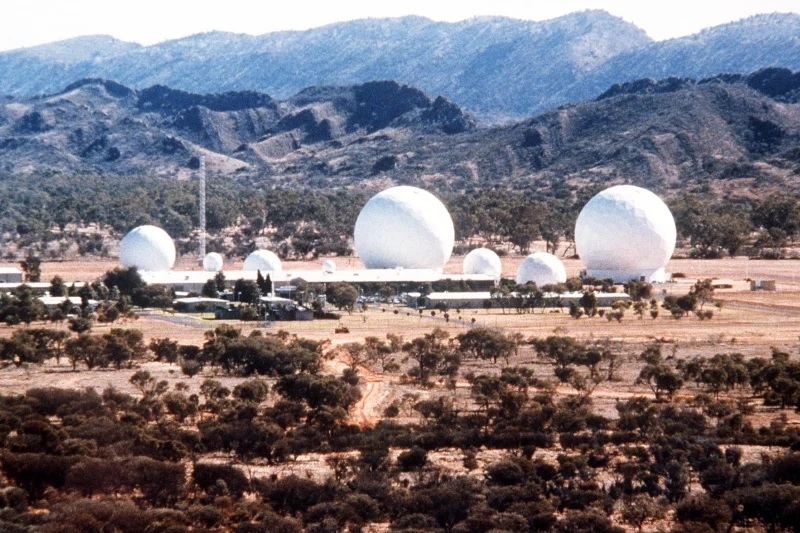
The Joint Defence Facility Pine Gap, near Alice Springs, is the most prominent example. Ostensibly a joint facility, it is a critical node in US global intelligence. Its functions extend far beyond any defensive mandate for Australia.
- Global Signals Intelligence: Pine Gap acts as a ground control and processing station for US geosynchronous signals intelligence (SIGINT) satellites. These satellites monitor a vast swath of the Eastern Hemisphere, collecting data including missile telemetry, anti-aircraft radar signals, and communications from mobile phones and microwave transmissions.
- Warfighting and Targeted Killing: Information from Pine Gap is not merely for analysis. It is used to geolocate targets for military action. The base has played a direct role in US drone strikes and has provided intelligence in conflicts from Vietnam and the Gulf War to the ongoing wars in Gaza. Experts testify that data downlinked at Pine Gap is passed to the US National Security Agency and then to allies like the Israel Defense Forces, potentially implicating Australia in international conflicts without public knowledge or parliamentary oversight.
- A History of Secrecy and Sovereignty Betrayed: The base’s history is marked by breaches of Australian sovereignty. During the 1973 Yom Kippur War, the US government placed Pine Gap on nuclear alert (DEFCON 3) without informing Australian Prime Minister Gough Whitlam. Whitlam’s subsequent consideration of closing the base was followed by his dramatic dismissal in 1975, an event that former CIA officers have linked to US fears over losing access to the facility.
Northern Bases: Launchpads for Power Projection
The network of bases across Australia’s north forms an arc designed for forward operations, not homeland defence.
- RAAF Base Tindal: This base in the Northern Territory is undergoing upgrades to host US B-52 strategic bombers. This transformation turns Australian territory into a forward operating location for long-range strike missions deep into Asia, fundamentally changing the nation’s role from a sovereign state to a launching pad for another power’s offensive operations.
- Marine Rotational Force – Darwin: The stationing of up to 2,500 US Marines in Darwin functions as a persistent force projection and logistics hub, enhancing the US ability to rapidly deploy forces into the Southeast Asian region.
- NW Cape (Harold E. Holt): The facility in Exmouth, Western Australia, hosts advanced space radar and telescopes for “space situational awareness.” This contributes to US space warfare and communications capabilities, a global mission with little direct relation to the defence of Australia’s population centres.
The True Cost: Compromised Sovereignty and Incurred Risk
This integration into a superpower’s military apparatus comes with severe, often unacknowledged, costs.
- The Loss of Sovereign Control: The operational control of these critical facilities is often ceded to the United States. At Pine Gap, the chief of the facility is a senior CIA officer, and certain sections, such as the NSA’s cryptology room, are off-limits to Australian personnel. This creates a situation where activities conducted on Australian soil are not fully known or controlled by the Australian government.
- Becoming a Nuclear Target: The critical importance of bases like Pine Gap to US global military dominance makes them high-priority targets in the event of a major conflict. By hosting these facilities, Australia voluntarily assumes the risk of being drawn into a nuclear exchange, a strategic decision made without public debate.
- Complicity in International Conflicts: As the protests and legal actions surrounding Pine Gap’s role in Gaza highlight, Australia faces legal and moral accusations of complicity in actions that may constitute war crimes or genocide. This places the nation in direct opposition to international law and global public opinion, all for the sake of an alliance that often prioritises US interests.
Conclusion: From Independent Ally to Integrated Base
The evidence is clear: the strategic network of US-linked bases in Australia is not primarily for the nation’s defence. It is the architecture of a vassal state, designed to service the global force projection and intelligence-gathering needs of a superpower. From the satellite surveillance of Pine Gap to the bomber forward deployment at Tindal, these facilities entangle Australia in conflicts far beyond its shores, compromise its sovereignty, and incur immense strategic risks. Until this fundamental reality is confronted, Australian defence policy will continue to serve an empire’s interests, not its own.
References…………………
Australia’s most advanced renewable grid is its most secure, but NSW must scramble as it nears “no coal” scenario.
South Australia, the most advanced renewable grid in the country and even
the world – thanks to its unrivalled near 75 per cent share of wind and
solar – is also the most secure, according to a major new report on the
state of the energy transition.
The Transition Plan for System Security,
published on Monday by the Australian Energy Market Operator, identifies
South Australia as the only state grid which is not facing a system
strength deficit in coming years.
That’s largely because South Australia
went first, and it went hard and fast. Its last coal fired power station
closed in 2016, and because it has such a high percentage of wind and
solar, as well as rooftop PV, it has had to deal with the issues around
frequency control, inertia and system strength before other states. South
Australia, the most advanced renewable grid in the country and even the
world – thanks to its unrivalled near 75 per cent share of wind and solar
– is also the most secure, according to a major new report on the state
of the energy transition.
When the new transmission link to NSW is complete in 2027, South Australia will
be the first in the world to be able to run its gigawatt scale grid at
times with “engines off” – i.e. no gas plant required for bulk power
or system security – as it nears or even achieves its target of reaching
100 per cent net renewables.
Renew Economy 1st Dec 2025, https://reneweconomy.com.au/australias-most-advanced-renewable-grid-is-its-most-secure-but-nsw-must-scramble-as-it-nears-no-coal-scenario/
Inside the power-hungry data centres taking over Britain

Our thirst for AI is fuelling a new construction wave: of giant data centres. But can ourelectricity and water systems cope — and what will the neighbours say?
Plants [like the one] run by the company Stellium on the outskirts of
Newcastle upon Tyne, are springing up across the country.
There are already
more than 500 data centres operating in the UK, many of which have been
around since the Nineties and Noughties. They grew in number as businesses and governments digitised their work and stored their data in outsourced “clouds”, while the public switched to shopping, banking and even tracking their bicycle rides online.
But it was in 2022, when a nascent
technology company called OpenAI launched ChatGPT, that the world woke up to the potential of AI and large language models to change the way the planet does, well, just about everything.
It can do this thanks largely to advances in chip design by the US company Nvidia — now the world’s most valuable (and first $5 trillion) business. The trouble is, a typical 4334wChatGPT query needs about ten times as much computing power — and electricity — as a conventional Google search.
This has led to an
explosion in data centres to do the maths. Nearly 100 are currently going
through planning applications in the UK, according to the research group
Barbour ABI. Most will be built in the next five years. More than half of
the new centres are due to be in London and the home counties — many of
them funded by US tech giants such as Google and Microsoft and leading
investment firms. Nine are planned in Wales, five in Greater Manchester,
one in Scotland and a handful elsewhere in the UK.
The boom is so huge that
it has led to concerns about the amount of energy, water and land these
centres will consume, as residents in some areas face the prospect of
seeing attractive countryside paved over with warehouses of tech. Typically
these centres might use 1GW (1,000MW) of electricity — more power than is
needed to supply the cities of London, Birmingham and Manchester put
together.
Times 29th Nov 2025, https://www.thetimes.com/business/technology/article/inside-britains-ai-data-centre-boom-can-the-grid-keep-up-jllzb3b0p
CT scans: benefits vs cancer risks

Program: CT scans: benefits vs cancer risks
CT scans can be vital in diagnosing disease, but they do come with small
increased risks because of the radiation exposure. A recent US study found
that if current practices persist, CT-associated cancer could account for
up to five per cent of all new diagnoses. So what can be done to drive down
the risk? One radiologist thinks mandating informed consent before a scan
is done would be a good start.
ABC 28th Nov 2025, https://www.abc.net.au/listen/programs/healthreport/ct-scans-cancer-radiation-risk/106076780
Non corporate-nuclear-military-politics-media-complex news this week

Some bits of good news –
Nations hatched a plan to abandon fossil fuels
Rewilding in Scotland‘s Highlands
Crop yields soar thanks to solar panels.
The Nationwide Movement Turning Guns into Garden Tools.
TOP STORIES.
The Nuclear Cult.
Confronting The Media’s Gaza Group-Think.
Security Council Shamefully Grants Colonial Domination Over Palestine to the US.
Nuclear’s Costly Comeback Meets Harsh Market Reality.
What? Peace in Our Time in Ukraine? Zelensky to Trump on US peace plan: ‘No peace with Russia till we win back all lost territory’– ALSO AT…… https://nuclear-news.net/2025/11/25/3-a-zelensky-to-trump-on-us-peace-plan-no-peace-with-russia-till-we-win-back-all-lost-territory/
From the archives. Millions of fish killed this winter at Bruce Power nuclear plant
Climate. Beyond the negative headlines, some truly good things came out of Cop30. How the United Nations has under-predicted the rate of global temperature rise.
‘It’s like arguing with robots’: negotiators on the state of Cop30 talks. COPout 30 Backpedals on Climate Action. Fossil Fuels at COP30: Sacred, Profane and Unmentioned.
AUSTRALIA Water is under pressure in the Great Artesian Basin – ALSO AT https://antinuclear.net/2025/11/23/water-is-under-pressure-in-the-great-artesian-basin/
Nuke Submarine ‘community consultation’ PORT ADELAIDE COMMUNITY OPPOSING AUKUS (PACOA)SUBMISSION TO ANI CONSULTATION.
Michael West Media scoops the prize pool in the 2025 Walkey Awards-(SATIRE)
NUCLEAR TOPICS
ART and CULTURE. Palestinians Will Not Let the Genocide Kill Their Hopes: The Forty-Seventh Newsletter (2025).
| ATROCITIES. UN Condemns ‘Brazen’ Israeli Killing of Surrendering Palestinians in West Bank –https://www.youtube.com/watch?v=8ZjnVw_fyLU Trump Gaza Plan Condemned as ‘Concentration Camps Within a Mass Concentration Camp’. Over 92 Percent of Homes in Gaza Are Rubble– How Do We Even Start Rebuilding? Thanks to US, in Gaza it’sdeath by a thousand planes. When medics become targets: Ukrainian strikes on Russian rescue workers and the silence of western media. |
| ECONOMICS. Hinkley Point C nuclear power station will add £1bn a year to energy bills -ALSO AT https://nuclear-news.net/2025/11/29/3-a-hinkley-point-c-nuclear-power-station-will-add-1bn-a-year-to-energy-bills/ UK ‘most expensive’ in the world for nuclear projects due to complex regulation, taskforce finds. UK Energy bills to rise to pay for nuclear plant and discount scheme. Trump’s Westinghouse nuclear deal comes with unresolved questions. |
| EDUCATION. Torness Power Station welcomes female school pupils. |
| EMPLOYMENT. Fears raised that specialist Vulcan MoD work could shift to Sellafield |
| ENERGY. We must embrace reality with cheap green energy – ALSO AT https://nuclear-news.net/2025/11/28/2-b1-we-must-embrace-reality-with-cheap-green-energy/ The50-Year Wind Farm That Ended a Nuclear Myth. |
ENVIRONMENT. Attacking nature protections with fudged figures is not the solution to slow growth: rivers charity responds to Hinkley Point C report.
UK’s new nuclear body urges scrapping nature protections for new projects.
Does ‘fish disco’ show we’re dancing to the wrong tune on regulations? – ALSO EXTRACT AT https://nuclear-news.net/2025/11/27/1-b1-does-fish-disco-show-were-dancing-to-the-wrong-tune-on-regulations/
Officials make alarming discovery outside of shutdown nuclear facility: ‘Significant’.
New Mexico Environment Department Requires Los Alamos National Laboratory to Stop All Injection Operations into Regional Drinking Water Aquifer.
HEALTH. Minnesota’s aging nukes pose national threat. |
| LEGAL. Soldiers Must Disobey Unlawful Orders Under Trump — It’s Their Legal Duty. Leavitt Says “All” MilitaryOrders by Trump Must Be “Presumed to Be Legal”. |
| MEDIA. The Seven Richest Billionaires Are All Media Barons. Right-wing media praise Trump’s made-up excuses for war against Venezuela. International Uranium Film Festival 2025. The Unseen Battle: Why Access to Alternative Media is a Modern Necessity |
| OPPOSITION to NUCLEAR . Oldbury nuclear reactor plans spark safety concerns at Lydney meeting. |
| PERSONAL STORIES. He once said he was a genius: Now he wants to immortalise himself. How Does It Feel When Your City Is Destroyed? Marco Rubio: From ‘Perfect Little Puppet’ to Most Dangerous Man Alive. |
| POLITICS. The USA: A democracy on life support. UK government adds nuclear energy to sovereign green bond framework. Due to legal considerations UK government is now pausing its planned nuclear regulatory reforms. Sir Keir Starmer to create commission with power to overrule environmental regulators through environmental red tape- ALSO AT https://nuclear-news.net/2025/11/27/1-a-sir-keir-starmer-to-create- Labour’s nuclear tax to blame for rising energy bills, says Octopus says. Japan approves restart of world’s biggest nuclear power plant – ALSO AT https://nuclear-news.net/2025/11/24/3-b1-japan-approves-restart-of-worlds-biggest-nuclear-power-plant/ Ontario’s Nuclear Announcement Locks Us Into a High-cost, High-risk Energy Path, ‘Elbows up’ means ‘lots of things,’ Canada’s energy minister says after pressed on U.S.-based nuclear contract. |
| POLITICS INTERNATIONAL and DIPLOMACY. Trump’s Ukraine peace plan D.O.A with neocon Rubio as Secretary of State, National Security Advisor. Rubio Neo-Conned Trump’s Ukraine Peace Plan. Fighting for Peace and Fighting for War in Ukraine. “Ukraine Agrees on ‘Essence’ of Peace Deal; Trump Meeting Expected Soon”. The EU counter-proposal to Trump’s peace plan keeps the door ajar for Ukraine to join NATO. ZELENSKY: CAUGHT BETWEEN A ROCK AND A HARD PLACE. Press-hating president kisses up to press-murdering crown prince. From Libya to Palestine: The UN’s Betrayal Of Arabs and Muslims. European Leaders Condemn Trump’s Military Escalation Against Venezuela. China warns of severe consequences if Japan fails to retract its threats of military intervention over Taiwan. Stepping back from the brink-How the UK could help lead the world away from the nuclear precipice. Hiroshima Declaration and Declaration on the Rights of Nuclear Victims 2025/ China releases arms control white paper in new era; ‘document injects positive energy, safeguards developing nations’ rights. |
| PUBLIC OPINION. Poll Shows 70 Percent in US Disapprove of Striking Venezuela as Trump Mulls War. |
| RADIATION. Prawns, sneakers and spices: What we know about Indonesia’s radioactive exports. |
| SAFETY. Reservations over a dash for nuclear– UK’s “Nuclear Regulatory Taskforce”- ALSO AT https://nuclear-news.net/2025/11/29/2-b1-reservations-over-a-dash-for-nuclear-uks-nuclear-regulatory-taskforce/ Zaporizhzhia nuclear plant needs cooperation agreement in event of Ukraine peace, says IAEA. Incidents. Risks of Restarting Duane Arnold nuclear plan. Visiting bombed nuclear sites is dangerous, Iran FM says. |
| SECRETS AND LIES Navy’s legal threats in bid to try and and keep nuclear pollution secret. British military trained in Israel amid Gaza genocide. Were The Brits Behind Bloomberg’s Russian-US Leaks? Zelensky covering up ‘dire’ frontline situation – Moscow. Iranian nuclear scientists sell products with Croydon-made parts -ALSO AT https://nuclear-news.net/2025/11/28/2-b1-iranian-nuclear-scientists-sell-products-with-croydon-made-parts/ |
| TECHNOLOGY. Elon’s last grift. DARPA Going Hard on Insect-Sized Spy Robots. |
| WAR and CONFLICT.Video shows Israeli forces killing two Palestinian men after apparent surrender https://www.youtube.com/watch?v=8ZjnVw_fyLU Israel is violating ceasefires in Gaza and Lebanon, and Trump is allowing it. The“Arsenal of Freedom” is a Dangerous Fantasy for Armchair Warriors. US military orders that should be disobeyed.From WMDs to “Narco-States”: How the US Sells Wars the Intelligence Doesn’t Support. |
| WEAPONS and WEAPONS SALES. Britain will have to obey US orders on nuclear jets, CND conference hears. The White House Ignored Legal Warnings—Now Latin America Faces Its Largest Military Buildup Since 1962. Israel accelerates production of Iron Dome with US aid money. |
Fossil Fuels at COP30: Sacred, Profane and Unmentioned

Most conspicuously, the final agreement makes no mention of fossil fuels (it made a unique appearance in COP28), tantamount to discussing a raging pandemic without ever mentioning the devastating virus.
28 November 2025 Dr Binoy Kampmark, https://theaimn.net/fossil-fuels-at-cop30-sacred-profane-and-unmentioned/
If the camel is a committee’s version of a horse, then the concluding notes of the 30th United Nations Conference of the Parties (COP30) at Belém, Brazil were bound to be ungainly, weak, and messy. That is what you get from an emitting gathering of over 56,000 mostly subsidised attendees keen to etch their way into posterity. Leave aside the fact that some of the conference mongers might have been well meaning, the final agreement was always going to be significant for what it omitted. It was also prominent for lacking any official role from the United States, a country where Make America Great Again has all but parted ways with notions of climate change.
For three decades, these events have drawn attention to climate change ostensibly to address it. For three decades, the stuttering, the vacillation, the manipulation, have become habitual features, making the very object of condemnation – fossil fuels – both sacred and profane. The message is that humanity must do without it lest we let planet Earth cook; the message, equally, is that it can’t. “COP30 will be the ‘COP of truth,’” Brazil President Luiz Inácio Lula de Silva declared extravagantly at the 80th United Nations General Assembly in September, immediately dooming it to comic platitude. The sacred and profane – fossil fuels – would remain strong at the end of the show.
There was some initial promise that attending member states might do something different. Initial pressure was exerted by the Colombia-led coalition (“mutirão” or joint effort) of 83 countries to abandon the use of fossil fuels and chart a Roadmap to decarbonise the global economy.
Then came a soggy threat by a group of 29 countries in a letter to the Brazilian COP presidency that any agreement lacking a commitment to phase out fossil fuels would be blocked. “We cannot support an outcome that does not include a roadmap for implementing a just, orderly, and equitable transition away from fossil fuels,” emphasised the authors, which included such countries as Austria, Belgium, France, Germany, Palau, the UK and Vanuatu. This expectation is shared by a vast majority of Parties, as well as by science and by the people who are watching our work closely.” The threat duly sagged into oblivion.
The resulting COP 30 agreement, with the aspirational title “Global Mutirão: Uniting humanity in a global mobilization against climate change” was a tepid affair. There were the usual tired acknowledgments – the importance of addressing climate change (yes, that’s what they were there for); the need to conserve, protect and restore nature and ecosystems through reversing deforestation (wonderful); the human rights dimension (rights to health, a clean, healthy and sustainable environment); the importance of equity and the principle of common albeit differentiated responsibilities specific to the States (fine sentiments) known as the just transition mechanism.
Most conspicuously, the final agreement makes no mention of fossil fuels (it made a unique appearance in COP28), tantamount to discussing a raging pandemic without ever mentioning the devastating virus. As Jasper Inventor, Deputy Programme Director of Greenpeace International acidly remarked: “COP30 didn’t deliver ambition on the 3Fs – fossil fuels, finance and forests.” In what can only be regarded as an observation born from defeat and desperation, UN Climate Change Secretary Simon Stiell offered his summary: “Many countries wanted to move faster on fossil fuels, finance, and responding to climate disasters. I understand that frustration, and many of those I share myself. But let’s not ignore how far this COP has moved forward.” In this area of diplomacy, movement is excruciatingly relative.
There remained a modish insistence on voluntariness, with COP30 President André Corrêa de Lago announcing a voluntary “roadmap” to move away from fossil fuels. Officially, the sacred and the profane could not be mentioned; unofficially, other countries and civil society could do what they damn well wished to when addressing climate change challenges. To that end, the process would take place outside the formal UN processes and merge with the Columbia-steered “coalition of the willing.” The parties would otherwise, as the agreement stipulated, “launch the Global Implementation Accelerator” to “keep 1.5°C within reach,” yet another woolly term conceived by committee.
Colombia and the Netherlands were quick to announce their co-hosting of the First International Conference on the Just Transition Away from Fossil Fuels. “This will be,” explained Irene Vélez Torres, Colombia’s Minister for Environment and Sustainable Development, “a broad intergovernmental, multisectoral platform complementary to the UNFCCC [United Nations Framework Convention on Climate Change] designed to identify legal, economic, and social pathways that are necessary to make the phasing out of fossil fuels.”
Admirable as this may be, a note of profound resignation reigned among many in the scientific community. While COP30 might have been seen as a meeting of “truth and implementation,” the truth, charged Johan Rockström, the director of the Potsdam Institute for Climate Impact Research, was that keeping the target of 1.5°C within reach entailed bending “the global curve of emissions downward in 2026 and then reduce emissions by at least 5% per year.” And that’s saying nothing about implementation.
The Unseen Battle: Why Access to Alternative Media is a Modern Necessity.

28 November 2025 Andrew Klein, https://theaimn.net/the-unseen-battle-why-access-to-alternative-media-is-a-modern-necessity/
In an age where information is power, a silent war is being waged for the mind. The landscape of public discourse is increasingly curated, with gatekeepers – both state and corporate – determining which narratives are amplified and which are silenced. In this environment, the role of alternative media transforms from a simple option to an urgent necessity. It has become the essential immune system for our democracy, fighting not only to disseminate information but to protect our fundamental right to a full and honest picture of the world.
The High Stakes: More Than Just News
To understand the critical importance of alternative media, one must first recognise what is at stake when a single narrative dominates.
The Weaponisation of Information: Mainstream media, often intertwined with powerful political and corporate interests, can be used to manipulate public sentiment. History provides a stark lesson: the powerful newspaper owner William Randolph Hearst famously cabled an illustrator in Havana, “You furnish the pictures. I’ll furnish the war,” demonstrating how media can be used to inflame public opinion and make conflict inevitable. This manipulation taps into deep-seated tribal emotions, a “militant enthusiasm” that can be mobilised on a huge scale for political ends.
The Distraction Economy: While the world faces unprecedented challenges – from the threat of thermonuclear war and catastrophic climate change to rising economic inequality – the mainstream media often offers a diet of pop music, sports, and sit-coms. This functions as a modern-day “bread and circuses,” numbing the public into political passivity and distracting from the severe, systemic issues that demand our immediate attention and action.
The Right to Information Undermined: According to the United Nations, the rise of disinformation is a direct threat to human rights, as it politically polarises populations and hinders people from meaningfully exercising their civic duties. When the information environment is flooded with false or misleading content, our very ability to discern truth is compromised, rendering the right to information meaningless.
The Vacuum of Censorship: Where Misinformation Thrives
A government’s attempt to restrict access to information, particularly under the guise of protection, is not a solution; it is a catalyst for a more profound problem. Limiting exposure to diverse perspectives does not create a well-informed citizenry; it creates an information vacuum.
The Rise of Unchecked Narratives: When official channels curate or suppress information, they create a void. This vacuum is rapidly filled by misinformation (false information shared without malicious intent) and disinformation (deliberately false information spread to deceive). Without the robust, competing frames provided by a healthy alternative media ecosystem, these false narratives can take root unchallenged.
The Illusion of Protection: Shielding any age group, especially the young, from complex political and world issues is a dangerous fallacy. It assumes that without exposure to challenging topics, individuals remain “safe.” In reality, it only ensures they lack the critical tools to analyse information when they inevitably encounter it through other, less reliable means. The lack of media literacy becomes a vulnerability, not a shield.
Challenging the Status Quo: A Skill for All Ages
The manufacturing of unquestioning consent is the goal of any authoritarian system. Breaking this requires a conscious, society-wide effort to foster critical thinking from childhood through adulthood.
Children as Critical Thinkers: The development of “mental state talk” – the ability to attribute thoughts, feelings, and intentions to others – is a cornerstone of understanding different perspectives. Narratives and stories are ideal contexts for children to develop this skill, as they practice connecting a character’s actions with their internal motivations. When children are encouraged to deconstruct stories, they are honing the very skills needed to later deconstruct political narratives.
Education, Not Indoctrination: Teaching media literacy is not about telling people what to think, but how to think. This involves equipping them with simple, effective tools like the “ESCAPE” method:
- Evidence: What facts are provided?
- Source: Who created this?
- Context: When and why was it made?
- Audience: Who is it meant for?
- Purpose: Why was it created?
- Execution: How was it presented?
The Role of Alternative Media: While mainstream media often operates with a top-down, “sedimenting” function – stabilising a single interpretation of events – alternative media can make an “explosive dent in the political culture of the moment.” It is vital for organising social movements, providing a platform for reflection and debate, and correcting the distorted picture provided by the mainstream.
The Path Forward: Reclaiming Our Cognitive Sovereignty
The battle for a healthy information ecosystem is not a lost cause. It requires a multi-faceted approach that defends alternative voices while empowering individuals.
Defend Alternative Media: Support and engage with independent media outlets. Their survival and growth are crucial for a balanced discourse, as they often give life to, and are given life by, social movements that challenge power.
Demand Media Literacy: Advocate for the integration of robust media literacy education at all levels of schooling. This is not a niche subject but a fundamental skill for navigating the modern world, helping individuals become discerning consumers and creators of media.
Embrace Critical Inquiry: As a society, we must move beyond the comfort of passive consumption. We must cultivate a culture where questioning the status quo and challenging state-manufactured narratives is not seen as subversion, but as the duty of every engaged citizen.
The trend towards restricting information and manufacturing consent is indeed dangerous. It addresses no real-world problems; it only hides them. In the face of this, the mission of alternative media and the critical, questioning citizen has never been more vital. It is a race between education and catastrophe, and we must ensure that the immune system of our democracy is strong enough to prevail.
This article synthesises key insights from academic and research sources to build a compelling case. It frames the issue not just as a matter of media preference, but as a fundamental requirement for democratic health and individual autonomy.
1 This month


Help Aunty Sue Protect Her Land and Sacred Sites From Destructive Rocket Testing.
.

Australians deserve the truth
about
AUKUS – https://aukuspublicinquiry.com/

PETITION – To: Prime Minister Anthony Albanese and the Australian Labor Government

of the week – Australians for War Powers Reform (AWPR)
To see nuclear-related stories in greater depth and intensity

