A $50 billion (bottomless?) pit? Four public interest groups demand review of production of nuclear weapons ”pits”
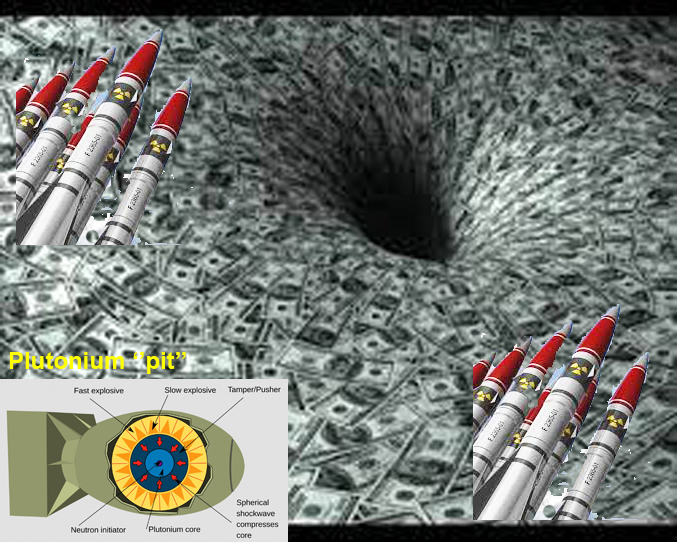
DOE’s and NNSA’s pit production plan would involve extensive processing, handling, and transportation of extremely hazardous and radioactive materials, and presents a real and imminent harm to the plaintiffs and to the frontline communities around the production sites.
The government estimates that the cleanup will take until about 2060, Kelley said. “And at Site 300, some contamination will remain there in perpetuity—parts of Site 300 are essentially a sacrifice.” Such contamination is present at all U.S. nuclear weapons sites, “and at some of the big production sites, the contamination is even worse.”
Nuclear weapons monitors demand environmental review of new bomb production plans https://wordpress.com/read/feeds/72759838/posts/3943195911 By Marilyn Bechtel. 10 Apr 22,
Four public interest groups monitoring the nation’s nuclear weapons development sites are demanding the Department of Energy and the National Nuclear Security Agency conduct a thorough environmental review of their plans to produce large quantities of a new type of nuclear bomb core, or plutonium pit, at sites in New Mexico and South Carolina.
The organizations, Tri-Valley Communities Against a Radioactive Environment, Savannah River Site Watch, Nuclear Watch New Mexico, and Gullah/Geechee Sea Island Coalition, filed suit in late June 2021 to compel the agencies to conduct the review as required under the National Environmental Policy Act. They are now fighting an effort by DOE and NNSA to dismiss the suit over the plaintiffs’ alleged lack of standing. The groups are represented by the nonprofit South Carolina Environmental Law Project.
In 2018, during the Trump administration, the federal government called for producing at least 80 of the newly designed pits per year by 2030.
The public interest groups launched their suit after repeated efforts starting in 2019 to assure that DOE and NNSA would carry out their obligations to issue a thorough nationwide programmatic environmental impact statement, or PEIS, to produce the new plutonium pits at the Los Alamos National Laboratory in New Mexico and the Savannah River Site in South Carolina.
The organizations said that in correspondence with NNSA in March, the agency stated that it did not plan to review pit production, relying instead on a decade-old PEIS and a separate review limited to the Savannah River Site.
Although more will be known when the Biden administration completes the Nuclear Posture Review now underway, the administration’s request for $43.2 billion in fiscal 2022 to maintain and modernize the U.S. nuclear arsenal, and individual items to expand U.S. capabilities including pit production, very much follows the Trump administration’s spending patterns. The proposed nuclear weapons spending comes to nearly 6 percent of the $753 billion the current administration is asking for national defense, itself a total marginally higher than under Trump.
Continue readingIn the midst of war in Ukraine, U.S. and NATO must de-escalate
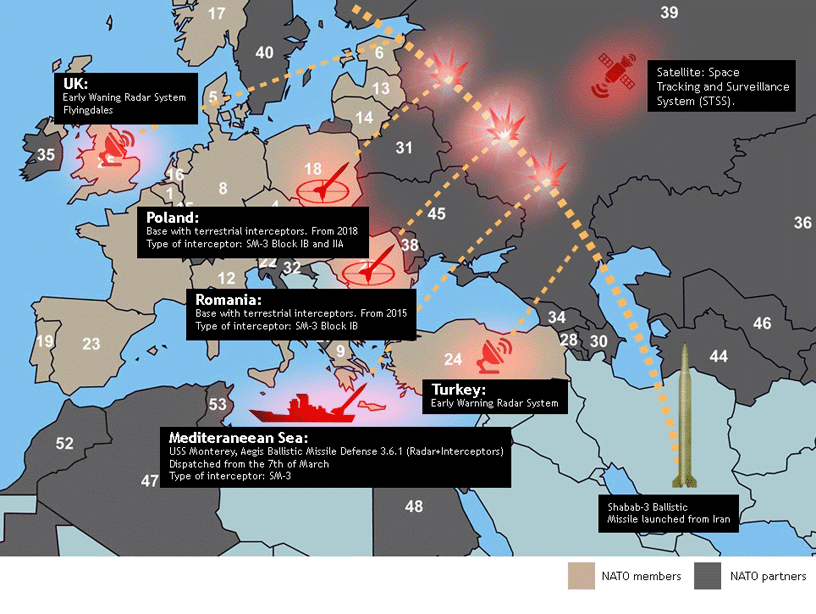
https://www.nj.com/opinion/2022/04/in-the-midst-of-war-in-ukraine-us-and-nato-must-de-escalate-l-opinion.html Apr. 09, 2022 By Star-Ledger Guest Columnist
Robert Moore
Since invading Ukraine on Feb. 24, President Putin has put Russian nuclear forces on high alert and issued warnings to other nations that if they interfere with the Russian invasion they risk “consequences such as they have never seen in their history.” The Russians also elevated the nuclear risk by saying that Russia has a “right” to use nuclear weapons in the Ukraine conflict in response to conventional weapon threats or an “existential threat” to Russia.
What makes Russia’s threat especially dangerous is that it has been made in the context of ongoing warfare. Even if this threat were meant solely to intimidate, the fog of war sharply increases the chances of nuclear war through inadvertent escalation, miscalculation or accident.
It is therefore imperative that the U.S. and NATO de-escalate NOW to prevent the war in Ukraine from escalating into a nuclear war. I advocate for two near-term steps toward that end.
First, the U.S., France and the United Kingdom should publicly issue No First Use of Nuclear Weapons pledges. This multilateral declaration would make clear that the policy and nuclear weapon posture of the nuclear weapon nations within NATO is to never initiate the use of nuclear weapons. The only time such doomsday weapons would be used by them is if they were under nuclear attack.
This has the potential to dramatically transform the current escalatory dynamic. Instead of nuclear saber-rattling, the three nuclear nations in NATO would join the only other nuclear power that has a No First Use policy, China, in eschewing initiating the use of nuclear weapons.
Second, NATO should stop deploying nuclear weapons in NATO countries that aren’t nuclear weapon states. Currently, there are an estimated 100 nuclear weapons at U.S. Air Force Bases in five non-nuclear NATO countries. These are superfluous to the thousands deployed by the U.S., France and the U.K.
For the medium term, the U.S. should re-enter the Iran Nuclear Agreement that President Trump withdrew from in 2018. As a result of that withdrawal, Iran is very close to having enough nuclear weapon-grade material to assemble a nuclear bomb. Negotiations are reportedly very near the finish line.
Other Nuclear Arms Control Treaties the U.S. could re-enter include the ABM Treaty George W. Bush withdrew from and the Intermediate Nuclear Forces (INF) Treaty, which Trump also withdrew the U.S. from — that was the first-ever nuclear reduction treaty in 1987 and banned an entire class of nuclear weapons. The U.S. could also take leadership for a follow-up to the New START Nuclear Reduction Treaty to seek deeper reductions.
Ultimately, the U.S. needs to take leadership to move forward on the groundbreaking work of the UN’s Nuclear Ban Treaty, supported by a large majority of UN members. Moving toward the global abolition of nuclear weapons is the only sure way to guarantee that the world’s people won’t face the risk of extinction.
I’ve been a leader in the U.S. anti-nuclear weapons movement for 44 years. When I began, our goal was to reverse the rapidly escalating nuclear arms race. The active engagement of millions in the U.S. and across the world resulted in a reversal and an over 80% reduction in global nuclear arsenals.
If enough citizens again engage in sustained anti-nuclear activism, we can make the world safe from the danger of nuclear weapons use, now in Ukraine, and for all future generations.
The Rev. Robert Moore is executive director of the Princeton-based Coalition for Peace Action.
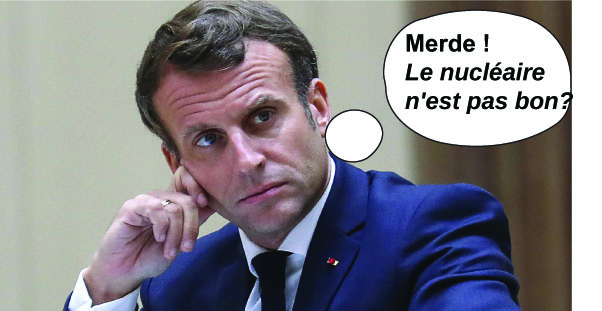
Emmanuel Macron Gets Nuclear Energy All Wrong
The price of nuclear generation today is inordinate: a rip-off in terms of value, to put it bluntly. Indeed, while safety concerns drive up the cost of nuclear plant insurance, the price of renewables is predicted to sink further, by as much as 50 percent or more by 2030. ……No nuclear reactors anywhere are built without enormous government support, and France will be no different: The bill for the French taxpayers will start at $57 billion, according to the New York Times.
The single greatest barrier to the so-called nuclear renaissance is nuclear power itself and its inability to deliver affordable power on time and on budget.
Nuclear power won’t help France meet its climate goals on budget or on time.
https://foreignpolicy.com/2022/03/22/macron-france-nuclear-energy-climate-renewables/ By Paul Hockenos, a Berlin-based journalist. 22 Mar 22, At year’s end, Germany will shutter its last three nuclear plants; Belgium will follow suit by 2025. France, on the other hand, is committed to remaining Europe’s last stronghold of nuclear energy. At the center of French President Emmanuel Macron’s re-election platform is his plan to construct as many as 14 new-generation reactors and a fleet of smaller nuclear plants, supposedly to bolster the country’s climate protection strategy.
France’s bet on nuclear energy, however, is an egregious miscalculation that will severely inhibit its decarbonization efforts. At a critical juncture in the battle against climate change, diverting any finances and losing time with nuclear power, which has been in decline worldwide for decades, will only set back the country’s climate efforts, perhaps dooming its chances to go carbon neutral by 2050. Indeed, this Hail Mary pass, taken out of desperation as France has fallen woefully behind on its climate targets, will most probably come to naught anyway as the era of nuclear power wanes further no matter France’s declarations.
The simple explanation: Fully fledged renewables are faster, cheaper, and lower risk than nuclear power.
Despite the flurry of media hype around new nuclear energy and loose talk of a “nuclear renaissance,” in recent years, the arguments against nuclear power have grown demonstrably stronger.
Critics’ original concern with nuclear power, namely its safety, remains levelheaded and paramount. The two most catastrophic meltdowns—namely in 1986 at Ukraine’s Chernobyl nuclear power plant and in 2011 at Japan’s Fukushima site—are well known and had horrific repercussions that haunt those regions today. But these mega disasters are only the blockbusters.
According to the International Atomic Energy Agency, there have been 33 serious incidents at nuclear power stations worldwide since 1952—two in France, and six of them in the United States. Currently, a fifth of France’s geriatric nuclear generation is shut down because of safety issues—the older reactors get, the higher the risk of an accident—exacerbating an acute energy crunch there. So much for the 24/7 reliability of nuclear power.

And then there’s the now 80-year-old conundrum of how and where to dispose of radioactive waste. To date, no secure repositories are in operation anywhere in the world for the spent fuel, which remains toxic for hundreds of thousands of years. Experts estimate that more than 250,000 metric tons of radioactive waste—over 14,000 metric tons in France and 90,000 metric tons in the United States—is currently in temporary storage near nuclear power plants and military production facilities worldwide.
In France and elsewhere, there’s broad agreement that for security and health reasons, highly radioactive material can’t simply be lodged interminably at interim sites. But France’s wish to one day entomb its toxic refuse 500 meters below the Earth’s surface and 186 miles east of Paris is still on hold as locals refuse to accept the presence of a long-term nuclear repository near their homes. The story is the same just about everywhere: No one wants to raise families near a nuclear waste dump.
But these days, there are other arguments against nuclear energy that are arguably even more averse to a nuclear revival than the issues of safety and nuclear waste.
Nuclear power plants have actually pulled off one of the most remarkable feats of recent technological history: Where virtually all other technologies have gotten cheaper over time as they have developed and matured, nuclear power has actually become more expensive. Indeed, it has grown dauntingly costly compared with renewables: at least four times as costly as utility-scale solar and onshore wind power. While the cost of solar and wind energy generation, as well as battery storage, plummets by the year—in 2020 alone, onshore wind costs declined by 13 percent and those of utility-scale solar photovoltaics by 7 percent—the bill for new nuclear sites climbs upward.
The price of nuclear generation today is inordinate: a rip-off in terms of value, to put it bluntly. Indeed, while safety concerns drive up the cost of nuclear plant insurance, the price of renewables is predicted to sink further, by as much as 50 percent or more by 2030. This price trend is one reason why in 2020 total investment in new renewable electricity surpassed $300 billion, 17 times global investment in nuclear power, according to the World Nuclear Industry Status Report. No nuclear reactors anywhere are built without enormous government support, and France will be no different: The bill for the French taxpayers will start at $57 billion, according to the New York Times.
This yawning price differential means renewables generate many more times the electricity per dollar invested than does nuclear—and thus decreases emissions by a greater factor.
The single greatest barrier to the so-called nuclear renaissance is nuclear power itself and its inability to deliver affordable power on time and on budget. If Europe’s current headline nuclear projects are a measure—marred for decades now by massive cost overruns and protracted delays—France’s hopes to have its first new reactor up and running by 2035 are illusory. In Flamanville in northwest France, the French energy firm EDF is struggling to finish a reactor that is a full decade behind schedule and now roughly four times above cost projections. The Olkiluoto 3 reactors in Finland, also many times over budget, have been delayed again and again since the early 2000s.
Indeed, not one reactor conceived since 2000 in the European Union has generated even a kilowatt of energy. The Olkiluoto 3 plant may begin commercial activities this year. As for the new, smaller, presumably cheaper nuclear reactors envisioned by billionaire Bill Gates among others, not one is in operation anywhere in the world.
In a widely circulated Jan. 25 letter penned by four former top nuclear energy regulators in France, the United States, Germany, and the United Kingdom, the authors excoriated the viability of relying on nuclear energy to beat climate change: Nuclear energy, they argue, “is just not part of any feasible strategy that could counter climate change. To make a relevant contribution to global power generation, up to more than ten thousand new reactors would be required, depending on reactor design.”
The fact is that nuclear power is simply too cumbersome to really play a meaningful role in tackling climate change—in France or elsewhere. We don’t have that kind of time. Indeed, there is no way countries can meet their 2030 decarbonization goals agreed to at the Paris Agreement by embarking now on nuclear power programs.
In stark contrast, renewable energy is a sprinter: Farms can be licensed, financed, and deployed much faster because they’re smaller, less capital intensive, more quickly approved, and easier to build. Depending on the country, vast utility-scale solar fields and onshore wind farms can materialize in just a handful of years. Last year, China brought to life about 50 gigawatts of solar capacity—that’s as much electricity generation as 10 nuclear reactors. Even the average nine-year schedule of offshore wind parks is still much, much shorter than nuclear’s erratic, extended timelines.
In Europe and elsewhere, building out nuclear power will greatly hamper the effort to curb climate change, not help it. “The more urgent climate change is, the more we must invest judiciously, not indiscriminately,” writes sustainability expert Amory Lovins, “to buy cheap, fast, sure options instead of costly, slow, speculative ones.”
In the end, the evidence speaks conclusively for ramping down fossil fuels and nuclear energy as fast as possible while embarking on an all-out expansion of sustainable renewables: wind, solar, biomass, geothermal, hydroelectric, and tidal/wave energy. Modern gas works will back up this clean energy model until green hydrogen can take over. Ever better energy storage, smart grids, energy conservation, and digital management will make this model of the future work.
Germany and Belgium—like Austria, Italy, and nine other EU countries—are looking the facts straight in the eye. By swearing off nuclear energy and fossil fuels at the same time, these countries will have the best chance at making a net-zero energy system functional by 2050, at the latest. https://foreignpolicy.com/2022/03/22/macron-france-nuclear-energy-climate-renewables/
Paul Hockenos is a Berlin-based journalist. His recent book is Berlin Calling: A Story of Anarchy, Music, the Wall and the Birth of the New Berlin (The New Press).
Why Ukraine’s Nuclear Waste Is A Major Threat:
Why Ukraine’s Nuclear Waste Is A Major Threat: Nuclear plants in Ukraine
aren’t at risk for a Chernobyl-style meltdown, but destabilizing the kind
of waste stored at Chernobyl and Ukraine’s four other nuclear plants
could create a widespread environmental disaster.
Business Insider 9th April 2022
The Greens: We’re eager to hold the balance of power
The Greens: We’re eager to hold the balance of power
As the major political parties try to play the underdog in the May 21 election, the Greens appear confident they will hold the balance of power after polling day.
April 10 Energy News — geoharvey

Opinion: ¶ “Britain Was Promised A Bold And Visionary Energy Plan. But We’ve Been Sold A Dud” • The double threat of climate crisis and war requires an urgent response. The government supplied its energy security strategy, which includes eye-catching headlines, especially on expanding nuclear power. But it fails on immediate, pressing problems. [The Guardian] […]
April 10 Energy News — geoharvey
Today: some dream of Australia as an international nuclear waste dump – the ultimate in colonial degradation

Right now, the Boris Johnson crowd in Britain, and the Emmanuel Macron crowd in France are enthusiastically thumping the tub for the mythical ”New Nuclear”, and for prolonging the operation of their creaky old nuclear reactors way beyond their proper use-by date.
Their whole plan is super expensive, and also pretty much irrelevant to climate action, seeing that new nuclear reactors take decades to become operatiinal.
But it’s not just the cost that’s so unwise, so imprudent.
It’s the waste problem. Both governments have a nonchalant attitude to that
Manwhile, back in this colony, the nuclear fans, which include Keith Pitt, the Minister for Resources, and sundry other politicians, keep pushing for a ”temporary” nuclear waste dump at Kimba, South Australia. (Other quieter players push for one in WEatern Australia,)
It looks to me as though the old nightmare of Pangea still lives in Australia – the transforming of this colony into a colonial nuclear waste dump. Australians need to be aware that this plan – to benefit a few greedy grasping Australian entrepreneurs and sycophantic politicians, could be seen as a convenient solution for our international ”betters”.
FAST TRACK TO ARMAGEDDON — Declassified Australia

Despite Australia’s headlong rush to splash cash on new advanced military weapons, there is some confusion apparent within the highest levels of the Defence Department as to the real strategic effect of the development and use of hypersonic missiles.
The use of hypersonic missiles trashes conventional reluctance to be the first to start a war as it removes the perceived threat of retaliation.
Hypersonic missiles will allow for a pre-emptive war if the nation possessing them thinks an enemy state is moving towards conflict. The Mutually Assured Destruction, or MAD, window for avoiding war is slamming shut.
Australia’s hypersonic missile development, rather than promoting peace in the region, is helping ignite an arms race and increasing the chance of conflict. Hypersonic missiles being developed in Australia are aircraft-launched highly-maneuverable high-speed precision cruise missiles, capable of delivering a conventional, and potentially a nuclear payload. PETER CRONAU, 8 APRIL 2022 Australia is already a long way down the track in developing nuclear-capable hypersonic weapons with the US and UK, despite a new announcement this week by the Australia-UK-USA ‘AUKUS’ military pact.
FAST TRACK TO ARMAGEDDON — Declassified Australia
AUKUS member nations this week, in an update to their much-reported pact of 2021, announced $1-billion for guided missile development in Australia, and stated: ‘We…committed today to commence new trilateral cooperation on hypersonics and counter-hypersonics’.
Last November Declassified Australia first reported on the work being done with the US and UK on the development of hypersonic missiles in Australia for the Australian Defence Force, in a story on the expanding military and intelligence links between the AUKUS trio of nations.
Some of the largest arms manufacturers in the world have been working in Australia in developing hypersonic missile prototypes under the Southern Cross Integrated Flight Research Experiment, or SCIFiRE.
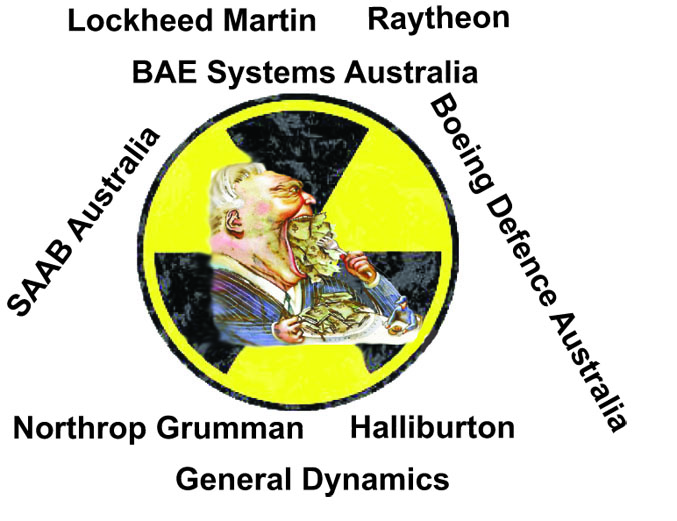
The SCIFiRE project was signed in 2020 by world’s largest weapons-maker and manufacturer of the RAAF’s F-35, Lockheed Martin, along with Boeing Defence Systems, manufacturer of the RAAF’s F/A-18 Hornets. These private companies reap the benefits of the publicly-funded HIFiRE scramjet engine technology of 2007 designed by a team at the University of Queensland.
The SCIFiRE hypersonic missile is a high-speed highly-maneuverable plane-launched precision cruise missile that gives a fighter or bomber aircraft a virtually unstoppable anti-shipping capability from over 400 km distance – and much further when used from planes launched off carriers or airbases. They could be nuclear-capable, but at present will be conventionally armed.
The hypersonic missile is light and fast, and will seriously outperform the Tomahawk cruise missiles already on order for the RAAF. The SCIFiRE doesn’t need a bomber to launch and will be carried by RAAF fighter aircraft such as the F/A-18F Super Hornet jetfighter, the new F-35A Lightning II air-combat stealth fighter, as well as the P-8A Poseidon maritime surveillance aircraft. They will be perfect for supporting a US war in the South China Sea.
The US has been testing its domestically-produced HARC hypersonic ramjet weapons and, though troubled by a string of failures, has reportedly tested the Lockheed Martin prototype last month. The new Australian SCIFiRE hypersonic missiles offers better prospects for delivery and are expected to enter service in 5-8 years, ready to join in the plunge over the precipice of a predicted 2030 US war with China
Not to be outdone, Britain’s BAE Systems since 2021 has been developing in Australia a hypersonic weapons system titled Project Javelin. The project involves a hypersonic long-range attack missile named ‘Javelin Strike’, and also, sensibly, defensive counter-measures to protect against high speed weapons named ‘Javelin Shield’. The project is running in parallel with the SCIFiRE missile, in developing a so-called ‘sovereign capability’ for the construction of the weapons in Australia.
Of even greater concern internationally is the potential development of nuclear-armed drone satellites, able to fire multitudes of hypersonic nuclear missiles upon any part of the globe. The US has for a decade been working on a highly secret X-37B Boeing space drone project capable of carrying satellites, as well as nuclear payloads. Now Boeing is presently building the Phantom Express, a hypersonic Experimental Spaceplane XS-1, able to carry payloads with ‘military and commercial applications’.
Such madness may not be too remote from Australia. A Brisbane-based aerospace engineering start-up company Hypersonix Launch Systems, working with the public-funded University of Southern Queensland, has last month received federal government funds for development of its DART CMP Airframe, the world’s first ‘reusable’ hypersonic drone.
Hypersonix is building the airframe of the hypersonic drone, capable of speeds up to 15,000 km/hr, supported by US companies Boeing, and Kratos Defence Security Solutions, which are both separately developing hypersonic drones with military applications.
‘New age’ hypersonic missiles and drones are not the only airborne weapons cooperation occurring between nations of the AUKUS pact. RAAF’s Woomera Test Range in South Australia has been the site of BAE Systems long-delayed development work on its Taranis supersonic stealth bomber drone.
The Defence Department is very serious about arming Australia with hypersonic missiles. In 2020 Defence allocated $9.3-billion for high-speed long-range strike and missile defence including for hypersonic development, test and evaluation. This is part of the eye-watering $270-billion spend on defence capability over the decade under the Force Structure Plan 2020, a part of Australia’s legitimate defence needs, as well as support to military actions of the US empire.
The use of two hypersonic missiles by Russia against Ukraine military targets in March seemed to take the US by surprise. The US Defence Secretary, Lloyd Austin, publicly downplayed the development, saying he did ‘not see it as a gamechanger.’
But have no doubt, the sphincters of the US Joint Chiefs of Staff and European military leaders tightened several notches as they realised the Russians had just used in battle a missile for which they have no present defence. Instantly, US military bases, like those in Germany or the NSA satellite surveillance post at Menwith Hill in the UK, were undefendable.
The Russian Kinzal ‘Dagger’ hypersonic air-to-surface missile reportedly has a range of 2,000 kms and can reach speeds of 12,000 km/hr. The missiles were fired from Mig-31 fighters outside of Ukraine airspace hitting one target in the far west of Ukraine near the border with Poland, a NATO member. As well as destroying the Ukraine military arms depot and fuel storage, the ‘Dagger’ missiles also destroyed the West’s sense of invulnerability.
Russian President Putin said development of the hypersonic missiles was permitted following the US decision in 2002 to abandon the 1972 Anti-Ballistic Missile Treaty, a bilateral agreement between the Soviet Union and US. China also has developed hypersonic weapons after first testing its Wu-14 missile in 2014.
The need for international controls and a return to adherence to the abandoned mutual containment system by all countries has suddenly become very apparent.
Despite Australia’s headlong rush to splash cash on new advanced military weapons, there is some confusion apparent within the highest levels of the Defence Department as to the real strategic effect of the development and use of hypersonic missiles.
A statement by the Australian Defence Minister at the time, Linda Reynolds, when speaking about hypersonic weapons for Australia illustrates the confusion: ‘Investing in capabilities that deter actions against Australia also benefits our region, our allies and our security partners.’
The utilisation of hypersonic missile technology has been described as ‘disruptive capability’ – and disruptive it surely is. Far short of ‘deterring’ other nations, as the minister suggests, hypersonic weapons may increase uncertainty and hence the likelihood of conflict. They are already contributing to a regional arms race with Japan, South Korea, North Korea, Taiwan, USA and China all presently expanding missile development.
The use of hypersonic missiles trashes conventional reluctance to be the first to start a war as it removes the perceived threat of retaliation. Hypersonic missiles which can travel as fast as eight-times the speed of sound, greatly reduce the chance of the targeted nation retaliating, as the warning time reduces dramatically. The first warning now might be the sounds of missile explosions.
At present an uneasy peace between nuclear nations exists, with the belief an enemy would not start a war due to the likely retaliation that would follow any first attack launch. The hypersonic capability allows nations to launch with a much reduced fear of interception or retaliation.
Hypersonic missiles will allow for a pre-emptive war if the nation possessing them thinks an enemy state is moving towards conflict. The Mutually Assured Destruction, or MAD, window for avoiding war is slamming shut.
“We remain committed to peace and stability in the region,’ said the Defence Minister. These words indicate a view far from a reality of the increased risk of hypersonic-propelled destructive conflict and a newly-energised regional arms race.
PETER CRONAU is co-founder of DECLASSIFIED AUSTRALIA, and is a multi-award winning investigative journalist, writer, and film-maker. He is co-editor of the recent book A Secret Australia – Revealed by the WikiLeaks Exposés.
Defence Dept blocks access to advice on location choice for Australia’s nuclear submarines base
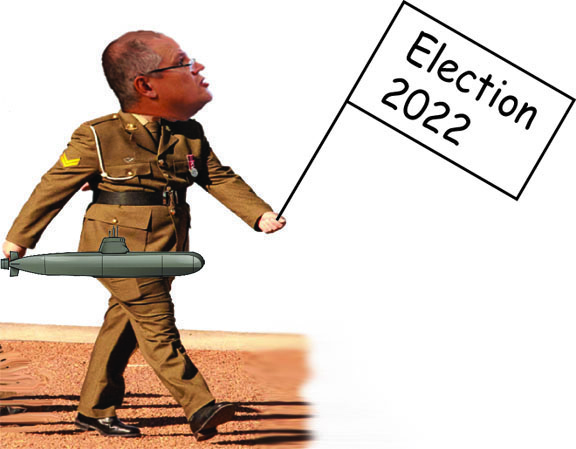
Labor’s defence spokesperson, Brendan O’Connor, questioned whether the government was “hiding their advice because the prime minister has made a political decision in shortlisting three east coast submarine bases”.
“Australians deserve to know if the government went through rigorous processes or if these bases have been chosen on a whim close to an election.”
“The timing of this announcement just before an election and the fact that it departs from the Navy’s previous analysis is quite inexplicable,” Patrick said.
Defence blocks access to advice on location choice for Australia’s nuclear submarines base https://www.theguardian.com/australia-news/2022/apr/09/defence-blocks-access-to-advice-on-location-choice-for-australias-nuclear-submarines-base
Labor demands government reveal how it shortlisted Brisbane, Newcastle and Port Kembla as potential sites for base Daniel Hurst Foreign affairs and defence correspondent, @danielhurstbne, Sat 9 Apr 2022
Voters will be kept in the dark on how Scott Morrison’s government selected three potential bases for Australia’s planned nuclear-powered submarines, after the advice was blocked from release.
With the prime minister preparing to formally call the election within days, Labor demanded the government reveal how it shortlisted the locations to prove the announcement was “not just a marketing ploy”.
Morrison named Brisbane, Newcastle and Wollongong’s Port Kembla as three contenders for a new eastern submarine base, and revealed Aukus-related infrastructure works would cost up to $10bn, in a keynote national security speech last month.
The government is expected to lock in one of these sites late next year, once further studies and negotiations are completed.
Morrison said the “three preferred locations” were identified “following significant work by Defence reviewing 19 potential sites”, although a minister later said it was the cabinet’s national security committee that had “narrowed it down to three”.
Guardian Australia applied to the Department of Defence under freedom of information laws seeking the site analysis. The request also covered any advice, briefings or submissions prepared for the defence minister, Peter Dutton, regarding the preferred locations.
Continue readingU.S., NATO push Asia-Pacific bloc against Russia, China, with Ukraine as pretext
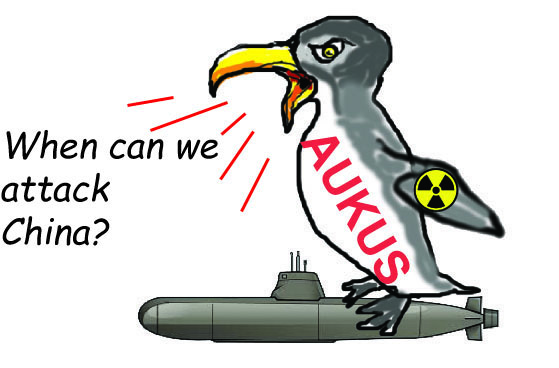
On Tuesday, the US, the UK and Australia announced they would cooperate to develop hypersonic weapons under the framework of the new AUKUS alliance, a move that analysts said is to build a NATO replica in the Asia-Pacific to serve US hegemony.
US, NATO seek united front with Asia-Pacific allies to isolate Russia, pressure China over Ukraine crisis
Global Times, By Liu Xin and Xu Yelu, 8 Apr 22, South Korean and Japanese foreign ministers were invited to join the high-profile NATO session on Thursday for the first time as NATO seeks to gain cooperation from Asia to isolate Russia and pressure China over the Ukraine crisis. But analysts said the US is coercing more countries to choose sides in the crisis and using it as an opportunity to help NATO’s global expansion.
South Korean and Japanese foreign ministers were invited to join the high-profile NATO session on Thursday for the first time as NATO seeks to gain cooperation from Asia to isolate Russia and pressure China over the Ukraine crisis. But analysts said the US is coercing more countries to choose sides in the crisis and using it as an opportunity to help NATO’s global expansion.
The NATO Foreign Ministers meeting in Brussels agreed to sustain and further strengthen support for Ukraine, and step up cooperation with partners, given the global implications of Russia’s action in Ukraine, according to a statement released after the meeting on Thursday.
The ministers also agreed that NATO’s next Strategic Concept, which will be finalized at the Madrid Summit in June, must take account of NATO’s future relations with Russia, and “China’s growing influence” on allied security, it said.
NATO will increase its cooperation with Asia-Pacific partners in areas like cyber, new technologies, disinformation, maritime security, climate change, and resilience, according to the statement.
South Korean Foreign Minister Chung Eui-yong was in Brussels to attend a meeting of the North Atlantic Treaty Organization (NATO) foreign ministers on Thursday. He was the first South Korean foreign minister to join a high-profile NATO session, Yonhap News reported. Aside from South Korea, three countries – Japan, Australia and New Zealand – also attended the NATO session. Nikkei Asia reported this was the first time a Japanese minister attended such a meeting.
By inviting the four Asia-Pacific countries, NATO and the US wanted to draw more countries to form a united front against Russia over the latter’s conflict with Ukraine, and such a move will also help NATO’s global expansion, especially to Asia, as the US has always sought to build a more effective framework to contain China in the Asia-Pacific region, Li Kaisheng, a research fellow and deputy director at the Institute of International Relations of the Shanghai Academy of Social Sciences, told the Global Times.
As important US allies in Asia, South Korea and Japan have always wanted to play a bigger role in regional and international affairs and they may work more closely with the US as it is coordinating NATO with Asia-Pacific alliances, including the Quad mechanism of the US, Japan, India and Australia, and AUKUS of the US, the UK and Australia, Li said, noting that South Korea may also lean to the US after President-elect Yoon Suk-yeol takes office in May.
Yoon, who emphasized further promoting the South Korea-US alliance on security, was elected as the country’s next president in March. With the US cajoling its allies into joining a united front in bashing China, Yoon will be tested on whether he will keep his country’s relations with China free from the influence of its alliance with the US, analysts said.
Nikkei Asia said on Wednesday that NATO is looking to deepen its cooperation with Asia-Pacific countries to “discourage China from backing Russia in the war in Ukraine” and the bloc worries that Chinese financial and military assistance could drag out the conflict.
China has refuted disinformation spread by the US and some Western media, which claimed that China was considering supplying Russia with weapons to support its operation in Ukraine.
So-called remarks on discouraging China from supporting Russia are excuses. The US and NATO are using the conflict for their own strategic purposes, exploiting the crisis to revive NATO’s influence and turning it into a “battle” between so-called “democracy” and “autocracy,” Yang Xiyu, a senior research fellow at the China Institute of International Studies, told the Global Times.
Yang said that since the beginning of this century, the US has used NATO to shift its global strategic focus and alliance system to the east. From the Iraq war to the Afghan and Syria wars, we have witnessed NATO’s more frequent military operations outside NATO and more NATO members’ presence in the South and East China Sea and the Asia-Pacific region. The strategic purpose for the NATO meeting is to start its global expansion.
On Tuesday, the US, the UK and Australia announced they would cooperate to develop hypersonic weapons under the framework of the new AUKUS alliance, a move that analysts said is to build a NATO replica in the Asia-Pacific to serve US hegemony.
By gathering NATO and US allies in the Asia-Pacific together at the NATO meeting, NATO will become a platform for the US to lead its global allies and realize its expansion from Europe to the Asia-Pacific, analysts said, noting that NATO’s expansion is the root of the current conflict between Russia and Ukraine, but the bloc never reflects on its problems and is still working to expand.
According to media reports, Finland is considering joining NATO. In response, Chinese Foreign Ministry spokesperson Zhao Lijian said at Thursday’s press briefing that China’s position on NATO’s eastward expansion is very clear. NATO is a product of the Cold War and should have become history long ago. “We advise relevant countries to exercise caution in developing relations with NATO.” Zhao said.
Yang warned that while the US is coordinating allies to contain China and Russia and spread confrontations globally, China should work harder to unite more countries to oppose the Cold War mentality and deepen cooperation with countries with shared interests, including South Korea and Japan.
As a product of the Cold War, NATO represents confrontations and targets certain countries. Its global expansion brings polarization and clashes. Its expansion in the Asia-Pacific region will surely target China, undermine the regional security environment and bring turbulence, Li said, urging regional countries to have a clear understanding of the disastrous results.
The choices: fight to the last Ukrainian, or choose Macron’s dialogue path.
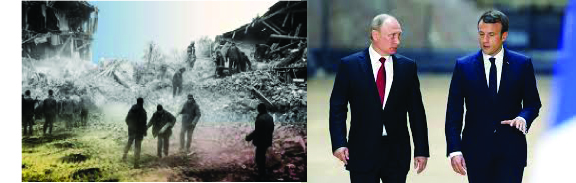
It will have to offer President Putin some kind of escape hatch.
“So the settlement will have to have an escape hatch. And everyone knows pretty much what it is.
“It will have to be a settlement that agrees on the neutralisation of Ukraine and some diplomatic finesse to put aside for the time being the status of Donbas and Crimea to be negotiated at a later stage, and a ceasefire and withdrawal of troops.
“Washington’s position now is to fight to the last Ukrainian,”
Chomsky’s nuclear war fear: Fight to last Ukrainian or choose Macron’s dialogue path https://www.thenationalnews.com/world/uk-news/2022/04/08/noam-chomskys-nuclear-war-fear-fight-to-last-ukrainian-or-choose-macrons-dialogue-path
Distinguished US professor sees a 30-year descent into conflict between Russia and the West
Damien McElroy, Apr 08,
Noam Chomsky has no truck with those who would explain away the brutality of the war in Ukraine, but he does warn that there only two outcomes of the seven-week conflict.
“One possibility is to move on to facilitate the destruction of Ukraine and possibly a nuclear war,” Prof Chomsky told The National. “That’s one possibility.
“So when you read a headline in a main journal in the United States calling for Russia delenda est (we must destroy Russia), what that is saying is I want to kill everybody in Ukraine and I want to move on to a nuclear war which will end human life on Earth.
“The other possibility is to abandon that stance to move in the direction that [French President] Emmanuel Macron was moving towards in his abortive discussions with [Russian leader Vladimir] Putin.”
The phrase “Russia delenda est” is an echo of Cato the Elder’s formula that declared Carthage must be destroyed to stop the enemies of Rome and was indeed published in recent weeks in Washington publications.
It is not an irony that it was updated by the Russian author Leo Tolstoy in 1899, in a famous attack on militarism and promotion of pacifism by the writer of the epic War and Peace.
For Prof Chomsky, 93, whose father was born in what is now Ukraine (his mother was born in what is now Belarus), the obvious path forward has been well promoted as an alternative to the Cold War settlement for more than 15 years.
To give Mr Putin the kind of security landscape he seeks for Russia avoids a bleak escalatory pathway with a country that has an enormous nuclear arsenal.
“Now that kind of settlement will be ugly,” he said. “That’s a fact. It will have to offer President Putin some kind of escape hatch.
“If it doesn’t offer an escape hatch then, when the hard men in Moscow have their backs to the wall and are told there’s nothing left for you, the only choice for them is to use all their power.
“So the settlement will have to have an escape hatch. And everyone knows pretty much what it is.
“It will have to be a settlement that agrees on the neutralisation of Ukraine and some diplomatic finesse to put aside for the time being the status of Donbas and Crimea to be negotiated at a later stage, and a ceasefire and withdrawal of troops.
“That’s basically the framework and it’s understood out of all sides.”
For one with an enormous following in radical leftist politics, Prof Chomsky evinces great respect for diplomatic expertise.
One scenario is that Ukrainian President Volodymyr Zelenskyy could reach a ceasefire with the Kremlin but Washington would effectively scupper it by refusing to unwind sanctions.
Continue readingIndia’s Inadvertent Missile Launch Underscores the Risk of Accidental Nuclear Warfare
Complex weapon systems are inherently prone to accidents, and this latest launch is one of a long history of military accidents in India, Scientific American By Zia Mian, M. V. Ramana on April 8, 2022
Last month, while most of the world focused on the war in Ukraine and worried that a beleaguered Russian leadership might resort to nuclear weapons, thus escalating the conflict into a direct war with the U.S.-led NATO nuclear-armed alliance, a nearly tragic accident involving India and Pakistan pointed to another path to nuclear war. The accident highlighted how complex technological systems, including those involving nuclear weapons, can generate unexpected routes to potential disaster—especially when managed by overconfident organizations.
India and Pakistan possess more than 300 nuclear weapons between them, and have fought multiple wars and faced many military crises. On March 9, two years after their dispute over Kashmir escalated into attacks by jet fighters, the Pakistan Air Force detected “a high speed flying object” inside Indian territory change course and veer suddenly toward Pakistan. It flew deep into Pakistan and crashed. The object was a BrahMos cruise missile, a weapon system developed jointly by India and Russia. India soon stated the launch was an accident.
The firing of the BrahMos missile falls within a long history of accidents involving military systems in India. Military aircraft have strayed across the borders during peacetime. India’s first nuclear submarine was reportedly “crippled” by an accident in 2018, but the government refused to divulge any details. Secrecy has prevented the investigation of an apparent failure of India’s ballistic missile defence system in 2016. Engagements between India and Pakistan can arise from such accidents, as in 1999 when a Pakistani military plane was shot down along the border by India, killing 16 people. Pakistan has had its share of accidents, including a Pakistani fighter jet crashing into the capital city in 2020.
All these weapons systems are inherently accident-prone because of two characteristics identified by organizational sociologist Charles Perrow decades ago—interactive complexity and tight coupling—that combine to make accidents a “normal” feature of the operation of some hazardous technologies. The first characteristic refers to the possibility that different parts of the system can affect each other in unexpected ways, thus producing unanticipated outcomes. The second makes it hard to stop the resulting sequence of events. For Perrow, “the dangerous accidents lie in the system, not in the components,” and are inevitable.
Perhaps the best and most troubling proof of this proposition is in the realm of nuclear weapons—which embody all the properties of high-risk technological systems. Despite decades of efforts to ensure safety, these systems have suffered many failures, accidents and close calls. During 1979–1980, for example, there were several false warnings of Soviet missile attacks, some of which resulted in U.S. nuclear forces being put on alert.
……………………………………The mistake that is of greatest concern is a false alarm of an incoming nuclear attack, possibly directed against nuclear forces. Indian or Pakistani—or Russian or NATO—policy makers may find themselves under immense pressure to launch a preemptive attack, thereby compounding the crisis. The terrible dilemma confronting them would be whether to use their nuclear weapons first or wait for the bombs from the other side to land. Nuclear war, even of a limited nature, between India and Pakistan could lead to millions of deaths in the short term and even graver consequences in the longer term for the region and beyond.
…………… As the legendary analyst of nuclear command and control Bruce Blair warned, among nuclear weapon system managers and operators there is an “illusion of safety” that masks “the systematic potential for tragedy on a monumental scale.” Whether it is India and Pakistan preparing for a fifth war, or the forces of a nuclear-armed Russia struggling ever more violently to subdue Ukraine and stem the flow of lethal NATO weapons, such illusions threaten the destruction of cities and may lead to the killing of nations. https://www.scientificamerican.com/article/indias-inadvertent-missile-launch-underscores-the-risk-of-accidental-nuclear-warfare/
In France, the nuclear waste keeps piling up: new reactors will add to the dilemma

France inches towards nuclear waste solution as more reactors planned
President Macron’s ‘French Nuclear Renaissance’ aims to provide energy independence and greener electricity for France – but the nuclear waste keeps piling up Connexion, By George Kazolias, 8 Apr 22,
Emmanuel Macron has announced plans to launch construction of six new nuclear reactors by 2050, along with studies for a possible eight further ones.
He also wants to prolong the life of existing reactors beyond 50 years in what he is calling the “French Nuclear Renaissance”.
Mr Macron’s vision to “take back control of [France’s] energy and industrial destiny” might be a winner with his electorate, but it clashes with the proposals of most of the left-wing presidential candidates, who want to reduce reliance on nuclear power.
New reactors will add to waste dilemma
Solutions for dealing with the waste already produced by existing power stations, however, are still struggling to get out of the starting blocks – and there is no plan for what would be done with waste from a potential 14 additional ones…………..At present, however, none of France’s nuclear reactor waste has been dealt with in a long-term way. All waste considered radioactive, almost two million cubic tonnes of it, is stored at surface level, in treatment centres and pools, or shallow repositories.
Some 60% of this comes from reactors and the rest is from medical, research, military and other sources.
The other waste, which includes items such as tools, clothing, mops and medical tubes, is not highly radioactive,
……… More problematic is what to do with France’s intermediate and high-level nuclear waste.
In 1998, a site near the village of Bure in the Meuse in north east France was chosen as the final storage place for most of it. It will be stored half a kilometre below ground in a vast network of tunnels and galleries known as a Deep Geological Repository (DGR).
The facility will be big enough for all the nuclear waste accumulated so far, but on-site studies, administrative procedures and opposition to the programme, including court cases and civil disobedience, have slowed its opening.
Deep underground storage could be three years away
The Bure DGR will store the waste in galleries carved out of 160-million-year-old compacted clay rocks. Known by its French acronym, Cigéo, the project currently holds 84% of the 665 hectares required to build the facility. The prefecture of the Meuse gave it a declaration of public utility (DUP) in December – a formal recognition that a proposed project has public benefits that must be obtained for most large construction and infrastructure projects before work can begin.
Once the Conseil d’Etat gives its consent, the prime minister can sign his own DUP. Andra will then have the power to get the rest of the property it needs.
In the meantime, work has continued with digging of wells and galleries to test reversible techniques of stocking waste for up to 100,000 years.
The prime minister is expected to sign off only after the presidential elections, but the final green light might be three years away as the rigorous and independent Nuclear Security Agency studies the permit request to move and store the spent nuclear fuel and other radioactive matter.
Plans are for existing not future waste
Activity at the Cigéo remains high, nevertheless. This year, a 1,700m² building, called The Eclipse, is being built to house companies working on underground trials.
A 100m-long cavity will also be dug to test technologies and conduct experiments. This is the length each cavity will have to be for intermediate-level waste, which is often solidified into concrete.
The nuclear authority is hoping to start storing this type of waste in 2025.
It is impossible to bury the high-level radioactive waste. This is turned into a glass-like substance, but then requires a cooling period of at least 50 years.
The clay storage facilities cannot handle temperatures above 90C.
Senator Sido said: “It is true that the most recent batches cannot be stocked in their present state. They are too hot and need a cooling-off period of several decades. But the first batches can be stocked now.”
The remaining high-level waste might not arrive before 2060. By then, France will have produced at least as much nuclear waste again. For that, it might have to create a new underground facility.
“As far as I know, there is no project in the pipeline for high-level and long-lived waste which will be produced in the future,” Mr Sido said. https://www.connexionfrance.com/article/Practical/Environment/France-inches-towards-nuclear-waste-solution-as-more-reactors-planned
Expert warning that UK’s nuclear plans mean that there won’t be room for all the new radioactive wastes.

 | |||
| to me |
Nuclear power plant plans could mean UK might run out of room for radioactive waste, says expert
https://inews.co.uk/news/nuclear-power-plant-plans-uk-could-run-out-room-radioactive-waste-1563015?ito=facebook_share_article-top&fbclid=IwAR2IxsDYG9O8oNJoXYfiKRKF18v2H-zI_l2NqC3VMWj5O8bGLZGYRMLQtssCurrent policy only allows for disposal of radioactive waste from 16GW of new nuclear capacity, far short of government’s new ambitions
By Madeleine Cuff, 8 Apr 22, Environment Reporter The UK could run out of room to store radioactive waste if the government presses ahead with plans to build eight new nuclear power stations across the country, a nuclear waste expert has warned.
Ministers today set out plans to accelerate the development of new nuclear power stations to bolster the UK’s energy security and push the country to net zero.
The long-awaited energy security strategy set out plans for trebling the UK’s nuclear generation, with up to 24GW of nuclear capacity planned for 2050.
But one of the country’s leading nuclear waste experts has told i the UK could “run out of room” to store the waste produced by so many plants.
Officials have spent the last 50 years hunting for a permanent way to dispose of radioactive waste produced by the UK’s fleet of nuclear plants.
In 2019 fresh search was launched to find a community willing to host the radioactive waste, which would be buried hundreds of metres below the Earth’s surface.
“The policy at the moment is that it can take all of the legacy waste – everything we have generated in the last 70 years, plus up to 16GW of new nuclear build,” said Professor Claire Corkhill, an expert in nuclear waste at the University of Sheffield.
But if the UK builds 24GW of new nuclear it could run into a storage problem, she warns. “My worry is that if we go to 24GW of nuclear energy then we might run out of room to store the radioactive waste,” she said. “We’ve jumped the gun a little bit in saying that we are going to have this much new nuclear energy without thinking really about whether we have got anywhere suitable to put the waste.”
She said it the government could look for a second storage site, but finding one could take decades.
US Officials Admit They’re Literally Just Lying To The Public About Russia

Former MI6 chief John Sawers told The Atlantic Council think tank in February that the Biden administration’s “intelligence” releases were based more on a general vibe than actual intelligence, and were designed to manipulate rather than to inform.
Just as the smear campaign against Julian Assange trained mainstream liberals to defend the right of their government to keep dark secrets from them, we may now be looking at the stage of narrative control advancement where mainstream liberals are trained to defend the right of their government to lie to them.
https://caitlinjohnstone.substack.com/p/us-officials-admit-theyre-literally?s=w— Caitlin Johnstone, Apr 7, 22, NBC News has a new report out citing multiple anonymous US officials, humorously titled “In a break with the past, U.S. is using intel to fight an info war with Russia, even when the intel isn’t rock solid“.
The officials say the Biden administration has been rapidly pushing out “intelligence” about Russia’s plans in Ukraine that is “low-confidence” or “based more on analysis than hard evidence”, or even just plain false, in order to fight an information war against Putin.
The report says that toward this end the US government has deliberately circulated false or poorly evidenced claims about impending chemical weapons attacks, about Russian plans to orchestrate a false flag attack in the Donbass to justify an invasion, about Putin’s advisors misinforming him, and about Russia seeking arms supplies from China.
Excerpt, emphasis mine:
It was an attention-grabbing assertion that made headlines around the world: U.S. officials said they had indications suggesting Russia might be preparing to use chemical agents in Ukraine.
President Joe Biden later said it publicly. But three U.S. officials told NBC News this week there is no evidence Russia has brought any chemical weapons near Ukraine. They said the U.S. released the information to deter Russia from using the banned munitions.
It’s one of a string of examples of the Biden administration’s breaking with recent precedent by deploying declassified intelligence as part of an information war against Russia. The administration has done so even when the intelligence wasn’t rock solid, officials said, to keep Russian President Vladimir Putin off balance.
So they lied. They may hold that they lied for a noble reason, but they lied. They knowingly circulated information they had no reason to believe was true, and that lie was amplified by all the most influential media outlets in the western world.
Another example of the Biden administration releasing a false narrative as part of its “information war”:
Likewise, a charge that Russia had turned to China for potential military help lacked hard evidence, a European official and two U.S. officials said.
The U.S. officials said there are no indications China is considering providing weapons to Russia. The Biden administration put that out as a warning to China not to do so, they said.
On the empire’s claim last week that Putin is being misled by his advisors because they are afraid of telling him the truth, NBC reports that this assessment “wasn’t conclusive — based more on analysis than hard evidence.”
I’d actually made fun of this ridiculous CIA press release when it was uncritically published disguised as a breaking news report by The New York Times:
Continue reading1 This month.


PETITION – To: Prime Minister Anthony Albanese and the Australian Labor Government
Chernobyl: The Lost Tapes – A good documentary on Chernobyl on SBS available On Demand for the next 3 weeks– https://www.sbs.com.au/ondemand/tv-program/chernobyl-the-lost-tapes/235274195556
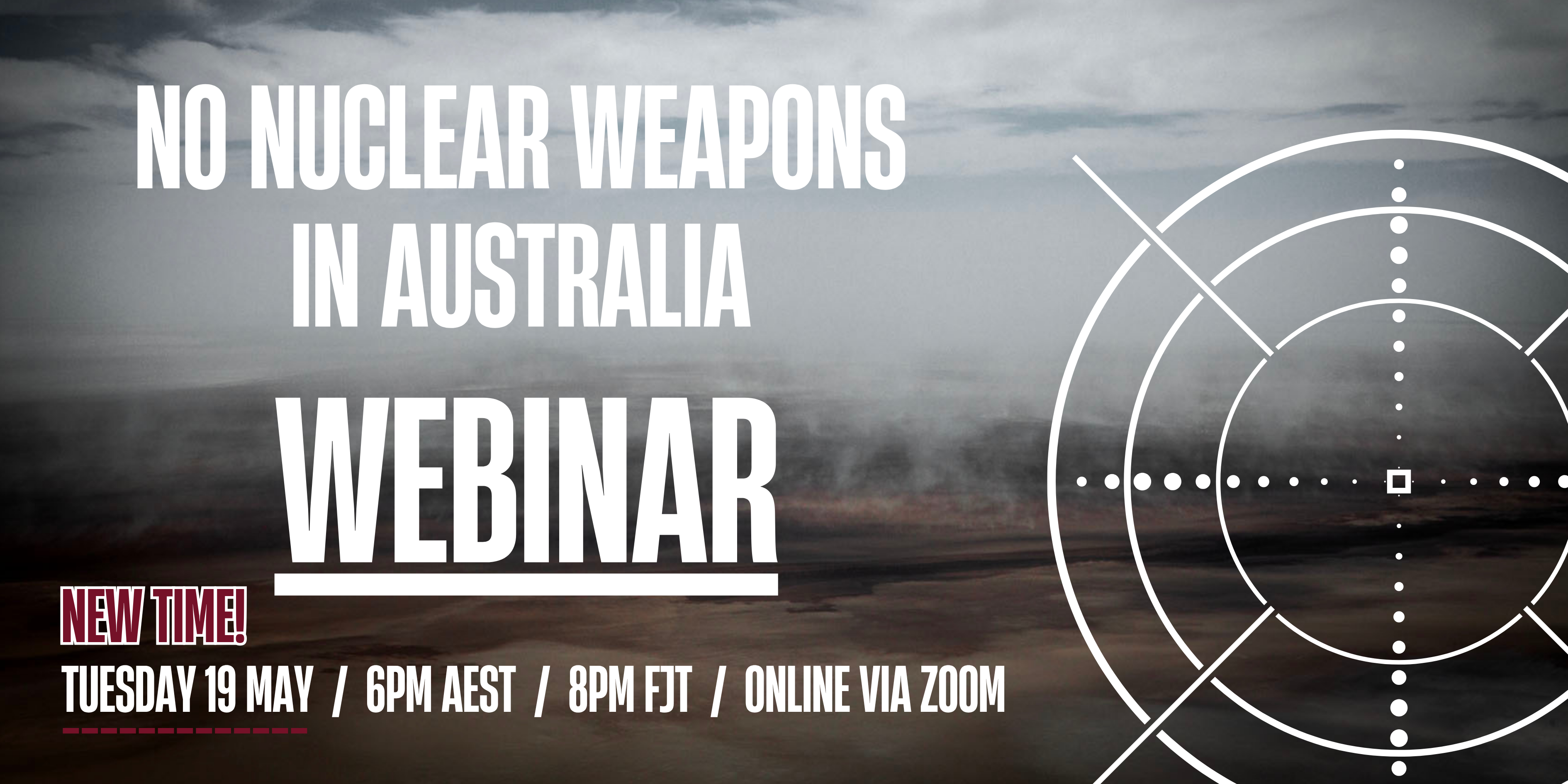
19 May – Webinar- Webinar: No Nuclear Weapons in Australia
Start: 2026-05-19 18:00:00 UTC Canberra, Melbourne, Sydney (GMT+10:00)
End: 2026-05-19 19:30:00 UTC Canberra, Melbourne, Sydney (GMT+10:00)
20 May – Webinar – The dangerous world of AUKUS, US, military occupation and suppression of dissent

National Webinar, 20th May, 2026, 6.30pm AEST. Confronting laws restricting/suppressing protest speech and action
Speakers: Former Sen. Rex Patrick, Lawyer Nick Hanna ,Arthur Rorris ,Jorgen Doyle, Sen David Shoebbridge,
Facilitator Kelley Tranter.

of the week – Australians for War Powers Reform (AWPR)
To see nuclear-related stories in greater depth and intensity
 Antinuclear