Those yearning for regime change in Russia rarely consider what might come next
George Kennan and the Russian future The late US diplomat saw that those yearning for regime change in Russia rarely considered what might come next, Asia Times, By JAMES CARDEN, MARCH 29, 2022
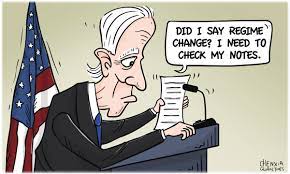
US President Joe Biden’s ill-advised and reportedly ad-libbed call for regime change in Russia last week implicitly raised the question what kind of government Washington has in mind should President Vladimir Putin be deposed or voluntary step down ahead of Russia’s 2024 presidential election.
Biden’s line of what might charitably be called “thinking” has long tempted American policymakers. Writing in 1951, the diplomat George F Kennan observed:
“The very virulence with which Americans reject the outlook and practice of those who now hold power in the Kremlin implies in the strongest possible way the belief in, and desire for, an alternative – for some other Russian outlook and some other set of practices in Russia to take the place of those we know today.
“Yet it may be permitted to ask whether there is any clear image in our minds of what that outlook and those practices might be and of the ways by which Americans might promote progress toward them.”
These are the opening lines to Kennan’s Foreign Affairs essay “America and the Russian Future,” an indispensable corrective to the kinds of magical thinking that mark Washington’s current approach toward Russia and the world.
The planning for regime change in Russia has been under way for at least a decade. In an e-mail congratulating a State Department aide on her promotion to the White House national security staff, then-secretary of state Hillary Clinton wrote, “… we need you at the White House to help plan and execute our Russian strategy post-Putin.”
Biden’s speech last weekend at the Warsaw Castle gave a clue as to what he and the US foreign-policy establishment have in mind “post-Putin.” In Biden’s telling, “Over the last 30 years, the forces of autocracy have revived all across the globe.” And Russia, which “has strangled democracy” at home, now seeks to do so elsewhere.
Biden’s speech attempted to recast the war in Ukraine as part of a larger battle “between democracy and autocracy, between liberty and repression, between a rules-based order and one governed by brute force.”………………………………………………….
Washington’s attempt to remake Russia socially, economically and politically in the 1990s quite inadvertently resulted in the Russia we are confronted with today.
So why does Washington insist on believing that its attempts to reshape Russia from the outside will somehow, someday work out?
Kennan himself was under no such illusions:
“Of one thing we may be sure: No great and enduring change in the spirit and practice of government in Russia will ever come about primarily through foreign inspiration or advice. To be genuine, to be enduring and to be worth the hopeful welcome of other peoples such a change would have to flow from the initiative and efforts of the Russians themselves.”
The sooner President Biden and his advisers come around to the late George Kennan’s way of thinking regarding the desirability of regime change, the better. https://asiatimes.com/2022/03/george-kennan-and-the-russian-future/
Getting bigger but not safer or cheaper – the myth of Rolls Royce and its very big non-modular reactor

Rolls Royce are now starting a ‘Generic Design Assessment’ (GDA) process with the ONR which will take around 5 years. After then they will be asking the UK Government for a blank cheque for the project.
https://100percentrenewableuk.org/getting-bigger-but-not-safer-or-cheaper-the-myth-of-rolls-royce-and-its-very-big-non-modular-reactor By David Toke, 30 Mar 22, Rolls Royce’s so-called small modular reactor (SMR) is getting bigger, but is likely to have fewer special safety features compared to EDF’s increasingly pricey design for Hinkley C.
In 2017 Rolls Royce said that its small modular reactor would be between 220 and 440 MW, but the latest design is bigger, at 470 MW. It is strange to call this small. Reactors in service at the moment (the so-called AGR reactors) were around the 600 MW size for each unit and, strange as it might seem, most of the first generation of so-called ‘Magnox’ nuclear reactors built in the UK were actually smaller than 470 MW. They were not called ‘small’. So why is Rolls Royce calling this a SMR? There’s no reason for this other than public relations.
Rolls Royce claim that the parts will be mainly built in factories. Well, of course they will, that’s always the case with nuclear power plant. The difference with building a relatively smaller plant of course is that you get less of the economies of scale in doing this. That is why nuclear power plant have got bigger.

So the fact that the Rolls Royce unit will be about a third the size of the EPR is likely to make them cost more. But there is one way that Rolls Royce will be able to economise compared to the European Pressurised Reactor (EPR) being built at Hinkley C, and that is because I have seen no sign that Rolls Royce will include some special safety features that have been included in the EPR.
The best known of these safety features are a) a ‘double containment’ feature that is designed to stop material from the inside getting out (as well as another external shell to shield from aircraft) and b) a ‘core catcher’ to stop a melting core eating its way into the ground and potentially contaminating water courses. I am assuming Rolls Royce will not be including either of these features, although it will have to satisfy the Office for Nuclear Regulation (ONR) that it has other ways of stopping radioactive releases from accidents.
Rolls Royce are now starting a ‘Generic Design Assessment’ (GDA) process with the ONR which will take around 5 years. After then they will be asking the UK Government for a blank cheque for a project.
Of course there is another factor and that is that EDF have some experience (admittedly not very successful of late) of building nuclear power plant. Rolls Royce do not have experience of building large nuclear power plant (which is what they are really hoping to do). Producing small (and, it must be said extremely expensive) genuinely small reactors for nuclear submarines is not the same thing at all! So Rolls Royce are likely not to have the skills to build large nuclear power plant. That is a bad sign!
The so-called SMRs proferred by Rolls Royce will just be the latest in a long line of very expensive, very lately delivered nuclear power stations in the UK. It is unlikely to be any cheaper than the reactor that EDF is building at Hinkley C (becoming more expensive as time goes on). But it will have fewer safety features.
Robert (Bob) Hoggar comments: Small Mod Reactors scattered about Britain will also have lots of nuclear waste scattered about Britain which will need careful looking after and that is guaranteed to be an additional rusk to the nation.
UN nuclear watchdog chief in Ukraine for safety talks
 | |||
UN nuclear watchdog chief in Ukraine for safety talks https://bellona.org/news/nuclear-issues/2022-03-un-nuclear-watchdog-chief-in-ukraine-for-safety-talks
The United Nations nuclear watchdog chief Rafael Grossi visited Ukraine on Tuesday unannounced to start providing assistance including experts and equipment aimed at keeping nuclear facilities there safe in the midst of war, apparently without Russia’s blessing. March 30, 2022 by Charles Digges
The United Nations nuclear watchdog chief Rafael Grossi visited Ukraine on Tuesday unannounced to start providing assistance including experts and equipment aimed at keeping nuclear facilities there safe in the midst of war, apparently without Russia’s blessing.

Grossi’s visit comes as seasonal wildfires are ripping unchecked through the irradiated area surrounding Chernobyl, the defunct nuclear power plant that was seized by Russian troops on February 24. Ukrainian officials have said the blazes within the 2,600 square kilometer exclusion zone around the disaster site could bear radiation aloft to surrounding territories and across borders.
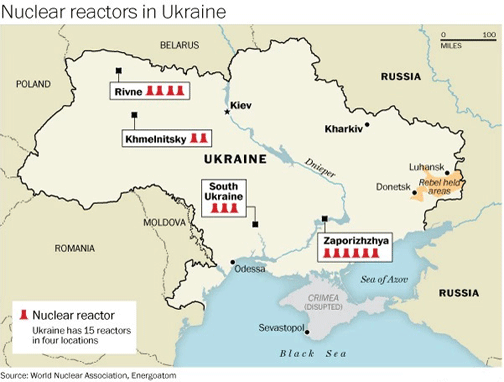
Since Russia invaded Ukraine last month, Grossi has called on both countries to agree a framework to ensure nuclear facilities, including spent nuclear fuel storage facilities at Chernobyl and Europe’s biggest nuclear power plant at Zaporizhzhya, are kept safe and secure.
International Atomic Energy Agency chief Grossi has so far failed to obtain such an agreement or even a three-way meeting with Ukraine and Russia. He had hoped to convene one at Chernobyl, which like Zaporizhzhya continues to be held under Russian control. He met the Ukrainian and Russian foreign ministers separately in Turkey almost three weeks ago.
On Wednesday Grossi appeared to make some progress, posting on Twitter that he had met with Ukraine’s energy minister and the head of Energoatom, the state company that oversees the country’s nuclear industry.
IAEA’s on-site presence will help prevent the danger of a nuclear accident that could have severe public health and environmental consequences in Ukraine and beyond,” Grossi wrote.
On Monday, Lyudmila Denisova, commissioner of the Verkhovna Rada of Ukraine for human rights said the wildfires around Chernobyl have led to an increased level of radioactive air pollution that could threaten neighboring European countries.
She attributed the fires to Russian combat in the region, saying 31 blazes have been recorded, and she called on the IAEA to send firefighters and equipment to help tackle them.
“Control and suppression of fires is impossible due to the capture of the exclusion zone by Russian troops,” Denisova wrote in a Facebook post Sunday. “As a result of combustion, radionuclides are released into the atmosphere, which are transported by wind over long distances.”
The IAEA’s Grossi has not yet commented on the blazes, but their presence contributed to fears of yet more mishaps as Ukraine’s nuclear infrastructure falls under Russian fire.
Since the Chernobyl plant fell into Russian hands, nearby combat has cut power to the site twice, jeopardizing cooling processes for 22,000 spent nuclear fuel rods stores on plant territory. Ventilation is also required to tamp down radiation levels below the New Safe Confinement, a giant steel dome that was installed over the sarcophagus of Chernobyl’s Unit Four reactor, which exploded in 1986.
Power has since been restored, but the IAEA has reported it no longer has access to data transmitted by radiation sensors at the site.
At the Zaporizhzhya plant, a March 4 rocket strike destroyed a training laboratory. Like Chernobyl, the Zaproizhzhya’s plant’s staff is now essentially hostage to invading Russian forces – a situation that worries the IAEA. Since then, the Russian military has detonated ordinance at the plant that remained unexploded during its attack. The IAEA said that both the reactors and radiation levels remained safe after that incident.
Russians have also twice shelled the site of a US funded research reactor and nuclear research facility in the northeastern city of Kharkiv. The reactor’s fuel had reportedly been withdrawn prior to the onset of war and the IAEA said chances for an uncontrolled chain reaction at the site are low.
He also visited the South Ukraine nuclear power plant, whose three reactors are thought to be in the crosshairs of advancing Russian troops.
Danish giant plans 1GW offshore wind farm in New Zealand waters — RenewEconomy

Copenhagen Infrastructure Partners may partner with NZ super fund to build 1GW offshore wind farm on the west coast of the North Island. The post Danish giant plans 1GW offshore wind farm in New Zealand waters appeared first on RenewEconomy.
Danish giant plans 1GW offshore wind farm in New Zealand waters — RenewEconomy
Danish renewables player enters Australia market with big wind, solar and storage plans — RenewEconomy

Danish renewables player enters Australian market with mandate for wind, solar and battery projects. The post Danish renewables player enters Australia market with big wind, solar and storage plans appeared first on RenewEconomy.
Danish renewables player enters Australia market with big wind, solar and storage plans — RenewEconomy
Queensland to build 200MWh big battery next to country’s biggest coal unit — RenewEconomy

Queensland announces another big battery, this time a 200MWh installation next to the Kogan Creek coal generator, the biggest in the country. The post Queensland to build 200MWh big battery next to country’s biggest coal unit appeared first on RenewEconomy.
Queensland to build 200MWh big battery next to country’s biggest coal unit — RenewEconomy
Some households lose 20 per cent of their solar output from grid curtailment — RenewEconomy

New study shines a light on the problem of rooftop solar curtailment and how some households are being affected by it much more than others. The post Some households lose 20 per cent of their solar output from grid curtailment appeared first on RenewEconomy.
Some households lose 20 per cent of their solar output from grid curtailment — RenewEconomy
Victoria approves first pine plantation wind farm, but big battery will need to wait — RenewEconomy

A Victorian wind farm, proposed to be built in a pine plantation gets planning green light, but without a planned battery component. The post Victoria approves first pine plantation wind farm, but big battery will need to wait appeared first on RenewEconomy.
Victoria approves first pine plantation wind farm, but big battery will need to wait — RenewEconomy
Another 115MW solar farm starts sending power to the grid in NSW — RenewEconomy

Another new solar farm has begun sending power to the grid in New South Wales, with the largest facility in northern NSW recording its first output. The post Another 115MW solar farm starts sending power to the grid in NSW appeared first on RenewEconomy.
Another 115MW solar farm starts sending power to the grid in NSW — RenewEconomy
THE MADNESS OF THE RESURGENT US COLD WAR ON RUSSIA

- By Nicolas J. S. Davies, Popular Resistance, March 29, 2022
The war in Ukraine has placed U.S. and NATO policy toward Russia under a spotlight, highlighting how the United States and its allies have expanded NATO right up to Russia’s borders, backed a coup and now a proxy war in Ukraine, imposed waves of economic sanctions, and launched a debilitating trillion-dollar arms race. The explicit goal is to pressure, weaken and ultimately eliminate Russia, or a Russia-China partnership, as a strategic competitor to U.S. imperial power.
The United States and NATO have used similar forms of force and coercion against many countries. In every case they have been catastrophic for the people directly impacted, whether they achieved their political aims or not.
Wars and violent regime changes in Kosovo, Iraq, Haiti and Libya have left them mired in endless corruption, poverty and chaos. Failed proxy wars in Somalia, Syria and Yemen have spawned endless war and humanitarian disasters. U.S. sanctions against Cuba, Iran, North Korea and Venezuela have impoverished their people but failed to change their governments.
Meanwhile, U.S.-backed coups in Chile, Bolivia and Honduras have sooner or later been reversed by grassroots movements to restore democratic, socialist government. The Taliban are governing Afghanistan again after a 20-year war to expel a U.S. and NATO army of occupation, for which the sore losers are now starving millions of Afghans.
But the risks and consequences of the U.S. Cold War on Russia are of a different order. The purpose of any war is to defeat your enemy. But how can you defeat an enemy that is explicitly committed to respond to the prospect of existential defeat by destroying the whole world?
This is in fact part of the military doctrine of the United States and Russia, who together possess over 90% of the world’s nuclear weapons. If either of them faces existential defeat, they are prepared to destroy human civilization in a nuclear holocaust that will kill Americans, Russians and neutrals alike.
In June 2020, Russian President Vladimir Putin signed a decree stating, “The Russian Federation reserves the right to use nuclear weapons in response to the use of nuclear weapons or other weapons of mass destruction against it and/or its allies… and also in the case of aggression against the Russian Federation with the use of conventional weapons, when the very existence of the state is put under threat.”
U.S. nuclear weapons policy is no more reassuring. A decades-long campaign for a U.S. “no first use” nuclear weapons policy still falls on deaf ears in Washington.
The 2018 U.S. Nuclear Posture Review (NPR) promised that the United States would not use nuclear weapons against a non-nuclear state. But in a war with another nuclear-armed country, it said, “The United States would only consider the use of nuclear weapons in extreme circumstances to defend the vital interests of the United States or its allies and partners.”
The 2018 NPR broadened the definition of “extreme circumstances” to cover “significant non-nuclear attacks,” which it said would “include, but are not limited to, attacks on the U.S., allies or partner civilian population or infrastructure, and attacks on U.S. or allied nuclear forces, their command and control, or warning and attack assessment.” The critical phrase, “but are not limited to,” removes any restriction at all on a U.S. nuclear first strike……………………………………….
The danger that hawks in the State Department and Congress may convince President Biden to escalate the U.S. role in the war prompted the Pentagon to leak details of the Defense Intelligence Agency’s (DIA) assessments of Russia’s conduct of the war to Newsweek’s William Arkin.
Senior DIA officers told Arkin that Russia has dropped fewer bombs and missiles on Ukraine in a month than U.S. forces dropped on Iraq in the first day of bombing in 2003, and that they see no evidence of Russia directly targeting civilians. Like U.S. “precision” weapons, Russian weapons are probably only about 80% accurate, so hundreds of stray bombs and missiles are killing and wounding civilians and hitting civilian infrastructure, as they do just as horrifically in every U.S. war.
The DIA analysts believe Russia is holding back from a more devastating war because what it really wants is not to destroy Ukrainian cities but to negotiate a diplomatic agreement to ensure a neutral, non-aligned Ukraine.
But the Pentagon appears to be so worried by the impact of highly effective Western and Ukrainian war propaganda that it has released secret intelligence to Newsweek to try to restore a measure of reality to the media’s portrayal of the war, before political pressure for NATO escalation leads to a nuclear war.
Since the United States and the U.S.S.R. blundered into their nuclear suicide pact in the 1950s, it has come to be known as Mutual Assured Destruction, or MAD.
As the Cold War evolved, they cooperated to reduce the risk of mutual assured destruction through arms control treaties, a hotline between Moscow and Washington, and regular contacts between U.S. and Soviet officials.
But the United States has now withdrawn from many of those arms control treaties and safeguard mechanisms. The risk of nuclear war is as great today as it has ever been, as the Bulletin of the Atomic Scientists warns year after year in its annual Doomsday Clock statement. The Bulletin has also published detailed analyses of how specific technological advances in U.S. nuclear weapons design and strategy are increasing the risk of nuclear war…………………………………
It is the epitome of official insanity that U.S., NATO and Russian leaders have resurrected this Cold War, which the whole world celebrated the end of, allowing plans for mass suicide and human extinction to once again masquerade as responsible defense policy.
While Russia bears full responsibility for invading Ukraine and for all the death and destruction of this war, this crisis did not come out of nowhere. The United States and its allies must reexamine their own roles in resurrecting the Cold War that spawned this crisis, if we are ever to return to a safer world for people everywhere.
Tragically, instead of expiring on its sell-by date in the 1990s along with the Warsaw Pact, NATO has transformed itself into an aggressive global military alliance, a fig-leaf for U.S. imperialism, and a forum for dangerous, self-fulfilling threat analysis, to justify its continued existence, endless expansion and crimes of aggression on three continents, in Kosovo, Afghanistan and Libya.
If this insanity indeed drives us to mass extinction, it will be no consolation to the scattered and dying survivors that their leaders succeeded in destroying their enemies’ country too. They will simply curse leaders on all sides for their blindness and stupidity. The propaganda by which each side demonized the other will be only a cruel irony once its end result is seen to be the destruction of everything leaders on all sides claimed to be defending………………………………
A top priority must be to dismantle the nuclear Doomsday machine we have inadvertently collaborated to build and maintain for 70 years, along with the obsolete and dangerous NATO military alliance. We cannot let the “unwarranted influence” and “misplaced power” of the Military-Industrial Complex keep leading us into ever more dangerous military crises until one of them spins out of control and destroys us all.
Nicolas J. S. Davies is an independent journalist, a researcher for CODEPINK and the author of Blood On Our Hands: the Invasion and Destruction of Iraq.
https://popularresistance.org/the-madness-of-the-resurgent-us-cold-war-on-russia/
War in Ukraine has produced a new energy crisis. Energy efficiency is the fastest way to address this.

| Vladimir Putin’s war in Ukraine is good reason to “crank with wartime urgency” the mass insulation of buildings and deployment of renewables, energy conservation pioneer Amory Lovins declares in an interview with the Guardian. “We have a new energy crisis, and efficiency is the largest, cheapest, safest, cleanest, and fastest way to address it,” said Lovins, chair emeritus of the Snowmass, Colorado-based Rocky Mountain Institute (RMI) and adjunct professor of civil and environmental engineering at Stanford University. While new renewable technology usually gets more attention, he added, the time has come to focus on the energy efficiency measures that Lovins and others have been advocating for the last 50 years. Lovins also happens to be the grandchild of 20th century Jewish immigrants. from small villages in Ukraine. Most of his Ukrainian ancestors were murdered by the Nazis in the infamous 1941 massacre of Tarashcha, which resulted in the deaths of 14,000 Jewish Ukrainians. Eighty years later, fossil fuels are underwriting further vicious loss of life. But in the first two weeks of the war, western countries paid out €8 billion for oil and gas purchases from Russia, he told the Guardian. The Energy Mix 27th March 2022https://www.theenergymix.com/2022/03/27/shift-to-energy-efficiency-could-pressure-putin-says-conservation-pioneer-lovins/ |
European Union lawmakers move to reject inclusion of nuclear energy as ‘green’

EU lawmakers move to reject green gas and nuclear investment rules, Reuters, By Kate Abnett and Simon Jessop
- Summary
- Greens, Socialists and Democrats oppose proposed rules
- Parliament vote on taxonomy proposal due by July
- EU advisers launch report on other environmental criteria
BRUSSELS, March 30 (Reuters) – At least two groups of European Union lawmakers have confirmed they will reject an EU proposal to label gas and nuclear energy as sustainable investments, officials said on Wednesday.
Reporting by Kate Abnett, Simon Jessop, editing by Ed Osmond………… (registered readers only) https://www.reuters.com/business/sustainable-business/eu-lawmakers-move-reject-green-gas-nuclear-investment-rules-2022-03-30/
Indigenous rangers program doubles with $636 million boost
Indigenous rangers program doubles with $636 million boost
Jobs in Aboriginal land management will be doubled under an expansion of the Indigenous ranger program, which received a $636 million commitment in the federal budget to create 1000 full-time equivalent workers.
Climate crisis worsened by population and economic growth
Climate crisis worsened by population and economic growth
David Shearman
Existing climate change issues are being exacerbated by increasing population and dwindling resources.
The unsustainable secret of almost half of Australia’s ‘sustainable’ funds
The unsustainable secret of almost half of Australia’s ‘sustainable’ funds
Charlotte Grieve
Is it ethical to invest in fossil fuels? Turns out almost half of Australia’s sustainable fund managers think so.
1 This month.
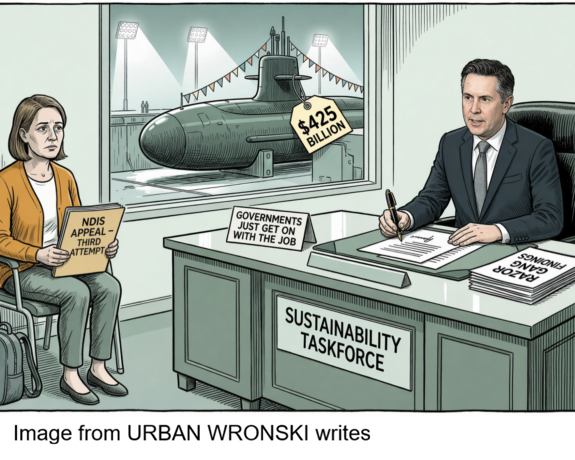

PETITION – To: Prime Minister Anthony Albanese and the Australian Labor Government
Chernobyl: The Lost Tapes – A good documentary on Chernobyl on SBS available On Demand for the next 3 weeks– https://www.sbs.com.au/ondemand/tv-program/chernobyl-the-lost-tapes/235274195556
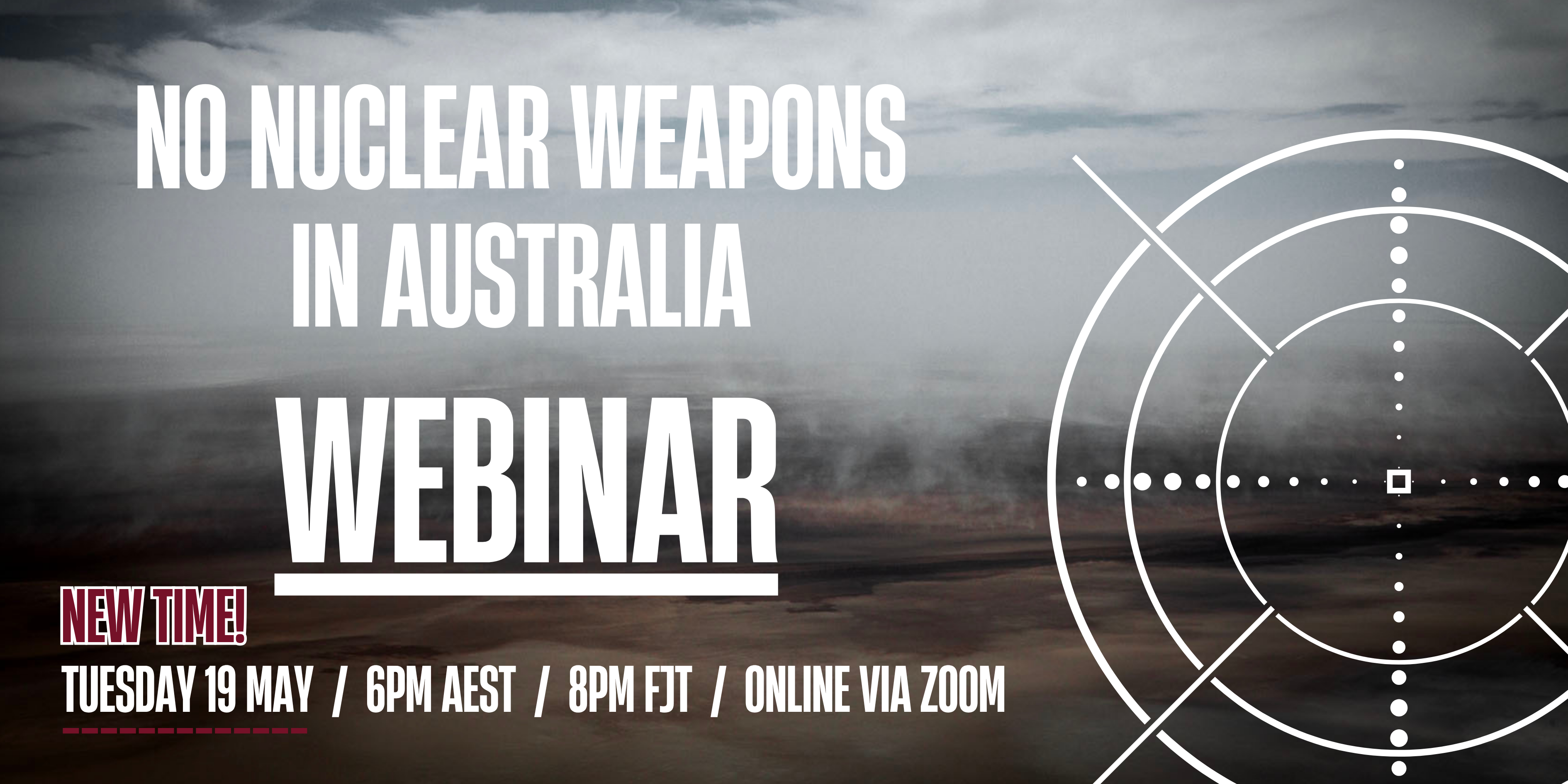
19 May – Webinar- Webinar: No Nuclear Weapons in Australia
Start: 2026-05-19 18:00:00 UTC Canberra, Melbourne, Sydney (GMT+10:00)
End: 2026-05-19 19:30:00 UTC Canberra, Melbourne, Sydney (GMT+10:00)
20 May – Webinar – The dangerous world of AUKUS, US, military occupation and suppression of dissent

National Webinar, 20th May, 2026, 6.30pm AEST. Confronting laws restricting/suppressing protest speech and action
Speakers: Former Sen. Rex Patrick, Lawyer Nick Hanna ,Arthur Rorris ,Jorgen Doyle, Sen David Shoebbridge,
Facilitator Kelley Tranter.

of the week – Australians for War Powers Reform (AWPR)
To see nuclear-related stories in greater depth and intensity
 Antinuclear