Japan’s nuclear power plants are “not designed for war” and if attacked by missiles, “radioactive materials will be scattered — Fukushima 311 Watchdogs

KEPCO’s Takahama Nuclear Power Plant March 9, 2022At a meeting of the House of Representatives’ Committee on Economy, Trade, and Industry on March 9, Chairman Toyoshi Sarada of the Nuclear Regulatory Commission said, “There is concern that radioactive materials will be spread” in the event of a missile attack on a nuclear power plant in […]
Japan’s nuclear power plants are “not designed for war” and if attacked by missiles, “radioactive materials will be scattered — Fukushima 311 Watchdogs
(11 Years after the Great East Japan Earthquake) Forest untouched by decontamination, creatures exposed to radiation continue to be affected at the cellular level — Fukushima 311 Watchdogs

Tohoku University lecturer Masatoshi Suzuki arranges samples of Japanese macaques in Sendai City on February 8. March 8, 2022 Eleven years have passed since the accident at TEPCO’s Fukushima Daiichi Nuclear Power Plant. While decontamination has progressed mainly in residential areas and other areas where people live, vast areas of forests remain largely untouched. A wild […]
(11 Years after the Great East Japan Earthquake) Forest untouched by decontamination, creatures exposed to radiation continue to be affected at the cellular level — Fukushima 311 Watchdogs
River fishing limits remain 11 years after nuclear disaster — Fukushima 311 Watchdogs

Researchers catch fish in the Otagawa river in Minami-Soma, Fukushima Prefecture, on Dec. 14, 2021, to survey the concentration of radioactive materials. (Keitaro Fukuchi) March 7, 2022 FUKUSHIMA–A sign along the Manogawa river that runs through Minami-Soma, Fukushima Prefecture, is faded, but the message is clear–and perhaps unnecessary. “Regulations have yet to be lifted,” it […]
River fishing limits remain 11 years after nuclear disaster — Fukushima 311 Watchdogs
Booklets touting Fukushima plant water discharge angers schools — Fukushima 311 Watchdogs

A leaflet distributed by the Reconstruction Agency for junior and senior high school students on the three topics regarding tainted water treated by the Advanced Liquid Processing System (ALPS) is shown at the Miyagi prefectural government office on Feb. 21. (Ryuichiro Fukuoka) March 7, 2022 Complaints from educators have prompted some municipalities in coastal areas of […]
Booklets touting Fukushima plant water discharge angers schools — Fukushima 311 Watchdogs
Ukraine war fills Pentagon’s, NATO allies’ war chests
“Over multiple administrations, Democrat and Republican, we have tried to minimize friction with Putin and with Russia, in the hopes that it wouldn’t exacerbate a problem….And I feel like that era is over,” said Slotkin, a former Pentagon official. “I think it’s a sea change for how both the Defense Department and the State Department should think about our presence in Europe.”

[N]ow there is a unique moment of bipartisanship that will allow the Pentagon to request and receive just about anything it wants, Rep. Elissa Slotkin, D-Mich., said last week during a House Armed Services Committee hearing. Congress is poised to approve $14 billion for Ukraine aid this week, including nearly $5 billion for additional troops in Europe and replenishing U.S. weapons already sent to Ukraine. The House passed the package Wednesday and the Senate is expected to vote on the bill by Friday.
“Over multiple administrations, Democrat and Republican, we have tried to minimize friction with Putin and with Russia, in the hopes that it wouldn’t exacerbate a problem….And I feel like that era is over,” said Slotkin, a former Pentagon official. “I think it’s a sea change for how both the Defense Department and the State Department should think about our presence in Europe.”
Ukraine war fills Pentagon’s, NATO allies’ war chests https://wordpress.com/read/feeds/113283937/posts/3880404511, Rick Rozoff, Anti-bellum
Stars and Stripes, March 10, 2022,
Congressional support for larger defense budget grows amid Ukraine invasion The changing security landscape in Eastern Europe will “no doubt” increase next year’s defense budget, Rep. Adam Smith, D-Wash., chairman of the House Armed Services Committee, said at an event last week. Other Capitol Hill lawmakers say they are also prepared to funnel more money to the Pentagon as the U.S. rethinks its national security and defense posture.
“President [Joe] Biden needs to put a serious budget proposal forward to confront the real threats we face,” Sen. Kevin Cramer, R-N.D., said in a statement. “Russia is just one reason why defense spending needs to be higher. China and other nations are watching the seriousness and resolve of freedom-loving nations.”
Russia’s unprovoked attack on Ukraine has prompted other NATO countries to pledge additional funding for their armed services.
In a reversal of decades of post-Cold War policy, Germany’s Chancellor Olaf Scholz said last month that his country would embark on a $110 billion rearming program. Poland announced last week that it will raise its spending on defense from 2% to 3% of the country’s gross domestic product. Leaders of France, Italy, Latvia and Romania have all vowed in recent days to boost their commitment to defense.
U.S. lawmakers authorized nearly $778 billion for defense spending for the 2022 fiscal year – $25 billion more than requested by the White House. The Biden administration has yet to submit its budget request for fiscal year 2023, which starts Oct. 1, but Smith said last week that the eventual spending plan will be “the most impactful and important budget that we’ve seen in the 25 years I’ve been in Congress.”
Sen. Jim Inhofe of Oklahoma, the top Republican on the Senate Armed Services Committee, said he wants to see defense expenditures grow by at least 3% to 5%, adjusted for inflation….
[N]ow there is a unique moment of bipartisanship that will allow the Pentagon to request and receive just about anything it wants, Rep. Elissa Slotkin, D-Mich., said last week during a House Armed Services Committee hearing. Congress is poised to approve $14 billion for Ukraine aid this week, including nearly $5 billion for additional troops in Europe and replenishing U.S. weapons already sent to Ukraine. The House passed the package Wednesday and the Senate is expected to vote on the bill by Friday.
“Over multiple administrations, Democrat and Republican, we have tried to minimize friction with Putin and with Russia, in the hopes that it wouldn’t exacerbate a problem….And I feel like that era is over,” said Slotkin, a former Pentagon official. “I think it’s a sea change for how both the Defense Department and the State Department should think about our presence in Europe.”
Prince of Wales links Australia’s floods to climate change in message of support
Prince of Wales links Australia’s floods to climate change in message of support
The Prince of Wales releases a message support to people who have been affected by floods in Queensland and NSW this month, saying he has “great admiration for the resilience, courage and compassion of the Australian people”.
EU military aid to Ukraine to exceed $1 billion — Anti-bellum
Daily SabahMarch 11, 2022 EU to boost military support to Kyiv, mulling new sanctions European Union leaders said Friday they will continue applying pressure on Russia by drafting a new set of sanctions to punish Moscow for its invasion of Ukraine while stepping up military support for Kyiv. The EU’s top diplomat, Josep Borrell, said […]
EU military aid to Ukraine to exceed $1 billion — Anti-bellum
Global medical and public health organizations call for immediate end to war in Ukraine and critical need to prevent nuclear escalation — IPPNW peace and health blog

Representing doctors, public health professionals and medical students worldwide, we call for an immediate cease fire and the withdrawal of all invading and occupying military forces and an urgent negotiated end to the current war in Ukraine. The alarmingly acute and growing danger of nuclear escalation must be reversed and nuclear war prevented by the […]
Global medical and public health organizations call for immediate end to war in Ukraine and critical need to prevent nuclear escalation — IPPNW peace and health blog
Children face “discrimination because of Fukushima,” the discovery of thyroid cancer, and bullying — Fukushima 311 Watchdogs

After the nuclear accident, Zensei Kamoshita evacuated from Iwaki City, Fukushima Prefecture, to Tokyo. 11 years later, he is now a university student. Photo by Shuzo Saito 22, 2022 issue Eleven years will soon have passed since the Great East Japan Earthquake and the Fukushima Daiichi Nuclear Power Plant accident. Many residents have yet to […]
Children face “discrimination because of Fukushima,” the discovery of thyroid cancer, and bullying — Fukushima 311 Watchdogs
March 11 Energy News — geoharvey

Opinion: ¶ “Why Record-High Gas Prices Won’t Be Solved By Drilling More Oil In The US” • As US oil and gasoline prices set records, politicians in both parties called for a seemingly easy solution: Drill our way out of the problem. But the idea that the US can be fully energy independent, thereby keeping […]
March 11 Energy News — geoharvey
Los Alamos Study Group outlines a clear solution to the Ukraine war

Understanding why Russia invaded is not condoning the invasion. Russia’s view is that of existential dangers to its very existence. …… Russia’s view has to be respected, whether or not we agree with it. Failure by the U.S. and NATO over the course of decades to respect Russia’s position, and to provide a humane and reasonable provision for Russia’s security needs is the main if not the only material cause of the present conflict.
An end to the invasion and war in Ukraine can only be guaranteed if Russia’s security is itself guaranteed. …… The fundamental cause of the current conflict is the desire of the U.S. to weaken or “break”Russia.
A Proposed Solution to the Ukraine War
An end to the invasion and war in Ukraine can only be guaranteed if Russia’s security is itself guaranteed. Security is largely indivisible. Security for one state requires security for others, says the Los Alamos Study Group.
Consortium News By Greg Mello, March 7, 2022
Los Alamos Study Group Since the Russian invasion of Ukraine began, what was a regional conflict has become a global hybrid war with ever-greater stakes, not least the risk of nuclear war.
Perhaps the greatest danger lies in the difference of motives between parties, which is also the fundamental cause of this war: Russia seeks security, while the U.S. and its NATO allies have been using Ukraine to deny that security — to “break Russia,” in Henry Kissinger’s 2015 phrase. The U.S. does not want peace, unless it be the peace of a conquered Russia. That is why there is no obvious end to the escalations and counter-escalations. The U.S. and NATO see opportunity in the war they have been trying so hard to provoke.
The tragedy is that few people seem to understand that at the root of the Ukraine crisis is a specific strategy known as the Wolfowitz Doctrine, named after Paul Wolfowitz who, as under secretary of defense in the administration of George H. W. Bush, was one of the authors of a 1992 document that laid out a neo-conservative manifesto aimed at ensuring American dominance of world affairs following the collapse of the Soviet Union………….
The Wolfowitz Doctrine triggered the post-Cold War use of NATO as an instrument of bloody aggression against Yugoslavia, Afghanistan, Iraq and Libya. It declared, in effect, that diplomacy was dead and that American power ruled by violence if necessary. A resurgent Russia led by Vladimir Putin was next, and on the horizon, a risen China.
The 2014 Washington-engineered coup in Ukraine that removed an elected leader who sought to reinforce his country’s relationship with neighboring Russia, was a product of the 1992 Doctrine and the extremism it represented. Victoria Nuland, a neo-conservative ideologue and President Barack Obama’s “point person” in Ukraine, has played the same role in President Joe Biden’s State Department.
The 1992 Doctrine is elaborated in an infamous RAND study on how to overextend and, in Kissinger’s words, “break Russia.” This is U.S. foreign policy today: a fact well understood by the Russian leadership who regard their country as effectively under siege by the United States.
The potential of American missiles pointed at Moscow from former Soviet satellite countries, together with NATO troop deployments, is the reality they see. A militarized and virulently anti-Russian Ukraine being used as a tool by the U.S., with an expressed wish for nuclear weapons, on the brink of invading Russian-sympathizing provinces on the Russian border — all that was too much for Russia. What, do you suppose, the U.S. would do if such a situation arose in Mexico or Canada?The potential of American missiles pointed at Moscow from former Soviet satellite countries, together with NATO troop deployments, is the reality they see. A militarized and virulently anti-Russian Ukraine being used as a tool by the U.S., with an expressed wish for nuclear weapons, on the brink of invading Russian-sympathizing provinces on the Russian border — all that was too much for Russia. What, do you suppose, the U.S. would do if such a situation arose in Mexico or Canada?
Since 2014, the Las Alamos Study Group has made it part of our business to understand the conflict in Ukraine and its significance for the world. In that year we held public meetings and teach-ins discussing it and since then have tried to examine developments as we could. In the Obama Administration, we took our concerns to the offices of the National Security Council — and were appalled by the lack of knowledge and understanding we found there.
Many non-governmental organizations (NGOs) have taken positions on this conflict. In our view, most (not all) of their statements are superficial, and/or omit the causes of the invasion as Russia understands them, or are in lock-step with U.S. and NATO propaganda.
The Study Group’s Basic Conclusions
- Understanding why Russia invaded is not condoning the invasion. Russia’s view is that of existential dangers to its very existence. The sincerity of that view is evident in the grave risks Russia is taking in this invasion which, again, we need neither justify nor condemn. Russia’s view has to be respected, whether or not we agree with it. Failure by the U.S. and NATO over the course of decades to respect Russia’s position, and to provide a humane and reasonable provision for Russia’s security needs is the main if not the only material cause of the present conflict.
- Telling Russia what to do is the problem, not the solution. We in NATO countries and in the West more broadly, and in peace-oriented groups, should confine our imperatives and judgments to what we ourselves can do, in our own countries and in relation to NATO. It is imperative to bring peace to Ukraine as best we can and to not inflame or broaden this conflict further. Our words can kill, or heal.
- An end to the invasion and war in Ukraine can only be guaranteed if Russia’s security is itself guaranteed. Security is largely indivisible. Security for one state requires security for others. This is a core principle of European security which Russia rightly insists upon. The U.S. should honor that. The fundamental cause of the current conflict is the desire of the U.S. to weaken or “break”Russia.
- Human rights, including the right of political self-determination, are pillars of Western values and institutions. The government of Ukraine has denied human rights and political self-determination to the peoples of the Donbass. Some 13,000 people have died during the eight years since the 2014 coup, according to the United Nations. The Ukrainian government has overtly genocidal policies toward Russian minorities. Since the 2014 U.S. sponsored coup, the U.S. and its European allies have used Ukraine to undermine Russian security.
- Nazi and neo-Nazi formations and ideologies in Ukraine present a clear danger to human rights and human life everywhere.
- Peace and nuclear disarmament organizations should be alarmed by NGO support for U.S. efforts to demonize and destabilize Russia.
What the Study Group Wants
1. We want a negotiated peace at the earliest possible time. In our own countries, every effort should be made to achieve this. We do not see those efforts.
2. We want an end to further escalation and broadening of the conflict, which threatens the well-being and security of the whole world. None of our countries should be introducing or transporting arms or conducting military activities or providing training or support of any kind in Ukraine. Peace groups should oppose all such escalation. “Helping Ukraine” with military “aid” is just a way of getting more people killed in the service of long-term U.S. aims to destroy the Russia.
3. Weapons should not be provided to civilian individuals, gangs, criminals, children, and “stay-behind,” guerrilla, or Volkssturmgroups. This only inflicts needless suffering and damages prospects for peace now and in the long run. There is no honor or legitimacy in such tactics in the present circumstances.
4. All economic sanctions – which hurt ordinary citizens more than elites – should be lifted. Economic sanctions are weapons of mass destruction, with global effects.
5. We want measured, just, de jure de-nazification of the Ukrainian government and laws.
6. The independence of the Donbass region within pre-conflict administrative boundaries should be accepted by all peace organizations and states.
7. The democratic decision of Crimea to rejoin Russia should be accepted by all peace organizations and states.
8. Peace groups should support a neutral, demilitarized (i.e. without heavy weapons or force projection capability) Ukraine, which is similar if not identical to the outcome sought by Russia.
9. Civilian areas must not be used as military staging or artillery bases. This is illegal, in fact. There is evidence that the Ukrainian Armed Forces are engaging in this odious practice.
10. Ukraine should not be allowed to join NATO. That was a capital demand of Russia and one that we should all support.
11. NATO should disband. The largest military alliance in the world, NATO consumes more resources than all the world’s militaries combined, and has conducted multiple wars of aggression, in violation of the U.N. Charter and Nuremberg principles. NATO is also a nuclear weapons alliance.
12. The U.S. and the five states that host U.S. nuclear weapons should, jointly or individually, end nuclear hosting arrangements, as well as end the training of non-U.S. pilots in nuclear weapons use and the prospective use of non-U.S. dual-capable aircraft for nuclear missions.
13. Clearly, all of the above is urgent if the killing is to end, and there is to be a lasting peace in Europe.
Greg Mello is the executive director of the Los Alamos Study Group in Albuquerque, New Mexico. https://consortiumnews.com/2022/03/07/a-proposed-solution-to-the-ukraine-war/
Lies leave the Assange case exposed – this is a political persecution
Lies leave the Assange case exposed – this is a political persecution, https://www.counterfire.org/articles/opinion/22480-lies-leave-the-assange-case-exposed-this-is-a-political-persecution
John Rees on how a false testimony has further confirmed that the Assange case is a political attack against critical journalists
Watching the US government’s case against Julian Assange is like watching a levitation act at the music hall. You can see that the object floats, but you’ve no idea how. If normal gravitational laws applied, the Assange case would have crashed to the ground already.
After all, a leading prosecution witness has admitted lying in his evidence to the court and the defendant and his lawyers have been spied on by the intelligence agency of the government attempting to extradite him. In any other case, the mere facts of these revelations would be enough to halt court proceedings, but the detail makes the case for abandonment of the extradition even more compelling.
The most recent bombshell is that Sigurdur ‘Siggi’ Thordarson has admitted to Icelandic journalists at Stundin that he lied when he gave evidence alleging that Julian Assange had instructed him to hack US government accounts. Thordarson’s evidence is not marginal to the US case: it’s woven all through the prosecution’s argument, and it is specifically referred to by the judge in the Westminster Magistrates’ Court in those parts of her judgement which are hostile to Assange.
Indeed, when the Trump administration realised that their case was weak, they specifically sought out Thordarson in Iceland and reissued their charges against Assange so that it would be, they imagined, strengthened by his evidence. They should have known better.
To say that Thordarson is an unreliable witness is a very considerable understatement. His allegations had been reviewed by the Obama administration and found too problematic to be taken seriously. Trump’s administration re-animated Thordarson in an attempt to breathe life into their flagging case.
Thordason had been a volunteer for WikiLeaks, working to raise funds. He stole some $50,000 from WikiLeaks and he misrepresented himself to the outside world in order to embezzle money. He was also convicted of sexual abuse of children. On both counts, Julian Assange helped put him in jail. His motive for lying once again for the Trump administration is plain: revenge. And his false evidence is meant to bolster a central contention of the US case: that Julian Assange is a hacker, not a journalist.
Quite what has now convinced this serial liar to admit that he invented the material on which the US case so heavily relies we cannot know. But his decision to do so blows a hole through the centre of the case for extradition.
Thordarson admitted to the Stundin investigative team that Assange never asked him to hack anything. In fact, he now says that his previous claim that Assange had instructed or asked him to access computers is false.
Yet this is precisely the evidence on which the US prosecution relies. Indeed, it was so important to them that they tore up their original indictment of Assange on the very eve of the extradition hearing so that they could reissue a second indictment specifically including Thordarson’s evidence – evidence now admitted to be a total fiction.
At this point most cases which had been exposed as relying on perjured testimony would collapse. Not so the Assange case, which is now heading to the Appeal Court where the US will try to overturn the decision of the Magistrates’ Court at the start of this year, which found that the US prison system is so ‘oppressive’ that Assange would be a suicide risk were he committed to it.
It’s not even as if the Thordarson revelations are the first time that evidence has emerged which would normally halt court proceedings in their tracks. It is already a matter of record that Assange and his legal team were spied on by a Spanish security firm reporting to the CIA. The firm, UC Global, were employed by the Ecuadorean embassy to protect Assange when he was granted asylum. They were suborned by the CIA and then supplied them with both audio and video recordings of Assange and his legal team in the embassy. All this has been revealed in an ongoing court case in Spain.
Again, in any normal trial, the revelation that attorney-client privilege had been abused in this way would have been grounds for dismissal. But not in the Assange case. The court seems content to accept the US government’s argument that the CIA would respect departmental boundaries and never tell the Department of Justice any information obtained from the spying operation on Assange. This excuse beggars belief, since the exact function of the CIA is to tell the US government about the threats to national security, as they see it.
And there is the whole core of the problem: the US government under Trump allowed the fiction to develop that the fundamental business of investigative journalism is a threat to national security. Accordingly, Julian Assange became reclassified as a ‘cyber-terrorist’, not a journalist.
In pursuit of this dangerous fantasy, the US government is keeping a multiple award-winning journalist banged-up in a high security jail specifically used for terrorists, in spite of the Magistrates’ Court decision against them.
It’s time that both the US government and the British government brought this embarrassing farce to an end. Every major human rights organisation on the planet has said it is wrong. Journalists’ unions across the globe say its wrong. Parliamentarians in Italy are protesting in their legislature to says its wrong. German MPs are demanding Angela Merkel tells Joe Biden its wrong. Australian MPs are campaigning for Assange’s release in unprecedented numbers. British MPs have been protesting outside Belmarsh because they are not even being allowed a briefing with Assange.
As the Assange case goes to the High Court, we are reaching a critical moment. This is the crucial freedom of the press case of the twenty-first century. If it is lost, the shadow of authoritarian government will be cast longer and darker over the body politic. We should not allow that to happen.
Scott Morrison has been urged to act over fears Australian uranium could be used to fuel Russia’s nuclear arsenal.
Fears Australian uranium could be seized by Russia for nuclear weapons arsenal
Scott Morrison has been urged to act over fears Australian uranium could be used to fuel Russia’s nuclear arsenal. news.com.au, Alex Blair 9 Mar 22.
The Electrical Trades Union of Australia has called on Scott Morrison to take immediate action over Australian uranium in Ukraine, which analysts believe could be seized by Russia and used to fuel its nuclear weapons arsenal..
In a letter sent to the Prime Minister this week, the ETU highlighted its concerns over Australian obligated nuclear material (AONM) which has been transferred to Ukraine under the Australia-Ukraine Nuclear Cooperation Agreement.
The ETU is urging the Prime Minister to reveal details on any contingency plans set in place following Russia’s invasion, as the Australian government has an “obligation to create a plan for the removal of nuclear material if it is at risk of a loss of regulatory control”.
The ETU has also requested information on whether uranium that was transferred to Ukraine is still stored in the besieged nation.
“Amongst many other horrors, the war in Ukraine is painfully highlighting the inherent problems with nuclear power,” ETU National Assistant Secretary Michael Wright said.
“If Russia is able to gain control of Australian uranium in Ukraine, the fallout could be catastrophic.
“Australians have a right to know if Australian uranium is at risk and what our nation’s obligations are in the event of an incident.
“We not only have an obligation under our own agreement with Ukraine but we owe it to the global community to ensure these materials are protected – preferably by leaving them in the ground.”
It came as Russian President Vladimir Putin was accused of using nuclear “blackmail” to keep the international community from interfering in his Ukraine invasion.
“This is one of the scariest moments really when it comes to nuclear weapons,” Beatrice Fihn, who leads the International Campaign to Abolish Nuclear Weapons, told AFP in an interview on Tuesday.
The 40-year-old, who has spearheaded the group’s global efforts to ban the weapons of mass destruction since 2013, said she had never in her lifetime seen the nuclear threat level so high.“It is incredibly worrying and overwhelming.”
Just days after Russia launched its full-scale invasion of its pro-Western neighbour on February 24, Putin ordered his country’s nuclear forces to be put on high alert, sparking global alarm…………………………… https://www.news.com.au/world/europe/fears-australian-uranium-could-be-seized-by-russia-for-nuclear-weapons-arsenal/news-story/565ae8e823834435ad1846798f4066d4
Directors net $3.7 million in selling off their Paladin Energy uranium shares, then uranium stocks plummet

Paladin directors narrowly avoid nuclear sell-off https://www.afr.com/rear-window/paladin-directors-narrowly-avoid-nuclear-sell-off-20220308-p5a2u3Joe AstonColumnist, Uranium miner Paladin Energy advised the Australian Securities Exchange on Monday that chairman Cliff Lawrenson and non-executive director Peter Watson had, between them, sold 4.5 million, or 55 per cent, of their shares in the company between February 28 and March 3, netting proceeds of $3.7 million.
Lawrenson’s broker secured an average out price of 84¢ while Watson had to settle for 81¢.
It was certainly an auspicious moment for the pair. That very evening, of March 3, Russian forces seized the Zaporizhzhia nuclear power plant in Ukraine, but not before their shelling set it on fire, and uranium stocks dutifully plummeted across global markets.
On March 4, 154 million Paladin shares changed hands, crunching the share price down 15 per cent to 74¢. At one point in intraday trading, they were down 26 per cent.
Timing is everything, the old truism goes, and you can safely say about Lawrenson and Watson that their timing is the opposite of radioactive.
Lawrenson still has 2.1 million Paladin shares to his name while Watson has 1.6 million.
Sydney ruled out as nuclear submarine base – despite topping list of sites in Defence study
Sydney ruled out as nuclear submarine base – despite topping list of sites in Defence study https://www.theguardian.com/australia-news/2022/mar/09/sydney-ruled-out-as-nuclear-submarine-base-despite-topping-list-of-sites-in-defence-study
Questions raised about how Coalition settled on its three potential locations Daniel Hurst Foreign affairs and defence correspondent, @danielhurstbne, Wed 9 Mar 2022
Sydney Harbour has been ruled out as a site for the proposed new base for Australia’s nuclear-powered submarines, with officials insisting it was not viable because of “limitations on berth space and shore facilities”.
Questions have been raised about how the Morrison government settled on the three potential sites it announced this week – Port Kembla in Wollongong, Newcastle and Brisbane – given that these were not among the top five options listed in a previous Defence review.
A 2011 Defence report ranked potential options for a new east coast home port for submarines. The top three options were in Sydney Harbour, followed by two options in Jervis Bay, south of Sydney.
The same study said it “would be impractical” to develop a future submarine basing capability at Port Kembla, noting it had previously been found to be “a small and congested harbour with little space for substantial expansion”.
When asked by Guardian Australia to explain what had changed since that review, a Defence spokesperson said changes in commercial activity at Port Kembla had released a large pocket of land which was “now potentially suitable for creation of a new naval base”.
Jervis Bay had been “discounted as it is a gazetted marine park”, the spokesperson said.
The Garden Island defence precinct in Sydney Harbour, which already serves as the navy’s key operational base on the east coast, was also “not considered a viable long-term solution” for a permanent submarine base.
“The site is constrained with limitations on berth space and shore facilities and suffers considerable encroachment,” the Defence spokesperson said. “Construction of dedicated submarine facilities at GIDP would exacerbate existing pressures and further limit expansion options.”
Scott Morrison announced the three potential sites in a national security speech on Monday, even though the selection process will not be complete until next year. That sparked Labor accusations of a pre-election marketing “ploy”.
Both the prime minister’s speech and the government’s subsequent press release contained ambiguous language about who precisely had settled on the three final sites, after Defence did “significant work” to review “19 potential sites”.
“Three preferred locations on the east coast have been identified,” Morrison said. He did not explicitly state whether it was the department or cabinet ministers who had done the identifying, or whether the government’s decision was in line with Defence’s recommendations.
The employment minister, Stuart Robert, told Sky News on Tuesday: “The national security committee of cabinet has worked through a range of options and narrowed it down to three.”
That committee is chaired by Morrison and includes senior ministers, including the defence minister, Peter Dutton, and the foreign affairs minister, Marise Payne. Robert is not listed as a member.
But the Defence spokesperson told Guardian Australia each site had been “assessed against Defence’s evaluation criteria”.
The factors included “access to exercise areas and proximity to industrial infrastructure and significant population centres to support personnel and recruitment”.
The three options would be “subject to further review and consultation”, the spokesperson said.
In Defence’s 2011 future submarine basing study, Newcastle port was ranked sixth and the Port of Brisbane eighth. That review said Newcastle’s strengths were “compromised by its isolation from any other naval infrastructure, its susceptibility to flooding, and its sometimes difficult harbour entrance”.
Dutton was asked on Tuesday whether a Chinese state-owned corporation’s part-holding of the long-term lease over the port would affect the eventual decision on where to build the submarine base.
“All of that would be taken into consideration,” he told the ABC.
He bristled at any suggestion he and Morrison were at odds on the timeframe for deciding which submarine design Australia would adopt under the much-trumpeted Aukus partnership with the US and the UK.
Dutton had said on Sunday the government would announce the selected boat “within the next couple of months”, sparking speculation this may occur before the federal election due in May.
But Morrison ruled out making a decision before the election, noting that caretaker conventions were due to begin by April.
The defence minister told the Nine Network: “I didn’t say it would be before the election. Of course the ABC and the Guardian and others have tried to spin it into that but that’s not the case.”
The Labor party has offered its support for the Aukus, saying it accepts advice that the deteriorating strategic environment in the Indo-Pacific justifies the need for less easily detectible nuclear-propelled submarines.
That committee is chaired by Morrison and includes senior ministers, including the defence minister, Peter Dutton, and the foreign affairs minister, Marise Payne. Robert is not listed as a member.
But the Defence spokesperson told Guardian Australia each site had been “assessed against Defence’s evaluation criteria”.
The factors included “access to exercise areas and proximity to industrial infrastructure and significant population centres to support personnel and recruitment”.
But Labor’s defence spokesperson, Brendan O’Connor, said the party was seeking a briefing on the east coast base plans. He said Morrison had “taken a leaf out of his marketing playbook by making an announcement about a decision that will be made in 2023”.
Officials from the US and the UK have visited Australia in recent weeks. It is understood the three governments are examining the full set of requirements to allow for the delivery of at least eight nuclear-propelled submarines under Aukus.
These include the submarine design, construction, safety, operation, maintenance, disposal, regulation, training, environmental protection, installations and infrastructure, industrial base capacity, workforce and force structure.
While Morrison has previously said the first submarine was expected to be in the water by about 2040, Dutton has since argued the may be achievable sooner.
The government has also foreshadowed a likely increase in visits by British and US nuclear submarines in the meantime.
1 This month.


PETITION – To: Prime Minister Anthony Albanese and the Australian Labor Government
Chernobyl: The Lost Tapes – A good documentary on Chernobyl on SBS available On Demand for the next 3 weeks– https://www.sbs.com.au/ondemand/tv-program/chernobyl-the-lost-tapes/235274195556
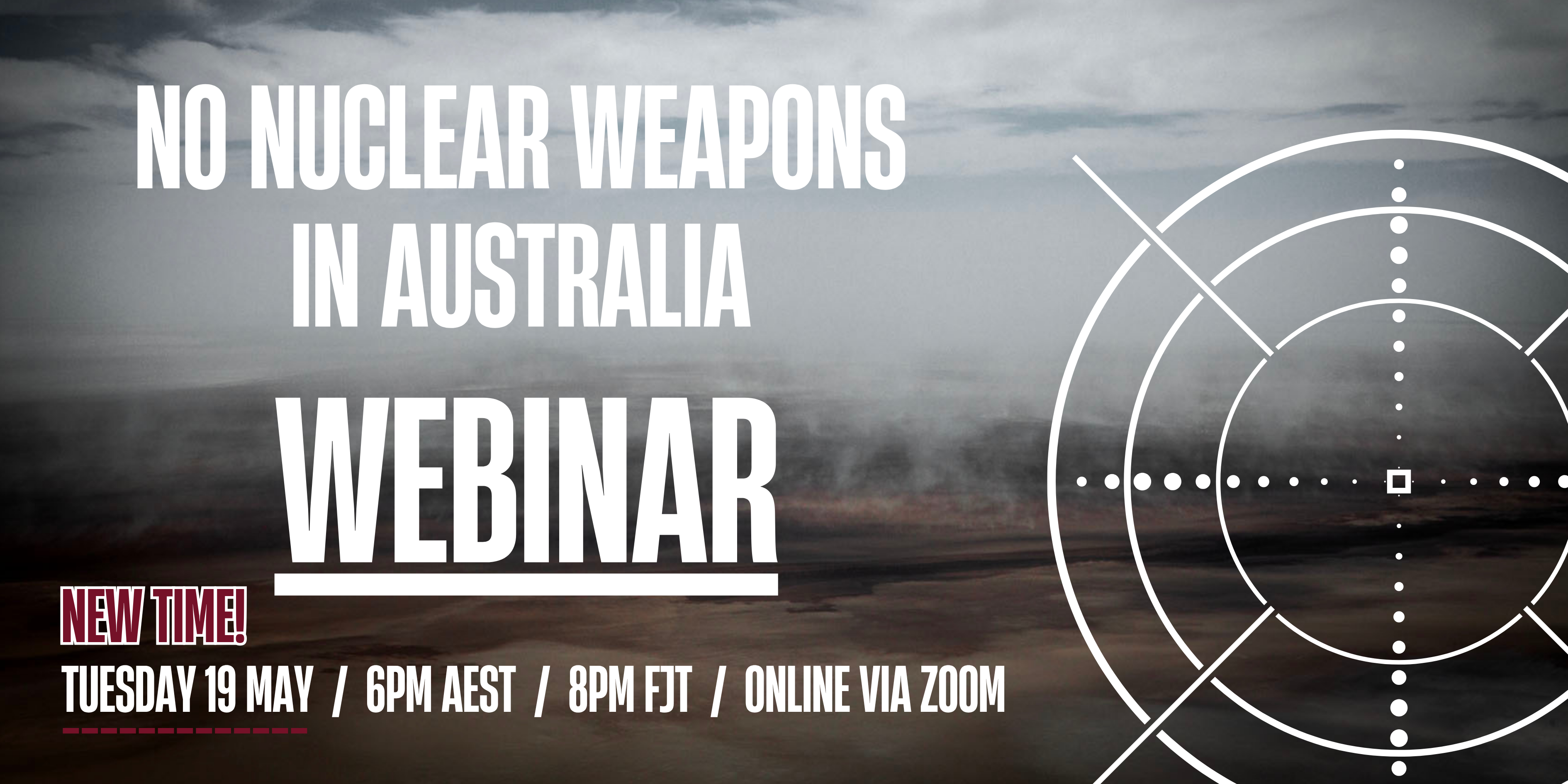
19 May – Webinar- Webinar: No Nuclear Weapons in Australia
Start: 2026-05-19 18:00:00 UTC Canberra, Melbourne, Sydney (GMT+10:00)
End: 2026-05-19 19:30:00 UTC Canberra, Melbourne, Sydney (GMT+10:00)
20 May – Webinar – The dangerous world of AUKUS, US, military occupation and suppression of dissent

National Webinar, 20th May, 2026, 6.30pm AEST. Confronting laws restricting/suppressing protest speech and action
Speakers: Former Sen. Rex Patrick, Lawyer Nick Hanna ,Arthur Rorris ,Jorgen Doyle, Sen David Shoebbridge,
Facilitator Kelley Tranter.

of the week – Australians for War Powers Reform (AWPR)
To see nuclear-related stories in greater depth and intensity
 Antinuclear