Nuclear Power In Australia: A Little More Conversation?
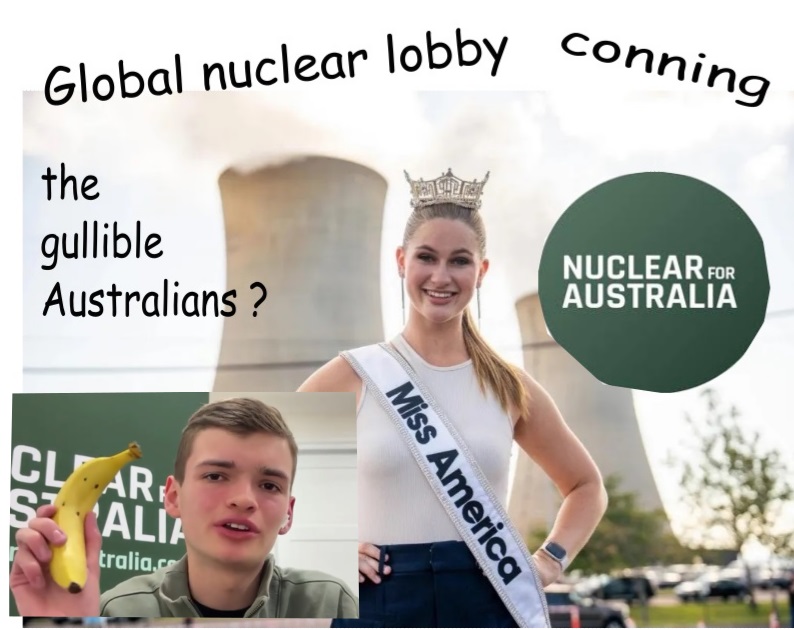
March 21, 2025 by Michael Bloch, https://www.solarquotes.com.au/blog/nuclear-ban-australia-mb3142/
Self-described grassroots movement Nuclear for Australia is calling for policy makers to kick off a science-driven conversation about including nuclear power in Australia’s future energy mix.
The group announced yesterday that more than 100,000 Australians (101,334 at the time of writing) have signed their petition calling for removing a ban on nuclear power here.
Nuclear for Australia was founded in December 2022 and is chaired by the former CEO of Australia’s Nuclear Science and Technology Organisation (ANSTO) Dr Adi Paterson. Also involved with the organisation is founder of Dick Smith Electronics, Dick Smith, who is a patron.

“Australians are tired of distractions and misinformation,”1 said Will Shackel, Founder of the group. “Over 100,000 signatures show that people want nuclear power on the table as a practical solution for Australia’s energy needs.”
As for the call for a science-based conversation on nuclear power, if only there was a suitable organisation policy makers could turn to for pretty reliable information.
How about the CSIRO? It’s in their name: Commonwealth Scientific and Industrial Research Organisation. Science *and* Industrial research – it seems like a suitable candidate to lead this. Now, if only CSIRO would weigh in on the thorny topic.
What’s that you say? They have?
Nuclear Not A Timely, Cost-Competitive Or Efficient Solution
The answer to the question of nuclear in Australia’s electricity sector is answered on this CSIRO page. The CSIRO is pretty clear in its view, last updated in early December 2024.
- Currently, nuclear power doesn’t offer the most cost-competitive solution for low emission electricity in Australia.
- Long development lead times mean nuclear can’t make a significant contribution to achieving net zero emissions by 2050.
- While nuclear power plants have a long operational life, this offers no unique cost advantage over shorter-lived technologies.
CSIRO’s draft2 GenCost 2024-25 Report found renewables continue to have the lowest cost range of any new build electricity generation technologies (for the seventh year in a row). That’s including the cost of firming – taking into consideration storage, transmission, system security and “spilled” energy.
Reversing The Ban A Pointless Distraction
As for other countries pursuing nuclear power; some are setting a good example of what *not* to do in Australia – and that is pursue nuclear energy.
A recent example is the latest reported cost blow-out for the UK’s proposed Sizewell C nuclear plant3; which has doubled since 2020 to around $80 billion Australian dollars. Along with large-scale firmed renewables, that could buy a lot of rooftop solar power systems and home batteries.
According to the Institute for Energy Economics and Financial Analysis (IEEFA), Sizewell C’s current estimated costs are about 2.5 times the capital cost used in the Coalition’s modelling for its nuclear dreams in Australia.
“For an Australian nuclear plant with similar costs to those reported for Sizewell C to be commercially viable, average household power bills would need to increase by between $561 and $961 per year,” states IEEFA.
It makes the electricity price rises on the cards for many Australians in 2025/26 seem like chump change.
As for mature and scientific conversation, we can do that until the cows come home and we have been; along with plenty of other types of conversations (including some here on SQ). But it’s not really a complicated thing to grasp – reversing a ban wouldn’t change the fact that:
Nuclear power is too expensive for Australia.
But cost alone isn’t a good reason for maintaining a ban. So what harm is there in removing it?
Given all the other issues associated with nuclear energy when there are more appropriate solutions already good to go and being implemented (renewables), just going through the motions and its impacts would turn into a huge time-sucking exercise and dangerous distraction. Time is a luxury we don’t have given all the faffing about with fossil fuels over the years – and that would be extended too.
To have nuclear power on the table as an energy solution in Australia, you’d first need to scrape it off the floor. Maintaining the ban helps save us from ourselves.
Never forget’: Pacific countries remember nuclear test legacy as weapons ban treaty debated.

Supporters of the UN treaty prohibiting nuclear weapons gathered this month in New York to call for wider ratification
Jon Letman, Guardian, 21 Mar 25
Growing up in the Pacific nation of Kiribati, Oemwa Johnson heard her grandfather’s stories about nuclear explosions he witnessed in the 1950s. The blasts gave off ferocious heat and blinding light. He told her people were not consulted or given protective gear against bombs detonated by the US and UK at Kiritimati Island, now part of Kiribati, decades ago.
People in Kiribati suffered grave health consequences as a result of exposure to radiation from the tests in the late 1950s and early 1960s, a legacy they say continues to this day. Johnson says there’s a lack of accountability and awareness of how nuclear testing by foreign countries has harmed her people and homeland.
“It doesn’t matter if they’re very small island nations, their stories matter,” the 24-year-old says.
Between 1946 and 1996, the US, the UK and France conducted more than 300 underwater and atmospheric nuclear tests in the Pacific region, according to Pace University International Disarmament Institute. Kiribati, French Polynesia, and the Republic of the Marshall Islands were among the most affected.
For decades the countries have called for justice for the ongoing environmental and health impacts of nuclear weapons development. The push intensified this month as supporters of the UN treaty on the prohibition of nuclear weapons (TPNW) – including many from Pacific nations – met to discuss the treaty and call for wider ratification.
The treaty imposes a ban on developing, testing, stockpiling, using or threatening to use nuclear weapons – or helping other countries in such activities. It entered into force in 2021 and has 98 countries as parties or signatories. In the Pacific region 11 countries have backed the treaty. Treaty supporters want universal global support but many countries – including the US, the UK and France – oppose the treaty.
The nine nuclear armed countries argue that nuclear weapons are critical to their security. Likewise, Nato nations, Japan, South Korea and others are not yet party to the treaty. Australia, where the UK conducted nuclear tests in the 1950s, has not ratified the TPNW despite the prime minister, Anthony Albanese, saying in 2018 that Australia would do so the treaty when his party was in power…………………………..
‘Nuclear risks rising’
Against this backdrop, politicians, activists and other representatives gathered at UN headquarters in New York this month for week-long discussions on how to secure more support for the TPNW.
Hinamoeura Morgant-Cross, a representative of the French Polynesia assembly, was among the parliamentarians. She says her family was significantly affected by French nuclear detonations at Moruroa and Fangataufa atolls between 1966 and 1996. Morgant-Cross told the forum high rates of radiation-induced cancer in her family had motivated her to become an anti-nuclear activist and assembly member.
“It started with my grandma with thyroid cancer,” she said. “Then her first daughter – my auntie – with thyroid cancer. She also got breast cancer. My mom and my sister have thyroid disease. I got chronic leukemia when I was 24 years old. I’m still fighting against this leukemia.”
New Zealand’s UN representative in Geneva, Deborah Geels, stressed the treaty’s “special importance in the Pacific”, warning: “Tensions between nuclear-armed states and nuclear risk are rising, and no region is immune – even the South Pacific.”……………………………….. more https://www.theguardian.com/world/2025/mar/21/never-forget-pacific-countries-remember-nuclear-test-legacy-as-weapons-ban-treaty-debated
‘Vandals in the White House’ no longer reliable allies of Australia, former defence force chief says
Henry Belot and Ben Doherty, Guardian, 21 Mar 25
Chris Barrie says Donald Trump’s second term is ‘irrecoverable’, but stops short of calling for end to Aukus pact.
A former Australian defence force chief has warned “the vandals in the White House” are no longer reliable allies and urged the Australian government to reassess its strategic partnership with the United States.
Retired admiral Chris Barrie spent four decades in the Royal Australian Navy and was made a Commander of the Legion of Merit by the US government in 2002. He is now an honorary professor at the Australian National University.
“What is happening with the vandals in the White House is similar to what happened to Australia in 1942 with the fall of Singapore,” Barrie said. “I don’t consider America to be a reliable ally, as I used to.
“Frankly, I think it is time we reconsidered our priorities and think carefully about our defence needs, now that we are having a more independent posture … Our future is now in a much more precarious state than it was on 19 January.
“Trump 1.0 was bad enough. But Trump 2.0 is irrecoverable.”
Barrie said it was “too soon” to say whether Australia should end its multibillion-dollar Aukus partnership, but raised concerns about a lack of guarantee that nuclear-powered submarines would actually be delivered. He also warned about an apparent lack of a back-up option.
Pillar One of the Aukus deal – which would see the US sell Australia nuclear-powered submarines before the Aukus-class submarines were built in Australia – is coming under increasing industry scrutiny and political criticism, with growing concerns the US will not be able, or will refuse, to sell boats to Australia, and continuing cost and time overruns in the development of the Aukus submarines.
“Let’s define why we really need nuclear submarines in the first instance, given a new independent defence posture for Australia,” Barrie said. “If they still make sense in that context, fine. But they might not. There might be alternatives. There might be alternatives with conventional submarines if we didn’t want to go any further than the Malacca Straits.”
Barrie’s warning comes after former foreign affairs minister Bob Carr said Australia would face a “colossal surrender of sovereignty” if promised US nuclear-powered submarines did not arrive under Australian control.
Carr, the foreign affairs minister between 2012 and 2013, said the Aukus deal highlighted the larger issue of American unreliability in its security alliance with Australia.
“The US is utterly not a reliable ally. No one could see it in those terms,” he said. “[President] Trump is wilful and cavalier and so is his heir-apparent, JD Vance: they are laughing at alliance partners, whom they’ve almost studiously disowned.”………………………. https://www.theguardian.com/australia-news/2025/mar/21/vandals-in-the-white-house-no-longer-reliable-allies-to-australia-former-defence-force-chief-says-ntwnfb?CMP=share_btn_url
Liberals must abandon unpopular nuclear policy and return to winning formula
Liberals Against Nuclear, 21 Mar 25
The Liberal Party’s conspicuous silence on nuclear energy in its advertising confirms the policy does not have internal party support, is electoral poison and must be dumped.
The Liberal Party’s conspicuous silence on nuclear energy in its advertising confirms the policy does not have internal party support, is electoral poison and must be dumped.
An analysis of Meta’s advertising library published today in the Nine newspapers reveals the Liberal Party has not used the word “nuclear” in any of its 24 paid social media advertisements currently running, having last funded promotion of its nuclear power policy in November 2024. Additionally, it was revealed earlier this week that only nine of the Coalition’s candidates for the upcoming election are promoting nuclear energy on their campaign websites.
“The Liberal Party’s actions speak louder than words,” said Andrew Gregson, spokesperson for Liberals Against Nuclear. “They avoid mentioning nuclear in their advertising because they know voters don’t want it. If the party leadership knows this policy is unpopular enough to hide from voters, they should abandon it so they can win the election and put Peter Dutton in the Lodge.
Recent Resolve Political Monitor polling shows just 21 percent of voters favor government subsidies for nuclear energy.
“The party’s silence on nuclear in its advertising suggests internal polling matches what we’re seeing publicly – nuclear is a losing proposition. People just don’t want to be lumbered with public debt and massive government intrusion.”
Liberals Against Nuclear is calling on party leadership to return to the winning formula that has historically delivered electoral success for the Liberal Party: lower taxes and strong borders.
“The Liberal Party knows how to win elections – by focusing on economic management through tax relief for hardworking Australians and ensuring our national security through strong border protection,” Gregson said.
“The absence of nuclear policy from almost all candidate websites says loudly what no one wants to say out loud – candidates know it’s either electoral poison in their electorates or, more likely, they realise the building and running seven government-owned nuclear plants is a terrible policy that contradicts core liberal values. Building a massive socialist project will force them to raise taxes, grow the debt, and have government running an enterprise that belongs in the private sector. It’s a bit awkward when your signature policy – nuclear – is the one policy you’re trying to avoid. The simple answer is to dump it
“Voters are desperate for immediate relief on power bills, not a $600 billion nuclear scheme that delivers nothing for decades. The Liberal Party should focus on immediate tax relief for struggling families and businesses while developing practical energy solutions that align with liberal values of smaller government and free markets.
“If the Liberal Party leadership feels they have to hide this policy in their advertising, they should take the next logical step and formally abandon it before it costs them the election.”Media contacts:
Andrew Gregson +61 432 478 066
www.liberalsagainstnuclear.au
Activists are spending big on pro-nuclear ads, but it’s Dutton’s silence that has Labor’s attention
The Age ByPaul Sakkal and Mike Foley, March 21, 2025
The Liberal Party has not used the word “nuclear” in any of its 24 paid ads running on social media, prompting Energy and Climate Minister Chris Bowen to claim the Coalition is now hiding its signature energy policy as protesters crash opposition media events.
An analysis of Meta’s advertising library, which tracks the messages that parties boost, shows the Liberals promoting Labor’s handling of the inflation crisis, energy bill prices and other key talking points, but the party last funded a push of its nuclear power policy back in November.
Anti-nuclear activists from radical climate group Rising Tide snuck into separate events at which Opposition Leader Peter Dutton and shadow treasurer Angus Taylor were speaking on Thursday, underscoring the contentiousness of the proposal to build seven nuclear plants to reach net zero emissions by 2050.
At Taylor’s event in Sydney, activists dressed in business attire effectively took over the press conference, raising questions about the security of MPs ahead of an election campaign.
Coalition MPs, unauthorised to speak to the media, told this masthead they wanted to see an opposition policy on gas and more immediate policies to put downward pressure on power bills, as LNP senator Matt Canavan calls for the opposition to embrace coal as a cheap form of energy. Currently, the Coalition promises a cheaper energy grid by 2050 but does not offer lower energy price rises in the short- or medium-term.
Dutton has posted written messages or videos about nuclear three times this year on Facebook. Energy spokesman Ted O’Brien has posted about nuclear a handful of times since January, but often omits mention of nuclear when writing online about energy and did not mention nuclear in his statement following last week’s power bill price rise.
Dutton is keen to emphasise the Coalition’s “balanced energy mix” that modelling carried out by Frontier Economics estimates would come in cheaper than Labor’s plan, and be underpinned mostly by renewable energy. Labor disputes these figures.
Bowen said “Peter Dutton knows his $600 billion nuclear scheme is a policy dud”, arguing the opposition was “now hiding nuclear as his signature policy” in advertising.
…………………………………………………………………… Resolve’s December survey shows 21 per cent of voters favoured government subsidies for nuclear energy, while 45 per cent of voters backed subsidies for rooftop solar and 34 per cent supported subsidies for home batteries.
Despite the opposition’s paltry marketing of nuclear power, third-party activist groups are spending big on pro-nuclear advertising to influence the federal election. https://www.theage.com.au/politics/federal/activists-are-spending-big-on-pro-nuclear-ads-but-it-s-dutton-s-silence-that-has-labor-s-attention-20250319-p5lkoc.html
“We will not back down:” Court tells Greenpeace to pay billion dollar damages bill to oil and gas company

The case has been mired in controversy from the outset with many jurors holding unfavourable views of the protests and it was reported that more than half the jurors selected to hear the case had ties to the fossil fuel industry.
the US decision is a good indicator about what may be in store for Australia.
Royce Kurmelovs, Mar 20, 2025,
https://reneweconomy.com.au/we-will-not-back-down-court-tells-greenpeace-to-pay-billion-dollar-damages-bill-to-oil-and-gas-company/
A jury in the US has hit Greenpeace with $US660 million ($A1.04 billion) in damages for defamation and other claims for the green group’s part in a campaign led by First Nations people against an oil pipeline in 2016 and 2017.
The Standing Rock protests marked a major turning point in the movement against new oil and gas infrastructure, when the Standing Rock Sioux Tribe led a campaign against the construction of the Dakota Access pipeline.
Right wing organisations and groups mobilised in response to the protests that became a flashpoint in the broader fight over climate change, with sweeping anti-protest laws rolled out across the United States.
The case against Greenpeace is the latest reaction to the protest with Dallas-based oil and gas company, Energy Transfer Partners, alleging it lost $70 billion as a result of the campaign. It pursued Greenpeace in the courts alleging defamation and incitement of criminal behaviour against the project.
The lawsuit relied upon a US-specific statute, the Racketeer Influenced and Corrupt Organizations Act (RICO), that was initially written to target the mob, but has since been used to prosecute international football federation FIFA for corrupt conduct and ExxonMobil for its role in attacking the science of climate change.
By seeking hundreds of millions in compensation against an organisation that played a minimal role in the protests, legal experts have described the litigation known as “strategic litigation against public participation”, or a “SLAPP Suit”. These are cases brought by large corporation to shut down public criticism or protest about a company’s activities.
The case has been mired in controversy from the outset with many jurors holding unfavourable views of the protests and it was reported that more than half the jurors selected to hear the case had ties to the fossil fuel industry.
Greenpeace made multiple attempts to move the hearings to another venue over concerns it would not get a fair hearing but were denied.
Following the verdict, Greenpeace International Executive Director Mads Christensen linked the decision to a broader corrosion of the right to protest in the US under the Trump administration.
“We are witnessing a disastrous return to the reckless behaviour that fuelled the climate crisis, deepened environmental racism, and put fossil fuel profits over public health and a liveable planet,” Christensen said.
“The previous Trump administration spent four years dismantling protections for clean air, water, and Indigenous sovereignty, and now along with its allies wants to finish the job by silencing protest.”
“We will not back down. We will not be silenced.”
David Mejia-Canales, a senior human rights lawyer from the Human Rights Law Centre, said the US decision is a good indicator about what may be in store for Australia.
SLAPP suits are not new in Australia, but the US lawfirm representing oil company Santos in the recent Munkara decision that ruled against the Environmental Defenders Office used an approach similar to US-style RICO litigation.
Coalition leader Peter Dutton has already pledged to defund the Environmental Defenders Office after the ruling in Munkara found its lawyers had behaved improperly, but has recently proposed to formally introduce RICO-style laws into Australia if elected.
Mejia-Canales said it was early days on the opposition leader’s proposal that seemed “a bit of a thought bubble” but said that should these laws be introduced, they had “potential to be abused”.
“In a way, the Greenpeace decision in the US is peering a little bit into our own future,” he said. “What we are seeing happening in the US today might be happening here tomorrow.”
“If these RICO type laws get introduced in Australia, they’re not doing it for the greater good or the greater purpose, it’s to stop us critiquing these massive companies whose behaviour leads to a whole lot of criticism and we should be able to do that safely.”
The Human Rights Law Centre is working to draft a bill that would introduce a set of principles for Australian courts to follow when confronted by a SLAPP litigation.
International ‘nuclear tombs’ are being built, but how do we warn future generations of what’s inside?
in November 2024, Adelaide residents said they were “blindsided” when federal parliament legislation allowed for nuclear waste to be stored and disposed of at a shipping yard in Osborne — 25 kilometres north-west of the CBD and seaside suburbs.
The plans are part of the $368 billion AUKUS project, which will involve building nuclear submarines in South Australia, and include a commitment from the federal government that it would secure storage for nuclear waste produced.
By Megan Macdonald for Future Tense, 20 Mar 25, https://www.abc.net.au/news/2025-03-20/nuclear-tombs-overseas-offer-warning-for-future-generations/105024144
Earth is no spring chicken.
In fact, based on scientific dating, it’s considered to be 4.5 billion years old.
Coincidentally, that’s also how long depleted uranium (a by-product of the process of enriching uranium for use in nuclear power reactors and weapons) remains dangerous.
And so, as the idea of using nuclear energy as an alternative power source dominates headlines, the safe storage of toxic waste produced by nuclear power and how we warn future generations about its dangers is being considered.
Dr Shastra Deo, a nuclear semiotics expert and author at the University of Queensland, tells ABC Radio National’s Future Tense this is a quandary at the centre of nuclear semiotics.
“Nuclear semiotics is obsessed with this idea of creating a sign to warn us about the dangers of nuclear waste into deep time … The main timeline we’re working with is 10,000 years, but that’s frankly not enough to keep us safe,” she says.
Nuclear on the mind
In June 2024, in response to Australia’s cost-of-living crisis and an upcoming federal election, Opposition Leader Peter Dutton announced his proposal for nuclear power in Australia.
Promising zero emissions and lower power prices, the announcement named seven locations for the nuclear power plants across Australia, which would be built next to existing infrastructure.
These included Mount Piper Power Station in New South Wales, Loy Yang Power Stations in Victoria and Tarong Power Station in Queensland.
While the announcement didn’t include a plan for how the toxic waste produced from nuclear power would be managed, it did state that a community engagement process would occur alongside “a comprehensive site study including detailed technical and economic assessments”.
Mr Dutton’s announcement added that currently, “32 countries [are] operating zero-emissions nuclear plants. Another 50 countries are looking to do so”.
Yet, while nuclear energy is a source of power for many countries, the question of what to do about the highly toxic waste that nuclear energy produces is not settled.
Toxic tension
The rolling hills of France’s Champagne region are known for their green landscapes and quaint villages.
But nearly 500 meters beneath the small village of Bure, France, large tomb-like chambers are being constructed by France’s national radioactive waste agency, Andra, so that they can demonstrate their suitability for building a geological disposal facility (GDF).
GDFs are built to store intermediate to high-level nuclear waste safely for thousands of years.
Andra’s chambers are part of a huge international engineering effort to build giant underground nuclear tombs for waste storage across the United Kingdom (UK) and Europe
Finland was the first country to build a deep GDF to store spent nuclear fuel for 100,000 years, and initial testing has already begun.
Mark Piesing, a UK-based freelance journalist, reported on the European and UK GDF plans last year.
He says GDFs take many years to get approved and built, and their long-term success relies on decades of future political stability.
“The security of them depends on the continuation of governments and states as we know it … If there is a political upheaval, if there [are] revolutions, if climate change brings about social chaos, then the security of these installations will be compromised,” he says.
Mr Piesing visited the Andra testing facility in Bure, France, and he describes the scale of the proposed GDF as “quite awe-inspiring”.
“The scale of it … you could imagine the pharaohs building something similar, the workers working for years,” he says.
While impressive, the construction and plans for GDFs across Europe haven’t been without controversy.
The Andra project underneath Bure, France (with a population of only 82 residents) has sparked protests — some violent — from anti-nuclear activists over the company’s plans to build a GDF for nuclear storage.
In Sweden, the Swedish Nuclear Fuel and Waste Management Company commenced test drilling across the country in the 1980s to find suitable locations for potential nuclear waste storage, a move that didn’t go down well.
“The Swedish authorities perhaps didn’t consult the community enough. So this caused protests in a number of locations where they’re trying to do their test drilling,” Mr Piesing said.
And here in Australia, proposed sites for storage of toxic nuclear waste have also received backlash.
Where would we store nuclear waste in Australia?
The storage of nuclear waste has been a long-held issue of national contention, particularly in South Australia.
In 2023, the Barngarla traditional owners of SA’s Eyre Peninsula won a legal challenge to stop the federal government from building a nuclear waste facility near Kimba.
The plans were to store low and intermediate-level radioactive waste at the proposed facility.
Then, in November 2024, Adelaide residents said they were “blindsided” when federal parliament legislation allowed for nuclear waste to be stored and disposed of at a shipping yard in Osborne — 25 kilometres north-west of the CBD and seaside suburbs.
The plans are part of the $368 billion AUKUS project, which will involve building nuclear submarines in South Australia, and include a commitment from the federal government that it would secure storage for nuclear waste produced.
Ted O’Brien, Shadow Minister for Climate Change and Energy, tells the ABC that the Coalition has a long-term plan for nuclear waste storage if it wins the upcoming election.
“Spent fuel from nuclear power plants will be temporarily stored on-site before being transported to a permanent waste repository, where spent fuel from our AUKUS nuclear submarines will also be stored,” he says.
Mr O’Brien says the permanent site’s location is a matter for the federal government.
The location of the permanent site under the AUKUS deal has not been addressed since late last year by the federal government.
However in January it was revealed by former senator Rex Patrick that documents obtained via Freedom of Information (FOI) show South Australia’s Defence Industries Minister met with a defence company in the UK for the “specific purpose of being briefed” on the dismantling of nuclear reactors and the waste associated with them.
“[The government is] yet to clarify the location … It is now Labor’s responsibility for identifying a long-term waste repository,” Mr O’Brien says.
“We stand ready to cooperate constructively.”.
A warning for generations to come
While the future for Australia’s nuclear waste remains unclear, Dr Shastra Deo says we can look back at history to inform the need for warnings surrounding toxic waste storage for future generations.
“You see the [Egyptian] pyramids and they’re very intriguing to us … There was a warning message on them from one of the pharaoh’s viziers that said, ‘If you intrude on my tomb, I will curse you and you will die,’ — and we went in anyway,” he explains.
“We’re curious people. That’s what humanity is … we want to find out what’s in these spaces.
n Ms Deo’s field of nuclear semiotics, several ideas have been raised to warn future generations of the dangers of toxic waste stored below ground.
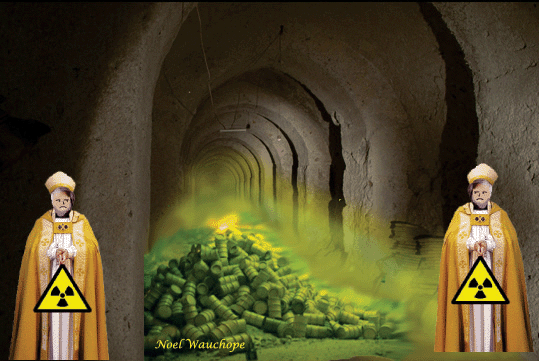
These include hostile architecture (an urban design strategy that uses elements of a built environment to purposefully guide behaviour of humans), the use of symbols and an “atomic priesthood” of knowledge keepers.
Rounding out the list is the “black hole” which, as Ms Deo explains, would involve “putting granite over the area and the sun would heat it up to a point where you just couldn’t walk across it”.
Ms Deo says the ongoing challenge lies in the length of time these warnings are required, which can be hundreds of thousands of years.
“How can we create a message that will last this long? Already you can kind of see the impossibility in that.”
Ms Deo says that regardless of the challenges, we must consider our accountability to those who come after us.
“We need to send a message to ourselves about this technology and how we’re going to move forward with it — and how we’re going to store it.”
It’s a question that we’ve yet to answer.
The “Great Era of Nuclear Decommissioning” begins – well, sort of, even in Australia

https://theaimn.net/the-great-era-of-nuclear-decommissioning-begins-well-sort-of-even-in-australia/ 20 Mar 25
Nuclear is big news for Australia. For the coming election, the federal Opposition party – the Liberal-National Coalition, has as its major, indeed, pretty much its only, policy – to establish the nuclear power industry at 7 sites across the continent. At the same time, a Liberal group has sprung up – Liberals Against Nuclear, vowing to ditch that policy.
Meanwhile the AUKUS plan, (beloved of both major parties) to buy super-expensive nuclear submarines, has run into problems, and is at risk of being ditched.
Also now, on March 4th the Australian Nuclear Science and Technology Organisation (ANSTO) announces that it is embarking on a major decommissioning project , getting into the wonderful new Era of Nuclear Decommissioning. This Era was predicted by The Ecologist, back in 2019, but only now is it reported to be getting underway.
Japan, one of the top nuclear nations, has just announced the first dismantling of a commercial nuclear reactor – ‘signifying that the so-called “great era of decommissioning” has begun in earnest in Japan.’ They have another 59 to go (10 cleared for operation, 23 described as “operable” , and 26 shut-down ones).
So what indeed is the “great era of decommissioning”? What does “decommissioning” actually mean?
According to the European Union – “ It involves all activities starting from the shutdown of the facility and the removal of all nuclear material right down to the environmental restoration of the site. The whole process is complex and typically takes 20 to 30 years to complete.“
So, in Japan, they really mean business – “dismantling of the reactor, which began on March 17, is considered the main part of the decommissioning work“
In Australia -not so much. It means that ANSTO, a few weeks ago, got a licence from the Australian Radiation Protection and Nuclear Safety Agency (ARPANSA), to begin Phase A, Stage 1, and is now beginning to remove peripheral equipment from the the 67 year old Hifar nuclear reactor, now 18 years out of action. More Phases and Stages to go.
Both the Japanese and Australian news items give short shrift to that final problem – nowhere to put the radioactive remains. ANSTO’s at pains to stress how small an amount it is “be managed and stored safely onsite at Lucas Heights” . The Japanese article concludes “While Japan has entered an era of decommissioning, decommissioning plans continue to be postponed due to the lack of a finalized waste disposal site.”
The World Nuclear Association goes into much detail on the decommissioning of 700 nuclear reactors, but only a few of these have been completely dismantled, and still no way of permanently disposing of their radioactive remains.
Meanwhile the International Atomic Energy Agency, and the governments of the most powerful nations are all complacently touting the need for new nuclear reactors. Australian authorities, keen to stress Australia’s nuclear know-how are joining in this happy disregard of the importance of dangerous radioactive trash.
That famous old Australian character “blind Freddy” would immediately know that this is an unreasonable and immoral attitude.
The “era of nuclear decommissioning” is not really underway at all. If it were happening, there’d be no more hype about new nuclear. I fear that the sad reality is that the men in charge realise that nuclear decommissioning is just too expensive, too fraught with problems “best to just leave it alone, until we are comfortably superannuated out, or dead. “
Liberal supporters launch election ad campaign against Peter Dutton’s plan to build nuclear power plants
Liberals Against Nuclear say the policy would increase bureaucracy and impose ‘massive taxpayer-backed risk’
Adam Morton Climate and environment editor, 18 Mar 25, https://www.theguardian.com/australia-news/2025/mar/18/liberal-supporters-launch-election-ad-campaign-against-peter-duttons-plan-to-build-nuclear-power-plants
A group of Liberal supporters has launched an advertising campaign against the party’s plan to build taxpayer-funded nuclear power plants, arguing it “betrays Liberal values”, divides the party and “hands government back to Labor”.
The new advocacy group Liberals Against Nuclear says it rejects the Coalition’s policy as it would require the government to borrow tens of billions of dollars, swell the bureaucracy and impose “massive taxpayer-backed risk”.
Peter Dutton’s proposal would involve eventually building nuclear reactors at seven sites across the country, mostly after 2040. In the short term, the Coalition says it would slow the rollout of renewable energy, attempt to extend the life of ageing coal-fired power plants and rely more on gas-fired power.
The Liberals Against Nuclear spokesman is Andrew Gregson, a former Tasmanian Liberal director and candidate who said he was not currently a party member but remained a supporter. He declined to say how many supporters the group had or name other members, but said those involved were concerned the nuclear policy was driving “free market and middle ground voters” to support “teal” and other independent MPs in seats the Coalition must win to return to government.
“We’re trying to save the party from a policy that will gift seats to their opponents,” he said. “Nuclear technology itself isn’t the issue. It’s the socialist implementation being proposed that trashes Liberal values.
“If nuclear energy is so good then the market will back it without massive government intervention.”
The group is running television, digital and billboard ads that argue “many Liberals are against nuclear”. One of the ads shows a woman reading a newspaper article that quotes the Nationals senator Matt Canavan as saying “nuclear fixes a political issue for us but ain’t the cheapest form of power” and cites a report by the Institute for Energy Economics and Financial Analysis that found the Coalition proposal would lead to a $665 increase in average power bills. The ads ask the opposition leader, Peter Dutton, to “please dump nuclear”.
Gregson said they would run across the country and be particularly targeted in marginal seats, including those held by teal MPs. He said the ads were aimed at the party, not voters.
Liberals Against Nuclear said polling had suggested only 35% of Australians backed nuclear energy, and that support collapsed once voters understood the policy details. Its website raises concerns about the policy driving up national debt and creating safety and security risks.
Gregson said dropping the policy would cause the Coalition a “couple of days’ worth of negative publicity” but would not cost it the election. “Nuclear power is the big roadblock preventing the Liberals getting to The Lodge,” he said.
Asked about the campaign on the Seven Network, Dutton said his policy was “based on the international experience” and claimed it would bring electricity costs down by 44% and provide “stability in the market”.
The Climate Change Authority, a government agency, found the Coalition’s proposal would add an extra 2bn tonnes of carbon dioxide to the atmosphere and make it “virtually impossible” for Australia to reach net zero by 2050, a position the opposition claims to support.
Labor has a target of 82% of generation coming from renewable energy by 2030, up from the current level of nearly 45%. The authority said that under the Coalition’s plan there would probably not be 82% of electricity from zero emissions technology – renewables and nuclear – until 2042.
Independent experts have suggested the Coalition policy would likely lead to household power bills being higher than under Labor’s policy as there would be less generating capacity competing in the grid. They have also said it would increase the risk of the electricity supply becoming unreliable at peak times as it was more reliant on old coal power plants that are nearing the end of their expected operating lives.
Peter Dutton interrupted mid-speech by anti-nuclear protesters
By Josh Hohne Mar 20, 2025, 9 News
Opposition Leader Peter Dutton and Shadow Treasurer Angus Taylor have been interrupted by anti-nuclear energy protestors today in Sydney.
Dutton was addressing the Lowy Institute think tank when two protestors began heckling him.
“Why are you lying to the Australian people about the cost of nuclear,” one of the protesters said as he was escorted out by security and federal police.
He held a banner reading “Nuclear lies cost us all”.
After a pause, Dutton continued with his address.
Later in his speech about the Coalition’s election priorities, he was interrupted again by a man speaking from the sidelines……………………………………..
The protesters were part of the Rising Tide environmental group.
“The Coalition’s scheme to force nuclear into Australia’s energy grid is going to cost $600 billion to the taxpayer, add up to $1200 to people’s energy bills, and produce 1.6 billion tonnes of climate pollution by 2050,” Zack Schofield, one of the protesters, said afterwards.
Hours after interrupting Dutton, the same protesters disrupted another press conference, this time forcing Shadow Treasurer Angus Taylor to relocate his media opportunity.
Schofield again interrupted Taylor.
Taylor quickly packed up his team and began relocating to another location.
Dutton and Taylor aren’t the first to be interrupted by protesters this week, with climate activists cutting off Treasurer Jim Chalmers during a pre-budget speech on Tuesday. https://www.9news.com.au/national/peter-dutton-interrupted-mid-speech-protesters-nuclear-energy/eaed0bf8-0e02-4617-b2de-1cab1c419830
Bob Carr says Aukus a ‘colossal surrender of sovereignty’ if submarines do not arrive under Australian control

Former foreign minister says it is ‘inevitable’ US won’t supply nuclear-powered submarines under Aukus.
Guardian, Ben Doherty, 20 Mar 25
Australia faces a “colossal surrender of sovereignty” if promised US nuclear-powered submarines do not arrive under Australian control, former foreign affairs minister Bob Carr has said, arguing the US is “utterly not a reliable ally” to Australia.
“It’s inevitable we’re not getting them,” Carr told the Guardian, ahead of the release of a report from Australians for War Powers Reform that argues the multibillion-dollar Aukus deal had been imposed upon Australia without sufficient public or parliamentary scrutiny.
“The evidence is mounting that we’re not going to get Virginia-class subs from the United States,” Carr said, “for the simple reason they’re not building enough for their own needs and will not, in the early 2030s, be peeling off subs from their own navy to sell to us.”
Under “pillar one” of the planned Aukus arrangement, it is proposed the US would sell Australia between three and five of its Virginia-class nuclear-powered submarines in the early 2030s before the Aukus-class submarines were built, first in the UK, then in Australia
However, the US has already forecast it might not have capacity to spare any of its Virginia-class boats, the Congressional Research Service instead floating a proposal in which: “instead of … them being sold to Australia, these additional boats would instead be retained in US Navy service and operated out of Australia”.
Carr said that alternative would leave Australia without Australian-flagged submarines and no control of when, and to where, those boats were deployed.
“It involves the total loss of any sovereign submarine capacity and, more than that, a colossal surrender of Australian sovereignty in general.”
Australia, Carr said, needed to look past the “cheerful flag-waving propaganda” of the proclaimed Aukus deal, saying the alternative likely to be presented by the US would leave Australia “totally integrated in American defence planning and we’ll be hosting even more potential nuclear targets”.
Australians for War Powers Reform, a group that advocates for parliamentary oversight of the decision to send Australian troops to war, launched a report on Thursday morning arguing that the Aukus deal – signed by the Morrison government in 2021 and adopted by its Albanese-led successor – had been instituted without any public or parliamentary scrutiny.
“The public and the national parliament have been kept in the dark every step of the way,” the report argues.
“The Aukus pact has become a textbook example of how to disenfranchise the community, providing almost no transparency or democracy in a sweeping decision which will affect Australia for decades.”
Aukus and the Surrender of Transparency, Accountability, Sovereignty argues the multi-decade, multibillion-dollar Aukus deal was presented to the Australian public without any discussion, consultation, and without parliamentary debate. The current forecast cost of “pillar one” of Aukus – to buy US Virginia-class submarines and build Aukus subs – is $368bn to the 2050s.
The report raises concerns over vague “political commitments” offered by Australia in exchange for the Aukus deal, as well as practical concerns such as where and how nuclear waste would be stored in Australia.
“Aukus has no legitimate social licence because the public has been shut out of the process, and as a result, scepticism and cynicism have increased.”
Dr Alison Broinowski, AWPR committee member and a former Australian diplomat, said Australia’s agreement to the Aukus deal was manifestation of a structural flaw in Australia’s democracy, where decisions to go to war, or to make consequential defence decisions, were not subject to parliamentary scrutiny or public debate.
Broinowski said Aukus was acutely significant because of its size and potential consequence “and yet the same failure to be frank with the people characterises every government this country has had, during every war there’s been”.
She argued Australia had no control over Aukus. “We don’t know what Trump’s going to do and we have no control over what he does. And so we’re left hoping for the best, fearing the worst and with absolutely no way of controlling or influencing what happens, unless we first get ourselves out of Aukus.”……………………………….more https://www.theguardian.com/australia-news/2025/mar/19/bob-carr-aukus-submarine-deal-us-australia-relationship
Investors take aim at Coalition as nuclear debate hits boiling point
The Age, By Nick Toscano, March 19, 2025
Major investors have clashed with the Coalition ahead of the federal election, warning that slowing the rollout of renewable energy will push up electricity bills by increasing the need to call on failure-prone coal plants and expensive gas-fired generators.
Debate about Australia’s clean energy shift has been thrust to centre stage as Opposition Leader Peter Dutton campaigns to limit renewables to 54 per cent of the electricity grid and build a fleet of government-owned nuclear generators across the mainland.
If it wins the election, the Coalition would roll back Labor’s 2030 climate commitments, including its target for renewables to make up 82 per cent of the grid by 2030, which experts believe is unlikely to be met.
However, in a significant intervention, a group of large investors including US asset giant BlackRock, France’s Neoen, Australia’s Macquarie Bank and the Andrew Forrest-backed Squadron Energy has ramped up its push against policies that would restrict the expansion of wind and solar and keep the grid heavily tied to fossil fuels for longer.
“Australia needs more renewables, not less, to achieve sustained power price reductions,” said the Clean Energy Investor Group, which represents 18 global and local investors with a portfolio value of $38 billion across Australian renewable projects.
Households have been hit with double-digit power bill increases since 2022, the year that Russia’s invasion of Ukraine unleashed a global energy crunch. Another power price rise, partly due to recent stretches of low wind and rain limiting renewables’ output, is set to take effect in Queensland, NSW and South Australia from July this year.
But bills would be up to $417 a year higher if not for renewable energy and batteries, the investor group’s analysis shows, as utilities would be forced to more frequently fire up their gas-powered generators, which are among the most expensive suppliers to the grid.
Separate industry modelling released last week by the Clean Energy Council suggests the Coalition’s push to limit renewables would require at least a three-fold increase in gas-powered electricity costs by 2030.
Investors have also expressed concern at the Coalition’s proposal to extend the lives of ageing coal-fired power stations beyond their closure dates in the 2030s and 2040s until nuclear plants were ready to replace them, which could raise risks of sudden breakdowns, power shortages and price spikes.
“Running a grid using fossil fuels rather than renewables would increase total system costs, weaken energy security, and place greater strain on ageing coal and gas infrastructure,” the investor group said………………………………..more https://www.theage.com.au/business/companies/investors-take-aim-at-coalition-as-nuclear-debate-hits-boiling-point-20250318-p5lkg8.html
Australian nuclear news 18 -24 March

Headlines as they come in:
- Dutton’s seat a target in $2m union war against nuclear.
- Coalition must provide clear answers on nuclear policy.
- Nuclear Power In Australia: A Little More Conversation?
- Activists are spending big on pro-nuclear ads, but it’s Dutton’s silence that has Labor’s attention.
- Liberals must abandon unpopular nuclear policy and return to winning formula.
- ‘Vandals in the White House’ no longer reliable allies of Australia, former defence force chief says.
- Climate Activists Protest Liberal Nuclear Speeches In Sydney.
- Liberal supporters launch election ad campaign against Peter Dutton’s plan to build nuclear power plants
- International ‘nuclear tombs’ are being built, but how do we warn future generations of what’s inside?
- Peter Dutton interrupted mid-speech by anti-nuclear protesters
- Bob Carr says Aukus a ‘colossal surrender of sovereignty’ if submarines do not arrive under Australian control.
- Investors take aim at Coalition as nuclear debate hits boiling point
- New advocacy group Liberals Against Nuclear calls on Peter Dutton to dump nuclear promise
- Nuclear policy blocking Liberal gains.
- “Desperate” Liberals urge Dutton to “stop this stupid nuclear palaver”
- Australia: Liberals Against Nuclear launches campaign to return party to core values.
- Peter Dutton is ‘desperate to avoid scrutiny’ on nuclear energy plans –https://www.youtube.com/watch?v=Q3baw-B49d4
Nuclear policy blocking Liberal gains
Liberals Against Nuclear, 19 Mar 25
A Redbridge poll released today confirms what Liberals Against Nuclear has been warning about: the Coalition’s nuclear energy position is actively preventing its path to an election win.
New RedBridge polling puts Labor ahead 51-49 on two-party preferred terms. The data reveals that despite the Coalition’s leadership’saggressive pro-nuclear campaign, voters aren’t buying it. Those believing nuclear energy is unsafe rising from 35% to 39% over the past year. Only 38% of voters believe nuclear would reduce power prices – barely moving from 37% a year ago
“The nuclear power policy is the single biggest roadblock preventing the Liberals from winning government,” said Andrew Gregson, spokesperson for Liberals Against Nuclear. “The Liberal Party’s nuclear fixation is alienating the very voters we need to win back.
“The numbers don’t lie. This policy betrays core liberal principles by requiring tens of billions in government borrowing, expanding bureaucracy, and imposing massive taxpayer-backed risk. It’s driving free-market centrist voters directly to the Teals and independents in must-win seats.”
RedBridge director Tony Barry, a former Coalition strategist, is quoted in today’s News Corp papers emphasizing that “the Coalition needs to return to its key equities of economic management.”
The data confirms the coming election will likely be decided by preferences, with both major parties struggling to reach the 76 seats needed for majority government. This makes winning middle-ground voters crucial – exactly the demographic being alienated by the nuclear position.
“We’re urging party leadership to pivot back to our core economic management strengths and abandon this policy that contradicts core principles.”
Media Contact: Andrew Gregson +61 432 478 066
www.liberalsagainstnuclear.au
1 This month
To see nuclear-related stories in greater depth and intensity
– go to https://nuclearinformation.wordpress.com/


 Antinuclear