UK High Court gives very little chance for Julian Assange

UK: HIGH COURT DECISION WELCOME IN ASSANGE CASE BUT CONCERNS REMAIN OVER LIMITATIONS ON APPEAL , Amnesty UK 26 Jan 22, Following today’s High Court decision to certify one issue in the Assange appeal as of ‘general public importance’, Massimo Moratti, Amnesty International’s Deputy Research Director for Europe, said:
“While we welcome the High Court’s decision to certify one narrow issue related to the US’s assurances as being of ‘general public importance’, and so to allow the Supreme Court to consider granting an appeal on this issue, we are concerned the High Court has dodged its responsibility to ensure that matters of public importance are fully examined by the judiciary. The courts must ensure that people are not at risk of torture or other ill-treatment. This was at the heart of the two other issues the High Court has now effectively vetoed.
“Torture and other ill-treatment, including prolonged solitary confinement, are key features of life for many people in US federal prisons, including those imprisoned on charges similar to Assange’s.
“The ban on torture and other ill-treatment is absolute and cannot be upheld by simple promises from a state that it won’t abuse people.
“The Supreme Court should have had the opportunity to deliberate and rule on all of the points of law raised by Assange at this crucially important point but the High Court has limited its scope to do so. If the question of torture and other ill-treatment is not of general public importance, what is?”
“We now hope that the Supreme Court will grant leave to appeal on the certified issue concerning at what stage in extradition proceedings should such assurances be submitted and considered.”
Full scale war in Ukraine? With its 15 nuclear reactors – no more Ukraine, no more Europe
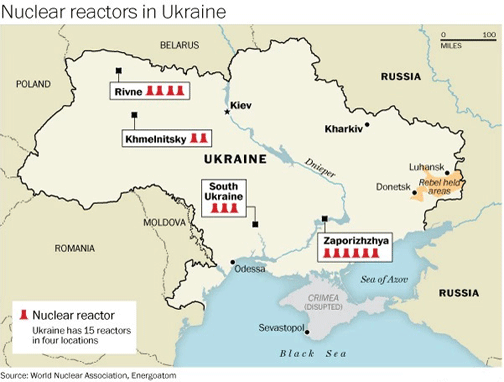
Ukraine diplomat sees little chance of war ‘in country with 15 nuclear reactors’ https://www.euractiv.com/section/global-europe/news/ukraine-diplomat-sees-little-chance-of-war-in-country-with-15-nuclear-reactors/
EURACTIV.com with Reuters, 26 Jan 22, Ukraine is committed to seeking a diplomatic solution to the current tension with Russia, its ambassador to Japan, Sergiy Korsunsky, said on Wednesday (26 January), adding that he saw little chance of all-out war, although there might be smaller conflicts.
nuclear reactors would bring about a devastating regional impact on Europe.
“I believe that full-scale war is very, very, very difficult to expect, but we may see more localised conflict,” Korsunsky told a news conference in the Japanese capital Tokyo.
If war is going to happen, that will be the first ever in the history of mankind, war against a country which has on its territory 15 nuclear reactors, which has 30,000 km of gas and oil pipelines, full with gas and oil,” said Korsunsky.
“If all these infrastructure is destroyed, there is no more Ukraine. But this is just one consequence. There is no more central Europe and probably western Europe would be affected, too.”
An accident at the Chernobyl reactor, located in what is now Ukraine, spewed tonnes of nuclear waste into the atmosphere in 1986, spreading radioactivity across swathes of the continent and causing a spike in cancers in the more immediate region.
Russia’s Ambassador to Australia, Alexey Pavlovsky, said on Wednesday that Russia did not plan to invade Ukraine.
We don’t intend to invade at all,” Pavlovsky told Australian Broadcasting Corporation radio.
“Our troops on the border…These troops are not a threat, they are a warning. A warning to Ukraine’s rulers not to attempt any reckless military adventure,” he said.
As to the sanctions, I think that by now everybody should understand that it is not the language which should be used when talking to Russia. The sanctions just don’t work.”
US and British governments are effectively using “lawfare” to ensure Assange’s continued detention
Although the threat of imminent extradition has been stayed, Assange stands on thin ice. What began as a case on the most fundamental rights of journalists to expose war crimes and torturehas been whittled away by the British judiciary to the single question of how “assurances” of Assange’s safety should be given by one criminal state to another.
Whatever the outcome, the US and British governments are effectively using “lawfare” to ensure Assange’s continued detention, even though he has been convicted of no crime.
Assange granted leave to appeal to UK Supreme Court against extradition, https://www.wsws.org/en/articles/2022/01/24/assa-j24.html?pk_campaign=assange-newsletter&pk_kwd=wsws Oscar Grenfell, Thomas Scripps, 24January 2022
The UK High Court has provided WikiLeaks founder Julian Assange a route to appeal to the Supreme Court in his extradition case against the United States government.
Assange is seeking to overturn the High Court’s direction last December that he be extradited, against the earlier ruling of the lower Magistrates’ Court that to do so would be “oppressive” on health grounds.
The High Court upheld a US appeal against the Magistrates’ Court ruling despite accepting evidence of Assange’s intense physical and psychological ill-health. It also did not contest the likelihood that the conditions he would be subjected to in the US, as discussed throughout the entire preceding court process, would likely result in his death by suicide.
The December ruling was overwhelmingly based upon supposed US assurances, issued months after deadlines had elapsed, that Assange’s conditions in an American prison would not be as bad as previously accepted.
With numerous caveats and loopholes, the US assurances asserted that Assange would not be held under Special Administrative Measures (SAMs), a regime of total isolation, to which those convicted of terrorism offenses, along with drug lords and major serial killers, are sometimes subjected in federal prison.
The High Court found that the Magistrates Court should have solicited such assurances prior to its ruling.
In response to Assange’s request for leave to appeal this decision yesterday, the judges certified a single point of law of public importance, the requirement for an issue to be heard in the Supreme Court. This was: “In what circumstances can an appellate court receive assurances from a requesting state which were not before the court of first instance in extradition proceedings [in this case, the magistrates’ court].”
Assange’s lawyers had argued that “profound issues of natural justice arise where assurances are introduced by the Requesting State for the first time at the High Court stage… These issues have never been addressed by the Supreme Court.”
As his solicitors elaborated in an explanatory note, “There has long been a general approach by the courts that requires that all relevant matters are raised before the District Judge appointed to consider the case in the Magistrates’ Court,” but this has been undermined by the treating of assurances as “issues” rather than “evidence”, allowing them to be introduced at a later stage in proceedings.
“The defence argument is that despite being as demanding of close evidential scrutiny as the evidence already heard, and despite the content of the assurances being applicable to the testimony of witnesses already heard but not to be heard again, assurances have been afforded a different procedural position.”
The assurances in question, accepted in “good faith” by the High Court, are given by a state with a decades-long history of lies and dirty tricks whose record in the Assange case was exposed a month before the High Court ruling as including plans to kidnap and assassinate the heroic journalist.
Based on the statements of 30 former US officials, Yahoo! News revealed that the Trump administration and the Central Intelligence Agency (CIA) had discussed kidnapping or assassinating Assange when he was a political refugee in Ecuador’s London embassy in 2017. The US indictment was first conceived of as a pseudo-legal cover for a possible CIA rendition.
The character of that indictment, as a concoction from spies and criminals, had been proven in June 2021. Sigurdur “Siggi” Thordarson, whose testimony still forms a crucial part of the indictment, admitted that all his substantive allegations against Assange were lies proffered in exchange for immunity from US prosecution. The star US witness is reportedly facing prosecution in Iceland on fraud charges, having been convicted of child molestation and embezzlement offenses prior to his latest collaboration with the American government.
Although the threat of imminent extradition has been stayed, Assange stands on thin ice. What began as a case on the most fundamental rights of journalists to expose war crimes and torturehas been whittled away by the British judiciary to the single question of how “assurances” of Assange’s safety should be given by one criminal state to another.
The Magistrates’ Court upheld the sweeping US attacks on democratic rights contained in the attempt by a state to prosecute a journalist for publishing true information about its unlawful activities. This forced Assange to defend the US appeal on the grounds of the threat to his mental health posed by extradition and imprisonment in the US. The High Court’s acceptance of the US appeal means Assange’s defence is now limited to the question of when assurances should have been provided.
In keeping with the UK’s courts’ trashing of democratic rights throughout this case, the High Court rejected out of hand the point of appeal that the assurances are worthless because the US asserts the right to withdraw them if Assange violates, or is alleged to have violated, certain conditions.
Assange’s lawyers argued “oppressive treatment” is barred, “whether or not the requesting state justifies its imposition by reference to conduct.”The High Court replied that it did not consider these arguments to “raise certifiable points” for the Supreme Court’s consideration.
It is now technically down to the Supreme Court to agree to hear Assange’s case; it would be highly unusual, though not impossible, for it to refuse to consider an issue certified by the High Court.
If Assange’s appeal is unsuccessful and his case is sent to Home Secretary Priti Patel to rubber-stamp his extradition, then his lawyers can seek to cross appeal the Magistrates’ Court’s original decision on the substantive issues of the case—press freedom, the espionage act and the bar on extradition for political offences. But leave to do so is not assured and would mean years more incarceration as the new appeal works its way through the courts.
Whatever the outcome, the US and British governments are effectively using “lawfare” to ensure Assange’s continued detention, even though he has been convicted of no crime.
He remains in the maximum-security Belmarsh Prison, dubbed the UK’s Guantanamo Bay. With the British government allowing the mass spread of Omicron, in the latest stage of its homicidal “herd immunity” policy, the prison has reportedly been hit by COVID outbreaks. Assange, because of his fragile health, is at intense risk of succumbing to the virus. The repeated prison lockdowns intensify his isolation.
Australia Day honours for services to environment and conservation.
| from Maelor Himbury, 26 Jan 22 Australia Day honours We congratulate the following Australia Day honours recipients for services to the environment and conservation (apologies to anyone I may have missed) Victoria Tom BEER Brunswick Alan Simon FINKEL South Yarra Kenneth Ian GUTHRIE Clifton Hill Victoria Fay MARLES Northcote Josephine Louise JONES Rye Eve KANTOR Hensley Park John Desmond KOEHN Ivanhoe Kevin Charles MASON Healesville Lee Alexander MIEZIS Ballarat Sarah Jane STEPHEN St Kilda Madeline Jane TOWNSEND Ballarat Mark WOOTTON Hensley Park | NSW Roslynne Elizabeth HANSEN Merimbula Ross Anthony JEFFREE Alfords Point Austrelle Susan (Sue) LENNOX Bellingen Margaret Joy BAKER Winmalee Matthew Peter HANSEN Dubbo Roz HOLME Joan REID |
| WA Claire Lynette BRITTAIN Claremont Anthony Arthur FOWLER Lynette Joan SERVENTY Margaret River | QLD Jo-Anne BRAGG West End Gordon Paul GUYMER SA Roger Bartram GRUND Mary Louise SIMPSON Burnside John William WAMSLEY Aldgate Tas John Alexander CHURCH Battery Point |
Doctor reveals severe health effects from heatwaves and humidity
Doctor reveals severe health effects from heatwaves and humidity
Richard Yin, 26 Jan 22,
It’s not Covid, heart disease, obesity or diabetes. This killer is deadly silent and it’s an issue that every Australian faces.
What drove Perth’s record-smashing heatwave – and why it’s a taste of things to come
What drove Perth’s record-smashing heatwave – and why it’s a taste of things to comeJatin Kala, 26 Jan 22,
Perth smashed its previous heatwave records last week, after sweltering through six days in a row over 40℃ – and 11 days over 40℃ this summer so far. On top of that, Perth has suffered widespread power outages and a bushfire in the city’s north.
Pandemic pollution: how COVID-19 has fuelled Australia’s waste crisis
Pandemic pollution: how COVID-19 has fuelled Australia’s waste crisis
Amber Schultz, 26 Jan 22,
Online shopping and home-delivered food is helping contribute to the 8 million tonnes of extra plastic waste accumulated globally during the pandemic.
“Largest offensive in Europe since World War II”: U.S. TV networks stir up war hysteria — Anti-bellum
Keep in mind that most Americans, perhaps the vast majority, receive most if not all their news (such as it is) from TV. Alexander Vindman: “Largest offensive in Europe since World War II.” “It’s all the responsibility of Donald Trump.” Senator Roger Wicker: “{Putn} is part of the effort to rebuild what Ronald Reagan called […]
“Largest offensive in Europe since World War II”: U.S. TV networks stir up war hysteria — Anti-bellum
January 26 Energy News — geoharvey

Opinion: ¶ “Elon Musk Not A Fan Of “Zero-Sum” Mindset” • Elon Musk isn’t a proponent of a zero-sum mindset. He’s opened up Tesla’s patents. And he’ll also soon open up the company’s Supercharger network to other automakers. He’s encouraged industry-wide electrification all along. Tesla’s mission is all about “accelerating the advent of clean transport.” […]
January 26 Energy News — geoharvey
Kimba flooding: Australian government must immediately abort nuclear waste dump project.
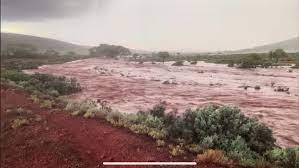
Peter Remta 25 Jan 22, Is this where the federal government should be placing its proposed above ground nuclear waste management facility?
There is no doubt that the sever flooding caused by the heavy rains in South Australia which included the Kimba district is a serious and essential reason for immediately aborting the proposed nuclear
waste management facility at Napandee farm.
From expert advice it is quite clear that Kimba as a whole – and not just Napandee – is far too dangerous to be an installation for theholding of nuclear waste particularly as the results of the present flooding may take up to ten years to overcome without any further flooding
This is especially the case as nuclear isotopes are dispersed and travel freely in water which can affect and contaminate all the surrounding land for many centuries making it completely unusable.
The federal government as the proponent of the Kimba nuclear waste facility cannot deny knowledge of floods and fires as risks for the purposes of the safety requirements for nuclear waste in Australia
As a result of advice by overseas experts that these two major risks are far more pertinent to Australia than other countries with nuclear waste the regulatory bodies should or must include these risks
within the Australian Radioactive Waste Management Framework and other applicable prescriptions and and standards for the longterm management of Australia’s radioactive waste including the storage or disposal of this waste at suitably sited facilities
I informed the officer at ARPANSA in charge of the Kimba facility development about formal inclusion of these risk and the requirement for the long overdue start of the safety case and her response was:
‘‘I think that it is not necessary at this stage however will take you up on the offer when we feel is the right time’‘
In view of the drastic situation that has now developed it is it is imperative that the federal government provides immediate funding to the Kimba community for an independent assessment and review of the government’s proposals
Massive flooding in Kimba district, – the Agricultural (no it’s now the Nuclear Waste) Town of the Year.
Flooding in Kimba district causes a decade’s worth of damage and communities are ‘completely shut off’
ABC North and West SA / By Declan Gooch, Brooke Neindorf, and Marcus Wilson, 23 Jan 22, V
Flooding on South Australia’s Eyre Peninsula has caused “massive, massive damage” to roads and infrastructure and left communities completely isolated.
Key points:
- Some parts of the Kimba district received 300mm of rain over the weekend
- The mayor says there has been “massive” damage to infrastructure
- A local farmer says his property looks like “channel country”
The Kimba district was among the hardest hit by the weekend’s destructive rain, which battered most of regional South Australia.
Mayor Dean Johnson said some areas received up to 300mm throughout Friday and Saturday.
The Bureau of Meteorology said the 160mm officially recorded in the 24 hours to 9am on Saturday was the most rain in a day ever documented there.
“It’s done massive, massive damage to our roads and general infrastructure,” Cr Johnson said.
“It will be some years and perhaps even a decade before we get to repair all of this, I think.”
“There are entire roads and sections of roads that have just been swept away by rivers of water. I can’t paint a much better picture than that. Just cliff edges where there used to be a road.”
He said many of the roads that had been damaged or destroyed were major roads, and the Kimba district was cut off from most directions.
“We’re completely shut off from the rest of the world at the moment. The road to the airport has completely washed away,” Cr Johnson said.
It is one of several regions that have been isolated by floodwater, with authorities scrambling to repair the Olympic Dam Highway that has cut off access to Roxby Downs.
‘You can mistake us for being in channel country at the moment’
Buckleboo, about 30 kilometres from Kimba, was another of the hardest-hit areas and also received its most rain ever recorded in a day.
Local farmer Tristan Baldock said his property had been transformed.
“You can mistake us for being in channel country at the moment, so we’ve got a historic watercourse that’s probably extending 20 kilometres through our property with a series of lagoons,” Mr Baldock said. ……
Will get through’
Cr Johnson said he was confident the region would recover. “The Agricultural Town of the Year is set up for a pretty good growing season next year, I think.”
more https://www.abc.net.au/news/2022-01-24/kimba-floods-eyre-peninsula-damage-isolated-roads-closed/100777084#:~:text=%22It’s%20done%20massive%2C%20massive%20damage,infrastructure%2C%22%20Cr%20Johnson%20said.&text=He%20said%20many%20of%20the,the%20world%20at%20the%20moment.
Funding for next-gen big batteries open next week, on road to fully renewable grids — RenewEconomy

A new $100 million funding round for next generation big battery storage installations, seen as crucial for the switch to fully renewable grids, will open next week. The post Funding for next-gen big batteries open next week, on road to fully renewable grids appeared first on RenewEconomy.
Funding for next-gen big batteries open next week, on road to fully renewable grids — RenewEconomy
Busting the nuclear propaganda about Liquid Fluoride Thorium Reactors (LFTR)
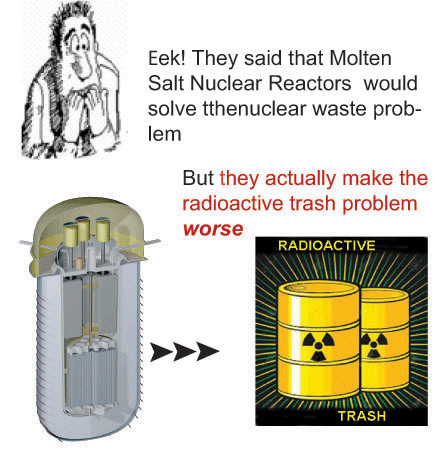
getting enough MSRs on-line to partially slake our energy glut would take 30-50 years. Given the urgency of global warming, we’ve already misspent such luxury.
Inhalation of thorium dust by townspeople near mining operations also correlated with higher lung, pancreatic and bone cancer rates than unexposed towns.
Investing in Renewable Technologies is Safer, Faster, and Cheaper. The Connecticut Examiner. BY SCOTT DESHEFY JANUARY 21, 2022, Thorium, formed by radioactive decay of uranium, is a naturally occurring radioactive metal found in rock, water, and soil. Found in monazite and other minerals, it’s 3X more abundant than uranium. Despite its radioactivity, small amounts of thorium were used in lantern mantles for brightness, ceramic glazes and welding rods. Until the 1950s, thorium dioxide was used as a contrast agent (i.e. Thorotrast) in medical radiology.
Between 1930 and 1950, after 2.5 million people were injected with Thoroplast worldwide, resulting lifelong exposures to thorium produced higher than normal incidences of liver tumors. Inhalation of thorium dust by townspeople near mining operations also correlated with higher lung, pancreatic and bone cancer rates than unexposed towns……………..
The U.S., China, France and Russia are currently exploring Molten Salt Reactors (MSRs) , including liquid fluoride thorium reactors (LFTRs), for improved electricity-making safety and efficiency compared to conventional nukes.
LFTRs are theoretically safer and more efficient than conventional reactors because fluoride salts will contain a nuclear reaction. But fluorine gases, which potentially could be released, are extremely lethal. Furthermore, getting enough MSRs on-line to partially slake our energy glut would take 30-50 years. Given the urgency of global warming, we’ve already misspent such luxury.
If, given declining cost and proven effectiveness, green energy was given the same government subsidies as nuclear we’d be answering the climate call-to-arms posthaste. Investing in renewable and smart-grid technologies is safer, faster, and cheaper, short-term and long. Scott Deshefy is a biologist, ecologist and two-time Green Party congressional candidate. https://ctexaminer.com/2022/01/21/investing-in-renewable-technologies-is-safer-faster-and-cheaper/
Unease in Ontario about planned nuclear waste dump (nobody suggests that they stop making this trash?)

The Plan to Bury All of Canada’s Nuclear Waste in One Northwest Ontario Town
This kind of dump for high-level nuclear waste has not yet been built anywhere in the world.
JANUARY 24, 2022 ON THE MONDAY SHOW BY CANADALAND Since Canada began using nuclear energy in the 1960s, the only solutions for the waste produced have been temporary. It’s now being stored onsite at nuclear plants, in containers that last a century at most.But nuclear waste takes thousands — or tens of thousands — of years to decay.
So in 2002, the federal government created the Nuclear Waste Management Organization (NWMO) and tasked it with finding a location to dispose of all of Canada’s high-grade nuclear waste.
Ignace, in Northwestern Ontario, was among the communities that volunteered to host a deep geological repository (DGR), and is now one of two sites under consideration. (The other is South Bruce, in the southern part of the province.) To create the DGR, used-up nuclear reactor cores would be placed inside canisters that would then be encased in a special clay that’s been shown to protect from water and cushion from seismic activity. The canisters would then be buried inside a rock 500 metres below ground.The NWMO is confident that the project — valued at $26 billion over the next 150 years — would pose virtually no risk to the local water supply, environment, or people. But a DGR for high-level nuclear waste has not yet been built anywhere in the world.
On this week’s CANADALAND, senior producer Sarah Lawrynuik travels to the area where she grew up, to learn about the divided reaction to the nuclear-waste project and whether the anxieties are justified:The following are edited excerpts from Sarah’s conversations with some of the residents and experts she spoke to…Our water is the most precious thing, I believe, in this country right now. Because so much in the world is polluted. Just so much. And we can’t afford to take that risk. Because no matter what they do to try to make it safe, nuclear waste is not safe and will never be safe.”
— Sylvia Green-Guenette, who lives on the shore of Wabigoon Lake in Dryden. Despite being roughly as close to the proposed site as Ignace, Dryden won’t get a say in whether the project goes ahead………………..
“I think the people who are totally for it are just looking at it through one lens. They’re looking at it through the business lens.…They’re promising a certain amount of jobs — not only for the community, but specifically for Indigenous folk as well. And I think a lot of people can see through that.”
— Maya Oversby, a Métis university student who started attending community meetings about the repository in 2015, when she was 14…………………… https://www.canadaland.com/nuclear-waste-ignace-ontario/
January 24 Energy News — geoharvey

Opinion: ¶ “Humans Do A Poor Job Of Calculating Risk. That’s Terrible For The Climate Crisis” • Humans do a poor job of evaluating climate risk and the cost of reducing it. Over the past five years, extreme weather disasters have cost the US more than $750 billion. The Build Back Better package would cost […]
January 24 Energy News — geoharvey
1 This month.


PETITION – To: Prime Minister Anthony Albanese and the Australian Labor Government
Chernobyl: The Lost Tapes – A good documentary on Chernobyl on SBS available On Demand for the next 3 weeks– https://www.sbs.com.au/ondemand/tv-program/chernobyl-the-lost-tapes/235274195556

19 May – Webinar- Webinar: No Nuclear Weapons in Australia
Start: 2026-05-19 18:00:00 UTC Canberra, Melbourne, Sydney (GMT+10:00)
End: 2026-05-19 19:30:00 UTC Canberra, Melbourne, Sydney (GMT+10:00)
20 May – Webinar – The dangerous world of AUKUS, US, military occupation and suppression of dissent

National Webinar, 20th May, 2026, 6.30pm AEST. Confronting laws restricting/suppressing protest speech and action
Speakers: Former Sen. Rex Patrick, Lawyer Nick Hanna ,Arthur Rorris ,Jorgen Doyle, Sen David Shoebbridge,
Facilitator Kelley Tranter.

of the week – Australians for War Powers Reform (AWPR)
To see nuclear-related stories in greater depth and intensity
 Antinuclear