Just prior to the election being called, Nationals leader David Littleproud was pressed on ABC’s Radio National breakfast on whether insurance costs were included in the modelling exercise putting a dollar figure on the Coalition’s nuclear plans.
It has been tough for the Coalition: nuclear power is notoriously expensive, and so trying to present a narrative of it being cheap has been tricky. Littleproud had a confident answer in response to being challenged about insuring nukes:
“Well, as many countries around the world do that is actually factored in and in fact, self insurance is normally what they undertake. So it’s not a significant amount of anything that goes into the running cost”.
The majority of the Coalition’s claims regarding nuclear power come from a December 2024 report published by Frontier Economics, which itself has been widely criticised by experts.
It pulls off the trick of presenting an expensive approach to energy transition as cheap by a variety of accounting tricks, previously covered at RenewEconomy. But what it doesn’t seem to do is actually incorporate the costs of insurance, as claimed by Littleproud.
In fact, the Frontier Economics modelling does not mention insurance at all. Not in any context, or even in passing, or in footnotes (nor is it mentioned in the Coalition’s ‘blueprint‘). The Frontier report simply declares an assumption about the capital costs of nuclear power ($10,000 per kilowatt). RenewEconomy emailed Frontier asking for more details, but received no response.
The 2024-25 CSIRO GenCost consultation draft does contain an assumption around the insurance costs of nuclear, and ultimately concludes that “nuclear power does not currently provide the most cost competitive solution for low emission electricity in Australia”, and that “while nuclear technologies have a long operational life, this factor provides no unique cost advantage over shorter-lived technologies”. Notably, GenCost actually assumes a problematically low cost for nuclear power, as discussed here recently.
It is bad enough that Littleproud seems to be making a false claim about it being ‘factored in’ to the modelling, but insuring extremely risky technologies prone to massive cost blowouts and very vulnerable to worsening climate disasters is not going to be cheap.
These communities weren’t asked if they want nuclear reactors in their backyard, and have been told it’s happening whether they like it or not.
“Proposed nuclear communities are asking key questions about nuclear reactors which have not been answered: Where is the water coming from? Where is the waste being stored? Where is the detail?“
These communities weren’t asked if they want nuclear reactors in their backyard, and have been told it’s happening whether they like it or not.
“Proposed nuclear communities are asking key questions about nuclear reactors which have not been answered: Where is the water coming from? Where is the waste being stored? Where is the detail?
Nuclear support has melted down in proposed nuclear communities, new polling released by a not-for-profit organisation working with regional communities for more than a decade, RE-Alliance, revealed today.
Energy attitudes polling by respected research firm 89 Degrees East and commissioned by the Renew Australia for All campaign has revealed support for building nuclear reactors at just:
27% in Gladstone
24% in the rest of Central Queensland
24% in Bunbury
22% in Central West NSW which includes Lithgow
32% in Hunter
31% Gippsland.
Further, the same polling showed just 13% of people polled thought nuclear reactors would bring down their bills the fastest (see table below on original ).
The sample size for the polling was 200 local residents in Gladstone, 151 in Central West NSW, 151 in Bunbury, 145 in Central Queensland excluding Gladstone, 301 in Hunter, 300 in Gippsland. Those polled were asked: How do you feel about developing large-scale nuclear energy infrastructure?
RE-Alliance National Director, Andrew Bray, said he was not surprised support for nuclear had bombed, because community engagement is key.
“RE-Alliance stands by the principle that all energy developments in regional Australia need broad community support – whether it’s for solar, wind, batteries, coal, coal seam gas or nuclear reactors,” Mr Bray said.
“Support for nuclear reactors seems to be melting down in the regions who’ve been told they are hosting them.”
These communities weren’t asked if they want nuclear reactors in their backyard, and have been told it’s happening whether they like it or not. Community engagement is by no means easy, but you’ve got to at least try. It’s no surprise support is so low.
“Proposed nuclear communities are asking key questions about nuclear reactors which have not been answered: Where is the water coming from? Where is the waste being stored? Where is the detail?
“Communities also don’t believe that nuclear power is capable of bringing down their energy bills anytime soon and see renewable energy solutions as a better bet. 72% of people said renewables would bring down bills faster, compared to just 13% who said nuclear.
“We see multiple polls from Porter Novelli, CSIRO, 89 Degrees East and more showing strong support for renewable energy on local farmland, between 66% and 71%. Now the polling shows us support for nuclear reactors in these regions is between 22% and 32%.
“Regional communities have enough uncertainty already. Let’s stop with the whiplash and stay the course on a shift to renewable energy which is already almost halfway done.”
Full results of the two poll questions can be found in the Appendix below (on original).
Note: The difference between a poll and a survey is survey respondents select themselves whereas respondents to a poll are selected by the pollster, weighted so the sample accurately represents the population being sampled, by gender, age group, occupation, and so on.
“Editors and reporters should carefully evaluate whether to report online surveys, having regard to their scope and methodology. They should be cautious of open-access online polls where the sample size and the exact questions asked are unknown and the results have been generated by self-selecting respondents.”
The polling was administered online with recruitment sourced from a consumer opt-in panel provided by Pure Profile, weighted to ensure a representative sample in line with ABS proportions for age, gender and location.
This study was conducted by the research firm 89 Degrees East as part of a larger poll with a total sample size of 5,952 Australians. The sample included a nationally representative poll of 2,014 Australians, with an additional boost sample of 1,900 Australians residing in Renewable Energy Zones (REZs). To ensure robust representation within each REZ, quotas and targeted postcode sampling boosts were applied.
The confidence level of the general population sample is +/- 2.14% at the 95% confidence level. Fieldwork was conducted by 89 Degrees East in March 2025. 89 Degrees East is a member of The Research Society of Australia and the Australian Polling Council.
If you’re a middle aged female with an interest in solar power, nuclear campaigners want you.
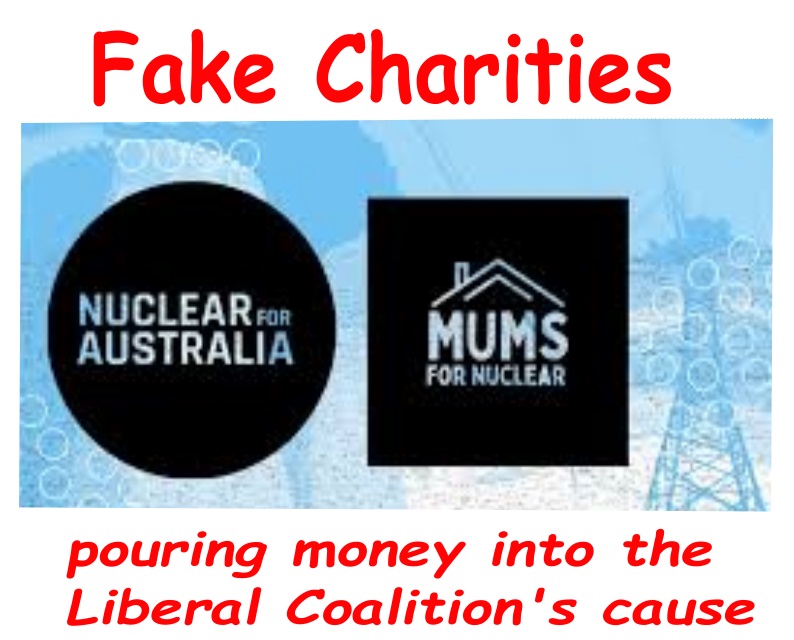
In the week 15th to the 21st of March, Nuclear for Australia and its offshoot astroturfing group, Mums For Nuclear, spent a combined $89,233 on Meta ads, according to online political database WhoTargets.Me.
Mums for Nuclear targets mothers with claims that nuclear power will reduce power bills and is essential to a “clean energy future for our children”. The ads claim “We’re not activists or lobbyists, but we know nuclear is our future”. Nuclear for Australia, which is backed by mogul Dick Smith, is the contact email address on the account.
Download the browser extension at WhoTargets.Me to see if you’re being targeted by political advertisers
While men and women saw the ad, around 18% of the budget was spent targeting women only. The group is also running print ads and issued a media release.………………..
Belinda Noble, founder of climate communications group, Comms Declare said, “Targeting mums with false promises of cheap power bills and climate solutions is as manipulative as it is cynical. The CSIRO has confirmed that only renewables can provide the cuts in climate pollution that we need this decade.”
Our submission raised questions about assumptions made about the nuclear submarine agreements:
“The Environmental Impact Statement (EIS) is premised on the assumption that the proposed AUKUS nuclear submarines are in Australia’s strategic interest (pp. 9-10) and South Australia’s economic interests (pp. 12-13). Both these premises are false.
Many highly qualified defence experts argue that nuclear submarines are not in Australia’s strategic interest. [1] Along with these experts, and retired senior politicians like Paul Keating, Gareth Evans and Malcolm Turnbull, we believe that Australia will be less safe if it acquires nuclear powered submarines. Although it is the federal government that has made this strategic blunder, the EIS should not lend it any credence (as in section 1.5.4).
…
AUKUS submarines will also be prejudicial to our economic interest. Some of the abovementioned analysts don’t think Australia will actually ever get the promised nuclear submarines, certainly not in a reasonable time frame. This is a view not restricted to left-leaning people. Conservative commentator Greg Sheridan has criticised AUKUS for this reason.[2]”
1. Correct the factual errors regarding the effects of radiation.
2. Include active commissioning in the assessment.
3. Include the disposal of radioactive waste in the assessment and publish plans for management, storage and disposal of all streams of radioactive waste, including intermediate and high-level waste and spent nuclear fuel.
4. Include a proper analysis of the risks and consequences of incidents and accidents that could lead to a release of radioactive material into the environment.
5. Inform the public about the potential for exposure to radiation and the levels of radiation they could be exposed to.
6. The Commonwealth Government should consult with other levels of government, the Australian Radiation Protection and Nuclear Safety Agency, emergency services and with the general public to develop a response plan for radiological emergencies.
7. Publish the Strategic Assessment Plan before finalizing the Strategic Impact Assessment Report.
SECRETS and LIES. More lies from British nuclear power advocate Zion Lights.Trump Killed Public War Research: Stargate Will Make It Secret—and Far More Dangerous.
SPACE. EXPLORATION, WEAPONS. The rush to war in space only needs a Gulf of Tonkin incident, and then what happens
This paper offers a brief reflection on the some of the principal recommendations of the recent South Australian Nuclear Fuel Cycle Royal Commission report. The Royal Commission proposed that the South Australian government put steps into motion to receive over one third of the world’s high level nuclear waste for above-ground storage and eventual burial in yet-to-be-built underground repositories in the South Australian desert. In real terms, the report recommended that South Australia imports 138,000 tons of high level waste in the form of spent fuel rods, and an additional 390,000 cubic metres of intermediate level waste for storage and eventual underground burial. The paper provides some historical context regarding the circumstances that have over the past 70 years seen the world-wide accumulation of 390,000 tons of high level nuclear wastes from nuclear reactors and nuclear weapons programs
………………………………………………………………………………………………………………………………………………………………… Resuscitating a Nightmare It is a curious thing to observe the confidence with which the recent Nuclear Fuel Cycle Royal Commission has embraced the promotion of South Australia as the ideal destination for over one third of the world’s accumulated stores of spent nuclear fuel. This spent fuel, together with the 400,000 cubic metres of intermediate-level nuclear waste that the Royal Commission recommends be transported to South Australia, represents a problem that nations with decades-long histories of nuclear energy production have failed to resolve. The entrancement induced by a whiff of billions of dollars of new revenue presently has a closed circle of nuclear advocates and politicians straining to persuade the people of South Australia to obligingly make their way as latter-day lemmings towards a dangerous and uncharted nuclear abyss.
In the short term, the Commission calls for the transportation of vast tonnages of highly radioactive materials from around the planet for decades-long storage in above-ground facilities. In the longer term, it proposes the construction of a deep underground repository for the “permanent” burial of the most dangerous wastes produced by a destructive and senescent civilisation.
……………Quo Vadis? The project to bury the world’s nuclear poison in the heart of the Australian desert has not sprung out of a void. It is an idea that has been insidiously festering for two decades in a variety of incarnations. The first stirrings of the hellish project to turn Australia into the world’s nuclear dumping ground emerged in the late 1990s when Pangea Resources, a U.K. based company promoted the construction of a commercially-operated international waste repository in Western Australia. The project was supported by a $40 million budget, 80% of which came from British Nuclear Fuels Limited (wholly owned by the U.K. government), with the remaining 20% from two nuclear waste management companies.
That particular project came to an abrupt halt in 1999 after Friends of the Earth in the U.K. came into possession of a promotional video produced by Pangea Resources and sent it on to its sister organisation in Australia. The project did, however, excite the imagination of a number of prominent Australian politicians including former prime ministers Bob Hawke and John Howard. In 2005, Bob Hawke excitedly proclaimed : “Forget about current account deficits . . . we could revolutionise the economics of Australia if we did this
The situation is no different today. Current Prime Minister Malcolm Turnbull and opposition leader Bill Shorten seem to be in lock-step regarding the desirability of importing the world’s high level nuclear waste into South Australia. Neither has listened to the voices of indigenous traditional owners or of the more informed advocates of restraint and sanity. …………….https://www.academia.edu/27381729/Poison_in_the_Heart_The_Nuclear_Wasting_of_South_Australia?email_work_card=title
Dutton has not visited Australia’s only nuclear reactor and has not received a brief from our country’s expert agency on the policy area he was developing. For completeness, I also asked the Government’s nuclear safety regulator, ARPANSA, if Dutton had visited them or sought advice from them. FOI came up with the same answer from them. Nothing at all.
Is Peter Dutton’s proposed ‘rollout’ of modular nuclear reactors real policy or just politics? What research has he done to develop the policy? Not much, it seems. Rex Patrick reports.
In September 2020, the Morrison Government released a Low Emissions Technology Statement that placed Small Modular Reactors (SMR) on a list of watching brief technologies. SMR developments were to be monitored to see if they might play a part in Australia’s energy future.
Consistent with that listing, the Government directed the Australian Nuclear Science and Technology Organisation (ANSTO) to join an International Atomic Energy Agency (IAEA) Coordinated Research Project focused on the Economic Appraisal of SMRs to provide information to assist in evaluating the technology’s economic viability.
ANSTO assembled a team to prepare, among other things, a case study on Australia’s potential to adopt SMR technologies in the future and analyse financing options for the technology. As part of that project, ANSTO even supported a University of Queensland PhD thesis on SMRs.
Flip flop politics
Peter Dutton, a minister in the Government that commissioned the ANSTO work, came out mid-way through 2023 with a proclamation of the Coalition’s plans for Australian to adopt SMRs as a preferred tool in our movement towards net zero carbon emissions.
In doing so Dutton opened himself up to a political battering because of the nascent state of SMR development around the world and huge questions around costs.
As Peter Dutton talks up nuclear power, it is not surprising to see Andrew Liveris shifting his pitch from a ‘gas led recovery’ to a call for Small Modular Reactors (SMRs) to be considered for the 2032 Brisbane Olympics. Dutton is engaged in politics, Liveris in fantasy. Rex Patrick reports on the nuclear distraction.]
Undeterred, in early March Dutton doubled down on nuclear power, switching his thinking to large nuclear power plants scattered about the country. As public controversy raged about the new plans, Dutton has started reinjecting SMRs into the total mix.
There are now to be a mix of economic and taxation incentives for the local communities targeted by the Coalition to host a nuclear reactor.
“Somewhere in a Coalition back office, there’s a whiteboard with a map waiting to be unveiled.”
In response to their hip flip to a larger nuclear power plant and his small flop back to SMRs, I thought MWM set out to see if Dutton has visited ANSTO or taken a brief from them in relation to his plans.
After all, there’s no shortage of precedent for parliamentary oppositions to seek factual briefings from government agencies, especially on complex and specialised subjects.
Missing homework
In response to their hip flip to a larger nuclear power plant and his small flop back to SMRs, I thought MWM set out to see if Dutton has visited ANSTO or taken a brief from them in relation to his plans.
After all, there’s no shortage of precedent for parliamentary oppositions to seek factual briefings from government agencies, especially on complex and specialised subjects.
In a recent nuclear estimates brief prepared for the CEO of ANSTO, the first two paragraphs stated:
“As the custodian of Australia’s nuclear expertise and capabilities, ANSTO is well positioned to advise governments, Australian parliaments, and members of the public on the technical aspects of nuclear power and nuclear power developments globally.”
“ANSTO has significant insight into what other countries and jurisdictions are doing around the world in terms of nuclear power.”
As mentioned above, ANSTO was specifically engaged by the former Coalition Government to take a look at SMRs. So, I was left gobsmacked when a Freedom of Information request I made to ANSTO to find out what Dutton’s interactions with ANSTO had been over the past five years returned nil information.
Dutton has not visited Australia’s only nuclear reactor and has not received a brief from our country’s expert agency on the policy area he was developing. In some measure, it explains the flip-flopping and limited detail in many of his announcements.
For completeness, I also asked the Government’s nuclear safety regulator, ARPANSA, if Dutton had visited them or sought advice from them. FOI came up with the same answer from them. Nothing at all.
Politics, not policy
You can’t develop policy just by chin-wagging at party room meetings and with briefs from vested business interests. That’s not how it works. You have to get independent and expert advice, and in the case of nuclear matters, a vital place to get that advice in Australia is ANSTO and ARPANSA.
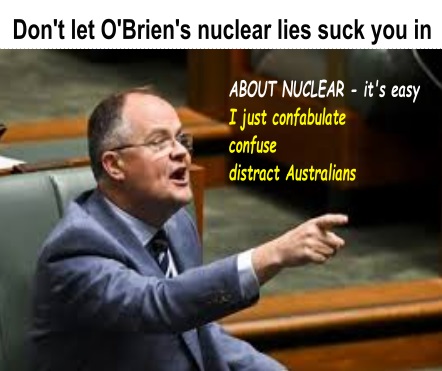
So, just what policy work has Dutton done? In large part, he appears completely dependent on the Google skills of his little-known Climate Change and Energy spokesperson, Ted O’Brien.
With a background in marketing, O’Brien has no ministerial experience, so the practicalities of major project implementation may be quite novel for him. He did once chair a parliamentary committee inquiry into nuclear energy, but as so often is the case, the research there was largely done by the committee secretariat, with O’Brien just adding a thin layer of pro-nuclear evangelism on the top.
It’s pretty safe to say that, in the absence of comprehensive briefs from and engagement with Australia’s leading experts, Dutton is not engaging in serious policy development. Rather it’s a manoeuvre to achieve political differentiation and keep the anti-renewals, climate-change-denying core of his Coalition happy.
Dutton’s approach to policy development, in this instance, says just as much about him as it does about his nuclear plans.
Rex Patrick is a former Senator for South Australia and earlier a submariner in the armed forces. Best known as an anti-corruption and transparency crusader, Rex is running for the Senate on the Lambie Network ticket next year – www.transparencywarrior.com.au.
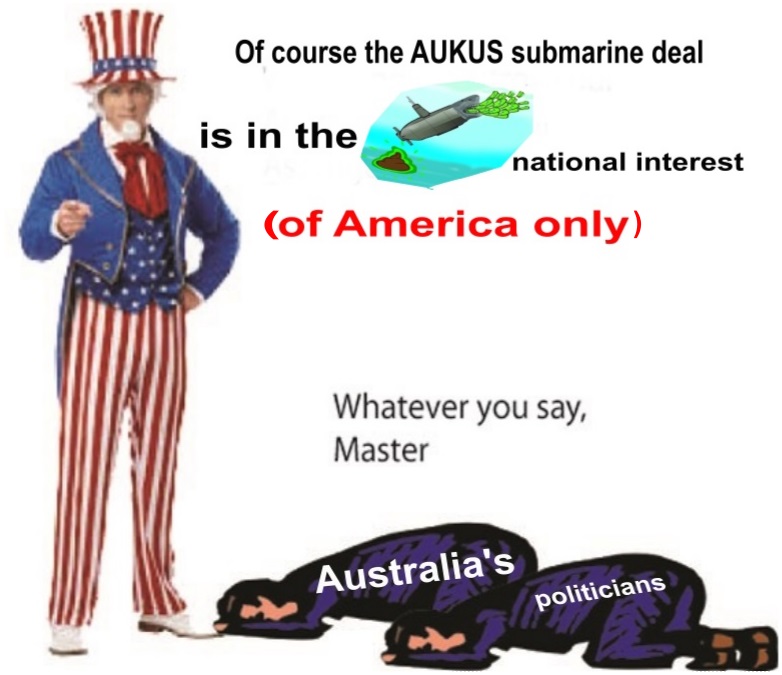
more https://ipan.org.au/no-aukus-no-nuclear-submarines/ AUKUS is a military agreement between Australia, the United Kingdom and the United States with two “pillars”. 1. The first pillar is a Federal Government commitment to spend $368 billion to purchase and construct 8 nuclear powered submarines to be part of the US nuclear submarine fleet surrounding the People’s Republic of China. 2. The second pillar to to collaborate with the Governments of UK and USA to “develop and provide joint advanced military capabilities” involving computer, missile and artificial intelligence technologies.
Doctors for the Environment Australia (DEA) does not support nuclear energy as a means of decarbonising Australia’s stationary energy generation and mitigating climate change. All Australia’s energy needs can ultimately be met from renewable sources, in combination with storage technology and energy efficiencies.
DEA does not support nuclear energy because it:
is unnecessary, uneconomical, and not flexible enough for changing energy needs
carries high health and safety risks
is a significant security risk
creates high-level radioactive waste, which cannot be safely disposed of and for which there is no known secure long-term storage
requires large amounts of water
cannot decarbonise the energy sector fast enough to avert catastrophic climate change
is neither renewable nor a low emissions energy source, if the entire nuclear life cycle from mining fuel to decommissioning of the reactor is considered
distracts from and delays more reliable, safer and less costly existing and developing technologies
emerges from the history of nuclear weapons testing and uranium mining on First Nations lands without consent, and may continue to disproportionately affect First Nations people.
come May 3, if Peter Dutton gets elected, this work will not be available to the Australian Submarine Agency or other Government Departments. At that point the review will be locked away at the National Archives of Australia, unavailable until at least 2044.
The Federal Government has successfully managed to bury, for twenty years, a report into how high-level AUKUS nuclear waste will be stored, and where. Transparency warrior Rex Patrick reports.
The circumstances of this case are extraordinary, as is the outcome. A report of very high public interest has effectively been hidden from view by the bureaucracy’s misrepresentation of the report’s nature and origin.
In early 2023, the Cabinet made some sort of direction for the Department of Defence to look into AUKUS’ high-level nuclear waste storage.
Ms Alexandra Kelton, a then Defence Department official and now Acting Deputy Director-General of Program and Policy in the Australian Submarine Agency (ASA) contracted a commercial company, SG Advice, to prepare a report.
This is despite the Cabinet Handbook expressly prohibiting external contractors from seeing or handling Cabinet documents.
The Cabinet Handbook states, “It is inappropriate to provide copies of, or access to, final or draft Cabinet documents to sources external to government.”
There was no evidence that a direction was made to produce a report for Cabinet. The February 2023 letter of engagement explains that the role of SG Advice would be advisory in nature and that any decision related to the storage and disposal of radioactive waste is “a decision for the Australian Government.”
Ms Kelton later deposed that the words “Australian Government” mean “Cabinet”. Administrative Review Tribunal (ART) Deputy President, Peter Britten-Jones, swallowed that.
Insecure and unsecured
Consistent with a document that is not a Cabinet document, the nuclear waste review was prepared on unclassified computers and transferred on unclassified networks across multiple agencies.
The Cabinet Handbook, which sets out Cabinet rules and is signed by the Prime Minister and Attorney General, states that in preparing Cabinet documents, such documents must be prepared on a separate secure Cabinet System called CabNet.It further states that Cabinet Division manages and maintains the CabNet+ system, which is the real-time, secure, whole of Australian government information and communications technology system used to support the Commonwealth’s end-to-end Cabinet process.
The system provides electronic access at the PROTECTED and SECRET security classifications from approved networks across government.
It is likely that Ms Kelton and perhaps others engaged in breaches of security by not enforcing this rule. Lawyers for the Australian Submarine Agency suggested that Ms Kelton’s statement, “as a matter of practicality for communicating and formatting parts of the draft, that process occurred outside the CabNet system,
“should be given more weight than the rules set by the Prime Minister and Attorney-General.”
RoboDebt conduct, eat your heart out. Britten-Jones referred to these as “irregularities”, and then just moved on.
Bad decisions by ART – the Administrative Review Tribunal
………As things now stand, any mid-ranking bureaucrat can unilaterally declare that a report was intended for Cabinet and Cabinet secrecy will apply, shrouding failures, scandals and politically awkward problems from public scrutiny for decades.……………
This latest decision is a bad one, too. It’s a very bad decision.
………………………..High public interest
When the nuclear waste review was completed in November 2023 and sent to Defence Minister Richard Marles with a bureaucratic proposal, the review was included as an attachment to a submission to the National Security Committee (NSC) of the Cabinet.
In the brief that recommended it be attached to an NSC submission Admiral Jonathon Mead warned Marles that the report would be of high public interest. The bureaucrats in the Australian Submarine Agency were clearly worried about public reactions if the review were ever released, so they belatedly wanted it shrouded in Cabinet secrecy……………………………………………………………
A waste of money
The contract for SG Advice to produce the report was $360,000. Four Agencies were involved in compiling the report: ANSTO, ARWA, Geoscience Australia, and the Australian Submarine Agency. The work was conducted over nine months. This document is a million-dollar document.
The nuclear waste review was described by Ms Kelton as a “significant piece of policy advice and [t]he subject matter for the Review report remains current and relevant to forward Government decision-making.”
Legally, at least for now, the report is a Cabinet document.
But the Cabinet Handbook states Cabinet documents are considered to be the property of the Government of the day. They are not departmental records. As such they must be held separately from other working documents of government administration.
That means, come May 3, if Peter Dutton gets elected, this work will not be available to the Australian Submarine Agency or other Government Departments. At that point the review will be locked away at the National Archives of Australia, unavailable until at least 2044.
So as soon as the Government changes, sooner or later, it will be a case of “start again”.
Who in their right mind would nominate that a significant piece of work should be a cabinet document? It’s a costly move. But then again, the Australian Submarine Agency did decide to give the United States $4.7B to upgrade their shipyards with no clawback if those same shipyards don’t ever deliver us a submarine. Before that, the Defence Department spent $4B not buying French submarines.
It’s stuff you wouldn’t normally read about, except here at MWM.
The Electrical Trades Union is targeting Peter Dutton’s nuclear plan with a $2 million ad campaign focusing on key federal electorates, including the opposition leader’s own seat of Dickson in Queensland.
Running under the slogan “Dutton’s Nuclear Plan: Why?”, the campaign seeks to deliver a powerful message through TV, radio, and digital platforms.
Featuring electricians, farmers, and policy experts, the ads question what the union says are “serious flaws in the nuclear plan around cost, timelines, and value for money”.
“The campaign highlights nuclear power’s enormous water consumption, which is 1.4 times greater than coal, a point that will resonate strongly in water-stressed areas like Western Australia,” ETU national secretary Michael Wright says.
Wright says the campaign will make voters aware of the costs, “impractical timelines, and job-killing consequences of Peter Dutton’s nuclear energy proposal”.
“Peter Dutton’s nuclear proposals are an expensive, impractical fantasy,” he says.
“Australia needs a new generation to keep the lights on today, in 2025. A nuclear power plan for 2045 is worse than useless – it is killing energy workers’ jobs. With 40% of the grid already powered by renewables and batteries, ETU members are building the energy transition today.
“Every day that Dutton pushes his nuclear fantasy for the 2050s is a day spent destroying and delaying real jobs and projects in 2025. Dutton’s plan would cost $600 billion, take more than 20 years to get off the ground, and provide only four percent of our energy needs.
“This isn’t a plan—it’s a delay tactic that puts thousands of jobs and the nation’s energy security at risk.”
Dutton last year announced he will go to the upcoming federal election promising to build seven nuclear power stations. He has promised the first sites could be operational between 2035 and 2037, years earlier than what the CSIRO and other experts believe is feasible.
Australia will head to the polls on 3 May for the federal election.
Today’s voter has it tough, especially younger Australians who get much of their information from apps. It’s daunting to sort fact from fiction in the Wild West world of online media, where hidden agendas and speculative opinion are rife. All the more so when a party’s policy only truly makes sense if viewed through a wider lens.
Opposition Leader Peter Dutton’s promise to build seven small-scale nuclear reactors, ostensibly to help meet future energy needs while keeping carbon emissions at bay, therefore needs to be seen for what it really is: a staggeringly bad idea, a stunt and a con. It is a backdoor attempt to pander to the fossil-fuel lobby – and under the electoral spotlight, more people will figure that out.
Younger voters understandably won’t know that a generation their age once packed the Sidney Myer Music Bowl with Midnight Oil, INXS and other friends to “Stop the Drop”. They won’t remember our Nuclear Disarmament Party campaign, which won Senate seats in Western Australia and NSW in the ’80s. They can’t know what it was like to grow up during the Cold War era or live through horrific meltdowns at the Three Mile Island, Chernobyl and Fukushima nuclear power plants, which were also “completely safe” until the day that they weren’t. But generations Y and Z can still smell a rotten idea when they give it a good sniff.
One example is the fanciful assumption that nuclear plants could be built in 12 years. Twenty years would be more likely – if they are built at all. Cost overruns and safety issues are equally certain. And the carbon consequences of prolonging our old coal-fired power generators are dire.
This deceptive proposal has all the Trumpian hallmarks: a quasi policy announcement intended to serve sectional interests – in this case, fossil-fuel conglomerates – while simultaneously serving up a cartoon enemy as ideological whipping boy, namely renewable energy.
Australia has abundant sunlight, plenty of wind, plus lots of pumped hydro resources that can all be converted by increasingly efficient technologies. Stored batteries are ramping up, too. The butterfly has emerged from the chrysalis and taken to the skies – the renewable energy transition is well under way. Construction costs will keep coming down. Supply will keep going up. The future is already here.
By wrenching the country off this course, Dutton’s plan would leave old, dirty, coal-fired power stations staggering on at increasing risk of breakdown, putting off the day of reckoning when we finally stop polluting and heating our world and get on with using affordable, reliable energy that does not cause more climate chaos.
What possible reason is there for Australia to embark on building a completely new, expensive energy infrastructure we don’t need and which, incidentally, is already illegal in states where the reactors are meant to go?
Nuclear energy features eye-watering costs, which history repeatedly shows blow out. It features risks associated with managing radioactive waste for tens of thousands of years. It is also a massive safety risk from both accidents and attacks.
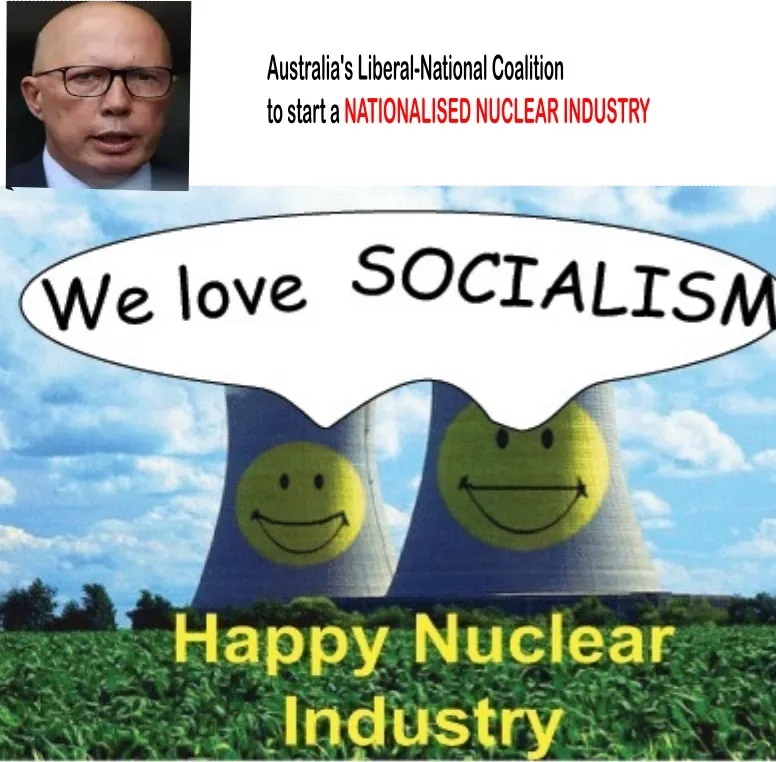
To cap the charade, this policy comes from the parties that supposedly champion free enterprise and want to reduce government spending, yet the hundreds of billions of dollars needed to fund the Coalition’s nuclear plan are to be borne by all of us, the taxpayer. Go figure!
Australian Independent Media March 29, 2025, By Denis Hay
Description
Why the US Australia alliance needs a rethink. The U.S. is no ally. Discover why Australia must distance itself to avoid war and reclaim its sovereignty.
How Australia Can Safely Distance Itself from U.S. Hegemony
Introduction – The US Australia Alliance: Myth vs Reality
Picture this: You’re sitting in a Brisbane café, sipping a flat white while reading the headlines – Australia has just signed another defence pact with the United States. More American troops, military hardware, and diplomatic praise about our “unbreakable alliance.” Yet, beneath the headlines lies a growing discomfort – are we allies, or are we just a strategic pawn in U.S. global dominance?
Joh Bjelke-Petersen once said that this is just politicians “feeding the chooks.” Empty words. The truth is, the U.S. government doesn’t respect its people, let alone Australia. It sees nations – including its own – as resources to be mined for profit. This article will explore how Australia can break free from this exploitative alliance without putting itself in harm’s way.
The U.S. Government’s Track Record: A Global Power Without Respect
Exploiting Its Own Citizens
Visit Detroit, Michigan – a city once bustling with manufacturing pride. Now, it stands as a ghost town of forgotten promises, where basic water access has become a luxury. Millions of Americans are homeless or working two jobs or more just to survive. U.S. billionaires soared in wealth, while 45 million Americans live impoverished.
Internal reflection: “If they treat their own citizens this way, what hope do allies have?”
Exploiting Other Nations
Let’s take Iraq. The 2003 invasion, sold on lies about weapons of mass destruction, cost hundreds of thousands of lives, all to secure oil. In Libya, a once-stable nation descended into chaos after U.S.-led intervention. This is not defence—it’s corporate imperialism.
When the U.S. backs coups in Latin America or imposes sanctions on countries like Venezuela or Cuba, the motive is always clear: control the global economy for U.S. corporate gain.
The U.S.–Australia Relationship: Not What It Seems
Political Rhetoric vs Reality
Australian and U.S. politicians often repeat phrases like “shared values” and “strong friendship.” But how many Australians were consulted when Pine Gap was set up or when AUKUS was signed?
Dialogue: “This isn’t a partnership. It’s a surrender of our sovereignty,” says a former Australian diplomat.
The Cost of Loyalty
Australia’s blind support for U.S. policy has real consequences:
• Trade tensions with China – our largest trading partner
• Environmental destruction from military exercises on Australian soil
• Loss of independence as U.S. bases expand here without public debate.
Why China Matters More Than Ever
60% of Australia’s exports go to Asia, with China alone accounting for over 25%. Australia’s economy is tightly linked to Chinese demand, from iron ore to wine. Trade disruptions – often driven by political antagonism encouraged by the U.S. – have already cost farmers, winemakers, and miners dearly.
The Danger of Choosing Sides
We risk becoming collateral damage in a U.S.-China conflict. Australia should not repeat its mistakes from Vietnam or Iraq – wars that had nothing to do with our national interest but cost us dearly in blood, treasure, and reputation. This has been the outcome of the US Australia alliance.
Thought: “Must we always fight other nations’ wars? When do we stand up for ourselves?”
Pathways Toward Australian Independence………………………………………..
Phasing Out US Australia Alliance and Military Influence
Start with transparency:
• Conduct a national audit of U.S. bases and agreements.
• Establish parliamentary oversight.
• Hold a public referendum on AUKUS.
Dialogue: “Our security must not come at the cost of our sovereignty,” says Senator David Shoebridge.






 Antinuclear