The Australian Electoral Commission is having words with Nuclear for Australia as the group spends $100,000s on its campaign.
A ‘non-partisan’ pro-nuclear lobby group has ramped up its spending ahead of the federal election — but has not declared what spending is on ‘electoral matters’.
Cam Wilson, Mar 28, 2025, https://www.crikey.com.au/2025/03/28/nuclear-for-australia-mums-for-nuclear-aec-campaign-spending/
Australia’s election regulator has reminded a Nuclear for Australia-affiliated group of its legal obligations, as the pro-nuclear lobby group spends hundreds of thousands of dollars to support a policy promoted by the Coalition.
In the past week, “Mums for Nuclear” ran more than $16,000 of Facebook and Instagram advertisements, in addition to a newspaper advertisement in The Age. None featured electoral authorisations, although the digital advertisements were classified as pertaining to “social issues, elections or politics” on Meta’s platform.
The group is an offshoot of Nuclear for Australia (NfA), a purportedly “nonpartisan” group started by then 16-year-old Will Shackel in 2022. Last year, Crikey reported that the group’s website listed Liberal Party-linked “digital political strategist” James Flynn as an author on some of its content. Flynn had also liked the group’s tweets on his personal account and criticised Labor’s energy policy on Sky News.
Nuclear for Australia did not respond to repeated requests for comment.
Since then, there have been other connections between NfA and Liberal politicians. Tony Irwin, one of its “expert working group” members, appeared at an August Liberal Party state fundraising event. Lenka Kollar, who featured in Mums for Nuclear’s newspaper advertisement and is also on NfA’s expert group, leads a firm that reportedly ran a “grassroots community engagement program” for shadow minister for climate change, energy, energy affordability and reliability Ted O’Brien.
In the lead-up to the federal election, NfA has emerged as one of the loudest advocacy groups on energy and climate policy, kicking off a blitz of advertising. In the past 90 days, the group has spent more than $156,575 on Meta ads on its account (out of $195,002 spent since it started). In January, the group paid for Miss America 2023, Grace Stanke, to come to Australia and do a publicity tour promoting nuclear energy. The campaign was promoted by PR agency Markson Sparks!’ Max Markson.
The group says it received charity status in March 2024 and that, up to that point, its primary funding was from patron Dick Smith, “who covered establishment legal fees and our founder’s trip to COP28”. In March this year, Smith claimed he had donated “more than $80,000” to the group and previously said in July 2024 that it was “more than $100,000”.
Since NfA received charity status, it has accepted donations from the public. Shackel says the group does not “accept funds from any political party, nor any special interest group, including the nuclear industry, including any think tanks”.
A financial statement filed with the charity regulator states that the group received $211,832 in donations and bequests between October 31, 2023, and June 30, 2024. In that time, the group spent $125,489 on “other expenses/payment”, which does not include employee salaries or payments.
However, the group did not file an AEC third-party return for this period. According to the AEC, any group that spent more than $12,400 on “electoral expenditure” in the 2023-24 financial year would be required to disclose its expenditure and donors. Whether NfA would qualify is unclear. The group has an electoral authorisation on its website and social media accounts.
Out of the $125,000 the group spent that year, it’s unknown how much — if any — is considered “electoral expenditure”. The AEC defines this as expenses with the dominant purpose of creating and communicating electoral matters to influence the way electors vote in a federal election. Complicating this further, charities like NfA are allowed to advocate on policy issues but can be deregistered for promoting or opposing a party or candidate.
The AEC can investigate and warn groups it suspects have not correctly authorised communications about an electoral matter. An AEC spokesperson did not disclose whether it considered Mums for Nuclear’s advertisement to be on an electoral matter, only that it had communicated with the group.
“The AEC is addressing disclosure and authorisations considerations directly with the entity Mums for Nuclear. Should this entity be required to register as a significant third party or an associated entity, they will appear on the AEC’s Transparency Register,” they said.
Dutton nuclear scheming depiction wins 2025 Bald Archy Prize

Region Riverina 29 March 2025 | Marguerite McKinnon
Despicable Ploy, by artist Phil Meatchem, has won the nation’s premier satirical art prize in Canberra. A Gru-inspired image of Opposition Leader Peter Dutton playing chess with some nuclear reactor pieces has taken out the 2025 Bald Archy Prize.
Mr Meatchem won the $10,000 prize for his painting after it was announced at the Canberra Potters and Watson Arts Centre.
Despicable Ploy is a satirical take on Opposition Leader Peter Dutton’s proposed nuclear power infrastructure plan.
“I’m not an artist with a strong political view. It was a simple idea of what looked like a pretty scary dude, to me at least, and these ominous looking nuclear monoliths,” Mr Meatchem said.
“It had been quite a while since I’d entered an art prize, and winning was a great surprise and a bit of lesson for me that, sometimes, you just have to have a crack.”………………………………………….. more https://regionriverina.com.au/dutton-nuclear-scheming-depiction-wins-2025-bald-archy-prize/87234/
Australia’s MUMS FOR NUCLEAR – propaganda wheels within wheels

March 30, 2025, https://theaimn.net/australias-mums-for-nuclear-propaganda-wheels-within-wheels/
I’ve only just discovered “Mums for Nuclear” – and they sound just so lovely. They are an Australian offshoot of “Mothers for Nuclear”, which is a very lovely global organisation, full of joy and delight in nature, and of course – all are lovely ladies with lovely children. Here’s a sample of their philosophy:
“I personally went from a fear of nuclear to understanding how many of my assumptions about it were astonishingly far from the truth. The more I read, the more I realized that we direly need more nuclear power to help solve some of the greatest threats to the environment and humanity, including mitigation of climate change, protection of natural resources, reductions in air pollution, and lifting people from poverty. I joined Mothers for Nuclear because I want to help leave a better world for our children.”
That was written by Iida Ruishalme – A Finnish mother, and one of nine women featured on the Mothers for Nuclear website She works as a science writer, and by the way, is the only one who is not directly involved with the nuclear industry. Most of the others are nuclear engineers.
Anyway, the website is beautiful – and it’s easy to come away from it with enthusiasm for nuclear power.
Those nine women represent the USA, Finland, Germany, and the UK. You don’t learn how many members the organisation has, nor where it gets its funding.
From their website:
“In 2022 Mothers for Nuclear became a fiscal sponsor of Stand Up for Nuclear. Stand Up for Nuclear is the world’s 1st global initiative that fights for the protection and expansion of nuclear energy. We are long-term partners who have worked together on multiple campaigns including in California, Europe, Kenya, and many others.”
Mmm..mm – I wondered – “What is a fiscal sponsor“?
“Fiscal sponsorship refers to the practice of non-profit organizations offering their legal and tax-exempt status to groups – typically projects – engaged in activities related to the sponsoring organization’s mission. It typically involves a fee-based contractual arrangement between a project and an established non-profit.”
Mmmmm – sounds as though Mothers for Nuclear is a real help to the nuclear industry, and quite useful to its own members. Though I don’t for a moment doubt their sincerity.
Now we come to the new – and what a timely newness – Australian version – the more relaxed sounding “Mums for Nuclear“. It has joined the “charity” nuclear front group Nuclear for Australia.
Once again, I’ve found it hard to discover just how many members are in Mums for Nuclear. And also – where it gets its funding.
I have found one member, Jasmin Diab, who is the face of the outfit, but doesn’t call herself a CEO or anything formal like that: “Hi, I’m Jaz! I’m a mum of one human and two dogs.”
However, Jaz does have another role, which is quite a bit more formal.
Jasmin Diab is a nuclear engineer and is the Managing Director for Global Nuclear Security Partners (GNSP) in Australia. Global Nuclear Security Partners is a world leading nuclear management consultancy:
“We work with partners, clients and relevant authorities to ensure that novel technology is secure. Across SMR, AMR and fusion we work to make sure that projects, programmes, processes and products are protected and commercially viable.”
“Our clients include: the UK Department for Energy Security and Net Zero; the UK Ministry of Defence; UK National Nuclear Laboratory; the Canadian Nuclear Waste Management Organistion; the Ukrainian Government and nuclear industry; Magnox; Babcock International; BAE Submarines; University of Bristol; University of Manchester and SMR developers. We’ve worked with the armed police capability of the Ministry of Defence Police, Civil Nuclear Constabulary and US teams in protecting nuclear material and developing doctrine, and with the infrastructure police of some Middle Eastern Governments.”
I don’t doubt that Jasmin Diab is sincere, and that she is a good mum to one human and two dogs. And she can provide for them well, with that good job with GNSP. I’m not sure that her message will go down that well with Australian women. A recent national survey shows that Australian women are strongly opposed to nuclear energy and are most concerned any consideration of the controversial power source will delay the switch to renewables.
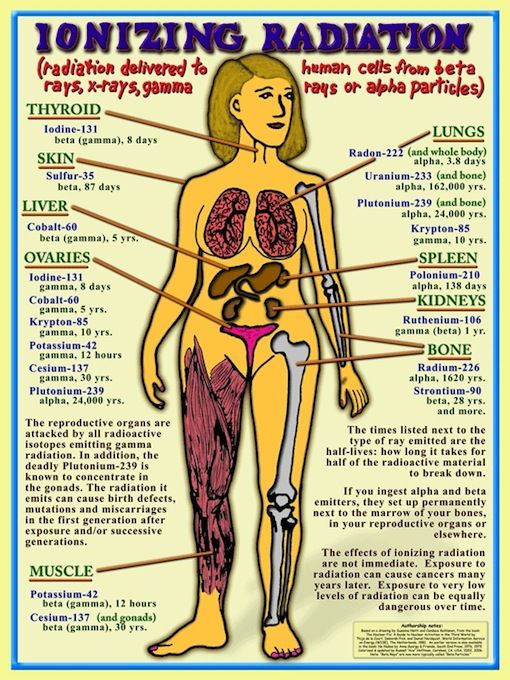
The Mums for Nuclear groups seem curiously uninterested in the fact that women, and children, are significantly more vulnerable to illness from nuclear radiation than men are.
Opposition Leader Peter Dutton interrupted by anti-nuclear protester while visiting XXXX factory in Brisbane
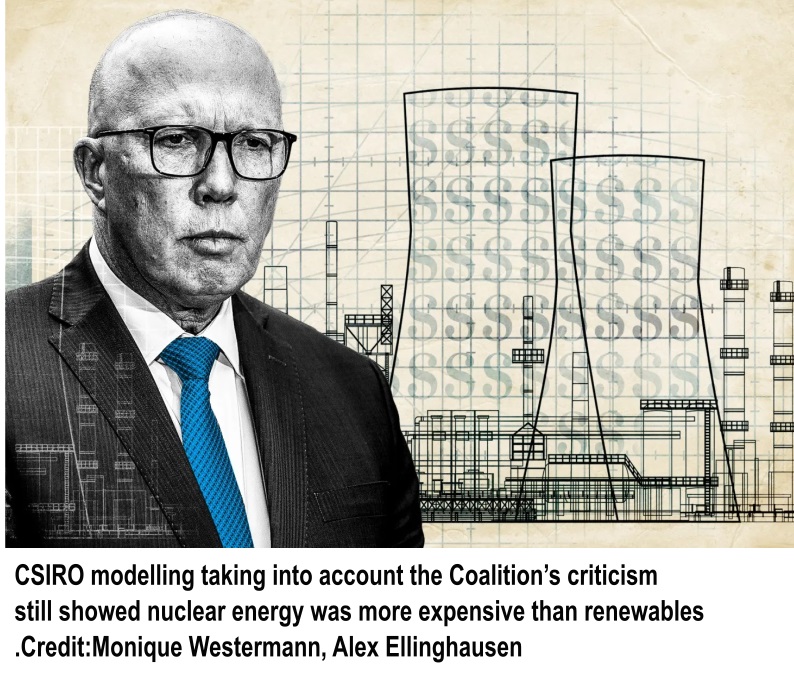
Opposition Leader Peter Dutton has been interrupted by an anti-nuclear protester representing Rising Tide during his first official campaign event in Brisbane.
Patrick Staveley, Digital Reporter. Sky News, 29 Mar 25
Peter Dutton has been heckled by a protester just over an hour after Prime Minister Anthony Albanese endured a similar incident in a chaotic start to the first full day of the election campaign for both parties.
The Opposition Leader visited the XXXX brewery in Brisbane on Saturday in his first official campaign event, where he was interrupted by a protester purportedly representing environmental group Rising Tide.
A woman held up a sign that read: “No new gas or nuclear” with “Rising Tide” scribbled underneath as she shouted towards Mr Dutton. Footage showed the woman emerge right next to Mr Dutton wearing a hi-vis vest appearing to blend in with the media in the brewery.
“Why are you lying to the Australian people about the cost of nuclear and gas,” she asked.
“It’s going to cook the country, it’s going to cook our country,” she continued as security began to eject her from the premises.”….
“Industry experts have already agreed your plan’s not going to work. Why are you lying to the Australian people?” she said.
A Rising Tide statement revealed Natalie Lindner was the woman who carried out the protest, in the fifth incident where the group has interrupted a politician’s event in the past fortnight.
It follows the disruptions of Angus Taylor’s press conference, Mr Dutton’s speech to the Lowy Institute, Jim Chalmers’ pre-budget speech and a Liberal Party fundraiser.
Ms Lindner made comment in the statement, claiming Mr Dutton’s nuclear scheme “will actively worsen the cost of living and climate crisis”.
Sky News Political Reporter Cameron Reddin asked Mr Dutton whether the protests would change how he would campaign over the next five weeks.
Mr Dutton defended his plan, arguing it would bring prices down contrary to the protester’s claims…………………………………. https://www.skynews.com.au/australia-news/politics/watch-live-opposition-leader-peter-dutton-speaks-from-brisbane-as-first-full-day-of-federal-election-campaign-begins/news-story/a50a58931665f83b360cfa67c69f10a5
Numbers don’t lie: $0 for nuclear, $1.3bn for polluting gas and bucketloads of climate harm in Opposition’s budget reply.
“While there’s plenty of cash being splashed on gas, no dollars are set aside for nuclear. Is this a genuine policy, or was it always just a ploy for more coal and gas?
March 27, 2025 AIMN Editorial, Climate Council , https://theaimn.net/numbers-dont-lie-0-for-nuclear-1-3bn-for-polluting-gas-and-bucketloads-of-climate-harm-in-oppositions-budget-reply/
Opposition Leader Peter Dutton’s budget reply details the Liberal-National Party’s polluting policies on energy and climate change:
- $0 for nuclear begs the question: is the party now walking away from their highly controversial energy scheme?
- A whopping $1.3 billion in handouts for multinational gas corporations during a cost-of-living crisis
- Zero mention of climate change, net zero or escalating costs of disasters is a head-in-the-sand approach to Australians suffering from worsening climate disasters
The Federal Opposition’s policies put more Australians in the crosshairs of escalating climate-fuelled disasters, the Climate Council summed up in response to tonight’s budget reply.
Their policies help the polluting gas industry with handouts and promises to wave through more projects. It continues their poor track record on climate change with more of the same: more excuses, more delays, and more harmful climate pollution from coal and gas. The Coalition still has no credible plan to deal with climate change, or replace our ageing coal generators.
Climate Council CEO Amanda McKenzie said; “While Australians are struggling in a cost-of-living crisis, the Liberal-National Coalition is focused on handing out $1.3 billion to the gas industry, and waving through their polluting projects. This tramples all over the progress we’re making to cut climate pollution and protect our environment. It’s reckless and destructive.
“While there’s plenty of cash being splashed on gas, no dollars are set aside for nuclear. Is this a genuine policy, or was it always just a ploy for more coal and gas?
“Combine their expensive nuclear scheme with bucketloads of gas, and you have a climate disaster that locks in at least two billion more tonnes of climate pollution from coal and gas.
“They still have no plan to cut climate pollution. They’re wilfully risking our kids’ future by kicking the climate can decades down the road. With coal-fired power stations on the way out, and the climate crisis accelerating, we need energy solutions for today. More renewable energy and storage is the fastest way to get power bills under control, the quickest way to replace coal as it retires, and the only way to secure a safer future for our kids and our communities.”
Campaign against nuclear heats up with attack ads aiming at hip pocket
Rachel Williamson, Mar 27, 2025 https://reneweconomy.com.au/campaign-against-nuclear-heats-up-with-attack-ads-aiming-at-hip-pocket/
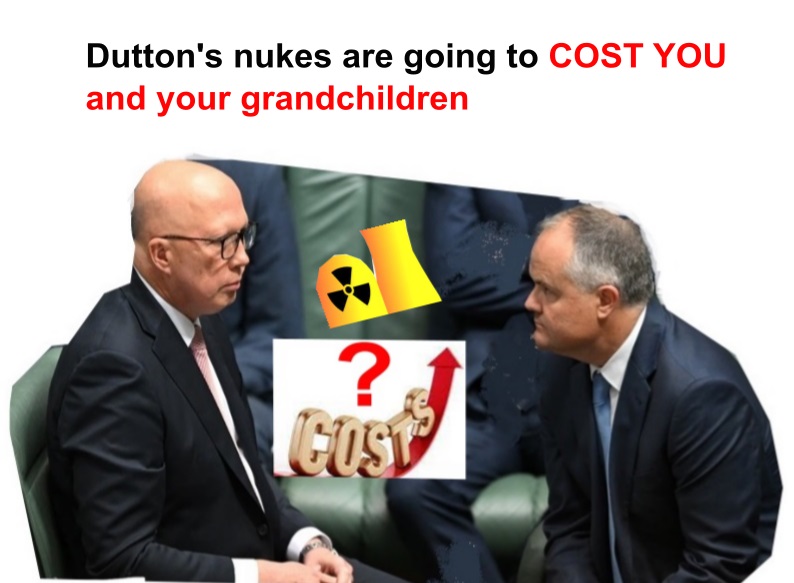
The 2025 federal election will be all about cost of living pressures, and that is exactly where the Smart Energy Council is aiming with a $1 million spend to tell Australians how much their power bills will go up if Dutton’s nuclear dreams come to fruition.
If the Coalition’s price tag of $600 billion for seven reactors is correct – and there are plenty who dispute it – then in today’s money that comes to $30,000 per Australian taxpayer, Smart Energy Council CEO John Grimes said in a statement.
That figure doesn’t take into account the higher power bills Australians will need to pay in order to fund the reactor rollout, he says.
Their accounting suggests that households without rooftop solar will see a potential power bill increase of an average of $665 a year, while households with rooftop solar can expect a bill increase as high as $1400 a year.
Last year, the Smart Energy Council estimated rooftop solar would need to be off for about 67 per cent of the year to make room for the proposed 14 gigawatts (GW) of nuclear power, a fact the nuclear lobby has already accepted.
In June last year Robert Barr, a member of the lobby group Nuclear for Climate, told the ABC that rooftop solar would need to make way for nuclear.
“I think what will happen is that nuclear will just tend to push out solar,” he said.
“I think it wouldn’t be that difficult to build control systems to stop export of power at the domestic level. It’d be difficult for all the existing ones but for new ones, it just might require a little bit of smarts in them to achieve that particular end — it can be managed.”
Given the “white hot rage” of consumers faced with the introduction of emergency stop buttons in South Australia, Victoria, Queensland and now New South Wales (NSW), it’s fair to say the nuclear lobby has underestimated how attached Australians are to their rooftop solar systems.
To give an idea of what they’re up against, the nuclear lobby is today pitting itself against the little over a third of Australia households who already have rooftop solar.
Slightly more than half of houses in Queensland have rooftop solar, the highest penetration in Australia. In South Australia it’s almost half, Western Australia has 45 per cent of homes topped by solar and in NSW it’s 35 per cent, according to a Climate Council report last year.
“Australians will be outraged to know that despite investing thousands of dollars to increase their energy independence and slash power bills, they’ll be forced to pay for their panels to be switched through nuclear power,” Grimes says.
This election is a sliding door moment for millions of Australians that have invested in renewable energy.”
Grimes points out that under the Coalition’s proposal nuclear power plants would be commercially protected, while there is no such law for Australians who’ve invested in rooftop solar systems.
Dutton’s nuclear plan would see large scale renewables capped at 54 per cent of the grid, compared to the minimum-82 per cent target currently in place under the Labor government.
But that would do harm to all Australians, regardless of whether they have been able to install their own solar system, says a report today from the Clean Energy Investor Group.
It found that in 2024, without wind, solar and battery storage, Australian households and businesses would have faced wholesale electricity prices up to between $30/MWh and $80/MWh higher than they actually were in 2024, and paid an estimated $155 – $417 more for household electricity bills.
But it also found that without rooftop solar the 2024 cost of electricity would have increased by a whopping $400-$3,000/MWh.
Avalon Air Show: Arms deals, weapons of destruction and family fun
F-35s, the weapons that have caused such destruction in Gaza, will be in the air at Avalon. For civilian populations on the receiving end, they are objects of terror and loathing, but the Air Show’s website begs to differ: ‘The F-35A Lightning II isn’t just advanced — it’s packed with record-breaking fun facts!’
By Dave Sweeney | 27 March 2025 https://independentaustralia.net/politics/politics-display/avalon-air-show-arms-deals-weapons-of-destruction-and-family-fun,19567
A Melbourne air show is being promoted as a family event, hiding the dark truth behind its glorification of death and mass destruction, writes Dave Sweeney.
IN THE MISTS of legend, Avalon was a place of mysticism and magic linked with the once and future King Arthur and carrying the scent of sorcery and whispers of the Holy Grail.
This week, the sorcery is back with a showcase of the dark arts of industrial warfare and the Holy Grail of unfettered armaments profits on full display at Melbourne’s “other airport”.
Located around 60 kilometres from Melbourne down the Geelong road, Avalon Airport is home to some Jetstar operations, but it has a long-standing military connection since the strip was first used by federal agencies 70 years ago for the development of the RAAF’s Canberra bomber.
These days, alternate years see the windswept paddocks between the nearby open range zoo and the closed range prison complex host a family feel good celebration of technology that makes many families in other parts of the world feel bad or cease feeling altogether.
The Australian International Air Show and Exhibition is a place for family fun, and with the exciting new food vendors and free carnival rides for children young and old, you are set for ‘a day out with the family that’s not to be missed!’
The Air Show has two parts – one Circus, where weekend crowds can ‘get right up close to feel the rumble and smell the jet fuel’ and one Bread, a closed-door, dollar-driven weapons and technology trade show and networking opportunity.
In a set play from the global textbook of normalising deeply distressing and dangerous practices, the event seeks to braid together war fighting and arms trading with civil aeronautical seminars and emergency response displays.
But the principal public face is a high-octane aerial spectacle and parade of power without glory and context.
Australian manufacturing plays a growing role in the global arms trade, including an essential role in keeping the Israeli Defence Forces F-35 fighters in the air.
According to Amnesty International, Australian-manufactured parts and components, including those produced by sole-source providers, are being used in F-35 fighter jets, raising serious concerns about Australia’s potential involvement in the atrocities in Gaza.
Earlier this year, over 230 global civil society organisations urged governments producing F-35 fighter jets to immediately halt all arms transfers to Israel.
F-35s, the weapons that have caused such destruction in Gaza, will be in the air at Avalon. For civilian populations on the receiving end, they are objects of terror and loathing, but the Air Show’s website begs to differ: ‘The F-35A Lightning II isn’t just advanced — it’s packed with record-breaking fun facts!’
This family fun promotion is worlds away from many other peoples’ experience of the sky as a hostile space that threatens rapid, remote and remorseless destruction and death.
For most of us, the closest we get to this all too common global reality is TV news footage of wailing sirens and survivors amid the rubble.
The reality of what these machines actually do is not likely to be publicly canvassed at the Air Show but will no doubt be a marketing point – as demonstrated in the field – in the exhibition sheds and over networking drinks.
Event sponsors and supporters include federal and state governments, the Australian Strategic Policy Institute and Defence, along with a who’s-who of arms corporations and nuclear weapons heavyweights.
BAE, GE Aerospace and Raytheon will join Lockheed Martin, Northrop Grumman and more in giving away show bags and swapping badged pens, sweets, lanyards and notebooks in an effort to ‘elevate your brand to thousands of attendees’.
The guest list has tentacles around the world, as evidenced by Amentum, an innocuous sounding outfit with fingerprints over Pine Gap, military and civil radioactive waste management in the U.S. and UK and a growing interest in future radioactive waste plans in the Northern Territory.
But none of this is reflected in an event website full of happy family pics, tips on where to park and footage of enraptured kids gazing skywards.
There will be public service announcements reminding folks to slip, slop, slap and stay hydrated and no doubt car conversations on the way home featuring excited chatter about the noise, the power and the cool merch.
But what is likely to be missing – and not by accident – is any serious conversation about Australia’s role and responsibilities and whether our nation prioritises building a human and humane peace or getting a piece of the armaments action and conflict cash in an increasingly uncertain world.
Energy election: How nuclear power is already costing Australians
The New Daily Ken Baldwin, Mar 24, 2025,
Taxpayers have already paid a price for the political division over Australia’s energy future — and now the Coalition’s nuclear policy is effectively hitting their hip pocket even before voters get their say on whether it’s part of the nation’s energy transition.
All Australians pay for the lack of a bipartisan approach to meeting national and global emissions targets. This is because uncertainty creates risk for investors and this risk adds a premium to the financing costs of energy megaprojects — a cost that has to be recouped.
Throwing the Coalition’s nuclear plans into that mix just fuels the uncertainty even before analysis of which path is the cheaper, more appropriate or most timely for our energy transition……………………..
Where are we now?
In the lead-up to the federal election, Australia again finds itself at a party-political crossroads in its response to climate change.
Despite more than a decade of debate driven by political parties, we still have no unified approach on energy or reaching emissions targets. This election we still have to choose between two pathways to decarbonise Australia’s electricity sector.
The Labor government is maintaining its target of 82 per cent renewable electricity by 2030, even though the trajectory is under some strain. Renewable installations have plateaued, even if 2024 is expected to show a record 4.3 gigawatts of approved large-scale solar and wind projects and 3.2GW of small-scale rooftop solar installed.
The reason for the slowdown is complex but is partly caused by connection difficulties for large-scale renewables and community pushback on transmission lines and wind and solar farms.
The Coalition plan
The Coalition has the same 2050 net-zero goal as Labor but has yet to provide interim targets.
It has instead promised to include nuclear power as part of the energy mix, starting with two small modular reactors, which are typically under 300 megawatt capacity, to come online in 2035 in South Australia and Western Australia.
No commercial small modular reactors have been built in the Western world and the only examples are in China and Russia.
If large-scale reactors are shown to be the better option, the Coalition plans for these to start producing electricity from 2037 in two locations in each of Queensland and NSW and one in Victoria.
There are also doubts the Coalition’s nuclear timetable is achievable. International experience shows that recent construction times in the West far exceed a decade, although in countries like the United Arab Emirates with different regulatory and governance systems it’s under nine years……………………
Realistically, if the Coalition started a nuclear energy program after the 2025 election, nuclear power stations could not be expected to start producing electricity in Australia until the 2040s.
This would be a problem for a Coalition government wanting to build nuclear plants to replace ageing coal-fired power stations on the same site.
The Australian Energy Market Operator projects all coal-fired power stations will have retired by 2037 — 90 per cent of them within a decade. Under this scenario, solar and wind will have replaced all coal-fired power stations well before 2040.
And if the Coalition plans to subsidise coal plants to extend their life, then reaching the 2050 net-zero emissions target will become much harder.
The emissions realities
Modelling by Frontier Economics for the Coalition uses the ‘Progressive Change’ scenario — one of three scenarios used by AEMO for Australia’s energy transition — which will take longer to decarbonise the electricity sector than the ‘Step Change’ scenario favoured by Labor.
The result will be greater emissions for the planet. Recent modelling by the Climate Change Authority calculated that the Coalition nuclear plan would yield at least an additional two billion tonnes of emissions, consistent with a global pathway to 2.6 degrees warming and missing Australia’s 2030 Paris emissions reduction commitment (43 per cent) by more than 5 per cent.
There are also doubts around the Coalition’s claims its plans are cheaper.
The Frontier Economics modelling says yes, largely because of savings from delaying coal plant closures, the additional systems costs for renewables and the shorter lifetimes of wind and solar plants.
The most recent CSIRO-AEMO GenCost annual report disagrees. It takes into account all the factors that Frontier Economics says makes nuclear cheaper — and still comes out with nuclear being twice as expensive as renewables, consistent with similar studies overseas.
It also doesn’t include the government subsidies needed to encourage Australia’s ageing coal-fired power stations to limp along until the 2040s.
Those coal-fired stations will have reluctant owners competing head-to-head with much cheaper renewables, particularly during the middle of the day when solar could literally eat both coal and nuclear’s lunch.
The choice for voters therefore boils down to this: A continuation of our energy transition to cheaper renewables already underway to keep below 2 degrees; or an uncertain nuclear future from 2040 resulting in more emissions and default on our Paris targets…………………….. https://www.thenewdaily.com.au/finance/consumer/2025/03/24/energy-election-nuclear
—
Shadow Treasurer Angus Taylor appears to struggle sharing cost of Coalition’s nuclear policy
Shadow Treasurer Angus Taylor appeared to repeatedly stumble over the cost of the Coalition’s flagship nuclear policy.
Jessica Wang, March 23, 2025, news.com.au
Shadow Treasurer Angus Taylor has repeatedly refused to directly answer questions around the cost of the Coalition’s nuclear policy, in a confusing pre-budget interview on the Opposition’s flagship policies.
Appearing on ABC’s Insiders on Sunday, Mr Taylor was repeatedly questioned by host David Speers on the cost of the Coalition’s plan to build seven state-owned reactors by 2050, with the first two reactors set to come online by 2035.
Despite the Opposition releasing its costing policies conducted by Frontier Economics in December, which said the Coalition’s energy plan would cost $331bn, Mr Taylor repeatedly avoided giving a figure.
Instead he stuck to the Coalition’s attack lines, stating: “44 per cent less than the alternative (Labor’s plan)”.
“I’m just asking what it’s going to cost Australia to build nuclear power?” said Speers, for asked Mr Taylor for the costing details 14 times.
Sharing multiple variations of the same answer during the three-minute grilling, Mr Taylor responded with: “44 per cent less than the alternative,” before comparing the costings between the two policies.
The Frontier modelling suggested the total cost of Labor’s policy, which includes its renewables rollout, transmission lines and gas would cost about $642bn to 2050, figures Labor has rejected.
The figures contradicts $122bn figure put forward by the Australian Energy Market Operator, which covers generation, storage and transmission infrastructure……………………………………………………. https://www.news.com.au/national/politics/shadow-treasurer-angus-taylor-appears-to-struggle-sharing-cost-of-coalitions-nuclear-policy/news-story/cd3cd5cf13ea68b8fc33fb7bd80c0ea4
Australian nuclear news March 25 – 31.

- Peter Dutton hasn’t done his nuclear homework.
- Australia’s MUMS FOR NUCLEAR – propaganda wheels within wheels.
- Nuclear campaigners target mothers.
- The Australian Electoral Commission is having words with Nuclear for Australia as the group spends $100,000s on its campaign.
- Opposition Leader Peter Dutton interrupted by anti-nuclear protester while visiting XXXX factory in Brisbane
- Dutton nuclear scheming depiction wins 2025 Bald Archy Prize
Shadow Treasurer Angus Taylor appears to struggle sharing cost of Coalition’s nuclear policy. - Energy election: How nuclear power is already costing Australians.
- Proposed Queensland nuclear power plants risk contaminating water supplies in event of disaster, research finds.Numbers don’t lie: $0 for nuclear, $1.3bn for polluting gas and bucketloads of climate harm in Opposition’s budget reply.
- Campaign against nuclear heats up with attack ads aiming at hip pocket.
- I’m a Liberal and I want Dutton to drop nuclear. Now’s the perfect time to do it.
- Numbers don’t lie: $0 for nuclear, $1.3bn for polluting gas and bucketloads of climate harm in Opposition’s budget reply.
Proposed Queensland nuclear power plants risk contaminating water supplies in event of disaster, research finds
Queensland Conservation Council analysis finds reactors could strain water supplies even under normal operations.
Joe Hinchliffe, Guardian, 23 Mar 25
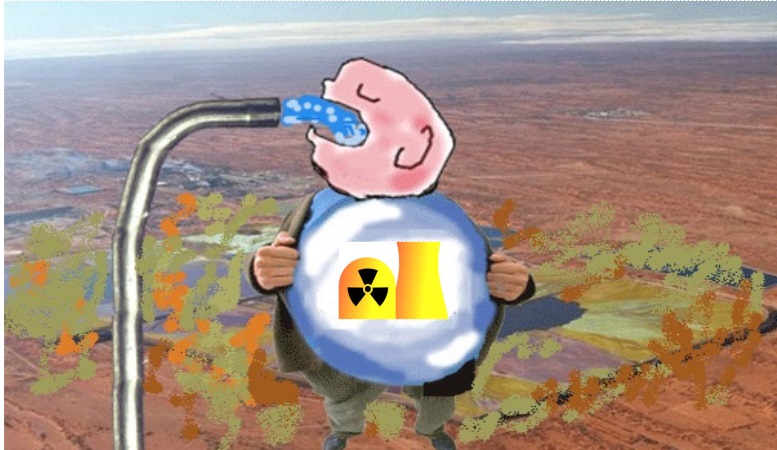
Proposed nuclear power plants in Queensland could strain water supplies, even under normal operations, and risk contaminating them in the event of a nuclear disaster, critics warn.
Analysis by the Queensland Conservation Council (QCC) has found that one of the two nuclear reactors proposed for the sunshine state, under the energy plan that the Coalition will take to the upcoming federal election, could require double the water currently used by the existing Callide coal-fired power station. The other, Tarong, could use 55% more water than its existing coal station.
Tarong’s primary water source is the Boondooma Dam, from which it is allocated 30,000 megalitres a year, and which also supplies drinking water for the nearby town of Kingaroy and irrigates the rich agricultural land along the Boyne River. But Tarong also has a pipeline to the Wivenhoe Dam, the main supply of water for Brisbane and Ipswich, which – due to substantial premiums – it only uses when Boondooma Dam levels are low.
The QCC report also raises concerns about additional water that would be required to prevent a meltdown in the event of disaster.
About 1.3m tonnes of seawater was required to cool Japan’s Fukushima nuclear reactors and prevent a complete meltdown in 2011 – water which has been stored on site for more than a decade and which began being gradually released into the ocean through an undersea tunnel about one kilometre long in 2023.
The report has been described as “flawed and highly politicised” by the Coalition.
But the director of QCCC, Dave Copeman, said there “simply is not enough water” available to run nuclear facilities in the proposed locations and “no plan for where to store irradiated water required for heat reduction in the case of an emergency”…………………………………….
The Callide coal-fired power plant has an annual water allocation of 20,000 ML from the Callide Dam, which is fed by the Awoonga Dam. As of Wednesday, Awoonga – which supplies the city of Gladstone’s water – was at 46% capacity, and Callide – which supplies drinking water to Biloela – was at 16.5% capacity. Callide Dam is also used to replenish aquifers that irrigate crops in the Callide Valley.
Callide would have to find an additional 27,000 ML of water to power the kind of power plants implied by the Coalition’s nuclear plan, the QCC report found – with Copeman saying there was simply “not enough water available”.
The renewable energy engineer for the QCC, Clare Silcock, who crunched the numbers on the report, said the Coalition’s nuclear proposal was scant on details. Instead she drew upon the Frontier Economic’s modelling that the opposition has relied upon to argue its nuclear vision for seven reactors across the country would be 44% cheaper than the government’s renewables-led plan.
That report models just over 100,000 gigawatt hours of nuclear electricity in the National Electricity Market (NEM) – which covers Queensland, New South Wales, the Australian Capital Territory, Victoria, Tasmania and South Australia – by 2050.
Six of the proposed nuclear sites are within the NEM, and so the QCC report assumes the generation would be spread equally across those sites.
Ian Lowe, emeritus professor at Griffith University’s school of environment and science, said that a rule of thumb was that a nuclear power station needed about 15% more water than a coal-fired power station of the same capacity.
“[But] if we were to build the amount of nuclear power proposed in the Frontier Economics report as part of the Coalition’s long-term approach for 2050 electricity, there would not be enough water for Tarong and Callide to provide the proposed share of power,” he said.
That meant that the Frontier report was “implicitly assuming that the nuclear power program would be expanded” beyond the sites already identified by the Coalition.
“So it would be reasonable to ask the question: if the much larger nuclear program proposed in the Frontier Economics report were to go ahead, where would all the extra power stations be sited?” Lowe said………………………………………..
The Coalition minister pointed to the Palo Verde Nuclear power plant in the Sonoran desert, one of the United State’s largest power producers and the only one in the world not near a large body of water as it uses treated wastewater from nearby cities.
Associate professor Martin Anda, with Murdoch University’s centre for water, energy and waste, said US comparisons were “not relevant to Australia”.
Anda said he was not “100% against nuclear” – and that it would “probably be a good solution” in the Arctic regions of the US and Europe, for example, where water abounds, renewable energy opportunities are more limited and the nuclear industry is established.
Australia, though, not only lacked for an abundance of water, but also the kind of regulatory frameworks and safeguards that could take years to establish.
https://www.theguardian.com/australia-news/2025/mar/23/proposed-queensland-nuclear-power-plants-risk-contaminating-water-supplies-in-event-of-disaster-research-finds-ntwnfb
Nuclear news and more – not industry handouts

Some bits of good news
UNICEF has almost single-handedly prevented the collapse of Afghanistan’s healthcare system. Armenia and Azerbaijan agree treaty terms to end almost 40 years of conflict
‘ All the birds returned’: How a Chinese project led the way in water and soil conservation.
TOP STORIES.Israel Makes Its Most Explicit Statement Of Genocidal Intent Yet.Chris Hedges: The Last Chapter of the Genocide.
What is the fate of Russian-held Zaporizhzhia nuclear power plant after Trump talks?Zelensky rejects Trump nuclear plan.
How bloated energy supply projections are usually wrong – a history of energy efficiency tells us why.
Climate. Climate impacts may be starting to spiral, but a sub-1.5C world is ‘still possible’. More than 150 ‘unprecedented’ climate disasters struck world in 2024, says UN.
Noel’s notes, Nuclear power is such a mess – Zaporizhzhia plant as the shining example.
AUSTRALIA.
- Complicity of Labor and Liberal in Israel’s genocide of Palestinians – https://www.youtube.com/watch?v=jVzoFd7EwOA
- A Little More Conversation? Nuclear Power In Australia: A Little More Conversation?
- International ‘nuclear tombs’ are being built, but how do we warn future generations of what’s inside?
- Dutton’s seat a target in $2m union war against nuclear.
- Nuclear policy blocking Liberal gains. Liberal supporters launch election ad campaign against Peter Dutton’s plan to build nuclear power plants. Australia: Liberals Against Nuclear launches campaign to return party to core values. “Desperate” Liberals urge Dutton to “stop this stupid nuclear palaver”. ‘Vandals in the White House’ no longer reliable allies of Australia, former defence force chief says. Nuclear policy blocking Liberal gains. Desperate” Liberals urge Dutton to “stop this stupid nuclear palaver” Australia: Liberals Against Nuclear launches campaign to return party to core values. – More Australian nuclear news at https://antinuclear.net/2025/03/19/australian-nuclear-news-18-24-march/
| ATROCITIES. With Trump’s ‘Thumbs Up’, Netanyahu restarts Gaza genocide. |
| CLIMATE. No Virginia, NUCLEAR REACTORS DO RELEASE carbon into the atmosphere. |
| ECONOMICS. Macron ousts EDF boss accused of giving French industry ‘the middle finger’. Macron Ousts EDF CEO as Tension Rises on French Power Costs. Hinkley Point C nuclear will cost at least £75 billion – highly unlikely that Sizewell C will be any cheaper.Idle Lepreau nuclear plant threatens to post worst operational year in 4 decades. |
| EMPLOYMENT. Subsidies attract companies, but not workers, to Fukushima zones. |
| ENVIRONMENT. Nuclear Severnside…is this our future? –https://www.youtube.com/watch?v=wz9CaHbM-9oMillions of fish killed this winter at Bruce Power nuclear plant.27-year-old chemist discovers a process for recycling rare earths.Niobium – A Radioactive Sword of Damocles Hangs over Brazil’s Northern Amazon.Radioactive Mussels May Pose Threat to Food Chain in Pennsylvania. Red light for the greenway. |
| HEALTH. Radiation exposure victims fight for compensation as nuclear weapons funding soars.i |
| LEGAL. “We will not back down:” Court tells Greenpeace to pay billion dollar damages bill to oil and gas company. SCOTUS Ruling Could Shape the Future of Nuclear Waste Storage.Hold Southern California Edison (SCE) Accountable: From Wildfires to Nuclear Waste.Federal Court Orders Reconsideration of Nuclear Waste Facility Approval, Citing Inadequate Indigenous Consultation. |
| MEDIA. Memoirs of Mohamed ElBaradei: “The Age of Deception”. Before Our Very Eyes, Fake Wars and Big Lies: From 9/11 to Donald Trump. |
| OPPOSITION to NUCLEAR . Time to take urgent action to help Stop Sizewell C. Most Scots disagree with Anas Sarwar about building new nuclear plants.Nuclear regulators hear concerns about plan to restart Three Mile Island reactor. |
| POLITICS. French government ousts head of nuclear power group EDF – ALSO AT https://nuclear-news.net/2025/03/24/1-b1-french-government-ousts-head-of-nuclear-power-group-edf/ EDF may get state loan for six new reactors. Labour ‘utterly wrong’ to double down on costly and immoral nuclear weapons, Scottish Greens say. UK Government ramps up nuclear threats ahead of CND Barrow protest . UK Regulators get targets to cut red tape and boost the economy.Reeves to outline plan to cut regulation costs and boost growth. BAE: Barrow MP hits out at planned nuclear protest. Canada Pours Nearly $450M into New Nuclear Subsidies. |
| POLITICS INTERNATIONAL and DIPLOMACY.‘Never forget’: Pacific countries remember nuclear test legacy as weapons ban treaty debated. The Phony Ceasefire. Walt Zlotow Trump pushing Ukraine peace for simple reason: he has no cards to play either. Britain wants Ukraine’s minerals too. The fight for control of Ukraine’s nuclear reactors. Trump offers to take control of Ukraine’s nuclear plants in call with Zelensky. Trump: best protection for Ukraine’s nuclear power is US takeover. Aaron Mate on how NATO provoked Russia in Ukraine and undermined peace.Trump eyeing Crimea as ‘international resort’ – HershKatz: Israel To Begin Annexing Gaza. US wants to negotiate with Iran on nuclear programme: US envoy. |
| SAFETY. In the shadow of a nuclear bargaining chip, Ukrainians fear disaster. – ALSO AT https://nuclear-news.net/2025/03/20/1-a-in-the-shadow-of-a-nuclear-bargaining-chip-ukrainians-fear-disaster/House Of Commons Public Accounts Committee: Decommissioning Sellafield – Sellafield is the most dangerous place in the U.K. Leak is Sellafield’s ‘biggest environmental issue’. |
| SECRETS and LIES. German media told to conceal Nazi symbols in Ukraine – Moscow.Whistleblowers at nuclear sites may face bullying and threats, MPs warn. |
| SPACE. EXPLORATION, WEAPONS. Star wars: alarm at space agency’s 130 meetings with Ministry of Defence, High radiation, low gravitation: The perils of a trip to Mars.Mars Attacks: How Elon Musk’s plans to colonize Mars threaten Earth. |
| SPINBUSTER. Nuclear plant boss Julia Pyke: ‘It’s a tough gig, developing big infrastructure projects in the UK’- ALSO AT https://nuclear-news.net/2025/03/19/2-nuclear-plant-boss-julia-pyke-its-a-tough-gig-developing-biginfrastructure-projects-in-the-uk/ |
| WASTES. Ministry of Defence under fire over nuclear clean-up in Scotland. Louth and Horncastle MP welcomes council pulling out of nuclear waste site partnership. “South Copeland Community Partnership Area of Focus” on nuclear waste is unravelling . County council set to withdraw from nuclear waste facility group. Questions asked in Cumberland on two key nuke dump concerns. Engie Finalises Agreement To Extend Operation Of Two Belgium Nuclear Plants – Transfer of waste liabilities reduces company’s exposure to future costs .Decommissioning: Sellafield decommissioning to continue for at least a century – robot dogs play a part.Thin-wall canisters do not really stop radiation from nuclear wastes . |
| WAR and CONFLICT. Israel Restarts Large-Scale Bombing of Gaza, Over 400 Killed. After Ukraine, Iran?1 |
| WEAPONS and WEAPONS SALES. One Trident sub could ‘incinerate 40 Russian cities’: Why Putin should fear Britain’s nuclear arsenal. UK will not shy away from nuclear weapons, John Healey tells Russia. UK nuclear deterrent could do ‘untold damage’, Healey warns.Trump’s threats reignite talk of nuclear bombs in Iran. |
How bloated energy supply projections are usually wrong – a history of energy efficiency tells us why
As we can see, overblown energy projections are now manifesting themselves in new ways. In Australia, the Australian Energy Market Operator (AEMO) is being criticised for imagining a future natural gas supply shortage. This is despite the fact that natural gas use in Australia is declining because of increasing electrification of services (See HERE).
One problem that obscures this, and makes the energy supply lobby ignore energy efficiency, is that the electricity supply and natural gas supply interests are intertwined. AEMO in Australia feels the need to bang the drum for natural gas, even though electrification is more efficient and more sustainable than natural gas.
David Toke, Substack, Mar 23, 2025
There’s a general belief going around about surging energy demand in developed countries like the USA and the UK. Goldman Sachs, for example, has been leading the chorus proclaiming massive AI-led increases in energy demand (See HERE). But such claims are likely much exaggerated. They are the latest in a history of falsely predicted energy bubbles. These have served the interests of the big energy corporations and their bizarre demands for state funding of technologies like small modular reactors (see my post HERE). I want to discuss this history of bloated projections of future energy consumption. I want to talk about how it is that they are false prophets, both in history and now.
Yes, we need to electrify the economy to make it more energy-efficient using things like heat pumps and EVs. These technologies will increase electricity demand, but they will actually reduce overall energy demand, not increase it. The stories about ‘surging’ energy demand imply absolute increases in energy consumption, not relative shifts.
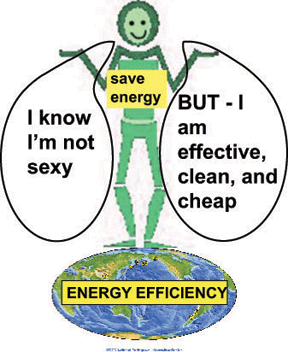
The (historical) role of bloated projections of future energy consumption has been to distract attention from energy efficiency improvements. These are important, if not the overriding, means through which the bloated energy projections are confounded. It is doubly true today when we desperately need to encourage energy efficiency through electrification. This will reduce emissions, increase energy security and create more demand for renewable energy.
A history of bloated energy projections
Bloated projections in the USA
Yes, we’ve been here before. The big energy corporations with their demands for massive investment in centralised power plant trade on the fact that the general public do not remember the past and the inaccuracy of the past claims of massive increases in energy consumption.
In the 1970s it became clear that the world could not survive unsustainable increases in energy production and pollution. This was, by the way, before climate change became a major issue even within the green movement. Amory Lovins led the way in charting a strategy based on decentralised energy consumption in a book called ‘Soft Energy Paths’. published in 1977. He noted how the US Government and its agencies were predicting a doubling of energy consumption in the year 2000 compared to 1975 (note: all energy not just electricity). They were predicting a massive increase in reliance on coal and nuclear power.
Lovins talked about what he called an alternative ‘soft energy path’ to this ‘hard energy path’. In his projection total energy projection increased by only around a third by 2000, and thereafter began to decline (pages 29 and 38 compared)1. He mused about how solar photovoltaics ‘could be used, to increase the range of functions now performed by electricity’ (page 143). Amazingly his projection of total US energy consumption by 2000 turned out to be broadly correct, even though many of his general policy rescriptions were not adopted. Energy consumption increased by only around a third compared to the confident predictions made by Government agencies and reports supported by big corporations.
Exaggeration of future energy demand is the usual practice of the Government. The US Government’s Energy Information Administration (EIA) publishes a lot of very useful data about energy. However its future energy projections are riddled with overestimations………………………………………..
I am focusing on the USA because I have more data for this discussion. The same general position holds in the UK………………………………
As we can see, overblown energy projections are now manifesting themselves in new ways. In Australia, the Australian Energy Market Operator (AEMO) is being criticised for imagining a future natural gas supply shortage. This is despite the fact that natural gas use in Australia is declining because of increasing electrification of services (See HERE).
How energy efficiency deflates bloated energy demand projections
Energy efficiency is the creeping destroyer of energy demand projections. I call it ‘creeping’ energy efficiency because this is often missed by people who are modeling projections of future energy. They simply do not know what improvements in energy efficiency there are going to be. But they do know how much is generated by power stations or supplied by gas. So they just do multiplication sums involving the supply-side data they do know about and they do not make radical enough assumptions about the development of energy efficiency.
Recently I have seen projections of the impact of AI on energy consumption derived by assuming a constant relationship between the amount of AI and data centres and energy consumption. They then multiply the expected expansion of AI by the current expected energy consumption of AI and arrive at some very large quantities. But this is stupid.
It is as if somebody in the year 1900 was projecting how much coal was going to be used in power stations in the future relying on the energy efficiency of a coal-fired power plant existing in 1900. This was around 10 percent (ie 10 percent of the coal’s energy was converted into electricity). Of course, this energy efficiency increased, ultimately to over 40 percent. So anybody doing these sums about future coal consumption would have gotten their answers absurdly wrong. Nowadays coal is on its way out, in the West, at least. But as will coal-fired power plants, the efficiencies of AI will improve. This may happen very rapidly.
Early 2025 saw the emergence of DeepSeek, an AI system that is radically cheaper than other US based systems. They, reportedly, have reduced energy consumption by around 75 per cent (see HERE), or perhaps even more according to some estimates (see HERE). Other companies will have to try to emulate their success since they will struggle to compete if they do not. According to an analysis of the company’s efforts:
‘DeepSeek’s research team disclosed that they used significantly fewer chips than their competitors to train their model. While major AI companies rely on supercomputers with 16,000+ chips, DeepSeek achieved comparable results using just 2,000. This strategic approach could mark a turning point in AI energy efficiency and resource allocation.’ (see HERE)
After the emergence of DeepSeek, much of the conversation on the energy demand from AI centres briefly paused. Then, the lessons of the example of DeepSeek apparently lost the cacophony of voices carried on from before in the vein of talking about ‘surging’ AI-related demand for energy.
So as was the case with coal-fired power plants, the efficiencies of AI will improve. This will happen very rapidly indeed if DeepSeek is anything to go by since the other AI companies will have to keep up with improving efficiencies and cutting costs if they are to keep up with the competition.
…………………. even in the case of the USA, it has all been much overblown. Certainly AI and data centers are unlikely to produce a substantial increase in energy demand in the UK. Indeed, AI is likely to induce declines in energy consumption, as I argue in an earlier post (see HERE).
Energy Efficient lighting
A good case study of how energy efficiency almost silently hacks away at energy is lighting…………………………………………………………………………….
Future energy efficiency
Often talk about likely increases in electricity consumption to power more energy-efficient technologies like EVs and heat pumps becomes confused with talk about surges in energy demand through data centres (which are overblown, as I argue). Heat pumps and EVs will reduce energy consumption overall – by pretty large amounts. Battery-electric technology will expand to all of transport (ultimately even including aircraft). Heat pumps will provide residential, commercial, and industrial space heating. The energy-saving potential is immense. Up to half of all energy consumption could be saved. Energy consumption has already stabilised in most western states – and has reduced in some such as the UK.
Conclusion
As we have seen, in the past clams of projected surges in energy demand have been undermined by greater energy efficiency. So why is it that demands for energy supply increases to meet overblown estimations of surges in energy demand receive so much more publicity than energy efficiency?
One major reason is that big corporations whose interests are concerned with building large power stations have concentrated political power. The lobby for greater energy efficiency has a much more diffuse base. But today the renewable energy lobbies and the energy efficiency lobbies should have a much keener interest in working together. To create a much bigger market for renewable electricity, electrification needs to be rapidly developed.
One problem that obscures this, and makes the energy supply lobby ignore energy efficiency, is that the electricity supply and natural gas supply interests are intertwined. AEMO in Australia feels the need to bang the drum for natural gas, even though electrification is more efficient and more sustainable than natural gas. The big energy corporations tend to sell both electricity and gas, and so they will try and promote both of them.
We need to combat the influence of the big corporations. We need to put our shoulders on the wheel in backing incentives and regulations to be shifted in favour of energy efficiency. Otherwise the energy transition will take much longer to happen.
https://davidtoke.substack.com/p/how-bloated-energy-supply-projections
Dutton’s seat a target in $2m union war against nuclear
David Marin-Guzman, AFR, 24 Mar 25
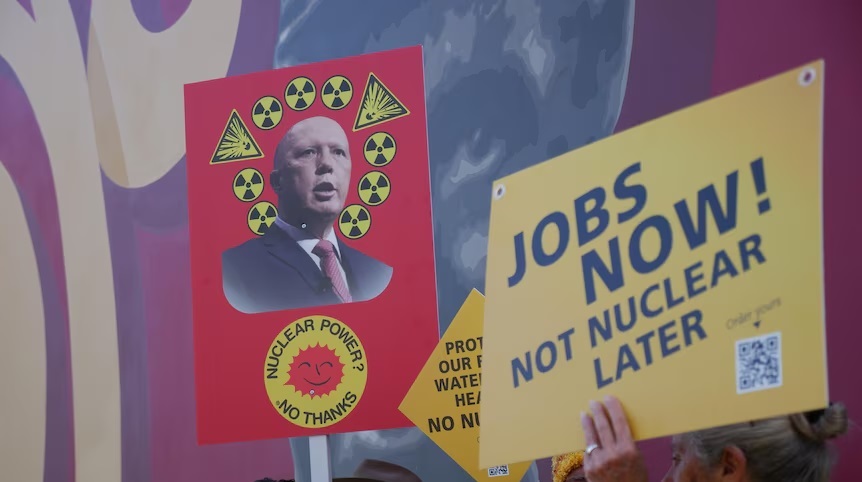
Unions will spend more than $2 million on an anti-nuclear energy campaign targeting the Coalition in key electorates ahead of the federal election, including Opposition Leader Peter Dutton’s own marginal Queensland seat.
The Electrical Trades Union is leading the campaign, involving television, FM radio and digital ads, with $1.5 million funding and is backed by the Maritime Union of Australia and the plumbers’ union, which are spending $400,000 and $200,000, respectively.
The campaign is one of the most significant union spends in the election and will attack the huge cost and time involved in building nuclear plants and question nuclear as the fix to energy concerns.
It will target a dozen Liberal and Labor seats in play across the east coast, including Hunter, Reid and Banks in NSW – the latter held by opposition foreign affairs spokesman David Coleman – and McEwen, Hawke, Dunkley and Bruce in Victoria.
In Queensland, the ads will focus on Capricornia, held by Liberal MP Michelle Landry, the inner-Brisbane seat of Bonner held by Liberal MP Ross Vasta, the regional seat of Flynn held by Nationals MP Colin Boyce, Labor’s working-class Brisbane seat of Blair, and Dutton’s seat, Dickson, which he holds by a margin of 1.7 per cent.
This is not a fear campaign’
The unions will also campaign in Moore in Western Australia, which the Liberals held by less than 1 per cent in the 2022 election. Electrician turned lawyer and ETU member Tom French is challenging for the seat on behalf of Labor after Liberal MP Ian Goodenough was ousted in pre-selection last year.
ETU national secretary Michael Wright, whose union holds a historic opposition to nuclear, said the ads ask: “How does a nuclear reactor built in 2045 keep the lights on in 2025?”
“Nuclear is too little energy for too much money coming too late,” he said. “This is not a fear campaign. It’s grounded in science and where this country is. If you can engage people with the facts you don’t need to scare people. Nuclear just doesn’t make sense.”
Plumbing and Pipe Trades Employees Union national secretary Earl Setches said Dutton was peddling a “nuclear fantasy”.
“We will not support a plan that costs out at, best guess, $600 billion to power only 4 per cent of the grid and will take over 20 years to become reality,” he said.
“Australian workers need a real secure plan for their future and this nuclear scheme will not provide that security. It will, in fact, kill jobs.”
MUA national secretary Paddy Crumlin said maritime workers were already working on offshore energy projects that promised jobs for “generations of Australian seafarers and wharfies”.
“A sudden shift to nuclear energy will bring that work to a standstill,” he warned.
Building trust in renewables
Dutton has said “nuclear energy will set us up for the next century” and criticised Labor’s early scare campaign as “childish” and “embarrassing”.
However, the advertisements, which run the slogan “Dutton’s Nuclear Plan: Why?” and feature experts, electricians and farmers, avoid the memes of three-eyed fish initially shared by Labor MPs when the opposition leader announced his plans……………………..
In WA, the union campaign would focus on water concerns in the state by emphasising that nuclear power consumes about 1.4 times more water than coal to produce the same amount of electricity.
Wright said the ETU had a particular interest because Dutton’s nuclear plans and opposition to renewables were “already delaying projects and that costs my members jobs”…………………………… https://www.afr.com/politics/dutton-s-seat-a-target-in-2m-union-war-against-nuclear-20250321-p5llh8
Integrity watchdog boss steps aside from six defence investigations

ABC News by political reporter Olivia Caisley, Sun 23 March 25
In short:
The National Anti-Corruption Commission has confirmed its chief Paul Brereton has recused himself from six defence matters referred to the watchdog and assigned those matters to a deputy commissioner.
Integrity experts are concerned about how Mr Brereton is handling potential conflict of interest issues related to defence.
What’s next?
The integrity watchdog will appear before a Senate committee on Thursday.
The head of the National Anti-Corruption Commission continues to hold senior roles in the Army Reserves, raising fresh questions about perceptions of neutrality as the watchdog probes a $45 billion federal defence contract.
Six months after a unintentional misconduct finding was made against Paul Brereton over a robodebt referral, the NACC has confirmed the commissioner is self-managing potential conflict of interest issues if and when they arise.
When contacted by the ABC the NACC did not detail whether Mr Brereton had stepped away from a referral regarding the navy’s $45b Hunter frigate project, but confirmed he had recused himself from six defence matters to avoid any perceptions of bias.
Federal crossbenchers — including Greens senator David Shoebridge and Independent MP Helen Haines — have flagged issues with the integrity body since its inception in July 2023 and are pushing for increased transparency in the next term of parliament…………………………………
A NACC spokesperson confirmed Mr Brereton has recused himself from six defence matters being investigated by the commission, but it’s unclear at what point in the process he stepped away.
“The commissioner has appropriately remained involved in decision making and deliberations where the matter does not involve the interests of an individual or unit with whom he has or has had a close association,” they said.
“… Where an actual or perceived conflict is declared or ruled, the member does not participate in the discussion and leaves the meeting while the matter is discussed and determined.”
But Greens senator David Shoebridge told the ABC Mr Brereton’s continued association with defence raised a red flag and the commissioner shouldexplain whether he’s recusing himself from early deliberations or just decision making.
“I think most people will just be shaking their heads at this” he said.
Responding to questions about whether it’s appropriate for Mr Brereton to retain his position as Major General in the ADF Reserves, as well as honorary appointments as Colonel Commandant of the Royal New South Wales Regiment and the University of New South Wales Regiment, the NACC said it wasn’t concerned.
“The commissioner’s ongoing defence roles are honorary appointments and generally present no conflict of interest,” a spokesperson told the ABC.
Director of The Center for Public Integrity, Geoffrey Watson SC, described the NACC’s explanation as problematic.
“I haven’t got complete confidence in the commissioner’s ability to gauge conflict of interest — given his robodebt error,” he said.
“The response seems to gloss over potential defence conflicts of interest because certain appointments of Mr Brereton’s are ceremonial or honorary. I would think if your commitment is so emotionally strong you’re willing to do it for free — it makes it worse not better.”
The August declaration provided to the Senate also lists nine current and former politicians with whom Mr Brereton has previously had professional contact.
Those names include — Defence Minister Richard Marles, former defence minister Linda Reynolds and Marise Payne, who was the defence minister at the time the frigate announcement was made.
The Guardian reported last year Mr Brereton’s Robodebt conflict related to his service in the army reserves.
Senator Shoebridge says he’s been waiting 18 months for a substantive response to his NACC referral regarding the Hunter frigates.
“I have not had any clarification about who is dealing with it, what stage it is at and I’m troubled commissioner Brereton might have had a role in it,” he said……………. https://www.abc.net.au/news/2025-03-23/integrity-watchdog-boss-steps-aside/105084982?utm_source=abc_news_app&utm_medium=content_shared&utm_campaign=abc_news_app&utm_content=twitter
1 This month

of the week – Australians for War Powers Reform (AWPR)
To see nuclear-related stories in greater depth and intensity
 Antinuclear