To suck up to the American government, Australia’s government leaders agreed to buy nuclear submarines, with no Parliementary discussion.
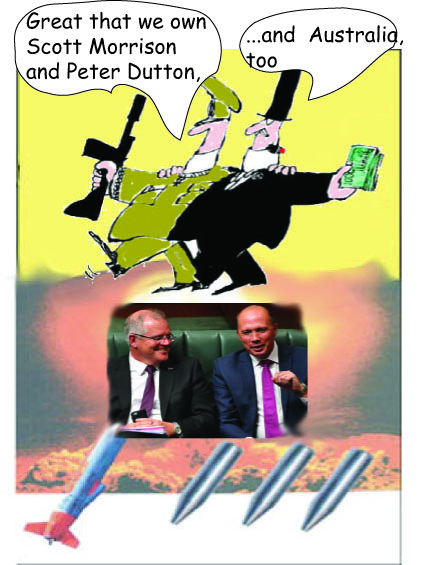
And as for the process, involving a sudden announcement to the Australian public, it is extraordinary that this momentous decision could be made without parliamentary or public scrutiny.
Australia bows down to America for nuclear submarines, Independent AustraliaBy Lee Duffield | 10 December 2021, As tensions between the U.S. and China grow, Australia’s nuclear submarine program has become less to do with our defence and more about placating the American Government, writes Dr Lee Duffield.
DEFENCE INDUSTRY MINISTER Melissa Price, on 9 November, declared the country’s nuclear-powered submarines would be built in South Australia.
How would this be done? Constructing the ships around imported reactors? It added into the brewing of questions and arguments since the sudden announcement of the nuclear plan and immediate cancellation of the French contract for conventional submarines on 16 September.
Trying to make sense of it all, several analysts, mostly through the Lowy Institute publication, The Interpreter, and at think-tanks to the Left and Right, have produced these main points:
- that American policy towards China is the main factor in this mix;
- that Australian sovereignty stands to be diminished, even if its security might be helped; and
- that the insult to France and its consequences, while not the main game, remains important — especially as it affects the standing of the Australian Government.
Sam Roggeveen, Director of the Lowy Institute’s International Security Program, contributed two articles, seeing the China-USA contest as the heart of it, with Australia now brought in more as a great power client, less as itself.
Roggeveen wrote:
‘The defence deal is a clear escalation and indication that Washington views Beijing as an adversary. It also has thrust Australia into a central role in America’s rivalry with China.’
U.S. reacts — Australia goes, too
The deal in question is the full package of the new tripartite defence arrangement, AUKUS (Australia, the United Kingdom, the United States), with Australia obtaining probably eight nuclear submarines at the centre of it.
As Roggeveen explains:
‘…the scale of this agreement and the close strategic and operational links it implies will create expectations from Washington. Australia cannot have this capability while assuming that it does not come with heightened expectations that Australia will take America’s side in any dispute with China.’
And as for the process, involving a sudden announcement to the Australian public, it is extraordinary that this momentous decision could be made without parliamentary or public scrutiny.
Allan Behm, Director of International and Security Affairs at the Australia Institute, gave a similar reading, seeing the decision to build long-range nuclear submarines for Australia as an American game, little to do with the defence of Australia:
The aim is to make possible an Australian contribution to U.S. battle plans against China which that country will view as profoundly threatening with implications also for war planning by Russia, North Korea and other nuclear-armed states.
Even leaving aside the fiscal profligacy and defence opportunity costs for Australia of the literal blank cheque issued by the Morrison Government, the nuclear submarine decision takes Australia into the heart of naval warfighting in East Asia and Southeast Asia.
“Step up to the bully”
Some steps to the right of Behm at the Australia Institute is Rowan Callick writing for the Centre for Independent Studies, a neoliberal and anti-communist lobby, in the current debate articulating much of the confrontationist thinking on how to deal with Beijing. …………
For the U.S., AUKUS is a win. It exemplifies the importance Washington attaches to deepening cooperation with key allies and strengthening their military capabilities to assist in deterring the security challenges posed by China in the region.
A very hard and costly undertaking
Great difficulty running a nuclear submarine program is foreshadowed for a country with no nuclear industry, where the navy for several years was unable to provide specialist crews for each of its Collins class submarines — rotating them ship-to-ship as vessels took turns in maintenance. There is also the long lead time proposed for getting the nuclear boats into service, starting with 18 months reserved for more discussion, for official thinking to get clarified on such questions.
Oriana Skylar Mastro and Zack Cooper have talked about many critics already raising ‘valid concerns’:
Critics of AUKUS… worry that 18 months is a long time to wait for clarity on the plan, and 18 years would be too long to wait for submarines. Nuclear-powered submarines will prove difficult and expensive for Australia to master and could create non-proliferation concerns. Washington, Canberra and London will have to mend ties with Paris as well as concerned friends in Southeast Asia, especially Jakarta. Others have argued that the deal ties Australia too closely to the United States or creates unnecessary tensions with China (although we would dispute these last two assertions)…………
In the vanguard of concerns about the French connection, Richard Ogier saw further risks to Australia’s options as a sovereign state, and considered that:
‘In Europe, and not only in France, the image of Australia has suffered a direct hit. Australia may be a staunch U.S. ally, but under certain circumstances, was prepared to go beyond the old ANZUS alliance. Australians may be warm and welcoming, is the message sent, but watch for the kick when your back is turned.’
A full version of this article has been published in subtropic.com.au. Dr Lee Duffield is a former ABC foreign correspondent, political journalist and academic. https://independentaustralia.net/politics/politics-display/australia-bows-down-to-america-for-nuclear-submarines,15832
Weapons making companies have the Australian Strategic Policy Institute in their grip.
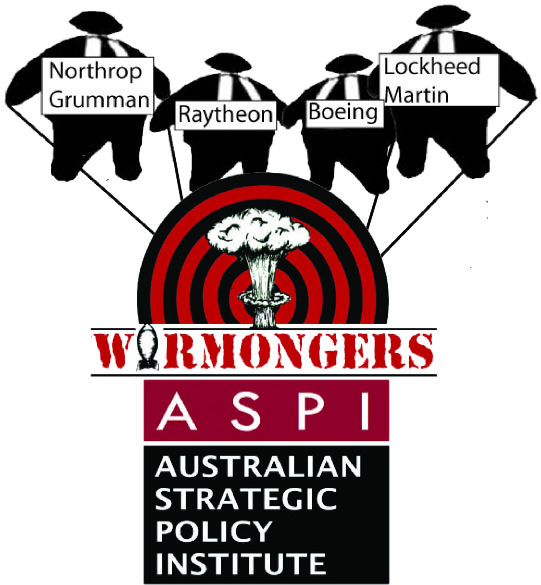
AUSTRALIA CAPTURED – How the military-industrial complex has captured Australia’s top strategic advisory body, MICHELLE FAHY, DECLASSIFIED AUSTRALIA 9 DECEMBER 2021
(These are some of the connections between ASPI staff and weapons corporations) : –
…………. Robert Hill (with German weapon-maker Rheinmetall’s Australian subsidiary, and chair of Viva Energy Group, a major supplier of fuel to the Australian Defence Force (ADF). Hill serves as ‘chair of counsellors’ at enigmatic lobbying firm Dragoman Global, where one of his colleagues is Nick Warner, former defence secretary, head of the Office of National Intelligence (ONI) and director general of the Australian Secret Intelligence Service (ASIS). Dragoman has a major client in Naval Group, the French naval shipbuilder that had won the $90 billion submarine project recently dumped by the Morrison government. serves as ‘chair of counsellors’ at enigmatic lobbying firm Dragoman Global, where one of his colleagues is Nick Warner, former defence secretary, head of the Office of National Intelligence (ONI) and director general of the Australian Secret Intelligence Service (ASIS). Dragoman has a major client in Naval Group, the French naval shipbuilder that had won the $90 billion submarine project recently dumped by the Morrison government.
Then there’s another former Liberal defence minister, Brendan Nelson, now the president of Boeing Australia, New Zealand and South Pacific. In addition to its commercial aviation business, Boeing is the world’s third largest arms manufacturer. Boeing Defence Australia is one of Australia’s top handful of defence contractors, supplying planes and drones to the RAAF, attack helicopters and, potentially, if ASPI’s recommendation is followed, drone submarines, along with much else. The presence of Boeing’s most senior regional leader on the ASPI council is perhaps the biggest challenge for ASPI in guarding its required independence.
Meanwhile, former chief of army, Lt Gen Ken Gillespie (ret’d), chairperson of ASPI’s council, is on the boards of Naval Group Australia and cybersecurity firm Senetas Corporation. He was previously on the board of Airbus Australia Pacific, a European conglomerate that mostly supplies and maintains the ADF’s helicopters. None of these interests is disclosed in Gillespie’s profile on ASPI’s website nor its annual report.
Another ASPI council member, Jane Halton, is also on the board of Naval Group Australia, although this is not mentioned on the ASPI website. Readers may recall her senior role in the Department of Prime Minister and Cabinet during John Howard’s 2001 ‘children overboard’ scandal. She is chair of the board of Vault Cloud, along with co-director, former defence secretary and ASIO boss Dennis Richardson. Vault Cloud provides high-security cloud infrastructure for government and critical industries, now in rapidly increasing demand.
Council member Gai Brodtmann, a former Labor MP, is on the advisory board of cybersecurity company Sapien Cyber, a Perth-based company chaired by former defence minister Stephen Smith. America’s former top surveillance chief, James Clapper, is on Sapien’s governance board.
The other ASPI Council members – James Brown, Stephen Conroy, Stephen Brady, Lavina Lee, Denis Dragovic, and Jennifer Ma – have relevant experience but no publicly known positions with weapons or defence-related companies.
On a recent ABC TV Q&A that focused on China, ASPI Council member Lavina Lee appeared along with Channel Nine reporter Chris Uhlmann, and host, ABC reporter, Stan Grant. Despite the program’s focus on Australia’s strategic outlook with China, no mention was made that Lavina Lee is an ASPI council member, bar a comment from Stan Grant that she was ‘associated with’ ASPI. Neither was it mentioned that the show’s host Stan Grant was a Senior Fellow of ASPI during 2020. Of lesser relevance but still of interest, panellist Chris Uhlmann’s partner is Gai Brodtmann, another ASPI council member……………….
……………… Another former Liberal defence minister, David Johnston, who famously didn’t trust the Australian Submarine Corporation to ‘build a canoe’, joined the ASPI Council soon after his appointment to the board of Saab Technologies, the Swedish arms multinational that supplies integrated combat systems for Australia’s submarines and warships. Johnston was appointed the Australian government’s first Defence Export Advocate during his tenure on the Council.
Retired Air Vice-Marshal Margaret Staib was on the board of QinetiQ, a British defence multinational that is deeply embedded with Defence’s weapons arm, Defence Science and Technology. Former defence secretary Allan Hawke was on the Lockheed Martin Australia board for the final six months of his time on the ASPI Council.
Senate inquiry calls for royal commission-like probe into Australia’s media diversity.

Australia has one of the world’s most concentrated media ownership markets with seven of the 12 national or capital city daily newspapers owned by Murdoch’s News Corp, according to a recent fact check.
That’s nearly 60 per cent of the metro and national print media market.
Senate inquiry calls for royal commission-like probe into Australia’s media diversity, Matthew Elmas, Dec 9,
A Senate inquiry has called for a royal commission-like probe into the the concentration of media ownership in Australia and whether a new independent press regulator is needed.
Handing down the findings from a year-long probe into media diversity on Thursday, the Environment and Communications Committee found Australia’s media laws are “weak, fragmented and inconsistent”.
Backing calls from former prime minister Kevin Rudd, the Labor and Greens majority committee recommended “a judicial inquiry, with the powers of a royal commission”.
It would consider whether a new independent media regulator was needed to “harmonise news media standards and oversee an effective process for remedying complaints”.
“Large media organisations have become so powerful and unchecked that they have developed corporate cultures that consider themselves beyond the existing accountability frameworks,” the inquiry report said.
The inquiry also urged the government to guarantee sustainable and adequate funding for public broadcasters the ABC and SBS.
Australia has one of the world’s most concentrated media ownership markets with seven of the 12 national or capital city daily newspapers owned by Murdoch’s News Corp, according to a recent fact check.
That’s nearly 60 per cent of the metro and national print media market.
The government has yet to formally respond to the report. But in a sign it might dismiss the recommendations, Liberal senator and committee deputy chair Andrew Bragg published a statement on Thursday calling the report a “shameless political stunt which should not be taken seriously”………
If the Morrison government resists pressure to create a Murdoch royal commission then Labor and the Greens could take the proposal to the upcoming federal election.
Opposition senators strongly supported the probe in Thursday’s report……….
The committee seized on News Corp’s coverage of the climate crisis as an example of media concentration damaging Australian politics.
……. The committee also highlighted YouTube’s recent ban of News Corp’s Sky News channel as evidence the empire is responsible for spreading misinformation.
“The YouTube ban on Sky News over the publication of public health misinformation highlighted that there is an issue when a private company is able to act swiftly to protect the public from misinformation but the ACMA, the media regulator is not,” https://thenewdaily.com.au/finance/finance-news/2021/12/09/murdoch-royal-commission/

China Wants to Join Southeast Asia’s Nuclear-Free Zone
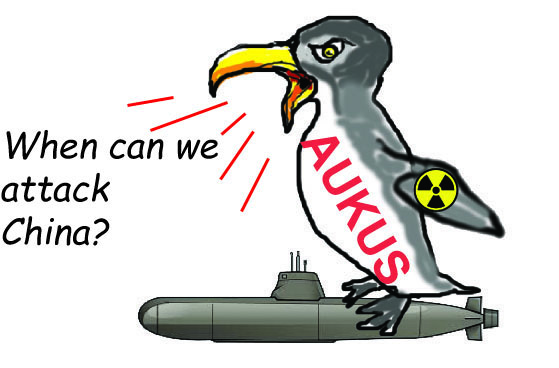
A greater factor in China’s calculus is the AUKUS alliance among the U.S., U.K. and Australia. Under the security partnership announced in September, the U.S. and U.K. agreed to equip Australia with a fleet of nuclear-powered submarines to counter China’s influence in the Indo-Pacific. China wants to even the score. In a phone call with counterparts from Malaysia and Brunei that same month, Chinese Foreign Minister Wang Yi skewered AUKUS as anathema to the Bangkok Treaty. “The United States and Britain chose not to participate in the SEANWFZ [Southeast Asia Nuclear Weapon-Free-Zone] Treaty,” Wang reminded his peers. “Instead, they have transferred military nuclear technology to the region under various pretexts and also provided the region with highly enriched uranium materials, running counter to the efforts made by ASEAN countries to build a nuclear-free zone.”
China Wants to Join Southeast Asia’s Nuclear-Free Zone. Why Now? LawfareBy Ryan A. Musto Thursday, December 9, 2021 China is ready to rock with the Treaty of Bangkok.
In a rare appearance at the special online summit for the Association of Southeast Asian Nations (ASEAN) on Nov. 22, China’s President Xi Jinping announced that China is prepared to sign the protocol of a 1995 agreement that establishes Southeast Asia as a nuclear-weapon-free zone. Under the agreement, known as the Bangkok Treaty, 10 regional states renounce the right to nuclear weapons in any form within the ASEAN zone. If it joins the treaty, China would agree not to use or threaten the use of nuclear weapons within the zone or against its members. It would make China the first nuclear-weapon state to adhere.
China’s support for the treaty is no surprise. To strengthen its enduring “no-first-use” policy to never initiate nuclear conflict, China routinely has asserted (most recently in a 2019 white paper) that it “is always committed to … not using or threatening to use nuclear weapons against non-nuclear-weapon-states or nuclear-weapon-free zones unconditionally.” For the Bangkok Treaty, ASEAN and China agreed in 2011 to a secret memorandum of understanding that preserves China’s territorial claims in the South China Sea, removing the greatest hurdle to Beijing’s commitment. China was ready to sign the protocol and memorandum in 2012 but deferred once the other eligible “P-5” nuclear-weapon states under the Non-Proliferation Treaty—France, Russia, the United Kingdom and the U.S.—refused to join. Now, Xi wants to legally bind China to the treaty “as early as possible.” But what’s the rush?
Adherence to the Bangkok Treaty would burnish China’s image amid its rapid expansion in nuclear capabilities…………
A greater factor in China’s calculus is the AUKUS alliance among the U.S., U.K. and Australia. Under the security partnership announced in September, the U.S. and U.K. agreed to equip Australia with a fleet of nuclear-powered submarines to counter China’s influence in the Indo-Pacific. China is furious and wants to even the score. In a phone call with counterparts from Malaysia and Brunei that same month, Chinese Foreign Minister Wang Yi skewered AUKUS as anathema to the Bangkok Treaty. “The United States and Britain chose not to participate in the SEANWFZ [Southeast Asia Nuclear Weapon-Free-Zone] Treaty,” Wang reminded his peers. “Instead, they have transferred military nuclear technology to the region under various pretexts and also provided the region with highly enriched uranium materials, running counter to the efforts made by ASEAN countries to build a nuclear-free zone.”……….. https://www.lawfareblog.com/china-wants-join-southeast-asias-nuclear-free-zone-why-now
Appeal to UK’s Supreme Court will just lengthen Julian Assange’s legal torment – of course Australia doesn’t care.
Edward Fitzgerald QC, for Assange, previously told the High Court that Australia had not indicated whether it would accept Assange, who “will most likely be dead before it can have any purchase, if it ever could”……..
Assange lawyers eye UK Supreme Court, The North West Star.Jess Glass and Tom Pilgrim, PA
11 Dec 21, Julian Assange’s lawyers intend to take his case to the Supreme Court, his fiancee says, after the High Court allowed the WikiLeaks founder’s extradition to the United States.
Assange, 50, is wanted in the US over an alleged conspiracy to obtain and disclose classified information following WikiLeaks’ publication of hundreds of thousands of leaked documents relating to the Afghanistan and Iraq wars
US authorities brought a High Court challenge against a January ruling by then-district judge Vanessa Baraitser that Assange should not be sent to the US, in which she cited a real and “oppressive” risk of suicide.
After a two-day hearing in October, the Lord Chief Justice Lord Burnett, sitting with Lord Justice Holroyde, ruled in favour of the US on Friday………..
The judges ordered that the case must return to Westminster Magistrates’ Court for a district judge to formally send it to UK Home Secretary Priti Patel.
Assange’s fiancee Stella Moris called the ruling “dangerous and misguided” and said his lawyers intended to seek an appeal at the Supreme Court……..
The legal wrangling will go to the Supreme Court, the United Kingdom’s final court of appeal.
“It is highly disturbing that a UK court has overturned a decision not to extradite Julian Assange, accepting vague assurances by the United States government,” Assange’s lawyer Barry Pollack said.
“Mr Assange will seek review of this decision by the UK Supreme Court.”
Supporters of Assange gathered outside of the court after the ruling, chanting “free Julian Assange” and “no extradition”.
They tied hundreds of yellow ribbons to the court’s gates and held up placards saying “journalism is not a crime”.
If Assange’s lawyers do take his case to the Supreme Court, justices will first decide whether to hear the case before any appeal is heard.
During October’s hearing, James Lewis QC for the US said that the “binding” diplomatic assurances made were a “solemn matter” and “are not dished out like Smarties”.
The assurances included that Assange would not be held in a so-called “ADX” maximum security prison in Colorado or submitted to special administrative measures (SAMs) and that he could be transferred to Australia to serve his sentence if convicted.
But lawyers representing Assange had argued that the assurances over the WikiLeaks founder’s potential treatment were “meaningless” and “vague”.
Edward Fitzgerald QC, for Assange, previously told the High Court that Australia had not indicated whether it would accept Assange, who “will most likely be dead before it can have any purchase, if it ever could”……..
The United Nations’ special rapporteur on torture Nils Melzer sharply criticised the verdict.
“This is a shortcoming for the British judiciary,” Melzer told the DPA news agency on Friday.
“You can think what you want about Assange but he is not in a condition to be extradited,” he said, referring to a “politically motivated verdict”.
with reporting from Reuters and DPA https://www.northweststar.com.au/story/7547237/assange-lawyers-eye-uk-supreme-court/?cs=13136
The latest court case for Australian Julian Assange – and the death of democracy
Assange is too important to the establishment to let get away. No matter that the C.I.A. wanted to kill him; no matter that the C.I.A. spied on his privileged conversations with his lawyers; no matter that the chief witness in the computer conspiracy charge admitted he made it all up.
The Old Boy Network of trust between the rulers of the Anglo-Saxon powers was enough.
To save their hides from more exposure about how they try to violently and deceptively dominate the world, they are willing to sacrifice the last vestiges of their pretend democracy.
Julian Assange is that important to them.
Democracy Dying in the Darkness of the Assange Case https://consortiumnews.com/2021/12/10/democracy-dying-in-the-darkness-of-the-assange-case/ December 10, 2021 The establishment figures on the bench took American promises as “solemn undertakings from one government to another” because Assange is too important to let go, By Joe Lauria.
It is a very dark day indeed for the future of press freedom. If Julian Assange does not find relief at the U.K. Supreme Court, it won’t be an exaggeration to say that democracy, already on life support, is done for. The U.S., and its best ally Britain, have behaved in this affair no better than any tinpot dictator tossing a critical reporter into a dungeon.
This judgement by the High Court today to allow Assange’s extradition to the U.S. comes on U.N. Human Rights Day; the day that Washington concluded its so-called Democracy Summit and the day when the Nobel Prize was awarded to two journalists, one of whom dismissed Julian Assange and said the purpose of journalism is to support national security.
That’s exactly what the national security state wants from its journalists. And they reward them with the highest honors. Assange did the opposite. He fulfilled journalism’s supreme purpose and he may be about to pay for it with his life.
The Choices Available
The High Court could have denied extradition to a country whose intelligence service plotted to kill or kidnap him. It could have sent the case back to magistrate’s court to be reheard.
Instead Lord Chief Justice Ian Burnett and Lord Justice Timothy Holroyde found an extremely narrow way to overturn the lower court’s decision not to extradite Assange.
Continue readingDRUMS OF WAR Biden is pushing us to brink of NUCLEAR WAR over Ukraine in chilling echo of Cuban missile crisis, Russia claims

FIRES OF WAR Biden is pushing us to brink of NUCLEAR WAR over Ukraine in chilling echo of Cuban missile crisis, Russia claims, The Sun UK, Katie Davis, 10 Dec 2021
RUSSIA has warned Joe Biden is pushing the nation to the brink of NUCLEAR WAR as tensions over Ukraine hit boiling point.
Sergei Ryabkov, Russia’s deputy foreign minister, has warned a chilling echo of the 1962 Cuban missile crisis is possible as the US closely watches unrest at the border.
“You know, it really could come to that,” he said.
“If things continue as they are, it is entirely possible by the logic of events to suddenly wake up and see yourself in something similar.”
A standoff between Russia and the US brought the world close to nuclear war when Washington blocked Moscow from shipping nuclear missiles to Cuba in 1962 – and Ryabkov has warned escalating tensions between the nations risk a repeat of that.
After strained negotiations, John Kennedy and Nikita Khrushchev reached an agreement, with the Soviet leader dismantling their offensive weapons in Cuba on the condition the US would sign a public declaration to not invade the Caribbean country again.
It comes amid mounting tensions between the West and Moscow over a potential invasion of Ukraine – with growing fears war could break out.
Last week US intelligence detected Russia massing 175,000 troops on the border with Ukraine as fears of a potential invasion in early 2022 are mounting.
Meanwhile, Moscow claimed its fighter jets intercepted a US spy plane that was flying over the Black Sea.
Russia has denied that it plans to attack Ukraine.
Ryabkov’s warning comes after Joe Biden held a high-stakes call with Vladimir Putin as tensions between Washington and Moscow intensify over Ukraine.
The two-hour call between the leaders was held in a bid to de-escalate tensions – with the US President threatening sanctions over the situation at Russia’s border…………….
Russia has been demanded Ukraine not join NATO and raged that the US must stop all military activity in the region.
Ukraine commanders have warned that a Russian invasion would overwhelm the country without help from the West…………
it’s reported Britain and her allies are ready to use force to stop Russia invading Ukraine – despite warnings it would lead to the worst conflict since World War Two…………
a US senator has warned America could “rain destruction” on Russia with nuclear weapons if Putin invades Ukraine……
Senator Roger Wicker said “We don’t rule out first-use nuclear action, we don’t think it will happen, but there are certain things in negotiations, if you are going to be tough, that you don’t take off the table.”
But the Russian Embassy in Washington hit back at Wicker’s remarks, branding his suggestion that the US should consider using nuclear weapons against Moscow in the event of invasion as “irresponsible”.
“Such statements are irresponsible,” the statement, posted on Facebook, said.
“We advise all the unenlightened to read the joint statement of the Presidents of Russia and the United States of June 16, 2021 thoroughly. This document reaffirms the two countries’ commitment to the principle that a nuclear war cannot be won and must never be fought.”………. https://www.thesun.co.uk/news/16999520/biden-pushing-brink-nuclear-war-ukraine-russia/
European Union passes sustainable taxonomy law, but postpones decision about nuclear power.

“The commission must deliver a science-based taxonomy regulation that excludes fossil gas, nuclear, and factory farming. Otherwise, the credibility of the taxonomy is ruined.”
EU green taxonomy becomes law, gas and nuclear postponed, Institutional investors have signalled they want a taxonomy that is based on science – not political compromise. euobserver, By WESTER VAN GAAL 11 Dec 21,
BRUSSELS, The first two chapters of the sustainable taxonomy, the EU’s ambitious labelling system for green investment, were passed on Thursday (9 December).
Until midnight on Wednesday, EU member states had time to reject this first set of rules – the so-called ‘first delegated act’.
But despite opposition from a group of countries, the proposal passed and will come into force on 1 January 2022. It will describe the sustainable criteria for renewable energy, car manufacturing, shipping, forestry and bioenergy and more, and include a “technology-neutral” benchmark at 100 grams of CO2 per kilowatt-hour for any investments in energy production.
The criteria for the list has mainly been compiled by the Sustainable Finance Platform, a group of 57 NGOs, scientific and financial experts, making the first part of taxonomy “science-based”…..
The European Commission will now likely unveil the second delegated act on 22 December.
This will describe how nuclear and gas will be labelled under the taxonomy. But the process has become highly-politicised over the last months.
Second act
In a meeting of member states on 29 November the project nearly faltered.
An EU diplomat, speaking anonymously, explained to EUobserver that a French-led group of 13 member states tried to block the first list “out of principle” – because the commission had not agreed to include nuclear and gas in the green taxonomy.
France and Finland pushed for nuclear to be “fully part of the taxonomy.” Ten other mainly eastern European countries want gas included. Sweden joined the group because the new rules endanger its forestry sector.
The group tried to gain a supermajority of 15 to force the commission’s hand but fell short. Germany and Italy abstained, but did not respond to requests for explanation made by EUobserver.
The commission will now decide how to label nuclear and gas before the end of the year, and it is not yet clear how the issue will pan out…………..
Whatever the commission will decide, only a supermajority in the council – 15 member states – or a parliamentary majority can block the second delegated act. Both are unlikely.
What next?
Institutional investors have already signalled they want a taxonomy based on science, not political compromise.
This will “harm the objective-scientific, transparent character of the taxonomy and increases the risk of ‘greenwashing’. Europe promised the world climate leadership, it is time to show it,” a group of banks wrote this week.
Sebastien Godinot, a senior economist at WWF and member of the EU’s Sustainable Finance Platform, said the commission must not give in to blackmail and bullying.
“The commission must deliver a science-based taxonomy regulation that excludes fossil gas, nuclear, and factory farming. Otherwise, the credibility of the taxonomy is ruined.”
But the commission may have no choice but to compromise between the gas and nuclear-supporting member states on one side, and countries opposing these on the other – while also being mindful that investors and experts from its Sustainable Finance Platform will reject a system containing contradictory political concessions. https://euobserver.com/climate/153776
Population Growth Advocacy: Mislead Immigration Support or Greed & Tribalism? — One Finite Planet

Rohingya refugees (CNS photo/Antara Foto, Rahmad via Reuters) In Australia, as in many countries, there appears to be almost universal acceptance of perpetual population growth. Population growth is seen as: Desirable because it is the path to economic prosperity.Inevitable. Neither reflects reality. So why is it, that so few contemplate a finite population target, given…
Population Growth Advocacy: Mislead Immigration Support or Greed & Tribalism? — One Finite Planet
Brown coal likely to close by 2032, AEMO says, but all coal may be gone by then — RenewEconomy

Step change has become AEMO’s core scenario to manage the grid, and it assumes a three fold increase in coal retirements by 2030. The post Brown coal likely to close by 2032, AEMO says, but all coal may be gone by then appeared first on RenewEconomy.
Brown coal likely to close by 2032, AEMO says, but all coal may be gone by then — RenewEconomy
Debunking the false claims that nuclear power is affordable for Australia
Nuclear Power’s Economic Crisis, Jim Green, 9 Dec 21
A new report by Friends of the Earth Australia comprehensively debunks claims that nuclear power is cheap or affordable in the Australian context.
The 32-page report, ‘Nuclear Power’s Economic Crisis and its Implications for Australia’, details catastrophic cost overruns with nuclear power construction projects ‒ including ‘small modular reactors’ (SMR) ‒ over the past decade.
Dr. Jim Green, author of the report and national nuclear campaigner with Friends of the Earth Australia, said: “Nuclear lobbyists base their claims about ‘cheap’ nuclear power on implausible cost estimates for reactor types that have not even been built. Our report aims to ground the nuclear debate in detailed, factual information about reactor construction projects.
“Every reactor project in the U.S. and Western Europe over the past decade has been a disaster. Costs for every one of those projects has ballooned by more than $10 billion. They are all behind schedule, by as much as 13 years.
“SMR projects have also been disastrous: expensive and over-budget, slow and behind schedule. There are disturbing connections between SMRs and nuclear weapons proliferation, and between SMRs and fossil fuel mining. The only operating SMR anywhere in the world is used by Russia to power fossil fuel mining in the Arctic.
“The nuclear ‘renaissance’ of the 2000s has collapsed into corporate carnage including the bankruptcy of American nuclear giant Westinghouse and near-bankruptcy of its parent company Toshiba. In France, Areva was saved with an $8 billion bailout and the other major utility, EDF, is saddled with $66 billion in debts. Nuclear corruption and criminality are evident in many countries operating nuclear power plants.
“The persistence of nuclear support can be attributed to three factors: ignorance, commercial interests, and the ‘culture wars’.
Those are the likely explanations for the Minerals Council of Australia’s ongoing disinformation campaign regarding nuclear power. Member companies such as BHP and Rio Tinto should stop the MCA’s nuclear disinformation campaign or resign their membership from the MCA.”
“Research by CSIRO and the Australian Energy Market Operator conclusively demonstrates that nuclear power is far more expensive than renewables coupled with storage. It’s time for nuclear lobbyists to stop dissembling and to face the facts: Australia’s future is renewable, not radioactive.” Dr. Green said.
The report notes that in 2020, a record 256 gigawatts (GW) of renewable capacity were added to the world’s power grids compared to a net gain of 0.4 GW of nuclear capacity. This year will be another record-setting year for renewables with 290 GW installed so far, and nuclear power has flatlined yet again with the small number of reactor start-ups matched by permanent reactor closures.
The report, ‘Nuclear Power’s Economic Crisis and its Implications for Australia’, is online at https://nuclear.foe.org.au/economics/
Australian superannuation funds still have considerable investments in nuclear weapons companies: some are not disclosing this

John Buckley 9 Dec 21
- Most major super funds have some kind of exposore to nuclear weapons.
- Australian Super, the nation’s largest fund, was found to have $1.5 billion in nuclear weapons holdings.
- Some omit nuclear weapons from their “controversial” investment exclusions.
Most of Australia’s major super funds continue to hold investments in nuclear weapons companies, almost a year after the UN Treaty on nuclear weapon prohibition came into effect.
According to new analysis from the Australia Institute and nuclear weapons prevention non-profit, Quit Nukes, 17 of Australia’s major super funds currently have holdings in nuclear weapons companies.
The funds that do, the analysis found, make opaque attempts — if any at all — to disclose the investments to current and potential members, and in some cases go to great lengths to conceal them.
Australian Super, the nation’s largest super fund both by membership and funds under management, has close to $1.5 billion in nuclear weapons companies.
The fund’s investment policy says Australian Super does not exclude nuclear weapons (or other controversial weapons technology) from its investment pot.
For members with a higher conscience, Australian Super offers a “Socially Aware” membership, but even then, that only excludes landmines and cluster munitions.
Moving through the list, the case was the same in most other corners across the market. Aware Super, Australia’s second largest fund, says that it excludes controversial weapons, but that definition doesn’t cover nuclear weapons.
Aware invests in 12 nuclear weapons companies.
HESTA, meanwhile, only excludes investment in companies which earn more than 5% of their total revenue from nuclear weapons across the whole portfolio, but still has exposure to 14 nuclear weapons companies.
Over at Hostplus, nuclear weapons aren’t classified as controversial weapons either, and therefore aren’t excluded from the fund’s investment prospects.
But the fund says that it plans to recategorise nuclear weapons come January next year, at which point it’ll have to find a way to divest from eight nuclear weapons companies.
It is a popular strategy at most of the market’s major players, where controversial weapons are excluded from investment, but nuclear weapons aren’t considered controversial.
Among them are Rest Super, Telstra Super, and Mercer Super. At Cbus “controversial weapons” are explicitly excluded from fund investment opportunities, but there’s no mention of nuclear weapons. The fund has exposure to six nuclear weapons companies.
A survey undertaken by Quit Nukes found that just under 70% of Australians would expect nuclear weapons to be considered “controversial weapons”, while that same proportion of Australians, when asked, said they’d prefer their super not be invested in nuclear weapons.
Margaret Beavis, co-director at Quit Nukes, said Australia’s $3.4 trillion pension industry has phenomenal power, and their abstinence could go a long way in eliminating nuclear weapons, which are now illegal under international law.
“While there is big money invested in nuclear weapons companies, these investments are usually a tiny percentage of the whole funds under management,” Dr Beavis said.
“There is no evidence to suggest that divestment will negatively impact returns. Some funds are making change, including Hostplus, which recently decided to divest all nuclear weapons holdings by the end of January 2022,” she said.
Bill Browne, a senior researcher at The Australia Institute’s Democracy and Accountability Program, said it’s clear that Australians don’t want their money “invested in weapons of mass destruction”, and that super funds should heed the warning.
“Australians have the right to know exactly how their money is being invested, but most major super funds do not tell their members about their investments,” Browne said.
“Superannuation is one of the great Australian projects, guaranteeing retirement income for millions of workers. Most Australians would have no idea that their retirement money is being used to finance nuclear weapons,” he said.
“It is incumbent upon all funds to invest in the future of Australians — and that future does not include nuclear weapons.”
Some smaller, emerging funds have already pulled the rug on nuclear investments completely. The only six funds that that have either fully divested, or weren’t exposed to nuclear in weapons in the first place are: Active Super, Australian Ethical, Christian Super, Crescent Wealth, Future Super, and Verve Super.
Nuclear Power’s Economic Crisis and its Implications for Australia

Nuclear Power’s Economic Crisis and its Implications for Australia, Nuclear Free Campaign, Friends of the Earth Australia
December 2021 report by Friends of the Earth Australia, ‘Nuclear Power’s Economic Crisis and its Implications for Australia’.
The full report is available as a PDF.
The introduction (minus references and footnotes) is copied below.
INTRODUCTION & SUMMARY
Despite the abundance of evidence that nuclear power is economically uncompetitive compared to renewables, the nuclear industry and some of its supporters continue to claim otherwise. Such claims are typically based on implausible cost projections for non-existent reactor concepts. For example the Minerals Council of Australia conflates self-serving, implausible company estimates for small modular reactors (SMRs) with “robust estimates” based on “conservative assumptions”. And the Australian Nuclear Association bases its claim that nuclear power is Australia’s “least cost low carbon energy option” on the non-existent BWRX-300 SMR.
Claims about ‘cheap’ nuclear power certainly don’t consider real-world nuclear construction projects. Those following real-world developments have come to the opposite conclusion. Indeed supporters of nuclear power have issued any number of warnings in recent years about nuclear power’s “rapidly accelerating crisis” and a “crisis that threatens the death of nuclear energy in the West” while pondering what if anything might be salvaged from the “ashes of today’s dying industry”.
Consider the following statements, many of them from industry insiders:
- “I don’t think we’re building any more nuclear plants in the United States. I don’t think it’s ever going to happen. They are too expensive to construct.” ‒ William Von Hoene, Senior Vice-President of Exelon, 2018.
Nuclear power “just isn’t economic, and it’s not economic within a foreseeable time frame.” ‒ John Rowe, recently-retired CEO of Exelon, 2012.- “It’s just hard to justify nuclear, really hard.” ‒ Jeffrey Immelt, General Electric’s CEO, 2012.
- “We see renewables plus battery storage without incentives being cheaper than natural gas, and cheaper than existing coal and existing nuclear.”‒ Jim Robo, NextEra CEO, 2019.
- France’s nuclear industry is in its “worst situation ever”, a former EDF director said in November 2016 ‒ and the situation has worsened since then.
- Nuclear power is “ridiculously expensive” and “uncompetitive” with solar. ‒ Nobuo Tanaka, former executive director of the International Energy Agency, and former executive board member of the Japan Atomic Industrial Forum, 2018…………………
Several reasons can be posited for the crisis which led Bob Carr ‒ a former nuclear supporter, NSW Premier and Australian Foreign Minister ‒ to describe nuclear power as lumbering, cripplingly expensive and moribund:
- The Fukushima disaster in Japan in 2011.
- A suite of economic challenges: catastrophic cost overruns with reactor projects; nuclear power’s negative learning curve (it has become more expensive over time); and nuclear power’s inability to compete economically with renewables.
- Nuclear corruption scandals in many ‒ perhaps most ‒ of the countries operating nuclear power plants.
Other reasons could be added to that list, such as the failure to find solutions to manage long-lived nuclear waste, and the explosion in the world’s only deep underground nuclear waste repository in 2014.
This paper focuses on nuclear power’s economic problems ‒ catastrophic cost overruns with reactor projects, and nuclear power’s large and worsening economic disadvantage relative to renewables.
Summary
Every power reactor construction project in Western Europe and the US over the past decade has been a disaster:
- The only reactor construction project in France is 10 years behind schedule and the current cost estimate of A$30.6 billion is 5.8 times greater than the original estimate.
- The reactor under construction in Finland is 13 years behind schedule and the current cost estimate is 3.7 times greater than the original estimate.
- The Hinkley Point nuclear plant in the UK was meant to cost £2 billion per reactor and be complete by 2017; but construction hadn’t even begun in 2017 and costs have increased more than five-fold.
- The V.C. Summer project in South Carolina was abandoned after the expenditure of around US$9 billion.
- The Vogtle project in Georgia is six years behind schedule and costs have doubled.
Western Europe and the US provide the most striking examples of nuclear power’s crisis and the most striking examples of a more generalised problem: alone among energy sources, nuclear power has become more expensive over time, or in other words it has a negative learning curve.
Section 5 discusses nuclear power globally and in important countries other than those in Western Europe and North America. Suffice it to note here that nuclear power is struggling almost everywhere. China is said to be the industry’s shining light but nuclear growth is modest (an average of 2.1 reactor construction starts per year over the past decade) and paltry compared to renewables (2 gigawatts (GW) of nuclear power capacity added in 2020 compared to 135 GW of renewables).
Outside of China, the writing is on the wall: 48 power reactor start-ups and 98 permanent shut-downs from 2001‒2020 as well as a looming wave of shut-downs because of the ageing of the world’s reactor fleet and, in some countries, nuclear phase-out policies. Globally, renewable power capacity grew by a record 256 GW in 2020 (four times greater than Australia’s total capacity) compared to 0.4 GW for nuclear power.
Small reactors have a history of failure. Recent and current SMR construction projects are few and far between and exhibit familiar patterns of lengthy delays and large cost overruns:
The SMR under construction in Argentina is seven years behind schedule; the cost exceeds A$1 billion for a plant with the capacity of two large wind turbines; and the current cost estimate is 23 times higher than preliminary estimates.- Russia’s floating nuclear plant ‒ said to be the only operating SMR in the world ‒ was nine years behind schedule, more than six times over budget, and the electricity it produces is estimated to cost an exorbitant A$284 / megawatt-hour (MWh).
- The high-temperature gas-cooled SMR in China is eight years behind schedule, plans for additional reactors at the same site have been dropped, the cost is 2‒3 times higher than initial estimates, and hopes that the reactor could produce cheaper electricity than large nuclear reactors have been dashed.
- China recently began construction of an SMR based on conventional light-water reactor technology. According to China National Nuclear Corporation, construction costs per kilowatt (kW) will be twice the cost of large reactors, and the levelised cost of electricity will be 50% higher than large reactors.
- Russia recently began construction of an SMR based on fast reactor technology. Construction was expected to be complete in 2020, but didn’t even begin until 2021. The construction cost estimate has increased by a factor of 2.4.Sections of the nuclear industry ‒ and some outside the industry ‒ claim that SMRs have a bright future. Those claims have no factual or logical basis. Everything that is promising about SMRs belongs in the never-never; everything in the real-world is expensive and over-budget, slow and behind schedule. Moreover, there are disturbing, multifaceted connections between SMR projects and nuclear weapons proliferation, and between SMRs and fossil fuel mining.
- Nuclear power ‒ large or small ‒ has become far more expensive than renewables and the gap widens every year. Research by the CSIRO and the Australian Energy Market Operator demonstrates that nuclear power is far more expensive than renewables plus backup power in the Australian context. Research by the same organisations demonstrates that nuclear power is far more expensive than renewables plus integration costs (transmission, storage and synchronous condensers).
- Support for nuclear power in Australia has no logical or rational basis. The persistence of that support can be attributed to several factors:
- Ignorance.
- Commercial interests (direct nuclear interests as well as indirect interests ‒ Australian economist Prof. John Quiggin notes that “in practice, support for nuclear power in Australia is support for coal).
- Ideological ‘culture wars’. Former prime minister Malcolm Turnbull describes nuclear power as the “loopy current fad … which is the current weapon of mass distraction for the backbench.”
- The same reasons could explain support for nuclear power within the Morrison federal government. Nonetheless, the federal Department of Industry, Science, Energy and Resources expects 69% renewable supply to the National Electricity Market by 2030. There is zero or near-zero support for nuclear power among state and territory governments, including conservative governments ‒ they are focused on the renewables transition (albeit unevenly). Tasmania leads the pack thanks to its hydro resources. South Australia is another pace-setter: wind and solar supplied 62% of local power generation over the past 12 months, wholesale electricity prices were the lowest on the mainland at an average of A$48 / MWh, and grid emissions have fallen to a record low. South Australia is on track to comfortably meet its target of 100% net renewables by 2030. https://nuclear.foe.org.au/economics/?fbclid=IwAR3Q4ib7eX6r2KPY6kXNztlDKR4_SVzZPL4JeWGc50XLOnyCDeyhPWu0Imw
Traditional owners apply for judicial review to stop South Australia nuclear waste dump
Traditional owners apply for judicial review to stop South Australia nuclear waste dump
Barngarla people say they were never consulted over the project which ‘should never be built’ Guardian, Tory Shepherd, Tue 7 Dec 2021 .
Traditional owners say they will keep fighting to stop a nuclear waste dump planned for South Australia.
Late last month, the federal government confirmed a facility will be built at Napandee, 24km from Kimba, and it is beginning the regulatory and design processes.
However, the Barngarla people say they’ve been excluded from consultation and will now lodge an application for a judicial review of the entire project.
The first hearing is expected to be in March – the month the SA election is due and the federal election could be held. That could then be appealed and the case could end up in the high court, and in a different political context.
Plans to build a nuclear waste facility in South Australia have been thwarted for more than two decades. After a series of governments, inquiries, and a state royal commission, one was meant to be operational in 2020. Now it is planned for 2030.
Barngarla Determination Aboriginal Corporation chair Jason Bilney said if they win the legal challenge, it opens the way for the government to nominate other sites.
They didn’t include us from the start,” he said. “What we’ve always hoped for and fought for is to stop the nuclear waste dump because it should never be built on Napandee. It didn’t have our support,” he said.
A ballot of ratepayers found more than 60% supported the facility. The traditional owners say they were excluded because they do not live in the council area. They held a separate ballot, in which they unanimously rejected the proposal.
Bilney said if you added those two ballots together, the support would have been less than half.
“This [judicial review] will delay it,” he said.
“Everyone has the right to question this government and the processes they go through.”
Bilney also said the site was just a “Band-Aid solution” and echoed conservationists who are pushing for the low and intermediate level waste to be stored at the Australian Nuclear Science and Technology Organisation’s facility at Lucas Heights………..
The Australian Conservation Foundation said it was a “long way from a done deal”.
“This plan will face scrutiny in the federal court, but it also needs to face the court of public opinion. The government needs to give Australians, particularly South Australians and the Barngarla people, a genuine say about this plan and its inter-generational risks and impacts,” campaigner Dave Sweeney, said. https://www.theguardian.com/australia-news/2021/dec/07/traditional-owners-apply-for-judicial-review-to-stop-south-australia-nuclear-waste-dump
Union leaders demand super funds dump nuclear-linked companies

Six super funds have already divested from the 26 companies on the list, including Active Super, Australian Ethical, Christian Super, Crescent Wealth, Future Super and Verve Super.
CareSuper previously had holdings in Safran and Thales but has divested from these companies, according to the report.
Union leaders demand super funds dump nuclear-linked companies, https://www.afr.com/policy/tax-and-super/union-leaders-demand-super-funds-dump-nuclear-linked-companies-20211208-p59frc , Michael Read Reporter, Dec 8, 2021 Hostplus has agreed to divest from companies linked to the nuclear weapons industry after coming under pressure from progressive think-tank the Australia Institute and Quit Nukes.
Other industry funds are being lobbied to follow suit, including AustralianSuper, which has $1.5 billion invested in 18 companies that critics say are linked to the nuclear weapons industry.
A new report by the Australia Institute and Quit Nukes says 17 of Australia’s largest super funds, including Aware Super and BT Funds Management, are investing in companies linked to the nuclear weapons industry.
The report argues that funds can divest from these companies without negatively affecting financial returns.
The report says Hostplus has agreed to divest by the end of the year, but The Australian Financial Review was unable to reach the fund to confirm.
“Just prior to the launch of this report, Hostplus confirmed with Quit Nukes that it has decided to include nuclear weapons in their definition of controversial weapons,” the report says.
It quotes Hostplus as saying: “Our Responsible Investment Policy and our Controversial Weapons Divestment Policy have both been updated and approved by the Board. Hostplus expects to be fully divested of their holdings in nuclear weapons companies by the end of January 2022.”
Wide range of investments
The Australia Institute classifies 26 companies as involved in the nuclear weapons industry. The companies are involved directly in the development, testing, production or maintenance of nuclear weapon-related technology, parts products or services.
The list includes defence industry giants such as Lockheed Martin and Raytheon and missile system producers Bharat Dynamics and Aerojet Rocketdyne.
Some of the companies on the list are conglomerates such as Airbus and Boeing whose corporate activities extend well beyond their involvement in the defence industry.
The report finds that the nation’s largest super fund, AustralianSuper, has $1.5 billion invested across 18 companies linked to the nuclear weapons industry. The investments include a $1.6 million stake in BWX Technologies, which is involved in uranium processing and other site-specific services for the United States’ nuclear arsenal.
AustralianSuper did not respond to a request for comment.
Aware Super holds a stake in 12 companies on the list, including US firm Textron, which produces re-entry vehicles for intercontinental ballistic missiles, and Safran, which is involved in missile production for the French nuclear arsenal.
A spokesman for Aware Super committed to reviewing its investment framework and said nuclear weapons companies were already excluded from its socially responsible investment option.
AustralianSuper did not respond to a request for comment.
Aware Super holds a stake in 12 companies on the list, including US firm Textron, which produces re-entry vehicles for intercontinental ballistic missiles, and Safran, which is involved in missile production for the French nuclear arsenal.
A spokesman for Aware Super committed to reviewing its investment framework and said nuclear weapons companies were already excluded from its socially responsible investment option.
“BT excludes securities where industries or activities undertaken breach our ESG (environmental, social and governance) exclusions framework, this includes nuclear weapons activities in contravention of the UN Treaty on the Non-Proliferation of Nuclear Weapons,” a spokeswoman said.
We have investment options available that exclude all nuclear weapons and we regularly review and refine our investment approach across a broad range of ESG issues … We haven’t seen the full report, so can’t comment on its findings,” she said.
Unions call for divestment
Union leaders are demanding that super funds divest from companies that critics say are linked to nuclear weapons production.
Electrical Trades Union national assistant secretary Michael Wright said it was “tough to claim industry funds are an ethical choice if they continue to invest in nuclear weapons”.
“I know a lot of our members are with funds called out in this report as investing in nuclear weapons. If these funds don’t divest soon our members may well look to place their retirement savings with funds that are more ethical,” Mr Wright said.
For union- and employer-backed industry funds, the equal representation board model means directors are sourced equally from the two groups.
Six super funds have already divested from the 26 companies on the list, including Active Super, Australian Ethical, Christian Super, Crescent Wealth, Future Super and Verve Super.
CareSuper previously had holdings in Safran and Thales but has divested from these companies, according to the report.
Australian Nursing and Midwifery Federation federal secretary Annie Butler said there was “an urgent need for superannuation funds to ensure their investments are safe and ethically sound – and not in industries which can ultimately cause so much devastation and misery to our populations”.
Australian Services Union national secretary Robert Potter said investments in nuclear weapons undermined the work done by the union’s members.
“We welcome the nuclear weapon ban treaty and we’re committed to steering workers capital to align with the objectives of our ASU national policy,” Mr Potter said.
The Australia Institute’s senior researcher, Bill Browne, said he hoped the report would act as a “wake-up call to all superannuation funds still investing in nuclear weapons companies”.
“Superannuation is one of the great Australian projects, guaranteeing retirement income for millions of workers,” Mr Browne said. “Most Australians would have no idea that their retirement money is being used to finance nuclear weapons.
“It is incumbent upon all funds to invest in the future of Australians – and that future does not include nuclear weapons.”
1 This month.


PETITION – To: Prime Minister Anthony Albanese and the Australian Labor Government
Chernobyl: The Lost Tapes – A good documentary on Chernobyl on SBS available On Demand for the next 3 weeks– https://www.sbs.com.au/ondemand/tv-program/chernobyl-the-lost-tapes/235274195556
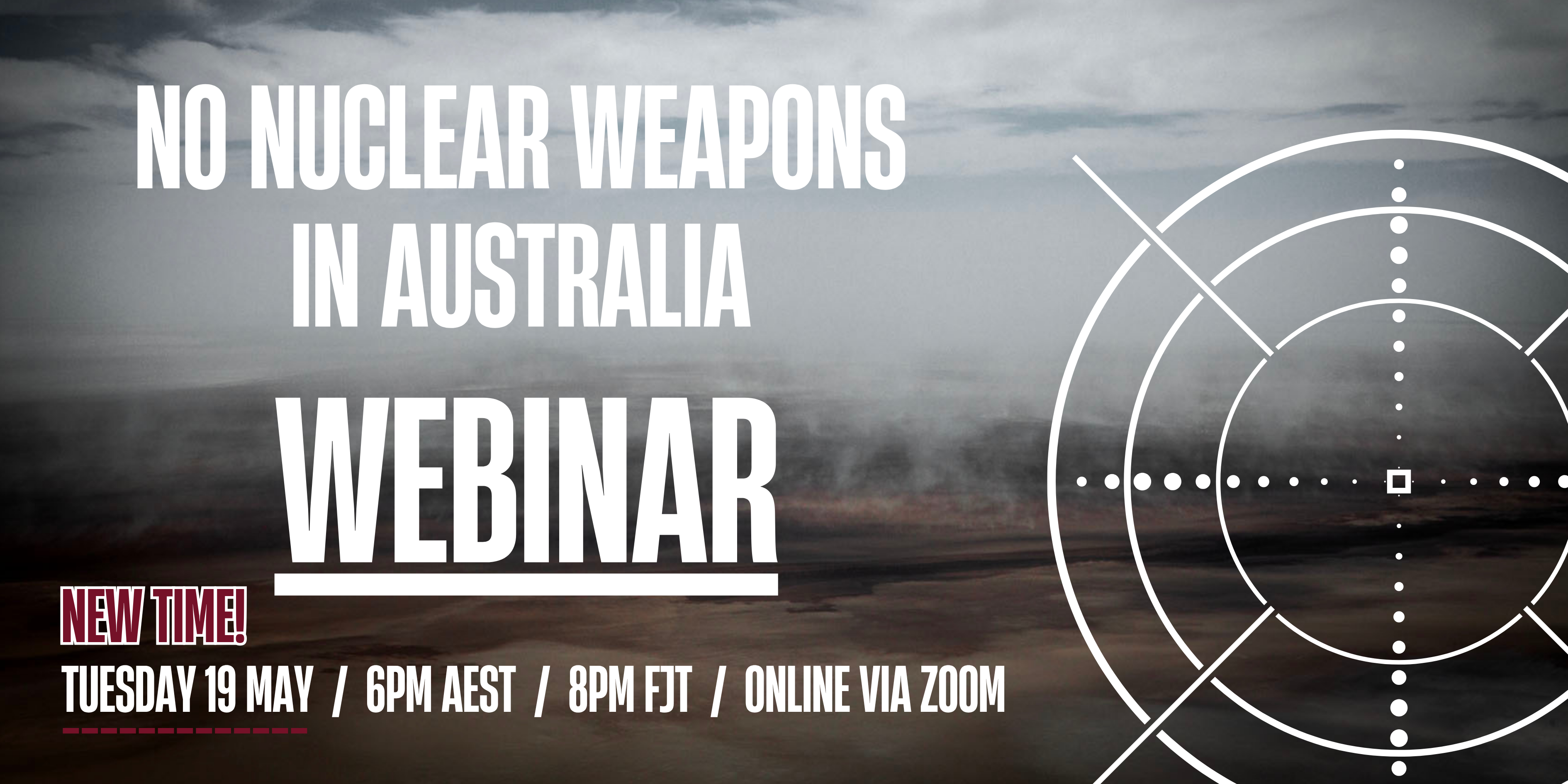
19 May – Webinar- Webinar: No Nuclear Weapons in Australia
Start: 2026-05-19 18:00:00 UTC Canberra, Melbourne, Sydney (GMT+10:00)
End: 2026-05-19 19:30:00 UTC Canberra, Melbourne, Sydney (GMT+10:00)
20 May – Webinar – The dangerous world of AUKUS, US, military occupation and suppression of dissent

National Webinar, 20th May, 2026, 6.30pm AEST. Confronting laws restricting/suppressing protest speech and action
Speakers: Former Sen. Rex Patrick, Lawyer Nick Hanna ,Arthur Rorris ,Jorgen Doyle, Sen David Shoebbridge,
Facilitator Kelley Tranter.

of the week – Australians for War Powers Reform (AWPR)
To see nuclear-related stories in greater depth and intensity
 Antinuclear