Australian Parliament should urgently review the potentially dangerous AUKUS deal
 | |||
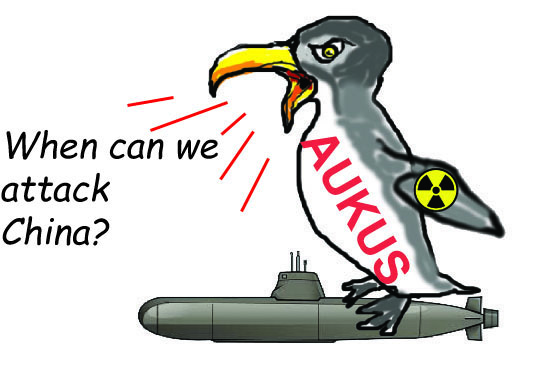
Australian Federal Parliament Should Urgently Review the Potentially Dangerous AUKUS Deal https://worldbeyondwar.org/australian-federal-parliament-should-urgently-review-the-potentially-dangerous-aukus-deal/
By Australians for War Powers Reform, November 17, 2021
On September 15 2021, with no public consultation, Australia entered into a trilateral security arrangement with Britain and the United States, known as the AUKUS Partnership. This is expected to become a Treaty in 2022.
At short notice, Australia cancelled its contract with France to purchase and build 12 submarines on 16 September 2021 and replaced it with an arrangement to buy eight nuclear submarines from either Britain or the United States or both. The first of these submarines is unlikely to be available until 2040 at the earliest, with major uncertainties in relation to cost, delivery schedule and the ability of Australia to support such a capability.
Australians for War Powers Reform sees the public announcement of AUKUS as a smokescreen for other undertakings between Australia and the United States, the details of which are vague but which have major implications for Australia’s security and Independence.
Australia said the United States had requested increased use of Australian defence facilities. The US would like to base more bomber and escort aircraft in the north of Australia, presumably at Tindale. The US wants to increase the number of marines deployed in Darwin, which would see numbers rise to around 6,000. The US wants greater home porting of its vessels in Darwin and Fremantle, including nuclear-powered and armed submarines.
Pine Gap is in the process of significantly expanding its listening and war directing capabilities.
Acquiescing to these requests or demands considerably undermines Australian sovereignty.
The US is likely to want oversight, amounting to control, of northern air space and shipping lanes.
If the US deploys Cold War tactics against China, for that is what this military build-up is all about, it is likely to conduct aggressive flight missions up to the edge of Chinese air space with nuclear armed bombers, just as it did against the USSR. The US will patrol shipping lanes with greater frequency and intensity, knowing it has secure home bases only a short distance away, protected by surface-to-surface and surface-to-air missiles which are soon to be installed.
Any one of these flights or naval patrols could trigger a warlike response directed against Australian and US defence facilities and other assets of strategic value, such as oil, fresh water and infrastructure, or a cyber-attack on Australian communications and infrastructure.
Australia could be at war before most Australian politicians are aware of what is happening. In such an event, Parliament will have no say on going to war nor on the conduct of hostilities. Australia will be on a war footing as soon as these arrangements are in place.
AUKUS will be detrimental to national security. The ADF will lose its capacity to act independently.
Australians for War Power Reform believes these arrangements should not come into force, and that AUKUS should not become a Treaty.
We deplore the lack of consultation with neighbours, friends and allies, particularly relating to the storage and home porting of nuclear weapons and other US arms, ammunition and materiel.
We deplore the hostile profile adopted against our recent friend and major trading partner China.
We deplore the activities of the Australian Strategic Policy Institute (ASPI), funded by foreign arms manufacturers and the US State Department, in blind-siding the Australian people with its advocacy for such a deleterious outcome.
Morrison’s tactless belligerence towards China, while USA moves to mend relationship to China
Morrison didn’t mention China – he didn’t have to, https://www.afr.com/policy/foreign-affairs/morrison-didn-t-mention-china-he-didn-t-have-to-20211117-p599t4
Scott Morrison is selling the broader and immediate technology benefits of the AUKUS deal as he campaigns on national security.Jennifer HewettColumnist he Morrison government’s blueprint for critical technologies is supposed to demonstrate the immediate benefits of much broader research and technology exchange as a result of the AUKUS deal on nuclear submarines.
After all, it’s not just France’s Emmanuel Macron expressing savage criticism about the “fantasy” of the decades-long timetable for Australia’s new submarine strategy to be realised.
So the Prime Minister wants to sell the national security significance of advanced technology co-operation with allies in protecting Australia from urgent, increasing threats in the Indo-Pacific region, including cyber attack.
A first step is $70 million for a quantum commercialisation hub to co-ordinate industry and research in quantum computing and partner with equivalent bodies in “like-minded countries”, starting with a joint co-operation agreement with the US.
“Our trilateral efforts in AUKUS will enhance our joint capabilities and interoperability with an initial focus on cyber capabilities, artificial intelligence, quantum technologies and additional undersea capabilities,” Morrison told the inaugural Sydney Dialogue.
Even though he didn’t specifically name China, Morrison’s primary target might as well have had blinking red lights around it. It wasn’t just that the government partnered for the dialogue with the Australian Strategic Policy Institute, regularly condemned by Beijing for overt antagonism towards China.
Morrison’s repeated references to the importance of trust, shared values and like-minded countries are all supposed to buttress the image of an Australian government in lockstep with other leading democracies against aggression and interference from governments that don’t “see technology the same way”.
“To state the obvious, AUKUS is about much more than nuclear submarines,” he said.
“The simple fact is that nations at the leading edge of technology have greater economic, political and military power. And, in turn, greater capacity to influence the norms and values that will shape technological development in the years to come.”
But the timing of Morrison’s address, right after US President Joe Biden held his virtual summit with China’s Xi Jinping, is an awkward reminder of Australia’s uniquely isolated status in China’s diplomatic deep freeze.
Even the government’s relatively modest $111 million “down payment” on quantum computing as one of nine priority critical technologies demonstrates the limits of Australia’s attempts to harness revolutionary global trends in technology as well as in geopolitics.
China’s leadership is clearly willing to punish Australia’s supposed transgressions with punitive trade measures and a refusal to engage indefinitely. Beijing’s blanket attitude will not soften and may yet harden, especially given the propensity of various government ministers to emphasise Australia’s determination to confront China.
US-China relationship reset
Beijing certainly paid furious attention to recent comments by Defence Minister Peter Dutton, for example, that it would be “inconceivable” for Australia not to support the US in defending Taiwan if the US chose to take that action. So much for the attempt at maintaining deliberate diplomatic nuance with a long-term policy of “strategic ambiguity” on this sensitive topic.
It will become yet another marker making it hard for Australia to retreat on its rhetoric and easy for China to berate with its own. While it is certainly China under Xi that has changed most – and made no friends in the region by doing so – Australia’s challenges to China’s approach can never add up to an argument between economic and power equals.
That’s why most other governments are more cautious in their wording unless their borders or direct interests are threatened.
And now the Biden administration is also keen to at least partially reset its relationship with China after the open hostility of the past few years.
That is despite continuing US ire over China’s behaviour translating into rare bipartisanship in Congress about the need to aggressively counter China as a military and economic threat.
Despite his confidence in the West’s steady decline and China’s inevitable ascendance, Xi also wants to improve the connection with the US.
Unlike its rejection of Australia, China can’t afford to ignore the potential moves and countermoves of another great power. With the erratic Donald Trump no longer in office and Xi seemingly in office for as long as he wants, talks have become more feasible.
The US President declared it to be the responsibility of both leaders to “ensure that the competition between our two countries does not veer into conflict, whether intended or unintended”.
The most obvious flashpoint is Taiwan with the virtual summit not producing any breakthroughs or much evidence of the “commonsense guardrails” that Biden had suggested could help manage tensions.
But beneath the litany of grievances reiterated by both leaders on a range of issues, the three-and-a-half-hour meeting demonstrated a desire to keep lines of communication open and encourage potential co-operation in discreet areas of mutual interest.
That was evident in their agreement on climate change – however vaguely worded – that was unexpectedly announced in Glasgow. After the summit, the two sides have also tentatively agreed to explore the possibility of arms control talks – spurred by China’s rapid acceleration of its nuclear weapons capability.
In contrast to the treatment of Australian journalists, there is also an apparent easing of current restrictions on journalists following China’s expulsion of some US reporters during the Trump Administration.
How much all this will alter the substance as well as the tone of the strategic rivalry and disputes between two great powers asserting themselves in the Indo-Pacific is even less clear.
But for all the talk of trusted partners, the importance of alliances of democracies and the US not “leaving Australia on the field” in terms of China’s economic coercion, the Biden administration will be heavily focused on its own national interest in dealing with China.
Caveat emptor.
”.
Taylor concedes key government policy was never intended to cut emissions — RenewEconomy

Taylor rules out strengthening the Safeguard Mechanism, raising fresh questions around how the Morrison government intends to get to zero net emissions. The post Taylor concedes key government policy was never intended to cut emissions appeared first on RenewEconomy.
Taylor concedes key government policy was never intended to cut emissions — RenewEconomy
Queensland’s biggest coal export terminal goes 100 pct renewable, with certificates — RenewEconomy

Dalrymple Bay Coal Terminal inks deal with CleanCo to offset 100% of its electricity consumption with the purchase of renewable energy certificates. The post Queensland’s biggest coal export terminal goes 100 pct renewable, with certificates appeared first on RenewEconomy.
Queensland’s biggest coal export terminal goes 100 pct renewable, with certificates — RenewEconomy
Queensland outlines plans for 3GW of new renewables, but it’s not nearly enough — RenewEconomy

Early feedback on framework for proposed 3.3GW first-stage build-out of Queensland’s renewable energy zones is that it is too little, and too slow. The post Queensland outlines plans for 3GW of new renewables, but it’s not nearly enough appeared first on RenewEconomy.
Queensland outlines plans for 3GW of new renewables, but it’s not nearly enough — RenewEconomy
Telstra to tap 1GW of batteries and “abundant, dirt cheap clean energy” in big new play — RenewEconomy

Telstra looks to huge battery reserve and machine learning as it outlines plans to steal the march on energy incumbents in a rapidly changing market. The post Telstra to tap 1GW of batteries and “abundant, dirt cheap clean energy” in big new play appeared first on RenewEconomy.
Telstra to tap 1GW of batteries and “abundant, dirt cheap clean energy” in big new play — RenewEconomy
Rooftop solar crunches minimum demand to new lows, despite aircon use in warm weather — RenewEconomy

Rooftop solar and industrial load outages send minimum demand to a new record low in WA’s main grid, despite warm weather and air-con use. The post Rooftop solar crunches minimum demand to new lows, despite aircon use in warm weather appeared first on RenewEconomy.
Rooftop solar crunches minimum demand to new lows, despite aircon use in warm weather — RenewEconomy
Germany’s Chancellor Merkel maintains stand against nuclear power being classified as sustainable

Merkel defends nuclear power exit despite climate challenges, Euro News, By Andreas Rinke, 17 Nov 21,
BERLIN -Chancellor Angela Merkel has defended her decision to phase out nuclear energy, even though it has made it harder for Germany to wean its economy off fossil fuels.
In an interview with Reuters, the outgoing chancellor also said she was opposed to any plans by the European Union to label nuclear power as “sustainable”.
“It’s true, of course, that we now face the very ambitious and challenging task of completing the energy transition while phasing out coal and nuclear power,” said Merkel, who will step down once a new government is sworn in following an election in September.
“But it’s also true that this will be worth it for our country if we do it right.”
Merkel, who has led her country for 16 years, pushed for Germany to abandon nuclear power after the Fukushima disaster in Japan a decade ago, a decision that most Germans agree with……..
RENEWABLES
The share of renewables in the energy mix of Europe’s largest economy has been growing steadily since the Fukushima disaster, though energy economists say it has not risen fast enough to help Germany meet its ambitious emissions targets.
Renewables accounted for 45% of Germany’s energy last year, up from 17% in 2010, data compiled by the Agora Energiewende think-tank showed. The share of electricity generated from coal fell to 23% from 42% a decade ago. Nuclear power was halved to 11%.
The EU executive, the European Commission, is drawing up a sustainable finance “taxonomy” setting out which activities meet the environmental criteria to qualify for funding under an EU sustainable investment programme.
A document viewed by Reuters in March indicated experts were preparing to label nuclear power as sustainable because it has none of the carbon dioxide emissions produced by fossil fuels.
Merkel said Germany would continue to oppose the plan but acknowledged that it would be hard to rally 19 other members behind its position to block it.
“It’s difficult to stall the procedure as such once the European Commission has presented an act,” said Merkel.
“We in Germany believe – across party lines – that nuclear energy should not be classified as being as clean as wind and solar energy.”……… https://www.euronews.com/next/2021/11/17/germany-merkel-nuclear-exclusive
November 17 Energy News — geoharvey

Opinion: ¶ “Nuclear Power Won’t Save the World. It Won’t Even Help” • Putting money into nuclear power goes beyond being a huge waste. It detracts from the vital issue of dealing with climate change now by making money unavailable for dealing with the problem using less expensive, more flexible energy that can be built […]
November 17 Energy News — geoharvey
Australia needs independent Inquiry on nuclear production and wastes. Kimba nuclear dump plan is not supported by facts.
Nuclear waste and nuclear medicine in Australia
Jim Green, Online Opinion, 16 Nov 2021, https://www.onlineopinion.com.au/view.asp?article=21721&page=0
Claims that the Australian government’s proposed national nuclear waste storage and disposal ‘facility‘ near Kimba in South Australia is required to support nuclear medicine are not supported by the facts.
Australia’s radioactive waste arises from the production and use of radioactive materials in scientific research and industrial, agricultural and medical applications. The Australian Nuclear Science and Technology Organisation (ANSTO), operator of the research reactor at Lucas Heights, south of Sydney, is the main source of waste destined for a national nuclear waste facility. (Other waste streams ‒ such as those generated at uranium mines, and wastes from nuclear weapons testing ‒ would not be disposed of at the national facility.)………….
Scare-mongering
Regardless of the outcome of the current push for a national waste facility ‒ and bearing in mind that all previous plans have been abandoned ‒ there will be an ongoing need for hospitals to store clinical waste. After nuclear medicine is used in a patient, the vast majority is stored on site while it decays. Within a few days, it has lost so much radioactivity that it can go to a normal rubbish tip. There will always be multiple waste storage locations even if a national facility is established.
The government’s claim that a national waste facility is urgently required lest nuclear medicine be affected amounts to scare-mongering………….
health professionals noted in a joint statement in 2011: “The production of radioactive isotopes for nuclear medicine comprises a small percentage of the output of research reactors. The majority of the waste that is produced in these facilities occurs regardless of the nuclear medicine isotope production. Linking the need for a centralised radioactive waste storage facility with the production of isotopes for nuclear medicine is misleading.”………..
ANSTO’s Lucas Heights site
ANSTO’s Lucas Heights site cannot be used for disposal of nuclear waste. It is unlikely that the site would meet relevant criteria, and in any case federal legislation prohibits waste disposal there.
But nuclear waste can be (and is) stored at Lucas Heights; indeed much of the waste destined for a national facility is currently stored there.
Claims that storage capacity at Lucas Heights is nearing capacity and that a national waste facility site is urgently needed have been flatly rejected by Dr Carl-Magnus Larsson, CEO of the federal nuclear regulator, the Australian Radiation Protection and Nuclear Safety Agency (ARPANSA). Dr Larsson stated in parliamentary testimony in 2020: “Waste can be safely stored at Lucas Heights for decades to come”.
Similar comments have been made by ANSTO officers, by the federal government department responsible for radioactive waste management, and by the Australian Nuclear Association. ANSTO officers have noted that “ANSTO is capable of handling and storing wastes for long periods of time” and that waste is stored there “safely and securely”.
Long-lived intermediate-level waste
Of particular concern is long-lived intermediate-level waste (ILW) including waste arising from the reprocessing of irradiated nuclear fuel from the OPAL research reactor at Lucas Heights as well as earlier research reactors. The government plans to move this ILW to the Kimba site for above-ground storage while a deep underground disposal site is found. (Lower-level wastes will be permanently disposed of at Kimba if the project proceeds.)
But the process of finding an ILW disposal site has barely begun and will take decades; indeed ARPANSA has flagged a timeline of 100 years or more.
The vast majority of ILW is currently stored at Lucas Heights. Why not leave it at Lucas Heights ‒ described by an ANSTO officer as “the most secure facility we have got in Australia” ‒ until a disposal site is found? The government doesn’t have a good answer to that question ‒ indeed it has no answer at all beyond false claims about storage capacity limitations and scare-mongering about nuclear medicine supply.
Until such time as a disposal site is available, ILW should be stored at Lucas Heights for the following reasons:
* Australia’s nuclear expertise is heavily concentrated at Lucas Heights;
* Storage at Lucas Heights would negate risks associated with transportation over thousands of kilometres;
* Security at Lucas Heights is far more rigorous than is proposed for Kimba (a couple of security guards); and
* Ongoing storage at Lucas Heights avoids unnecessary costs and risks associated with double-handling, i.e. ILW being moved to Kimba only to be moved again to a disposal site.
Conversely, above-ground storage of ILW in regional South Australia increases risk, complexity and cost ‒ for no good reason.
Need for an independent inquiry
The current plan for a waste facility at Kimba should be scrapped. It is unacceptable to be disposing of nuclear waste against the unanimous wishes of Barngarla Traditional Owners, and ILW storage at Kimba makes no sense for the reasons discussed above.
Australia needs a thorough independent inquiry of both nuclear waste disposal and production. We need a long-term disposal plan that avoids double-handling and unnecessary movement of radioactive materials and meets world’s best practice standards.
An inquiry should include an audit of existing waste stockpiles and storage. This could be led by the federal nuclear regulator ARPANSA in consultation with relevant state agencies. This audit would include developing a prioritised program to improve continuing waste storage and handling facilities, and identifying non-recurrent or legacy waste sites and exploring options to retire and decommission these.
An inquiry would also identify and evaluate the full suite of radioactive waste management options. That would include the option of maintaining existing arrangements until suitable disposal options exist for both ILW and lower-level wastes.
Radioisotope production options
We also need to thoroughly investigate medical radioisotope production options with the aim of shifting from heavy reliance on reactor production in favour of cyclotrons (a type of particle accelerator). Among other advantages, cyclotrons produce far less radioactive waste than research reactors…………. https://www.onlineopinion.com.au/view.asp?article=21721&page=0
The consumerism that destroys life is also the cause of the environmental emergency — Hawkins Bay Dispatch — Barbara Crane Navarro

The consumerism that destroys life is also the cause of the environmental emergency, https://hawkinsbay.wordpress.com/2021/11/13/the-consumerism-that-destroys-life-is-also-the-cause-of-the-environmental-emergency/
Decades ago, corporations and governments invented the traits we now call ‘human nature.’ COP26 has shown ‘consumers’ that buying something ‘different’ is not working. 13 November 2021 | Graham Peebles | Euroasia Review The natural environment has been poisoned, vandalized and trashed in accordance with the demands and values of the all-pervasive socio-economic system, and as long as it persists it is impossible to imagine the steps required to save the natural world being taken.
The consumerism that destroys life is also the cause of the environmental emergency — Hawkins Bay Dispatch — Barbara Crane Navarro
greed, ownership of things (homes, cars, clothes etc.), and the general accumulation of stuff is insisted upon, for the simple reason that it is consumerism that feeds the monster. This very same consumerism, which is perpetuating unhappiness and fuelling ill health, is also the underlying cause of the environmental emergency.
As COP26 draws to an unimpressive close, governments haggle over emission targets, funding of fossil fuels and money for the global south, and a new poll reports that most people (in the 10 countries polled, including UK, US, Germany, France) say they are unwilling to alter their way of life to save our planet. We must once again ask, what will it take for humanity to wake up and change?
Economic considerations and short term self-interest will continue to be applied and the devastation will continue.
Continue readingRenewable technology is highly suitable for Australia – compared to the severe wastes problem of nuclear power
Imagine nuclear waste stored at Katandra Reserve https://coastcommunitynews.com.au/central-coast/news/2021/11/imagine-nuclear-waste-stored-at-katandra-reserve/ Col Hodgson, NOVEMBER 15, 2021Forum –There will always be environmental problems with energy generation, transformation, transport and consumption.
Probably the main problem will be energy conversion efficiencies as energy losses from the conversion and transmission systems necessitate larger installations to provide the overall energy requirement of and to the customer.
There is also the problem of disposal of used generating equipment.
Solar panels have a useable life of 20 to 30 years in commercial installations.
They can and are being recycled (aluminium and glass recovery), while panels whose output may have decreased below commercial requirements can still be used at reduced costs in less demanding situations.
Wind turbine blades can last up to 30 years before maintenance replacement.
Research is underway on the production of wind turbine blades that can be recycled (Scientific American November 27, 2020).
This technology may take some years to fully develop.
Hydro systems, both generation and pumped storage, involve the construction of water catchment systems and dams – no need to explain the environmental impact.
Batteries (rechargeable varieties) can and are being recycled.
This leaves the main problem with nuclear energy.
What period of time is required for the safe, radiation free disassembly of a nuclear reactor at the end of its design life?
Spent fuel rods can and are processed to recover the original un-reacted uranium atoms so replacement rods can be manufactured.
However, the separated highly radioactive fission products cannot be recycled to other uses and must be stored in biological isolation until their level of radioactivity has decreased to biologically safe levels.
In some cases this may take tens or even hundreds of thousands of years.
Comments have been made that Australia has an extremely large renewable energy capability with technology already in existence.
Perhaps this is the main reason (CCN317) why decisions have been made for Australia not to start on the nuclear energy path.
Finally, if all the used nuclear waste products from the US, as claimed, can be stored in a volume of 100 x 50 x 10 metres (CCN 316) imagine the storage facility being placed at Katandra reserve, Mount Elliot.
How far would the biological isolation zone extend plus the security extension and for what period of time?
The reserve would be unusable and surrounding acreages would have to be resumed.
America’s relentless pursuit of Australian Julian Assange is a threat to any journalist who might expose a USA massacre of civilians
Julian Assange currently sits in Belmarsh Prison waiting to find out if British judges will overturn a lower court’s ruling against his extradition to the United States to be prosecuted under the Espionage Act for journalistic activity which exposed U.S. war crimes. War crimes not unlike those that were just exposed by The New York Times in its reporting on the Baghuz massacre.
The precedent the U.S. government is trying to set with its persecution of Assange will, if successful, cast a chilling effect over journalism which scrutinizes the U.S. war machine, not just in the United States but around the world.
Syria Massacre Coverup Shows Danger of Assange Precedent, https://consortiumnews.com/2021/11/15/syria-massacre-coverup-shows-danger-of-assange-precedent/ November 15, 2021 The precedent the U.S. government is trying to set with its persecution of Assange will, if successful, cast a chilling effect over journalism which scrutinizes the U.S. war machine, writes Caity Johnstone. By Caitlin Johnstone
CaitlinJohnstone.com The New York Times has published a very solid investigative report on a U.S. military coverup of a 2019 massacre in Baghuz, Syria which killed scores of civilians. This would be the second investigative report on civilian-slaughtering U.S. airstrikes by The New York Times in a matter of weeks, and if I were a more conspiracy-minded person I’d say the paper of record appears to have been infiltrated by journalists.
The report contains many significant revelations, including that the U.S. military has been grossly undercounting the numbers of civilians killed in its airstrikes and lying about it to Congress, that special ops forces in Syria have been consistently ordering airstrikes which kill noncombatants with no accountability by exploiting loopholes to get around rules meant to protect civilians, that units which call in such airstrikes are allowed to do their own assessments grading whether the strikes were justified, that the U.S. war machine attempted to obstruct scrutiny of the massacre “at nearly every step” of the way, and that the Air Force’s Office of Special Investigations only investigates such incidents when there is “potential for high media attention, concern with outcry from local community/government, concern sensitive images may get out.”
“But at nearly every step, the military made moves that concealed the catastrophic strike,” The New York Times reports. “The death toll was downplayed. Reports were delayed, sanitized and classified. United States-led coalition forces bulldozed the blast site. And top leaders were not notified.”
Journalist Aaron Maté has called the incident “one of the U.S. military’s worst massacres and cover-up scandals since My Lai in Vietnam.”
Asked by the Times for a statement, Central Command gave the laughable justification that maybe those dozens of women and children killed in repeated bomb blasts were actually armed enemy combatants:
“This week, after The New York Times sent its findings to U.S. Central Command, which oversaw the air war in Syria, the command acknowledged the strikes for the first time, saying 80 people were killed but the airstrikes were justified. It said the bombs killed 16 fighters and four civilians. As for the other 60 people killed, the statement said it was not clear that they were civilians, in part because women and children in the Islamic State sometimes took up arms.“
I mean, how do you even address a defense like that? How do you get around the “Maybe those babies were ISIS fighters” defense?
Reading the report it becomes apparent how much inertia was thrown on attempts to bring the massacre to light and how easy it would have been for those attempts to succumb to the pressure and just give up, which naturally leads one to wonder how many other such incidents never see the light of day because attempts to expose them are successfully ground to a halt.
The Times says the Baghuz massacre “would rank third on the military’s worst civilian casualty events in Syria if 64 civilian deaths were acknowledged,” but it’s clear that that “acknowledged” bit is doing a lot of heavy lifting there.
And it really makes you appreciate how much work goes into getting information like this in front of the public eye, and how important it is to do so, and how tenuous the ability to do so currently is.
Julian Assange currently sits in Belmarsh Prison waiting to find out if British judges will overturn a lower court’s ruling against his extradition to the United States to be prosecuted under the Espionage Act for journalistic activity which exposed U.S. war crimes. War crimes not unlike those that were just exposed by The New York Times in its reporting on the Baghuz massacre.
The precedent the U.S. government is trying to set with its persecution of Assange will, if successful, cast a chilling effect over journalism which scrutinizes the U.S. war machine, not just in the United States but around the world.
If it can succeed in legally establishing that it can extradite an Australian journalist for publishing information in the public interest about U.S. war crimes, it will have succeeded in legally establishing that it can do that to any journalist anywhere. And you can kiss investigative reporting like this goodbye.
This is what’s at stake in the Assange case. Our right to know what the most deadly elements of the most powerful government on our planet are doing. The fact that the drivers of empire think it is legitimate to deprive us of such information by threatening to imprison anyone who tries to show it to us makes them an enemy of all humanity.
Low dose radiation has its medical benefits, but has harmful effects on the immune system
Low dose ionizing radiation effects on the immune system, Science Direct, Environment International Volume 149, April 2021, 106212KatalinLumniczkya NathalieImpensb GemmaArmengolc SergeCandéiasd Alexandros G.Georgakilase SabineHornhardtf Olga A.Marting FranzRödelh DörtheSchaue
Abstract
Ionizing radiation interacts with the immune system in many ways with a multiplicity that mirrors the complexity of the immune system itself: namely the need to maintain a delicate balance between different compartments, cells and soluble factors that work collectively to protect, maintain, and restore tissue function in the face of severe challenges including radiation damage. The cytotoxic effects of high dose radiation are less relevant after low dose exposure, where subtle quantitative and functional effects predominate that may go unnoticed until late after exposure or after a second challenge reveals or exacerbates the effects.
For example, low doses may permanently alter immune fitness and therefore accelerate immune senescence and pave the way for a wide spectrum of possible pathophysiological events, including early-onset of age-related degenerative disorders and cancer.
By contrast, the so called low dose radiation therapy displays beneficial, anti-inflammatory and pain relieving properties in chronic inflammatory and degenerative diseases
In this review, epidemiological, clinical and experimental data regarding the effects of low-dose radiation on the homeostasis and functional integrity of immune cells will be discussed, as will be the role of immune-mediated mechanisms in the systemic manifestation of localized exposures such as inflammatory reactions.
The central conclusion is that ionizing radiation fundamentally and durably reshapes the immune system. Further, the importance of discovery of immunological pathways for modifying radiation resilience amongst other research directions in this field is implied………….. https://www.sciencedirect.com/science/article/pii/S016041202032167X
Nuclear power company First Energy prosecuted for corruption, but still finds it worthwhile to bribe politicians

It is the largest fine ever imposed by the U.S. Attorney’s Office for the Southern District of Ohio.
But it is a pittance when compared to the earnings it brought in last year: $1.1 billion. For that reason, the company’s stock has a 52-week range of between $26 and its current high of $39 a share.
Paying Bribes Got FirstEnergy In Trouble, But It Is Still Making Political Donations , Forbes, 15 Nov 21,
Has FirstEnergy Corp. learned anything from its nuclear energy scandal and criminal probe? Prosecutors say that if the company fully cooperates then it will drop the charges against it in three years. But the utility is still giving millions to lobby lawmakers — a bit cringeworthy, given the events.
It’s legal. But the company’s chief executive since March, Steven Strah, has said that FirstEnergy FE +1.2% will play a more subtle political role. The protocol now is strict oversight of its lobbying activities — the kind of thing that would avoid, for example, bribing public officials to keep open struggling nuclear plants. For sure, FirstEnergy’s campaign spending is already at $1.5 million this year. That is in line with the contributions it has been making for the last decade.
FirstEnergy is sticking to “the way they did business 50 years ago,“ said Ashley Brown, a former Ohio public utilities commissioner, who now leads the Harvard Electricity Policy Group. “That’s part of why they’re just a lobbying firm with a utility sideline.”
Brown’s comments appeared in a story by Eye on Ohio, which joined with Energy News Network in the endeavor. Eye on Ohio is a division of the Ohio Center for Journalism.
In a deferred prosecution agreement reached over the summer between FirstEnergy and federal prosecutors, the utility admitted that it conspired with and subsequently bribed public officials: $60 million, which was used to secure a $1.3 billion bailout package for its nuclear units and to also help defeat a voter initiative that would have thrown out that law.
The company was penalized $230 million — money to be split equally between the federal and state government. In Ohio, it will be used to help low-income citizens pay their utility bills. It is the largest fine ever imposed by the U.S. Attorney’s Office for the Southern District of Ohio. But it is a pittance when compared to the earnings it brought in last year: $1.1 billion. For that reason, the company’s stock has a 52-week range of between $26 and its current high of $39 a share.
Prosecutors said that they wanted the penalty to “sting” but they did not want to disrupt the company’s business. They filed one charge: conspiracy to commit honest services and wire fraud, which will be dismissed if FirstEnergy continues to cooperate.
“Our activity in this space will be much more limited than it has been in the past, with closer alignment to our strategic goals and with additional oversight and significantly more robust disclosure,” says CEO Strah, before investors. “These efforts, together with enhanced policies and procedures, will help to bring additional clarity around appropriate behaviors at FirstEnergy.”
The bargain between prosecutors and the utility examines how FirstEnergy took monies from its regulated units and then paid off public officials. Former Ohio House Speaker Larry Householder has already been charged. Former Ohio Public Utilities Commission Chairman Sam Randazzo has resigned his position. The power company used a dark money group called Generation Now to hide its efforts. A lobbyist has pleaded guilty along with a staffer for Householder, who set up the shady organization to receive the dirty money.
A New Track
Subsequent to this criminal settlement, Ohio’s Attorney General Dave Yost added FirstEnergy’s former CEO Charles Jones to a list of defendants his office is suing. (Prosecutors would not comment on whether Jones is also in criminal trouble.) The civil complaint also includes ex-FirstEnergy senior vice president Michael Dowling and Sam Randazzo.
The “corruption was more cancerous than previously thought––necessitating adding additional defendants and giving rise to additional claims,” the lawsuit says. Ohio’s legislature, meantime, has revoked the $1.3 billion bailout. …… https://www.forbes.com/sites/kensilverstein/2021/11/15/paying-bribes-got-firstenergy-in-trouble-but-it-is-still-making-political-donations—and-amends/?sh=1e29ece1150a
1 This month.


PETITION – To: Prime Minister Anthony Albanese and the Australian Labor Government
Chernobyl: The Lost Tapes – A good documentary on Chernobyl on SBS available On Demand for the next 3 weeks– https://www.sbs.com.au/ondemand/tv-program/chernobyl-the-lost-tapes/235274195556
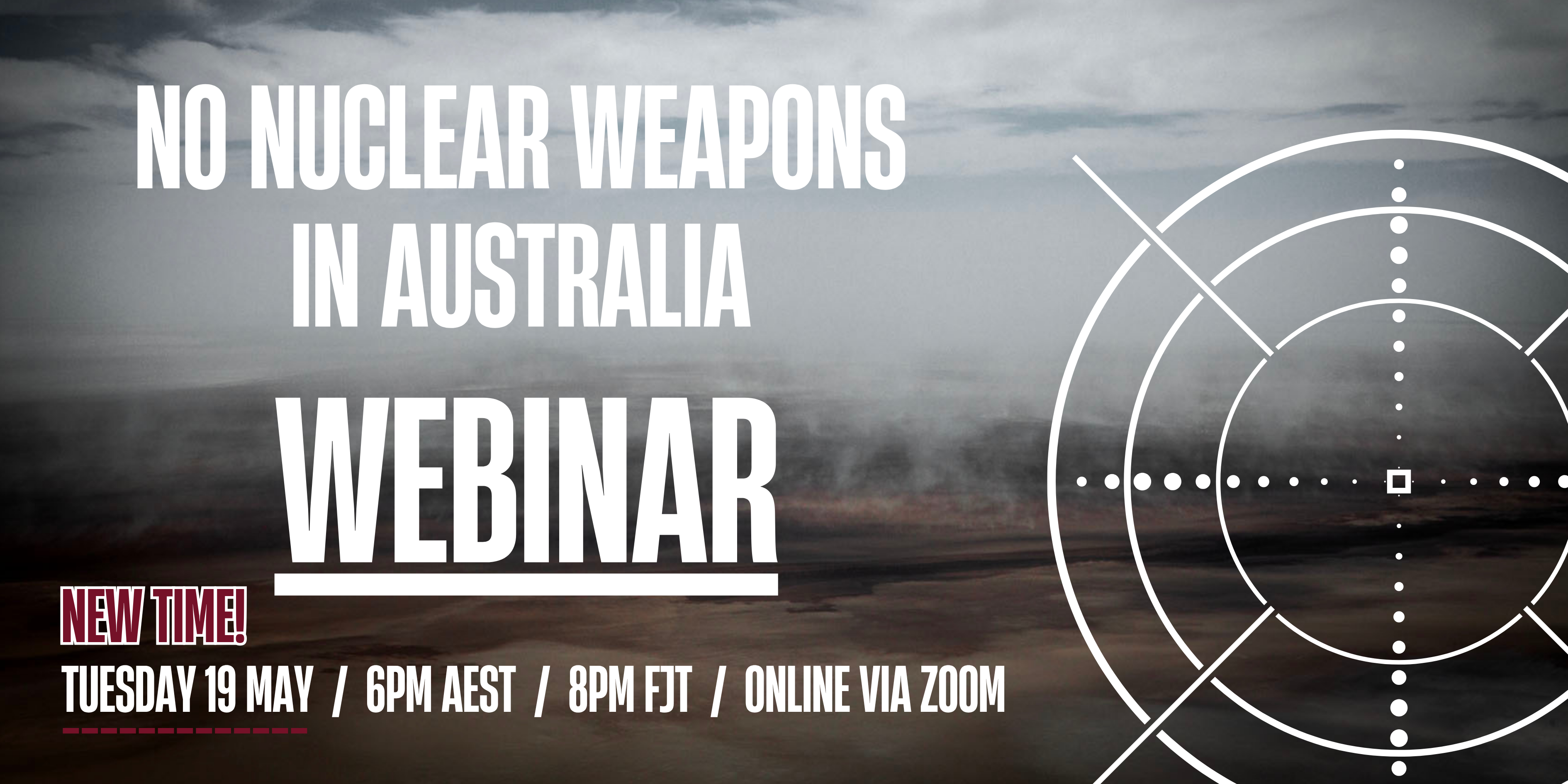
19 May – Webinar- Webinar: No Nuclear Weapons in Australia
Start: 2026-05-19 18:00:00 UTC Canberra, Melbourne, Sydney (GMT+10:00)
End: 2026-05-19 19:30:00 UTC Canberra, Melbourne, Sydney (GMT+10:00)
20 May – Webinar – The dangerous world of AUKUS, US, military occupation and suppression of dissent

National Webinar, 20th May, 2026, 6.30pm AEST. Confronting laws restricting/suppressing protest speech and action
Speakers: Former Sen. Rex Patrick, Lawyer Nick Hanna ,Arthur Rorris ,Jorgen Doyle, Sen David Shoebbridge,
Facilitator Kelley Tranter.

of the week – Australians for War Powers Reform (AWPR)
To see nuclear-related stories in greater depth and intensity
 Antinuclear