ESG – Environmental Social and Governance investing excludes nuclear power
Green finance clarifies nuclear issue, https://www.taipeitimes.com/News/editorials/archives/2021/11/02/2003767157, By Honda Chen 陳鴻達 Translated by Perry Svensson

MSCI, the world’s most reputable compiler of investment indices, generates ESG lists by first excluding firms in the nuclear power, arms, gambling and pornography industries.
The EU Taxonomy excludes nuclear power generation, and nuclear power cannot be used to account for carbon reduction efficiency.
ESG funds exclude companies that generate revenue from nuclear power.
Nuclear power cannot be regarded as green energy, so carbon reduction still requires renewable energy, energy efficiency, or carbon capture and storage technology, Environmental Protection Administration (EPA) Minister Chang Tzi-chin (張子敬) told a question-and-answer session at the Legislative Yuan in Taipei on Thursday.
This is the mainstream view worldwide, and green finance, or ESG — environmental, social and governance — investments, which have surged over the past few years, prohibit investing in nuclear power plant projects.
For example, MSCI, the world’s most reputable compiler of investment indices, generates ESG lists by first excluding firms in the nuclear power, arms, gambling and pornography industries. Only then does it look at whether a firm’s performance indicators meet sustainability requirements. Many funds based on MSCI’s ESG indices do not buy the stocks or bonds of companies in those industries.
Although most power plants in other countries are privately owned, many are publicly traded, but ESG funds exclude companies that generate revenue from nuclear power.
Over the past few years, the EU has been promoting its Green Deal, a transformation of the bloc’s energy sector, and has adopted the EU Taxonomy, a transparency tool that lists economic activities that meet sustainability standards.
Businesses that meet the standards can issue green bonds, which enjoy lower borrowing costs and fewer administrative procedures. Funds that claim to be ESG must disclose how sustainable the companies in their portfolios truly are.
The EU Taxonomy excludes nuclear power generation, and nuclear power cannot be used to account for carbon reduction efficiency.
The EU’s logic is that carbon reduction cannot be achieved to the detriment of other environmental objectives, such as eliminating radioactive waste or safeguarding biodiversity. Sustainable carbon reduction must “do no significant harm” to the environment.
By this logic, nuclear power is a major hazard in Taiwan, a densely populated country situated in an earthquake zone.
The proposed third liquefied natural gas terminal off the coast of Datan Borough (大潭) in Taoyuan’s Guanyin District (觀音) is another example of this.
Infrastructure for the project has been moved farther out to sea, far from the coastline, and the shipping lane is not to be dredged, minimizing damage to an algal reef.
In other words, if the terminal is part of the fight against air pollution, it must comply with the principle of not causing significant harm to other aspects of the environment.
The referendums that are to be held next month have either become highly politicized or distort the issue of nuclear power.
Perhaps the logic behind today’s ESG trend in global finance could help the public to better understand the issue and make more informed decisions.
Honda Chen is an associate research fellow at the Taiwan Academy of Banking and Finance.
Extreme weather events now the new normal – State of the Climate report 2021

Extreme weather events – including powerful heat waves and devastating floods – are now the new normal, says the World Meteorological Organisation. The State of the Climate report for 2021 highlights a world that is “changing before our eyes.” The 20-year temperature average from 2002 is on course to exceed 1C above pre-industrial levels for the first time. And global sea levels rose to a new high in 2021, according to the study. These latest figures for 2021 are being released early by the WMO to coincide with the start of the UN climate conference in Glasgow known as COP26.
BBC 31st Oct 2021
US and UK must stop’: Chinese diplomat warns New Zealand audience of Australia’s nuclear ambitions
US and UK must stop’: Chinese diplomat warns New Zealand audience of Australia’s nuclear ambitions, Stuff, Thomas Manch , Nov 02 2021 A senior Chinese diplomat has warned a New Zealand audience that Australia will not only acquire nuclear-powered submarines in the coming decades, but nuclear weapons.
And it was claimed Australia’s purchase of nuclear-powered submarines would mean “more nuclear arms race … more nuclear tests, and nuclear pollution” in the Pacific.
China’s deputy chief of mission in New Zealand, Wang Genhua, made the claim about Australia’s nuclear ambitions during an event about the new defence pact between Australia, the United Kingdom, and the United States – dubbed AUKUS – on Monday evening.
“Australia is going to own nuclear-powered submarines. It will be almost necessary for them to equip nuclear weapons as the next step. The step just couldn’t be prevented,”
The AUKUS pact, announced in September, has Australia acquiring nuclear-powered submarines from the UK and US in the coming decades, in a bid to counter China’s growing influence in the Asia-Pacific region. The move grates against New Zealand’s anti-nuclear stance.
China, which has expanded its footprint into the contested waters of the South China Sea, was quick to condemn the AUKUS pact as irresponsible, “Cold War zero-sum mentality” that would undermine peace in the region.
The comments from Wang come as the fallout from AUKUS continues, with French President Emmanuel Macron accusing Australia’s Scott Morrison of lying about the deal.
Morrison, along with US and UK leaders, have insisted the nuclear-powered submarines Australia intended to acquire in the coming decades would only be equipped with conventional (non-nuclear) weapons, and the countries’ nuclear proliferation obligations will be met………… https://www.stuff.co.nz/national/politics/126854210/us-and-uk-must-stop-chinese-diplomat-warns-new-zealand-audience-of-australias-nuclear-ambitions
UK Astute class nuclear submarine visits Perth
British nuclear-powered sub visits Perth
1 November 2021
A Royal Navy nuclear-powered submarine has conducted a port visit to Perth, one of the first since the announcement of AUKUS in September.
The Astute class submarine went alongside HMAS Stirling in Rockingham, WA on Friday.
The submarine has been part of the UK Carrier Strike Group deployment to the Indo-Pacific which had recently exercised with a range of RAN units alongside numerous engagements with regional partners……………. https://www.australiandefence.com.au/news/british-nuclear-powered-sub-visits-perth
Solar and wind keep getting cheaper, and crush coal, gas and nuclear on costs: Lazard — RenewEconomy

Latest LCOE report from Lazard confirms that wind and solar by far the cheapest of all energy sources, and cost of storage is falling too. The post Solar and wind keep getting cheaper, and crush coal, gas and nuclear on costs: Lazard appeared first on RenewEconomy.
Solar and wind keep getting cheaper, and crush coal, gas and nuclear on costs: Lazard — RenewEconomy Giles Parkinson & Sophie Vorrath 1 November 2021 [GOOD GRAPHS]
As world leaders meet in Glasgow for critical climate talks, they have been given a stark reminder of the lowest cost alternatives to achieve the full decarbonised grid that science says is required of major economies by the middle of next decade, at the latest.
Investment bank Lazard has released the 15th edition of its highly regarded Levelised Cost of Energy Analysis and it reinforces what is pretty much already known: Wind and solar are by far the cheapest forms of electricity generation, storage costs are falling, and now hydrogen is part of the equation.
The best illustration of the cost difference between the various technologies is this following table, which shows the various energy supply sources and their sensitivity to the cost of capital.
All technologies are affected in some way, but wind and solar, which are easily the cheapest form of generation, actually increase their advantage as the cost of capital increases. In all cases, they are five times cheaper than nuclear. Even storage and network costs don’t come close to making up the difference…………………………….. https://reneweconomy.com.au/solar-and-wind-keep-getting-cheaper-and-crush-coal-gas-and-nuclear-on-costs-lazard/—
A supporter of nuclear power has second thoughts
Can Nuclear Power Stay Relevant in a World Filled with Renewables? https://www.powermag.com/can-nuclear-power-stay-relevant-in-a-world-filled-with-renewables/ by Aaron Larson —Aaron Larson is POWER’s executive editor. 1 Nov 21, I have long been a supporter of nuclear power. I’ll admit I’m biased, having spent 13 years in the U.S. Navy’s nuclear power program and having worked for several more years in the commercial nuclear industry at the Quad Cities station. Even so, when I step back and look critically at nuclear technology, I find it to be a sound form of power generation.
I’m obviously not the only person who believes in it. Several advocacy groups tout the benefits nuclear reactors provide. The Nuclear Innovation Alliance, for example, says the world needs the “economic, flexible, secure, zero-carbon energy” that nuclear power offers, suggesting it can be scaled up “rapidly to expand energy access while halting climate change.” The truth is, however, many nuclear plants are not so “economic” and few things happen “rapidly” in the nuclear industry
Financial Challenges and Construction Delays

It’s no secret that nuclear power plants have been struggling in competitive markets. Until recently, Exelon, which operates the largest fleet of commercial reactors in the U.S. (including the plant I previously worked at), was on the verge of retiring its Byron and Dresden facilities because they were “uneconomic.”
The company claimed that “despite being among the most efficient and reliable units in the nation’s nuclear fleet,” Byron and Dresden faced “revenue shortfalls in the hundreds of millions of dollars because of declining energy prices and market rules that allow fossil fuel plants to underbid clean resources in the PJM capacity auction.”
Byron and Dresden were ultimately saved when legislation was passed by Illinois lawmakers in September. The state’s new energy bill will reportedly give Exelon $694 million in incentives to keep the plants open. Similar subsidies have been necessary to keep nuclear plants viable elsewhere, including in Ohio and New York.
When it comes to speed of deployment, there are countless examples of delayed nuclear power projects all over the world. For my purposes, I’ll focus on the only project currently in progress in the U.S., that is, the Vogtle expansion in Georgia. Southern Nuclear (a subsidiary of Southern Company) filed for an early site permit application for Vogtle Units 3 and 4 in August 2006. The Georgia Public Service Commission approved construction of the two AP1000 reactors in March 2009. Southern Company notified The Shaw Group and Westinghouse Electric Co. to proceed fully on their engineering, procurement, and construction contract in mid-April 2009.

Original plans called for Vogtle Unit 3 to be operational in 2016 and Unit 4 to enter service in 2017, but that didn’t happen. The project has had countless delays, and costs have ballooned. In a July 29-issued press release, Georgia Power, the Southern Company subsidiary that will own 45.7% of the two new units along with Oglethorpe Power Corp. (30%), Municipal Electric Authority of Georgia (22.7%), and Dalton Utilities (1.6%), said it was projecting a Unit 3 in-service date in the second quarter of 2022 and a Unit 4 in-service date in the first quarter of 2023, but even that timeline may be optimistic. In Oglethorpe’s investor briefing issued on Aug. 26, the company said its revised budget “assumes in-service dates of June 2022 and June 2023 for Unit 3 and Unit 4, respectively.”
And speaking of budgets, Georgia Power’s capital cost forecast for the project was also revised in July, pegging its share of the project at $9.2 billion. If you do the math, that works out to more than $20.1 billion in total project costs, which is 40% higher than the $14.3 billion projected in August 2008.
Progress on SMRs Has Been Equally Slow
Some nuclear power proponents feel small modular reactors (SMRs) could provide a boost to the industry. The concept has been around for decades. I remember hearing about pebble-bed small modular reactors when I was still in the Navy back in the 1990s. The idea of building moduals in a factory-type setting and shipping them to a site for final assembly seems forward-thinking. The process could be more like an assembly line, saving time and money.
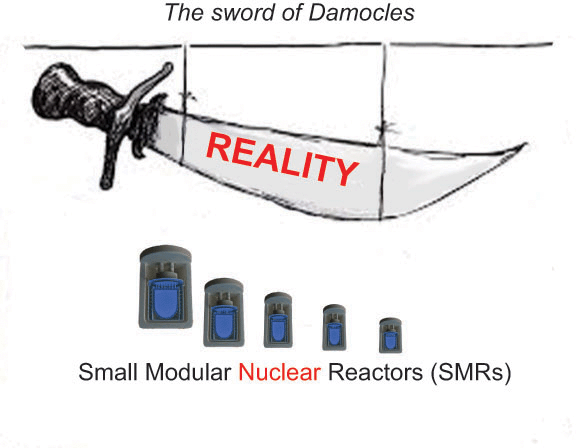
Yet, for all the hype, we still haven’t seen an SMR approved and constructed in the U.S. NuScale Power is perhaps the furthest along in the process. so I’ll focus on what it has accomplished.
POWER has been reporting on NuScale’s design since at least early 2013. The company began developing its reactor in 2000 under a Department of Energy–funded research program, and began pre-application discussions with the Nuclear Regulatory Commission (NRC) in 2008. It took until September 2020 for the NRC to finally issue a Standard Design Approval for the NuScale SMR.
While NuScale has signed several agreements with companies and countries interested in exploring SMR deployment, no one has signed on the dotted line to build one. Furthermore, it’s highly debatable whether SMR costs will be competitive with other available clean-energy options.
Insurmountable Obstacles?
A grim picture was painted for the future of nuclear power during a media event on Sept. 29 to roll out the “World Nuclear Industry Status Report 2021,” a Mycle Schneider Consulting project that provides an overview of nuclear power plant data including information on operation, production, and construction. One of the takeaways from the presentation was: “Nuclear is irrelevant in today’s electricity capacity newbuild market.”
I asked the eight-member panel of presenters if the tide could be turned. M.V. Ramana, a professor at the University of British Columbia and a contributor to the report, told me in a direct message, “I don’t think this tide can turn. These problems are structural.” I hope he’s wrong, because I believe the world needs nuclear power to be a relevant piece of a carbon-free future.
Positive developments: rise in electric cars, ever cheaper renewables, moves towards energy efficiency

| The climate emergency is the biggest threat to civilisation we have ever faced. But there is good news: we already have every tool we need to beat it. The challenge is not identifying the solutions, but rolling them out with great speed. Some key sectors are already racing ahead, such as electric cars. They are already cheaper to own and run in many places – and when the purchase prices equal those of fossil-fueled vehicles in the next few years, a runaway tipping point will be reached. Electricity from renewables is now the cheapest form of power in most places, sometimes even cheaper than continuing to run existing coal plants. There’s a long way to go to meet the world’s huge energy demand, but the plummeting costs of batteries and other storage technologies bodes well. And many big companiesmare realising that a failure to invest will be far more expensive as the impacts of global heating destroy economies. Even some of the biggest polluters, such as cement and steel, have seen the green writing on the wall. Buildings are big emitters but the solution – improved energy efficiency – is simple to achieve and saves the occupants money, particularly with the cost of installing technology such as heat pumps expected to fall. Guardian 31st Oct 2021 https://www.theguardian.com/environment/2021/oct/31/reasons-to-be-hopeful-the-climate-solutions-available-no |
New Study: Electricity would already be Cheaper today with a Full Supplyof 100% Renewables.
**Germany – renewables**
New Study: Electricity would already be Cheaper today with a Full Supply
of 100% Renewables. New short study by the Energy Watch Group (EWG) finds:
Electricity would already be cheaper today with a full supply of 100%
renewables.
In the coalition negotiations for the new German government,
both ambitious climate protection and the reduction of electricity prices
play a central role. The previous government still expects only 45%
renewables in the electricity mix by 2025.
A new short study by the Energy
Watch Group offers an answer to the rising energy costs: The study
calculates that a full supply with 100% renewables would already be
economically competitive today compared to the current energy system based
on coal, natural gas and nuclear. By 2025 at the latest, an energy system
based on 100% renewables would then be significantly cheaper than power
generation with fossil fuels.
Sonnenseite 28th Oct 2021
US military blazes trail for 100 per cent renewable energy economy
| US military blazes trail for 100 per cent renewable energy economy with carbon neutral synthetic fuel. Carbon neutral synthetic fuel whose production is powered by renewable energy is a practical way of long-term storage of renewable energy. But it is no surprise that the big energy corporations with their fossil fuel and nuclear power interests don’t advise Governments to support this – but when it can help the US military, well, it’s just chocks away chaps! The irony is that this system was researched in the UK only a few years ago at a pilot stage, and then – you’ve guessed it – completely ignored by the UK Government in favour of kooky ideas like small nuclear reactors and blue hydrogen – not to mention large nuclear power plant that take forever to be built incredible cost! 100% Renewables 31st Oct 2021 https://100percentrenewableuk.org/us-military-blazes-trail-for-100-per-cent-renewable-energy-economy-with-carbon-neutral-synthetic-fuel |
Portugal’s success in cutting greenhouse emissions through its offshore floating wind and solar plants
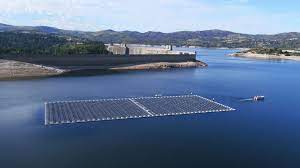
Portugal is the EU country that has been most successful at cutting
greenhouse gas emissions since 2005, partly through the use of floating
wind and solar plants located off its coast. Today, 65 percent of all the
electricity consumed in Portugal comes from renewable sources.
France24 30th Oct 2021
“The Australian way:” Morrison exposes Australia as climate laggard on world stage — RenewEconomy

Morrison took his climate plan to Glasgow and the world has seen it as a hollow gesture, with Fiji offering its own blueprint for Australia to follow. The post “The Australian way:” Morrison exposes Australia as climate laggard on world stage appeared first on RenewEconomy.
“The Australian way:” Morrison exposes Australia as climate laggard on world stage — RenewEconomy
Rooftop solar squashes grid demand to records lows in two states — RenewEconomy

Rooftop solar pushes minimum operational demand down to record lows in two states, and reaches 87 per cent of supply in South Australia. The post Rooftop solar squashes grid demand to records lows in two states appeared first on RenewEconomy.
Rooftop solar squashes grid demand to records lows in two states — RenewEconomy
Glasgow Diary: Australia named a ‘fossil of the day’ on first day of COP26 — RenewEconomy

Australia named ‘fossil of the day’, Boris Johnson compares climate change to ‘James Bond style doomsday device’ and Biden apologises for actions of Trump administration. The post Glasgow Diary: Australia named a ‘fossil of the day’ on first day of COP26 appeared first on RenewEconomy.
Glasgow Diary: Australia named a ‘fossil of the day’ on first day of COP26 — RenewEconomy
Australia now has nearly 1kW of solar per capita after smashing year of rooftop installs — RenewEconomy

Australia now has nearly 1kW of solar installed for every person in the country, thanks to a record year of rooftop installations. The post Australia now has nearly 1kW of solar per capita after smashing year of rooftop installs appeared first on RenewEconomy.
Australia now has nearly 1kW of solar per capita after smashing year of rooftop installs — RenewEconomy
Morrison fumbles in Rome, but his main game is to block progress at Glasgow — RenewEconomy

Morrison’s mishandling of major international relationships has come back to bite the PM, as Australia isolated on the eve of COP26. The post Morrison fumbles in Rome, but his main game is to block progress at Glasgow appeared first on RenewEconomy.
Morrison fumbles in Rome, but his main game is to block progress at Glasgow — RenewEconomy
1 This month.


PETITION – To: Prime Minister Anthony Albanese and the Australian Labor Government
Chernobyl: The Lost Tapes – A good documentary on Chernobyl on SBS available On Demand for the next 3 weeks– https://www.sbs.com.au/ondemand/tv-program/chernobyl-the-lost-tapes/235274195556

19 May – Webinar- Webinar: No Nuclear Weapons in Australia
Start: 2026-05-19 18:00:00 UTC Canberra, Melbourne, Sydney (GMT+10:00)
End: 2026-05-19 19:30:00 UTC Canberra, Melbourne, Sydney (GMT+10:00)
20 May – Webinar – The dangerous world of AUKUS, US, military occupation and suppression of dissent

National Webinar, 20th May, 2026, 6.30pm AEST. Confronting laws restricting/suppressing protest speech and action
Speakers: Former Sen. Rex Patrick, Lawyer Nick Hanna ,Arthur Rorris ,Jorgen Doyle, Sen David Shoebbridge,
Facilitator Kelley Tranter.

of the week – Australians for War Powers Reform (AWPR)
To see nuclear-related stories in greater depth and intensity
 Antinuclear