Poisoning the well – The toxic legacy of Cold War uranium mining in western New Mexico

Studies have shown that chronic exposure to uranium through drinking water can cause kidney damage and cardiovascular disease. When inhaled, uranium can lead to lung cancer and pulmonary fibrosis, a scarring of the lung tissue. Studies of uranium miners associate cumulative exposure to radon with higher rates of death by lung cancer.
Proving that one’s illness originated as a result of living near a mine or mill, as opposed to actually working in it, is nearly impossible, given that symptoms can take years to manifest — a lack of clear causation that is ultimately advantageous to polluters.
Near the western New Mexico town of Grants, the toxic legacy of Cold War uranium mining and milling has shattered lives, destroyed homes and created a contamination threat to the last clean source of groundwater for an entire region
SEARCHLIGHT NEW MEXICO, by Alicia Inez Guzmán, March 13, 2025 [ excellent pictures and maps]
Driving along a stretch of New Mexico Highway 605, just north of the tiny Village of Milan, it’s easy to imagine that this area has always been no-man’s-land. Little appears in the distance except for a smattering of homes and trees peppered by expanses of bone-dry scrub brush. But a hard second look reveals something else — vestiges of a mass departure. Sidewalks lead to nowhere, a dog house sits in the middle of a field next to a mound of cinder blocks, phone lines crisscross empty stretches of land and deserted propane tanks and mailboxes sit perched in front of nothing. Around the bend on one unpaved side road, a neighborhood watch sign stands sentinel where a neighborhood no longer exists…………………………………………………………………………………………………………………
This home site was once part of a cluster of five rural subdivisions interspersed with rich farm and ranchland. The Homestake Mining Company — famously known for gold mining in the Black Hills of South Dakota — took up residence here in 1958, to mill uranium. From that year until 1990, millions of tons of ore were prised from nearby mines and processed at Homestake, where the ore was ground into fine particles and leached with a solution that coaxed out pure uranium oxide, often called “yellowcake.” That uranium was then shipped off to help make America’s Cold War fleet of nuclear weapons or to power nuclear reactors. The leftover slurry was piped into two unlined earthen pits, the largest the size of 50 football fields and filled with over 21 million tons of uranium mill tailings.
Over time, the uranium tailings decayed into radon gas; meanwhile, radioactive contaminants seeped into four of the region’s aquifers. Residents compiled a list of neighbors who died of cancer — they called it the Death Map. In 2014, the U.S. Environmental Protection Agency (EPA) predicted that the probability of developing cancer was notably higher for residents who lived closest to the mill, especially if they drank the water.
In the intervening decades, Homestake attempted to hold its remaining contamination at bay rather than offer a long-term solution. That changed in 2020, when the company declared that a full cleanup of the groundwater was not feasible and instead embarked on a mass buyout and demolition of homes inside the rural subdivisions and beyond, Boomer and Billiman’s included. Homestake’s goal, ultimately, is to hand over 6,100 acres of land — almost twice the size of nearby Milan — to the U.S. Department of Energy (DOE) as part of a special federal program that takes over shuttered nuclear outfits when industry walks away. The deadline is 2035. And if this site is anything like the majority of the DOE’s other sites, the land will be rendered inaccessible to the public, with the company’s guarantee that toxins will stay inside the massive contamination zone boundary for a thousand years.
“Talk about the myth of containment,” says Christine Lowery, a commissioner in Cibola County. “The myth of reclamation as well,” she adds. For Lowery, a member of the Pueblo of Laguna who lives in Paguate, one of its six villages — itself blighted by the Jackpile-Paguate Uranium Mine, one of the world’s largest open pit uranium mines — the subtext is clear. “What they should be saying is, ‘We’ve contaminated everything we can, and there’s no way we can fix it.’”
In fact, the conditions necessary for contaminants to infiltrate a fifth aquifer in a single generation — not a thousand years — could already be in the making. The aquifer in question is the San Andres-Glorieta, so ancient that its limestone was forged from the same material as seashells before the era of the dinosaurs. It’s also the last clean source of groundwater for Milan, the county seat of Grants, many private well owners and the Pueblo of Laguna, as well as the Pueblo of Acoma, one of the longest continually inhabited communities in the United States.
According to regulators, the San Andres-Glorieta still meets standards for groundwater that is safe to use and drink. According to Homestake’s own reports, however, at least three uranium plumes are converging toward what Ann Maest, an aqueous geochemist with Buka Environmental, a Colorado-based firm, calls “a bull’s-eye of radioactive contamination.” The potential target? A geological formation called a subcrop. Here, approximately 100 feet below the surface of the earth and three miles southwest of the Homestake site, this subcrop directly connects the San Andres-Glorieta with an overlying aquifer long known to transport contamination from two uranium mills including Homestake. In 2022, the company commissioned an independent firm to study the geological feature. But according to a memo sent to state and federal regulators and written by Maest the following year, the findings were “light on interpretation” and evaded answering the most important question of all: Have those contaminants reached the San Andres-Glorieta?………………………
Gauging the extent of groundwater plumes is notoriously difficult. Topography and geology shape how groundwater moves, and sampling can underestimate the full range of a plume, leaving gaps in the data, whether that’s inadvertent or intentional. A 2022 ProPublica investigation found that regulators had been lax in their oversight of the Homestake mill, its toxic footprint and the uranium industry as a whole. Over time, a dizzying array of state and federal agencies have each overseen a different aspect of the site’s reclamation; in the past, those agencies haven’t even agreed on what that reclamation should look like.
Now, as uranium mining undergoes a national revival under initiatives that favor carbon-free nuclear energy, waste from the previous Cold War era of mining and milling endures. Homestake’s remediation — which has gone on for 49 years — exemplifies this legacy. During that time, company reports say, its collection wells have pumped out billions of gallons of contaminated water. Nearly one million pounds of uranium have been removed from the groundwater, too. Bingham says this represents 85 percent of the total uranium that was released into the environment. That’s in addition to the removal of tens of thousands of pounds of selenium and over a million pounds of molybdenum.
The company has attempted to keep pollutants that have seeped into groundwater from migrating farther away from the source. But this so-called hydraulic barrier has only addressed the symptoms of the contamination, not the cause: the tailings piles, which the company declined to relocate into a lined repository nearby. That means that some groundwater contamination continues to spread beyond Homestake’s site. The hydraulic barrier has another drawback — it has used “a massive amount of freshwater from the San Andres-Glorieta aquifer to operate,” says Laura Watchempino, a member of the Multicultural Alliance for a Safe Environment (MASE), a grassroots network of uranium-impacted communities working collectively to address the legacy of mining and milling on the health and environment of future generations. Watchempino is a former lawyer who also worked as a water quality specialist for the Pueblo of Acoma………………………………………………………………………………..
………………………………………………………………….Carver estimates that he is one of around 30 holdouts left in the five subdivisions; four of the families live in his own, Murray Acres. But few others have spent so much time fighting to hold the company accountable. “I’m 85 and it all started when I was 40,” he says.
In 1983, he was one of the plaintiffs in a lawsuit filed against the company, which argued, among other claims, that contamination of the well water had “completely destroyed the market value of the plaintiffs’ properties.” As part of the settlement, the company made small cash payments to residents and hooked them up to the municipal water system, which drew from the last clean source of water in the region, the San Andres-Glorieta. That year, the mill was designated a Superfund site, and in 1987 the company entered into a consent order with the EPA to analyze radon levels in residents’ homes, the product of uranium decaying from the tailings piles.
The mill closed in 1990, less than a decade after the uranium industry went bust. Records from the county assessor’s office show that Homestake quietly began buying a handful of homes in adjacent neighborhoods as early as 1996. (In 2001, Homestake Mining merged with the Canadian juggernaut, Barrick Gold, one of the world’s largest gold mining companies.)
“Every time someone dies or decides to move away, Homestake-Barrick Gold buys the property at a greatly reduced cost, which they can do because their ineffective groundwater remediation has devalued property many of us worked lifetimes to build,” Candace Head-Dylla, a former resident, said in a 2017 letter to the NRC.
In 2020, the company argued that it was no longer technically practical to clean up the groundwater to match its pre-mill days, Bingham wrote. So began the tangled regulatory process of applying for a less-stringent cleanup standard through the NR……………………………………
Searchlight asked the DOE for comment, but the agency declined. According to Samah Shaiq, a former DOE spokesperson, the agency is not yet responsible for the site.
The NRC denied Homestake’s application for the lower standard — the basis of the buyout — but the company remains steadfast in its desire to walk away. As part of those plans, Homestake has already scooped up approximately 455 of the estimated 523 properties that sit inside its proposed boundary, an expanse that’s nearly as large as the most contaminated area of the Rocky Flats Plant, another of the more than 100 sites under the DOE’s perpetual care, where thousands of plutonium bomb cores for the nation’s nuclear arsenal were fabricated between 1952 and 1989.
Much of Milan, along with huge swaths of land west and north, including some five miles of Highway 605, sit within this massive pie-shaped chunk, a proposed boundary that is based on the company’s groundwater modeling data. Inside are public water and electric lines, groundwater wells, septic systems and other, smaller roads, the fate of which have yet to be determined. Milan Elementary School sits only a mile away from the boundary’s southernmost rim.
When Searchlight asked how fast those plumes are migrating, drawing on a Homestake-produced simulation that’s meant to predict how contaminants move in groundwater aquifers at the site, the EPA declined to comment, because the simulation was still in draft form.
Regulators, meanwhile, are plodding through the process of determining what final act of remediation they should require before allowing Homestake to hand off the site to the DOE. But prospects for that remedy depend on whether and when the company will receive a lower cleanup threshold. If a lower standard is settled on, that remedy, whatever it may be, will fall radically short of truly protecting groundwater, advocates believe. Adding to the uncertainty is a recent announcement that the Trump administration intends to cut personnel at the EPA by up to 65 percent.
The future of the site seems all but predetermined: a wasteland in the truest sense, and a national sacrifice zone. The buyout, a prologue to this future, has fractured residents’ lives in the present. Homestake subjected sellers to nondisclosure agreements — “standard business practice,” in Bingham’s words — but to some in the community, a mechanism for silencing dissent……………………………………………………………………………………………………………………………………………
“We’ve been poisoned to the gills”
The Grants Mining District stretches from the Pueblo of Laguna to Gallup, across almost 100 miles of western New Mexico’s red bluffs. Uranium here and throughout the world is ancient even by cosmic standards………………………………………………………
…………………………..in time, more than 150 mines would be developed across this district and the greater San Mateo Creek Basin, and, today, there are a total of 261 former uranium mines statewide, making New Mexico the fourth-largest producer of uranium globally, behind East Germany, the Athabasca Basin and the Democratic Republic of the Congo, which supplied much of the uranium for the Manhattan Project.
But with the uranium boom came a wave of devastation across the greater Southwest, including in Indigenous communities like the Pueblo of Laguna, as well as the Navajo Nation, where there are more than 500 abandoned uranium mines. Workers often lived near mines and mills and would bring yellowcake home on their clothes, exposing their families to harmful radioactive dust; water sources, meanwhile, have shown “elevated levels of radiation,” according to the EPA.
In the Church Rock Chapter of the Navajo Nation, a tailings dam breached on an early July morning in 1979, sending contaminated water into the Rio Puerco. Today, it constitutes the largest release of nuclear materials in the U.S. worse even than the meltdown at Three Mile Island.
Church Rock was among the eight mills that processed uranium ore in New Mexico. Others include Homestake and, in its immediate vicinity, Bluewater and two mills at Ambrosia Lake. Workers flocked here from across the state and nation during the booming 1960s and 1970s, with Homestake alone employing 1,500 people at its peak.
After graduating from high school and intermittently through his college years, Carver worked stints at all four of those mills before opening his own business, Carver Oil. At Homestake, he worked at a site where yellowcake was processed and packaged into barrels to go to Oak Ridge, Tennessee, where it would be enriched for use in nuclear weapons. He also worked in the tailings piles.
Carver now receives benefits for spots on his lungs from the Radiation Exposure Compensation Act (RECA), a program he qualified for because of his time working in the mills. Whether his illness was compounded by living near the mill tailings and by breathing excess radon, or by drinking the water — at least until the company connected residents to a clean source — is unknown. Studies have shown that chronic exposure to uranium through drinking water can cause kidney damage and cardiovascular disease. When inhaled, uranium can lead to lung cancer and pulmonary fibrosis, a scarring of the lung tissue. Studies of uranium miners associate cumulative exposure to radon with higher rates of death by lung cancer.
Maggie Billiman, who’s from the Sawmill Chapter of the Navajo Nation, has advocated for RECA to cover people in New Mexico and parts of Arizona who lived downwind of atmospheric nuclear tests or who worked in mines after 1971, the current cutoff date. Last fall, she traveled with other Indigenous activists to Washington, D.C., as part of her efforts to expand RECA after struggling with various undiagnosed illnesses for years; several painful cysts that have yet to be biopsied were recently found on her liver and pancreas. Many doctor visits later, she’s still pursuing a clear diagnosis and treatment plan.
But whether or how one gets sick can depend on biological sex, age when exposed and the pathway a certain type of radioactive particle takes to enter the body. Proving that one’s illness originated as a result of living near a mine or mill, as opposed to actually working in it, is nearly impossible, given that symptoms can take years to manifest — a lack of clear causation that is ultimately advantageous to polluters.
Groundwater contamination from uranium mining was detected as early as 1961. Even before that, the federal government was aware that New Mexico’s waterways were already showing signs of radioactive contamination from the burgeoning uranium extraction industry. It would take another 15 years for Homestake to begin a convoluted, if limited, remediation effort: A series of collection wells would pull contaminated water out and treat it, then pump that water, along with clean water sourced from the San Andres-Glorieta, back into the subsurface.
………………………………………………………………………………………………………………………….. It’s hard to visualize such an underground fortification — on maps, it looks like a cashew-shaped moat that wraps around the west and south sides of the large tailings pile — or the timescale needed for its maintenance. In 1982, Homestake said it would “require operation for a considerable amount of time.” In response, NMED declared that Homestake had to commit to operating the system until it “can be demonstrated that contaminants in the groundwater will not exceed New Mexico Water Quality Control Commission standards off Homestake’s property in the foreseeable future.”
Advocates believe that means forever. If barrier maintenance is stopped, experts contend that highly contaminated groundwater will migrate southward and downward and eventually make its way to the subcrop, an entry point into the San Andres-Glorieta, municipal supply wells for Milan and Grants and eventually the Río San José. “This signals a bleak future for the stream system and for future generations,” Laura Watchempino warns.
Bluewater’s plume is coming from the northwest; Homestake’s plumes from the northeast. Models show that all are converging, like a Venn diagram, in a location where groundwater flows toward the subcrop. On one side, the hydraulic barrier is warding off some of that pollution, but when it stops operation completely, those contaminants will very likely infiltrate the San Andres-Glorieta, according to NMED.
In the past, it’s been difficult to discern what contaminants belong to what polluter, especially when they mingle, as is the case here. But in 2019, the USGS published the findings of a study that “fingerprinted” such mine and mill contaminants to show their point of origin……………………….
…………………………………….. “We’ve been poisoned to the gills,” says Christine Lowery, the Cibola county commissioner. “The question is: How do we recover and live with contamination?”
Alicia Inez Guzmán
Raised in the northern New Mexican village of Truchas, Alicia Inez Guzmán has written about histories of place, identity and land use in New Mexico. She brings this knowledge to her current role at Searchlight, where she focuses on nuclear issues and the impacts of the nuclear industry. The former senior editor of New Mexico Magazine, Alicia holds a Ph.D. in Visual and Cultural Studies from the University of Rochester in New York. More by Alicia Inez Guzmán https://searchlightnm.org/new-mexico-cold-war-uranium-mining-toxic-legacy-threat-homes-underground-aquifers/?utm_source=Searchlight+New+Mexico&utm_campaign=d2d0fd81fc-3%2F13%2F2025+%E2%80%93+Poisoning+the+well&utm_medium=email&utm_term=0_8e05fb0467-d2d0fd81fc-395610620&mc_cid=d2d0fd81fc&mc_eid=a70296a261
Nuclear law: Could Australia go nuclear?

Holding Redlich, 11 March 2025, Scott Schlink, Valentina Hanna
Key takeaways
- The Coalition continues to advocate for its plan to introduce nuclear into Australia’s energy mix, claiming that it will provide cheaper, cleaner and consistent power. Part of this plan includes the construction of 7 nuclear power plants across the country.
- Australia has legislated prohibitions at commonwealth, state and territory levels against the construction and operation of nuclear plants and installations.
- The House Select Committee on Nuclear Energy recently published an interim report, concluding that nuclear power generation is not a viable option for Australia’s energy needs due to the significant deployment time and costs.
- A future Coalition Government must therefore navigate through a series of social, political and economic barriers to bring nuclear energy into the mix.
……………………………………………………………………………………………………………………………………………………… https://www.holdingredlich.com/nuclear-law-could-australia-go-nuclear
New tool to cut through energy debate as price hike prompts new questions about nuclear
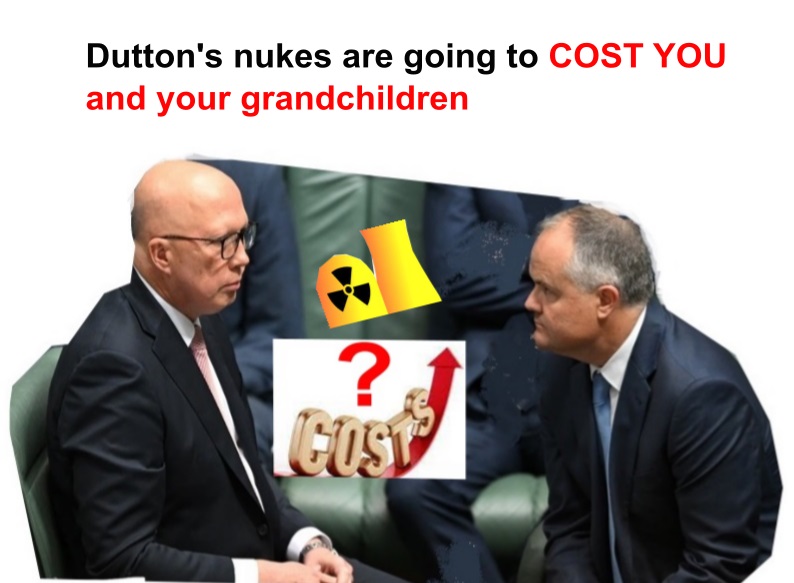
March 13, 2025 AIMN Editorial, Australians for Affordable Energy https://theaimn.net/new-tool-to-cut-through-energy-debate-as-price-hike-prompts-new-questions-about-nuclear/
Amid today’s news of energy bill spikes, Australians have a new tool to calculate how their bills would fare with a nuclear generation option.
It’s been confirmed that unreliable coal-fired electricity plants are causing 2.5-8.9 per cent energy bill increases. That has raised concerns about the Coalition’s nuclear proposal, which would keep households vulnerable to coal price spikes for many years, Australians for Affordable Energy (AFAE) warned today.
With energy costs shaping up as a key election issue, AFAE has launched a free calculator, available at afae.net.au/calculator, which provides a real-world cost estimate for households based on the proposed nuclear energy plan.
The calculator extrapolates from the Institute for Energy Economics and Financial Analysis (IEEFA) analysis to provide Australians with a clear picture of nuclear energy costs based on international examples.
The tool allows users to input their current electricity costs and household size – or use state averages if unsure – to see potential changes to their bills under various nuclear scenarios and help them make an informed decision.
“Australians are confused about the costs and timelines of building seven nuclear reactors—one of the largest government projects ever proposed. There’s widespread uncertainty in the energy debate, and our goal is to clarify exactly what nuclear power could mean for household bills, good or bad,” said AFAE spokesperson Jo Dodds.
“Cost of living will dominate the upcoming election, and Australians deserve clear answers. Our calculator helps Australians see firsthand whether nuclear energy genuinely stacks up as an affordable option.”
The Australian Energy Regulator confirmed today that power prices are predicted to go up by up to 8.9% per cent from July, forcing families and businesses already struggling with cost-of-living pressures to pay even more for essential electricity.
The price hike directly results from continued reliance on ageing coal-fired power stations. Gas prices also contribute to rising energy costs due to ongoing international volatility, adding uncertainty and pressure to wholesale electricity prices.
“Today’s announcement is another blow to households already struggling. Australians are exhausted as bills keep rising with no clear solutions in sight. Australians for Affordable Energy wants to help everyone understand what these price hikes really mean as we approach the federal election. Australians deserve better than constant uncertainty and higher costs.
“Coal is like a beloved old, beat-up car we keep throwing money at just to keep it running. Nuclear is increasingly becoming something we don’t need and can’t afford. Both drive costs higher without offering practical, affordable solutions. Australians deserve reliable, affordable electricity – not crumbling coal plants or overpriced nuclear projects decades away.”
Australians for Affordable Energy (AFAE) is dedicated to ensuring energy policies prioritise affordability and sustainability for all Australians.
“Nothing but broken promises”: ICAN Ambassador, Karina Lester calls out Australia’s inaction on the Treaty for the Prohibition of Nuclear Weapons,
ICAN Australia, 13 Mar 25
On Thursday, Yankunytjatjara-Anangu woman, second-generation nuclear test survivor, and ICAN Ambassador Karina Lester delivered a statement during the segment on Victim Assistance and Environmental Remediation and International Cooperation.
| In her powerful statement, Karina outlined the expectations from affected community members worldwide for support under Articles 6 & 7 of the TPNW, which require states parties of the TPNW work collaboratively to provide support to communities impacted by the use and testing of nuclear weapons. Karina also called out the Australian Government’s lack of action on the TPNW to date, and made clear that it is time for Australia to sign and ratify the TPNW, without delay. |
| “I am concerned and deeply saddened that my own country has yet to sign and ratify the Treaty on the Prohibition on Nuclear Weapons. My country, my traditional lands, has felt the reality of nuclear weapons use. We even launched the movement that brought us to this day here in New York – the International Campaign to Abolish Nuclear Weapons. |
Yet despite promises, despite the expectations of community members and parliamentarians, and despite the clear and urgent need, we are still waiting.
Australia is the gap in our region. And this is shameful, nothing but broken promises. Many of our friends in the Pacific Islands and those in South East Asia have joined the Treaty. We call on our government to sign and ratify, to join this community of nations in working together to abolish nuclear weapons.”
In an interview with NITV, Karina said that the impacts of the British Nuclear tests on her country are still felt today, more than 70 years later.
Yet despite promises, despite the expectations of community members and parliamentarians, and despite the clear and urgent need, we are still waiting.
Australia is the gap in our region. And this is shameful, nothing but broken promises. Many of our friends in the Pacific Islands and those in South East Asia have joined the Treaty. We call on our government to sign and ratify, to join this community of nations in working together to abolish nuclear weapons.”
In an interview with NITV, Karina said that the impacts of the British Nuclear tests on her country are still felt today, more than 70 years la
US report discusses possibility of nuclear submarine accident, if subs supplied to Australia

A report to the US Congress discusses the possibility of an accident with a nuclear-powered submarine if it supplies one to Australia.
This comes amid renewed questions over whether an AUKUS submarine deal would leave the US vulnerable, and an accident off the English coast where a tanker carrying jet fuel for the US military has hit a cargo ship.
The risk of a marine accident is one of three risks looked at around the submarines deal that is central to the the AUKUS Pillar One pact.
The congressional research report said an accident “might call into question for third-party observers the safety of all US Navy nuclear-powered ships”.
That could erode US public support and the ability of US nuclear-powered ships to make port calls around the world.
The 111-page report by the Congressional Research Service discussed the US not handing over the subs at all – although Canberra just made a $870m downpayment on them.
Keeping them might make up for the US sub fleet hitting “a valley or trough” around now till the 2030s, and shipbuilding being at a low point, it said.
Donald Trump’s pick for the top defence policy role at the Pentagon, Elbridge Colby, has said AUKUS could leave the US short and “it would be crazy to have fewer SSN Virginia-class [attack submarines] in the right place and time”.
The new research report to Congress said Pillar One was launched in 2021 without a study of the alternatives.
One alternative “would keep all US-made SSNs under the control of the US Navy, which has a proven record extending back to 1954 of safely operating its nuclear-powered ships”.
The original Pillar One pact is for the US to sell between three and five subs to Australia, then Australia to use US and UK nuclear propulsion technology to build another three-to-eight nuclear powered, conventionally armed submarines itself, for a total fleet of eight.
Australia’s Defence Minister Richard Marles said on Monday that Elbridge Colby was broadly supportive of AUKUS, if enough subs were available.
Canberra was aware of the challenge in the US around producing submarines, “and that’s why we’re contributing to the US industrial base”.
“And it’s a significant contribution and it’s going to increase the availability of Virginia class submarines for the United States.
“That’s a point which has been accepted and understood by the US Defence Secretary, Pete Hegseth, in the meeting that I had with him.”
Australia was last year included as a “domestic source” of US military production for the first time, and is aiming to ramp up making ammunition and missiles, as well as test hypersonic weapons with the US and UK.
“That’s going well in the sense that we are making the contributions, we are seeing an increase in production rates, and over the time frame in which we are looking to have our Virginia class submarines transferred to us, we are confident that this challenge can be met,” Marles told the ABC.
In the US, Trump appears most focused on building an ‘Iron Dome’ missile defence system, as he mentioned in his speech to Congress. This would be another huge pressure on military spending.
The report to Congress covered three big risks – accidents and whether Pillar One was the best option for deterrence and “warfighting cost-effectiveness”, and how the tech – the “crown jewels of US military technology” – could be kept secret, especially from China.
It debated a different “military division of labour”.
“Australia, instead of using funds to purchase, build, operate, and maintain its own SSNs, would instead invest those funds in other military capabilities – such as … long-range anti-ship missiles, drones, loitering munitions, B-21 long-range bombers, or other long-range strike aircraft” to conduct “missions for both Australia and the United States”.
The general rule was programmes should not go ahead without a sound business case, it noted.
“There is little indication that, prior to announcing the AUKUS Pillar 1 project in September 2021, an analysis of alternatives … or equivalent rigorous comparative analysis was conducted to examine whether Pillar 1 would be a more cost-effective way to spend defence resources for generating deterrence and warfighting capability”.
The report made no mention of how New Zealand, Japan, Korea and others might join AUKUS Pillar Two, an agreement for sharing advanced military tech.
Coalition’s nuclear plan most expensive option for Australia, former US climate official says
Dr Jonathan Pershing, a former US special envoy for climate change and climate negotiator under Democratic presidents, says few countries building nuclear power plants
Adam Morton Climate and environment editor, Tue 11 Mar 2025 , https://www.theguardian.com/australia-news/2025/mar/11/coalitions-nuclear-plan-most-expensive-option-for-australia-former-us-climate-official-says
A longtime senior US climate official has weighed in on Australia’s energy debate, saying “very, very few people” internationally are building new nuclear power plants and, in most cases, the combination of solar and batteries delivers “higher reliability than gas”.
Dr Jonathan Pershing, a former US special envoy for climate change and climate negotiator under Democratic presidents, was in Sydney on Monday to speak at the city’s climate action week. Asked whether nuclear power as proposed by the Coalition was a viable option for Australia, he said “almost all the numbers that I have seen suggest that that’s a more expensive option than other choices”.
“What’s really interesting is the global community’s progress on nuclear with, frankly, a bigger head start than Australia’s had, because the ban here has been in place for a long time,” he told Guardian Australia.
“Very, very few people are building new nuclear.”
Pershing, who is program director at the William and Flora Hewlett Foundation, said even if Australia was able to overcome two immediate hurdles to nuclear energy – the legislated ban and an historical lack of public support for the technology – it then faced asking taxpayers to pay “holding costs” for 10 to 20 years when it could be building the same amount of generating capacity sooner.
“The cheapest one still globally, and I think here as well, is probably a combination of solar plus batteries – and that’s firm capacity, by the way,” he said. “If we look at the way that’s been analysed, the combination of the two [solar and batteries] gets you higher reliability than you get from gas.
He cited the example of the 40-year-old Diablo Canyon nuclear plant, in California. He said it was not likely to be replaced with a new nuclear generator once it reached the end of its life because of the cost. “They’ll do some life extensions, but they don’t think it is even plausible to imagine building new capacity there,” he said. “It’s just too expensive.”
The Coalition has claimed that its proposal to slow the rollout of renewable energy, extend the life of ageing coal plants, rely more on gas-fired power and later build publicly funded nuclear plants at seven sites, mostly after 2040, would be cheaper and more reliable than Labor’s promise of sourcing 82% of Australia’s electricity from renewable energy by 2030.
Peter Dutton has said the Coalition’s claim is supported by a report by consultants at Frontier Economics. But several other independent energy experts have argued the Coalition’s plan would, in relative terms, be likely to be more expensive for consumers over the next decade, at least, and less reliable and lead to substantially higher greenhouse gas emissions.
Pershing said a another problem for Australia would be training personnel for a nuclear power industry. Technical experts would have to be brought from overseas, which isn’t the case for other types of energy generation, he said.
That expertise could come from Canada, China, France or Russia, adding that in the case of Russia, “I’m not so convinced that that’s where you’d want to go”.
Pershing said the Trump administration’s anti-climate action stance would have an effect “but, I think, less than people might imagine”. He said the change in the US was an opportunity for Australia, “depending on how it chooses to engage”.
“The thing that’s most salient is that the rest of the world has decided that the least-cost solution to provide for more energy, particularly for electricity, is through some combination of renewables technologies plus batteries,” he said, citing International Energy Agency data showing it was the cheapest and faster solution “for about 80% of the world”.
“In much of the world, demand [for energy] is rising and you’re going to have to supply that demand from something. That means transition minerals, and that means technology, and that means investment. Those are places that the Australian economy is well positioned to deliver.”
Based on Trump’s language and early actions, the US was likely to slow the construction of wind and solar power and electric vehicles while increasing its demand for critical minerals, he said. But the US was “not the primary place where things are happening”.
“The place where things are happening is across Asia, broadly, with enormous continued demand from China, demand from India, demand from Indonesia and then actually others around the world who are building on that capacity,” he said.
Regarding fossil fuel exports, Pershing said the question for Australia was how it replaced the economic value of the coal and gas it sells with other exports, and what commitments it has made that were consistent with keeping global heating to less than 2C.
Australia could, for example, build a new mutually beneficial trade relationship with Japan where Australia produced and sold zero carbon steel and other metals. Pershing said Australia would also have to deal with the future of communities, such as in the Hunter Valley and its nearby port of Newcastle, that rely heavily on coal mining and coal exports.
“I think these are difficult questions, and they’re legitimate ones for the whole society to take up,” he said. “[A change] is coming. It’s not that it won’t come, but if we don’t manage it, it’ll have enormously negative consequences for communities, and I think that’s on the collective government, civil society and thought leadership to resolve and to address”.
Climate Authority head Matt Kean says Liberals ‘socialist’ for ‘nonsense’ nuclear policy
In short:
Matt Kean, a former NSW treasurer and energy minister, has launched a broadside at his own party for backing nuclear energy.
Mr Kean now chairs the Climate Change Authority, which argues nuclear reactors will result in more emissions than renewable energy.
But Liberal senator Hollie Hughes told Q+A nuclear energy promised zero emissions and jobs for coal plant communities.
A former Liberal state treasurer has branded his own party “socialist” in an extraordinary broadside at the opposition’s plan to build nuclear power reactors.
Matt Kean, who now chairs the government’s Climate Change Authority, has also warned parts of Australia will become “uninhabitable” from worsening climate events such as the ongoing emergency from ex-Cyclone Alfred.
Mr Kean told the ABC’s Q+A on Monday the federal Liberal Party proposal for replacing coal-fired power plants with nuclear reactors was too expensive for governments and consumers.
“I’m not anti-nuclear, but I am anti-nonsense,” he said.
“There’s no private investors knocking down anyone’s door to build a nuclear reactor.
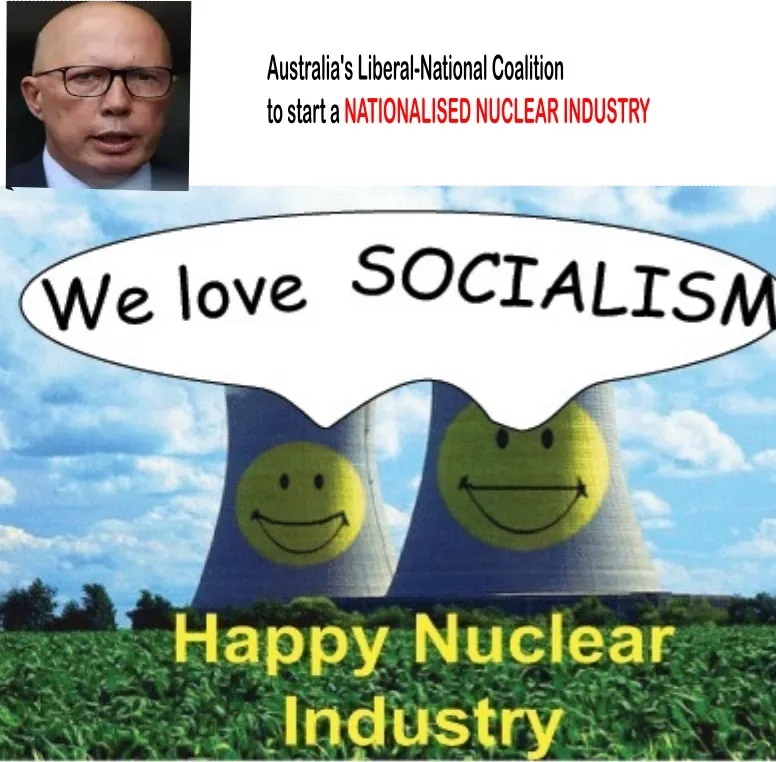
“In fact, under Peter Dutton’s nuclear plan, it won’t be the national energy market, it will be the nationalised energy market, because it will only be funded by the government.
“Now I forgot when the Liberal Party decided to be socialist in how it operates.”
Mr Kean is in a public spat with the federal branch of his party, with Liberal frontbencher Jane Hume suggesting he would be sacked from a Climate Change Authority (CCA) that had been “badly politicised”.
The CCA has modelled the potential impacts of the Coalition’s promise to build seven nuclear power plants by 2050, concluding it would result in an additional 2 billion tonnes of emissions…………………………………………………….
Mr Kean argued smaller reactors as proposed by the Coalition “aren’t even invented yet” and offered no short-term cost relief for consumers.
“People talking about building nuclear today are the same people that are sort of arguing that we should be building a Blockbuster Video complex when Netflix is already here,” he said.
“I don’t think anyone in this audience believes that a nuclear power station that’s not going to be built ’till at least 2035 — and that’s the most heroic assumption anyone has ever said, right? — is going to help anyone with their power bills today.
“It’s just not, OK?”
Senator Hughes said of the Liberal nuclear proposal, “I own it,” prompting Mr Kean to point out: “Not the NSW Liberals.”
Both NSW Liberal leader Mark Speakman and Queensland Liberal Premier David Crisafulli have rejected nuclear as a short-term fix for energy cost and reliability.
‘Poor planning’ on disaster risks
With ex-Cyclone Alfred still posing major a flood risk to parts of Queensland and New South Wales, Mr Kean warned of “whole communities being disrupted” by worsening climate conditions.
“There will be some parts of the coastline, there’ll be some parts that are flood prone, that will be uninhabitable,” he said.
“We need to make sure that we’re protecting those vulnerable people and dealing with the issue of carbon emissions, but also building in policies that help communities adapt to the new reality, which is a changing climate.”………………………………………….. more https://www.abc.net.au/news/2025-03-10/matt-kean-nuclear-energy-liberal-party-slammed-socialist/105033754
Coalition’s Canavan forgets he’s backing nuclear, calls for new coal power as election looms
RenewEconomy Rachel Williamson, Mar 10, 2025
The Coalition just can’t kick its coal habit, with renegade Nationals senator Matt Canavan ignoring the new nuclear talking points to return to his favourite hobby horse: to build new coal power plants.
Canavan made his oft-repeated pitch for new coal power on X, citing a move in Wyoming, USA, to gift $10 million in taxpayer funds for a new coal power station.
But the Australian politician’s contribution to the energy debate was pooh-poohed by Matt Kean, the former New South Wales energy minister and current chair of the Climate Change Authority.
“It appears there is a new update to the Coalition’s energy policy for the coming election: new coal fired power plants in Australia to complement the nuclear power plants. It will be interesting to see the full details on this new “coal first” policy,” Kean deadpanned on X……………………………..
The cost of building new coal is around double the price of wind and solar, even with storage and transmission, according to CSIRO’s GenCost report, which compares the cost of building probable and existing energy sources, as well as nuclear, which is even more expensive………………………………………………………….. more https://reneweconomy.com.au/coalitions-canavan-forgets-hes-backing-nuclear-calls-for-new-coal-power-as-election-looms/
Australian nuclear news 10-17 March.
Headlines as they come in:
- The end of coal and the fake nuclear energy ‘red herring’
- Greens leader Adam Bandt says Australia should walk away from AUKUS in wake of Trump’s tariffs.
- Bandt says Australia should cancel Aukus payments and leave pact.
- Australia’s Trump cards.
- The Lizard’s Revenge
- Silent vigil against nuclear.
- There’s a bipartisan conspiracy of silence on AUKUS — and it flies in the face of democracy
- “Nothing but broken promises”: ICAN Ambassador, Karina Lester calls out Australia’s inaction on the Treaty for the Prohibition of Nuclear Weapons.
- New tool to cut through energy debate as price hike prompts new questions about nuclear
- Coalition’s Canavan forgets he’s backing nuclear, calls for new coal power as election looms .
- Radioactive secrets: Fight to hide AUKUS nuclear waste sites gets absurd .
- US report discusses possibility of nuclear submarine accident, if subs supplied to Australia.
- Higher household bills by 2030 under nuclear: report.
- Coalition’s nuclear plan most expensive option for Australia, former US climate official says.
- Climate Authority head Matt Kean says Liberals ‘socialist’ for ‘nonsense’ nuclear policy.
- What if a Fukushima-sized nuclear accident happened in Australia? –
Radioactive secrets. Fight to hide AUKUS nuclear waste sites gets absurd

by Rex Patrick | Mar 11, 2025 | https://michaelwest.com.au/radioactive-secrets-fight-to-hide-aukus-nuclear-waste-sites-gets-absurd/
Where to store nuclear waste from AUKUS submarines is a decision which will impact us for millennia, but they are going to extraordinary lengths to hide it from the public. Rex Patrick reports.
Somewhere deep inside a locked government filing cabinet within Australia’s labyrinthine Defence bureaucracy, there’s a document intended to advise the Government on what locations in Australia might be suitable to store high-level nuclear waste and how to select one of those locations.
It’s a roadmap to where the most toxic material on our planet may be dumped for tens of thousands of years. The report itself is just paper, but it’s red hot. It’s politically radioactive.
The document in question is the result of a $360,000 February 2023 contract to a company called SG Advice. The principal of SG Advice was tasked with coordinating the Australian Nuclear Science and Technology Organisation, the Australian Radioactive Waste Agency, the Australian Submarine Agency, Defence, and Geoscience Australia to produce a “significant piece of policy advice” for the government.
The document is being held secret despite the obvious fact that a decision on a location for a high-level nuclear waste facility will be a decision with impacts which will last for millennia.
The government doesn’t want the public to see it – it’s just too controversial. All the more reason then for me to seek access to it using our Freedom of Information laws.
A Cabinet document
When I requested the report, the newly minted Submarine Agency told me I couldn’t have it because it was a cabinet document. But when I thought about the nature and purpose of the report, this didn’t make sense.
The Cabinet Handbook, the authoritative rules governing all matters relating to Cabinet, states that “… Cabinet documents are … not the property of … [the] department. Access to them by succeeding governments is not granted …”
If this ‘significant piece of policy work’ dealing with the problem of high-level nuclear waste in a multi-decade program was a Cabinet document, it would only be available to the Department for the period that the Albanese Government was in power. If there was a change of Government, the work that was done would go into the archives and would not be available for reference by future governments, at least not for 20 years. So, the nuclear waste planning would have to be revisited from scratch.
But the Submarine Agency went to the Administrative Review Tribunal with its taxpayer funded lawyers to argue that the report was a Cabinet document and consequently must remain secret.
Government Ministers and bureaucrats love Cabinet-in-confidence exemptions because if they’re upheld, it’s ‘all over red rover’ as far as any public access is concerned. First Assistant Director-General of the Submarine Agency, Alexandra Kelton, deposed:
… “my understanding at all times was that the final Review report would be a document submitted to the [National Security Committee of Cabinet] for its consideration.“
If it was intended for Cabinet, then the Submarine Agency had engaged in wasteful administrative folly.
Document purpose
In order for the Tribunal to find that the report was a Cabinet document, it needed more than just evidence that it has been to Cabinet. The FOI Act demands that the Agency must show, with probative evidence, that the report was
“brought into existence for the dominant purpose of submission for consideration by the Cabinet.“
The only evidence before the Tribunal that the document was born with Cabinet submission in mind was in the $360,000 contract to SG Advice Pty Ltd which stated, “Any decision related to locations for the storage and disposal of radioactive waste is a decision for the Australian Government.”
Ms Kelton deposed, “The capitalised reference to ‘Australian Government’ in the [contract] is synonymous with Cabinet. That is a common expression in Defence and [the Submarine Agency] when referring to Cabinet.”
Instead of using the word ‘Cabinet’, Ms Kelton used the broader multi-definitional word “Australian Government”. She could have used “Cabinet” but she chose to be ambiguous.
The contract to commence the report was signed in late February 2023. The report was completed in November 2023. Only after the document was finalised was it sent to the Defence Minister, suggesting it should go to Cabinet. In the covering brief, the Submarine Agency raised the political sensitivity of the content of the report.
Despite the attempt by the agency to wrap the report in a 20-year-long secrecy blanket, it’s likely the Tribunal will rule in my favour and we will all get to see the report. It should not otherwise be kept secret.
Reckless conduct
The Submarine Agency will bear the ultimate responsibility for Australia’s nuclear stewardship under the AUKUS agreement and in relation to our nuclear non-proliferation obligations with the International Atomic Energy Agency. Those stewardship obligations include commissioning, operating, maintaining, and decommissioning reactors and disposing of their high-level waste.
The Submarine Agency promotes the idea that it will manage all nuclear activities safely, informed by international best practices. Yet its approach to the nuclear waste report shows otherwise.
If we indulge the Submarine Agency for a moment and believe that the nuclear waste report was for Cabinet, their conduct and care of this report has been reckless. They’ve been playing fast and loose with rules that are laid down at the highest level of the Australian Government; rules approved by Prime Minister Albanese and the Cabinet Secretary, Attorney-General Dreyfus, and endorsed by Cabinet itself.
Ignoring the rules for convenience
The Cabinet Handbook states that it is inappropriate to provide copies of, or access to, final or draft Cabinet documents to sources external to government. Yet, in total disregard for that rule, the Submarine Agency contracted the consulting company SG Advice PTY LTD to lead the review and the report writing team.
Moving on, there exists a real-time, highly secure, whole of Australian government information and communications technology system used to support the Commonwealth’s end-to-end Cabinet process. It’s called CabNet+.
The Cabinet Handbook states Cabinet documents, including pre-exposure drafts, exposure drafts, drafts for coordination comments, final submissions, and drafting comments (including coordination comments), must only be circulated via the CabNet+ system to ensure that they are circulated securely and that copies of the documents can be accounted for.
It is important, therefore, that exposure drafts, drafts or finals (either in the template or in a document which looks like a Cabinet submission) are not circulated by any other means.
It goes on to state: Similarly, substantive comments on submissions should only be transmitted via CabNet+.
“And yet all the work associated with the nuclear waste site report was carried out on standard departmental networks.“
Much of the communication was only marked official (unclassified), including emails that contained drafts of the report. In response to the argument that the report could not be a Cabinet document because it was not prepared and stored on CabNet+ Ms Kelton deposed, “The process for planning and drafting the Review report was collaborative and iterative. As a matter of practicality for communicating and formatting parts of the draft, that process occurred outside the CabNet system.”
So, one of the most senior people in an Agency responsible for stewardship of high-level nuclear waste has indicated that it’s OK to depart from mandatory requirements.
How’s that for knocking people’s confidence in an organisation’s ability to manage highly radioactive nuclear material.
In the lead up to the hearing, the government’s lawyers threatened me not to reveal these details.
Stop the secrecy!
Yes, the report I’m after relates to a highly controversial topic and one of great importance. It relates to the location of an AUKUS spent nuclear fuel repository. But it’s a document that ought to be made public … and especially so because of its controversy.
“Prime Minister Albanese insisted that Opposition Leader Dutton be transparent about the sites of his seven proposed nuclear power reactors.“
Dutton obliged.
Yet Albanese has obstinately resisted disclosure of documentation about the location of a future High Level Nuclear Waste facility. It’s almost certainly politically radioactive, but politics is no justification for secrecy.
Moreover, this is a document that will inform government decisions of an indefinite character. Wherever the nuclear waste goes, it will go there for good.
“The need for full public and expert scrutiny of this report is absolutely compelling.“
Before he won high office, Anthony Albanese promised openness and transparency. Even if the nuclear waste report were a Cabinet document, he could authorise its release. That’s always in his power.
That he has refused to do so, sends my secrecy Geiger Counter way into the red zone; maxed out by wilful obstruction and shameless hypocrisy.
Rex PatrickRex Patrick is a former Senator for South Australia and earlier a submariner in the armed forces. Best known as an anti-corruption and transparency crusader, Rex is running for the Senate on the Lambie Network ticket next year – www.transparencywarrior.com.au.
Higher household bills by 2030 under nuclear: report

by News Of The Area – Modern Media – , https://www.newsofthearea.com.au/higher-household-bills-by-2030-under-nuclear-report
HOUSEHOLDS could fork out an extra $450 a year for power by 2030 if policymakers pursue nuclear and a slower renewable rollout, modelling suggests.
An analysis commissioned by the Clean Energy Council found the additional pricey gas needed under a nuclear pathway would drive bills higher by 2030 than if the renewables-led grid transition continues.
The modelling mirrors the energy policies on offer from the major federal parties – the Labor government is vying for 82 per cent of renewable energy in the grid by 2030, while the coalition is promising to build nuclear power plants.
Renewable energy would make up about half the energy grid by 2050 and nuclear power 38 per cent under the opposition plan.
Opposition leader Peter Dutton has promised cheaper electricity long-term based on calculations it commissioned from consultancy Frontier Economics.
Using AEMO’s “progressive change” scenario for the nation’s energy mix, Frontier found including nuclear energy would reduce costs from $437 billion to $331 billion – or slash costs by 44 per cent compared to the “step change” scenario.
Yet numbers crunched by professional services firm Jacobs on the clean energy industry body’s behalf found households could expect a 30 percent average increase by 2030 under the nuclear pathway.
This would amount to an $449 annual increase for the typical consumer ser
viced by the main energy grid.
Small businesses could expect a $877 increase in their bills by 2030 if the clean energy rollout slows down while waiting for nuclear to be built.
Even bigger price jumps were possible were a coal generator to unexpectedly fail – something that becomes more likely as they age – as more gas would be needed to make up the shortfall.
Voters are set to go to the polls May 17, at the latest, and cost of living will be front of mind following a prolonged stint of high interest rates aimed at taming inflation.
Clean Energy Council chief executive officer Kane Thornton said halting renewable energy deployment and relying on coal and gas before nuclear comes online would be a “disaster” for power prices.
“Australia would have to increase its reliance on increasingly expensive and unreliable old coal generation, as well as significantly increase gas generation, which is a much more expensive energy source,” he said.
“Getting more renewables into our system, such as solar and wind and backed by pumped hydro, batteries and small amounts of gas, is the cheapest and most reliable way to keep energy bills as low as possible for Australians.
The analysis considered the influence of wholesale electricity prices on power bills for households and small businesses under each scenario.
Network costs and other components of electricity bills were not included in the modelling.
Tuesday’s power bill numbers follow the Climate Change Authority’s report highlighting the nuclear power plan could push Australia’s 2030 climate target out until 2042 and add two billion tonnes of carbon emissions to the environment by 2050.
What if a Fukushima-sized nuclear accident happened in Australia?
Today is the 14th anniversary of the Fukushima disaster, and this morning the good folks at Don’t Nuke the Climate released a huge research project that shows what a Fukushima-style nuclear disaster would look like if it happened at one of Dutton’s seven proposed reactor sites.
About these maps, https://nuclearplume.au/ 11 Mar 25
The seven sites on this map have been selected by the federal Coalition to house multiple nuclear power reactors.
You can select the reactor site and wind direction to see how a Fukushima-scale nuclear disaster would contaminate different areas surrounding the seven sites in Australia.
The interactive map uses a radiation plume map, originally peer reviewed and published by the European Geosciences Union. It shows the deposition of radioactive caesium-137 from the Fukushima disaster as of July 2011. The darker the shading, the higher the level of radioactive contamination and the higher the radiation exposures for people in those areas. At distances far from the Fukushima plant, radiation exposures were low but even low radiation doses can cause negative health impacts including fatal cancers and cardiovascular disease.
Caesium-137 has been one of the most significant radioactive contaminants since the March 2011 Fukushima disaster but many other types of radioactive particles contaminated wide areas (iodine-131, xenon-133, etc.).
Other radiation fallout maps from the Fukushima disaster can be seen here and here.
A lot of nuclear and related news this week

Some bits of good news – 27 New UK Tree Cities of the World. How Stockholm Is Sprouting Healthy Trees From Concrete. Degraded Lands Transformed into Productive Farms: With Science, We Can Create Wonders. Once feared extinct, Australia’s most endangered marsupial has had a comeback
TOP STORIES .
“Difficult-to-Return” zones.
Jeffrey Sachs: Negotiating a Lasting Peace in Ukraine. Zelensky’s hostility to peace triggered White House meltdown.
British journalists are celebrating the lack of opposition to war in parliament.
Failure After Failure: Let’s Ditch Small Modular Reactors.
We’ve failed to stop climate change — this is what we need to do next ALSO AT https://nuclear-news.net/2025/03/09/1-a-weve-failed-to-stop-climate-change-this-is-what-we-need-to-do-next/
Climate. Earth’s strongest ocean current could slow down by 20% by 2050 in a high emissions future. Global Ocean Treaty two years on: Australia’s chance for international cooperation.
Half of world’s CO2 emissions come from 36 fossil fuel firms, study shows. UK’s richest can boost climate action but need to cut outsized emissions – study.
First Trump threatened to nuke hurricanes. Now he’s waging war on weather forecasters.
Noel’s notes. Does the Deep State really exist? And if so, is it being dismantled?
AUSTRALIA. Surface tension: could the promised Aukus nuclear submarines simply never be handed over to Australia?
How US Military Bases in Australia Threaten Our Future & How to Remove Them., More Australian nuclear news at https://antinuclear.net/2025/03/05/australian-nuclear-news-headlines-week-to-11-march/
NUCLEAR ITEMS.
| CLIMATE. Nuclear Power Is the Cuckoo in the Climate Policy Nest.Turbine, cooling: these unforeseen events that keep the Flamanville EPR at a standstill. |
| ECONOMICS. East Lindsey District Council wants to claim costs for nuclear waste site work. |
EDUCATION. University of Suffolk co-opted by the nuclear industry.. |
| EMPLOYMENT. EDF considers plans to revive ‘fish disco’ at Hinkley Point plant ALSO AT https://nuclear-news.net/2025/03/06/3-b1-edf-considers-plans-to-revive-fish-disco-at-hinkley-point-plant/ |
| ENERGY. Most Contaminated U.S. Nuclear Site Is Set to Be the Largest Solar Farm. |
| ENVIRONMENT. Air Force picks remote Pacific atoll as site for cargo rocket trials. Radioactive pollution is increasing at Britain’s nuclear bases. Fish disco plan revived to protect salmon from Hinkley Point C ALSO AT https://nuclear-news.net/?s=%E2%80%98Fish+disco%E2%80%99+plan+revived Has common sense finally prevailed at Hinkley Point C? |
| EVENTS. Uranium’s Poison Power in Leafy Cheshire –Remembering Fukushima. |
| INDIGENOUS ISSUES. Mi’kmaw Chiefs send stinging rebuke to Nova Scotia Premier Tim Houston. |
| LEGAL. Fukushima victims angered, saddened by TEPCO acquittals. 9-year lawsuit fails to stop Ikata nuclear plant operationsSupreme Court steps into debate over where to store nuclear waste.Nuclear waste at Chalk River: opponents defeated in court – ALSO AT https://nuclear-news.net/2025/03/08/1-b1-nuclear-waste-at-chalk-river-opponents-defeated-in-court/ |
| OPPOSITION to NUCLEAR . Campaigners attend East Lindsey District Council meeting to call on Lincolnshire County Council to withdraw from Geological Disposal Facility process. |
| PERSONAL STORIES. Nuclear fallout: why Karina Lester is calling on Australia to sign the treaty banning atomic weapons. |
POLITICS
- How the Media Walked us into Autocracy (w/ Ralph Nader) The Chris Hedges Report –https://www.youtube.com/watch?v=oQZuzIzY8YQ
- Doug Ford: Rip up the GE-Hitachi US nuclear contract.
- Nuclear Policy in Scotland. Nuclear energy has no role in Scotland’s green future. Changing nuclear policy would make ‘SNP as bad as Tories’, MSP warns – ALSO AT https://nuclear-news.net/2025/03/10/1-b1-changing-nuclear-policy-would-make-snp-as-bad-as-tories-msp-warns/
- UK Government slaps down Ian Murray over UN nuclear weapons summit. Keir Starmer’s plan for UK growth – the Ukraine war. Conservatives’ push to identify ‘suitable sites’ for nuclear reactors in Telford and Wrekin is defeated. Keir Starmer faces backbench rebellion over ‘shortsighted’ cuts to aid budget. Keir Starmer tells SNP to reverse nuclear weapons opposition.
POLITICS INTERNATIONAL and DIPLOMACY.
- Treaty on the Prohibition of Nuclear Weapons States agree – the ban is the alternative to reckless nuclear deterrence and proliferation as Third Meeting of States Parties draws to a close.
- Trump plans to make Ukraine a US economic colony, exploiting its critical minerals.
- US Threatens Possible Military Response After Tehran Rejects Nuclear Outreach.
- The Russians aren’t coming, the Russians aren’t coming.
- Europe’s Face-Saving Theater on Ukraine.
- Macron’s Offer: France and the Delusions of Nuclear Deterrence.
- Zelensky reverses hardline position on peace talks.
- Russia agrees to help US in negotiations with Iran over nuclear program, Bloomberg reports.
- Non-Proliferation Treaty ‘struggling’ in new nuclear age, expert warns. One empty seat. UK fails again to send representation to UN nuke conference.
- UK urged to prepare for Donald Trump halting Trident partnership ALSO AT https://nuclear-news.net/2025/03/09/2-b1-uk-urged-to-prepare-for-donald-trump-halting-trident-partnership/ UK Government ignoring international law on nuclear weapons – experts ALSO At https://nuclear-news.net/2025/03/09/2-b-1-uk-government-ignoring-international-law-on-nuclear-weapons-experts/
- Delays in Trident renewal put our deterrent in peril.
| SAFETY.Ripping up the rules on nuclear power heightens the risk to us all.Cybersecurity in the Nuclear Industry: US and UK Regulation and the Sellafield Case .Is giving old reactors new life the future of nuclear energy?Continued Incidents Raise Concerns Over Nuclear Security, Says UN More than 145 Reports Added to IAEA Incident and Trafficking Database in 2024. |
| SECRETS and LIES. Israeli technician accused of offering country’s nuclear secrets to Iranian regime. |
| TECHNOLOGY. The SMR Gamble: Betting on Nuclear to Fuel the Data Center Boom. |
| URANIUM. Fearing toxic waste, Greenland ended uranium mining. Now, they could be forced to restart – or pay $11bn. |
| WASTES. American companies profit from Canada’s radioactive waste.Supreme Court wrestles with nation’s frustrating search for nuclear waste storage.East Lindsey overwhelmingly backs GDF withdrawal call to Lincolnshire County Council. Bank Head Estate residents attend public meeting over nuke dump blight. ‘Vote out!’: Protestors win motion at ELDC full council to urge county council to withdraw from nuclear dump talks. |
| WAR and CONFLICT. UN summit ‘delivers strongest condemnation yet’ of nuclear deterrence. |
WEAPONS and WEAPONS SALES.
- More Guns, Less Butter: Starmer’s Defence Spending Splash . Britain’s nuclear weapons fiasco is a nightmare for Rachel Reeves. Britain’s nuclear submarines bill spirals by £5bn. US support to maintain UK’s nuclear arsenal is in doubt, experts say.
- US poised to house nuclear weapons in Britain for first time in two decades.
- Potentially ‘catastrophic’ use of AI in nuclear weapons systems raised by former Royal Navy boss.
- Air Force Activates Key Unit for Nuclear Modernization at VSFB.
- Trump Pauses All Military Aid to Ukraine.
- It’s time to ditch Virginia subs for AUKUS and go to Plan B.
Britain’s nuclear submarines bill spirals by £5bn

The MoD blames inflation as the cost of replacing the UK’s at-sea deterrent hits £37bn
Szu Ping Chan Economics Editor. Matt Oliver Industry Editor
The cost of replacing the submarines carrying Britain’s nuclear deterrent
has ballooned by more than £5bn in just three years, according to official
documents. The Ministry of Defence (MoD) has raised its estimate for the
lifetime cost of manufacturing and maintaining four new ballistic missile
submarines to £36.7bn as of March last year, up from an estimate of
£31.5bn in 2020-21. It is also £2.5bn more than projected in March 2023.
Telegraph 9th March 2025, https://www.telegraph.co.uk/business/2025/03/09/cost-for-britains-new-nuclear-submarines-spirals-by-5bn/
Does the Deep State really exist, and if so, is it being dismantled?
March 9, 2025, https://theaimn.net/does-the-deep-state-really-exist-and-if-so-is-it-being-dismantled/
What is the Deep State? Does it really exist?
These questions are hard to answer. I had heard the term Deep State over many years, and I connected it with all sorts of conspiracies – not just about U.S. politics and intelligence systems, but with wild ideas about satanism, reptilian shapeshifters, the antichrist, child-trafficking, blood harvesting – and all connected with extreme right-wing and pro- Trump propaganda. So I just dismissed and ignored them – there was no such thing as the Deep State !
It is not that simple.
Indeed, it is very complex.
If you start delving, the term Deep State takes you back to Turkey, over 100 years ago, where the concept of a “shadow government” a “secret state within the state” was a real thing. In more modern times the Deep State is defined as:
“The deep state conspiracy theory in the United States is an American political conspiracy theory that posits the existence of the deep state, a clandestine network of members of the federal government (especially within the FBI and CIA). The theory argues that there exist networks of collaborators within the leadership of the high-level financial and industrial entities, which exercise power alongside or within the elected United States government” – Wikipedia
So, OK it’s still just a theory – a conspiracy theory pushed by Donald Trump’s supporters in order to discredit USA’s Biden Democrat administration? And various extreme religious and other wacky groups tacked the more sinister stuff onto it.
The trouble is, as with many problems, there is some truth in it. Over the decades since World War 2, successive U.S. Presidents have turned to secret discussions with unelected officials from the CIA in particular, but also from other agencies and business circles, relying on their advice to make decisions. The decisions were then pretty much rubber-stamped by a complacent and oblivious Congress.
The following (annoying advertisement-afflicted) video from early 2024, is unmistakably a propaganda piece for the Trump campaign. But it does contain some telling information. Even from its first example, we see that J.F. Kennedy, in the Cuban missile crisis, went not to his advisors, but to a social group of very secret members of the CIA to decide what to do. The development of the very powerful, very secretive CIA, in partnership with military leaders, rocket scientists from Germany, media and business leaders, produced an information network on which Presidents relied for decision-making. The CIA’s spying powers that were appropriate in war against the enemy are now directed also against the American public, even in peacetime. Huge well-funded resources went to secret activities that included misinformation and disinformation against civil rights and peace activists. Congress accepts these secret programmes in the name of security.
That video – however pro-Trump it might be, does not mention satanism, etc. If you separate that wacky stuff from the Deep State story – it is all remarkably convincing. To an American public, fed up with the secrecy, the endless expensive pointless wars – Vietnam, Iraq Afghanistan …, Donald Trump’s promise of change, and of dismantling the Deep State sounded attractive.
And hey – presto ! Trump is doing it! He’s sacking those unelected officials, thousands and thousands of them. He’s purging law enforcement and intelligence agencies, and plans to cut 70 percent of staff from various government agencies — freezing of billions of dollars in funding,
Ain’t that great!
Actually, no.
We might welcome the disruption of a Deep State system based on militarism, with the USA forever fomenting trouble overseas, and spending unknown $squillions on military gimmickry. A phrase springs to mind – “Throwing the baby out with the bath-water” . That’s a very corny metaphor. But what is really happening is this:
Trump’s aim is nothing to do with the “Deep State” . Trump’s goal and methodology was set out, detailed in Project 2025, the Center for Renewing America and the America First Policy Institute. The goal is the destruction of democracy – removing or rendering useless the laws, regulations, protocols and rules that prevent autocratic power. No more compromise, limited power, checks and balances and accountability. He made a good start in getting control over the Supreme Court
And I don’t know if everybody noticed two salient points in Trump’s “defeat of the Deep State”
- the power and unaccountable funding of the Pentagon will continue.
- Trump’s getting rid of “unelected officials” – but apparently taking orders from unelected Elon Musk.
The end goal is the dictatorship of Donald Trump. It would be funny if it were not so deadly serious. The first step – the “Trump’s Birthday and Flag Day Holiday Establishment Act” gives a clue as to what will follow.

The President Trump phenomenon will end eventually, for sure in chaos. Western World leadership is in the hands of a powerful, but unhinged , dictator, who is taking the advice of another powerful unelected unhinged billionaire, Elon Musk.
The whole process is far too much to pay for the destruction of the Deep State. Yes, it is welcome that the secretive decision-making by unelected officials and business leaders – taking the USA into endless wars – has been stopped. But its replacement is a terrifying fascism.
And at the end of it all, after the chaos, what will emerge? If we’re lucky enough to avoid catastrophes of global heating, and war, will we again get a government of men that are happy to have decisions made by macho men in bureaucracy and industry, who are itching for war – another Deep State in the name of “security”?
1 This month

of the week – Australians for War Powers Reform (AWPR)
To see nuclear-related stories in greater depth and intensity
 Antinuclear