The new AUKUS pact may have paved the way for Iran to move to a nuclear weapon
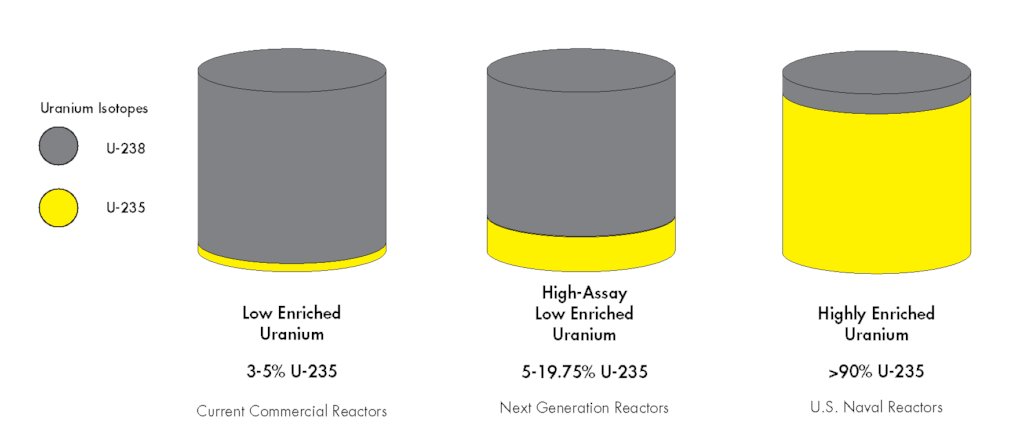
The International Atomic Energy Agency, the world’s nuclear watchdog, has a safeguards agreement that excludes naval reactors from probes. Simply put, an IAEA inspector can’t be expected to live on a nuke-powered sub for weeks to conduct oversight. As a result, non-nuclear weapons states can declare highly enriched uranium (HEU) for naval propulsion purposes and keep the IAEA from sniffing around that material
For Australia to have nuke-powered subs, it’s likely going to obtain the same HEU used in American and British vessels..
Could AUKUS give Iran a nuclear excuse? https://www.politico.com/newsletters/national-security-daily/2021/09/16/could-aukus-give-iran-a-nuclear-excuse-494362, By ALEXANDER WARD and QUINT FORGEY 09/16/2021 ”……………. During a private call with experts, administration officials failed to satisfactorily answer nuclear-related questions about the trilateral pact..
DARYL KIMBALL, director of the Arms Control Association, had serious questions about what providing Canberra with nuclear-propulsion technology for submarines meant for America’s long-standing nonproliferation policy.
Continue readingAustralia’s new nuclear submarines will have dangerous Highly Enriched Uranium, not the Low Enriched Uranium of the French ones.

The United States and UK operate naval reactors in their submarines that are fueled with 93.5 percent enriched uranium (civilian power plants are typically fueled with three to five percent uranium-235) in quantities sufficient to last for the lifetime of their ships (33 years for attack submarines).Having resisted domestic efforts to minimize the use of HEU and convert their naval reactors to LEU fuel, the United States and UK have no alternative fuel to offer. France, on the other hand, now runs naval reactors fueled with LEU. The new Suffren-class submarine, from which the French conventional submarine offered to Australia was derived, even runs on fuel enriched below 6 percent.
Until now, it was the US commitment to nonproliferation that relentlessly crushed or greatly limited these aspirations toward nuclear-powered submarine technology. With the new AUKUS decision, we can now expect the proliferation of very sensitive military nuclear technology in the coming years, with literally tons of new nuclear materials under loose or no international safeguards.
It is difficult to understand the internal policy process that led the Democratic Biden administration to the AUKUS submarine announcement. It seems that just like in the old Cold War, arms racing and the search for short-term strategic advantage is now bipartisan.
The new Australia, UK, and US nuclear submarine announcement: a terrible decision for the nonproliferation regime https://thebulletin.org/2021/09/the-new-australia-uk-and-us-nuclear-submarine-announcement-a-terrible-decision-for-the-nonproliferation-regime/
By Sébastien Philippe | September 17, 2021 On September 15, US President Joe Biden, United Kingdom Prime Minister Boris Johnson and Australian Prime Minister Scott Morrison launched a new major strategic partnership to meet the “imperative of ensuring peace and stability in the Indo-Pacific over the long term.” Named AUKUS, the partnership was announced together with a bombshell decision: The United States and UK will transfer naval nuclear-propulsion technology to Australia. Such a decision is a fundamental policy reversal for the United States, which has in the past spared no effort to thwart the transfer of naval reactor technology by other countries, except for its World War II partner, the United Kingdom. Even France—whose “contract of the century” to sell 12 conventional submarines to Australia was shot down by PM Morrison during the AUKUS announcement—had been repeatedly refused US naval reactor technology during the Cold War. If not reversed one way or another, the AUKUS decision could have major implications for the nonproliferation regime.
In the 1980s, the United States prevented France and the UK from selling nuclear attack submarines to Canada. The main argument centered on the danger of nuclear proliferation associated with the naval nuclear fuel cycle. Indeed, the nonproliferation treaty has a well-known loophole: non-nuclear weapon states can remove fissile materials from international control for use in non-weapon military applications, specifically to fuel nuclear submarine reactors. These reactors require a significant amount of uranium to operate. Moreover, to make them as compact as possible, most countries operate their naval reactors with nuclear-weapon-usable highly enriched uranium (HEU) fuel.
With tons of weapons-grade uranium out of international safeguards, what could go wrong?
The United States, UK, and Australia are giving themselves 18 months to hammer out the details of the arrangement. This will include figuring out what type of submarine, reactors, and uranium fuel will be required. Similarly, questions about where to base the submarines, what new infrastructure will be needed, how maintenance will be conducted, how nuclear fuel will be handled, and how crews will be trained—among many others—will need to be answered.
Australia has no civilian nuclear power infrastructure beyond a 20 megawatt-thermal research reactor and faces a rough nuclear learning curve. It will need to strengthen its nuclear safety authority so it has the capability to conduct, review, and validate safety assessments for naval reactors that are complex and difficult to commission.
How long this new nuclear endeavor will take and how much it will cost are anyone’s guesses. But the cancelled $90 billion (Australian) “contract of the century” with France for conventionally powered attack submarines will most likely feel like a cheap bargain in retrospect. Beyond these technical details, the AUKUS partnership will also have to bend over backwards to fulfill prior international nonproliferation commitments and prevent the new precedent created by the Australian deal from proliferating out of control around the world.
The United States and UK operate naval reactors in their submarines that are fueled with 93.5 percent enriched uranium (civilian power plants are typically fueled with three to five percent uranium-235) in quantities sufficient to last for the lifetime of their ships (33 years for attack submarines).Having resisted domestic efforts to minimize the use of HEU and convert their naval reactors to LEU fuel, the United States and UK have no alternative fuel to offer. France, on the other hand, now runs naval reactors fueled with LEU. The new Suffren-class submarine, from which the French conventional submarine offered to Australia was derived, even runs on fuel enriched below 6 percent.
So Australia is likely to receive HEU technology, unless an LEU crash program is launched that could take more than a decade to complete or in a dramatic reversal, France is pulled back into a deal—two scenarios that remain unlikely at this point and at any rate do not solve all proliferation concerns. Assuming the high-enrichment route is followed, if Canberra wants to operate six to 12 nuclear submarines for about 30 years, it will need some three to six tons of HEU. It has none on hand and no domestic capacity to enrich uranium. So unless it kickstarts an enrichment program for military purposes, the material would need to come from the United States or the UK.
One can only imagine the drops of sweat trickling down the neck of the International Atomic Energy Agency leadership in Vienna when an Australian delegation comes knocking at its door bringing the good news. The agency, which is currently battling to prevent Iran from acquiring enough fissile material to build a nuclear weapon—25 kilograms (0.025 ton) of HEU according to the internationally agreed standard—will have to figure out how to monitor and account for 100 to 200 times that amount without gaining access to secret naval reactor design information. Managing that feat while keeping its credibility intact will be difficult to pull off.
What could happen if AUKUS moves forward? France clearly feels “backstabbed” by its Anglo-Saxon allies and angered to the unimaginable point of cancelling a gala celebrating the 240th anniversary of the Revolutionary War Battle of the Capes during America’s war of independence. In response, the French could relax their position on not transferring naval reactor technology to Brazil as part of helping the country build its first nuclear attack submarine. South Korea just successfully launched a ballistic missile from a conventional submarine and recently floated the idea of starting a nuclear submarine program in response to growing nuclear threats from North Korea. Seoul could now ask the United States or other nations for an arrangement similar to Australia’s.
Russia could begin new naval reactor cooperation with China to boost China’s submarine capabilities in response to the AUKUS announcement. India and Pakistan, which already have nuclear weapons, could benefit from international transfers as well, possibly from France and China respectively. Iran, of course, has already expressed interest in enriching uranium to HEU levels to pursue a submarine program.
Until now, it was the US commitment to nonproliferation that relentlessly crushed or greatly limited these aspirations toward nuclear-powered submarine technology. With the new AUKUS decision, we can now expect the proliferation of very sensitive military nuclear technology in the coming years, with literally tons of new nuclear materials under loose or no international safeguards.
Domestic political opposition to the nuclear submarine deal is already brewing in Australia. The Green Party has announced that it will fight the deal “tooth and nail.” Meanwhile, Australian Prime Minister Morrison is very much struggling in the polls and could lose next year’s election—before the end of the 18-month review process announced by AUKUS. The nuclear submarine project could then be buried before it takes off, saving the international community further headaches.
But if Morrison gets re-elected and the program continues, it will be for the United Stated to take up its responsibilities as the guardian of the nonproliferation regime. Poor nuclear arms control and nonproliferation decisions—such as leaving the Anti-Ballistic Missile Treaty and approving the US-Indian nuclear deal—have so far been a trademark of the US Republican Party. It is difficult to understand the internal policy process that led the Democratic Biden administration to the AUKUS submarine announcement. It seems that just like in the old Cold War, arms racing and the search for short-term strategic advantage is now bipartisan.
New Zealand PM says Australian nuclear subs will NOT be welcome in country’s waters
New Zealand PM says Australian nuclear subs will NOT be welcome in country’s waters, https://7news.com.au/politics/federal-politics/australian-nuclear-subs-not-welcome-in-nz-c-3978704 7 News, Ben McKay, 16/09/20
Australia’s planned nuclear submarine fleet won’t be welcome in New Zealand, according to Prime Minister Jacinda Ardern.
The new submarines are the centrepiece of the new AUKUS security tie-up of Australia, the United States and the United Kingdom.
NZ has been left out of the AUKUS alliance, despite being a member of the Five Eyes intelligence-sharing network, along with AUKUS members and Canada.
The country has been staunchly nuclear-free for decades, earning the ire of treaty partner US by declining visits from its nuclear-powered ships.
“We weren’t approached by nor would I expect us to be,” Ardern said.
“Prime Minister Morrison and indeed all partners are very well versed and understand our position on nuclear-powered vessels and also nuclear weapons.
Australia’s planned nuclear submarine fleet won’t be welcome in New Zealand, according to Prime Minister Jacinda Ardern.
The new submarines are the centrepiece of the new AUKUS security tie-up of Australia, the United States and the United Kingdom.
NZ has been left out of the AUKUS alliance, despite being a member of the Five Eyes intelligence-sharing network, along with AUKUS members and Canada.
The country has been staunchly nuclear-free for decades, earning the ire of treaty partner US by declining visits from its nuclear-powered ships.
“We weren’t approached by nor would I expect us to be,” Ardern said.
“Prime Minister Morrison and indeed all partners are very well versed and understand our position on nuclear-powered vessels and also nuclear weapons.
That of course means that they well understood our likely position on the establishment of nuclear-powered submarines and their use in the region.”
Ardern said by law, and by a consensus of NZ’s major political parties, nuclear-powered vessels would not be welcome.
“Certainly they couldn’t come into our internal waters,” she said.
Ardern declined to say whether it would be appropriate for Australia’s new fleet to sail in the Pacific but welcomed interest from the US and the UK in the “contested region”.
“I am pleased to see that the eye is being tuned to our region, from partners that we work closely with.”
Some Kiwi experts believe the AUKUS formation shows an Australian acquiescence to US foreign policy.
“It highlights that much deeper level of Australian integration into US defence and security planning and thinking,” Victoria University professor David Capie told The Guardian.
“New Zealand and Australia were in a different space to begin with and this has perhaps just made that look sharper again.”
Ardern said the new alliance “in no way changes our security and intelligence ties with these three countries”.
NZ’s opposition is less sure, with leader Judith Collins saying other aspects of the defence alliance would be worth involvement.
”No need to relax the ban on nuclear energy ”- Scott Morrison
There’s no need to do that’: Prime Minister rejects calls for nuclear power in Australia, Prime Minister Scott Morrison has quashed the hopes of Australian nuclear energy advocates, despite agreeing to a new nuclear-powered submarine deal with the Unites States.Sky News 17 Sep 21
Australia contains a third of the world’s uranium, but the Prime Minister told Ben Fordham “there’s no reason for Australia to need to” relax the ban on nuclear energy.
The reactors powering the new submarines will be built overseas and imported.
“This doesn’t require the development of Australia’s civil nuclear capability.
“Australia has capability here – we don’t come to this new – but in terms of going ahead with a civil nuclear capability, that is not something that is linked to this decision.” https://www.2gb.com/theres-no-need-to-do-that-prime-minister-rejects-calls-for-nuclear-power-in-australia/
US President Joe Biden appears to forget Scott Morrison’s name (it doesn’t really matter)
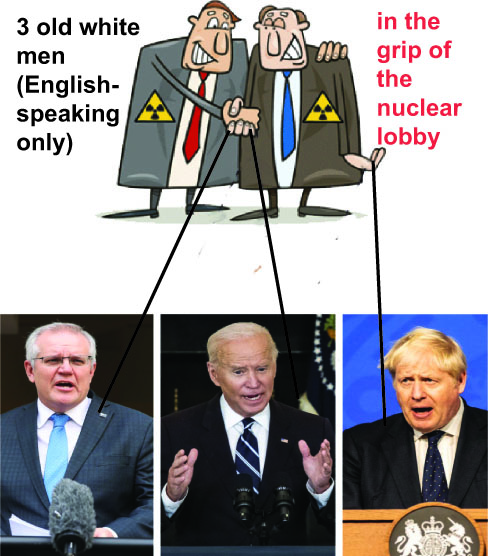
(ED. Biden only wants to sell USA nuclear stuff to any willing buyer. Poor old #ScottyFromMarketing just wants a bit of military glory, leading upm to the Australian election)
US President Joe Biden appears to forget Scott Morrison’s name in embarrassing blunder, Aamer Madhani and Jonathan Lemire, AAP/7NEWS : Thursday, 16 September 2021
“”…………Thank you Boris, and I want to thank that fellow Down Under,” Biden said.“Thank you very much, pal! Appreciate it, Mr Prime MinisterAttempting to backtrack, Biden quickly addressed the PM by his name – but unfortunately for Joe, the damage was done …. https://7news.com.au/politics/joe-biden/biden-hails-new-aukus-defence-pact-c-3977425
France angry at Australia’s cancellation of submarine pact
France vents subs anger with recall of Australian, US envoys, AFR Hans van Leeuwen, Europe correspondent Sep 18, 2021 –London | France has issued a diplomatic slap in the face to Canberra and Washington, recalling its ambassadors to vent its displeasure at the cancellation of Australia’s $90 billion submarine contract with state-controlled defence company Naval Group.
The move signals a potentially serious rupture in Franco-Australian relations, after Foreign Minister Jean-Yves Le Drian publicly described Australia’s switch to a maritime security pact with the US and Britain as “a stab in the back”.
This exceptional decision is justified by the exceptional gravity of the announcements made on September 15 by Australia and the United States,” Mr Le Drian said in a statement on Friday (Saturday AEST).
“The cancellation of the Attack class submarine program binding Australia and France since 2016, and the announcement of a new partnership with the United States meant to launch studies on a possible future cooperation on nuclear-powered submarines, constitute unacceptable behaviour between allies and partners.”
Mr Le Drian said the “consequences directly affect the vision we have of our alliances, of our partnerships and of the importance of the Indo-Pacific for Europe”………
Although Australia’s French embassy has issued a statement arguing that the decision was made purely on technical grounds, the French government and commentariat has interpreted it as a political decision – and it will potentially rankle for years to come…… https://www.afr.com/world/europe/france-vents-subs-anger-with-recall-of-us-australian-envoys-20210918-p58srz
Buying nuclear-powered submarines now doesn’t make sense strategically, and it doesn’t make sense operationally.

White says Australia is now tied more closely to the US strategy against China, which is aimed at stopping Beijing from challenging American primacy. Australia’s eventual acquisition of eight nuclear-powered submarines is not going to make any difference to Xi Jinping’s calculations.
And if deterrence fails, and we end up going to war, will eight Australian submarines make any difference to the outcome? I don’t think it will,” White says.
Nuclear family: Setting a new course in submarine policy
The acquisition of nuclear-powered submarines promises to transform the Australian navy, but there are some uncomfortable realities Australia must also confront. AFR Andrew Tillett correspondent ’17 Sep 21, ‘……………. n Thursday, the Prime Minister unveiling plans to build nuclear-powered submarines in Adelaide with the help of the United States and United Kingdom.
Morrison, who places a high premium on secrecy, had explored the proposal with a tight-knit circle of aides and officials for 18 months. So classified was their work that officials in Defence’s Capability, Acquisition and Sustainment Group, including those overseeing the $90 billion French submarine project, found out the dat before. Morrison effectively destroyed one of the shibboleths of Australian public policy – that nuclear technology falls in the “too hard” basket.
…………….. “This is a big policy shift in Washington, DC,” says Hugh White, Australian National University emeritus professor of strategic studies.
Buying nuclear-powered submarines now doesn’t make sense strategically, and it doesn’t make sense operationally.
The acquisition of nuclear-powered submarines promises to transform the navy – just a handful of countries operate them – but there are some uncomfortable realities Australia must also confront.
…….. A Defence-led taskforce will spend up to 18 months assessing whether the British or American submarine is the best option, along with workforce, shipyard and training needs. The government maintains construction can still start in the latter part of this decade, but the new submarine will be delivered a couple of years later than the French one would have been.
But this is predicated on the project going well. If Australia wants to tinker with the design, that will add time. There are also capacity constraints in the US and UK. Their shipyards are busy and the construction of Australian reactors will need to be squeezed into production schedules.
And despite assurances that reactors will be sealed and Australia effectively just has to “plug” them in, it goes without saying this is technology that has never been used here before. So even a 2040 delivery date may be optimistic.
China challenge
By then, it may be too late. “The challenge we face from China is not a challenge that is going to emerge in the 2050s. It’s happening now. The timeframe is wrong,” White says. “[Buying nuclear-powered submarines now] doesn’t make sense strategically, and it doesn’t make sense operationally.”
White says Australia is now tied more closely to the US strategy against China, which is aimed at stopping Beijing from challenging American primacy. Australia’s eventual acquisition of eight nuclear-powered submarines is not going to make any difference to Xi Jinping’s calculations.
And if deterrence fails, and we end up going to war, will eight Australian submarines make any difference to the outcome? I don’t think it will,” White says.
…… White says he is not against eventually acquiring nuclear-powered submarines but the question Morrison should be asking is what boats best suit Australian objectives, not American.
White says the navy’s priority should be using submarines closer to Australian shores to protect shipping lanes. He says for the cost of 12 French submarines, or eight nuclear-powered ones, Australia could buy 24 Collins class size conventionally powered subs.
“The reason we have been driven towards a big boat is we have decided our most important role is helping the US to hunt Chinese submarines in the South China Sea and East China Sea,” he says. “You would sink more enemy ships with 24 boats than you would with eight nuclear-powered ones.”…………… https://www.afr.com/policy/foreign-affairs/nuclear-family-setting-a-new-course-in-submarine-policy-20210916-p58s9t
Pacific Forum Members Hold Third Briefing With Japan Regarding Fukushima Treated Nuclear Wastewater — Fukushima 311 Watchdogs

Thursday, 16 September 2021, 6:01 amPress Release: Pacific Islands Forum Secretariat Wed 15th September 2021—Pacific nations continue to raise questions and concerns in closed briefing sessions around plans by Japan to discharge over a million tonnes of treated water from the Fukushima Daiichi Nuclear Power Plant into the Pacific Ocean. The Government of Japan committed […]
Pacific Forum Members Hold Third Briefing With Japan Regarding Fukushima Treated Nuclear Wastewater — Fukushima 311 Watchdogs
Russian international envoy says that Australia’s acquisition of nuclear submarines imperils non-proliferation
Australia’s acquisition of nuclear technologies imperils non-proliferation — Russian envoy, https://tass.com/world/1339043, Canberra plans to use US technologies to build at least eight nuclear-powered submarines, the first of which will become operational in 2036
MOSCOW, September 17. /TASS/. Australia’s acquisition of technologies for producing nuclear-powered submarines may create issues for the nuclear non-proliferation system, Russian Permanent Envoy to International Organizations in Vienna Mikhail Ulyanov told the Rossiya-24 TV channel on Friday.
“Why exactly does Australia need to acquire these sensitive technologies? There is no reasonable explanation. At the same time, it is a fact that it can create problems for the nuclear non-proliferation regime on a global scale,” he pointed out.
On September 16, Australia, the United Kingdom and the United States announced the formation of a new security partnership to be known as AUKUS. Australia particularly plans to use US technologies to build at least eight nuclear-powered submarines, the first of which will become operational in 2036, as well as to equip its armed forces with US-made cruise missiles.
Canberra’s plan breaks an earlier defense contract inked with France, the biggest in Australia’s history. Paris has slammed the move as “a stab in the back.” China, in turn, warned that the creation of the AUKUS partnership would speed up the arms race, and called on the three member countries to abandon “the mentality of the Cold War era” and “narrow-minded geopolitical concepts”.
Secret nuclear submarine deal started in March

Like a scene from Le Carré’: how the nuclear submarine pact was No 10’s biggest secret
Only ten people in Britain knew about its plans to stand with Australia and the United States against Chinese aggression in the Indo-Pacific. This is how the deal was done The Times UK 17 Sept 21,
When the First Sea Lord was invited to a meeting at the Australian high commission in March this year, he had no idea of the magnitude of what was about to unfold. Admiral Sir Tony Radakin — described by colleagues as a “doer” — was asked by Vice-Admiral Michael Noonan, the Australian Chief of Navy, whether the British and Americans could help their ally to build a new fleet of nuclear-powered submarines……….. (subscribers only) https://www.thetimes.co.uk/article/like-a-scene-from-le-carre-how-the-nuclear-submarine-pact-was-no10s-biggest-secret-dj7z5f8bh
New Australia, Britain, and U.S. military alliance—AUKUS— a serious escalation of the new Cold War on China.

‘Anti-China’ Military Pact ‘Threatens Peace and Stability’ in Pacific, Groups Warn
“The announcement of the new Australia, Britain, and U.S. military alliance—AUKUS—represents a serious escalation of the new Cold War on China.” Common Dreams , KENNY STANCIL, September 16, 2021 Anti-war advocates are denouncing Wednesday’s formation of a trilateral military partnership through which the United States and the United Kingdom plan to help Australia build a fleet of nuclear-powered submarines—a long-term initiative broadly viewed as a challenge to China by Western powers determined to exert control over the Pacific region.
Although Australian Prime Minister Scott Morrison, U.K. Prime Minister Boris Johnson, and U.S. President Joe Biden did not mention Beijing during their joint video announcement of the so-called AUKUS alliance, “the move is widely seen as a response to China’s expanding economic power, military reach, and diplomatic influence,” the Washington Post reported. “China is believed to have six nuclear attack submarines, with plans to increase the fleet in the next decade.”
The Guardian noted that it could take more than a decade for AUKUS to develop submarines propelled by enriched uranium—which allow the attack vessels to operate more quietly and remain deployed for up to five months—”but once at sea, the aim is to put Australia’s currently diesel-powered navy on a technological par with China’s navy, the world largest.”
In addition to “cooperation on naval technology,” the newspaper reported, “the partnership will involve closer alignment of regional policies and actions, and greater integration of the militaries and the defense industries of the three allies,” which “also intend to work together on cyberwarfare and on artificial intelligence capabilities.”
In response to the development, the British chapter of the No Cold War coalition said Thursday in a statement that “the new anti-China military alliance forged between Australia, Britain, and the U.S.—AUKUS—is an aggresive move which threatens peace and stability in the Pacific region.”
According to the coalition of nearly two dozen peace groups, the creation of AUKUS “follows the recent sending of a British warship to the South China Sea in an aggressive and provocative gesture of support for the U.S.’s massive military build-up against China.”
“It should be noted,” the coalition continued, “that New Zealand is not participating in this aggressive military alliance and it’s no nuclear policy means that Australian nuclear-powered submarines will be banned from New Zealand’s ports and waters.”
“It is against the interests of the British people, the Chinese people, and all of humanity for Britain to join the U.S. and Australia in racheting up aggression against China,” No Cold War added. “The world needs global cooperation to tackle shared threats of the pandemic and climate change, not a new Cold War.”
Anti-war progressives from Australia and the U.S. have also condemned the new military alliance.
“It was only a few weeks ago that a generation-long war in Afghanistan came to an end,” Alison Broinowski of the Independent and Peaceful Australia Network, said in a statement shared prior to the official launch of AUKUS. “Instead of reflecting on the pointlessness and horror of U.S. militarism, Australia and the U.S. are already talking about their next military adventure.”
“How can Australia assert an independent and peaceful foreign policy with a military that is so integrated into the U.S.?” Broinowski asked.
During his remarks publicizing the pact, Biden claimed that “we need to be able to address both the current strategic environment in the region, and how it may evolve, because the future of each of our nations, and indeed the world, depends on a free and open Indo-Pacific enduring and flourishing in the decades ahead.”
China Is Not Our Enemy, a project of U.S.-based peace group CodePink, responded by asserting that “if Biden and the Pentagon really want to ‘ensure peace and stability’ in the region, they could simply stop dealing missiles, weapons, [and] nuclear tech to Australia, Japan, South Korea, and Taiwan that escalate conflict and threaten global safety.”
Officials in Beijing also criticized the agreement, with China’s Foreign Ministry spokesperson Zhao Lijian reportedly calling the U.S. and U.K.’s decision to export extremely sensitive nuclear technology to Australia an “extremely irresponsible” move that exposes “double standards.”
AUKUS “seriously undermines regional peace and stability, aggravates the arms race, and hurts international nonproliferation efforts,” Zhao added.
Describing AUKUS as a “disastrous” deal, CodePink co-founder Medea Benjamin tweeted Wednesday that Australia, the U.K., and the U.S. “are ratcheting up the tension that could easily lead to a nuclear war with China.”
Amid growing concerns that Washington’s increasingly hostile approach to China could escalate into a full-blown military conflict, nearly 50 advocacy organizations in July sent a letter to Biden and members of Congress in which they argued that “nothing less than the future of our planet depends on ending the new Cold War between the United States and China.” https://www.commondreams.org/news/2021/09/16/anti-china-military-pact-threatens-peace-and-stability-pacific-groups-warn
Of course Tony Abbott has to put his pro nuclear oar in.

Tony Abbott says Australia’s decision to secure nuclear submarines sends a message of ‘don’t mess with us’
Tony Abbott says Australia’s trilateral security partnership with the United Kingdom and the United States indicates “we are prepared to act to meet the common danger”. Bryant Hevesi Former Prime Minister Tony Abbott says Australia’s landmark deal to acquire at least eight nuclear-powered submarines through a new trilateral security partnership sends a message to other countries of “don’t mess with us”. ……
It’s a brave decision because it overturns decades of strategic caution and it’s an important decision because it indicates that we are going to stand shoulder-to-shoulder with the United States and United Kingdom………. https://www.skynews.com.au/australia-news/defence-and-foreign-affairs/tony-abbott-says-australias-decision-to-secure-nuclear-submarines-sends-a-message-of-dont-mess-with-us/news-story/620b73a358062f3808a3cf89faa790cd
Doubts about the nuclear submarines, do they make Australia less safe? Hugh White wonders.
What the submarine deal means for Morrison’s future, The Age, By David Crowe, SEPTEMBER 18, 2021 ”…………… Morrison has made sweeping decisions in the coronavirus pandemic, shutting borders and spending billions, but none is like the move to bolt Australia to the United States and the United Kingdom and build a new fleet of nuclear submarines……………
The toughest decisions are safely postponed until after the federal election due by May next year. Anxious about his prospects in the shipbuilding states of Western Australia and South Australia, Morrison promises more money for defence and more jobs for workers who lose from the cancellation of the French deal.
What he does not promise is that every submarine will be built in Australia. This is because the government’s immediate political objective is at odds with the country’s strategic imperative to replace today’s Collins-class submarines as soon as possible. Only after the election will voters know if the fastest way to deploy the new fleet is to have the first vessels built by the British or Americans.
So there is a tactical move embedded in the strategic shift.
…….. But there are real concerns the Prime Minister could lead the country into greater danger, or at least leave it exposed.
…… This will be a defining argument for the next 18 months. If this call is so fundamental to Australian security, why is Morrison so comfortable with such a long wait for delivery? The alternatives are to buy US submarines that are already in the water as the US deploys newer vessels over time, or place orders for new submarines built overseas.
…… Is this as significant as ANZUS, as Morrison claims? “It is not,” says John McCarthy, a senior adviser to Asialink at the University of Melbourne and a former ambassador to the US, Indonesia, Japan and India. “I simply cannot see that changing the type of submarine, albeit important, makes a hell of a lot of difference. I don’t buy the hype.”
McCarthy does not take issue with the shift to nuclear or the strengthening of the US and UK alliances, but he worries about the breach with France and the message to Asia. After decades of greater engagement in Asia, the government has chosen to tighten the knot with the Anglosphere, yet France is a greater power in the Pacific than Britain. Only months ago, Morrison sought support from French President Emmanuel Macron to counter China………..
| “The easy thing is to assume that what’s worked for us in the past is going to work for us in the future,” says Hugh White, professor emeritus at the Australian National University.“The easy thing is not to recognise that Australia has to look after itself in the new order in Asia. It is to assume that we can rely on America and, God save us, the British to look after us and all we have to do is help them. That’s the way we’ve thought about our security for 150 years……. White believes a bigger fleet of conventional submarines could be more effective and doubts the nuclear fleet can arrive before 2040, but he also questions whether this is significant for China. “If the Chinese go and push ahead anyway, and we end up in a war, I don’t think it is going to make a very big difference as to who is going to win or lose,……………….. https://www.theage.com.au/politics/federal/what-the-submarine-deal-means-for-morrison-s-future-20210917-p58sjo.html |
The Australian submarine agreement: Turning nuclear cooperation upside down
The Australian submarine agreement: Turning nuclear cooperation upside down, Bulletin By Ian J. Stewart | September 17, 2021 The UK and US have announced they will support Australia in development of a nuclear submarine fleet and will provide (conventionally armed) Tomahawk cruise missiles. This is one of those exceedingly rare and exceedingly significant announcements that come along only every decade or so. The announcement literally turns existing precedence and practice on their heads in order to extend traditionally northern hemisphere cooperation to Australia and bolster its role in countering an increasingly assertive China. While much is not yet known, some of the ramifications and implications of this development are discernable.
Before considering the announcement’s specific implications, it is worth reiterating how exceedingly rare and significant it is. Many in the nonproliferation and strategic studies field will draw a parallel between this announcement and the 2005 announcement that the United States would renew civil nuclear cooperation with India. The so-called AUKUS declaration, like the other, was made with the grand purpose of securing an additional strategic ally against the rising China. However, neatly associated with both is also an expectation that domestic industries will benefit from access to a new market.
…. In this announcement, the United States and UK are overturning decades of accepted practice to support the transfer of a strategic capability to another country. The decision is sure to irk China and accelerate the spiral towards a Cold War-style standoff, with renewed strategies of containment against the revisionist power. The initiative has also offended France, which had become closer to the UK and, to a lesser extent, the US on nuclear matters in the last decade or so.
……. The Australian breakup with France is clearly not a happy one, with the French Embassy tweeting its contempt for how the announcement was made. On Friday, France announced it was recalling its ambassadors to the United States and Australia, calling the US-Australia agreement “unacceptable behavior between allies and partners.”
A second implication is for the nonproliferation regime itself. Much like the announcement of the US-India deal, AUKUS is already dividing the international security community. Many nonproliferation practitioners call foul, on the basis that, on the face of it, the announcement appears to cut across several norms, agreed rules, and accepted practices. The cooperation may be used by non-nuclear weapons states as more ammunition in support of a narrative that the weapons states lack good faith in their commitments to disarmament……..
A third implication involves precedence. There has been constraint in terms of naval nuclear reactor exports for many decades. However, several countries have been working to acquire naval nuclear reactors. Brazil is perhaps the first country that comes to mind. It will be argued by many that AUKUS reaffirms Brazil’s legitimacy in pursuing nuclear-powered submarines.
………. the British government is almost certainly thinking about it as a means to bolster Rolls Royce. The United States by law and by practice is particularly protective of its reactor technology. As such, the prospect of an independently designed UK reactor being sold to Australia could check a number of boxes.
The agreement may have an additional casualty in UK/French nuclear cooperation. …….. https://thebulletin.org/2021/09/the-australian-submarine-agreement-turning-nuclear-cooperation-upside-down/
THIS WEEK IN AUSTRALIA : NUCLEAR SUBMARINE SPECIAL.
Scott Morrison’s decision on nuclear submarines is his first foray into the murly world of Khaki electioneering. A pity that Joe Biden doesn’t even remember Morrison’s name. But no matter -the big thing is to sell super expensive U.S. nuclear technology to a willing, if somewhat ignorant and unimporrtant customer.
During the coming week, this website will feature the various aspects of this extraordinarily unwise decision, (while not ignoring other important Australian nuclear issues.)
1 This month.


PETITION – To: Prime Minister Anthony Albanese and the Australian Labor Government
Chernobyl: The Lost Tapes – A good documentary on Chernobyl on SBS available On Demand for the next 3 weeks– https://www.sbs.com.au/ondemand/tv-program/chernobyl-the-lost-tapes/235274195556
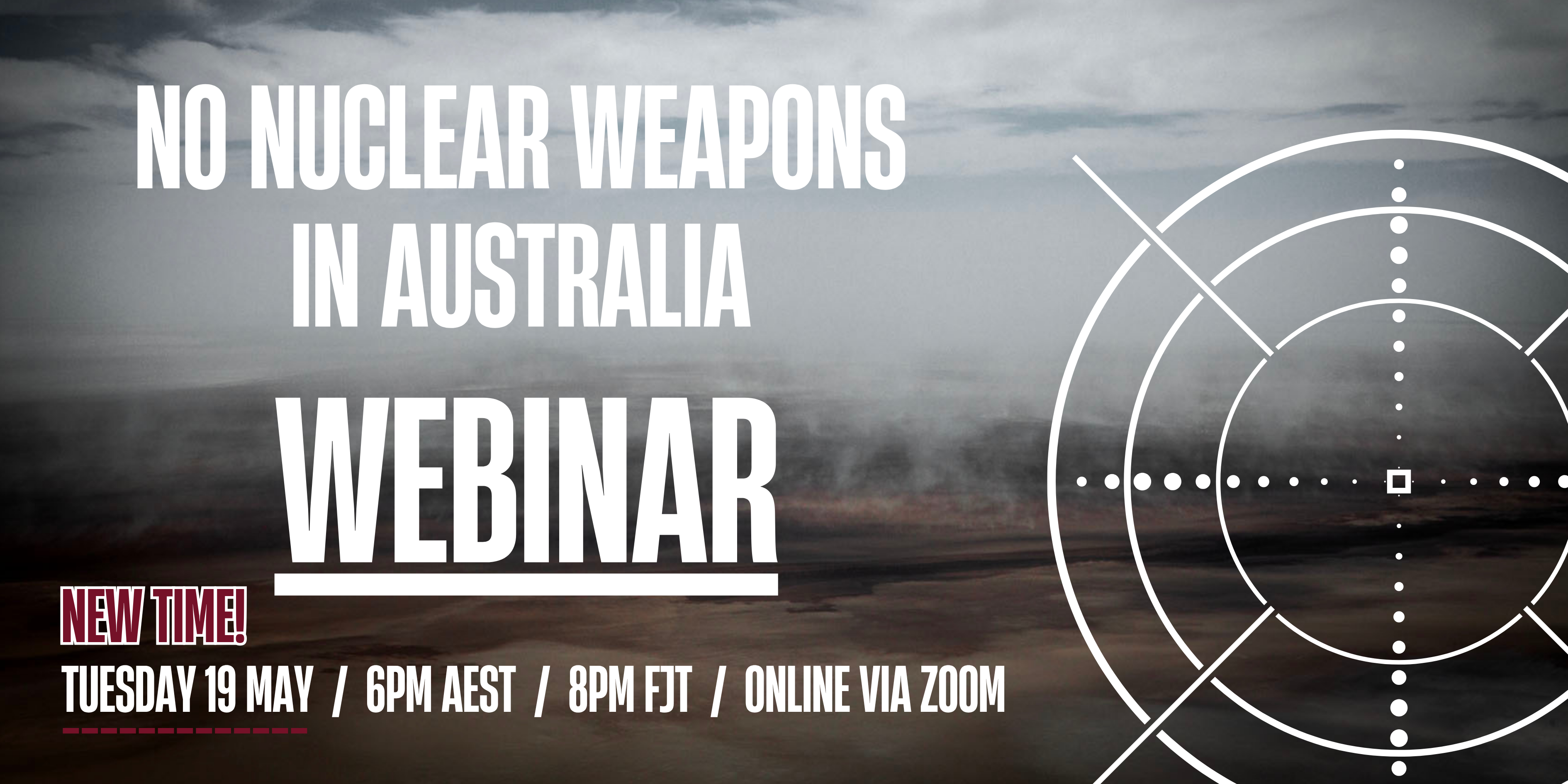
19 May – Webinar- Webinar: No Nuclear Weapons in Australia
Start: 2026-05-19 18:00:00 UTC Canberra, Melbourne, Sydney (GMT+10:00)
End: 2026-05-19 19:30:00 UTC Canberra, Melbourne, Sydney (GMT+10:00)
20 May – Webinar – The dangerous world of AUKUS, US, military occupation and suppression of dissent

National Webinar, 20th May, 2026, 6.30pm AEST. Confronting laws restricting/suppressing protest speech and action
Speakers: Former Sen. Rex Patrick, Lawyer Nick Hanna ,Arthur Rorris ,Jorgen Doyle, Sen David Shoebbridge,
Facilitator Kelley Tranter.

of the week – Australians for War Powers Reform (AWPR)
To see nuclear-related stories in greater depth and intensity
 Antinuclear