Regional site in Western Australia geologically and geographically suited to nuclear waste repositary, unlike the Kimba site in S.A.
West Australia site could house nuclear waste, Whyalla News, Louis Mayfield 22 July 21,
A regional site in Western Australia regarded by experts as one of the best sites in the world for nuclear storage should be used instead of Napandee for the federal government’s nuclear waste dump.
This is according to Peter Remta, the Executive Director of the Azark Project, who are developing an underground facility for the disposal of nuclear waste near Leonora in Western Australia.
Mr Remta said the site is within the Bardu Aboriginal peoples tribal land and is considered the best in the world for an underground disposal facility due to its geological structure.
“The Azark site is geologically and geophysically set in granite hard rock going from near surface to many kilometres in depth being a natural structure that has not moved,” he said.
“It is a natural structure that has not moved for over two billion years which makes it ideal in every respect for the geological burial of nuclear waste.”
The proximity to necessary infrastructure and amenities, access to a competent workforce, and high degree of security are other factors which Mr Remta says make Leonora an ideal nuclear waste storage site………..
By contrast, Mr Remta said there were many issues with siting a Nuclear Radioactive Waste Management Facility (NRWMF) at Napandee, near Kimba.
“The Napandee farm is in the heart of prime agricultural land, so there’s a very real possibility of completely decimating the agricultural industry of the Kimba region and a large part of the Eyre Peninsula,” he said.
Should this occur, Mr Remnta said it would go against all safety codes and prescriptions of the International Atomic Energy Agency (IAEA) and the Australian Radiation Protection and Nuclear Safety Agency (ARPANSA).
“Napandee is a completely unsuitable site to host the facility,” he said.
Federal Resources Minister Keith Pitt said the government did not receive detailed information to independently assess a site at Leonora, and couldn’t accept “unverified information” which could “cut short” the consultation and assessment process.
“Additionally, the communities around Leonora did not have the benefit of an in-depth consultation process, or the time to consider the details of the proposed facility,” he said.
“This stands in contrast to other communities who have had the benefit of extensive consultation to assist them make an informed decision on any proposed NRWMF.
“The selection of a suitable site will be the culmination of extensive technical work and consultation undertaken over a number of years.
“As the government has said previously, the site for the facility will be in a community that has demonstrated broad support.”………….https://www.whyallanewsonline.com.au/story/7352659/west-australia-site-could-house-nuclear-waste/?fbclid=IwAR2EQ5S2Z27iovKYFTm_CD8AOCtL967iA2RcZO3v-EscZz93Kq-hcWgktzY
Western Australian site far more suitable than Kimba, South Australia, for nuclear waste dump
Leonora site ‘ideal’ for N-dump, Andrew Probyn Kalgoorlie Miner, Tue, 3 November 2015 The man behind WA’s only short-listed site for a radioactive waste dump says the mulga scrub near Leonora would be an ideal home for the world’s spent nuclear fuel rods.
Glenn Baker, who owns 100ha submitted by the Shire of Leonora for a low and intermediate-level radioactive waste dump, said the area had the stable geology, environment and remoteness necessary for a world repository of nuclear waste……. https://www.kalminer.com.au/news/goldfields/leonora-site-ideal-for-n-dump-ng-ya-131750?fbclid=IwAR2SsUSc7MBhMP-3YKuEaXmVLtqiwU53FJbeVz-0iQKArCjQ57HJ6v8Qr5w
Nuclear power is not feasible for Australia
Nuclear is not feasible https://www.theage.com.au/national/victoria/nuclear-is-not-feasible-20210724-p58cl4.html
Your correspondent unfortunately ignores the time scale of any nuclear installation in eastern Australia (“Making the nuclear case”, Rod Cripps, Letters, The Sunday Age, 18/7).
Their massive water usage for cooling means a coastal installation (remember Japan’s Fukushima plant?). Where? It would take at least 15 years to get public approval of any site, by which time we will have burnt.
Nuclear can’t compete on price with even coal or gas, both of which are already becoming uncompetitive with renewables. To even consider it just gives our incompetent federal “denialista” more arguments for delaying critical action now.
The nuclear industry determined to influence climate talks before COP26
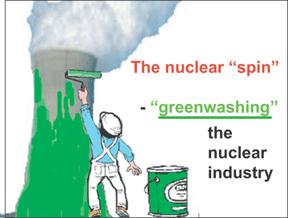
Nuclear industry under fire for trying to influence climate talks ahead of COP26. The National By Rob Edwards 25 July 21, HE nuclear industry has come under fire for trying to influence international talks in the run-up to the COP26 climate summit in Glasgow in November.
Six people from the European Nuclear Society registered to attend UN negotiations in May and June. Two were from the UK Government’s Magnox Ltd, which is decommissioning nuclear plants, and one was from the US nuclear firm, Westinghouse.
There were also 12 representatives from the International Atomic Energy Agency, the UN body charged with both promoting and regulating nuclear power, plus one from the Canadian Nuclear Association.
The nuclear industry was accused by environmentalists of “jumping on the bandwagon” of climate change. “The latest wheeze is to tell us that nuclear is the answer,” said Dr Richard Dixon, director of Friends of the Earth Scotland.
“With renewables and energy efficiency cheaper, quicker and safer than nuclear, they have already lost this argument and should have no place at COP26. The nuclear industry’s disastrous history of cost and time over-runs show very clearly that what they offer would be too little, too expensive and far too late.”
Pete Roche, policy adviser to the Scottish Nuclear Free Local Authorities, said: “When you look at nuclear power you find it is hopelessly expensive, far too slow to be of any use and hugely problematic – producing dangerous waste and with a potential risk of a serious accident.”……….. https://www.thenational.scot/news/19466992.nuclear-industry-fire-trying-influence-climate-talks-ahead-cop26/
A strong convention on radioactive waste safety means that nuclear’s toxic by-products should be kept as close as possible to the point of production
Paul Waldon Fight to Stop a Nuclear Waste Dump in South Australia ·
Remember “Claytons Beer.” A beer that’s not a beer.
Well, we have reached the 20 year anniversary of when “The Joint Convention,” came into force. The Joint Convention has been described as the first legal instrument to address used fuel rods and radioactive waste management safety across this earth.”So is it fair to say this a Claytons Convention?” Remember the beer didn’t have the alcohol content, only the taste.
This maybe nothing but a watered down “Basel Convention.” The Basel Convention was overlooking the safety of the populous by addressing the control of any transboundary movements of hazardous wastes and their disposal, which came into force in 1992, with over 170 members, and Australia becoming a member in 1992.
The Basel Convention’s charter makes mention that hazardous byproducts should be kept, managed and disposed of as close as possible to the point of production. However, radioactive products are exempt from the Basel Convention’s charter. I put it to you, to maintain the integrity of any legal instrument for handling radioactive products or by-products we should adopt the Basel Convention’s charter. That would install faith in the populous and any community that’s willing to embrace nuclear production will have to accept the product that’s produced there.
“No more yeah, buts”: Renewable ad campaign to combat myths and misinformation — RenewEconomy

Clean Energy Council launches new ad campaign to spur Australians to action, with the message that ‘renewables are here now’. The post “No more yeah, buts”: Renewable ad campaign to combat myths and misinformation appeared first on RenewEconomy.
“No more yeah, buts”: Renewable ad campaign to combat myths and misinformation — RenewEconomy
Australia sets new wind output record, breaks through 6,000MW for first time — RenewEconomy

Updated: Relaxation of constraints in South Australia allows wind energy to set third output record in a week in Australia’s main grid. The post Australia sets new wind output record, breaks through 6,000MW for first time appeared first on RenewEconomy.
Australia sets new wind output record, breaks through 6,000MW for first time — RenewEconomy
Investigation of uranium miners’health to be carried out by pro nuclear bodies

“They want to show that it doesn’t cause cancer. I think they want to find that result.”
for years, the CNSC has served both as a regulator and promoter of the nuclear industry
“It is concerning that health standards are set by physicists and industries, based on financial and technological convenience, rather than by those educated in and committed to public health and safety.”
Canadian Nuclear Safety Commission to Investigate Lung Cancer Rates Among Uranium Workers, Mother Jones
What’s happened to 80,000 people who have worked in Canada’s mines and processing facilities?CHARLES MANDEL, 25 July 21, The Canadian Nuclear Safety Commission (CNSC) is leading a national study examining incidences of lung cancer in uranium workers from across the country.
The Canadian Uranium Workers Study (CANUWS) will examine health data from 80,000 past and present employees at Canada’s uranium mines, mills and processing and fabrication facilities. The study, which is now underway and set to end in 2023, is the largest examination of lung cancer in Canadian uranium workers to date.
Rachel Lane, one of the lead researchers on the new study, told Canada’s National Observer she believes it will reassure workers they face less risk than before from lung cancer arising from exposure to radon, ……..
The $800-million mining and milling uranium industry employs over 2,000 people—of whom more than half are residents of northern Saskatchewan—at mine sites. The researchers plan to examine causes of death in uranium workers from 1950 on and chart their cancer data from 1970 onwards, using research from previous studies.
The new study will build on the results of two historical studies: the Eldorado study and the Ontario Uranium Mine Workers Study, both of which found elevated risks of lung cancer in uranium workers. During numerous follow-ups ending in 2015, both studies found lung cancer among miners was still more prevalent than in the general population………….
deaths from lung cancer associated with radiation were historically higher for uranium workers than the general male population……….
In 2015, a follow-up to the 2007 Ontario Uranium Miner Cohort study was done. It examined approximately 28,546 male and 413 female uranium miners who had worked at least one week in the Elliot Lake and Bancroft regions or at the Agnew Lake Mine between 1954 and 1996.
The conclusion: “Significant elevations in lung cancer mortality and incidence, as well as silicosis and injury mortality were observed in comparison with the general Canadian population.”……….
Anne Leis, the department head of Community Health and Epidemiology at the University of Saskatchewan, will administer the project and analyze the data. Her colleague, Punam Pahwa, a professor of biostatistics, will lead the statistical analysis of the health data……….
Uranium mining companies Cameco, Orano, and BWXT are co-funding the study, contributing $60,000. The CNSC is providing $125,000, while the Saskatchewan government is kicking in $60,000, and the University of Saskatchewan is contributing $90,000 of in-kind funding.…………
Concerns Over Possible Bias
While former employees and industry watchers applaud efforts to study the health of uranium workers, some are skeptical about the ability of CNSC to produce an unbiased report.
Jamie Kneen, communications and outreach coordinator at Mining Watch Canada, says it’s important to understand the longer-term impacts of radon on the miners. But he cautions that the peer review and oversight of the study must be carefully examined because it is being led by CNSC.Kneen contends that for years, the CNSC has served both as a regulator and promoter of the nuclear industry. “Their tendency has been to extend license periods and to give operators, whether it’s in the uranium industry or the nuclear power industry, more space, more time in terms of licensing and more leeway rather than the kind of tight supervision and oversight that the public probably would expect.”
Therefore, it’s a question of scrutinizing who’s doing the work and reviewing the study to ensure that it really is independent, according to Kneen. He notes that’s a difficult task given that the methodology around radiation is intricate and that not many people can decipher the technical details.
“So there’s a lot of potential for not necessarily deliberate manipulation, but for error to creep in and biases to creep in.”
Rod Gardiner, a former general foreman at the now-defunct Cluff Lake Mine in Saskatchewan, expresses his own concerns about the industry. Gardiner was at the mine for 33 years, working his way up to general foreman and acting mine manager.
He alleges management at Cluff Lake, which was owned by the multinational mining corporation Orano Group, consistently boasted that working in the mine was as safe as working in a supermarket and putting prices on soup cans. “That’s what they used to say, the company.”
He hopes a new study might answer questions about workers’ health. But others aren’t sure whether results will be trustworthy, primarily because the CNSC is partially funding and leading the study.
The CNSC’s work has been subject to just those kinds of complaints in the past.
Writing in the journal Canadian Family Physician in 2013, Dale Dewar and two other authors expressed concern over the CNSC’s ability to act independently of government and industry. The authors noted the former Conservative federal government fired the commission’s CEO when she applied safety guidelines to shut down the Chalk River reactor in Ontario.
The authors observed: “It is concerning that health standards are set by physicists and industries, based on financial and technological convenience, rather than by those educated in and committed to public health and safety.”
Dewar, a longtime general physician in northern Saskatchewan, recently told Canada’s National Observer: “They want to show that it doesn’t cause cancer. I think they want to find that result.”
Dewar expressed surprise that the CNSC has opted for a focused study when northerners have been asking for decades for a baseline health study to determine such things as whether or not there have been increases in autoimmune diseases or cancers that couldn’t be explained by diet, for example.
“I think not only is it virtually a sin that they’ve never done this, but I think it’s a really huge missed opportunity because if they had a study done like this, they would have researchers around the world trying to get information out of it.”…………
Compensation for Uranium Workers
Another, less discussed issue is compensation for uranium miners. In the United States, the Radiation Exposure Compensation Act (RECA) administered by the Department of Justice has awarded over US$2.4 billion in benefits to more than 37,000 claimants since its introduction in 1990. https://www.motherjones.com/environment/2021/07/canadian-nuclear-safety-commission-to-investigate-lung-cancer-rates-among-uranium-workers/
Radioactive cesium found in honey produced near Fukushima Daiichi nuclear power plant

Cesium exceeding the standard in honey produced near the Fukushima Daiichi nuclear power plant in Japan https://www.newsdirectory3.com/cesium-exceeding-the-standard-in-honey-produced-near-the-fukushima-daiichi-nuclear-power-plant-in-japan/?fbclid=IwAR14svkp8cegftROdHB3KZDmQPYPNKW3UOmJK99m85ydVnwXG7ZqPlmjzqQ
written by News Dir July 24, 2021 The Yomiuri Shimbun reported on the 23rd that cesium, a radioactive substance exceeding the standard, was detected in honey produced in Namie-machi, Fukushima Prefecture, Japan.
According to the report, Fukushima Prefecture announced on the previous day that 130 to 160 becquerels of cesium were detected in honey produced by the beekeeping department of the Sawakami Management and Cultivation Association in Namie-machi, which exceeds the government standard of 100 becquerels per kilogram (㏃).
Namie-machi is an area near the Fukushima Daiichi Nuclear Power Plant, and there are still many ‘difficult-to-return areas’ where decontamination work of antiseptic materials has not been completed.
This is the first time that cesium exceeding the standard has been detected in honey in Fukushima Prefecture. The Sawakami Management and Cultivation Association is recovering honey that was sold at local stores and other stores, Yomiuri said.
By Kwon Jae-hee, staff reporter jayful@asiae.co.kr
Climate change, extreme weather, is taking its toll on the nuclear industry

Nuclear power’s reliability is dropping as extreme weather increases
A comprehensive analysis shows that warmer temperatures aren’t the only threat. Ars Technica, K. E. D. COAN – 7/24/2021,With extreme weather causing power failures in California and Texas, it’s increasingly clear that the existing power infrastructure isn’t designed for these new conditions. Past research has shown that nuclear power plants are no exception, with rising temperatures creating cooling problems for them. Now, a comprehensive analysis looking at a broader range of climate events shows that it’s not just hot weather that puts these plants at risk—it’s the full range of climate disturbances.
Heat has been one of the most direct threats, as higher temperatures mean that the natural cooling sources (rivers, oceans, lakes) are becoming less efficient heat sinks. However, this new analysis shows that hurricanes and typhoons have become the leading causes of nuclear outages, at least in North America and South and East Asia. Precautionary shutdowns for storms are routine, and so this finding is perhaps not so surprising. But other factors—like the clogging of cooling intake pipes by unusually abundant jellyfish populations—are a bit less obvious.
Overall, this latest analysis calculates that the frequency of climate-related nuclear plant outages is almost eight times higher than it was in the 1990s. The analysis also estimates that the global nuclear fleet will lose up to 1.4 percent—about 36 TWh—of its energy production in the next 40 years and up to 2.4 percent, or 61 TWh, by 2081-2100.
Heat, storms, drought
The author analyzed publicly available databases from the International Atomic Energy Agency to identify all climate-linked shutdowns (partial and complete) of the world’s 408 operational reactors. Unplanned outages are generally very well documented, and available data made it possible to calculate trends in the frequency of outages that were linked to environmental causes over the past 30 years. The author also used more detailed data from the last decade (2010–2019) to provide one of the first analyses of which types of climate events have had the most impact on nuclear power.While the paper doesn’t directly link the reported events to climate change, the findings do show an overall increase in the number of outages due to a range of climate events.
The two main categories of climate disruptions broke down into thermal disruptions (heat, drought, and wildfire) and storms (including hurricanes,
typhoons, lightning, and flooding). In the case of heat and drought, the main problem is the lack of cool-enough water—or in the case of drought, enough water at all—to cool the reactor. However, there were also a number of outages due to ecological responses to warmer weather; for example, larger than usual jellyfish populations have blocked the intake pipes on some reactors.
Storms and wildfires, on the other hand, caused a range of problems, including structural damage, precautionary preemptive shutdowns, reduced operations, and employee evacuations. In the timeframe of 2010 to 2019, the leading causes of outages were hurricanes and typhoons in most parts of the world, although heat was still the leading factor in Western Europe (France in particular). While these represented the most frequent causes, the analysis also showed that droughts were the source of the longest disruptions and thus the largest power losses.
The author calculated that the average frequency of climate-linked outages went from 0.2 outages per year in the 1990s to 1.5 outages in the timeframe of 2010 to 2019. A retrospective analysis further showed that, for every 1° C rise in temperature (above the average temperature between 1951 and 1980), the energy output of the global fleet fell about 0.5 percent.
Retrofitting for extreme weather
This analysis also shows that climate-associated outages have become the leading cause of disruptions to nuclear power production—other causes of outages have only increased 50 percent in the same timeframe. Projecting into the future, the author calculates that, if no mitigation measures are put into place, the disruptions will continue to increase through the rest of this century.
“All energy technologies, including renewables, will be significantly affected by climate change,” writes Professor Jacapo Buongiorno, who was not involved in the study, in an email to Ars. Buongiorno is the Tepco Professor of Nuclear Science and Engineering at the Massachusetts Institute for Technology (MIT), and he co-chaired the MIT study on The Future of Nuclear Energy in a Carbon Constrained World. “The results are not surprising—nuclear plants can experience unplanned outages due to severe events (e.g., hurricanes, tornadoes) or heat waves, the frequency of which is increasing.”………….. https://arstechnica.com/science/2021/07/climate-events-are-the-leading-cause-of-nuclear-power-outages/
DN! “All We Can Save”: As Climate Disasters Wreck Our Planet, Women Leaders Are Key to Solving the Crisis — Rise Up Times

“We should care because this is the planet that we have to live on, right? Like, we can’t actually all leave the planet. And it is interesting that you opened this segment by talking about the balance of coverage. We are simply not seeing very much climate coverage at all in the mainstream media.”
DN! “All We Can Save”: As Climate Disasters Wreck Our Planet, Women Leaders Are Key to Solving the Crisis — Rise Up Times
Have We Outgrown Growth? — Rehabilitating Earth

By Caitlin Leney-Tillett Economic development has simultaneously perpetuated inequalities and depleted the world’s natural resources, the product of which is the climate crisis. Despite this, countries across the globe continue to choose unsustainable, fossil fuel-led development, deepening the crisis and closing the window of opportunity to overcome climate change. So, where did our addiction to […]
Have We Outgrown Growth? — Rehabilitating Earth
July 25 Energy News — geoharvey

Opinion: ¶ “We Cannot Short-Change Transit – Not Now” • Given the urbanization of our nation, the overdue focus on racial inequity, and climate change, our nation needs to invest much more in cleaner transportation options. Sadly, a bipartisan infrastructure bill could set transit up for long-term cuts in funding. We need to see that […]
July 25 Energy News — geoharvey
Submission: Leon Ashton opposes ANSTO’s flawed plan to set up a stranded nuclear waste dump at Kimba, South Australia
it is only a temporary measure until the other temporary measure of storing I.L.W. Is built. How many more temporary storage facilities will need to be constructed before a permanent disposal plan is found?
Submisson No. 2. Leon Ashton, 23 Jul 21, TO PARLIAMENTARY STANDING COMMITTEE ON PUBLIC WORKS CURRENT ENQUIRY: AUSTRALIAN NUCLEAR SCIENCE AND TECHNOLOGY ORGANIZATION INTERMEDIATE LEVEL SOLID WASTE STORAGE FACILITY LUCAS HEIGHTS NSW I I wish to make a submission to the public works committee in regards to the above matter. The biggest concern that I have with this application by ANSTO is that it appears as if it will still be built with a view that it is only a temporary measure until the other temporary measure of storing I.L.W. Is built. How many more temporary storage facilities will need to be constructed before a permanent disposal plan is found.
Dr. Allison McFarlane, a leading proponent from the Obama administration on Worlds Best Practice, (WBP) for the permanent disposal of nuclear waste has said high and intermediate level waste must be buried below the ground at a depth of 500 and 250 metres in deep stable granite. Why is this so hard to find in Australia. There must be several hundred sites in the Woomera Prohibited Area alone that would fit the bill. The millions and millions of tax payers dollars spent by this department in kicking the can down the road is disgraceful. It could have been put to good use to bring all vested parties together to follow W.B.P. For a permanent home for all our own nuclear waste.
We have heard this government department DISER argue that we do not have enough I.L.W. To warrant the cost of a deep permanent disposal site however, the hundreds of millions of dollars being spent at present do nothing to address the inevitable. Further more, the people of Kimba and Quorn and Hawker who have tried to seek answers to so many unanswered questions by this department, have realised long ago that there will never be a amicable outcome for any community if the I.L.W. Is moved from one temporary storage to another purely for political purposes. The trust that must be sought from any community has been destroyed forever. If an application is granted to temporarily store I.L.W. For more years at Lucas Heights, then how will this effect the Low Level Waste dump at Nappandee if it is approved and not the I.L.W. Storage approved?
Dr. Adi Patterson, the CEO of ANSTO has already stated that if any community does not get the I.L.W storage, there will be no economic benefits to the community. ANSTO has stated that this application if granted will be the cheapest option as it will be in their existing premises. How ever, as there are no increase in personnel numbers to put the I.L.W. in a new shed, why then are DISER falsely claiming a number of 45 jobs to guard the I.L.W at any other temporary storage site? This was stated by the federal minister for the environment Matt Canavan. Stating the only reason the massive job structure changed when trying to find a site for the Low Level Dump went from 8 to 45 was purely because he had decided the I.L.W would go to the site as well.
Submission: Flinders Local Action Group points out the flaws in ANSTO’s nuclear waste plan.
Intermediate Level Waste is the key element of greatest concern in the current NRWMF proposal.
• ANSTO has informed to us that Intermediate Level is the most dangerous and long-lived nuclear waste in Australia, with a toxic life in excess of 10,000 years. Our research tells us that in Europe little distinction is made between Intermediate and High Level waste – both remain potentially extremely dangerous over enormous time periods.
Subission No 5. Submission to the Parliamentary Standing Committee on Public Works, Greg Bannon, (On behalf of the Flinders Local Action Group 23 July 21,
SUBJECT: Australian Nuclear Science and Technology Organisation (ANSTO) Intermediate Level Solid Waste (ILSW) Storage Facility Lucas Heights, NSW
INTRODUCTION: The Flinders Local Action Group (FLAG) welcomes the opportunity to make a submission to this Public Works Standing Committee.
FLAG was formed to challenge the 2015 nomination of Wallerberdina Station in the Flinders Ranges district, and its inclusion on the shortlist of three potential South Australian sites for the proposed National Radioactive Waste Management Facility (NRWMF). The Group is made up of indigenous and non-indigenous members of the community.
We have become very well informed on the NRWMF proposal, seeking out and researching information from independent sources to weigh up against what has been provided to the community by the Department of Industry, Innovation and Science (DIIS – now the Department of Industry, Science, Energy & Resources, DISER). As both the proposer and promoter of the NRWMF, the Department cannot claim any sort of neutral position.
SUMMARY:
• ANSTO’s preferred Option 2 must be considered on the basis that interim storage will be until a permanent disposal site has been established. This would provide the licensing pathway to disposal required by the independent regulator, ARPANSA.
• There is no logic or economic sense in double-handling ILW from temporary storage at Lucas Heights to further temporary storage somewhere else, in preparation for yet another transfer to a third location for final disposal at some time in the future.
• There is no economic sense in establishing a facility for low level waste alone when a disposal site, critical for ILSW and more than suitable for LLW, is still to be established.
SUBMISSION POINTS:
Temporary Intermediate Level Solid Waste (ILSW) Storage:
The Department has guaranteed that all waste to be received at the NRWMF will be in a dry, compacted or compactable form. ANSTO defines ILSW as the result of conditioning Intermediate Level Liquid Waste under the Synroc process. In solid or liquid form, it is still Intermediate Level Radioactive Waste (ILRW). We do not accept any difference between what we have been opposing and refer to as ILRW, and ILSW.
Intermediate Level Waste is the key element of greatest concern in the current NRWMF proposal.
• ANSTO has informed to us that Intermediate Level is the most dangerous and long-lived nuclear waste in Australia, with a toxic life in excess of 10,000 years. Our research tells us that in Europe little distinction is made between Intermediate and High Level waste – both remain potentially extremely dangerous over enormous time periods.
Until now, the only plan for ILSW has been to remove it from temporary storage at Lucas Heights and transport it halfway across the country to a proposed NRWMF – still to be established. There it will remain in further temporary storage, for an undefined period, colocated
with Low Level Radioactive Waste.
• Temporary storage does not solve the national problem, which is the permanent, safe disposal for all of Australia’s nuclear waste, including the most dangerous and long-lived category, ILSW.
• ANSTO’s submission to the Standing Committee outlines five options “to assess the most efficient and effective approach to the design and construction of new storage capacity”.
We note that Option 2 (4.1.2. – ANSTO submission) “provides a direct continuation of existing operations for storing waste…(with the)…benefits of low capital outlay…minimalorganisational change…at low business risk make this the preferred option”.
• This would be of great encouragement to our Group if it means that ANSTO intends to continue interim storage of ILSW at Lucas Heights until the promised “single, state-of-the-art, world’s best practice radioactive waste management facility” (quotes from DIIS information) for the permanent disposal of both waste categories, ILW and LLW, is established.
• After more than 60 years of producing nuclear waste and 40 years of failed attempts to establish a national nuclear waste facility it is hard to accept that the only plan for the country’s most dangerous radioactive material continues to be temporary storage for an indefinite period of time. This would be a classic example of that over-used metaphor “kicking the can down the road”
National Radioactive Waste Management Facility:
If ILSW remains at Lucas Heights until a permanent disposal site is established, there is no necessity
for a facility to separately manage Low Level waste.
• The flaw in the NRWMF proposal has always been that, despite the Department’s assertion to the contrary, there was never to be a single national facility. Low level waste would be disposed of there, with Intermediate Level co-located alongside on a temporary basis, for an indefinite period, until a disposal facility was established somewhere else.
• The economic benefits promoted to the community from a nearby NRWMF were promised because the decision was announced to co-locate Intermediate Level Waste at the same site.
This was the reason given to both communities, Flinders and Kimba, for the Ministerial announcement that the 15 full-time equivalent jobs initially promised were suddenly increased to 45 along with a number of other economic incentives.
•Any site that is suitable for the permanent disposal of ILSW is suitable for the disposal of Low
Level waste.
CONCLUSION:
Our Group readily accepts the benefits that result from Australian atomic research and the production
of medical isotopes. We accept the need for a NRWMF to consolidate and dispose of all the
country’s nuclear waste in one location.
What is hard to accept, and still being experienced, are the disruptive and divisive effects this
process has had on our communities. Inflated promises of economic benefits have raised overly
optimistic expectations in some people. Cold, hard logic shows that these expectations will not be
met by the model that is currently being proposed. https://www.aph.gov.au/Parliamentary_Business/Committees/Joint/Public_Works/ANSTOLucasHeights/Submissions—
1 This month.
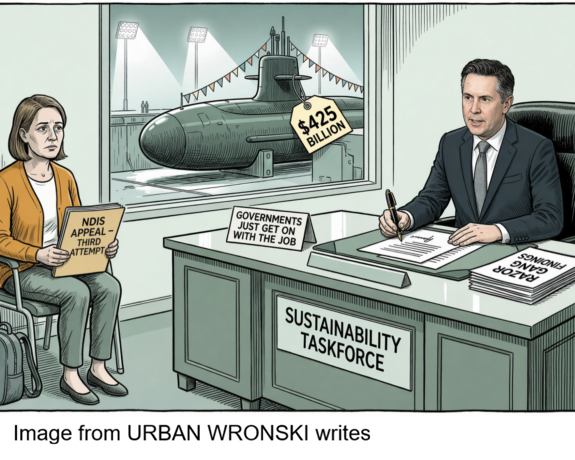

PETITION – To: Prime Minister Anthony Albanese and the Australian Labor Government
Chernobyl: The Lost Tapes – A good documentary on Chernobyl on SBS available On Demand for the next 3 weeks– https://www.sbs.com.au/ondemand/tv-program/chernobyl-the-lost-tapes/235274195556
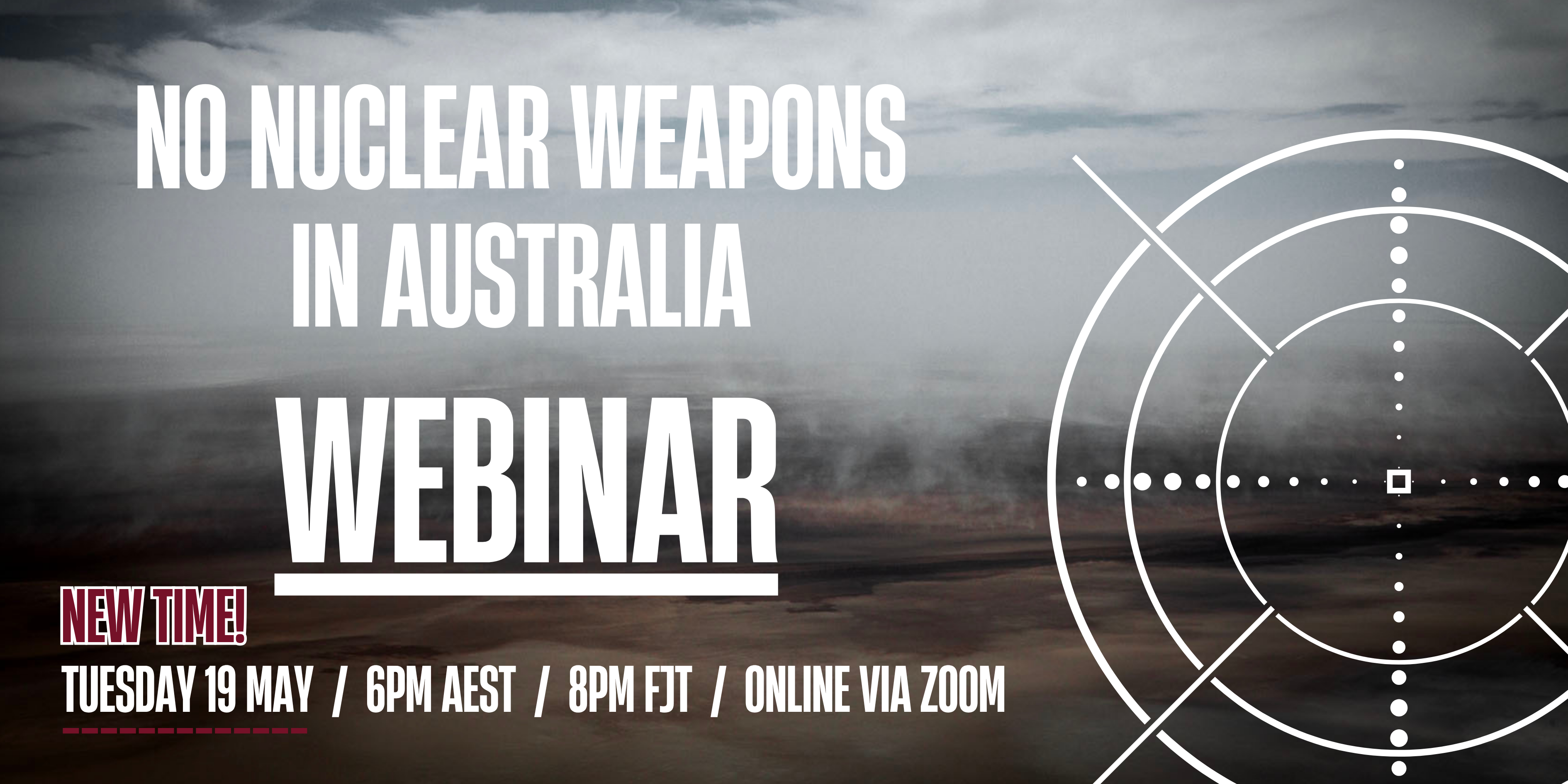
19 May – Webinar- Webinar: No Nuclear Weapons in Australia
Start: 2026-05-19 18:00:00 UTC Canberra, Melbourne, Sydney (GMT+10:00)
End: 2026-05-19 19:30:00 UTC Canberra, Melbourne, Sydney (GMT+10:00)
20 May – Webinar – The dangerous world of AUKUS, US, military occupation and suppression of dissent

National Webinar, 20th May, 2026, 6.30pm AEST. Confronting laws restricting/suppressing protest speech and action
Speakers: Former Sen. Rex Patrick, Lawyer Nick Hanna ,Arthur Rorris ,Jorgen Doyle, Sen David Shoebbridge,
Facilitator Kelley Tranter.

of the week – Australians for War Powers Reform (AWPR)
To see nuclear-related stories in greater depth and intensity
 Antinuclear