Hundreds dead as record-breaking heat wave hits Canada and United States

Key Points
Record highs of 4.5 degrees Centrigrade are attributed to climate change.
233 deaths have been reported beteen Friday and Monday in British Columbia
Schools and Covid-19 vaccination centres have been forced to close
Hundreds dead as record-breaking heat wave hits Canada and United States, ABC, Scores of deaths in Canada’s Vancouver area and large wildfires are likely linked to a gruelling heat wave, authorities said Tuesday, as the country recorded its highest-ever temperature amid scorching conditions that extended to the Pacific Northwest region of the United States.
At least 134 people have died suddenly since Friday in the Vancouver area, according to figures released by the region’s city police department and the Royal Canadian Mounted police.
The Vancouver Police Department alone said it had responded to more than 65 sudden deaths since Friday, with the vast majority “related to the heat.”
The chief coroner for the province of British Columbia, which includes Vancouver, said that it had “experienced a significant increase in deaths reported where it is suspected that extreme heat has been contributory.”
The service said in a statement it recorded 233 deaths in the wider British Columbia area between Friday and Monday, compared with 130 on average.
The deaths came as Canada set a new all-time high temperature record for a third day in a row Tuesday, reaching 49.5 degrees Celsius in Lytton, British Columbia, about 250 kilometres east of Vancouver, the country’s weather service, Environment Canada, reported.
Vancouver has never experienced heat like this, and sadly dozens of people are dying because of it,” police sergeant Steve Addison said.
Climate change is causing record-setting temperatures to become more frequent.
Globally, the decade to 2019 was the hottest recorded, and the five hottest years have all occurred within the last five years.
The scorching heat stretching from the US state of Oregon to Canada’s Arctic territories has been blamed on a high-pressure ridge trapping warm air in the region.
Temperatures in the US Pacific Northwest cities of Portland, Oregon and Seattle, Washington reached levels not seen since record-keeping began in the 1940s.
Homes are being evacuated due to wildfires…………… https://www.abc.net.au/news/2021-06-30/heatwave-kills-dozens-in-canada-us/100255480
Government economists accept reality and slash coal export forecasts — RenewEconomy

The government’s resources forecaster has significantly revised downwards their predictions of thermal coal exports. Is this the beginning of the end? The post Government economists accept reality and slash coal export forecasts appeared first on RenewEconomy.
Government economists accept reality and slash coal export forecasts — RenewEconomy
Conservative group says Germany could reach 100% renewables by 2030 at low cost — RenewEconomy

Conservative group says Germany could reach 100 pct renewables by 2030, and save $100 billion a year on energy imports. The post Conservative group says Germany could reach 100% renewables by 2030 at low cost appeared first on RenewEconomy.
Conservative group says Germany could reach 100% renewables by 2030 at low cost — RenewEconomy
| The conservative climate group KlimaUnion (ClimateUnion), which is made up of party members of the governing CDU/CSU alliance, has released a position paper in which the members argue that Germany could become the world’s first industrialised country running on 100-percent renewable energy supply as early as 2030 and simultaneously reduce citizens’ expenses on transport, heating and power use. The group was founded in April with the aim of pushing the conservative bloc to adopt climate policy in line with the Paris Agreement’s 1.5°C target. In the paper, KlimaUnion argues that Germany could save up to 63 billion euros ($A100 billion) in energy imports per year if it manages to achieve a complete transition to renewable energy, which could be turned into a “growth booster” in the wake of the coronavirus pandemic. Renew Economy 30th June 2021 https://reneweconomy.com.au/conservative-group-says-germany-could-reach-100-renewables-by-2030-at-low-cost/ |
Video: New electric motorcycle launched in Australia — RenewEconomy

Nigel Morris test rides the all-new electric Evoke, and talks to its distributors. The post Video: New electric motorcycle launched in Australia appeared first on RenewEconomy.
Video: New electric motorcycle launched in Australia — RenewEconomy
June 30 Energy News — geoharvey

Opinion: ¶ “Japan’s Nuclear Wastewater Plan Clouded By Politics” • The Japanese government’s approval of a plan to discharge treated radioactive water stored at the Fukushima Daiichi nuclear plant into the Pacific Ocean stands out as a reversal of a decade of nuclear safety reform in Japan. Indeed, the issue suffers from an unfortunate lack […]
June 30 Energy News — geoharvey
Nuclear news – this last week of June
Pandemic. Daily Update: What you need to know about the coronavirus around the world right now. World Coronavirus Dispatch: Three studies hint at where pandemic is headed.
Oh dear – I promised myself that I would not digress off into the pandemic discussion. But – I’m finding it scary – to come across people who think that the pandemic is not real, or that vaccination is some plot to take over the world, or who’ve decided that they don’t need vaccination.. Dammit – vaccination is our best bet.……
Climate. As if anti-vacc isn’t enough to worry about, now we’ve got climate complacency – possibly more dangerous than climate denialism – as global heating moves on inexorably. Hundreds of millions of people worldwide at risk from rising sea levels. Canada sets all-time record-high temperature as North America’s north-west cooks under ‘heat dome‘.
Nuclear. Well it’s the drums of war beating. The one thing that Wester conservatives and progressives agree on – we’d better boost our nuclear weapons ready for a war on China. Meanwhile, the promotion of new small nuclear recators goes on. See below – excellent article by Victor Gilinsky, Henry Sokolski, (highlighted in yellow)
A bit of good news – Park it! Why the world is greener.
AUSTRALIA.
Australia’s collective voice should silence the ‘drums of war‘. Federal nuclear waste dump plan.
- The Senate’s nuclear waste dilemma. Nuclear waste Bill passed. This is what will happen next. Within weeks, Minister Keith Pitt is expected to declare Napandee, (Kimba, South Australia) as the site for the nuclear waste dump.
- Barngarla Aboriginals and Kimba farmers join forces to fight nuclear waste dump plan. Barngarla people hold Native Title land close to planned nuclear waste dump, but were denied a vote on this.
- Need to reveal full details of nomination forms for Kimba and Wallerberdina nuclear waste dump plans. South Australian Minister Dan van Holst Pellekaan shuns Supreme Court Justice’s ruling to release Kimba nuclear documents.
- Australian Parliamentarians misled by Minister Pitt’s lies about nuclear medicine.
- Senator Hanson Young gave the clearest explanation of the issues around the government’s nuclear waste Bill. ‘ Senator Hanson-Young outlined the shambles that the nuclear waste siting process has been. Senator Rex Patrick explained why the Woomera prohibited area would be a more suitable site for a nuclear waste dump.
- OTHER
- Construction of ANSTO’s new intermediate waste facility at Lucas Heights –
- Australian government pushes to remove the ban on nuclear power. Morrison government bringing push for nuclear energy as an election issue.
- Lowy Institute polling shows that 91% of Australians want the federal government to support renewable energy development.
- ‘A new chapter’: NT town to be returned to traditional owners today Historic handback of Kakadu town to Mirarr traditional owners.
- Australian Local Government Association support Mount Isa nuclear weapons ban motion.
- Australia’s failed nuclear front group bites the dust.
INTERNATIONAL
Nuclear power is in the front line of climate change – and NOT in a good way. Ten reasons climate activists should not support nuclear. Rising sea levels might mean the end for many nuclear power stations. Increasing carbon emissions from uranium mining.
Increasing numbers of nuclear warheads globally.Nuclear fusion’s unlikely future, – too late for climate action.
Old cracked infrastructure – the Florida building collapse – a warning for old cracked nuclear reactors.
Australia’s failed nuclear front group bites the dust.

Ben Heard’s lobby group is closing down, June 2021: Heard’s ‘Bright New World’ group — which received secret corporate donations from the Nuclear Industry — is closing down.
Concerted efforts to have state and federal laws banning nuclear power have failed in recent years. At a guess, the corporate donors have given up and will no longer fund Bright New World.
A stocktake on Heard’s 10 years of pro-nuclear, anti-renewables campaigning: renewable capacity grew by an incredible 1500+ gigawatts worldwide and renewables now account for 30% of global electricity generation. Nuclear generation was stagnant and nuclear’s contribution to global electricity generation fell to 10%.In Heard’s home state of South Australia, renewables have grown to 60% of electricity generation and the conservative state government is enthusiastically committed to 100% net renewables by 2030.Heard’s efforts to turn South Australia into the world’s nuclear waste dump were equally unsuccessful.Good riddance to Bright New World. https://nuclear.foe.org.au/ben-heard-secret-corporate-donations/
Old cracked infrastructure – the Florida building collapse – a warning for old cracked nuclear reactors.

embrittlement, pipe cracking, component degradation, technical obsolescence, an aging workforce, rampant incompetence, and worse define the reality of virtually every operating atomic reactor, here and around the planet.
Collapsed Florida Condo Sends a Giant Nuke Warning https://readersupportednews.org/opinion2/277-75/70146-rsn-collapsed-florida-condo-sends-a-giant-nuke-warning, By Harvey Wasserman, Reader Supported News, 28 June 21 he horrifying collapse of a south Florida condo should alarm us all about the next reactor catastrophe.
The owners of that 13-story condo were warned years ago that it could implode. They were apparently getting ready for repairs, but in the interim did nothing.
The owners of America’s 93 licensed reactors have been warned for decades that they could both implode and explode. They have also done nothing.
More than 150 people may have died in this avoidable Florida disaster. The death toll from the next avoidable reactor disaster could stretch into the millions, with property damage in the trillions, a blow from which our economy and ecosystems might never recover.
South Florida authorities have now ordered inspections of large buildings over forty years old. Nearly all US reactors – including four on the ocean in South Florida – are also now around forty years old.
They all must be immediately shut for rigorous inspection. To wait is to invite a radioactive version of what just happened to that condo.
The argument is not about nuclear power. It’s about basic sanity.
The industry is currently pushing “new” designs based on fusion, thorium, breeder technologies, molten salt, small modular, and more. None have been proven safe or effective in fighting climate chaos. Nor can they compete with renewables. None have a reasonable prospect of coming online before being completely left in the radioactive dust by accelerating advances in wind, solar, batteries, and LED efficiency.
All are certain to consume huge quantities of public money, pouring into private pockets (like those of Bill Gates) before failing utterly.
But they pale in importance alongside the 93 US reactors (there are some 430 worldwide) now plummeting toward certain catastrophe.
None of these reactors can get private liability insurance against an apocalyptic disaster. Most were designed in the pre-digital 1950s and ‘60s. Many were built with inferior materials and understanding.
Critical welds at California’s Diablo Canyon, for example, contain metal components long since banned. But Unit One continues to operate.
Critical concrete at New Hampshire’s Seabrook and Ohio’s Davis-Besse is crumbling. Fort Calhoun in Nebraska was flooded. Intake pipes at South Texas froze. Reactors in Ohio and Virginia have been damaged by earthquakes. Diablo is surrounded by earthquake faults set to deliver seismic shocks which a Nuclear Regulatory Commission resident inspector has said it can’t withstand. The owners of San Onofre want to bury their high-level wastes ONE HUNDRED FEET from the tide line. Meaningful evacuation planning is nonexistent at sites where nearby population centers have exploded since the original siting approval.
All these old reactors contribute to climate chaos with emissions of heat, radiation, and carbon. They suck up billions of gallons of precious water, then dump it or evaporate it with chemical, radioactive, and thermal pollution. In every case, our planet would benefit from their shutdown.
Virtually all US reactors are almost certainly embrittled, meaning emergency cooling water poured into the core to quell a meltdown would shatter critical components, resulting in apocalyptic hydrogen and possibly fission explosions, as at Chernobyl and Fukushima.
To put it most simply: no embrittled reactor has a workable set of brakes. Yet states like California, and the NRC itself, refuse to conduct relatively cheap and simple open inspections.
Thus embrittlement, pipe cracking, component degradation, technical obsolescence, an aging workforce, rampant incompetence, and worse define the reality of virtually every operating atomic reactor, here and around the planet.
So when we look in horror at that collapsed south Florida condo, with all those innocent souls buried in the rubble, we must remember that later today, parallel pictures could show a mega-hot runaway reactor spewing Chernobyl/Fukushima levels of radiation throughout the ecosphere.
Thankfully, the Solartopian realities of fast-accelerating wind, solar, battery, and efficiency technologies give us the leeway to shut them all NOW.
Let’s do it before it’s too late!!
Harvey Wasserman co-convenes the weekly Election Protection 2024 ZOOM. His People’s Spiral of US History is at www.solartopia.org.
Australian Local Gov Association support Mount Isa nuclear weapons ban motion
Australian Local Gov Assoc pass Mount Isa nuclear weapons motion https://www.northweststar.com.au/story/7316487/australian-local-gov-assoc-pass-mount-isa-nuclear-weapons-motion/
Derek Barry ocal Government Association has supported Mount Isa City Council’s letter to the federal government looking for a nuclear weapons ban……..(subscribers only)
Portrait of a pro nuclear shill – Ben Heard
Ben Heard and the nuclear lobby group ‘Bright New World’ that accepts secret corporate donations

For factual rebuttals of the misinformation promulgated by other nuclear advocates, please visit: https://nuclear.foe.org.au/propaganda/
Ben Heard founded the South Australia-based ‘Bright New World’ nuclear advocacy group that accepts secret corporate donations from the nuclear industry.
Like so many other nuclear advocates, Heard very rarely or never says or does anything about the problems of the nuclear industry such as its systemic racism (abundantly evident in his home state, South Australia) or the inadequate nuclear safeguards system and the associated WMD proliferation risks.
A big part of Heard’s schtik is his conversion from a nuclear critic to a supporter. It is a back-story built on slender foundations. A mining industry magazine article said Heard was “once a fervent anti-nuclear campaigner” but in fact he never had any involvement whatsoever in anti-nuclear campaigning. Heard made no effort to correct the error in the magazine article — indeed he put the article, uncorrected, on his own website and only corrected it after the falsehood was publicly exposed. Likewise, Heard made no effort to correct an ABC article which described him as a “former anti-nuclear advocate”.
Heard has a recurring disclosure problem. He rarely disclosed his consulting work for uranium company Heathgate when spruiking for the nuclear industry. He said the reason he rarely disclosed his consulting work with Heathgate was that it was mentioned on his website. So any time you hear anyone speaking about anything in the media, it’s your responsibility to do a web-search to see if they have a financial interest! More recently, he rarely discloses corporate funding — indeed his lobby group has a policy of accepting secret corporate donations. Moreover, Heard rarely if ever discloses his connection to nuclear power company Energy. https://nuclear.foe.org.au/ben-heard-secret-corporate-donations/rrestrial Energy.
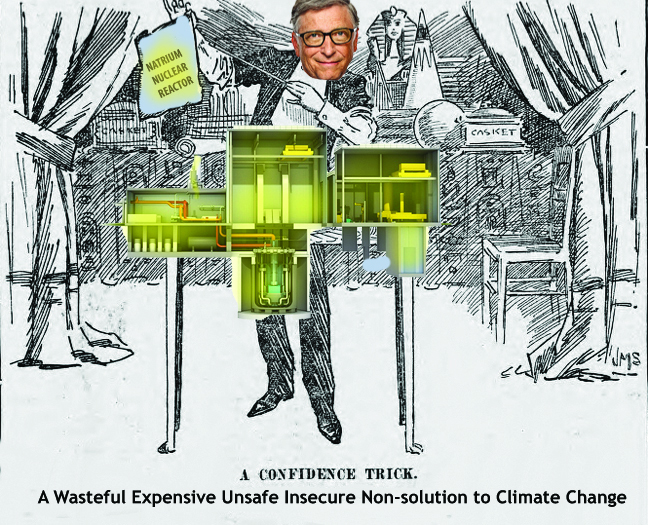
Serious questions about government funding Bill Gates’new confidence-trick, the NATRIUM nuclear reactor
Can we be sure that we will not end up with plutonium-fueled reactors coupled with reprocessing?
Dangerous Decisions about Advanced Nuclear Reactors Could Lead to New Threats https://portside.org/2021-06-27/dangerous-decisions-about-advanced-nuclear-reactors-could-lead-new-threats
Congress should have answers to tough questions before giving the Energy Department’s Advanced Reactor Development Program additional funding. June 27, 2021 Victor Gilinsky, Henry Sokolski
The Department of Energy’s recently launched Advanced Reactor Demonstration Program (ARDP) is slipping by without any close Congressional oversight, which is unfortunate as there are some serious questions that should be answered, including ones related to national security. The program was launched with an award of $160 million to TerraPower for its Natrium design and X-energy for its Xe-100. Each is to build a full-scale nuclear reactor within the next seven years, one that could be duplicated and sold commercially. While not a huge sum, it is intended to be the down payment on over $3 billion, a sum that is supposed to be cost-shared by the companies, with more for other projects.
At a March 25 Senate Energy Committee hearing on “advanced” reactors, executives of the two companies described a future with almost unlimited opportunities worldwide for their reactors, hundreds, maybe thousands. They got an enthusiastic reception from both sides of the aisle, summed up by Chairman Joe Manchin’s (D-WV) final observation that while wind and solar power were OK, “nuclear really does the job.” No one asked how the reactors will be fueled. Will they be fueled with nearly highly enriched uranium, or with plutonium? And what will be the security consequences of selling and encouraging reactors fueled with such fuels around the world?
Despite the enthusiasm for new technology, the “advanced” label is misplaced. These are re-engineered versions of old designs, some over fifty years old. “Advanced small modular reactors” trips off the tongues of people who think they are talking about the nuclear future, whereas in fact, they are talking about reviving the past.
“Small” is also an inaccurate label. Yes, there are lots of projects for small reactors, but they are a sideshow, for niche applications. The real action, the main ring, concerns larger units. TerraPower’s CEO, Chris Levesque, told the senators at the March 25 hearing that the company was pursuing a 300-megawatt (electric) unit because that was what today’s market would accept. But as it gained experience, TerraPower anticipated “growing Natrium output back up to gigawatt scale,” the size of current large light water reactors. The obvious conclusion is that TerraPower doesn’t think the smaller units would be economic, despite the current ballyhoo about the economic advantages of such units. Levesque thought there was a market for hundreds of the large units domestically and more abroad. As much of the talk was on competing with Russia and China, it is clear that the nuclear industry business plan centers on exporting the technology around the world.

Above – a different model – NuScale, but see the person indicated – this ”small” reactor is not small
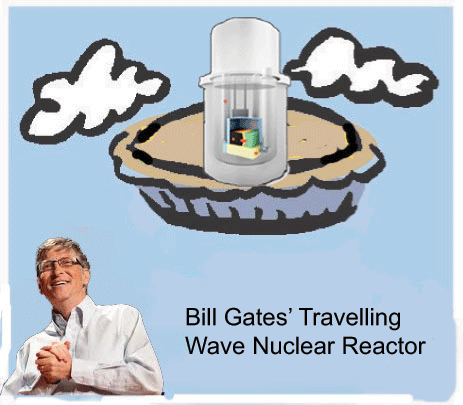
The Natrium reactor TerraPower has promised to build with DOE funds is not, as many people think, the highly advertised “traveling wave” reactor design that TerraPower pursued when started by Bill Gates. That idea involved the active (fissioning) reactor region slowly “traveling” from the center of the reactor core over the life of the reactor, “breeding” plutonium from uranium and fissioning it in place, therefore with no need for reprocessing. That Bill Gates was assumed to be a shrewd investor boosted the company’s credibility. The traveling wave idea didn’t work, but TerraPower retained the label for a different design, apparently because it aids marketing.
The Natrium reactor is a scaled-up version of a General Electric design for a small sodium-cooled, plutonium-fueled fast breeder reactor (natrium is German for sodium, and “fast” means it relies on energetic neutrons). This is the reactor the nuclear enthusiasts have wanted to build since Congress canceled the Clinch River Fast Breeder Reactor in 1983. The Atomic Energy Commission, the DOE’s predecessor agency, pushed the liquid metal fast breeder (LMFBR) reactors in the 1970s as the energy solution in what was thought to be a uranium-poor world. But it turned out we live in a uranium-rich world so the expensive LMFBR made no economic sense.
It also made no sense to flood the world with untold tons of plutonium when a few kilograms is enough for a bomb. That’s why Presidents Gerald Ford and Jimmy Carter made it U.S. policy to discourage commercializing of plutonium-fueled reactors. Enthusiasts tried but failed to revive fast reactors as part of the second Bush administration’s Global Nuclear Energy Partnership program. It appears they are trying again.

TerraPower’s CEO told the senate hearing that the Natrium reactor would be fueled with uranium enriched to just short of 20 percent U-235 (a level that America is trying to prevent Iran from enriching to). It’s the borderline between low and highly enriched uranium. That choice seems to be related to DOE’s interest in developing a large enrichment market for the DOE-created Centrus Corporation, which is a story in itself.
Widespread use of reactors in this mode would dramatically increase demand for enriched uranium. Will 20 percent enriched uranium remain the preferred fuel for Natrium, or will it revert to plutonium with reprocessing to meet foreign customer interest? (The original GE design included an onsite reprocessing plant.) So configured, the reactor would make and reuse massive quantities of material that could be used to create a bomb. Recently, the Senate armed Services Committee raised this worry with regard to China’s fast reactor program. Congress should nail down the answer to this key question with regard to DoE’s programs.
There is a natural tendency to loosen the financial reins on projects that fall into the research and development category. But the two ARDP projects are prototypes for the commercial market. Congress should have answers to tough questions before giving the Energy Department’s ARDP additional funding. A good start would be to ask: Can we be sure that we will not end up with plutonium-fueled reactors coupled with reprocessing?
Taylor wants CCS in Emissions Reduction Fund to help fossil fuel hydrogen — RenewEconomy

Taylor seeks new avenue to fund controversial technology a week after Senate blocked his attempt to expand ARENA’s remit to include CCS. The post Taylor wants CCS in Emissions Reduction Fund to help fossil fuel hydrogen appeared first on RenewEconomy.
Taylor wants CCS in Emissions Reduction Fund to help fossil fuel hydrogen — RenewEconomy
Department refuses to disclose details of Collinsville coal study approval process — RenewEconomy

The Morrison government has refused to release details of approvals for a controversial $3.6 million grant for a coal plant feasibility study. The post Department refuses to disclose details of Collinsville coal study approval process appeared first on RenewEconomy.
Department refuses to disclose details of Collinsville coal study approval process — RenewEconomy
Offshore wind: Taylor pushed to remove regulatory blocks to new technology — RenewEconomy

Labor says Australia’s first offshore wind projects at risk, after Angus Taylor delays removal of regulatory blockages. The post Offshore wind: Taylor pushed to remove regulatory blocks to new technology appeared first on RenewEconomy.
Offshore wind: Taylor pushed to remove regulatory blocks to new technology — RenewEconomy
Frydenberg talks up gas and CCS, skates over climate in Intergenerational Report — RenewEconomy

Coalition’s 198 page Intergenerational Report dedicates 119 words to climate mitigation, and says almost nothing about the risks of global warming. The post Frydenberg talks up gas and CCS, skates over climate in Intergenerational Report appeared first on RenewEconomy.
Frydenberg talks up gas and CCS, skates over climate in Intergenerational Report — RenewEconomy
1 This month.


PETITION – To: Prime Minister Anthony Albanese and the Australian Labor Government
Chernobyl: The Lost Tapes – A good documentary on Chernobyl on SBS available On Demand for the next 3 weeks– https://www.sbs.com.au/ondemand/tv-program/chernobyl-the-lost-tapes/235274195556

19 May – Webinar- Webinar: No Nuclear Weapons in Australia
Start: 2026-05-19 18:00:00 UTC Canberra, Melbourne, Sydney (GMT+10:00)
End: 2026-05-19 19:30:00 UTC Canberra, Melbourne, Sydney (GMT+10:00)
20 May – Webinar – The dangerous world of AUKUS, US, military occupation and suppression of dissent

National Webinar, 20th May, 2026, 6.30pm AEST. Confronting laws restricting/suppressing protest speech and action
Speakers: Former Sen. Rex Patrick, Lawyer Nick Hanna ,Arthur Rorris ,Jorgen Doyle, Sen David Shoebbridge,
Facilitator Kelley Tranter.

of the week – Australians for War Powers Reform (AWPR)
To see nuclear-related stories in greater depth and intensity
 Antinuclear