Senator Hanson Young gave clearest explanation of the issues around the government’s nuclear waste Bill

25 June 21, Senator Hanson -Young gave most lucid and logical exposition of the important and little recognised facts regarding the government’s proposals for a nuclear – radioactive to use the government’s terminology – waste management facility
She was the only senator to speak about the technical issues of the proposed facility who did not reprise the disingenuous and nonsensical threats about the effect on nuclear medicine if the proposed facility was not established at Napandee
What is more her comments covered fundamental aspects of nuclear waste safety and management that appear to have been either wilfully or through sheer ignorance omitted from any consideration or debate of the government’s proposals
ALSO – it was a very poor reflection on our parliamentary system when the rather understandably emotional speech by Senator Lidia Thorpe was met with a shout of “bullshit” from the public gallery by a senior member of the House of Representatives who should have known better
Even if not to everyone’s liking there was nothing in her speech to deserve that description which may be far more appropriate to all that has been said by the ill-mannered shouting member over the past five years.
Need to reveal full details of nomination forms for Kimba and Wallerberdina nuclear waste dump plans

Full copies of the nomination forms by the respective owners of the site at Wallerberdina and the five or six sites at Kimba should be publicly known
They should be full and true photocopies without redactions as apparently the original forms have handwriting on them which could be extremely embarrassing to the government and the responsible ministers Canavan and Pitt
All of these nominations were under machinery provisions of the National Radioactive Waste Management Act 2012 but the form of the nomination and administrative requirements are contained in the Radioactive Waste Management Nominations of Land: Guidelines November 2016 issued by the then Department of Industry Innovation and Science
Previous requests for the nominations were met with the standard response that they could not be disclosed as they contained personal and private information of the respective parties nominating their land but instructions note 8 in the nomination form prescribed by the Guidelines specifically states that the Nominator confirms that it consents to the public disclosure of the nomination ……
In addition the Guidelines contain quite detailed provisions regarding disclosures and privacy including the operation of the freedom of information regime . The nominations requested will also be of significance in any judicial review or similar proceedings .
‘A new chapter’: NT town to be returned to traditional owners today
‘A new chapter’: NT town to be returned to traditional owners today
The NT town of Jabiru will today be handed over from uranium miners to indigenous traditional land owners in a milestone move that will end one of Australia’s longest running native title wrangles…… NT New s -subscribers only
Nuclear power is in the front line of climate change – and NOT in a good way

In the last year, climate models have run hot. As knowledge of enhanced climate sensitivity and polar ice melt-rate evolves, it has become clear that sea-level rise is significantly faster than previously thought, resulting in more frequent and destructive storm, storm surge, severe precipitation, and flooding.
With rare extreme events today becoming the norm in the future, existing risk mitigation measures become increasingly obsolete. The corollary to this analysis is that present and planned UK coastal nuclear installations will be at significant risk.
In other words, nuclear’s lower-carbon electricity USP sits in the context of the much larger picture – that UK coastal nuclear will be one of the first, and most significant, casualties to ramping climate impact. Put simply, UK nuclear is quite literally on the front-line of climate change – and not in a good way.
Nuclear Consultation Group 24th June 2021
NASA wants to increase allowable radiation exposure for astronauts – women affected most.
“As missions go deeper into space, we need to communicate why astronauts are being asked to take on that risk and offer explicit ethical justifications. This report offers a framework for accomplishing that,”

Report backs NASA proposal to change astronaut radiation exposure limits, Space News, by Jeff Foust — June 25, 2021 WASHINGTON — A National Academies committee has endorsed a NASA proposal to change the radiation exposure limits the agency sets for its astronauts but cautioned that the revised limit is still insufficient for human Mars missions.
The June 24 report by a committee established by the National Academies and sponsored by NASA backs the agency’s proposal to set a single lifetime radiation exposure limit for astronauts, rather than different limits based on age and gender.
Currently, lifetime exposure limits range from 180 millisieverts for a 30-year-old woman to 700 millisieverts for a 60-year-old man. Those limits are based on models intended to set a limit of no more than a 3% risk of radiation exposure-induced death (REID) at the 95% confidence level.
NASA proposed changing that to a limit of about 600 millisieverts, regardless of age or gender. That limit is based on the mean 3% risk of REID for a 35-year-old woman, the most conservative case but measured to a different standard than the earlier calculation.
The change, the committee noted, will allow more opportunities for female astronauts given the higher radiation limits. “Taken together, the proposed standard creates equality of opportunity for spaceflight with the trade-offs of somewhat higher allowable exposure to radiation for a subset of astronauts (primarily women) and limiting exposures below otherwise acceptable doses for others (primarily older men),” the committee’s report stated………
While the revised levels will increase flight opportunities for many NASA astronauts, the levels are still more conservative than many other space agencies. Roscosmos, the European Space Agency and the Canadian Space Agency all set lifetime exposure limits of 1,000 millisieverts for their astronauts and cosmonauts, without any age or gender differences. The Japanese space agency JAXA does have age and gender differences, varying between 500 and 1,000 millisieverts.
Even those higher levels fall short of projected radiation exposures for round-trip Mars missions, which the report noted would exceed 1,000 millisieverts. Any astronauts who fly on a Mars mission would need a waiver to NASA’s radiation exposure limits, which raises ethical questions. “NASA should develop a protocol for waiver of the proposed space radiation standard that is judicious, transparent, and informed by ethics,” the committee recommended.
“As missions go deeper into space, we need to communicate why astronauts are being asked to take on that risk and offer explicit ethical justifications. This report offers a framework for accomplishing that,” said Julian Preston of the U.S. Environmental Protection Agency, vice-chair of the committee, in a statement.https://spacenews.com/report-backs-nasa-proposal-to-change-astronaut-radiation-exposure-limits/
New Zealand Greens want to stop New Zealand’s participation inthe militarisation of space.
Green MP Teanau Tuiono wants to stop Rocket Lab launching weapons into space on behalf of foreign powersNews Hub, 21/06/2021, Zane Small Green MP Teanau Tuiono wants to change the law to stop Rocket Lab from launching weapons into space on behalf of foreign powers.Tuiono, the Green Party’s security and intelligence spokesperson, announced his Member’s Bill – legislation proposed by MPs who are not ministers – at a protest outside Rocket Lab’s Auckland headquarters on Monday.
His proposed law change would amend the Outer Space and High Altitude Activities Act and prohibit the launching of military hardware into space from New Zealand. The Bill will only go before Parliament if it’s pulled from the ballot box.
“This change would ensure that Aotearoa New Zealand’s space industry and its facilities could never be used by military actors to launch weaponry, establishing in legislation an enduring commitment to peaceful conduct in outer space,” says Tuiono.
“The Government has a responsibility to make sure technologies sent into orbit from New Zealand soil do not assist other countries’ armies to wage war.”
Rocket Lab, a United States-owned but New Zealand-based space company estimated to be worth more than US$1.2 billion, has become a leader in a new market of small rocket services provided by private companies.
It launches satellites into space for the United States military and private companies from Māhia Peninsula, located between Napier and Gisborne.
Some of the launches, such as one dubbed Gunsmoke-J in March this year on behalf of the US Army’s Space and Missile Defense Command, have raised questions about New Zealand’s role in assisting with foreign warfare.
The Gunsmoke-J mission was designed to improve US missile targeting capabilities during combat, which activists from Auckland Peace Action say makes us complicit in US military practices, thereby making New Zealand a military target.
“The US military satellites launched by Rocket Lab can control activity such as communications with troops, surveillance and reconnaissance, intercepting information or spying, and targeting weapons, like drones, bombs, and also nuclear weapons,” says Auckland Peace Action spokesperson Eliana Darroch.
“If we send these satellites into space with US military capacities, we are complicit in the drone and precision bombings and other acts of warfare which the United States does.”
She says with New Zealand being a proud Nuclear Free country, and being instrumental in the 2017 international treaty banning nuclear weapons, launching satellites capable of controlling nuclear weapons is unacceptable.
“The New Zealand Government must immediately suspend Rocket Lab’s launches until a public review of the Outer Space and High Altitude Activities Act has taken place.”
It is due for review this year.
“It is hypocritical for the New Zealand Government to want peace, yet allow Rocket Lab’s military payload launches to continue,” says Darroch.
“Rocket Lab, with its connections to the Pentagon through its board and investors including a CIA venture capital firm, and Lockheed Martin, is a private company defining New Zealand’s foreign relations.
“Rocket Lab is creating links between New Zealand and the US military that the public have not consented to. That is undemocratic and dangerous.
Tuiono says the Greens are also conscious of the impact successive rocket launches have on the whenua and moana of Māhia.
“When we visited Māhia the whānau told us about the absence of local birds and kaimoana and we continue to support the call from whānau for independent cultural and environmental impact assessments.”……………….. https://www.newshub.co.nz/home/politics/2021/06/green-mp-teanau-tuiono-wants-to-stop-rocket-lab-launching-weapons-into-space-on-behalf-of-foreign-powers.html
Japan’s murky management of Fukushima nuclear wastewater

Japan’s murky management of Fukushima nuclear wastewater https://www.eastasiaforum.org/2021/06/25/japans-murky-management-of-fukushima-nuclear-wastewater/25 June 2021
Author: Cheol Hee Park, SNU
On 13 April 2021, the Japanese government announced plans to dispose of the wastewater stored at the Fukushima Daiichi nuclear plant into the Pacific Ocean over a period of 30 years.
The plant has about 1000 wastewater tanks that can hold up to 1.37 million tons of contaminated water. Currently, 1.25 million tons are being stored, which accounts for about 90 per cent of the total storage capacity. The tanks are expected to fill up by the autumn of 2022, which prompted the Japanese government to adopt the least expensive option — disposing the wastewater into the sea, starting from 2023.
The United States and the International Atomic Energy Agency (IAEA) remain sympathetic to the Japanese decision, saying that it meets the international standard. On the other hand, China and South Korea have voiced concerns about the decision. They are distrustful of and dissatisfied with the sudden decision made by the Japanese government. The difference is starkly highlighted in how the wastewater is being referred to by different countries. Japan and the United States call it ‘treated water’ while China and South Korea define it as ‘contaminated water’.
The Japanese government explained that it will fully treat and dilute the wastewater until the contamination level is reduced to at least one-hundredth of its original concentration. Officials say that tritium will be reduced to one-fortieth of the Japanese government’s normal standard. Deputy Prime Minister Taro Aso even claimed that the treated water will be drinkable.
he Japanese government also made it clear that before the accident in 2011 the Fukushima nuclear plant disposed of 2.2 trillion becquerels of tritium into the sea each year, which caused no problems. They added that because tritium is a weak radioactive isotope, most of the material will exit the human body, meaning its negative impact will be small.
Despite the Japanese government’s efforts to convince people outside of the country, the most vocal opposition has come from within Japan. The Japan Fishermen’s Association argued that they will not accept the Japanese government’s decision. They explain that the decision went against the government’s promise in 2015 that the release would not happen without their consent. Fishermen from Fukushima and Ibaraki are particularly sensitive about the potential consumer backlash over the radioactive wastewater release, which will directly impact their livelihoods. About 70 per cent of fishermen oppose the government’s decision. It remains unclear whether the Japanese government will be able to persuade them.
Concerns from neighbouring countries are another hurdle to overcome. There is little sign that the Japanese government fully consulted adjacent countries before it announced the decision. Because of the lack of prior consultation and reliable notice, the Japanese government’s decision should be regarded as a unilateral move. South Korea and China should not approach this issue to drag down Japan’s efforts to resolve the problem. At the same time, it is Japan’s responsibility to be attentive to neighbouring countries’ legitimate concerns.
Securing transparency in the process of implementing the plan is another challenge. Despite the Japanese government’s explanation, it remains uncertain whether various nuclides other than tritium can be reliably removed using the Advanced Liquid Processing System (ALPS). Passing on the correct and reliable information to concerned parties in and outside the country is necessary. Japan should incorporate third-party specialists to provide objective and reliable information about the process.
Finally, verifying the safety of the water with international standards would give comfort to and garner trust from concerned parties, including Japanese fishermen. The IAEA could mobilise experts or build a verification team on behalf of Japan and its neighbouring countries so that all concerned regional countries can be persuaded about the safety of the water.
The Japanese government should better fulfil its responsibilities, justify the necessity of its decision, remain transparent about its implementation of the plan and be resilient in verifying the safety of the water it disposes of.
Cheol Hee Park is Professor at the Graduate School of International Studies and Director of the Institute of International Affairs, Seoul National University.
Barngarla people hold Native Title land close to planned nuclear waste dump, but were denied a vote on this.
The nuclear waste site is planned for Barngarla Country, but the amendments will allow Traditional Owners to take the matter to court, https://www.sbs.com.au/nitv/article/2021/06/23/traditional-owners-can-challenge-nuclear-waste-dump-country-1?fbclid=IwAR0ZYwZRYOUQn58LdV3A0X4L1AeERiDi8ylqkVFcjReI5KQj7_fl6VTXcaABy Keira Jenkins
Source: NITV News, 23 JUN 2021 The Senate has passed legislation that would allow nuclear waste to be stored at a remote site in South Australia, replacing current city facilities.
The Morrison government was forced to abandon key features of the bill to gain opposition support, including a provision that would have locked in Kimba as the new storage location.
Instead, Minister for Resources Keith Pitt can issue an ‘intention to declare’ a preferred location.
The amended bill, which passed through the Senate this week, also allows for a judicial review of the location if there is a dispute.
Barngarla Determination Aboriginal Corporation welcomed the reinstatement of the right to a judicial review on the process.
“This is a great moment for democracy, and for those who appreciate the independent scrutiny of government action,” they said in a statement.
In 2019, the Australian Electoral Commission conducted a month-long community ballot, asking the question ‘Do you support the proposed National Radioactive Waste Management Facility being located at one of the nominated sites in the community of Kimba?’
The ballot returned a 61.58 per cent ‘yes’ vote.
Barngarla conducted their own poll, saying they had been excluded from the AEC’s postal ballot.
100 per cent of the votes returned from Native Title holders said ‘no’ to the proposed nuclear facility.
Barngarla said the site selection process had been “completely and utterly miscarried”.
“No proper heritage assessment of the site was ever undertaken,” read the statement.
“… the most obvious and appalling example of this failed process was when the Government allowed the gerrymandering of the Kimba ‘community ballot’ in order to manipulate the vote.
“The simple fact remains that even though the Barngarla hold Native Title land closer to the proposed facility than the town of Kimba, the First Peoples for the area were not allowed to vote.
“…Mistakes have been made and the process needs to start again.”
Australia’s collective voice should silence the ‘drums of war’

Australia’s collective voice should silence the ‘drums of war’ Independent AustraliaBy Barbara Hartley | 24 June 2021, With Australia raising its hand to be part of joint naval exercises in the South China Sea, its departure from the G7 in Cornwall continues the “down-under” tradition of following U.S. foreign policy.
Although the beat of war drums is currently more muffled, anti-China rhetoric still echoes down the chilly halls of Federal Parliament as the winter sitting takes place.
In 2003, without parliamentary oversight, Australia followed the U.S. into Iraq. The given purpose was to initiate action against what then-U.S. President George W. Bush called the “axis of evil”: initially Iraq, Iran and North Korea, and later expanded to Cuba, Libya and Syria. This axis was in fact quite shaky.
One consequence of that unconscionable invasion was the toll on young Australian defence personnel, and others such as journalists, in terms of moral injury and stress. The compulsive loop of the Federal Government supporting U.S. wars with no direct relation to Australia – Korea, Vietnam, Iraq, Afghanistan – and those wars damaging Australian lives, has played non-stop since its entry into the ANZUS agreement.
Some, especially weapons trade profiteers and their political lackeys, want conflict with China to continue that unhappy pattern.
It is imperative that the now muted “drums of war” are silenced once and for all.
Readers are therefore urged to respond to the People’s Inquiry for a Peaceful and Independent Australia being conducted by the Independent Peaceful Australia Network (IPAN).
The inquiry’s purpose is to examine the impact of involvement in U.S.-led wars and the U.S.-Australia Alliance on everyday Australians. The current obsession with China and the inexplicable desire to face off with the world’s greatest military power is arguably a result of our alliance with the U.S.
The Inquiry Chairperson is Kelly Tranter, one of Australia’s leading authorities on the growing influence of weapons manufacturers on government policy in Australia.
There are also several panels addressing the various ways in which involvement in U.S.-led wars impacts our lives.
In addition, an IPAN website questionnaire can be completed in a very short time. Both submission and questionnaire suggestions will inform the Inquiry’s final report. Possible submission talking points are raised below………………………….. https://independentaustralia.net/politics/politics-display/australias-collective-voice-should-silence-the-drums-of-war,15219
Barngarla Aboriginals and Kimba farmers join forces to fight nuclear waste dump plan
Barngarla Determination Aboriginal Corporation and No Radioactive Waste on Agricultural Land in Kimba or SA group 24 June 21, The issue of the nuclear waste facility is something which provokes significant emotion, and community opposition. However, no one else is as affected by it like we are. We issue this joint press release as the First Peoples for the Kimba area, and the farming communities who make their livelihood from the land because we are having our home, our land and our heritage threatened. We are the groups of people whose lives will be permanently damaged,if a waste facility is placed on our home.
We have fought hard and will continue to fight against a nuclear waste facility being placed on our home. We do not want it, and we will never support it. Our voices and views have been ignored by the Government. Local member Rowan Ramsey has been one of the main influences in pushing the Government to place a nuclear waste facility at Kimba. If you do not want this facility in SA orin the Eyre Peninsula or the Mid-North, then you must vote out Rowan Ramsey. We will never end this issue, whilst he is a local member.
The Government has completely and utterly miscarried the site selection process. There are many examples of this. No proper heritage assessment of the site was ever undertaken, andthey have marginalised the voices of the farming community throughout the entire process. However, the most obvious and appalling example of this failed process was when the Government allowed the gerrymandering of the Kimba “community ballot”, in order to manipulate the vote. The simple fact remains that even though the Barngarla hold native title land closer to the proposed facility than the town of Kimba, the First Peoples for the areawere not allowed to vote. They prevented Barngarla persons from voting, because native title land is not rateable. Further, they did not allow many farmers to vote, even though they were within 50km of the proposed facility, because they were not in the Council area. They targeted us, because they knew that if they had a fair vote which included us, then the vote would return a “no” from the community.
The process also ignores the fact that the Government never sought the views of the communities which will be affected by the transport of nuclear waste. Those communities, where the waste will be transported through, have had no right to have a say. SouthAustralians more broadly have had any rights to have a say.
Mistakes have been made and the process needs to start again. Instead, the Government sought to change the law to remove our democratic right to judicial review of their actions so that no Court could ever assess what had been done. We find this staggering, as checks and balances are needed for a functioning democracy. The removal of independent scrutiny is, for all Australians, frightening, Protecting judicial review was the issue before the Federal Senate on Monday. It is important to understand that this is what the Senate was debating. We have won our right to have judicial review restored in this process. The broader failures are matters which will have to be dealt with in the future.
The Government have been forced by the Senate to preserve judicial review. The table in Schedule 1 of the Government’s revised Bill, is merely a face-saving exercise, and has no legal impact or effect. Even the Government Explanatory Memorandum makes this clear. Their own document states: “Recognition of the three shortlisted sites confirms the sites as being nominated and approved under the Act, but does not limit the Minister from approving new nominations. The Minister may declare any approved nomination as a site, and is not bound to declare one of the three shortlisted sites”
The Government’s attempt to remove judicial review was so egregious and careless, that it provoked almost unanimous opposition across the political spectrum. This is a great moment for democracy, and for those who appreciate the importance ofindependent scrutiny of Government action, this is a day that the Barngarla people and the farmers at Kimba have saved one of the fundamental rights in a Democratic Country. Because the Government were opposed by everyone from very different political backgrounds, such as: Labor, Pauline Hanson’s One Nation, the Greens and Senator Patrick, we consider it appropriate to express our thanks to all of these groups. This reflects the fact that judicial review is a pivotal right no matter a person’s political background. We thank everyone in no particular order, as it remains the fact that had they not stood together, the Government would have removed the democratic rights of judicial review from us, and set a precedent which would have weakened democracy for all Australians:
Labor: The Australian Labor Party deserves congratulations from all Australians for its actions. Without of the support of the Opposition, the Government would have gotten away with removing a fundamental democratic right from us and set aprecedent to remove that right every other time they did not get their way.
Labor listened to all of us, but in particular they lived up to their commitment to listening to the First Peoples for the Kimba area. The Barngarla worked extensively with Labor, and in particular the Shadow Minister Ms Madeliene King ensured that the Barngarla were entitled to review any further amendments before they wereintroduced. We intend to write to other members of Labor, such as Senator Wong who has fought for all South Australians to express our thanks. As a party, however, they have been outstanding.
More broadly, there is the issue of what to do if Labor win Government. Many in Labor do not support a process where Aboriginal people were denied the right to vote. We believe Labor will continue to fight for us. But that is tomorrow’s issue. Monday was about judicial review, and Labor protected us and by extension all Australians, by preserving our right to judicial review. •
Pauline Hanson’s One Nation & State Leader of One Nation in SA Ms Jennifer Game: It remains a simple statement of fact that without PHON and Ms Jennifer Game, there would be a nuclear waste facility on prime farming land, in circumstances where Aboriginal people were denied the right to vote, and Aboriginals and farmers would have no right to independent legal review.
For those of you out there who might relate to this side of politics, particularly the farmers in the Eyre Peninsula, who do not want a waste dump then we strongly suggest you look at what One Nation and their representative Ms Jennifer Game have done to save South Australia from nuclear waste. They said “no” and listened to the local farming community when the Local member ignored us.
The Barngarla also recognise the great work of PHON and Ms Jennifer Game. It is a testimony of our work together that we have prevented the Government from removing fundamental basic rights for all Australians.
The Greens: Special recognition must be given to the Greens. This is an issue that is central to the Greens, they have stood up and through their tireless and passionate advocacy have helped us immensely.
All Green supporters should be proud of their party’s efforts. In particular, Senator Hanson-Young has been a tireless advocate for South Australia. She was one of the first Senators to help us, and we imagine she will be with us to the end of this fight.
We would also like to acknowledge the strong words of Senator Thorpe. We agree that the Government has been tokenistic in its approach to the Barngarla people. What could be more tokenistic than saying they want to hear Barngarla views, but then deny the Barngarla the right to vote. It is our hope that with advocates likeSenator Thorpe, no other Aboriginal group will ever have to be treated in such a despicable way.•
Senator Patrick: Senator Patrick deserves great credit for his commitment to South Australia. He deserves the recognition of everyone committed to our State. He has been actively engaged on this issue from the very beginning. He has tirelessly fought to access Government documents under FOI so that South Australian’s can have access to the information which shows how badly this process has been miscarried.
We would like to thank Senator Patrick for his regular commitment and support to us in fighting to ensure our access to judicial review. Senator Patrick has also sought to find other solutions by trying to assess additional site options, whether Woomera or Leanora or others. We hope that this work by Senator Patrick will one day paydividends, and the Government will abandon its terrible plan to place this facility on prime agricultural land, which is significant also to the Barngarla People. •
The remaining cross bench: We would also like to thank the efforts of the remaining cross bench. Although we did not ultimately need to rely on their votes, we understand that they would likely have ensured our rights to judicial review. Theyspoke to us and engaged and should be acknowledged for their efforts.
Further information contact: Barngarla: barngarlamedia@gmail.com Peter Woolford: 0447 001 493
Lowy Institute polling shows that 91% of Australians want the federal government to support renewable energy development
https://poll.lowyinstitute.org/charts/potential-federal-government-policies-on-climate/ Looking at a range of possible federal government policies, almost all Australians (91%) say they would support the federal government ‘providing subsidies for the development of renewable energy technology’. This aligns with Lowy Institute polling in 2018 in which 84% of Australians said the government should focus on renewables rather than traditional energy sources
.ight in ten Australians (78%) support ‘setting a net-zero emissions target for 2050’, suggesting they seek a firmer commitment from Prime Minister Scott Morrison, who has said that Australia’s “goal is to reach net zero emissions as soon as possible, and preferably by 2050”.
Seven in ten Australians (77%) support providing subsidies for the purchase of electric vehicles. A sizeable majority of Australians (64%) support introducing an emissions trading scheme or a carbon tax. These views have shifted significantly in the past five years. In 2016, in response to a differently-worded question in the Lowy Institute Poll, only 40% said they would prefer the government to introduce an emissions trading scheme or price on carbon.
ustralian views of coal exports and coal mines also appear to have shifted significantly in recent years. Six in ten Australians (63%) support a ban on new coal mines opening in Australia. The same proportion of the population (63%) say they support reducing Australian coal exports to other countries, in an apparent shift from five years ago when a majority (66%) said Australia should continue to export coal. In 2021, only three in ten Australians (30%) say they support the federal government providing subsidies for building new coal-fired power plants.
On a number of these policies, there is a significant gap between support from younger and older Australians. For example, 72% of Australians aged 18–44 years old support banning new coal mines, compared to 55% of Australians aged over 45. Similarly, 71% of respondents aged 18–44 support imposing a carbon tax or emissions trading scheme, compared to 57% of Australians over 4
The federal government’s promotion of a ‘gas-fired recovery’ for Australia’s economy appears to have general support, with 58% in favour of Australia increasing the use of gas for energy generation.
Australians are split over the question of nuclear power, which has been prohibited in Australia since 1998. Almost half the population (47%) would support removing the existing ban on nuclear power, but the same number (51%) are opposed to that measure.
Australian government pushes to remove the ban on nuclear power – UK’s Daily Mail
Why the government’s push to finally drop the ban on nuclear power in
Australia could be one of the most important decisions in a generation. The
federal government is reportedly considering a move to lift the ban on
nuclear energy to help reduce carbon emissions while providing reliable
power. According to The Australian, ministers from both the Liberal and
National parties have discussed taking the policy to the next election,
which is due by May.
Daily Mail 23rd June 2021
https://www.dailymail.co.uk/news/article-9715061/Push-remove-ban-nuclear-energy-Australia.html
Morrison government bringing push for nuclear energy as an election issue
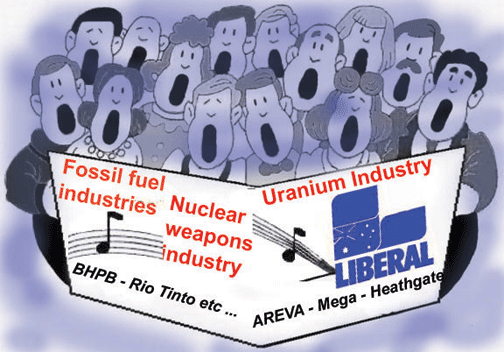
Morrison ministers lay the groundwork for nuclear energy election plan. The Australian 23 June 21, The option of taking a proposal for nuclear power in Australia to the next election has been considered in cabinet-level discussions as pressure grows within the Morrison government to prepare for a nuclear energy industry.
The top-level political and policy discussions including Liberal and Nationals ministers involved the argument that the moratorium on nuclear energy could be lifted in the decades ahead ….
Politically, the option of the Coalition adopting a policy of future nuclear energy was considered too dangerous without bipartisan support from the ALP.Before attending the G7 summit in Cornwall, Scott Morrison publicly said nuclear power was not an option in Australia unless there was bipartisan support for lifting the moratorium. The cabinet-level discussions were not part of a formal cabinet submission but traversed the politics and strategy of taking advantage of a shift in public opinion about the role of nuclear energy in reducing carbon emissions.
……… the Morrison government has included considering the latest modular nuclear reactor technology as part of its “energy road map” to create affordable, reliable energy…
Politically, the option of the Coalition adopting a policy of future nuclear energy was considered too dangerous without bipartisan support from the ALP.Before attending the G7 summit in Cornwall, Scott Morrison publicly said nuclear power was not an option in Australia unless there was bipartisan support for lifting the moratorium. The cabinet-level discussions were not part of a formal cabinet submission but traversed the politics and strategy of taking advantage of a shift in public opinion about the role of nuclear energy in reducing carbon emissions.
……… the Morrison government has included considering the latest modular nuclear reactor technology as part of its “energy road map” to create affordable, reliable energy…
Hersey helped Hiroshima survivors tell and preserve their stories — IPPNW peace and health blog

Hiroshima author John Hersey [This book review was originally published in IPPNW’s designated journal, Medicine, Conflict and Survival.] In 1946, John Hersey wrote a magazine article that changed the world. On the 75th anniversary of the events he described so vividly in Hiroshima, journalist Lesley M. M. Blume has given us Fallout, a timely reminder that Hersey’s courageous […]
Hersey helped Hiroshima survivors tell and preserve their stories — IPPNW peace and health blog
A controversial US book is feeding climate denialists in Australia — RenewEconomy

Australian commentator Alan Jones has been championing a contentious book about climate science which has gained traction in the US. So does it hold up? The post A controversial US book is feeding climate denialists in Australia appeared first on RenewEconomy.
A controversial US book is feeding climate denialists in Australia — RenewEconomy
1 This month.
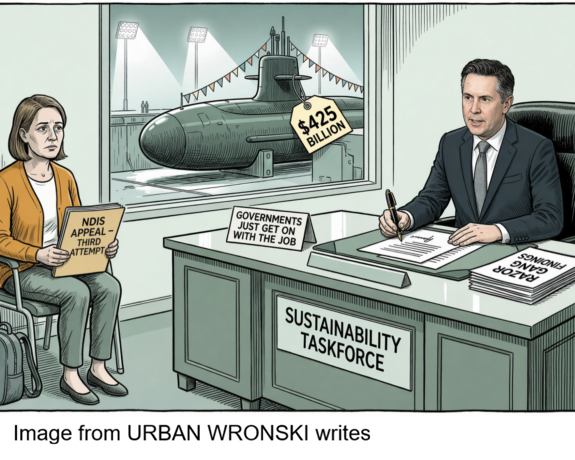

PETITION – To: Prime Minister Anthony Albanese and the Australian Labor Government
Chernobyl: The Lost Tapes – A good documentary on Chernobyl on SBS available On Demand for the next 3 weeks– https://www.sbs.com.au/ondemand/tv-program/chernobyl-the-lost-tapes/235274195556

19 May – Webinar- Webinar: No Nuclear Weapons in Australia
Start: 2026-05-19 18:00:00 UTC Canberra, Melbourne, Sydney (GMT+10:00)
End: 2026-05-19 19:30:00 UTC Canberra, Melbourne, Sydney (GMT+10:00)
20 May – Webinar – The dangerous world of AUKUS, US, military occupation and suppression of dissent

National Webinar, 20th May, 2026, 6.30pm AEST. Confronting laws restricting/suppressing protest speech and action
Speakers: Former Sen. Rex Patrick, Lawyer Nick Hanna ,Arthur Rorris ,Jorgen Doyle, Sen David Shoebbridge,
Facilitator Kelley Tranter.

of the week – Australians for War Powers Reform (AWPR)
To see nuclear-related stories in greater depth and intensity
 Antinuclear