Australia/UK Free Trade Agreement will give corporations the right to sue governments.

Australia/UK Free Trade Agreement: What’s the Scam? https://www.michaelwest.com.au/australia-uk-free-trade-agreement-whats-the-scam/
by Michael West | May 31, 2021 The British Trade Minister has confirmed that corporations are likely to have the right to sue the Australian and UK governments if governments make laws which hit their profits. What’s the scam?
ISDS is the scam; Investor-State Dispute Settlement that is, clauses buried in “Free Trade” agreements, such as this one, which allow corporations to sue governments in obscure foreign tribunals. Australia’s most celebrated ISDS case was brought by tobacco giant Phillip Morris which sued Australia in Hong Kong when Australia introduced its wonderfully successful plain packaging laws.
“There are now over 1,000 known ISDS cases, with increasing numbers against health and environment laws, including laws to address climate change,” says Patricia Ranald convenor of the Australian Fair Trade & Investment Network (AFTINET).
“ISDS would give UK corporations the right to sue Australia over democratic legal changes in Australia. For example, British aged care company BUPA could claim compensation if the government follows the recommendations of the Royal Commission into Aged Care Quality and Safety and regulates for improved staffing levels and quality of care.”
Just another chapter in the saga of rising corporate power over democracy.
“Unqualified” —who is allowed to talk about nuclear power ?

Who is allowed to talk about nuclear power?
“Unqualified” — Beyond Nuclear International Nuclear trolls turn on the aggression as industry collapses around them
By Linda Pentz Gunter, 31 May 21, “My advice is to look out for engineers. They begin with sewing machines and end up with nuclear bombs.” Marcel Pagnol
My normal rule of thumb is to ignore the unrelenting pro-nuclear trolls who pepper our sites with incessant nay-saying and, occasionally ad hominem name-calling. After all, they have only one goal in mind — other than to get up one’s nose — which is to dominate and thereby control the narrative.
But recently, a recurring theme has emerged which needs addressing, because it speaks to who is allowed to talk about nuclear power.

In the view of the trolls, if you have no scientific credentials, you are unqualified to comment on nuclear power. In my case, because I have a degree in English literature, albeit garnered many decades ago, I have, according to the trolls, no authority to expound on the negatives of nuclear anything.
There are some rather obvious flaws in this argument, the first being that it pre-supposes the human brain is incapable of learning anything new after the age of 21.
But it also exemplifies the theme of a recent conference held virtually in Linz by three Austrian anti-nuclear groups which examined the “Atomic Lie.” How has this lie been perpetuated? Answer: by those who promote the nuclear power industry anointing themselves as the only authority deemed knowledgeable enough to either comment about it or make decisions on its use and safety.
What kind of a world we will end up with if, heaven forfend, we allow only engineers to decide what is in our best interest (with all due respect to my friends who are engineers and who, I suspect, would be the first to agree)? Hence the Pagnol quote at the top of this page.
This would mean, for example, that the Western Shoshone should have no say in the fate of the land in Nevada they steward, because nuclear engineers have decided it is perfectly alright to dig a big hole in the volcanic ground and bury nuclear waste there.
It would mean that Marshall Islanders should have nothing whatever to say about the generations of cancers and birth defects they have suffered as the unwilling guinea-pigs of atomic “testing,” because after all it was scientists who decided that it was perfectly alright to detonate 67 atomic bombs there and obliterate islands………..
This intent to dominate the narrative — in our case the nuclear power one — and silence critics, was aptly described by Arnie Gundersen in his presentation during the Linz conference. He talked about the origins of the nuclear cabal — under its alias, Atoms for Peace — in which its originator, President Dwight D. Eisenhower, described the program as solving “‘the fearful atomic dilemma’ by finding some way in which the ‘miraculous inventiveness of man’ ‘would not be dedicated to his death, but consecrated to his life’”.
Gundersen looked up the Oxford Dictionary definition of “consecrate” and found it to mean “to make sacred or declare sacred; dedicate formally to a religious or divine purpose.”

This nuclear priesthood into which believers were ordained did not welcome skeptics gladly, however. Quite the reverse. When Gundersen, a nuclear insider at the time, blew the whistle on a safety issue, he was told to his face that “in this business, you’re either with us or against us, and you just crossed the line.” He was not only fired but persecuted in further attempts to silence him.
Luckily for our movement, the nuclear inquisition was largely unsuccessful in this latter endeavor, but it came at a steep price for Gundersen and his family personally.
As evidenced by Gundersen’s experience, these attacks are by no means restricted to us “lay” advocates, but they have grown observably more vitriolic. This disturbing trend was flagged recently by Andy Stirling of the Science Policy Research Unit at the University of Sussex in the UK, responding to an aggressive critique of an article he co-authored in Nature Energy.
His detractor, Jeremy Gordon, “goes beyond pejorative labelling to actively ridicule any position not in-principle supportive of nuclear power,” Stirling wrote in a letter published in Nuclear Engineering International. “This is exemplified by Gordon’s intemperate ad hominem attack on my fellow author (the globally leading energy scholar Benjamin Sovacool).” Stirling concludes that it is “reasoned policy discourse that forms the lifeblood of democracy itself”.
We are a grand collective of experts. We do have scientists and engineers —Gundersen is one — to whom we can turn in order to unravel the deeper complexities of the workings of nuclear power plants or uranium mines or reprocessing facilities. But it is not the only dimension that matters. So we need Indigenous people, and writers, and lay advocates, and economists, and historians, and artists, and humanitarians to tell this story and set the agenda, too.
Even if it is rocket science, rocket scientists aren’t the only ones who count when decisions are made about whether to put missiles into space or send a nuclear-powered probe to Mars.
As Pagnol implied, when you leave it to the scientists and engineers, you get a Manhattan Project, where consciences pricked far too late. Imagine if humanitarian voices had held sway inside Los Alamos. Would things have turned out differently?
The Japanese mothers, evacuated from Fukushima, who shout on street corners through bullhorns about their experiences, warning Japan never to re-embrace nuclear power, don’t hold engineering degrees. But they know a lot more about the real, lived consequences of using nuclear power than any of the nuclear industry trolls.
Those voices of truth need to be heard, along with those who practice sound science and honest engineering and who are willing to call out the dangers, not control the lies.
It’s one thing to have command of the facts, which of course we must. But it’s another to accompany these with a hefty dose of integrity. And that’s what we are here for, even if we can quote Shakespeare while we are doing it.
Linda Pentz Gunter is the international specialist at Beyond Nuclear and writes for, curates and edits Beyond Nuclear International. https://beyondnuclearinternational.org/2021/05/30/unqualified/
The appalling mistreatment of Australian citizen, Julian Assange, – by USA, UK, and Australia
CHRIS HEDGES ON THE RULING CLASS’ REVENGE AGAINST JULIAN ASSANGE, May 31, 2021 · by Rise Up Times ·
Pulitzer Prize-winner Chris Hedges joins Robert Scheer to discuss the WikiLeaks founder’s plight as he languishes in a British prison. SCHEER INTELLIGENCE: A ROBERT SCHEER PODCAST
BY MODERATOR SCHEERPOST MAY 7, 2021
The mistreatment of WikiLeaks founder Julian Assange over the past decade has been defined as “psychological torture” by the UN Special Rapporteur on Torture, Nils Melzer. Yet, there is still no real end in sight to Assange’s promethean plight. Several months after a British judge blocked his extradition to the U.S.–citing that conditions in America’s inhumane prison system would be detrimental to his health–the WikiLeaks founder continues to be held in a maximum security prison in the U.K. The U.S. government, first under Donald Trump’s rule and now under Joe Biden’s, is appealing the extradition ruling. With a new decision in the case is due to be announced any day now, Pulitzer Prize-winning journalist and ScheerPost columnist Chris Hedges joins Robert Scheer on this week’s installment of “Scheer Intelligence” to discuss what Hedges has called Assange’s “martyrdom.”
Scheer and Hedges assert that Assange’s case is a clear threat to freedom of the press given that he acted in the capacity of a publisher in the same way the global media outlets that printed the content released by WikiLeaks did. Should the publishers of the Washington Post, New York Times and other media have been charged with a crime for publishing the content? Hedges and Scheer, who have both been staunch supporters of the WikiLeaks founder, conclude that there can only be one reason for all recent Republican and Democratic administrations to doggedly persecute Assange: he is a major threat to the establishment’s most sinister interests.
“Your job [as a publisher] is not to be partisan,” says Hedges. “Your job is to expose the machinations of power, the crimes of power, the lies of power–whoever’s in power. And that’s precisely what Julian did. when he was going after Bush with the Iraq War Logs, the Democrats loved him. But as soon as his journalistic integrity led him to also expose the inner workings of the Democratic Party establishment, they turned on him as vociferously as the Republicans.
“I’ve been stunned at what an egregious assault [Assange’s persecution] is on press freedom and how the institutions that purport to care about freedom of the press have been complicit in the persecution of Julian.”
As Assange is tortured before our eyes, Hedges decries the silence of organizations such as PEN, which “are tasked with holding up the kind of liberties and press freedoms that we care about.” The award-winning journalist argues that PEN and others have not only sold out to their liberal donor base, but have been “taken over” by Democratic establishment figures such as Suzanne Nossel, the current head of PEN America and former member of the State Department under Secretary of State Hillary Clinton. Scheer also highlights the plight of another person who has become collateral damage in America’s tyrannical mission against Assange.
“The real hero of this whole thing is Chelsea Manning,” says Scheer. “The U.S. government has been tormenting Chelsea Manning because they basically want to get her to say: ‘Julian Assange put me up to this; he’s the really bad guy.’ It’s a horrible story of government torture and manipulation that you have this rare, exemplary citizen, Chelsea Manning, who does the right thing and says our government, in our name, is committing war crimes–killing innocent children and journalists and everything–and then they want to now break her so she’ll go against Julian Assange.”
Listen to the full conversation between Hedges and Scheer as they examine in detail the U.K.’s role in the Assange trial, as well as discuss the very real dangers the results of the case could pose to journalists and journalism the world over.
TRANSCRIPT
RS: Hi, this is Robert Scheer with another edition of Scheer Intelligence, where the intelligence comes from my guests. And in this case, unquestionably; a very shrewd observer, Chris Hedges, longtime correspondent, bureau chief for the New York Times, and wrote for a lot of other publications.
But I want to get Chris on now with some urgency, because I’m really concerned about the fate of Julian Assange. I’ve turned 85; in my whole life I don’t think I’ve had, experienced a case of such splendid indifference to press freedom and the suffering of a brave journalist in this country, in the United States. He’s of course not from the U.S., which makes it even more appalling that he’s being held under terrible conditions in an English prison……………….. https://riseuptimes.org/2021/05/31/chris-hedges-on-the-ruling-class-revenge-against-julian-assange/
Chris Hedges on the Ruling Class’ Revenge Against Julian Assange — Rise Up Times

“The whole process has really been a mockery of the rule of law. Julian is not a U.S. citizen; WikiLeaks is not a U.S.-based publication.”
Chris Hedges on the Ruling Class’ Revenge Against Julian Assange — Rise Up Times
Tough environmental regulation brings economic benefits. Australia lags behind all OECD countries
Using the example nations – Australia, Germany, United States and United Kingdom – against the OECD average, Denmark had the highest and Germany the second-highest average score over the 17 years of all 22 OECD countries (see
And Australia had the worst.
TOUGHER ENVIRONMENTAL POLICIES CAN CREATE ECONOMIC WINNERS
There seems to be a working assumption that if Australia adopts tougher environmental policies, our economic growth will be undermined. But new research finds the opposite is true , Pursuit, By Dr Ou Yang, University of Melbourne 31 May 21, No longer concerns for a distant future, climate change and environmental degradation are an urgent challenge facing the planet. And they’re happening now.
According to the 2019 United Nations Climate Change report, between 1990 and 2016, global aggregate greenhouse gas emissions increased by 46.7 per cent. In 2018, the global mean temperature had risen about 1°C above the pre-industrial baseline.
As the US and EU move forward with their green recovery, there was little talk of the climate crisis or the environment in Australia’s 2021 Federal budget.
While Australia’s largest trading partners make bigger and bolder commitments to decarbonisation and use their COVID-19 recovery budgets to maximise the opportunity to boost a clean energy transition, the Australian government has committed to a gas-fired recovery over a green one, pouring billions into fossil fuel projects.
Instead of adopting a wide range of more effective and efficient environmental policies, like price and tax mechanisms, the government has pinned its hopes on a low-emissions technology plan.
The Morrison government’s increasing support for fossil fuel projects seems to have some elements in common with former US president Donald Trump’s 2020 Executive Order which allowed US federal agencies to bypass environmental protection laws and fast-track pipeline, highway and other infrastructure projects.
Trump declared regulatory delays would hinder “our economic recovery from the national emergency”.
Likewise, in 2017, Trump withdrew the US from the Paris Agreement for international climate action for the same reason. The Agreement, he said, would undermine the US economy “and put us at a permanent disadvantage to the other countries of the world”.
All of these recent policy moves seem to be made with the notion that greater action on environmental policy harms a nation’s productivity growth. But experts like Australian economist Ross Garnaut argue that taking greater action on climate change now could actually benefit our economy in the long run.
And this is a position our recently published research supports.
Our study looked at the environmental policies of 22 countries belonging to the Organisation for Economic Co-operation and Development (OECD), alongside their productivity growth, finding some positive evidence of the economic effect of environmental policies.
Using the OECD’s Environmental Stringency Policy Index, we rated each nations’ environmental policies including Australia and the US, between 1990 and 2007, in order to investigate the impact of greater environmental policy actions on a nation’s productivity.
These policies include taxes on carbon and subsidies for renewable energy, as well as regulations like limits on sulphur content in diesel.
The model we used is flexible enough to capture country-specific effects of taking greater environmental action on a nation’s productivity growth.
We can also identify the causal impact of environmental policies on productivity by exploiting the time-series variation within each country, which basically measures the movements of productivity caused by changes in policy stringency.
Our research, published in Energy Economics looking at 22 OECD countries, found that all of this group had gradually tightened their environmental regulation between 1990 and 2007.
Using the example nations – Australia, Germany, United States and United Kingdom – against the OECD average, Denmark had the highest and Germany the second-highest average score over the 17 years of all 22 OECD countries (see Figure 1 on original).
And Australia had the worst.
By examining short and long-term effects, our results show that while environmental regulations do increase the cost of production initially – for example, a carbon tax makes coal more expensive, which increases the costs of metal production – adopting tighter environmental policies boosts a country’s productivity in the long run.
This positive effect is more noticeable in countries that showed leadership on environmental protection and adopted tougher environmental policies.
According to our estimates, during the 17-year sample period, if an average OECD country had increased the stringency of its environmental policies by one unit, its annual productivity growth rate in three years’ time would have increased by about 0.71 percentage points from -0.09 per cent to 0.62 per cent………….
Our findings show that while there might be a short-term hike in cost, countries whose governments implement strong environmental regulations reap the productivity – and economic growth – rewards in the long term. https://pursuit.unimelb.edu.au/articles/tougher-environmental-policies-can-create-economic-winners
Nuclear power to be boosted in New South Wales – says News Corpse pulication, Daily Telegraph
Nuclear power to be boosted in NSW Daily Telegraph, 31 May 21,
There are plans to lift a ban on small reactors developing nuclear power in a new proposal being looked at by Treasurer Dominic Perrottet. …. (subscribers only)
As electric vehicles take off, we’ll need to recycle their batteries

As electric vehicles take off, we’ll need to recycle their batteries Electric car batteries contain critical minerals like cobalt and lithium. We’ll need to recycle them unless we want to keep mining the earth for new ones.As electric vehicles take off, we’ll need to recycle their batteries
Electric car batteries contain critical minerals like cobalt and lithium. We’ll need to recycle them unless we want to keep mining the earth for new ones. BY MADELEINE STONE, 29 May 21 , When Ford unveiled the F-150 Lightning last week — an all-electric version of the best- selling vehicle in the United States—it was a big moment in the short history of electric cars. The 530-horsepower, 6,500-pound truck’s sticker price of just under $40,000 ($32,474 with a federal tax credit) drew comparisons to Ford’s Model T, the vehicle credited with making cars accessible to the middle class. In the first 48 hours after the battery-powered behemoth debuted, Ford received close to 45,000 pre-orders for it, equivalent to nearly 20 percent of all EVs registered in the U.S. last year……… (subscribers only)
May 31 Energy News — geoharvey

Opinion: ¶ “Rental Efficiency Standards: A Win For Equity And Climate” • Rental buildings use, on average, 20% more energy per square foot than owner-occupied homes. Landlords have little incentive to improve home efficiency when they do not pay energy bills, and tenants have little incentive to invest in their homes. But the problem can […]
May 31 Energy News — geoharvey
Nuclear trash – a tale of two Sydney suburbs

Radioactive trash – a tale of two Sydney suburbs, https://johnmenadue.com/radioactive-trash-a-tale-of-two-sydney-suburbs/ By Noel Wauchope, May 26, 2021
Australia is relatively clear of nuclear reprocessing waste problems. But the Sydney suburbs of Hunters Hill and Barden Ridge have radioactive wastes from uranium processing which have been sitting there for decades. A bill is now before the Senate addressing the issue.
Australia does have radioactive waste problems in the lingering concerns over historic atomic bomb test sites in South Australia., and in both the functioning and the closed uranium mines. But there is only one uranium-processing facility producing radioactive wastes, the Opal nuclear research reactor at Lucas Heights in Sydney.
Now, Federal and State governments are making decisions on the disposal of these wastes. But there is still uncertainty and lack of public information on just how [or whether] these decisions will be carried out. For example, there’s no detail on transport routes, dates etc.
There are significant differences between the situations of the two suburbs. Perhaps the most significant one is that at Barden Ridge, the nearby Opal nuclear research reactor will be continuing to produce nuclear wastes for the foreseeable future, whereas the Hunters Hill wastes are set for final and permanent removal. Hunters Hill residents have been worried about this for over a century. For Barden Ridge, it has been been recognised as a problem for a much shorter time.
2021 looks like being a watershed year for both.
Hunters Hill.
n 1911, radium was a valuable commodity, and was processed was processed at Hunters Hill, Some 2,000 tonnes of uranium ore were transported from Radium Hill in South Australia, to extract the radium. Several tonnes of uranium oxide were left, and also thorium 230, which itself decays to form more radium and is therefore dangerous for thousands of years. The project closed in 1915. From then on, it was a saga of mistakes and failed attempts to clean up this remaining debris. There was a tin smelter there until 1964.
Then the Australian Atomic Energy Commission (AAEC, now ANSTO) decided it was safe for housing. In the following years, residents and others became concerned about the uranium tailings spread over 6 housing blocks, in Nelson’s Parade, with the risk to health. They were met with cover-ups and obfuscation from the government. Health tests were kept secret, radiation hotspots were found, and cancers and deaths were claimed to be linked to this, and legal cases ensued.
Government plans to solve the problem included dumping the wastes at sea. This was resisted by environmentalists. The next plan was to dump it in Western NSW. This was strongly opposed by Aborigines from the area’s Bakandii tribe. When several Nelson Parade residents fell ill in the 1970s, the NSW government purchased several houses and demolished them, but failed to remediate the site.
in 1981 The then NSW Premier, Mr Wran asked South Australia to take 5,000 tonnes of contaminated soil. A NSW Upper House Inquiry in 2008 led to the government attempting to plan for the clean-up of 2,000 tonnes of radioactive waste. The Australian Radiation Protection and Nuclear Safety Agency said radioactive waste from Hunters Hill wasn’t permitted to be stored at ANSTO’s Lucas Heights interim waste storage facility.
In 2012, most of the contaminated earth was reclassified as ”restricted solid waste”. Two Sydney suburbs were mooted as destinations for the wastes – Kemps Creek and Lidcombe. This was resisted by the local residents. Then in 2019, the New South Wales government proposed to store the contaminated soil on site in an ”encapsulated” form. This was vigorously rejected by the Hunters Hill residents.
Now, in 2021, beginning in July, New South Wales Property and Housing Minister Melinda Pavey announced that the radioactive material will beexcavated and and be shipped to Idaho ,USA. The contaminated soil is to be sealed in bags, loaded into shipping containers and taken to a secure facility in the Eastern Sydney suburb of Matraville before shipping them overseas in scheduled consignments. ANSTO would oversee the process with up to 1800 tonnes to be transported to Idaho in an18-month-long mission.
Barden Ridge.
The radioactive waste problem of formerly Lucas Heights has a more recent history, with the original HIFAR nuclear research reactor starting operations in 1958. Lucas Heights was then a remote bushland site well outside the suburban area of Sydney. Nuclear development was meshed in secrecy, and controlled by influential experts Philip Baxter, and Ernest Titterton., without much understanding by the parliament or the public. It was the time of British atomic weapons tests in Australia, and heightened fears about the cold war. Little attention was paid to the subject of radioactive wastes.
In later years, as Sydney grew, Lucas Heights did become more of a suburb. And the Three Mile Island 1979 and Chernobyl 1986 nuclear accidents aroused a general awareness of nuclear risks. Radioactive wastes from Fisherman’s Bend in Victoria was brought to Lucas Heights in 1990. By now, public concern was raised. When Lucas Heights agreed to take the waste from St Mary’s Defence Base NSW (1991) the Sutherland Shire Council won a court case against ANSTO to stop Lucas Heights taking waste from other entities.
In 1992, local residents voted to rename the suburb of Lucas Heights, and in 1996 it officially became Barden Ridge. It is widely accepted that this was done to increase the real estate value of the area, as it would no longer be instantly associated with the HIFAR nuclear reactor.
Barden Ridge has a conservative community, historically voting Liberal, that accepts the reality of ANSTO and the now Opal nuclear reactor, with the jobs that come with it. Still, the presence of nuclear wastes is an issue. The Sutherland Shire Council in 2013 said that they liked having the nuclear reactor, but not the radioactive wastes. Local people and Council were relieved to learn, in 1997, of the federal government’s plan to set up a waste facility in another State. Sutherland Shire Council rejoiced in 2014, when the federal government announced plans for a nuclear waste facility in the Northern Territory.
Which brings us to the Australian Government’s Bill about radioactive waste, now before the Australian Senate, the National Radioactive Waste Management Amendment (Site Specification, Community Fund and Other Measures) Bill 2020. This Bill specifies Napandee, a farm near Kimba, South Australia, as the nation’s nuclear waste dump. Resources Minister Keith Pitt has recently announced more grants to the local community .Yet there is significant local opposition to the plan, from Aborigines and farmers. If this Bill is passed, there can be no judicial review of the decision. So, Barden Ridge residents will get their solution. Or maybe not.
The Hunters Hill solution is an unusual one, and quite a precedent. There could still be some opposition to the planned process. The Barden Ridge one is also fraught with problems, as nuclear waste will continue to be produced by the nearby nuclear reactor. The Senate might not pass this Bill, leaving the Resources Minister with the option of declaring the Napandee site, which would then open the matter up for court action.
It’s again ‘wait and see’ time for two worried communities.
Australian Robert Floyd to head the Comprehensive Nuclear-Test-Ban Treaty Organisation.
‘Never in my wildest dreams’: The Australian set to head UN body policing nuclear weapons has grand plans, SMH, By Anthony Galloway, May 30, 2021 When Australian Robert Floyd began his career as a biological scientist, he had no aspirations of heading a United Nations body charged with policing the world for any signs of nuclear tests. He did not foresee a life of negotiating with the world’s major powers to ban all testing of nuclear weapons.
But that is exactly what is in store for him after last week being elected as the first Australian executive secretary of the Comprehensive Nuclear-Test-Ban Treaty Organisation.
………… He will take up his position in Vienna in August, after 10 years as the Director-General of the Australian Safeguards and Non-Proliferation Office, which implements Australia’s treaty obligations on weapons of mass destruction……..
The CTBTO is the organisation charged with policing the Comprehensive Nuclear-Test-Ban Treaty, which was adopted by the United Nations General Assembly in 1996 and seeks to ban all nuclear tests.
But the treaty is not legally binding because eight countries have held off on ratifying it: the US, China, North Korea, India, Pakistan, Iran, Israel and Egypt.
Floyd concedes it is unlikely that he will convince all eight countries to ratify the treaty, but he is going to try to get some of them across the line before his four-year term is up.
…….. The CTBTO has an arsenal of more than 300 monitoring stations that can pick up seismic vibrations or radioactive particles in the air, ocean or atmosphere. Floyd says this allows it to detect a nuclear explosion “anywhere, anytime”.
“That network produces data that no country can have by themselves. So everyone sees value in the treaty,” he says.
………. Unlike other nuclear treaties, the CTBT is not about nuclear getting states to rid themselves of nuclear weapons; it is focused on convincing them not to test them. ………..https://www.smh.com.au/politics/federal/never-in-my-wildest-dreams-the-australian-set-to-head-un-body-policing-nuclear-weapons-has-grand-plans-20210527-p57vlf.html
Wind and solar help Australia slash emissions, but no credit to Coalition — RenewEconomy

Australia’s emissions fell in 2020, due to the pandemic and the ongoing decline of coal, but signs of a post-Covid bounce back are already starting to show. The post Wind and solar help Australia slash emissions, but no credit to Coalition appeared first on RenewEconomy.
Wind and solar help Australia slash emissions, but no credit to Coalition — RenewEconomy
Despite the Small Nuclear Reactor push from Bill Gates and the rest of the nuclear lobby, we already have the technologies to decarbonise our global economy.
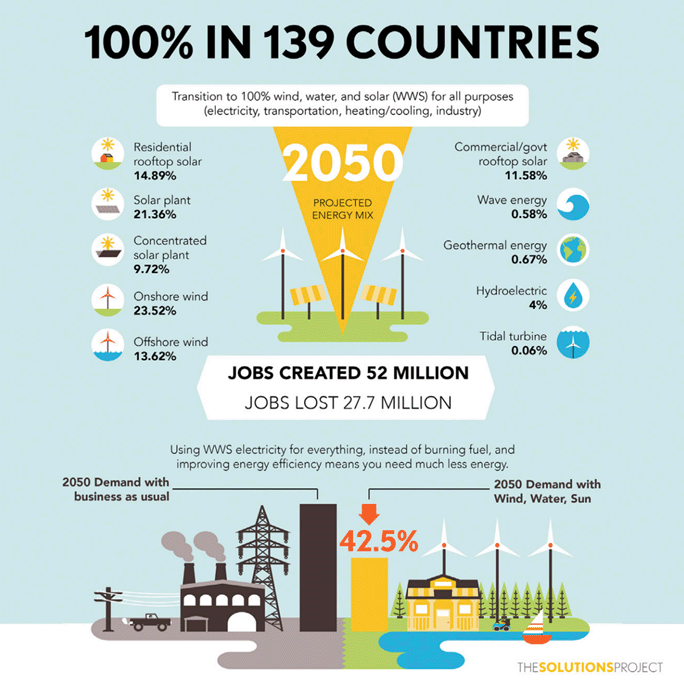
Dave Elliott: The International Energy Institute’s new Global Energy
Roadmap sets a pathway to net zero carbon by 2050, with, by 2040, the
global electricity sector reaching net-zero emissions. It wants no
investment in new fossil fuel supply projects, and no further final
investment decisions for new unabated coal plants. And by 2035, it calls
for no sales of new internal combustion engine passenger cars. Instead it
looks to ‘the immediate and massive deployment of all available clean and
efficient energy technologies, combined with a major global push to
accelerate innovation’.
For its part, on that issue, the IEA report
summary says ‘most of the global reductions in CO2 emissions between now
and 2030 in the net zero pathway come from technologies readily available
today. But in 2050, almost half the reductions come from technologies that
are currently only at the demonstration or prototype phase’. So it says
‘this demands that governments quickly increase and reprioritise their
spending on research and development – as well as on demonstrating and
deploying clean energy technologies – putting them at the core of energy
and climate policy.
. Progress in the areas of advanced batteries,
electrolysers for hydrogen, and direct air capture and storage can be
particularly impactful’. U.S. Climate Envoy John Kerry had already
relayed the suggestion that ‘50 percent of the reductions we have to make
to get to net zero are going to come from technologies that we don’t yet
have.’ And Bill Gates had claimed that that solar, wind and batteries
were not enough, so we need ‘miracle technologies’ to decarbonize our
global economy.
Commenting on this issue, Prof Mark Jacobson from Stanford
University said it all depends on what you mean by ‘new’. Yes, we need
to improve wind, solar, storage and transmission systems, but what was
really being hinted at in these statements was that we need other
completely new technologies- such as Small Modular Reactors, Carbon Capture
systems and such like. He says we don’t need them: ‘we have 95% of the
technologies we need today and the know-how to get the rest’:
Renew Extra 29th May 2021
https://renewextraweekly.blogspot.com/2021/05/the-iea-set-out-way-ahead.html
Not only at the Poles, but also mountain glaciers, are melting faster than ever.
Scotsman 28th May 2021 Richard Dixon: The last few weeks have seen several new studies yielding
new insights into the role and future of ice sheets and glaciers. Last
month, the seasonal sea ice in the Arctic covered almost one million square
kilometres less than the long-term average, making it the sixth-lowest ice
cover ever recorded.
The poles are among the places feeling the heat of
climate change most rapidly. In March, the world was 0.88C above the
long-term average, but parts of the South Pole and all of the North Pole
were between 2 and 4C warmer. Recently, locations in Alaska were officially
reclassified from “sub-Arctic” to “warm summer continental”, based
on the upward trend of yearly average temperatures.
Last week, a studyconcluded that the Greenland ice sheet is already melting sufficiently to
raise global sea levels by one or two metres. If it all went, sea levels
would be seven metres higher.
Another study found that the massive Thwaites
Glacier in Antarctica is melting faster than previously thought. The
picture across the region is confusing because warmer seas mean the ice
sheets are melting, but they also mean there is more new snow falling,
replenishing the ice from the top. So, the ice sheets can be feeding tens
of billions of tonnes of water into the ocean a year, while at the same
time seeming to contain about the same amount of ice.
Despite promises to
keep the global temperature rise well below 2C and even to try for 1.5C,
the world is on track for a potential 3C rise by 2100. A new study suggests
that the tactic some governments are backing – to go over 2C but then
come back down again – would likely create irreversible ice loss in the
Antarctic, even if it worked. But ice is not only found at the poles,
another study finds that mountain glaciers are melting faster even than the
Antarctic ice, adding billions of tonnes of water to the oceans every year.
https://www.scotsman.com/news/environment/dr-richard-dixon-chilling-news-on-polar-ice-trends-3253510
| R |
Good taste and food security: How Sundrop used solar to bring tomatoes to the desert — RenewEconomy

The solar tower that rises at Sundrop Farms shines like a beacon from above the saltbush landscape. The post Good taste and food security: How Sundrop used solar to bring tomatoes to the desert appeared first on RenewEconomy.
Good taste and food security: How Sundrop used solar to bring tomatoes to the desert — RenewEconomy
May 30 Energy News — geoharvey

Opinion: ¶ “Seven Ways Ford Did Everything Right With The F-150 Lightning” • Zach Shahan of CleanTechica summed up the F-150 Lightning: “Thinking on it more after letting the enthusiasm from the opening week settle in, I thought it would be good to point out that I think Ford did basically everything right with the […]
May 30 Energy News — geoharvey
1 This month.


PETITION – To: Prime Minister Anthony Albanese and the Australian Labor Government
Chernobyl: The Lost Tapes – A good documentary on Chernobyl on SBS available On Demand for the next 3 weeks– https://www.sbs.com.au/ondemand/tv-program/chernobyl-the-lost-tapes/235274195556

19 May – Webinar- Webinar: No Nuclear Weapons in Australia
Start: 2026-05-19 18:00:00 UTC Canberra, Melbourne, Sydney (GMT+10:00)
End: 2026-05-19 19:30:00 UTC Canberra, Melbourne, Sydney (GMT+10:00)
20 May – Webinar – The dangerous world of AUKUS, US, military occupation and suppression of dissent

National Webinar, 20th May, 2026, 6.30pm AEST. Confronting laws restricting/suppressing protest speech and action
Speakers: Former Sen. Rex Patrick, Lawyer Nick Hanna ,Arthur Rorris ,Jorgen Doyle, Sen David Shoebbridge,
Facilitator Kelley Tranter.

of the week – Australians for War Powers Reform (AWPR)
To see nuclear-related stories in greater depth and intensity
 Antinuclear